
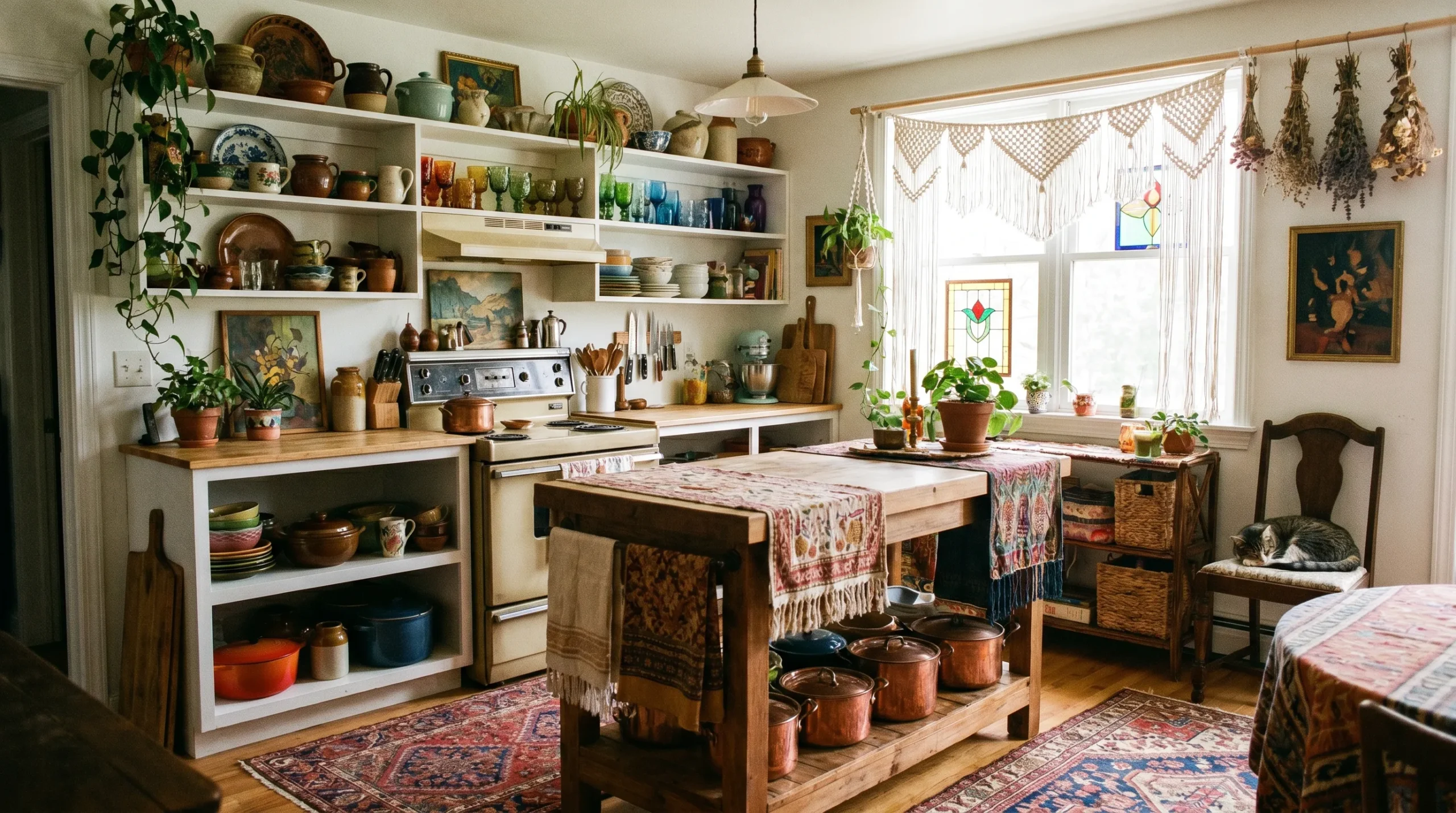
The kitchen is the one room where people consistently forget they’re allowed to have opinions. Bathrooms get the interesting tile. Living rooms get the statement sofa. Bedrooms get the mood lighting. And then the kitchen gets white cabinets and a subway tile backsplash because that’s what sells houses.
It doesn’t have to be that way.
Bohemian kitchens operate on a different logic entirely. They treat the kitchen as a living space first and a functional space second. Not because function doesn’t matter — you still need to be able to cook — but because a kitchen that looks like a showroom is not actually more efficient than one that looks like someone lives in it.
The images in this post are proof that the rules you’ve been following were never rules at all. They were just the path of least resistance. Here’s what’s actually possible.
What Happens When You Stop Treating the Kitchen as a Showroom
Most kitchens are designed for a photograph. Everything is hidden, uniform, and easily cleaned for resale. The problem is that you have to actually spend time in this room every single day.
A kitchen designed for living looks dramatically different. It has things out because they’re used. It has things up because they’re beautiful. It has colour and texture because those things affect how you feel at six in the morning when you’re making coffee and you’d rather be asleep.
The Open Shelf Argument
Upper cabinets close off a kitchen. They create a wall of identical rectangular boxes and make the whole room feel sealed. Remove even one run of upper cabinets and replace it with open shelving and the room breathes differently.
Open shelving is not inherently messy. It is inevitably honest. What you put on it is what you have, and arranging it takes maybe ten minutes and is something you’ll adjust over time as you use the kitchen. Stack bowls by colour or by size. Nestle a trailing pothos between stacks of plates. Put the mugs you actually use at the front and the ones that came in a set at the back.
The shelves themselves should have weight. Thick oak or walnut boards on simple brackets read as permanent and considered. Thin MDF floating shelves do not.
When Colour Commits Fully
The kitchens that work with bold colour are the ones where the colour doesn’t apologise for itself. A deep teal on every lower and upper cabinet, paired with black marble countertops and brass hardware, is a commitment. It looks like a decision was made. That decisiveness reads as confidence, and confidence reads as good design.
The mistake is going halfway. A single teal island in an otherwise all-white kitchen is a feature. Full teal cabinetry is an identity. They are not the same thing and they do not produce the same result.
Small Kitchens and the Maximalism Question
A small kitchen doesn’t need to be minimal. The logic that small spaces require restraint is largely a real estate convention, not a design truth.
A small galley kitchen with a dark wall, a circular moss art installation, stacked stone backsplash, warm wood countertops, and candles lit on every surface is small and maximalist and extremely effective. The dimensions don’t change. What changes is whether the room feels like it was designed or just built.
The Materials That Make a Bohemian Kitchen
Before you change anything visual, understand what materials are doing the work. A bohemian kitchen is almost always built on the same material logic: natural over synthetic, handmade over manufactured, aged over pristine.
Tile as the Main Event
Most backsplash tile is chosen to disappear. It coordinates. It complements. It retreats politely so the eye can rest on the cabinetry.
Bohemian tile does the opposite. It asserts itself. A hand-painted Talavera tile installation behind a range hood becomes the focal point of the entire kitchen. A repeat geometric cement tile in teal and rust running floor to ceiling makes the kitchen a room worth walking into. An encaustic patchwork tile floor turns the ground plane into something you’d pause to look at.
The tile doesn’t need to be expensive. It needs to have enough visual complexity to hold attention. Mass-produced subway tile has zero visual complexity. A Moorish star pattern in two tones has considerable visual complexity. The cost difference can be smaller than you think.
Wood That Shows Its History
Butcher block and reclaimed timber countertops do something stone and laminate cannot. They change over time. They absorb oil, develop patina, show knife marks and heat rings and the occasional water stain. They become more interesting the longer you have them, not less.
This is not a bug. It is the entire point. A kitchen surface that records time is fundamentally different from one that resists it.
The grain matters. Wide plank oak with visible medullary rays running through it is beautiful. Tight maple butcher block is functional. For a bohemian kitchen, choose the wood that has the most to say.
The Handmade Object Test
Run a simple test on everything you’re considering putting in the kitchen: could this have been made by a person, with their hands, in a workshop?
A turned wooden bowl — yes. A stainless steel mixing bowl — no. A hand-thrown ceramic mug in three mismatched glazes — yes. A matching set of mass-produced mugs — no. A woven seagrass basket hung on a leather strap — yes. A plastic storage container — no.
This isn’t about removing all manufactured objects. It’s about making sure the kitchen has enough handmade objects that the room feels like it has human presence in it.
Bohemian Kitchen Ideas
The Teal Cabinet Plant Kitchen
Paint every cabinet — upper and lower — in a deep forest teal. Choose a finish between matte and satin, not gloss. Install black marble or black-veined stone countertops and replace all hardware with solid brass cup pulls and knobs.
Run open wooden shelving along one wall and fill it with a mix of glass storage jars, terracotta pots, ceramic bowls, and trailing plants. Let pothos and philodendron cascade freely from every available surface — over the top of the upper cabinets, from the open shelves, from hanging planters near the window. A printed floral backsplash tile behind the sink area adds the final layer of pattern. The plants tie the whole room together because green reads as natural against both the teal cabinets and the botanical tile.
The Copper Pot Rack Kitchen
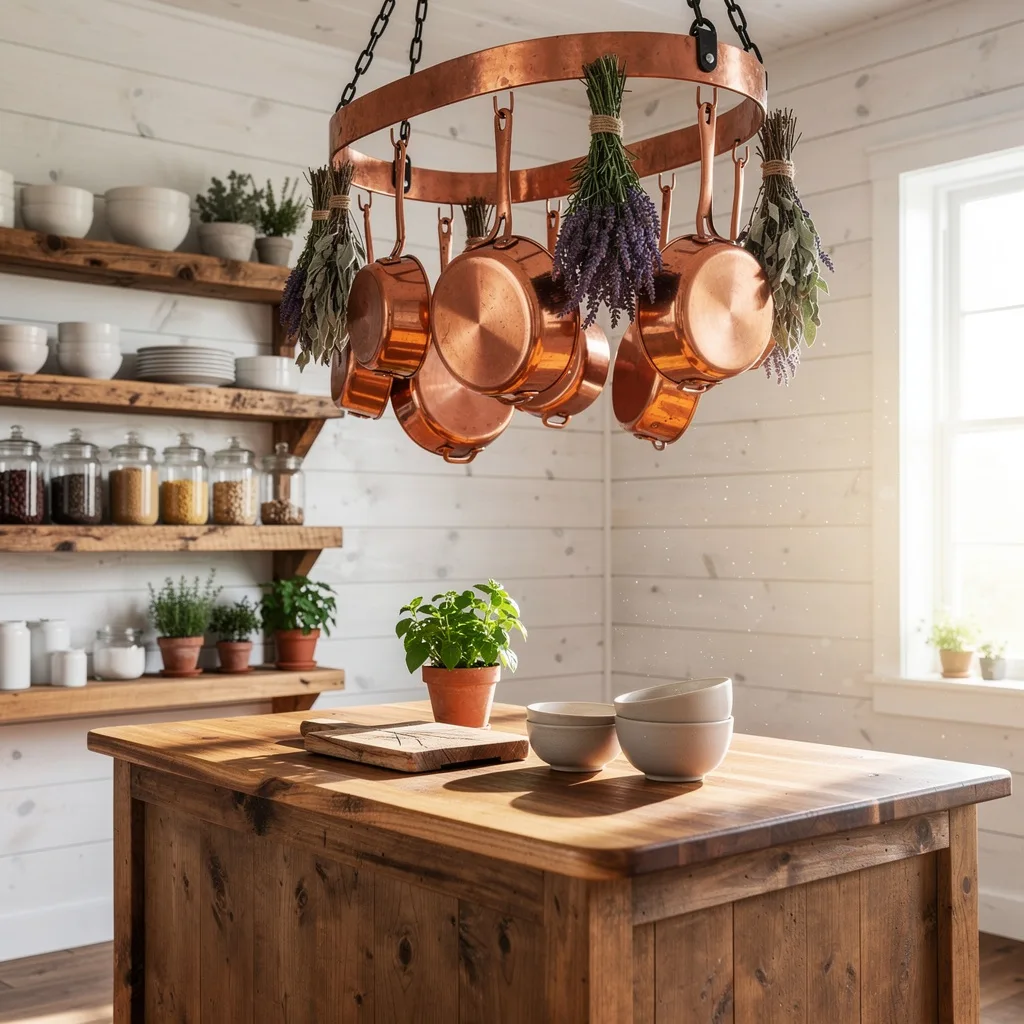
Source a circular copper pot rack — either antique or newly cast — and hang it from the ceiling above a reclaimed timber butcher block island. Hang copper or copper-bottomed pans from the rack at slightly different heights. Between the pans, tie small bundles of dried lavender and sage to the rack using natural twine.
Keep the open shelving behind the island stocked with glass storage jars in rows, rows of terracotta pots with herb plants, and white ceramic vessels. The copper overhead and the white and natural tones behind create a room that manages to be warm without being dark.
The Maximalist Blue and Gold Kitchen
Install cobalt blue shaker-style cabinets from floor to ceiling. Use an ornate antique-brass or copper range hood as the centrepiece above the range. Source hand-painted Talavera or similar artisan tiles for the backsplash behind the range — go for the most elaborate pattern available, mixing florals, geometric medallions, and illustrated motifs. Use butcher block countertops for warmth and install a matching patchwork tile floor in the same blue-and-gold palette.
This room only works if it fully commits. Pull back on anything and it becomes a loud room that didn’t quite have the nerve. Go all the way and it becomes a room that is unmistakably itself.
The Wall Basket Storage System
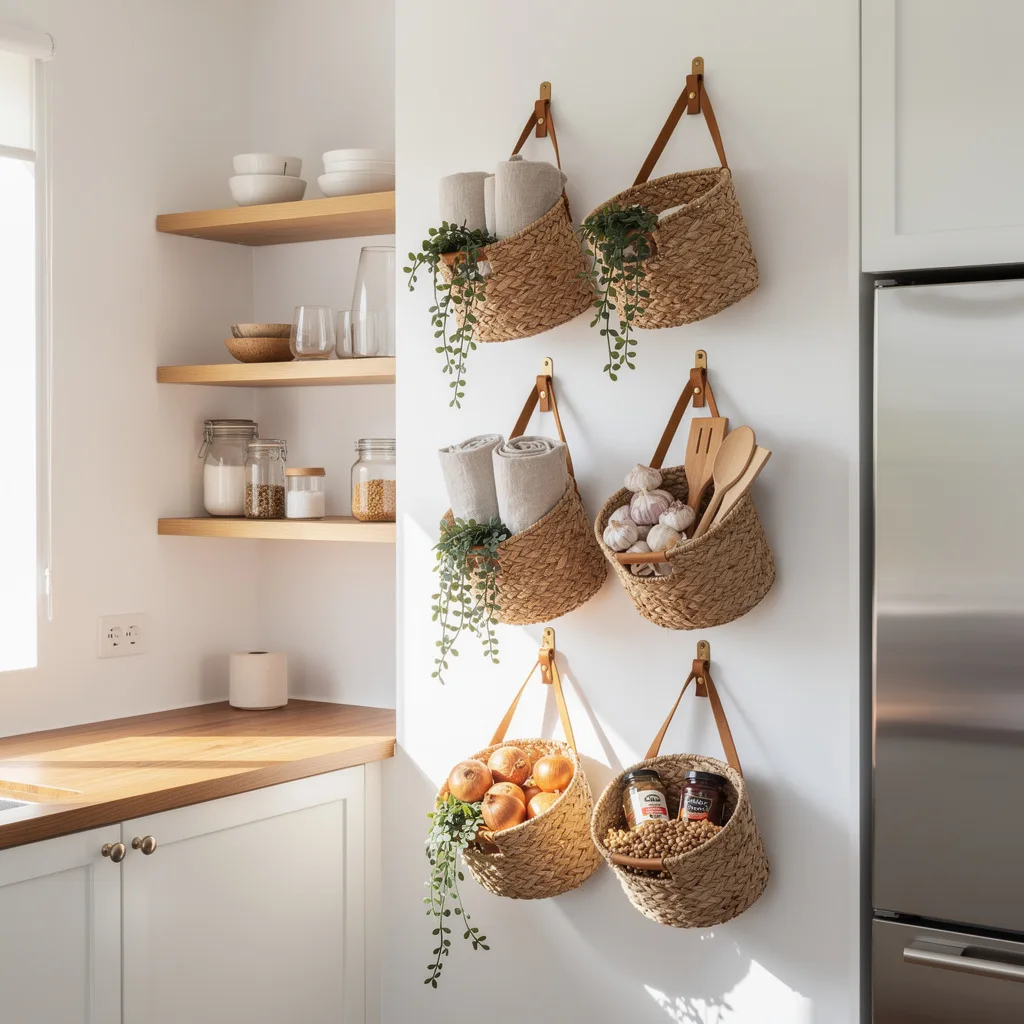
On a plain white wall beside a refrigerator or in a pantry corridor, install five or six seagrass or water hyacinth baskets in graduating sizes. Hang each basket from a single brass hook using a doubled leather strap — the leather strap adds warmth and prevents the baskets from reading as purely utilitarian.
Fill the baskets with things that look good loose: onions and garlic in the bottom baskets, linen tea towels and wooden utensils in the middle baskets, small trailing plants and dried herbs in the top baskets. The whole arrangement is a functional storage solution that reads as art from across the room.
The Painted Ceramic Sink Station
Commission or source a hand-painted farmhouse-style apron sink with large-scale floral medallion motifs in red, green, and gold on a cream ground. Set it into a dark walnut or ebony-stained cabinet with ornate ceramic knobs. Install a bridge-style brass faucet with a high gooseneck spout. Tile the backsplash behind in mismatched hand-painted decorative tiles — each one different — so the wall behind the sink reads as a collection rather than a uniform surface.
Add matching hand-painted ceramic accessories on the counter: a soap dispenser, a toothbrush holder if this is in a kitchen-bathroom combination, a small utensil crock. A vase of deep red roses in a white ceramic vase completes the picture. The sink becomes the room’s most interesting object.
The Warm Cement Tile Kitchen
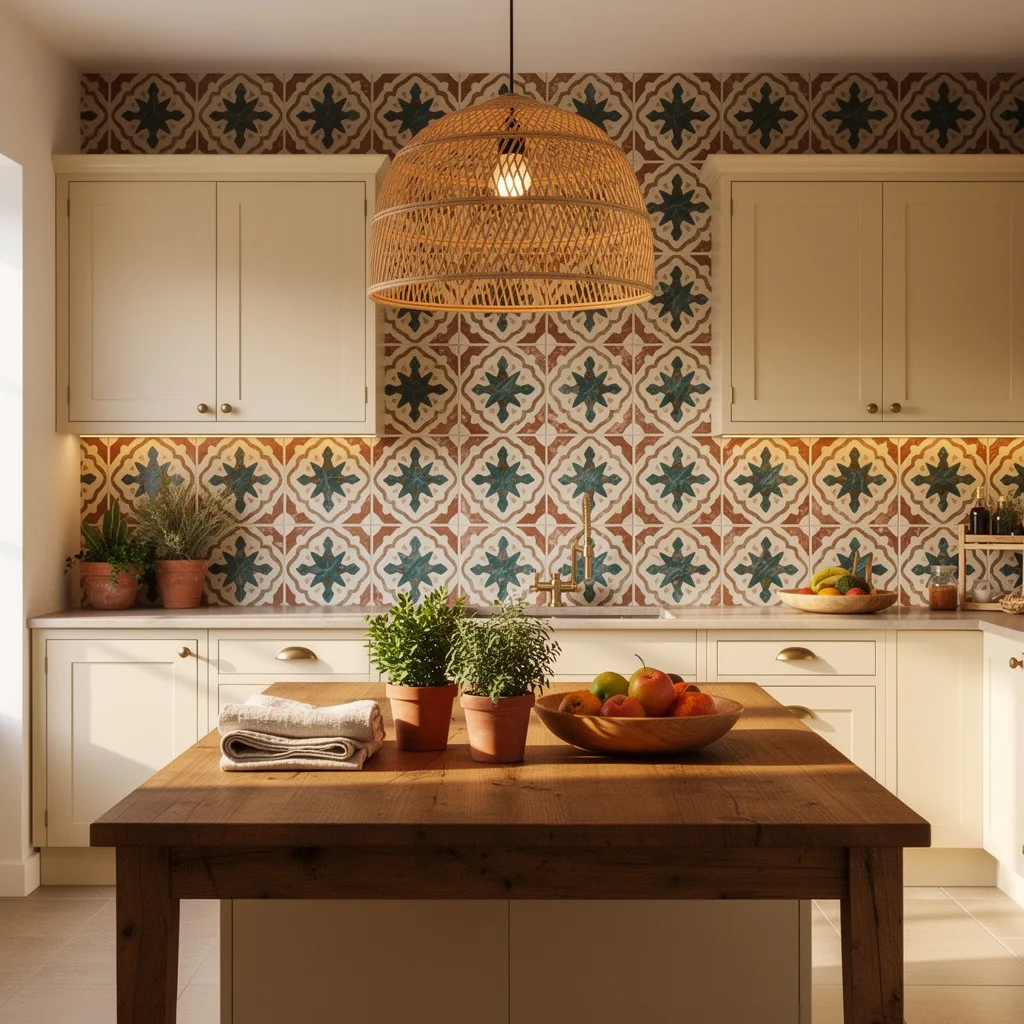
Source cement encaustic tiles in a Moorish star or large geometric medallion pattern in teal, rust, and cream. Install them as the backsplash from countertop to ceiling — don’t stop at the top of the cabinets. Use cream or off-white shaker cabinets so the tile can do its work without competing with bold cabinetry. Install a large woven rattan dome pendant above the kitchen island or dining table.
On the island or table, keep only what belongs: a wooden fruit bowl, two terracotta pots with herbs, a folded linen cloth. The restraint on the surfaces lets the tile carry the room.
The Dark Moody Galley
In a narrow galley kitchen, paint one long wall in near-black or deep charcoal and leave the opposite wall and ceiling white. Mount a single floating wooden shelf on the dark wall and keep it spare — a few plants, a candle or two, a matte black coffee setup. Install stacked natural stone tile as the backsplash on the dark wall.
On the adjacent wall, hang a circular moss art frame — preserved reindeer moss set into a large round frame, roughly 60 to 80 cm in diameter. This is the only large-scale art piece the room needs. Lay a woven jute runner with a simple stripe pattern on the floor. The combination of dark wall, living moss circle, and natural floor textile creates a kitchen that feels like it belongs somewhere interesting.
The Warm Neutral Open Shelf Kitchen
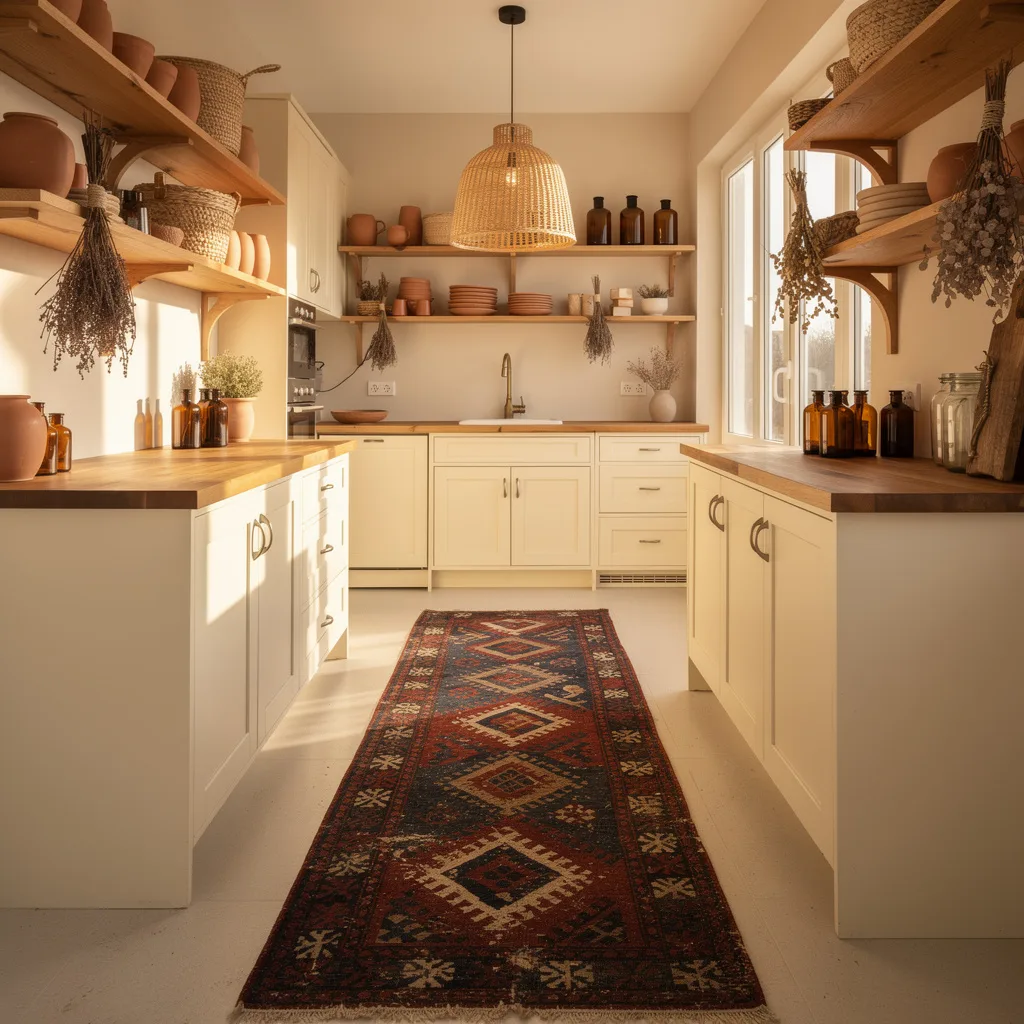
Use cream or parchment-coloured base and upper cabinets with butcher block or solid oak countertops. Replace one run of upper cabinets entirely with bracketed open wooden shelves. On those shelves, arrange dried herb bunches hanging downward from the shelf edges — lavender, rosemary, wheat stalks, dried roses, dried chillies — and group terracotta pots and amber glass bottles at intervals between them.
The dried botanicals hanging from the shelves function as both decor and organisation. They smell good, they create a sense of abundance, and they give the eye something unexpected to look at in a kitchen that would otherwise be entirely neutral.
The Maximalist Small Kitchen
In a small white-cabinet kitchen, use the textiles and soft furnishings to do all the bohemian work. Hang two large-scale printed curtain panels in a deep fuchsia and orange patchwork suzani fabric — floor length, hanging from a simple black rod. Source a large printed globe pendant in multicoloured mosaic or embroidered fabric as the overhead light. Lay a flat-weave kilim with strong red, teal, and cream geometry on the floor. Keep a folded printed textile draped on the oven handle.
The structure of the kitchen stays neutral. The fabrics transform it entirely.
The Beam and Bundle Ceiling Kitchen
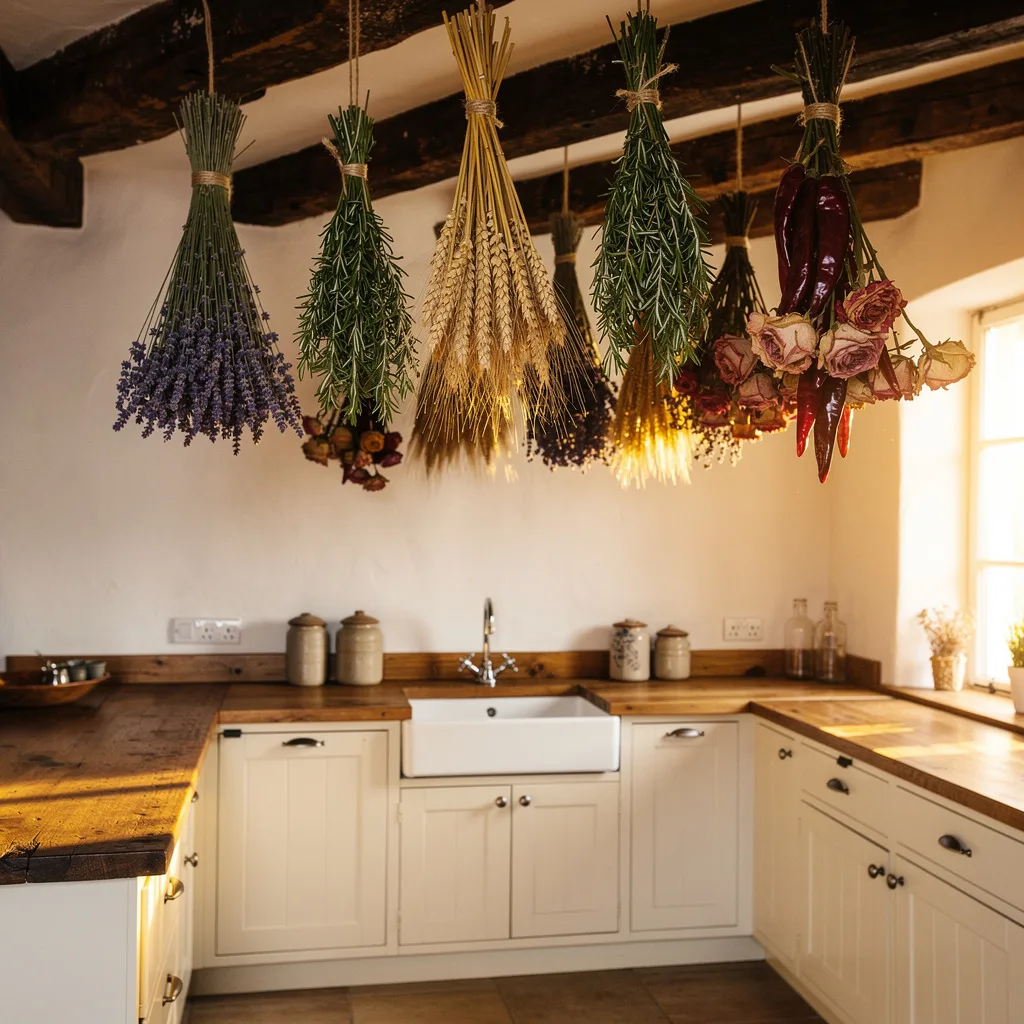
In a kitchen with existing ceiling beams — or with false beams added — tie bundles of dried botanicals directly to the beams with natural twine. Mix lavender, rosemary, wheat, dried chilli strings, and dried roses. Hang them at different heights and densities.
Below, keep the kitchen simple: white painted cabinets, white farmhouse sink with a simple chrome bridge tap, butcher block countertops, three ceramic canisters, minimal counter clutter. The ceiling does all the work. The contrast between the rustic hanging botanicals and the clean white kitchen below is the whole design.
The Botanical Gallery Kitchen
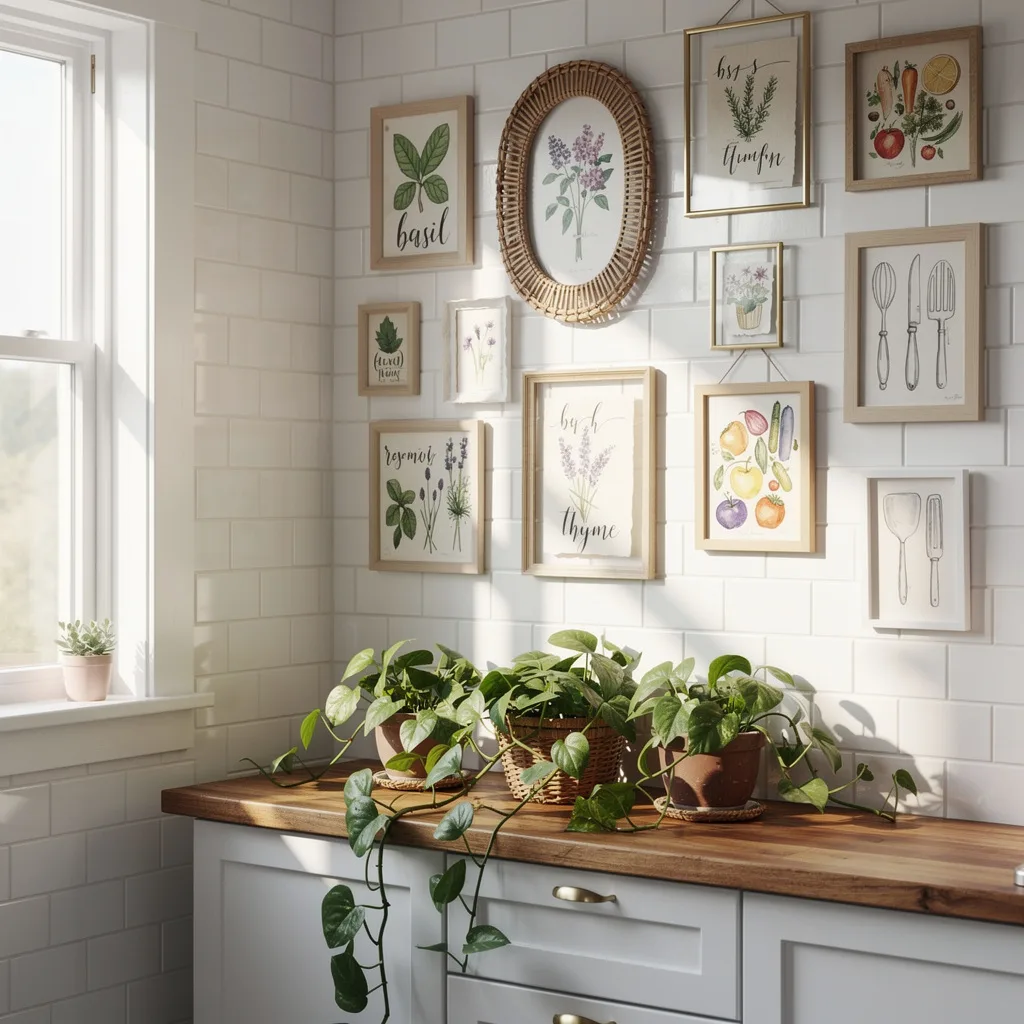
Cover one tiled or painted kitchen wall with a gallery arrangement of framed botanical prints — watercolour herb illustrations, vegetable studies, kitchen tool line drawings. Mix frame sizes and leave a few centimetres between each one. Include one rattan oval mirror frame in the centre to break up the rectangular repetition.
On the counter below the gallery wall, cluster two or three trailing pothos in terracotta pots and woven baskets. Let the vines trail freely onto the counter surface. The botanical theme runs from the wall down to the counter and ties the whole corner together as a deliberate space rather than a wall with things on it.
The Ceramics and Climbing Plants Shelf
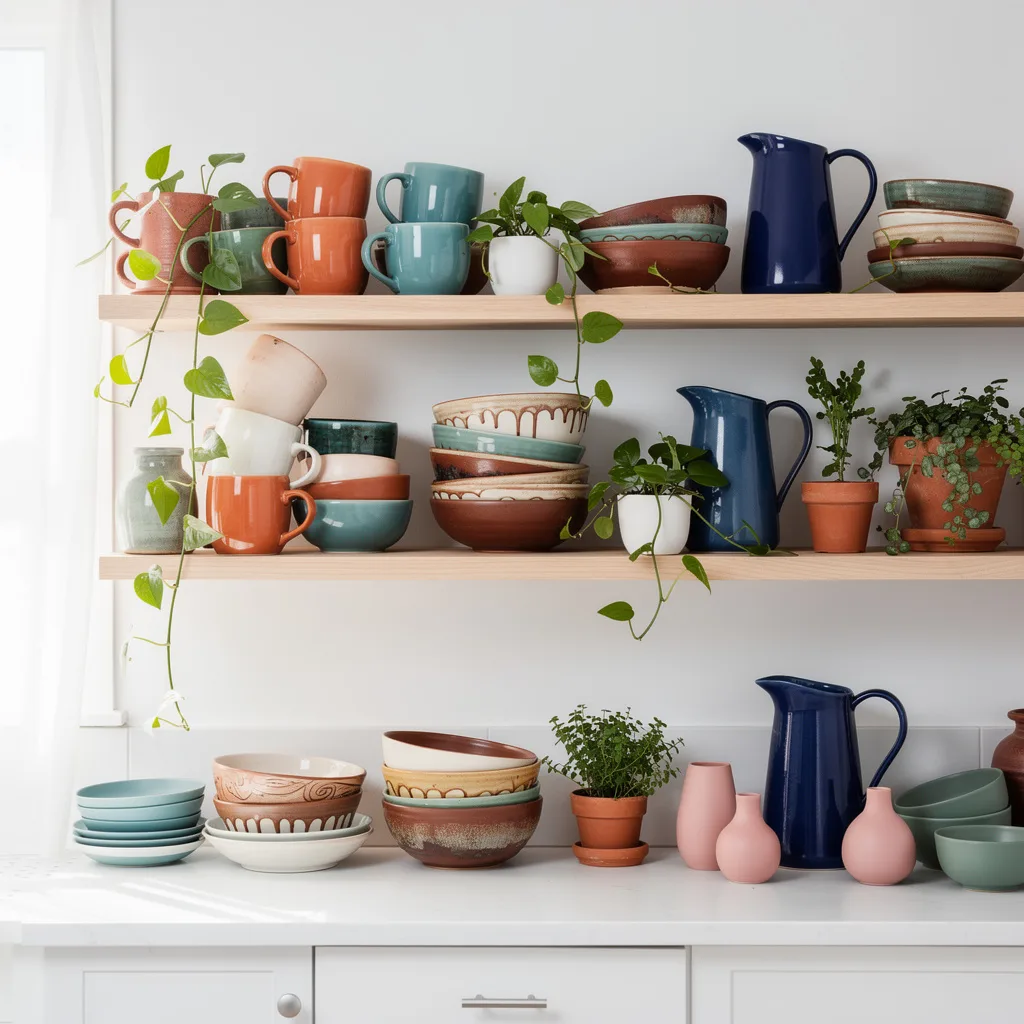
On two parallel wooden shelves against a white wall, build a display that treats everyday ceramics as objects worth looking at. Group mugs by colour family — rusts and terracottas together, teals and blues together, neutrals and creams on the end. Nestle small terracotta pots between the mug groupings. Let a trailing pothos climb across both shelves over time, weaving between the stacks.
On the counter below, add more ceramics at different scales: large navy pitchers, a stack of reactive-glaze mixing bowls, small matte vases in blush and sage. The principle is abundance rather than minimalism — a shelf that looks like it has been gathered over time, not bought all at once.
The Dome Rattan Island Light
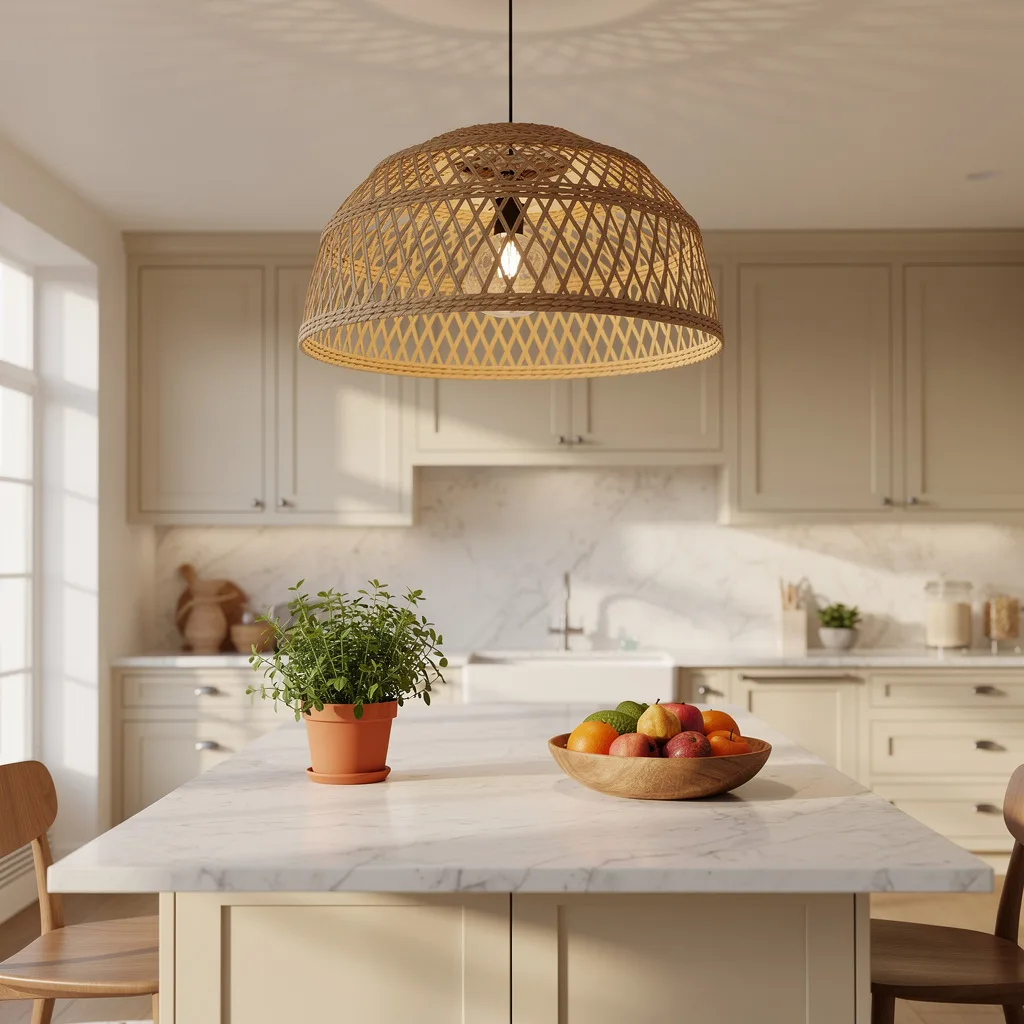
Install a very large woven rattan or bamboo dome pendant over a kitchen island — aim for a diameter of at least 60 cm, and hang it low enough that it creates a pool of warm light over the work surface without being so low it interrupts sightlines across the island.
Use an Edison or warm filament bulb inside so the light glowing through the woven lattice is amber rather than white. The shadow pattern cast upward onto the ceiling from the weave is as much the point as the light itself. Keep everything else in the kitchen quiet — cream cabinets, white stone counters, bare shelves — so the pendant is the undisputed focal point.
The Herb and Dried Flower Shelf Corner
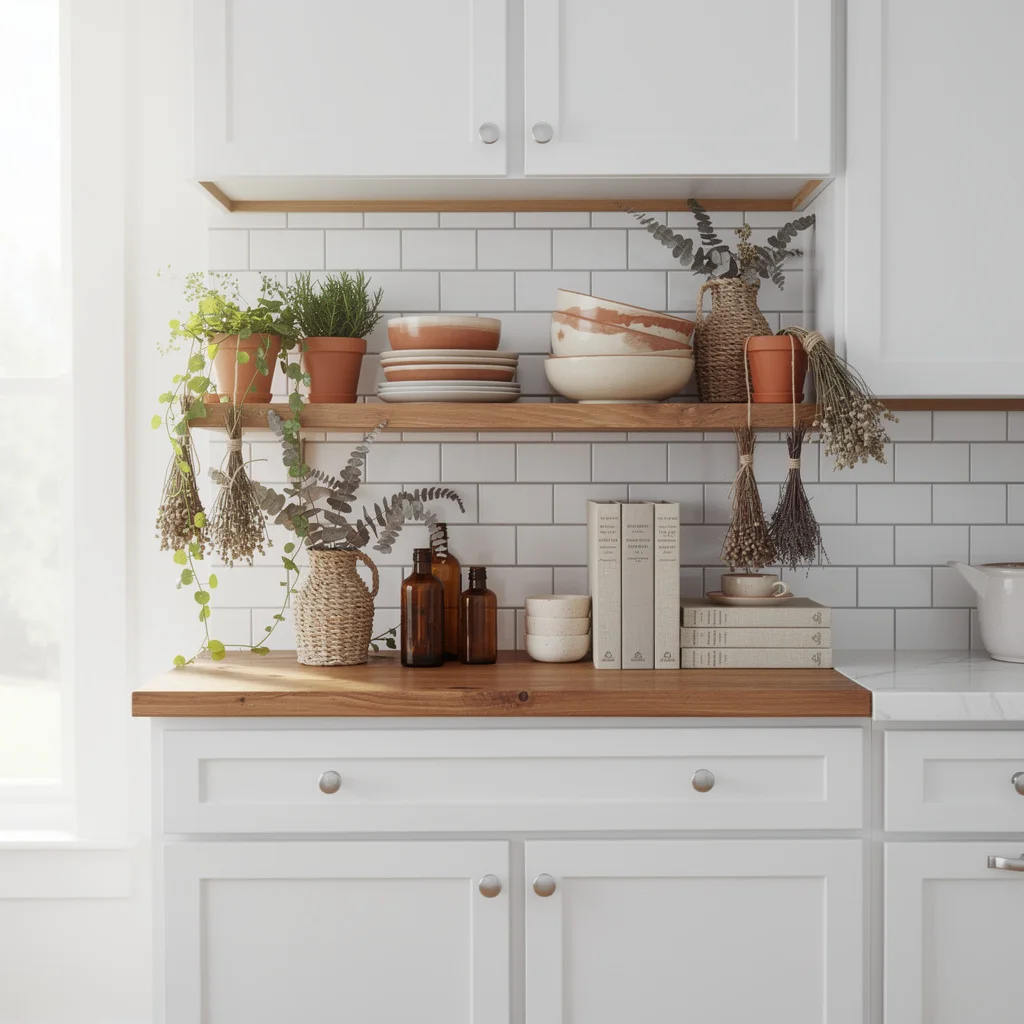
On a white subway tile backsplash, mount one floating wooden shelf at shoulder height. Hang small dried botanical bunches from the front edge of the shelf using twine — eucalyptus, dried lavender, baby’s breath. On the shelf itself, place a few terracotta herb pots, two amber apothecary bottles, a woven seagrass vase, and a small stack of linen-covered books.
On the counter below, add a wooden cutting board propped against the tiles, one larger terracotta pot with a full trailing plant, and a small woven basket holding seed packets or tea bags. This is a corner composition, not a whole-room intervention. A single well-composed corner can shift the feeling of a kitchen more than a cabinet repaint.
The Terracotta Arch Alcove
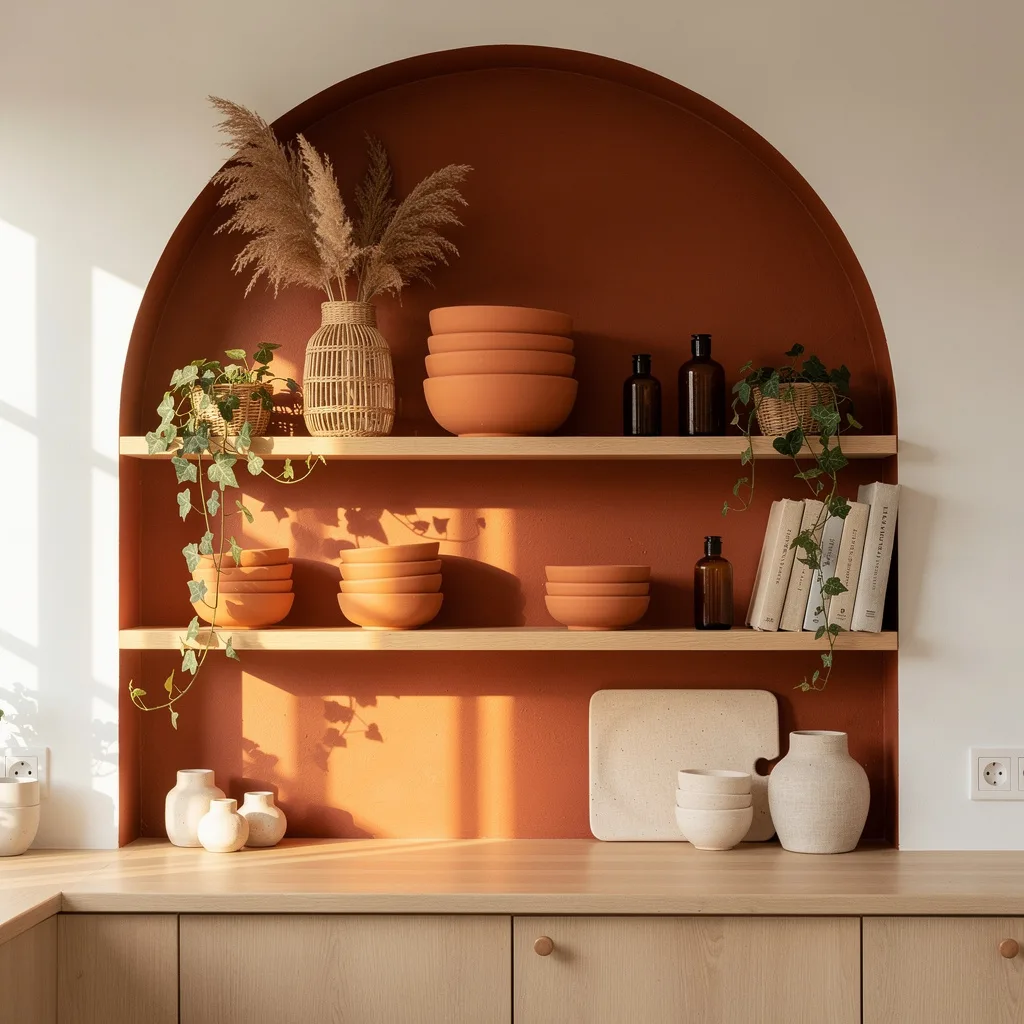
Build or commission a full arched alcove into one kitchen wall — the arch should span from counter height to as close to the ceiling as the architecture allows. Paint the interior of the arch in a deep terracotta or burnt sienna. Install three floating shelves of light oak inside the arch.
On the shelves, use only terracotta-toned objects: unglazed terracotta bowls nested in stacks, amber glass bottles, woven rattan vases. Allow one trailing ivy to cascade down from the top shelf. On the counter in front of the arch, keep small white ceramic vases and a stone cutting board. The arch becomes the room’s focal wall and the warm interior colour makes every object inside it glow in afternoon light.
The Herb and Canister Corner
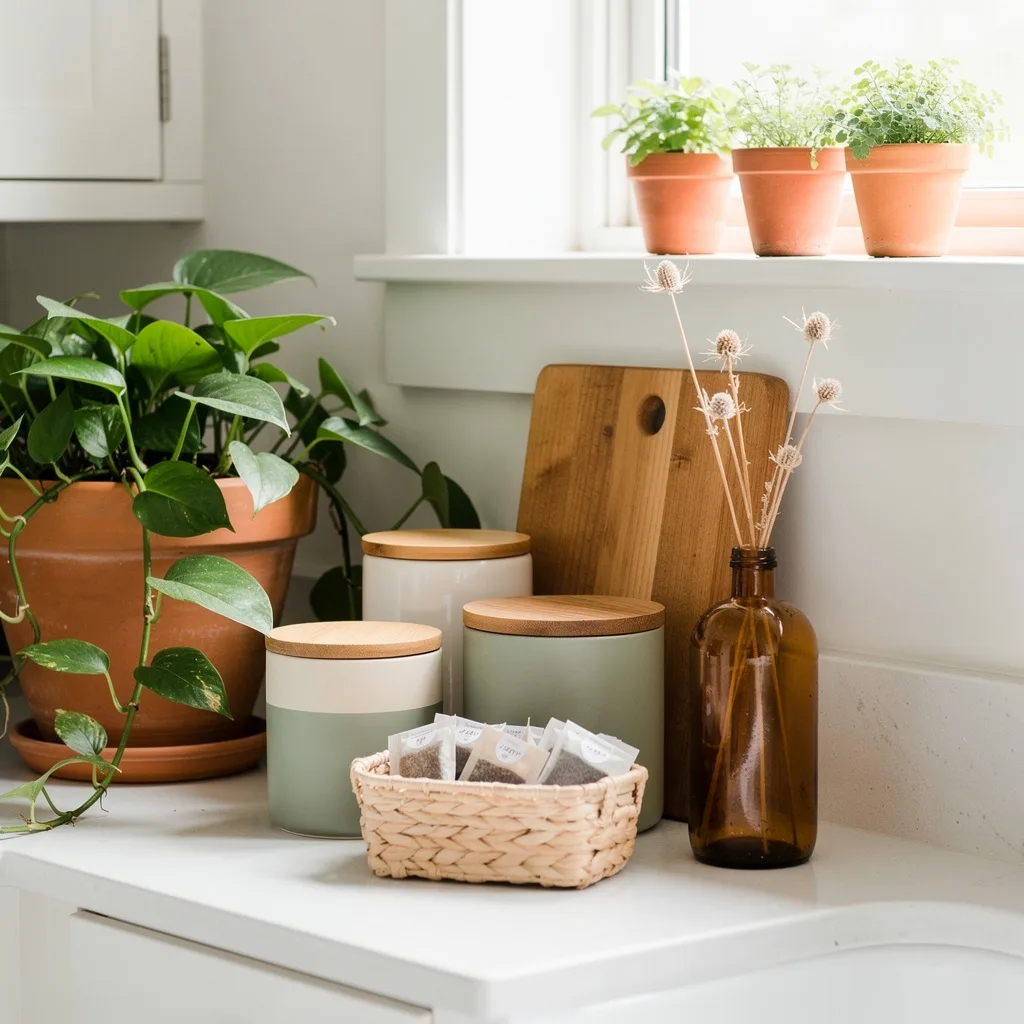
On a white kitchen counter in a corner beside a window, build a small composition: one large terracotta pot with a full trailing plant to the left, two matte ceramic canisters with bamboo lids at centre in sage green and cream, one wooden cutting board propped vertically, one amber glass bottle with a few dried allium seed heads as a vase, and a small woven tray holding tea bags.
Across the windowsill above, line up four terracotta pots with growing herbs — basil, thyme, parsley, coriander. Keep them in matching unglazed terracotta, not in decorative painted pots. The uniformity of the terracotta is what lets the arrangement look composed rather than cluttered.
The Rattan Dining Corner
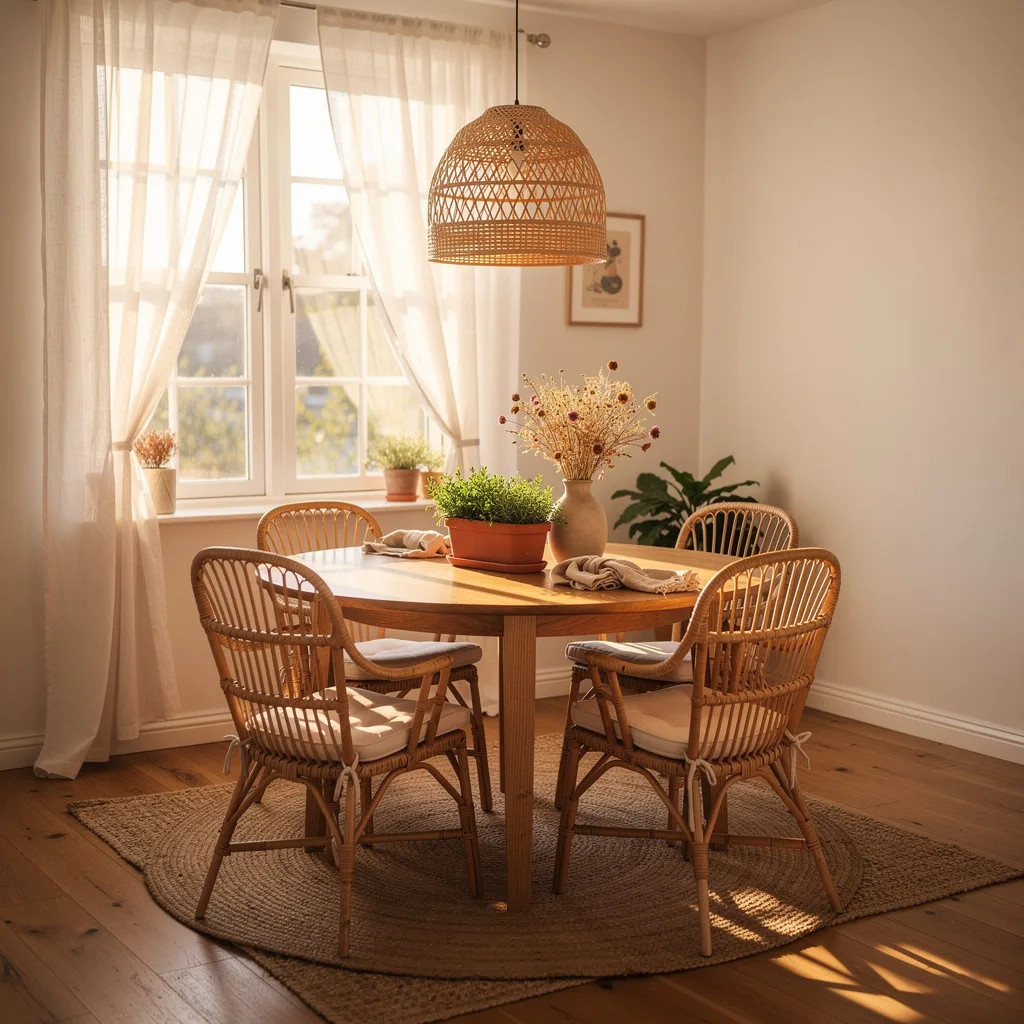
In the space adjacent to the kitchen — or in a kitchen large enough to hold a dining table — place a round solid oak or birch table with four rattan armchairs around it. Lay a jute or sisal round rug underneath the whole arrangement. Hang a woven rattan bell-shaped pendant directly above the table.
On the table, keep a terracotta pot of thyme or another low herb, a linen napkin folded and draped, and one ceramic vase with a dried wildflower stem or two. Hang sheer white linen curtains on the window, not cotton or polyester — the weight of the linen matters for how the light falls through them.
The Cane Panel Cabinet Kitchen
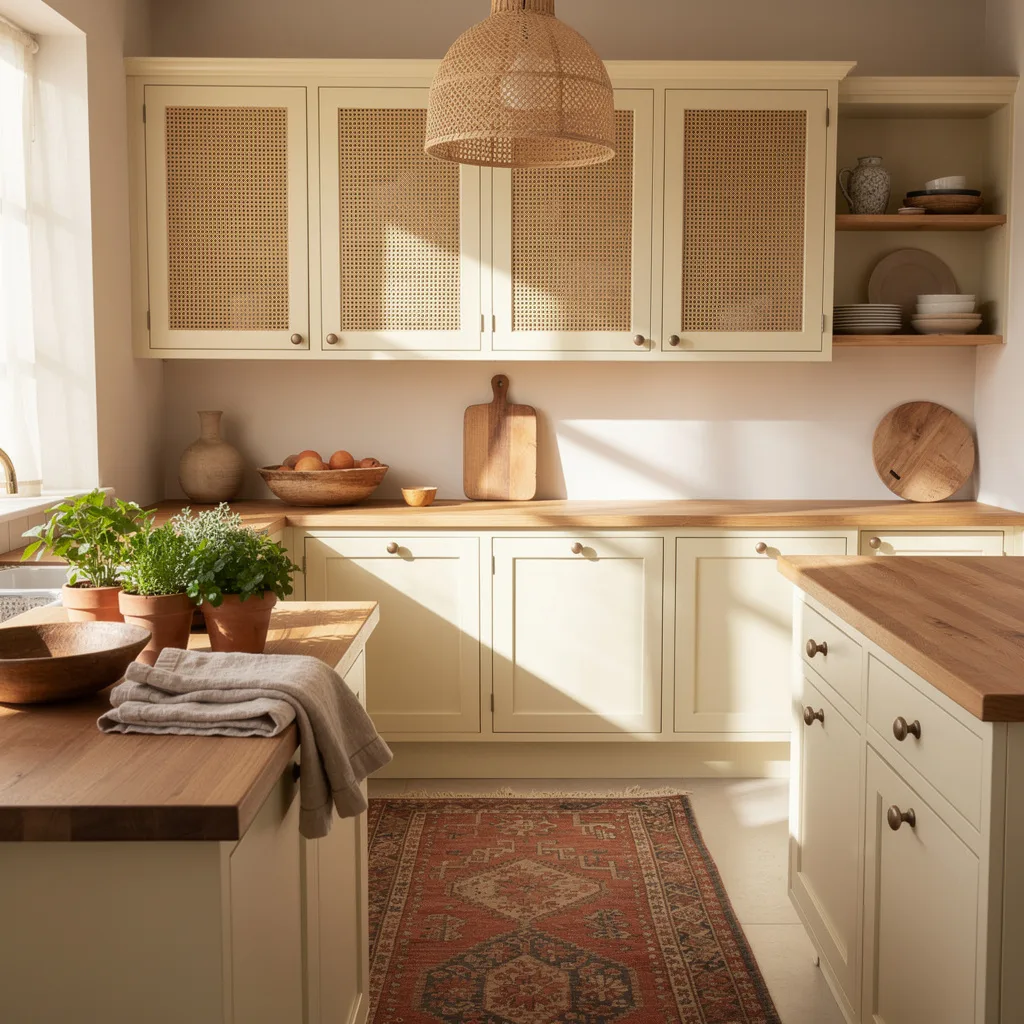
Take existing plain-door upper cabinets and replace the flat panel inserts with natural woven cane webbing. You can do this by removing the door, routing out the centre panel, stretching cane webbing across the opening, and stapling it to the back of the door frame. Repaint the cabinet frames in a warm cream or pale parchment.
Install butcher block countertops. Source a woven rattan pendant for overhead lighting. Add a vintage kilim rug in rust and indigo on the floor. The cane door inserts do the bohemian work while everything else stays restrained. A single visual intervention, repeated across every cabinet door, transforms the whole kitchen.
The Macramé Herb Hanging Window
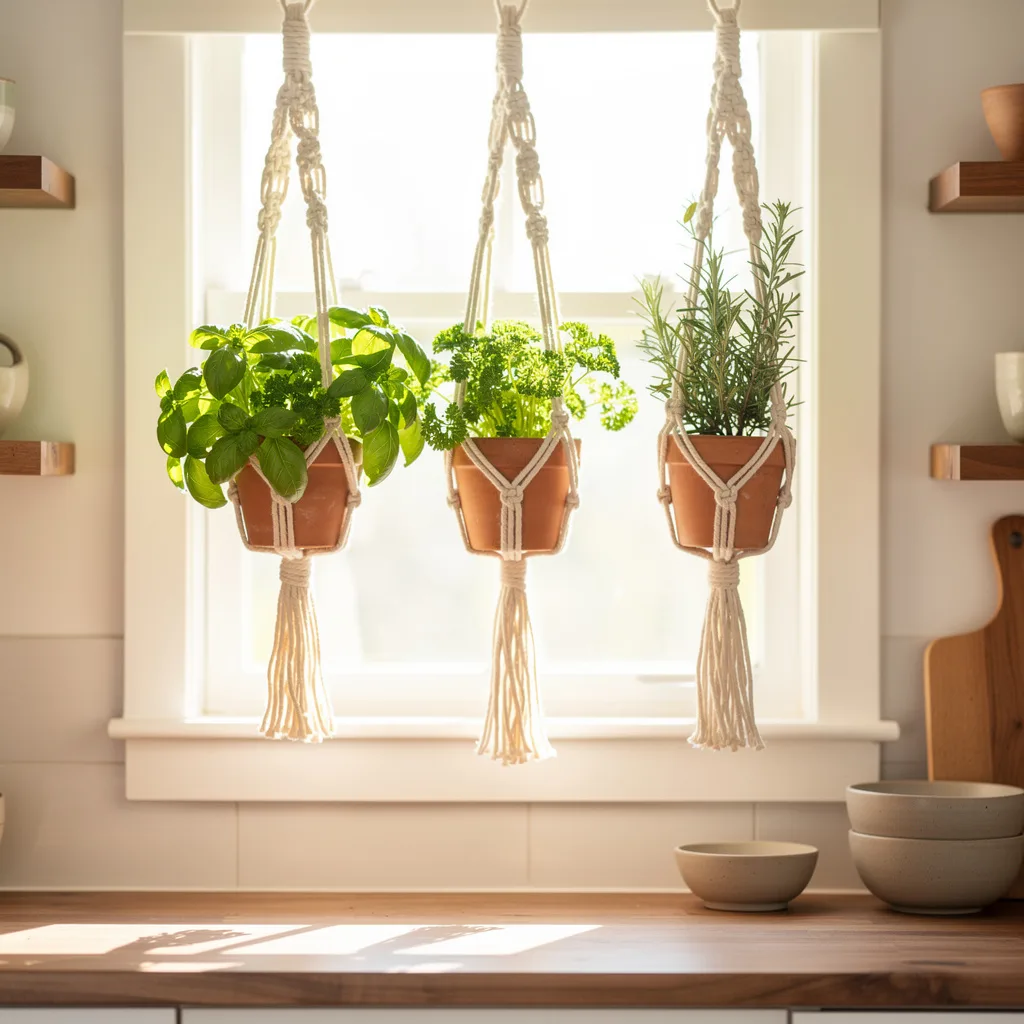
In front of a kitchen window, hang three macramé plant hangers at different heights from a single wooden or copper dowel mounted above the window frame. Each hanger should hold a terracotta pot — basil, parsley, and rosemary are the obvious choices, but any herbs you actually use work.
The hangers should be made in undyed natural cotton rope with a simple square-knot body and a generous tassel at the base. The terra cotta pots backlit by the window create silhouettes. The rope creates a fine texture layer between the kitchen and the outdoors. On a sunny morning, the shadows they cast on the counter below are reason enough to have made them.
Why These Rooms All Feel the Same Kind of Alive
None of these kitchens are convenient. Not in the way showroom kitchens are convenient, where everything is behind a door and the surfaces are empty and the whole room tells you nothing about who uses it.
What they share is the admission that the kitchen is inhabited. Things are out because they are used. Things hang because they are beautiful and being near beautiful things matters when you spend an hour in a room every day. Plants are growing because living things change the quality of a space in ways that artificial light and neutral paint cannot.
The bohemian kitchen isn’t an aesthetic you buy. It’s an attitude about what a kitchen is for. It’s the decision that the room where you feed yourself deserves as much thought as any other room in your home.
Start anywhere. A rug. A plant. A decent rattan pendant. The room will tell you what it needs next.