
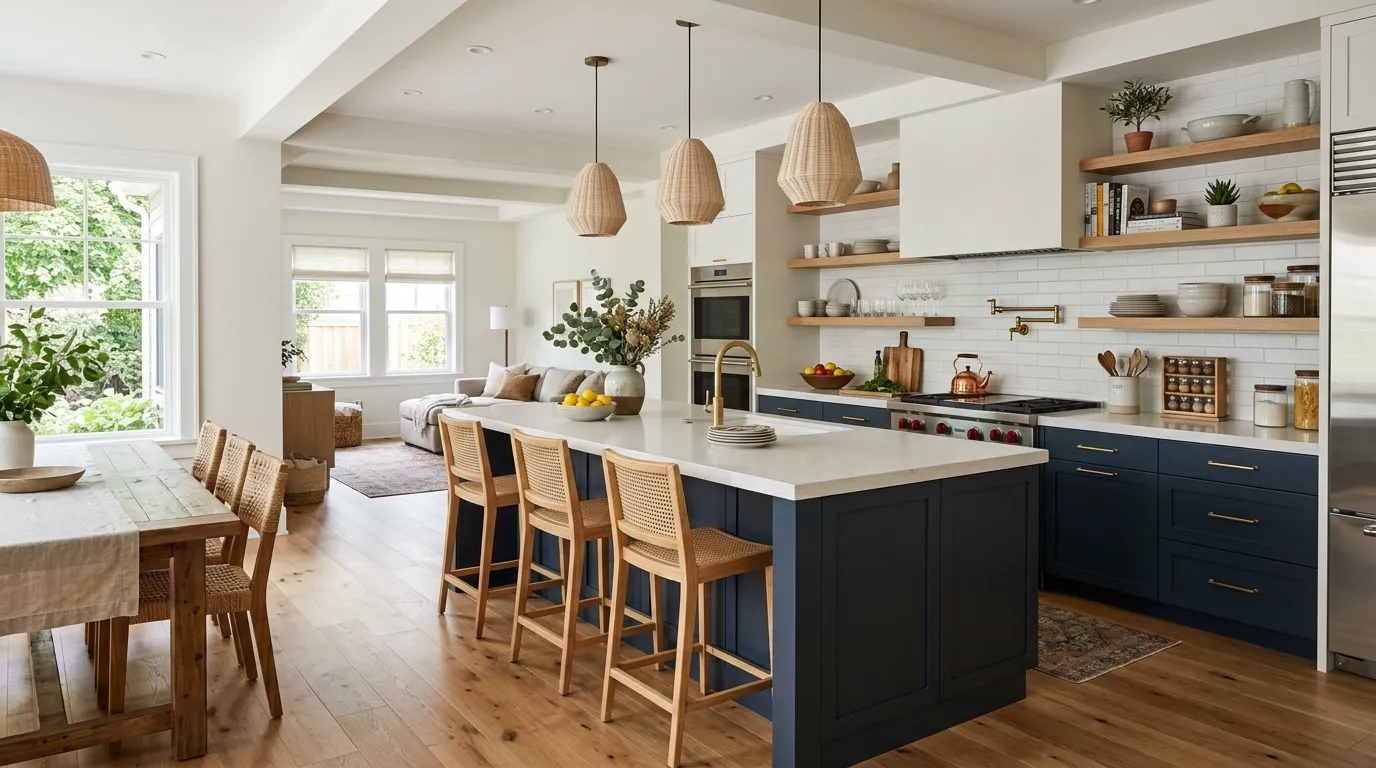
Somewhere along the way, the kitchen became a room you hid in. The cook disappeared behind a wall while everyone else sat in the living room having a better time. The meal arrived. The cook emerged, slightly resentful.
The open kitchen fixes this. It lets the person making dinner stay in the conversation. It lets the kitchen be part of the home rather than a service corridor attached to it. It makes the whole house feel larger, and — if done well — it makes the kitchen the most considered room you own.
Done badly, it makes the kitchen the most visible disaster in your home. Every unwashed dish, every pile of post, every cluttered counter: all of it on permanent display for anyone sitting on your sofa. The open kitchen is not a compromise. It is a commitment.
These twenty rooms committed. Every one of them found a way to make the kitchen and the living space work as a single composition. The approaches are wildly different. What they share is intention.
Why Most Open Kitchens Fall Apart Before You’ve Unpacked
The Island That Doesn’t Know What It Is
The island is the most important piece of furniture in an open kitchen.
It defines the boundary between cooking space and living space. It determines how people move through the room. It sets the social rhythm — whether people gather around it, or pass it on the way somewhere else. And in most open-plan renovations, it is treated as a storage solution with a countertop.
An island needs to earn its position. The base material, the counter overhang, the stool selection: these are not afterthoughts. They are the decisions that determine whether the island becomes the beating heart of the room, or a long, expensive obstacle.
The Light Problem Nobody Solves in Advance
When a kitchen opens into a living room, the lighting logic for both spaces becomes complicated.
A kitchen needs task lighting — bright, focused, practical. A living room needs ambient lighting — warm, soft, atmospheric. These two requirements are in direct conflict. Most open-plan renovations solve this by putting recessed lights everywhere and then wondering why the space feels neither warm nor functional.
The solution is zones. A pendant or two above the island defines the kitchen zone with warmth and atmosphere. Under-cabinet lighting or a dedicated wall sconce handles the task requirements at the preparation area. The living space gets floor lamps and table lamps — sources that create pools of light rather than uniform illumination. The spaces feel related but distinct.
Forgetting That the Kitchen Is Now a View
A closed kitchen can look like anything. Nobody sees it unless they walk in.
An open kitchen is visible from the sofa, from the dining table, from anywhere in the connected space. It is a permanent backdrop. The design decisions — the colour of the cabinets, the material of the island base, the height of the shelving — read as part of the room’s overall composition, not just as kitchen choices.
This does not mean the kitchen has to match the living room. But it has to be aware of it. A dark, moody kitchen opening into a bright, airy living room will create tension — not the good kind. A chaotic maximalist kitchen next to a quiet, spare sofa arrangement will make both spaces feel worse. The kitchen and the living area need to share a design language, even when they don’t share a palette.
Open Kitchen Ideas
Warm Oak Island Brass Bridge
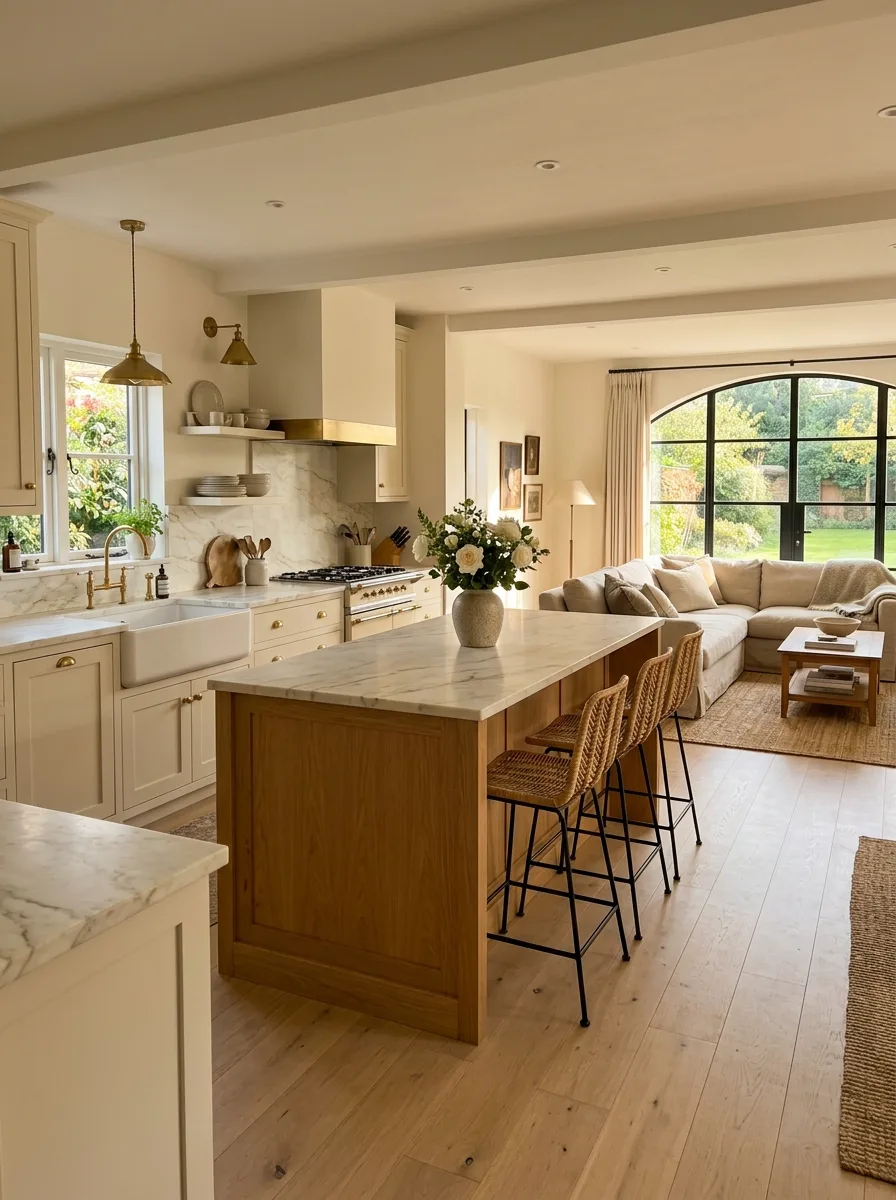
Use cream or warm off-white shaker cabinets for the run against the wall, with brass cup pulls throughout and a brass bridge tap over a farmhouse sink. The counter should be marble with visible grey veining, honed not polished.
The island is the pivot point of this kitchen. Build it in natural oak — solid, not veneered — with no paint or stain, just a clear protective finish that lets the grain show fully. The island counter should continue the marble, giving the whole kitchen surface a single material identity. The contrast between the warm, raw oak island base and the painted cream cabinetry is what makes this look work.
Hang woven rattan bar stools with black steel frames at the island. The rattan reads warm and natural; the steel frames keep it from going rustic. Float a single brass pendant above the sink area — the dome or factory shape, in aged brass rather than bright gold.
The floor should run continuously into the living space: wide-plank pale pine, ideally with the natural knots visible. A large arched steel window or door at the far end of the living room anchors the far wall and frames the garden.
Dark Green Dome Wallpaper Drama
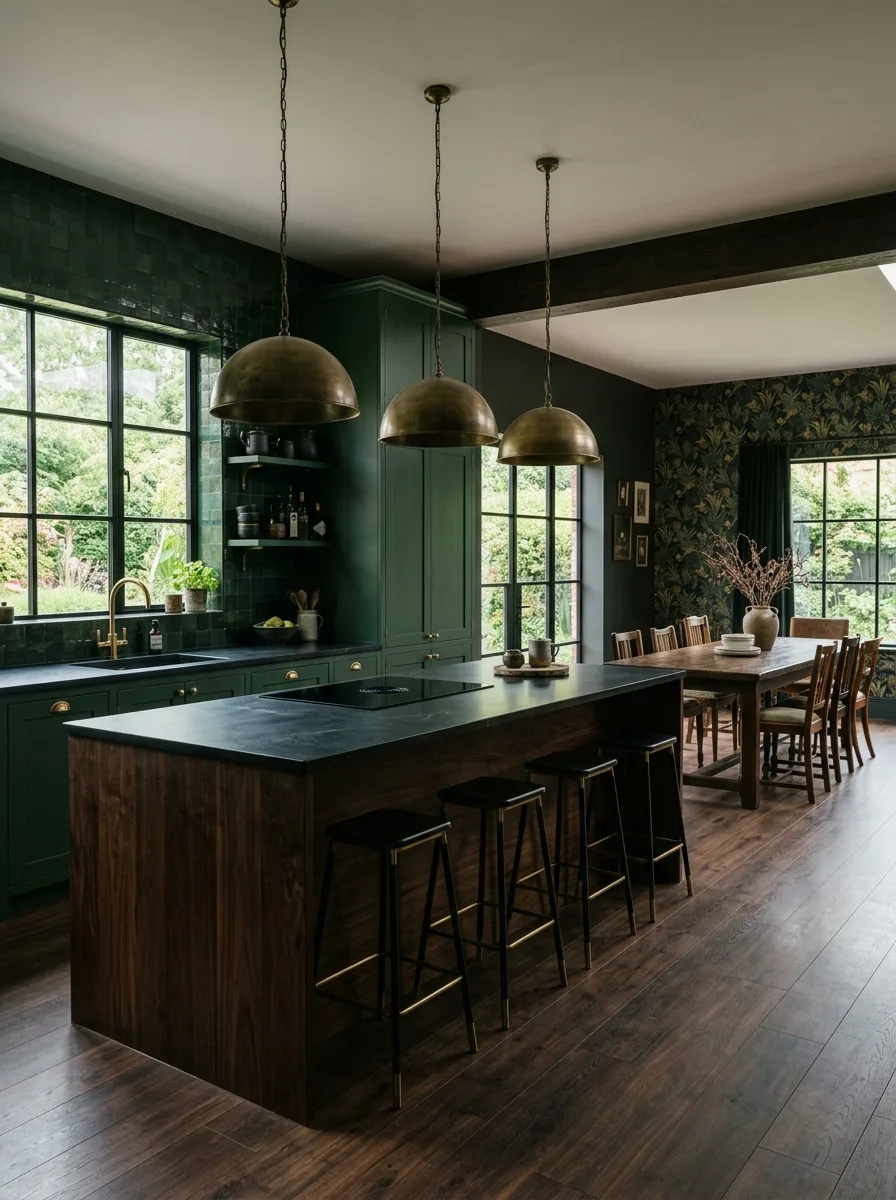
This kitchen operates in full commitment mode, and the adjoining dining space follows suit.
Paint the kitchen cabinetry — every surface, floor to ceiling — in deep forest or racing green. Use a Zellige tile in the same family for the backsplash. Keep the counter in a dark stone: soapstone or near-black granite, nothing pale or bright.
Build a large island in dark walnut with a black stone top. No hardware; instead use routed push-to-open drawers so nothing disrupts the surface. Seat the island with flat-topped stools in black steel with brass footrail detail.
Hang three aged brass dome pendants above the island — large scale, on exposed brass chain, positioned at slightly different heights for a graduated effect. The pendant chain and the canopy should be brass.
In the dining zone, use a vintage or antique timber table — wide, scarred planks on turned legs — with a collection of mismatched dining chairs. The far wall of the dining zone should have botanical or dark floral wallpaper in forest green and ochre. The wallpaper and the kitchen tile should share the green note and be tonally connected.
Dark hardwood floors throughout. No rugs in the kitchen zone; a vintage Persian rug under the dining table only.
Cathedral Beam Shiplap White
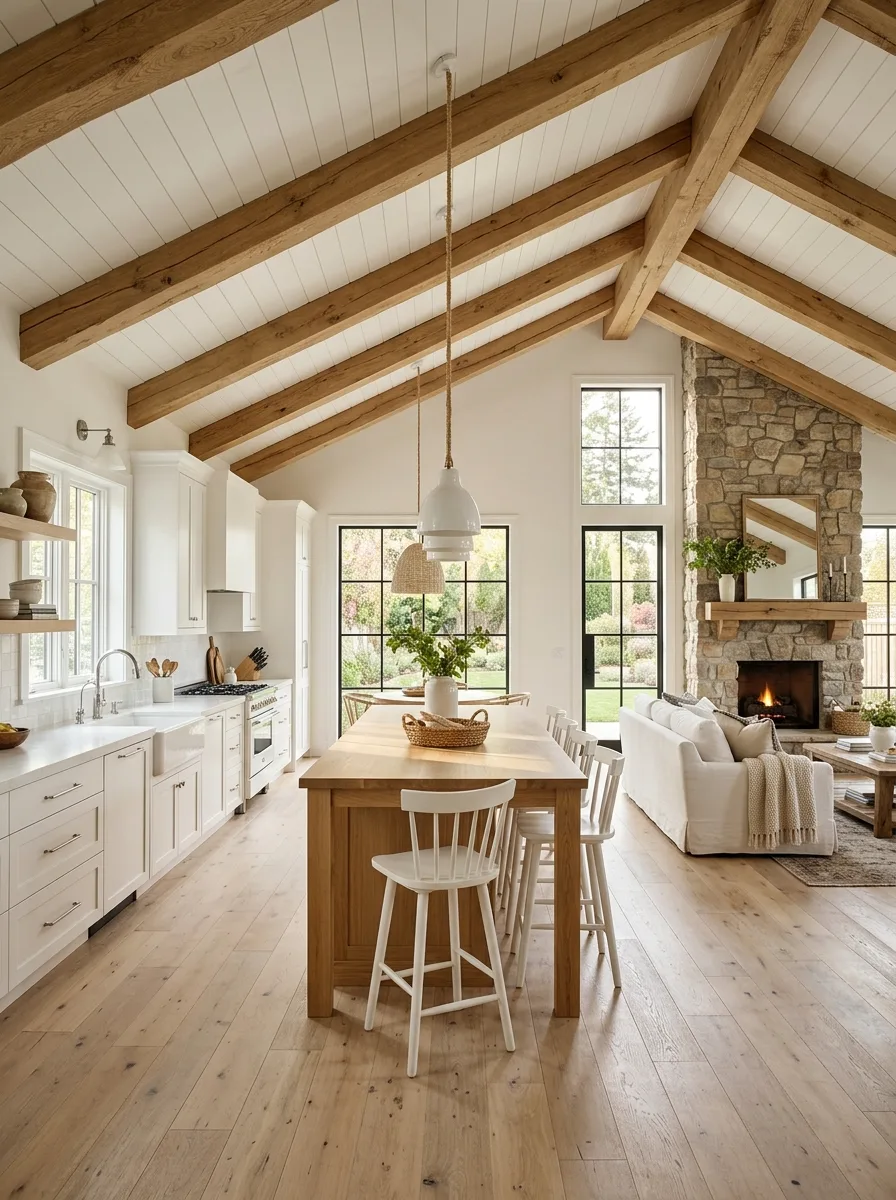
This kitchen depends on the ceiling. Without the vaulted ceiling and exposed beams, it becomes just another white kitchen. The ceiling is the design.
Install exposed oak beams in the cathedral ceiling — the beams should be roughly square section, untreated or lightly oiled, in a warm honey tone. The ceiling between them should be shiplap or V-groove timber planking, painted white to match the walls. This gives the ceiling depth and texture without darkening the room.
Use white shaker cabinetry throughout with simple chrome hardware — no brass here, chrome only, to keep the look clean rather than country. All counters in white or pale grey quartz. Farmhouse sink in white.
Build the island in natural raw oak — matching the ceiling beams — with a white or marble top. Seat it with classic white painted spindle-back chairs or stools. Hang a single rope pendant above the island — a large plaster or ceramic dome shade on a woven cord that nods to the ceiling’s texture.
The living area beyond the kitchen should have a stone fireplace, visible from the kitchen, with a raw oak mantle. White slipcovered sofas. The continuity from ceiling beams to island base to fireplace mantle — all in the same raw oak tone — is the through-line that holds the entire space together.
Concrete Island Exposed Brick Loft
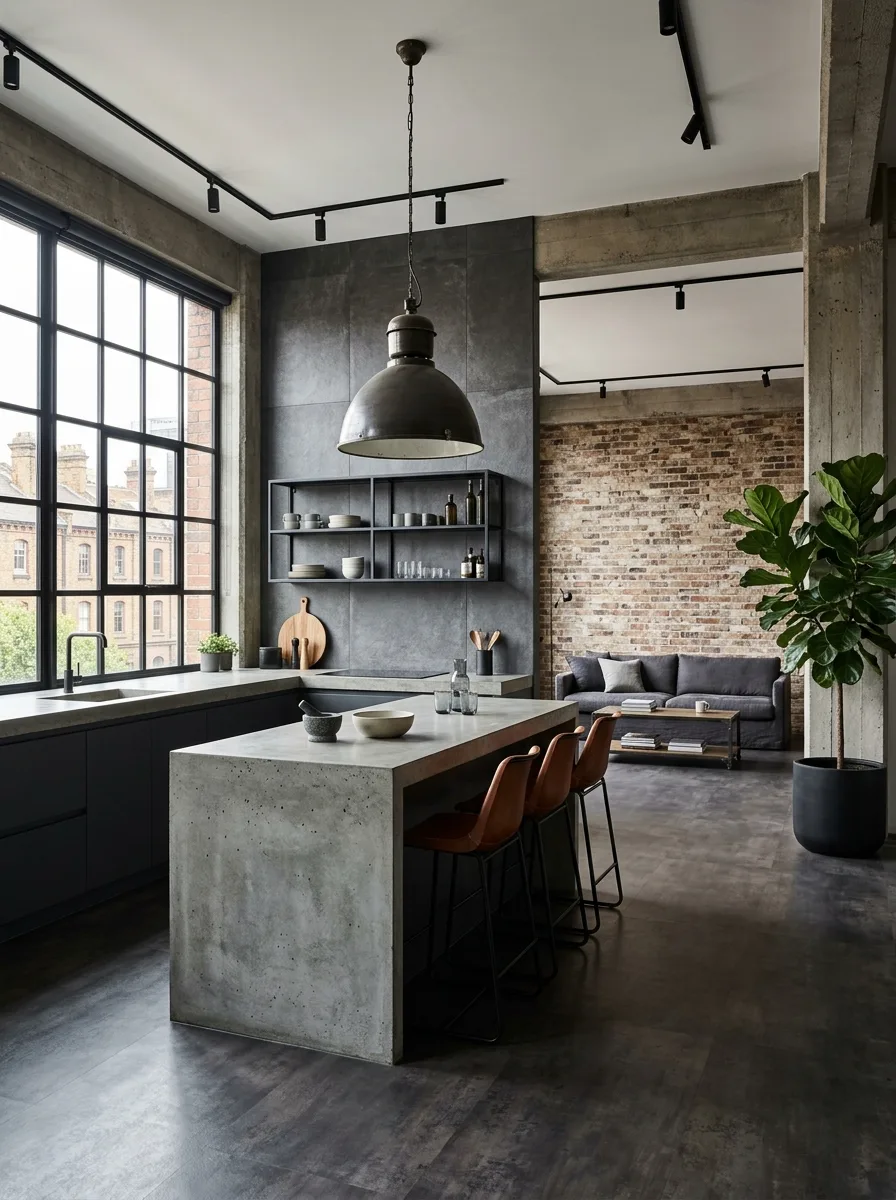
This is a kitchen that has not forgotten where it came from. The building used to be something else, and the design makes no attempt to conceal this.
Keep the exposed concrete columns intact and do not clad them. Do not seal the exposed brick wall on the far side. These elements are structural features of the original space and they give the kitchen its authority.
Use dark, almost-black flat-front cabinetry — handleless, slab-front — for the kitchen run. The backsplash and one feature wall should be large-format dark microcement or stone-effect tile in the same charcoal family. All surfaces in the kitchen should operate in the dark grey-to-black register.
The island is the counterpoint. Pour a concrete island — solid, monolithic, with visible aggregate texture — in a mid-grey tone that is three or four shades lighter than the cabinet surround. This single material contrast is what gives the room its tension.
Hang one oversized industrial pendant above the island — a factory dome in aged or weathered steel, hung on chain from the high ceiling. Install black track lighting along the ceiling for the kitchen and living zones.
Seat the island with leather saddle-seat stools on black steel frames — the tan leather is the warmest material in the room. Place a large fiddle-leaf fig in a matte black ceramic planter near the window. That plant is doing significant work.
French Stone Fireplace Kitchen
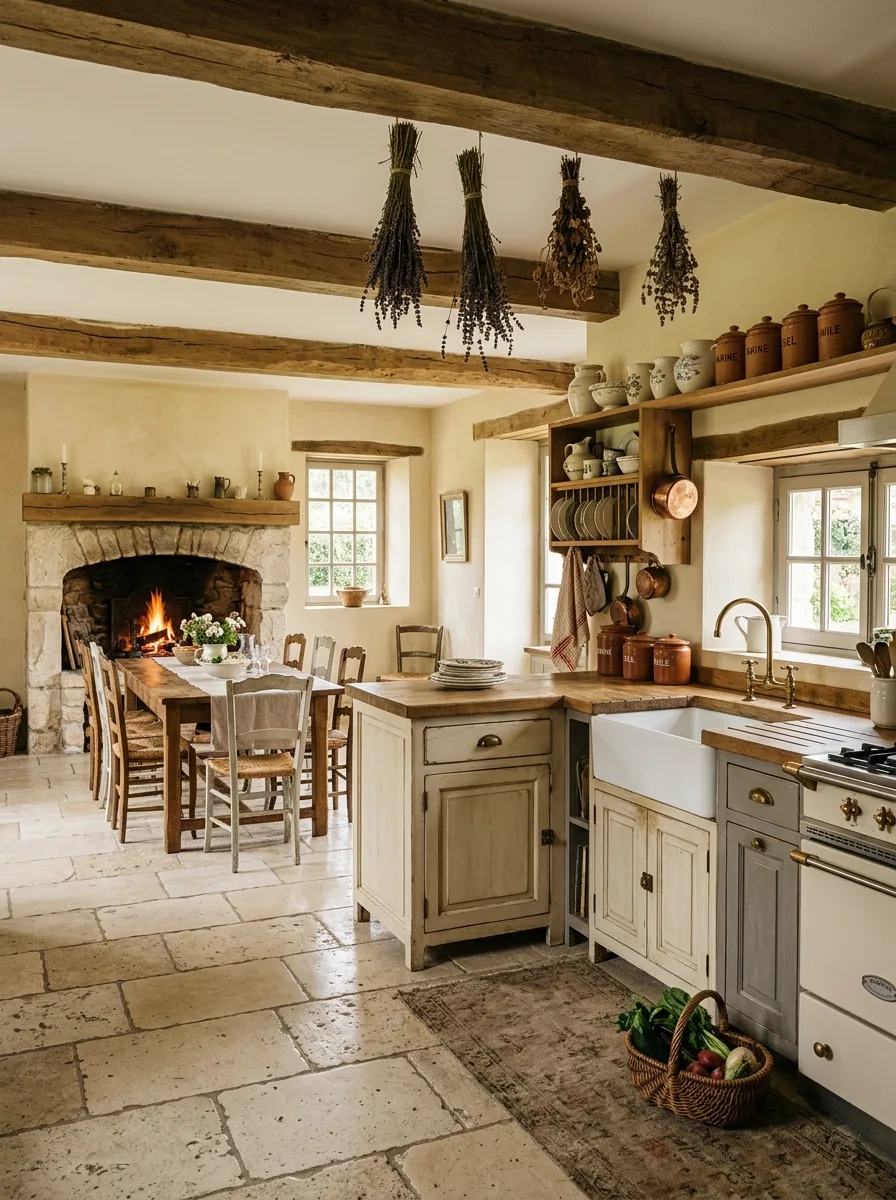
This is not a kitchen that was built. It is a kitchen that accumulated, over a long time, in a farmhouse in a warm climate.
The floor is large-format limestone flags — irregular, worn, in warm cream and grey tones. Do not choose uniform tiles; the unevenness is the point. These should run through the kitchen and the dining space continuously, with no transition strip.
Expose the ceiling beams — rough-hewn timber, original to the building if possible, in a dark warm oak. Hang several bundles of dried lavender and herbs directly from the beams using simple twine, positioned above the dining table and in the kitchen zone.
Use freestanding cabinetry rather than fitted units where possible — a painted dresser, a standalone island with a timber top, a plate rack mounted on a bracket above the counter. Nothing should look purpose-built. The sink base can be fitted and traditional in style, painted in aged grey-green with a butler sink.
The fireplace is in the dining zone, built from field stone with a broad stone mantle. It should be used. Put candles on the mantle, a small jug of flowers, a ceramic pot or two. The dining table beside it should be a long, scrubbed farmhouse table — the kind that can seat twelve and has clearly seated hundreds. Rush-seated ladder-back chairs.
This kitchen earns its look through age, real or manufactured. Every new element should be chosen to look like it has been there for thirty years.
Blush Velvet Marble Island Open Plan
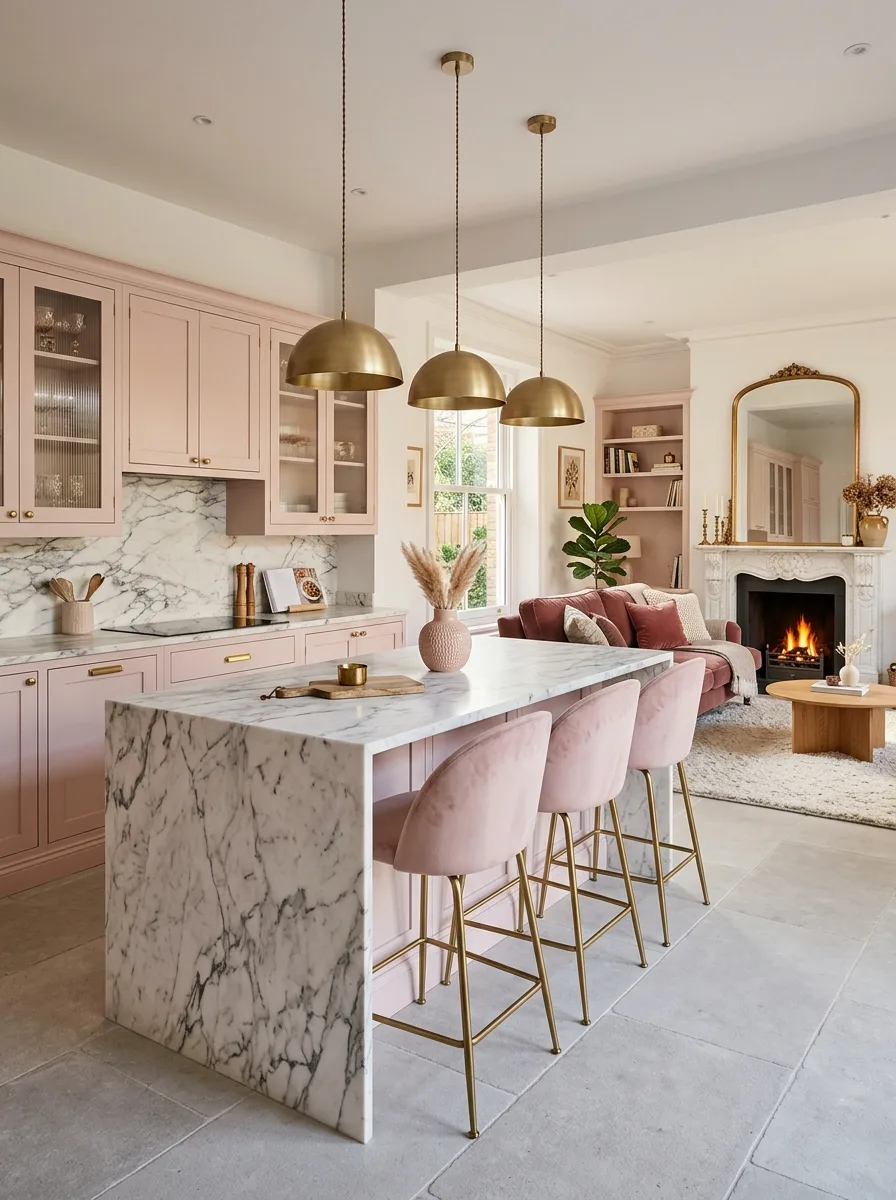
The island is a sculpture. The rest of the kitchen is the plinth.
Have the island clad in Calacatta or Arabescato marble slab from counter to floor — not a marble top with a painted base, but full marble on every exposed face of the island. The veining should be bold and directional. Position the island so the most dramatic face of the slab is visible from the living room.
Paint the cabinets in dusty blush — a muted, slightly grey-pink, not candy. Use ribbed or reeded glass in the upper cabinet doors. Brass bar pulls throughout. A marble slab backsplash behind the cooking zone that matches the island.
Hang three brass dome pendants above the island — solid polished brass, a scale that fills the space. These are statement lights and they need to be sized accordingly.
The living space beyond should be tonally warm and slightly rich: a deep rose or dusty terracotta sofa, a white marble fireplace with a gilt overmantle mirror, cream wool rugs. The pink of the cabinets should rhyme with the upholstery — not match, rhyme.
Seat the island with velvet barstools in a blush or pale rose, with brass legs. The velvet seat and the brass frame echo the cabinet and hardware palette. Pale limestone floor tiles throughout.
Shiplap Rattan Hamptons View
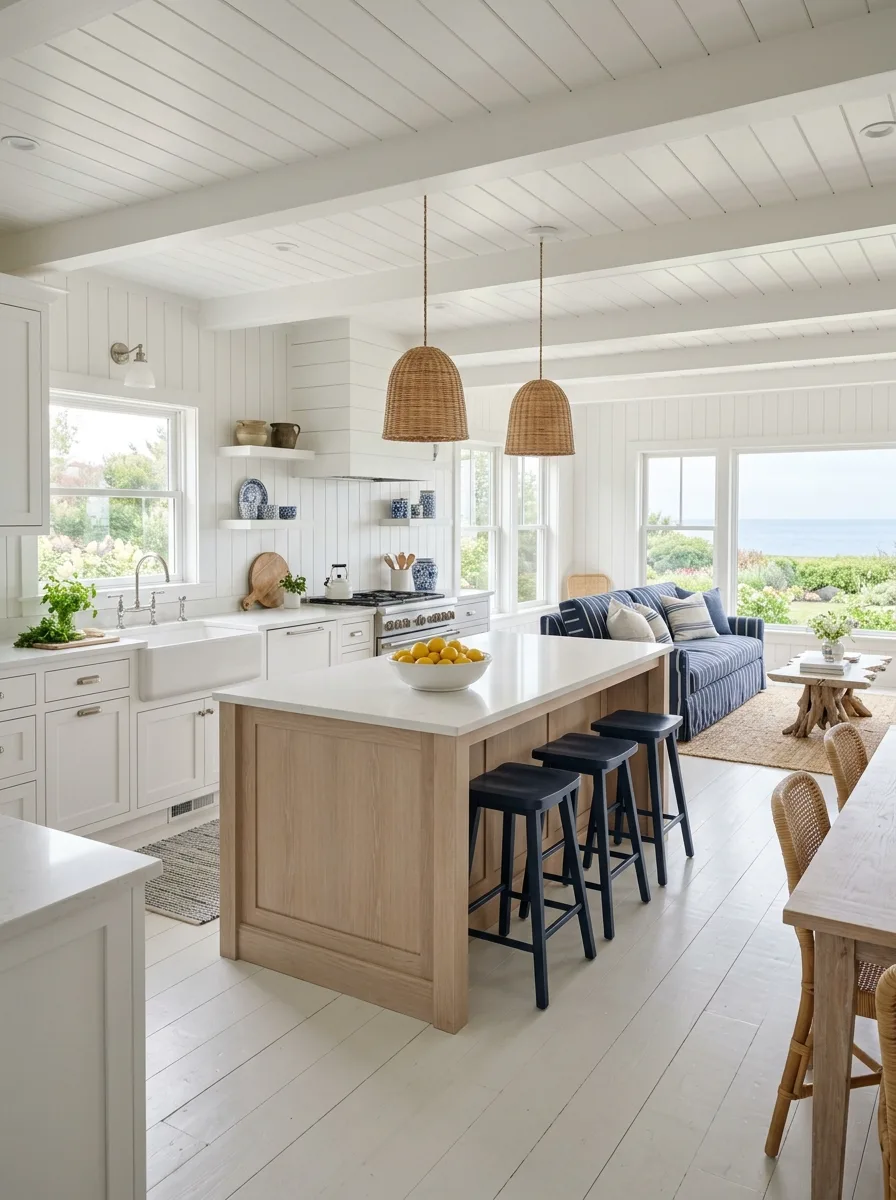
This kitchen is built to be looked through, not just looked at.
Every window in this space is a picture frame. The design works outward — from the lemon bowl on the island, past the rattan pendants, through the double shiplap wall panels, to the navy stripe sofa in the living zone, and then to the ocean or garden visible through the glass beyond.
Install shiplap or V-groove timber panelling on the kitchen walls — painted white throughout. Upper cabinets white with simple chrome hardware; lower cabinetry also white. A farmhouse sink. All surfaces in white quartz or white-veined marble. The kitchen itself is deliberately background.
The island breaks the pattern. Build it in raw natural oak — blonde, not stained — with a white quartz top. Seat it with backless matte black stools; the dark colour pops against the white countertop and the blonde base. Hang two large rattan dome pendants in natural wicker tone above the island.
Use blue-and-white ceramics deliberately: a few pieces on the open shelves, a stripe-upholstered sofa in the living zone. These are the only colour notes in the room, and they carry the coastal register across both spaces.
White painted floor planks from kitchen to living area. A natural jute rug under the living zone seating. A bowl of lemons on the island is the warmest element in the kitchen. It should always be there.
Mediterranean French Doors Terracotta
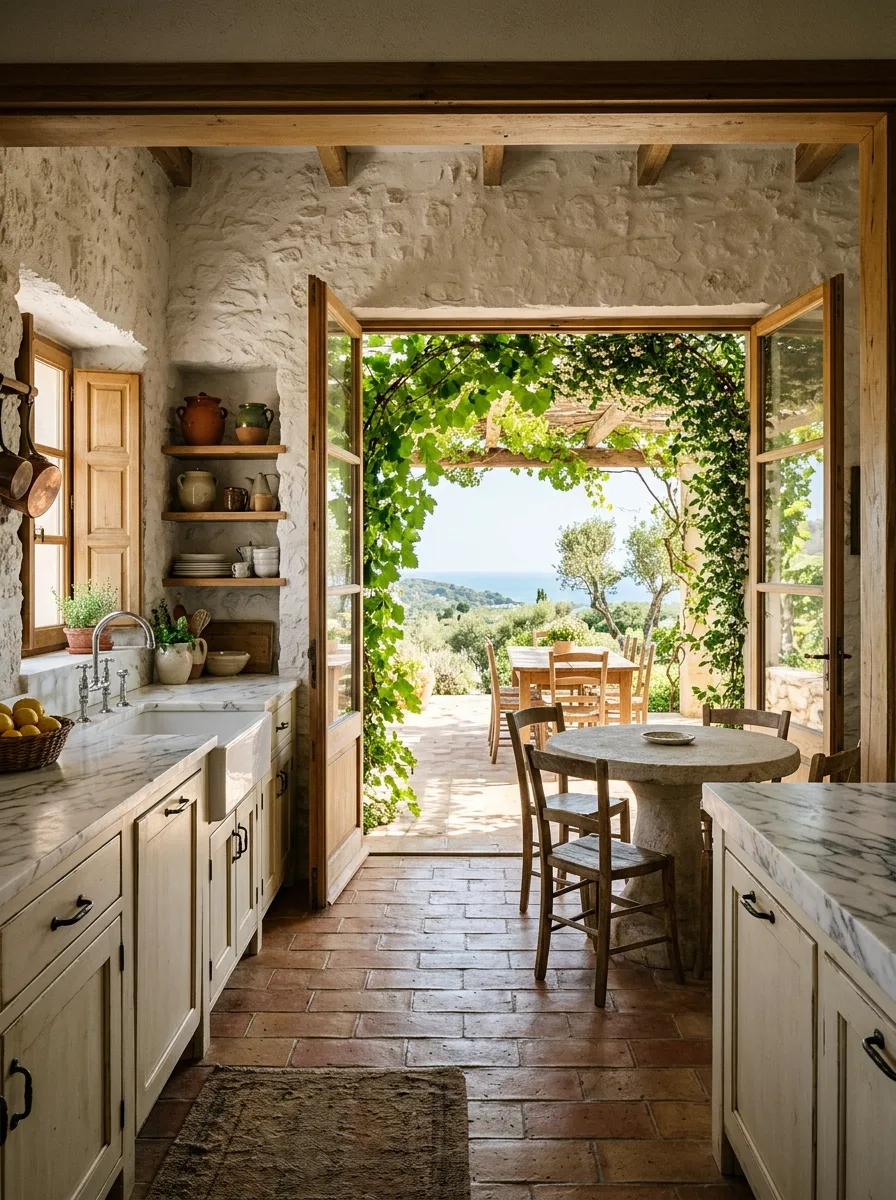
The doors are the feature. Not the cabinets, not the counters, not the backsplash.
Install full-height timber French doors — ideally with a divided light pattern in the upper sections — at the end of the kitchen opening onto a terrace or garden. The door frame should be in raw or lightly stained timber, not painted. When open, the doors should fold back against the wall and allow the garden, terrace, and light to flow directly into the room.
Lay antique or reclaimed terracotta brick tiles on the floor in a herringbone or running bond pattern. The bricks should be worn and variably toned — not uniform. They run through the kitchen and outdoors onto the terrace with no threshold change.
Use cream or aged white freestanding and semi-fitted cabinetry with simple iron ring pulls. Marble counters throughout. An apron-front sink. Leave the back wall above the counter in exposed rough stone — whitewashed lime plaster is an acceptable alternative if the original stone is not available.
Float a few raw oak shelves against the stone wall for pottery — earthenware in terracotta and cream, a jug of lemons, a small herb plant. Position a round stone pedestal table just inside or just outside the doors — the ambiguity between inside and outside is the point.
Cream Oak Garden Arch Open Plan
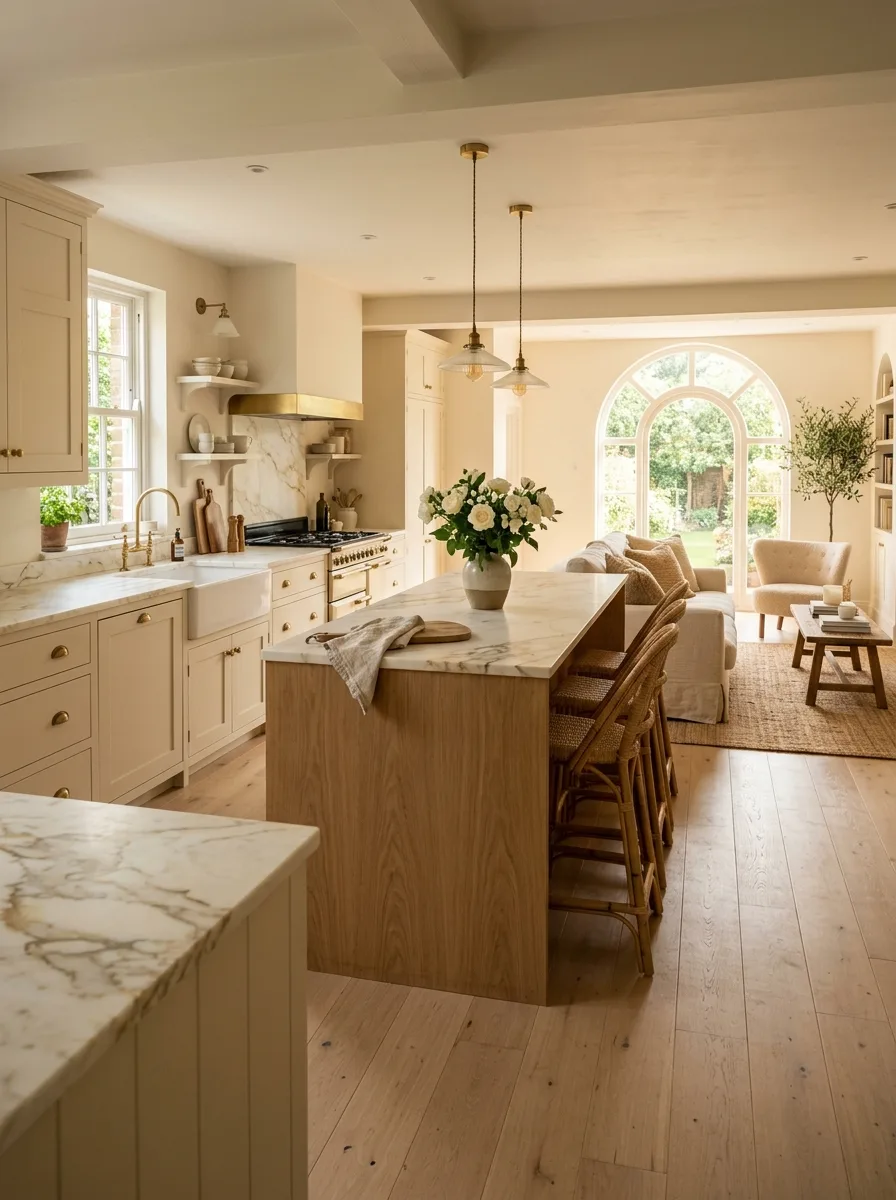
This is the same house as Image 1, seen from a slightly different angle — and the two images together tell the same story: that the materials have to work whether you’re standing at the sink or sitting on the sofa.
The cream shaker cabinetry, the marble counters, the oak island, and the brass hardware in the kitchen read as warm and considered from the living room. The woven rattan bar stools and the brass pendant above the sink land as pieces of furniture, not just kitchen fittings. Nothing about the kitchen says it stopped caring where the kitchen ended.
The key decision in this room is the island base. It’s in natural oak, the same tone as the floor, which means it doesn’t read as a kitchen island from the living side — it reads as a piece of furniture. This is the trick. An island in the same painted colour as the cabinets belongs to the kitchen. An island in a contrasting material belongs to the room.
Float the island in the space between kitchen and living area — not against any wall, not connected to anything. Let it be freestanding in feel. Hang a clear glass pendant above it; the transparency keeps it from blocking the sightline to the arched window at the far end. A single vase of white garden roses on the island is the only thing that needs to be on it.
Scandinavian White Black Pendant
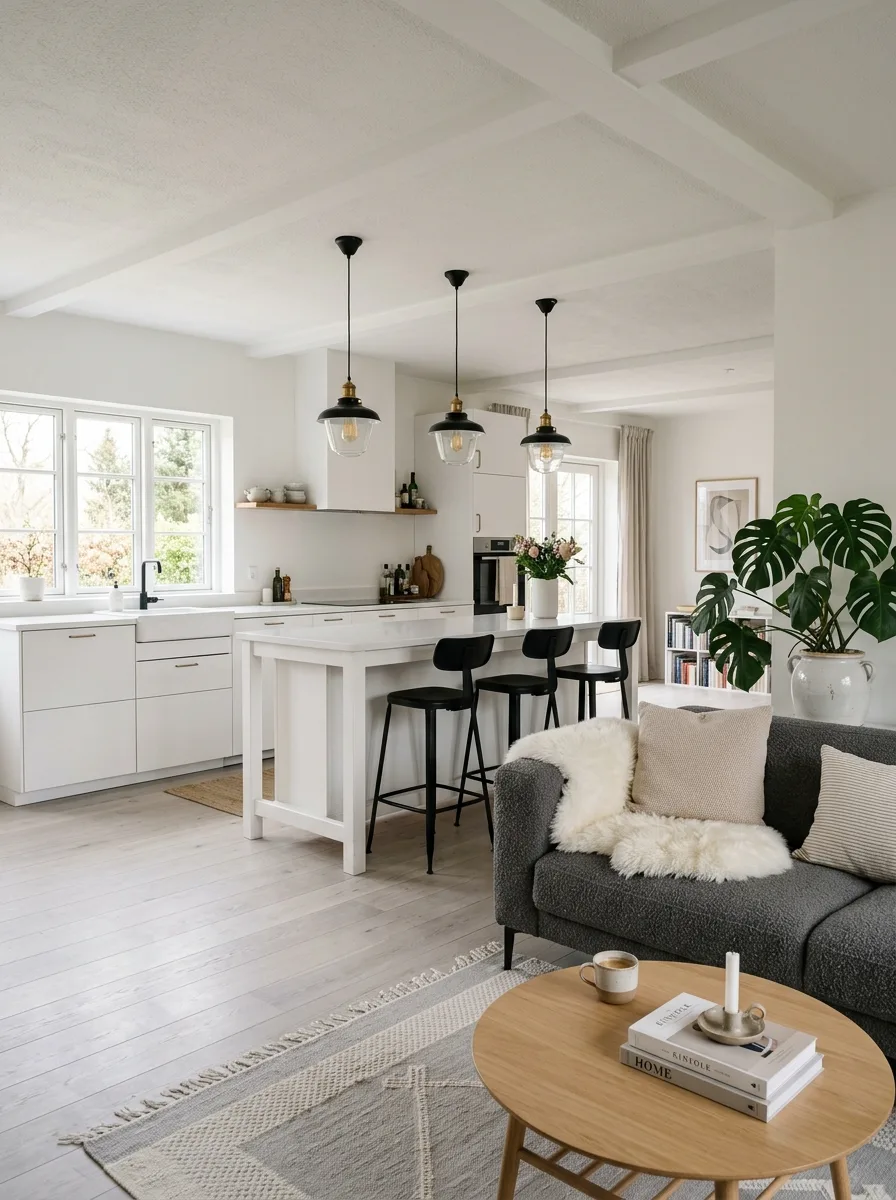
This kitchen’s restraint is doing heavy lifting.
Use flat-front handleless cabinetry in pure white — every surface, including uppers and lowers. No hardware at all; all doors and drawers open via integrated push-catch or small routed finger pulls. The backsplash is white, the counter is white quartz, the ceiling is white. The only departure is a single raw oak shelf floating above the counter.
Hang three clear glass pendants above the island — the classic schoolhouse or tulip shade in glass with a black canopy and fitting. They are the most visible design decision in the room and they need to be chosen carefully. The glass should be clear, not frosted; the filament bulb inside should be warm white.
The island itself can be white-painted with simple black-painted legs — giving it the look of a piece of furniture rather than a fixed unit. Top in white quartz. Seat it with matte black stools.
The living space beyond should have white walls, pale grey or beige sofas, one oversized houseplant in a white ceramic pot — a monstera or fiddle-leaf — and a round raw oak coffee table. The floor throughout should be pale washed or grey-washed oak. One soft woven rug in cream or oatmeal under the sofa. Nothing colourful. One candle on the coffee table.
Brick Arch Loft White Kitchen
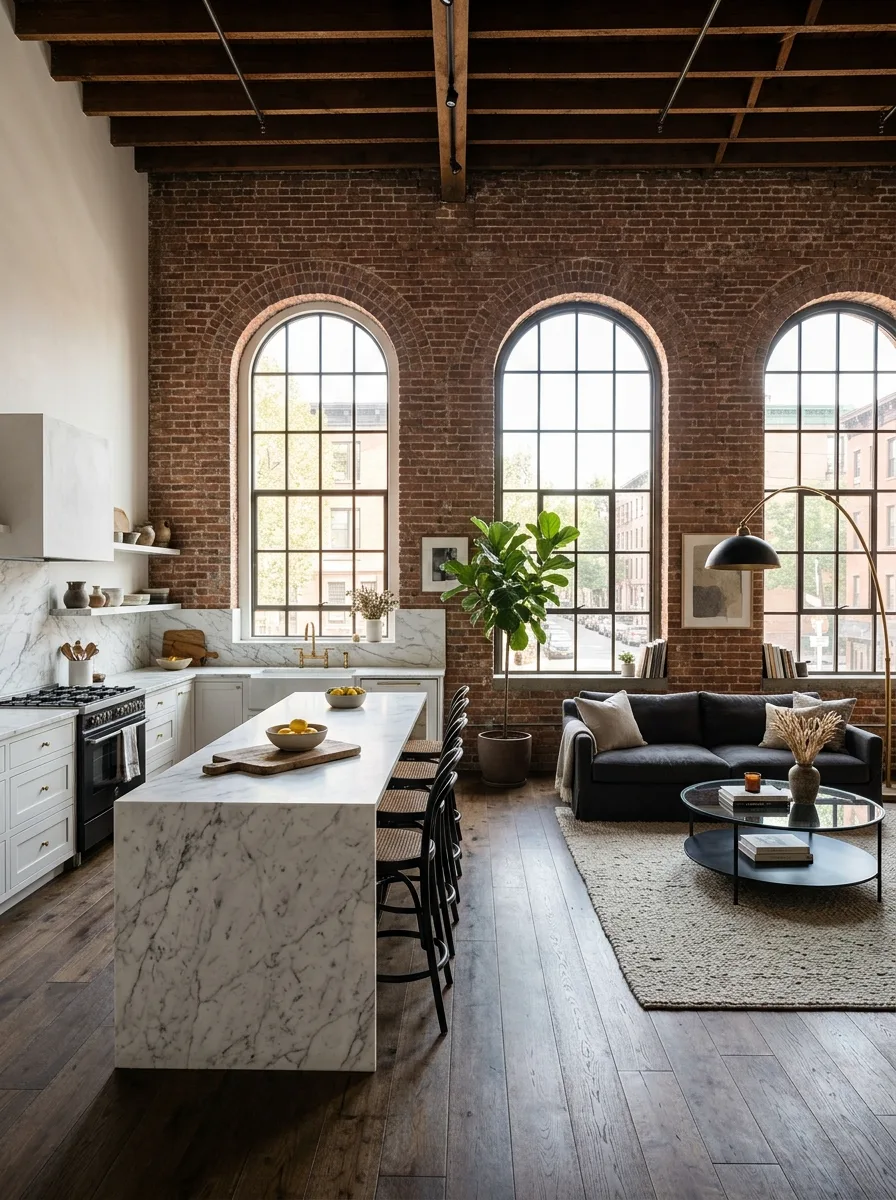
The brick wall with the arched windows is structural and dominant. Work with it, not against it.
Keep the kitchen in pure white — flat-front slab cabinetry, white quartz counters, white plaster hood — so the kitchen reads as a clean, calm backdrop to the raw brick wall behind and alongside it. The contrast between the white kitchen and the warm terracotta brick does the work that colour would otherwise need to do.
Build the island in Calacatta marble slab from counter to floor — all four sides clad. The island is a freestanding sculpture in the space. Use a gold or brass undermount tap fitted directly into the marble surface. Position the island so the most expressive face of the marble is visible from the living zone.
Use dark wood herringbone flooring throughout — the warm-dark tone of the hardwood connects the brick wall to the floor and grounds the white kitchen above it. Do not use pale or washed oak; this room needs a dark floor to anchor the height of the space.
Fit woven seat chairs as island stools — a bistro-style seat with bent metal framing. A fiddle-leaf in a large terracotta pot near the window. One arc floor lamp in the living zone with a dark dome shade. No overhead lighting in the living area.
Butter Yellow Rattan Island
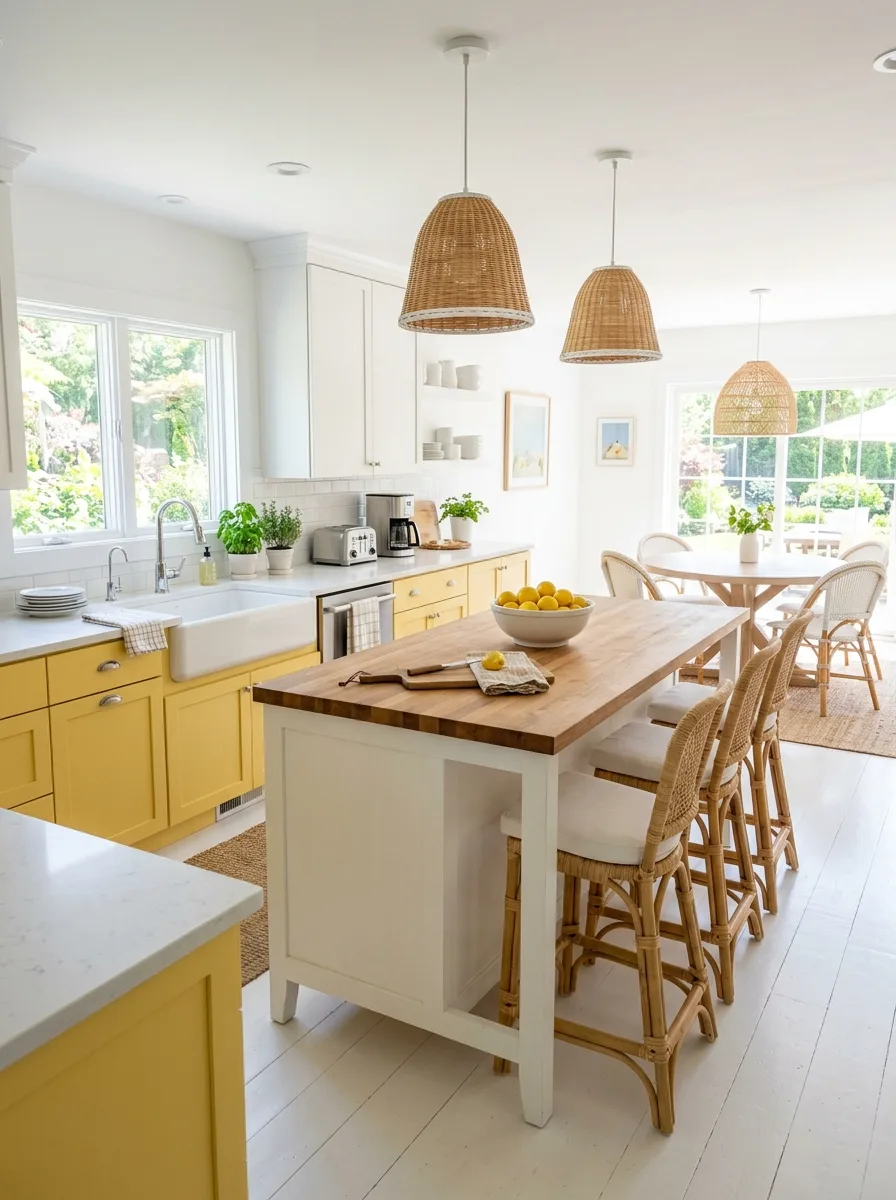
This kitchen earns its cheerfulness honestly. It does not try to be sophisticated. It is unambiguously a room for cooking in, eating in, and being glad to be in.
Paint the lower cabinetry in a warm, saturated butter yellow — not lemon, not mustard, but the exact golden yellow of a ripe honeydew melon. Upper cabinets in white. Simple chrome hardware throughout. All counters in white marble or quartz. Farmhouse sink.
Build the island in white-painted timber with turned or square legs — a freestanding table more than a fitted island — and top it with a solid butcher block in warm oak. The butcher block on the white-painted base is the material relationship that makes this look work. Keep a bowl of lemons on the island; they earn their place here.
Hang two rattan dome pendants above the island. Extend the dining zone with a separate round rattan-and-white-dining table and rattan chair seating. The rattan reads as a continuous note from the pendants to the chairs.
White painted timber floors throughout. A seagrass or jute runner beneath the kitchen run. Position a herbs-in-terracotta arrangement on the windowsill. Make the room as light-filled as possible — this kitchen needs sun.
Japanese Shoji Screen Island
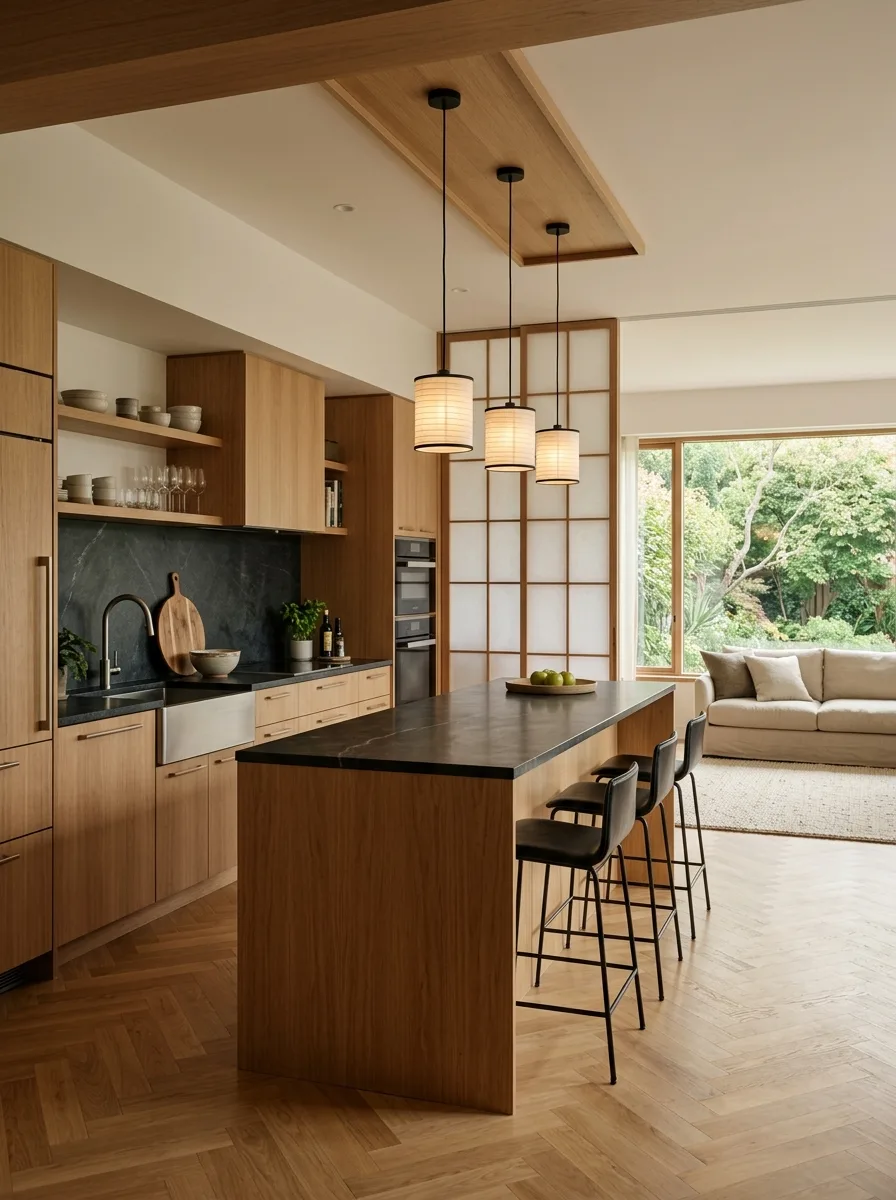
The shoji screen is the boundary element. It defines where the kitchen ends and the living space begins without using a wall.
Build or source a shoji-style sliding panel in a natural timber frame with rice paper or frosted glass infill. Mount it between the kitchen zone and the living area so it can be fully open, partially closed, or fully closed — giving the space complete flexibility between open-plan and separated. The frame should be in the same blonde oak as the cabinetry.
Use flat-front cabinetry in warm natural oak throughout — no stain, no paint, just clear-sealed timber in its natural blonde tone. The backsplash should be dark soapstone or black granite in a slab format — the one moment of contrast against all the warm wood. Under-counter sinks only; keep the countertop as uninterrupted as possible.
Hang three cylindrical paper or fabric pendant lights above the island — washi paper shades or linen drum pendants in a warm white. Three identical shades grouped close together read as intentional; space them evenly and at the same height.
Lay herringbone floor in pale blonde oak throughout kitchen and living space. The living area beyond the shoji screen should be minimal: a low cream sofa, a jute rug, a single oversized ceramic vase. Natural materials everywhere. Nothing synthetic.
Checkerboard Floor Black Marble Open
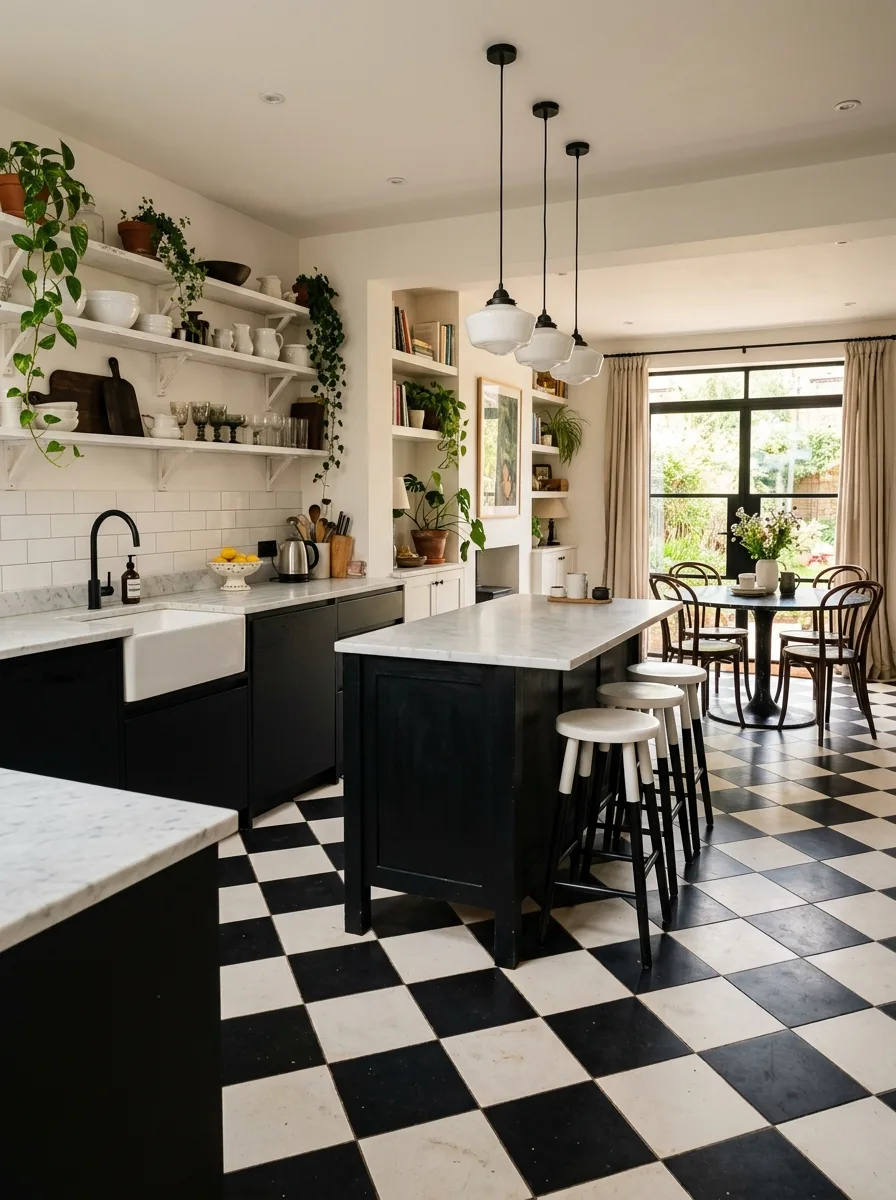
The floor is the character. Everything above it is designed to let the floor speak.
Install large-format black and white checkerboard tiles — not small mosaic, not diagonal diamond, but large square-format tiles in a straight grid, roughly 30x30cm or larger. The scale matters; a large checkerboard floor reads graphic and confident. A small one reads quaint and dated.
Paint the lower cabinetry and the island in matte black — flat-front or simple Shaker style with no hardware, or with minimal black iron knobs. Upper cabinetry and shelving in white. All counters in Carrara marble — white with grey veining, nothing dramatic. Farmhouse sink in white.
Float two long white shelves on brackets above the kitchen counter, filled with trailing plants — pothos, devil’s ivy, heartleaf philodendron — that hang down toward the counter. The greenery cascading over the white shelves against the white tile is the organic element that keeps the monochrome from feeling sterile.
Hang three schoolhouse globe pendants — milk glass with black fittings — above the island. The milk glass echoes the counter marble; the black fittings echo the cabinetry.
In the dining zone, use a round black pedestal table with Thonet bentwood chairs in natural timber. The mix of black furniture and warm wood chairs is the dining room’s version of the kitchen’s black-and-white relationship.
Moroccan Tile Gallery Wall Boho
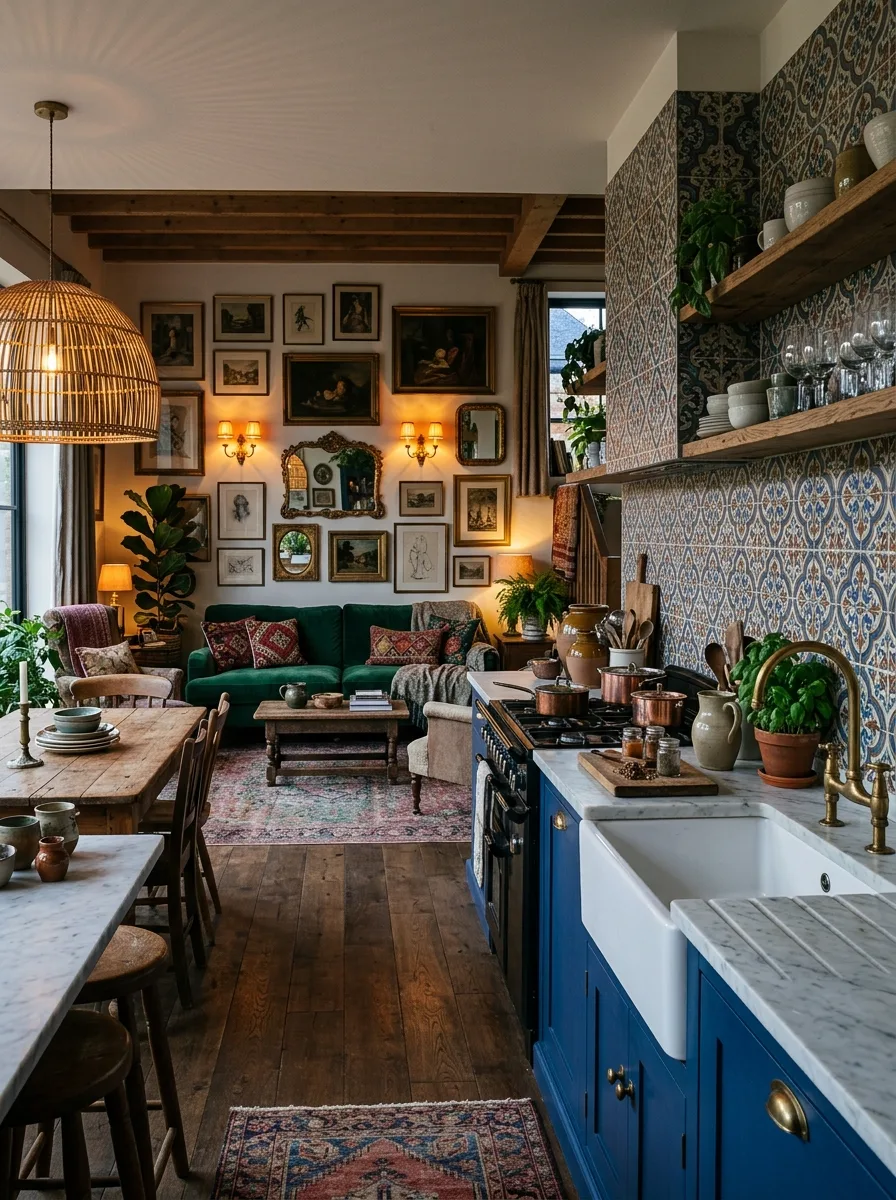
This kitchen and living room are a single artwork. The design system is layered, historical, and entirely comfortable with itself.
Use indigo or cobalt blue shaker cabinetry for the kitchen run, with aged brass cup pulls and a brass tap. White marble counter. An apron-front butler sink. The backsplash should be Moroccan encaustic cement tiles in a geometric pattern with blue, white, cream, and terracotta — running from counter to ceiling on the feature wall.
Float raw timber shelves above the tiles on simple iron brackets. Load them with copper pans, white ceramics, terracotta pottery, and a few trailing herbs in mismatched pots.
Dark reclaimed hardwood floors run through kitchen and living space without a break. A large woven rattan pendant hangs over the dining table end of the kitchen. The dining table is a long, scarred farm table in raw oak.
The living space transition is marked by vintage Persian rugs layered on the floor — two or three overlapping, in red, navy, and ochre. The sofa is in deep forest velvet, loaded with kilim cushions and a heavy throw. The wall behind is a full gallery arrangement — oil paintings, prints, gilt mirrors, taxidermy, architectural fragments — hung from floor to ceiling. Wall sconces in brass light the gallery wall from below.
The Moroccan tile and the gallery wall are from different traditions. They work because they share a love of pattern, history, and the idea that a room should not be finished.
Travertine Arch Plaster Rattan
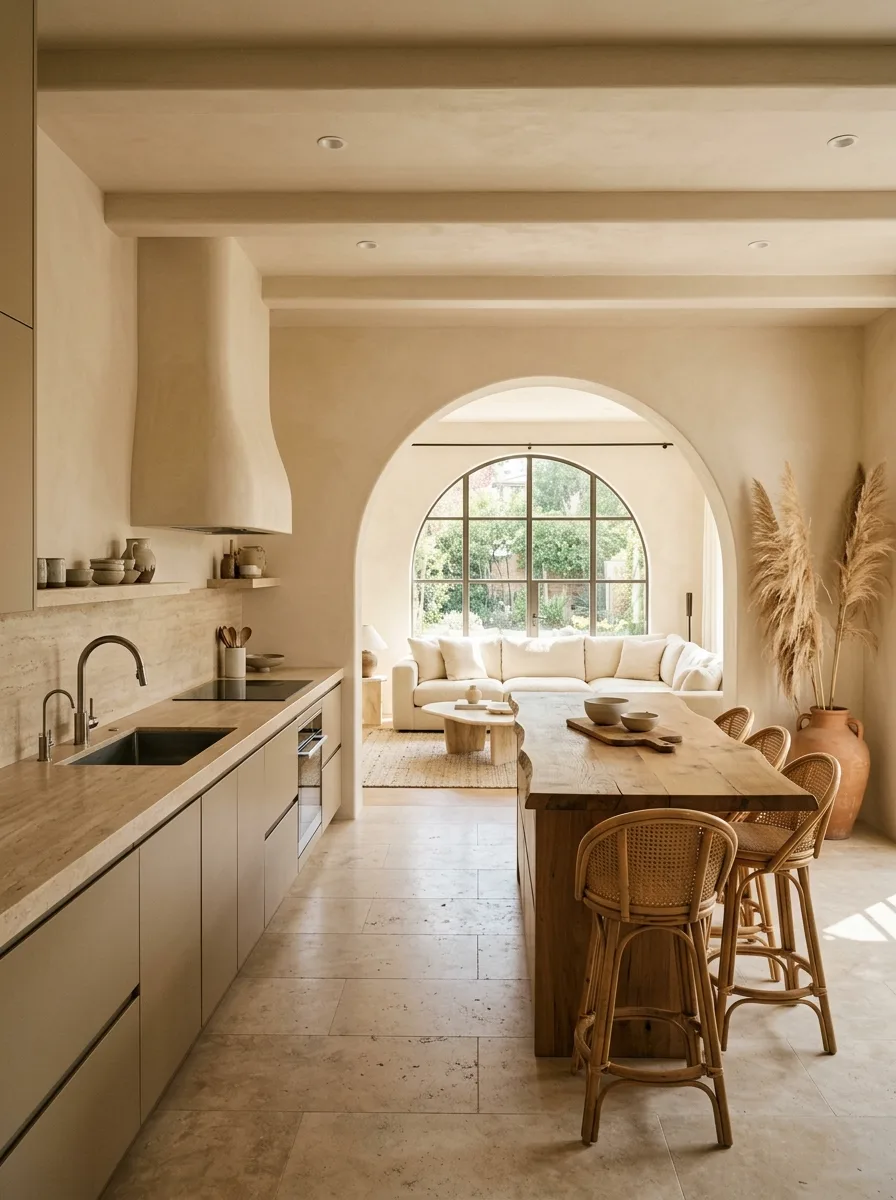
This kitchen is built around one structural decision: the archway opening between the kitchen and the living space.
The archway should be a full plastered arch — rounded, generous, at least two metres wide — connecting the kitchen to the adjoining room. The arch surround and all walls should be in the same warm beige microtopping or venetian plaster: the entire space, inside the arch and beyond it, in one continuous warm tone.
Use flat-front handleless cabinetry in a warm sand or greige — neither beige nor grey but exactly between them. No hardware. The backsplash should be travertine stone in honed finish, with visible pores and natural variation. Counter in the same travertine. All surfaces textured and natural.
The plaster range hood above the cooking zone should be smooth and curved — matching the arch opening — so both architectural elements read as from the same hand.
The island is the one raw element: a thick, rough-hewn timber plank on a simple base, in contrast to the smooth plaster of everything else. Seat it with rattan and cane chairs.
On the floor throughout: large-format travertine or limestone tiles. A large terracotta vessel in the corner of the living area with dried pampas stems. White boucle sofa beyond the arch, visible through the opening.
Teal Terrazzo Brass Dome
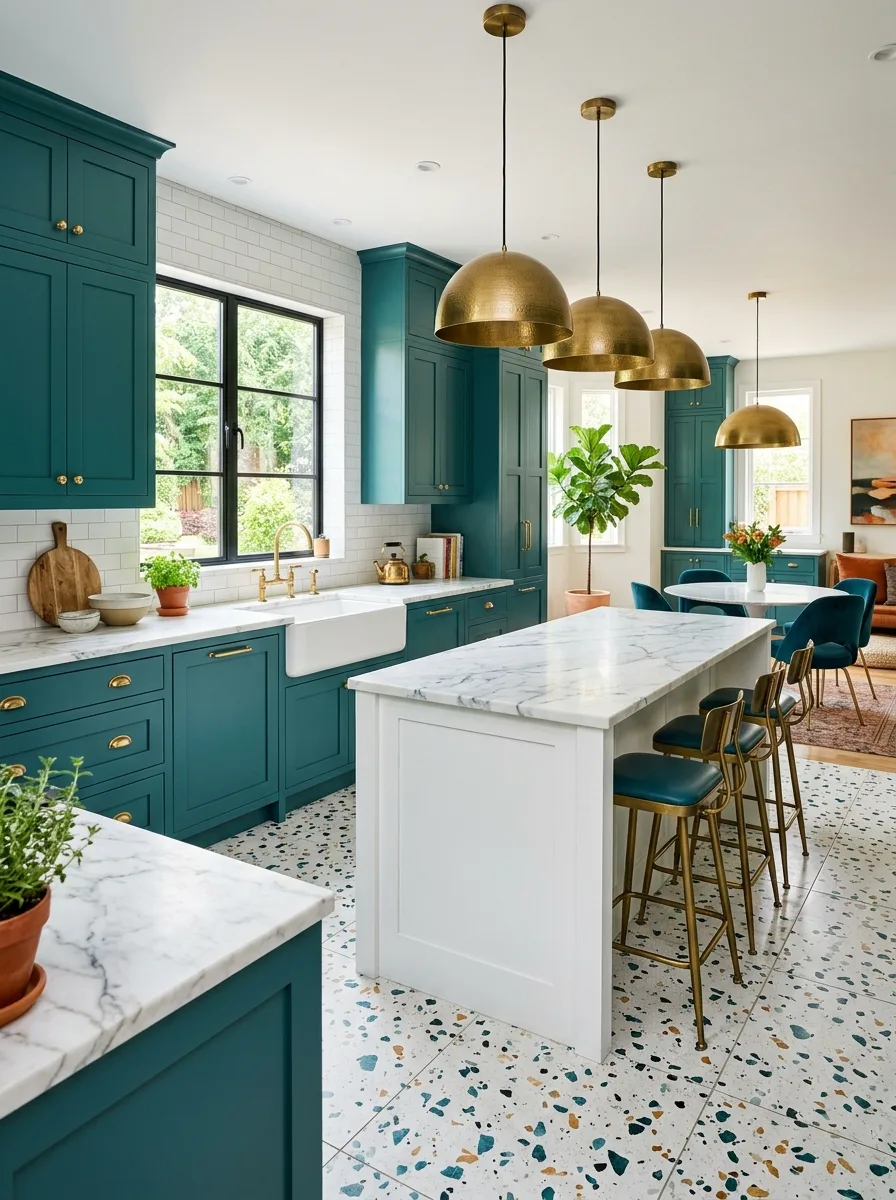
The floor and the pendants need to be decided before anything else, because this kitchen is built around those two elements.
Source large-format terrazzo floor tiles — white or cream ground with multicoloured aggregate chips including teal, ochre, and warm terracotta. The tile should run continuously through the kitchen and as far into the dining zone as the room allows. This is the base; everything above it responds to it.
Paint the cabinetry in a rich teal — the shade should be blue-leaning rather than green-leaning, similar to a peacock or Atlantic colour. Shaker door profile, raised panel, or flat-front all work; the colour is the thing. Brass cup pulls and a bridge tap in aged brass throughout.
The counter should be white marble. The island should also be white-painted — distinct from the teal cabinets — with a marble top, to create a visual break.
Hang four brass dome pendants in a row above the island — hammered or textured brass finish, not smooth, so the surface catches light variably. Space them evenly. They should be large enough that four of them together feel architectural.
Seat the island with velvet-upholstered chairs in matching teal with brass-frame legs. The chair colour linking back to the cabinet colour is what ties the island, despite being white, into the overall palette.
Fluted Island Greige Marble Slab
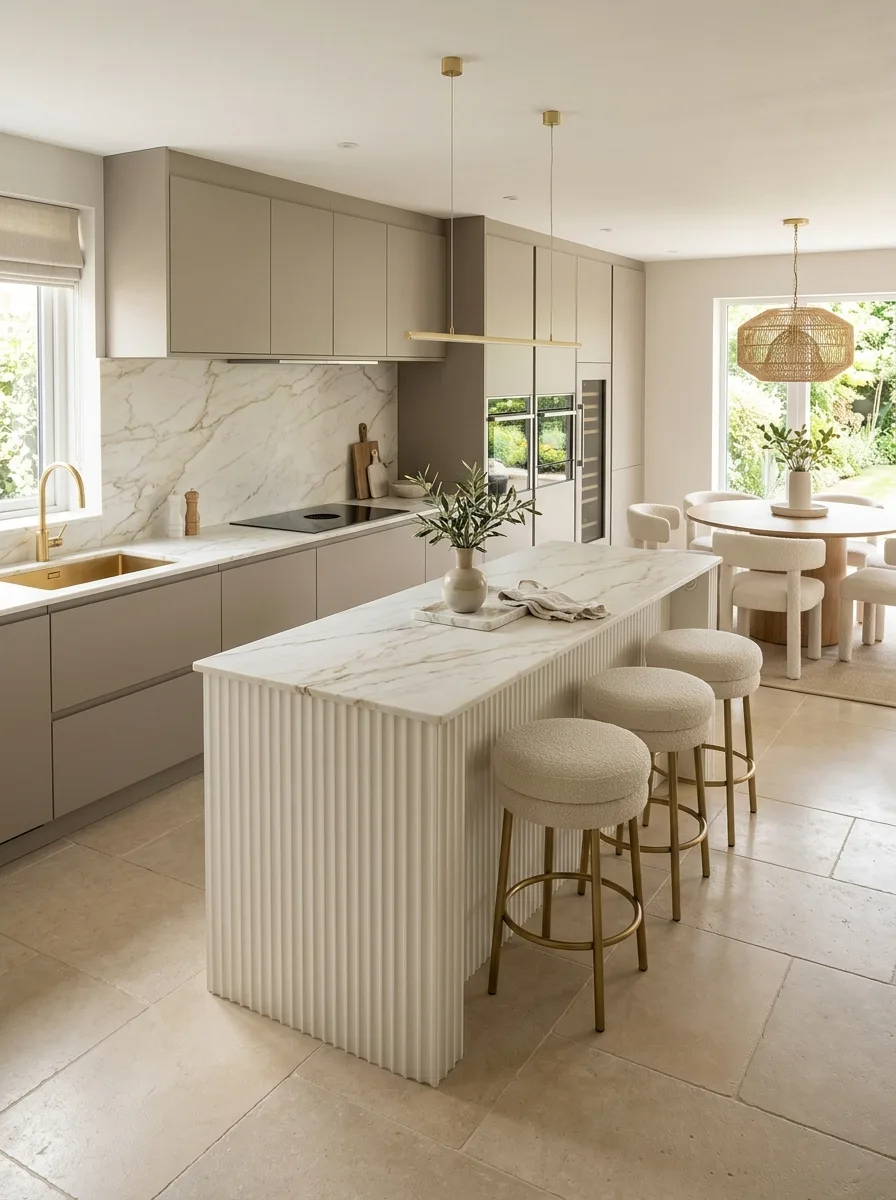
The island base is the design decision that makes this room. Not the marble, not the cabinetry, but the vertical fluting on the island panels.
Build the island with fluted or reeded cladding on all exposed faces — the vertical grooves should run from counter to floor in a crisp, slightly formal pattern. The island base should be painted in a warm creamy white. The counter in Calacatta or Arabescato marble, with expressive gold and grey veining.
The surrounding kitchen run uses flat-front handleless cabinetry in warm greige — a colour that sits between grey and beige with slightly more warmth than taupe. Floor to ceiling. All appliances integrated and invisible. One thin, horizontal brass linear pendant above the island — a single long bar of light in brushed gold.
The floor throughout should be large-format unfilled travertine or limestone in warm cream — minimal grout lines, natural surface variation. The floor material continues into the dining zone where a round marble table on a sculptural base sits with boucle-upholstered dining chairs.
A single large woven rattan pendant hangs above the dining table. It is the only warm, organic texture in an otherwise restrained room — and that contrast is the point.
Navy Gold Zellige Candlelit Dining
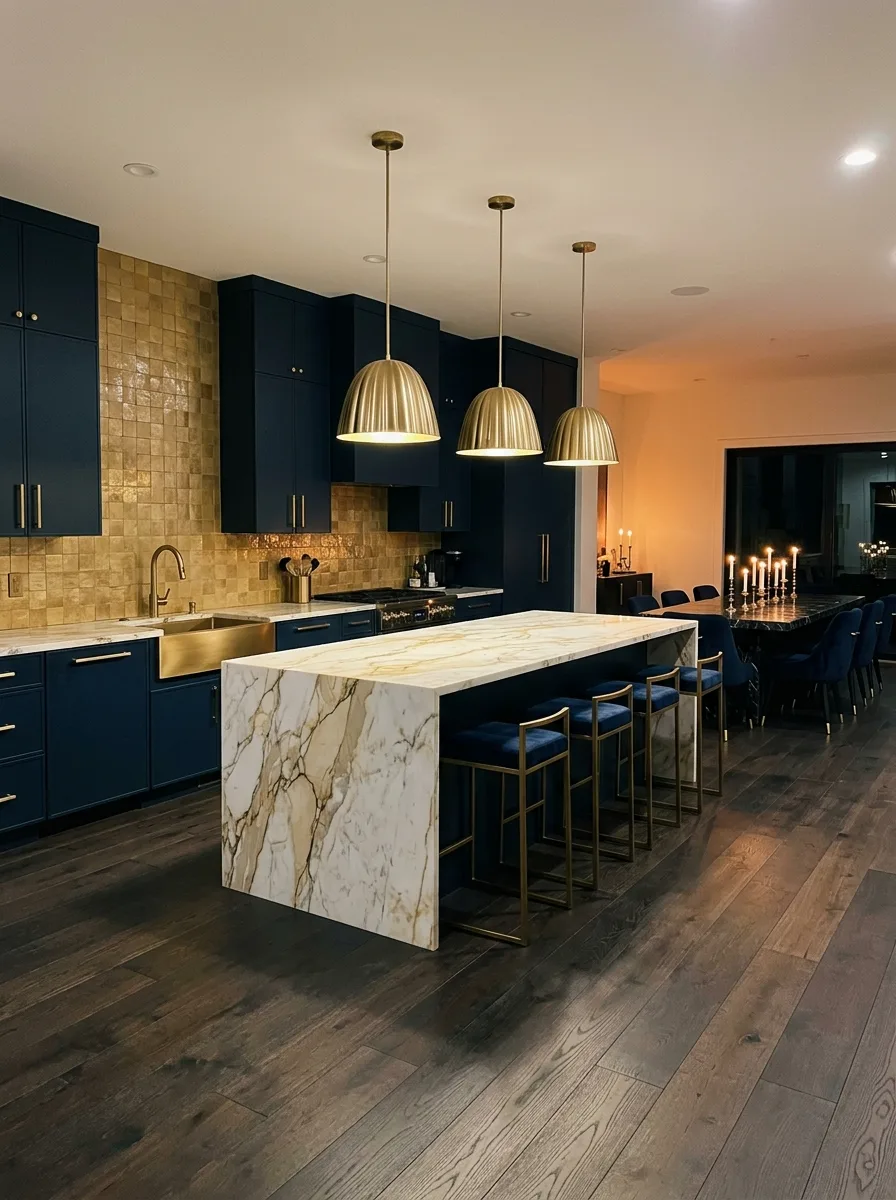
This kitchen at night is a different room from this kitchen in the morning. Design for both.
Use deep navy cabinetry — a blue-black, not a mid-navy — with flat-front doors and integrated brass bar pulls, long and slender. All surfaces in pale Calacatta marble with gold veining. The island should be cladded in the same marble slab from counter to floor, with the most dramatic veining facing the dining zone.
The backsplash is the defining element: gold Zellige tiles — handmade, with uneven surface and a warm bronze-to-gold glaze that catches light differently from every angle. These tiles should fill the entire wall from counter to ceiling behind the kitchen run. In daylight, they read as warm and rich. By candlelight, they read as something else entirely.
Hang three ribbed or fluted brass dome pendants above the island — the ribs should run vertically, so the surface reflects light in bands. Dark hardwood floors throughout, running into the dining zone.
The dining table should seat eight to ten, in dark timber with matching dark chairs upholstered in velvet navy. A row of brass candlesticks with taper candles down the centre. The living beyond the dining zone should be designed for evening use: dark walls, a chandelier, framed artwork. This is not a kitchen for morning people.
All-White Plaster Arch Niche
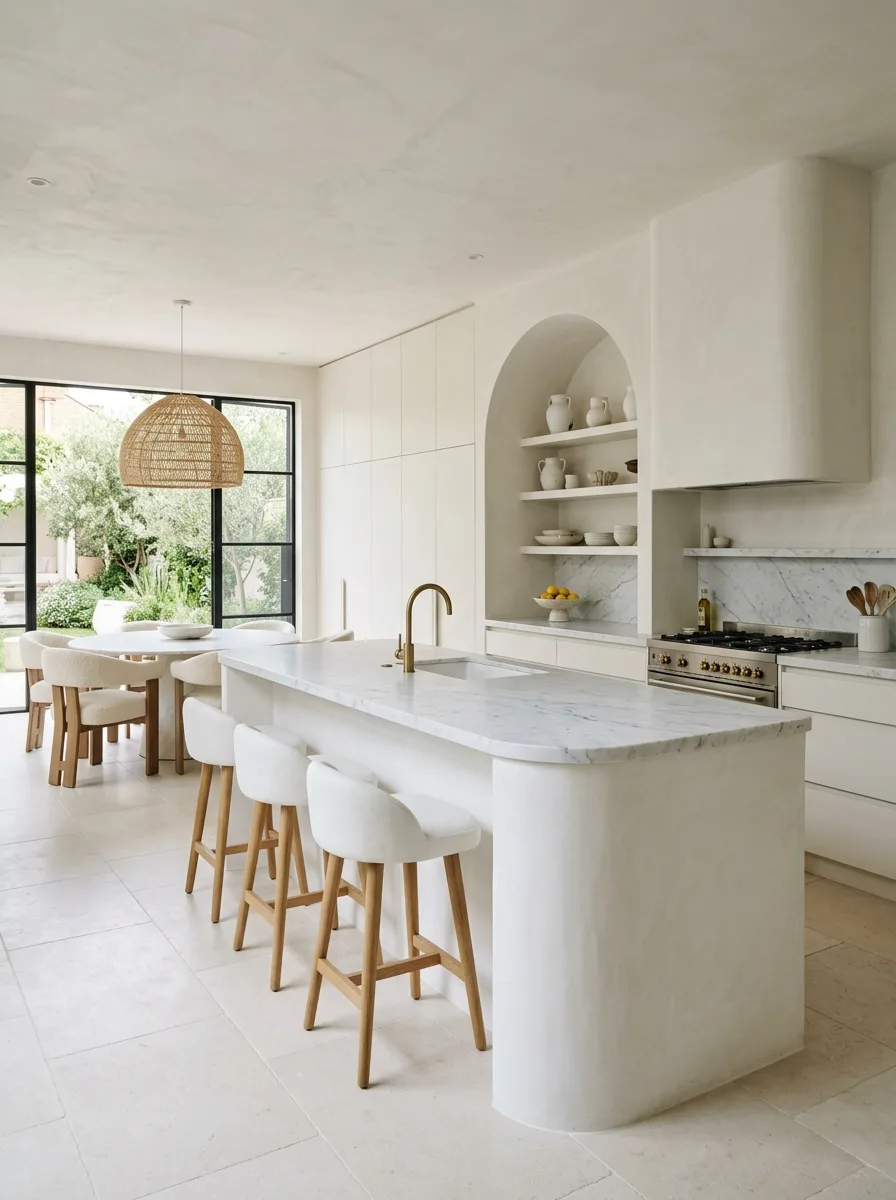
This kitchen is the quietest room in the collection and the hardest to execute.
Every surface in white. Plaster hood, white slab cabinetry, white island, white counter, white ceiling, white walls. Not painted white — applied venetian plaster or microtopping in warm white, so the surface has variation and depth rather than the flat opacity of paint.
The arch niche is the single architectural feature: a rounded-top recess built into the wall beside the range, lined with integrated shelving in the same white plaster as the surround. The shelves hold only white ceramic vessels — simple, handmade, varied in height and form. Nothing coloured.
Build the island with rounded corners — no sharp 90-degree edges. The island should feel like it was formed rather than built. A brass undermount tap fitted directly into the marble top surface. Seat it with low-back boucle chairs on natural oak legs.
The floor is large-format pale travertine or limewash-finish stone tiles throughout. A single large rattan pendant above the island — the only natural material in the kitchen zone, and the one element that provides warmth to the whiteness.
The steel arch window or door at the far end of the dining zone should be visible from the kitchen. The garden beyond it — the green of leaves, the sky — is the colour in this room. Let it be.
Final Thoughts
Every kitchen in this collection solved the same underlying problem: how do you make one large, open space feel like a home rather than a showroom?
The answer is not to fill it. It’s not to match everything. It’s not to choose a theme and apply it like wallpaper to every surface.
The answer is to make decisions — about the floor, the boundary, the one material that runs through both spaces — and then let the room develop from those decisions rather than imposing a finished look onto an empty shell.
The rooms here that work best are not the most decorated. They are the most decided. They knew what they were before a single piece of furniture arrived, and that knowledge shows in every choice that followed.
That’s not a design philosophy. It’s just what good rooms have in common.