
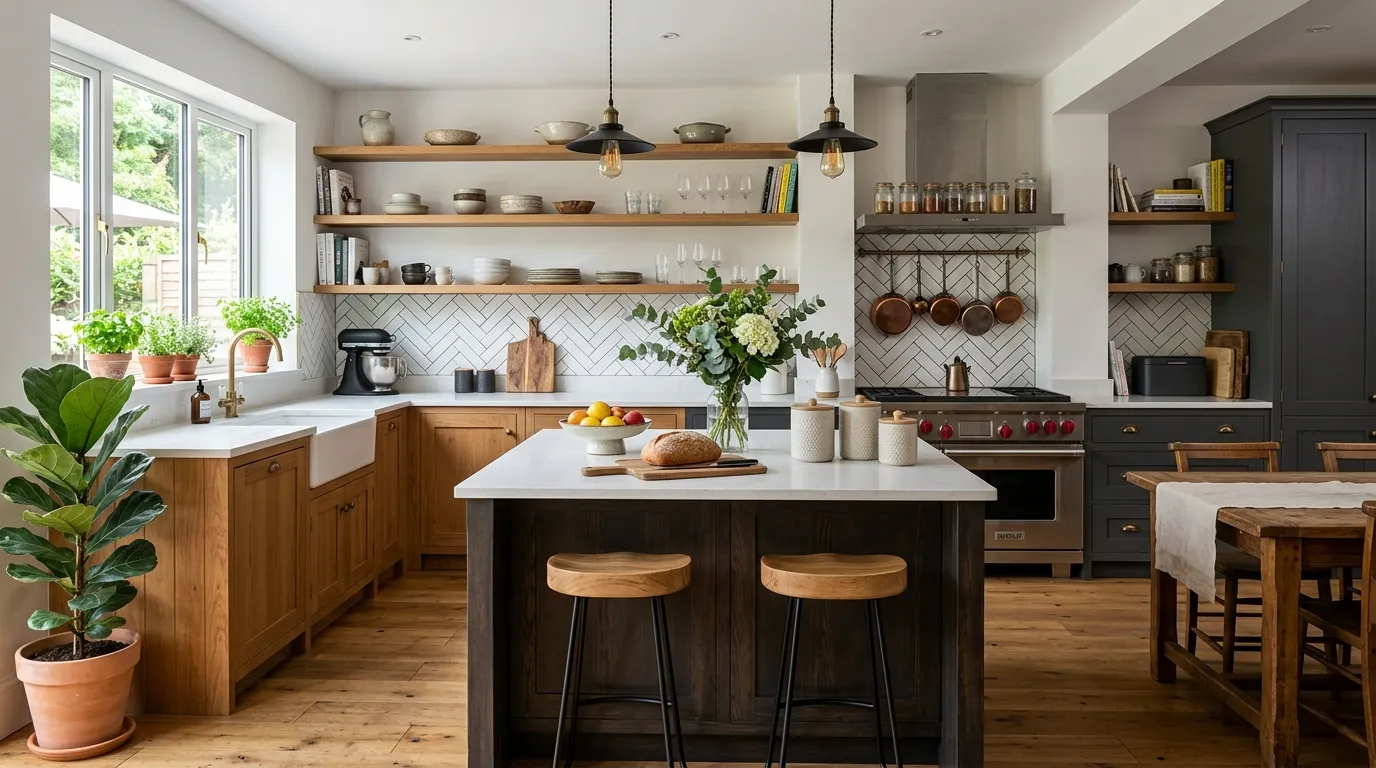
The kitchen is the one room in your house that has to earn its keep every single day. It gets used, it gets looked at, it gets judged by every person you’ve ever invited over. It cannot afford to be boring.
And yet. Walk into most kitchens and you’ll find the same thing: white shaker cabinets, stainless steel pulls, a subway tile backsplash installed without conviction. A kitchen designed by someone who googled “safe kitchen ideas” and clicked the first result. A room that has no opinion about itself.
The images in this post have very strong opinions about themselves. Some are quiet. Some are loud. A few will make you reconsider every decision you’ve made since 2015. All of them committed to a direction and then kept going until it worked.
Your kitchen deserves the same treatment.
The Design Principles Nobody States Out Loud
Contrast Is the Thing That Makes a Room Work
A kitchen with no contrast has no tension. No tension means nothing to look at.
The rooms that stop you mid-scroll all have at least one moment where two very different things are placed directly next to each other. Dark, moody cabinets with warm copper pans. Crisp white with matte black fixtures. Terracotta floors under cream cabinetry. The contrast is not an accident. It’s the decision.
Contrast does not have to be dramatic. It just has to be present. Even a very quiet kitchen needs at least one element that pushes back against everything else — a dark pendant over white surfaces, a weathered wood shelf against smooth tile, a single warm-toned flower on a cold countertop.
The Floor Is a Design Decision, Not a Default
Most people match their kitchen floor to whatever’s in the rest of the house, or they pick whatever was cheapest, or they assume no one notices. All three of these are mistakes.
The floor is roughly 30 percent of what you see when you look at a kitchen. Hexagonal terracotta tiles will transform the entire mood of a space. So will wide-plank warm oak. So will pale limestone squares. The floor anchors everything above it, and a kitchen built on the wrong floor will always feel slightly off, regardless of how good the cabinets are.
Texture Is the Difference Between Flat and Finished
A kitchen that reads as flat has usually made one of two errors: everything is the same finish, or every surface is smooth.
Zellige tile behind dark cabinets works because the handmade tiles have an uneven, light-catching surface that smooth subway tile does not. Raw brick behind shelving adds depth to a dark kitchen in a way that painted plaster never could. A rough-hewn butcher block counter next to a matte painted cabinet creates a relationship between surfaces. Texture is what makes a room feel built rather than installed.
Aesthetic Kitchen Design Ideas
Rustic Stone Arch Window Manor
The arched windows are doing most of the work. If your windows are not arched, building this look requires installing steel arch inserts into existing window openings — a structural intervention, but a transformative one.
The window framing should be black steel, with multi-pane glazing that breaks the window into small sections. Arched at the top, rectangular at the body. Two or three of these windows side by side will turn the kitchen into something entirely different from its original form.
Build a stone surround on the left wall — actual rough-laid fieldstone or limestone, floor to ceiling, as a feature chimney-breast or column beside the range. The stone should have visible mortar, visible variation in size and tone, and no surface sealing. It should look structural.
Use dark charcoal-grey or near-black cabinetry throughout — traditional raised-panel doors with period hardware in oil-rubbed bronze or black iron. A butcher block island top in wide-plank oak.
Expose ceiling beams in reclaimed oak — square-section, not rounded, with visible marks and colour variation from prior use. The beams should run perpendicular to the main window wall.
Fill windowsills and the counter beneath with potted herbs and ferns in terracotta. A large bunch of cream or yellow flowers in a glass vase on the island.
Zellige Forest Green Drama
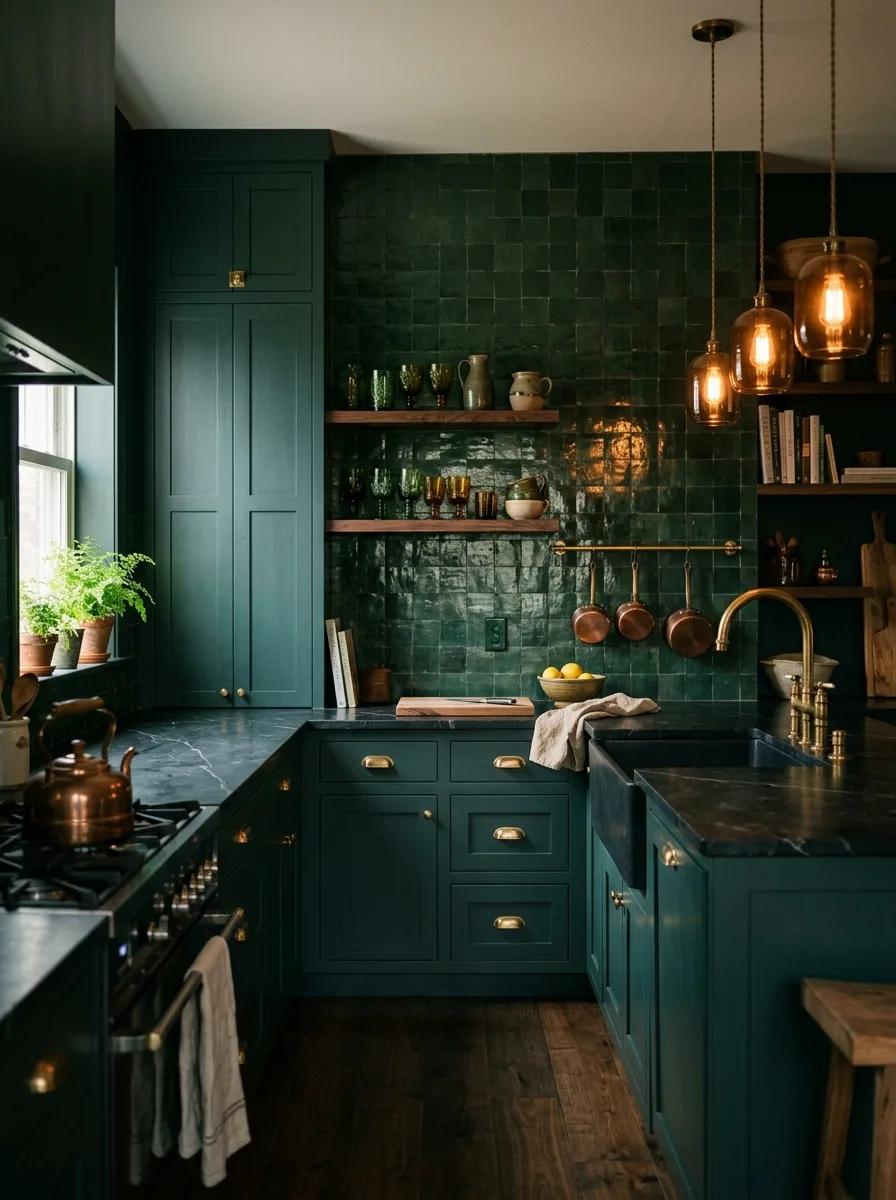
This kitchen commits to one colour and uses it everywhere — walls, cabinets, tile — and then allows three specific materials to provide all the contrast: dark walnut wood, aged brass hardware, and copper cookware.
Start by painting every cabinet surface in a deep forest or teal green with an eggshell finish. Choose a Zellige tile in the same colour family for the backsplash. Zellige is made in Morocco by hand, which means each tile is slightly different in depth and finish — this gives the wall a texture that reads as almost luminous under pendant light, rather than flat.
Float two walnut wood shelves against the tile, positioned at eye level. Keep the shelf contents simple: earthenware vessels, coloured glassware, a few cookbooks. Nothing matching, nothing too precious.
Install copper pans on a brass rail above the cooking area. Use amber glass pendants — the same shape as frosted lantern pendants but with visible Edison-style filament. Dark hardwood flooring throughout. The floor should be rich brown or ebony, not warm honey; the contrast with the green needs to have weight to it.
White Floral Galley Garden Door
This kitchen’s defining feature is the glass door at the end of the galley — and the way everything in the kitchen frames a view of the garden beyond it.
Choose a full-length glass door with a traditional pane layout — not a solid sliding door, but a hinged French door with glass from knee height to top. Paint the door and its surround in pure white to match the cabinetry. Allow the garden to be the colour in the room.
Use raised-panel white cabinetry throughout with gold or brass hardware — ornate, period-appropriate pulls rather than flat contemporary bar handles. Install tongue-and-groove panelling on the upper walls and ceiling, painted white throughout.
Hang dusty pink floral curtains at the door — light cotton or linen with a small-scale flower print in pale pink on cream. Mount them on a brass rod just above the door frame. The curtains should be slightly longer than the door opening and full enough to gather when open.
Position large bunches of fresh flowers on both counters — heavy, overgrown arrangements that spill over the edge of the container slightly. Mixed pink and white blooms with trailing greenery.
Keep the shelving minimal and white: a few glass storage jars, small botanical sprigs, and nothing else. Let the flowers do the decorating.
Inky Navy Marble Herringbone
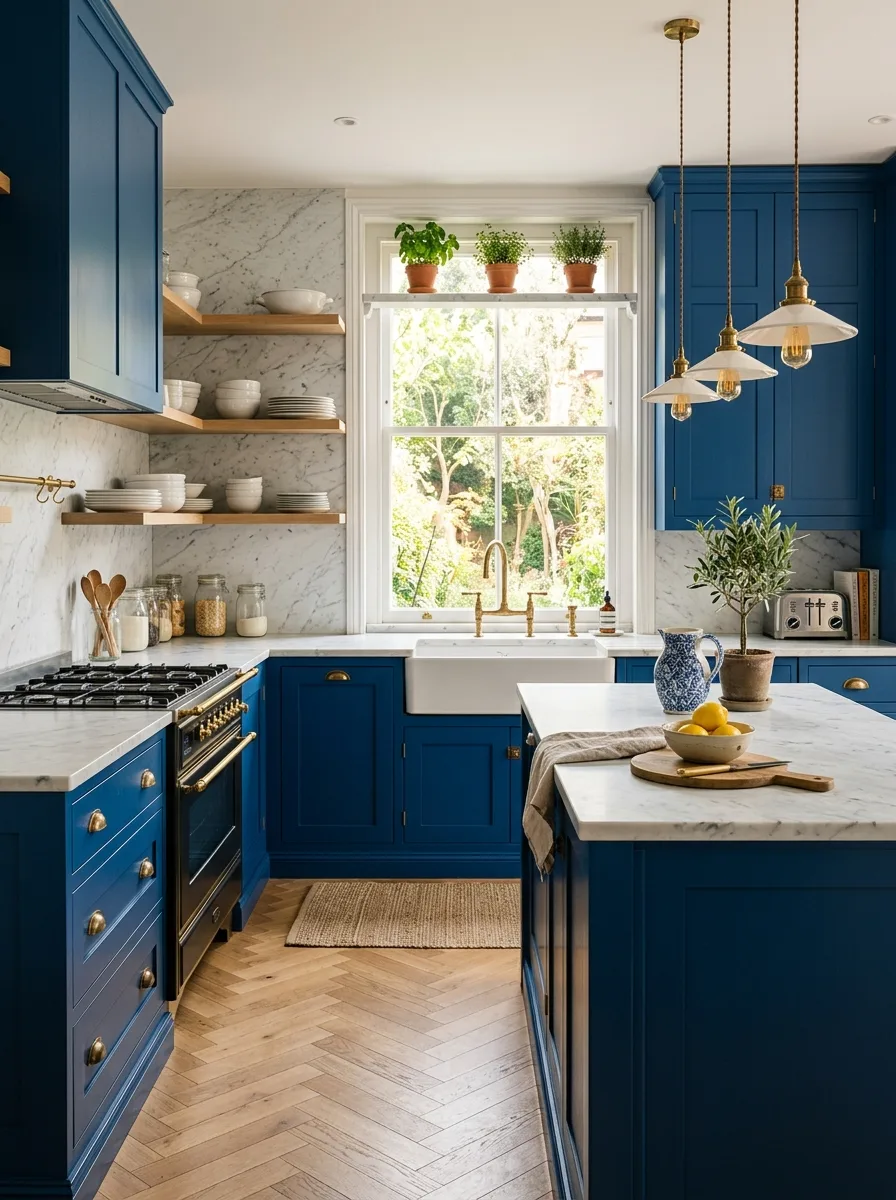
This kitchen’s defining structural decision is the herringbone timber floor. It does more work than the colour.
Lay a light oak herringbone floor — the wood tone should be warm blonde, not orange — and then build the entire kitchen upward from it. The contrast between the light geometric floor and the dark navy cabinetry is what gives the room its energy. The floor is not incidental; it’s the thing people notice first.
Paint every cabinet surface — uppers, lowers, island — in a deep, slightly muted navy. The blue should lean towards the grey spectrum rather than bright royal blue; think ink or midnight rather than cobalt. Pair with brass cup pulls throughout.
Use a slab marble backsplash carried all the way up to the ceiling — not tile, but large-format slabs with visible movement in grey and white veining. The marble should be continuous, uninterrupted by grout lines, from counter to cornice.
Install a herringbone oak floor, then anchor the island with three mismatched pendants — two matching milk glass wide-shade pendants and one exposed Edison bulb for asymmetry. Float two open oak shelves against the marble for white dishes and a few glass storage jars.
Outside the window, put herbs in terracotta pots on the sill. They are the only warm element and they belong there.
Sage Trim Banquette Corner
The architectural trim colour is the whole decision. Paint the window trim, door frame, crown moulding, and baseboard all in the same sage green — not the walls, just the mouldings. The walls remain white. The contrast between white wall and green trim turns every window and door in the room into a framed artwork.
Build a banquette into the corner where the kitchen meets the dining area. The seat base should be built-in, painted to match the green trim, with an upholstered seat pad in a thin blue-white stripe — ticking stripe or seersucker, not a bold print. Use the space beneath the banquette for storage with simple push-open drawers.
Position a round pedestal table with a ribbed or turned base at the centre of the banquette. One bistro chair pulled up on the open side. The pedestal shape of the table keeps the space from feeling too heavy.
Use matching green on the kitchen cabinetry and the island base — the whole room should feel like one continuous palette. White walls, white counters, sage everything else.
Hang a ruffled linen pendant above the banquette — a soft, shade-style pendant in natural undyed linen. Hang a second pendant, more architectural and traditional, above the island. The two different pendant styles are intentional.
Matte Black Gold Dome Kitchen
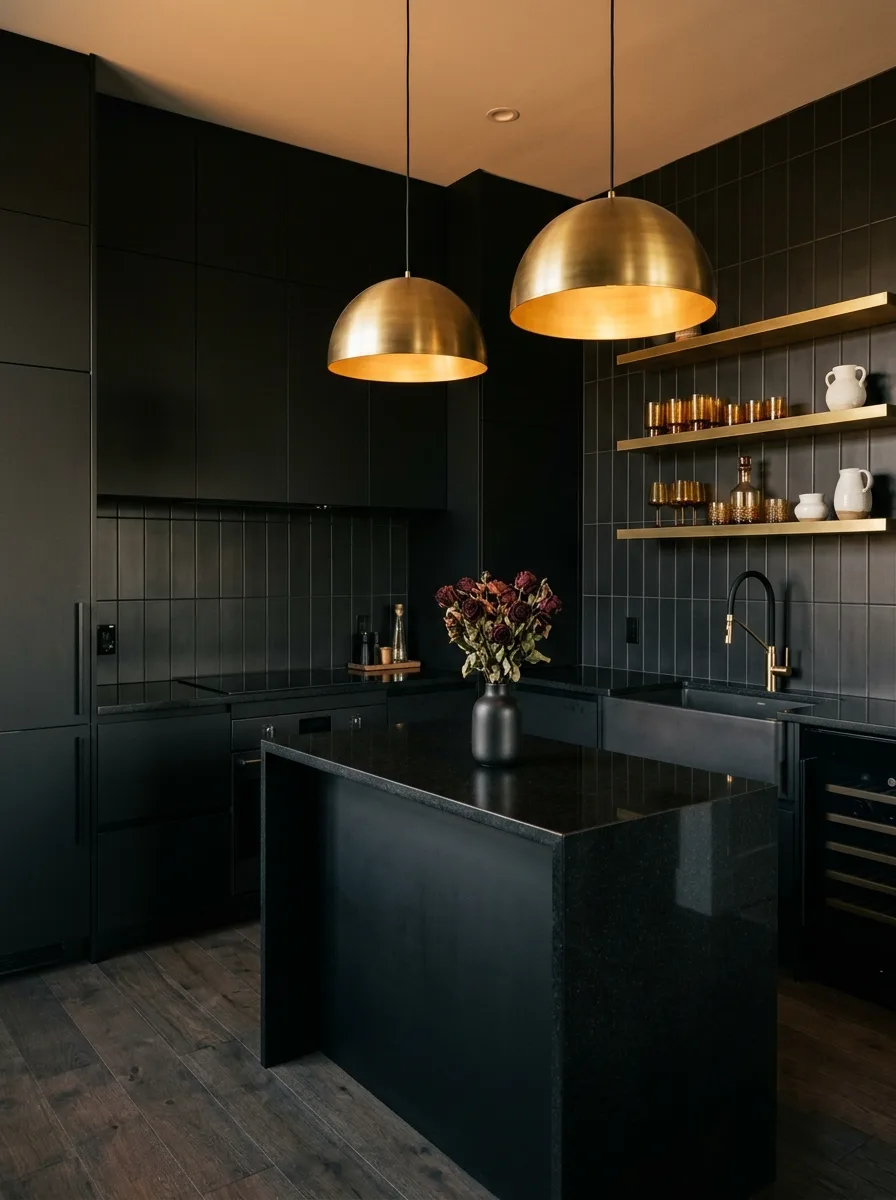
This kitchen removes every colour but black, dark charcoal, and gold. Nothing else. That’s the whole design.
Use flat-front handleless cabinetry in matte black — not glossy, not ebony wood, but true matte painted black. All surfaces. Floor to ceiling. The backsplash should be a narrow-format vertical tile in matte near-black — the tile grout should be black so the tile pattern shows only as texture rather than a grid.
The island top and counter should be a dark, near-black granite or quartzite with minimal veining — you want a surface that reads as almost matte in lower light. No white counter, no marble; this kitchen does not want contrast at the surface level.
Hang two dome pendant lights directly above the island — large scale, polished brass on the outside, warm gold on the interior. These are the statement pieces and they need to be large enough to command the space. The interior gold finish will bounce warm light downward across the counter.
Install brass open shelves — the shelf itself in brushed brass — on the right-hand wall. Place only a small number of objects: amber glassware, a white pitcher, one ceramic vessel. The restraint on the shelves matters; this kitchen earns its drama through editing.
Place dark dried roses or wine-coloured peonies in a matte black vase on the island. This is the only organic element in the room and it should be the only gesture toward the natural world.
Dark Conservatory Greenhouse Kitchen
This is a kitchen under a glass roof. The structural requirement is a lean-to or full conservatory addition — a glazed steel frame built against the back of the existing house, with glass panels in the roof and walls.
Use black powder-coated steel for the frame — every visible structural element should be flat black. The glazing panels should be clear, allowing full light penetration and a direct visual connection to the garden and sky above.
Keep the kitchen cabinetry in dark charcoal or near-black — flat-front, minimal, with antique brass hardware. The counter should be a warm-toned stone or granite in amber-brown — not black, not white, but something that reads as organic against the dark cabinetry and exposed brick.
Leave at least one interior wall in exposed brick. Do not seal it, do not paint it. The brick is the texture that makes the dark conservatory feel grounded rather than gothic.
Float raw timber shelves across the brick wall — reclaimed planks on metal brackets. Fill them with preserving jars, brown-glazed stoneware, copper pans, and fresh herbs still in terracotta pots.
Build a rustic wooden bench or long farm table along the glazed wall — rough-hewn timber on simple wooden legs. Place potted herbs, basil, and cut vegetables directly on the surface. Let the garden grow up against the outside of the glass.
Brass Rack Cream Cabinet Glow
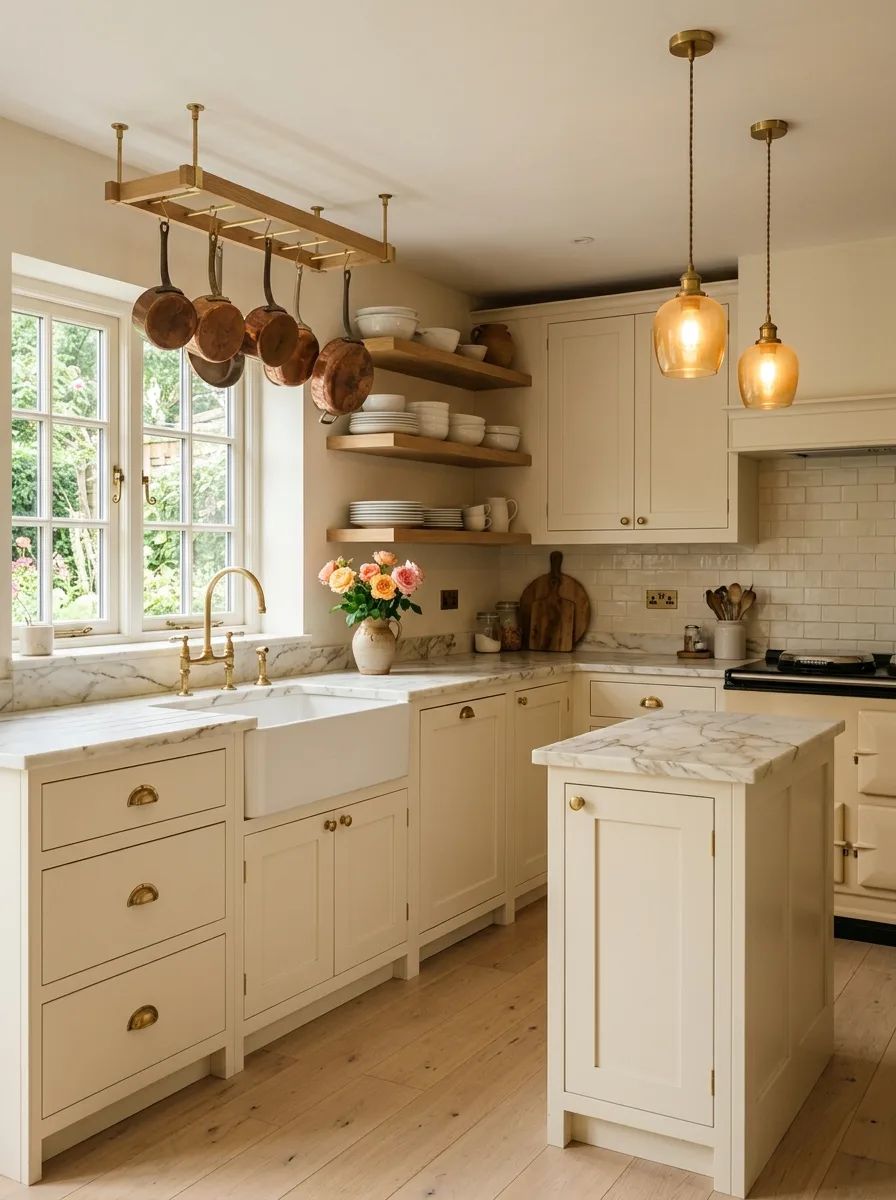
Mount a rectangular brass pot rack flush to the ceiling using threaded brass rods, positioned directly above your prep area between the window and the cabinetry. The rack should be proportional — roughly the width of your sink base or slightly wider, and no more than 30cm deep. Hang copper or dark steel pans at varied heights using S-hooks, with the longest handles visible from across the room.
Paint your cabinets in a warm off-white — think raw linen or aged parchment rather than bright white — and pair with brass cup pulls throughout. The warmth of the brass and copper reads as a single material family without being matchy.
Use marble counters with visible veining and float two or three solid oak shelves in the corner for white ceramics. The shelf material should be untreated or lightly oiled, not stained.
Add amber glass pendant lights above the island — the glass should be warm-toned, not clear, so the bulb light takes on colour. A single fresh flower arrangement in a ceramic pitcher on the counter is the one piece of colour this kitchen needs.
Full Maximalist Pink Kitsch Display
The shelving unit built into the cabinetry is the key structural piece. It should be an open-front built-in, floor-to-ceiling or close to it, with three or four shelves, positioned between the window and the main cabinet run. Paint the interior of the shelves and the back panel in the same pink as the cabinets — everything the same colour so the objects on the shelves read as three-dimensional against a flat background.
Paint every single surface in the kitchen the same candy pink — cabinetry, walls, ceiling if you dare. Use gold hardware throughout: flat bar pulls and round knobs in brushed or satin gold. The counter should be in a neutral, low-contrast material — a warm grey laminate or light concrete-effect surface that doesn’t compete.
Fill the shelves with the most joyful, unmatched ceramics you own: novelty mugs shaped like animals, hand-painted bowls in every colour, figurines, cake stands, small planters. Nothing should match. The arrangement should look genuinely personal, not curated.
Add colour-coordinated appliances where possible — a pastel toaster oven in a peach or coral tone that reads as retro. A pink-toned dish rack beside the sink. A gingham or checked cutting board in red and white.
The ceiling light should be a small gold spot cluster. It adds sparkle without competing with the colour.
Japandi Black Fixture Simplicity
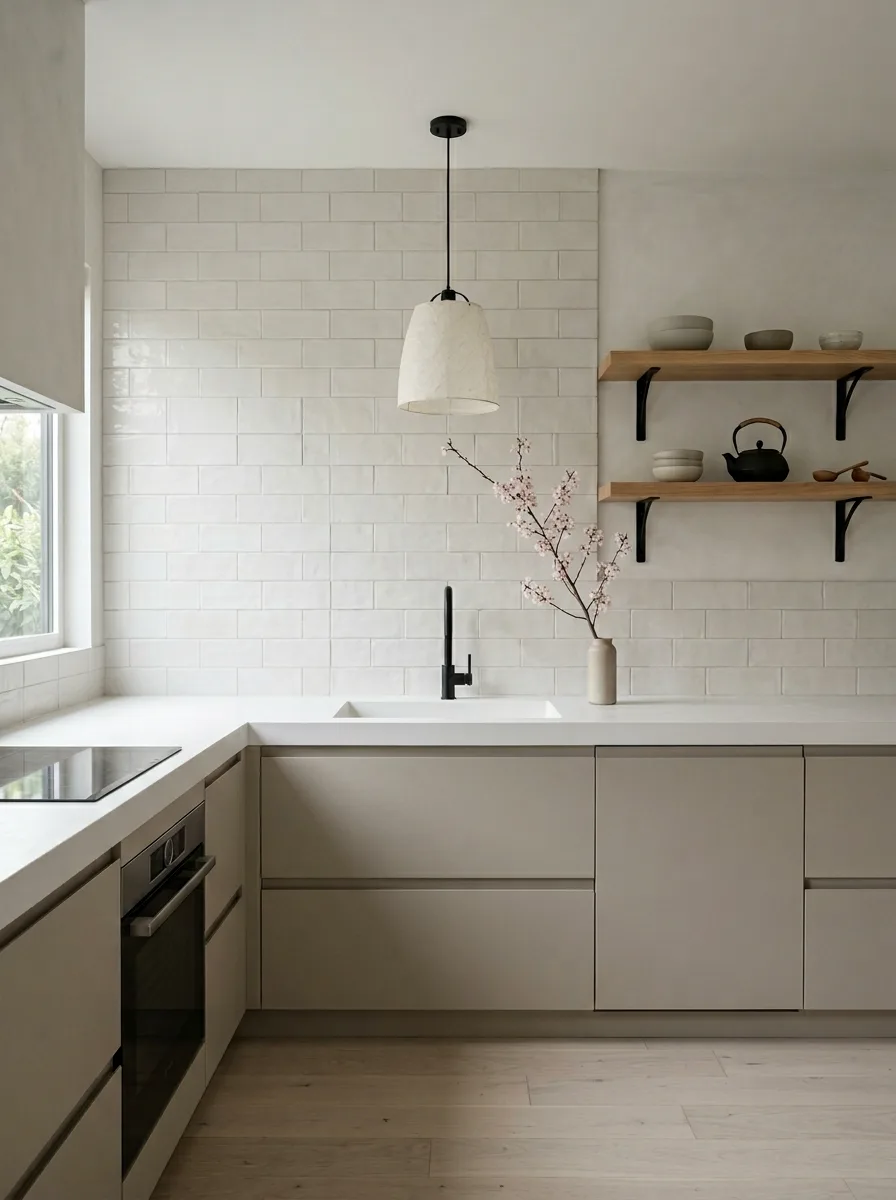
Choose handleless flat-front cabinetry in a warm greige — not beige, not grey, but a colour that sits exactly between the two. A dusty mushroom or pale sand reads correctly. The finish should be matte.
Install a white subway tile backsplash but use slightly larger tiles than standard — closer to the proportions of a brick than a classic subway — with a slightly uneven handmade finish that catches light differently depending on the time of day. Do not use bright white grout. Use an off-white grout in a shade one or two tones darker than the tile.
Choose a single matte black pendant — pendant shape, not industrial, not cage — in white concrete or plaster, hung low enough over the sink to be visible from across the room. All fixtures including the tap should be matte black. This is non-negotiable; mixing black with chrome here will kill the look.
Place raw oak shelves with black metal brackets above and to the right of the sink. The shelves should hold only a few things: a matte cast iron kettle, a small stack of ceramic bowls in neutral tones. One slender vase with a single cherry blossom stem.
The floor should be pale, washed oak. Light wood underfoot will lift the room and soften the contrast between the warm cabinetry and the cool tile.
Provençal Hanging Herb Kitchen
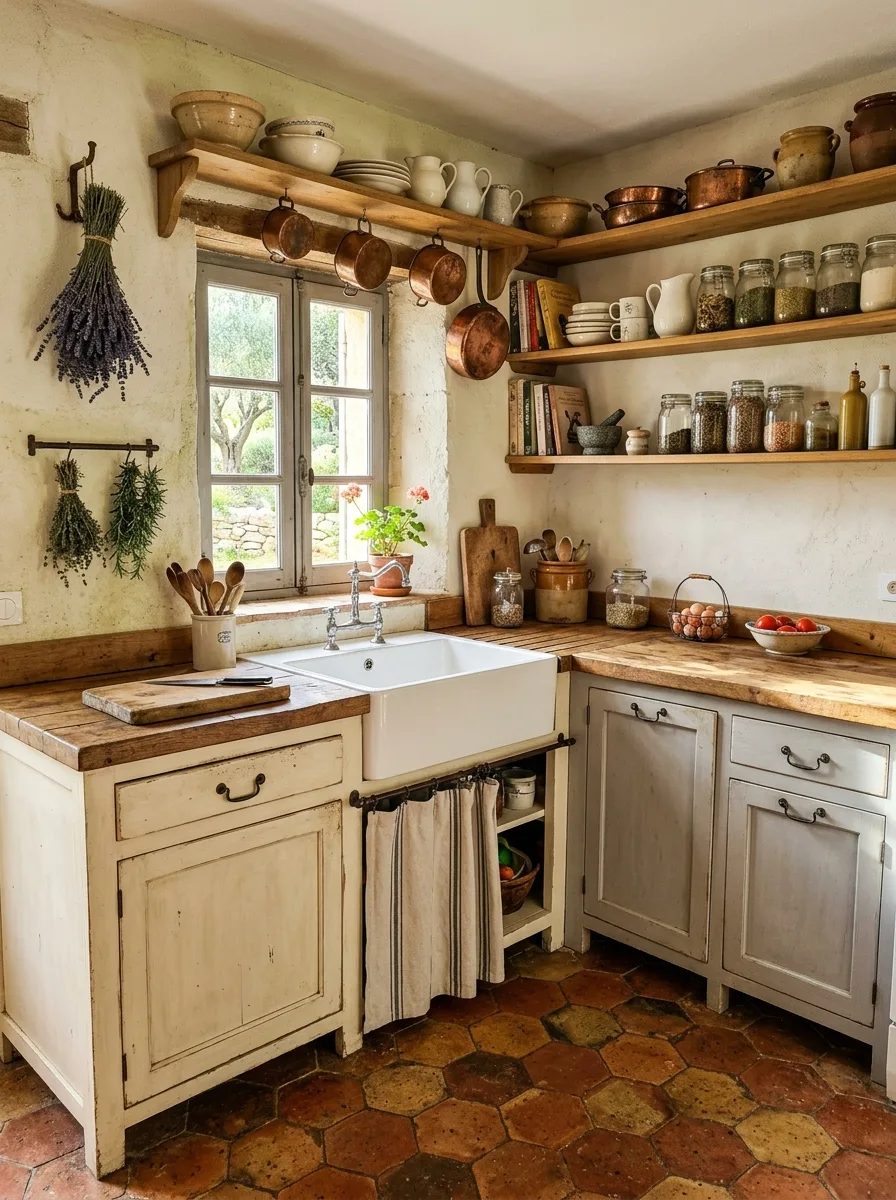
The defining move here is abandoning upper wall cabinets in favour of shelving, hooks, and a pot rail built into the shelf bracket itself.
Install chunky, rough-sawn timber brackets into the wall above your sink window — the kind with visible nail holes and evidence of previous life. Float planks across them, spaced at irregular heights. Do not sand or stain; the wood should look like something from a barn, not a furniture shop.
Hang bunches of dried lavender, rosemary, and thyme from a simple iron bar mounted to the wall beside the window. The bar needs only two hooks and a length of flat iron. Hang three to five bunches at slightly varied heights.
Use an apron-front farmhouse sink set into a freestanding base unit — the cabinet beneath the sink should have a linen or ticking-stripe curtain on a thin rod rather than doors. The curtain slides along the rod; no ties, no fuss.
The floor should be original terracotta hexagon tiles — the kind with colour variation from years of use. If they’re new tiles, buy the handmade variety with deliberate tonal inconsistency. Cover the countertop in thick reclaimed timber — not butcher block, but a single plank of aged oak that overhangs the cabinet by at least two centimetres.
Fill the shelves with glass storage jars, copper pans, mismatched ceramic bowls, and a geranium in a terracotta pot on the windowsill.
Plaster White Pampas Quiet
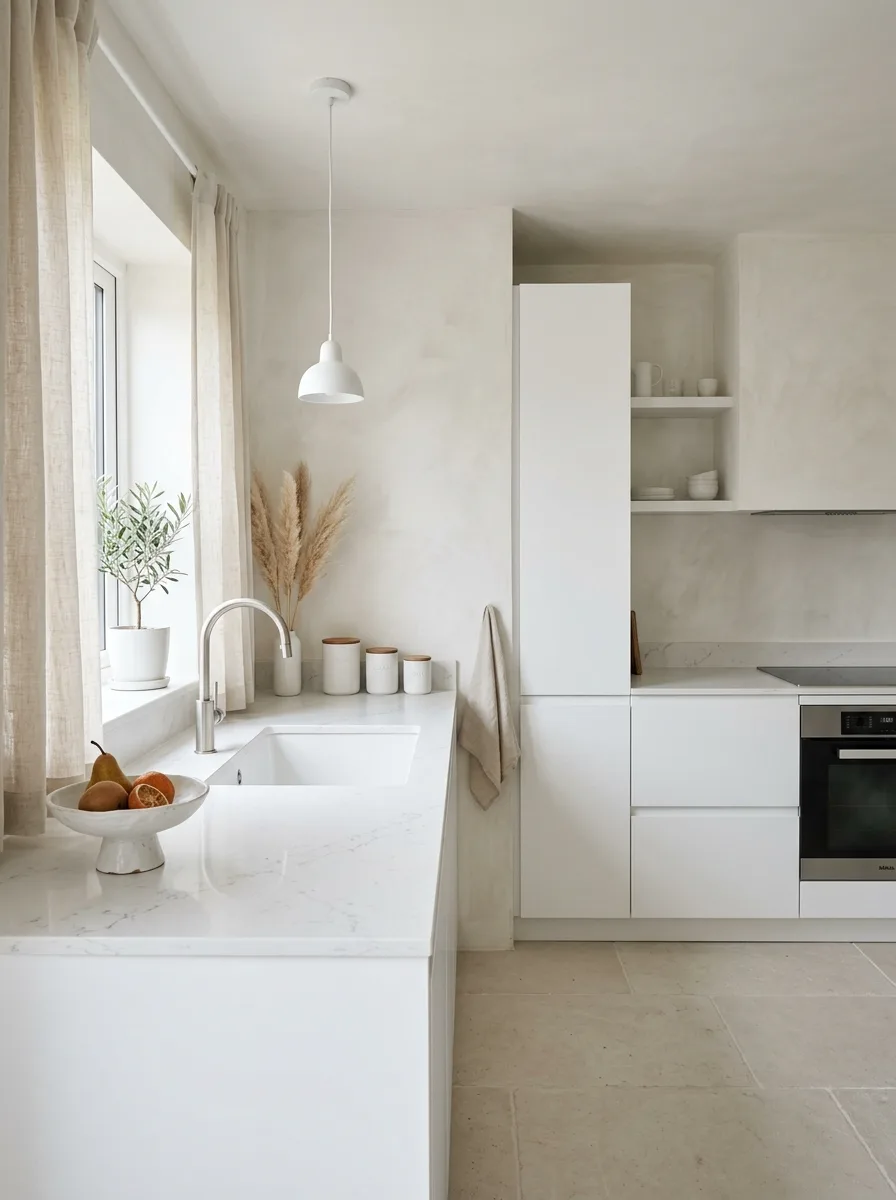
This is a kitchen built entirely on tone. Everything — walls, cabinets, counters, pendants — operates within the same very narrow range of warm white to pale cream, and the restraint is the point.
Apply a limewash or venetian plaster finish to the walls in pure white. The texture matters: a smooth painted wall in the same colour will look sterile. The plaster should have visible movement and depth, with lighter highlights and slightly warmer recesses. This is what makes the room feel soft rather than clinical.
Use handleless slab-front cabinetry in warm white with an integrated undermount sink — the counter, sink, and cabinet should all read as one continuous surface. Choose flat stone floor tiles in a very pale beige — large format, minimal grout lines. The floor should almost disappear.
A single white pendant above the island — the classic factory or dome shape — hung on a white cord from a white ceiling. No metal finish visible.
On the counter: a small olive tree in a white ceramic pot, a bundle of dried pampas in a matte vase, three stackable ceramic canisters with timber lids. Nothing else. The restraint on the counter is essential — this kitchen earns its visual calm by editing ruthlessly.
Use linen curtains at the window — unlined, in natural undyed linen — that let daylight diffuse through them. This is the one textile in the kitchen and it does significant work.
Sage Shaker Butcher Block
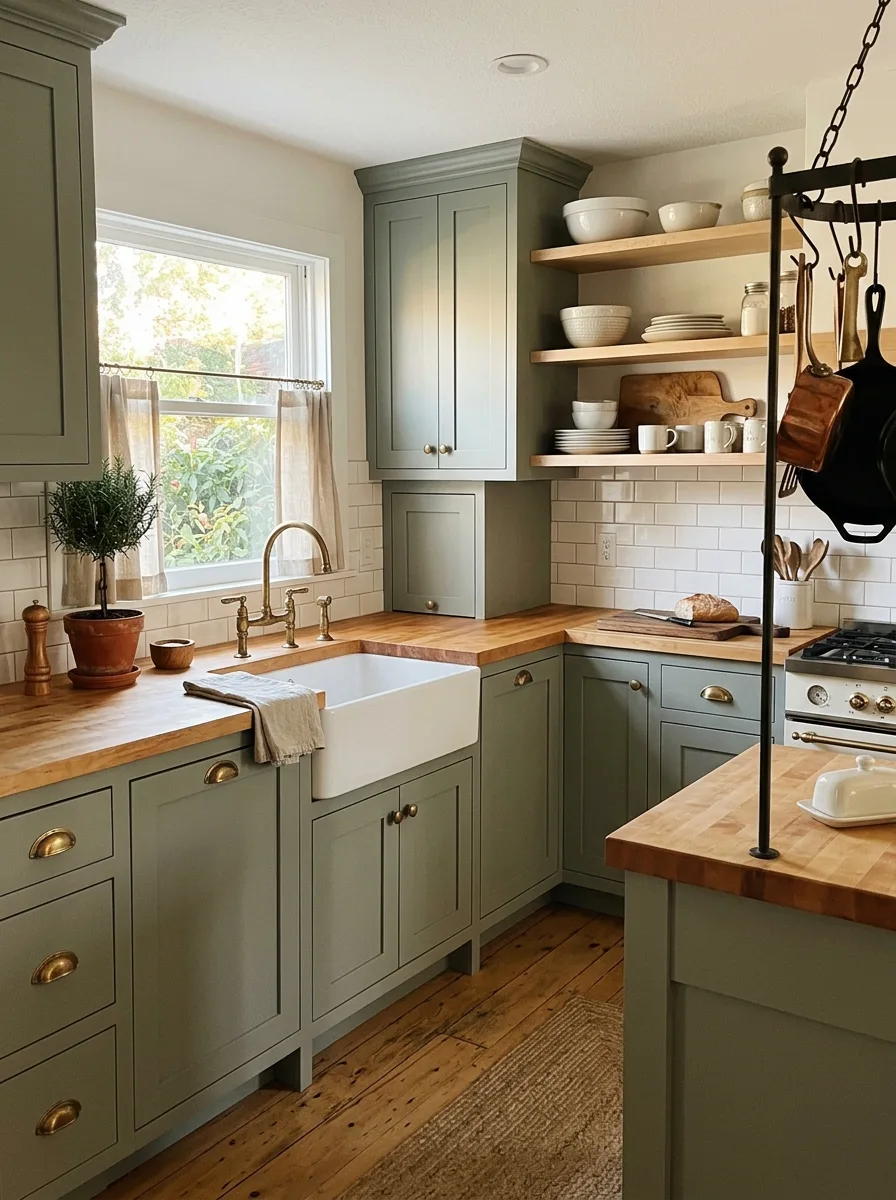
Choose sage green or khaki green for every cabinet — a muted, slightly dusty tone, nothing bright. Shaker door profile throughout. Brass cup pulls on every drawer, brass knob pulls on every door. All the same hardware family; no mixing.
The counter is butcher block, sealed to a satin finish — warm honey oak is correct here, not maple, not walnut. The warmth of the wood against the cool-neutral green is the entire visual relationship of this kitchen.
Mount a cast iron pot rack directly above the island using chain and a ceiling-mounted cross bar of black iron. Hang cast iron skillets and copper pans at the ends. The rack should be black iron, not brass, because this kitchen already has brass everywhere else and the black introduces the one note of contrast.
Use white subway tile for the backsplash in a standard horizontal stack pattern — keep it simple, the colour and the wood do the work. Install open oak shelves in the corner for a small collection of white ceramics and a few cookbooks. Thin linen cafe curtains on the window, hung at the sill only.
Wide-plank pine floors — original if possible, pale and worn, with visible knots. A small rosemary plant in a terracotta pot is the only thing on the windowsill.
Maximalist Talavera Tile Collision
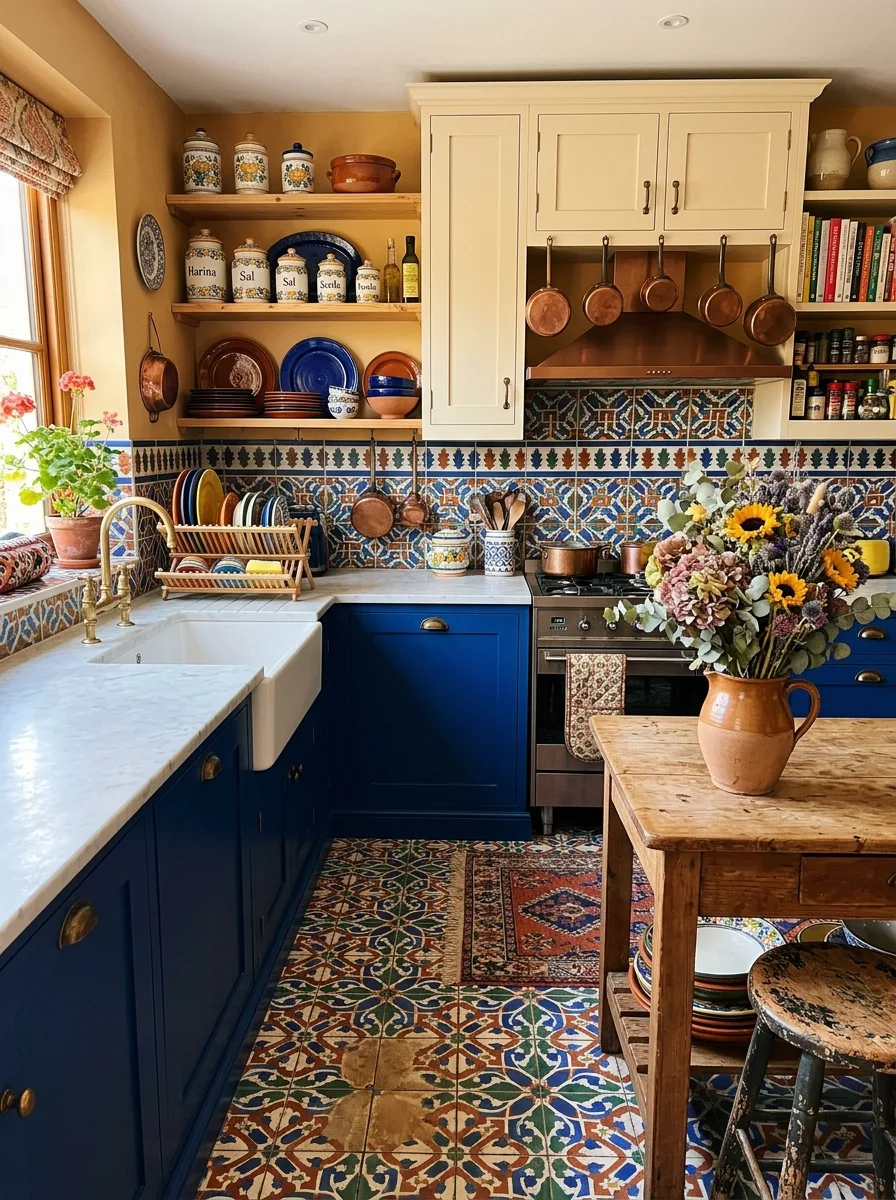
The backsplash and floor need to match in pattern without matching in colour, and the whole thing should feel like the kitchen was not decorated so much as it accumulated.
Source Talavera tiles — traditional hand-painted Mexican or Spanish tiles in a geometric pattern with cobalt blue, terracotta, ochre, and white. Install them as both the backsplash and the floor in slightly different patterns. The floor tile should be larger format than the wall tile; running the same tile on both surfaces at the same scale will make the room feel busy rather than layered.
Paint the lower cabinets in deep navy and leave the upper cabinetry in cream. The two tones of cabinet break up the pattern without competing with it. Install brass hardware throughout — aged brass rather than bright.
Float three tiers of raw open shelves above the counters on the left wall. Fill them with Talavera pottery, painted Spanish canister sets, terracotta plates, copper pans on a rail below the hood, and a geranium on the windowsill. The shelves should look like they’ve been collected over decades, not curated in one afternoon.
Use a farmhouse sink and a bridge tap in brass. Place a reclaimed pine worktable at centre as an island — rough, worn, with stretcher rails. Put an oversized terracotta jug of mixed flowers — sunflowers, eucalyptus, lavender — on the table.
Dusty Rose Ribbed Glass Cabinet
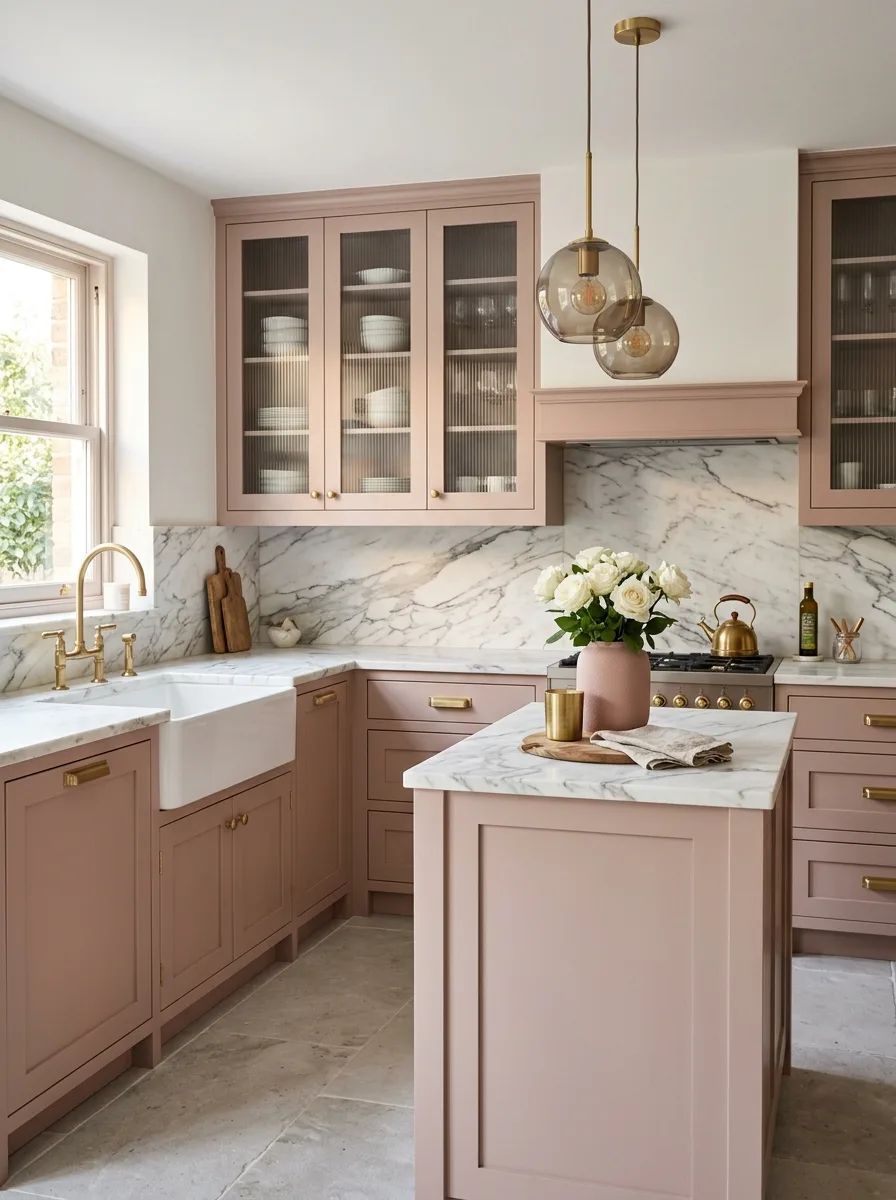
The upper cabinet doors are the defining decision here. They require ribbed or reeded glass — not clear glass, not frosted, specifically ribbed — set into the cabinet frame so the glass has its own presence.
Paint every surface in the same dusty rose — not bubblegum pink, not salmon, but a desaturated, grown-up pink that leans slightly towards blush grey. Eggshell finish on all cabinetry. The upper and lower cabinets should match; any two-tone approach will interrupt the commitment.
Install a slab marble backsplash — white with grey-blue veining, not overly dramatic — that runs uninterrupted from counter to under the upper cabinets. The marble should be leathered or honed, not polished, so it sits quietly rather than competing.
Use brass hardware throughout — flat bar pulls on lower drawers, round knob pulls on upper glass doors. All brass, same family, no mixing. Pair with a bridge tap in brass and an apron-front farmhouse sink.
Hang smoked glass globe pendants above the island — three spheres in two sizes, hung at varied heights on brass canopies. The smoked glass will warm the light and soften the pink without going full amber.
Allow one shelf unit on the back wall to hold white dishes, stacked simply. Add white roses in a pink ceramic vase and a small gold kettle to the island. Nothing else on the counter.
Terracotta Arched Plaster Hood
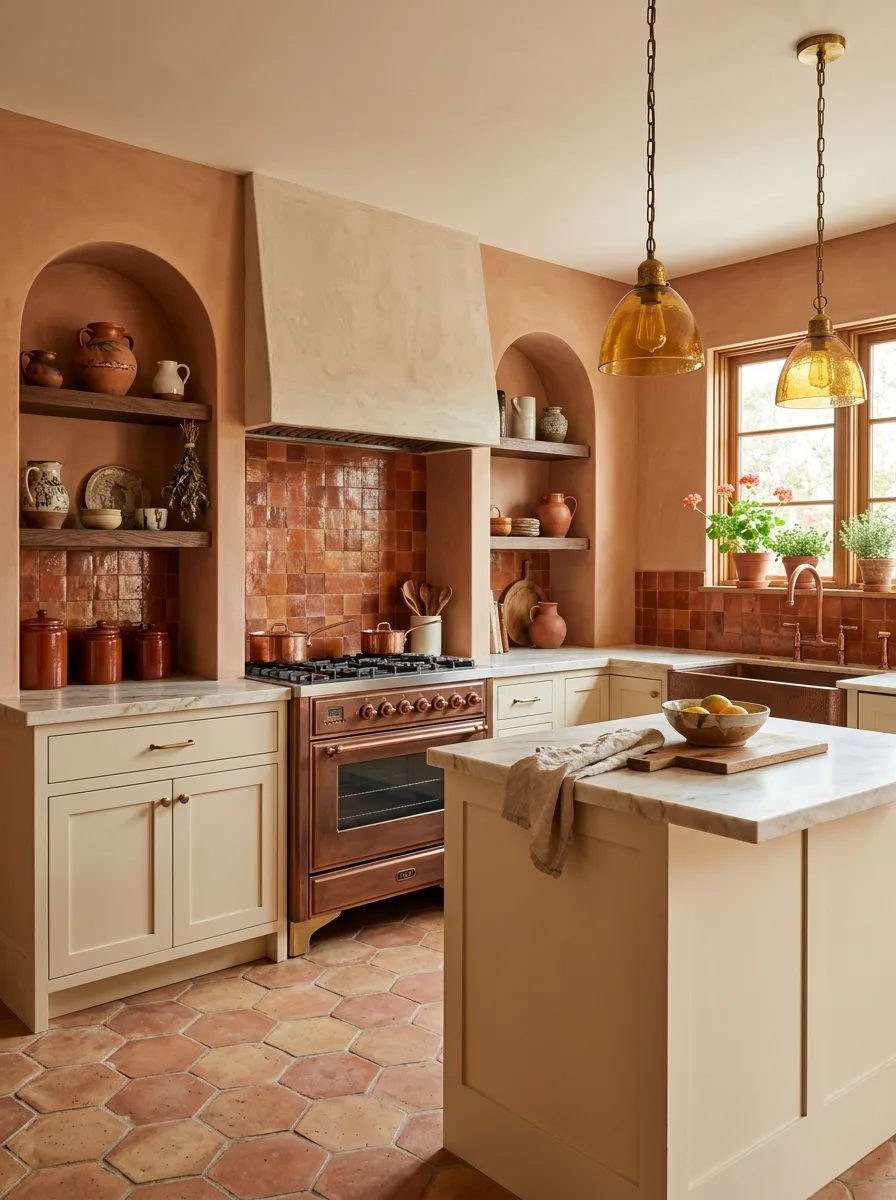
The hood is structural and it determines the whole kitchen. Build it as an arched plaster surround — not a standard metal range hood insert with a cover, but a plastered, structural arch that goes from counter height to ceiling and frames both the range and the Zellige tile behind it.
Use terracotta Zellige tiles as the backsplash inside the arch. The tiles should be uneven, handmade, in the warm sienna-orange family — not uniform clay, not matte, but glazed to a low lustre. The arch itself should be plastered smooth in a warm cream and allowed to dry to a natural chalky finish.
Build flanking arched niches on either side of the hood — shallow, rounded-top recesses set directly into the plaster wall. Float raw oak shelves inside them at two heights. These shelves hold only terracotta pottery and earthenware.
Paint the walls in the same warm terracotta as the tiles — it sounds like too much and it’s exactly right. The wall colour, the tile, and the pottery should all operate in the same family. The pale cream cabinets, marble counters, and hexagonal terracotta floor tiles provide the grounding.
Hang amber bubble glass pendant lights above the island — the glass should be the colour of raw honey and the brass fittings visible. Keep the island simple: cream shaker cabinets, marble top, one linen tea towel, a single bowl of fruit.
Arched Window Herb Garden Sink
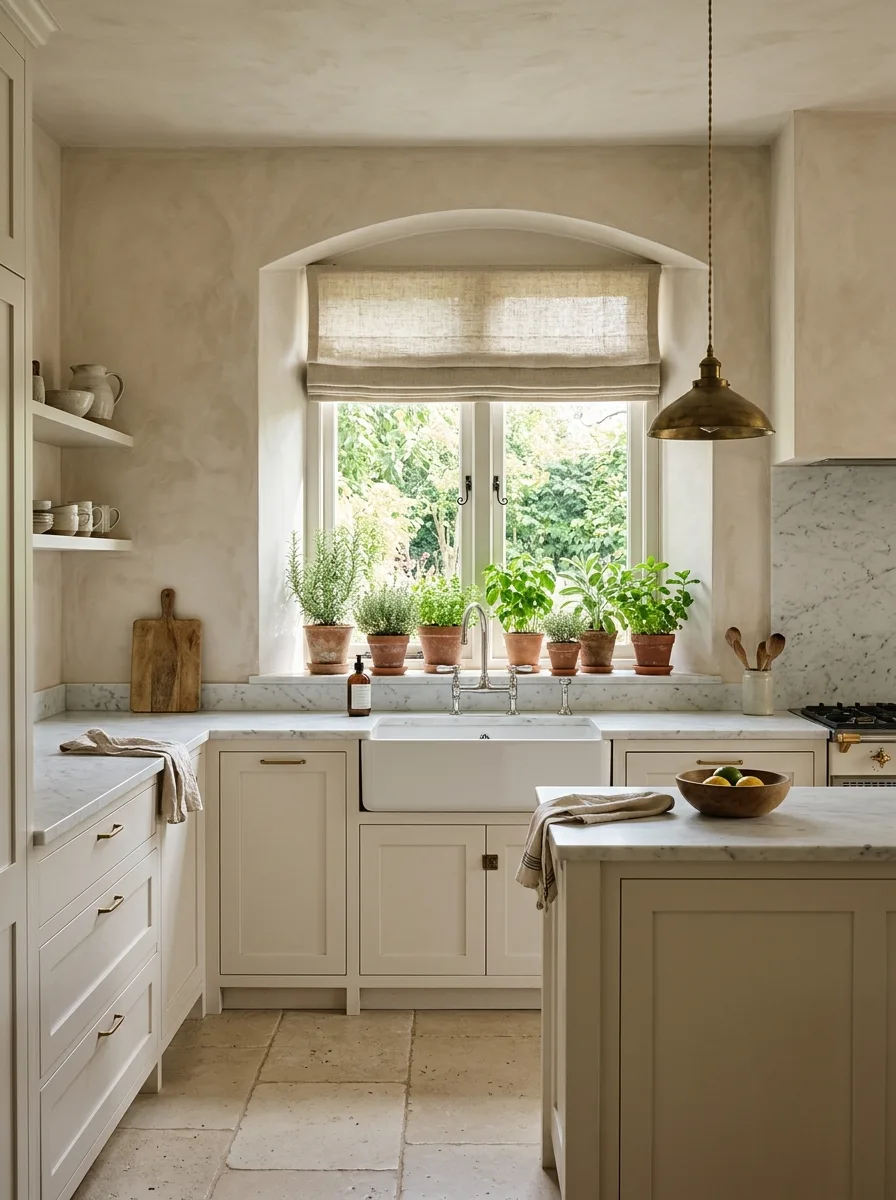
This look depends on the window architecture. The sink should sit within a deep wall with an arched plaster opening around the window above it — not framing the window with a painted arch, but building an actual recessed arch that gives the window the depth of a doorway.
Plaster the entire wall — including the arch interior — in a warm off-white venetian plaster. Allow visible variation and movement in the plaster surface. Apply a linen roman blind inside the arch, not inside the window frame — it should fold flat against the top of the arch opening, just grazing the arch curve.
Line the window sill with terracotta herb pots — rosemary, thyme, basil, and sage — filling the entire ledge from one side to the other. The pots should be unmatched terracotta of slightly varying sizes and ages.
Use cream shaker cabinets with brass bar pulls and a brass bridge tap. Marble counters with visible grey veining. Float one simple open shelf on the left wall for white ceramics; keep it spare. Use large limestone floor tiles — unfilled and honed — in a warm cream-stone tone.
Hang one aged brass industrial dome pendant off-centre above the island. The asymmetry is intentional.
Dark Walnut Calacatta Arch
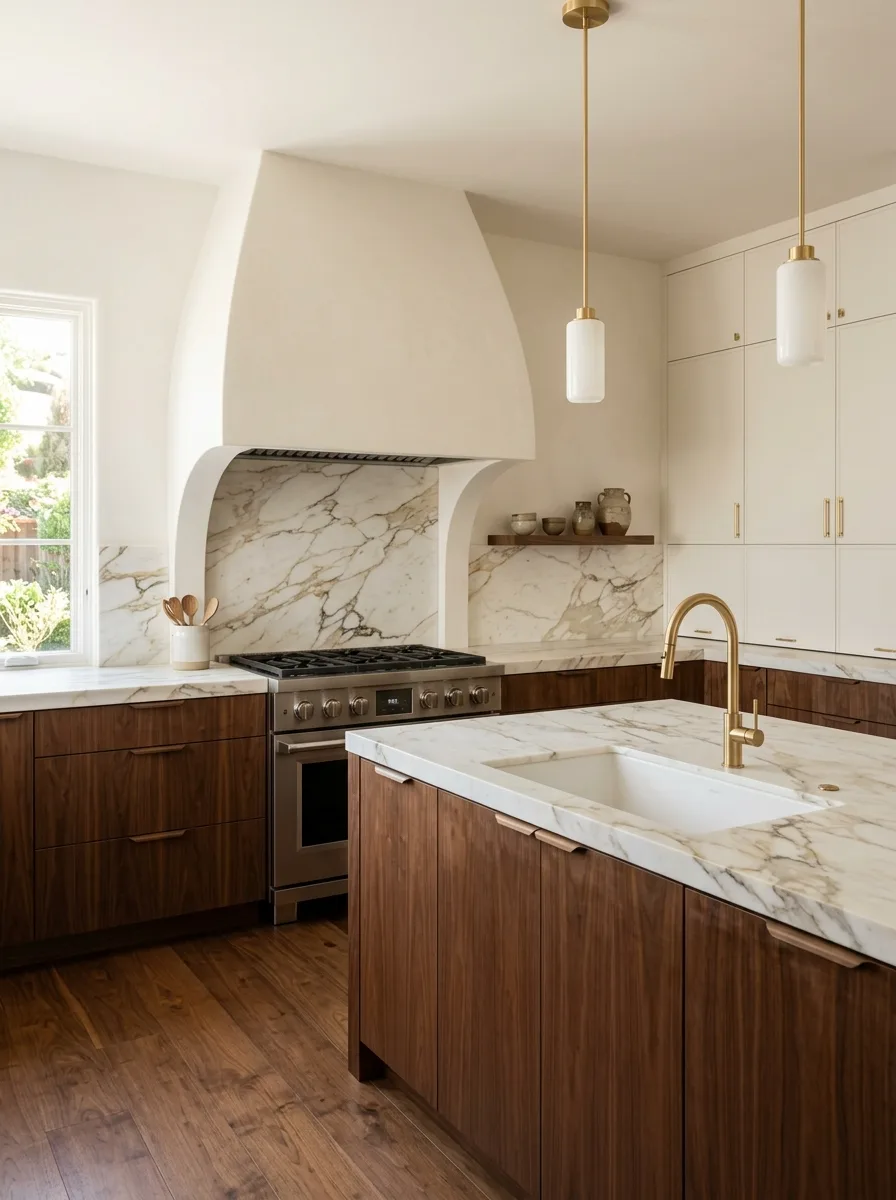
The range hood is the centrepiece. Build it as a smooth plaster arch — rounded, generous, from counter height to ceiling — without any casing or trim around the edges. The arch should look grown from the wall, not attached to it.
Inside the arch, tile the backsplash in Calacatta marble slab with dramatic gold veining. The marble should continue across the counter surface and up the back wall of the arch without interruption. Choose a slab with expressive, bold veining — thin, delicate veining will get lost inside the arch.
Use flat-front cabinetry in dark walnut throughout — natural grain, not stained, in a finish that shows the wood’s own warm brown and grey tones. No hardware on the lower cabinets; instead, use routed edge pulls integrated into the drawer face. The upper cabinets should be cream plaster to match the arch, keeping the upper portion of the kitchen light.
Install a polished brass gooseneck tap and undermount sink in the island. The island counter should continue the Calacatta marble. Hang two cylindrical white glass pendants on brass stems directly above — slim, understated, positioned to frame rather than fill the space.
Float one narrow walnut shelf above the range area for a small group of stoneware vessels. Nothing else on this wall.
Coastal Rattan Pendant Shelving
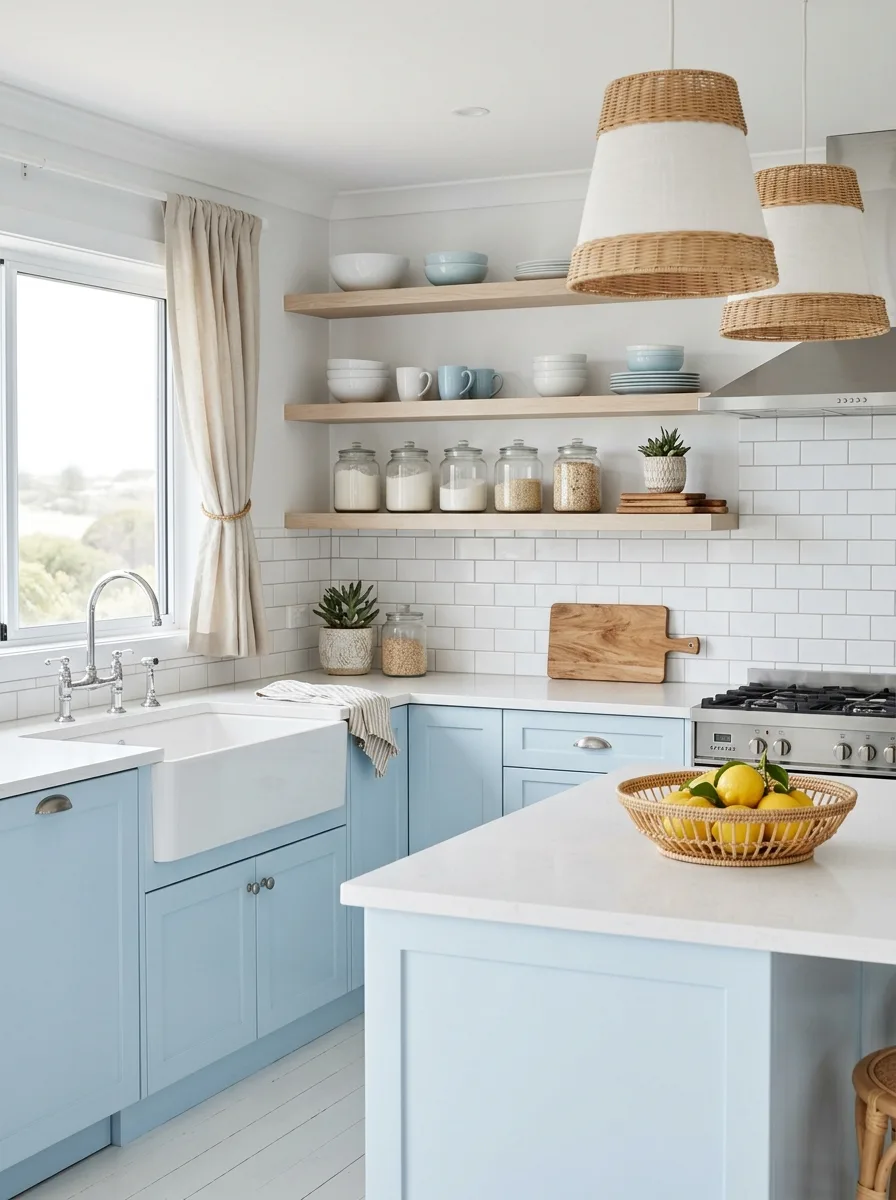
The pendants are non-negotiable. They need to be natural rattan or woven seagrass — not bamboo, not white paper — in a tiered or banded shade that casts warm light through the weave. Hang two or three at the same height directly above the island.
Paint the lower cabinets in a soft sky blue — not navy, not royal, but a pale, washed blue-grey that sits close to the white cabinets above it. The contrast between blue lowers and white uppers should be gentle rather than dramatic. Use simple chrome hardware throughout — no brass here, chrome only.
Float three raw wood shelves on the back wall in a natural blonde finish — not stained, just lightly sealed. Arrange the shelves with glass storage jars filled with dry goods, white dishes, pale blue ceramic mugs, and a small succulent or two. The arrangement should look edited but not styled.
Carry white subway tile up the entire backsplash wall. Standard horizontal stack, standard white grout. The tile is the background, not the feature.
Use a farmhouse sink in white. Install white painted pine floors — not grey, not natural, but white so the whole room reads light and coastal. A woven rattan fruit bowl on the island with a few lemons. The colour of the lemons is the warmest element in the room.
English Cottage Floral Toile Kitchen
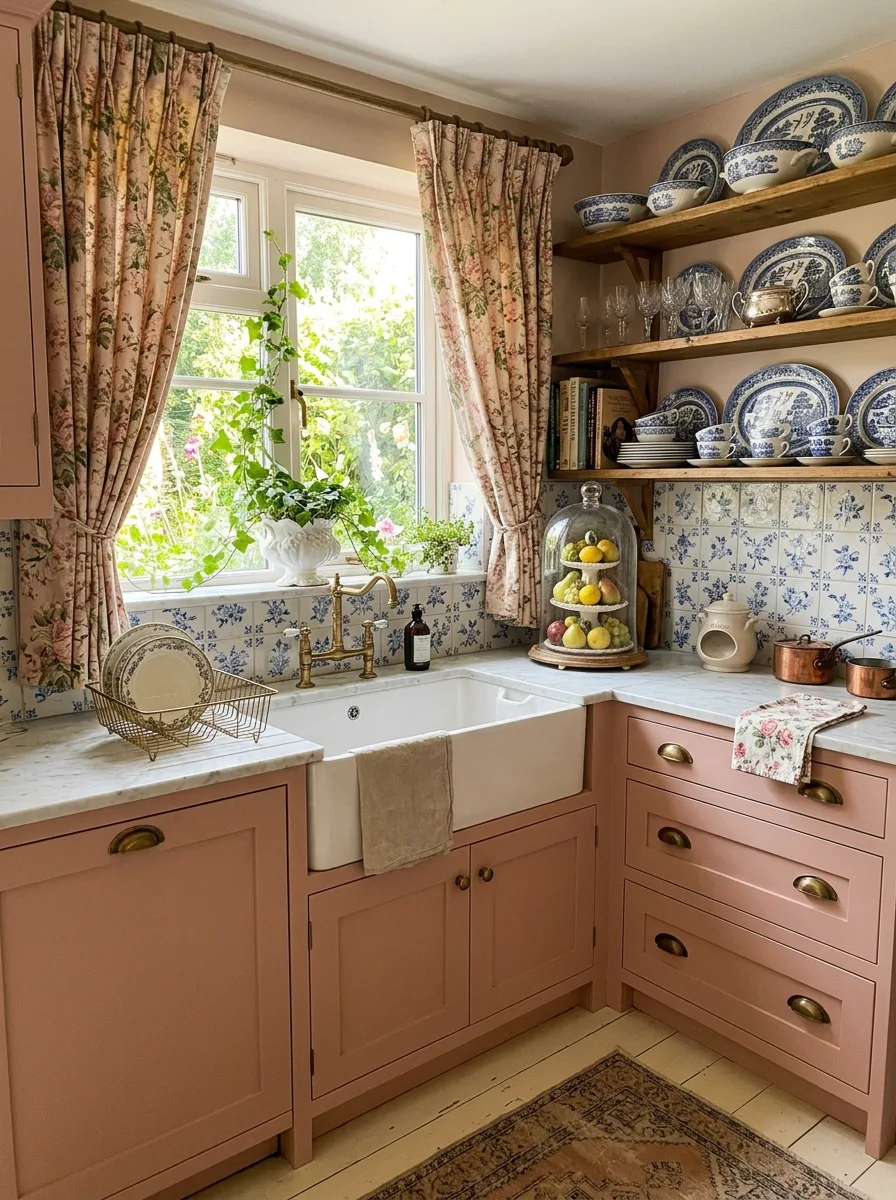
The curtains are the foundation. They need to be a full-length floral cotton print — not a cafe curtain, not a roller blind, but proper gathered curtains on a brass rod, hung from above the window to the floor. The print should read as vintage English floral: small repeating blooms in dusty pink, sage, and cream on a cream background.
Paint the cabinets in a faded rose — not coral, not salmon, but a muted, slightly chalky pink with brown undertones. Aged brass cup pulls throughout. Marble counters with soft grey veining. A farmhouse sink in white.
The backsplash should be delft-style tiles — white ground with hand-painted blue floral motifs in repeat. They should cover the entire wall from counter to upper cabinet base. The tiles do not need to match each other precisely; slight variation in the blue of the motif is part of the look.
Stack open pine shelves on the right-hand wall — raw, slightly rustic, with visible wood grain. Fill them with a matching blue-and-white willow-pattern china collection: plates standing upright, bowls stacked, cups hung from small brass hooks on the shelf edges. The collection should look like it was inherited, not purchased.
Place a glass cloche with a tiered fruit display on the counter. A trailing ivy in a white ceramic pot on the windowsill. A brass dish rack with a few plates drying beside the sink. A floral cotton tea towel over the island.
Final Thoughts
Every kitchen in this collection made a decision and committed to it. The terracotta kitchen went all the way into warm earth tones without apology. The black kitchen removed colour entirely and trusted that drama would fill the space. The galley with the floral curtains let the garden do the decorating.
What they all have in common is the understanding that a kitchen is not a backdrop. It is a room with its own convictions. The ones that work are the ones that went looking for a specific feeling — warmth, drama, calm, joy, wildness — and made every decision in service of it.
The material choices, the hardware, the colour of the grout: these are not the details. They are the decisions. The kitchen you end up with is the sum of whether you made them with intention or left them to default.
Stop defaulting.