
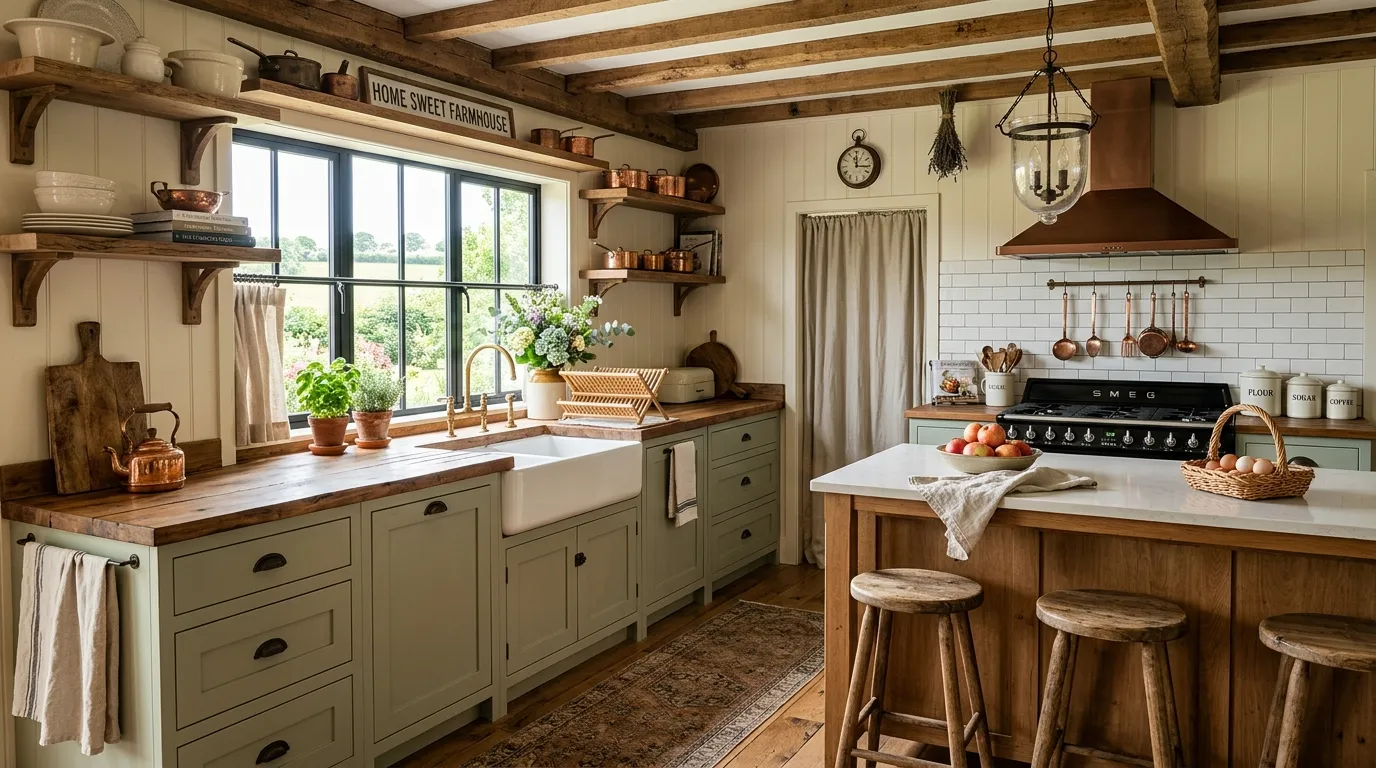
The modern farmhouse kitchen has a reputation problem.
For every room that gets it right — warm, layered, genuinely lived-in — there are twenty with shiplap on every wall, a faux-distressed sign above the stove, and farmhouse-style hardware from a box store that arrived in bubble wrap. They look like a set. Nobody actually cooks in them.
The real version is harder to fake and worth the effort. It borrows from working kitchens — open shelves because you need the access, natural wood because it holds up, a farmhouse sink because it’s deep enough to be useful — and layers that practicality with enough design intelligence to feel current rather than costumed.
Every kitchen in this post knows the difference. Some are bright and spare. Some lean dark and moody. A few are genuinely ambitious about colour. All of them feel like a real house rather than a magazine staging.
What to Decide Before You Order a Single Cabinet
The Wood Tone First
Before you choose a paint colour, a countertop, or a tile, decide on your wood tone.
Every farmhouse kitchen has wood in it: in the floor, the island base, the open shelves, the ceiling beams, the butcher block, or some combination of these. If those wood tones fight each other — a cool grey-washed floor beside warm honey oak shelves beside dark walnut beam — the room will feel restless and unsettled.
All the wood in the room should belong to the same family. Warm blondes together. Warm medium browns together. Dark chocolate walnuts with dark floors. Pick the family and commit to it before you pick anything else.
Cabinet Colour and Its Relationships
Cabinet colour is not just a paint chip decision. It is a relationship decision.
A dark cabinet — charcoal, black, forest green — needs a light counter and a light wall treatment to breathe. A soft sage or dusty blue needs warm wood tones to stay from feeling cold. A cream or off-white needs contrast from hardware and accents to stay from reading as beige by default.
Ask not just “what colour do I want the cabinets” but “what will they sit against, and what will they sit with.” The relationships are the design.
The Ceiling Treatment
Shiplap, exposed beams, or flat paint: the ceiling treatment in a modern farmhouse kitchen sets the height and warmth of the entire room.
A shiplap ceiling at low height makes the room feel deliberate and cosy. A vaulted ceiling with exposed oak beams makes it feel architectural and grand. A flat painted ceiling with nothing happening overhead makes the room feel like it stopped before it was finished.
Decide the ceiling treatment in the planning stage, not after the walls are in. Structural decisions — exposing beams, building a vaulted frame — require planning permits and contractor coordination. They cannot be added as an afterthought.
Modern Farmhouse Kitchen Ideas
Black Charcoal Cabinet Marble Drama
Paint every cabinet surface — uppers, lowers, the island base, and the hood surround — in a deep charcoal that reads as near-black in evening light and reveals its warm undertone in daylight. Use a raised-panel door profile with simple moulding detail at the crown; the traditional profile softens the darkness and keeps it from reading industrial.
The backsplash is the counterpoint. Use a white marble tile in a standard brick-laid format — not Zellige, not herringbone, but a clean horizontal stack that lets the marble’s natural veining do the visual work. The tile should run from counter to ceiling on the feature wall behind the range, uninterrupted by shelving or accessories.
Source counters and the island top in a dramatic Calacatta or Super White marble — slabs with bold, expressive grey veining on a bright white ground. The island counter should overhang generously on the seating side, and the slab should be chosen for veining that reads clearly from across the room.
Hang two or three oversized black factory dome pendants above the island — the large hemisphere shape in matte black, sized to command the space rather than complement it. The pendant scale matters; undersized lights above a dark, confident kitchen look apologetic. Install glass-fronted upper cabinets on at least one wall section, with interior lighting that shows the shelved contents.
Pair with dark hardwood floors in a warm brown tone. Seat the island with bistro-style chairs in natural timber and black metal. Keep the counter completely clear except for a single small plant and a copper or bronze bowl. This kitchen earns its drama through restraint, not accumulation.
Sage Shiplap Hood Butcher Block
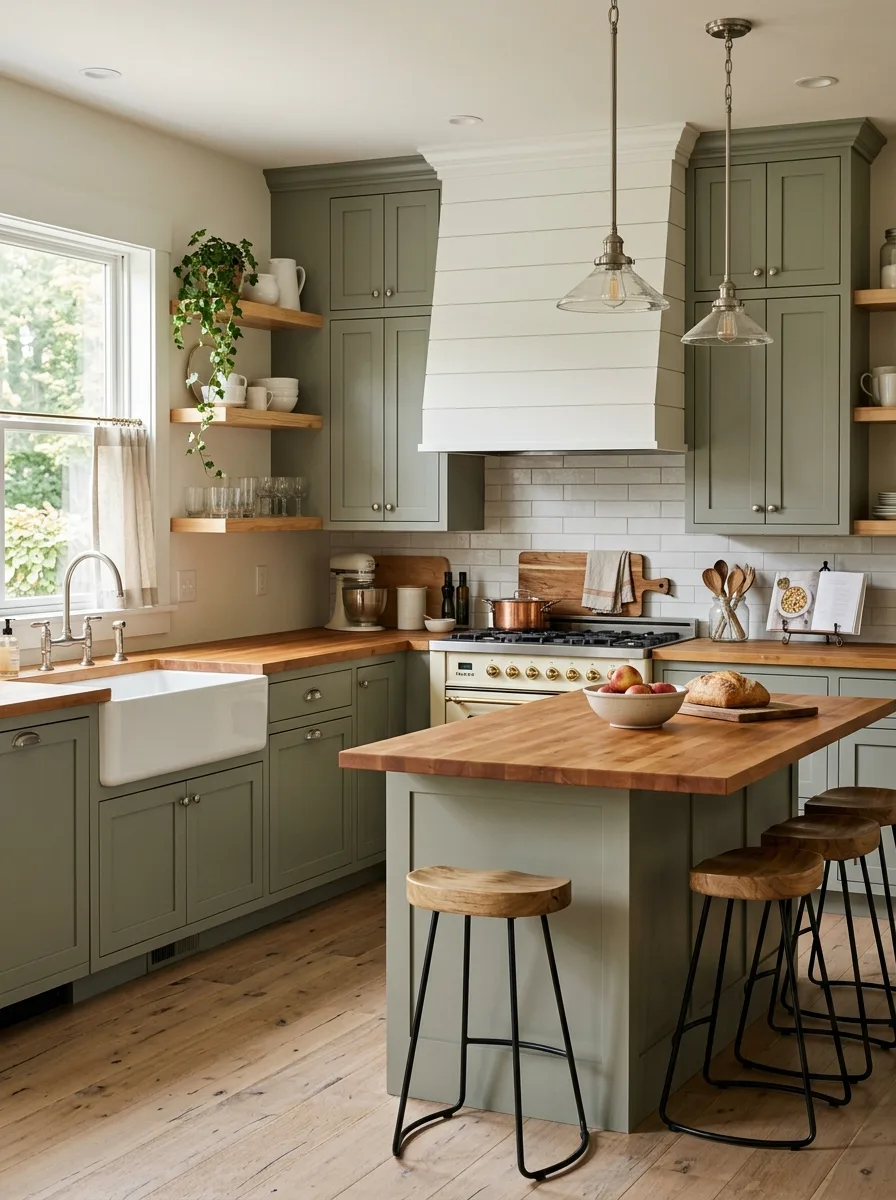
The range hood is built in the same shiplap as the walls — a flat-faced hood surround in white shiplap that reads as a structural element of the building rather than an appliance cover. This requires a custom-built surround, not a purchased hood cover, but the effect is architectural and worth the cost.
Paint the shaker cabinets throughout in a muted sage or khaki green. The shade should be desaturated — more grey-green than yellow-green. Use brushed nickel hardware throughout.
All counters in butcher block — warm honey oak, sealed to a satin finish — including the island. This is non-negotiable; the butcher block and the sage green are the relationship that makes this kitchen work. Do not swap one for marble or quartz. The organic, warm wood against the cool-neutral green is the whole visual argument.
Float raw oak shelves in the corner using simple metal shelf brackets. Load them with trailing ivy or pothos, white ceramics, and a few clear glass storage jars. Hang two clear glass bell pendants in polished nickel above the island.
Wide-plank light pine floors. A white farmhouse sink. Linen or cotton cafe curtains on the window at sill length, hung on a thin rod. An antique or vintage cream stand mixer on the counter is the one appliance that earns its visible place.
Dark Green Brass Range Wood Hood
The range is the first decision and it dictates everything else. Source a statement range in a dark finish — forest green, black, or dark enamel — with brass or gold hardware throughout: brass knobs, brass handles, brass trim on the oven doors. This appliance is not background. It is the reason the kitchen exists, and it should look like it.
Build the range hood surround in natural solid oak — a French provincial profile with a shaped apron, deep cornice, and fluted or panelled face. The hood should be genuinely large: wide enough to extend several centimetres beyond the range on either side, and tall enough to reach toward the ceiling with architectural presence. Use a lightly oiled or natural finish that shows the grain clearly.
Paint all cabinetry in a deep forest or hunter green — the shade should be saturated and serious, not muted or grey-toned. Brass cup pulls and bar pulls throughout, long and slender on the drawers. Use glass-fronted upper cabinet doors with simple pane divisions so the interior is visible; load those shelves with white ceramics and a few plants.
The counter should be warm butcher block in oak or maple — sealed to a satin finish — running the full perimeter. The warmth of the wood counter against the green cabinetry and the natural oak hood creates a layered, tonal warmth that marble or stone would interrupt.
Mount brass pot-filler arms on either side of the range. Keep the counter loaded with beautiful, functional objects: a collection of wooden chopping boards standing upright, glass jars of dry goods, a terracotta pot with trailing greenery, a copper-lidded jar. This kitchen is meant to be used, and it should look like it is.
Black Shiplap Copper Hood Drama
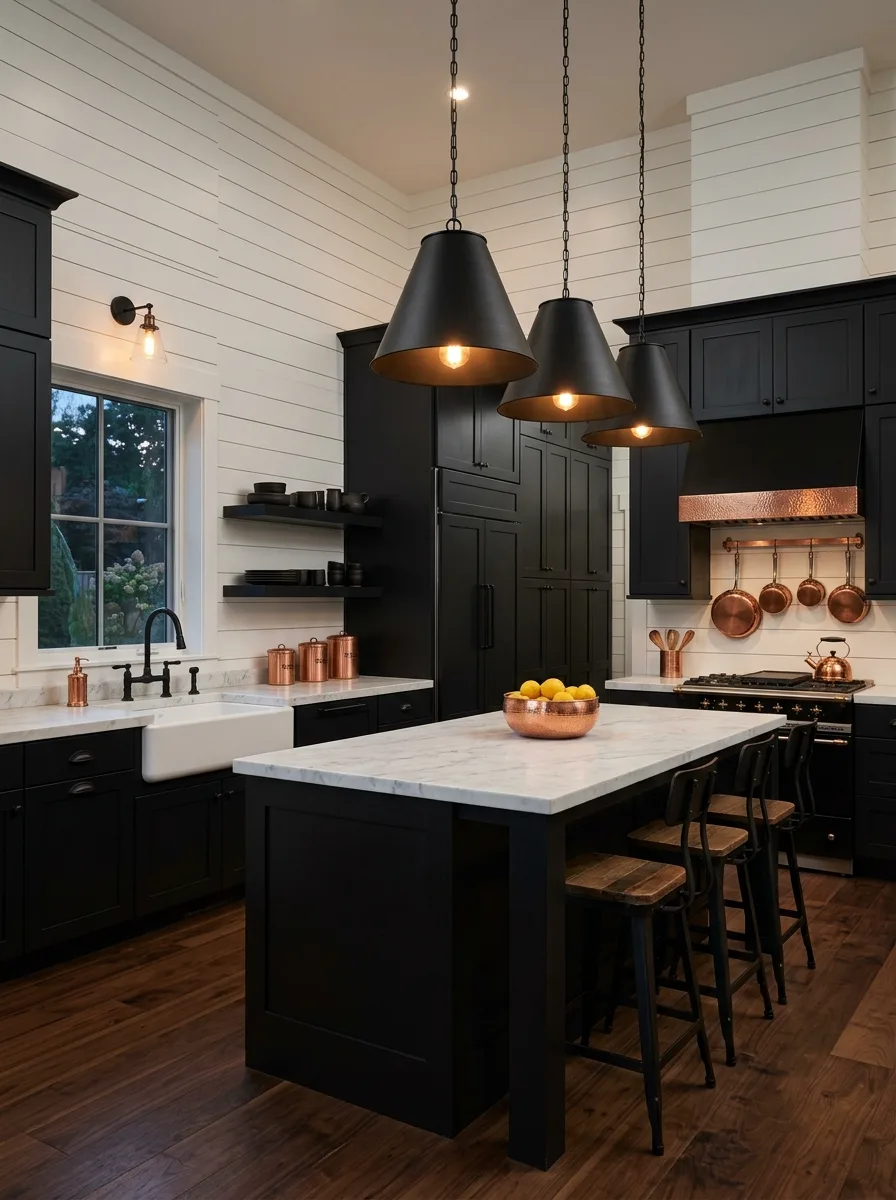
This kitchen commits to the most demanding version of the contrast principle: black cabinets against white shiplap walls, with copper as the metallic note running through both zones.
Install white shiplap on all walls — not just the feature wall, but all four, continuing up to the ceiling edge — and paint every single cabinet surface in a deep, flat black. The white shiplap and black cabinetry create a graphic, high-contrast interior that earns the word dramatic.
The range hood is a hand-hammered copper panel in a traditional farmhouse profile — not a sleek metal insert, but a textured copper face with visible hammer marks. Mount copper pans on a rail below it. A copper tea kettle on the stove. Copper canisters on the counter. Every copper element in the room is connected to this hood, and the effect is that copper reads as a deliberate design material rather than a collection of separate objects.
Use white marble counters throughout for the maximum contrast. A white farmhouse sink with a matte black bridge tap. Seat the island with industrial stools — black metal base, raw aged timber seat.
Hang three large conical pendants above the island in matte black with a warm gold interior — they should be generously scaled, not delicate. Dark hardwood floors. Keep the shiplap walls completely bare — no art, no shelves — because the contrast is already doing everything.
Vaulted Beam Arched Niche Cathedral
The ceiling is the decision that cannot be undone and cannot be faked. If the building has the capacity — a single-storey wing, a new build, a barn conversion — vault it. Expose the rafters or install decorative beams in raw or lightly treated oak running from the ridge to the eaves. The beams should be substantial in section, with visible grain and natural colour variation. Between them, the ceiling can be smooth plaster or a light wood panelling painted cream.
On either side of the range hood, build symmetrical arched niches directly into the wall — rounded-top recesses approximately 60cm wide and deep enough to hold two or three shelves. Line the shelves with LED strip lighting underneath each shelf, positioned so the light washes the contents from below. Load the niches with ceramic jars, glass storage, small pottery, and baskets. The niches should feel like they grew from the wall, not like cabinets with the doors removed.
Build the range hood in natural oak to match the ceiling beams — the same tone, the same finish. Use white shaker cabinetry for the upper run and natural oak or warm timber cabinetry for the lower run, creating a two-material approach where the upper kitchen is light and the lower kitchen is warm and wood-forward.
Install a Calacatta marble slab as the backsplash behind the range — a single uninterrupted panel with expressive veining. Run the same marble across all counter surfaces and the island top. The island should be clad in the same marble slab on all exposed vertical faces.
Hang three large clear glass globe pendants above the island — the full-sphere or teardrop shape in clear glass with a visible Edison filament, on black iron chain. Warm-toned wide-plank oak floors throughout. Upholstered island stools with nailhead trim in cream or natural linen, on dark espresso or black legs.
Pale Blue Schoolhouse Butcher Block
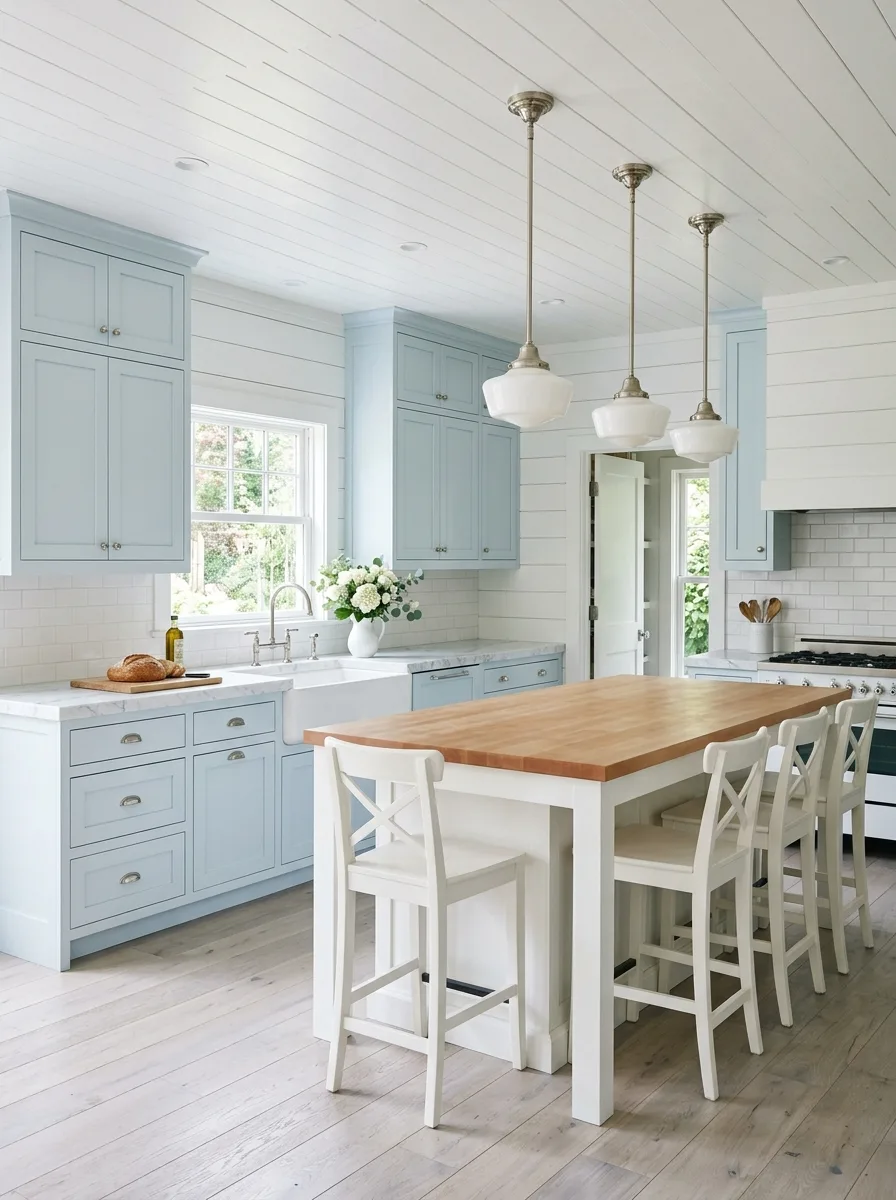
Pale blue — the powder blue, the washed denim, the morning sky — is the colour that works in farmhouse kitchens when every other colour has failed you. It is simultaneously warm and cool, simultaneously classic and current.
Paint every cabinet surface in a pale, slightly grey-tinted blue — not sky blue, not duck egg, but a tone that reads as blue only in relation to white. Upper and lower in the same colour. Chrome or brushed silver cup pulls throughout. A farmhouse sink with a bridge tap in chrome.
White marble counter on the wall run. White subway tile backsplash. Build the island in white-painted timber with a butcher block top in warm honey oak. Seat it with white painted cross-back chairs — the X-back chair, in white, is the farmhouse chair par excellence.
Hang three schoolhouse pendants in polished nickel above the island — the large acorn or teardrop globe in milk glass with a visible nickel stem and canopy. The nickel hardware and nickel pendants form a consistent metallic thread through the room.
Install white shiplap on the ceiling — the panelling continuing the white note upward and giving the room its farmhouse ceiling texture. Pale grey-washed wide-plank oak floors throughout. A white ceramic jug of white hydrangeas on the counter beside the sink. A loaf of sourdough bread on a wooden board on the island. The bread is not staging. Every farmhouse kitchen should have bread on the counter.
Blue Grey Glass Cabinet Brass Sink
The windows are doing as much work as the cabinetry, and they need to be treated accordingly. Where the sink sits below a wide bank of windows, do not cover them with blinds or curtains. Let the light pour in unobstructed. The visual relationship between the garden beyond the glass and the flowers on the counter inside is the emotional core of this kitchen.
Paint the cabinetry throughout in a dusty blue-grey — a tone that sits between slate and sage, leaning slightly cooler than warm. Use a raised-panel or transitional door profile with brass cup pulls and bar pulls in an unlacquered or satin brass that will patina over time. At least two upper cabinet sections should have glass-fronted doors with simple rectangular panes — load the interior with white ceramics, clear glassware, and a small potted plant to keep the display light-filled.
Install a white apron-front farmhouse sink — a wide double-basin if the window bank allows — set into the marble counter. The tap should be a gooseneck or bridge tap in unlacquered brass that connects visually to the hardware. The farmhouse sink apron should be visible from the room; do not recess it fully into the cabinet face.
Use Calacatta marble for the counter and backsplash — the same slab material running from counter to the upper cabinet base without any break. The white marble and the blue-grey cabinets sit in natural contrast without fighting; the warmth of the brass hardware mediates between them.
Place generous arrangements of white flowers — hydrangeas, garden roses, white ranunculus — in clear glass vases or ceramic pitchers at the sink. Not one vase. Several. The flowers are not decoration. They are the point of the whole composition, and the windows behind them are the light source that makes them visible from anywhere in the room.
White Shiplap Cage Pendant Oak
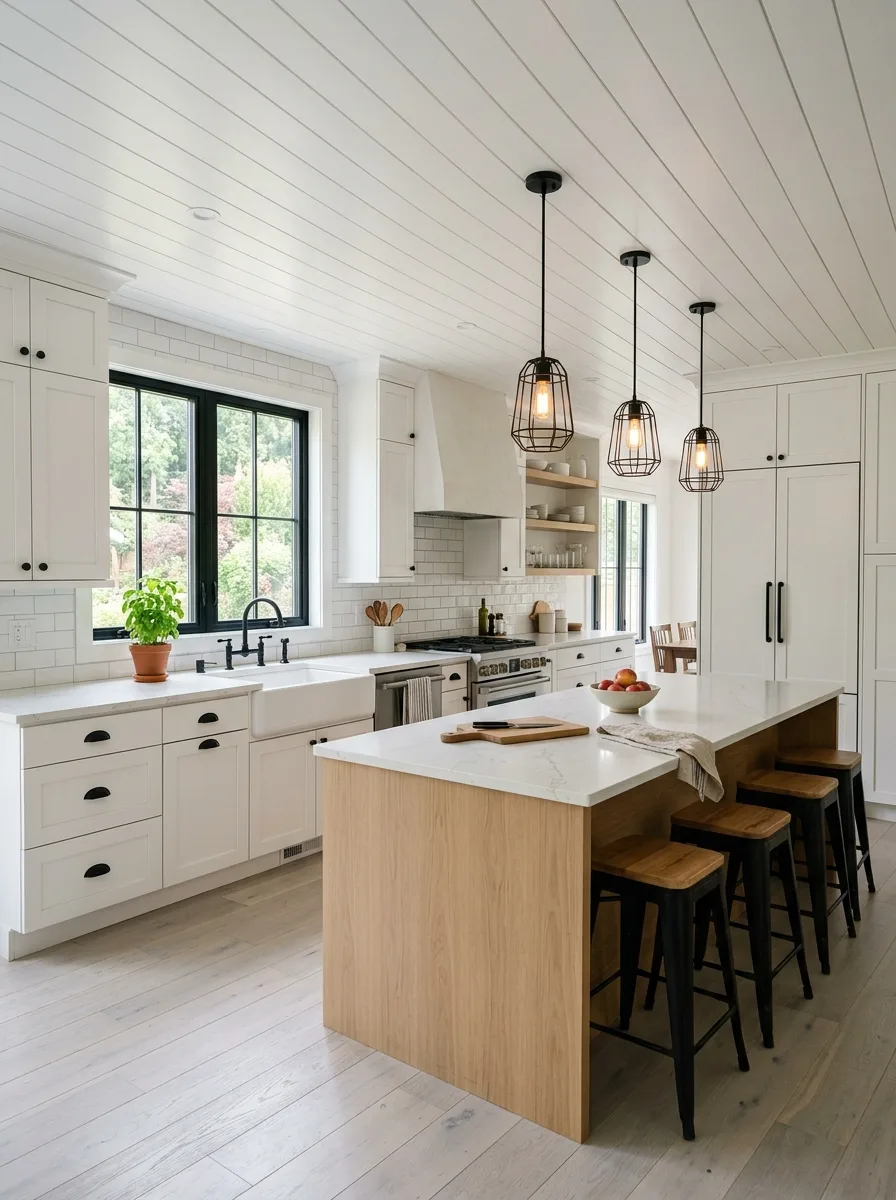
Install shiplap on the ceiling only — not the walls — in painted bright white. This lets the ceiling carry the farmhouse texture while keeping the walls clean and reflective. Paint the shaker cabinets throughout in warm white with matte black bin pulls and cup pulls in a consistent hardware family.
Build the island in natural raw oak — no paint, no stain — with a white quartz top. The contrast between the warm blonde wood base and the bright white counter is the central visual relationship of this kitchen. Seat the island with backless industrial stools in matte black with a warm wood seat insert — the black legs echo the hardware, the wood seats echo the island base.
Hang three cage pendant lights above the island — not the wire diamond cage, but a more architectural oval or cylindrical cage in matte black, with a visible Edison filament inside. These should hang at slightly different heights if the ceiling allows.
The backsplash should be white subway tile in a standard horizontal stack. Black window frames and a black bridge tap at the farmhouse sink. Pale washed oak floors throughout. A single terracotta pot with basil on the windowsill.
White Oak Hood Herringbone Lantern
The range hood is the centrepiece, and it needs to be built in natural white oak — not painted, not stained, but clear-sealed so the grain shows fully in a warm, honey-blonde tone. The hood profile should be traditional with a shaped cornice and corbel detail at the base, sized generously so it reads as an architectural element rather than an appliance cover. The contrast between the natural wood hood and the white painted cabinetry on either side is the relationship that defines this kitchen.
Use white or warm cream shaker or transitional cabinetry throughout. Simple brushed nickel hardware — tab pulls on the drawers, cup pulls on the doors. A white farmhouse sink with a nickel bridge tap. The backsplash should be a stone tile in a herringbone pattern — choose a material with natural variation in tone, such as a tumbled marble or a travertine mosaic, so the herringbone reads as textured and organic rather than graphic.
Source the island counter and perimeter counters in a polished granite with natural patterning in cream, warm brown, and soft grey. The granite’s movement and warmth connects the white cabinetry to the natural oak hood without requiring additional warm materials.
Hang two or three square iron lantern pendants above the island — the open cage lantern with clear glass panels and multiple candle-style bulbs inside. The iron frame in an aged or oil-rubbed bronze finish connects to the warm wood hood tone. Seat the island with backless stools upholstered in woven sea-grass or natural rattan on a timber base.
Wide-plank warm oak floors throughout. A vintage or antique runner rug in muted tones in front of the sink run. Keep the counter styling minimal: a small potted herb, a wooden chopping board, a ceramic vessel of wooden utensils.
Cream Shaker Brass Pot Rack Walnut
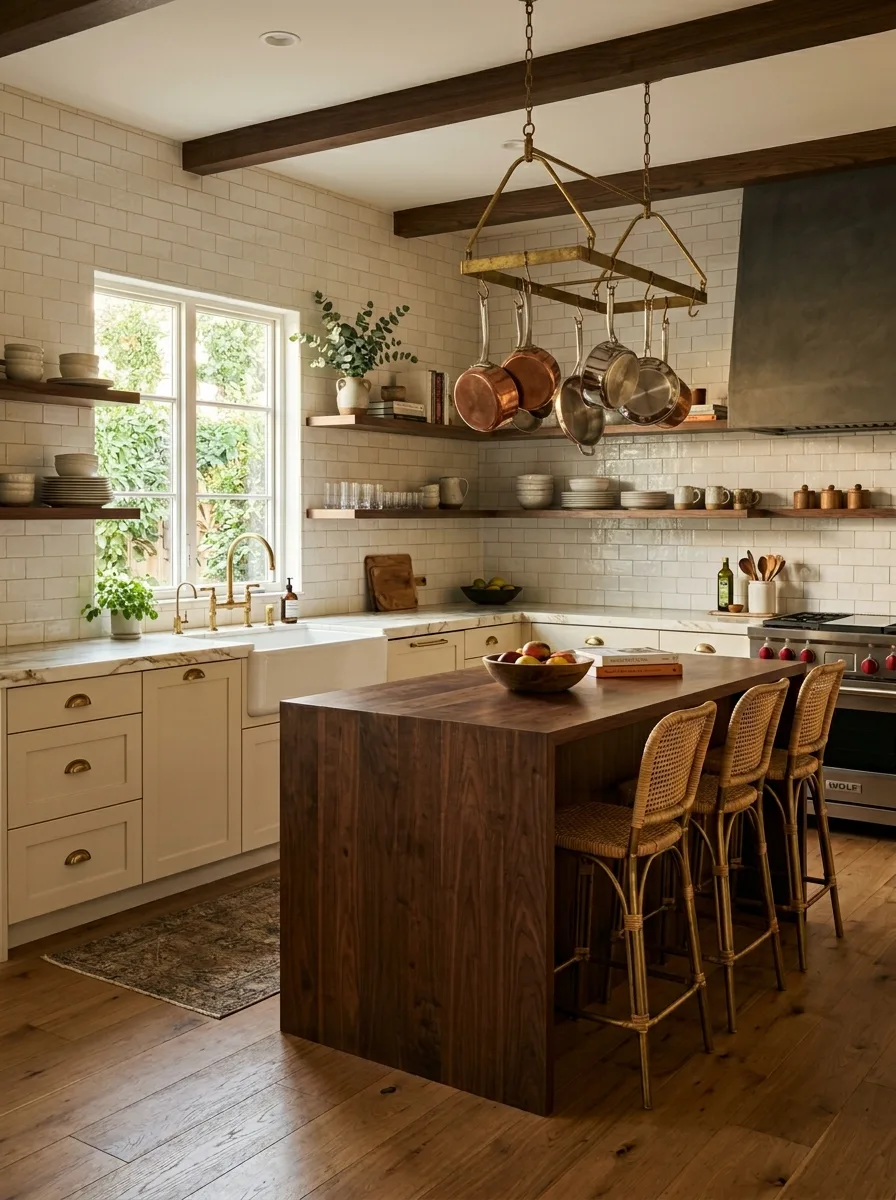
The defining element is the pot rack, and it needs to be proportioned correctly. Build or source a rectangular brass or brass-and-timber rack frame — roughly 90cm by 50cm — and suspend it from the ceiling on brass chain or rods directly above the island or prep zone. The rack should be centred in the room and positioned at a height where hanging pans are visible but don’t obstruct sightlines.
Use cream or warm off-white shaker cabinetry with brass cup pulls throughout. A farmhouse sink. Marble counter with visible grey veining. A dark grey zinc or plaster range hood — not painted to match the cabinets but in a contrasting material that feels utilitarian.
Float raw walnut or dark oak shelves on either side of the window using simple shelf brackets. Load them with ceramics, glass storage, and a few cookbooks. The shelf surface and the island top should match — both in dark walnut.
Hang two or three brass pendants at different heights near the window wall — not above the island, which has the pot rack. Wide-plank warm oak floors. A vintage or antique runner rug in front of the sink in a muted floral or geometric.
Vaulted Beam Cathedral Lantern
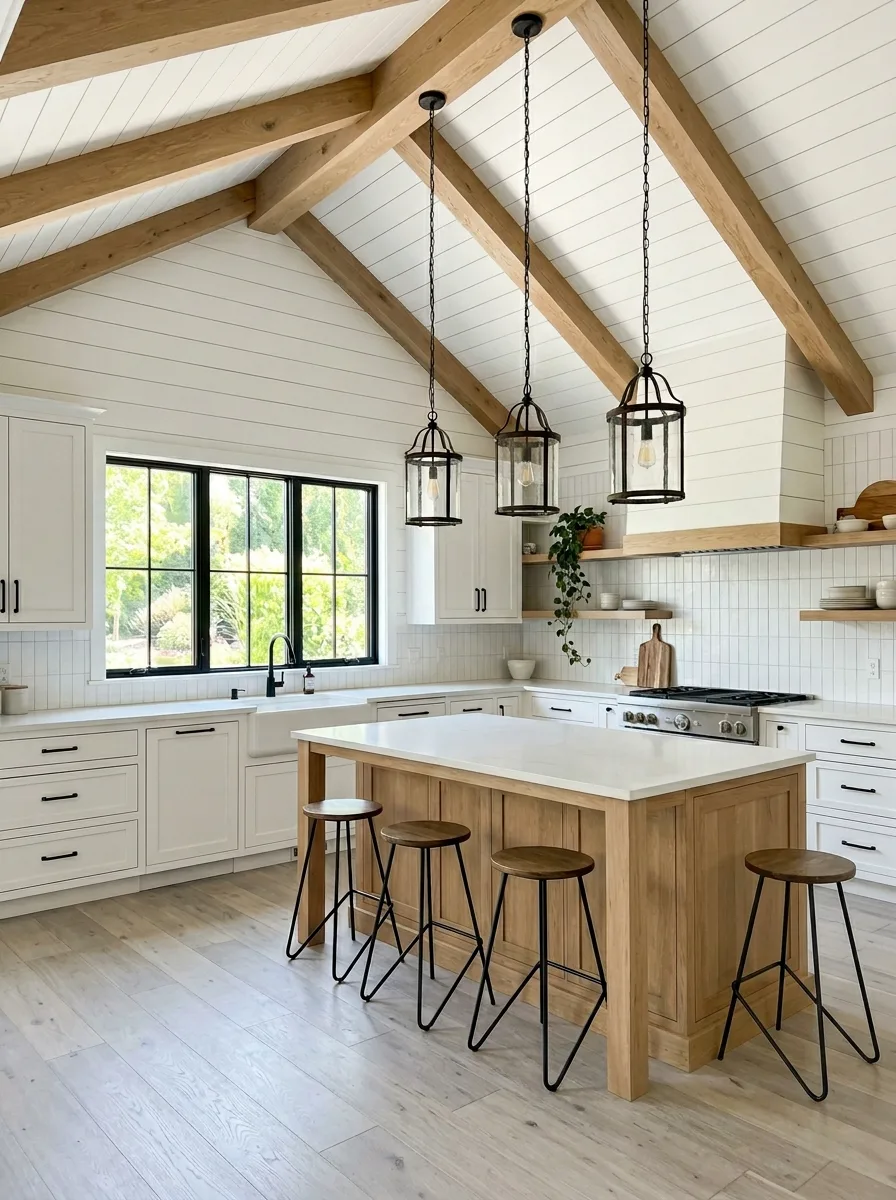
The vaulted ceiling with exposed oak beams is not something you can retrofit cheaply or easily. If the building has the capacity for it — a single-storey wing, a barn conversion, a new build — it transforms the room from a kitchen into a room that people will talk about.
Install white shiplap between the beams on the ceiling plane — the contrast between the white panelling and the raw blonde oak beams is the defining texture of this kitchen. Keep the walls below smooth and white so the ceiling does the work.
Use white shaker cabinetry throughout with flat black hardware. A farmhouse sink with a black tap. White quartz counters. Build the island in raw natural oak with a white quartz top — the island base matching the ceiling beam tone.
Hang three black lantern pendants on chain from the ceiling — the clear glass and black iron lantern style, with visible filament bulbs inside. These should hang significantly lower than you think — deep enough that the flame of the bulb is roughly at standing eye level.
Float a single raw oak shelf above the range area on simple iron brackets. Keep it minimal: one ceramic vessel and a small plant. Pale washed oak floors. Black window frames throughout. Round-seat birch wood stools on black hairpin legs at the island.
Navy White Two-Tone Schoolhouse
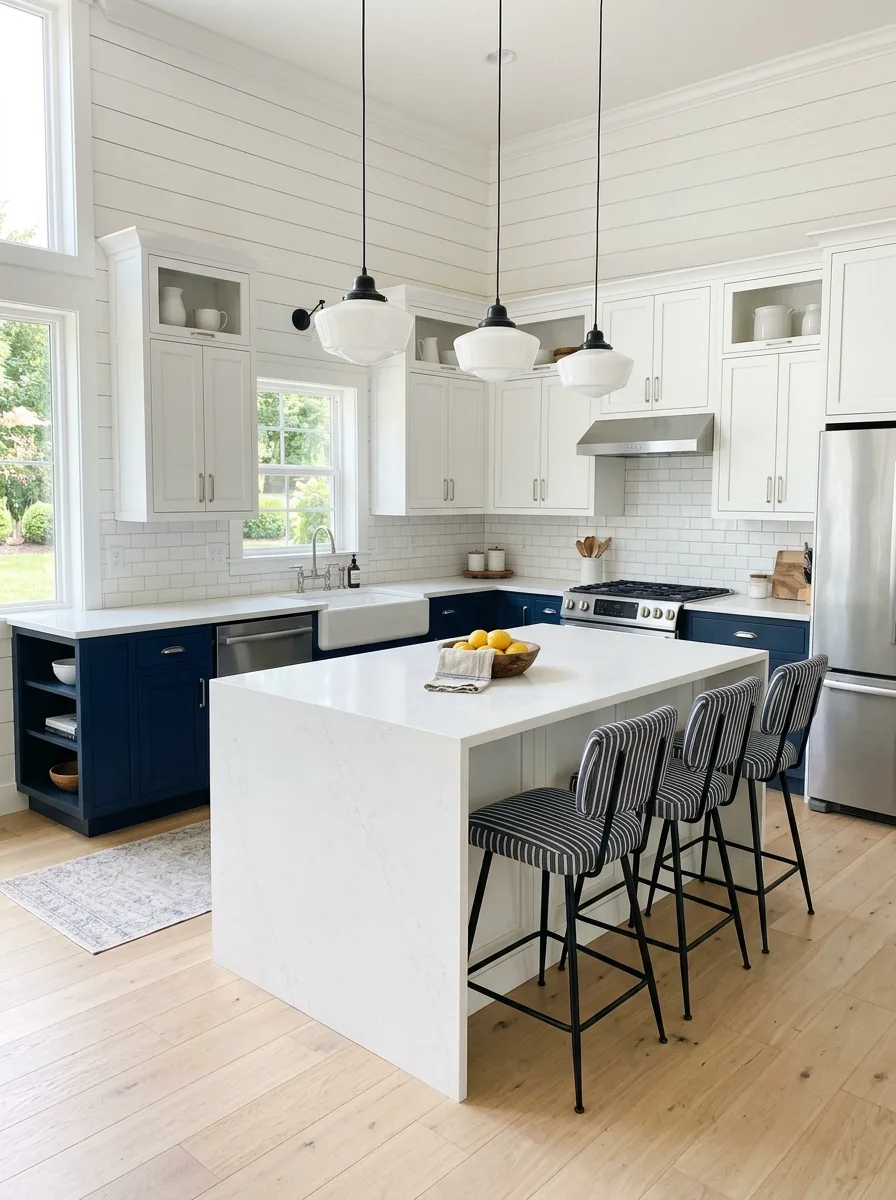
The two-tone cabinet approach works only when the split point is definitive — at the counter line, with the upper cabinets in white and the lower cabinets in a saturated colour. Any ambiguity at the join reads as indecision.
Paint the lower cabinetry in a deep, slightly muted navy — leaning towards the ink-and-midnight end of the spectrum rather than bright royal blue. All uppers in white. Brushed nickel hardware throughout. Glass-fronted upper cabinet doors with simple rectangular panes on at least a few of the upper units to let the shelved interior show.
White subway tile backsplash from counter to upper cabinet base. White quartz or marble counters throughout. A white farmhouse sink. A white island with a waterfall quartz edge.
Install shiplap on the upper walls above the cabinetry — the zone between the top of the upper cabinets and the ceiling — painted white to match the uppers. This creates a continuous white upper zone that makes the room feel taller.
Hang three schoolhouse pendants — milk glass in a round or acorn shape — on black fittings above the island. Seat the island with striped upholstered bar chairs in navy and cream ticking stripe on black steel frames. The chairs carry the navy into the island seating zone.
Light oak floors. A single dark-framed wall-mounted sconce beside the window. Keep the counter completely clear except for a wooden bowl of lemons or citrus.
Reclaimed Beam Herringbone Island
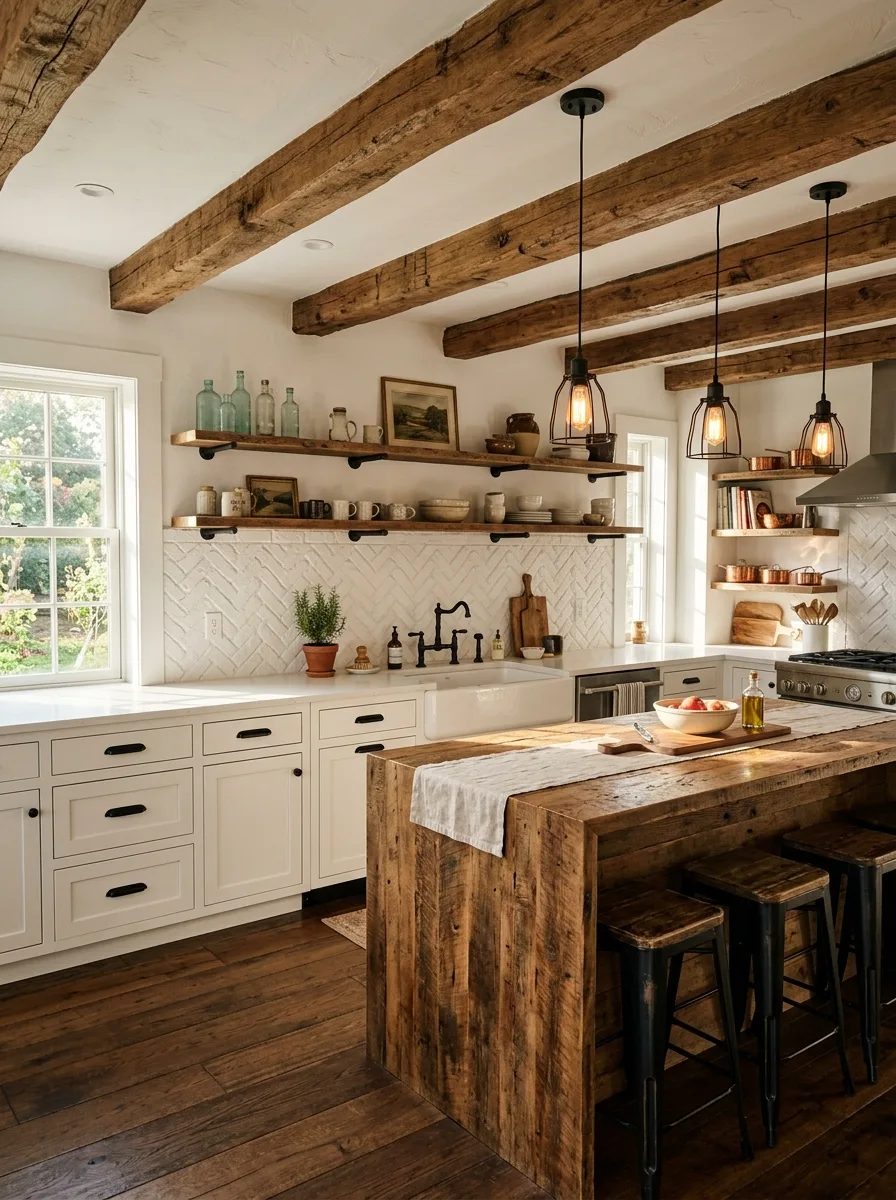
The island is the character study. Build it in reclaimed timber — barn wood, old floor boards, or salvaged structural lumber — where the patina, staining, nail holes, and colour variation are visible and intentional. The island should look like it was found, not built. This requires sourcing authentic reclaimed material, not new wood distressed to look old.
Use cream or warm white shaker cabinetry for the wall run. Matte black bin pulls. White or light stone counter. A farmhouse sink with a matte black bridge tap.
The backsplash should be white tile laid in a herringbone pattern — not the standard horizontal subway stack but full herringbone, which adds movement and texture behind the reclaimed island’s roughness.
Hang two or three cage pendants above the island — the open cage style in matte black, with exposed Edison bulbs. Float two long planks of aged hardwood as open shelves above the counter on simple iron pipe brackets. Load them with mismatched vintage bottles, pottery, a small framed print, and copper cookware. The shelves should look like they were styled over years, not in an afternoon.
Dark wide-plank hardwood floors. Heavy exposed ceiling beams in untreated dark oak. A small terracotta pot with rosemary beside the sink.
Grey Shaker Globe Nickel Marble
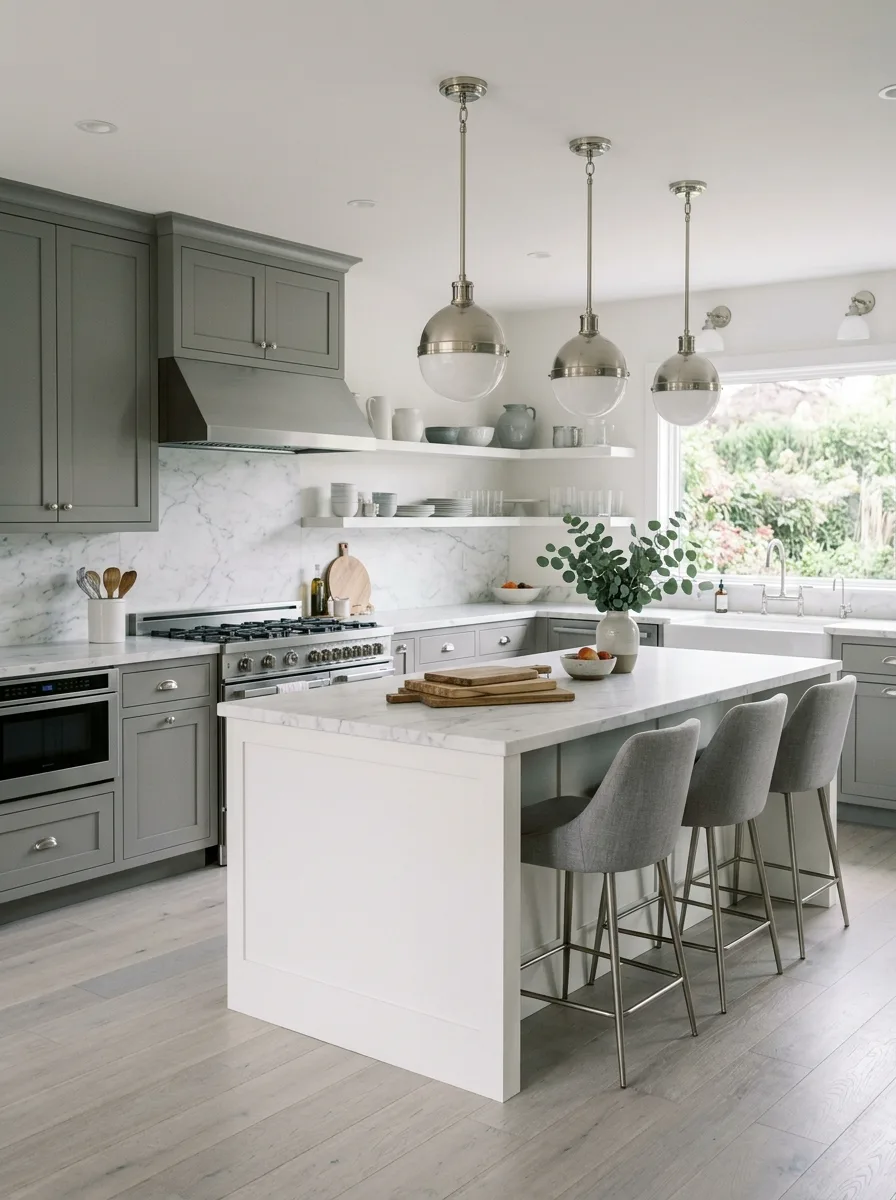
This kitchen uses a single metallic family — brushed nickel or polished nickel — and applies it everywhere: hardware, pendant fittings, tap, appliance handles. The discipline of a single metal tone is what gives this kitchen its cohesion.
Paint the shaker cabinets throughout in a mid-tone warm grey — neither cool blue-grey nor warm taupe, but a true neutral grey with a faint warm undertone. Simple cup pulls in brushed nickel throughout. A grey or stainless steel range hood to match.
The backsplash should be a marble slab in Carrara — white ground with soft grey veining — running from counter to ceiling in a continuous panel behind the range. No tile grout lines. The slab should carry into the counter surface so the material reads as one continuous element.
Float two long white shelves above the counter on concealed or thin brushed nickel brackets. Keep them styled with only grey, white, and ceramic objects — no warm woods, no terracotta, nothing that breaks the cool neutral palette.
Hang three large globe pendants in polished or brushed nickel above the island. The globe should be milk glass or opal glass — translucent, not clear — with a nickel equator band. Pale grey washed oak floors. A white island with marble top and grey upholstered bar stools on nickel legs.
Checkerboard Cream Black Schoolhouse
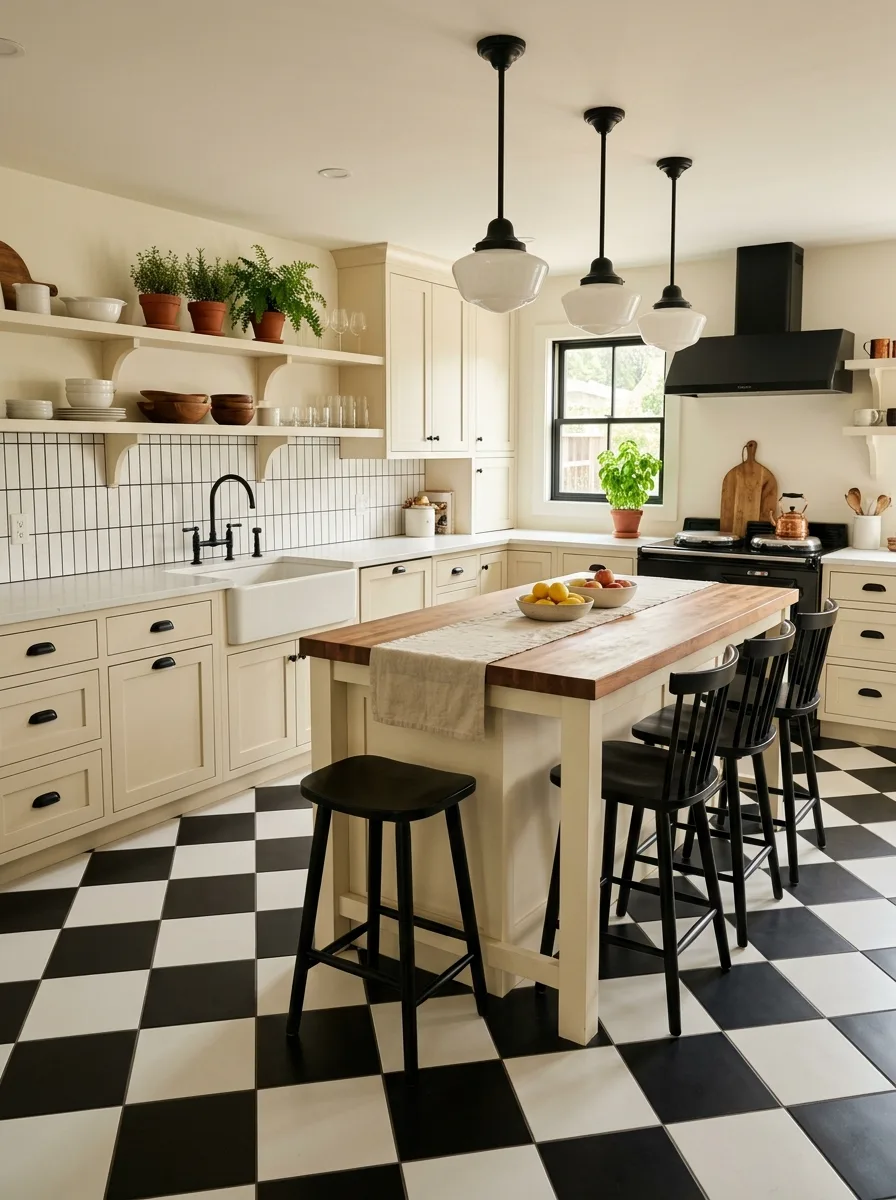
The floor is the commitment. Everything above it serves the floor.
Lay large-format black-and-white checkerboard tiles — 30cm squares or larger — in a straight grid across the entire kitchen. Do not lay them at a diagonal. The straight grid reads modern; the diamond pattern reads period and decorative. This is a modern farmhouse, not a Victorian brasserie.
Use cream or warm off-white shaker cabinetry throughout with matte black bin-pull hardware. A farmhouse sink with a matte black tap. The counter should be white quartz — the palest, cleanest white available — to let the floor dominate.
Build or source a white-painted island with turned or straight legs — a freestanding table style rather than a fitted unit — and top it with a reclaimed or warm butcher block plank. The plank overhang should be generous enough that stools can slide in from all accessible sides.
Hang three schoolhouse pendants — the acorn or teardrop shape in milk glass — on matte black fittings above the island. Seat the island with matte black spindle-back chairs or simple matte black stools.
Keep the open shelves minimal: white ceramics, terracotta herb pots, a small stack of wooden chopping boards. One small framed art print on the open shelving only. Everything else should be out of sight.
Forest Green White Upper Farmhouse
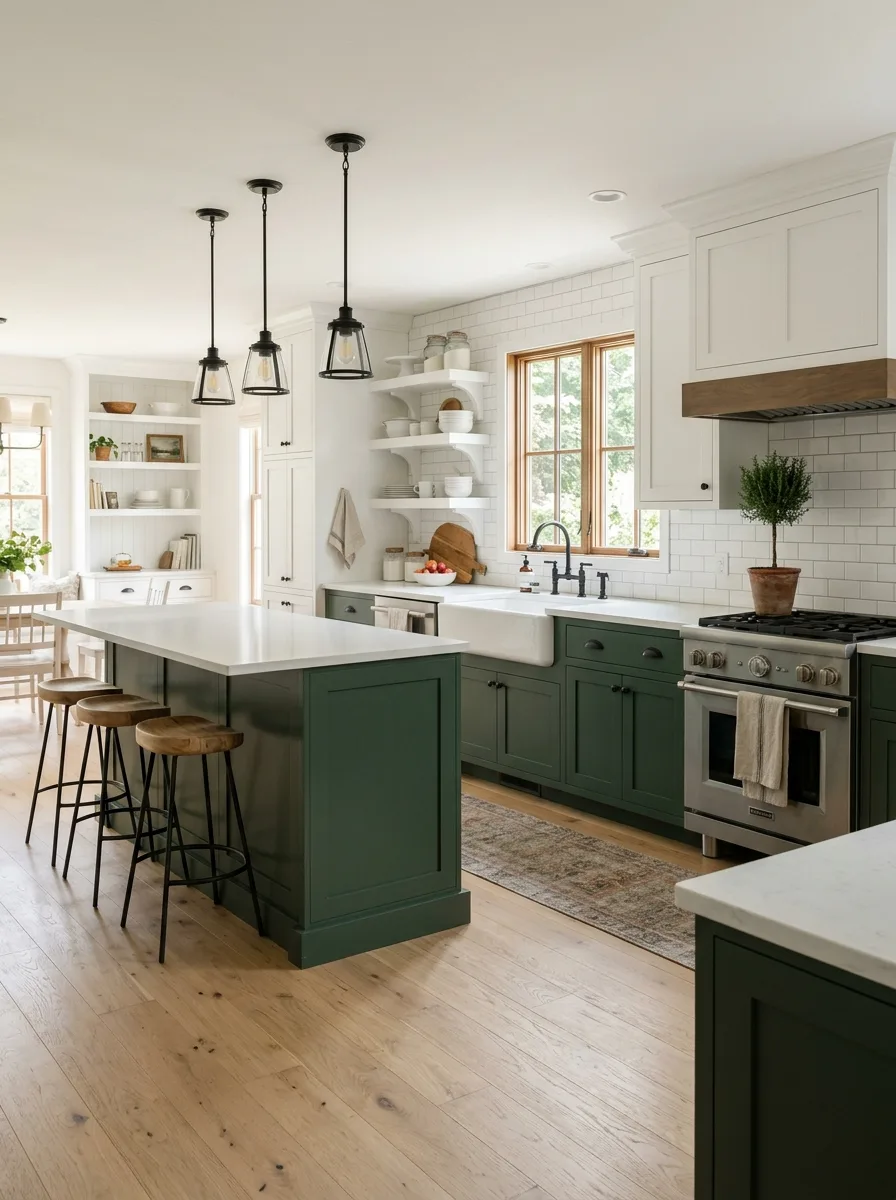
Dark lower cabinetry against white uppers is a familiar formula in modern farmhouse kitchens. This version uses a deep, saturated forest green — more British racing green than sage, more bottle than olive — and makes no apologies for it.
Paint only the lower cabinets and island in forest green. All upper cabinetry, the range hood surround, and the island counter in white. Matte black bar pulls throughout — flat, simple, horizontal — on every drawer and door. A white farmhouse sink with a black bridge tap.
White subway tile backsplash from counter to upper cabinet base. White quartz counter. Float two white open shelves beside the window on simple concealed brackets. Keep them styled with only white ceramics and one small topiary or herb plant in terracotta.
Hang three small lantern-cage pendants in black above the island — the clear glass cube or bell shape with black iron frame. Build a custom range hood surround in raw oak — a flat-faced box in natural, unsealed timber — that sits above the range and reads as a warm, contrasting material against the white tile behind it.
Seat the island with round-seat backless stools in natural timber on black hairpin legs. Light blonde wide-plank floors. A vintage or worn rug runner in muted tones in front of the range. Keep the counter clear except for one terracotta pot with a small topiary.
Full White Black Hardware Shiplap
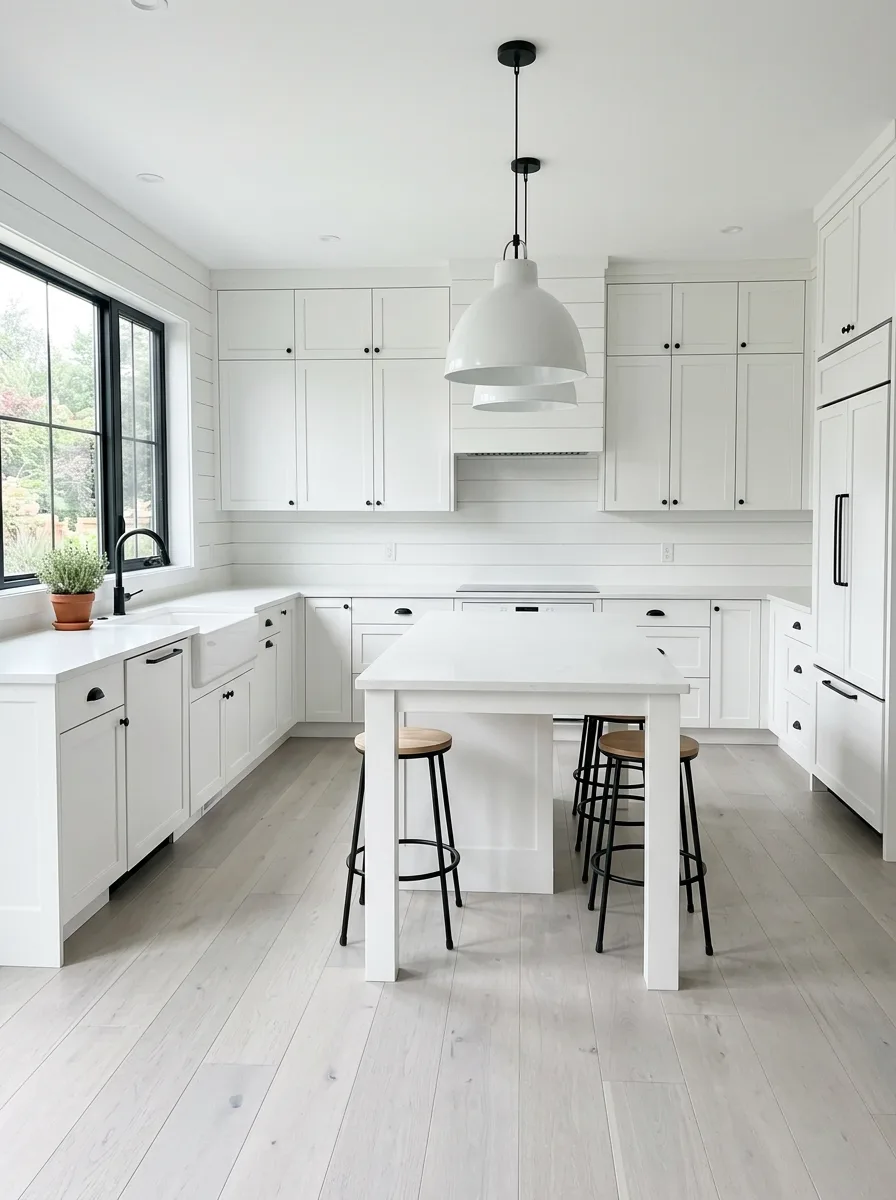
This is the hardest version of the white farmhouse kitchen to pull off, because restraint in a completely monochromatic room has nowhere to hide.
Paint every cabinet surface — all uppers, all lowers, the island, the range hood surround — in the same bright warm white. The walls behind the cabinetry and above in shiplap, painted the same white. The ceiling in shiplap, painted the same white. One continuous white envelope from floor to ceiling, interrupted only by the black windows, the black hardware, and the pale wood floor.
Use simple shaker cabinetry with small round or D-ring pulls in matte black — consistent throughout. A white farmhouse sink with a matte black tap. White quartz counters. No backsplash tile; the shiplap continues behind the cabinets and reads as the wall treatment.
Build a square or rectangular island in the same white-painted timber as the cabinets, with simple turned or straight legs. Top it with white quartz at the same level as the kitchen counter.
Hang one large white factory dome pendant — the schoolhouse or warehouse dome shape in matte white — above the island on a black cord and canopy. Just one. The scale matters; it should be generous enough to hold the space without competing with the white room around it.
Seat the island with round black-frame hairpin stools with small natural timber seats — the single warm material in the room. Pale grey-washed oak floors. One terracotta pot with lavender on the windowsill. That’s all the colour this kitchen needs.
Blue Grey Two-Tone Shiplap Hood
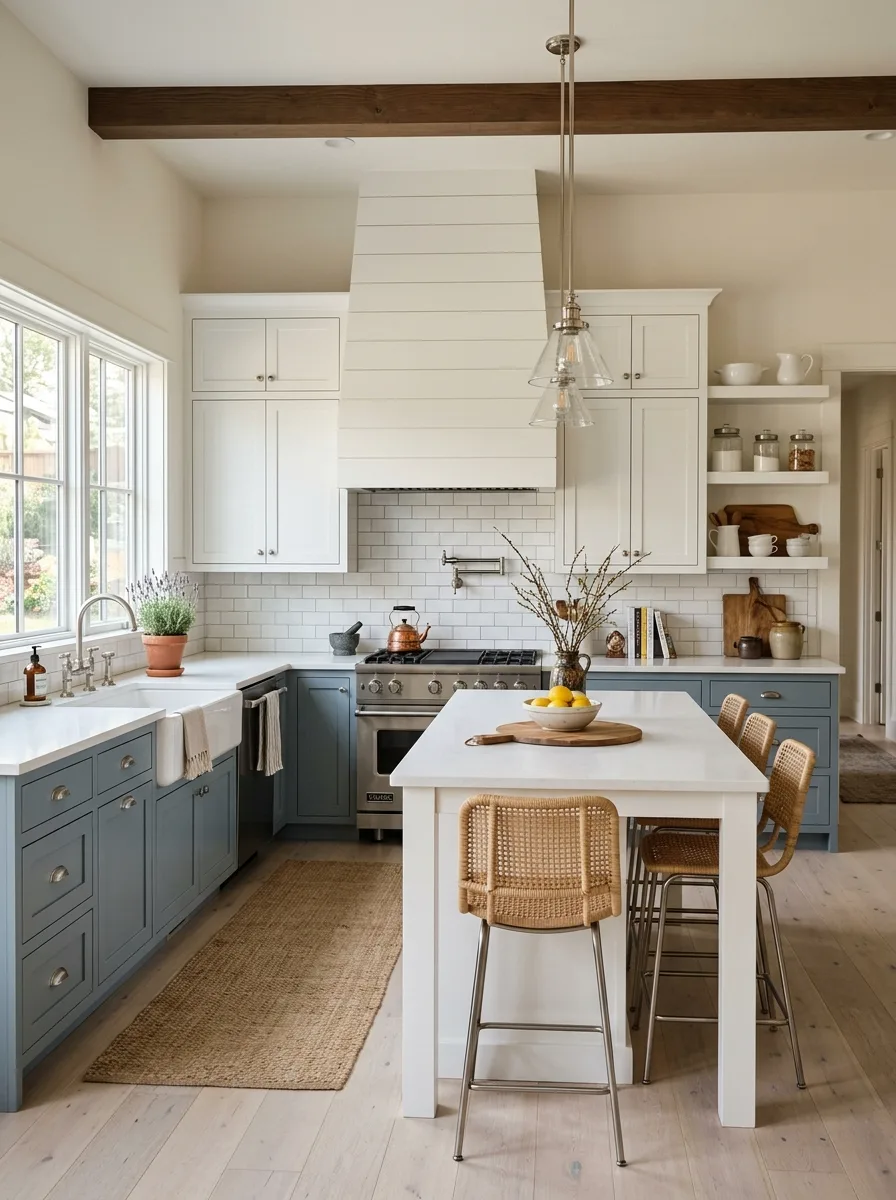
This kitchen handles the two-tone formula at a softer register — using a dusty slate-blue for the lower cabinetry rather than a saturated navy, which allows a warmer, more relaxed reading while keeping the visual interest of the colour split.
Paint the lower cabinets in a blue-grey that sits at the cooler end of what you might call “French blue” — not quite steel, not quite denim, but somewhere between them. All upper cabinetry in white. Brushed silver or antique silver cup pulls throughout. A farmhouse sink with a bridge tap in brushed nickel.
Build the range hood surround in white shiplap — continuing the shiplap from above the upper cabinets into the hood face. This creates a continuous architectural element where the hood reads as part of the building fabric.
Build or source a white-painted island with turned or simple straight legs and top it with white quartz. Seat it with rattan or cane chairs in a natural tan tone — the warmest material in the room.
Hang one or two clear glass pendant lights in polished nickel above the island — the bell or flare shape, simple and transparent. Float two white painted shelves with simple nickel brackets on the open wall. A copper tea kettle on the stove. A small bunch of dried lavender and a bottle of olive oil on the shelf. A jute runner in front of the sink.
Charcoal Oak Island Globe Light
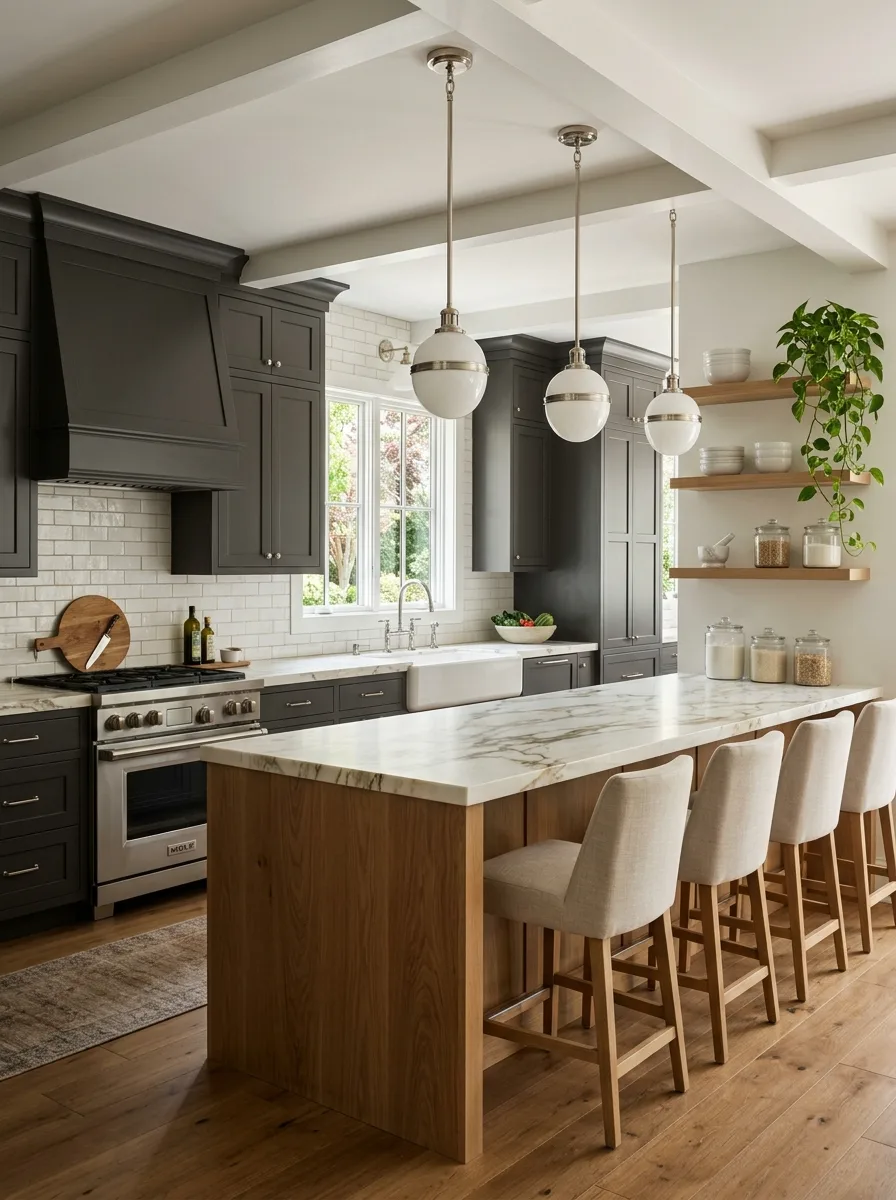
Dark charcoal cabinetry is more forgiving than true black because it holds warmth at its edges. In a kitchen with significant natural light, charcoal reads as a sophisticated dark neutral rather than a gothic statement.
Paint all shaker cabinetry in a warm dark charcoal — the kind that, in certain light, reads almost as a very dark warm grey, and in evening light reads closer to near-black. Simple brushed nickel or chrome cup pulls. A farmhouse sink with a bridge tap in chrome.
White subway tile backsplash. White marble or quartz counter. Build the island in raw natural oak — the warm blonde end of the spectrum — with a Calacatta or Arabescato marble top. The island base should be unsealed or lightly oiled, showing grain clearly.
Hang two large globe pendants above the island — milk glass in the full sphere shape, with a nickel equator band and nickel stem. Seat the island with upholstered counter chairs in a cream or oatmeal boucle on natural oak frames — the chair legs matching the island base.
Float two natural oak shelves with simple metal brackets on the right-hand wall. Load them with white ceramics, glass storage jars, and one trailing pothos. Wide-plank warm oak floors. A vintage runner rug in muted tones in front of the range. The charcoal cabinetry requires at least one warm natural element — the island base does that work.
White Shiplap Beam Cage Butcher Block
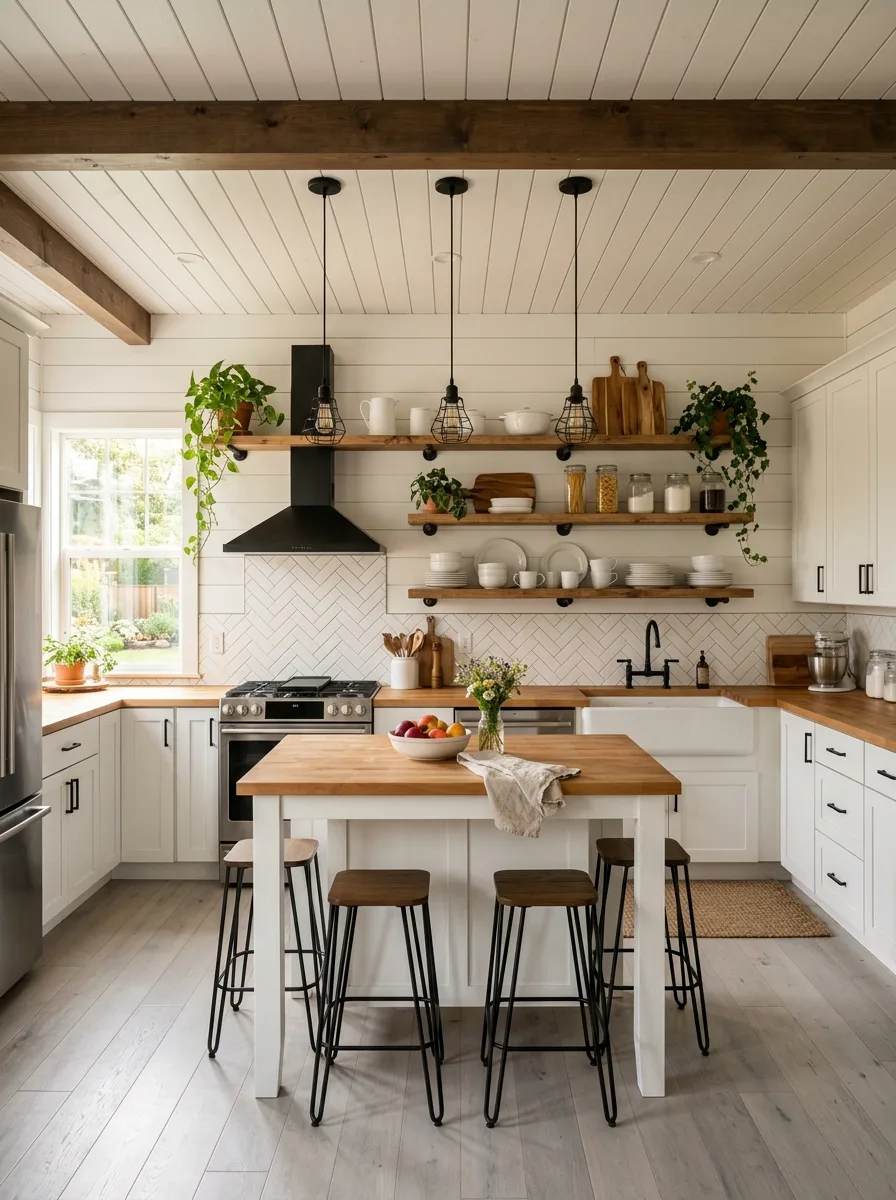
This kitchen layers three strong elements — shiplap ceiling, exposed timber ceiling beam, and a butcher block island — and keeps everything else deliberately quiet so the three elements read clearly.
Install white shiplap on the ceiling only. Run one or two thick raw timber beams perpendicular to the ceiling planks — structural if possible, decorative if not. The beams should be untreated or lightly oiled in a warm dark brown.
Paint the shaker cabinetry in a clean warm white throughout. Matte black bar-pull hardware — flat, minimal, horizontal. A farmhouse sink with a black tap. White quartz or white marble counters on the wall run.
Build the island in white-painted timber with a butcher block top in warm oak. The island base should match the cabinetry. The contrast between the white painted base and the warm butcher block top is the central material relationship.
Hang two or three cage pendants — the open cage in matte black, with bare filament bulbs — above the island. Float three open shelves in raw warm oak above the counter using iron pipe brackets. Load them with trailing plants, white dishes, wooden chopping boards, and glass storage jars.
Pale washed oak floors. A white herringbone tile backsplash behind the shelves — the diagonal pattern of the tile adding texture against the horizontal shiplap ceiling. Hairpin stool legs with round wood seats at the island.
Final Thoughts
The modern farmhouse kitchen keeps earning its place in the design conversation because it solves a real problem: how to make a kitchen feel warm, personal, and practical without sacrificing the clean lines that keep a room from overwhelming you.
The answer, every time, is the same: good materials, earned through use or through honesty about what they are. Wood that looks like wood. Stone that shows its character. Tile that was chosen for the space rather than the trend.
The farmhouses this style borrows from were built to work. The rooms that capture that spirit — whatever their colour, however dark or light their cabinets, however simple or layered their surfaces — are the ones where someone made decisions with conviction and stopped second-guessing them.
Stop second-guessing. The kitchen will thank you.