
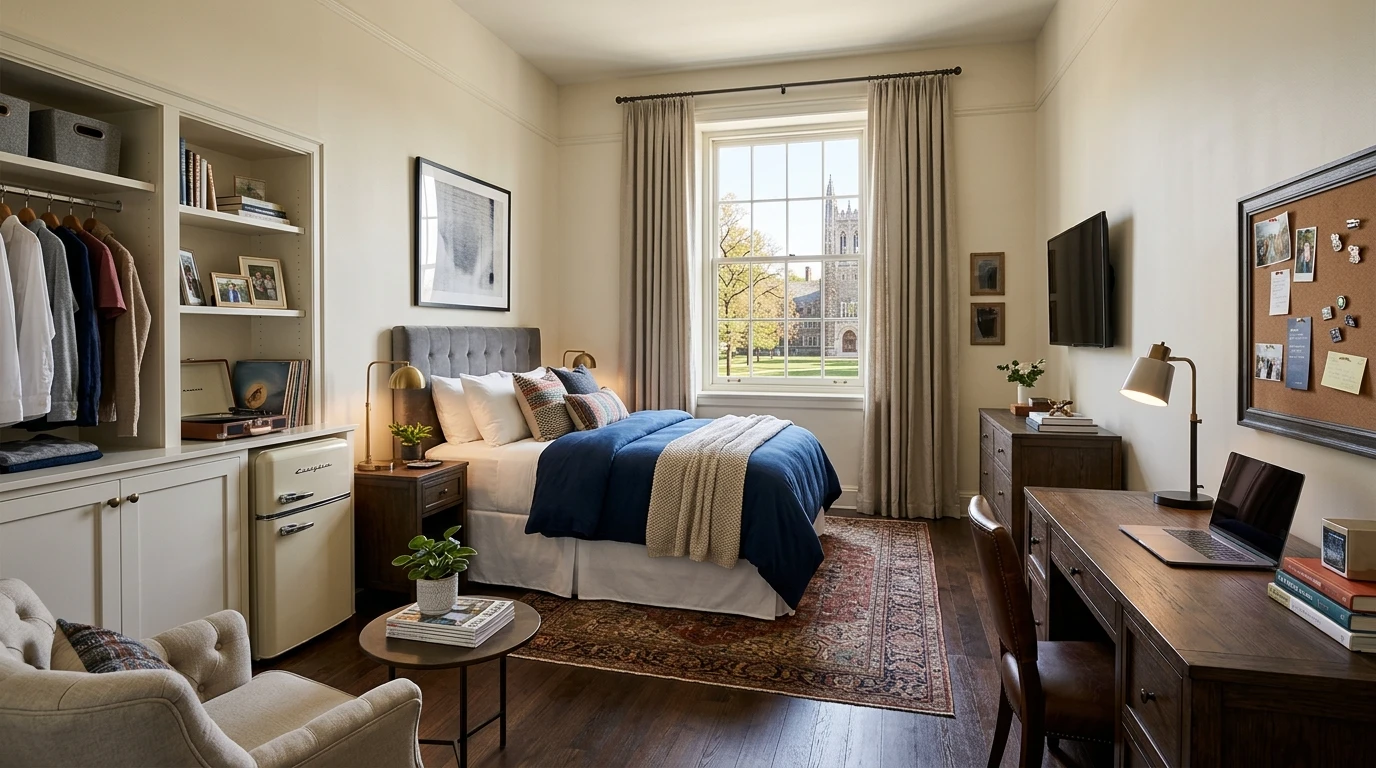
The standard dorm setup is a masterclass in institutional indifference. A bare mattress on a metal frame. One overhead light that could interrogate a suspect. A desk that has witnessed thirty years of questionable decisions by thirty different strangers.
You’re going to spend nine months here. Possibly more. And the decision most people make is to tolerate it.
That’s the wrong call. A dorm room is not a waiting room. It’s a home, with the same need for warmth, logic, and identity as any other space you’ll ever inhabit. The only difference is the budget and the constraints — and neither of those is as limiting as people assume.
What you’re about to see is proof.
Why Dorm Rooms Look Expensive Only on Paper
Buying Luxury Items Without a Luxury Framework
You can spend a lot of money on a dorm room and have it look like a catalog threw up. The problem isn’t the pieces — it’s the absence of a plan that makes the pieces make sense together.
Luxury in a room doesn’t come from expensive objects. It comes from visual coherence. It comes from light quality. It comes from the decision to finish something rather than let it trail off. A dorm room that looks genuinely elevated almost always has one clear palette, one clear light temperature, and no objects present by accident.
Buying an expensive headboard and then surrounding it with random things you owned in high school is not a strategy.
Ignoring the Desk Entirely
The desk exists in every single one of these rooms. It takes up roughly a third of the usable floor space. And most people style it as an afterthought — or don’t style it at all.
A room with a beautiful bed across from a cluttered, unthought-about desk looks unfinished from the chair you sit in for most of the day. The luxury of a space is not just what you see when you walk in. It’s what you see every single time you look up.
Style the desk with the same intention you give the bed. A desk mat, one lamp, one decorative object, a pen cup that matches the room. That’s it. It’s not complicated. It’s just easy to skip.
Overhead Lighting Left On
Every room in this collection uses lamps. Not one of them is relying on the overhead fluorescent for atmosphere. This is not a coincidence.
Overhead institutional lighting flattens a space. It removes shadow, which is what gives a room depth. Lamps — table lamps, desk lamps, sconces, floor lamps — create pools of warm light that make a room feel inhabited rather than surveilled.
The cheapest thing you can do to make a dorm room feel expensive is turn off the overhead light and use two lamps instead. The room will immediately feel like somewhere worth being.
Luxury Dorm Room Ideas
Hydrangea Floral Twin Symmetry
Source a large-scale floral wallpaper in blue and cream — look for a hydrangea or garden botanical motif with a white or ivory ground. Apply it to the full wall behind both beds, running it to the ceiling. This paper needs to be floor-to-ceiling and wall-to-wall; anything smaller reads like a patch.
Install two plug-in sconces — brass finish, with white drum shades — one on each side of the wall at approximately headboard height. These sconces sit on the wallpaper surface and connect the two beds visually. Between the beds, place a white three-drawer chest with brass ring pulls as the shared nightstand.
Source matching upholstered headboards in a solid periwinkle or cornflower linen. Dress both beds identically: white duvet, white euro shams, one green-and-white geometric print pillow, one monogrammed white lumbar. Use blue and white stripe skirted ottomans at the foot of each bed — the stripe reads as a second pattern but stays within the same cool blue and white palette. Finish with a sisal or jute area rug.
Rose Gold Mirror Clip Photo Wall
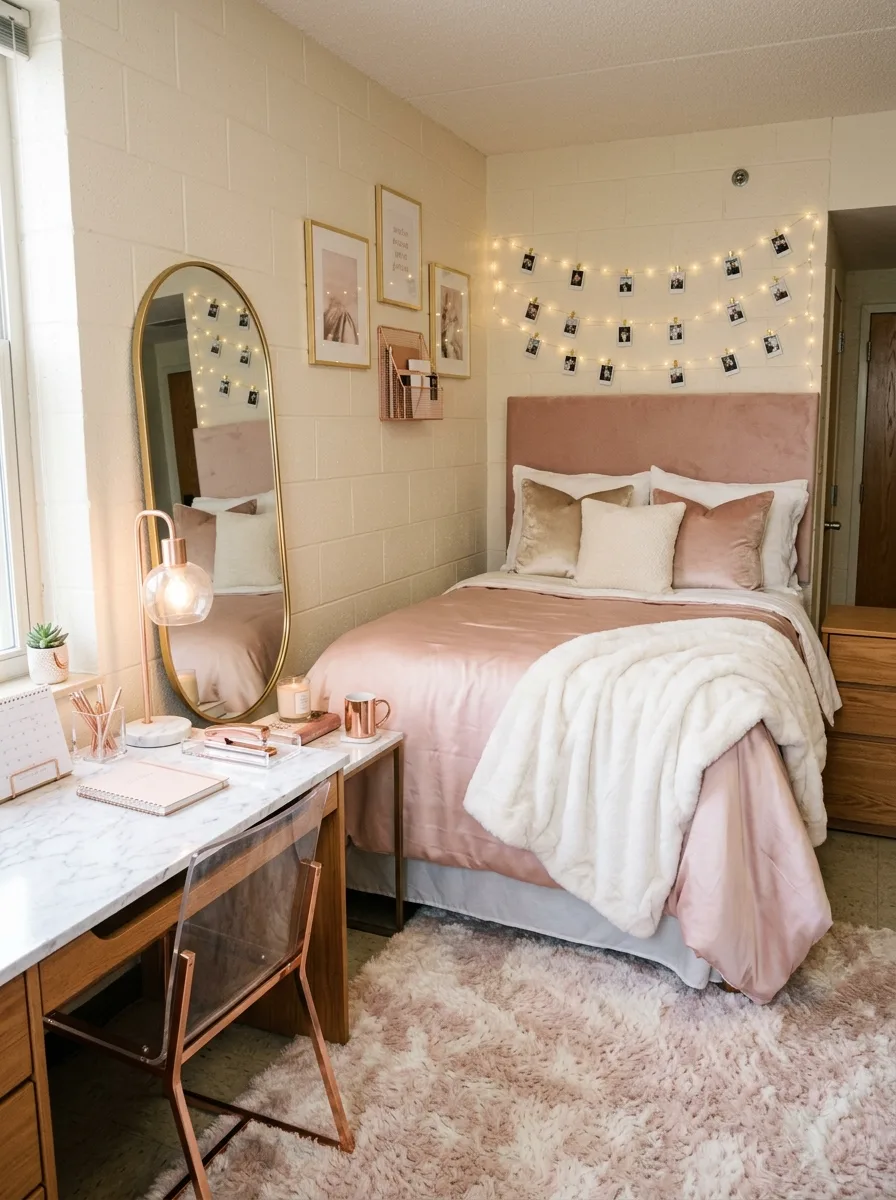
Source a full-length oval mirror with a gold or brass frame — this goes against the wall beside the desk, leaned at a slight angle, not mounted. It should be tall enough that the top reaches your shoulder height when standing.
Attach two horizontal strands of copper fairy lights to the wall, running them from the mirror across the wall above the bed, with small binder clips holding Polaroid-format photos at intervals of three to four inches. This creates a photo installation that also provides ambient light.
Add a marble-finish contact paper to the desk surface — lay it edge to edge, trim carefully, and press out air bubbles. Pair the desk with a rose gold metal task lamp and an acrylic chair with rose gold legs.
For the bed: a dusty mauve velvet upholstered headboard, blush satin-finish duvet, one cream velvet lumbar, one blush euro behind. Drape a white faux fur throw across the lower third of the bed, not folded neatly. The look should feel slightly undone, not precise.
Place a small brass or copper succulent pot on the desk corner. Use a long-pile pink blush rug.
Built-In Loft Study System
Loft the bed to ceiling height. This is the non-negotiable first step. Below the loft, run a continuous L-shaped desk surface made from plywood cut to width and supported by a shelf unit on one side and a small filing cabinet on the other. Source open wooden shelving units to flank the desk and run them up to loft height, filling them with books, plants, and a few curated objects.
On the wall behind the shelves, create a horizontal gallery — pinned postcards, film photography prints, and a few pages of personal work. The gallery should be asymmetric and pinned directly, not framed.
Below the loft, pull a daybed or sofa-style cushioned platform into the space to create a secondary seating zone separated from the desk. Add a small pendant lamp hanging down into the study alcove — a rattan dome or simple cloth shade on an extension cord is enough. Use roman blinds rather than curtains. The whole system works because every inch of vertical space has a purpose.
Dark Academia Scholar Study
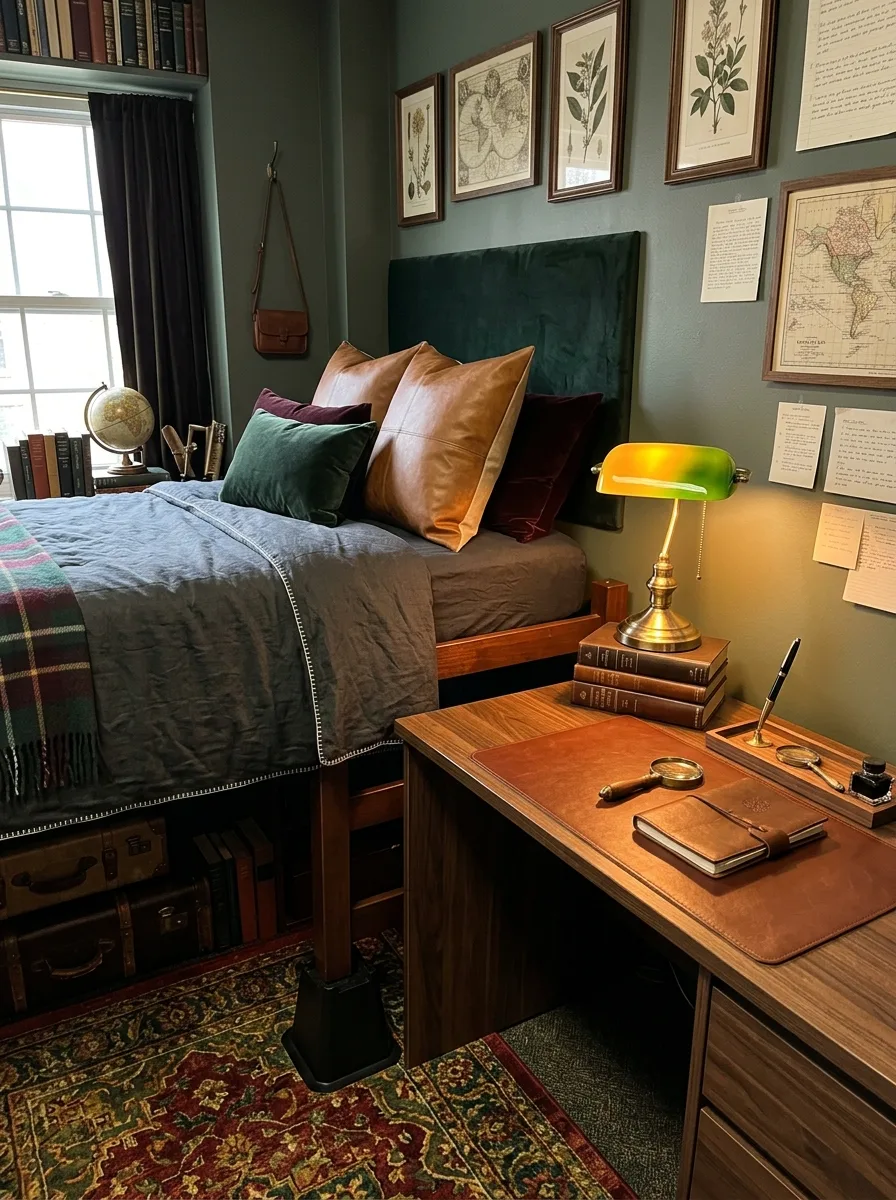
The walls are painted or temporarily wallpapered in a deep slate blue — not navy, not gray, a color that exists in the middle. This wall color is doing the work of making an ordinary room feel old and serious.
Source a dark forest green velvet upholstered headboard. Dress the bed with a slate gray linen duvet, a plaid blanket in forest green and wine draped across the lower half, and faux leather throw pillows in cognac tan paired with velvet pillows in forest green and deep plum.
On the desk, build up the surface: stack two or three hardcover books, place the banker’s lamp on top of the stack, add a leather journal, a brass magnifying glass, an ink pen, and a leather desk blotter. The desk should look like a writer’s desk from 1930, not a student’s desk from last year.
Mount a gallery wall of antique maps, vintage botanical prints, and handwritten notes pinned directly to the wall above the desk. Hang the same style of prints in dark wood frames above the bed. Use a vintage Persian rug in deep red, forest green, and gold. Store a vintage suitcase under the bed and let it show.
White Toile Neon Name Dorm
Start with the bedding and let it be the most elaborate thing in the room. Use a French toile duvet — blue and white floral toile, with a white ruffle-hem duvet cover layered over it. The bed should have a white frame with a simple slatted or spindle headboard.
Above the bed, install a white wall-mounted shelf running the full width of the sleeping zone. Style it with a single neon name sign in a script font in coral or blush, a small table lamp in gold, and three or four fashion-oriented art prints in gold frames leaning against the wall. The neon sign provides the only warm ambient light source above the bed.
Use a white five-drawer dresser as a nightstand beside the bed. On the adjacent wall, install a long horizontal float shelf at eye height and lean additional gold-framed prints in a loose row. Mount a Hollywood vanity mirror on the desk surface rather than on the wall — the lit mirror adds both function and atmosphere to the workspace. Floor rug should be an overdyed floral in deep blue to provide contrast against the white-heavy room.
Jewel Tone Velvet Scholar
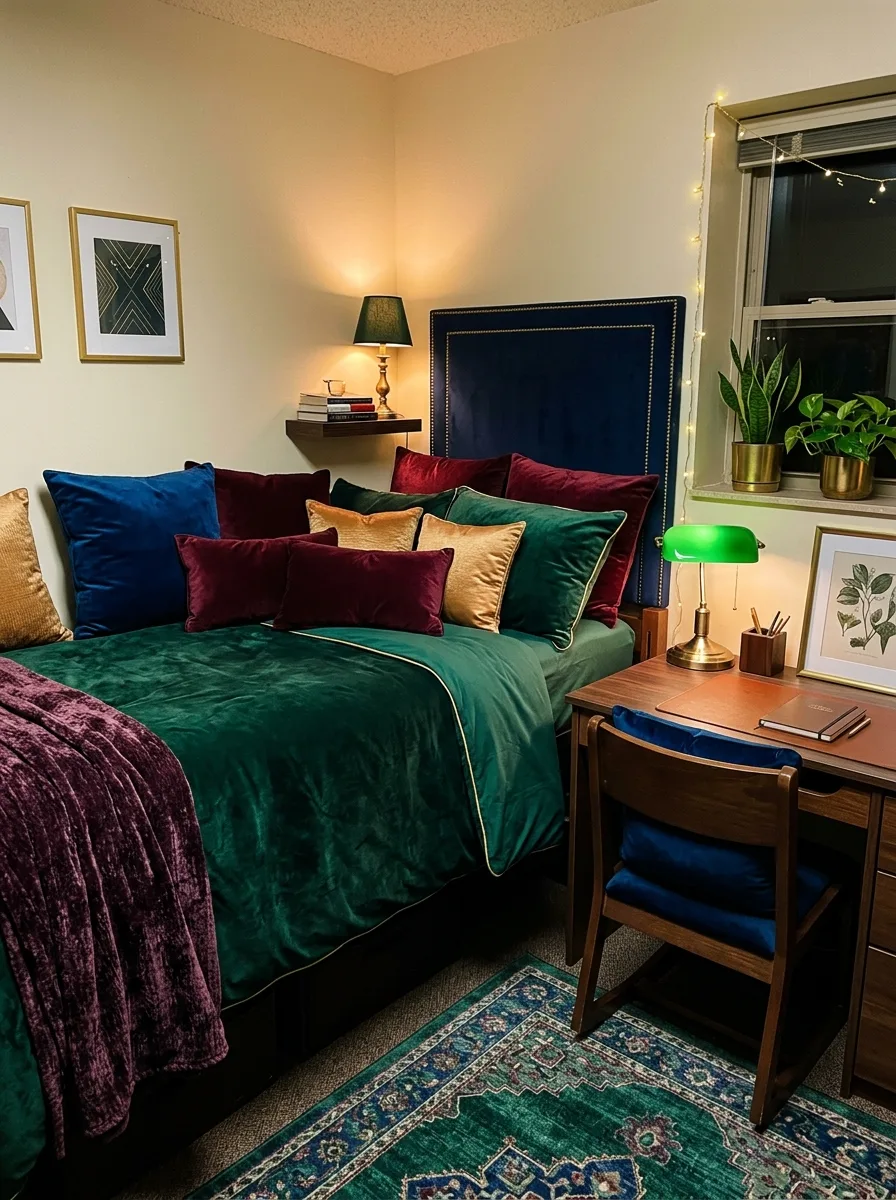
Source a navy velvet upholstered headboard with nailhead trim detail — the taller the better, at least forty inches. This is the anchor.
Use a forest green velvet duvet as the base layer, with a gold-edged stitch detail along the hem. Pile the pillows in a jewel-tone mix: navy square, burgundy square, gold lumbar, deep green euro. The pillows are all velvet, all different colors, all from the same jewel family. The mix looks intentional because the finish is consistent even as the colors vary.
Install a floating shelf on the adjacent wall — shallow, in dark walnut or wood-tone — at nightstand height. Stack two books on it, add a small traditional lamp with a dark green shade and brass base, and one small object.
Place a green banker’s lamp on the desk. Source the desk chair with a navy or deep blue velvet cushion pad. Use a vintage-style Persian rug in teal and navy on the floor. Hang two gold-framed prints with dark geometric or abstract line art on the wall. Fill brass-toned pots on the windowsill with plants — snake plant, pothos, or fiddle leaf. Every element earns its place by fitting the palette.
Navy Nautical Scholar Room
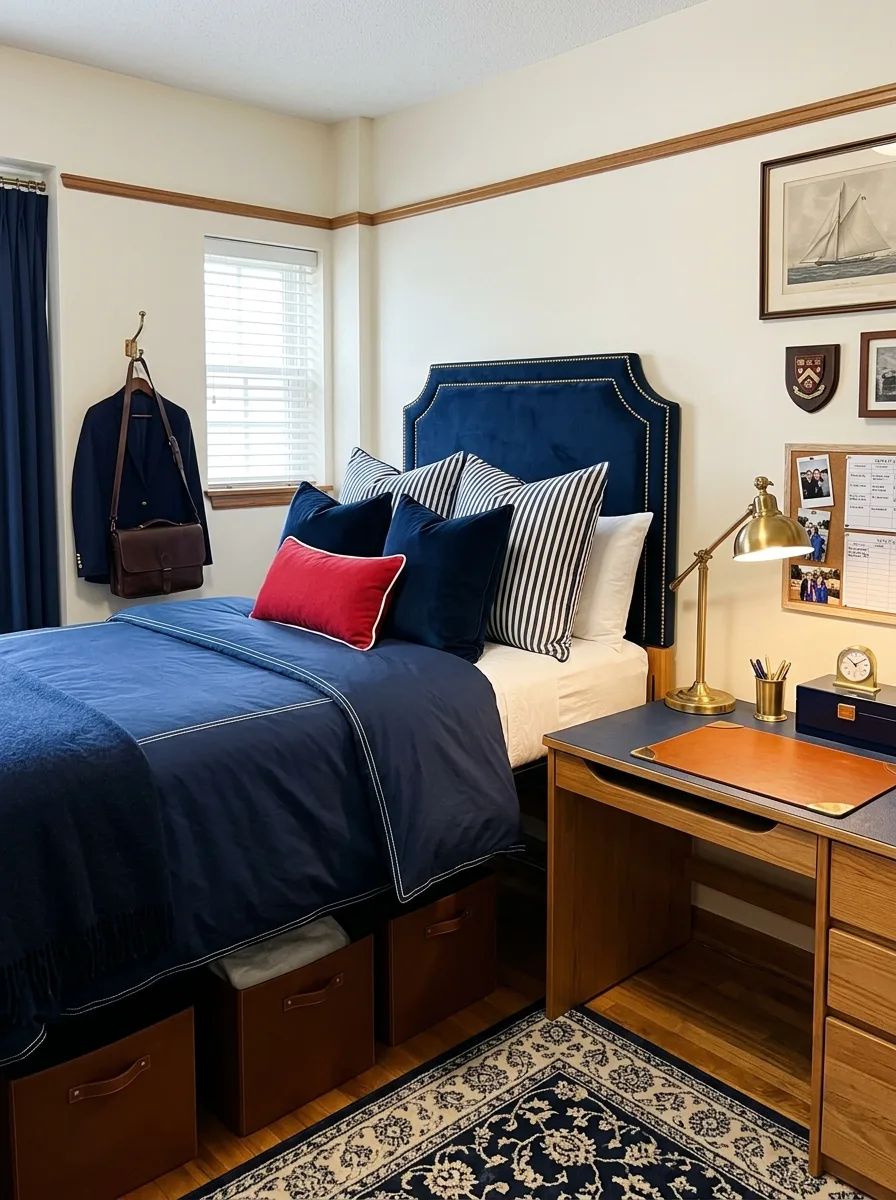
The entire palette is navy, white, brown leather, and brass. Every single element. There is no fourth color.
Mount a navy velvet upholstered headboard with nailhead trim. Dress the bed with a navy duvet with white contrast stitching, white euro shams, navy velvet square pillows, navy and white stripe lumbar pillows, and one red velvet lumbar as the single accent. The red is the only thing in the room that breaks the navy and white — and it works because it’s small, isolated, and historically associated with nautical color combinations.
Hang a nautical or sailing-themed framed print above the desk — an engraving style, not a photograph. Beside it, add a school crest or other institutional emblem in a small frame. Install a brass library lamp on the desk; the lamp shade should be either green glass or black metal.
Use a brown leather desk mat, a brass pen cup, and a brass desk clock. Under the bed, use brown leather-handled storage bins. Install a dark wood rail with brass hooks on the wall for hanging a blazer and bag. Use an antique-style Persian rug in navy, cream, and dark red. Add wood-trim molding along the top of the walls using adhesive trim strips if the architecture lacks it.
Shoji Screen Zen Minimal
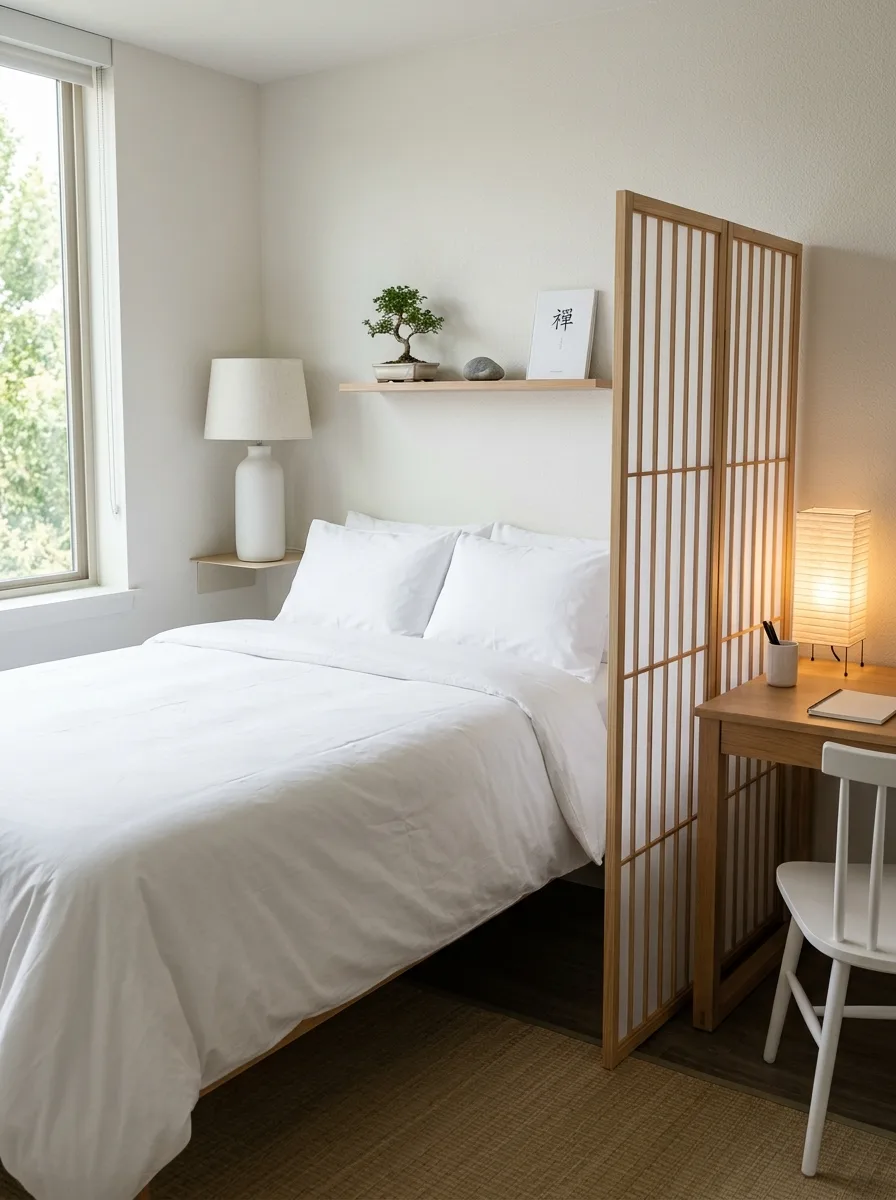
All bedding is white. All furniture is natural blonde wood or white. The walls stay white. Nothing is added to this room that doesn’t have a specific reason to be there.
Source a freestanding shoji screen — two or three panels, natural bamboo frame with rice paper or slatted wood panels — and use it as a room divider between the sleeping zone and the desk zone. This one element creates the suggestion of two separate spaces where there is only one room.
Mount a single floating shelf above the bed headboard area — wide enough for three objects: a bonsai tree in a shallow ceramic pot, a smooth river stone, and one small framed print with a single Japanese character. That’s the shelf. Nothing else goes on it.
Use a ceramic white table lamp beside the bed and a paper lantern-style lamp beside the desk. The desk lamp should be small, warm, and simple. Use a sisal or natural jute rug across the full floor area. No patterns. No prints on the walls. The bonsai is the only living thing in the room, and it is doing a significant amount of work.
Champagne Curtain Headboard Suite
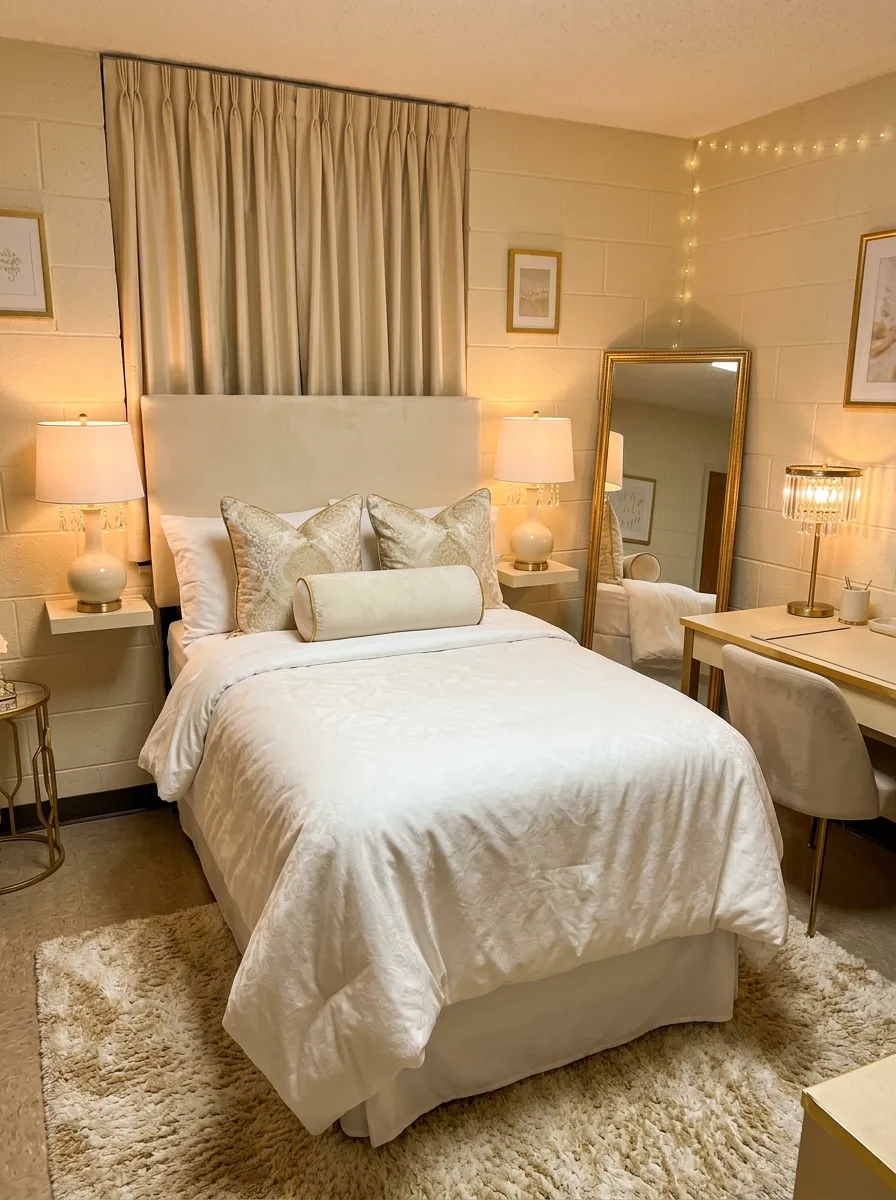
This is the room that looks like a boutique hotel despite being a cinder block box. The secret is the wall behind the bed.
Hang a ceiling-to-floor curtain panel from a tension rod or ceiling-mounted curtain track directly on the wall behind the bed. The curtain should be a pinch-pleat or pencil-pleat style in heavy champagne or cream linen — floor length, full width of the bed. This curtain is not functional. It’s purely architectural. It creates a luxurious draped surface where there was once just a cinder block wall.
In front of this curtain, place a tall cream upholstered headboard. On either side of the bed, add matching white ceramic table lamps on white floating nightstands at the same height. These lamps should be symmetrical — same size, same shade, same placement. The symmetry is what gives the setup its hotel quality.
Dress the bed in all white: white duvet, white shams, cream brocade accent pillows, a single cream velvet bolster centered in front. Use a long-pile cream shag rug that extends well past the foot of the bed. Lean a full-length gold-framed mirror against the adjacent wall. Add a crystal chandelier-style table lamp on the desk — the sparkle is a deliberate counterpoint to the quiet cream of everything else.
Terracotta Warm Linen Organic
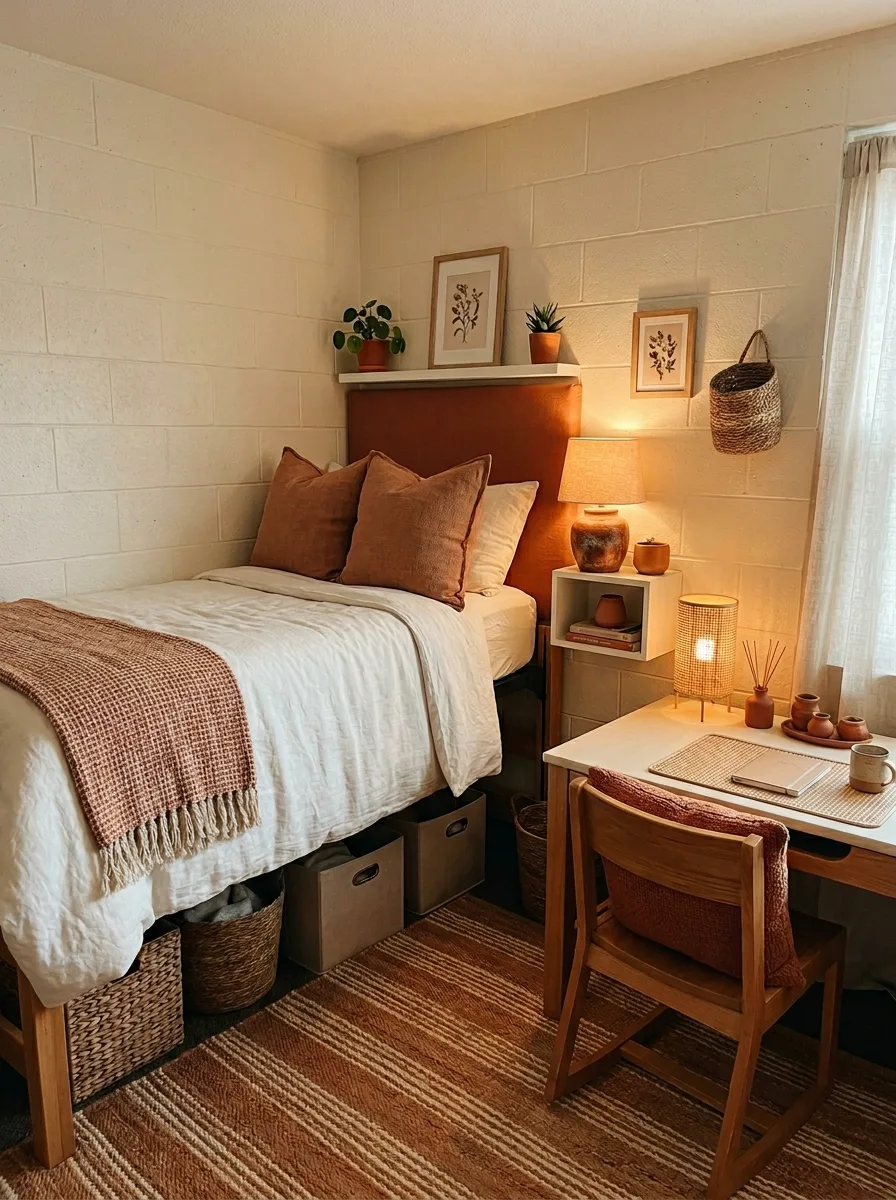
Everything in this room is warm. That’s the principle and it applies without exception.
Source a terracotta leather or faux-leather upholstered headboard — not velvet, not linen, specifically a smooth matte surface in a warm amber brown. Mount a single floating shelf across the full width of the headboard wall above the bed. On it: two or three small terracotta pots with plants, one small framed botanical print leaning against the wall, and space between each object so they breathe.
Dress the bed in white linen — truly linen, not cotton, because linen has a natural texture and drape that cotton can’t replicate. Layer a terracotta linen throw across the foot. Add rust-colored linen square pillows, two of them, same size.
On the desk, style a rattan-shade lamp, a small reed diffuser, two or three small terracotta votive holders, and one ceramic mug holding pens. Use a woven rattan desk mat or a natural fiber placemat instead of a standard desk mat. Under the bed, use woven seagrass baskets for storage — never plastic bins in this room, ever. The floor rug should be a warm stripe in rust and cream.
Forest Green Botanical Sconce Room
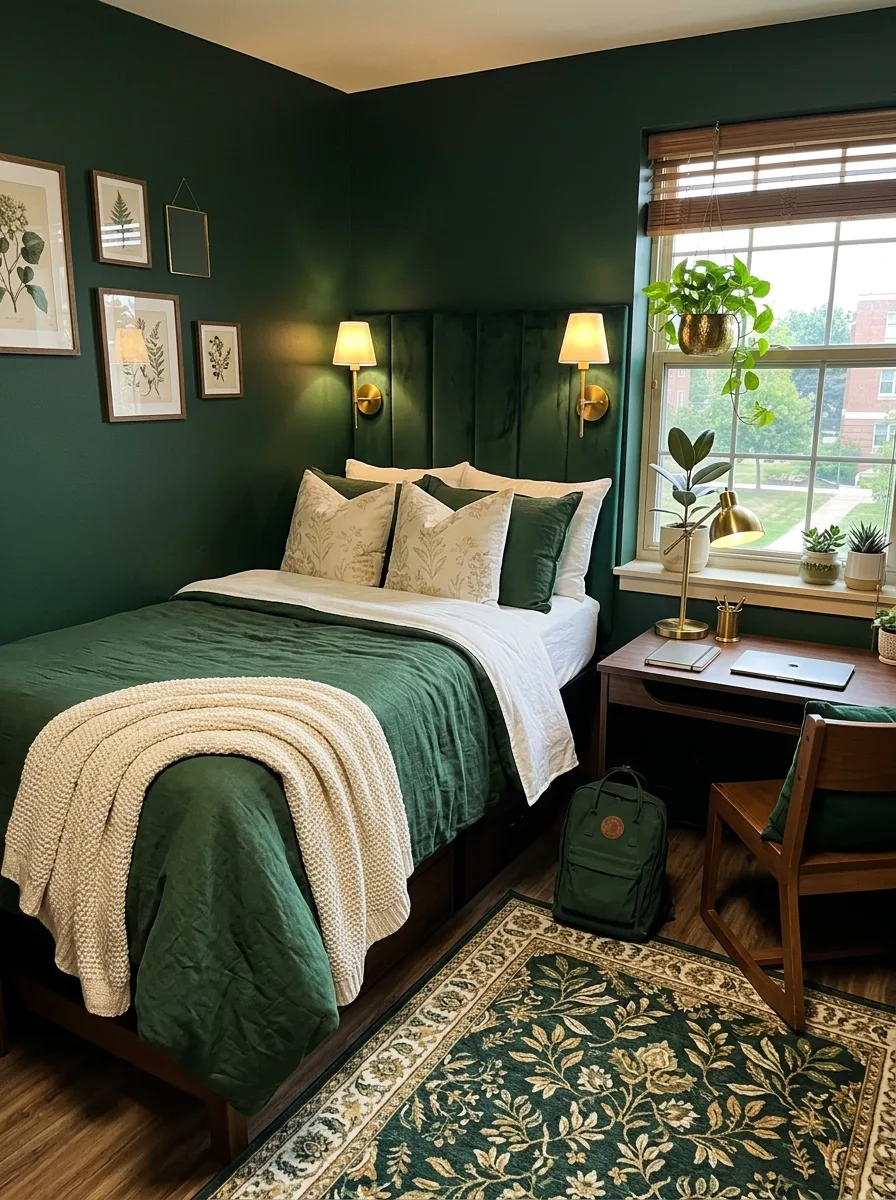
Paint or temporarily wallpaper the walls in deep hunter green — floor to ceiling, all four walls. This is non-negotiable. If one wall is green and the rest are beige, it’s a different room with a different quality. The effect only works when the room is enveloped.
Source a tall channeled velvet headboard in the same green or one shade darker. Mount two plug-in brass sconces directly to the wall on either side of the headboard, positioned at headboard height. These sconces provide the primary sleeping light and connect the headboard to the wall architecturally.
Dress the bed in white linen — the white against the deep green is the central contrast the room relies on. Add two large square pillows in a cream and sage botanical print, and two small deep green velvet pillows in front of those. Drape a cream waffle-knit throw across the foot.
On the windowsill, cluster four or five plants in white or brass pots — a pothos trailing over the edge, a small rubber tree, two or three succulents. Use a brass desk lamp with a dome shade. Hang a loose gallery of framed botanical prints on one green wall — keep the frames wood-toned and un-matted. Use a large vintage-style floral rug in forest green and cream.
Greige Gallery Linen Calm
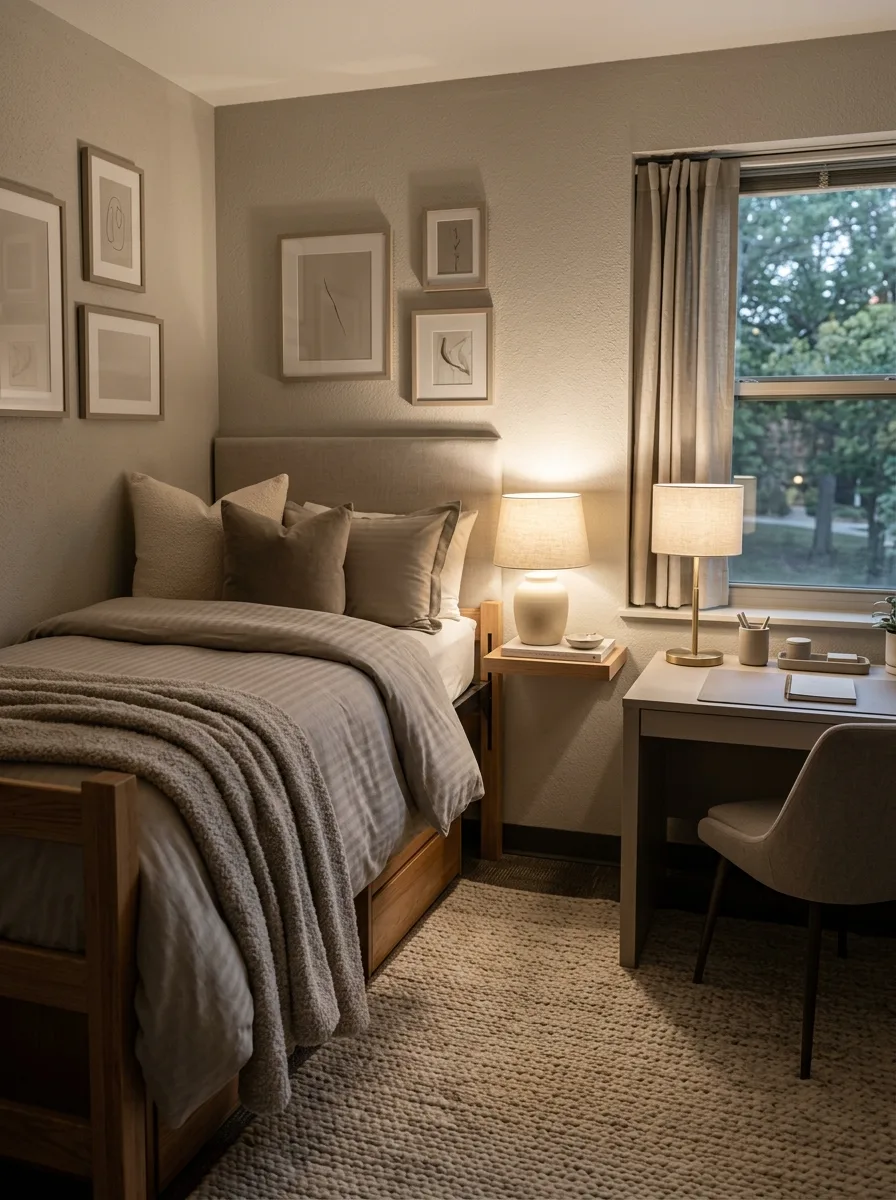
The palette is greige — a gray that reads warm, not cool. Neither beige nor gray; exactly between them. All textiles in this room are in the same tonal range and the room works because the range is executed without deviation.
Source a linen upholstered headboard in warm greige. Use a greige linen duvet with a subtle stripe weave, not a print. Layer two boucle square pillows in the same tone on top of the shams. Add a chunky teddy-bear-texture throw in a slightly lighter shade across the lower quarter of the bed.
Mount five small frames in varying sizes in an asymmetric cluster above and to the side of the headboard — all the same frame finish (thin natural wood or matte white), all with minimal line-drawing or abstract prints with no color. The gallery provides visual interest without introducing a second hue.
Place two lamps: one ceramic table lamp with a round barrel shade beside the bed, and one slender brass-leg lamp on the desk. Both should have bulbs in the 2700K warm white temperature. Use a chunky woven jute rug across the full floor area. Keep the desk entirely clear except for a desk mat, the lamp, a mug, and a small white ceramic tray.
Champagne Satin Hotel Bed
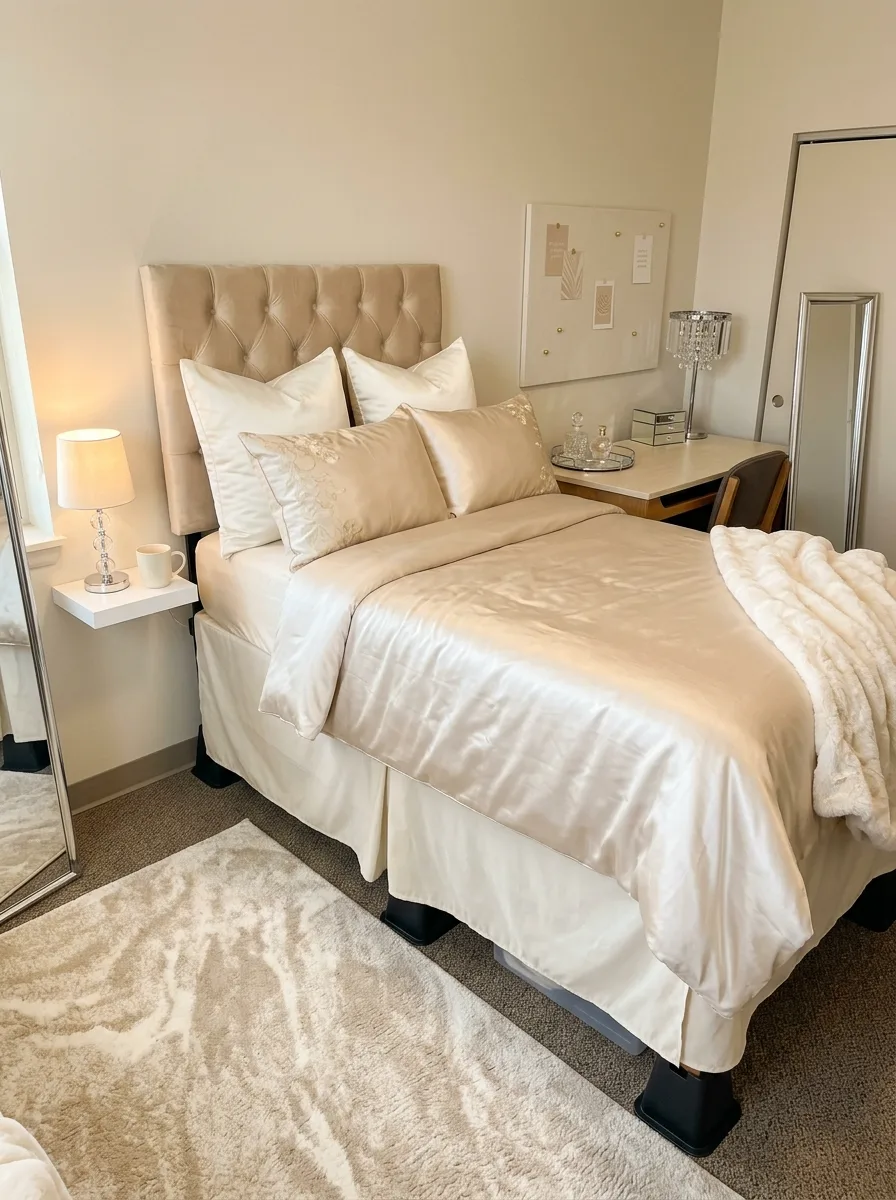
This look is built on one decision: the duvet is satin. Not cotton satin-weave. Not cotton percale. Satin — smooth, reflective, draping differently than any other fabric when it catches light.
Source a cream or champagne satin duvet cover, the kind with a subtle sheen. Pair it with pillow shams in the same fabric. Layer a tufted velvet headboard in champagne above the bed — the velvet and satin share a color family but the contrast in texture is what makes the bed feel luxurious rather than simply pale.
Add one embroidered lumbar pillow in cream on white — the embroidery gives the neutral palette a surface to catch light. Drape a cream faux-fur throw across one corner of the bed. Use a crystal-base lamp on the nightstand and a crystal chandelier accent lamp beside the desk. Both should be on separate circuits or plugs so they can be used independently.
Apply a calf-hair or abstract animal print area rug in cream and soft taupe underneath the bed. Use a mirrored desk surface or lay a clear acrylic sheet over the standard desk to add reflection without adding color.
Sage Green Rattan Sconce Setup
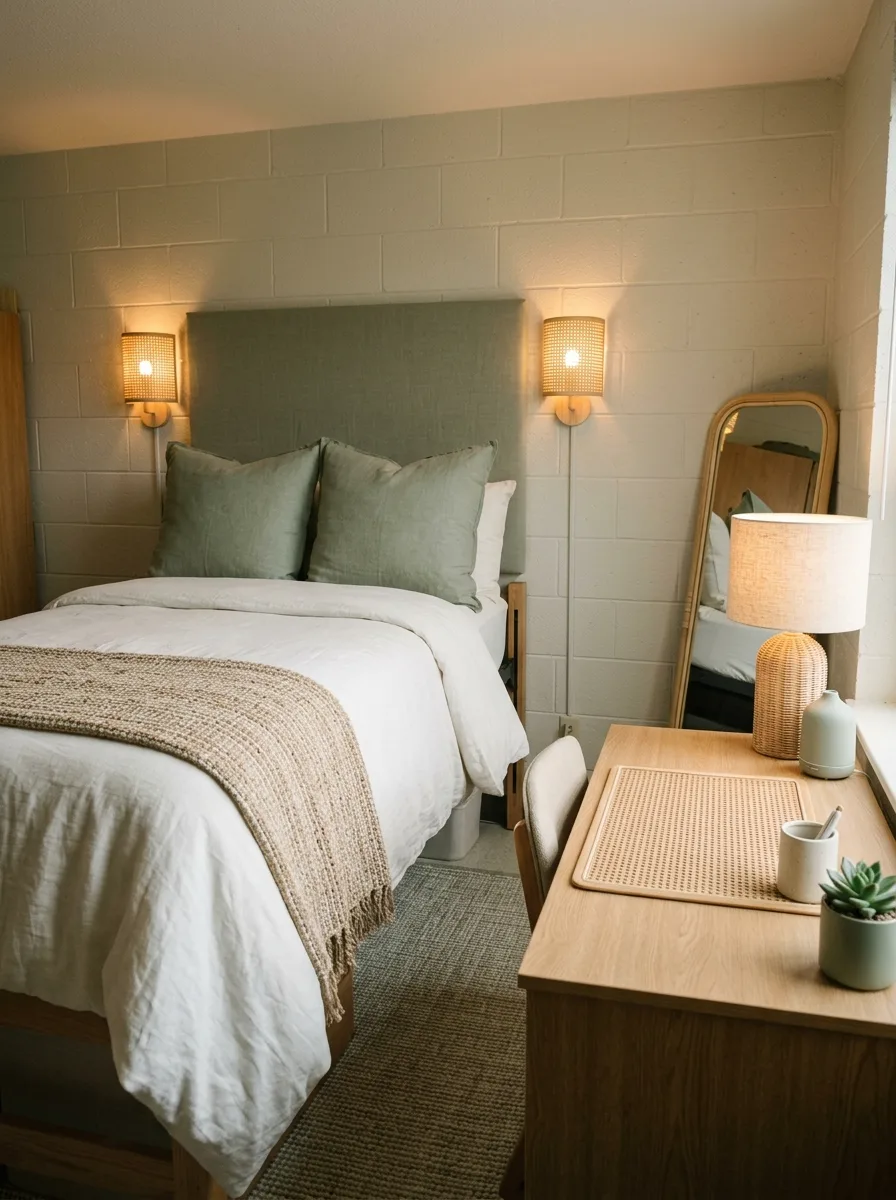
Paint the wall behind the bed — or apply temporary wallpaper — in a muted sage green. Just the one wall, floor to ceiling. The rest of the room stays white or cream; the accent wall is the only color commitment.
Mount two plug-in rattan drum sconces on either side of the headboard, positioned symmetrically at headboard height. These sconces are the defining feature of the room. They provide warm light in a material that reads as natural and intentional. Source a linen upholstered headboard in the same sage tone as the wall so they read as a single continuous surface.
Dress the bed entirely in white linen — no color in the bedding. The color lives on the wall and in the pillow covers. Use two sage linen square pillow covers on the standard shams, and nothing else on the bed.
Place a rattan-base table lamp on the desk and a small sage ceramic vase beside it. Use a cane-weave or rattan desk mat. Lean a full-length mirror with a rounded natural wood frame against the wall beside the desk. Use a neutral stripe jute rug on the floor.
Black and White Architecture Room
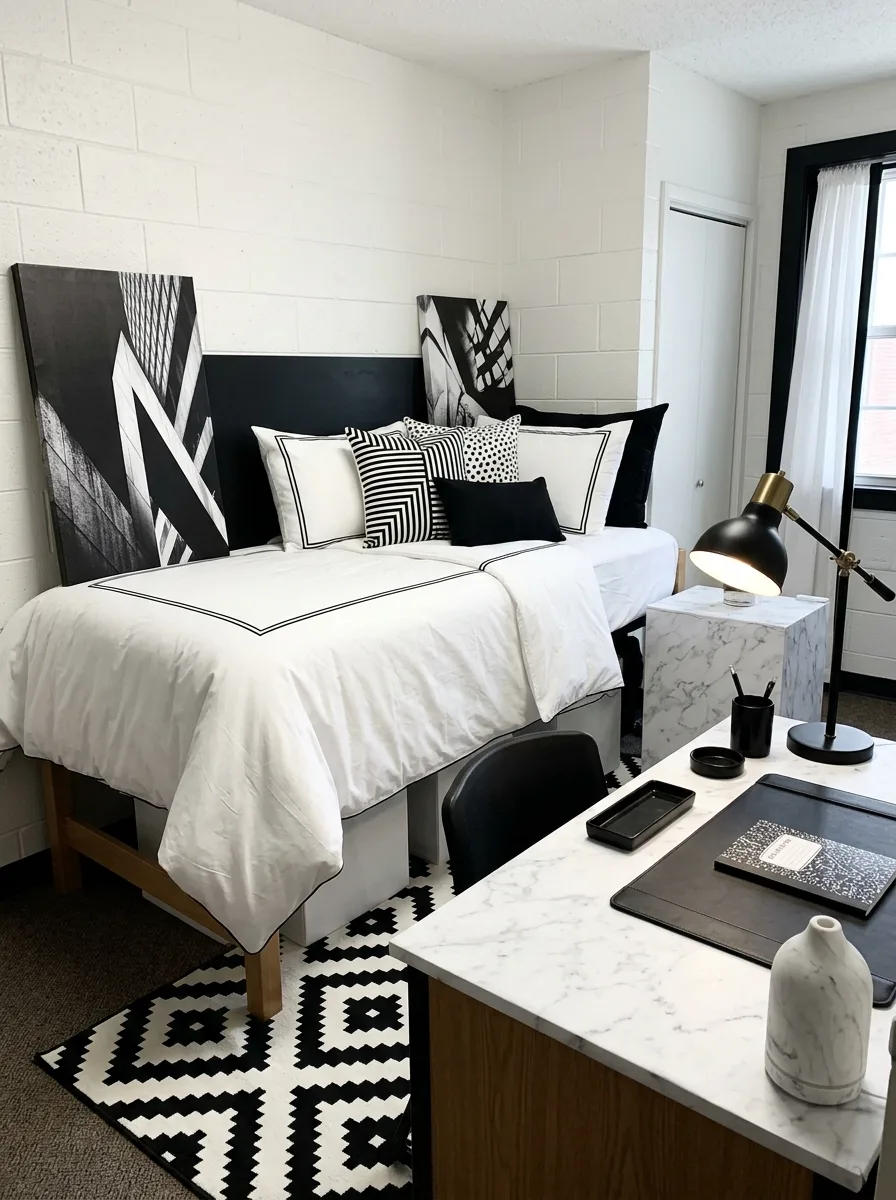
Two oversized black and white photography canvases — architectural subject matter, urban geometry, building lines — lean against the wall on either side of the bed at headboard height. They’re not mounted. They lean. This is the move that makes the arrangement feel deliberate rather than cautious.
Use a hotel-white duvet with black border stitching — visible contrast piping along all four edges. Dress with black and white pillow covers in multiple patterns: a stripe, a geometric, a polka dot, a houndstooth. Every pillow is black and white. Every pattern is different. It works because the palette is completely locked.
Apply marble-finish contact paper to the full desk surface, edge to edge. Source a marble-cube or marble-look side table — either stone or contact-paper-wrapped — as the nightstand. Use a black articulating desk lamp with brass hardware. Use a black and white geometric area rug.
Keep the walls otherwise blank. No gallery. No art. The two canvases leaning beside the bed are sufficient visual weight.
Gray Blush Gold Shelf Room
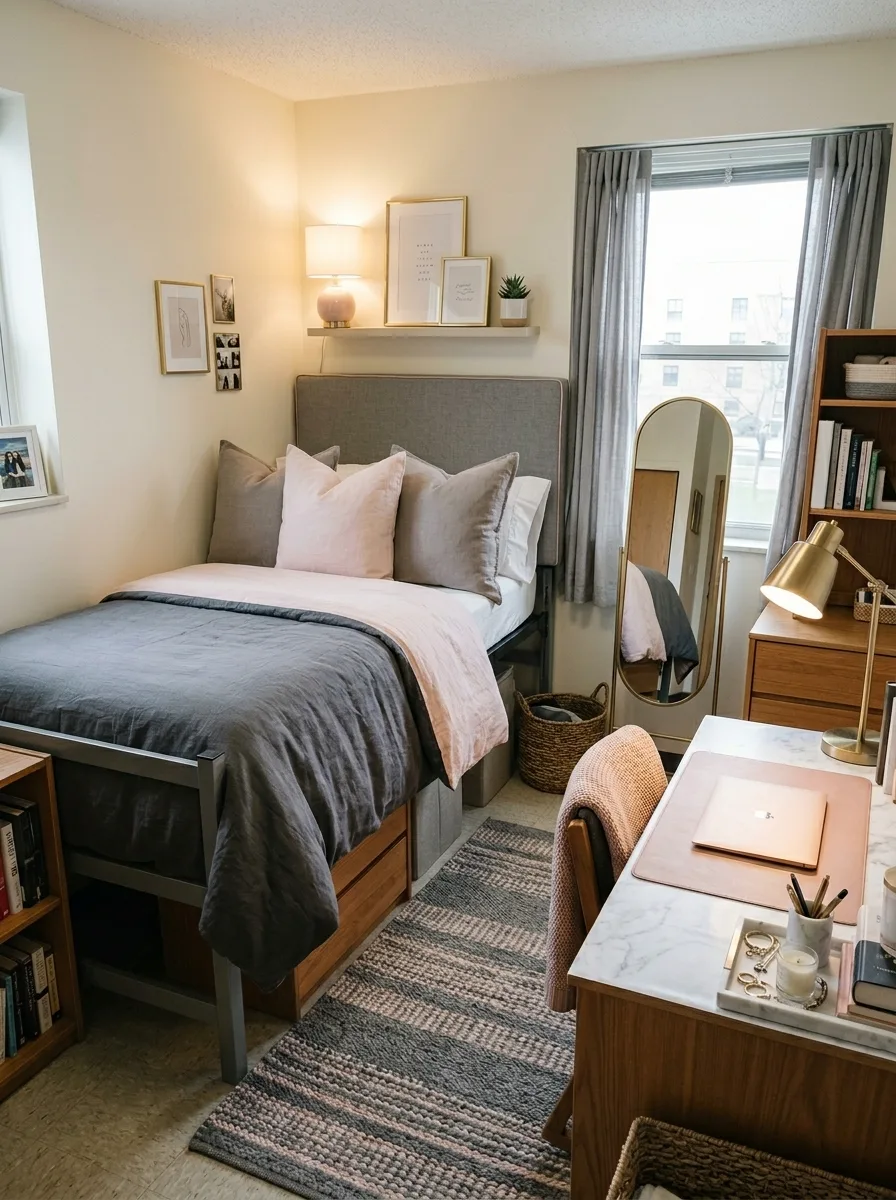
Source a gray upholstered headboard — the fabric should be textured, not smooth. Install a long floating shelf directly above the bed running the full width of the headboard or slightly wider. Style it with a small round pink ceramic table lamp on one end, two gold-framed prints leaning against the wall, and one small plant.
Dress the bed with a gray linen duvet, blush pillow covers in silk or velvet, and one cream linen sham behind them. Drape a blush throw across the foot. The three-tone combination of gray, blush, and cream is the palette.
Hang gray linen curtains from ceiling height, full length to the floor — not from the window frame. The extra ceiling height of the curtains makes the room feel taller. Mount a gold oval mirror against the wall opposite the bed. Place a gold dome desk lamp on a marble-top desk surface and use a blush-cushioned chair.
Add a short wooden bookcase beside the desk — style it with books interspersed with small objects rather than filling it completely. Use a gray and beige stripe woven rug across the full floor area.
Burgundy Velvet Dark Moody Scholar
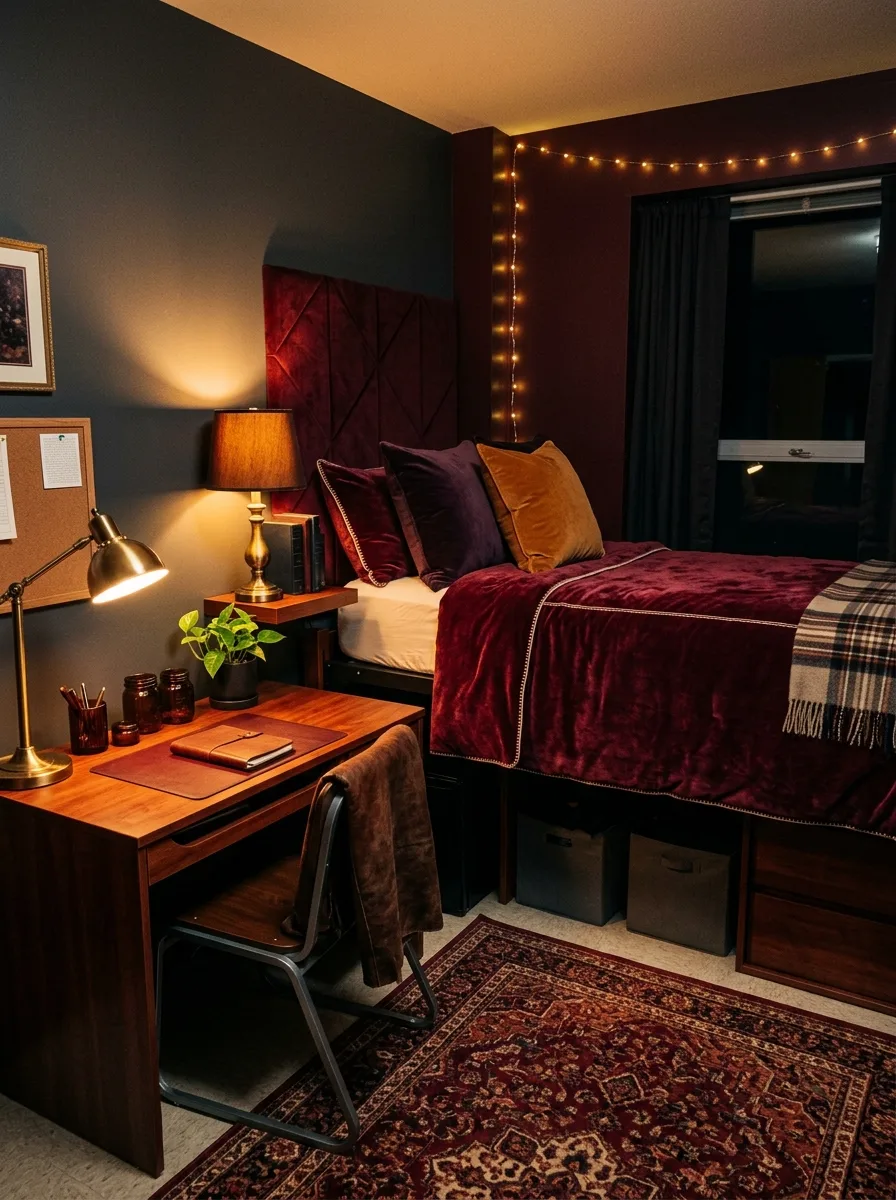
Two separate wall colors. The wall behind the bed: deep burgundy or wine. The desk-side wall: dark charcoal or slate. These two dark colors share the room without fighting because both are deeply saturated and close in value. Neither is trying to be the neutral.
Source a tall diamond-pattern quilted burgundy velvet headboard. Dress the bed with a burgundy velvet duvet, plum velvet square pillows, and a gold mustard velvet lumbar. The gold is the only warm contrast and it prevents the palette from becoming too heavy.
Drape a traditional plaid throw in charcoal, burgundy, and cream across the lower third of the bed — let it fall asymmetrically to one side.
On the desk, use a cherry or warm walnut surface if possible. Source a traditional brass desk lamp — either a banker’s green glass variety or a simple brass arm lamp. Place three small mason jars or inkwell-style vessels on the desk surface as pen and pencil holders. Use a leather desk journal. Run a single strand of globe fairy lights along the wall-ceiling junction near the window. Use a vintage-style Persian rug in deep red and navy.
William Morris Wallpaper Botanical Dorm
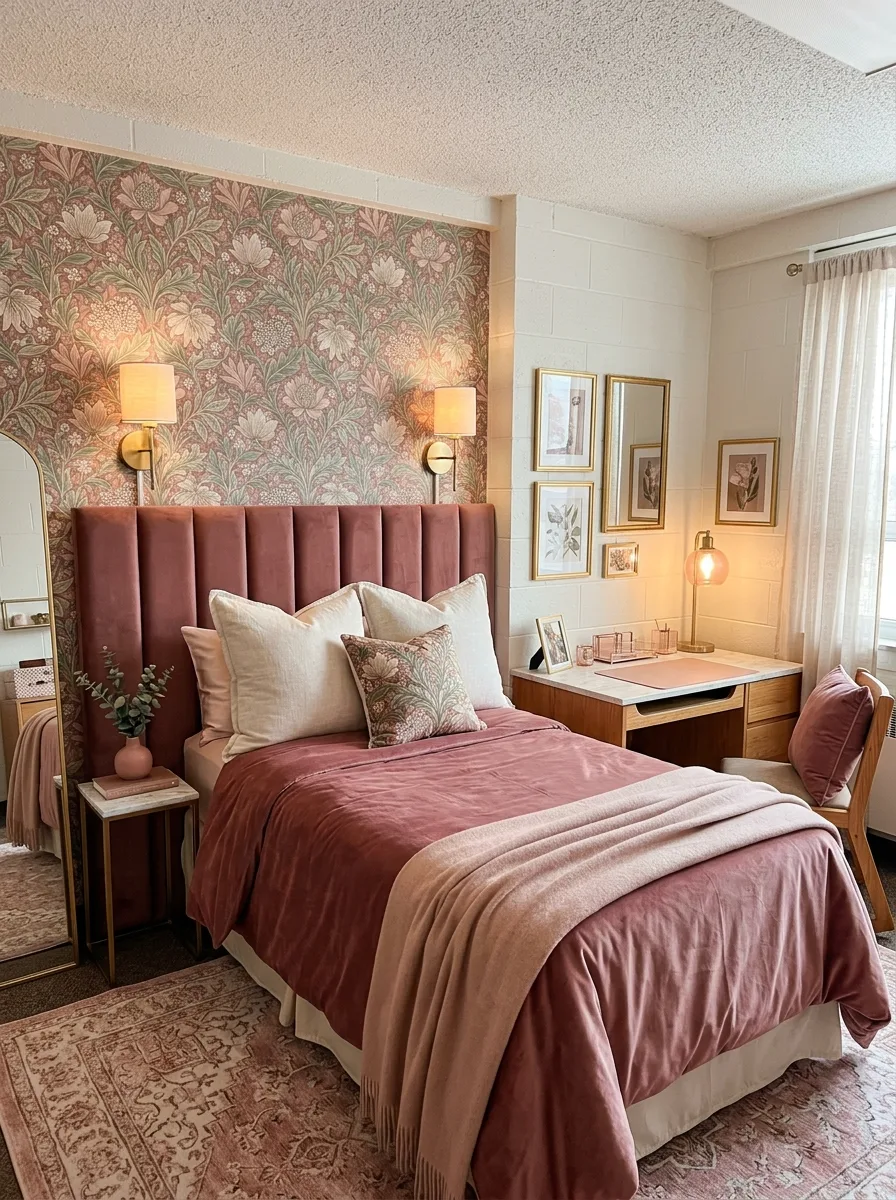
Source a William Morris-style large-scale botanical wallpaper — look for a design in dusty rose, sage green, and cream with a detailed floral and leaf motif. Apply it to the full wall behind the bed, ceiling to floor.
Mount two plug-in brass disc sconces — flat, minimal, contemporary in shape — on either side of the wallpaper panel at mid-wall height. The contemporary sconce against the traditional pattern creates productive tension.
Source a tall channeled velvet headboard in deep rose or dusty pink, the same family as the dominant color in the wallpaper. Dress the bed with a rose or dusty mauve velvet duvet, cream euro shams, one floral print pillow that picks up the wallpaper motif, and one cream velvet pillow. Keep the bedding relatively restrained so the wallpaper reads as the lead.
On the adjacent white wall, create a gallery of four to five gold-framed botanical and architectural prints in varying sizes — no two the same size, asymmetrically arranged. Use a small globe desk lamp with a gold base on the desk, pink desk mat, and rose gold accessories. Use an overdyed vintage-style rug in blush and cream.
Safari Natural Brass Study
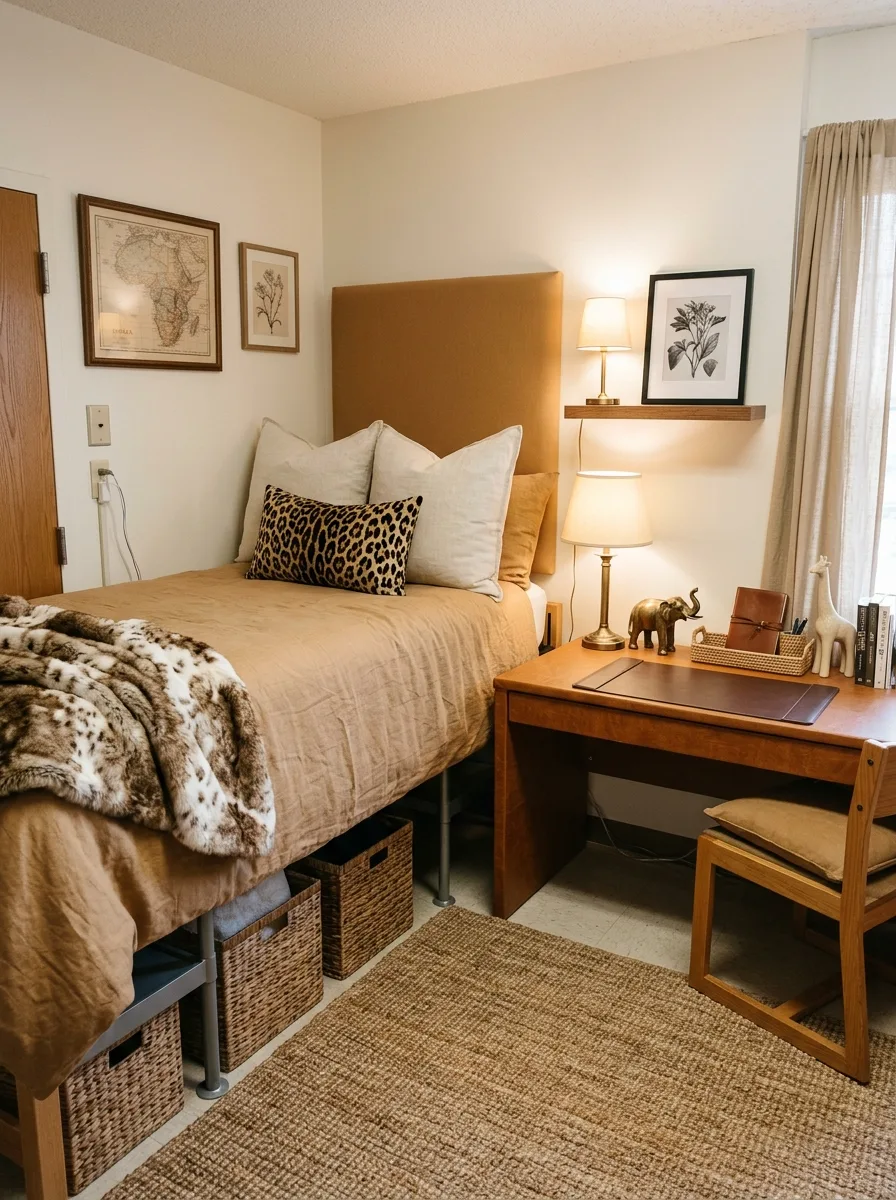
Source a camel or cognac leather — or high-quality faux leather — upholstered headboard. Use a warm sand or biscuit-colored linen duvet as the base. Layer two large cream square throw pillows and one single leopard-print lumbar pillow in front. Drape a faux leopard or snow-leopard-spot throw across the lower left corner of the bed.
On the wall above the desk, hang a framed vintage map as the primary piece — an old colonial cartographic map in black and cream, wood-framed. Add one framed botanical print beside it. Mount a single floating shelf beside the headboard at nightstand height and place a brass table lamp with a cream shade on it, along with a small brass animal sculpture and a leather-bound journal.
Use a warm walnut or cherry wood desk if possible. Lay a leather blotter across the desk surface. Place a brass elephant figurine, a leather pen box, and a stack of books organized by height on the desk. Store wicker baskets under the bed for visible, textured storage. Use a jute or sisal area rug in natural tan. Put a linen or canvas curtain panel over the window — undyed, natural.
Dark Floral Wallpaper Gallery Wall
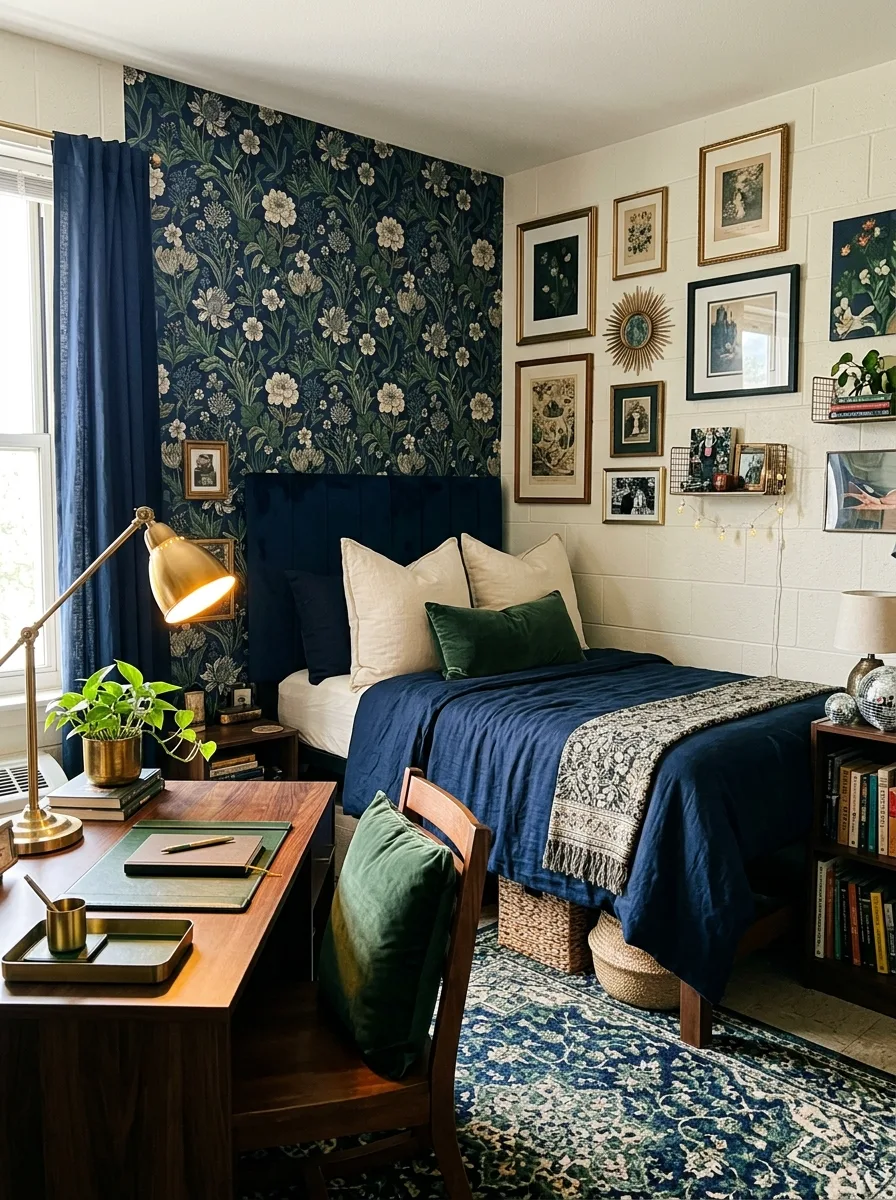
Source a dramatic, large-scale botanical wallpaper in dark navy or black ground with white and green floral motifs. Apply it to the wall behind the bed — floor to ceiling, full width. This paper is doing enormous visual work and needs no competition directly on the same surface.
Mount a dark navy velvet headboard in front of the wallpaper — the headboard color should almost disappear into the pattern so the bed seems to emerge from the botanical wall itself.
On the adjacent white cinder block wall, build a gallery of mismatched frames in gold, wood, and black — botanical prints, a vintage portrait, a small circular starburst mirror, and one or two personal photographs. The key is irregularity: no grid, no alignment, objects of different sizes overlapping in visual space. Add a small floating ledge shelf midway through the gallery for one plant and one small object.
Dress the bed with a navy linen duvet, cream euro shams, one deep hunter green velvet pillow, and a patterned cream and tan textile bed runner across the foot. Use navy linen curtains hanging from ceiling height. Place a brass adjustable desk lamp on a warm walnut desk surface with a green leather desk mat. Use a navy and cream vintage-style floral rug. Add one trailing pothos in a brass pot on the desk.
Final Thoughts
Every room in this collection made an argument. Some argued for quiet elegance. Some for dark drama. Some for academic seriousness. Some for botanical romance. Not one of them argued for nothing.
That’s what separates a room that looks designed from a room that looks assembled. Design is intentional. Assembling is just putting things in the same space and hoping for the best.
A dorm room is the smallest canvas you’ll ever work with. That’s not a limitation. That’s the point. With a small enough space, you don’t need much to make an argument. You just need to decide what you’re arguing for.
The rooms that fail are the ones that couldn’t decide.