
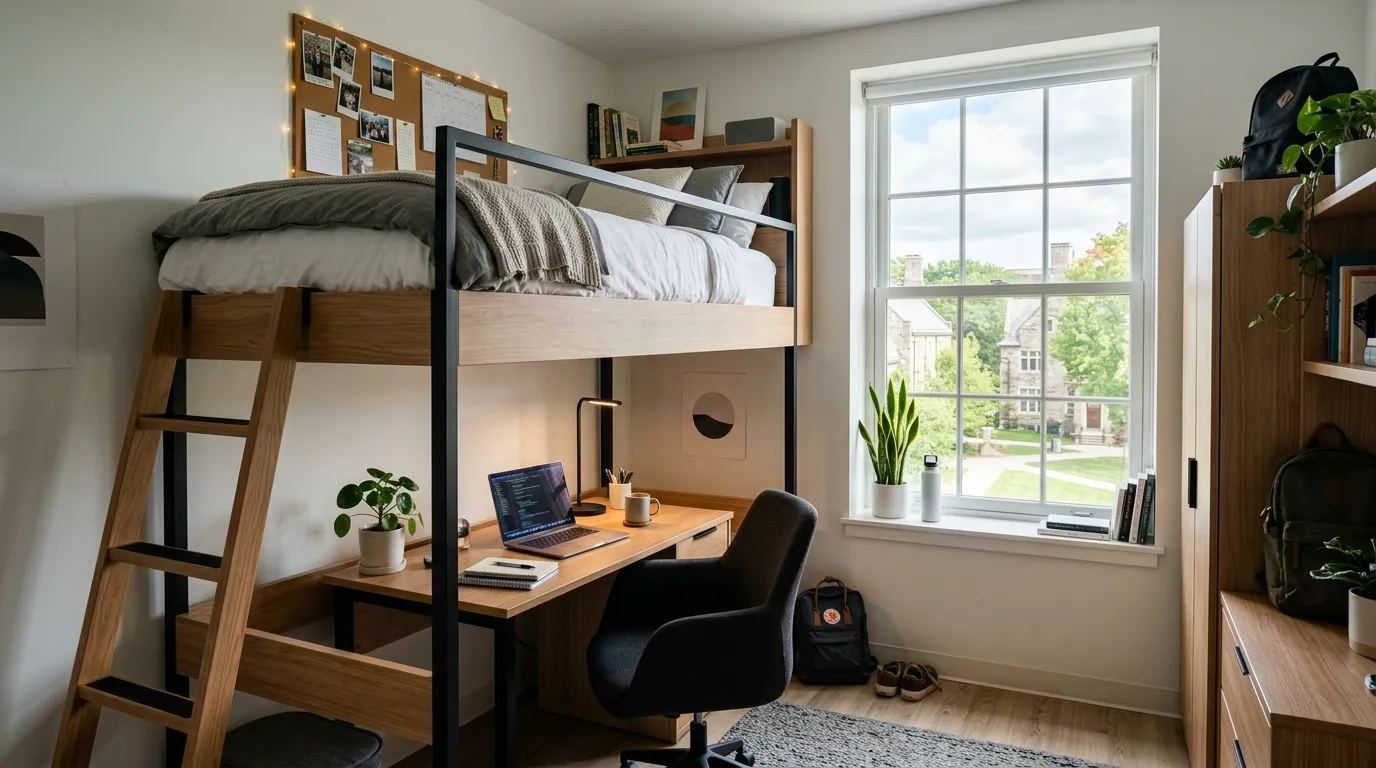
Lofting your dorm bed is the single highest-leverage design decision you will make all year. It is also the decision most people waste completely.
They loft the bed, shove a desk underneath it because that seems like the obvious move, and call it done. The result is a slightly taller version of the default room: same furniture, same configuration, same failure to use the space with any intention.
The rooms in this post did something different. They asked a question the standard approach never considers: what do I actually need most in the space where I spend the majority of my waking hours? The answers vary — a music studio, a meditation corner, a walk-in wardrobe, a reading hammock, a canopy-draped sanctuary, a self-contained cooking zone. Every single one of them is more interesting than “desk underneath, storage bins at the sides.”
That’s the invitation. Your loft is not a storage solution. It’s a room inside your room. Use it like one.
Why Lofted Dorm Rooms Still Disappoint
The bed is in the air. The problem is everything else.
Treating the Under-Loft as Leftover Space
The moment the bed goes up, the under-loft becomes the most valuable real estate in the room. It has four walls, a ceiling, and a defined floor area. It is, functionally, a room.
Most students treat it as a convenient place to put the desk because the desk has to go somewhere. That thinking produces an under-loft that feels like a cupboard someone is working in, not a designed space someone chose to inhabit.
Decide what you want the under-loft to be before you loft the bed. Not after. If you decide after, you’re decorating around a default. If you decide before, you’re building toward an intention.
Letting the Loft Frame Do Nothing
The loft frame has structural pipes or wooden beams at every corner. Those corners are attachment points. Every one of them is a place to hang curtains, string lights, mount a shelf, trail a plant, or clip a reading lamp.
A bare loft frame reads as unfinished. A dressed loft frame — with curtains drawn across the front, fairy lights along the rails, vines climbing the posts — reads as architecture.
The frame is not just a bed support. It is the visual structure of the under-loft space. Treat it accordingly.
Ignoring the Sleeping Zone Above
The top of the loft is where you sleep. It is also where you will lie in the dark before you fall asleep and the first thing you see when you open your eyes. Most lofted beds have bare mattresses and institutional bedding and nothing else.
The rooms that feel elevated — the botanical wallpaper enclosure, the blush fabric canopy, the fairy-light curtained cave — treat the sleeping zone itself as a destination. The bedding matters. What you see when you look up from the pillow matters. What greets you when you pull back the curtain matters.
The loft is a bedroom suspended in the air. Furnish it like one.
Lofted Bed Dorm Room Ideas
White Metal Loft With Sofa Below
A white powder-coated metal loft frame with clean straight lines and a full staircase rather than a ladder. The staircase is important — it provides storage drawers in each step and reads as more architecturally resolved than a ladder.
Under the loft, position a low white or grey sofa against one wall and a white L-shaped desk against the adjacent wall. The two zones — lounge and work — exist within the same under-loft footprint, separated by the 90-degree angle of the room’s corner.
Mount two matching black-framed prints in the corner above the sofa, at identical heights. On the desk side, install a floating shelf above the monitor for books and a small plant.
The metal frame reads as Scandinavian in its economy of line. Everything in the room should reinforce that register: grey, white, light wood, black. No warm tones, no pattern, no decorative excess. The geometric ceiling of the under-loft becomes a feature with subtle recessed lights or adhesive LED puck lights at each corner.
All-White Light-Up Loft Alcove
Paint or paper the walls inside the under-loft zone in white. Use a white built-in or freestanding desk. A white Bertoia-style wire chair. The sofa below the loft in white boucle or white cotton. The shag rug in white.
Frame the desk recess with fairy lights running along the full perimeter — the top edge, both side edges, and the bottom edge — creating a glowing rectangular frame around the workspace. This frame of warm light against the white interior of the alcove creates the impression of a lit stage set.
Mount a guitar on the wall outside the under-loft zone using a wall-mounted hook. This single object, in warm wood against the white wall, is the room’s only decorative non-white element. Its presence is proportionally very powerful.
The bed above in white bedding, visible through the grid of the metal frame. The whole room operates in a single value — white — with all variation in texture rather than colour: the boucle sofa, the shag rug, the cotton duvet, the wire chair.
Dark Curtain Coder Cave
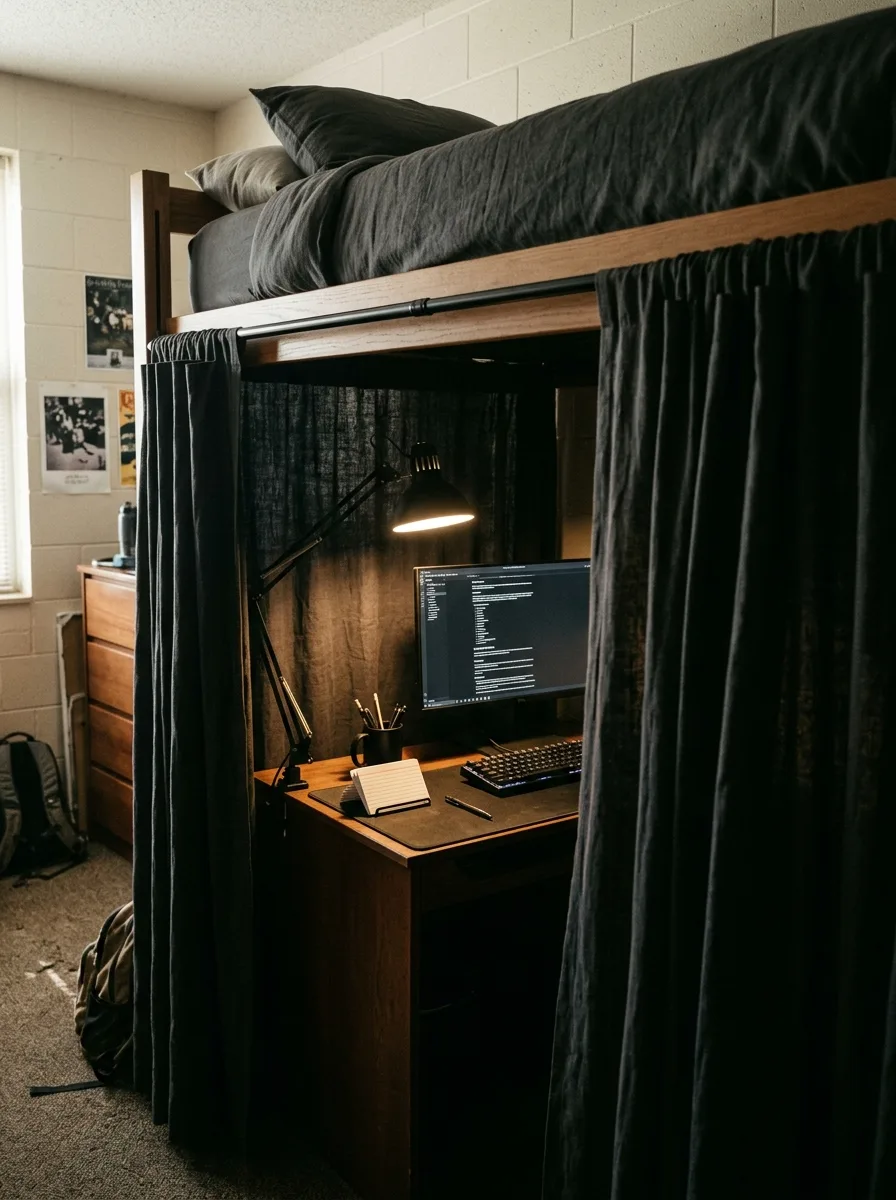
Loft the bed to maximum height using a dark walnut or espresso-stained frame. Mount a standard closet rod across the front face of the loft frame, just below the mattress level. Hang floor-length black linen or velvet curtains from the rod — they should reach the floor and be full enough to draw completely closed, enclosing the desk below entirely.
Inside the enclosed zone, keep every surface dark: dark desk, dark monitor, dark keyboard. Use a single articulated arm lamp in matte black angled over the desk surface. The only light in the zone should come from the lamp and the monitor — nothing else. The contrast between the warm amber desk lamp and the dark walls of the curtained enclosure is the defining atmosphere.
Keep the area outside the curtains minimal: dresser on one side, backpack storage on the other. When the curtains are open, the monitor glow and the desk lamp invite you in. When they’re closed, the under-loft disappears entirely and the room above reclaims its space.
Bean Bag Built-In Loft Nook
A platform loft bed built into a corner, with rounded-edge construction in white laminate, creates a fully integrated sleeping and study zone. The under-loft space is designed at the build stage: a built-in L-shaped shelf on the left for books, a fold-down desk surface at the right, and a clear central floor area.
In the clear central floor area: a velvet bean bag in dusty mauve, positioned at the desk angle. The bean bag is the primary seating for both the desk and for lounging. A thick shag rug in grey covers the entire under-loft floor.
The personalisation happens above the sleeping zone: a fairy light string in a loose wave along the slanted ceiling wall, music and culture posters grouped in the upper corner of the angled space. These items establish that a specific person lives here without requiring any wall decoration below.
The storage shelf built into the left side holds coloured magazine boxes in muted pastels for organised book and supply storage. The overall palette is white, grey, and soft mauve — young, light, and personal without being loud.
Lofted Vanity Glam Station
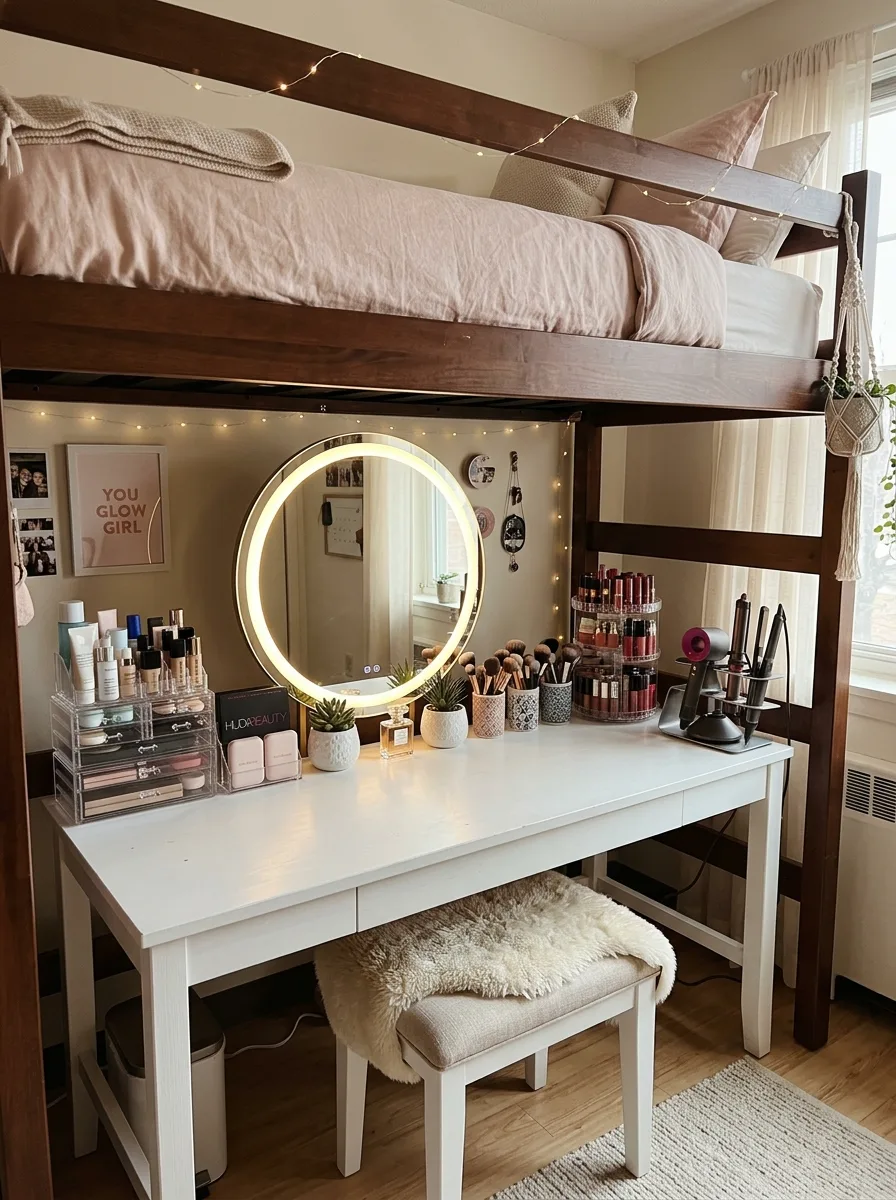
Set the loft bed in dark walnut at full height and use the under-loft entirely as a vanity and dressing area. Place a white table-height vanity desk directly beneath the loft, centered. Mount a round LED ring mirror — not a Hollywood bulb style, but the continuous ring variety in warm white — on the wall behind the vanity at face height.
Organise the surface in a specific left-to-right logic: skincare in acrylic stackable organisers on the left, brushes in individual cups in the centre, lip and eye product in a rotating turntable on the right. Styling tools go at the far right edge on a heat-resistant mat.
Hang fairy lights along the top edge of the loft frame and let them drape down the sides — the effect from the vanity chair looking in the mirror is a warm glowing frame around your own reflection. Add a small trailing plant in a macramé hanger attached to the loft post at one corner, and a framed motivational print on the wall to one side.
Use a white fur-topped bench or a low upholstered stool as the vanity seat — something with comfort for a longer morning routine. The bed above dressed in blush linen closes the visual frame of the vanity world below.
Staircase Loft Library Nook
This configuration is built around a bespoke or high-quality freestanding loft with a staircase rather than a ladder. Each step of the staircase contains a deep pull-out drawer — these steps provide the room’s primary storage without any additional furniture.
The under-loft is divided into two zones: a full-height bookcase on the left side, and a desk nook with a chair on the right. A mid-century style upholstered armchair sits outside the staircase, in the remaining room space, oriented toward the bookcase.
The bookcase is filled with books arranged by spine colour — a warm spectrum moving from reds through oranges to yellows in the upper shelves, cooling to greens and blues below. The colour arrangement makes the bookcase read as a designed element rather than a functional shelf.
Paint one wall in deep navy behind the loft structure. The white of the loft frame against the navy accent wall provides the visual contrast that makes the whole arrangement read as intentional. A single brass table lamp inside the desk nook, a fiddle-leaf fig on the floor outside the staircase.
The loft above dressed in the same navy and white stripe as the accent wall palette. Everything is in conversation.
Under-Loft Music Studio
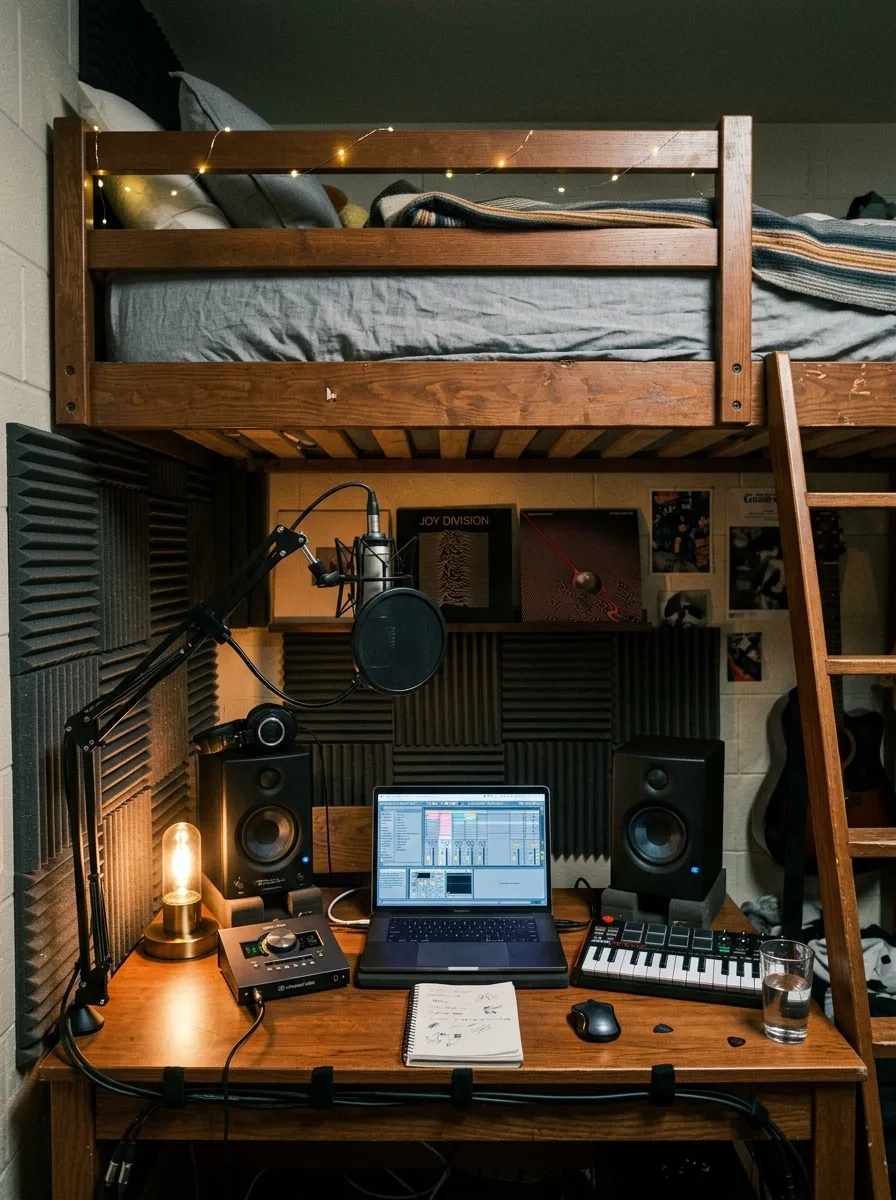
Build the music setup before you choose the loft frame. The under-loft studio works because the wedge acoustic foam panels go on the back wall first, then the desk is positioned against them, and the loft frame extends over the whole arrangement.
Mount wedge foam panels in charcoal or dark grey on the wall behind and to the sides of the desk chair — not the entire room, just the surfaces that face the microphone. Stick them in a staggered grid rather than a perfect pattern.
Position a condenser microphone on an articulated boom arm at one side of the desk. Pair with an audio interface, studio monitor speakers on each side, and a small MIDI controller at the right side of the keyboard. The desk surface layout matters: interface on the left, laptop in the centre, controller right. A single Edison-bulb desk lamp in brass provides warm task light that doesn’t interfere with the monitor screen.
Lean vinyl record sleeves against the back of the desk in the space between the acoustic foam and the desk surface. The record art is both personal and decorative. Keep the loft above simply made — a grey or olive duvet, a knit blanket, nothing elaborate. The studio is the statement. The sleeping zone is the rest.
Fairy Light Under-Loft Lounge
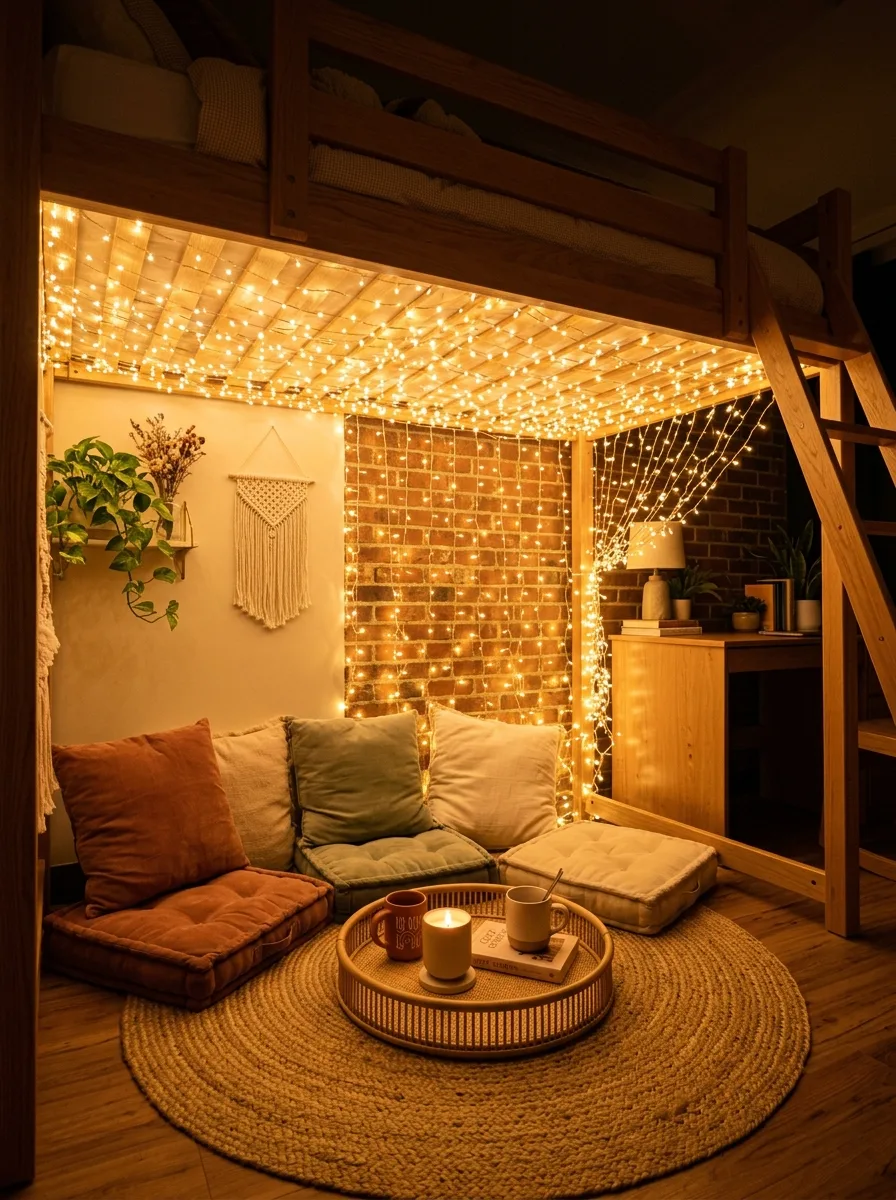
This configuration replaces the desk with a floor-level lounge entirely. Remove or reposition the desk to elsewhere in the room. Under the loft: floor cushions, floor seating, a round jute rug, a small low rattan tray table.
Cover every surface inside the under-loft zone with fairy lights. Thread them across the underside of the loft frame so they form a glowing ceiling inside the enclosure. Let additional strands cascade down the back wall behind the seating. The goal is a fairy-light grotto — a space that exists in an entirely different light register from the rest of the room.
Add a small macramé wall hanging on the back wall of the under-loft, mounted at sitting eye level. A trailing plant on a small shelf at one side. Three to four floor cushions in terracotta, sage, and warm cream arranged in a semicircle around the tray table.
Use the lounge for social time, video calls, reading, decompressing. The desk lives elsewhere in the room. The separation of work and rest zones is itself a wellness strategy.
Under-Loft Kitchen Station
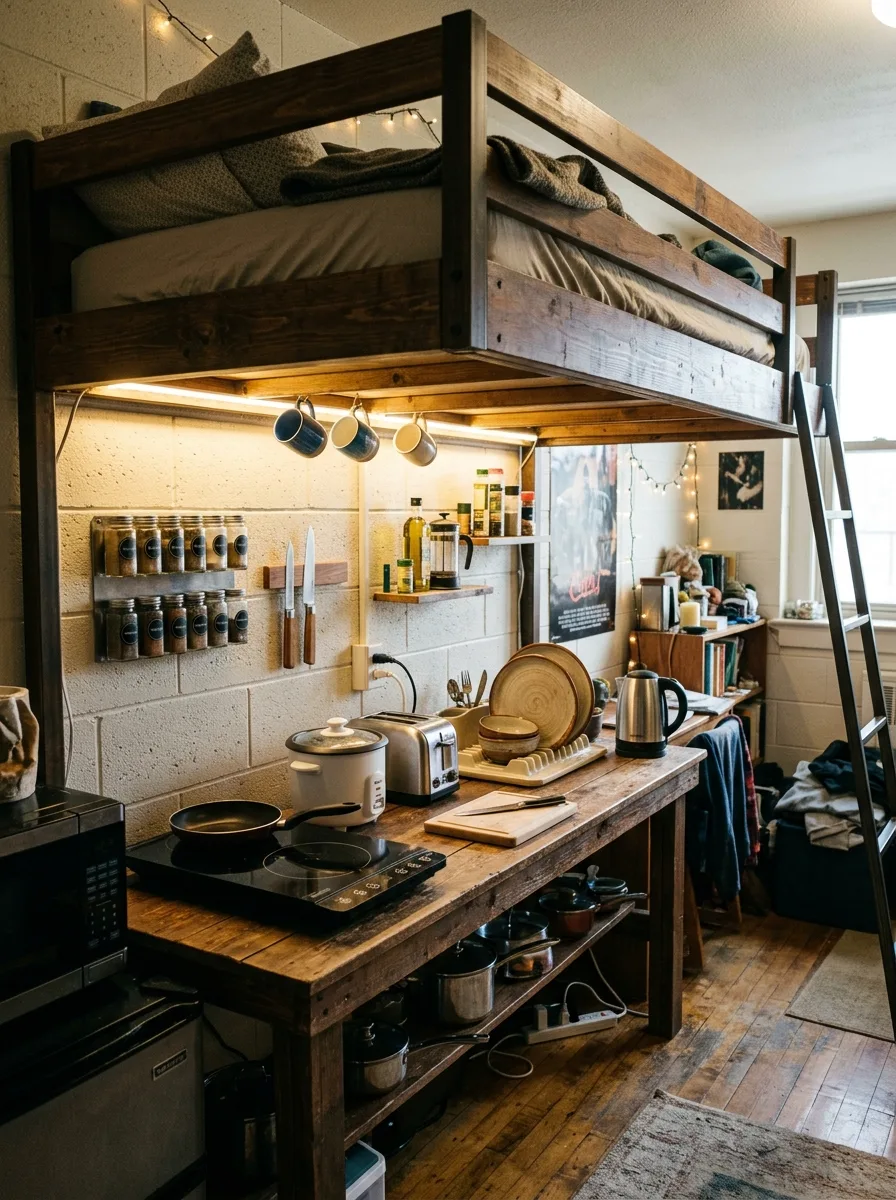
This setup works in a room with real floor space and a loft frame that clears at least five and a half feet. Place a solid butcher-block or heavy wood utility table under the loft — the full width of the under-loft zone. This is your kitchen counter.
Mount a magnetic knife strip on the cinder block behind the table. Add a wall-mounted spice rack using removable adhesive shelf brackets. Install a single LED strip light along the underside of the loft frame, pointing down to illuminate the counter surface as task lighting.
On the counter surface: a portable induction burner, a rice cooker, a kettle, a toaster. Below the counter on a shelf: pots, bowls, and a dish drying rack. Hang ceramic mugs from hooks screwed into the underside of the loft frame along the front edge.
The loft above should be dressed warmly but simply — a grey or olive duvet, a knit throw. The kitchen counter below should be functional and honest about what it is: not decorated, just organised. This is a room for someone who cooks. It knows what it is.
Hammock Reading Nook Loft
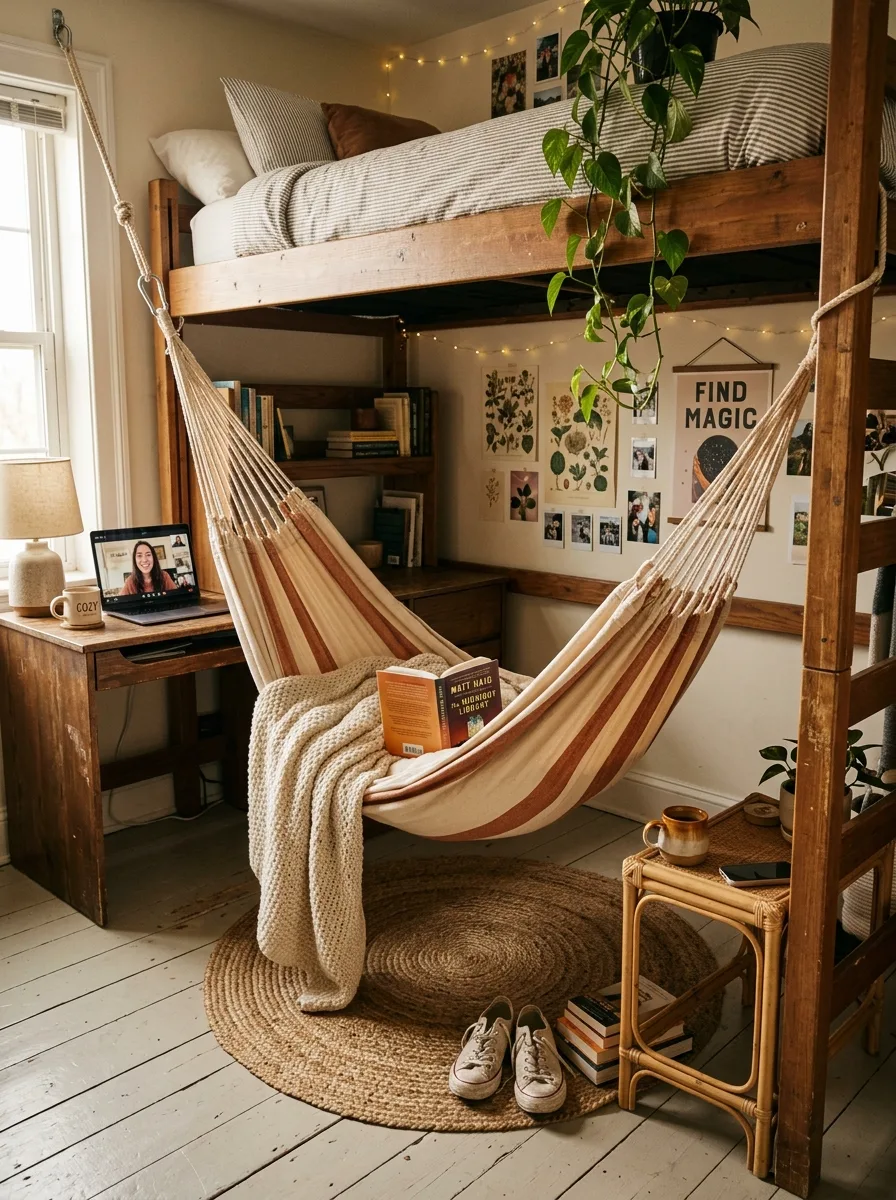
The hammock replaces both the desk chair and the floor seating. Source a Brazilian-style cotton hammock in natural tones with rust and cream stripe — the hanging points should be attached to the loft frame posts rather than the wall, avoiding the need for any wall-mounted hardware.
Mount two hammock hooks to the vertical posts of the loft frame, at a height that allows the hammock to sag to a comfortable sitting position when weighted — generally about eighteen inches off the floor at the lowest point. A round jute rug beneath catches the drape of the hammock and defines the zone.
The desk goes to the opposite side of the loft, away from the hammock. Keep the hammock side entirely clear of study material. Books go there. A mug. A blanket draped in. The functional separation — desk for work, hammock for reading — gives the room a rhythm it wouldn’t otherwise have.
Mount a small shelf at hammock height on the wall adjacent to the hanging point, for a lamp and a water glass. A trailing pothos plant dropping from a hook at the loft corner brings life to the zone without requiring maintenance attention.
Botanical Enclosed Bed Alcove
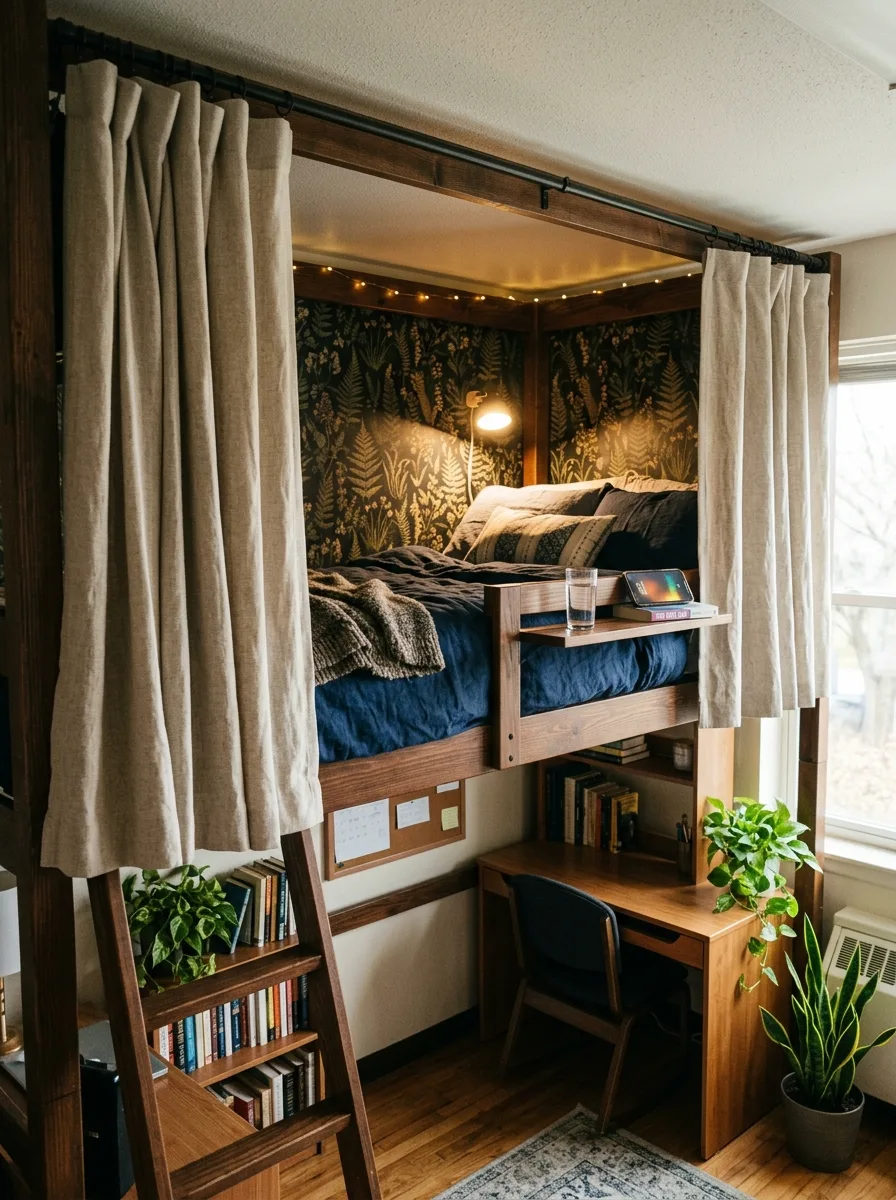
Apply removable dark-ground botanical wallpaper to the back wall inside the loft sleeping zone — the wall your head rests against. This paper, with its dark navy or forest green background printed with fern fronds, wildflowers, and trailing vines, turns the sleeping alcove into a grotto.
Hang linen curtains from a rod mounted across the front face of the loft frame. In natural or greige linen, falling to the floor. These curtains should be able to close completely, sealing the sleeping zone off from the room.
Install a small puck light or clip-on reading light just inside the curtain on the wall, positioned to illuminate the pillow end of the bed. Add a small built-in shelf to the inner edge of the loft frame at mattress height — a place for a glass, a phone, a book. Line the underside of the sleeping alcove ceiling with fairy lights.
Use deep navy or forest green bedding inside the alcove. The botanical wallpaper, the dark bedding, and the warm fairy light above the pillow together make the sleeping zone feel like a cabin in a forest. The curtains close. The world outside the loft disappears.
Under-Loft Yoga and Meditation Corner
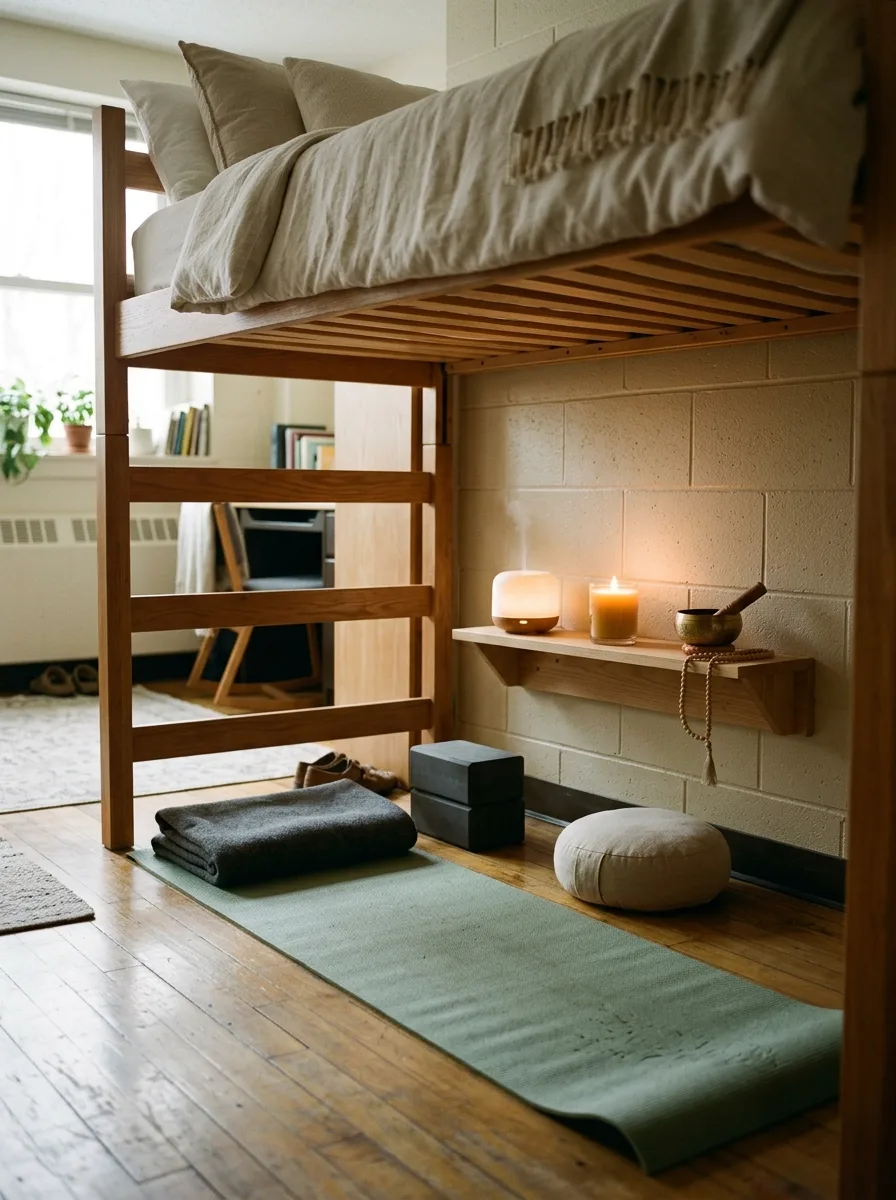
The under-loft here is not a workspace. It is a recovery zone. The desk is elsewhere.
Lay a sage green yoga mat lengthwise under the loft, filling most of the zone’s floor space. At the head of the mat, mount a floating shelf to the cinder block wall at approximately standing waist height. On this shelf: a mist diffuser, a pillar candle in a glass vessel, a Tibetan singing bowl, and a mala bead bracelet.
Add a small round zafu cushion at the end of the mat closest to the shelf. Two yoga blocks stacked neatly at the opposite end.
Keep the loft frame above bare of additional objects. No curtains. No fairy lights. The openness above is intentional — the space needs to feel uncluttered to function as a practice area. The ambient light from a window is the only light source needed during the day. At night, the candle and diffuser light are sufficient.
Open Wardrobe Loft System
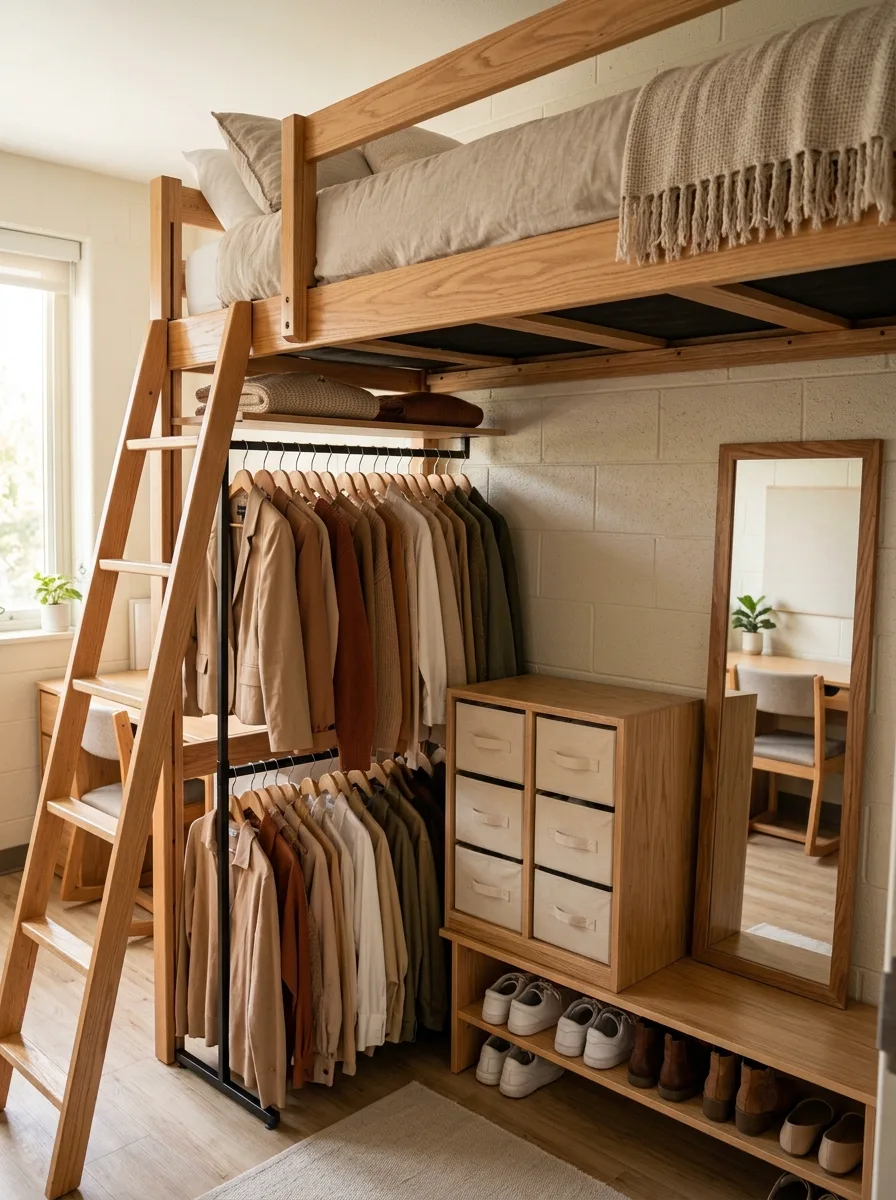
Mount a double-hanging clothing rail under the loft — a freestanding rail with two tiers, or a wall-mounted rail at two heights. The upper rail holds longer items: coats, dresses, shirts. The lower rail holds shorter items: jackets, folded trousers on hangers.
Add a narrow six-drawer unit beside the rail for folded items. Top it with a small mirror leaning against the cinder block wall, propped at a slight angle. A low shoe shelf below the mirror.
Organise clothing by colour on the hangers — this turns the functional wardrobe into a visual element. When the clothing moves from warm tones to cool tones across the rail, it reads as a design choice rather than a storage solution.
Keep the loft above in the same tonal register as the clothing palette: natural linen and camel tones, reflecting the muted earth tones of the wardrobe below. A textured blanket draped over the loft rail in a complementary colour ties the sleeping zone to the dressing zone.
Vine-Covered Iron Loft Frame
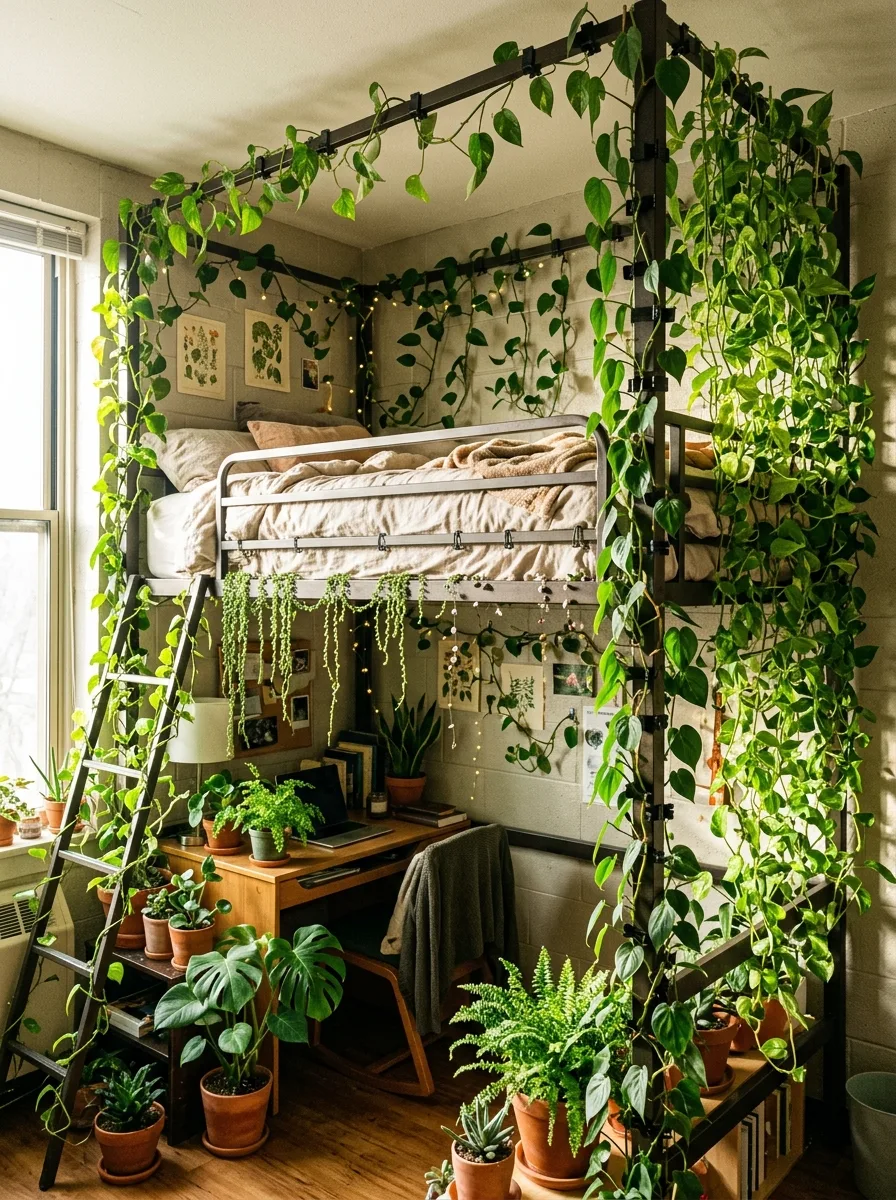
This is the maximum plant version of the lofted room. Start with a four-poster style black metal loft frame — the kind with vertical posts at all four corners connected by horizontal rails. Every post and rail is a vine training opportunity.
Grow or purchase long trailing pothos vines and allow them to climb and drape the frame naturally over time. Supplement with faux vines threaded through the frame at areas where real plants can’t reach — the distinction between real and faux is undetectable when combined at scale. The goal is complete coverage: vines on the posts, trailing from the upper rails, cascading down the corners.
At ground level, surround the base of the loft with terracotta pots: monstera, ferns, small succulents along the windowsill, a spider plant hanging from one post. The loft frame becomes the vertical infrastructure of a garden room.
Keep the bedding neutral — cream or natural linen — so the green of the plants reads against it clearly. Keep the desk minimal and functional: laptop, single plant on the surface, copper watering can on the floor beside it.
Clean Loft Productivity Setup
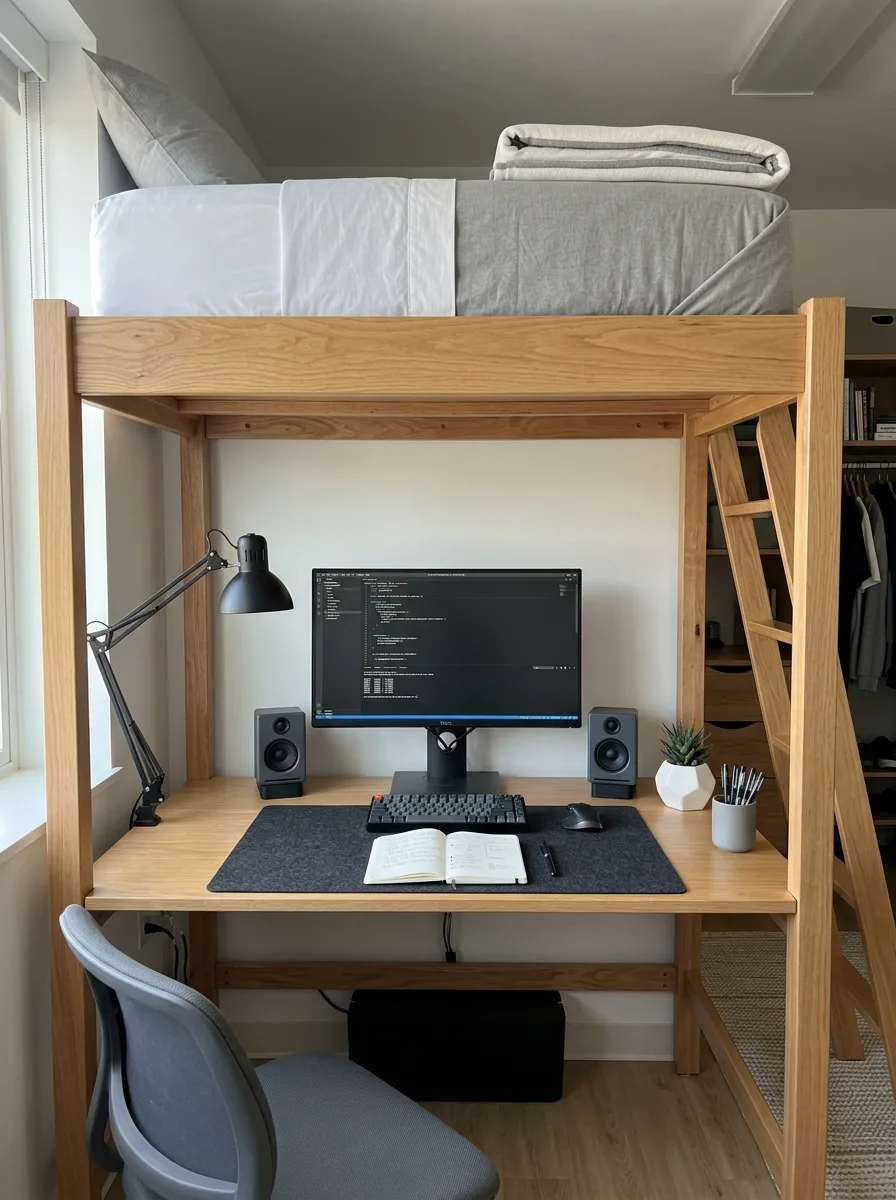
Remove all decorative ambition from the under-loft zone. The goal is a workspace so stripped and organised that distraction becomes structurally impossible.
Mount a single external monitor on a monitor arm at eye height, centred in the under-loft wall space. Position a felt desk mat across the full depth and width of the desk surface. Place the keyboard in the centre of the mat, a mechanical keyboard preferred for tactile feedback. Two small studio speakers flanking the monitor. A single black articulated lamp on the left side.
Only three items are allowed on the desk surface beyond the computer setup: a small succulent in a geometric white pot, a pencil cup in white ceramic, and an open notebook. Nothing else. No snacks, no decorative items, no clutter of any kind.
The loft bed above in white and grey with a neatly folded weighted blanket. The bedding should be made every morning. The desk should be cleared every evening. This is a room built around the conviction that the environment shapes the behaviour.
RPG Fantasy Gaming Loft
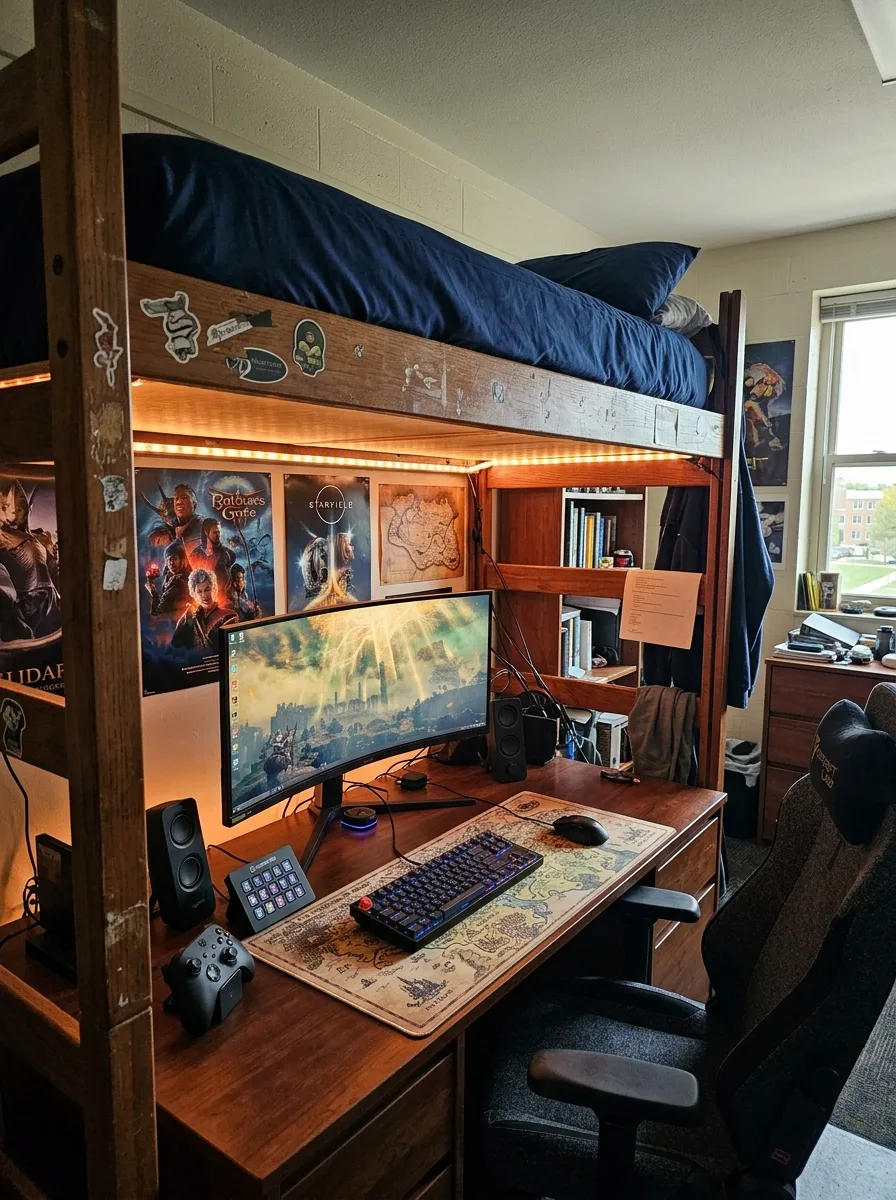
Mount an ultrawide curved monitor centered in the under-loft on an arm or stand, positioned at the back of the desk so the monitor face is visible from across the room. Add a full-length fantasy map desk mat — the kind printed with a fictional world map in aged parchment tones — across the entire desk surface.
Mount warm-toned LED strip lighting along the underside of the loft frame, running front to back along both side edges. Set the colour to amber or warm gold rather than RGB cycling. The strip lighting casts a warm atmospheric glow down onto the desk and monitor that reads as campfire rather than neon.
Pin poster-sized fantasy game art directly to the wall under the loft and on the adjacent cinder block surfaces — no frames required. These posters, combined with the warm strip light and the map desk mat, establish the fantasy aesthetic without requiring any additional decoration.
Apply themed stickers to the loft frame itself — game logos, fantasy creature illustrations — as a low-cost way of continuing the aesthetic into the structural element of the room. The bed above in dark navy. A gaming chair in dark tone.
Plant Desk Jungle Station
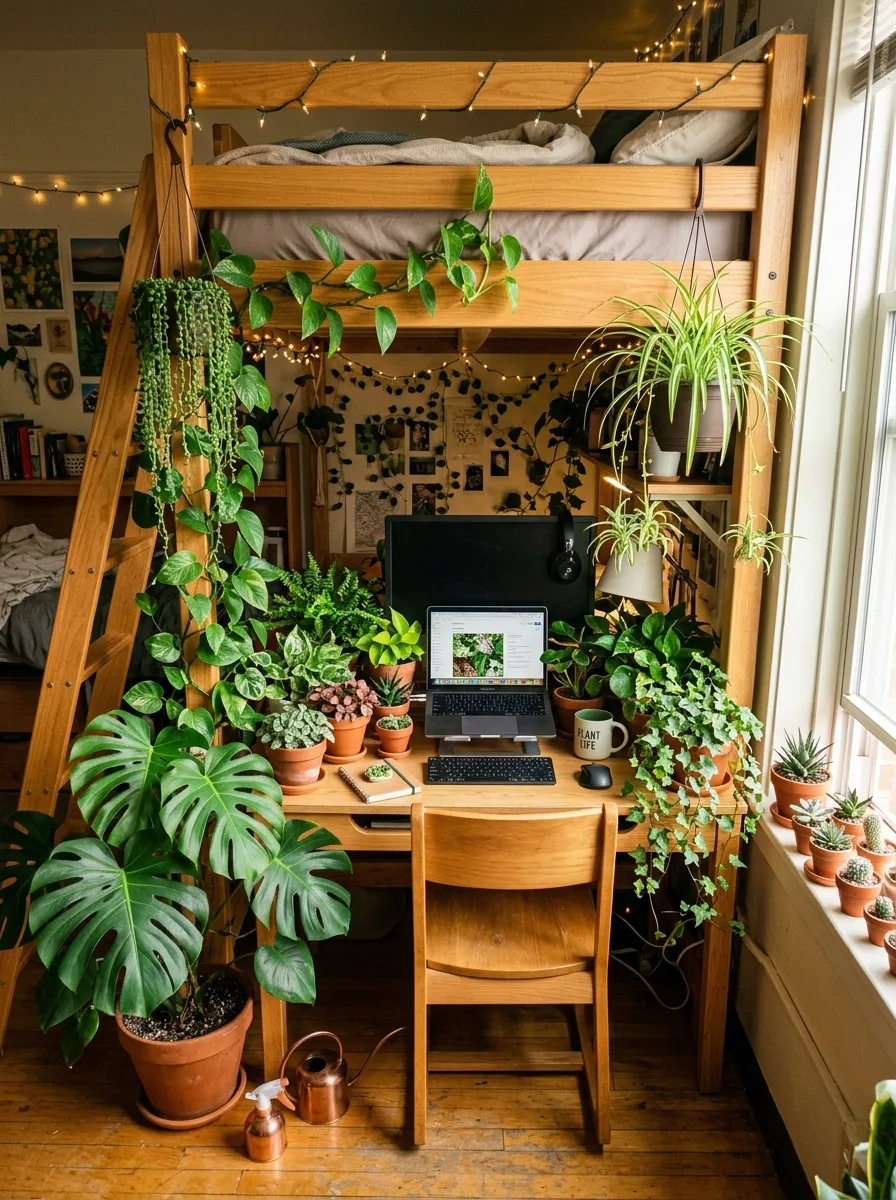
This is the under-loft dedicated entirely to the combination of plants and work, in roughly equal measure.
Start with a monstera deliciosa at floor level in a terracotta pot on the left side of the chair. This plant needs to be large — a small monstera won’t do the work. Allow it to grow and spill into the desk zone over time.
On the desk surface itself, position three to four smaller plants in terracotta pots at the perimeter of the workspace, leaving a clear central zone for the laptop and keyboard. A trailing English ivy allowed to drape over the desk edge toward the floor. A spider plant in a hanging clip mount on the loft frame post above the desk’s right side.
Wind pothos vines along the loft frame ladder rails and let them trail downward. Line the windowsill adjacent to the desk with a row of small cacti in terracotta. The overall effect is a desk that appears to be operating within a conservatory.
Keep the bedding above in neutral grey or cream — the plants provide all the colour this room needs. A copper watering can should live visibly beside the desk as both a functional item and a material note.
Blush Muslin Loft Canopy
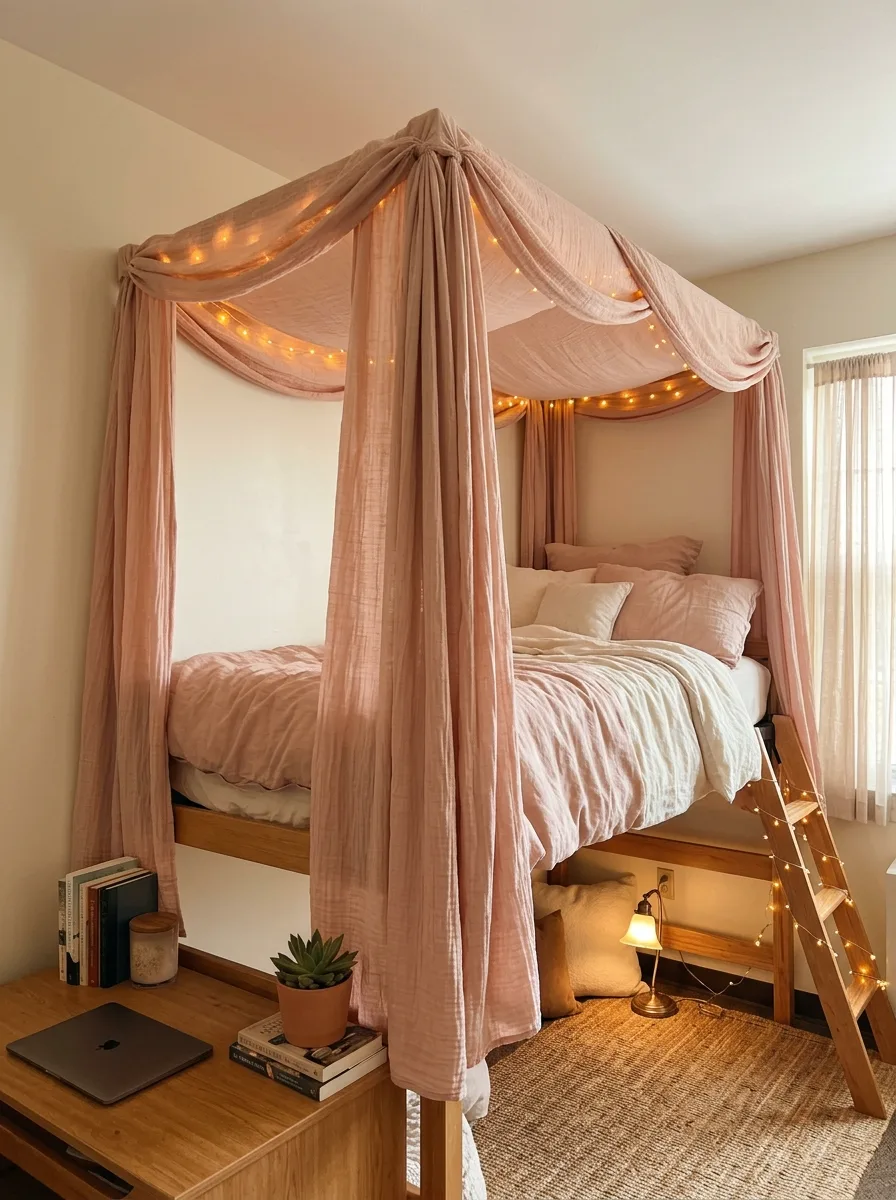
Purchase three to four metres of blush or dusty rose muslin fabric — not curtain fabric, but raw muslin, which drapes naturally and allows light to glow through. Gather the fabric at the centre of the ceiling directly above the loft bed and secure it to a ceiling hook using a loose knot that allows the fabric to splay outward in a gathered dome.
Bring the fabric panels down to the four corners of the loft frame and tie them at the posts, so the muslin forms a tent-like canopy over the sleeping zone with the gathered ceiling point at the top and the tied corners at the bed level.
Thread warm fairy lights along the inside edge of the canopy — running from the ceiling hook along each fabric panel to the corner ties. When the lights are on, the muslin glows from within and the fairy lights are visible as a warm line along each panel edge.
Wrap the loft ladder with additional fairy lights, winding them around each rung from top to bottom.
Use blush linen bedding inside the canopy. A small brass table lamp at floor level below the ladder. A natural jute rug beneath. The desk adjacent but kept clear and simple — the canopy is the room’s entire statement and the surrounding space should be quiet enough to let it speak.
Wall Calendar Loft Study Desk
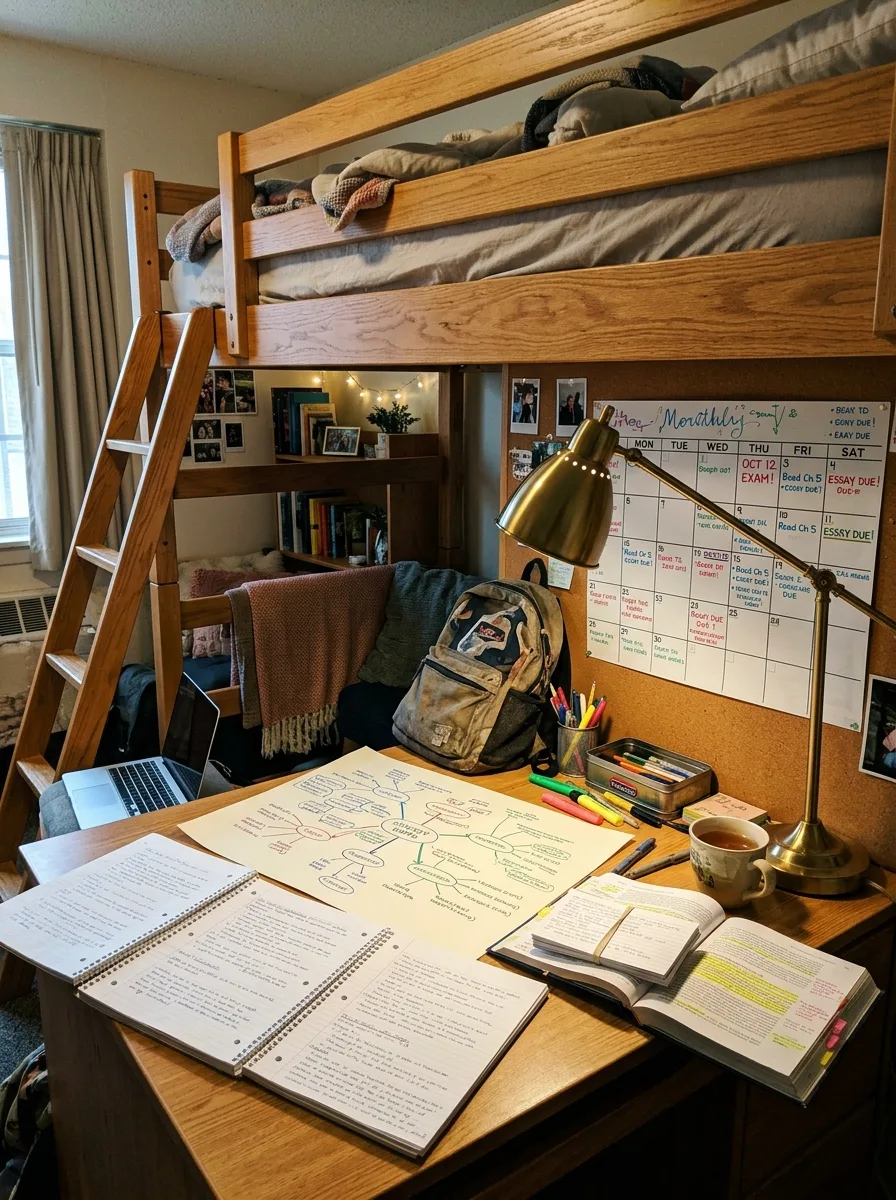
The defining element here is not decorative. It is the wall calendar: a full month-at-a-glance calendar tacked directly to the cork board mounted within the under-loft zone, large enough to read from the desk chair and annotated in multiple colours.
Pair it with a brass adjustable desk lamp — the kind with a hinged arm and a classic dome shade. The warmth of the brass reads as serious and focused, unlike a white or chrome lamp. Position it so the cone of light falls directly onto the desk surface and the calendar is in a secondary circle of illumination.
The under-loft here is fully open — no curtains. The desk faces outward so the calendar wall is visible from the rest of the room. The clutter on the desk is the authentic clutter of active studying: open notebooks, highlighted textbooks, a mind map spread across the surface, a tea mug at one corner. This desk is not styled. It is in use.
The loft above is genuinely lived-in: a grey duvet, a striped throw, a pillow arrangement that hasn’t been precisely placed. The room makes no pretense of being anything other than what it is — a space where someone is working very hard.
Open Loft Wardrobe With Shelf Altar
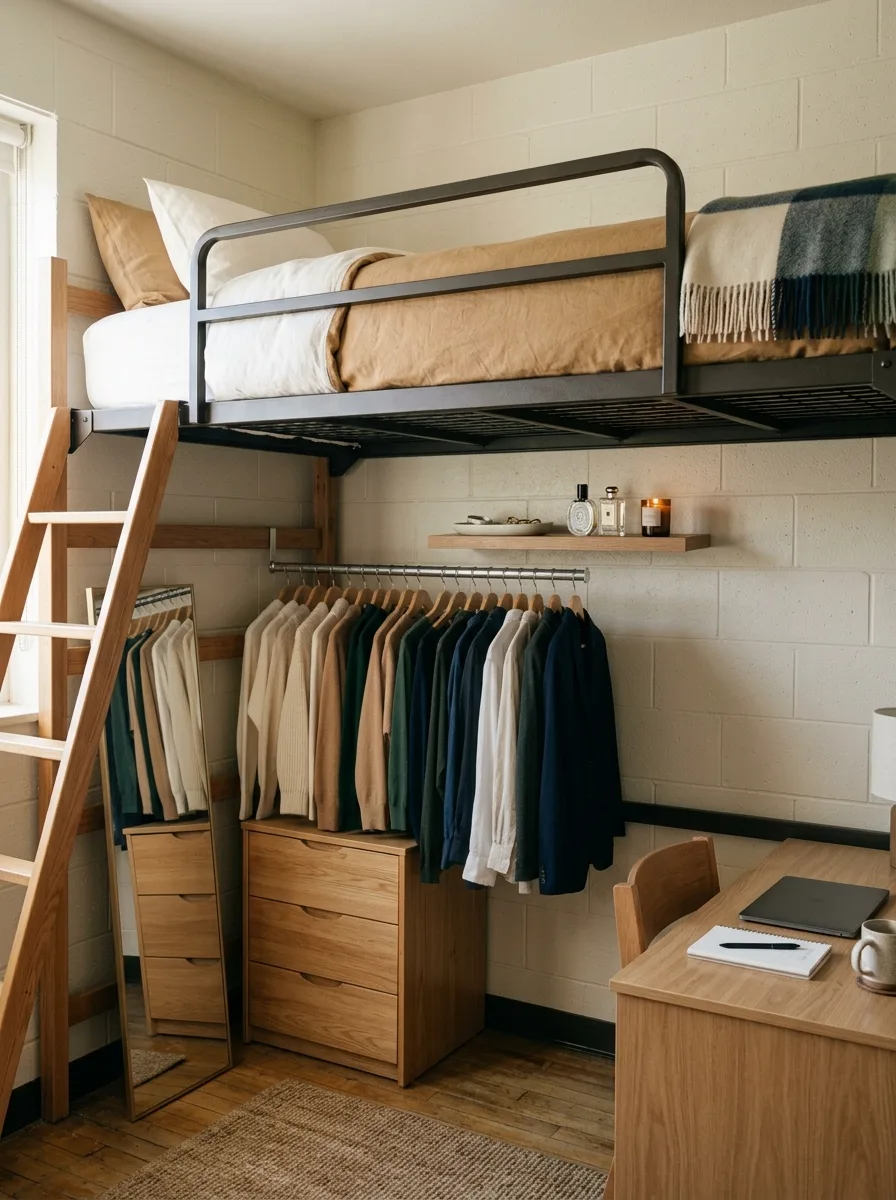
Mount a single clothing rail directly under the loft, wall to wall, using wall-mounted brackets into the cinder block. Hang clothing in a deliberate order, grouped by colour and type, on matching wooden hangers. The clothing rail is the primary storage and primary visual element.
Place a small oak or walnut drawer unit to one side. On the opposite side, mount a leaning full-length mirror at a slight angle against the cinder block.
Mount a single floating shelf above the clothing rail at approximately head height when standing — this is the altar shelf. On it: a candle, a perfume bottle, a small tray with jewellery, something personal. Three objects maximum.
The loft above in camel and sand tones, with a tartan or colour-block blanket draped over the rail. The wardrobe and the sleeping zone above share a palette — warm wood, natural linen, muted earth tones — so the lofted arrangement reads as unified from across the room.
Final Thoughts
The loft bed is not a space-saving trick. It is an architectural decision.
When you raise the bed, you don’t just free up floor space. You create a vertical relationship between two distinct zones: the sleeping world above and the living world below. Every room in this post understood that relationship and designed both sides of it with the same level of intention.
The coder who draped black curtains around their desk was designing a workspace that could disappear completely at night. The student who turned the under-loft into a music studio was designing a life that had room in it for making things. The person who installed a yoga mat and a candle shelf was designing a room that took their recovery as seriously as their academics.
None of these are decorating decisions. They are decisions about who you want to be while you’re in the room, and what the room should ask of you every time you walk in.
The loft just makes that decision visible. Use it like you mean it.