
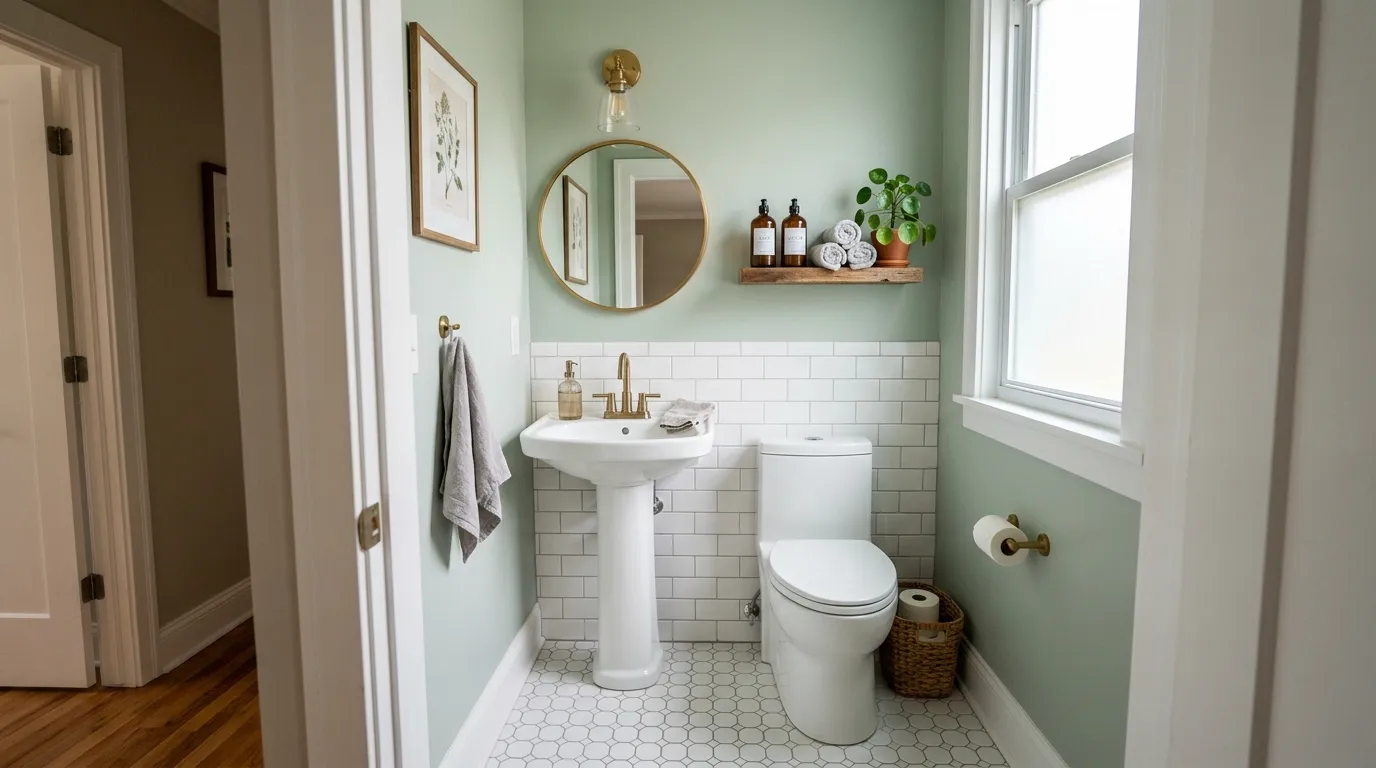
You already know the size of your bathroom. Stop bringing it up like it’s a character flaw.
Every small bathroom eventually gets the same unsolicited advice. Go light. Go white. Go mirror-on-every-wall. All of it in service of a single, exhausting goal: tricking the eye into thinking the room is bigger than it is. Nobody ever asks why that’s the goal.
A small bathroom is not a large bathroom that failed. It’s a different kind of room, with a different job. It doesn’t need to disappear. It needs to commit.
Small Bathroom Ideas
Gilded Floral Dark Wallpaper
Cover the upper walls in a black wallpaper printed with metallic gold botanicals — daisies, wildflowers, trailing stems, all rendered in a warm gold ink against a near-black ground. This is the single loudest decision in the room, so let it run from the ceiling down to a chair rail height, and stop there.
Below that line, switch to matte black vertical shiplap panels. The contrast between the printed upper wall and the flat, moody lower wall is what keeps the pattern from feeling overwhelming.
Hang a large, irregular oval mirror in a warmed brass frame off-center above the vanity, and let a three-light brass vanity fixture with clear ribbed glass shades sit just above it. The warm light against the dark wallpaper is what makes the gold ink actually glow instead of just sitting flat.
Bring in a warm wood vanity with a light marble counter to break up all that black without lightening the mood. A single piece of framed art with real negative space keeps the eye somewhere to rest.
Skip anything chrome. This room only works in brass, bronze, and warm gold.Black Marble Slab Drama
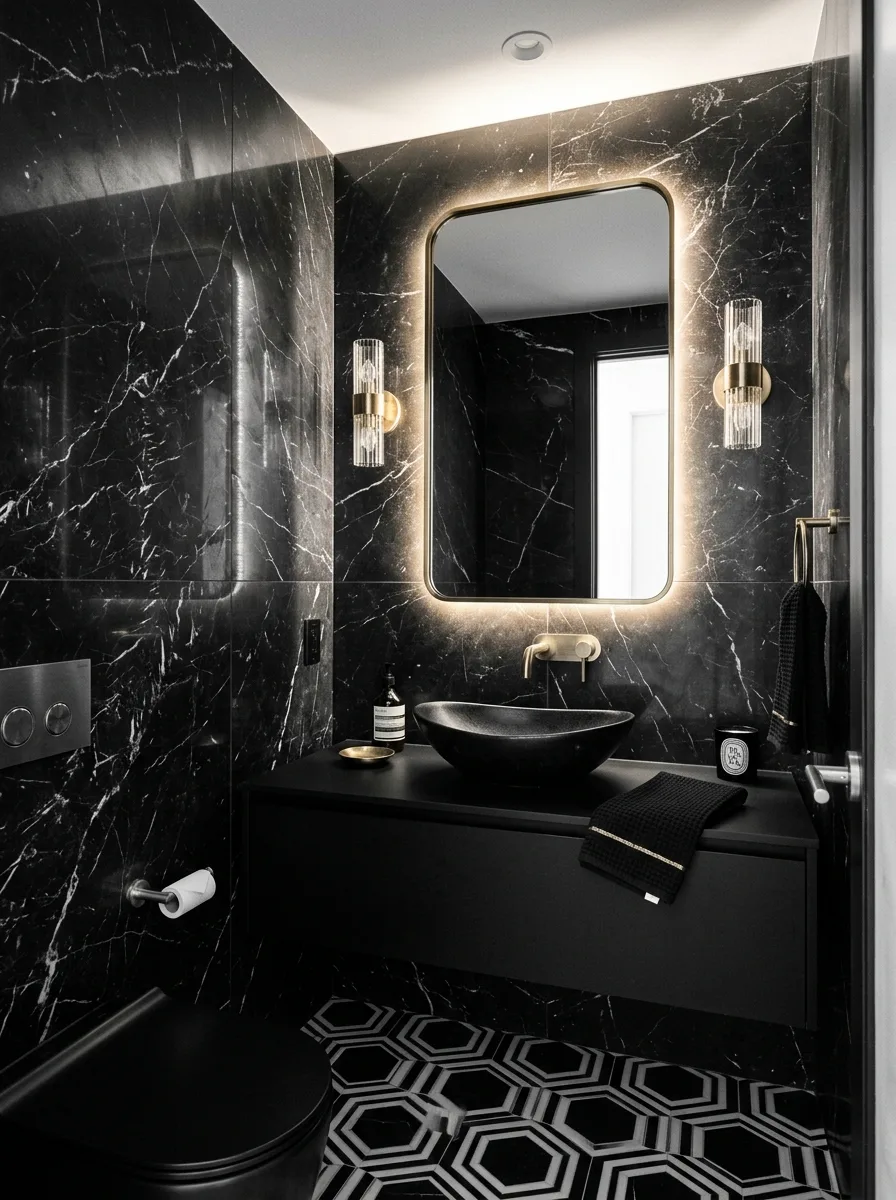
Slab black marble with dramatic white veining across every wall, edge to edge, with no visible seams if you can manage it. This is the most expensive move on this entire list, and also the one that does the most work in the smallest footprint.
Choose a matte black wall-hung toilet and a matte black vessel sink to match, both sitting against the marble rather than contrasting with it. Keeping every fixture the same tone as the walls is what turns a small room into a single cohesive object instead of a collection of parts.
Mount a rounded rectangular mirror with a built-in backlit LED ring, flanked by two brass and glass wall sconces. The warm backlighting against cool grey-black marble is what keeps the room from reading as cold.
Install a floating black vanity cabinet with no visible hardware, just a single discreet brass pull, and finish the floor in a black and white hexagon mosaic. The graphic floor is the one place pattern is allowed to show up in an otherwise monochrome room.
A single black glass candle and one brass dish are the only accessories this room needs. Anything more starts to compete with the marble.
Vintage Cistern Pimpernel Corner
Choose a densely patterned botanical wallpaper — the classic tangled vine-and-flower repeat — in muted sage and dusty coral, and run it floor to ceiling on at least two walls. Pair it with painted sage tongue-and-groove panelling on the lower half of the remaining walls.
Source a genuine high-level cistern toilet with an exposed pull chain and a wood veneer seat, not a modern low-flush model. This single fixture does more to set the era of the room than anything else you’ll buy.
Build a narrow open shelf above the cistern and load it with mismatched apothecary jars, a small stack of old hardback books, and a trailing plant in a terracotta pot. Add a row of mismatched hooks below it for hanging small linen bags or a spare towel.
Keep the sink small, wall-mounted, and unapologetically old-fashioned, with cross-handle taps in polished chrome. A potted fern or small conifer on the floor beside the toilet fills the one awkward corner every small bathroom has.
Let candles do the lighting work here instead of anything electric and modern. This room is meant to feel found, not designed.
Jungle Wallpaper Coral Vanity
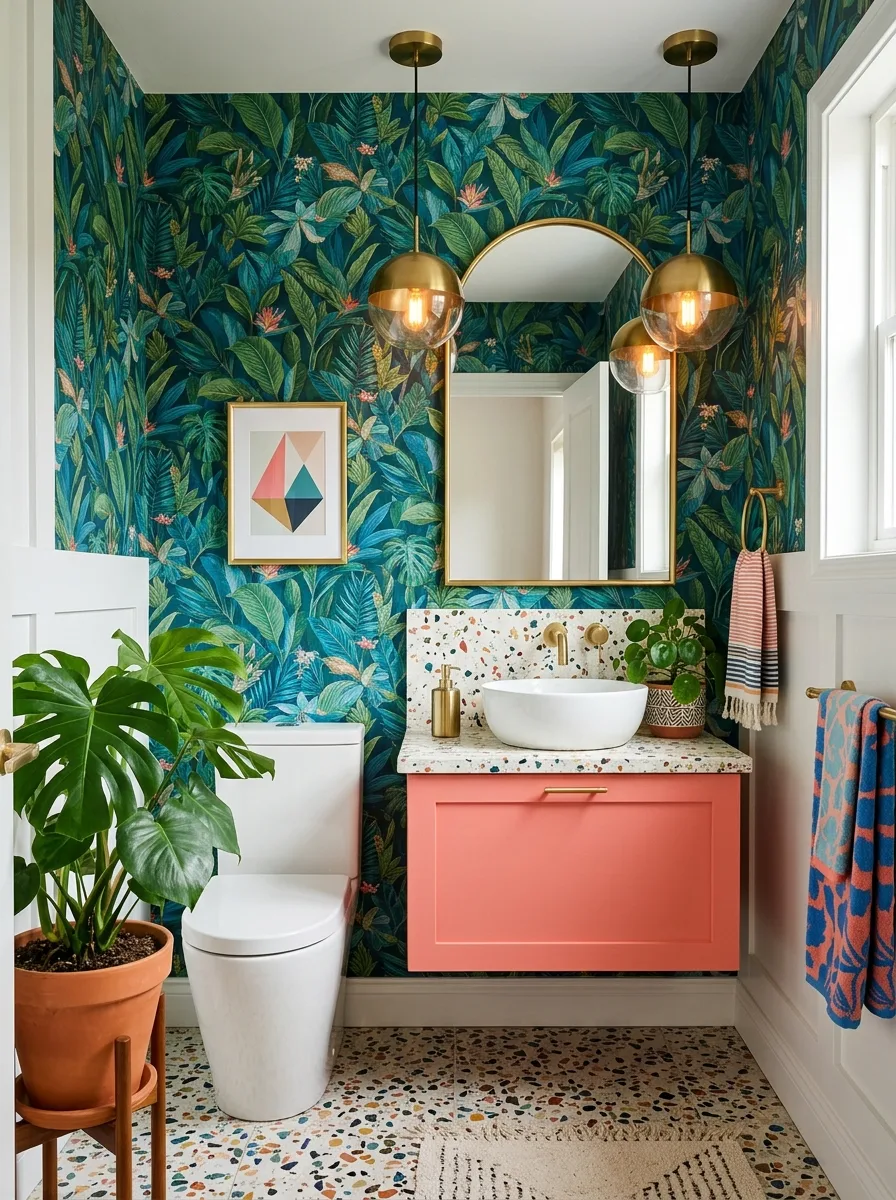
Choose a dense, large-scale tropical wallpaper — big leaves, birds of paradise, saturated greens against a deep teal ground — and run it across every wall without a single break for a chair rail. This kind of print needs full commitment or it looks like a mistake.
Install a floating vanity in a punchy coral or salmon paint, topped with a speckled terrazzo counter and a round white vessel sink. The coral against all that deep green is the color-wheel move that makes this room feel curated instead of chaotic.
Hang a plain brass arched mirror with two brass and glass globe pendants suspended on either side, rather than wall-mounted sconces. Pendants read as slightly more casual and playful, which suits a room this loud.
Add a piece of small, colorful abstract art on the one wall not dominated by the mirror, and let a single oversized monstera in a terracotta pot sit on the floor where there’s room. Real, oversized foliage is what makes printed leaves feel intentional rather than like wallpaper trying too hard.
Finish the floor in confetti-style terrazzo tile, and hang a graphic striped towel instead of a plain one. This room has no interest in being subtle, so don’t ask it to be.
Corner Sink Brass Detail
Wallpaper the upper walls in a small-scale cream and brown leaf print, then run painted timber tongue-and-groove panelling below in a deep chocolate brown, right up to a chair rail. The tight, repetitive print reads almost as a texture from a few feet back, which is exactly the point.
Fit a compact corner-mounted basin with an unlacquered brass tap that will darken and patina with age. Corner sinks reclaim floor space no rectangular vanity ever could, which matters enormously in a room this narrow.
Choose a matching wood toilet seat in the same warm tone as the brass fixtures, so the toilet doesn’t read as a stark white interruption in an otherwise warm room. A small stoneware vase with a few dried stems on the windowsill adds the only soft note in the room.
Install a freestanding brass heated towel rail rather than a single towel hook. In a small, dark-paneled room, that one warm metal object does a lot of quiet visual work.
Finish the floor in narrow brick-laid tile in a muted taupe. It grounds all that brown without adding another pattern to compete with the wallpaper.
Checkerboard Floor Pink Panels
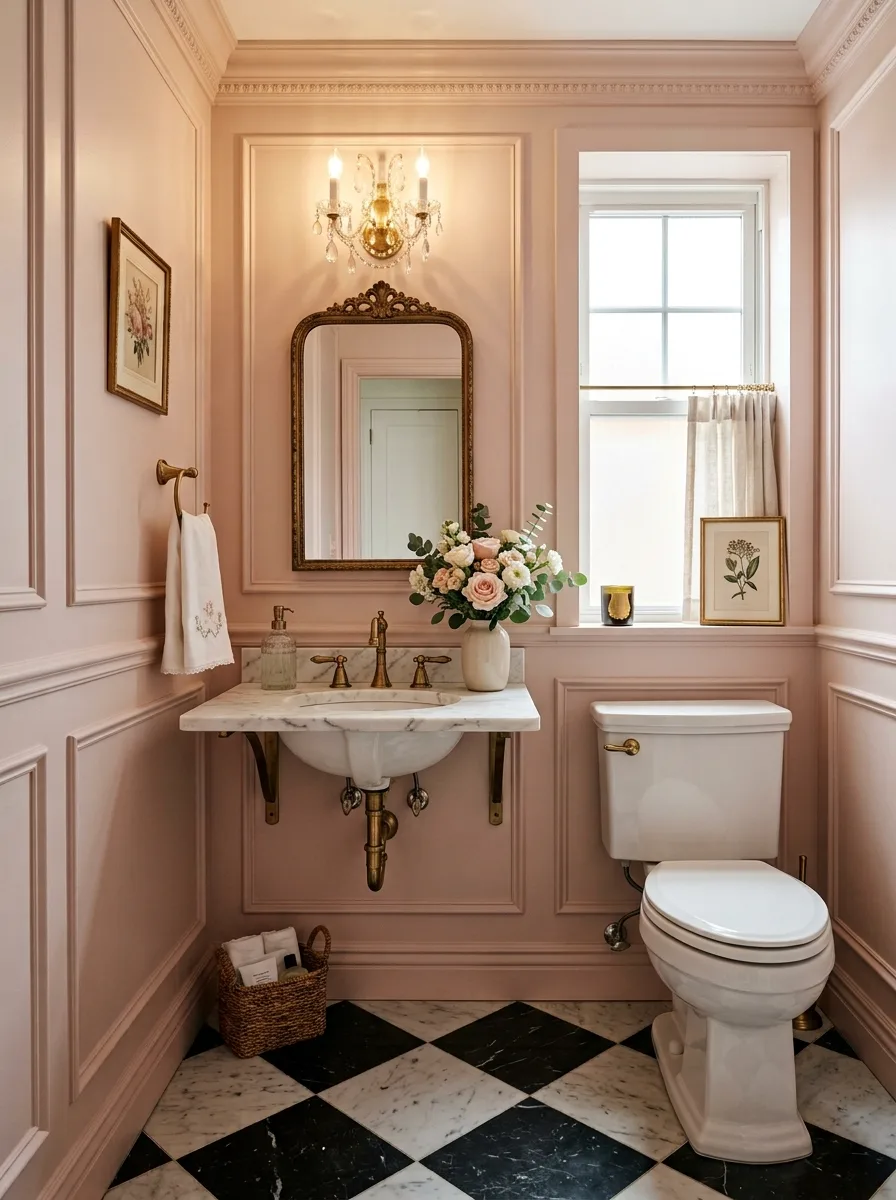
Panel every wall in raised rectangular wainscoting, painted a single soft blush pink from baseboard to crown molding. The formal, symmetrical panel layout is what keeps a playful color from reading as childish.
Lay a black and white diagonal checkerboard marble floor, and let it run right up to the base of every fixture with no transition strip. A graphic floor like this is bold enough to anchor the entire room on its own.
Mount a marble-topped wall-hung sink on exposed brass brackets, skipping the cabinet entirely to keep floor space open. Exposed brackets like this read as considerably more tailored than a boxed-in vanity ever could.
Choose an ornate antiqued gold mirror with carved detailing, and add a matching crystal sconce mounted directly above it. The mix of a formal antique mirror against clean modern paneling is the tension that keeps this room interesting.
Add a small woven basket beneath the sink for spare towels, and keep a fresh arrangement of pale pink and white flowers on the counter. This room rewards restraint everywhere except the floor.
Green Zellige Trough Sink
Tile the lower half of the room in handmade sage-green zellige squares, laid in a straight grid, and leave the upper walls in plain white plaster. The uneven, glossy surface of zellige catches light in a way flat tile never will, which matters when half your walls are one solid color.
Choose a rectangular wall-hung toilet and mount it flush against the tiled wall with a concealed cistern and a simple two-button flush plate. Keeping the tank hidden is what makes this room feel current instead of dated.
For the sink, pick a deep, ribbed teal ceramic trough basin mounted directly onto the tile, paired with a wall-mounted brass gooseneck tap. The color contrast between teal and sage is subtle enough to feel intentional rather than mismatched.
Hang a plain round brass mirror slightly off-center, and let a tall, leggy houseplant sit on the windowsill where natural light hits it directly. Lay a speckled terrazzo floor in cream and grey to keep the whole room feeling light despite all that tile.
A layered crystal chandelier overhead is the one unexpected splurge that makes the whole room feel like a decision instead of a default.
Marble Slab Geometric Floor
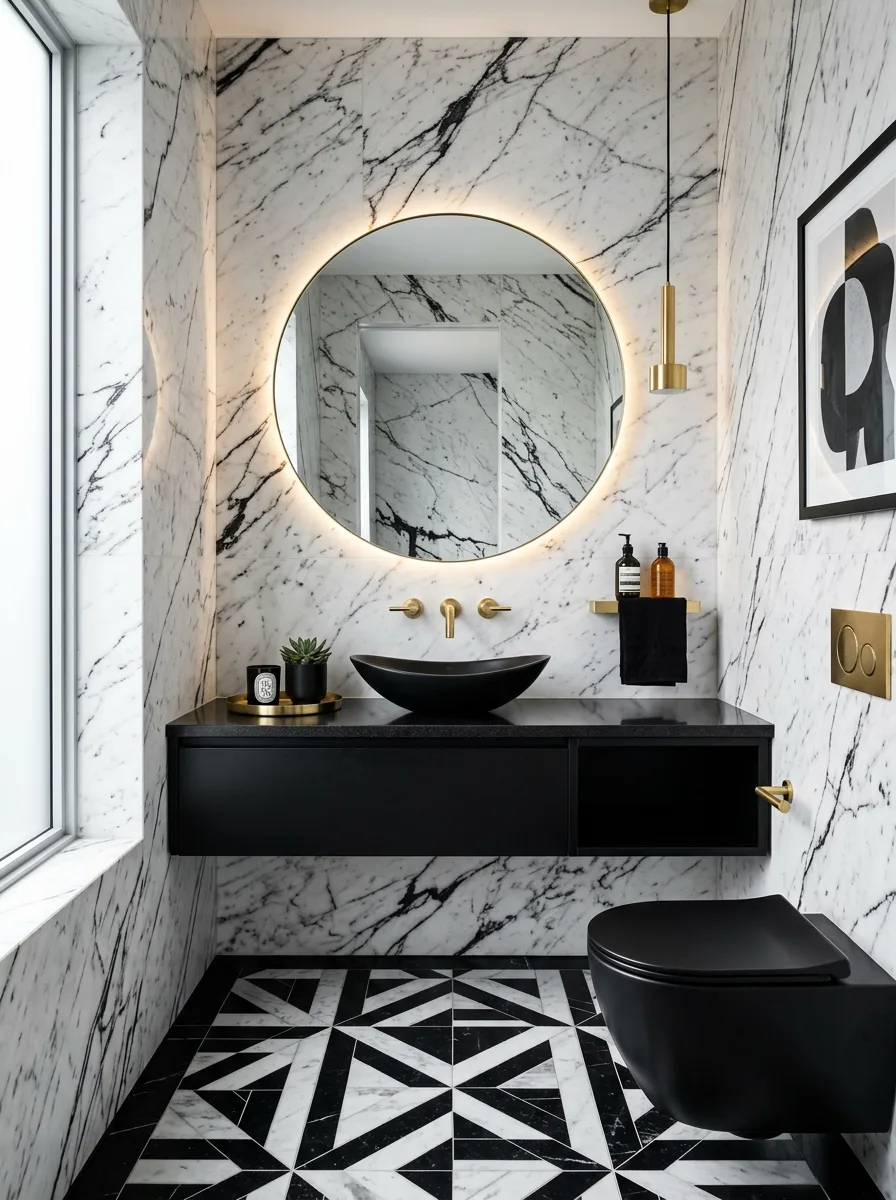
Slab bookmatched white and grey marble across every wall so the veining lines up in a mirrored pattern at the seams. This is a stonemason’s job, not a weekend project, but it’s the single most dramatic thing you can do to a small room’s walls.
Choose a matte black wall-hung toilet, a black vessel sink, and a black floating vanity, keeping every fixture in the same dark tone against all that pale marble. The stark contrast between white stone and black fixtures is the entire point of this look.
Hang a round backlit mirror with a warm LED ring, and suspend a single brass pendant light just beside it rather than centering it. Asymmetry in the lighting keeps a room this graphic from feeling too rigid.
Lay a geometric black and white marble mosaic floor in a bold angular pattern, distinct from the slab pattern on the walls. Two different marble patterns in the same room work because they share a palette, not because they share a design.
Keep accessories to a single black-and-white striped candle and a small framed abstract print. Anything more starts to fight with two competing marble patterns.
Navy Hexagon Tile Wrap
Wrap the entire room, walls and all, in glossy navy elongated hexagon tile with crisp white grout. Let it run right up into a sloped ceiling if you have one — following the roofline instead of stopping at a straight line makes the tile feel architectural rather than accidental.
Leave one small cutout in the tile as a shallow shelf for plants and candles, rather than adding a separate shelf that would break up the tile’s continuity. This is the trick that makes wall-to-wall tile look designed instead of overwhelming.
Choose a compact wall-hung toilet and a small corner or wall-mounted basin in plain white, so the fixtures recede against all that navy. A brass gooseneck tap and a matching brass toilet roll holder are the only warm notes you need against so much cool, dark tile.
Finish the floor in white penny round mosaic tile with grey speckling. The pale, textured floor is what keeps a room wrapped entirely in dark tile from feeling like a cave.
A single potted plant in the corner and one small framed print on the shelf are all the decoration this room can handle. Everything else is already being said by the tile.
Emerald Walls Vessel Sink
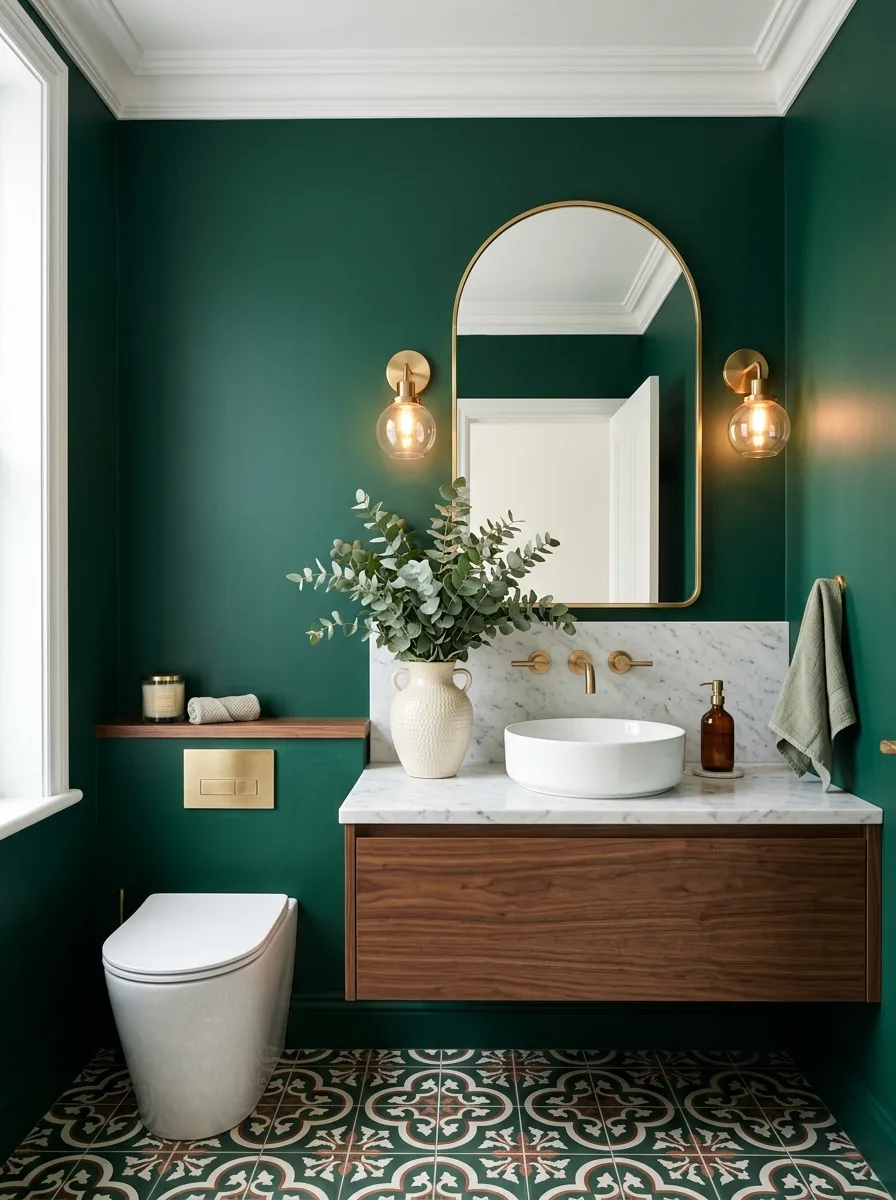
Paint the walls a deep, saturated forest green in a matte or eggshell finish, and carry that same green right up into the crown molding. Committing to one unbroken color, ceiling trim included, is what makes a small room feel enveloping instead of just painted.
Mount a walnut floating vanity with a white marble slab counter, and drop in a round white vessel sink rather than an undermount bowl. The round white form against all that dark wood and green wall is the single visual anchor of the whole room.
Install matte brass wall-mounted taps directly into the marble backsplash, skipping the deck-mounted option entirely. It’s a small change that reads as considerably more expensive.
Flank a tall arched brass-framed mirror with two glass globe sconces mounted directly to the green wall. The warm glow against dark green is what sells the whole “moody but not gloomy” effect.
Finish the floor in a patterned encaustic-style tile in cream, rust, and green tones, and let a single oversized vase of eucalyptus do the only “soft” decorating in the room.
Shiplap Rattan Coastal Calm
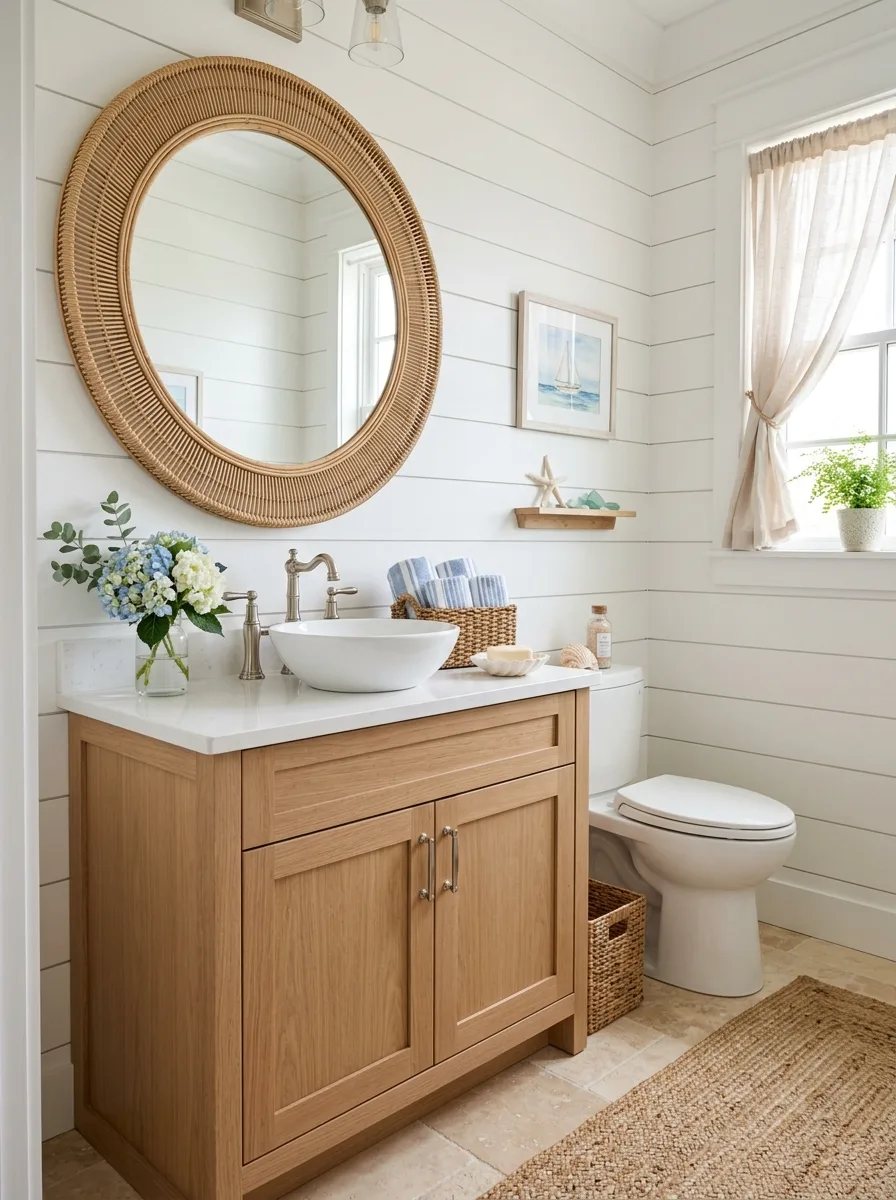
Run horizontal white shiplap paneling across every wall, floor to ceiling, with visible reveal lines between each plank. The repetition of that horizontal line is doing the same job pattern does in bolder rooms — it just does it quietly.
Hang an oversized round mirror in a woven rattan frame directly above the vanity, sized large enough that it becomes the obvious focal point of the room. In an otherwise all-white space, texture has to do the work that color usually would.
Choose a light oak vanity with a white vessel sink and brushed nickel bridge faucet, and add a woven seagrass basket on the counter for rolled towels instead of a closed drawer. Visible texture like this keeps a white room from feeling sterile.
Add a small wood shelf for a starfish or a piece of coastal-themed art, and hang linen curtains at the window instead of a blind. Soft, imperfect fabric against all those hard flat shiplap lines keeps the room from feeling like a showroom display.
A potted plant on the windowsill and a jute rug on the floor are the last two moves that make a neutral room feel lived-in instead of staged.
Scalloped Pink Vanity Charm
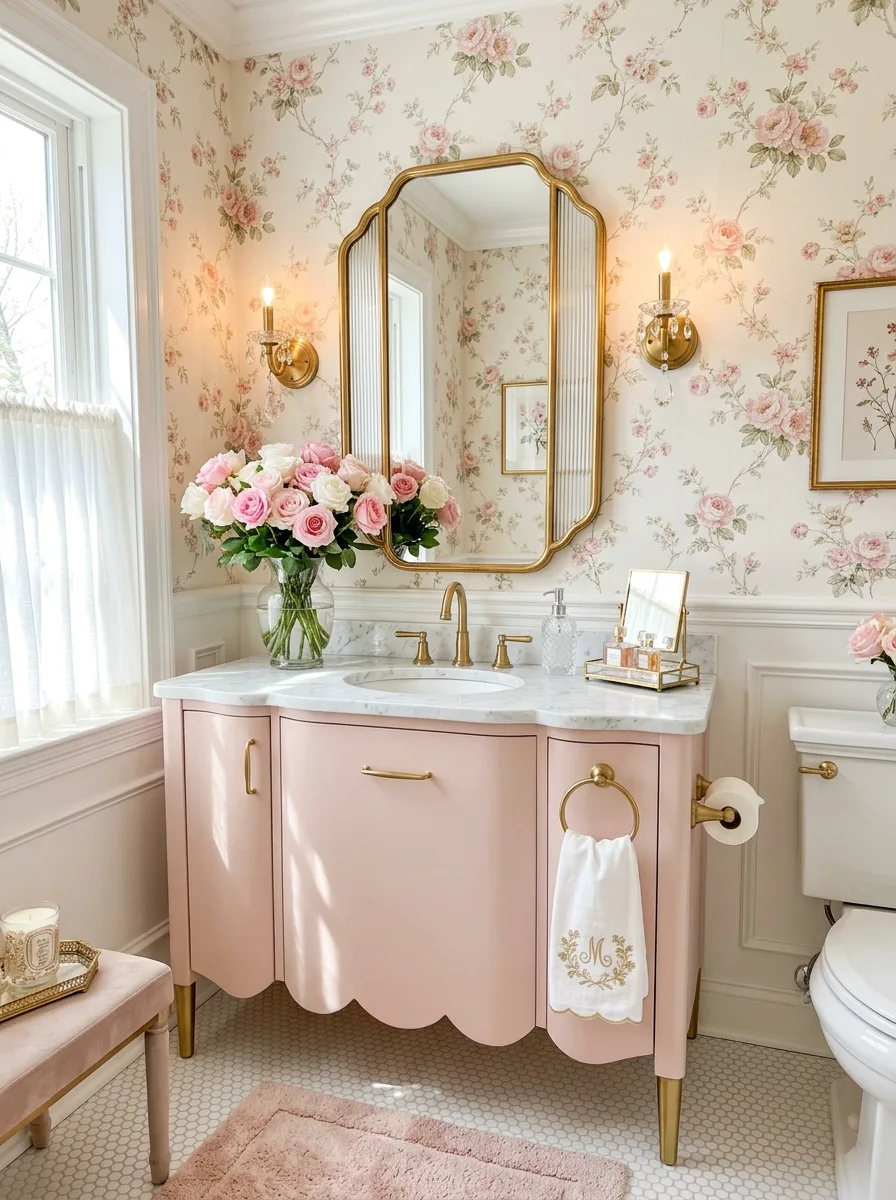
Paper the walls in a trailing pink rose print on a cream ground, letting individual floral stems climb the wall like they’re actually growing there. This kind of print only works because it’s busy — a sparse floral will read as timid, not romantic.
Build or source a vanity with a scalloped wave-cut base in a soft blush pink, paired with a white marble counter and an oval undermount sink. The scalloped edge is the single detail that turns a plain painted cabinet into a genuinely special piece of furniture.
Choose an ornate brass-framed mirror with soft angled edges, and flank it with two crystal candle-style sconces. The sparkle from cut crystal against a soft floral wall is what keeps this from tipping into overly sweet.
Add a monogrammed white hand towel on a brass ring mounted to the vanity itself, and keep a low arrangement of fresh pink and white roses on the counter at all times. Fresh flowers are doing real work in this room — silk ones will flatten the whole effect immediately.
Lay a small pink bath mat over penny tile flooring, and let the natural light from an unobstructed window do most of the lighting work during the day.
Backlit Organic Mirror Oak
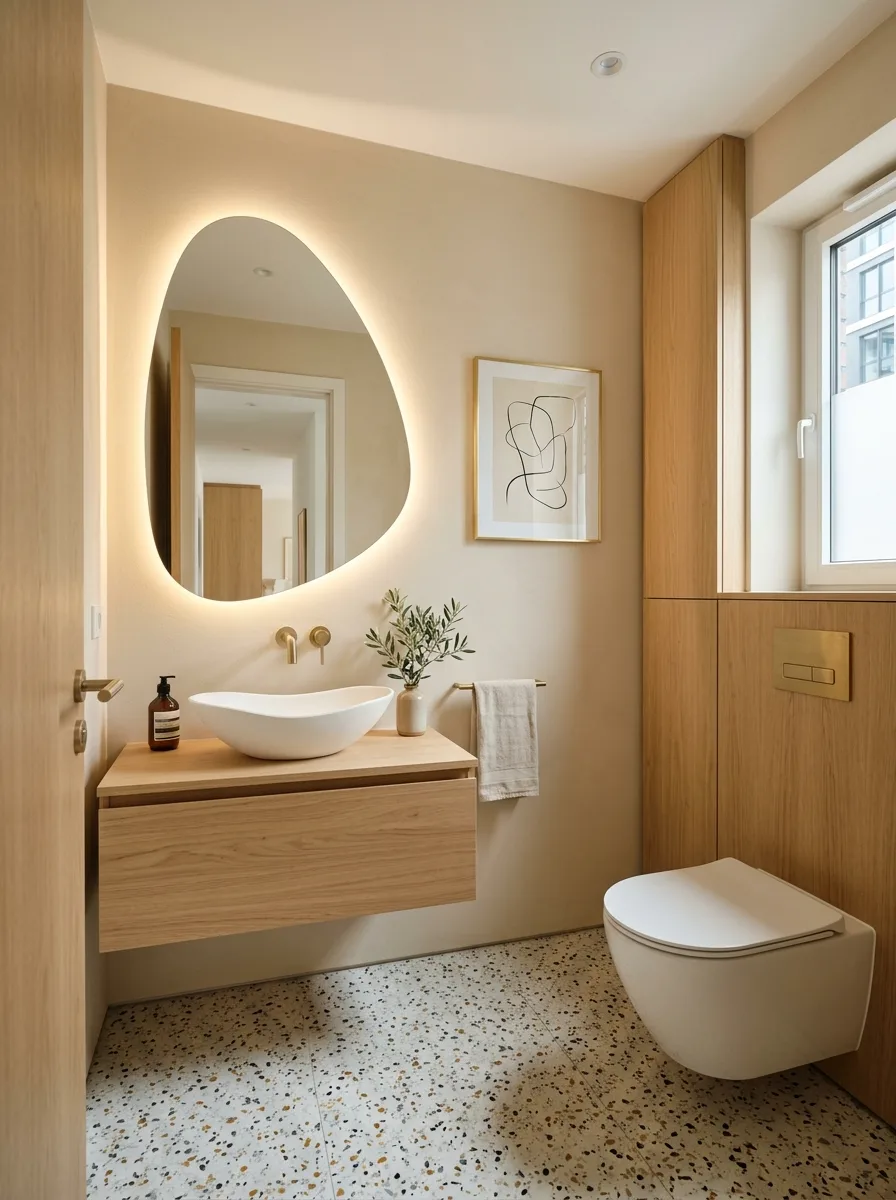
Choose a soft, organic pebble-shaped mirror with an integrated LED backlight, and mount it slightly asymmetrically rather than dead-center over the sink. The irregular shape is what keeps a minimal, pale room from feeling clinical.
Panel one full wall in warm light oak slats or paneling, running vertically, and paint the remaining walls a warm greige to match the wood’s undertone. Matching the paint to the wood, rather than contrasting against it, is what makes a small room feel calm instead of busy.
Mount a floating light oak vanity with a sculptural white vessel sink that curves rather than sits as a rigid rectangle. Soft, rounded forms throughout the room are doing the same job pattern does elsewhere on this list — giving the eye something to follow.
Skip visible hardware entirely and rely on push-to-open cabinetry, and hang one small abstract line drawing in a thin brass frame beside the mirror. Restraint here isn’t accidental — it’s the entire concept.
Finish the floor in warm-toned terrazzo with gold and cream flecks, which ties back to the brass fixtures without adding a second competing material.
River Stone Sink Green
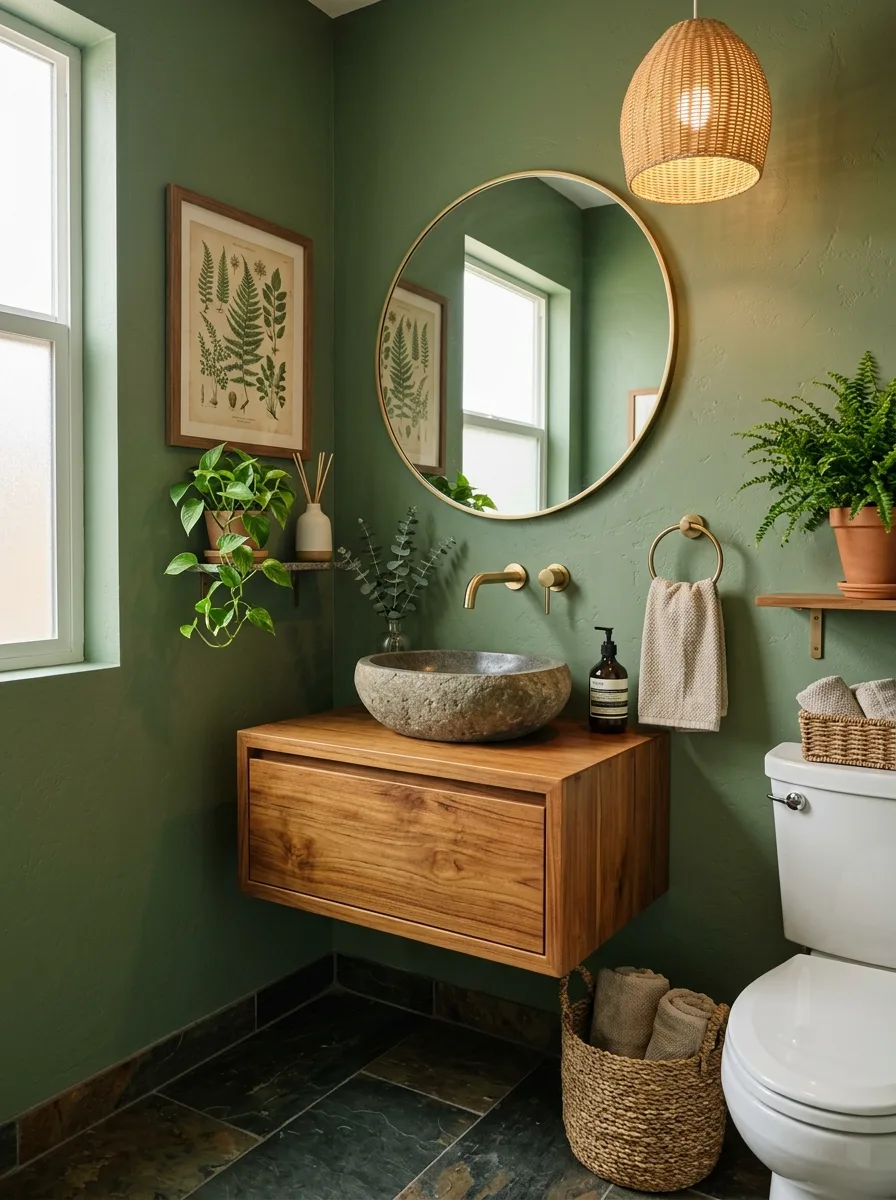
Paint the walls a muted olive green in a chalky matte finish, and let the color wrap fully into the corners with no white trim breaking it up. An unbroken color field is what makes a small, awkward-shaped room feel deliberate instead of chopped up.
Source a genuine river stone vessel sink, left in its natural rounded, uneven form rather than a machined circle. This is the single object that gives the whole room its point of view — do not substitute a standard ceramic bowl here.
Build a simple rectangular floating vanity in warm-toned solid wood with visible grain, and mount a brass wall tap directly above the stone basin rather than a deck-mounted one. Wall-mounted plumbing keeps the stone sink as the uninterrupted hero of the counter.
Hang a round mirror in a slim brass frame, and suspend a woven rattan pendant light just to the side of it rather than centered. Off-center lighting placement is a small move that keeps a symmetrical room from feeling stiff.
Fill every available shelf and corner with trailing plants in terracotta pots, and finish the floor in dark slate tile to ground all that green and wood in something cooler.
Limewash Walls Brass Glow
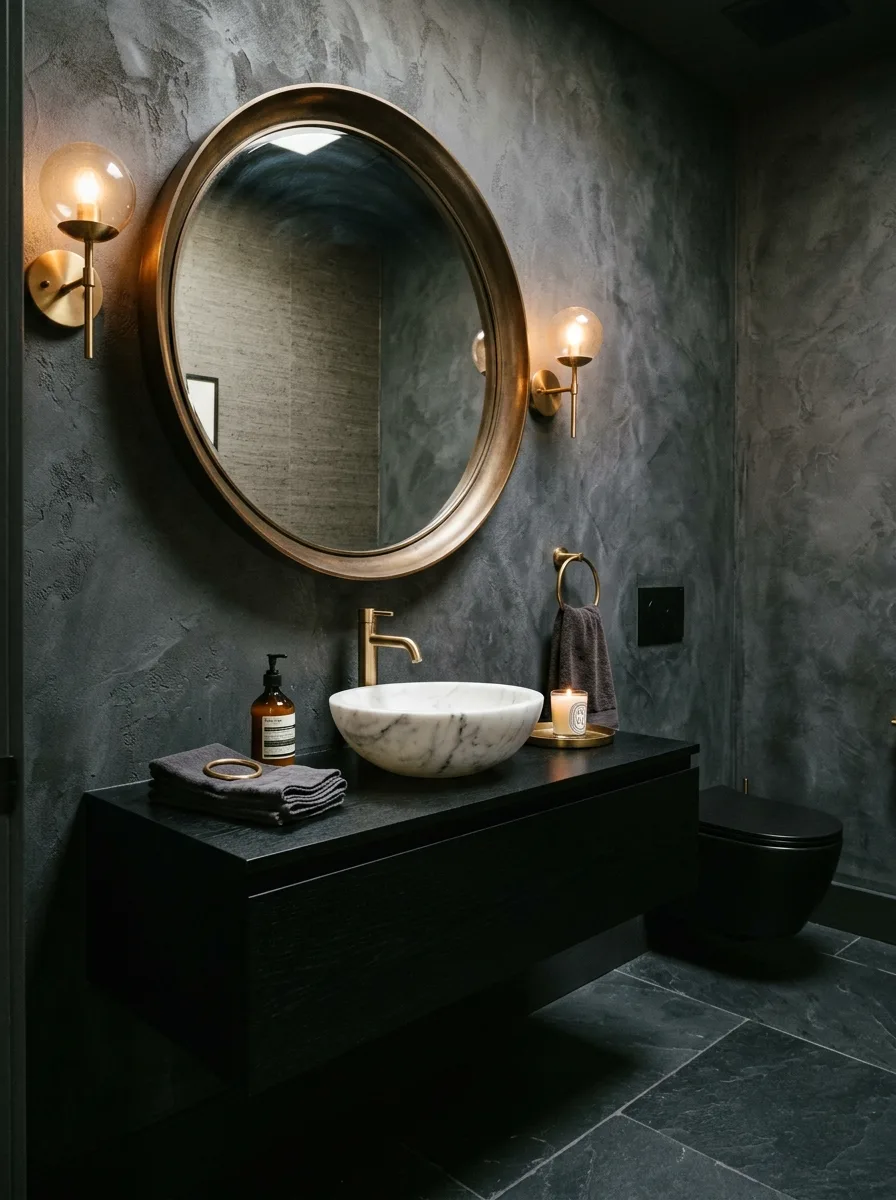
Apply a textured limewash or Venetian plaster finish in charcoal grey across every wall, letting the natural mottling and variation show rather than sanding it smooth. This uneven, cloud-like texture is what gives a monochrome room all its visual interest.
Hang a large round mirror in an aged, unlacquered brass frame, flanked by two brass and smoked-glass globe sconces mounted at eye level. Warm brass light against cool grey plaster is the single contrast doing all the work in this room.
Choose a solid black floating vanity with a white marble vessel sink set slightly off-center on the counter. Off-center placement, rather than perfectly centered, is what keeps a minimal room from feeling like a hotel bathroom.
Pair a matte black toilet with the black vanity so the two darkest objects in the room read as a single family rather than two separate purchases. Add one small candle in an amber glass jar on the counter for warmth.
Finish the floor in large-format charcoal slate tile, and hang a single waffle-weave towel from a slim brass ring. This room is proof that “moody” and “cold” are not the same thing.
Tropical Palm Coral Combo
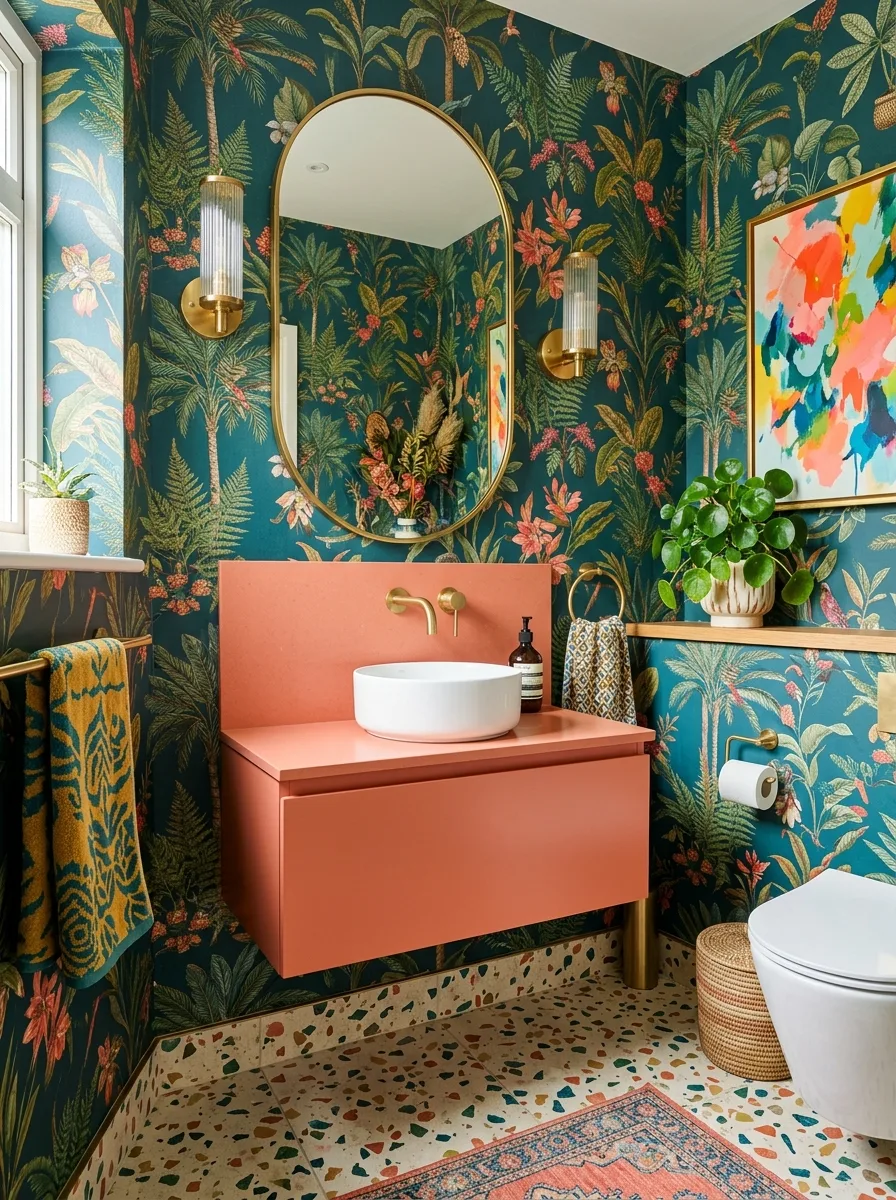
Wallpaper every wall in a rich, densely illustrated jungle print — palms, ferns, and tropical flowers rendered in teal, coral, and gold — running the paper into the ceiling line if the room allows it. This is the loudest possible version of a small room, and it only works because nothing holds back.
Install a floating vanity in a bold coral-orange lacquer, paired with a plain white round vessel sink and a wall-mounted brass tap. The solid coral block against all that busy pattern gives the eye one place to land.
Hang a tall oval mirror in a brushed brass frame, flanked by brass and ribbed-glass sconces mounted directly to the wallpaper. Don’t be precious about drilling into pattern — the room can take it.
Add one piece of bold, colorful abstract art on the least busy wall, and let a large potted plant sit on the windowsill where it gets direct light. Real foliage keeps printed foliage from feeling flat.
Finish the floor in confetti terrazzo and layer a small vintage-style rug over it. A rug on a bathroom floor reads as intentional here, not out of place, because the whole room has already committed to maximalism.
Plaster Walls Rattan Pendant
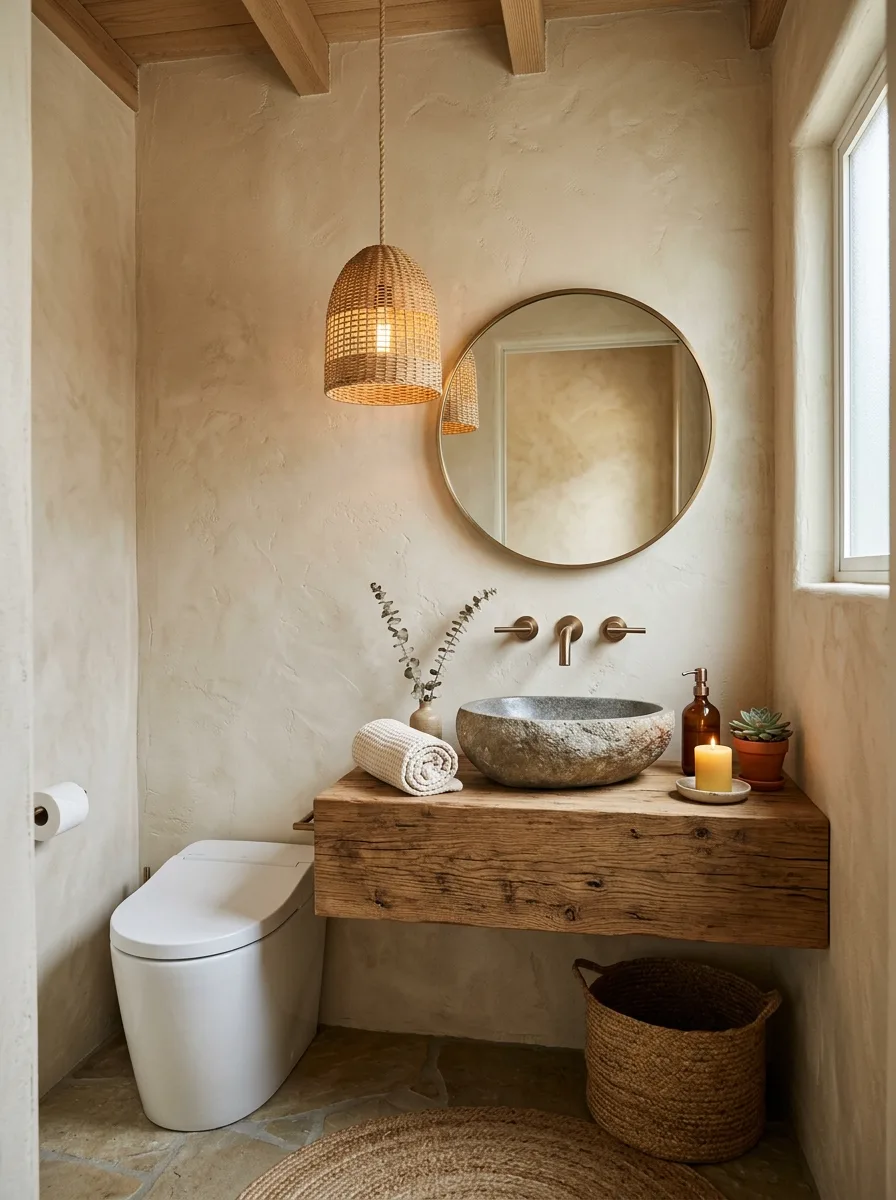
Coat every wall in a warm, sandy Venetian plaster finish, and leave the ceiling in exposed wood beams if your structure allows it. The raw, tactile texture of the plaster against natural wood is what gives this room its whole personality.
Hang two woven rattan pendant lights of slightly different heights above a round brass-framed mirror. Uneven pendant heights read as more organic and considered than a matched pair hung level.
Build a floating vanity from a single thick slab of reclaimed raw-edge wood, and drop in a genuine stone vessel sink with its natural uneven rim left intact. Every material in this room should look like it came from somewhere, not off a shelf.
Mount a brass wall tap directly above the stone basin, and add a single rolled linen towel and a lit candle on the vanity’s edge. Warm, low light from candles suits this room more than anything electric and bright.
Finish the floor in weathered terracotta tile, and place a woven jute basket beneath the vanity for towels. This is a room built entirely from texture, so resist the urge to add pattern on top of it.
Concrete Vanity Black Toilet
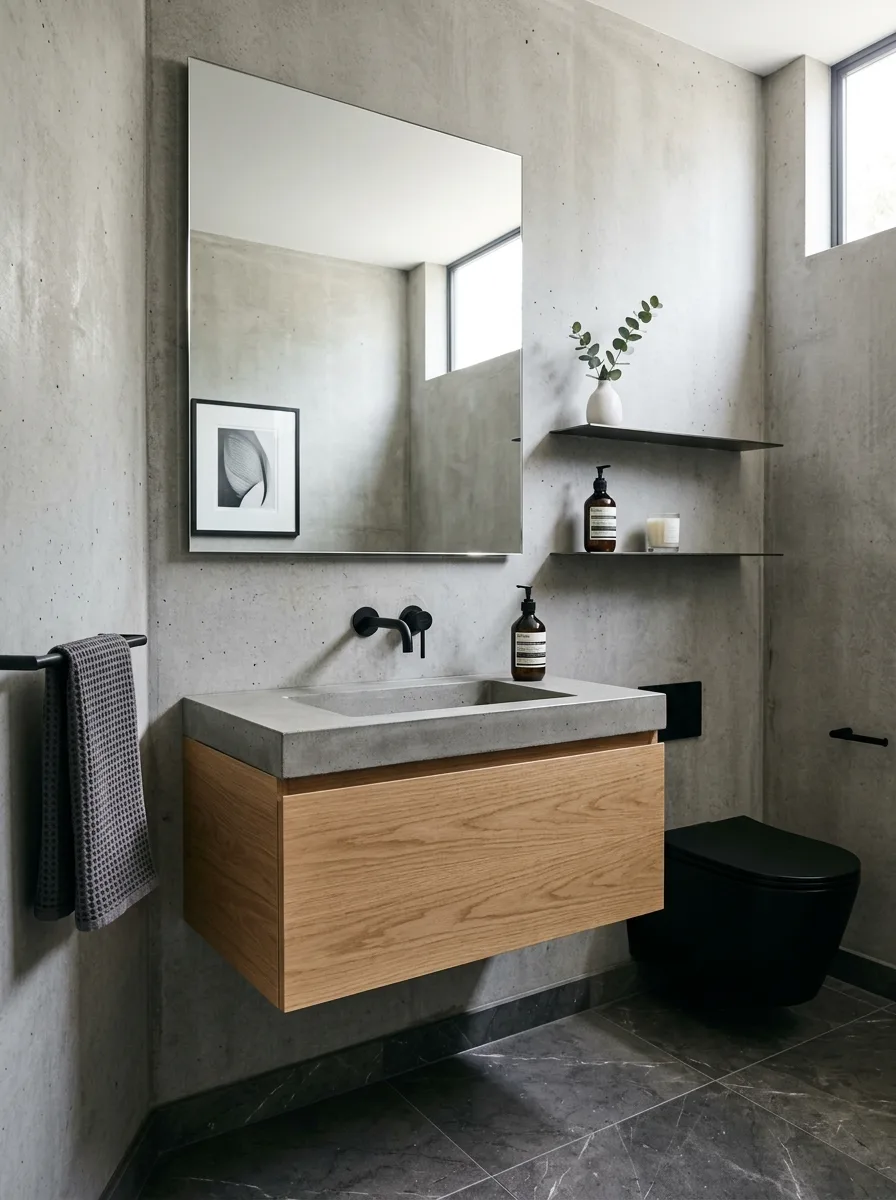
Finish every wall in raw, board-formed concrete, leaving the subtle grain and texture from the formwork visible rather than smoothing it out. Concrete does something no paint color can — it reads as cool, industrial, and permanent all at once.
Mount a floating light oak vanity beneath a poured concrete countertop with an integrated basin, so sink and counter read as one continuous slab. This single-material counter is the detail that separates a genuinely designed concrete bathroom from a construction site.
Hang a plain rectangular mirror in a thin black frame, with no additional lighting built in, relying instead on a wall-mounted matte black faucet and open black shelving beside it. The restraint in the hardware finish is what keeps concrete from reading as cold — everything is deliberately underplayed.
Choose a matte black wall-hung toilet to sit against the concrete without disappearing into it, and add a single black towel bar rather than a full rail. A black toilet against grey concrete reads as considered, not stark.
Finish the floor in dark grey slate or polished concrete to match the walls, and add one small vase with a single eucalyptus stem as the only soft object in the entire room.
Terracotta Zellige Boho Warmth
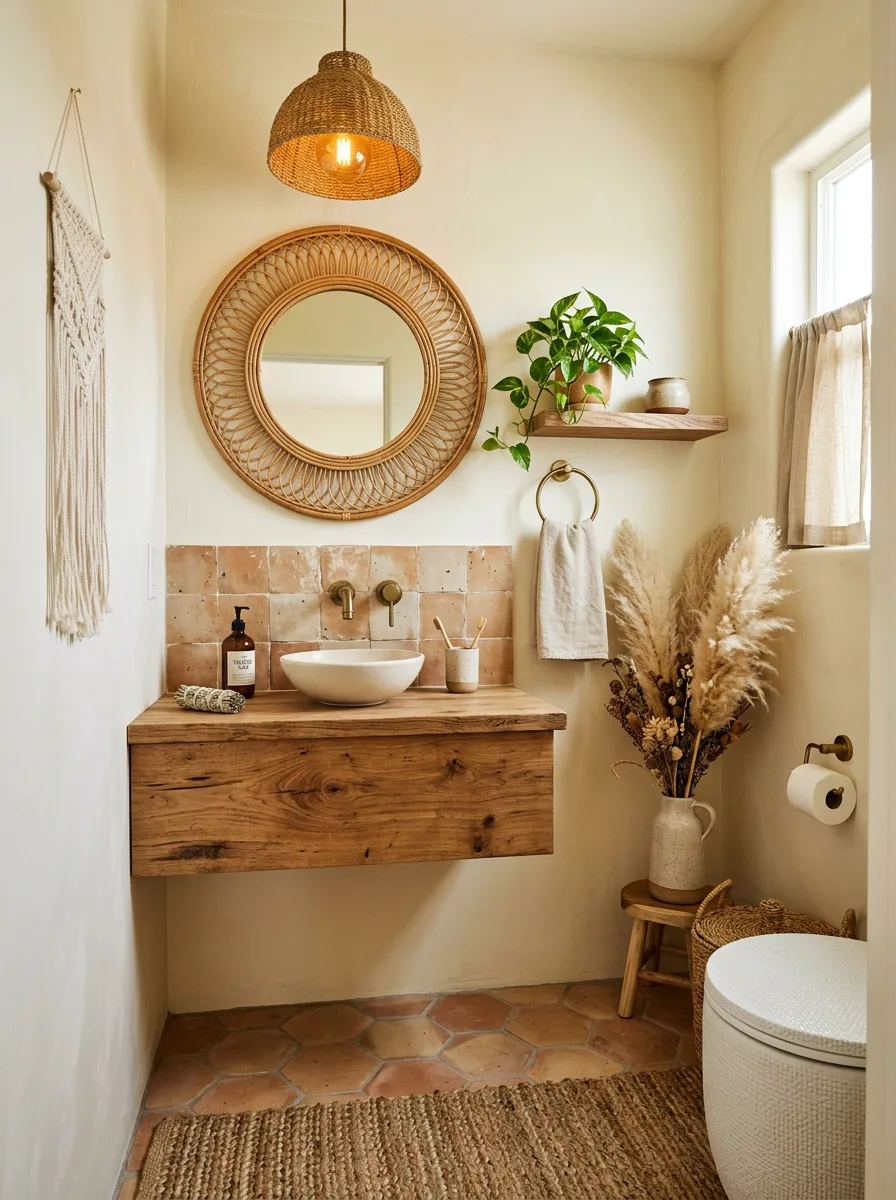
Paint the walls a warm, unbleached cream, and tile a single backsplash area in irregular terracotta zellige squares rather than covering the whole room. Using pattern and texture in one contained zone, instead of everywhere, is what keeps a boho room from tipping into clutter.
Hang a woven rattan sunburst mirror alongside a matching woven pendant light, letting the two pieces of natural texture echo each other without matching exactly. They don’t need to be identical — they need to be from the same material family.
Build a floating vanity from a single raw wood slab, and drop in a plain white vessel bowl to keep the counter from getting too busy. One neutral object on a warm, textured counter gives the eye somewhere calm to land.
Add a macramé wall hanging on the opposite wall, a bundle of dried pampas grass in a stoneware vase on the floor, and a woven basket beside the toilet for extra storage. Layering natural materials — rattan, wood, jute, ceramic — is the actual technique here, not any single hero piece.
Finish the floor in warm terracotta hexagon tile and add a chunky jute rug. This room works because every material in it could plausibly have been foraged, not bought.
Raw Stone Waterfall Vanity
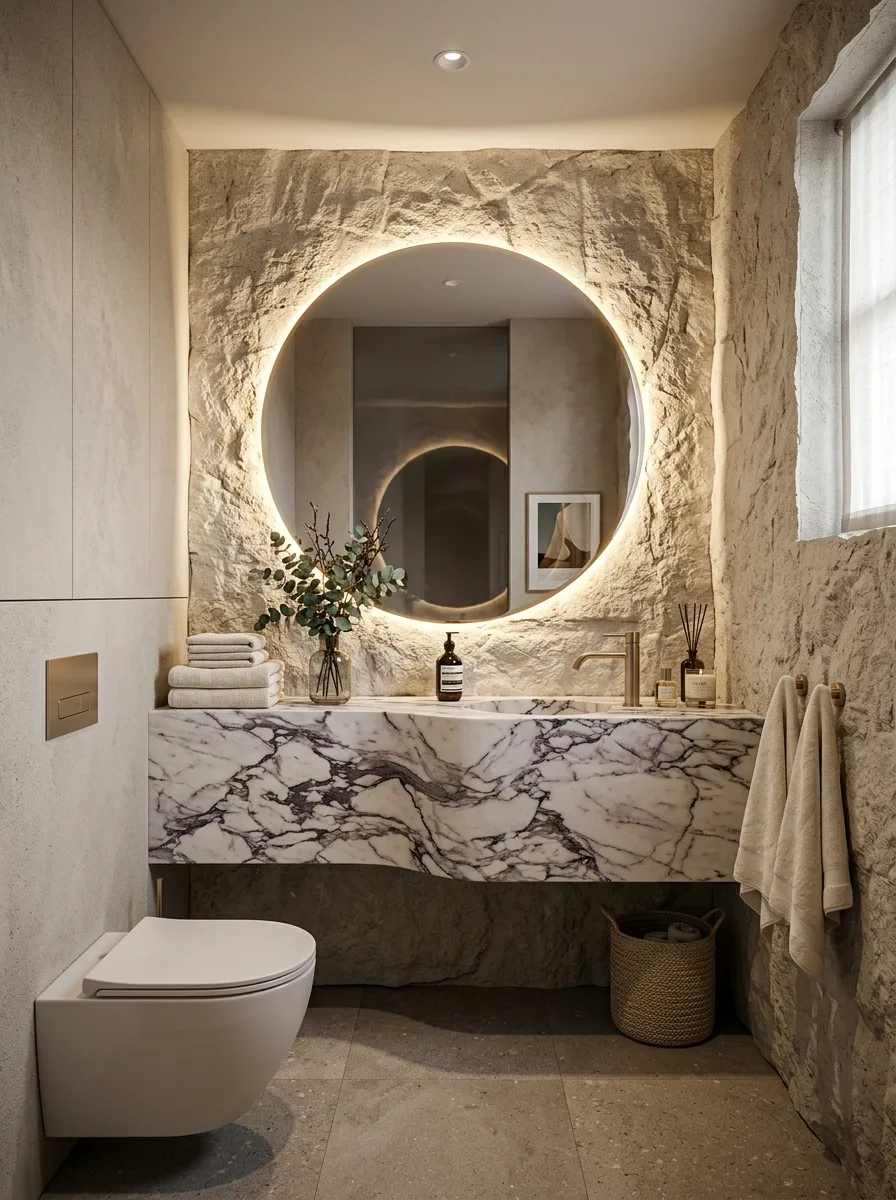
Clad one full wall in raw, rough-cut natural stone, left unpolished and irregular, and keep the remaining walls in a smooth pale plaster to let the textured wall stand out as a feature. Mixing one rough surface against otherwise calm, smooth surroundings is the whole trick.
Install a dramatic white and grey veined marble vanity counter with a waterfall edge that wraps down the side to the floor, rather than stopping at a standard countertop edge. A waterfall edge on a small vanity reads as considerably more luxurious than the square footage would suggest.
Hang a large round mirror with a warm backlit ring set directly into the rough stone wall, letting the light bounce unevenly off the textured surface behind it. That uneven glow off rough stone is what gives this room its warmth despite an otherwise neutral palette.
Choose a wall-hung toilet in plain white to keep the fixtures quiet and let the stone and marble do all the talking. Add a woven basket for towels rather than an open shelf, keeping the visual noise to a minimum.
Finish the floor in large-format warm stone tile that echoes the wall without matching it exactly, and add a single stem of fresh eucalyptus on the counter. This is restraint in service of texture, not the absence of a design decision.
Final Thoughts
None of these twenty rooms are actually about square footage. They’re about the fact that most people treat a small bathroom as a problem to minimize instead of a canvas to fill.
Every room on this list made one real decision — the wallpaper, the stone, the color — and then had the discipline to build everything else in support of it. That’s the entire skill. Not more stuff. Fewer, better decisions, followed all the way through.
A small bathroom you actually love to be in will always beat a large one you’re too scared to commit to. Size was never the constraint. Commitment was.
The next time someone tells you to keep it white and simple because the room is small, ask them why that’s the room’s job to prove something to a real estate agent it will probably never meet.