

There’s a very specific kind of bathroom that shows up in every renovation magazine — white tile, white walls, a single sad plant fighting for its life on the windowsill. It photographs well. It feels like nothing.
Somewhere along the way, an entirely different bathroom started showing up in people’s feeds instead: dark green walls, dried flowers hanging upside down, a claw-foot tub lit by candlelight, wallpaper so dense with peonies it looks like it might start growing.
That bathroom has a mood. It has a whole personality before you’ve turned on a single tap.
This is the version of the room that remembers it’s allowed to feel like something.
Why People Are Scared of a Dark Bathroom (And Shouldn’t Be)
The fear that dark paint makes a small room smaller
This is the single most common objection, and it’s backwards. A small room painted dark stops trying to convince you it’s bigger than it is and instead disappears into itself — the walls recede into shadow rather than announcing their boundary.
A pale small bathroom shows you exactly where every wall stops. A dark one blurs those edges the second the lights go low.
The room isn’t smaller. It just stops apologizing for its size.
Worrying that dark means cold or clinical
People associate dark rooms with the sleek, minimal, black-marble version of moody design — all hard angles and no warmth. That’s one interpretation of dark, not the only one.
Cottagecore dark is the opposite of clinical. It’s built on velvet, wood, brass, candle flame, and things that were once alive — dried flowers, ivy, moss. Every material in the room is soft or organic, even when the wall color is nearly black.
Dark and cozy aren’t in conflict. They’re the same decision, executed with the right materials.
Assuming a dark bathroom needs to be treated like a dark bedroom
A bedroom this dark needs curtains and control over daylight. A bathroom doesn’t have the same relationship with the sun — most of its best hours happen after dark anyway, lit by candles and warm bulbs rather than a window.
That means a dark cottagecore bathroom actually plays to the room’s natural rhythm instead of fighting it. Nobody’s reading a novel by the tub at 2pm. This room was always going to peak at night.
Dark Cottagecore Bathroom Ideas
Butterfly Decal Clawfoot Tub
Source or hand-decorate a clawfoot tub with a botanical, butterfly-and-floral motif in soft lilac and blush tones, letting the pattern wrap the exterior fully rather than staying confined to one panel. This becomes the room’s centerpiece before anything else in the space gets a say.
Paint the surrounding walls near-black and hang an ornate, oversized black-framed oval mirror directly behind the tub, angled to catch the room’s candlelight and multiply it.
Drape trailing faux or dried florals across the window and curtain rod, letting vines spill down past the sill rather than staying contained in a planter. A crystal chandelier overhead ties the whole vignette to something slightly theatrical.
Choose a floral-print bath mat in the same palette as the tub’s decal so the pattern continues down onto the floor instead of stopping abruptly at the rim.
William Morris Print Corner Sink
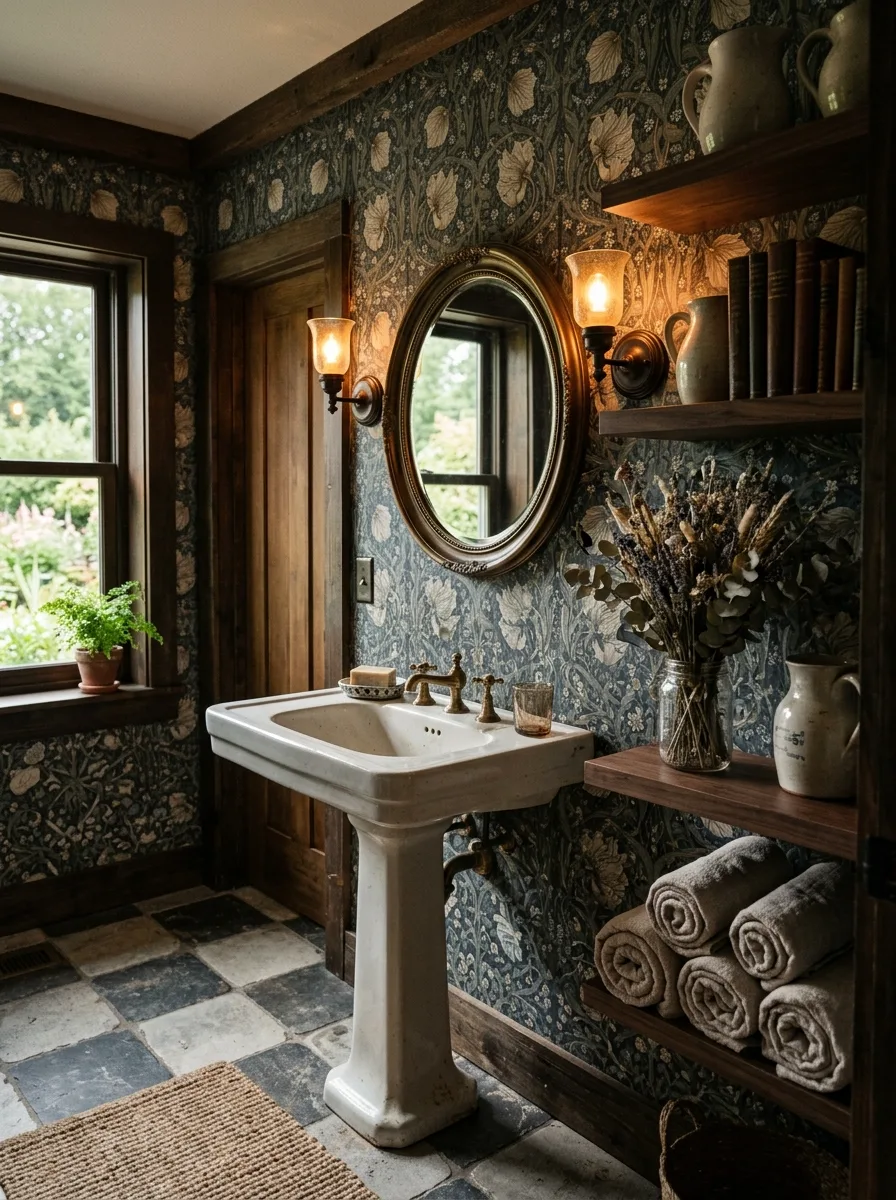
Choose a dense, illustrative floral wallpaper in the William Morris tradition — layered leaves and blooms in muted blues and creams — and run it floor to ceiling around a corner pedestal sink. The density of the pattern is the entire point; a sparser print won’t carry the same weight.
Hang an oval mirror in a simple aged gold frame directly above the sink, flanked by a single warm sconce rather than a symmetrical pair, allowing the wallpaper itself to provide the balance.
Install open wood shelving beside the sink and stack rolled linen towels alongside a collection of leather-bound books and stoneware pitchers. A checkerboard stone floor in muted greys grounds the pattern-heavy walls in something calm.
Keep a single potted herb on the windowsill rather than a full garden of plants — this look is about pattern density on the walls, with restraint everywhere else.
Botanical Wallpaper Wainscot Suite
Hang a dense, dark floral wallpaper above a painted sage or olive wainscot, keeping the paneling simple enough that it doesn’t compete with the wallpaper’s detail. The contrast between the busy upper wall and the plain lower half is what keeps the room from tipping into overwhelming.
Frame two small matching botanical or butterfly prints and hang them directly on the wallpaper itself, letting the pattern show through the mat’s white space. Choose black frames so they read as intentional additions, not accidental clutter.
Panel the tub to match the wainscot color exactly, so the bath reads as built-in furniture rather than a separate fixture. A slim brass mixer tap and pedestal sink keep the hardware simple against all that pattern.
Add one small round accent table in aged brass beside the tub for towels and a candle — round shapes soften a room built mostly from straight-edged paneling.
Black Beadboard Apothecary Wall
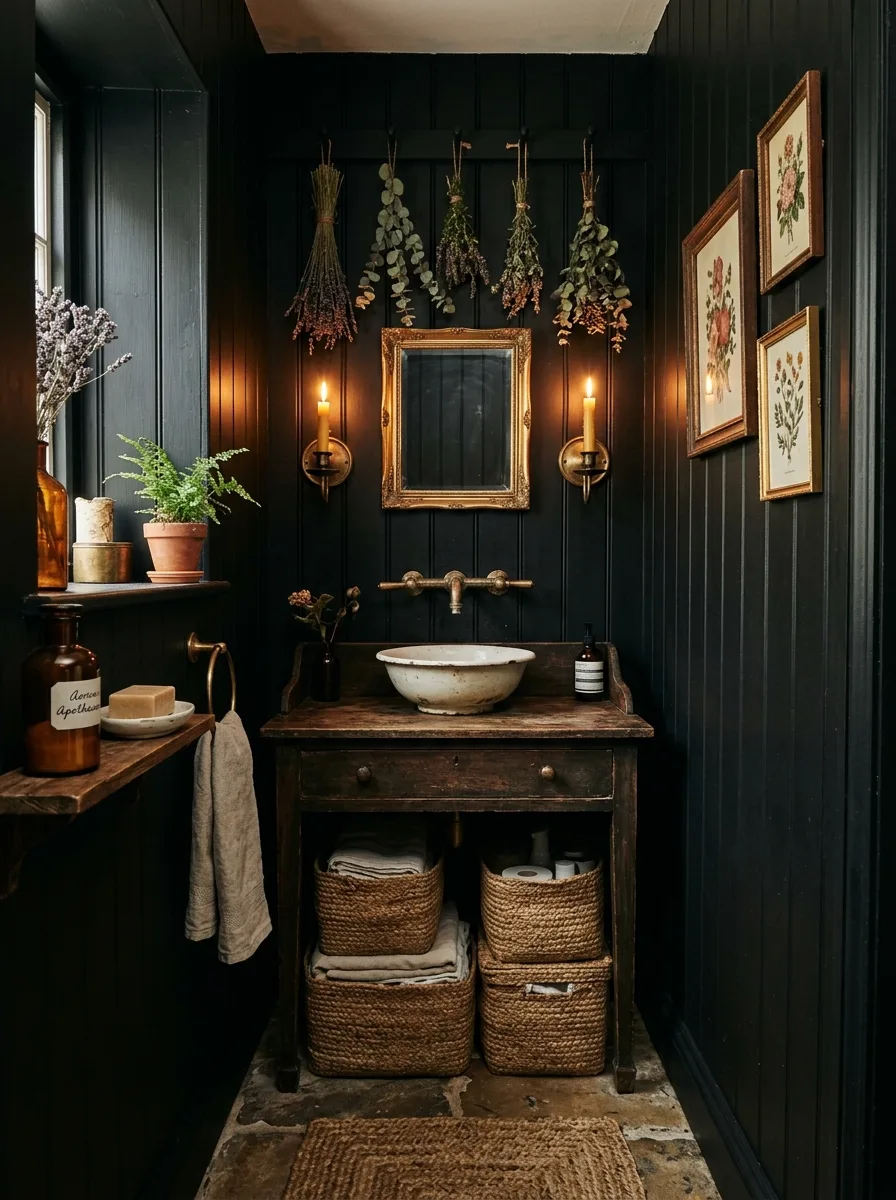
Panel the walls in black beadboard and hang a row of hooks above the vanity for drying flower and herb bundles, letting them hang at slightly different lengths for visual rhythm. This turns a functional drying rack into the room’s main decorative gesture.
Choose a genuinely aged wood washstand as the vanity, topped with a simple ceramic bowl sink rather than a built-in basin. Leave the underside open, styled with woven baskets holding folded towels and spare rolls.
Hang a single ornate gold-framed mirror flanked by warm candle sconces, and group three or four small botanical prints on the opposite wall in mismatched frames. Amber glass apothecary bottles on the open shelf complete the stillroom feeling.
This look depends on restraint in color — everything should stay black, gold, and warm wood, with only the dried botanicals allowed to bring in muted color.
Green Subway Tile Candlelit Corner
Tile the lower half of the walls in deep green subway tile, laid in a classic brick pattern, and paint everything above it and the ceiling in matching near-black. The tile’s slight sheen is the room’s only reflective surface — everything else should stay matte.
Cluster candles of varying heights along the windowsill and bath tray rather than a single matching set, mixing pillar candles with tapers in aged brass holders. The mismatched heights read as gathered over time.
Hang a small ornate mirror on the wall beside the window, and let a trailing plant spill from a wall shelf above it. A second potted fern or calathea beside the tub adds a second green note that plays off the tile.
Keep the window’s original texture — frosted or antique glass reads better here than a clear pane, since it diffuses whatever daylight does make it in.
Dried Botanical Vanity Table
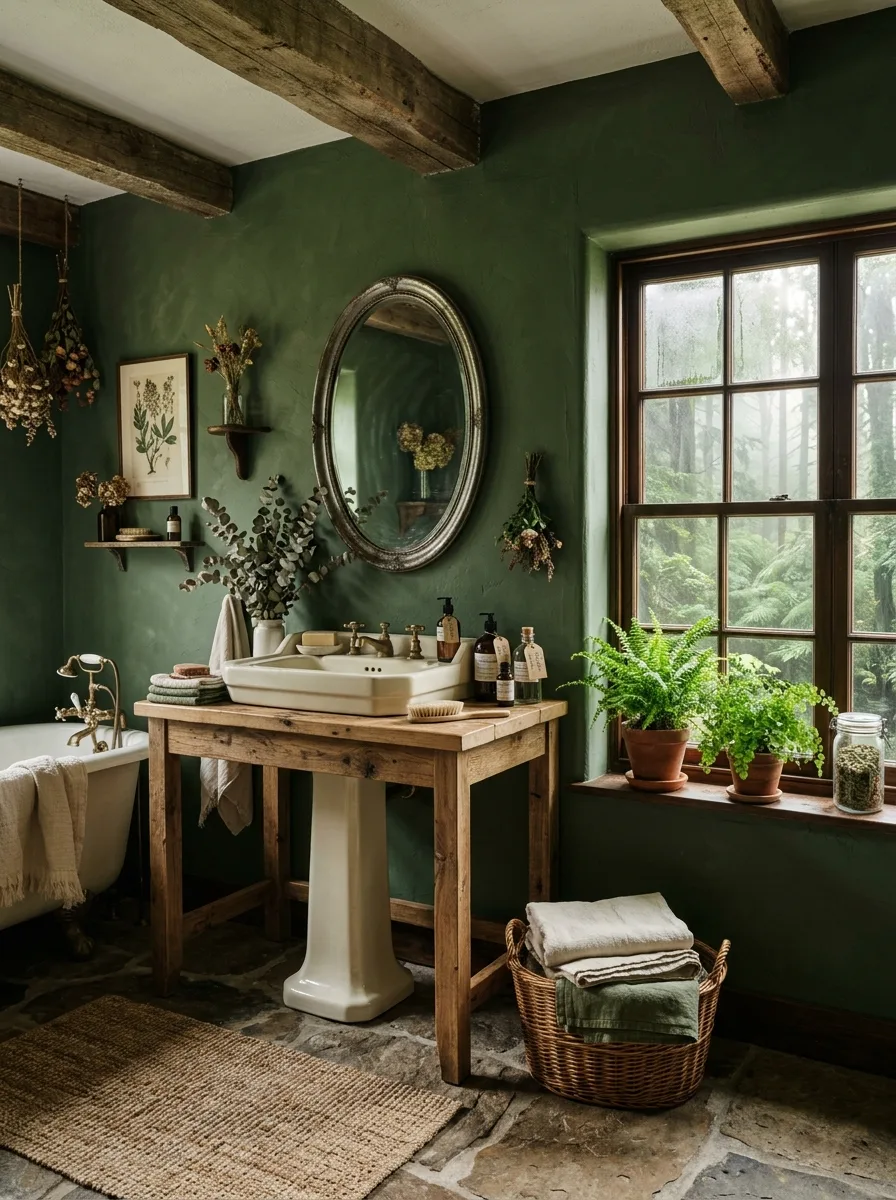
Build a bathroom vanity from a genuinely rustic wood table rather than a built-in cabinet, painted walls in deep forest green around it. Let the table’s imperfections — knots, uneven grain, visible joinery — show rather than sanding them away.
Hang bundles of dried flowers and eucalyptus upside down on the wall beside the mirror, mimicking the way an old stillroom or apothecary would have dried herbs for the season. Vary the bundle sizes so the arrangement feels gathered, not purchased as a set.
Choose a simple oval mirror in a worn silver or pewter frame, and add potted ferns to the windowsill alongside a small jar of loose dried seed heads. A woven basket underneath the table handles towel storage without a single visible drawer.
This look rewards genuine wear. Buy the table secondhand if you can — new wood distressed to look old rarely convinces anyone.
Wood Paneled Botanical Bath
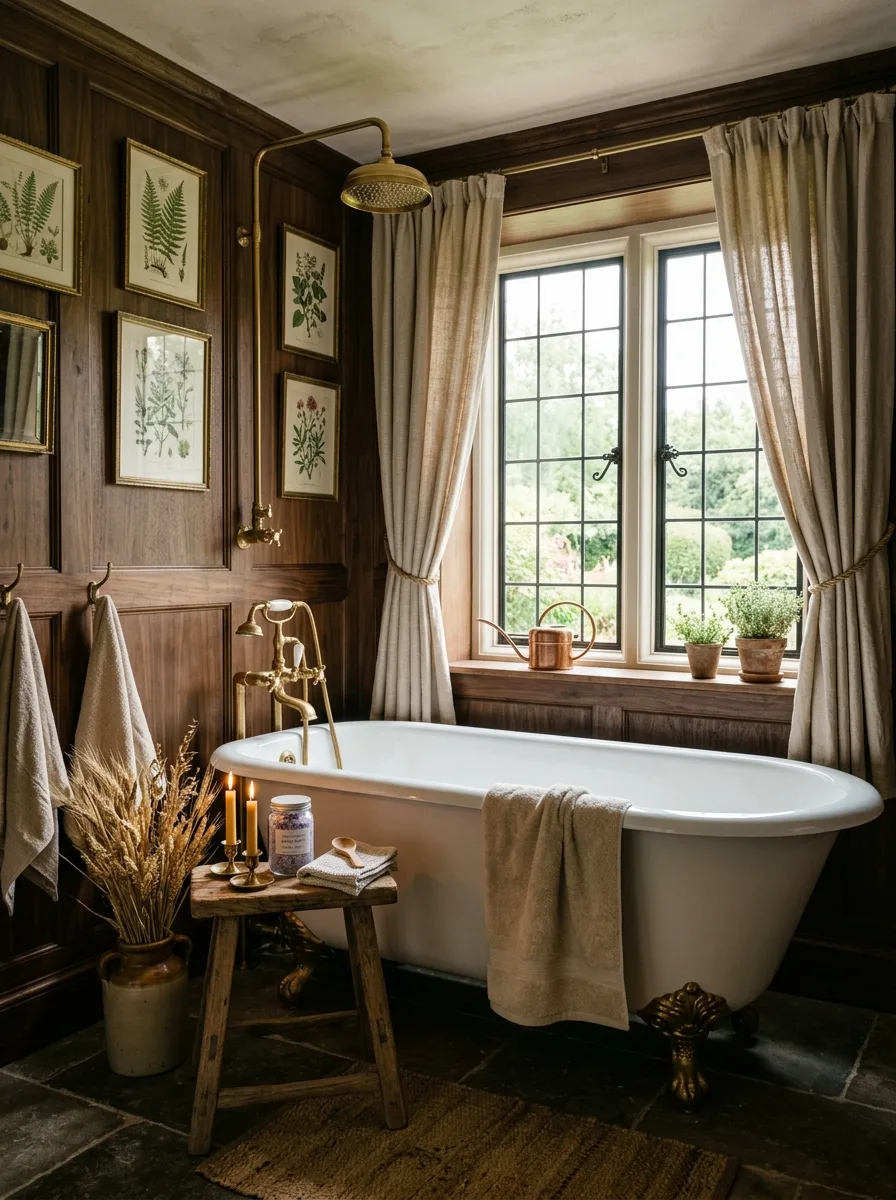
Panel the walls fully in dark stained wood, floor to ceiling, and hang a grid of small botanical prints in matching gold frames along one panel as a quiet gallery moment. The uniform framing keeps a grid of six or more prints from feeling scattered.
Install an exposed brass shower fixture arching directly over a freestanding tub, letting the hardware itself become part of the room’s decoration rather than hiding it behind tile.
Dress the window in loose, unlined linen curtains tied back with simple rope, and rest a small copper watering can and potted herbs on the sill. A rustic wood stool beside the tub holds folded towels and a small jar of bath salts.
Keep all the metal in the room the same warm brass tone — the shower arm, the towel hooks, the picture frames — so the wood paneling has one consistent thread running through it.
Rose Petal Candlelit Retreat
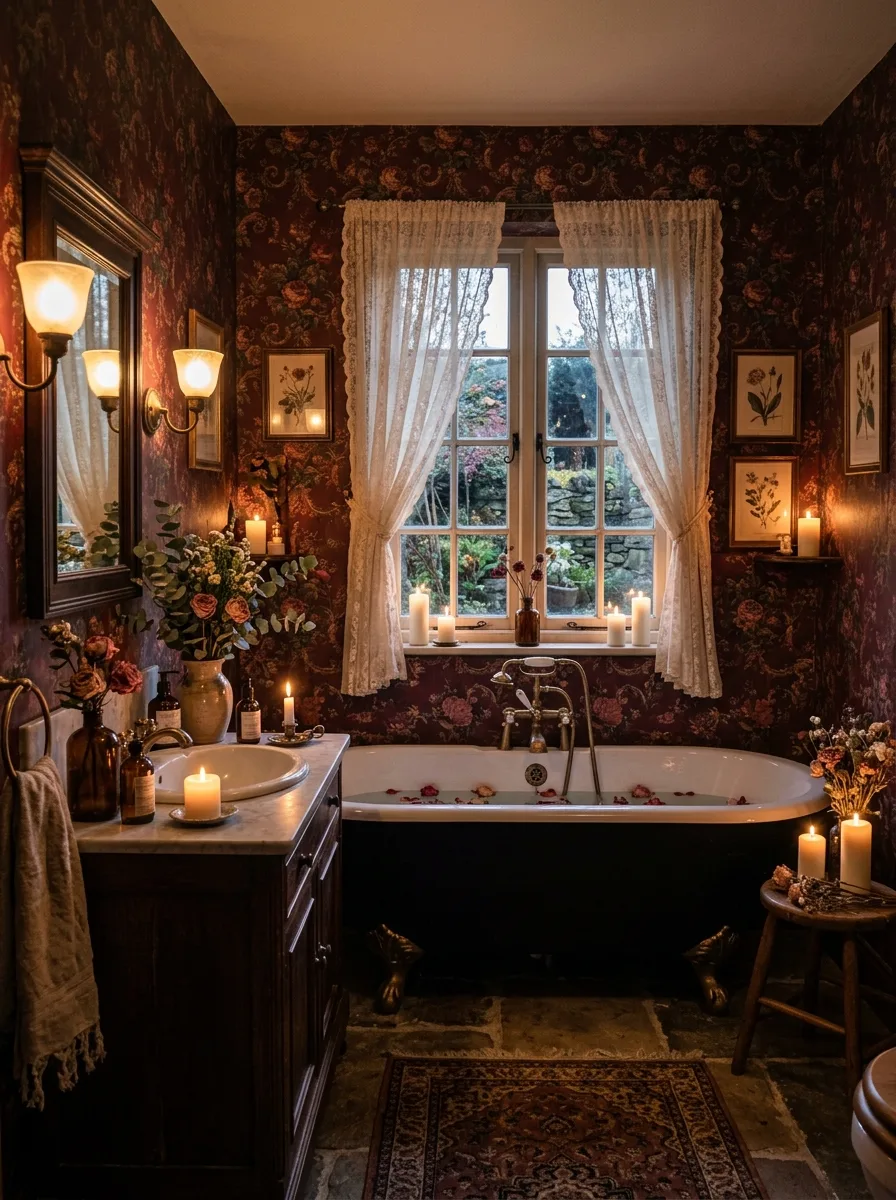
Choose a dense, dark floral wallpaper in deep burgundy and cream, and hang soft lace curtains at the window rather than heavier drapery — the delicate texture keeps a very saturated wallpaper from feeling heavy. Scatter fresh rose petals directly into the bathwater for the room’s signature detail.
Line the windowsill and vanity edge with pillar candles of uneven heights, mixing candlelight with a single warm sconce rather than any overhead fixture. Frame small botanical prints in simple dark wood and hang them symmetrically on either side of the window.
Choose a dark-painted tub exterior with a crisp white interior, so the tub itself reads as an object rather than disappearing into the wallpaper behind it. A loose floral arrangement in a ceramic jug on the vanity ties the fresh flowers to the wallpaper’s printed ones.
This is a look built for evening use specifically — style it knowing the room will rarely be seen in full daylight.
Copper Vessel Sink Arched Mirror
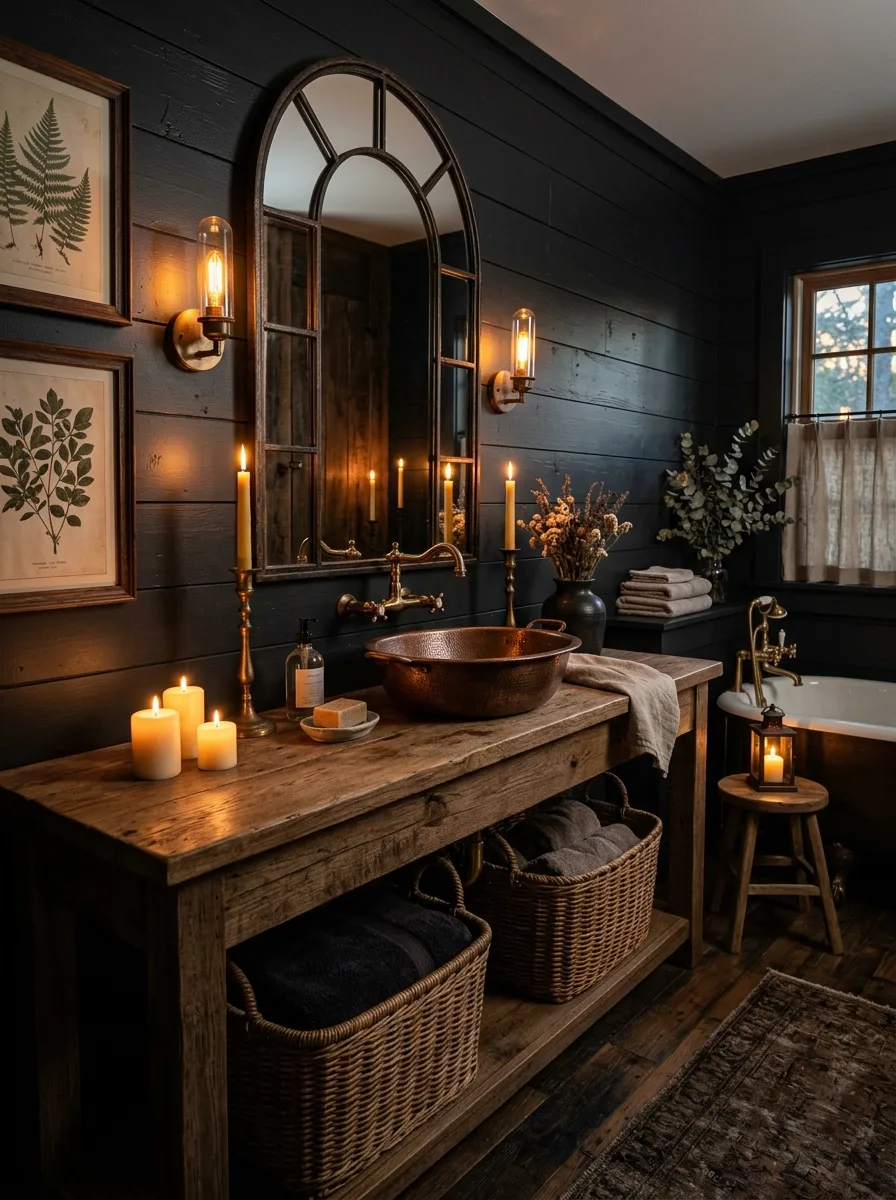
Paint the walls in matte black shiplap and mount a copper hammered vessel sink on a reclaimed wood console, letting the copper’s warm tone be the room’s only bright metal note against all that black.
Hang an arched iron-framed mirror with a windowpane-style grid overlay directly above the sink, flanked by simple glass-shade sconces. The architectural shape of the mirror adds structure to an otherwise soft, rustic room.
Style the console with a cluster of pillar candles, a small vase of dried flowers, and a stack of neutral towels, keeping every object in the warm-neutral-to-black range so nothing distracts from the copper’s shine.
Add a small lantern candle on a stool beside the tub for a secondary light source at a lower height — layered candlelight at different elevations reads far richer than a single cluster at counter height.
Ivy-Framed Vessel Sink Vanity
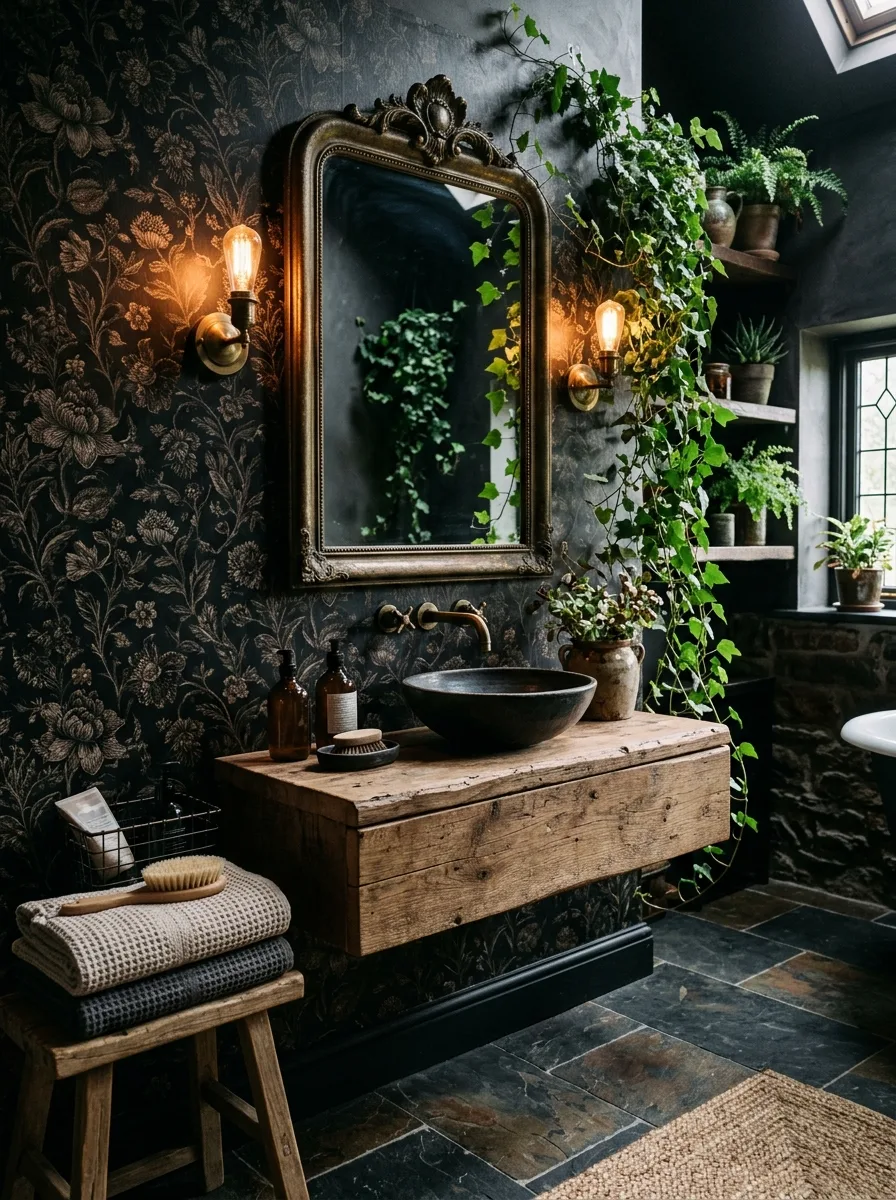
Let a real or faux ivy vine climb the wall beside the mirror and trail across the top of the window frame, training it with small hooks so it grows in a deliberate arc rather than a tangle. This single gesture turns a plain wall into the room’s most alive element.
Choose dark floral wallpaper as the backdrop and hang a heavily ornate antique gold mirror against it, letting the gilding stand out starkly against the dark pattern. Flank the mirror with warm filament-bulb sconces rather than shaded ones, for a slightly industrial contrast to all the botanical softness.
Build the vanity from raw, reclaimed wood and top it with a matte black stone vessel sink. A stone jug filled with fresh greenery on the vanity’s corner continues the ivy’s living-plant thread.
Keep the ivy pruned enough that it doesn’t obscure the mirror’s reflection — a little wild is the goal, not fully overgrown.
Olive Green Vintage Bath Suite
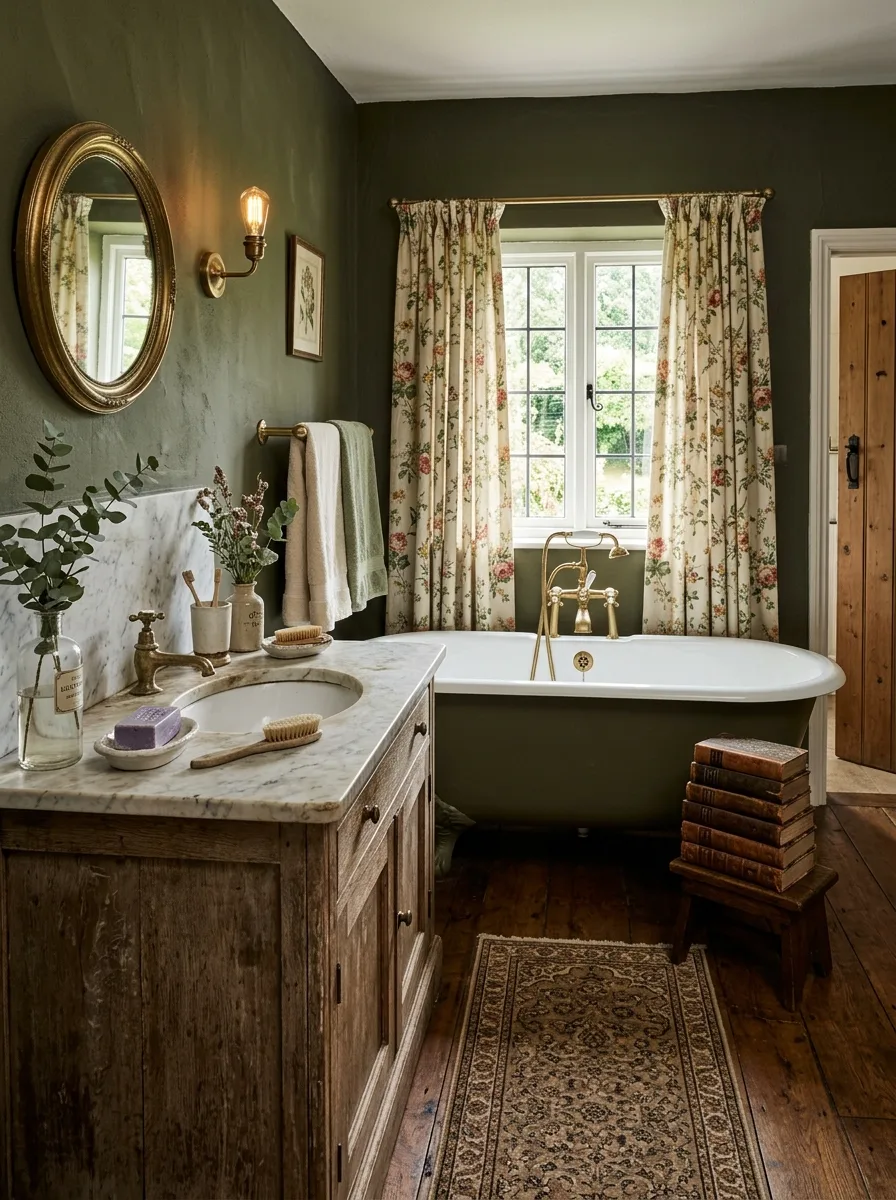
Paint the walls a muted olive green and choose a matching painted clawfoot tub, so the tub becomes part of the wall’s color story instead of a stark white interruption. Dress the window in floral curtains in a complementary rose-and-cream print for the room’s one deliberate pattern moment.
Hang a round gold mirror above a marble-topped wood vanity, and rest a stack of old leather-bound books beside the tub as an informal side table for a candle or a cup of tea. The books add warmth and history without costing anything beyond a flea market trip.
Style the vanity with glass apothecary bottles, a small enamel soap dish, and a single stem of eucalyptus in a bud vase, keeping the surface uncluttered enough that the marble’s veining stays visible.
Choose worn wide-plank wood flooring rather than tile — the warmth underfoot matches the softness of the palette above it.
Farmhouse Sink Beadboard Bath
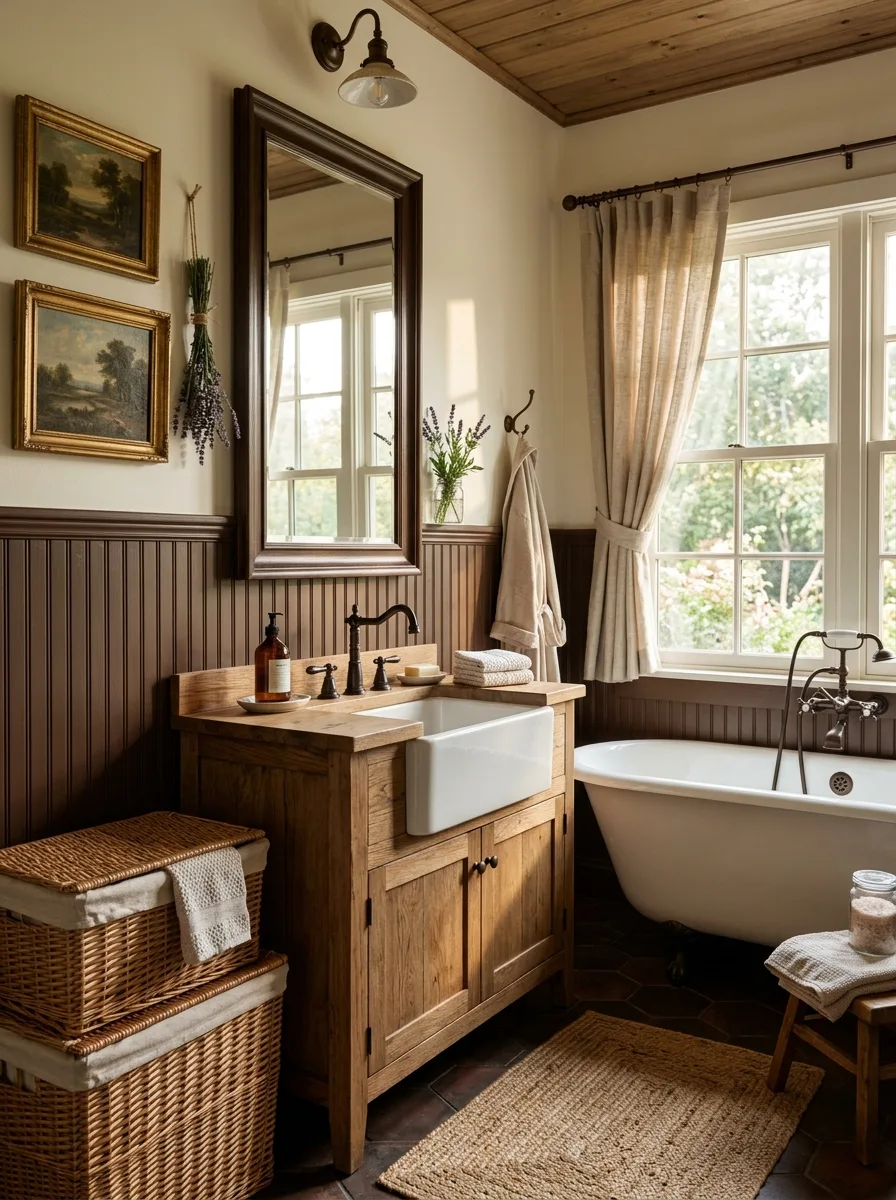
Panel the lower walls in dark wood beadboard and paint the upper walls a warm cream, then top the divide with a simple picture rail. Choose a genuine farmhouse-style apron sink set into a reclaimed wood vanity for the room’s main statement piece.
Hang a plain dark wood mirror directly above the sink and flank it with a small gallery of gilt-framed landscape paintings on the cream upper wall, letting the warm frames pick up the beadboard’s tone below.
Stack woven hampers with lidded tops beside the vanity for laundry and towel storage, and hang a linen robe from a simple hook beside the window. A small jar of bath salts on a stool by the tub finishes the vignette.
This is the most livable version of the style on this list — ideal for a bathroom that needs to function daily, not just photograph well.
Copper Tub Woodland Apothecary
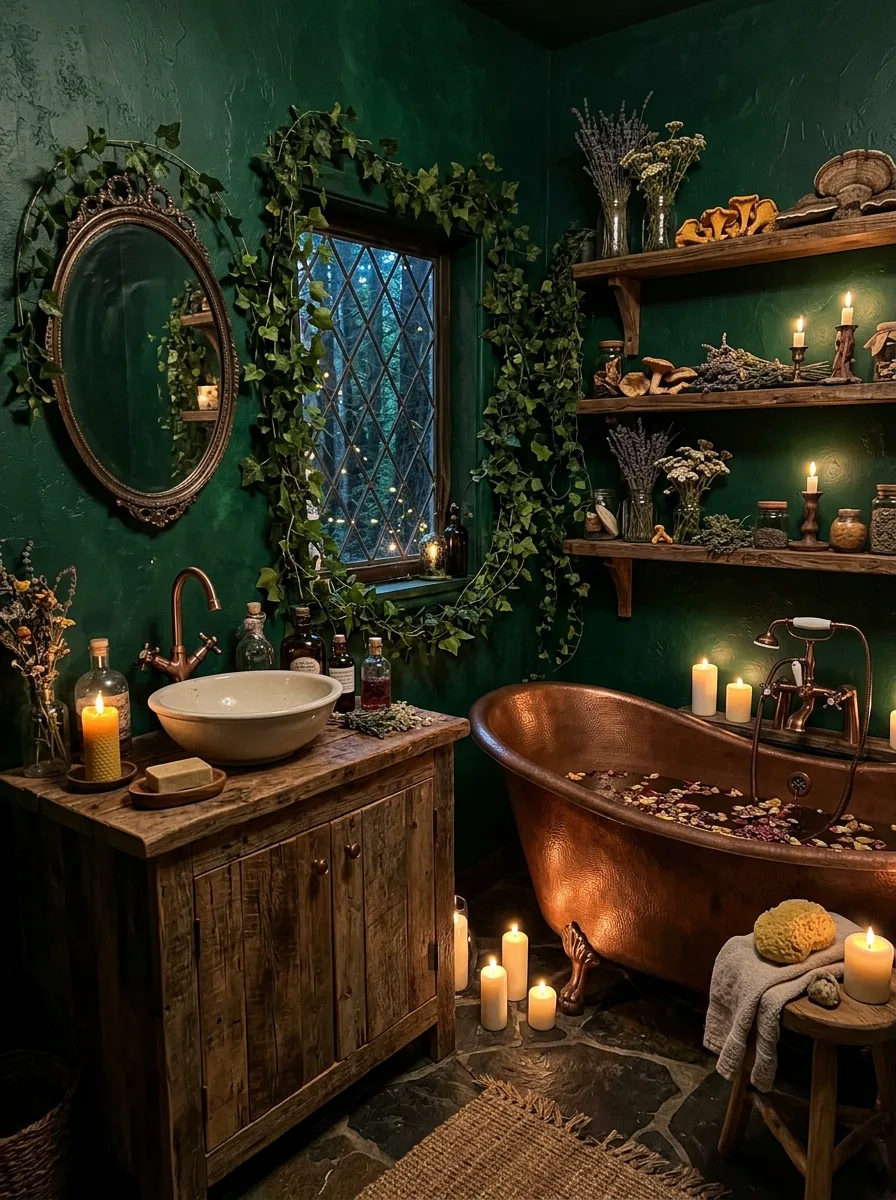
Plaster the walls in a deep, textured forest green and let a hammered copper soaking tub take center stage, filled with floating petals for a woodland-bath moment. The copper’s warm glow against the green plaster is the visual anchor of the entire room.
Build open wood shelving along one wall and style it densely with dried lavender, foraged mushrooms, glass apothecary jars, and small taper candles, treating the shelves like a forager’s cabinet of curiosities rather than standard bathroom storage.
Let ivy frame the window fully, trained around the entire frame rather than just draping from the top, so the window itself becomes a piece of living art. A rustic wood vanity with a simple stone bowl sink keeps the fixtures humble against all that styled detail.
Light the whole room in candles at multiple heights — windowsill, shelf, and floor level — for the deepest, most atmospheric version of this look on the list.
Navy Floral Vessel Sink Bath
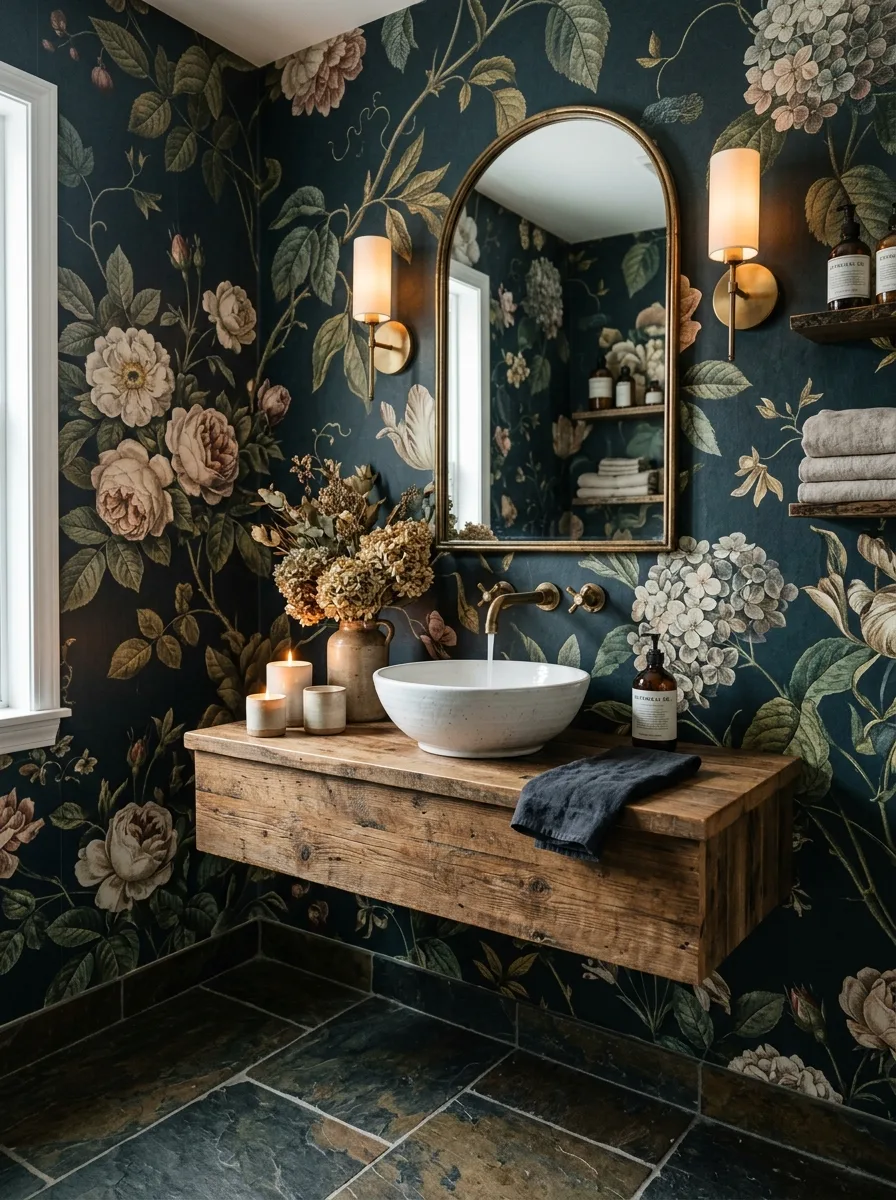
Choose a dark navy wallpaper with a dense, illustrated floral print in dusty rose and cream, and let it run uninterrupted across every wall. Mount a white ceramic vessel sink on a raw reclaimed wood console for a stark, deliberate contrast against all that pattern.
Hang an arched brass mirror directly above the sink, flanked by simple glass-cylinder sconces, and rest a stack of rolled linen towels on an open shelf beside it.
Style the console with a small cluster of pillar candles and a stoneware jug of dried hydrangea, choosing dusty, faded blooms rather than fresh bright ones so the florals echo the wallpaper’s muted tone rather than fighting it.
Keep the floor dark — slate or charcoal tile reads best here, grounding all that pattern in something solid underfoot.
Green Shiplap Medicine Cabinet Bath
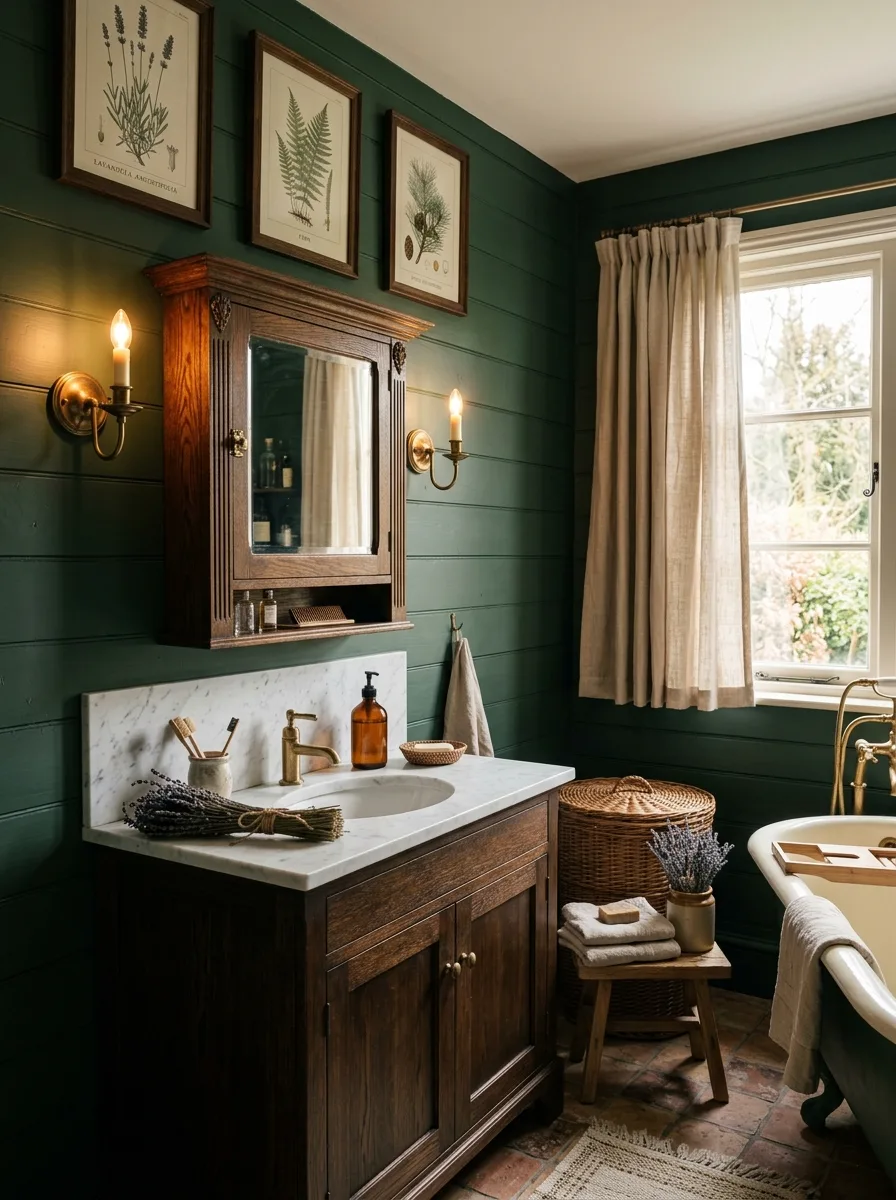
Panel the walls in dark green shiplap and mount an antique wood-framed medicine cabinet with a mirrored door as the room’s central fixture — the added storage behind the mirror is a practical bonus most gilt-framed mirrors don’t offer.
Hang three small botanical prints above the cabinet in matching dark frames, spaced evenly for a quiet, orderly gallery moment against the shiplap’s texture.
Top a dark wood vanity in white marble, and rest a bundle of fresh lavender directly on the counter rather than in a vase — the loose, untethered styling reads more casual and lived-in than a formal arrangement would.
Add a lidded wicker hamper beside the tub and drape a linen curtain at the window in a soft neutral tone, letting the green walls and dark wood carry all the color in the room.
Autumnal Copper Sink Corner
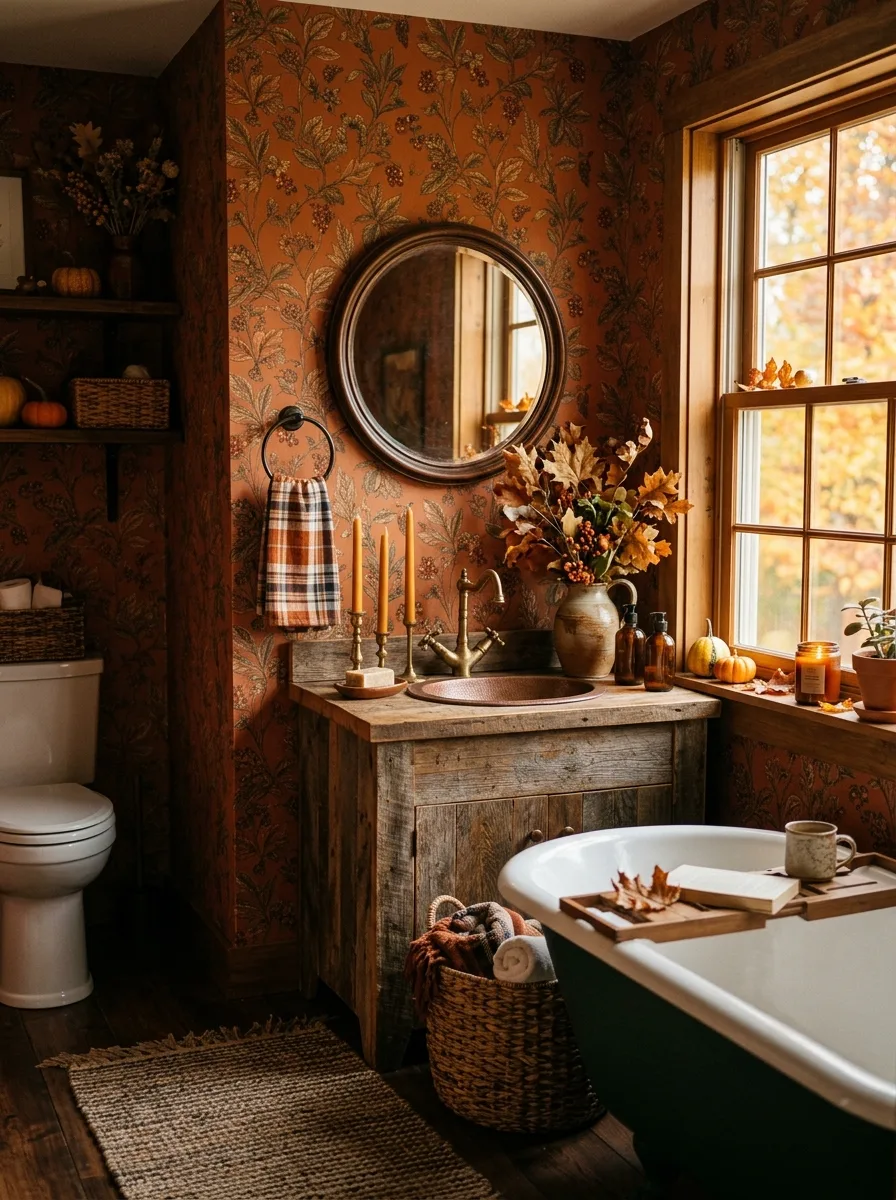
Choose a warm rust-orange floral wallpaper as the backdrop, and pair it with a round wood-framed mirror and a hammered copper sink set into a raw barnwood vanity. This palette leans warmer than most cottagecore dark rooms, closer to an autumn forest than a moody green one.
Style the windowsill with small pumpkins, dried seed pods, and a rustic stoneware jug of autumn leaves and berries, letting the arrangement look gathered on a walk rather than purchased from a shop.
Hang a plaid towel from a simple ring beside the sink for a pattern that echoes the wallpaper’s warm tones without matching it exactly. A woven basket beneath the vanity holds a folded throw blanket for chilly mornings.
Keep the tub’s exterior painted a deep forest green rather than the wallpaper’s rust tone — the contrast keeps the room from tipping into monochrome.
Chandelier Rose Petal Grand Bath
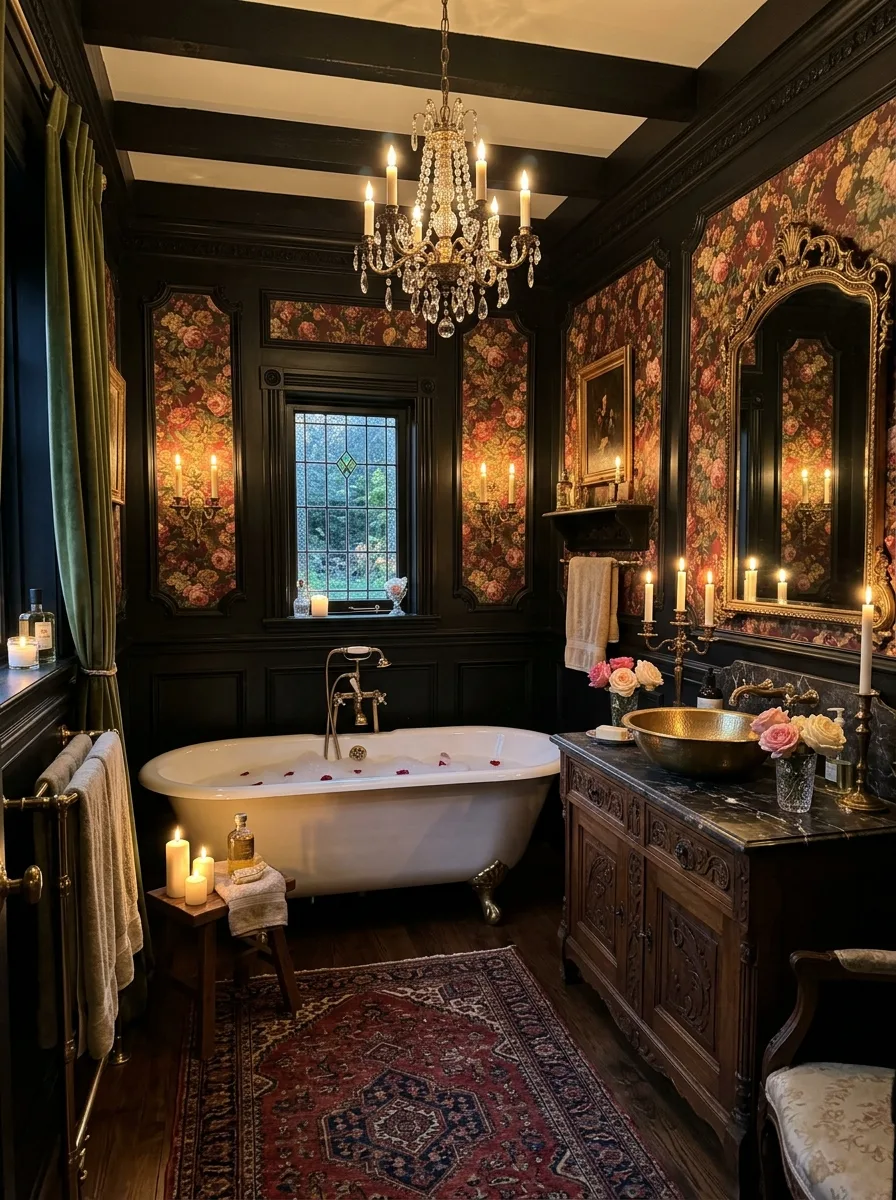
Panel the walls in black moulded frames filled with dense burgundy floral wallpaper, and hang a full crystal chandelier from a black beamed ceiling as the room’s most dramatic gesture. This is the most formal, most theatrical version of the style on this list.
Choose an ornate gilt mirror above a dark carved wood vanity topped in black marble, with a hammered gold vessel bowl sink as the centerpiece. Fresh roses in a cut-glass vase beside the sink tie the live flowers to the wallpaper’s painted ones.
Scatter fresh rose petals in the bathwater and light a full cluster of candles along the vanity and a nearby stool, layering flame at several different heights around the tub.
Add a patterned area rug in matching burgundy and gold tones to anchor the floor — this room can carry more pattern underfoot than almost any other look on the list, given how formal and enclosed the rest of the space already is.
Golden Frame Botanical Beadboard
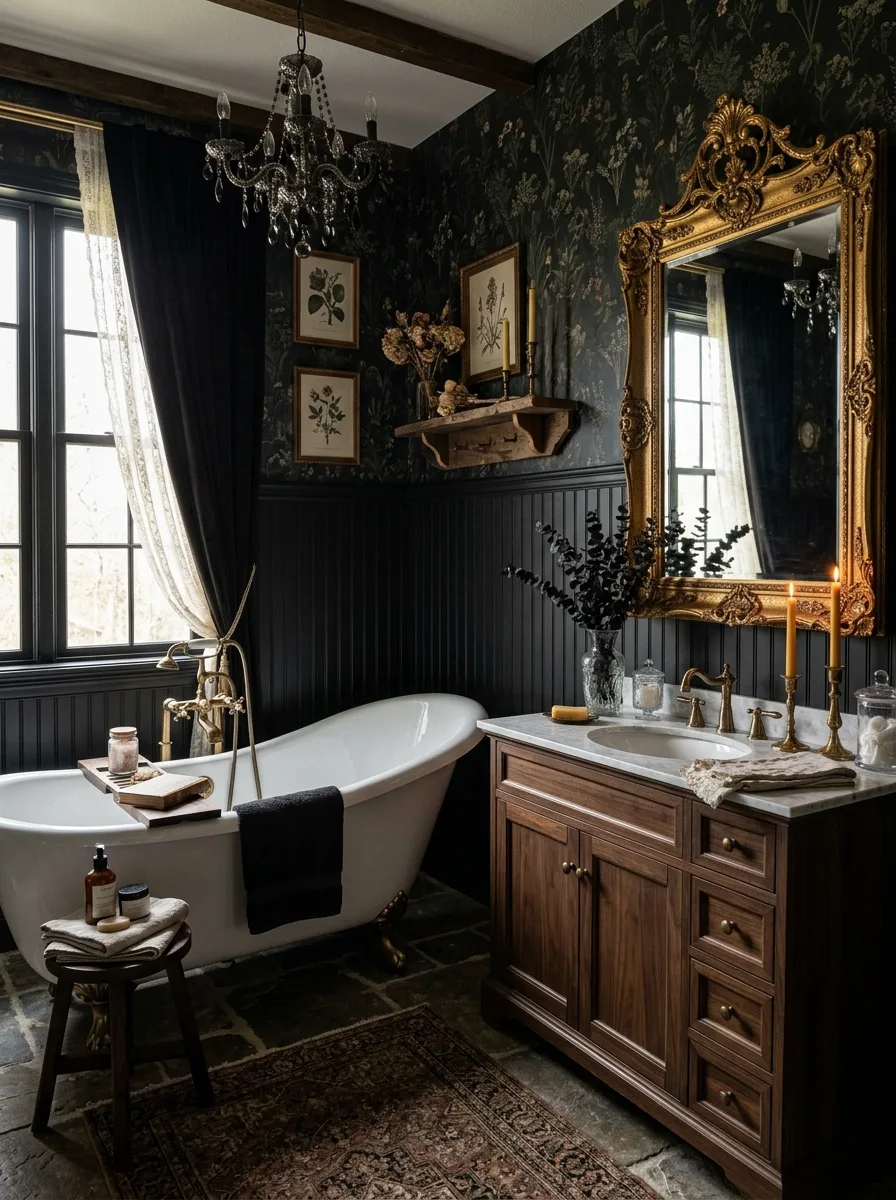
Panel the lower walls in black beadboard and hang a dense floral-and-herb wallpaper above it, choosing a print with visible botanical illustration detail rather than an abstract repeat. Hang two or three small framed botanical prints directly on the wallpapered section for a layered, collected effect.
Choose the largest, most ornate gilt mirror the wall can hold — oversized on purpose — above a rich walnut vanity with a white marble top. The scale mismatch between a modest vanity and a dramatic mirror is intentional; it’s what gives the room its sense of theater.
Add sheer lace curtains at the window for softness, and rest a small tray with candles and a wood bath caddy across the tub for evening use.
Keep the wood tones warm and consistent — walnut vanity, gold mirror frame — so the room’s only real contrast comes from the black beadboard against all that warmth.
Rainy Window Herb Drying Nook
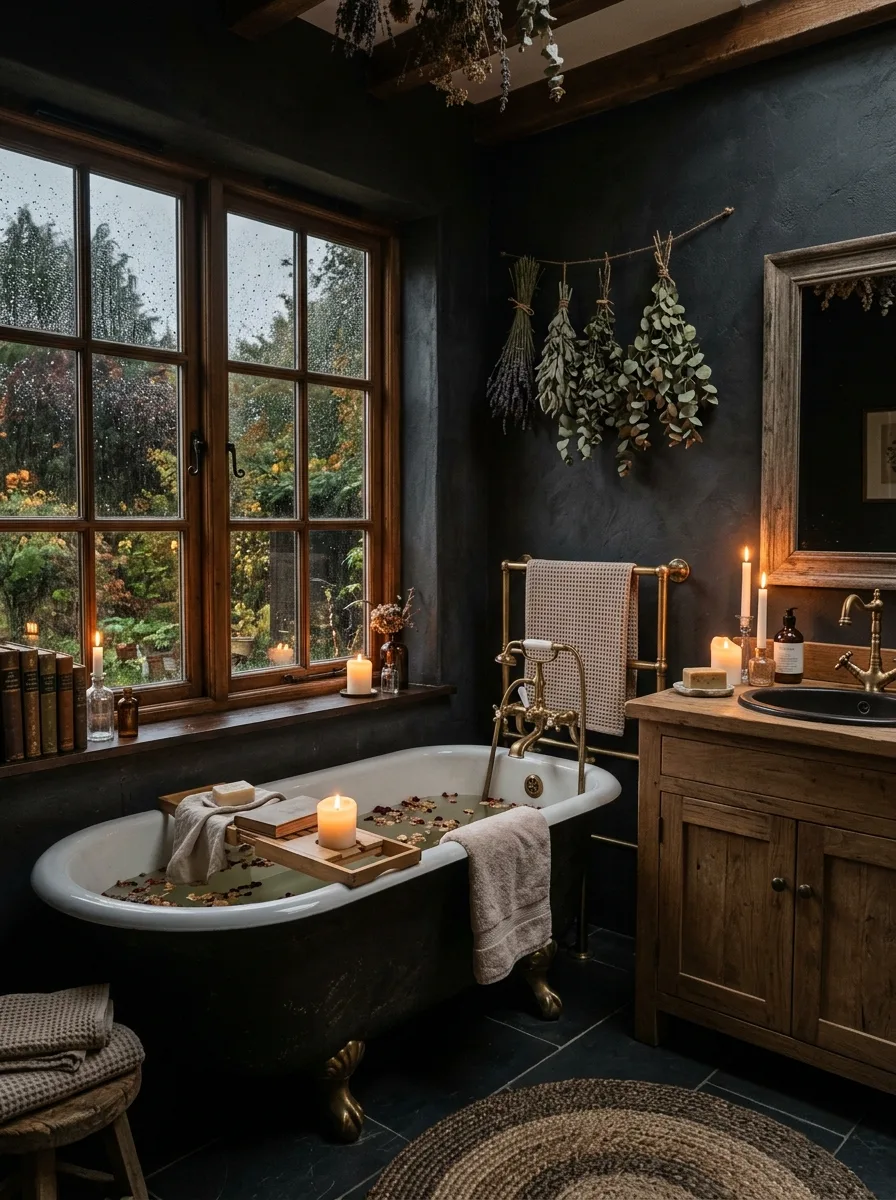
Paint the walls in deep charcoal plaster with visible texture, and hang bundles of drying lavender and eucalyptus from a simple string strung along one wall, letting them hang loosely rather than in a perfectly even row. The imperfect spacing is what makes this read as a working drying station rather than styled decor.
Position the tub directly beneath a large multi-pane window, so rain on the glass becomes part of the room’s atmosphere on the right kind of evening. A stack of old hardcover books on the windowsill doubles as reading material and a small plant stand.
Choose a rustic wood vanity with a simple black vessel sink, and hang a plain wood-framed mirror beside it rather than anything gilded — this room’s drama comes from the window and the herbs, not the hardware.
Light a cluster of candles at the tub’s edge and one more on the windowsill, keeping the room lit almost entirely by flame after dark. This is the most quietly atmospheric version of the whole list — built for a rainy night more than a sunny morning.
Final Thoughts
A dark cottagecore bathroom isn’t really about the color on the walls. Plenty of moody, forgettable rooms are painted the exact same deep green or near-black and still feel like nothing.
What separates these twenty rooms from a merely dark bathroom is that every one of them remembers where the style actually came from — stillrooms, apothecaries, overgrown cottage gardens, rooms built before electricity assumed control of how a space should feel after dark.
That history is why candlelight, dried flowers, and worn wood do more work here than any paint color ever could on its own.
Painting the walls is the easy part. The room only comes alive once something in it is allowed to look a little wild, a little gathered, a little like it grew there instead of being bought there.