
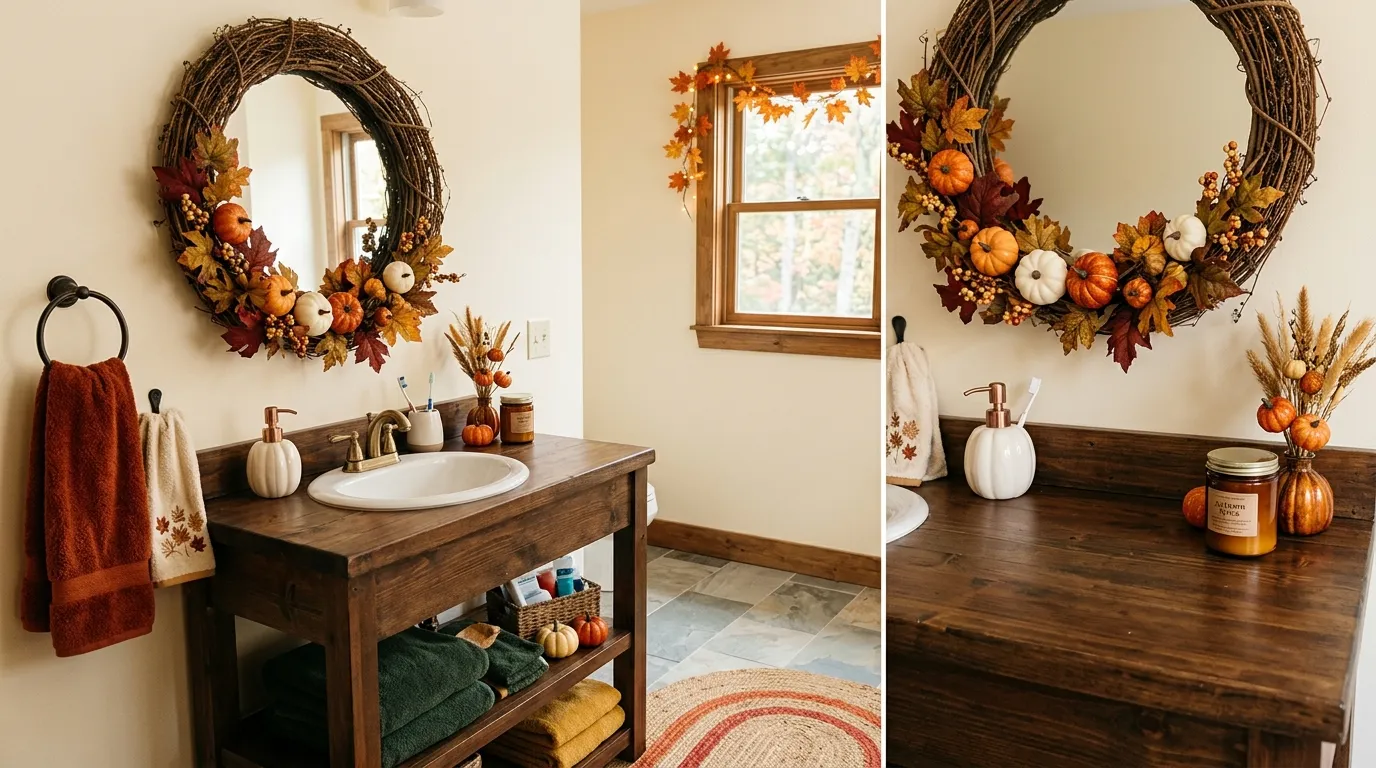
Nobody decorates their bathroom for fall. They do the porch. They do the mantle. They do the console table nobody actually looks at.
The bathroom gets a bar of soap and a prayer.
That’s a mistake, and not a small one. It’s the room you’re in first thing in the morning and last thing at night, alone, with nothing to do but notice what’s around you. A living room performs for guests. A bathroom performs for you.
So this is the room worth getting right.
Fall Bathroom Ideas
Wreath Hung On Mirror
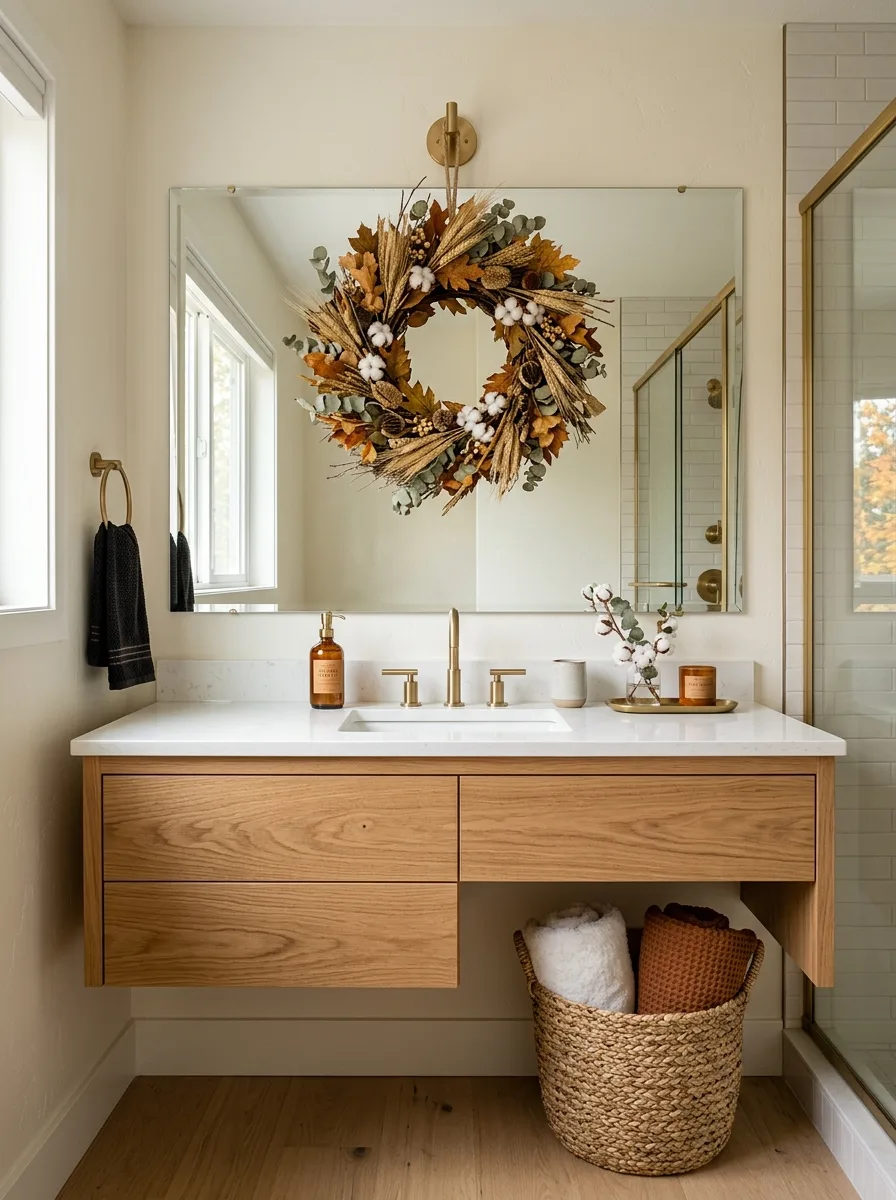
Hang a dried wreath — cotton bolls, wheat, autumn leaves — directly onto the face of a large mirror, not on the wall beside it. The wreath should sit low enough to reflect in the glass, doubling its visual presence without adding a second object.
Choose a wreath with visible texture variation: some faded leaves, some pale cotton, some deep rust tones. A wreath in a single uniform color reads flat against a large mirror.
Keep the vanity below almost bare — one soap pump, one small vase with a single dried stem. The wreath is doing all the seasonal work here, and a busy counter underneath it competes for attention it won’t win.
Use a simple brass hook or wall mount for hanging, positioned so the wreath hangs slightly off-center from the mirror’s midpoint. Dead-center symmetry reads staged.
Stacked Stool Candle Display
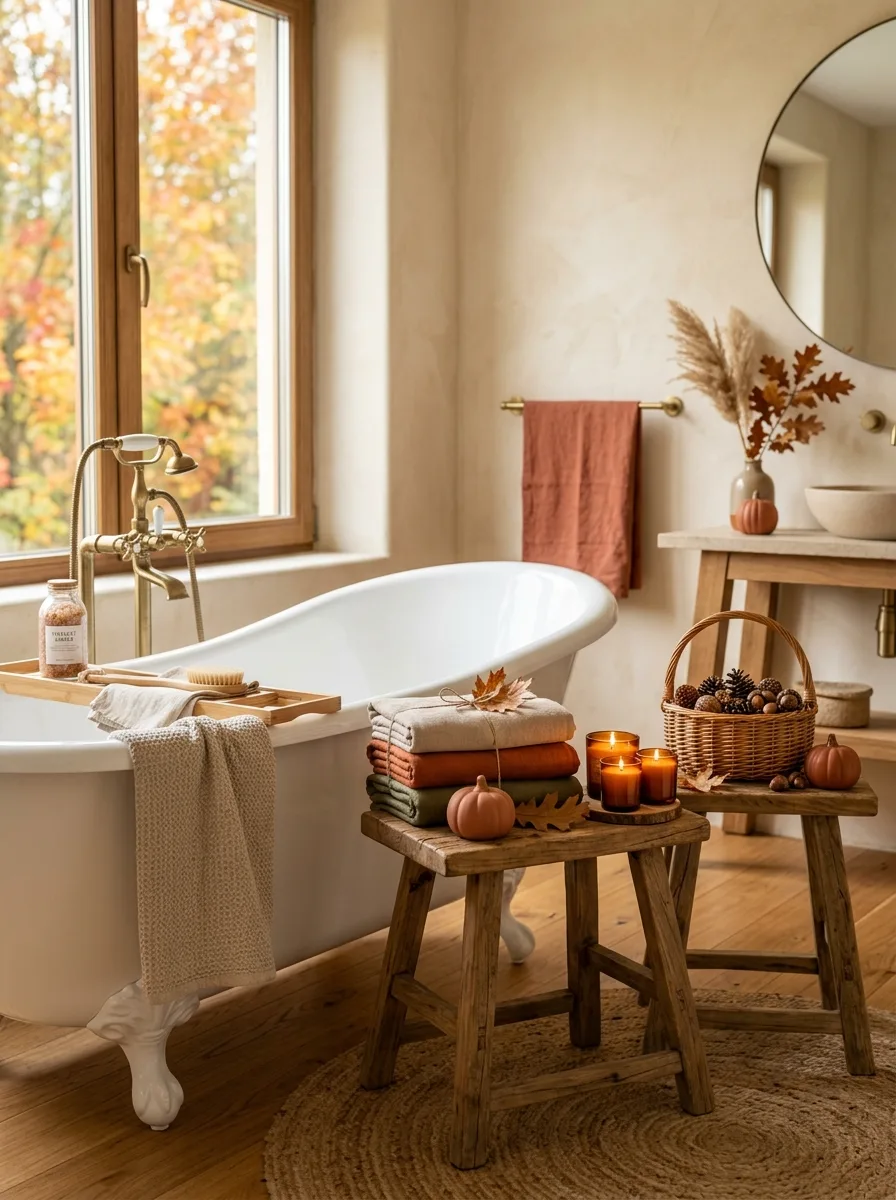
Push two mismatched wooden stools together at slightly different heights beside a clawfoot-style tub, using them as a makeshift side table instead of buying one. The mismatch in height is what makes the pairing look collected rather than purchased as a set.
Stack folded towels in three tones on the lower stool, tied loosely with twine, and set a small pumpkin on top of the stack rather than beside it. Weight on top of soft folded fabric reads more casual than objects lined up next to it.
Cluster two or three lit pillar candles on the taller stool, close enough together that the flames read as one warm source from across the room. Scattered single candles lose that effect.
Rest a small woven basket of pinecones and acorns on the floor at the base of the stools, letting a few spill loosely onto the rug. A perfectly contained basket looks staged; a slightly overflowing one looks gathered.
Moody Green Powder Room
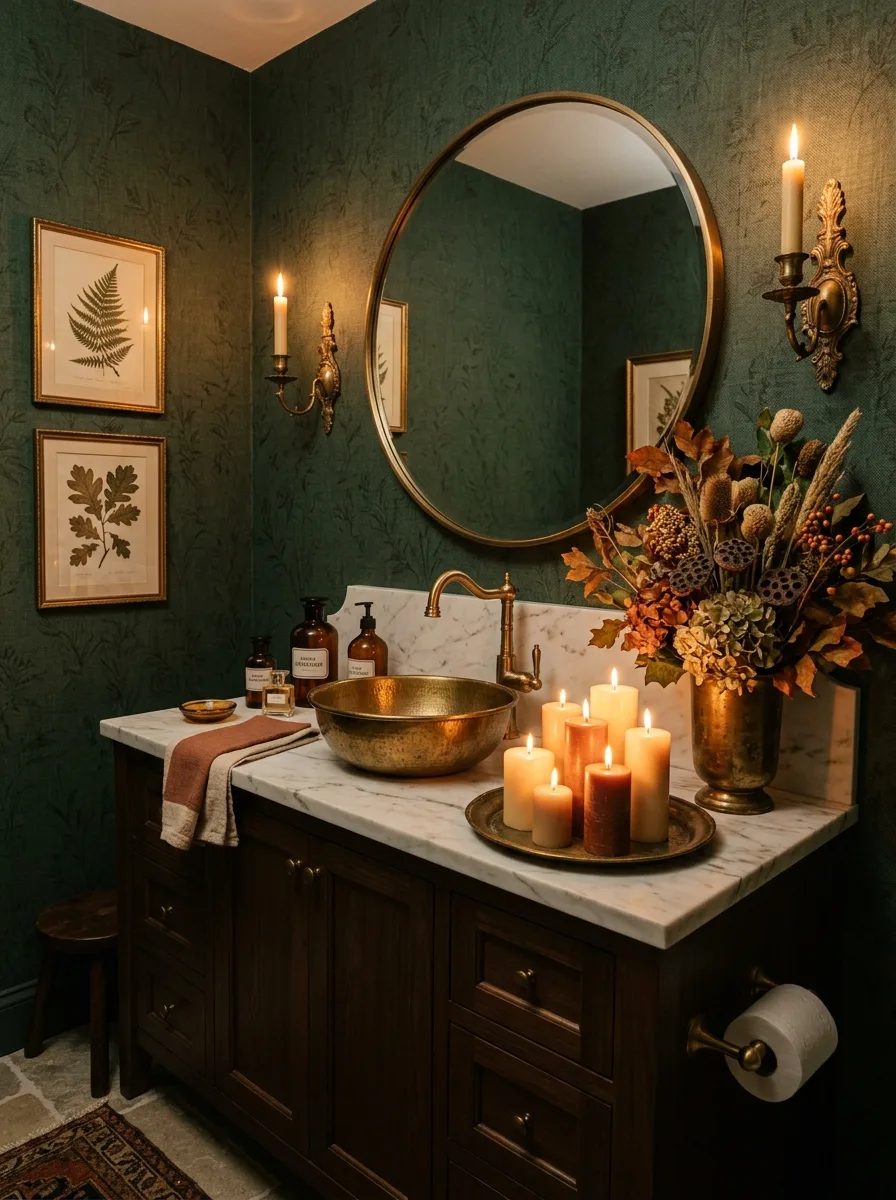
Commit fully to a dark botanical wallpaper — deep green with a subtle fern or leaf print — rather than treating it as an accent wall. A powder room is small enough to handle a mood this saturated, and diluting it with lighter walls elsewhere in the room undercuts the effect.
Install a brass or hammered-gold vessel bowl as the sink, set into a white marble counter so the metal has something pale to contrast against. Dark walls need at least one bright surface to keep the room from feeling cave-like.
Hang a pair of framed botanical prints — ferns, pressed leaves — in slim gold frames, positioned at eye level rather than centered on the wall. Off-center placement suits a small room where symmetry can feel try-hard.
Cluster pillar candles of varying widths on a brass tray beside the sink, alongside a loose arrangement of dried hydrangea in a tall vessel. In a room this dark, the candlelight is doing as much decorating as any object on the counter.
Overflowing Woven Storage Basket
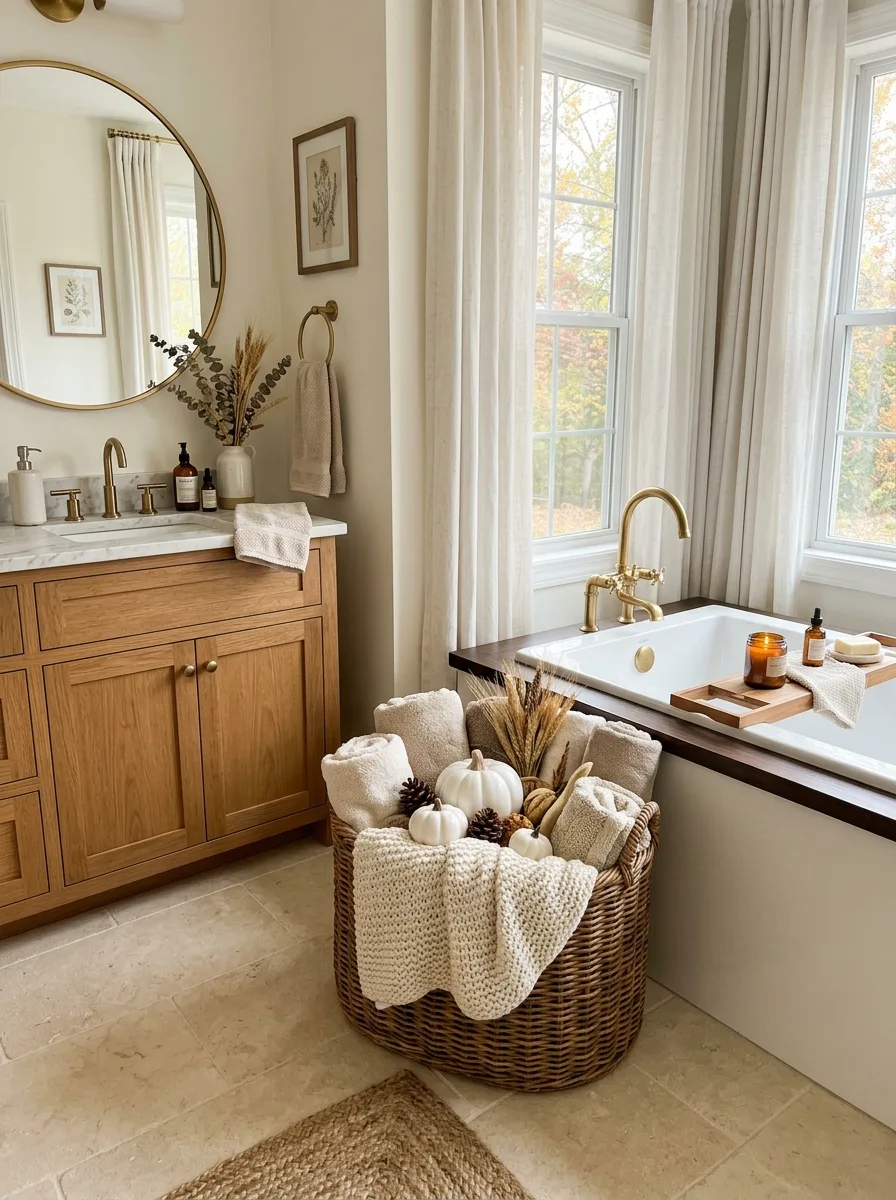
Choose a large, tightly woven basket with real height — tall enough to stand upright beside a tub without looking like an afterthought on the floor. This is functional storage first, styling second.
Layer rolled towels around the basket’s edges, standing upright, before adding anything else. The towels create the structure that everything else gets tucked into.
Nestle small white pumpkins and a few pinecones into the gaps between towel rolls, rather than piling them on top. Tucked-in objects look incidental. Piled-on objects look staged.
Finish by draping one chunky knit throw over the rim, spilling slightly over the basket’s edge. It should look like it was grabbed and dropped there, not folded and placed.
Ladder Styled As Shelving
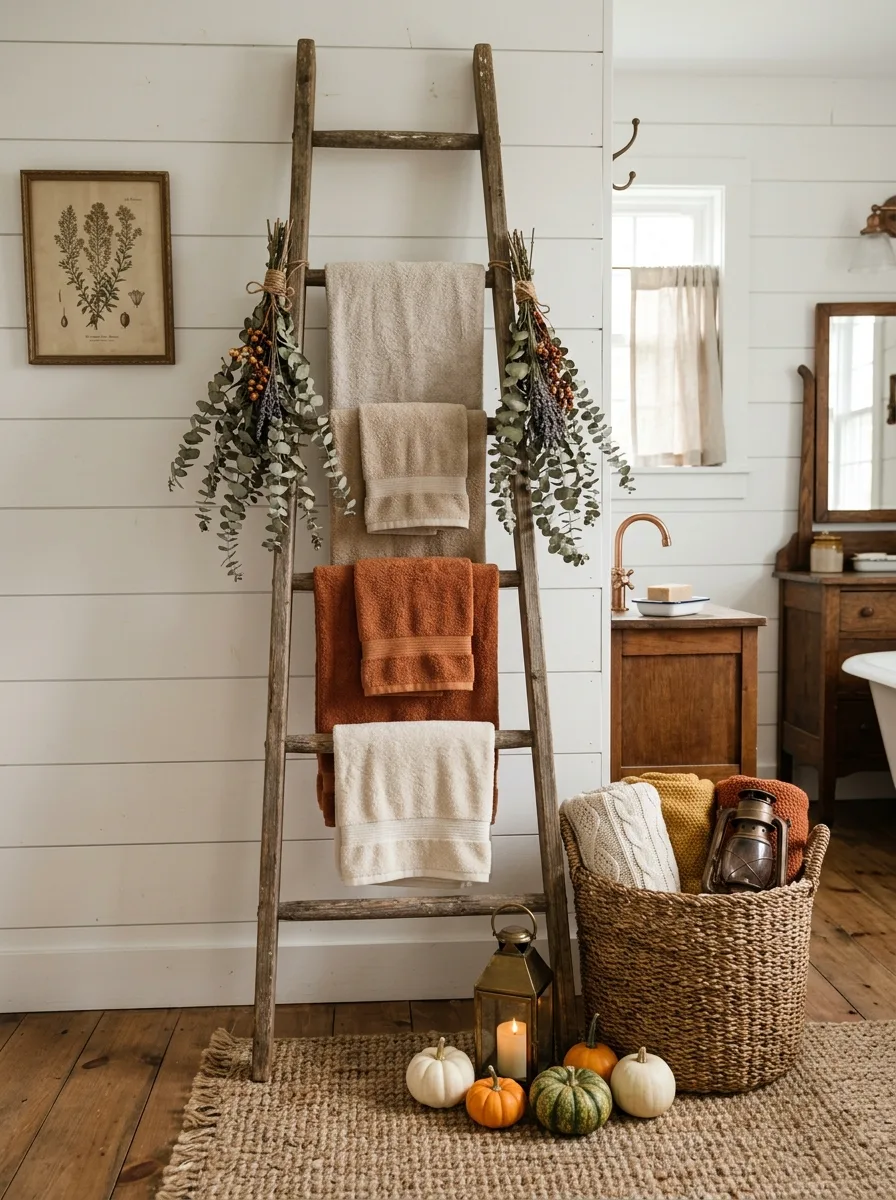
Repurpose an old wooden ladder — the more weathered, the better — as a leaning towel rack against a plain wall. The ladder needs enough rungs to hold at least three towels at staggered heights.
Drape towels in a deliberate color gradient from top to bottom: pale neutral, then a warm rust or terracotta, then cream again. Random color placement looks messier than it should; a gradient looks intentional even with mismatched towels.
Tie small bundles of dried eucalyptus and berries to the top corners of the ladder with twine, letting them hang loose rather than pinning them flat. Movement in the greenery keeps the whole piece from looking static.
Set a woven basket at the base holding lanterns and folded knit blankets, with a few small gourds scattered on the rug in front. The floor-level styling grounds the vertical height of the ladder above it.
Oversized Pampas Vase Pairing
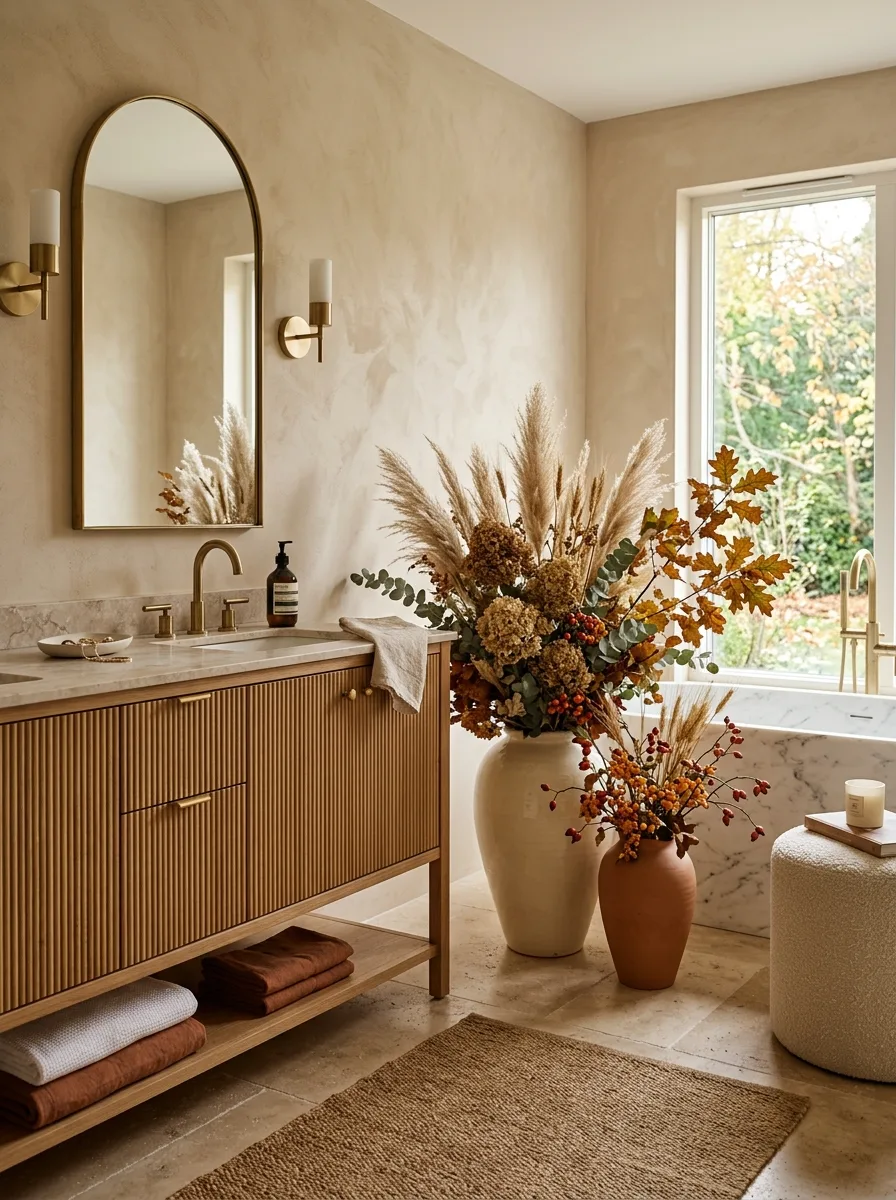
Pair two vases of noticeably different heights and materials — a tall ceramic urn and a shorter terracotta pot — rather than matching them. The contrast in scale is what makes the arrangement feel gathered instead of bought as a set.
Fill both with a mix of pampas grass, dried hydrangea, and a few branches of turning leaves, letting the pampas rise well above the vase rim. Height variation within the arrangement matters as much as height variation between the two vases.
Position the pairing on the floor beside the tub rather than on a counter. Floor placement lets the arrangement’s full scale register, which a counter would cut off.
Leave the wall behind bare, plastered and unadorned. A textured plaster wall is doing enough on its own without competing artwork.
Windowsill Herb And Wheat
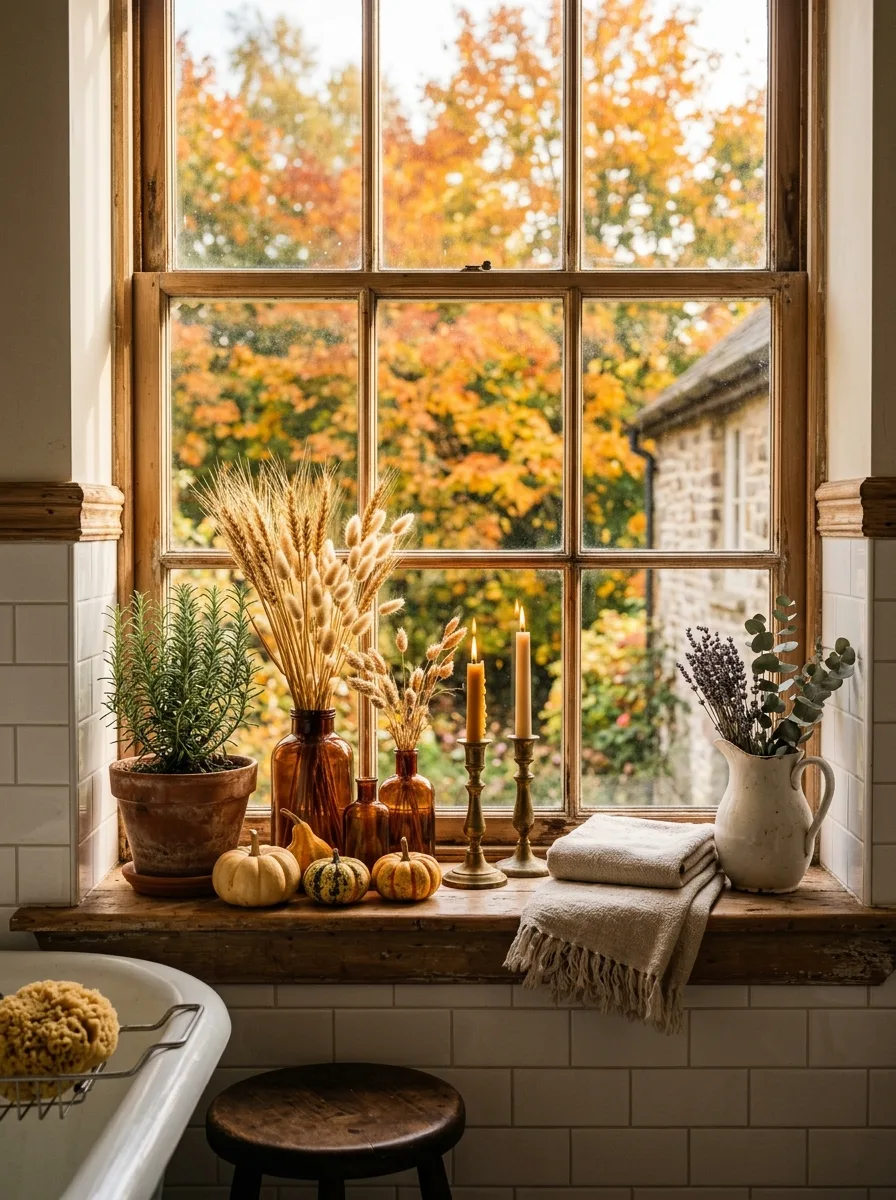
Claim a deep windowsill as its own vignette, separate from the rest of the room’s styling. The depth of the sill matters — it needs to hold at least three or four objects without crowding.
Anchor one end with a potted rosemary or herb plant in a terracotta pot, left slightly overgrown rather than trimmed neat. A too-tidy plant reads artificial next to dried elements.
Fill amber glass bottles with tall wheat stalks and bunny-tail grasses, positioned at the sill’s center where they’ll silhouette against the window light. Add a small ironstone pitcher on the opposite end, holding folded waffle towels instead of flowers.
Finish with a few small gourds tucked at the base of the taller elements and a pair of brass candlesticks between them, unlit during the day and lit at night.
Underlit Floating Shelf Display
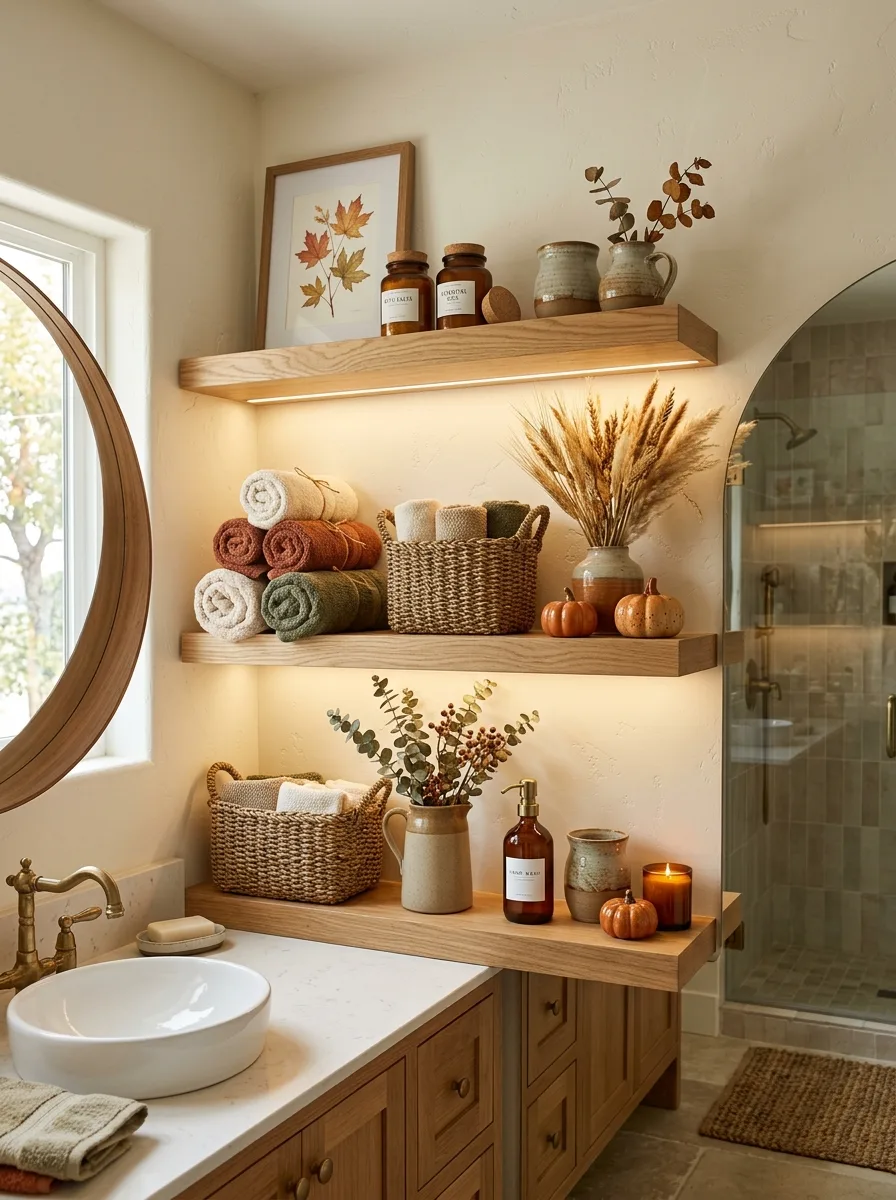
Install floating shelves with a hidden LED strip along the underside of each one, warm-toned rather than cool white. This single detail does more to make the display feel intentional than any object placed on the shelves.
Stack rolled towels in a tight color block on one shelf — cream, rust, and deep green rolled together — with a woven basket bookending one side. Keep the towel stack itself the visual anchor of that shelf.
Fill a ceramic vase with dried wheat on the shelf below, tall enough that it nearly reaches the shelf above without touching it. That near-miss of scale creates tension that a shorter arrangement wouldn’t.
Reserve the bottom shelf for function — a soap dish, a lotion pump, a single small candle — so the eye reads a clear hierarchy moving down from display to daily use.
Brass Candlestick Trio Lineup
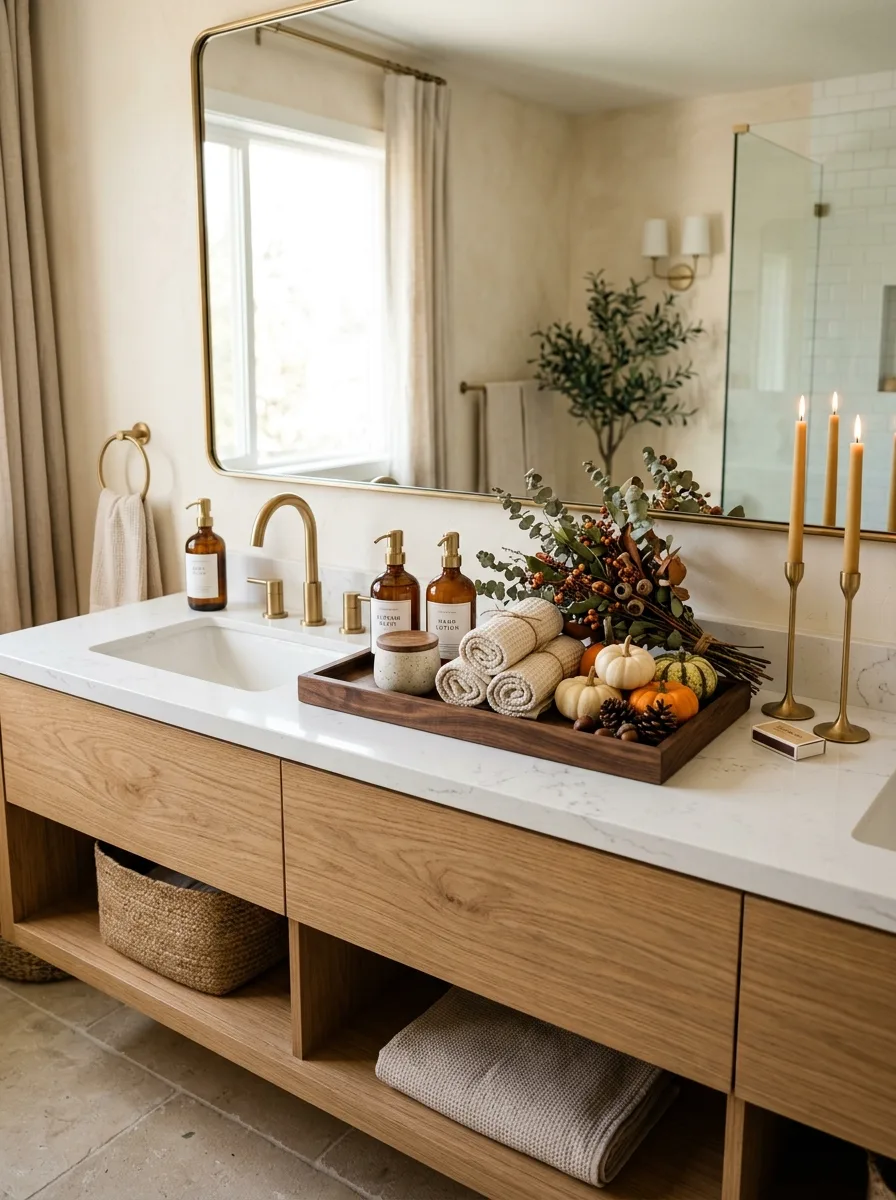
Line up three brass candlesticks at slightly varied heights along one edge of a wooden tray, rather than centering them as a single group. The slight stagger keeps a symmetrical object from reading too rigid.
Fill the rest of the tray with rolled towels, a small ceramic lidded jar, and two or three mini pumpkins in mixed colors. Keep the pumpkins small enough that they don’t visually compete with the candlesticks’ height.
Set the tray on a marble or quartz counter with visible veining, letting the stone’s pattern show around the tray’s edges rather than covering the whole surface.
Tuck a small box of matches at one corner of the tray, half-hidden behind a candlestick. It’s a functional detail that also reads as an intentional prop.
Wooden Caddy Reading Ritual
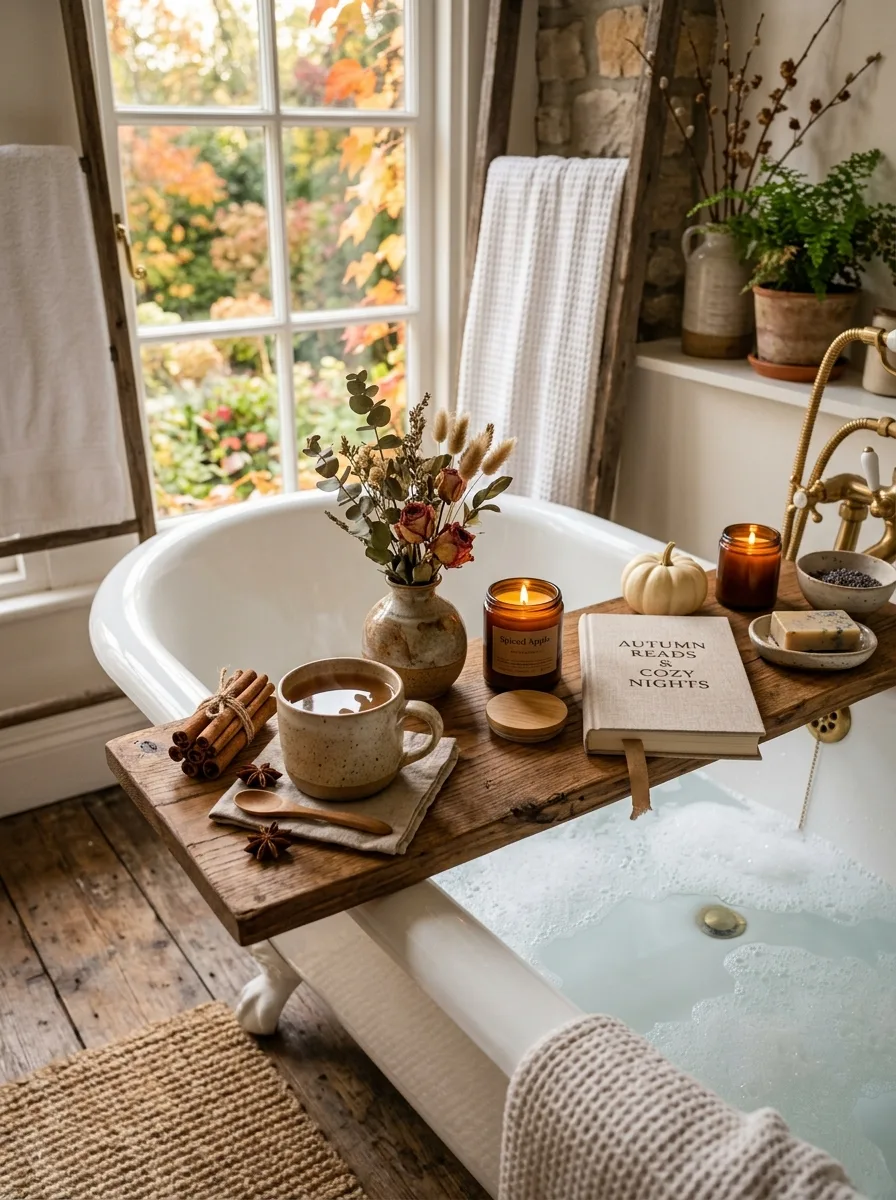
Build or source a reclaimed wood bath caddy long enough to span the tub’s width with a few inches of overhang on each side. Reclaimed, visibly weathered wood matters here — a smooth new board reads generic.
Set a ceramic mug of tea slightly off-center, next to a small stack of cinnamon sticks and a wooden spoon resting on a folded linen napkin. These small functional props do more than decorative ones to make the caddy feel used rather than staged.
Add one lit candle and one small pumpkin at the far end, leaving the center of the caddy open for a book. The book should lie open or dog-eared, not stacked and closed.
Keep everything on the caddy low-profile enough that nothing blocks the view out the window behind the tub. The caddy should support the moment, not dominate it.
Twin Basket Tub Flanking
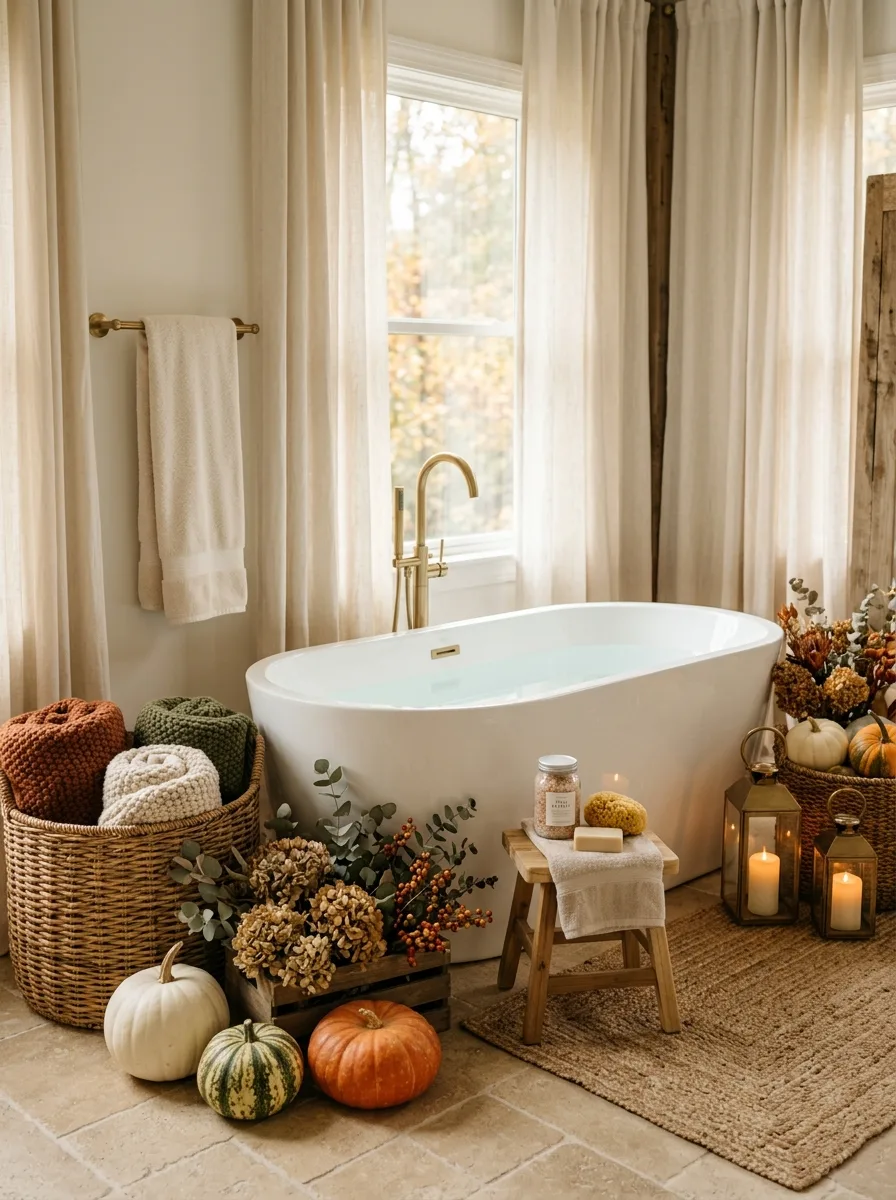
Flank a freestanding tub with two woven baskets of contrasting content — one filled with rolled knit throws, the other with a mix of small gourds and dried hydrangea. Matching baskets with different contents create balance without looking like a matched set.
Tuck a lit lantern beside each basket, low to the ground, so the light source sits below eye level and casts upward. This changes the whole mood of the room after dark compared to overhead lighting.
Layer a jute rug beneath both baskets and extending slightly under the tub itself, anchoring the whole grouping as one visual unit instead of two separate corners.
Let sheer curtains stay open rather than drawn, so natural light from outside becomes part of the styling instead of something blocked out.
Working Fireplace In The Bath
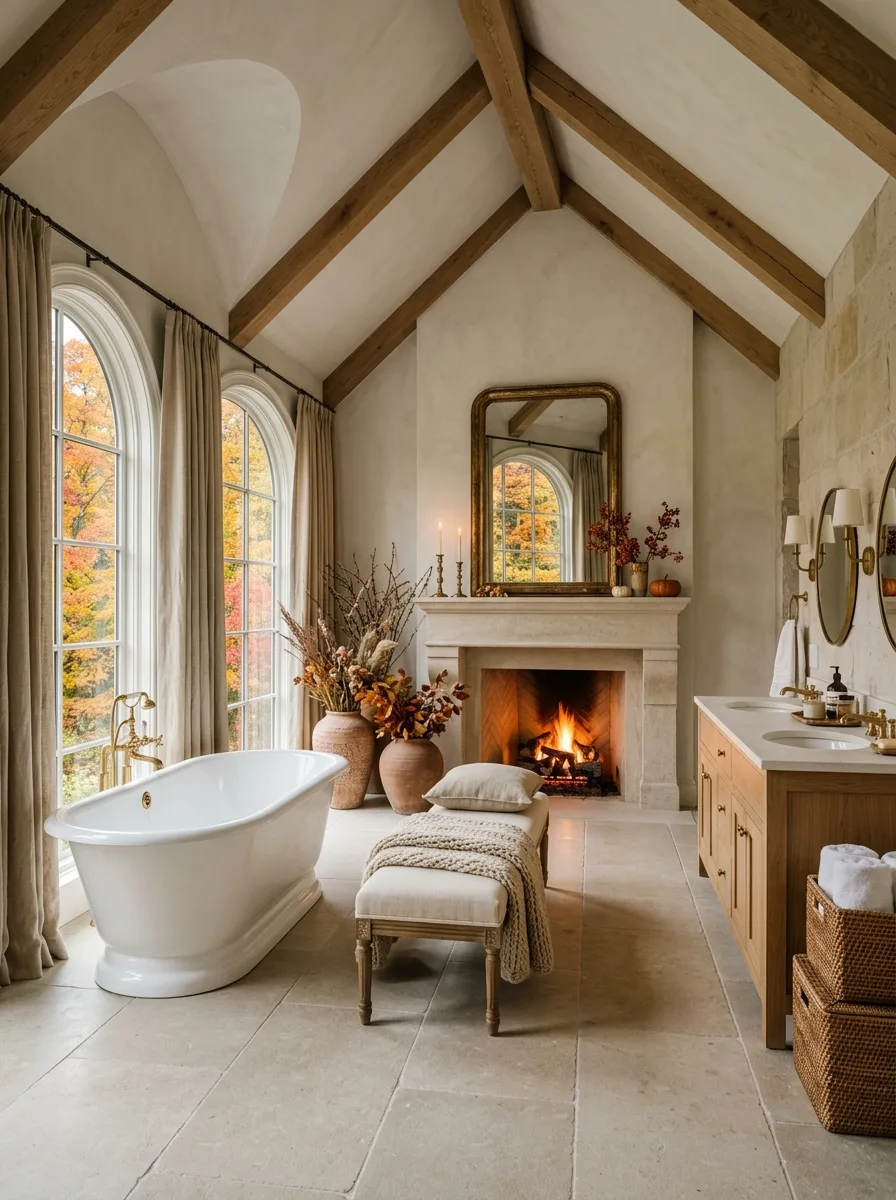
Frame a freestanding tub with a working fireplace at eye level, not off to the side. The fireplace needs a proper stone or plaster surround, not a decorative shell, and enough clearance in front for a bench or stool to sit between the tub and the flame.
Source antique or antiqued brass candlesticks for the mantle, flanking a large aged mirror. Skip anything shiny or new here — the mirror should look like it’s been in the room for decades, foxed glass and worn frame included.
Fill oversized ceramic urns with dried branches instead of fresh florals. Height matters more than fullness. A single dramatic branch arrangement reading against tall arched windows does more than a dense, symmetrical bouquet ever will.
Keep the floor in warm stone tile and leave it bare near the tub. A rug here fights the fireplace for attention, and the stone alone reads as grounded and warm once the fire’s lit.
Copper Tub Candlelit Corner
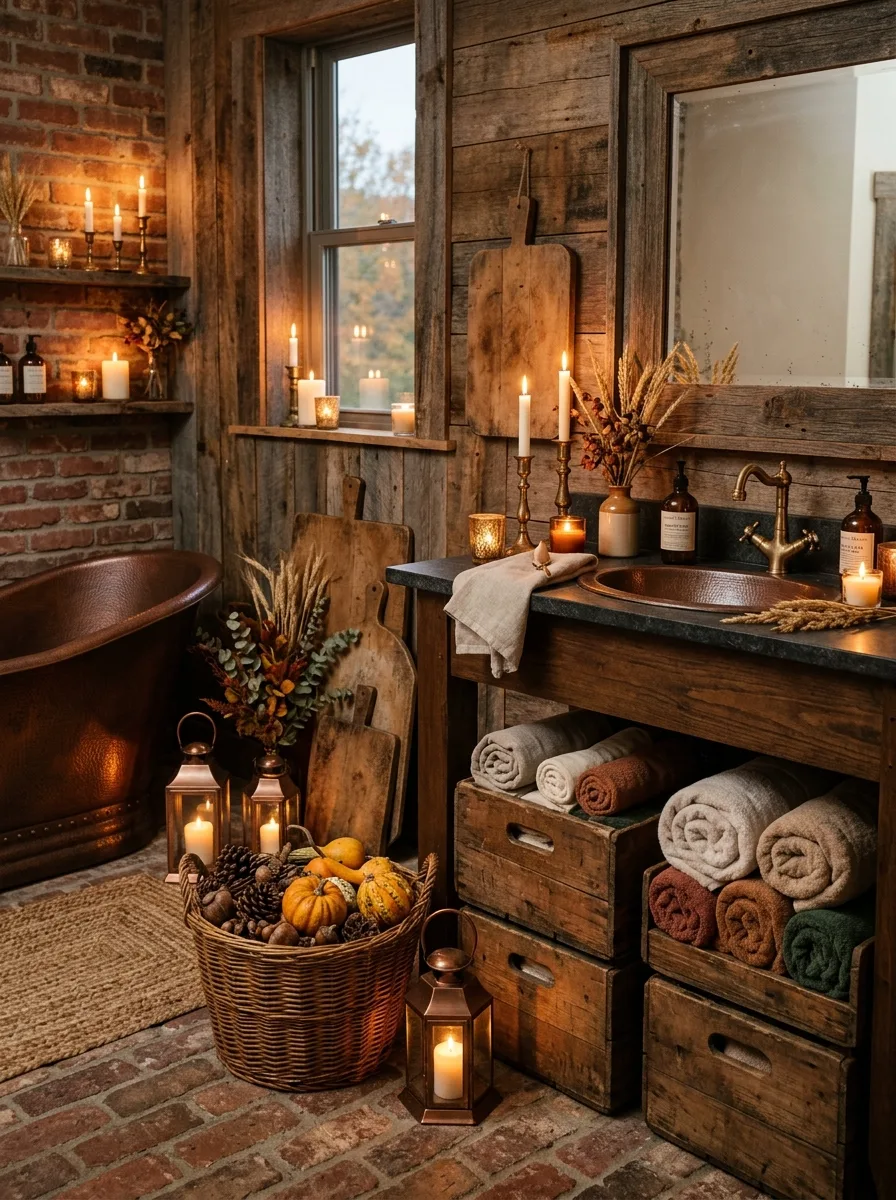
Start with a hammered copper soaking tub — the unlacquered kind that develops patina over time, not a coated finish that stays shiny forever. Position it against a raw brick or reclaimed wood wall so the warm tones bounce off each other.
Cluster pillar candles at wildly different heights on every available surface: the windowsill, the vanity edge, the floor beside the tub. This room runs almost entirely on candlelight, so err toward more than feels reasonable.
Lean a few old wooden cutting boards against the wall as texture, not for use. Their worn grain and irregular shapes do more visual work propped upright than any framed art would in this kind of rustic space.
Swap open shelving for wooden crates stacked as drawers, filled with rolled towels in mixed autumn tones. The imperfection of raw wood crates is the point — polished storage would look out of place next to hammered copper and exposed brick.
Boucle Reading Chair Nook
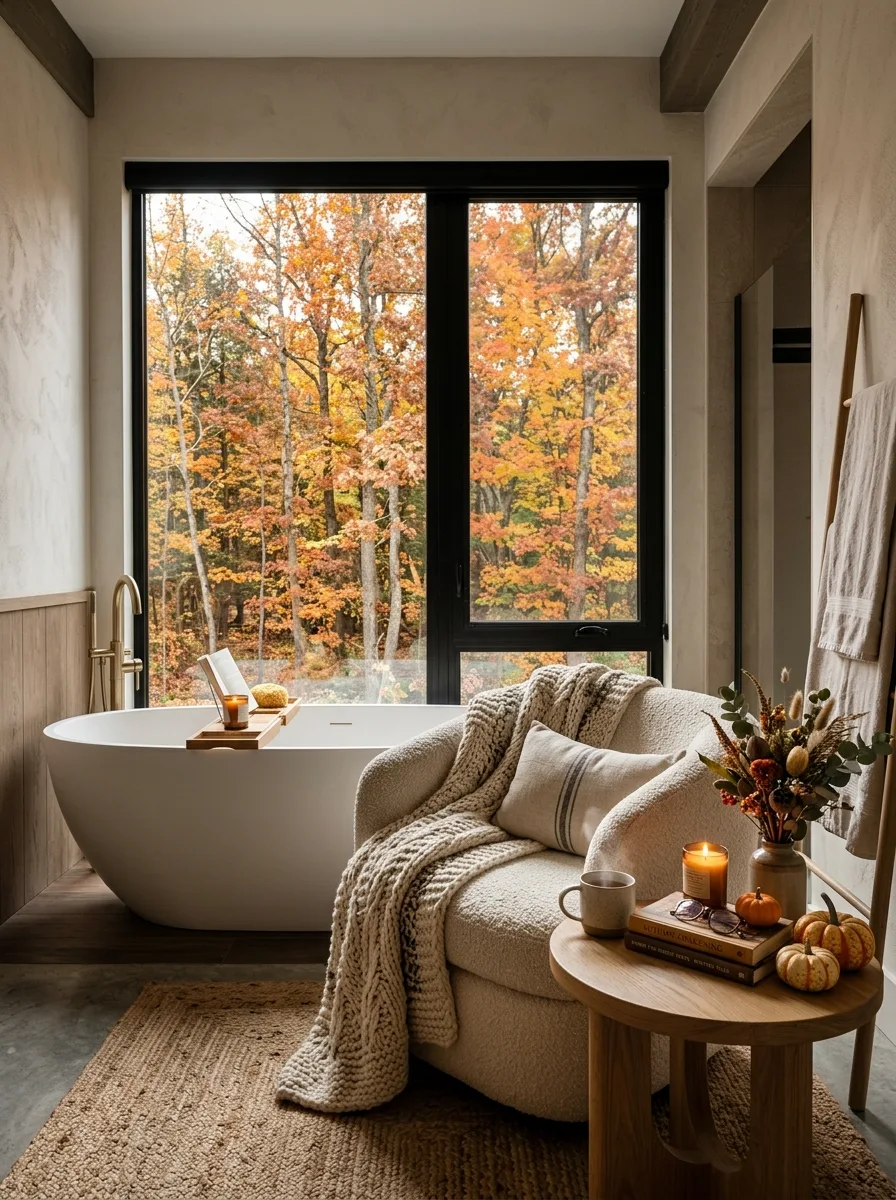
Pull an oversized boucle armchair right up against the tub, angled toward a black-framed window instead of into the room. The chair needs to feel like a second destination, not just a place to hang a towel.
Drape a chunky knit throw over one arm, loosely, not folded square. It should look like it was just used, not staged for a photo.
Set a low wood side table within arm’s reach, holding a single object per shelf-inch: a mug, a stack of two or three books, a small candle. Resist the urge to fill the whole surface.
Anchor the floor with a jute rug in a natural weave, large enough that the chair and tub both sit partially on it. A too-small rug under just one piece reads as an afterthought.
Garland-Draped Rustic Mirror
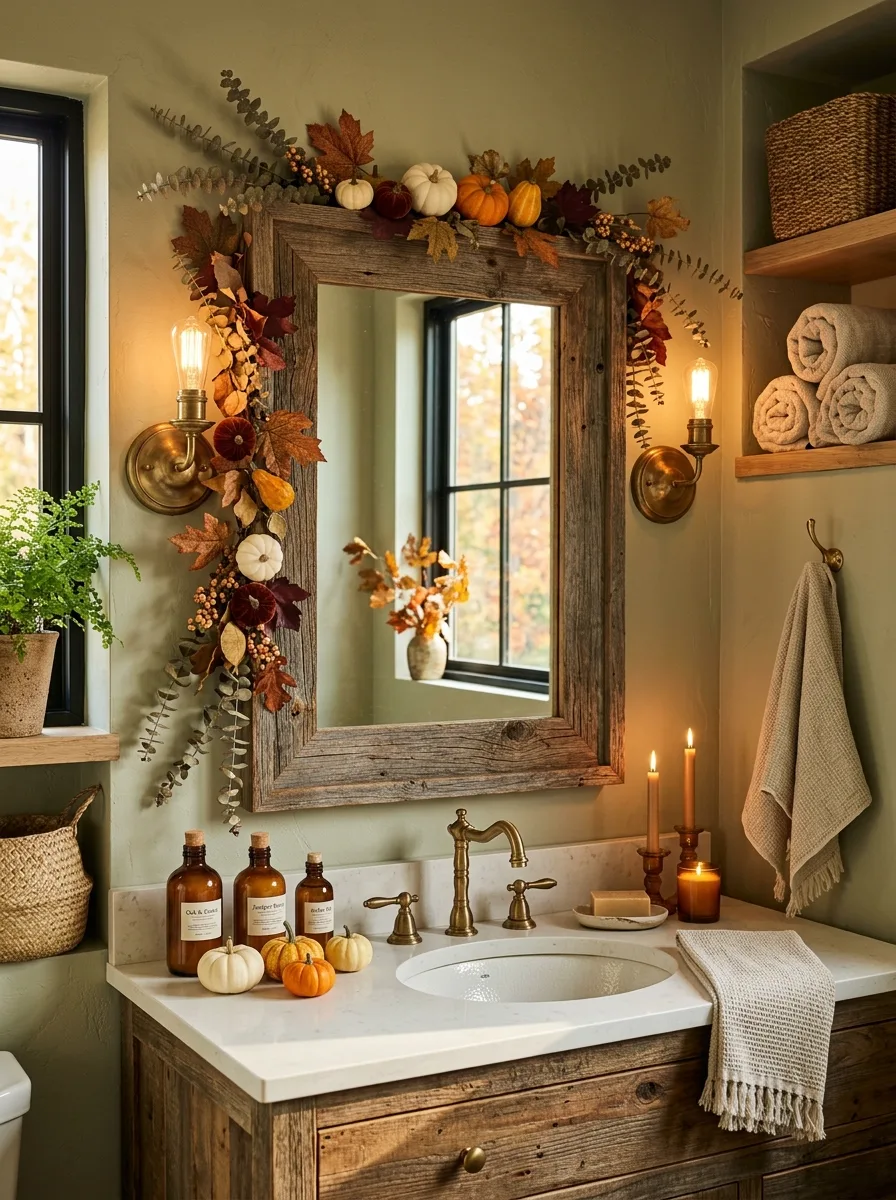
Choose a mirror with a substantial reclaimed wood frame — thick, rough-cut, with visible grain. This is the piece the whole vignette hangs off of, literally.
Drape a loose garland of dried leaves, eucalyptus, and small gourds diagonally across one top corner of the frame, letting it spill down one side rather than wrapping the entire perimeter. Symmetrical garlands read artificial. Asymmetrical ones read gathered.
Flank the mirror with warm brass or bronze sconces at matching heights, angled slightly inward. The light should hit the garland and cast soft shadow, not flood the mirror with glare.
Line the counter below with unlabeled amber apothecary bottles in a loose row, varying their heights slightly. Consistency in bottle material, inconsistency in height — that combination reads as collected over time rather than bought as a set.
Wooden Tray Harvest Vignette
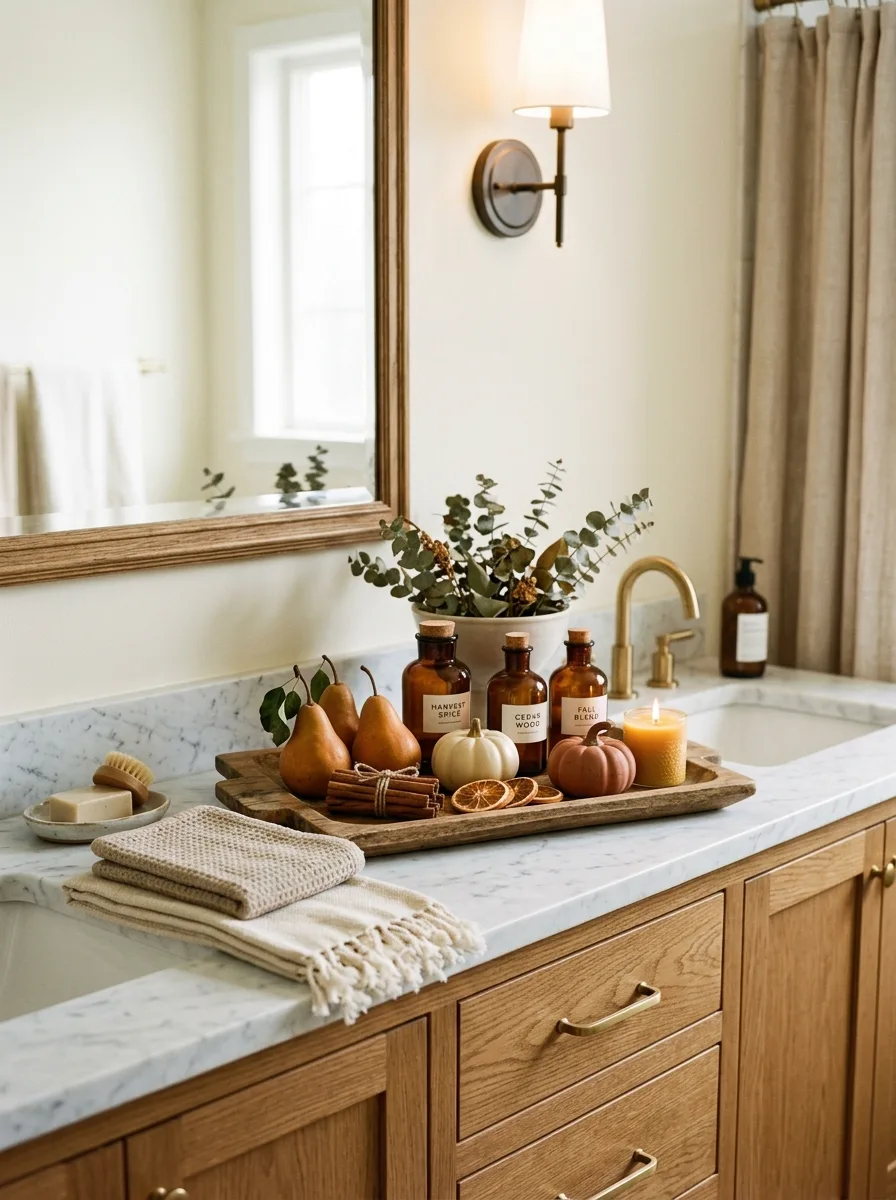
Find a shallow wooden serving tray or dough bowl with a worn, uneven finish. This is the vessel that holds everything else, so it needs texture of its own before a single object goes in it.
Layer in real produce: pears, small pumpkins, bundled cinnamon sticks tied with twine. Real fruit ages and needs replacing, but the imperfection is worth it over the flat sheen of anything artificial.
Add one amber glass candle and let the wax pool visibly rather than swapping it out fresh. A candle that’s clearly been lit belongs in this vignette more than one straight from the box.
Tuck a folded linen or waffle towel underneath one edge of the tray, just enough to peek out. It softens the hard edge of the wood against the stone counter.
Floating Petal Bath Ritual
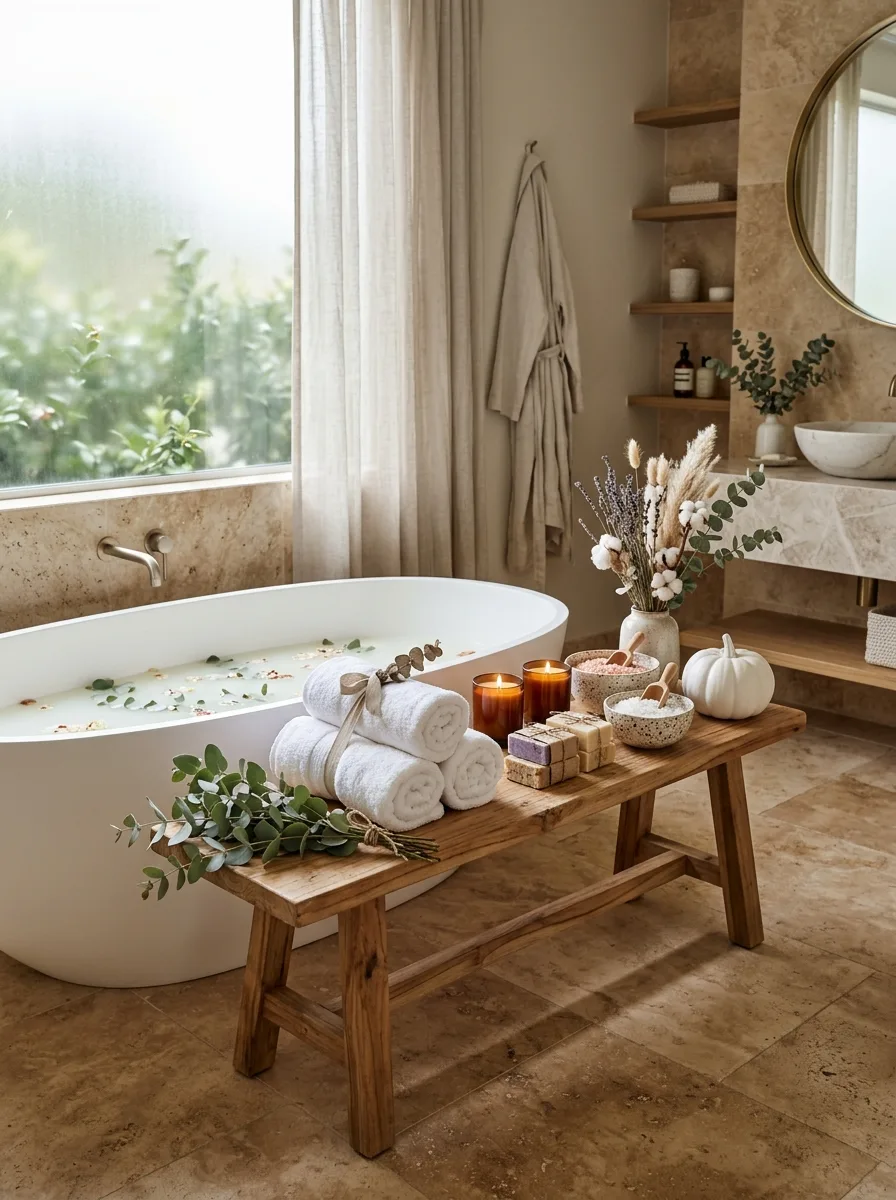
Run the bath first, then scatter dried rose petals and a few sprigs of eucalyptus directly onto the water’s surface. Do this last, right before getting in — petals sitting in water too long turn the whole thing murky.
Set a low wooden bench parallel to the tub, at a height where everything on it is reachable from the water. This bench does the job a side table would in any other room.
Stack rolled white towels tied loosely with ribbon or twine, next to small bowls of coarse bath salts in mismatched but complementary colors. The salts should look scooped from a larger container, not perfectly leveled.
Finish with a loose bundle of fresh eucalyptus laid across the bench edge, stems visible. The greenery ties the bath water back to the styling around it.
Carved Stone Vessel Sink
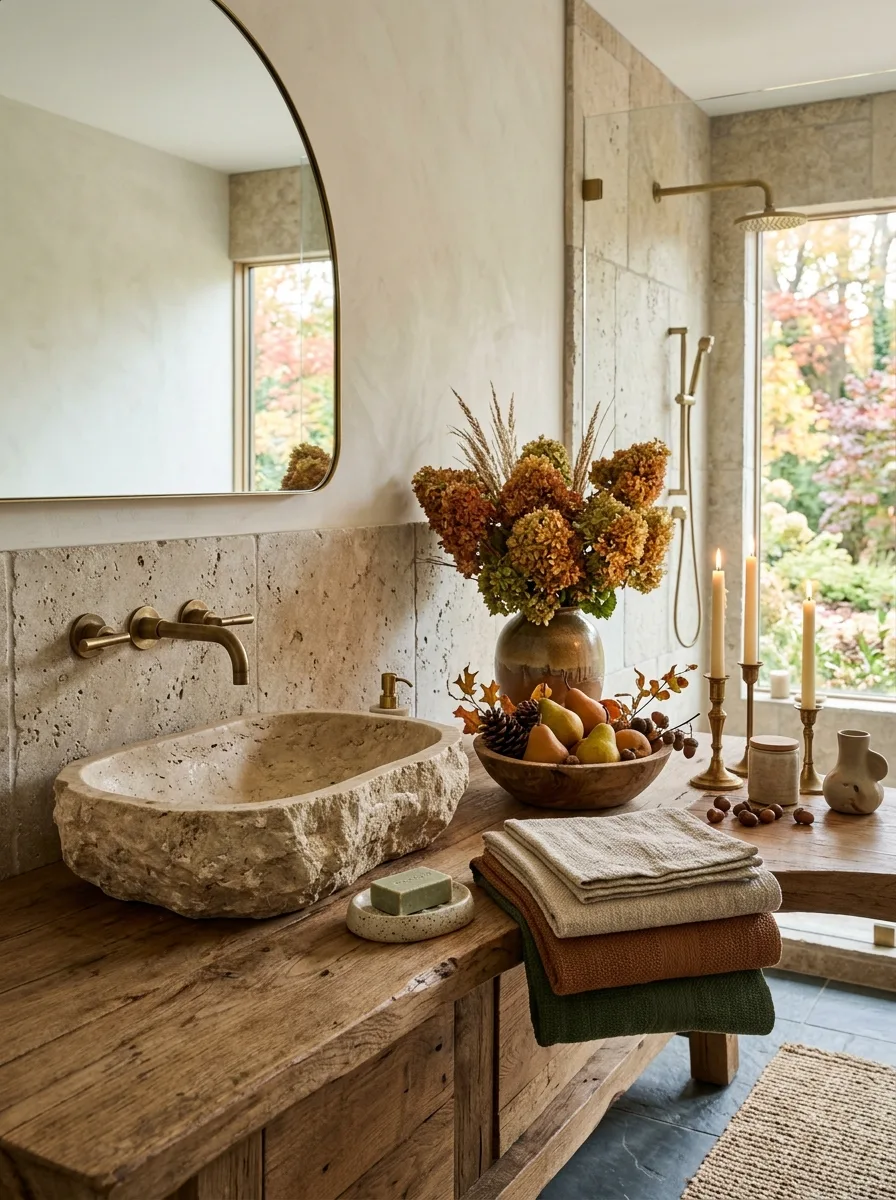
Source a hand-carved stone vessel sink with visible tool marks and irregular edges — the kind that looks quarried, not manufactured. This piece should be the loudest thing in the room, so build everything else around it quietly.
Pair it with a slim brass wall-mounted faucet rather than anything bulky. A vessel sink this textural needs a fixture that recedes, not competes.
Fill a low wooden bowl with pears, pinecones, and a few loose berries, positioned beside the sink rather than centered under the mirror. Off-center placement keeps the eye moving instead of locking onto one focal point.
Stack folded towels in three different earth tones directly on the wood counter, no basket needed. The wood grain itself acts as the backdrop these towels need.
Labeled Apothecary Jar Shelf
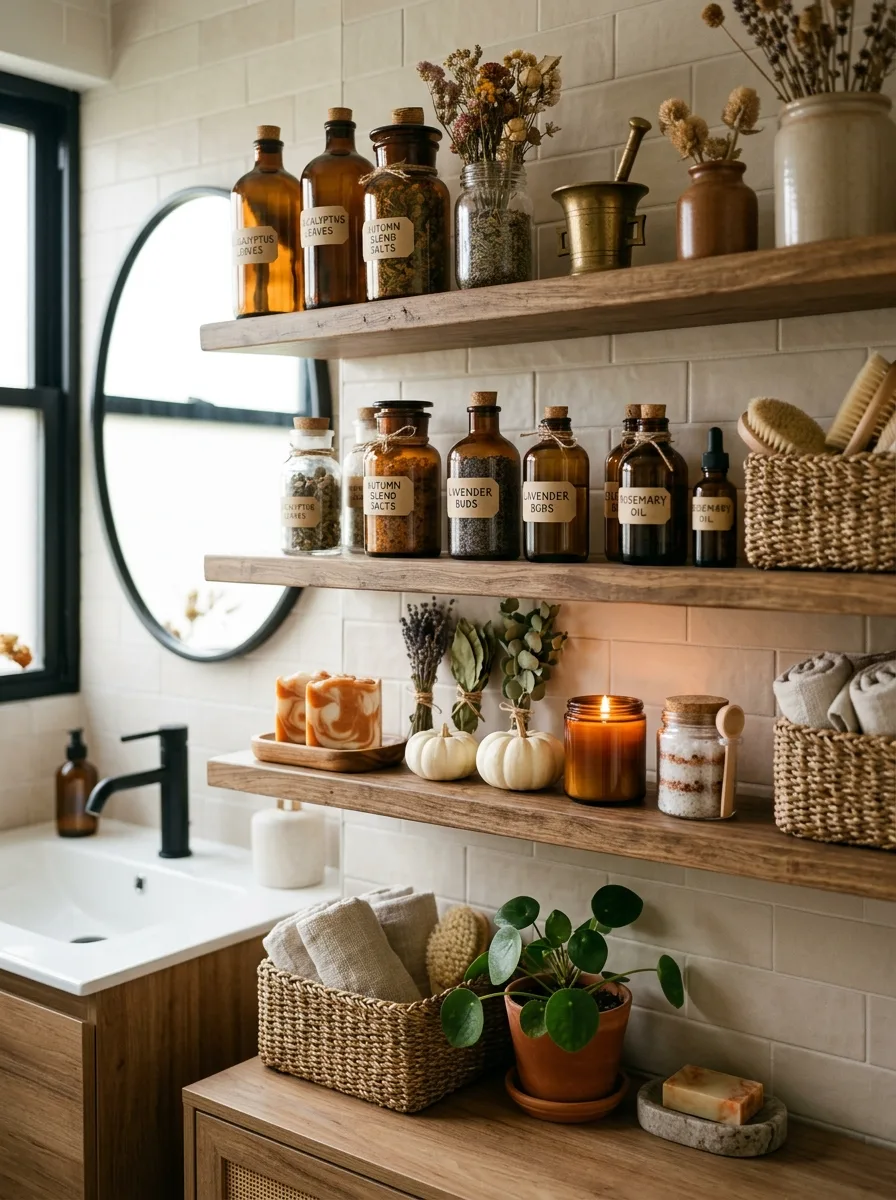
Install floating wood shelves with visible depth, deep enough to hold jars two rows back without looking crowded from the front. Shallow shelves force everything into one flat line, which kills the layered look.
Fill amber and clear glass jars with dried herbs, bath salts, and rosemary sprigs, each labeled by hand rather than printed. Handwritten labels, even slightly imperfect ones, read as personal. Printed labels read as retail.
Group jars by height within each shelf rather than by contents, so the silhouette varies even if two jars hold the same thing. A shelf full of same-height jars reads flat no matter what’s in them.
Anchor one end of each shelf with a woven basket holding rolled towels or brushes, giving the eye a soft textural break from all the glass and wood.
Floor-To-Ceiling Window
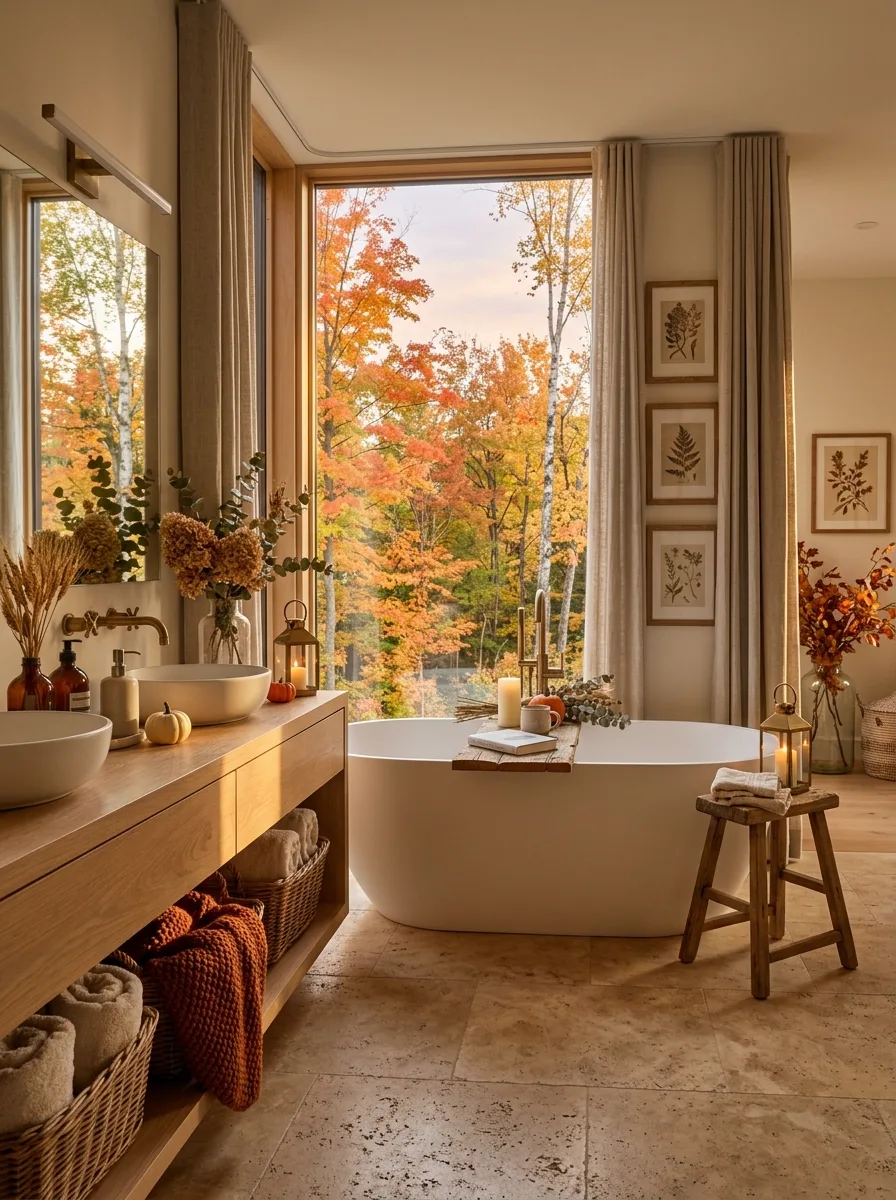
Orient a large oval tub toward the biggest window in the room, floor-to-ceiling if the layout allows it, so the view of turning leaves outside becomes the actual focal point rather than anything placed indoors. No amount of styling competes with real trees in full color.
Lay a reclaimed wood board across the tub as a caddy, holding one mug, one small book, and a single votive candle. Keep this styling minimal — a busy caddy pulls focus away from the window it’s sitting in front of.
Pair a wide double-sink vanity in pale oak with vessel-style basins, keeping the counter nearly bare aside from a small vase of dried wheat and a soap pump on each side. Symmetry here works because the window, not the vanity, is the room’s centerpiece.
Hang a trio of small framed botanical prints along the wall opposite the tub, evenly spaced, and tuck woven baskets with rolled knit throws into the open shelving below the vanity. These are quiet, supporting details — the room only needs one loud element, and it’s outside the glass.
Final Thoughts
None of this is really about pumpkins. It’s about noticing that the room you use twice a day, alone, with no audience, deserves the same care as the one guests see first.
Every example here works because it stopped treating the bathroom like a smaller living room and started treating it like what it actually is — a room built around water, steam, and quiet.
The materials that survive that environment are the same ones that make it feel considered: real stone, real wood, warm metal that only gets better with age. Nothing here is fighting the room it’s in.
Do less than feels natural. Let the fixtures you already have carry more of the weight than a new object ever could. The room was probably already halfway there.