
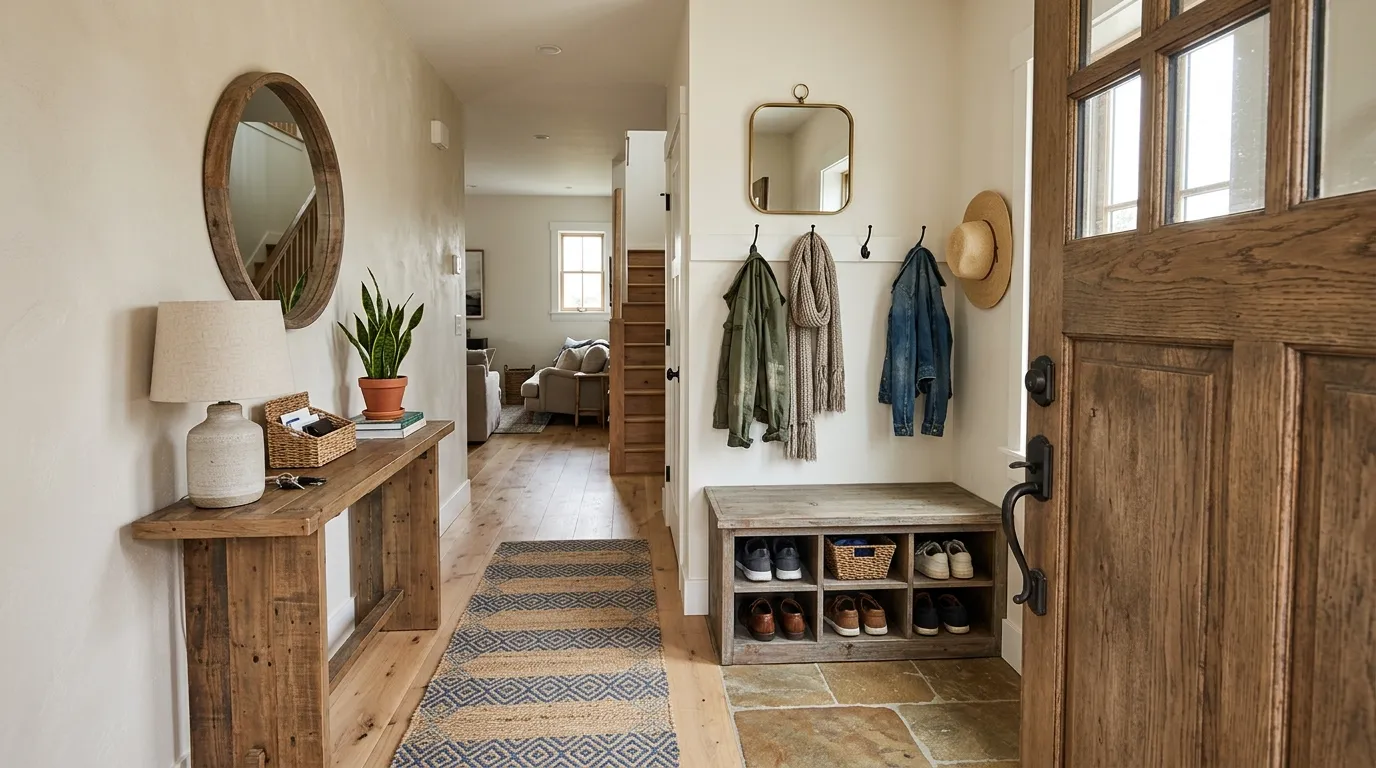
You already know what you think of a house before you’ve taken your shoes off.
That’s not an exaggeration. It’s how entryways work. Ten seconds, one glance, and a verdict forms — before the living room, before the kitchen, before anyone’s said a word about the renovation.
Most entryways don’t earn that verdict. They’re a pile of shoes and a coat hook and whatever mail didn’t make it further into the house.
Fall is the season that fixes this fastest, because it asks for so little. Not a redesign. A few honest choices about what greets people first.
What An Entryway Is Actually For
Before any styling happens, the entryway has a job, and it’s not decorative. It’s the handoff between outside and inside — coats come off, shoes come off, keys go somewhere. Decorate around that function and it works. Decorate over it and the room stops working within a week.
The Function Has to Survive the Decor
A gorgeous vignette on a console table means nothing if the actual coat hooks are buried behind a garland. The seasonal styling has to sit around the functional elements, not on top of them.
That means testing every addition against a simple question: can someone still hang up a coat, drop their keys, and get their boots on without moving anything? If the answer’s no, the styling has failed the room, however good it looks in a photo.
First Impressions Run on Contrast, Not Volume
A pile of pumpkins doesn’t make an entryway feel more welcoming. A single well-placed one, against a clean surface, does more work than ten scattered across the floor.
The instinct in a small transitional space is to fill it, because it feels underdressed otherwise. Resist that. An entryway with restraint reads as considered. An entryway with volume reads as trying to compensate for something.
The Door Counts as Part of the Room
Most people stop decorating at the threshold, treating the front door and porch as a separate project. They’re not. The wreath on the door and the mirror inside it are read as one continuous first impression, seconds apart.
If the exterior styling and interior styling use completely different palettes, the transition feels jarring instead of intentional. Carry one material or tone — dried wheat, aged brass, a specific shade of rust — from the porch through the front door.
Fall Entryway Ideas
Twin Baskets Under Console
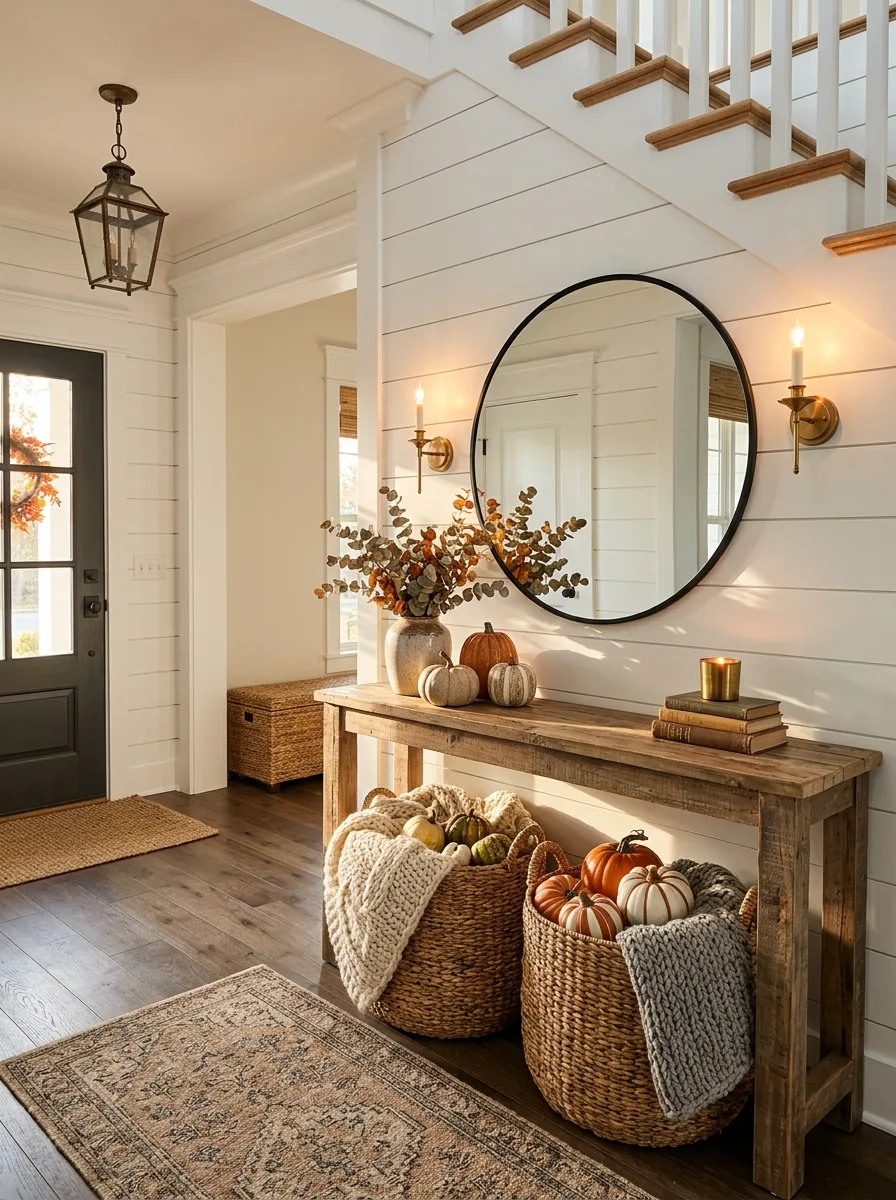
Choose a reclaimed wood console table with enough clearance underneath for two matching baskets side by side. The gap beneath the table is prime real estate — don’t leave it empty.
Fill one basket with mixed mini pumpkins and gourds, left loose rather than arranged in rows, and the other with a chunky knit throw draped over the rim. The contrast between hard gourds and soft knit gives the pairing texture instead of repetition.
Center a tall stoneware vase above, filled with a loose mix of dried eucalyptus and turning branches, positioned slightly off to one side rather than dead center under the mirror. Flank it with two or three small pumpkins at the base, tucked close rather than lined up.
Finish with a stack of hardcover books beside the vase, spines facing out, topped with nothing. A bare stack of books reads more intentional than one with an object balanced on top.
Styled Built-In Cubby Wall
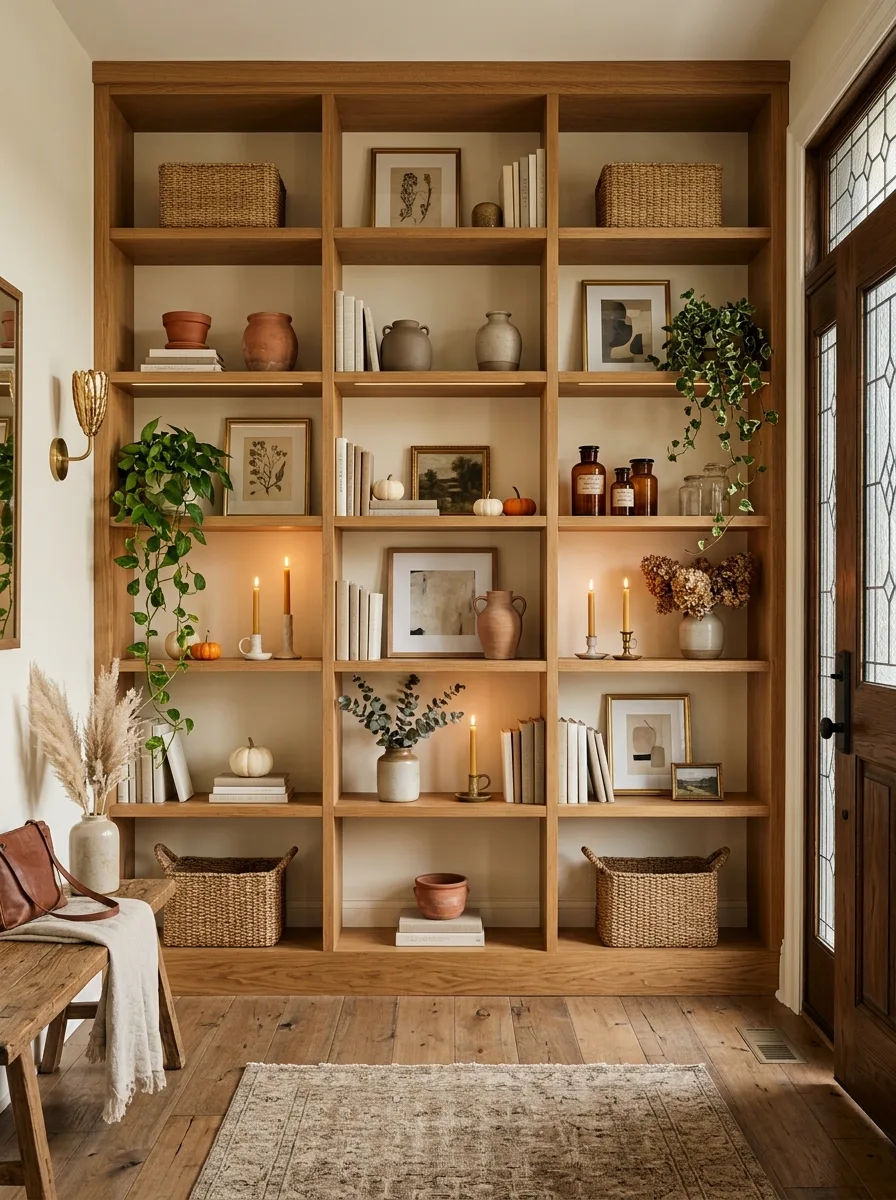
Build or use an existing grid of open wood cubbies, and resist the urge to fill every single opening. Leave at least a quarter of the cubbies empty or holding just one small object — the negative space is what keeps a large built-in from reading as cluttered.
Mix functional storage with display in the same wall: woven baskets in some cubbies, framed botanical prints or art in others, a trailing plant in one corner cube. No two adjacent cubbies should hold the same category of object.
Add a lit taper candle or two in a small handful of cubbies at staggered heights, not lined up on one shelf. The scattered candlelight does more to warm up a large wall of storage than any single design object could.
Keep the color palette tight — terracotta, cream, warm wood, one or two amber glass pieces — even though the cubby wall holds many different objects. A wide color range across that many openings reads chaotic fast.
Window-Flanked Mudroom Bench
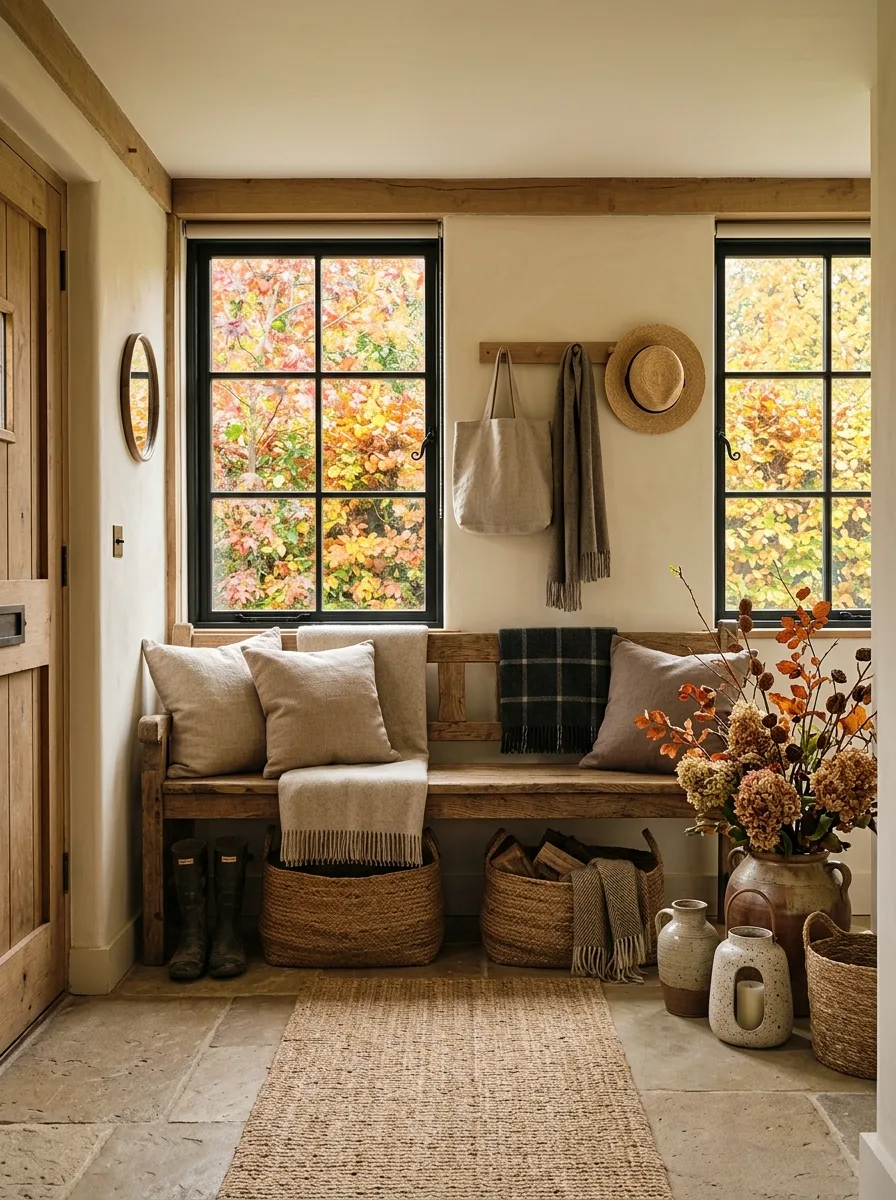
Position a simple wood bench directly beneath a pair of windows, using the natural light as the backdrop instead of adding overhead fixtures. The windows do the lighting work this vignette needs.
Layer linen pillows and a folded wool throw across the bench seat, kept in a narrow tonal range — oatmeal, taupe, soft gray — so the bench reads calm rather than busy. Save bolder color for one accent, like a single plaid throw draped over the back.
Mount simple hooks above the bench holding a canvas tote, a scarf, and a straw hat, spaced with real gaps between them rather than crowded together. Overcrowded hooks make a functional wall look like storage overflow instead of a styled moment.
Tuck woven baskets under the bench for boots and extra layers, and add a ceramic jug of dried hydrangea on the windowsill between the two windows. The jug is the one purely decorative object in an otherwise functional vignette, and that’s exactly the right ratio.
Dark Wall Floating Console
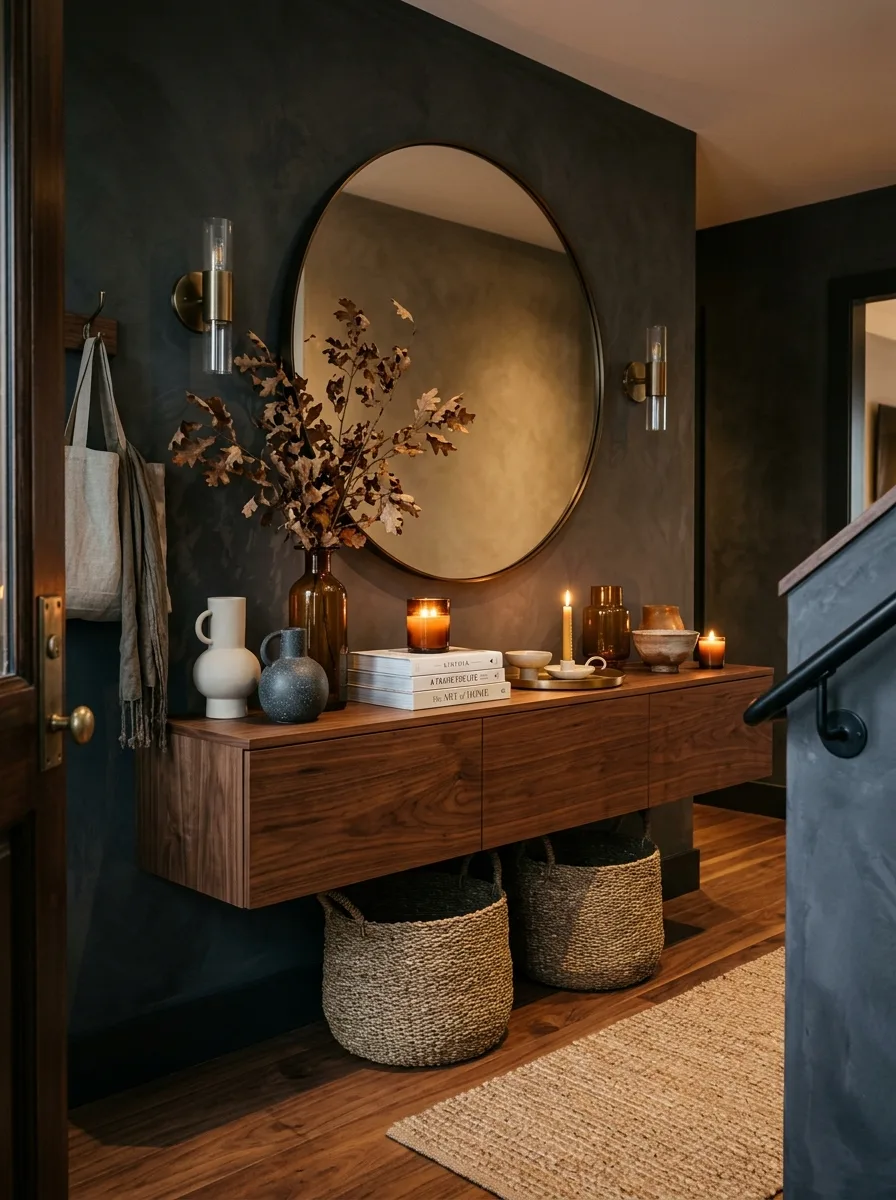
Commit to a dark, moody paint or plaster finish on the entryway wall — charcoal, deep espresso, near-black — and let a floating walnut or dark wood console sit against it so the two tones nearly merge. This only works with genuine commitment to the dark palette; a halfway version reads muddy instead of dramatic.
Hang a large round mirror with a thin brass frame slightly above the console’s centerline, flanked by slim brass sconces at matching heights. The brass needs to be the only bright metal in the room — mixing metals here dilutes the effect.
Style the console with dried oak branches in a single amber glass vessel, a short stack of books, and two or three lit candles at varied heights. Let the candlelight do most of the visual work; a dark wall photographs almost entirely by what’s lit within it.
Slide two woven baskets underneath in a tone lighter than the wall — natural rattan or jute — so there’s one visual break from all the dark surfaces. Without that lighter texture, the whole vignette reads flat.
Ornate Console By Open Door
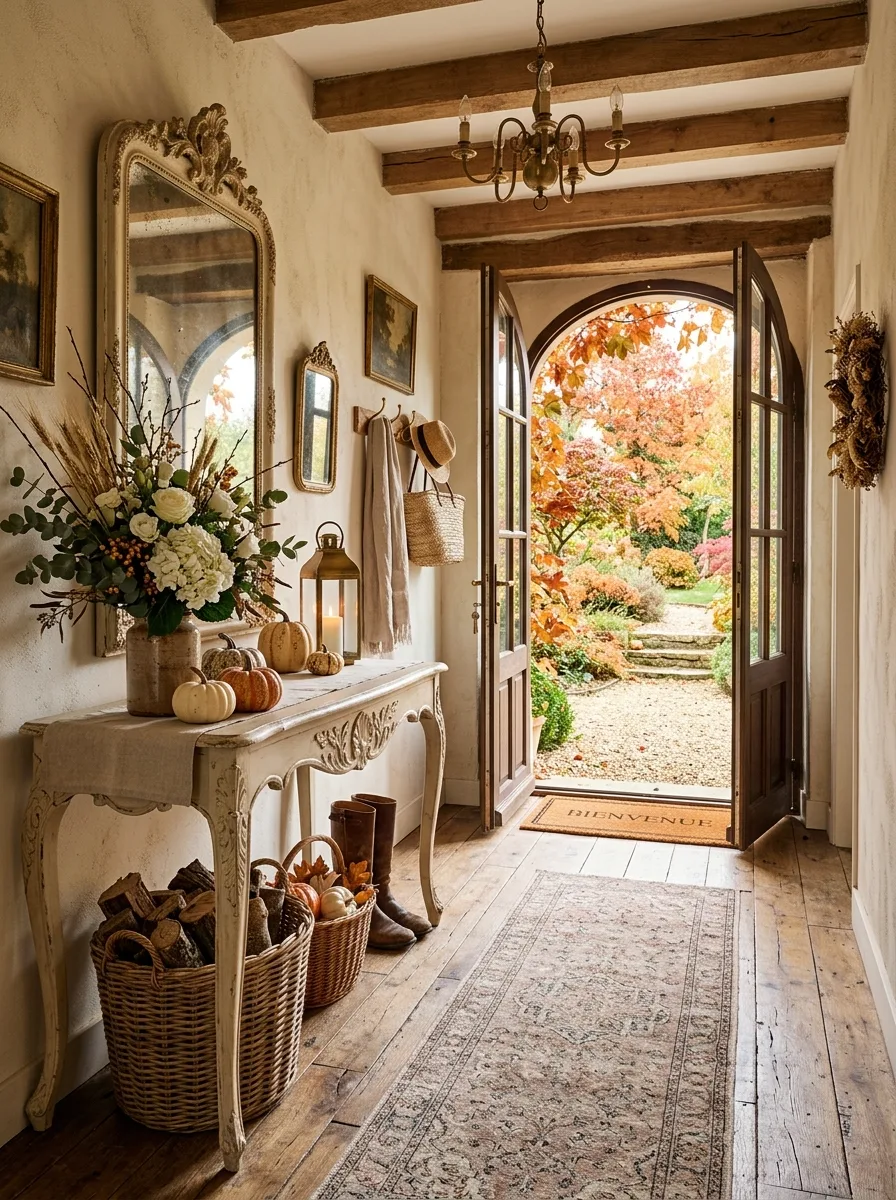
Source a French provincial-style console with visible curved legs and carved detail, and let it sit unapologetically ornate against otherwise simple plaster walls. This piece wants to be the most decorative object in the room, so nothing else should compete for that role.
Prop an oversized gilt or aged mirror behind it, tall enough to lean rather than hang, catching the light spilling in from an open door nearby. An open door in the vignette itself — even mid-photograph — signals the entryway as a living, used threshold rather than a staged room.
Fill a stoneware jug with a loose, garden-style arrangement of white hydrangea and eucalyptus, letting stems cross and overlap rather than arranging them symmetrically. A too-tidy arrangement fights the console’s romantic, worn character.
Tuck two woven baskets beneath — one holding firewood, one holding boots — so the ornate top half of the vignette is grounded by something entirely utilitarian below. That contrast is what keeps the whole look from feeling precious.
Botanical Gallery Wall Grouping
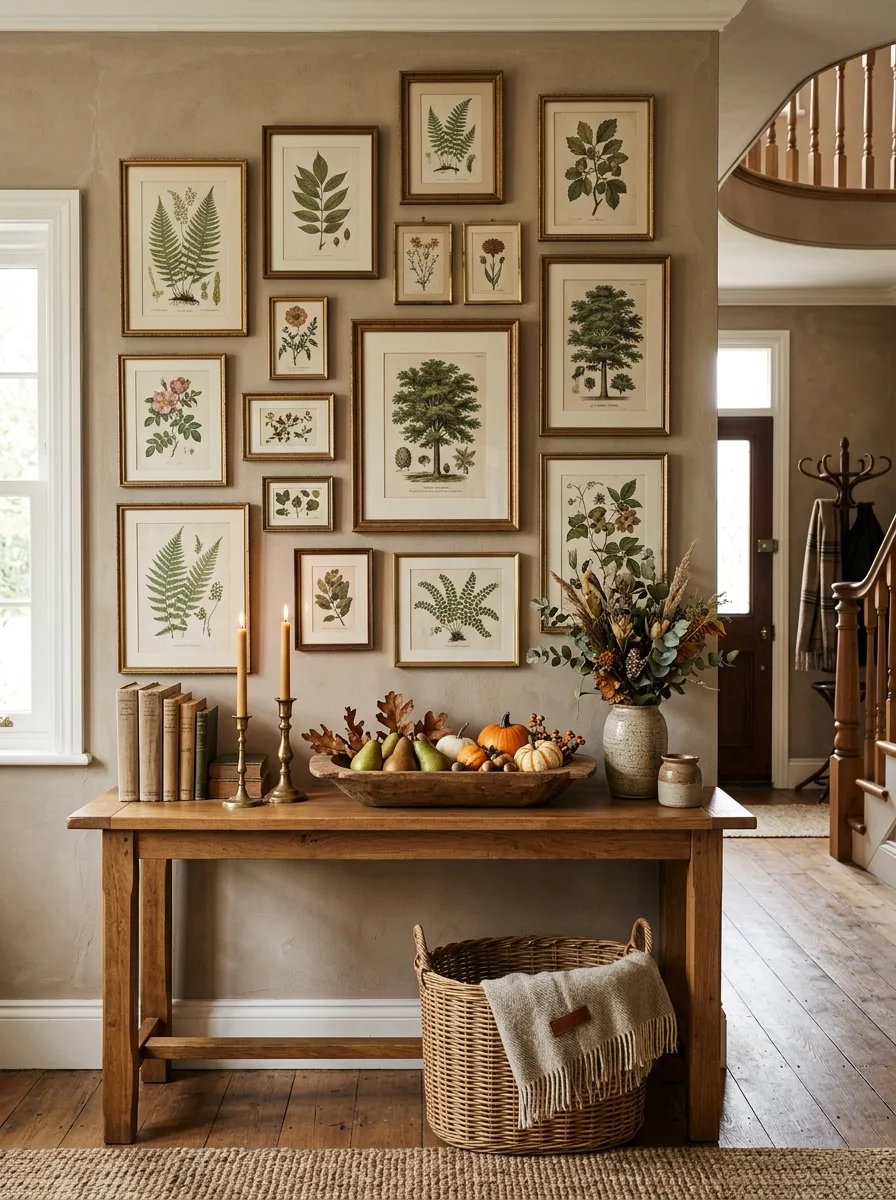
Frame a tight cluster of botanical prints in mismatched gold and brass frames, varying the print sizes significantly rather than keeping them uniform. A gallery wall of same-size frames reads like a template; varied sizes read like a collection built over time.
Hang the grouping with minimal gaps between frames — closer than feels natural at first — so the wall reads as one dense visual block rather than scattered individual pieces. Density is what makes a gallery wall feel intentional instead of sparse.
Below it, set a dough bowl or shallow wooden vessel filled with real pears, gourds, and dried oak leaves directly on a simple wood console. Let the produce spill slightly over the bowl’s edge rather than sitting contained.
Add a pair of brass candlesticks beside a short stack of aged books, and finish with one ceramic vase holding a loose mix of dried wheat and berries at one end of the console. The gallery wall carries the visual weight; the console below should stay relatively restrained.
Lantern Trio Floor Lighting
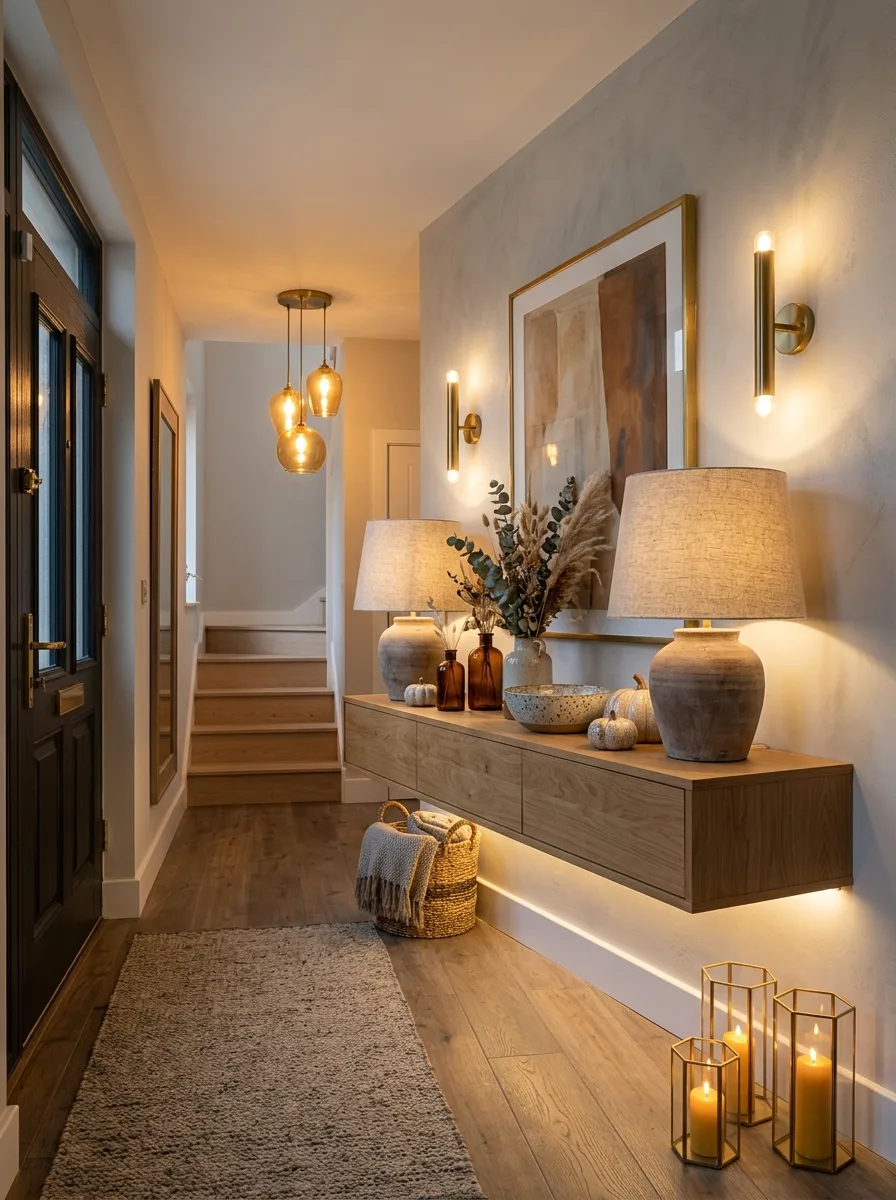
Cluster three glass-and-brass lanterns of varying heights directly on the floor beneath a console or lamp setup, rather than placing them on a shelf. Floor-level lantern light casts upward in a way that shelf lighting never does, and it’s an underused trick in narrow hallways.
Pair the lanterns with a floating wood console lit from beneath by a hidden LED strip, so the whole lower half of the hallway glows without a single overhead fixture doing the work. Warm, low light does more for a fall mood than bright overhead lighting ever will.
Style the console above with two ceramic table lamps flanking a large framed art piece, and a single vase of dried pampas and eucalyptus between them. Let the lamps stay lit even during the day — they’re part of the styling, not just function.
Add a woven basket with a folded throw at floor level, off to one side rather than centered, so the lantern trio has room to be the visual anchor of that lower zone.
Paper And Woven Pendant Pairing
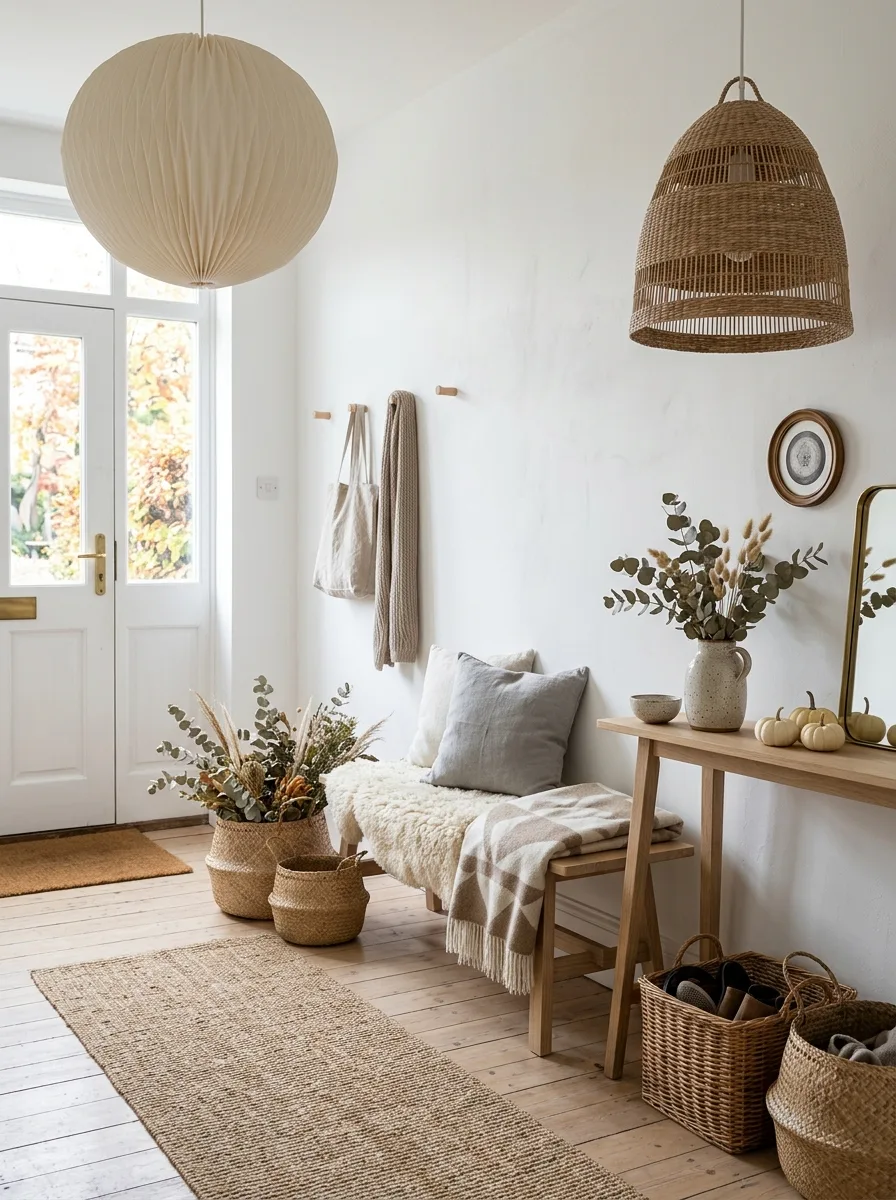
Hang two different pendant light styles in the same entryway — a round paper lantern and a woven rattan dome — rather than matching fixtures throughout. The deliberate mismatch signals a collected, layered approach instead of a matched showroom set.
Place a low bench beneath one pendant, layered with a sheepskin throw and simple linen pillows in neutral tones only. Keep this bench almost entirely textural rather than colorful — the pendant lights are carrying the visual interest overhead.
Group two or three small woven baskets on the floor nearby, filled with dried eucalyptus and pampas grass rather than anything decorative on a table. Floor-level greenery works especially well in a bright, minimal entryway that has no room for a console.
Finish with a stack of larger baskets for actual shoe storage tucked into a corner, left slightly open rather than fully hidden. A glimpse of real use keeps a minimal space from feeling untouched.
Sculptural Wood Stool Corner
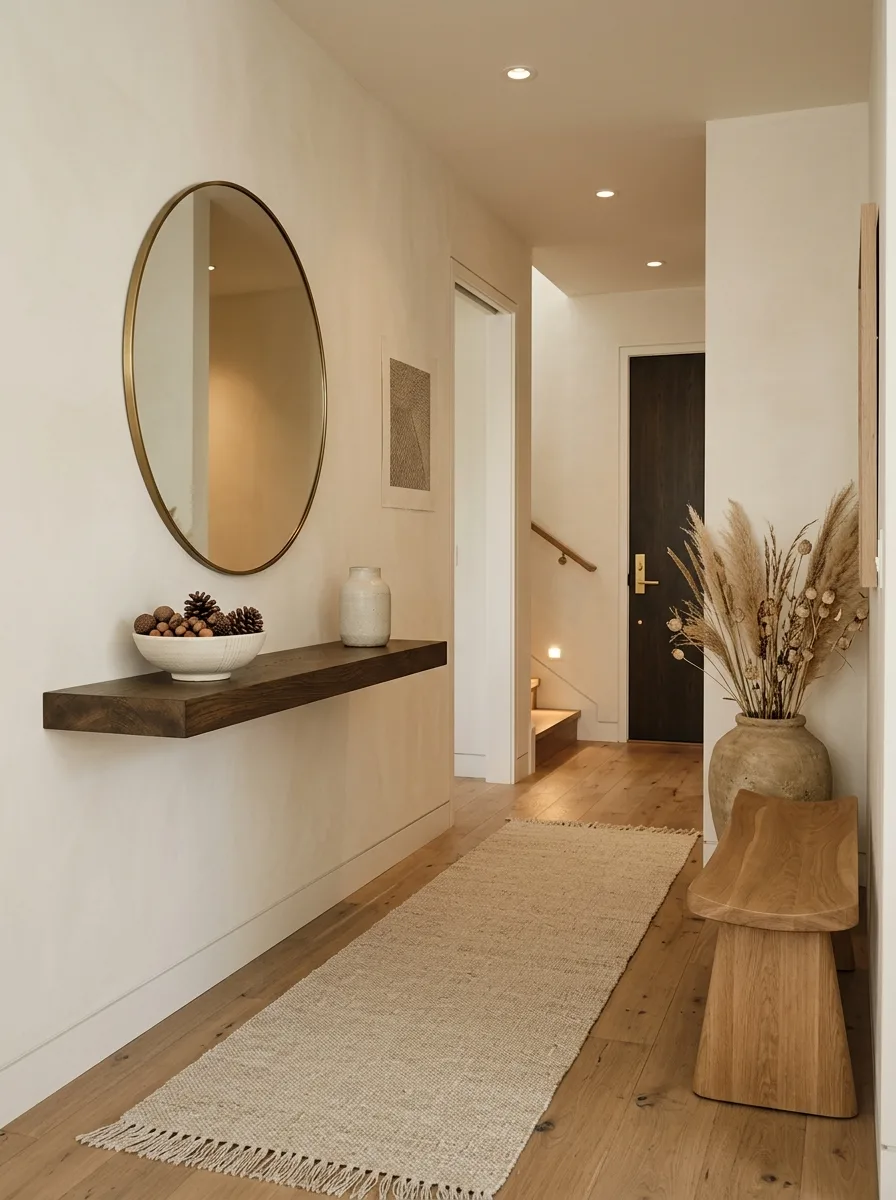
Place a solid, sculptural wood stool in an entryway corner as an object first, seating second. Its shape should be interesting enough to function as a piece of art even when nobody’s sitting on it.
Pair it with an oversized ceramic vase filled with dried pampas grass, tall enough to nearly reach the stool’s height when both are viewed together. The two objects should feel like they’re in conversation, not randomly placed.
Mount a round brass mirror above a slim floating wood shelf nearby, holding only a ceramic bowl of pinecones and acorns and a single small vase. This is a shelf that earns its minimalism — every object on it should be able to justify its spot alone.
Run a narrow jute runner down the hallway connecting the stool corner to the rest of the entry, letting the natural fiber tie the wood tones together without adding another pattern.
Straw Hats On Hook Row
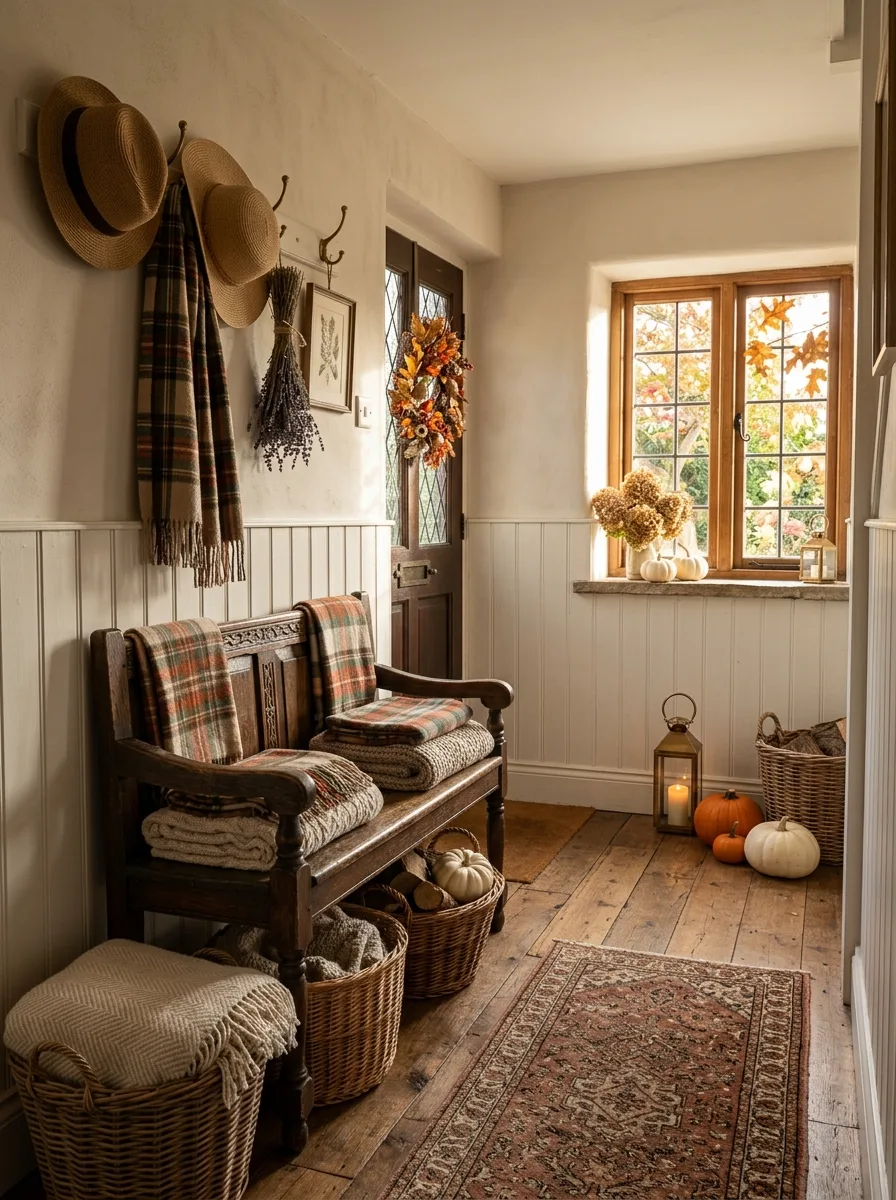
Mount a row of hooks at two different heights along a cottage-style entry wall, hanging straw hats, a wool scarf, and a dried lavender bundle in the mix rather than only coats. Treating decorative and functional objects as interchangeable on the same hooks is what makes a cottage entry feel lived-in.
Dress a wooden bench with layered plaid throws and folded wool blankets in a tight red-and-green tartan palette, letting the pattern repeat across two or three textiles rather than appearing once. Repetition of a single strong pattern reads as a considered choice, not clutter.
Hang a dried wreath — heavy on wheat, leaves, and berries — directly on the interior side of a paned door, so it’s visible from both inside and through the glass. This doubles the wreath’s impact without adding a second one anywhere else.
Set a small cluster of white and orange pumpkins directly on the floor near the door, unpotted and ungrouped in any container. Left loose on the floor, they read as gathered from the garden rather than purchased as a set.
Leaning Landscape Paintings Display
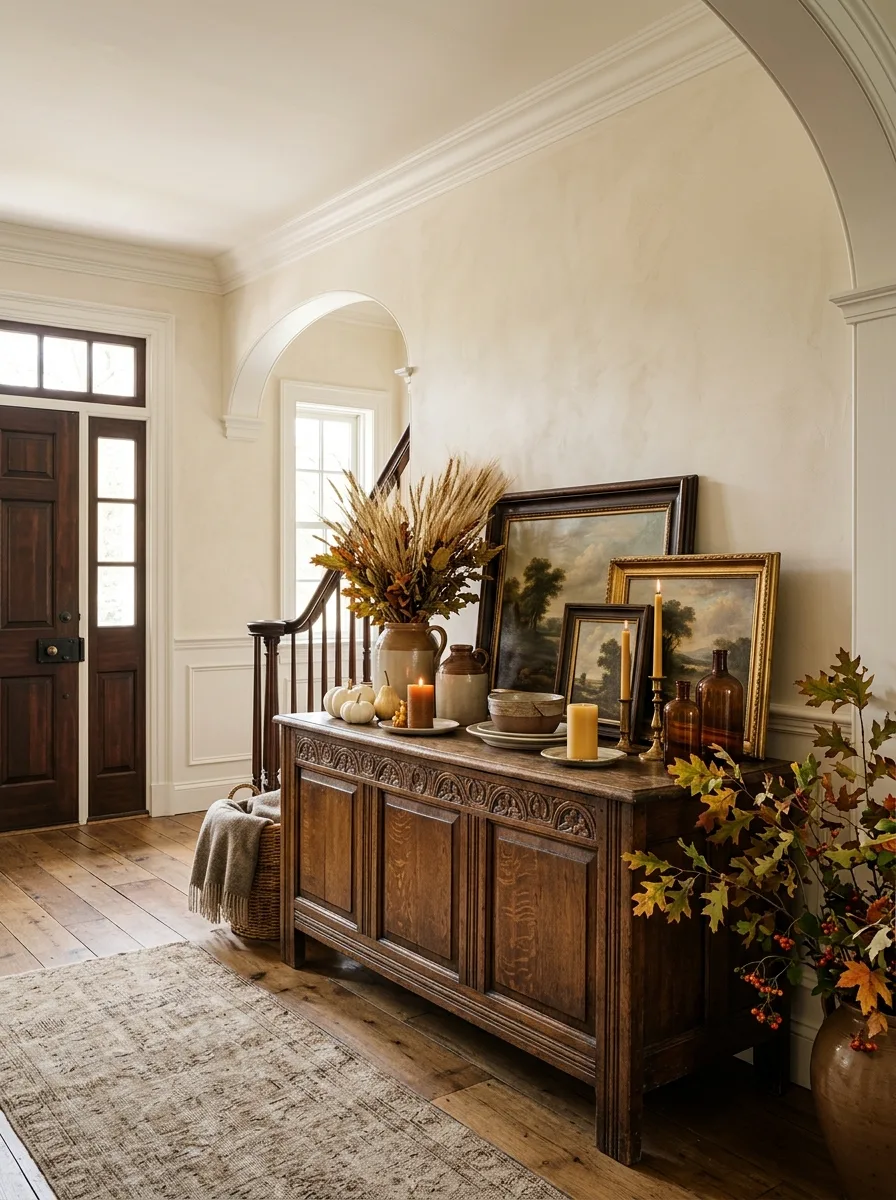
Prop two or three gilt-framed landscape paintings against the wall behind a console rather than hanging them. Leaning art signals intentional imperfection — a look that hung, perfectly level frames can’t achieve.
Choose a heavily carved antique sideboard as the base, letting its ornate detailing stay fully visible rather than covering it with too many objects. A piece with this much character needs open surface area around it to read properly.
Fill a stoneware jug with a dramatic, oversized sheaf of dried wheat, tall enough to rise well above the leaned paintings behind it. Height variation between the wheat and the artwork keeps the whole vignette from reading as one flat plane.
Add a scatter of small pumpkins and pears directly on the sideboard’s surface, along with two or three lit taper candles in mismatched holders. The mismatch in candle holders — brass here, ceramic there — keeps an otherwise formal piece from feeling too matched.
Full Mudroom Cubby System
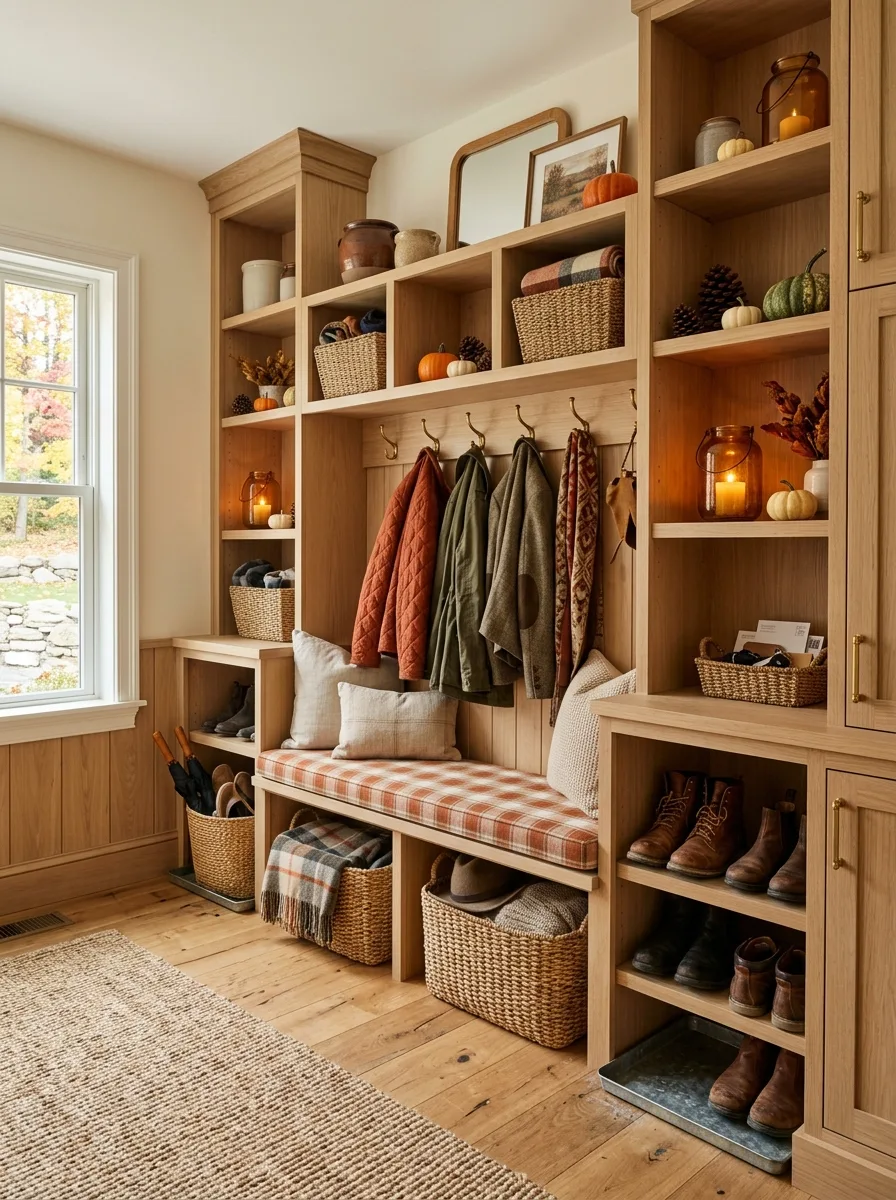
Build a mudroom wall with distinct zones — open cubbies up top, hooks in the middle, boot storage at the bottom — so the eye reads a clear hierarchy from decorative to functional moving downward. This structure does more organizational work than any amount of styling on a flat console.
Fill the top cubbies with a mix of baskets, small pumpkins, pinecones, and one or two lit lantern candles, keeping no single cubby overloaded. Each opening should hold two or three objects at most.
Hang actual outerwear on the hooks — real coats in real colors, not styled for a photo — because a mudroom this functional should look used. A perfectly staged coat row undermines the whole point of the room.
Reserve the bottom section for boots and shoes in open bins rather than hidden behind doors. Visible, accessible storage is what makes a mudroom actually get used instead of ignored in favor of dropping things on the floor.
Arch-Legged Console Table
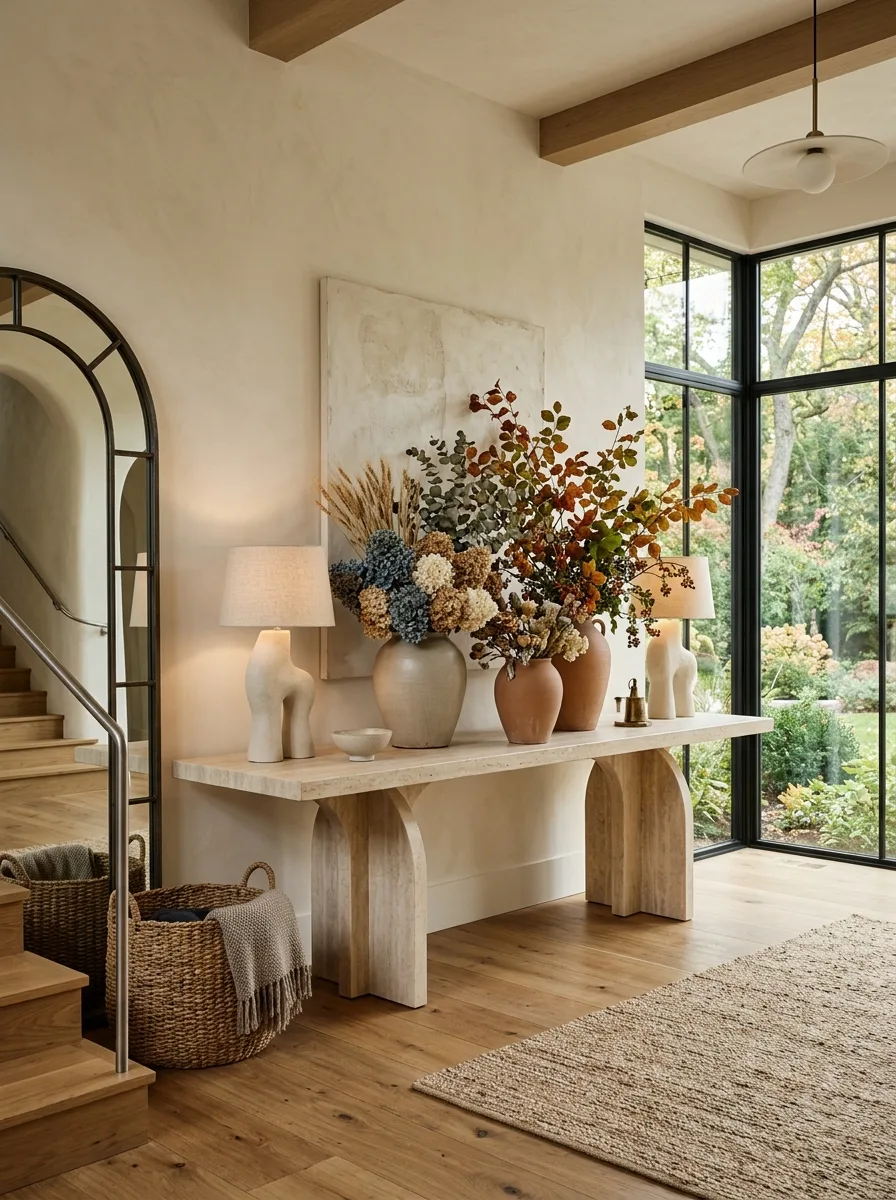
Choose a console table with a sculptural, arched leg design in a pale washed wood, and let its silhouette do as much visual work as anything placed on top. A console this architectural doesn’t need heavy styling to make an impression.
Pair two organic-shaped ceramic table lamps at either end, unmatched in exact form but similar in tone, casting warm light even during daylight hours. The slight asymmetry between the two lamps keeps the arrangement from feeling too formal.
Cluster three or four vases of varying heights and materials — stoneware, terracotta, ceramic — at the center, filled with a mix of dried hydrangea, pampas, and turning branches. Let the tallest stems reach well above the mirror’s bottom edge for real drama.
Tuck woven baskets with folded throws beneath the table’s arched legs, using the negative space the leg design creates rather than hiding it. The architecture of the table itself becomes part of the storage solution.
Pumpkins Lined Along Runner
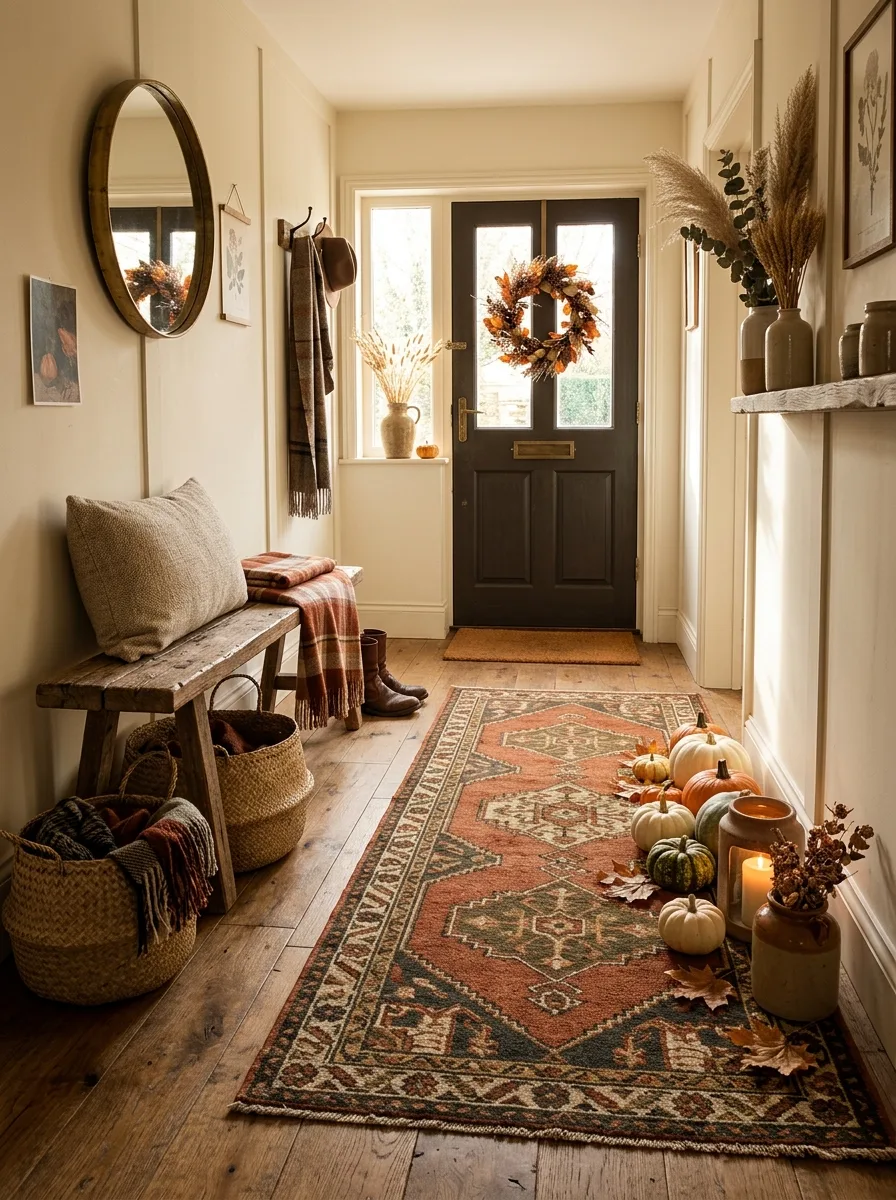
Run a patterned wool or kilim runner the full length of a narrow hallway, and let it carry most of the color and pattern so nothing else in the space needs to compete with it. A bold runner is often the only bold choice a narrow entry needs.
Line a small row of mixed white and orange pumpkins directly along one edge of the runner, close to the wall rather than centered, so foot traffic isn’t obstructed. This is one of the few spots where lining objects up in a row actually works, because the runner’s straight edge gives them a reason to be aligned.
Set a lit lantern candle and a small ceramic vase of dried florals at the end of the pumpkin row, marking a natural stopping point. Without that visual anchor, a long row of pumpkins can feel like it’s trailing off rather than ending intentionally.
Keep the bench and wall above simple — one throw, one wreath on the door glass — so the runner and its pumpkin border stay the clear focal point of the hallway.
Arched Mirror Amber Vases
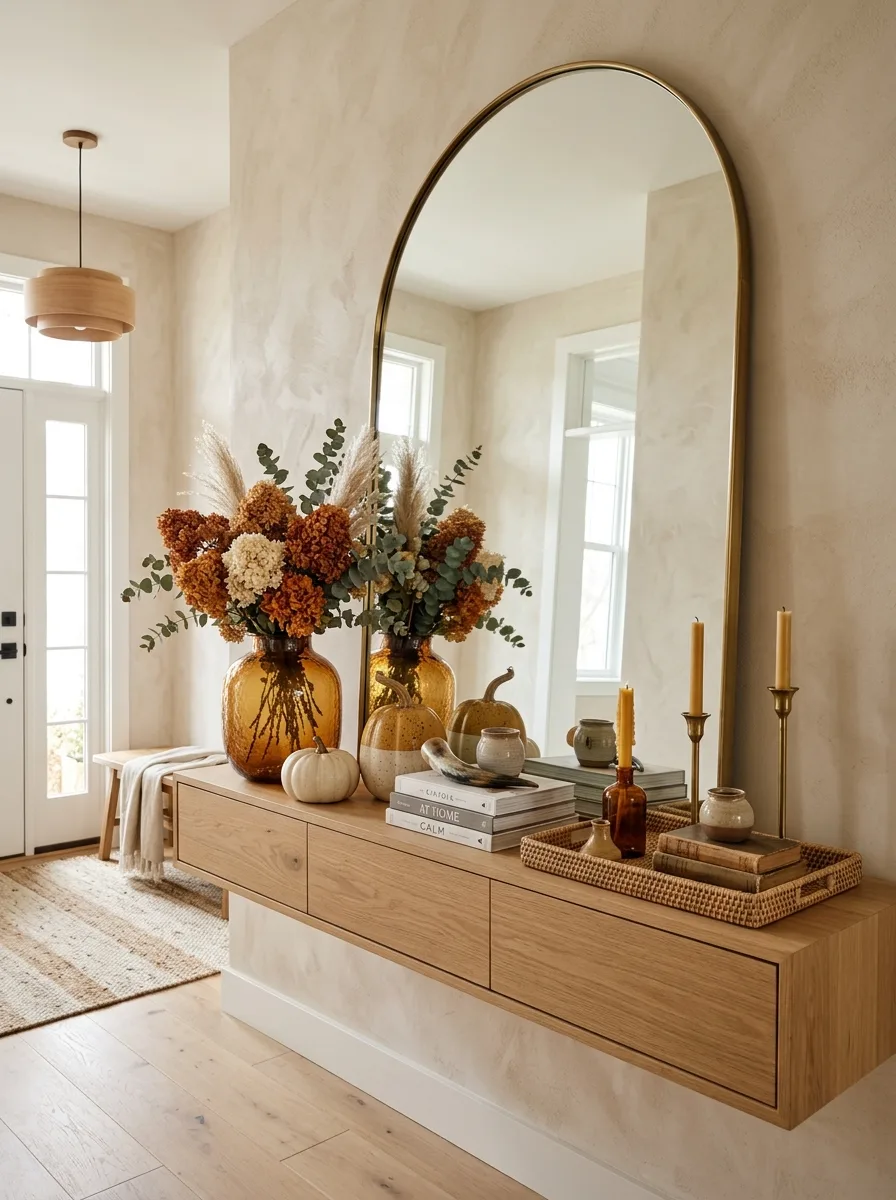
Hang a tall, arched mirror in a light wood frame directly above a floating console, letting its height dominate the wall rather than centering a smaller piece. In a narrow entry, one oversized mirror does more than several small decorative objects combined.
Fill matching amber glass vases with dried hydrangea and pampas grass, positioned so their reflection in the mirror doubles the arrangement’s visual size. This is a trick worth using anywhere a large mirror sits directly behind a floral moment.
Add a pair of brass candlesticks at the console’s far end, paired with a short stack of hardcover books and a woven tray holding smaller objects — a jar, a bottle, a votive. The tray keeps the smallest items from scattering across the console’s surface.
Tuck one small mini pumpkin at the base of the vases, the only nod to the season in an otherwise material-driven vignette. A single pumpkin reads as intentional restraint here, where five would compete with the amber glass.
Terracotta Pots Flank Door
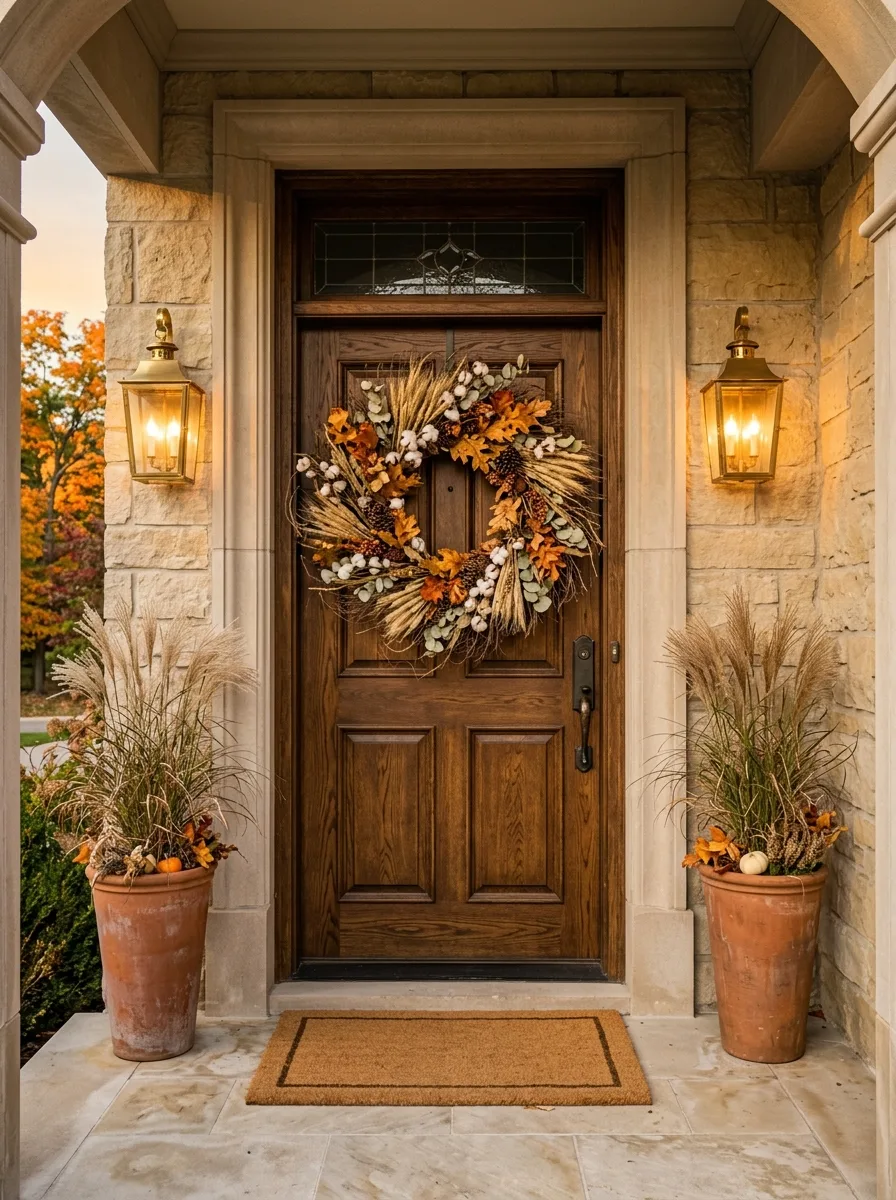
Set two oversized terracotta pots on either side of a front door, planted with tall ornamental grasses that catch the light and move in the wind — motion a static wreath can’t provide. The grasses should be tall enough to reach shoulder height or above.
Tuck one or two small pumpkins into the base of each pot, nestled at soil level rather than balanced on top of the grasses. This grounds the arrangement and keeps the eye from reading the pots as purely decorative planters.
Hang a substantial dried wreath directly on the door’s center panel, heavy with wheat, cotton bolls, and layered leaves, and flank it with warm brass lantern sconces on either side. The sconces should stay lit even in daylight for anyone approaching at dusk.
Lay a simple coir mat at the threshold in a neutral tone, letting the wreath and potted grasses carry all the seasonal color so the mat itself doesn’t need a pattern.
Dutch Door Boot Room
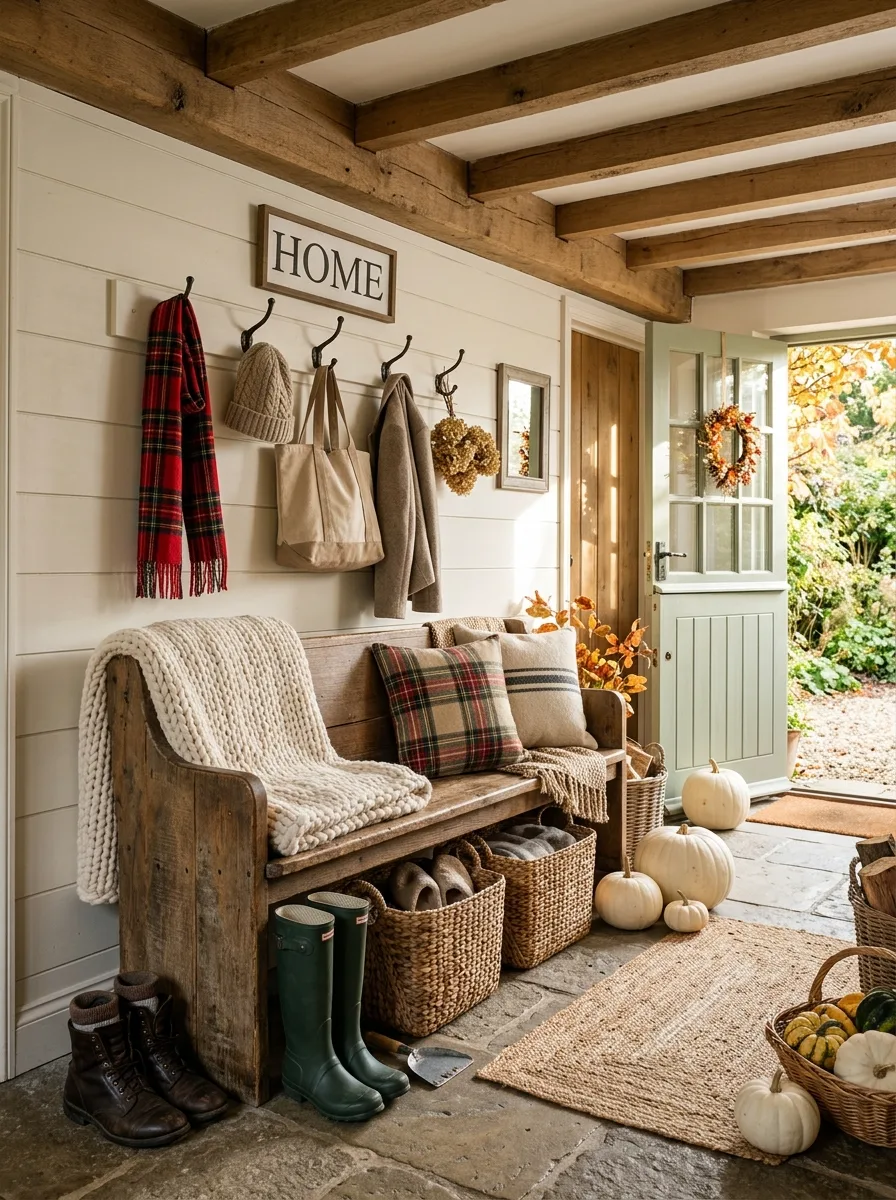
Install a Dutch door at the entry, left open on top even when closed below, so light and air move through the boot room without fully opening the space to outside. This single architectural choice does more for the room’s character than any styling on top of it.
Line a row of hooks above a wood pew-style bench, mixing a plaid scarf, a knit hat, and a canvas tote at varied heights rather than in a straight row. Add a small dried hydrangea bundle on one hook, the only purely decorative object among genuinely functional ones.
Layer the bench with plaid wool pillows and a chunky cream throw, keeping real muddy boots lined up on the floor directly below rather than tucked out of sight. This room works because it looks used, not staged.
Set a woven basket of mixed gourds just inside the open door, positioned so it’s one of the first things visible from outside. It bridges the transition between the porch and the boot room without needing anything else to make that connection.
Oversized Olive Tree Urn
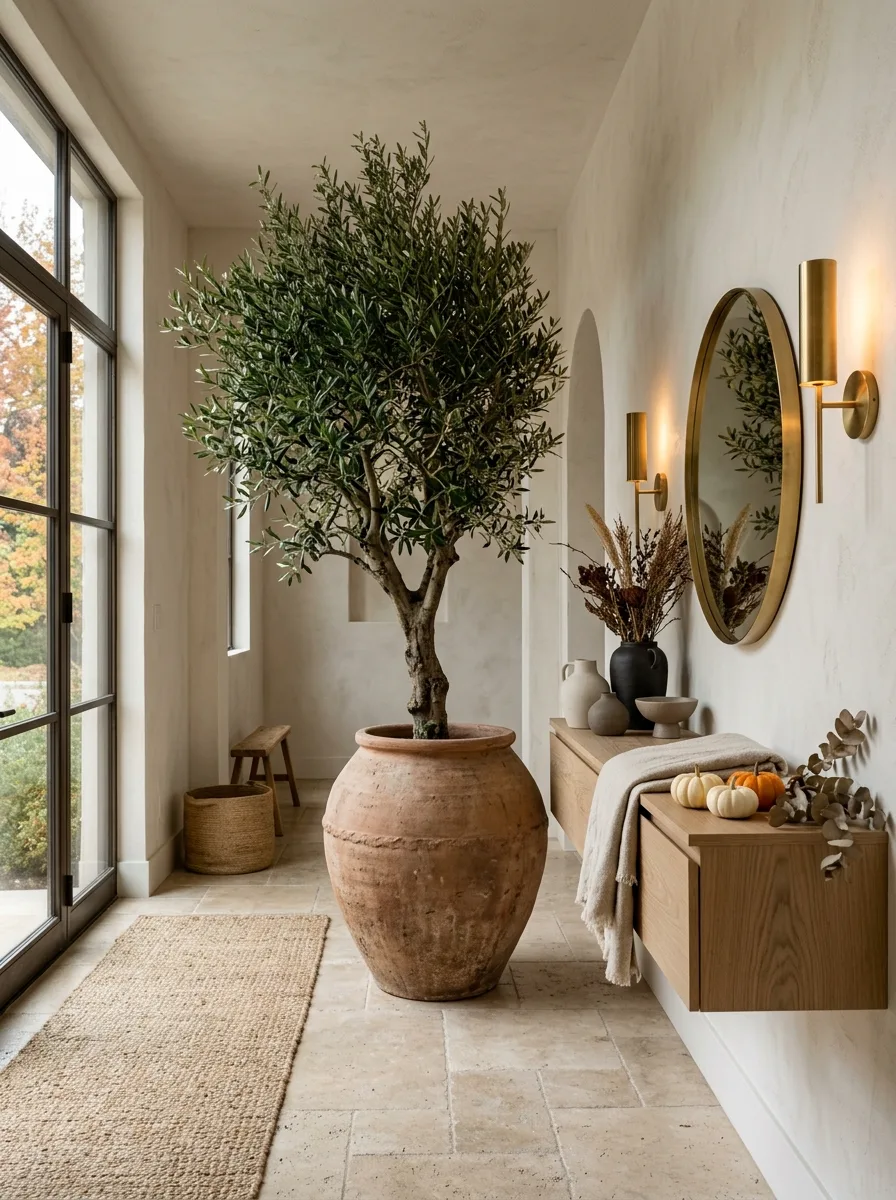
Plant a mature olive tree in an oversized aged terracotta urn, sized to command real floor space rather than tucked into a corner as an afterthought. The scale here is the entire point — a small potted plant in a small pot won’t read the same way.
Position the urn near a floor-to-ceiling window so natural light hits the tree’s canopy and casts shifting shadow across the plaster wall behind it. This works especially well in a light-filled, minimal entry where the tree becomes the room’s main organic element.
Keep the console nearby nearly bare — a folded linen throw, two or three small pumpkins, one ceramic vessel — so the oversized urn stays the undisputed focal point. Anything more competes with a piece this large.
Add a single round brass mirror and slim sconces on the wall above the console, angled to catch and reflect the tree’s greenery rather than facing straight out. The reflection doubles the impact of the one big gesture the room is built around.
Basket Overflowing With Pinecones
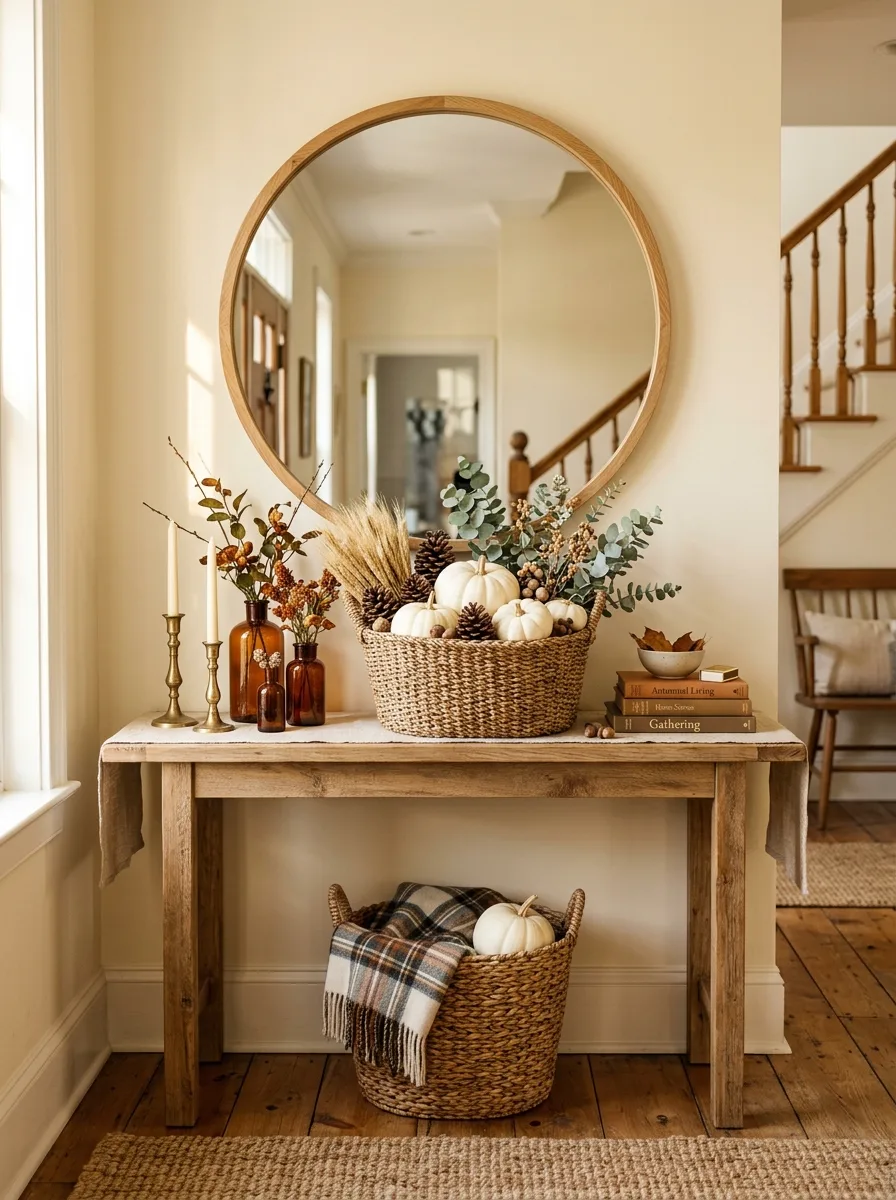
Fill a wide, shallow woven basket with a loose mix of pinecones, mini white pumpkins, and dried floral stems, letting the arrangement rise well above the basket’s rim rather than sitting flush. Overflow is the effect to aim for here, not containment.
Set the basket directly on a simple wood console beneath a round wood-framed mirror, flanked by amber glass bottles holding single dried stems on either side. The bottles should vary slightly in height so the whole grouping has a visible rhythm.
Add a pair of brass candlesticks and a short stack of hardcover books to one side of the basket, leaving the opposite side of the console entirely bare. That asymmetry is what keeps a fairly full console from tipping into cluttered.
Tuck a second, smaller basket beneath the table holding a folded plaid throw and one more mini pumpkin, echoing the top arrangement without repeating it exactly.
Wreath Beside The Door
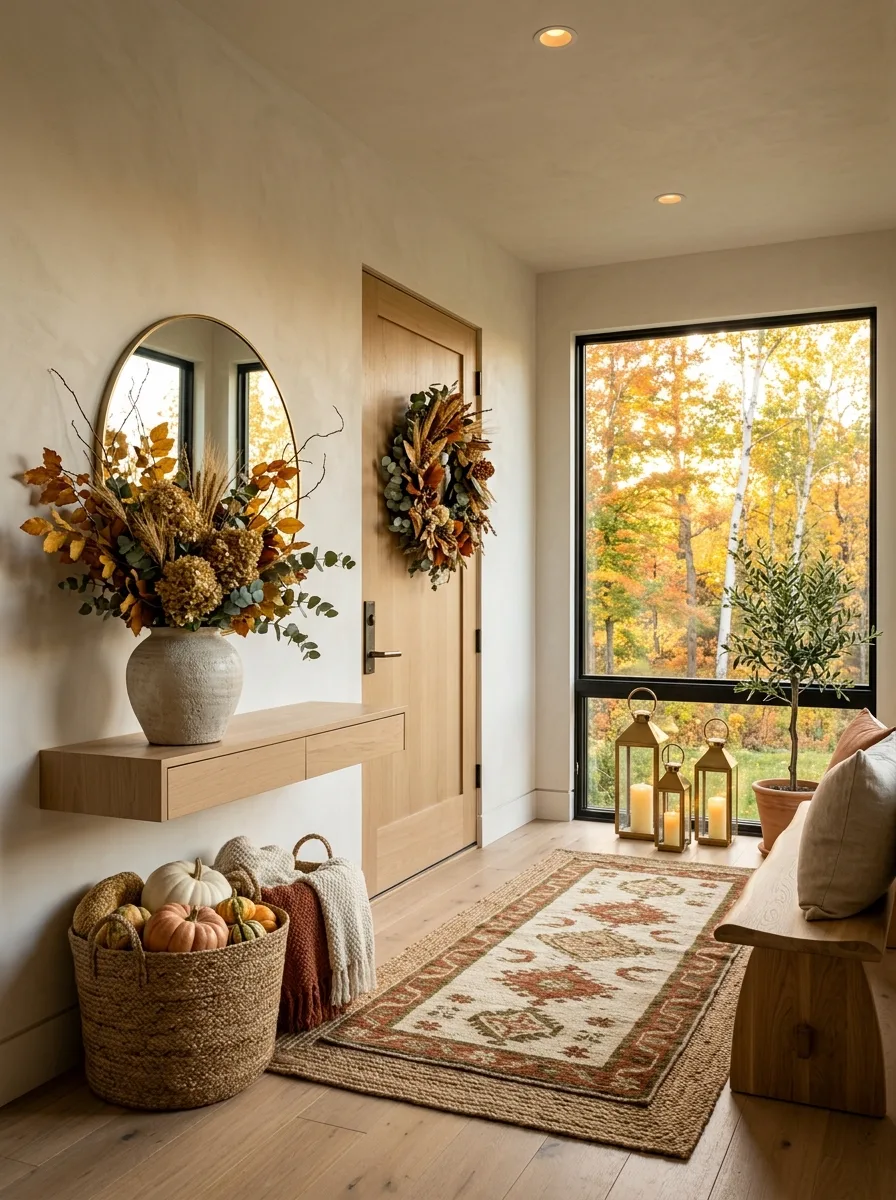
Hang a dried wreath directly on the wall beside the front door rather than on the door itself, giving it a permanent, unobstructed spot that doesn’t move every time the door opens. This placement works especially well in modern entries where the door itself stays clean and unadorned.
Pair a floating wood console on the opposite wall with a single oversized ceramic vase, filled with a dramatic mix of dried hydrangea and turning branches reaching well above the round mirror hung above it. Let the arrangement’s scale match the wreath’s presence across the room.
Set a cluster of brass-and-glass lanterns on the floor beneath a large window, positioned to catch both the natural light coming in and the golden hour glow outside. Lit even during the day, they read as intentional ambiance rather than functional backup lighting.
Anchor the floor with a patterned runner and a single woven basket of mixed gourds near the console’s base, keeping the rest of the floor clear so the room’s architecture — the big window, the wreath, the vase — stays the visual story.
Final Thoughts
An entryway isn’t really about pumpkins or wreaths. It’s about deciding, in the ten seconds someone has to form an opinion, what you want that opinion to be.
Every example here does one thing well and lets everything else support it — a mirror, a tree, a runner, a wreath hung where it can actually be seen. None of them try to do everything at once, and that’s exactly why they work.
The rooms that fail aren’t missing objects. They’re missing a decision about which object matters most.
Pick one thing to be the reason someone stops for a second before taking their shoes off. Let the rest of the room hold that thought up, quietly, and get out of the way.