
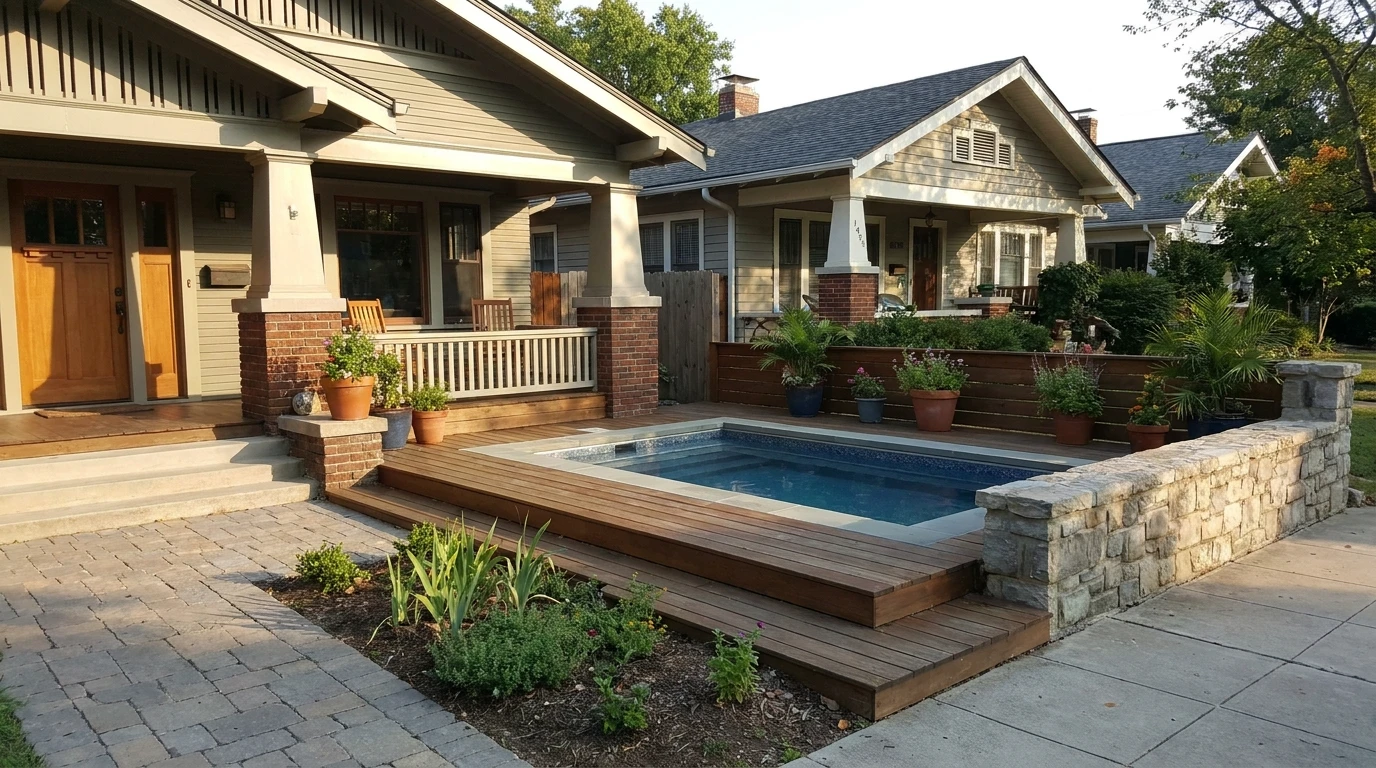
The pool industry spent decades convincing people that bigger is better. Massive kidney-shaped lagoons with waterfalls, adjacent hot tubs, and enough square footage to host a neighbourhood swim meet. And then everyone discovered they had a backyard the size of a parking space and no budget for excavation equipment.
Here’s the thing nobody wanted to admit: smaller pools are often better pools. They’re faster to build, cheaper to heat, easier to maintain, and when they’re designed well, they look more intentional than anything you could pour into a half-acre lot.
The problem isn’t the size. It’s that most people approach a small pool the same way they’d approach a large one — and then wonder why it looks like something got left unfinished.
These ideas are for people who’ve decided to stop apologising for their yard and start actually using it.
The Shape Question Nobody Asks Early Enough
Most people choose a pool shape the way they choose a paint colour — by looking at swatches and picking what seems nice. Shape is not an aesthetic choice. It’s a spatial one.
When Rectangles Are Right and When They’re Not
A rectangle is not the safe choice. It’s the choice that demands the most from its surroundings.
A rectangular pool draws two parallel lines across your yard. Those lines have to go somewhere meaningful, or they just point at a fence. If your space is longer than it is wide, a rectangle works. If it’s a rough square, a rectangle will always look jammed in.
In a long, narrow courtyard, a rectangular pool aligned with the axis of the space turns constraint into composition. The long edge becomes a lap feature even if the pool is only six metres. The coping becomes a visual line that leads the eye to whatever is at the end — a wall, a garden bed, a water feature.
If your yard isn’t shaped like a rectangle, don’t force one into it.
What Curves Are Actually For
A curved or freeform pool is not softer or more natural because of its shape. It’s because curves follow the contours of existing landscape rather than cutting across them.
If your yard has irregular boundaries, established garden beds, or trees you want to keep, a curved pool lets you work around them instead of against them. A freeform shape with generous planting along the perimeter can make a small pool look like it grew there.
The mistake is using a curved pool in a perfectly rectangular yard. Then it just looks like you couldn’t decide.
The Compact Plunge Pool Argument
Below roughly five by three metres, the question of shape changes entirely. At that scale, the pool is more furniture than infrastructure. It sits in the yard the way a fire pit or a large planter does — as a feature, not a floor plan.
Compact pools work best when they’re treated exactly that way. Placed deliberately, framed by a single strong material on the surround, surrounded by enough negative space to breathe. The error is trying to squeeze a full pool experience into a plunge pool footprint. You won’t. So commit to what it actually is.
What You Build Around the Water Matters More Than the Water
The pool is a hole with water in it. What makes it a space is everything else.
The Deck Is Not a Bonus Feature
The decking or paving around a small pool is where the design lives. A beautiful pool with bad coping looks like a renovation that ran out of money three metres from the finish line.
For small pools, the surround should be at least as wide as feels uncomfortable. The impulse is to save space by narrowing the deck. The result is a pool that looks squeezed. Two to three pavers wide on each accessible side is the minimum. More if you want a sun lounger.
Material matters. Timber decking makes a small pool feel warm and residential. Large-format stone makes it feel architectural. Terracotta or textured tile makes it feel Mediterranean. Choose one and commit to it — mixing materials around a small pool creates visual noise.
Fencing Is a Design Element, Not Just a Legal Obligation
Every pool needs fencing. Most pool fencing is handled as an afterthought. This is where a lot of otherwise decent small pool setups fall apart.
Frameless glass is the obvious choice and often the right one. It doesn’t break the visual plane. But it requires the view beyond it to be worth seeing. If your fence line is a colorbond boundary fence or a bare wall, glass fencing just frames that problem clearly.
Slat fencing — horizontal or vertical timber — can become the backdrop against which the whole pool space reads. A white horizontal-slat fence behind a small plunge pool with timber decking creates a cohesive room out of what was a leftover corner.
Plants Are Not Optional
A pool without any planting looks like a photo from a sales brochure. Not a place anyone actually lives.
For small pools, the plants aren’t there to fill space. They’re there to create scale. A single large-leafed tropical plant — bird of paradise, elephant ear, a potted olive tree — next to a small pool makes the water look deliberate. Nothing next to it makes it look like it needs more room around it.
Small Backyard Pool Ideas
The Raised Stone Plunge Pool That Earns Its Footprint
Take a compact plunge pool — no larger than four by two and a half metres — and raise it entirely above grade on a dry-stacked natural stone surround. Use irregular fieldstone or split sandstone, not manufactured block. The surround should be at least four to five courses high, wide enough at the top to sit on.
Fill in the ground plane with decomposed granite or crushed white rock and plant low succulents tight to the base. Add a ring of compact uplights around the perimeter at ground level, angled up toward the stone. At night, the structure glows from the base.
The interior tile should be small-format — mosaic or similar — in a teal or sea-glass blue. The contrast between the rough natural stone exterior and the fine reflective tile at the rim is the detail that makes this work.
The steps integrate into the stone surround on one face. They’re part of the structure, not added on.
The Natural Swimming Pond With the Stone Surround
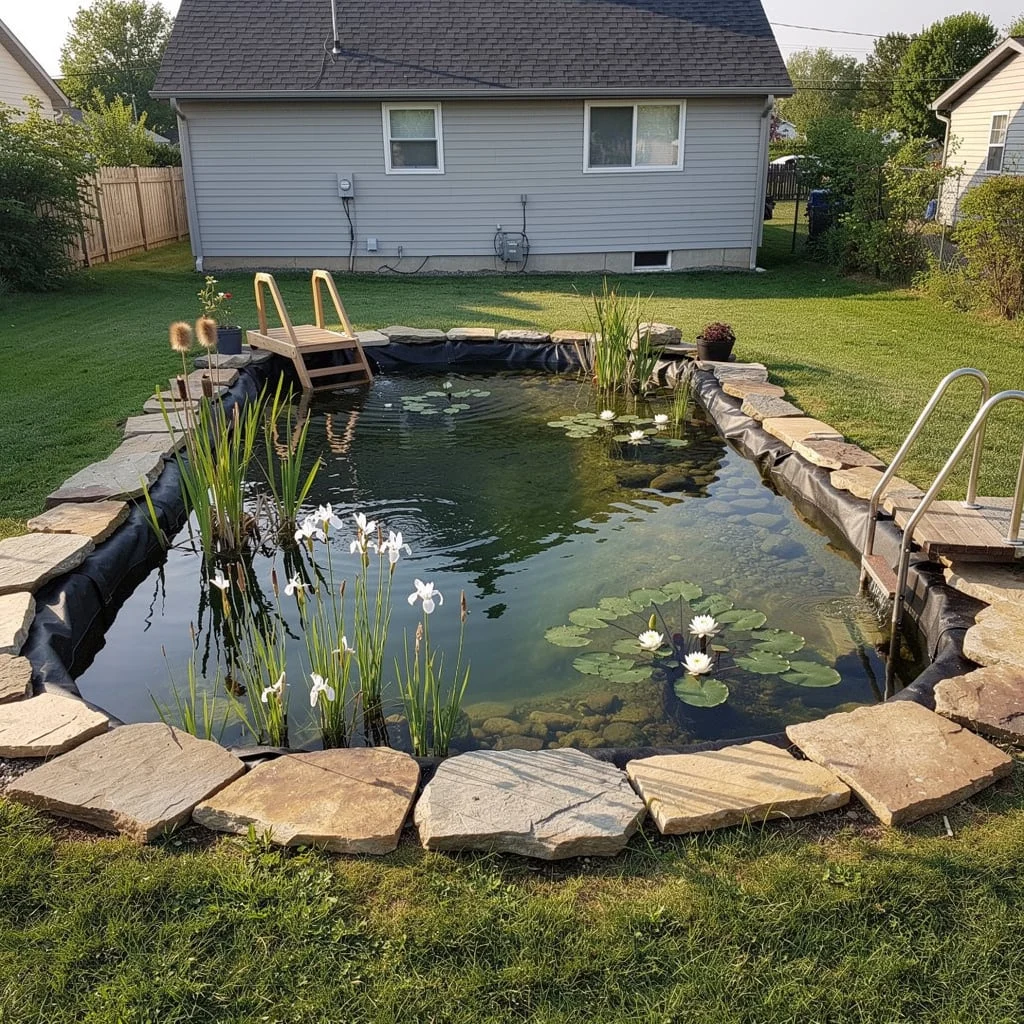
Excavate a large irregular shape and line it with a butyl rubber pond liner in black. Build up the perimeter with flat sandstone slabs laid loosely as coping — not mortared, not perfectly level. Some should overhang the water slightly.
Divide the pond into two zones: a deep swimming section and a shallow regeneration zone planted with aquatic marginals — iris, cattail, water lily. The regeneration zone is the filtration system. No chemicals. No pump beyond a gentle circulation to keep water moving between zones.
Add a simple timber ladder on one end using two uprights and three rungs. Nothing architectural. Just functional.
This is not a low-maintenance pool. It requires understanding how the ecosystem works, monitoring the plant balance, and managing the planted zone seasonally. But it cleans itself. And in three seasons, it looks like it’s always been there.
The Round Mosaic Plunge Pool With Ground Lighting
Install a circular plunge pool — around two to two and a half metres in diameter — entirely above grade, standing roughly 700mm off the ground. Clad the exterior in small-format mosaic tile in a dark teal or slate blue, the same tile that lines the interior.
Lay a ring of crushed white pebbles around the base, roughly 400mm wide. Plant a ring of compact succulents or ground-hugging bromeliads into the pebble band. Install a series of low-voltage spike lights around the perimeter, pointing upward at the mosaic exterior.
Build wide timber steps into one section of the surround — three steps, generous tread depth, no railing. The steps are part of the structure.
At night this pool works as a lantern. The uplighting through the mosaic tiles creates a warmth that reads completely differently from daytime.
The Dark Courtyard Pool With the Climbing Green Wall
Dig a rectangular pool into a walled courtyard space — roughly four and a half by two and a half metres. Use a charcoal or near-black interior finish. Lay large-format slate or dark bluestone paving around the perimeter, two full tiles wide on each side.
Train climbing ivy or Virginia creeper across the entire rear wall — from ground to parapet. This is the dominant feature. The dark water, dark paving, and green wall create three distinct registers of the same moody palette.
Place two low-slung matte black sunloungers on the paved section. Nothing upholstered, nothing that requires cushions. Keep the furniture count low.
The only colour in this yard comes from flowers that seed themselves into the base of the climbing plant. You don’t plant them intentionally. You let them appear.
The Wisteria Pergola Pool With White Tile Surround
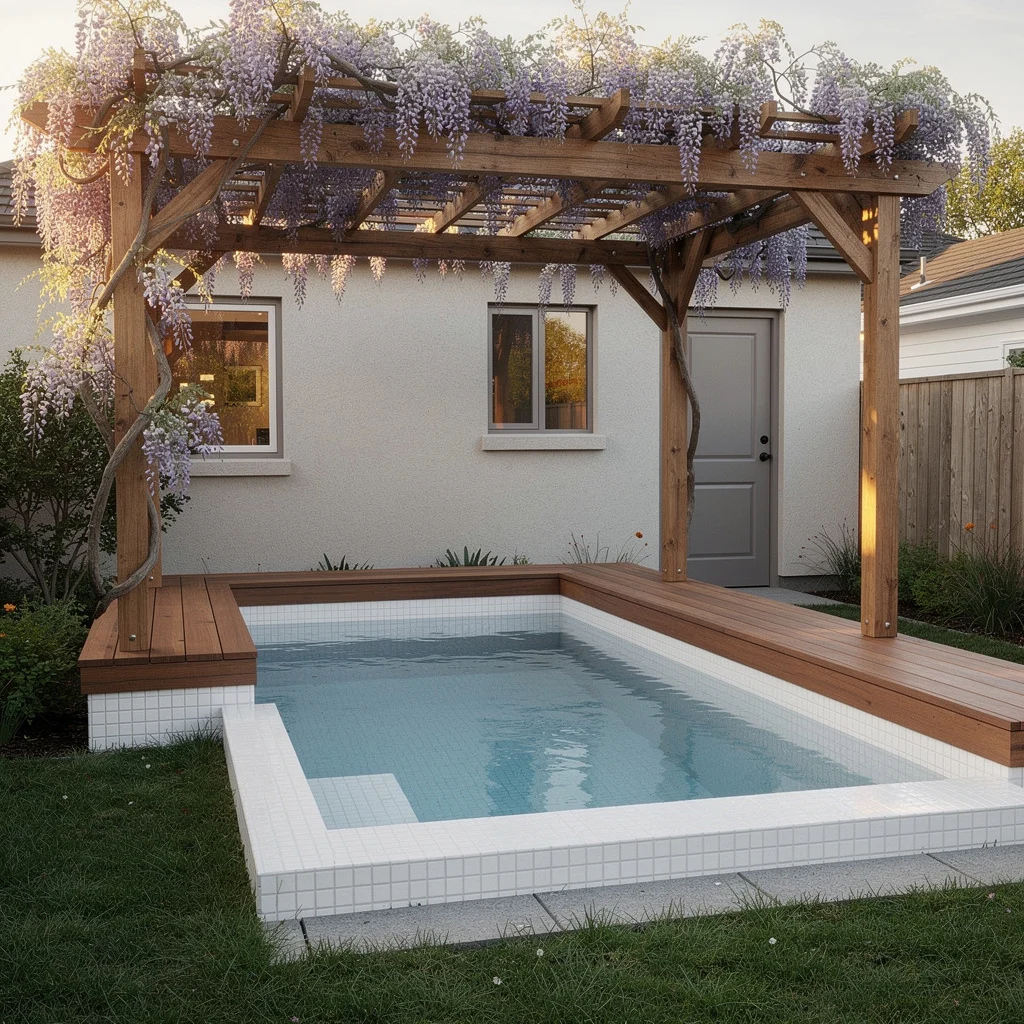
Build a simple rectangular pool — approximately four by three metres — raised approximately 400mm above grade. Clad the visible exterior faces entirely in white square ceramic tile, grout joint and all. The top surface of the coping is timber — a flat-sawn hardwood board around the full perimeter.
Build a timber pergola over half the pool and all of the adjacent deck. Use rough-sawn treated pine or cedar in heavy dimensions. Plant wisteria at two base posts and train it aggressively. Give it two to three seasons before this design reaches full effect.
Install a single strand of festoon lighting across the pergola, looped loosely.
At golden hour, the light through the wisteria onto the white tile surround does something that no amount of design planning fully replicates. This is a pool built for one specific kind of afternoon.
The Brick Backyard Rectangle With the Limestone Border
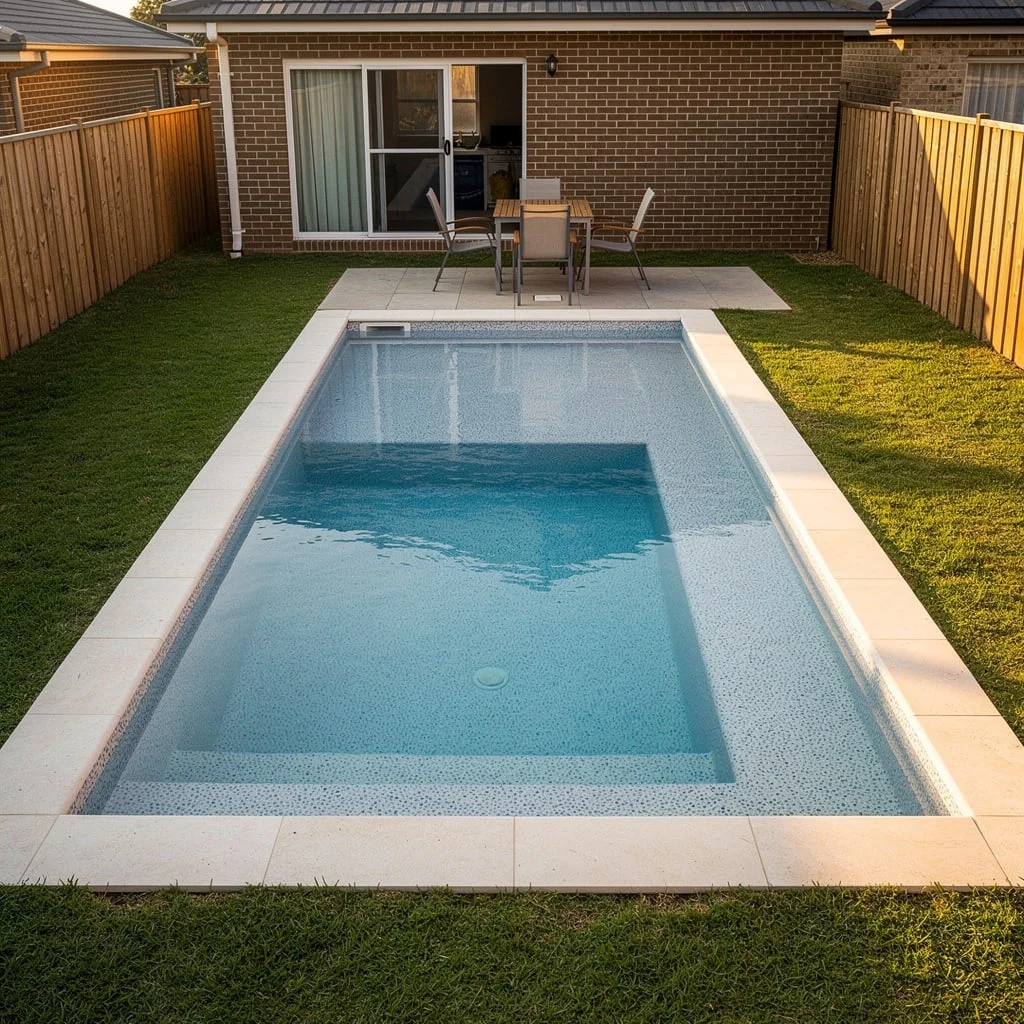
Lay a straightforward in-ground rectangular pool — standard proportions, no entry steps at the deep end — with a light pebble or aggregate interior. The water should read as a clear, bright blue.
Surround it with honed limestone coping and paving, large format, laid flush to level. Keep a consistent joint width. No pattern, no variation.
Leave generous grass on two sides. Don’t tile up to the lawn edge — let the grass run right to the coping. The contrast between the clipped green and the pale stone is the composition.
Place a small outdoor table and two chairs directly behind the pool on the paved section. That’s the whole yard. Don’t add more.
This design works because of what it doesn’t do. It refuses the temptation to fill every corner.
The Dark Lap Pool With the Waterfall Wall
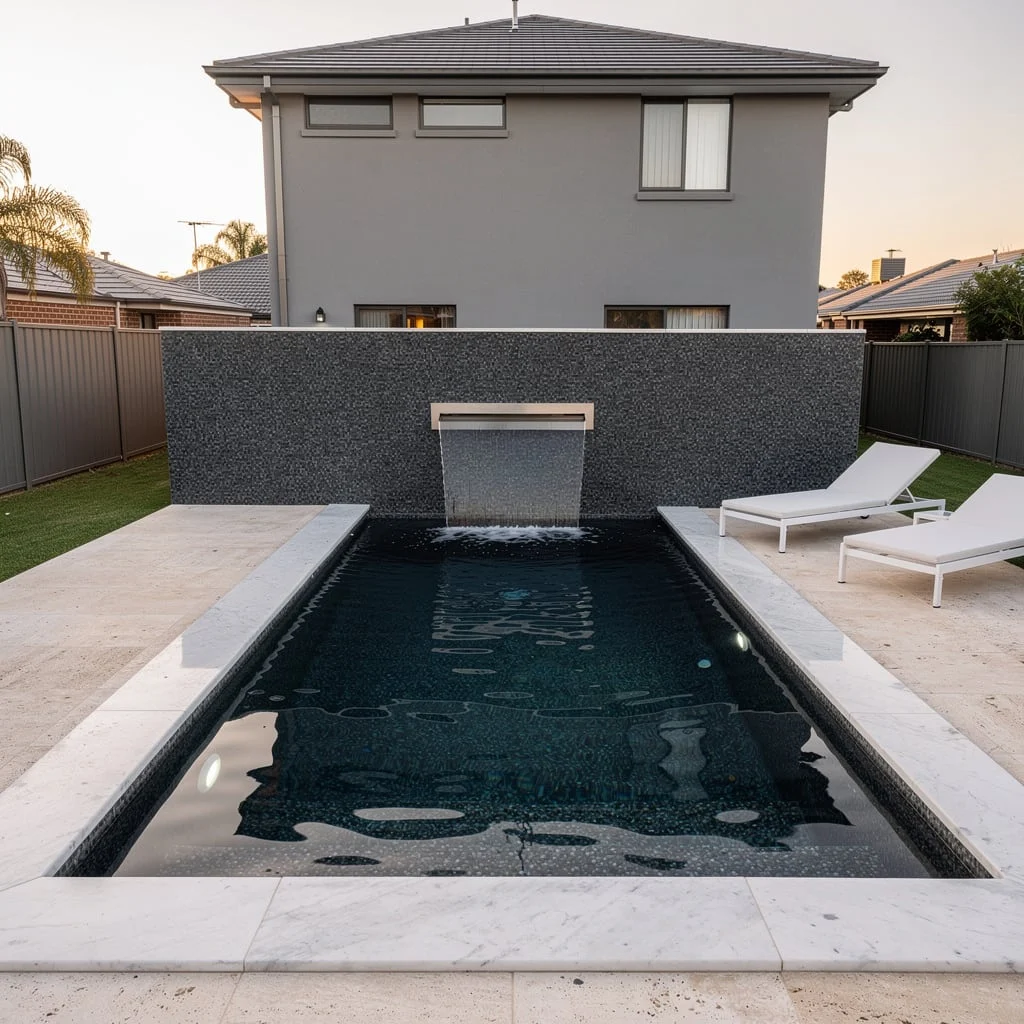
Build a narrow rectangular pool — six by two metres, or similar lap proportions — with a charcoal interior and travertine or marble coping and surround. The contrast between the white stone and the near-black water is the entire visual.
At the short end, build a tiled feature wall — same mosaic tile as a pool interior might use, in charcoal or dark grey. Centre a stainless steel blade spillway at mid-height. The water falls approximately 300mm into the pool in a continuous curtain.
Place two white powder-coated sunloungers on the travertine beside the pool. No umbrellas. No accessories.
The sound of the blade water feature is as important as the look. In a small courtyard, the white noise fills the space and creates an acoustic separation from whatever is happening on the other side of the fence.
The Hardwood Deck Pool With the Hanging Chair
Build a raised hardwood deck — spotted gum or merbau — at a consistent height above the existing lawn. The pool sits flush with the deck surface, surrounded on all four sides by the timber. The deck extends out generously on at least two sides, one of which has a step down to the yard.
Install frameless glass pool fencing at the deck perimeter rather than immediately around the water. This turns the whole deck into a fenced zone, not just the pool.
Hang a wicker egg chair from a free-standing timber post on the deck. Add a single oversized tropical plant — monstera, bird of paradise — in a tall concrete pot in one corner. Hang two linen towels on a simple wall hook screwed into a timber slat fence behind.
The deck does most of the work here. The pool is almost secondary.
The Freeform Pool With the Lavender Border
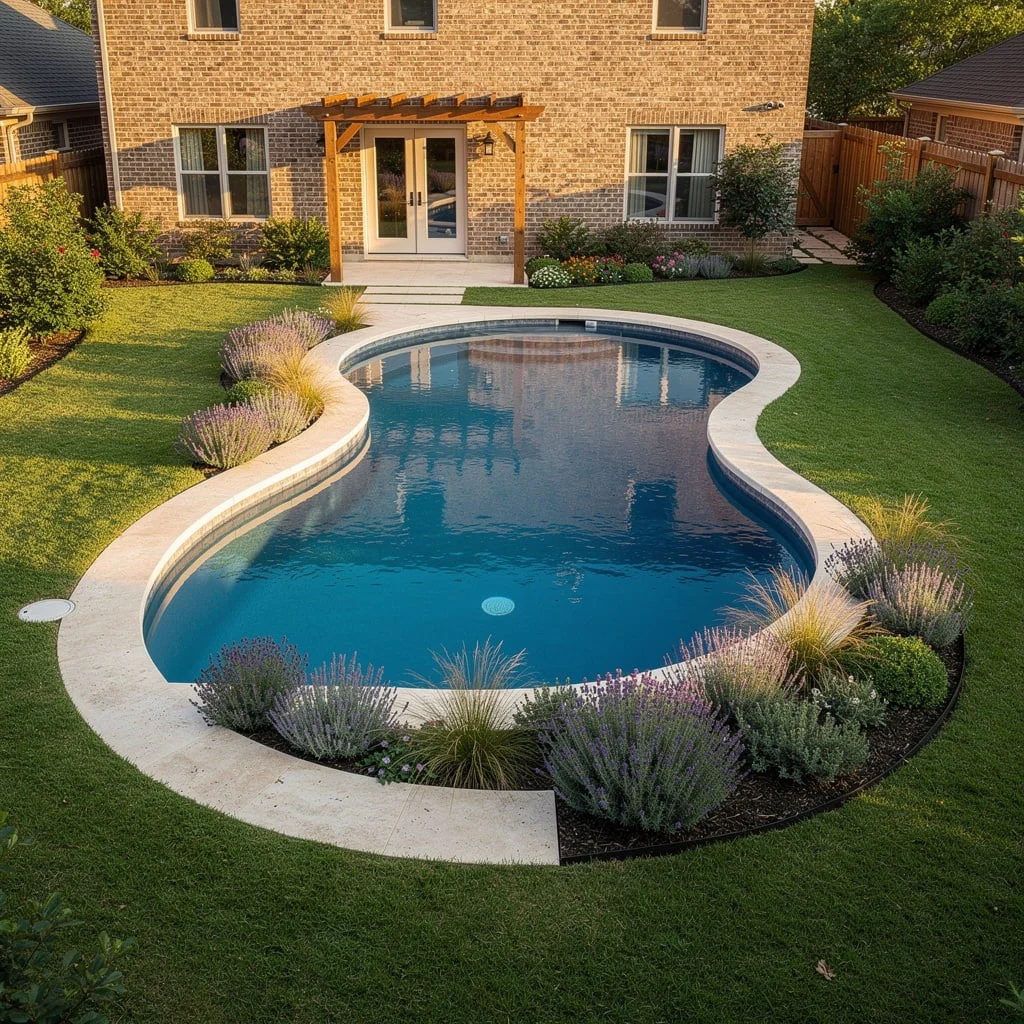
Dig a freeform pool into an open lawn — not kidney-shaped, but genuinely irregular, following a path that curves wide on one side and narrows on the other. Keep the interior mid-to-dark blue. Use a light limestone or sandstone coping that follows the curve exactly, cut to fit.
Plant lavender densely along the full curved perimeter of the coping edge, in a band roughly 600mm wide. Add clusters of ornamental grasses at wider intervals. Let the planting reach over the coping slightly.
No deck. Grass runs to the planting border. Grass runs from the planting border to the house.
This pool lives in the garden rather than occupying it. It reads as a water feature that you happen to be able to swim in, which is precisely the right way to think about a pool in a generous open lawn.
The Above-Ground Oval With the Timber Cladding
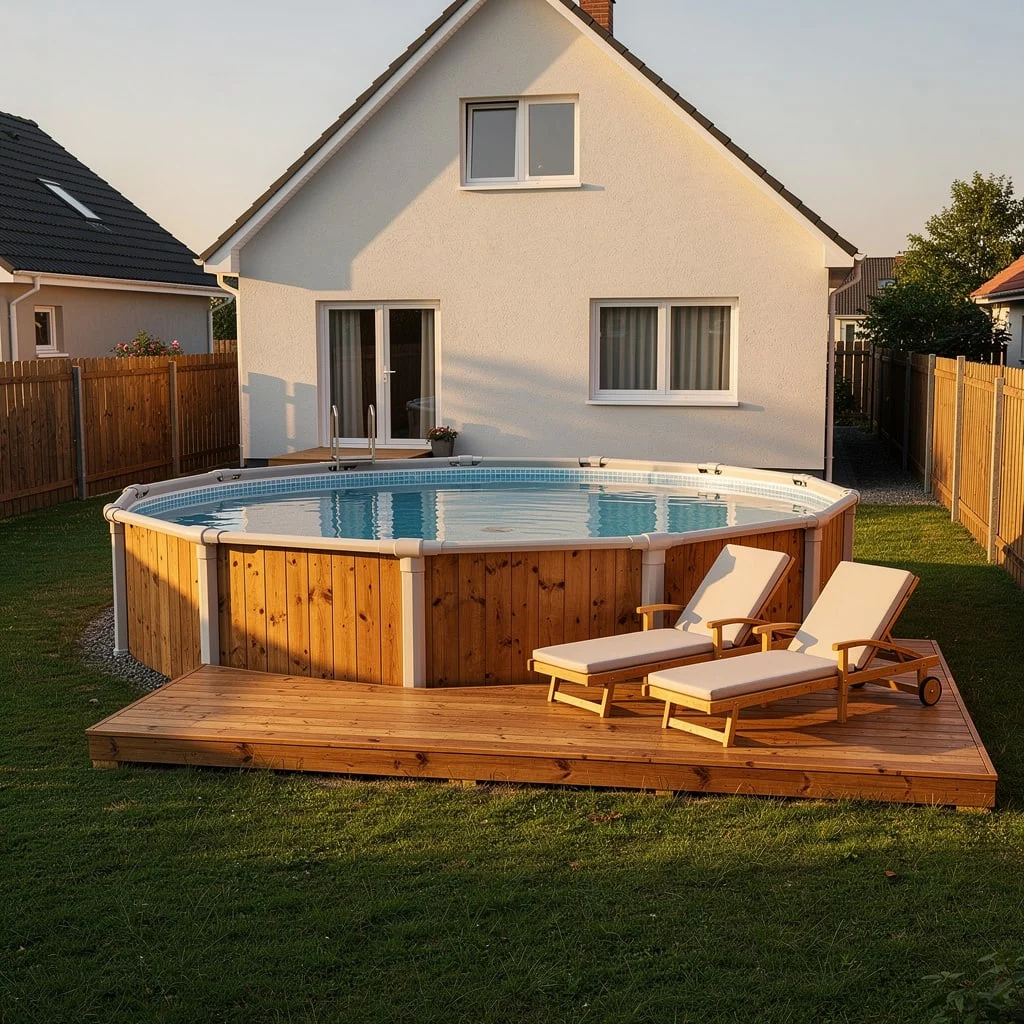
Take a standard above-ground oval pool and build it properly. Start by removing the factory panels from view entirely. Clad the exterior with horizontal rough-sawn timber boards — cedar or treated pine — in a warm honey stain. Run them from the ground up to the pool rim in a clean, uninterrupted band.
Build a low-level timber deck against one side of the pool, level to the top of the pool rim. The deck extends outward roughly two metres. Place two timber sun loungers on it with cream linen cushions.
Don’t try to disguise the pool as an in-ground pool. It’s above ground. The timber cladding says so honestly. The whole thing reads as a designed structure, not a thing someone bought in a box.
The Plunge Pool Set Into the Timber Room
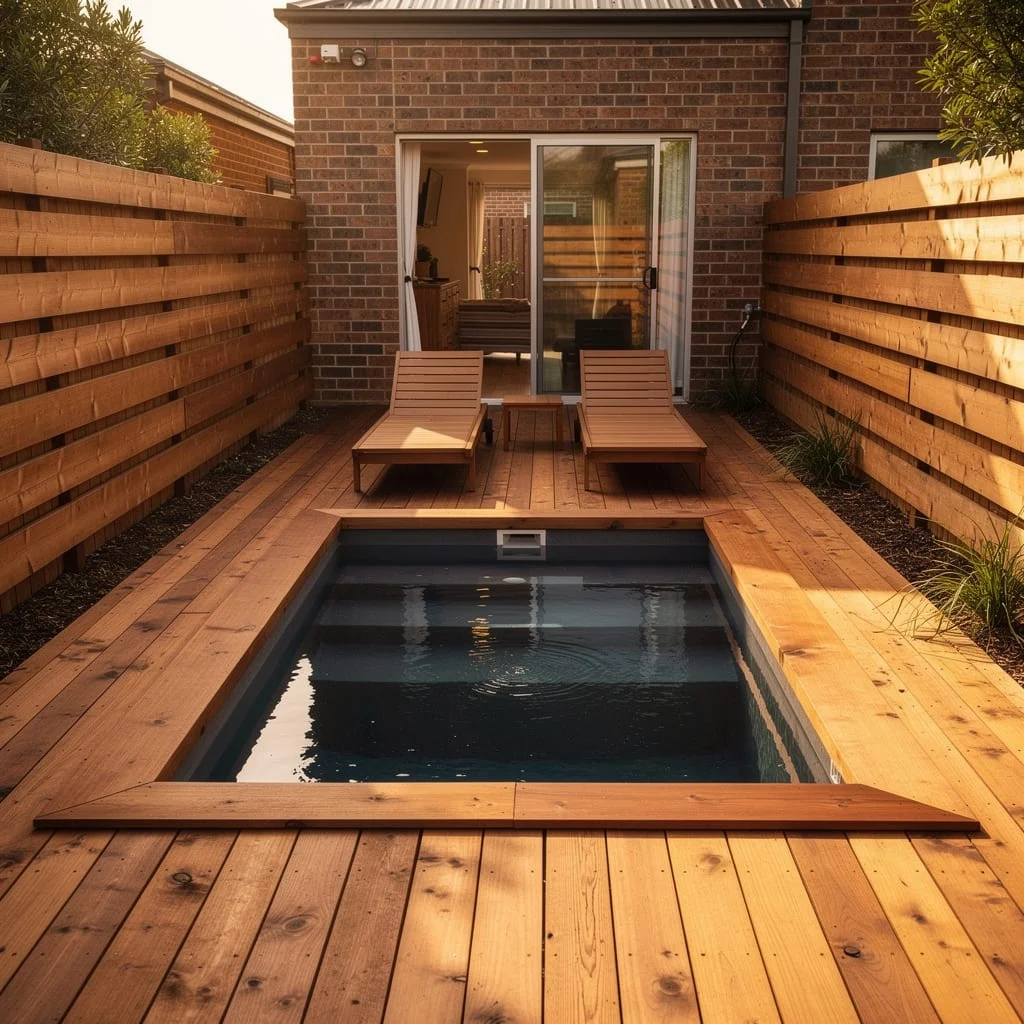
Build a small square plunge pool — roughly two and a half by two and a half — entirely surrounded by horizontal timber fencing that creates three walls of a room. The fence height should be at least 1.8 metres. Use hardwood in a mid-brown stain — not orange, not grey. Warm.
Lay hardwood decking across the entire floor of this room, with the pool dropped into it flush. The deck continues to the house door, creating a level threshold.
Place two matching timber sun loungers on the deck, parallel to the pool. Add a single plant — a tall, architectural grass or a thin-leaved screen plant — in the corner where two fence sections meet.
The fencing is doing the work. It’s turning a corner of the yard into something you actually want to spend time in. The pool is the reason you’re there, but the room is the reason you stay.
The Shipping Container Pool With Black Finish
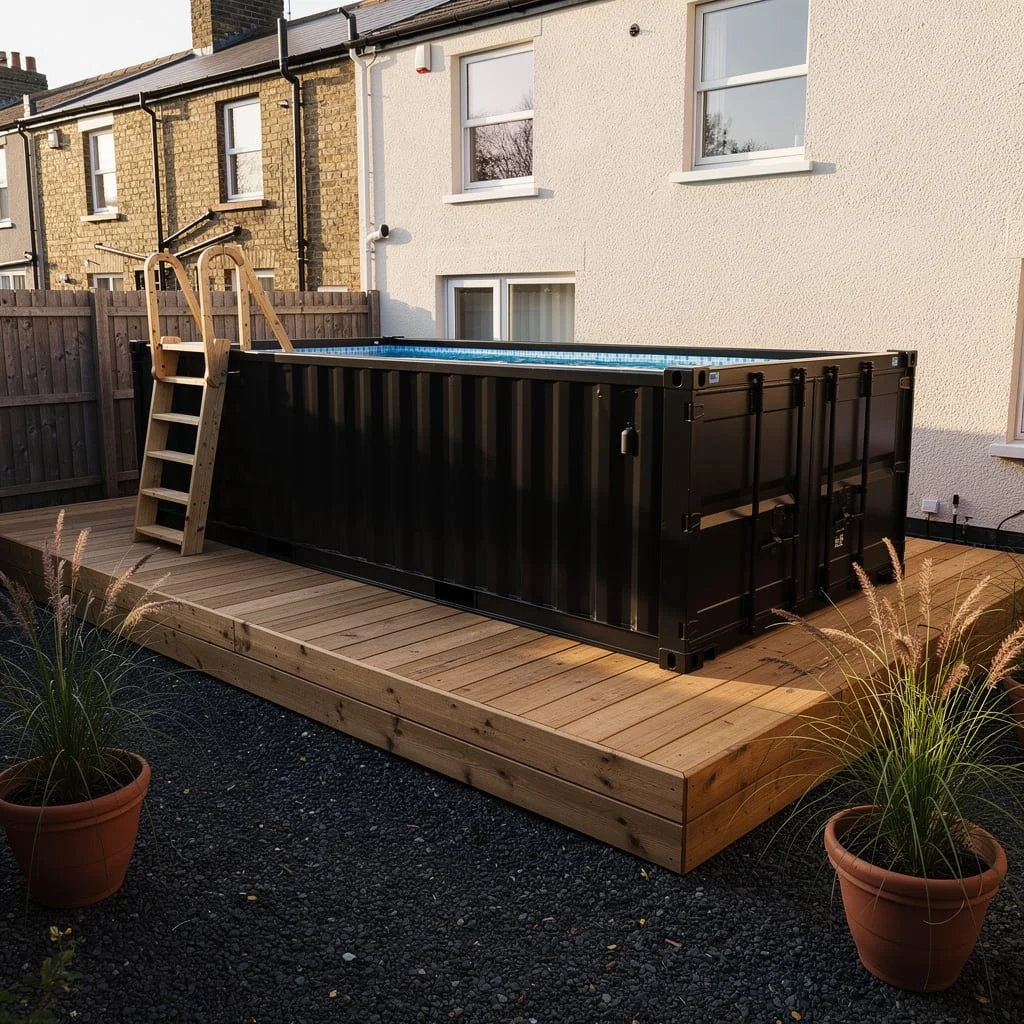
Source a standard 20-foot shipping container and have it professionally converted to a pool. Sandblast the exterior, treat it, and repaint in a flat matte black. Install an interior liner in white or light grey — you want bright water against the black exterior.
Build a low timber deck along one long side and one short side of the container. The deck sits at pool-rim height on the long side and step-down height on the short side, where you install a simple timber ladder entry.
Lay black gravel across the remaining ground plane. Place two terracotta pots with ornamental grasses on the gravel. Nothing else.
This pool isn’t trying to look like a conventional pool. It looks like exactly what it is, and that’s the whole point. It’s industrial, deliberate, and cheap to install compared to anything dug into the ground.
The Illuminated Evening Pool With the Terracotta Terrace
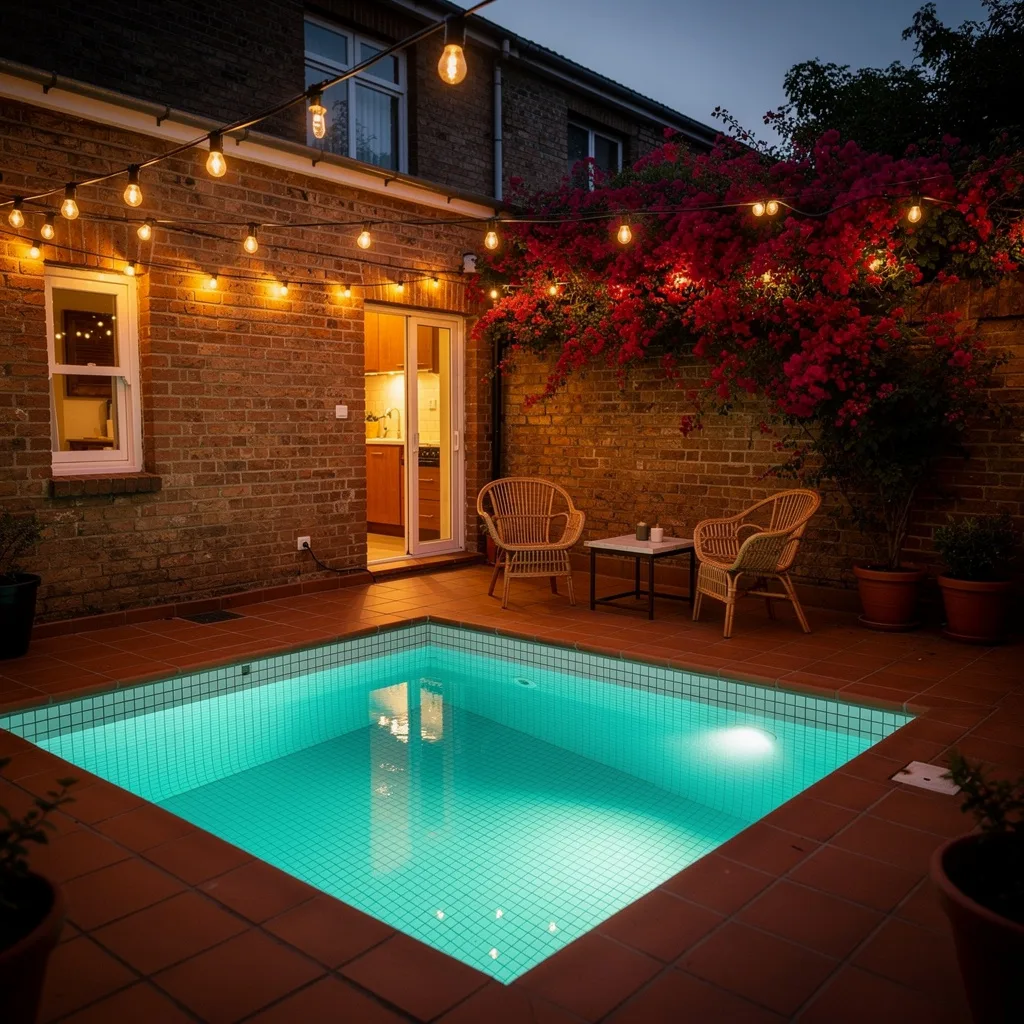
Lay a terracotta tile terrace — classic square format, dark grout — flush to the house back door. Set a small square pool into the terrace, about two and a half by two and a half metres. Tile the pool interior in small white mosaic tile. Install a single LED pool light centred in the floor, set to a cool teal or aqua tone.
Hang three to four strands of festoon lights from the house wall to a point above the terrace — a hook fixed to the fence post, a simple eye-bolt into the garden wall. The bulbs should be filament style, warm white. No coloured lights.
Plant one large bougainvillea at the corner of the terrace fence. Train it up the wall. Let it make a mess.
Place two wicker chairs and a small table within reach of the pool edge. This is not a sunbathing pool. It’s an evening pool. The whole design resolves at dusk.
The Minimalist Courtyard Plunge With the Olive Tree
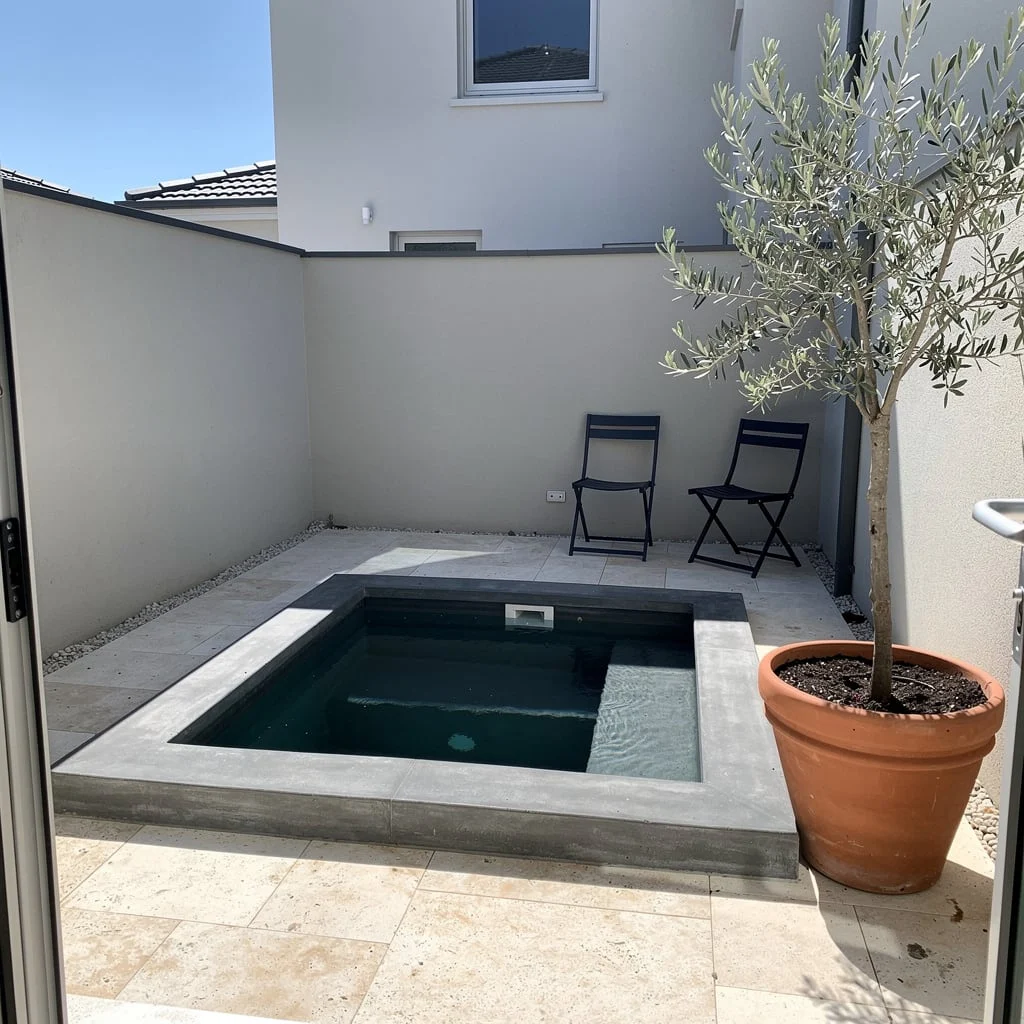
Take a small courtyard with rendered white walls — the kind you get in a terrace house or a newer townhouse with a side passage. Set a square plunge pool into the paved floor — approximately two by two metres, with a dark interior and a flat grey concrete or limestone coping that sits flush with the surrounding paving.
Don’t add anything decorative to the pool or its immediate surround. The water does the work.
Plant a single large olive tree in a generous terracotta pot — 60cm diameter minimum — beside the pool. Position it so one branch reaches over the water slightly. Add two folding black metal chairs against the wall opposite. Small table if needed.
This yard works because it refuses to try. The white walls, the dark water, the grey stone, and the olive tree create a composition that looks inevitable. Add anything and it tips over.
Final Thoughts
Every pool in this post was designed around a constraint. A small yard. A tight budget. A need to work with existing architecture rather than against it. The constraint wasn’t the problem. The constraint was the design brief.
What these pools share is commitment. Not to a style or a trend, but to a decision. The decision to go dark, or go natural, or go industrial, or go minimal — and then hold the line on that decision all the way to the last detail.
The pools that don’t work are the ones where someone chose a direction and then got nervous. Added the hanging chair but also the planter but also the string lights but also the textured coping and the coloured tile border. Everything cancels everything else out, and the yard ends up feeling busy without ever feeling finished.
A small pool in a small yard is a lesson in editing. Figure out the one thing that makes yours worth building. Then let that one thing do its job.