
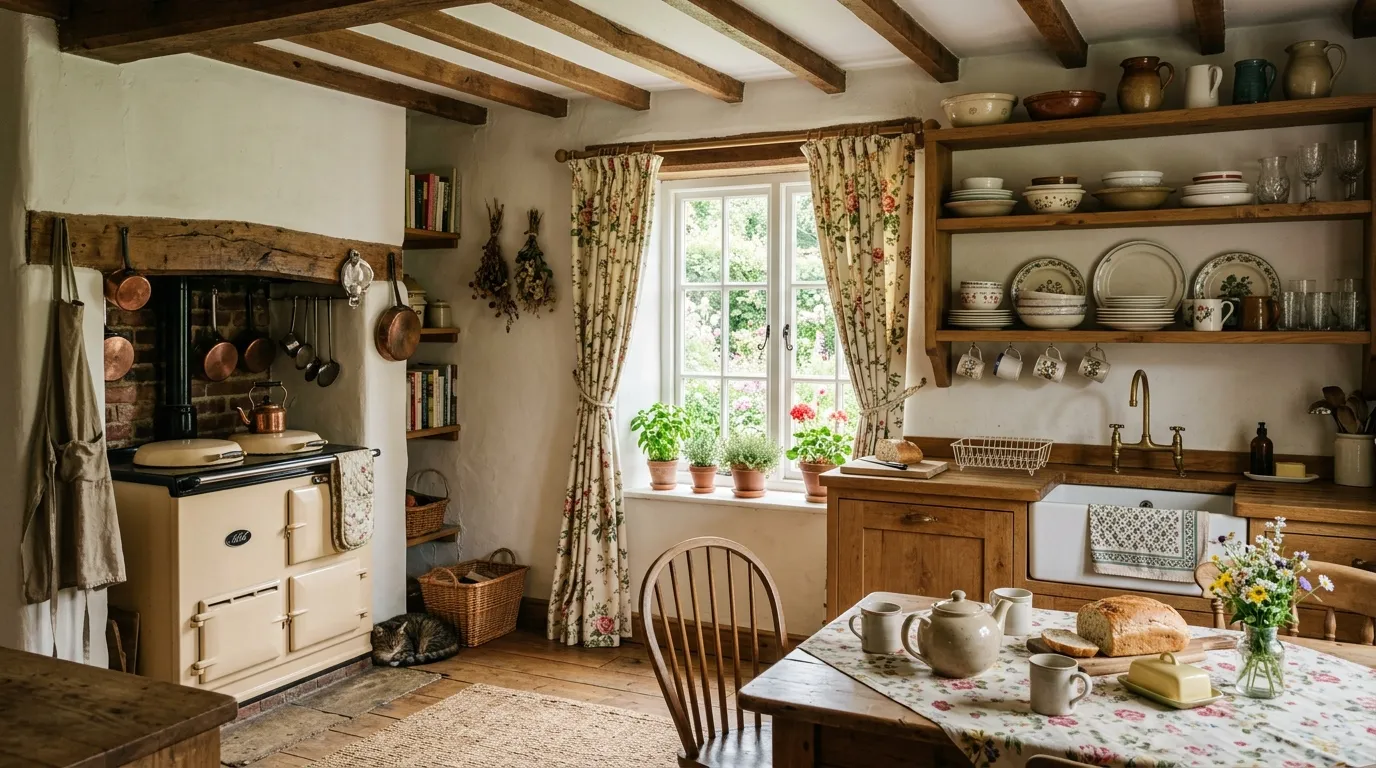
There’s a version of you that owns a kitchen with unlacquered brass hardware, bundles of dried lavender hanging from a beam, a farmhouse sink, and a collection of transferware plates displayed on open shelves. That version of you is not aspirational. It’s just waiting for you to stop pinning grey slabs and start making decisions.
Cottage kitchens get dismissed as fussy. Too much stuff. Not enough countertop. The wrong side of timeless. This is the opinion of someone who has never stood in a kitchen that smelled like dried herbs and old wood and felt genuinely at home in their own house.
The thing about a cottage kitchen is that it has to be inhabited. It cannot be styled into existence with a few wicker baskets and a bridge faucet. The rooms that work are the ones where every surface tells you something about the person who lives there. The collection on the shelves is real. The copper pans are used. The flowers came from the garden.
That’s the standard. Not Instagram-worthy. Liveable-in.
Cottage Kitchen Ideas
Sage Island Butcher Block Wicker
Take a freestanding kitchen island — not built-in, but a genuine freestanding piece with legs — and paint it in a dusty sage green, chalk-finish rather than gloss. Source one with a drawer and an open bottom shelf. Top it with a solid butcher block, which should be left unfinished or oiled rather than lacquered to preserve the working-kitchen quality.
On the bottom shelf, place a generously sized wicker basket to hold table linens or produce. Keep the surrounding cabinetry in cream or off-white with small brass cup-pull hardware. The island should look like you found it somewhere and repurposed it, even if you had it made.
Hang vintage white pendant shades above. Use a chrome bridge faucet at the farmhouse sink. Arrange fresh flowers — lilacs, roses, whatever the garden offers — in white ceramic jugs on both the dining table and the island surface.
Butcher Block Brass Grid Windows
This look lives and dies by the windows, so plan accordingly. The windows should reach from counter height nearly to the ceiling, arranged in a grid pattern with slim white frames — as much glazing as the wall will allow. Below them, run butcher block counters end to end, with the sink set directly into the wood rather than dropped into stone.
Install a bridge faucet in unlacquered brass. Keep the cabinets below in cream with bail hardware in the same unlacquered brass. The counter surface becomes the focal point: arrange it generously with crockery canisters, wooden utensils, small potted herbs, a basket of fruit.
Let the window light do the work. The kitchen should glow.
Dark Plum Wild Garden Cabin
Paint all lower cabinetry in a rich, fully saturated plum — deep enough that it reads as almost aubergine in shadow and reveals its purple character in direct light. Leave upper shelving in raw reclaimed timber with no painted surface. The walls and ceiling should be left in their natural dark timber where possible, or painted in a warm dark tone.
The defining move is the plant life: trailing vines over the window frames, potted herbs crowding every shelf, hanging baskets of fresh flowers, and cut flowers in vases on every surface. The flora overwhelms the cabinet colour in the best possible way.
Use a simple chrome faucet and a plain white farmhouse sink — no competition with the drama happening everywhere else. Source purple and fuchsia textiles for any textile surface in the room.
Blush Floral Galley French Door
For a galley kitchen — two runs of cabinets facing each other with a corridor between — the defining decision is the end wall. Install a pair of French doors that open to a garden or outdoor space. Hang floor-length curtains on either side in a lightweight printed fabric: small florals in blush pink on a white or off-white ground. Let the curtains pool very slightly at the floor.
Paint everything — cabinets, walls, ceiling, floor — in the same warm white so the room reads as a single light-filled volume. Use brass hardware throughout: ornate bail pulls on the cabinets, a brass wall sconce between the doors, a brass single-arm wall light.
Bring climbing plants over the outside frame of the French doors so vegetation is visible through the glass. The curtain fabric is the only pattern in the room. Let it be enough.
Floral Wallpaper Arch Window Café Table
Apply a small-scale floral wallpaper to all the walls above the cabinet height — or in a kitchen with open shelving, behind the shelves and above them. The print should be light-ground with a mix of small flowers in warm tones: blush, cream, soft orange, sage green. Install an arched window or door to the garden that acts as the room’s focal point.
For the ceiling detail, source a plaster rose and install a flush-mount dome light with a brass fitting. Use warm-toned oak cabinets with simple round knobs.
Position a small round café table beside the arch with two matching wooden bistro chairs — the table is for morning coffee and croissants, not serious dining. Keep the island counter clear and white to provide relief from the pattern.
English Cottage AGA Exposed Beam
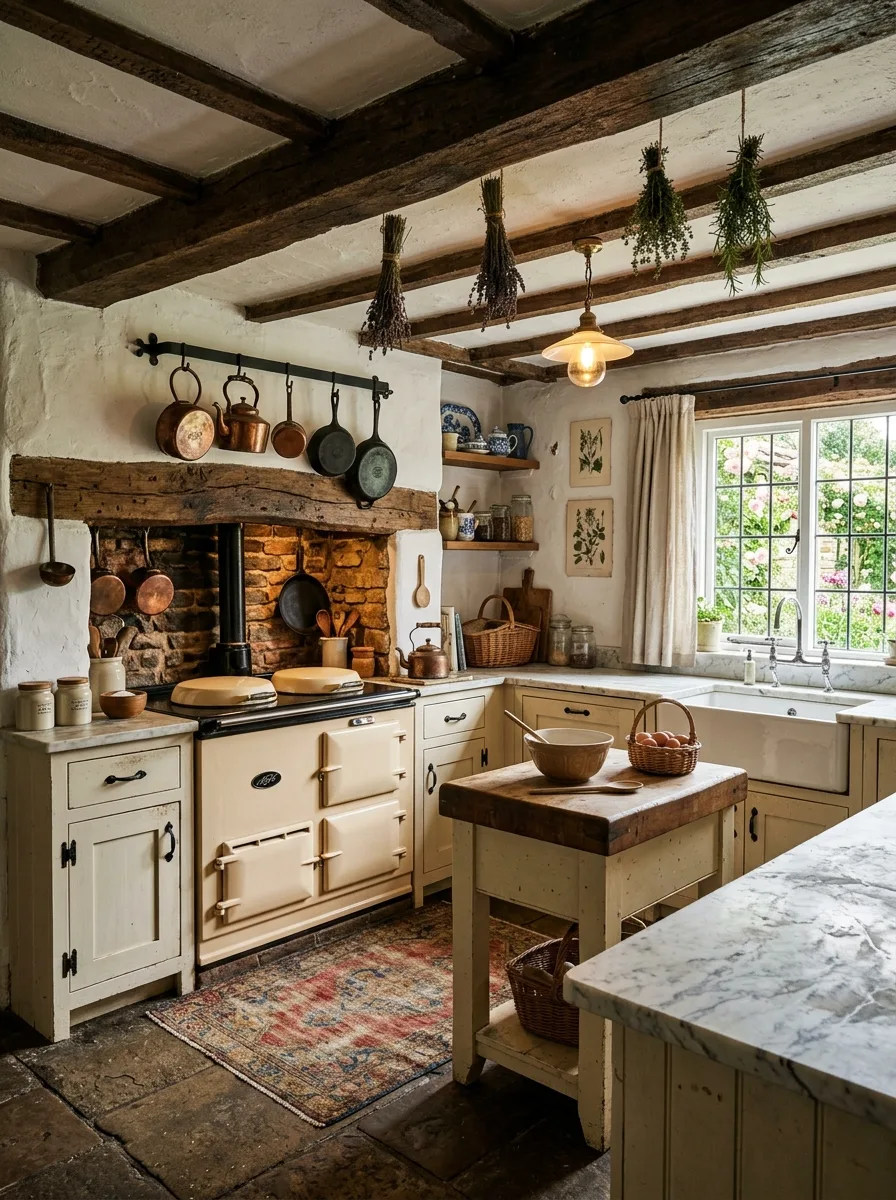
The AGA is the architectural centrepiece. Position it in a brick or stone fireplace recess if possible, or set it against a plaster wall that can read as the chimney breast. Mount a black wrought iron bar on the wall to the left of the AGA and hang copper and iron pans from it on S-hooks.
The cabinetry should be simple — cream flat-panel or inset doors with black iron hardware, nothing that competes with the range. Keep the counter in honed marble or a worn limestone. Hang dried herb bundles from the exposed ceiling beams, spaced freely rather than evenly.
On the open shelves across the room, display blue and white transferware alongside stoneware crocks and glass jars of dried goods. Use a flagstone floor. Let the AGA run.
Powder Blue Floral Dresser Beams
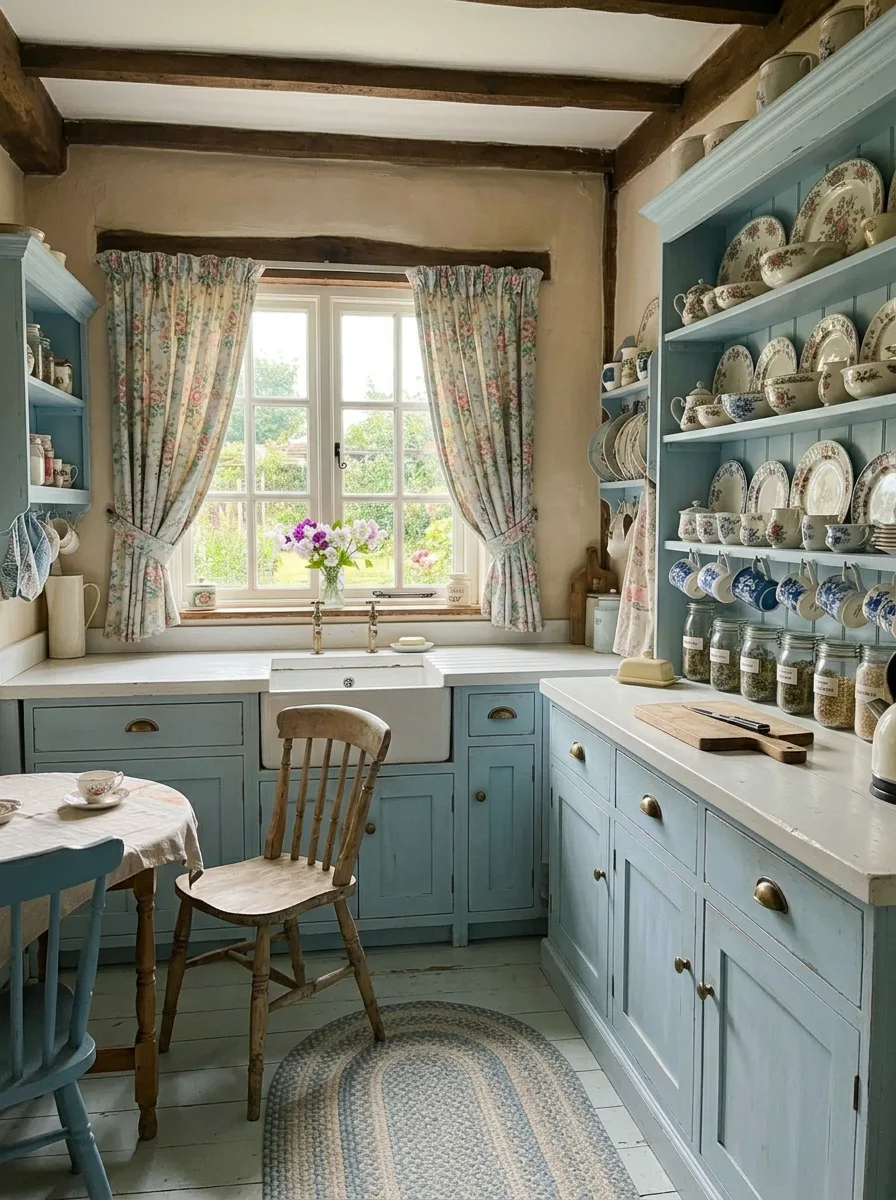
Paint every surface in a soft, chalky powder blue — cabinets, dresser, and the lower half of the room’s built-in dresser where plates are displayed. The blue should have enough grey in it to read as aged rather than fresh. Keep the upper walls and ceiling in warm plaster or cream paint.
Source a large freestanding dresser unit and paint it the same blue; fill the open shelves with transferware in blue and white floral patterns, stacked plates, cups hung from hooks, and glass jars. Use floral curtains at the window — the same small floral print that appears on the transferware, in the same blue and white palette.
Use brass cup-pull and bail hardware. Source a braided oval rug in cream and blue for the floor. The room is a single colour story told in many different materials.
Dark Forest Stone Wall Copper Sink
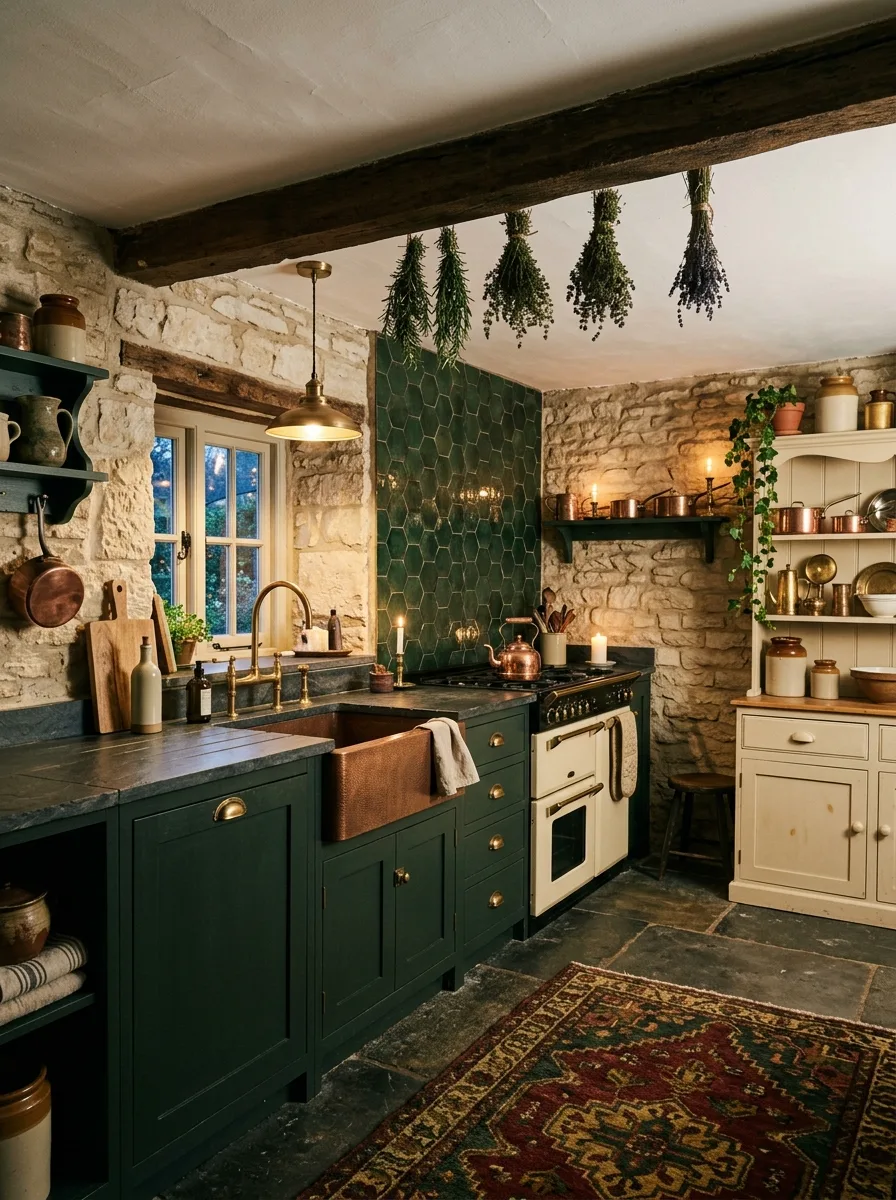
This kitchen earns its atmosphere through material weight rather than colour. The walls should be rough-hewn stone — either original in an old building or sourced reclaimed stone applied over the substrate wall. Leave the mortar visible and slightly rough. Paint the cabinetry in a deep forest green — not sage, not hunter, but a near-black green that holds its depth.
Use a copper farmhouse sink rather than a white ceramic one: the warm metal against the dark green cabinet face is the defining contrast of the room. Source a single industrial brass dome pendant to hang over the sink. Fill the hanging beam with bunches of rosemary, thyme, lavender, and other garden herbs.
Install a vintage cream range with brass fittings against the stone wall. Layer in copper and brass accessories — a kettle, small candleholders, pot hooks — throughout. The candlelight bounces off the copper surfaces in a way that makes the kitchen warm despite its dark palette.
Mustard Yellow Gingham Beadboard Cottage
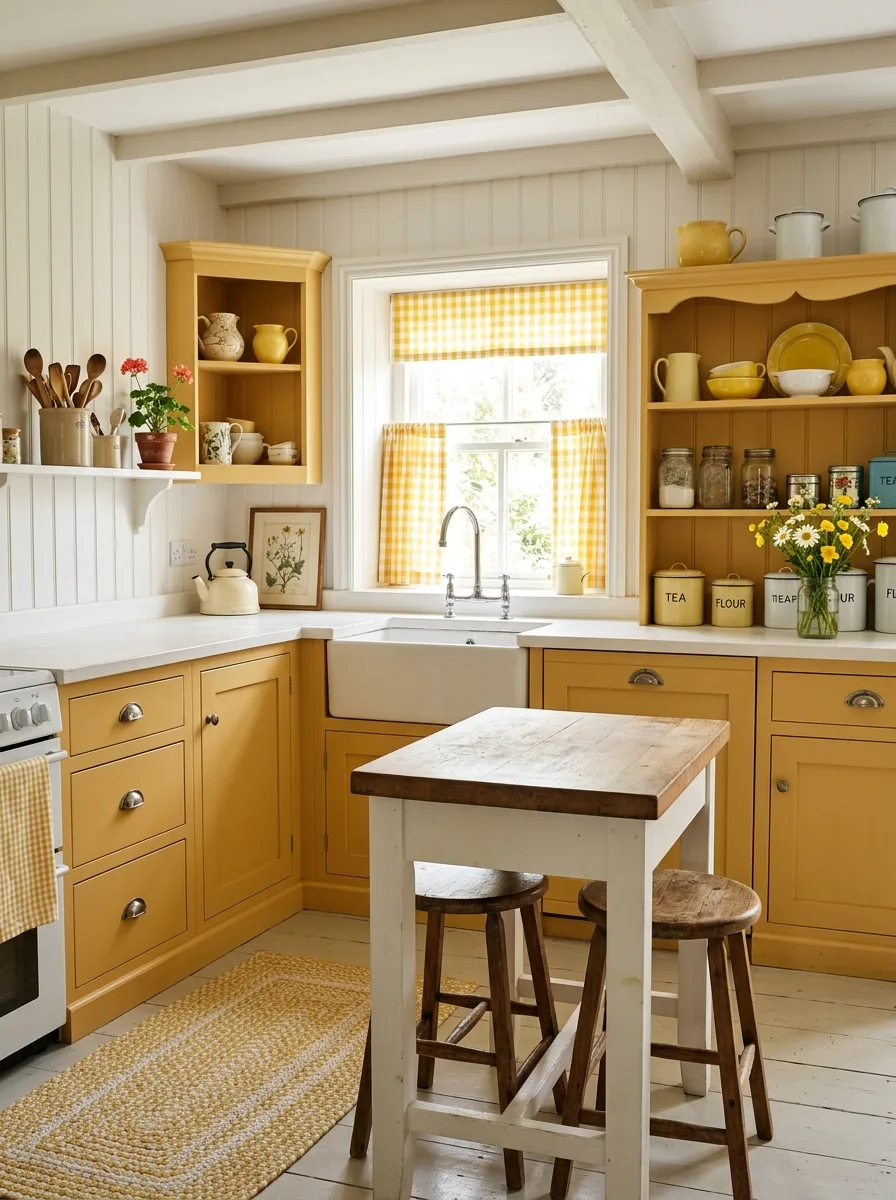
Paint all the cabinetry in a warm, saturated golden yellow — the colour of ripe mustard flowers, not lemon and not orange. Use simple Shaker-profile doors with small nickel half-round cup pulls. Run beadboard or tongue-and-groove panelling on the upper walls above the cabinets, painted in cream to contrast gently with the yellow below.
At the window, hang a simple café curtain in yellow and white gingham — half the window height only, so the light comes over the top. Style the open shelving and freestanding dresser in matching yellow, filled with yellow and cream ceramics: a yellow jug, a white stoneware teapot, enamel canisters, a jar of daisies.
Use white painted floorboards. Source a freestanding white-painted island with a raw timber top. The yellow should look like it arrived with the sun and stayed.
Exposed Brick AGA Herb Beam Sage Dresser
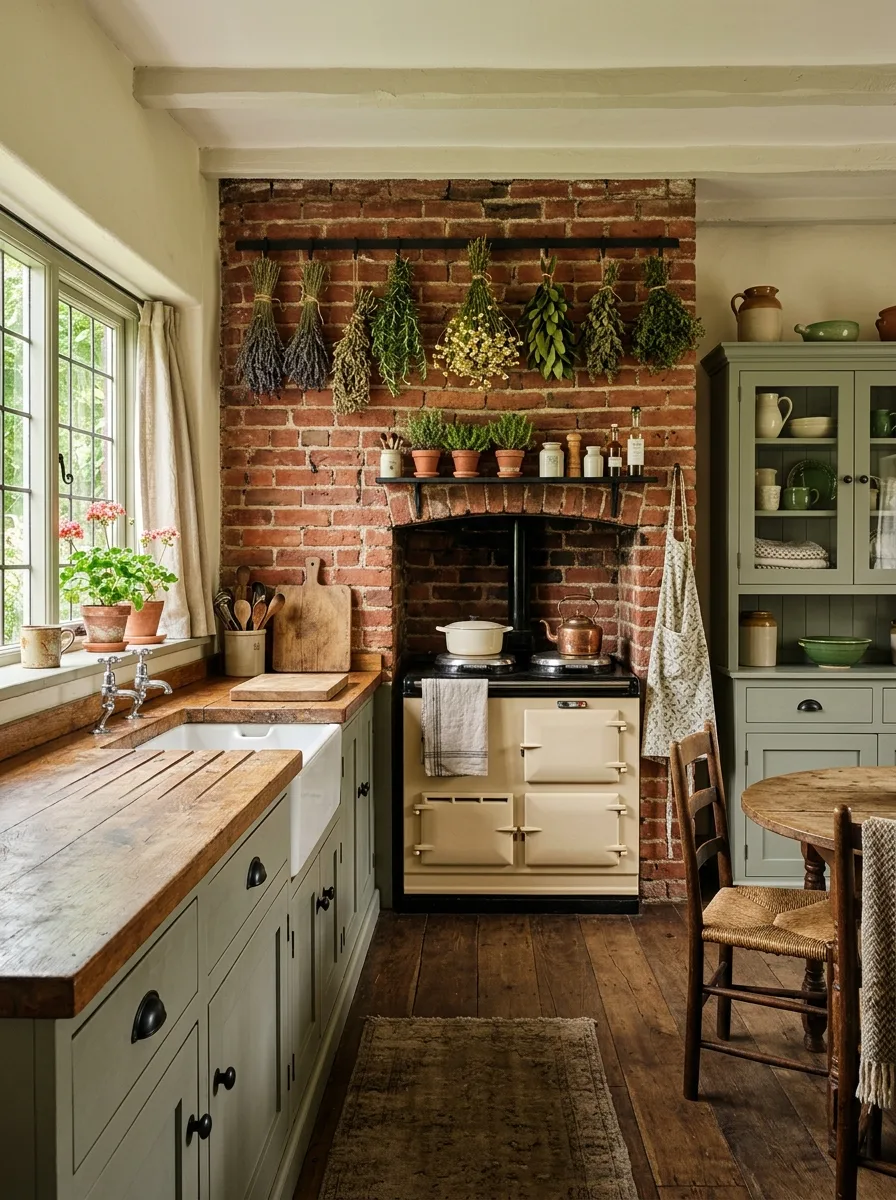
Build the range wall in original or reclaimed brick, unpainted and unsealed. Source a cream AGA with simple oven doors and black detailing. Mount a horizontal iron rail above the AGA at beam height for hanging bundles of dried herbs — lavender, sage, rosemary, thyme, mint — in quantities generous enough to create a ceiling-level botanical layer across the entire cooking zone.
On the opposite wall, install a painted sage green dresser with glass-fronted upper cabinets displaying cream and green ceramics. Use sage-green lower cabinets throughout with black iron bin-pull hardware. Keep the counter in plain reclaimed timber.
Use reclaimed dark oak floorboards. The brick, the timber, the herbs, and the sage green exist in the same warm, earthy register.
Butter Yellow Hexagonal Tile Café Curtain
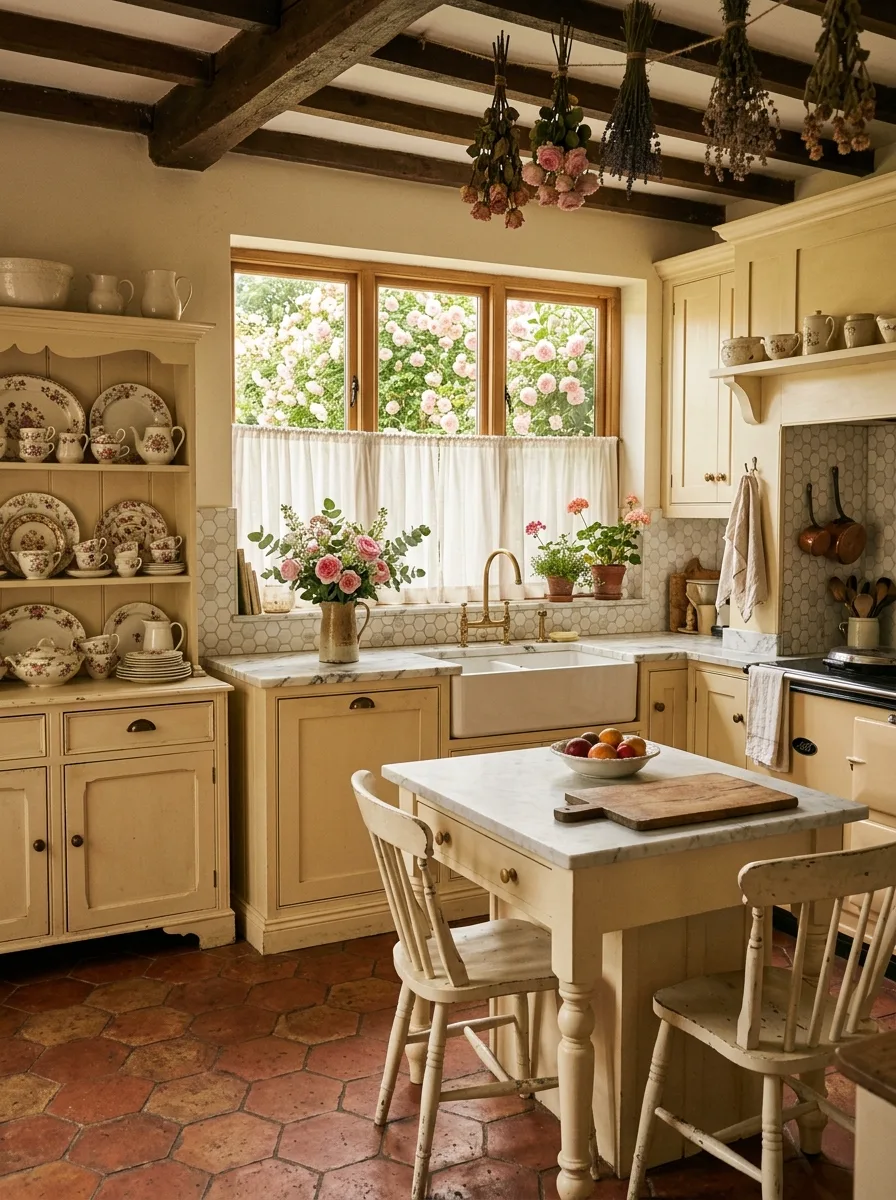
Use pale, matte terracotta hexagonal tiles on the floor — unglazed, in the natural warm clay colour rather than any treated or sealed finish. Paint the cabinetry in a warm butter yellow — a yellow with cream in it rather than white, so it reads as food-safe and lived-in rather than cheerful.
For the backsplash, use a small white hexagonal tile in a simple running-bond pattern or the same terracotta hex scaled down. At the window above the farmhouse sink, hang a café curtain only: half the window height, in a cream linen or a small floral print, allowing full light above.
Keep the open dresser shelf beside the range filled with a complete set of matching china — the kind of well-arranged collection that reads as intentional rather than accumulated.
French Farmhouse Copper Pot Rack Vault
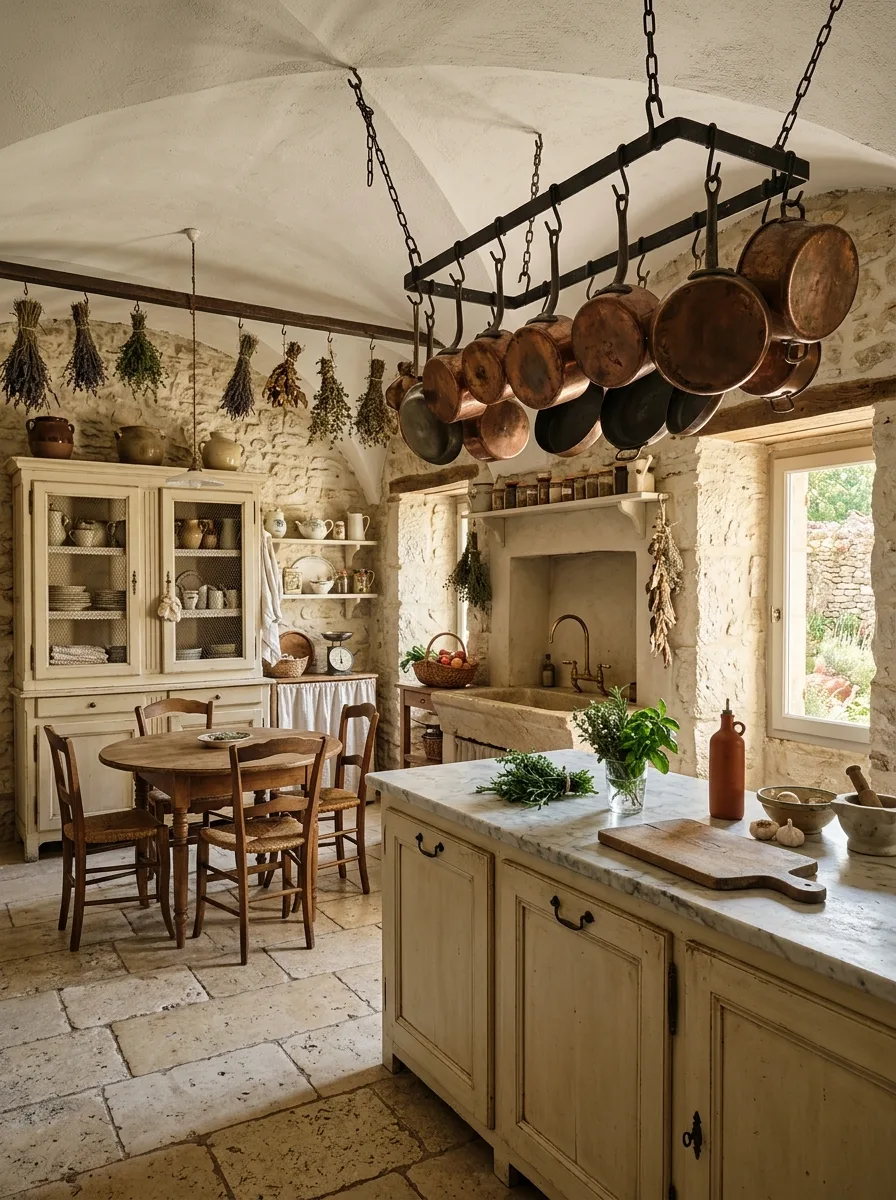
This is a room built around a copper pot rack. Install a rectangular iron rack from the ceiling on four chain drops, hung at a height where the pots clear the heads of people working below but are still reachable. Load it with genuine copper cookware — the more the better — in different sizes, all hung by their handles.
The kitchen itself should be as simple as possible in deference to the rack: cream-painted freestanding furniture with no upper cabinets, rough stone or plastered walls, a stone-flagged floor, a deep stone sink recessed into the wall. Source a large freestanding cupboard in painted cream with wire mesh door panels rather than glass for the china storage.
Hang dried herb bundles from the walls and the iron rack chains. Everything in the room should point to the fact that serious cooking happens here.
Midnight Cabinetry Copper Hardware Candles
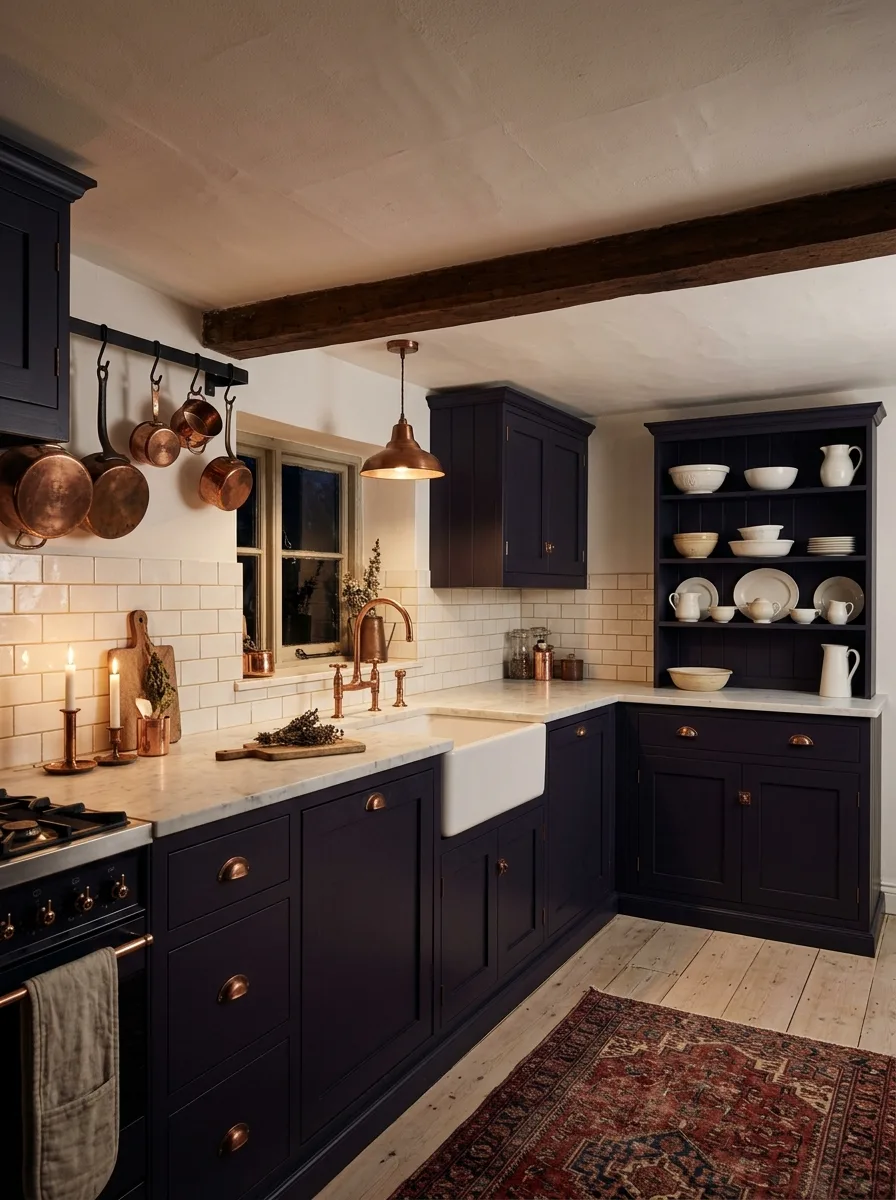
This cottage kitchen is dark. The cabinetry is near-black — a very deep blue-grey or charcoal, not black for its own sake. The subway tile backsplash is cream or warm white to provide the contrast that stops the room from closing in. Use copper cup-pull hardware throughout: every drawer, every door, the same warm metal.
The defining atmosphere is candlelight — position three or four candleholders on the counter and windowsill and light them in the evening. The copper accessories — a hanging kettle, a few pots on hooks above the range — catch and multiply the flame. Hang a single copper-shade pendant above the sink.
Use a Persian or Turkish rug at the base of the cabinets. Display only white ceramics on the open shelves, which should be painted the same near-black as the cabinets. The white ceramics and the warm candlelight are the whole colour story.
Lavender Beam Wicker Basket Ceiling
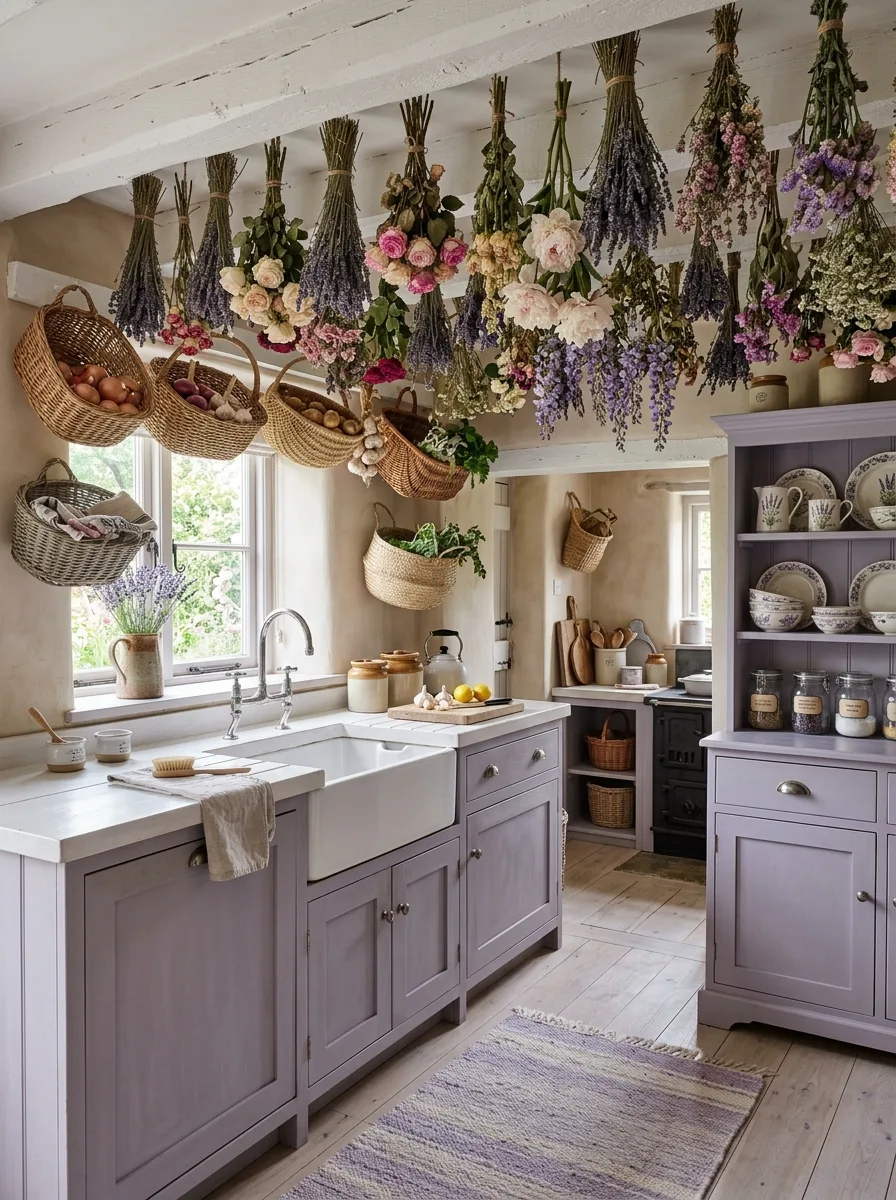
Paint the cabinetry in a grey-lilac — a purple with enough grey that it reads as sophisticated rather than sweet. The colour should be matte. Use simple Shaker doors with plain nickel knobs. Install ceiling beams if not original, painted white.
From the beams, hang two types of things at different heights: wicker baskets of different sizes filled with produce and eggs, and bundles of dried flowers — roses, lavender, statice, peonies — in generous quantities that create a ceiling-level botanical canopy.
The rest of the kitchen should be deliberately quiet: cream walls, white counters, a simple chrome faucet, a farmhouse sink. Let the ceiling be the entire room.
Teal Geometric Tile Cream Range
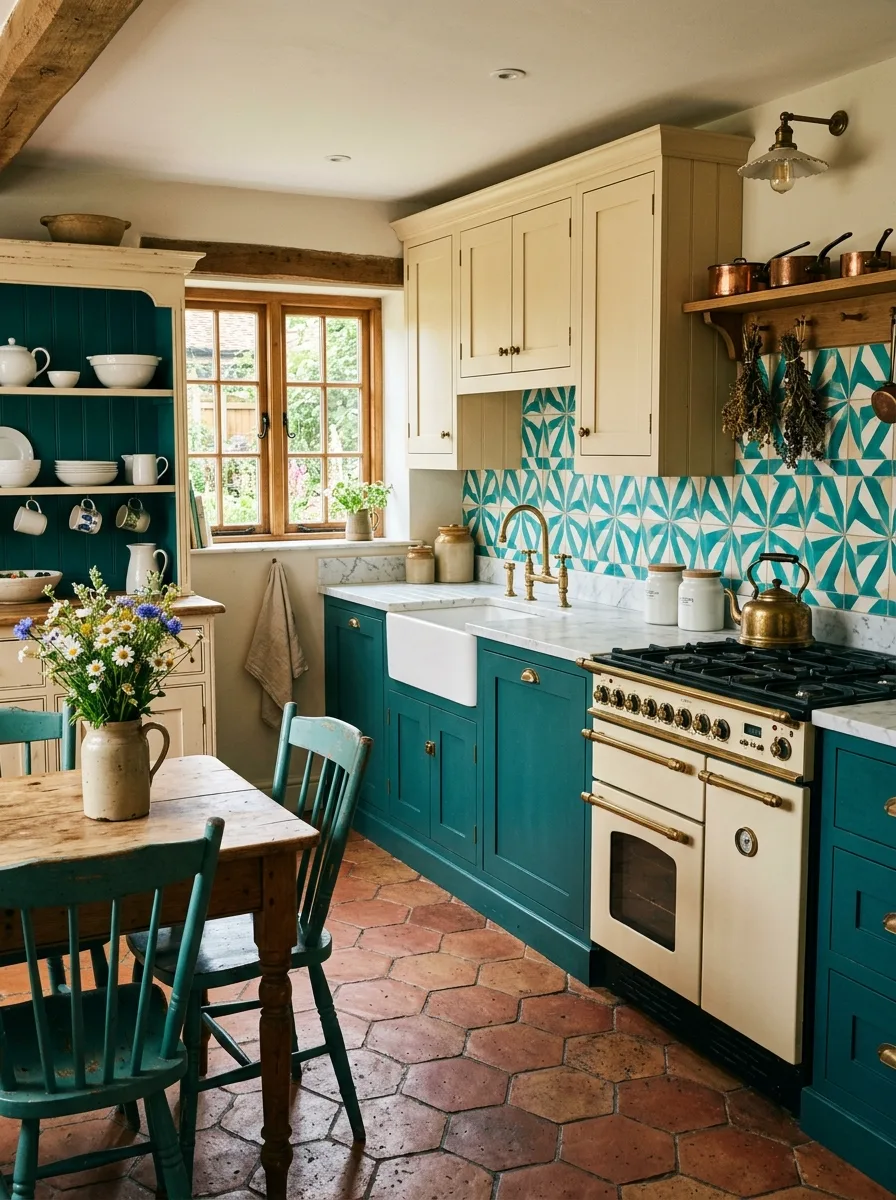
The backsplash is the point of this kitchen. Source a bold geometric encaustic or cement tile in teal and white — a starburst, a diamond grid, or a pinwheel pattern, but not a subtle one. Install it as the full backsplash from counter to upper cabinet on the cooking wall.
Paint the lower cabinetry in a matching deep teal, and upper cabinets in cream. Source a vintage-style range in cream with brass knobs and fittings — the cream body of the range relates to the upper cabinets while the brass hardware relates to the teal wall fittings. Use terracotta hexagonal floor tiles to add warmth at ground level.
Source a raw-top pine dining table with painted chairs in the same teal. Mount a single traditional wall-mounted sconce in aged brass near the range.
Blue and White Willow Plate Dresser
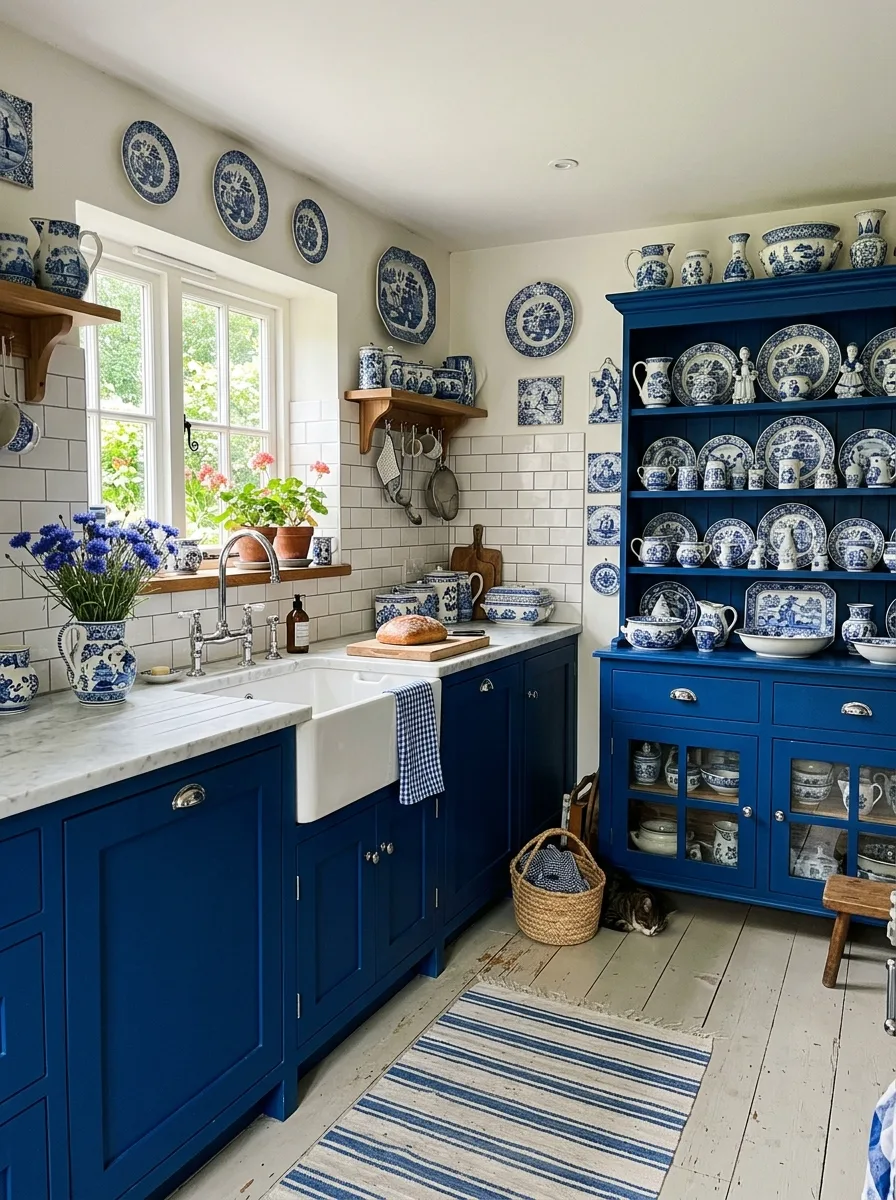
The dresser is the point. Source or build a full-height kitchen dresser in deep cobalt or royal blue — large enough to hold an entire collection of blue and white transferware. Load it completely: plates stood upright in plate rails at the back of each shelf, cups hung from hooks beneath the shelves, jugs arranged by size, serving pieces positioned at the ends.
On the walls surrounding the dresser, hang individual blue and white transfer plates using small disc hangers, arranged in a loose grid that extends above the dresser height.
Keep the rest of the kitchen very simple: white subway tile, white marble counter, chrome faucet. The dresser is the room.
Mint Chicken Wire Vintage Range
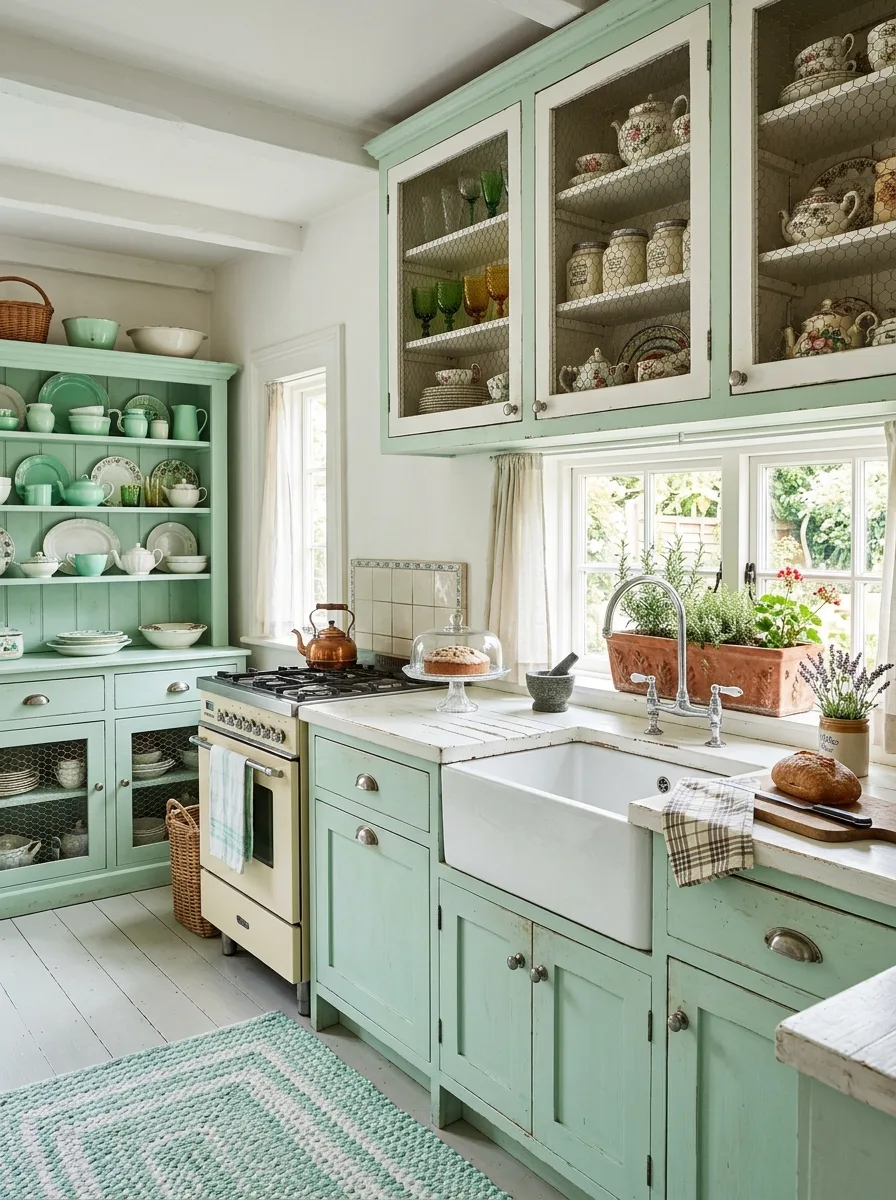
Paint every cabinet and every piece of freestanding furniture in a single mint green — the colour of old painted wood that has been touched by every decade since 1940. The finish should show its age: slightly chalky, slightly uneven, with occasional bare wood showing through at corners and edges.
For upper cabinet doors, replace the glass panels with chicken wire — the small hexagonal galvanised mesh commonly found in old larders and pantries. The chicken wire allows you to see through to the displayed china while adding period texture. Source a cream vintage range with chrome dials and trim.
Fill all visible shelving with china in the mint, cream, and white register: green depression glass, floral transferware, plain creamware. Use a braided rug in mint and cream. Paint the floor white.
Dusty Pink Botanical Print Gallery Wall
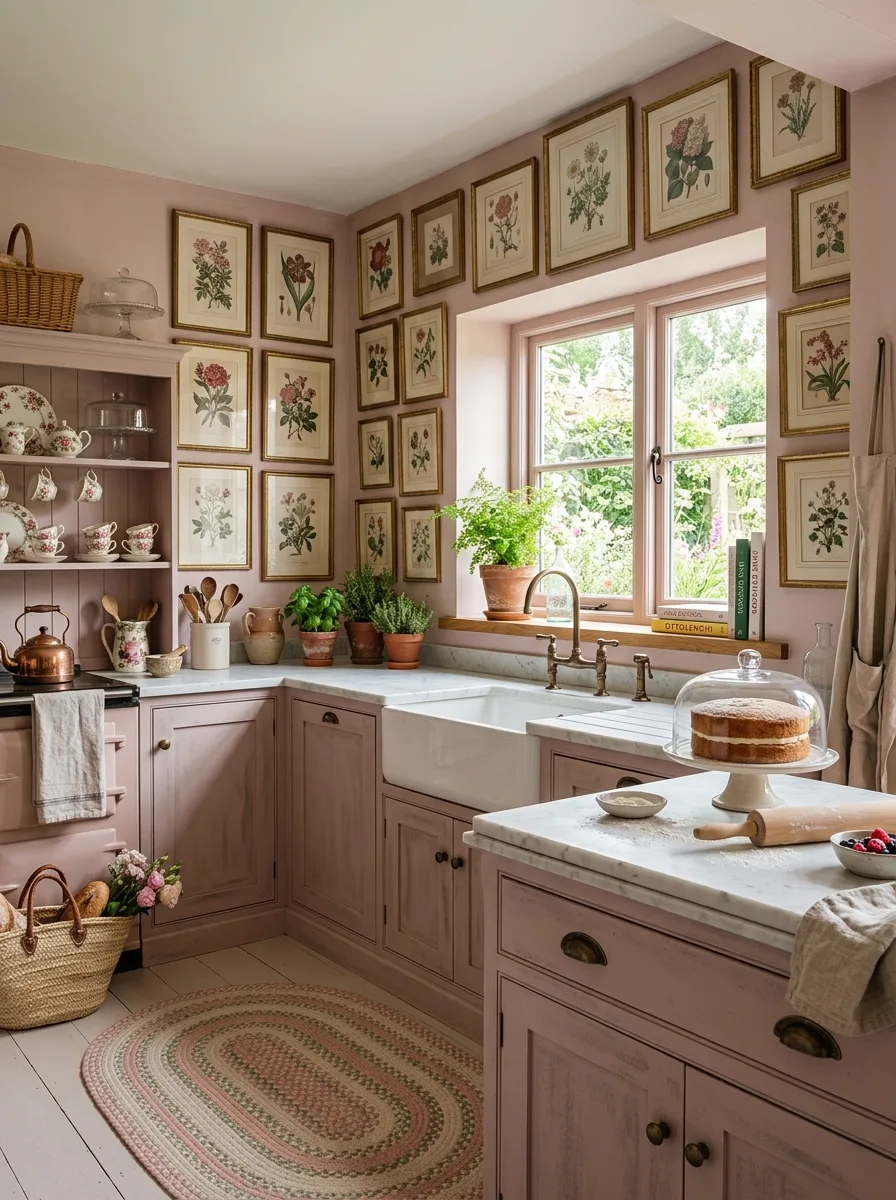
Paint every surface — cabinets, walls, even the ceiling — in a single dusty pink. The pink should be sufficiently greyed that it reads as a sophisticated neutral under most light conditions and reveals its pink character when warm light hits it directly. Keep all hardware in aged brass.
Source a large collection of antique botanical prints in matching gold frames and arrange them on the walls in a dense, edge-to-edge gallery arrangement that covers nearly every vertical surface above the cabinetry. The prints should be genuine aged pieces or convincing reproductions — the quality of the illustration matters because they will be viewed at close range.
Crown the kitchen island with a dome cloche over a cake stand. Let the marble counter be generously lived-in: rolling pin out, a bowl of flour, a bunch of garden herbs.
Teal Lower Cream Upper Encaustic Cottage
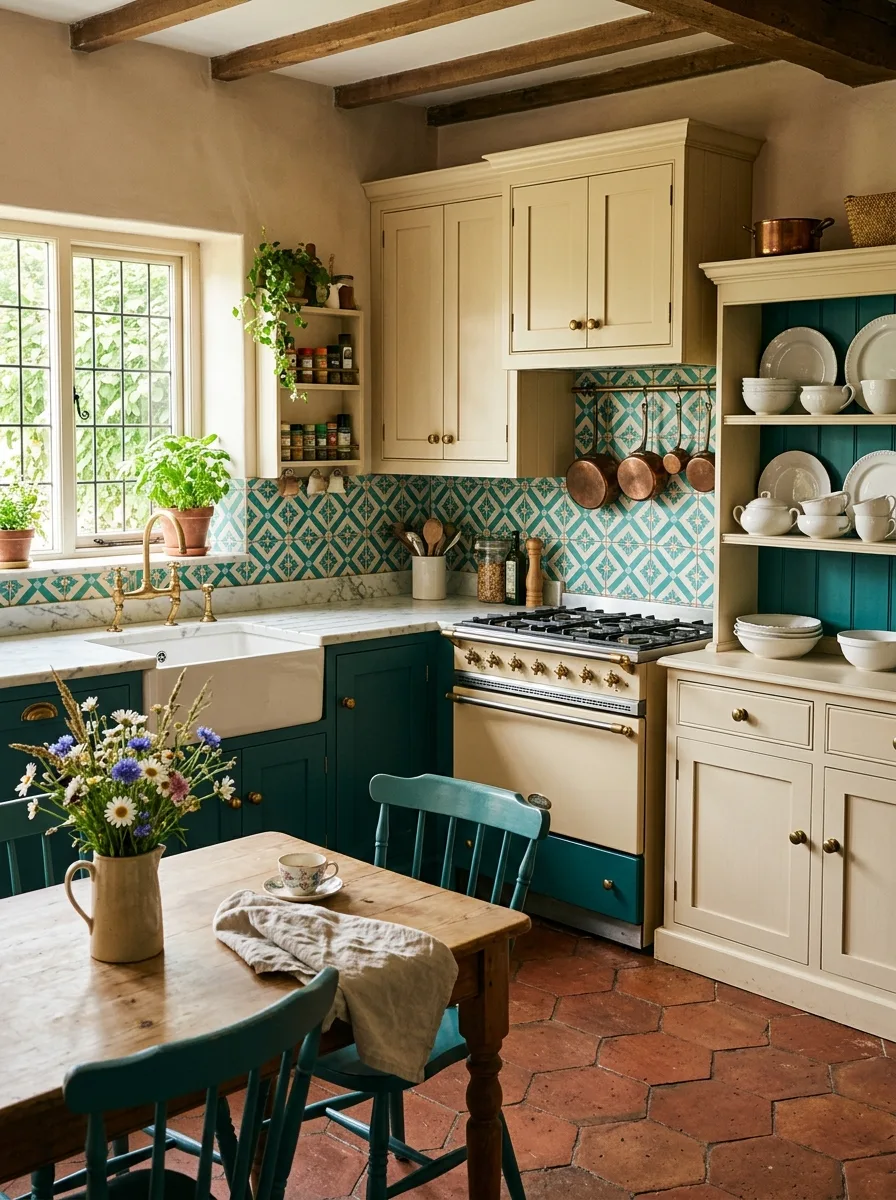
This kitchen runs two cabinet colours: a deep teal on the lower cabinets and a warm cream on the upper. The dividing line is clear, not graduated. The defining element is the backsplash tile between them: install a geometric encaustic pattern tile in teal and cream that ties the two cabinet tones together, running from the counter to the bottom of the upper cabinets as a full-height decorated band.
Source a vintage cream range with brass fittings. On the open shelves flanking the range, arrange white ceramics against the teal-painted back panel. Use terracotta hex tiles on the floor to warm the whole palette.
Hang two or three bundles of dried herbs from the ceiling near the range. Install aged brass fittings throughout — faucet, light switch plates, small cup pulls.
Sage Chicken Wire Copper Kettle Cottage
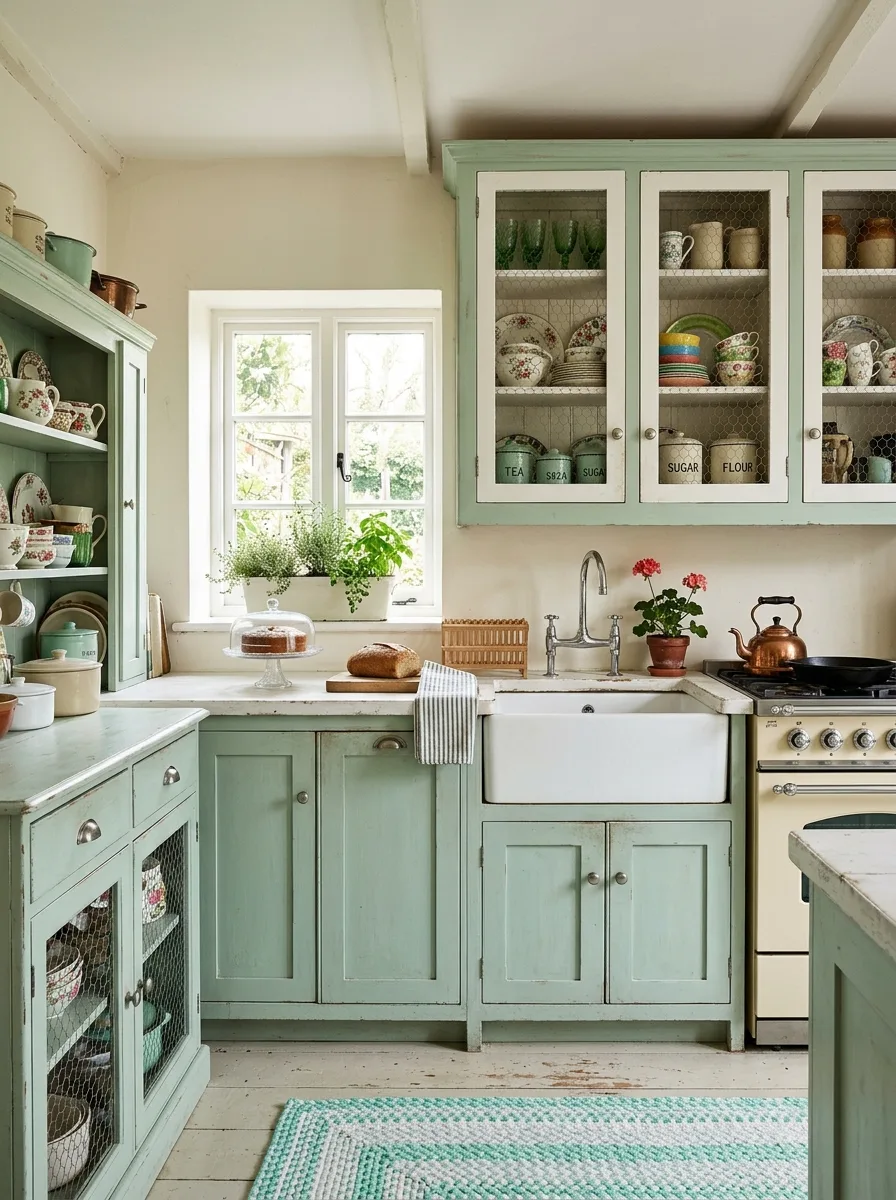
The deciding detail in this kitchen is the chicken wire cabinet door insert. Replace the doors on all upper wall cabinets with frames holding a panel of small-hex galvanised chicken wire instead of glass. Paint all the cabinets — upper and lower — in a worn sage green with a chalky, flat finish.
Behind the chicken wire, display a mix of floral transferware, creamware, vintage tins, and stoneware. On the counter, leave a cake dome on a stand, a copper kettle on the gas range, a terracotta plant pot with herbs. The farmhouse sink should be broad, with a chrome bridge faucet.
On the floor, a braided cotton rug in sage and cream beside the sink. The chicken wire makes every cabinet a display — treat them that way.
Final Thoughts
Every kitchen in this collection is proof that the desire for a kitchen that feels like something — warm, storied, inhabited — is not a design compromise. It is, in fact, the harder thing to achieve.
A white marble kitchen with handleless cabinets can be done by formula. A kitchen that smells like dried lavender and has thirty years of good copper pots hanging from a beam takes longer to arrive at. It requires patience, accumulation, and the willingness to make choices that are specific to you rather than safe enough for everyone.
The best cottage kitchens are not designed. They are composed, slowly, from pieces that belong together. Start with the bones — the floor, the ceiling, the era. Pick a colour and commit to it. Then build the rest one object at a time, and only keep the things that have something to say to everything already in the room.
That’s not a design process. It’s a practice. The kitchens worth having are the ones that show it.