
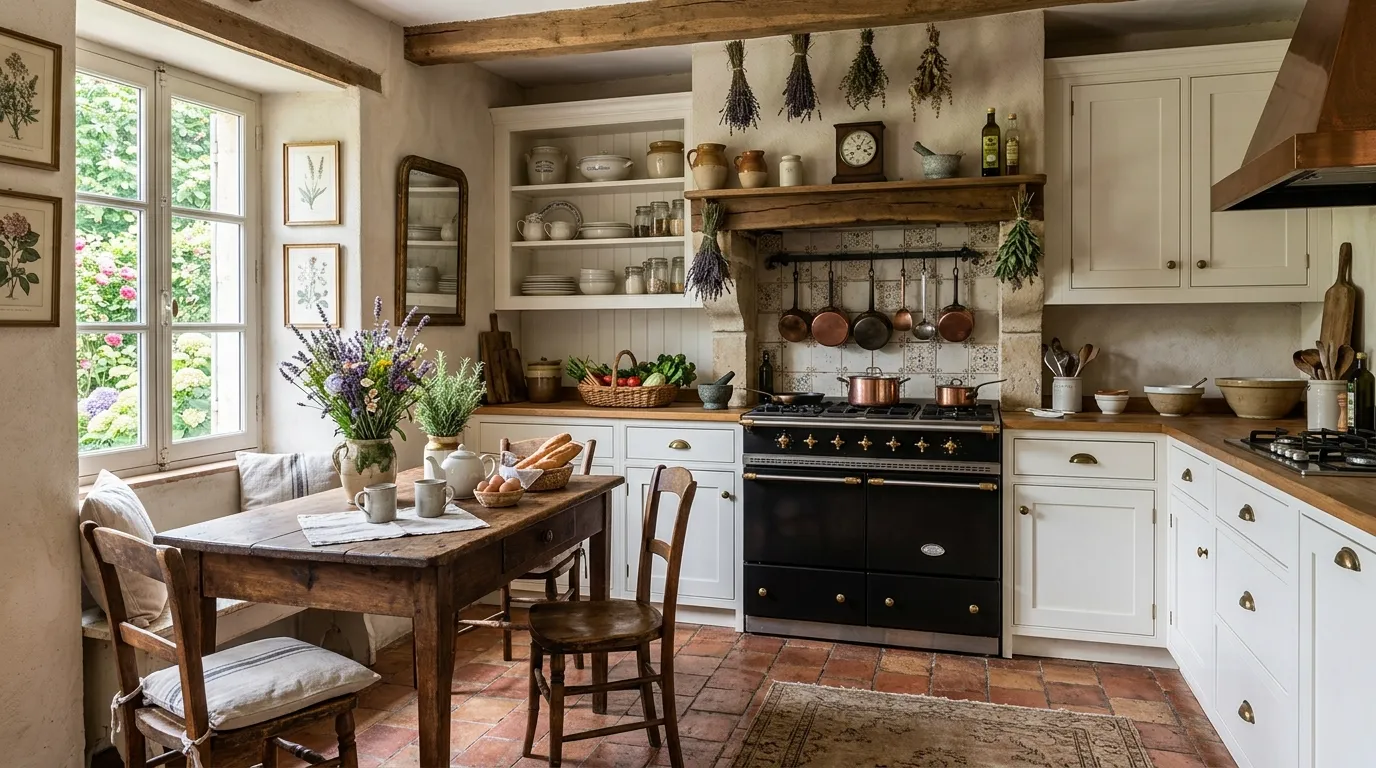
There is a version of French country style that exists only in hotel lobbies and badly curated Pinterest boards. Everything is toile. Everything matches. There is a rooster somewhere.
That version is not what you want. You just don’t know how to articulate the difference yet.
The kitchens that actually make you feel something — the ones that stop you mid-scroll — are the ones that look like they belong to a specific place, a specific person, a specific century of accumulated living. They are not decorated. They are inhabited.
The gap between those two things is what this blog is about.
Why Your French Country Kitchen Looks Like a Theme Park
The French country aesthetic has been badly served by the home decor industry for thirty years. The result is a style that most people get catastrophically wrong without even knowing it. The mistakes are not in the details. They are in the premise.
Copying the Parts Instead of the Whole
Most people approach this look by collecting objects: a rooster, a lavender bouquet, some toile fabric, a bunch of sunflowers. They are assembling a mood board rather than designing a room.
Authentic French country kitchens were not designed at all. They were accumulated over generations. A dresser from a grandmother. A table that was already old when the house was built. Copper pots bought one at a time over thirty years. That accumulation is what you’re sensing when a room feels right. You cannot shortcut to it by buying a set.
The lesson is uncomfortable: you have to let the room be incomplete and let it develop. The alternative is a kitchen that looks like it was styled for a catalogue shoot and cleared out the same afternoon.
The Wrong Kind of Colour
The instinct when people say “French country” is to go neutral. Linen. Cream. Warm white. And while those tones appear in this collection, the kitchens that have the most life are the ones that committed to actual colour: ochre yellow, robin’s egg blue, saturated rose, deep plum, terracotta red.
French country colour is not timid. It comes from the landscape — from saffron fields and lavender, from the red earth of Provence and the grey-green of the Auvergne hills. It is applied directly to walls, not hedged on an accent pillow. The colour is structural, not decorative.
If your kitchen feels flat, you probably haven’t gone far enough. That is almost always the problem.
Forgetting That Function Is the Aesthetic
The storage systems in these kitchens — the pot racks, the open dressers, the ceiling-hung herbs and garlic, the shelf of labelled confit jars — are not decorative. They are how a serious kitchen works.
The beauty comes from the function. From the fact that a cook actually needs a hundred pots of dried herbs. That the copper pans are hung because the cook reaches for them daily, not because they look charming. The moment you install something that looks functional but isn’t — a decorative pot rack with no pots, a shelf of empty jars — the room knows. And so does anyone who stands in it for more than five minutes.
French Country Kitchen Ideas
Painted Green Folk Cabinet Kitchen
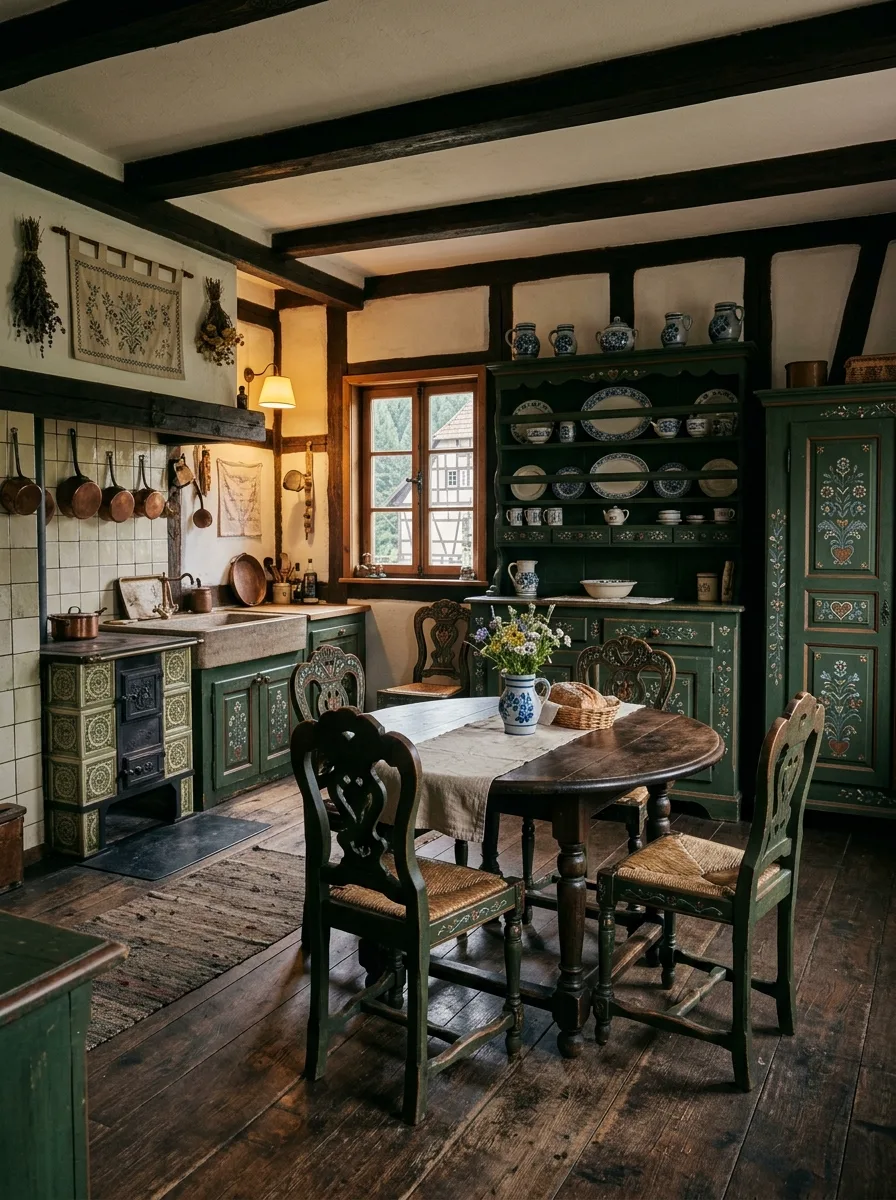
Source or commission cabinetry with hand-painted folk motifs — stylised botanical designs, small flowers, repeated geometric borders — in the tradition of Alsatian or Central European painted furniture. The base colour should be a deep bottle green with the kind of quiet complexity you find in real oil paint: not flat, not plastic, slightly uneven in its coverage.
Pair with dark-stained timber flooring, equally dark exposed ceiling beams, and simple pressed-tin or hand-made ceramic tiles behind the stove. A large free-standing dresser in the same painted green, loaded with blue and white transferware, completes the wall. The copper pans on the wall are not decorations — they are the working batterie de cuisine, hung from simple iron hooks at usable height. Hang dried lavender and herbs from the ceiling beams in bunches tied with rough string.
Stone Arch Cotswolds Sink
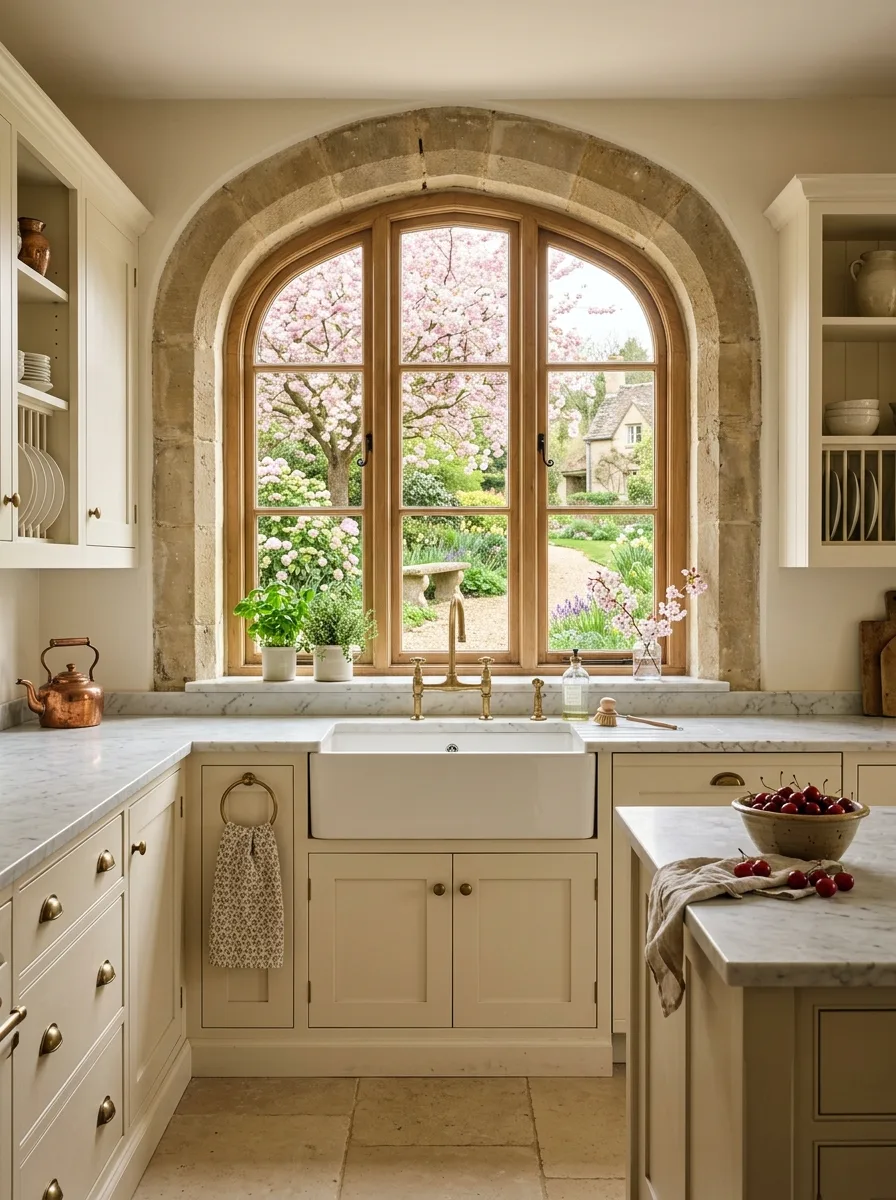
Install or reveal a reclaimed limestone arch around your kitchen window — the arch itself frames both the glazing and the garden view beyond, turning the sink moment into the room’s defining feature. The stone should be honey-coloured Cotswolds limestone if you can source it, or a similar warm oolitic limestone rather than the harder grey varieties.
Set a large farmhouse sink in cream or white fireclay directly under the arch, with a brass bridge tap and a simple brass towel ring for the linen cloth. Keep the surrounding cabinetry in a warm cream with cup pull and knob hardware in aged brass. Open glass-fronted cabinets on either side display white porcelain stacked without excessive arrangement. Plant a flowering cherry tree close enough to the window that it fills the arch in spring — the view should change with the seasons.
Wabi-Sabi Plaster Garden Table
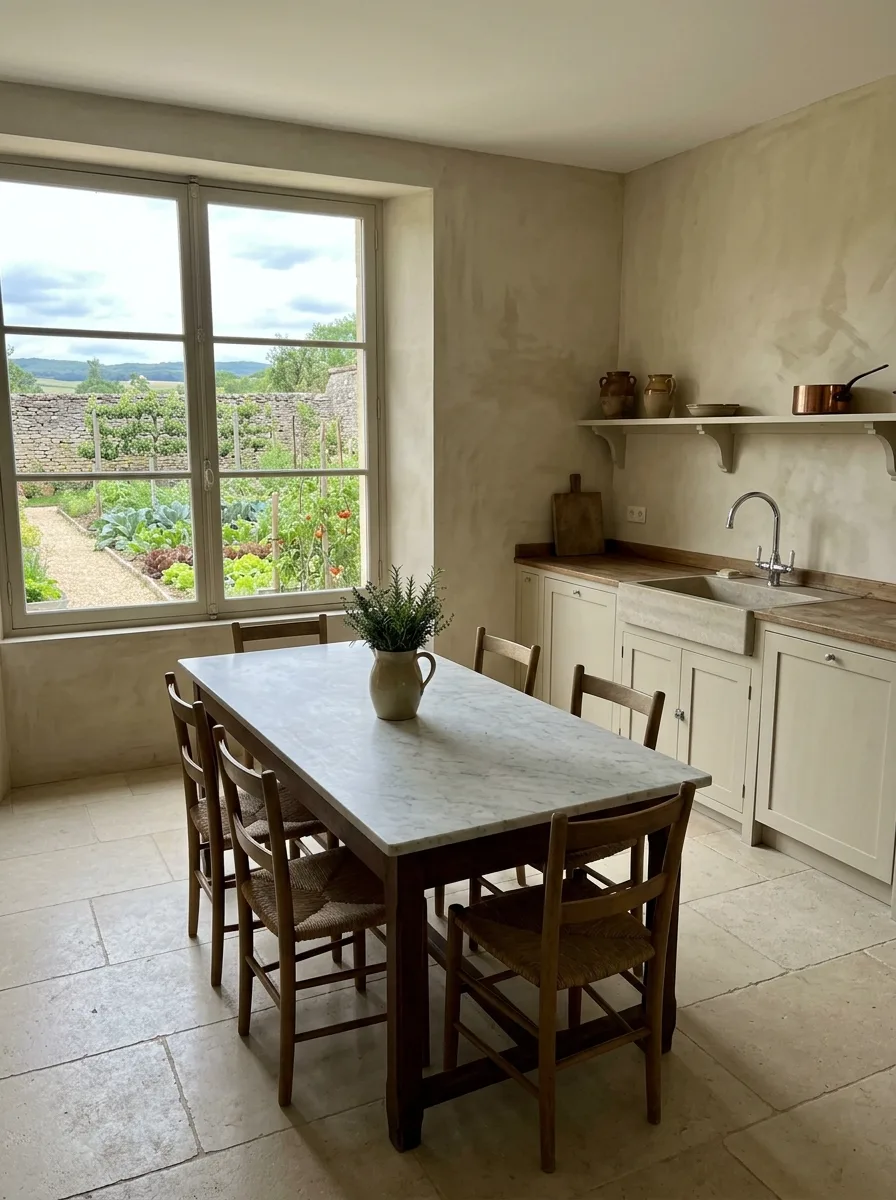
Skim the walls in traditional lime plaster applied rough, with the trowel marks left visible and the surface allowed to vary slightly in colour as it dries. Do not sand it smooth. Do not apply any subsequent coat. The wall should look like it has been there for two hundred years and never been touched.
Keep the cabinetry minimal and simple — shaker doors in a warm cream, no upper cabinets at all on one wall. Install a single open shelf on plain corbels at the right height for reach. Set a farmhouse table in the centre with rush-seat chairs in natural wood. The table surface should be marble or a good marble-look stone. Put nothing decorative on the counter. A single rosemary sprig in a ceramic jug. One cutting board. The simplicity is the look.
Ceiling Herb Drying Provençal Kitchen
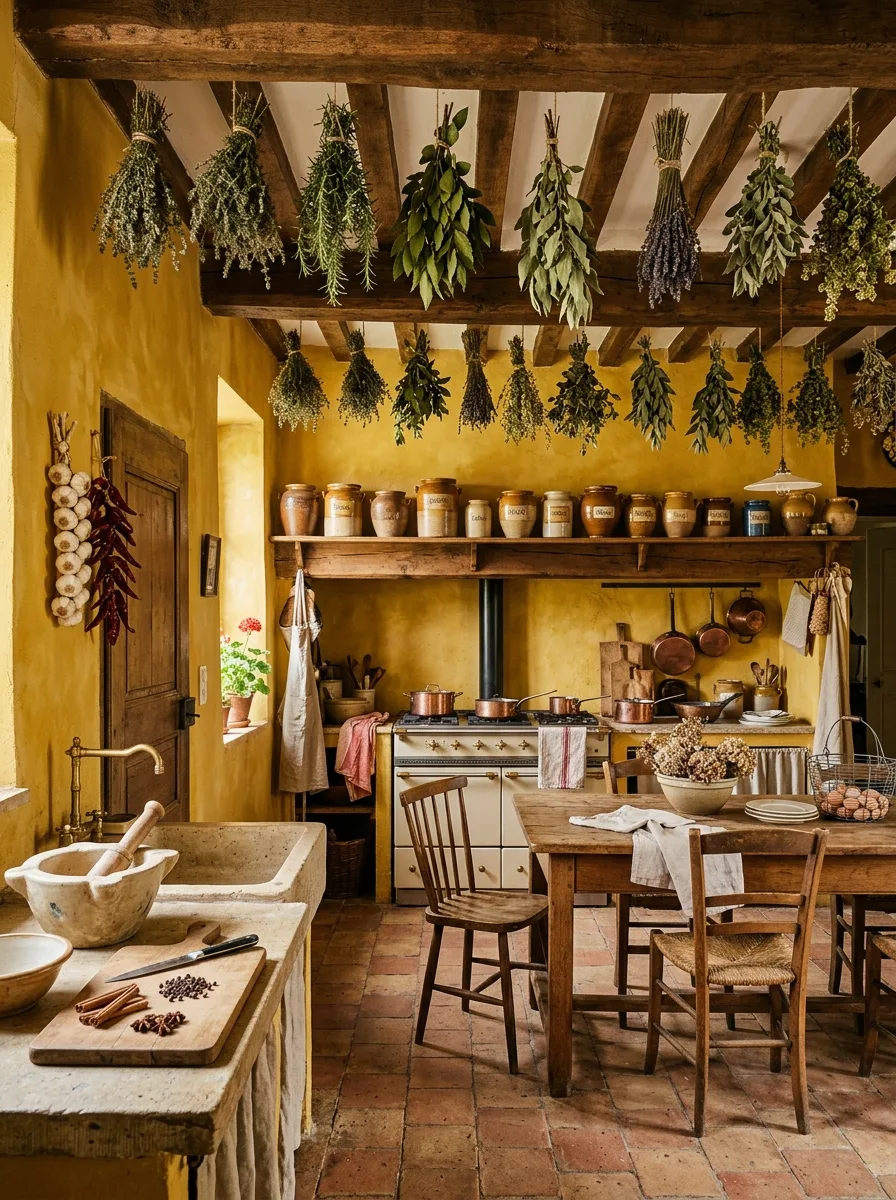
The defining decision here is the ceiling. Span your entire kitchen ceiling with rows of dried herbs hung from the beams in generous bunches — lavender, thyme, rosemary, bay, sage, oregano. The bunches should be large enough to read as a feature, not so small they look sparse. Tie with rough natural twine and vary the height slightly so the ceiling reads as a canopy rather than a uniform installation.
Paint every wall in an ochre yellow mineral pigment paint — Farrow & Ball’s Babouche or a French mineral paint in raw sienna. The colour should be warm, saturated, and slightly variable in tone. Set a complete row of antique confit jars along one full shelf above the stove, and hang a string of garlic braids and dried chillies on the adjacent wall. Terracotta brick floor throughout. The room should smell extraordinary.
Breton Fishing Village Shelf Kitchen
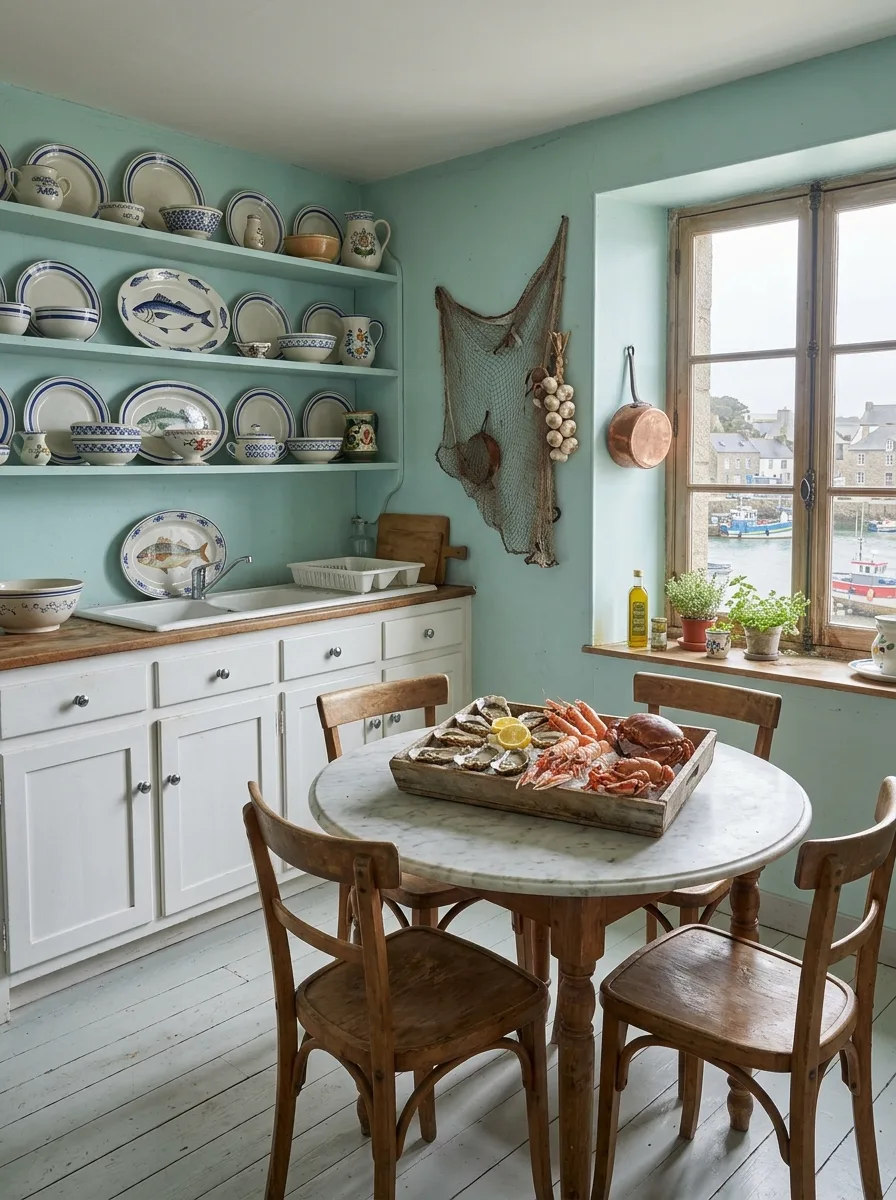
Paint all four walls in a washed aqua — not the grey-blue of a Hamptons kitchen, but the particular blue-green you find in Breton fishing villages, a colour that refers to sea glass and weathered boat paint. The colour should be applied in an eggshell or matte finish that looks slightly chalky and uneven.
Run full wall shelving on one side at two levels, displaying an entire collection of blue and white faïence: fish-printed platters, bowls with blue edge detailing, soup tureens, mugs. The more pieces the better — these shelves should look collected, not curated. Hang a section of fishing net on the adjacent wall with a few props from a real kitchen: a braided string of onions or garlic, a copper pan, a wooden float. Use a round white marble bistro table in the centre with wooden Bentwood chairs. The floor should be white-painted boards.
Basque Red Chilli Pepper Kitchen
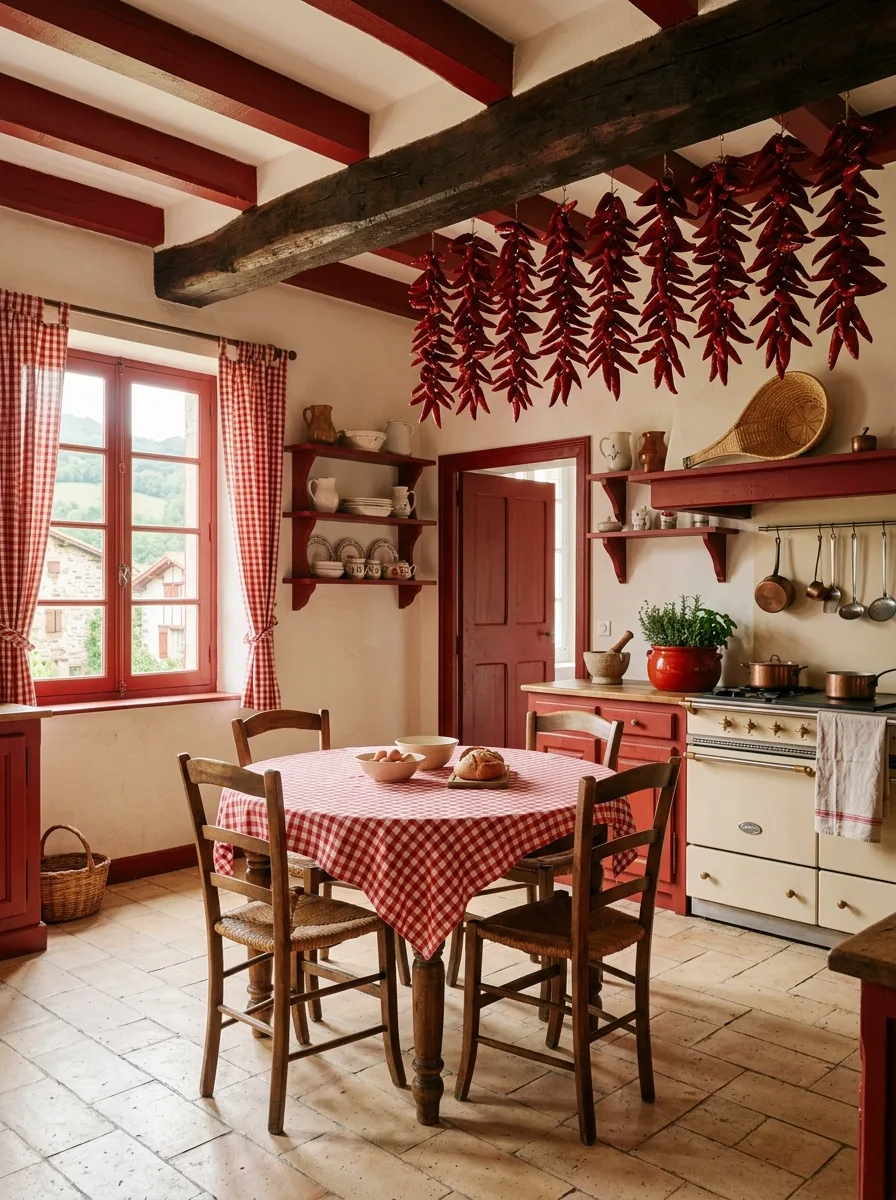
Paint the window frames, door frames, shelf brackets, and any exposed beam edges in a single deep red — Farrow & Ball’s Incarnadine or a similar saturated terracotta red. Leave the walls themselves in plain plaster or warm cream, so the red reads as architectural trim rather than a feature wall. The contrast between red structure and neutral surface gives the room its energy.
Hang dried red peppers — the long, thin Espelette variety if you can source them — from a horizontal beam above the table in dense, overlapping rows. The effect should be abundant, not sparse. Dress the table in a red and white gingham cloth and use mismatched wooden rush-seat chairs. A cream Lacanche or Godin range as the centrepiece. Red gingham café curtains at the windows with a simple brass rod.
Parisian Apartment Enamel Canister Kitchen
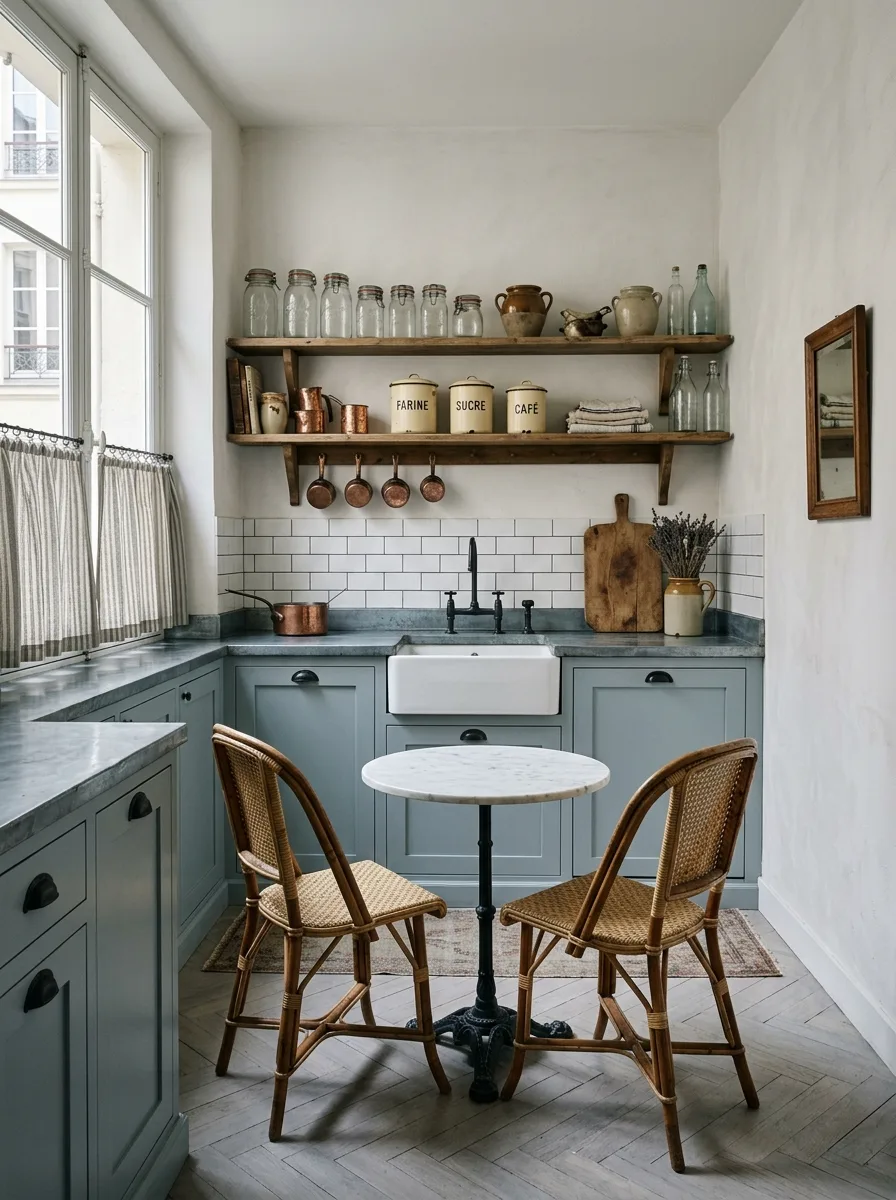
Paint the cabinetry in a grey-blue with steel undertones — not navy, not duck egg, but the particular blue of the Seine in overcast light, the colour of old zinc. Use black cup pulls throughout. Set two floating oak shelves at different heights on visible iron brackets, styled as a French épicerie: a complete row of matching glass preserving jars along the top shelf, a line of antique enamel canisters labelled FARINE, SUCRE, CAFÉ in vintage stencil along the lower shelf.
Install a bistro table in the kitchen itself — a small round marble-topped table on a cast iron pedestal — with two rattan café chairs. The table is not for large dinners. It is for morning coffee and one croissant. Use linen café curtains cut to half-height so the window light comes in above them. Keep all objects on the counter strictly limited: one wooden board, one bunch of dried lavender in a stoneware pot, one copper pan on the shelf.
Blue Washed Truffle Farmhouse Kitchen
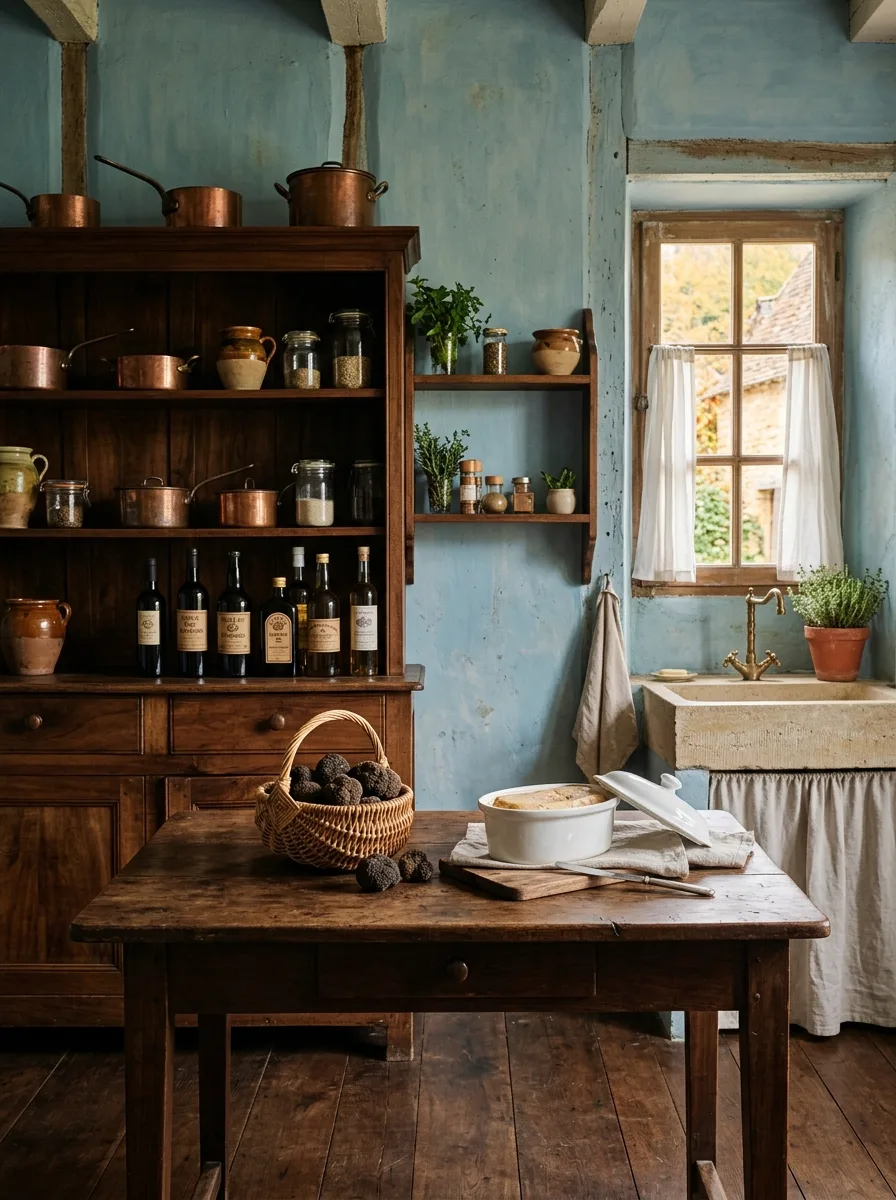
Leave the walls in raw, undulating plaster that still shows the base coats of old paint underneath, then wash the entire surface — plaster, exposed timber structure, and all — with a thin, diluted blue wash in a mineral paint. The blue should be barely there: just enough to shift the white plaster cool and unify the different surfaces without hiding the underlying texture.
Source a large antique kitchen dresser in dark walnut or stained pine and position it as the dominant piece of furniture. Load the shelves with working pantry items: confit jars, copper pans of various sizes, glass bottles of oil and vinegar, a few stoneware crocks. At the window, dress the sink in a gathered linen skirt under the basin rather than a cabinet. A heavy farm table in raw oak beside it. Let the room look like it is actively being used for serious cooking.
Blue Transferware Plate Wall Kitchen
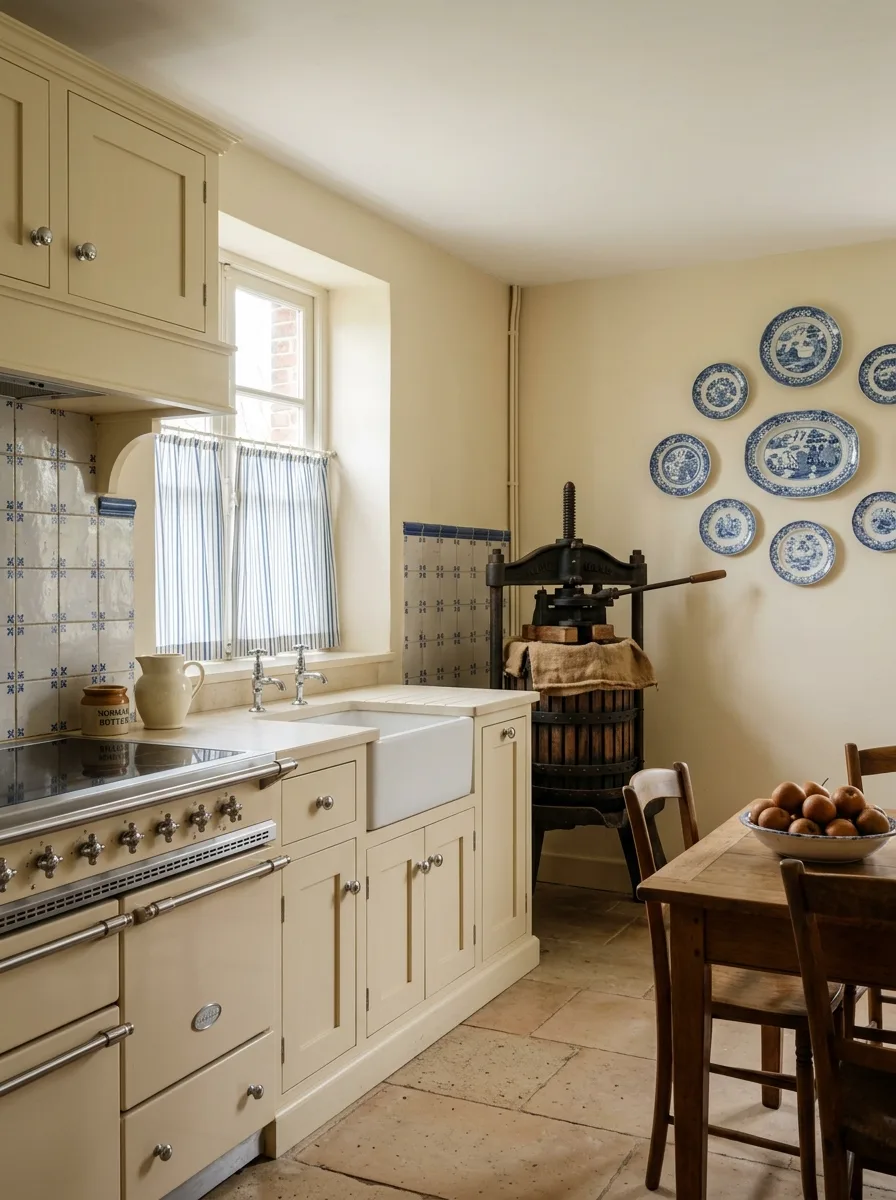
Group six to eight blue and white transferware plates — Willow Pattern or similar toile de Jouy style — directly on the wall in a loose cluster arrangement, mixing sizes between approximately 20 and 35 centimetres in diameter. Hang them with proper plate hooks in chrome or brass, spacing them so they feel like a collected group rather than a formal grid or a rigidly hung series.
Keep the surrounding kitchen in the warmest cream you can find, with simple shaker cabinetry and chrome hardware that echoes the plate hooks. Include a genuine antique domestic object as a statement piece in a corner — a large cast iron fruit press, an old weighing machine, a vintage butter churn. These functional antiques are doing more than any decorative object could. Hang linen café curtains in a narrow stripe at the window.
Castle Kitchen Open Fire
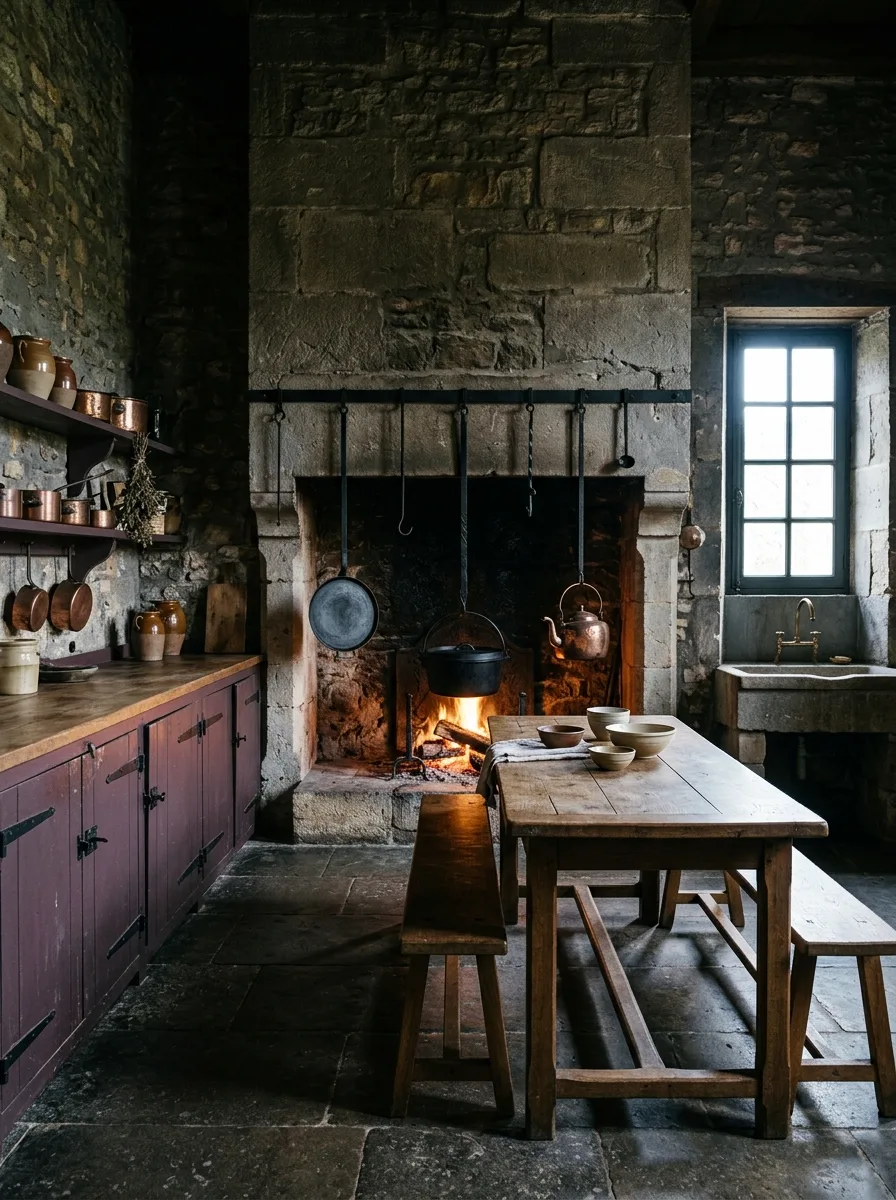
Build or commission a large open fireplace — wide enough to accommodate a Dutch oven hung from a crane, which is exactly what it should be used for — from rough-cut stone with a lintel beam in heavy oak or iron. The firebox should be genuinely wide: this is not a decorative fireplace but a functional cooking hearth. Install a swinging crane arm in cast iron from which to hang your cooking pots.
Paint the cabinetry flanking the fireplace in a deep burgundy or aubergine — Farrow & Ball’s Pelt or similar — with simple blackened iron hardware. Stone flooring throughout in dark slate. A long refectory table with plain wooden benches, sized for the room and nothing more. The fire is the light source in the evenings. Add no other lighting that competes with it.
Provençal Mosaic Floor Mediterranean Kitchen
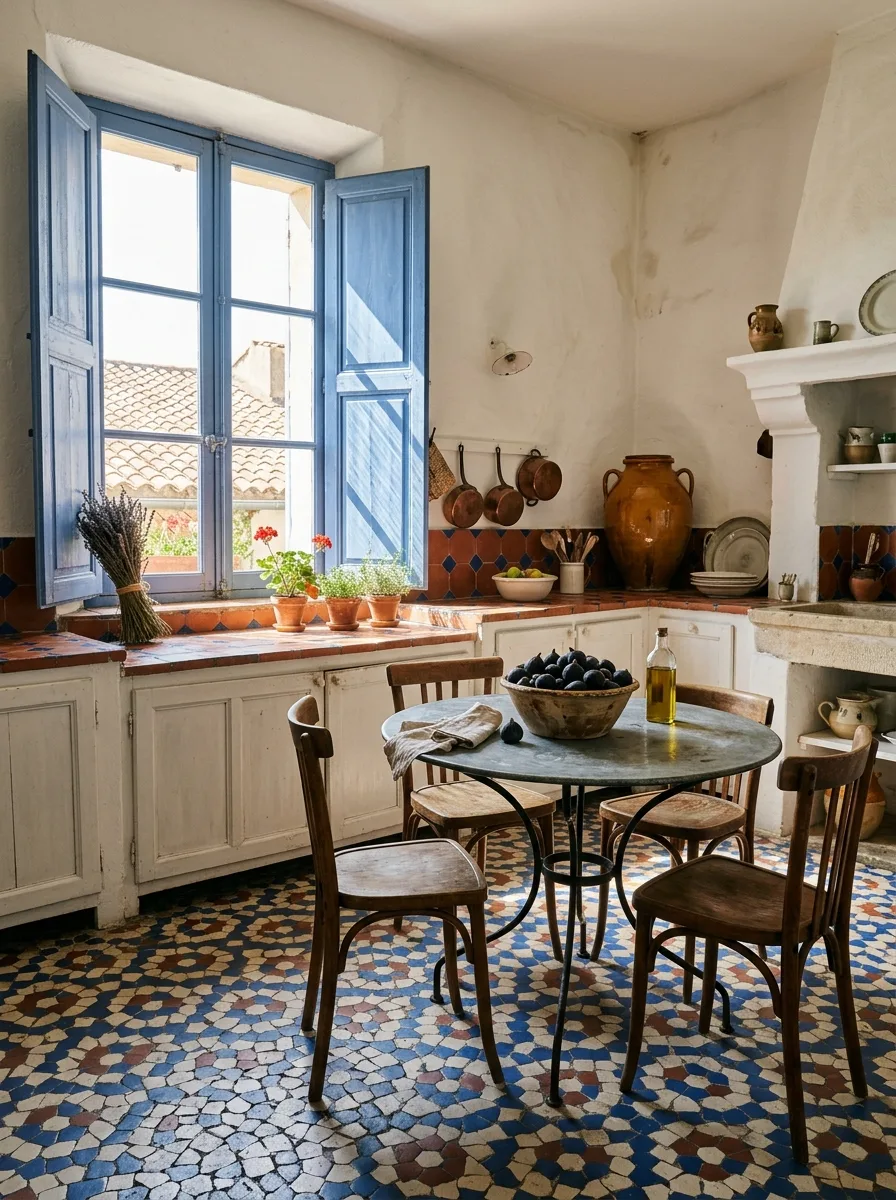
Lay a full floor of genuine antique encaustic cement tiles in the blue, terracotta, and cream colour combination found in traditional southern French farmhouses. These tiles are available from specialist reclamation dealers and Mediterranean tile importers — source genuine antique if possible, or handmade reproduction if not. The floor sets the entire colour conversation for the room.
Install traditional blue painted timber shutters on the window that open fully into the room. Paint the countertop in traditional terracotta-coloured tile — square, unglazed, set in a simple grid with a wide grout joint. Place a large antique amphora or oil jar in a corner as a sculptural element. A round iron table with Bentwood chairs. Keep the walls in plain white plaster, undecorated. The floor is enough.
Medieval Open Hearth Stone Kitchen
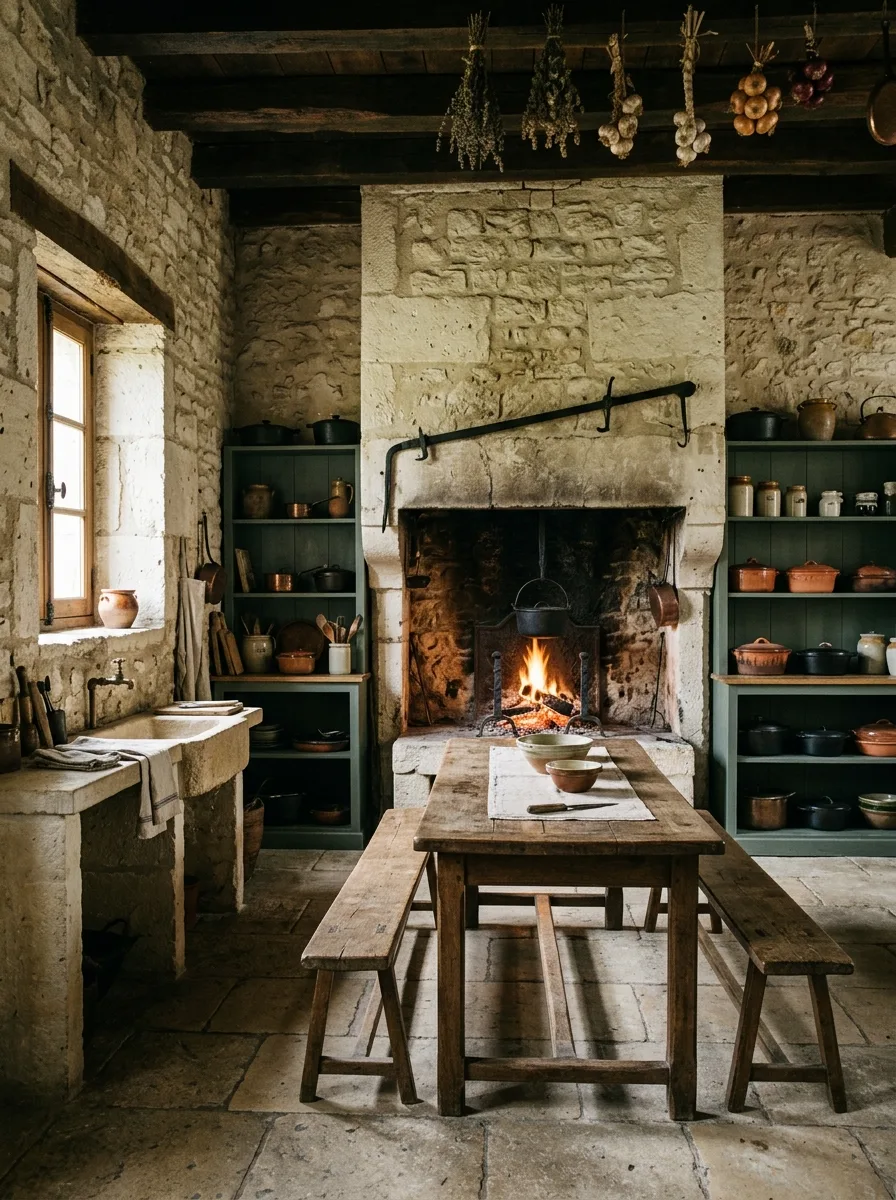
The dominant feature here is an inglenook fireplace proportioned for actual cooking — the opening should be at least a metre wide and tall enough to stand beside comfortably. Construct it from rough-hewn limestone or sandstone without mortar pointing, so the individual blocks read individually. Leave the chimney breast exposed stone from floor to ceiling and don’t plaster it.
Extend the stone cladding to at least two of the kitchen walls. Keep all shelving in dark painted iron brackets supporting thick raw oak boards. A long, narrow trestle table in the centre in heavily worn pine with plain wooden benches rather than chairs. The floor should continue whatever stone you’ve used for the walls — coherence between floor and wall material makes the room feel carved from the landscape rather than built in front of it.
Italian Riviera Lemon Tree Kitchen
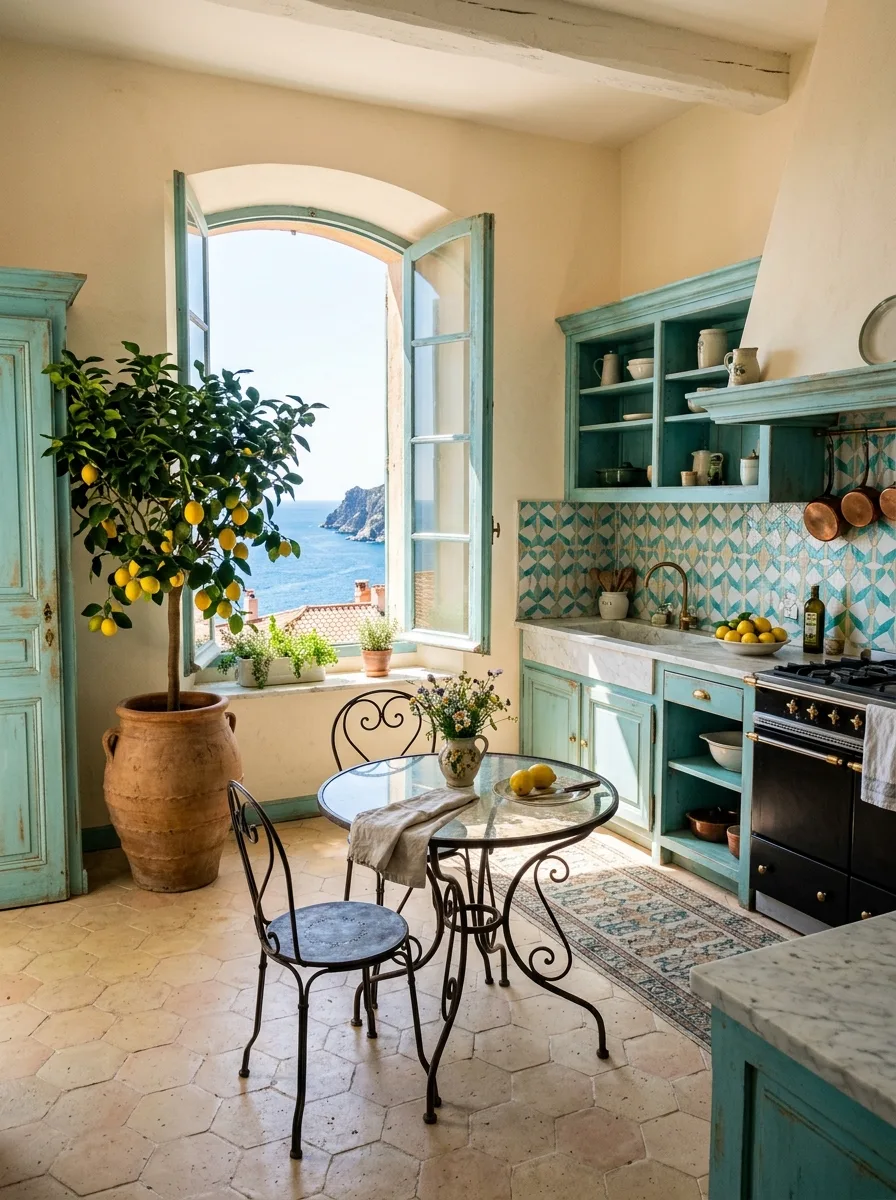
Grow a lemon tree in a terracotta pot large enough to genuinely support it — the pot should be at least 60 centimetres in diameter and the tree at least 120 centimetres tall when positioned. Place it directly in front of your largest window or beside an open arched door. The lemon tree is not a decorative prop. It is a living occupant of the room.
Paint or source cabinetry in a chalky turquoise — the particular washed blue-green of old Riviera shutters. Use hand-painted encaustic backsplash tiles in the same colour family with a simple geometric or floral repeat. A round glass-top bistro table with wrought iron base, paired with small-scale wrought iron café chairs. Terracotta or limestone hex floor. One large terracotta olive jar on the opposite side of the room from the lemon tree to balance the scale.
Maximalist French Farmhouse Salvage Kitchen
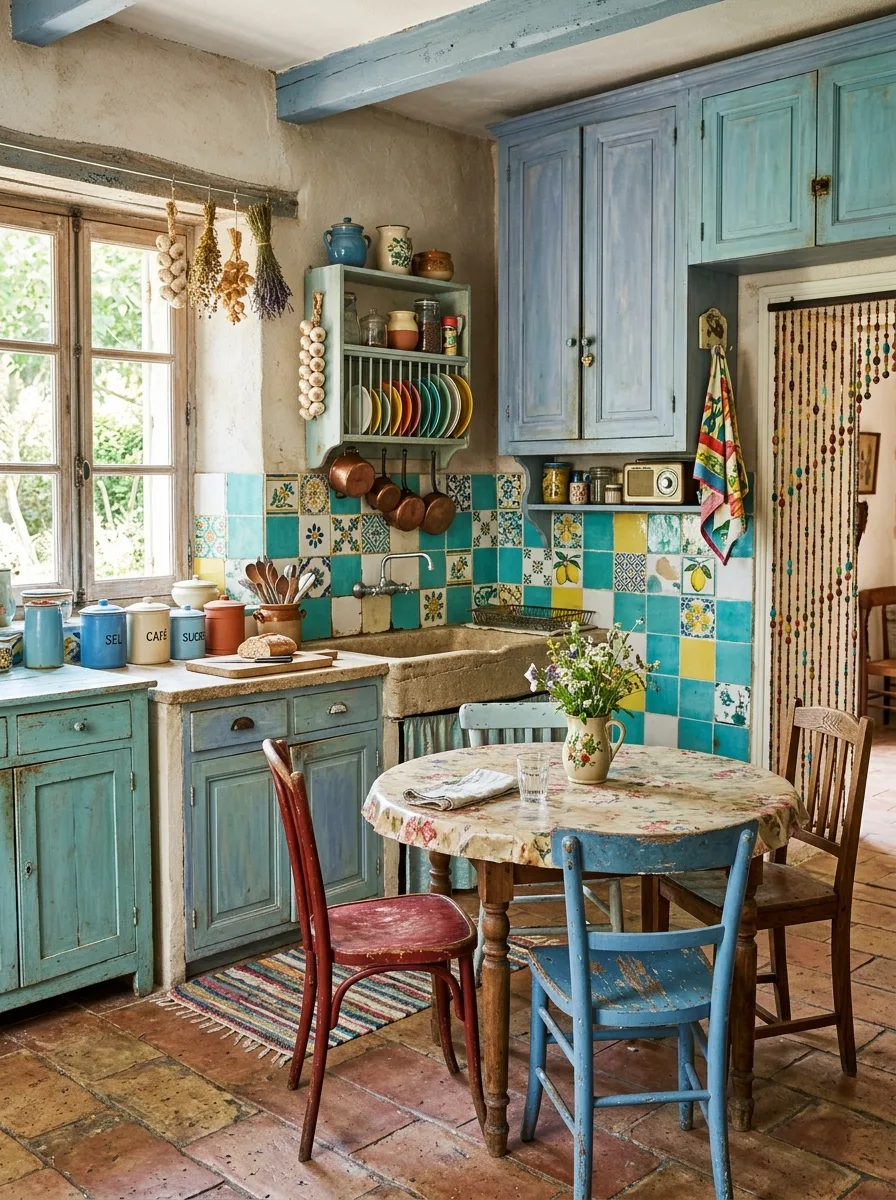
The defining quality here is that nothing matches and everything belongs together. The chairs are mismatched. The tiles are a patchwork of different patterns and colours across the same backsplash wall. The table is decoupaged with different papers. The cabinetry is in two or three different blues applied at different times.
The material principle is patina and accumulation rather than coordination. Paint the cabinetry in different stages — the lower units in one shade, the upper units in another, applied with a brush rather than a roller so the marks show. Layer textiles on the table and chairs. Hang multiple small open shelves at slightly different heights. Use a beaded curtain rather than a door. Add a working radio. Let the room feel like it’s been continuously inhabited rather than periodically redecorated.
Timber Frame Beam and Bench Kitchen
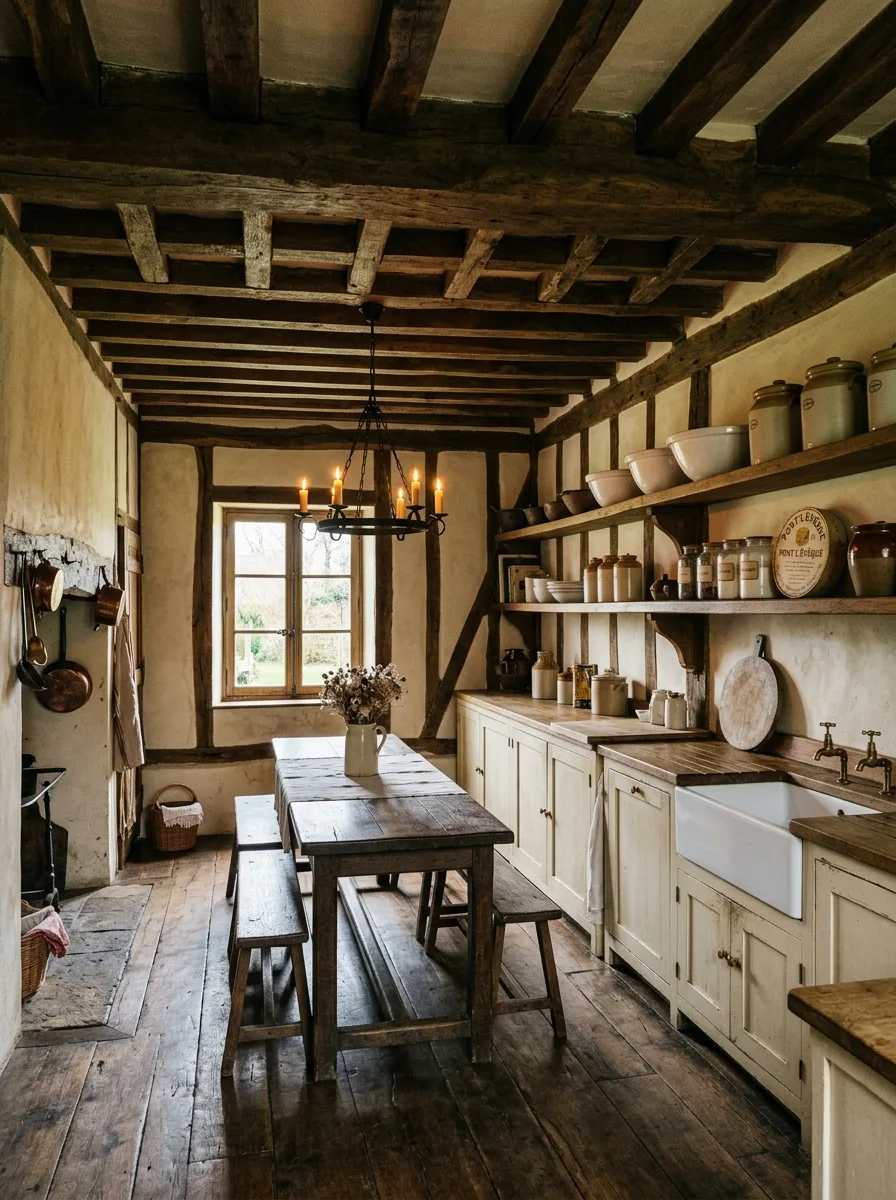
In a room with original or installed timber frame construction — the posts and beams visible within the wall structure — allow the frame to do all the decorative work. Do not cover the timber, panel over it, or plaster around it with a smooth modern finish. The infill panels between timbers should be in a pale warm plaster — traditional lime plaster if possible — deliberately uneven.
Install a full-length run of open shelving along one beam-framed wall at two heights, supporting antique stoneware, crock pots, storage jars, and simple white porcelain without over-arrangement. Hang a simple candelabra chandelier from the main ceiling beam, with actual candles rather than electric bulbs. A long farmhouse table with benches and one or two mismatched wooden stools. The room should look medieval and completely functional at the same time.
Toile de Jouy Copper Collection Kitchen
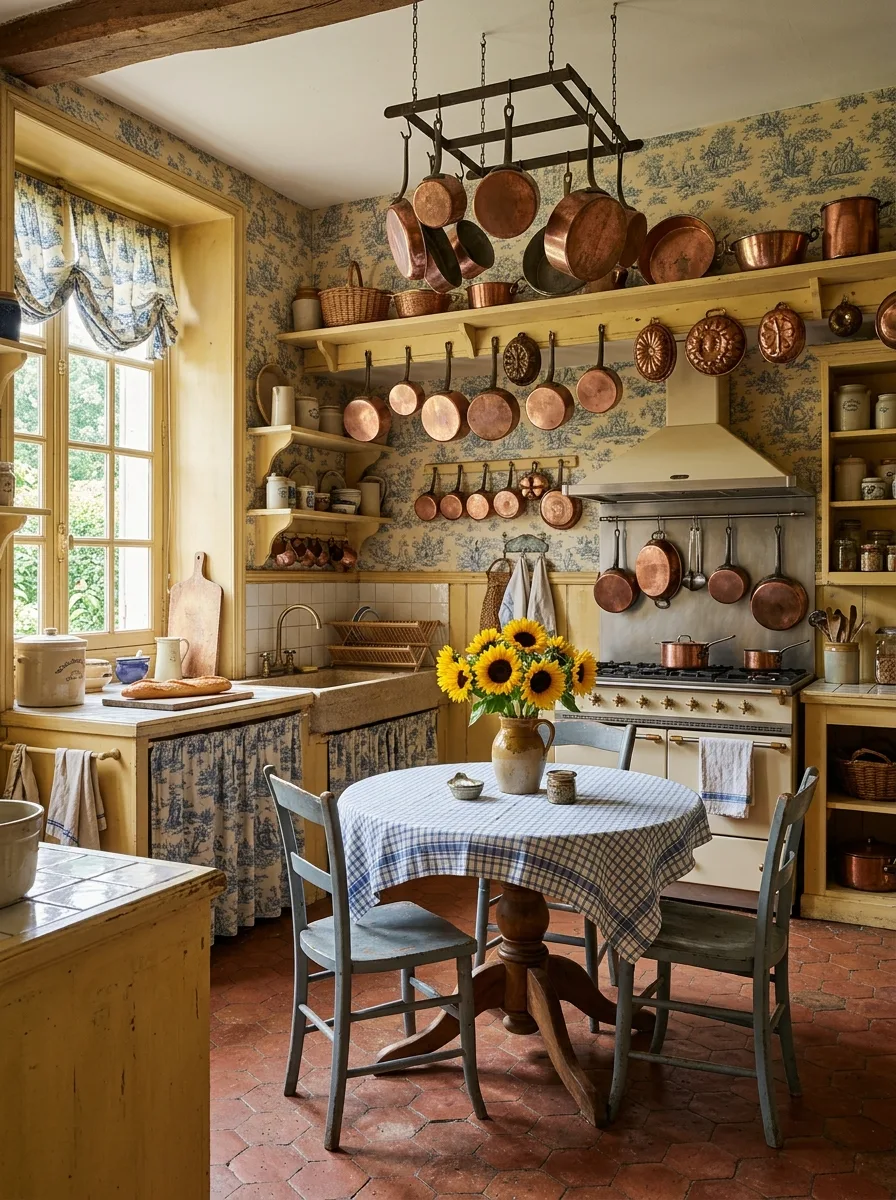
Apply toile de Jouy wallpaper from dado to picture rail — not as a feature wall, but full coverage on every wall surface the paper will reach. Choose a traditional blue on cream or black on cream colourway in the classic pastoral pattern. The wallpaper is not a background element here. It is half the room.
Pair with a complete collection of copper cookware — not a few decorative pieces but a genuine working collection of thirty or forty pieces — hung from every available horizontal surface: a pot rack above the table, a rail around the range hood, a bracket on the side wall, hooks on the underside of shelves. The copper should be in all states of age and polish, from bright newly-cleaned to dark and richly tarnished. The ceiling beam and floor in terracotta hexagon tile. Sunflowers in a stoneware jug.
Dusty Rose Patisserie Kitchen
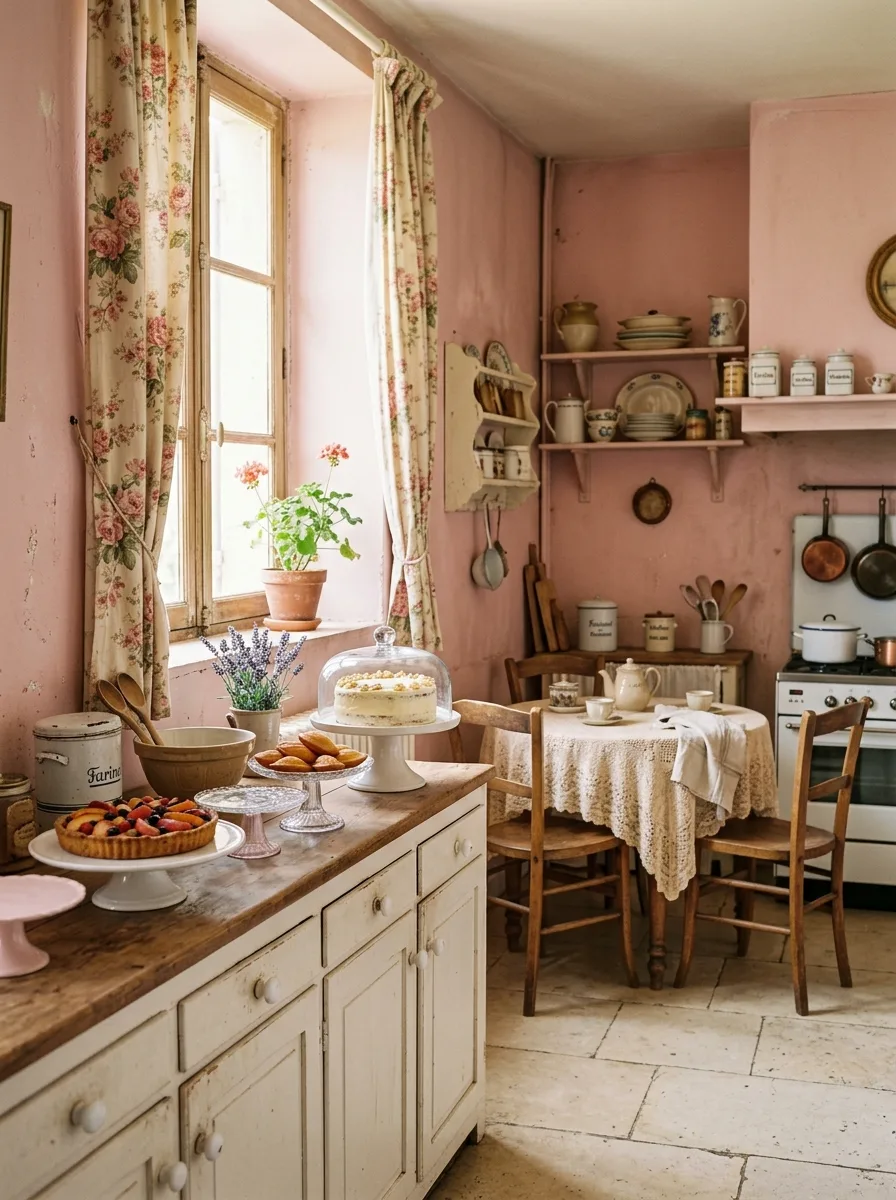
Paint the walls in a chalky rose — the faded, dusty pink of old French confectionery tins and Parisian apartment walls. Not blush, not coral, not salmon. A warm pink that has been sitting in the sun for several decades and has gone slightly powdery. Farrow & Ball’s Calamine or Setting Plaster, applied in a dead flat finish so it looks like washed pigment rather than painted emulsion.
Dress all counter surfaces with baking. A cloche-covered cake. A tart on a ceramic stand. A tray of madeleines. Enamel flour and sugar canisters in cream. A pedestal stand with a glass dome. This kitchen should look like someone is perpetually in the process of making something sweet. Floral curtains in a faded chintz pattern at the windows, held back with a simple fabric tie. A small round table with a lace or broderie anglaise cloth and mismatched chairs.
Dark Plum Still Life Gallery Kitchen
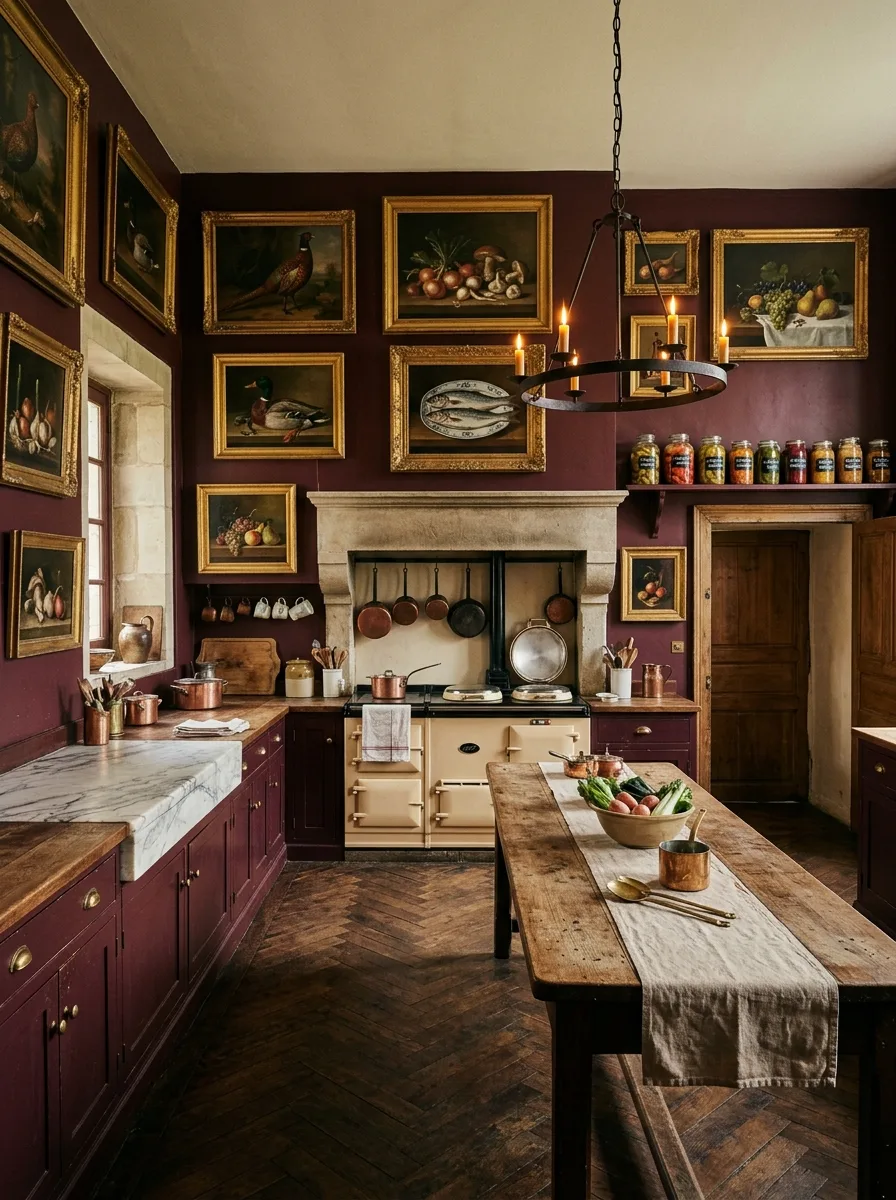
Paint the walls in a deep, dark plum — the colour of old burgundy wine, the colour of dried violets. Farrow & Ball’s Brinjal or Pelt, or any deep purple-red that has brown in it and reads almost black in low light. On these walls, hang a full gallery of framed oil paintings: still lifes of game birds, fish, fruit, vegetables, and kitchen objects in heavy gold frames, hung salon-style from ceiling to dado with no regulated spacing.
Use a cream Aga as the focal point with a carved stone mantel surround. A blackened iron candelabra chandelier above the table for the evening’s only additional light. Cabinetry in the same plum as the walls so it disappears into them, allowing the paintings, the chandelier, and the Aga to read as the room’s only furniture. A long, narrow refectory table with mismatched wooden benches in a lighter wood than the floor.
Exposed Stone Candle Chandelier Kitchen
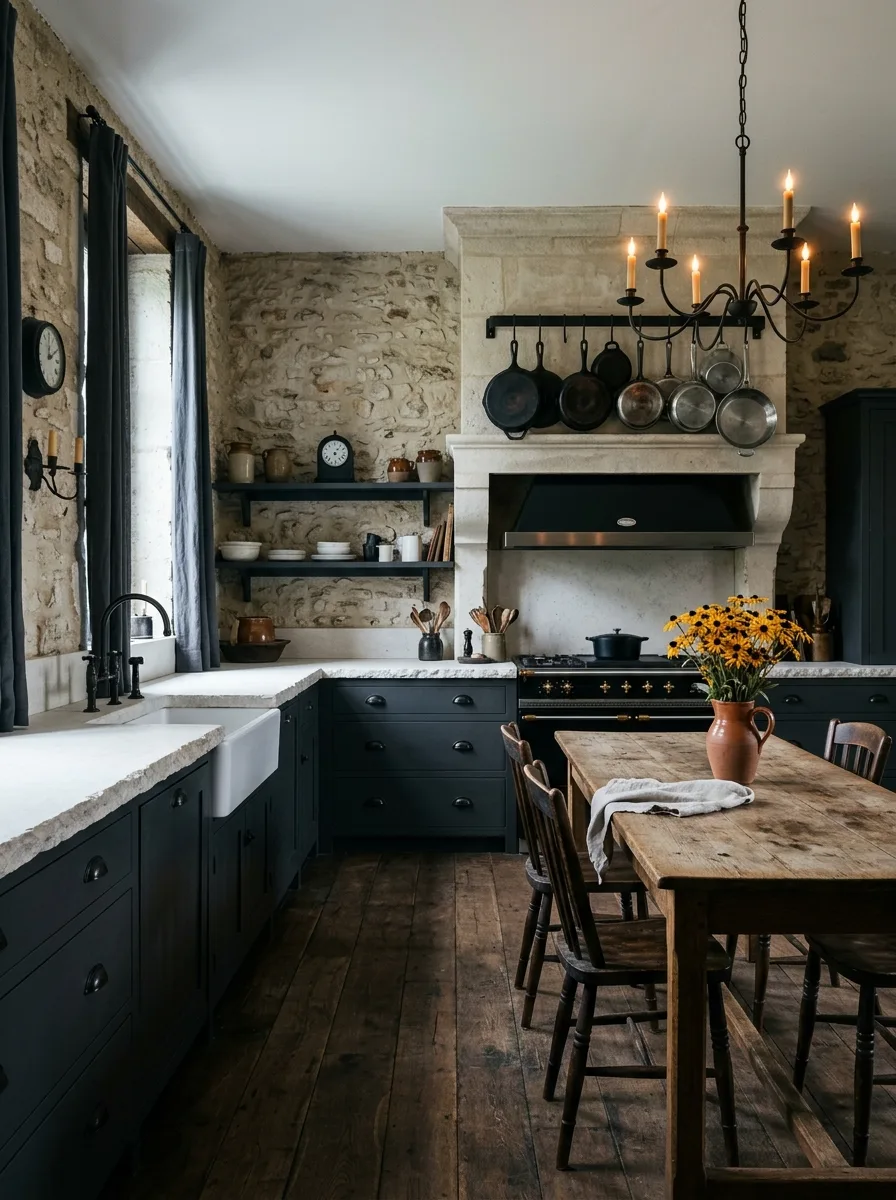
Expose the original stone of the kitchen walls and leave it in as-found condition — repointed with lime mortar where necessary, but not cleaned, not sealed, not smoothed. The raw aggregate quality of the stone surface is the texture the room needs. Against it, all other materials should be either very pale or very dark, with no middle ground.
Install matte black cabinetry — the blackest matte you can find, with simple black cup pulls — against the stone. The contrast between the dark painted wood and the pale limestone is stark and intentional. A stone mantel over the range in the same limestone as the walls. A cast iron candelabra chandelier above the table hung on chain from the original ceiling hook. One bunch of sunflowers in a terracotta jug on the farm table. Everything else stripped back.
Rattan Wicker Camargue Kitchen
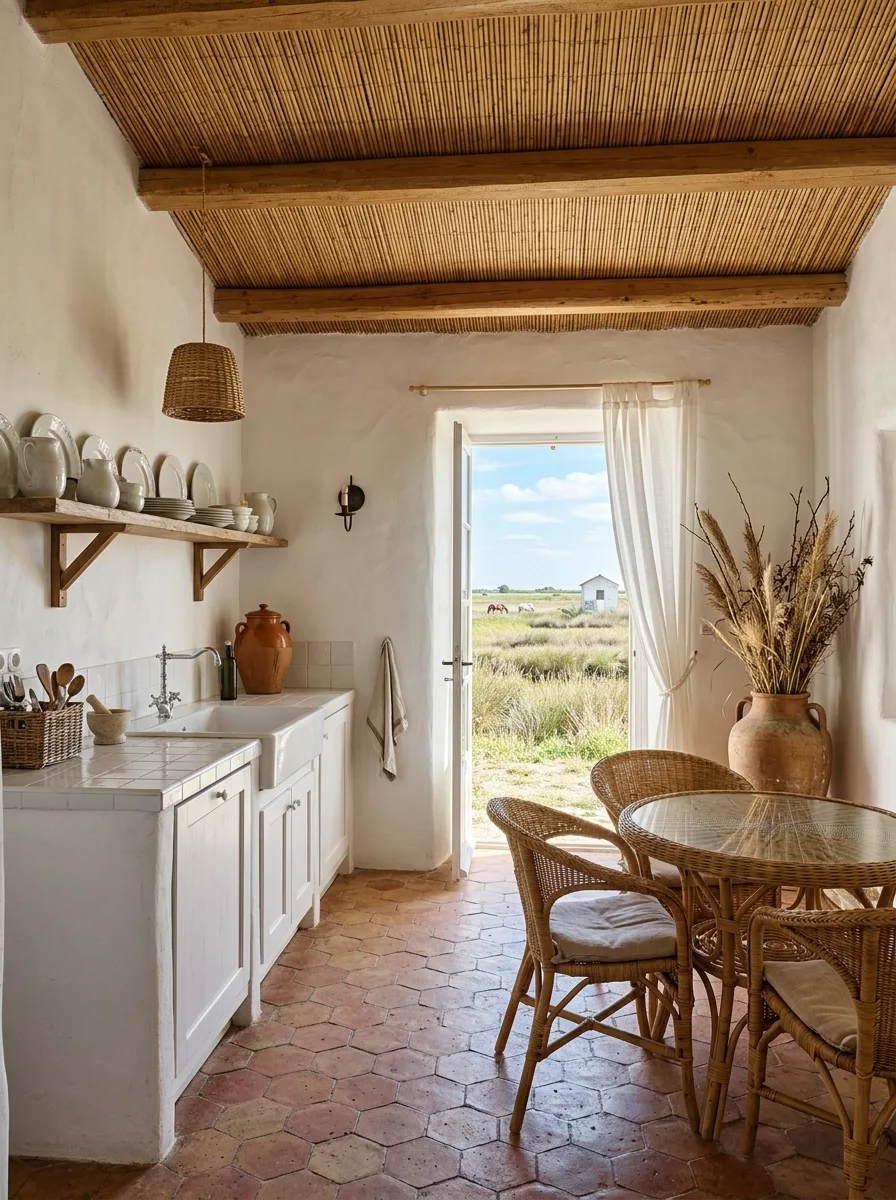
Install a ceiling of bamboo canes laid tightly together between exposed wooden beams, sealed with a clear matte finish. This ceiling technique comes from the marshland architecture of the Camargue and requires no structural work — the canes are simply cut to length and laid in courses between the beams, held with simple wire clips. The result is a warm, textured overhead plane that transforms the character of the room completely.
Render the walls in coarse white lime plaster and leave them rough. A wicker pendant lamp rather than a fixed ceiling light. A round glass-top or glass-surface table with rattan and wicker chairs that refer to the ceiling material. Terracotta hexagon tile floor. A large antique ceramic amphora or oil jar in the corner filled with dried pampas grass stems, wheat, and bare branches. White cabinetry as simple as possible so the ceiling and floor carry all the texture.
What Holds All of This Together
These twenty kitchens come from wildly different traditions. Alsatian, Breton, Provençal, medieval English, Italian coastal, Parisian apartment. They share almost no surface treatment, colour palette, or material in common.
What they do share is a refusal to be generic. Each one made specific, committed choices and followed them through. The colour went on the wall, not the cushion. The aged table was not replaced with something new. The exposed stone was left exposed rather than skimmed over for a cleaner result. The copper pots were bought and used until they tarnished, not arranged for display.
The best French country kitchens feel like the cook made all the choices and the designer was never consulted. Whether or not that is true, it is the effect to aim for. The room should feel like an expression of a specific life, not a mood board executed by committee.
Get the structure right. Choose one tradition and follow it seriously. Then let it age.