
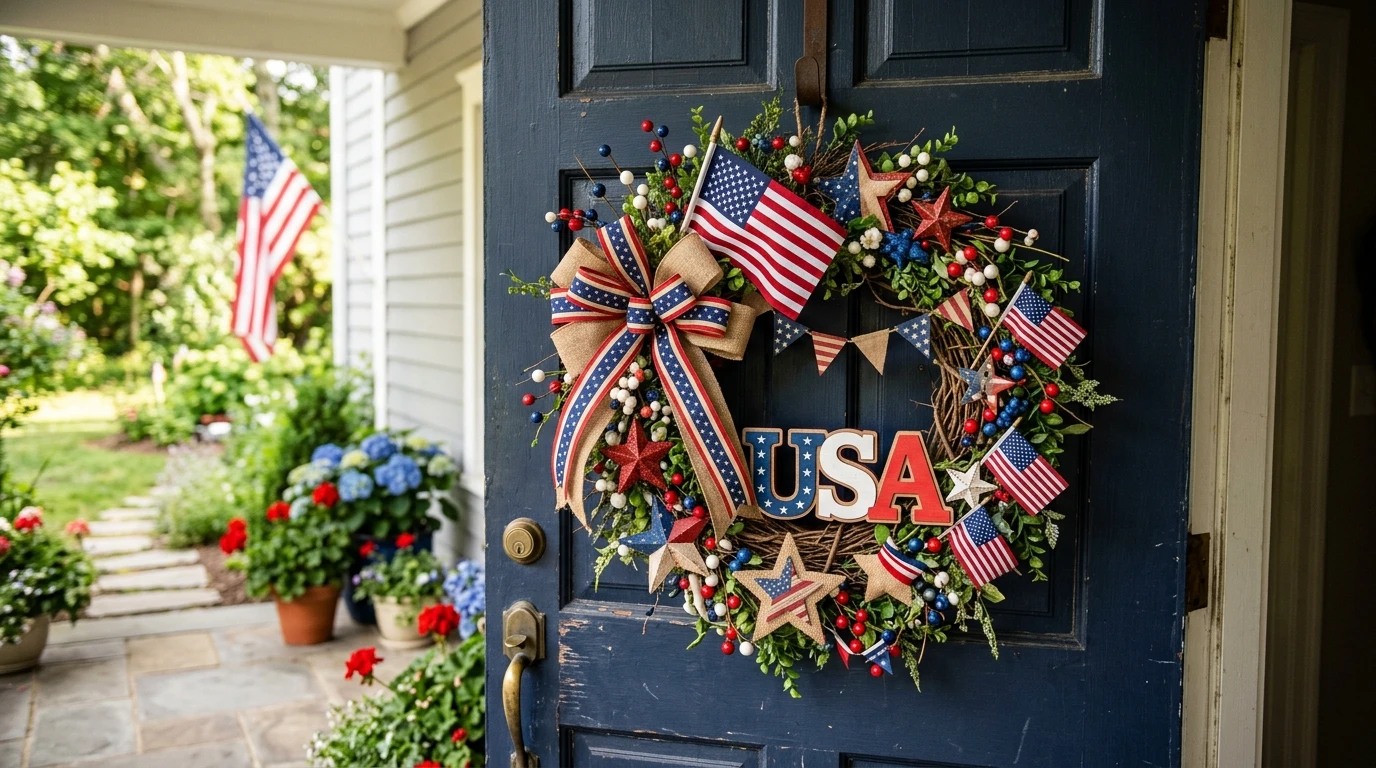
Your front door is working harder than you think. It’s the first thing anyone sees, the last thing they remember, and it sets the tone for every party you’ve ever thrown before a single guest walks inside. Most people treat it like an afterthought. A quick wreath slapped up two days before the fourth, ordered in a panic, forgotten by August.
That’s a waste of a very good surface.
The door wreath is one of the few pieces of holiday decor that has to work at a distance. It needs to read from the street, survive humidity and direct sun, and still look intentional up close. Those are real design constraints. Most holiday wreaths fail one of them — usually the last one. They look fine from thirty feet. Walk up to the door and they fall apart.
The twenty wreaths in this collection don’t fall apart. Each one made a specific material or structural decision and committed to it. Here’s how to build them.
The Base Form Changes Everything
Grapevine vs. Wire vs. Foam
The wreath base is not a neutral starting point. A grapevine base is warm, organic, and visible through any arrangement — it reads rustic whether you want it to or not. A wire hoop base reads modern and minimal because so much of the form is empty space. A foam ring base disappears entirely under heavy flower coverage, which makes it right for dense, lush arrangements where the base should never show. A polystyrene or wire-frame star or other shaped base creates a form that is part of the composition itself.
Choose the base based on whether you want the underlying structure to be part of the visual story or invisible. If you’re going lush and dense, foam. If you’re going sculptural and open, wire hoop or shaped frame. If you want that warm naturalistic quality coming through, grapevine.
Scale Relative to Door Width
A wreath that is too small for the door it hangs on reads as tentative. The standard rule is that a wreath should span at least one-third of the door’s width. For a standard 36-inch door, that means a minimum of 24 inches in diameter. For a double door, scale up significantly — a 30 to 36 inch wreath or larger. Undersized wreaths don’t just look wrong; they make the door look wrong too.
The wreaths in this collection that look the most confident on their doors are the ones that commit to scale. When in doubt, go bigger.
The Hanging Method Matters
A wreath hung on a flimsy plastic hook at the wrong height — too high, crowded against the frame, or swinging loose in a breeze — undermines everything. Use a heavy-duty magnetic wreath hanger rated for the weight of your specific wreath. For large, heavy wreaths, consider a two-point hanging system with ribbon looped over the top of the door at two points. The ribbon tail becomes a design element. Use a wide satin or grosgrain ribbon in navy, red, or gold. The ribbon showing at the top of the door, above the wreath, is not a failure to hide the mechanics — it is part of the composition.
Building the Bow
Why Most Bows Look Wrong
The bow is the most technically demanding part of a wreath and the most likely to go wrong. A flat, limp bow looks like a gift wrap accident. A bow that is too small for the wreath looks like an afterthought. The three things that make a bow look right: wire, volume, and proportion.
Always use wired ribbon for wreaths. It holds its loops. Unwired ribbon collapses. Make each loop generous — at least four to six inches — and vary the loop angles slightly rather than stacking them flat. A good bow should have six to eight loops minimum, built from two or three different ribbons layered and wired together at the center. The tails should be at least as long as the bow’s width and cut at a diagonal or V-shape.
Layering Multiple Ribbons
The wreaths in this collection that use multiple ribbon patterns all follow the same logic: one dominant ribbon anchors the bow and one or two accent ribbons add detail. The dominant ribbon is the largest, most structured loop — often solid navy, solid red, or a stripe. The accent ribbons are narrower, patterned, and fill in the gaps between the dominant loops. Never use ribbons of the same width — the variety in scale is what makes layered bows look considered rather than chaotic.
Bow Placement Changes the Wreath’s Energy
A bow at twelve o’clock reads formal and symmetrical. A bow at eight or nine o’clock reads casual and garden-style. A bow at six o’clock — at the bottom of the wreath — reads elegant and deliberate. None of these is wrong. Decide on the placement first because it determines how you distribute the rest of the wreath’s elements around it.
Flower and Foliage Strategy
Greens Come First
Every wreath that involves foliage — fern, eucalyptus, boxwood, dusty miller, ivy — should have the greens placed before a single flower goes in. The greens establish the silhouette, fill the base, and create the ground everything else sits in front of. Greens placed after flowers look stuffed in. Greens placed first look like the flowers grew from them.
Work from the outside edge inward and from the base toward the center. Let some greens extend well beyond the wreath perimeter — a fern frond extending four inches past the edge of a grapevine base is the thing that makes the whole arrangement look alive.
Flower Distribution Approaches
There are two approaches to flower placement on a wreath: mixed distribution, where all three colors appear throughout the entire form, and zoned placement, where each color occupies a distinct section. Mixed distribution reads lively and cottage-garden. Zoned placement reads graphic and intentional. Both work. What doesn’t work is accidental zoning — where the colors cluster in sections because you ran out of one color halfway through and had to compensate with another. Decide before you start which approach you’re using and plan your flower quantities accordingly.
4th of July Wreath Ideas Worth Making
Fern and Mixed Ribbon Grapevine
Start with a large grapevine wreath base, at least 24 inches. Push full fern fronds into the grapevine throughout, extending them beyond the perimeter so the wreath has a loose, overgrown silhouette. Add silk blue dahlia heads, white astilbe sprays, and red glitter berry clusters, distributed throughout the fern base. Insert several small American flags on wooden stakes, angled outward at different positions around the wreath. Build a multi-ribbon bow using five ribbons: navy solid, red polka dot, flag stripe, navy buffalo check, and a narrow glitter red — layered and wired together. Attach a small holiday sign or tag to the bow center. Mount on a matte black door so the green fern reads clearly against the dark surface.
Flower Star Wreath Frame
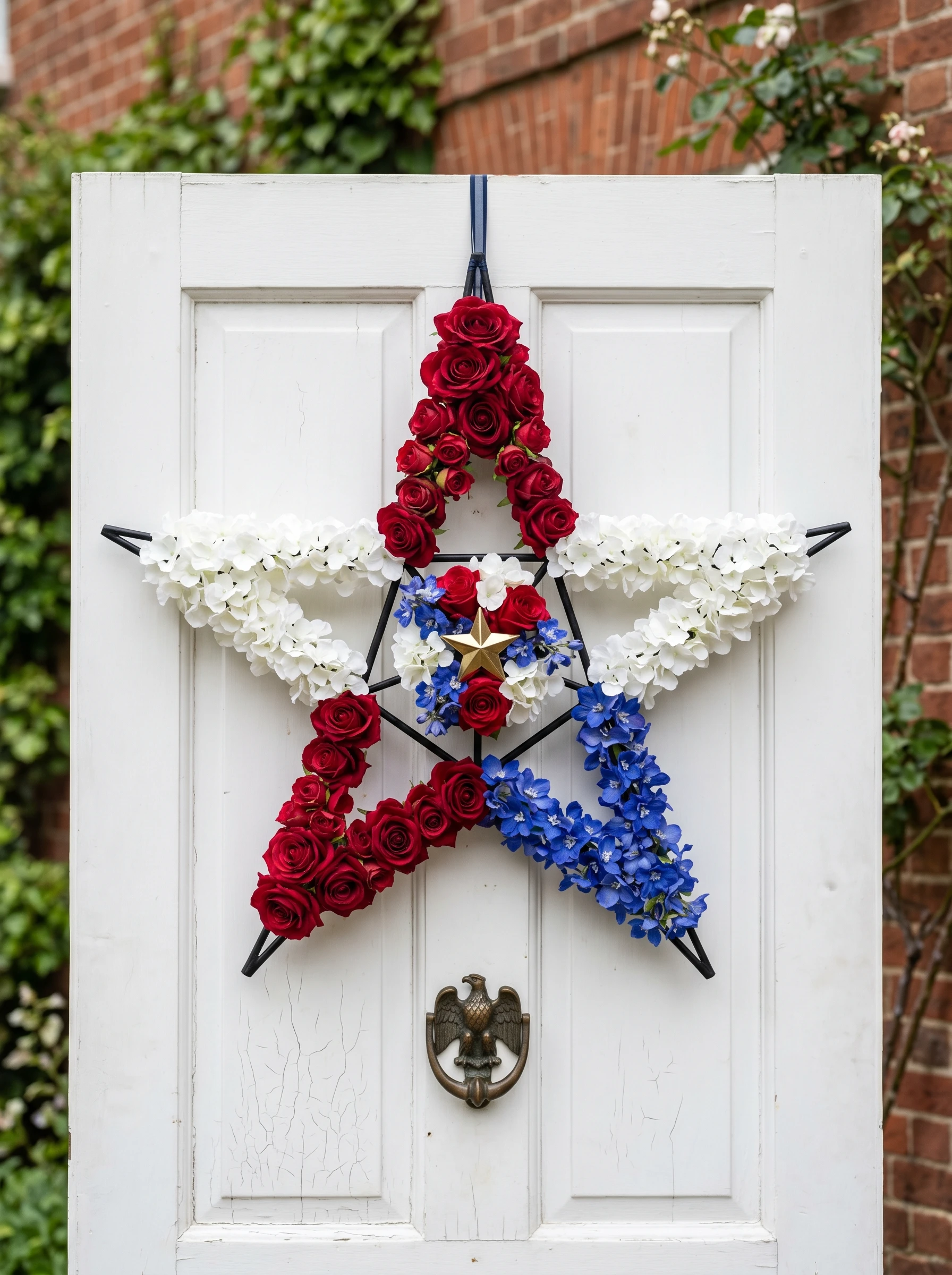
Purchase or fabricate a large five-pointed star frame in black wire or metal rod — approximately 24 inches point to point. Using floral wire and wet or dry floral foam inserts, attach flower clusters along each arm of the star: deep red roses on the top point and left lower arm, white hydrangea on the two horizontal arms, and blue delphinium and blue hydrangea on the right lower arm. Add a small gold star ornament at the center intersection of the frame. Hang from a navy ribbon attached to the top point. Hang on a white paneled door with a brass eagle knocker. The star-shaped form does the patriotic work — the flowers fill it. Every arm of the star needs to be fully covered, or the negative sections draw the eye in the wrong way.
Grapevine Duo with Chinoiserie Ribbon
Make two small-to-medium grapevine wreaths rather than one large one. For each, cluster a small arrangement of mixed flowers at the lower left position: red ranunculus, blue hydrangea, blue delphinium, white waxflower, and small green boxwood sprigs. Wire a large bow using a blue-and-white chinoiserie-print wired ribbon as the dominant loop, with a wide red satin ribbon as the accent. Let the red ribbon tails hang long — eight to ten inches — below the bow. Hang both wreaths on the same door or wall surface in a stacked or side-by-side arrangement. The paired placement is the design decision; a single wreath in this style would be diminished by it.
Grand Double Door Statement Wreath
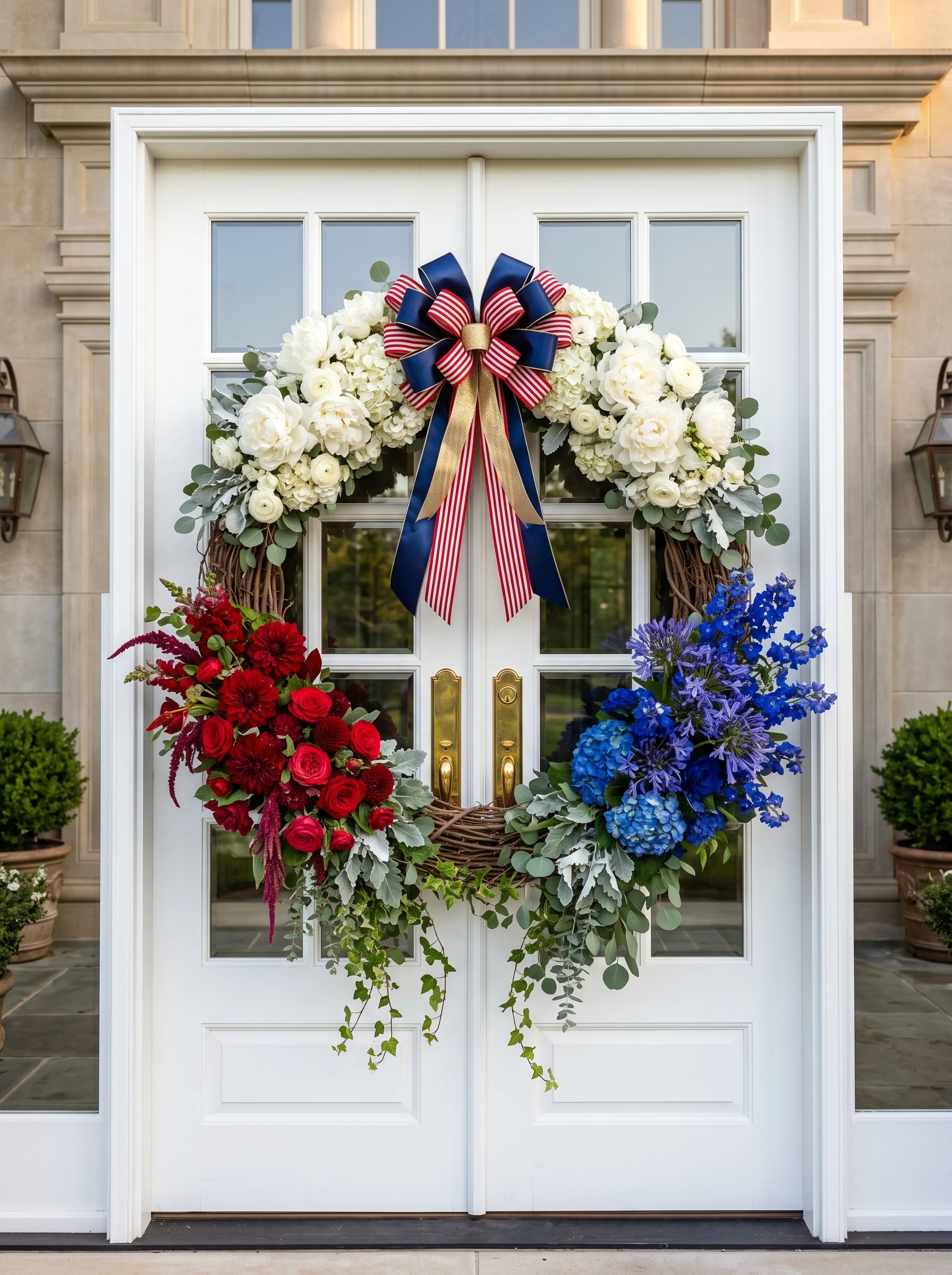
Source or build a very large grapevine wreath — 36 inches or larger — for a set of double doors. The wreath should span wide enough that it touches or nearly touches both door panels. Build three distinct floral zones: a dense arc of all white flowers at the top — white hydrangea, white ranunculus, white garden roses, and dusty miller — covering the upper third of the wreath form. On the lower left, build a full, spilling cluster of deep red flowers — red dahlia, red roses, red amaranth, and red ranunculus — allowing some stems to trail downward below the wreath perimeter. On the lower right, build a blue cluster of blue hydrangea, blue delphinium, and purple-blue agapanthus, also trailing downward. Let eucalyptus and dusty miller trail through the green grapevine center between all three sections. At twelve o’clock, build a layered bow from three ribbons: navy satin, red-and-white stripe, and a narrow gold ribbon between them.
Feathery Green Pull-Bow Fern Wreath
Build a large, full wreath base entirely from feathery fern or Norfolk pine fronds wired onto a foam ring — aim for maximum density and fullness so the finished form is pure green with no base showing. Build a multi-ribbon pull bow using four ribbons: navy solid, red-and-white polka dot, red-and-white stripe, and a star-print patriotic ribbon. A pull bow is made by looping ribbon back and forth in figure-eights and pulling a center wire tight — it produces a dramatically full, spiky bow shape. Mount the bow at nine or ten o’clock on the wreath, with tails extending downward. The all-green wreath against a black door with the saturated patriotic bow is a high-contrast, graphic combination. Flank the door with matching black urn planters of red geraniums.
Gradient Ranunculus Color Wheel
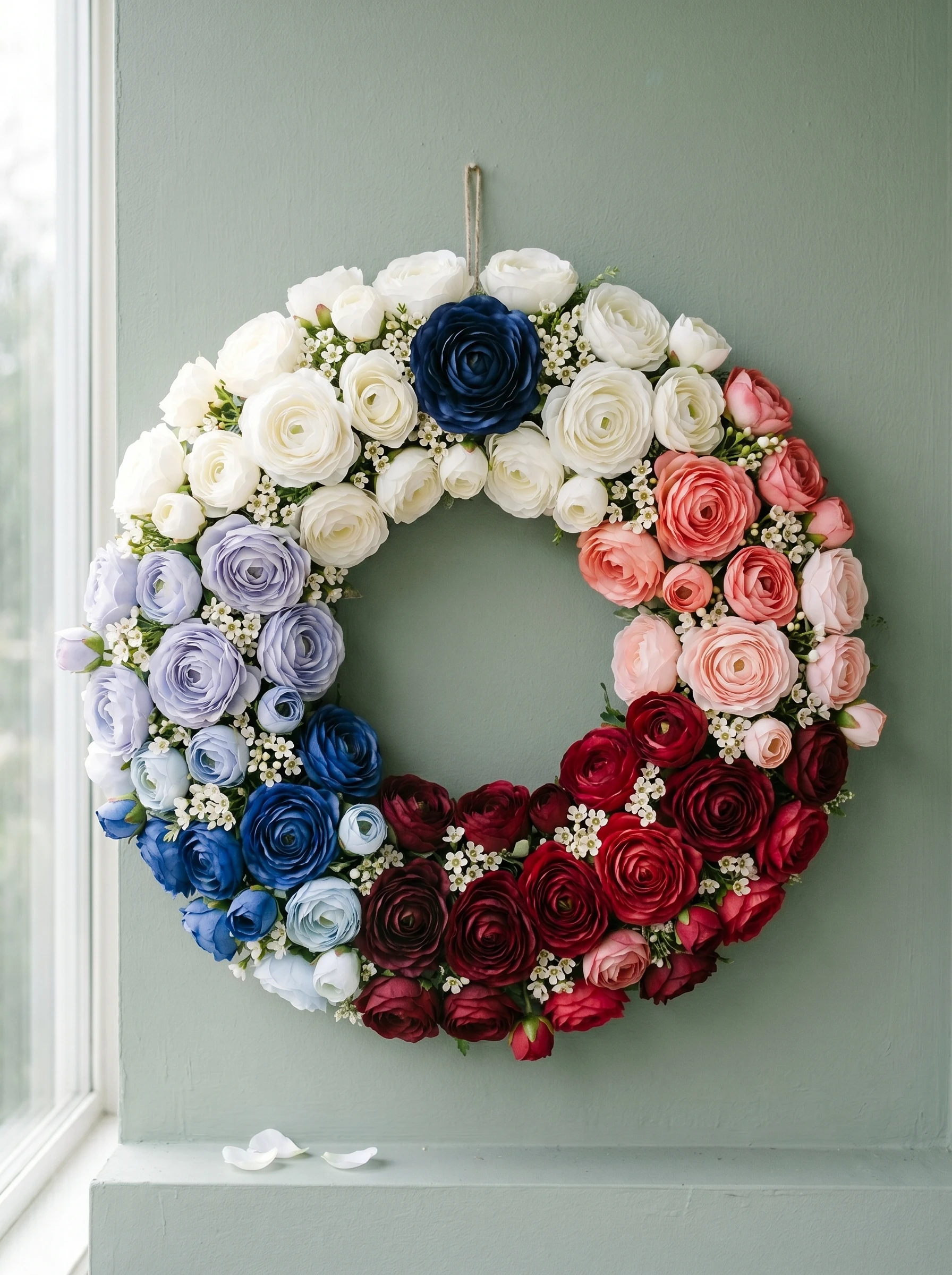
On a foam ring base, plan the color placement as a gradual progression around the full circle: deep navy blue ranunculus at the bottom left, transitioning to lavender-blue, then pale white, then ivory, then blush pink, then coral, then deep crimson red, back to deep navy. Fill every section with tightly packed ranunculus heads, all the same flower variety, so the color change is the only variable. Add tiny white waxflower stems tucked between the ranunculus heads throughout as filler. Place a single deep navy ranunculus as an accent at the twelve o’clock position. Hang from jute twine on a sage or grey-green wall. Do not add a bow — the color wheel wreath is its own statement.
Gold Hoop with Mixed Florals
Source a 20 to 24 inch brass or gold metal hoop ring — available at craft stores or online. Wire a cluster of silk flowers onto the bottom third of the hoop only, leaving the top arc completely bare. Use white garden roses as the largest focal flowers, red poppies for height and movement, blue cornflowers for the blue element, white baby’s breath as filler, and small fern fronds at the edges of the cluster. Keep the arrangement asymmetrical — heavier on one side than the other. Hang on a matte black shiplap or paneled door using a simple loop of jute or twine at the top of the hoop. The negative space of the bare gold hoop arc is what makes this look modern. Do not fill the whole hoop.
Fresh Moss and Rose Study
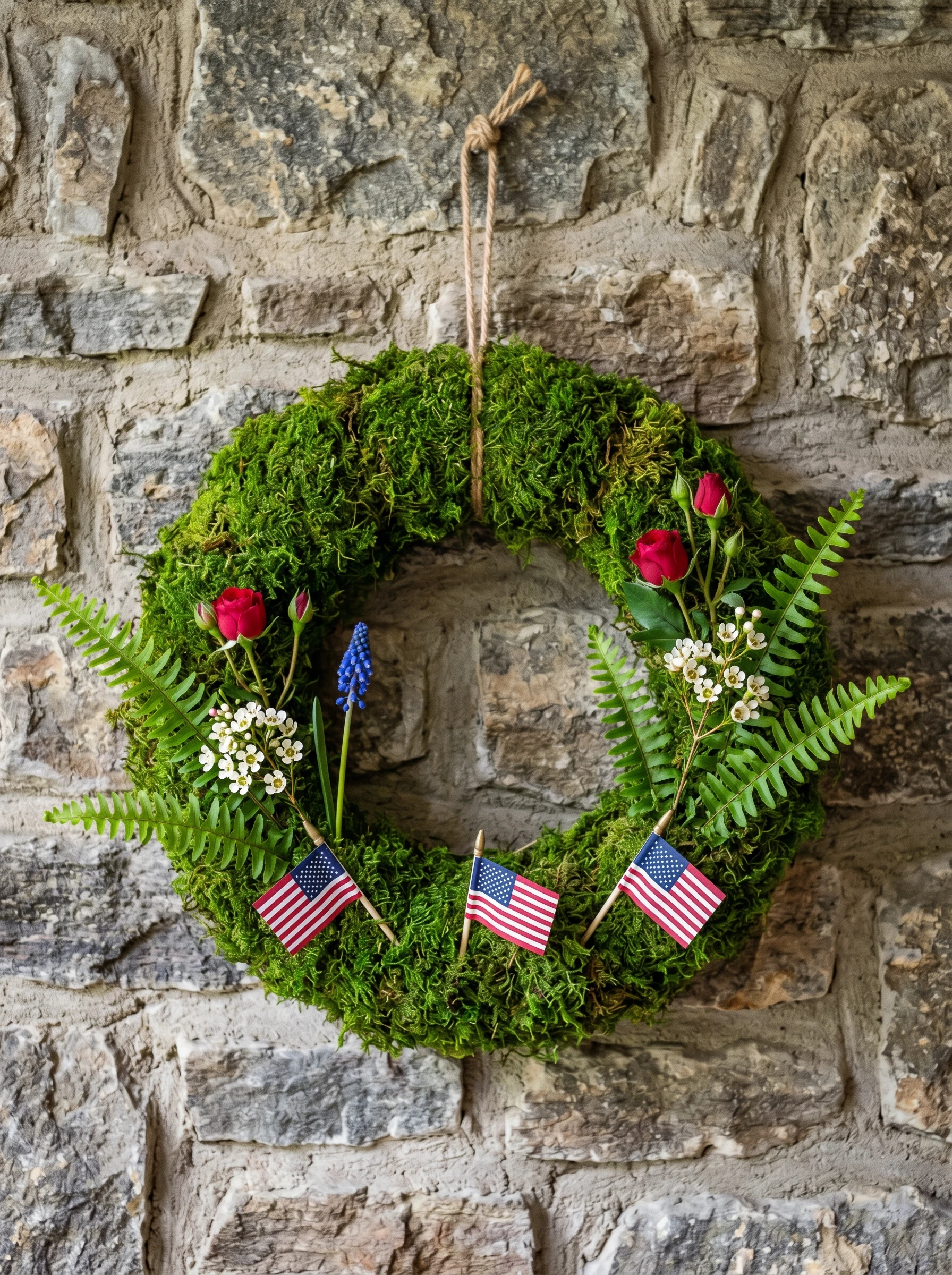
Wrap a foam ring base completely and tightly in preserved or fresh sheet moss, securing with floral pins pushed directly through the moss into the foam. Let the moss be the dominant surface. Into the moss, insert only a small number of elements at intentional intervals: two or three single red rose stems on long straight cuts, two fern fronds flat against the moss surface, a small cluster of white waxflower, a single stem of blue muscari, and three small American flags on wooden stakes pushed into the bottom arc. Hang from jute twine on a stone or exposed brick wall. The restraint is non-negotiable. If it starts looking full, remove something.
Bandana Flag Wreath
Buy twelve to fifteen cotton bandanas in red, white, and blue — navy bandana print for the blue section, red bandana print for the red-and-white stripe section, and white bandana print for the white section. Fold each bandana into a long rectangle, then fold again into a shorter rectangle, and tie or clip it onto a wire wreath frame ring. Pack them tightly around the full form, alternating colors to create a flag-inspired progression — blue-section bandanas on the left half, alternating red and white on the right. Apply small white adhesive or wooden star shapes to the blue section after the bandanas are attached. Hang on a blue door. The bandana print texture reads as patriotic without being flag-literal, and the material gives it a soft, handmade quality that sets it apart from every other wreath on the street.
Deco Mesh Ribbon Wreath
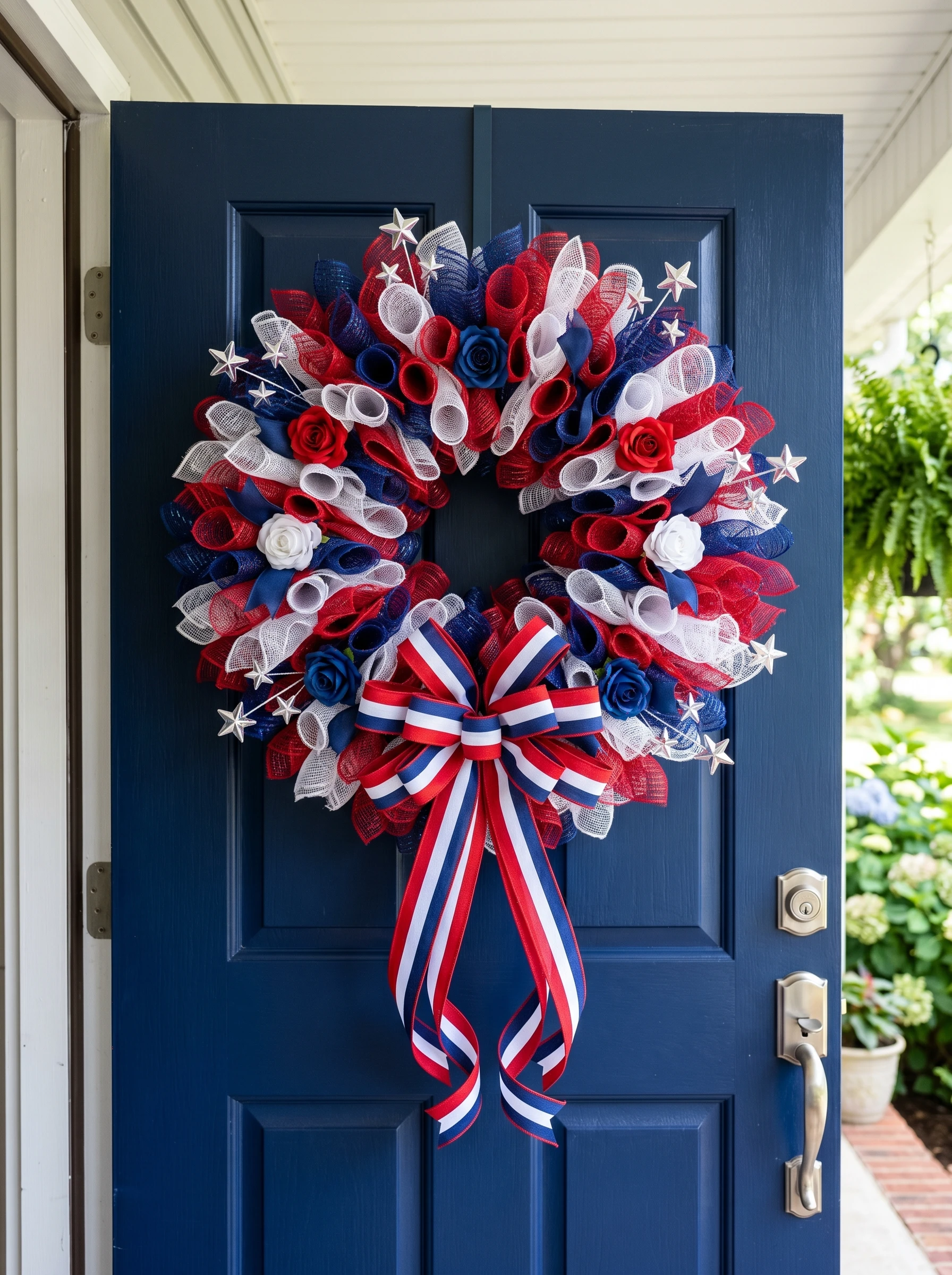
On a wire wreath frame, build a full deco mesh wreath using red metallic mesh, white metallic mesh, and navy fabric ribbon, alternating and layering as you work around the frame. Push each section of mesh in with a pencil or chopstick to create volume and dimension — flat mesh reads cheap, puffed mesh reads full. Add small silk red and blue rose heads tucked into the mesh throughout. Wire silver star picks at intervals around the wreath. Build a striped red-white-blue grosgrain ribbon bow and attach at six o’clock with long tails. This is an outdoor-rated style — deco mesh holds up in rain and sun far better than fabric flowers, making it a practical choice for an exposed front porch.
Sectioned Dahlia Wreath
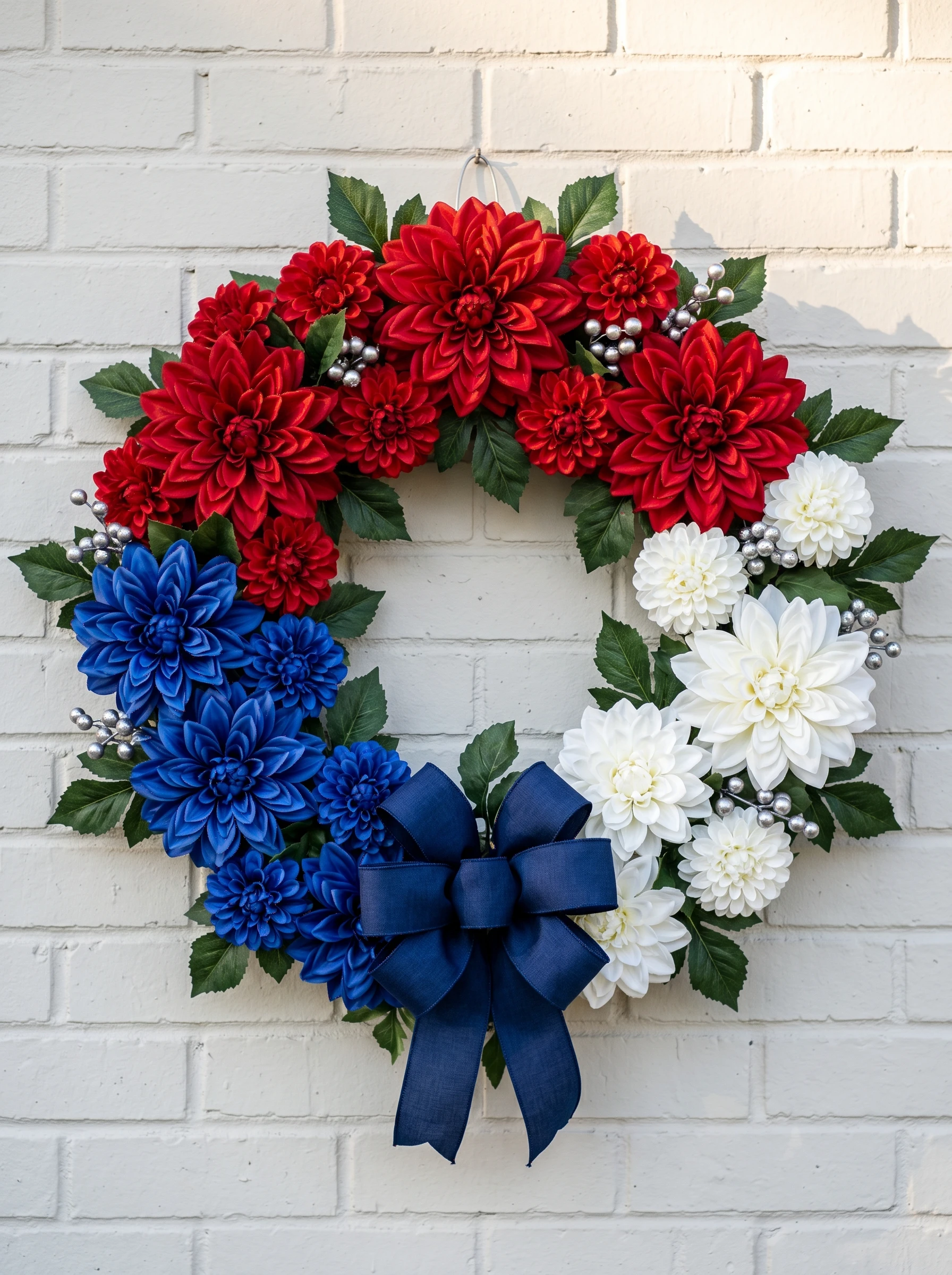
On a foam ring base, divide the wreath into three distinct sections: red on the top arc, blue on the lower left, and white on the lower right. Use identical dahlia-style silk flower heads in each section — same variety, same scale, just different colors. Pack them tightly so no foam shows. Add glossy silver berry picks at the transition points between color sections. Wire a navy grosgrain ribbon bow at the transition point between the blue and white sections, at approximately seven o’clock. Hang against a white painted brick wall. The graphic segmentation of the color zones, with no blending, is the entire design statement — do not mix the sections.
Peony and Globe Thistle Linen Bow
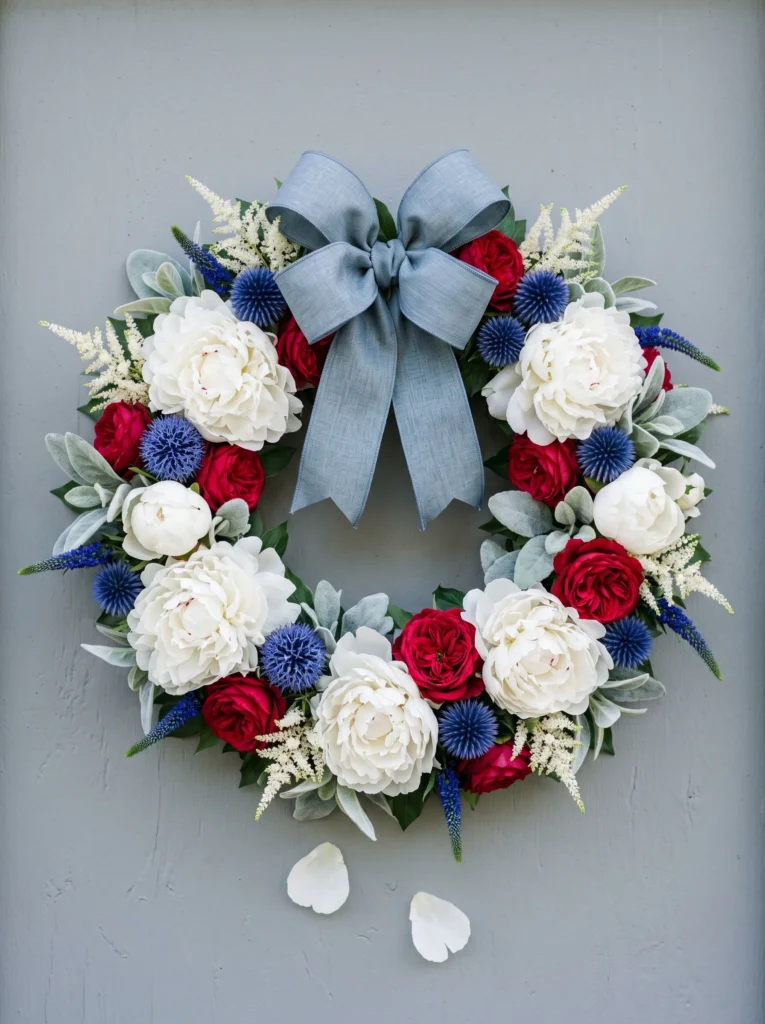
Build a full, lush wreath on a foam ring using a botanically varied mix: large white peony heads as the dominant flower, deep red garden roses in clusters between the peonies, blue globe thistle heads for texture and color, dusty miller throughout for silver-grey foliage, white astilbe spikes for height variation, and small eucalyptus stems. Distribute all elements evenly around the full wreath form — no bare spots, no visible foam. Tie a large, relaxed bow in a washed chambray or linen-look ribbon in slate blue — not navy, but softer — and mount it at twelve o’clock. The muted bow against the lush, saturated flowers is a deliberate contrast. A few petals dropped at the base of the door during installation complete the look.
Rose, Hydrangea, and Navy Satin Bow
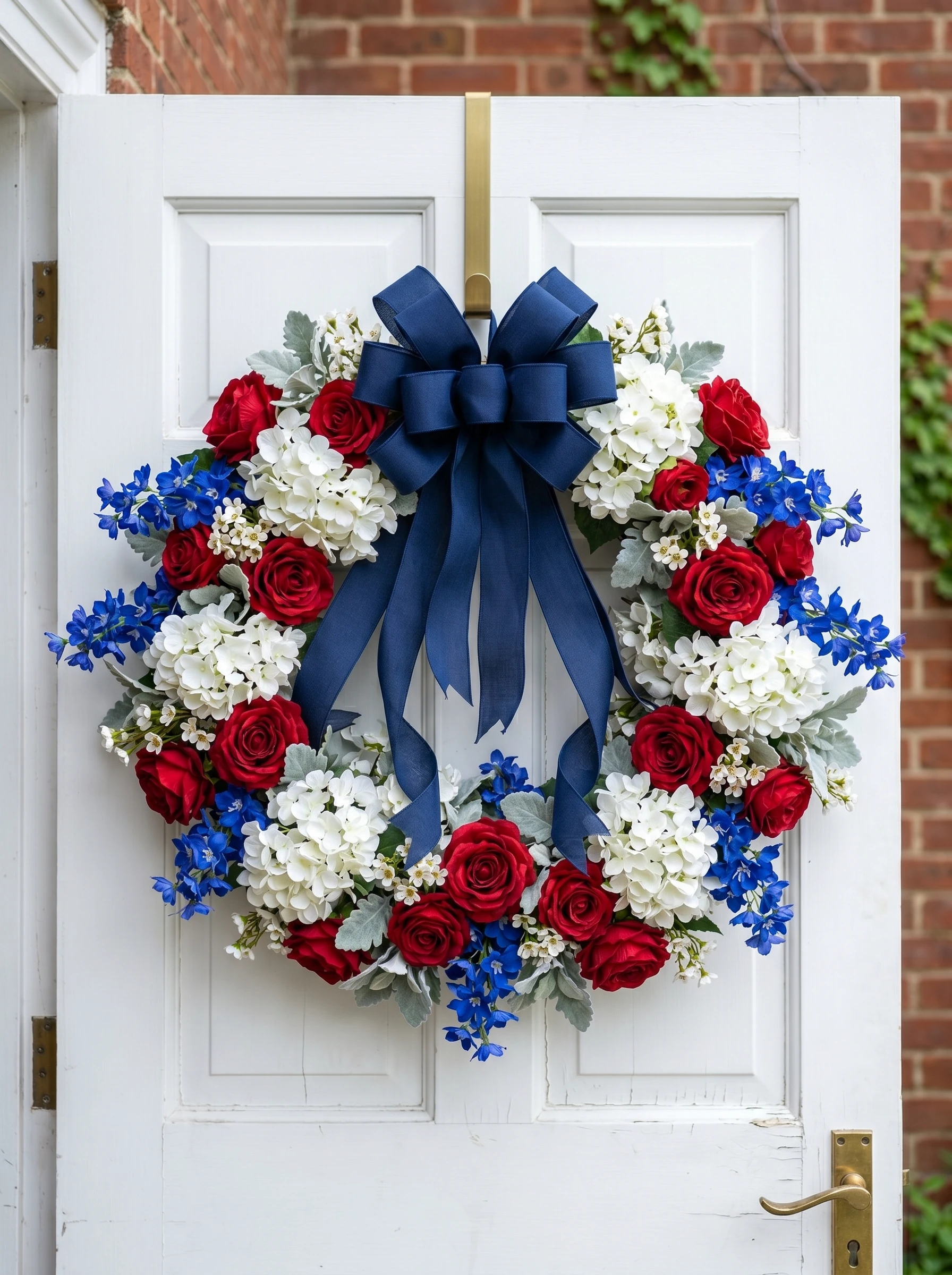
Build a dense, fully packed wreath on a foam ring using red roses, white hydrangea, blue delphinium, white waxflower, and dusty miller distributed evenly around the full form. The white hydrangea should be the volume element — use enough that it provides the background texture behind the roses and delphinium. Mount a substantial double-loop navy satin bow at twelve o’clock, with two long tails hanging to approximately the five and seven o’clock positions. Hang on a white painted paneled door. The restraint of the all-floral wreath with a single clean bow, on a plain white door, is the point. No flags, no signs, no picks — just flowers and one excellent bow.
Burlap and Buffalo Check Farmhouse
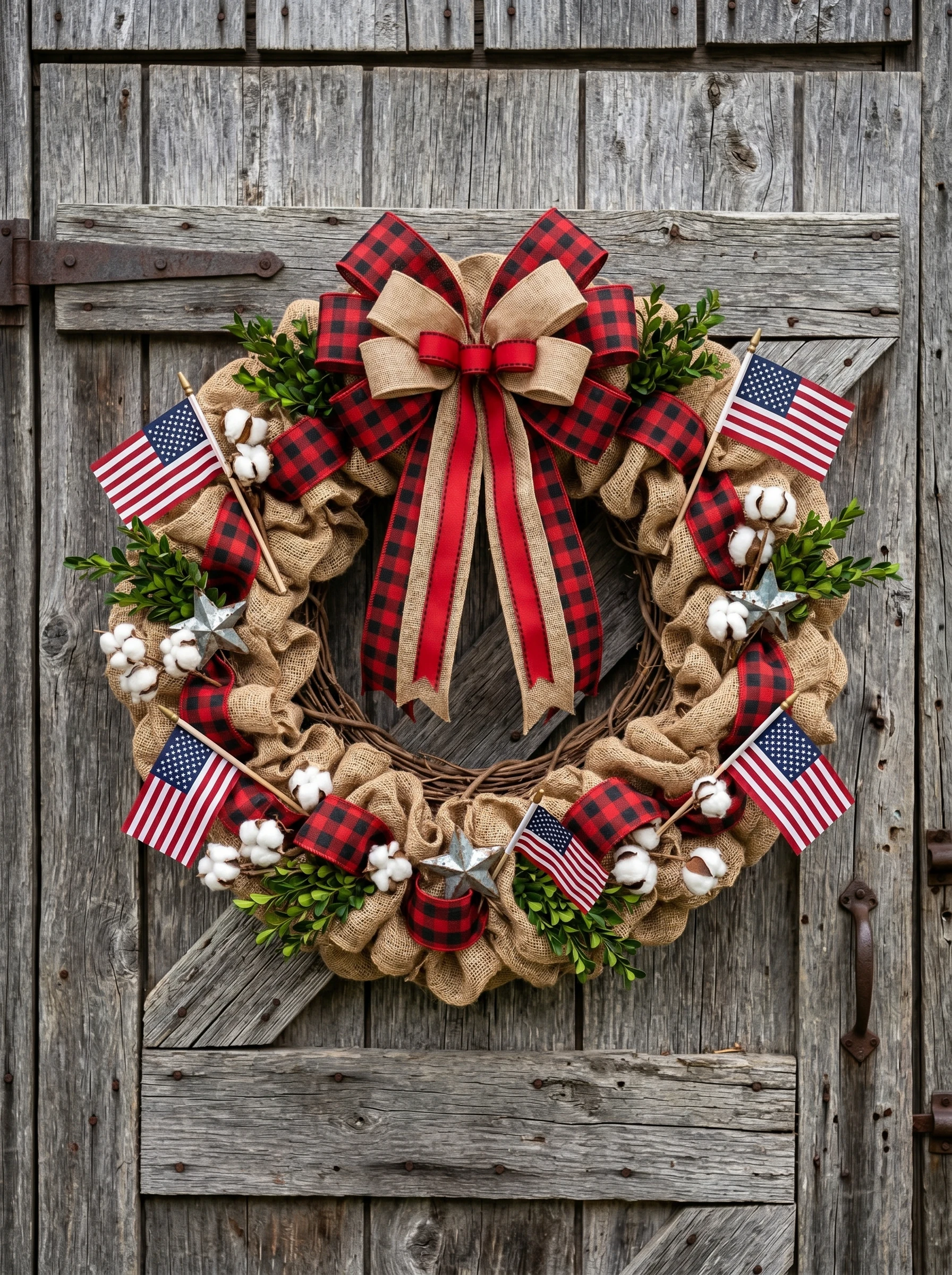
Build a full, puffy wreath on a grapevine or wire frame using natural burlap ribbon looped and tucked around the entire form. Between burlap loops, weave lengths of red-and-black buffalo check wired ribbon at irregular intervals — not evenly spaced, but clustered in threes and twos so they feel gathered. Tuck dried cotton stem branches throughout, three or four stems with open cotton bolls facing outward. Add small galvanized metal star ornaments wired in at the cotton stem positions. Push small American flag picks into the burlap at four or five points around the wreath. Build a large double bow using one loop of burlap ribbon and one loop of buffalo check ribbon layered together and mount at twelve o’clock. Hang on weathered barn wood or grey-stained exterior siding.
Fireworks Sunburst Wreath
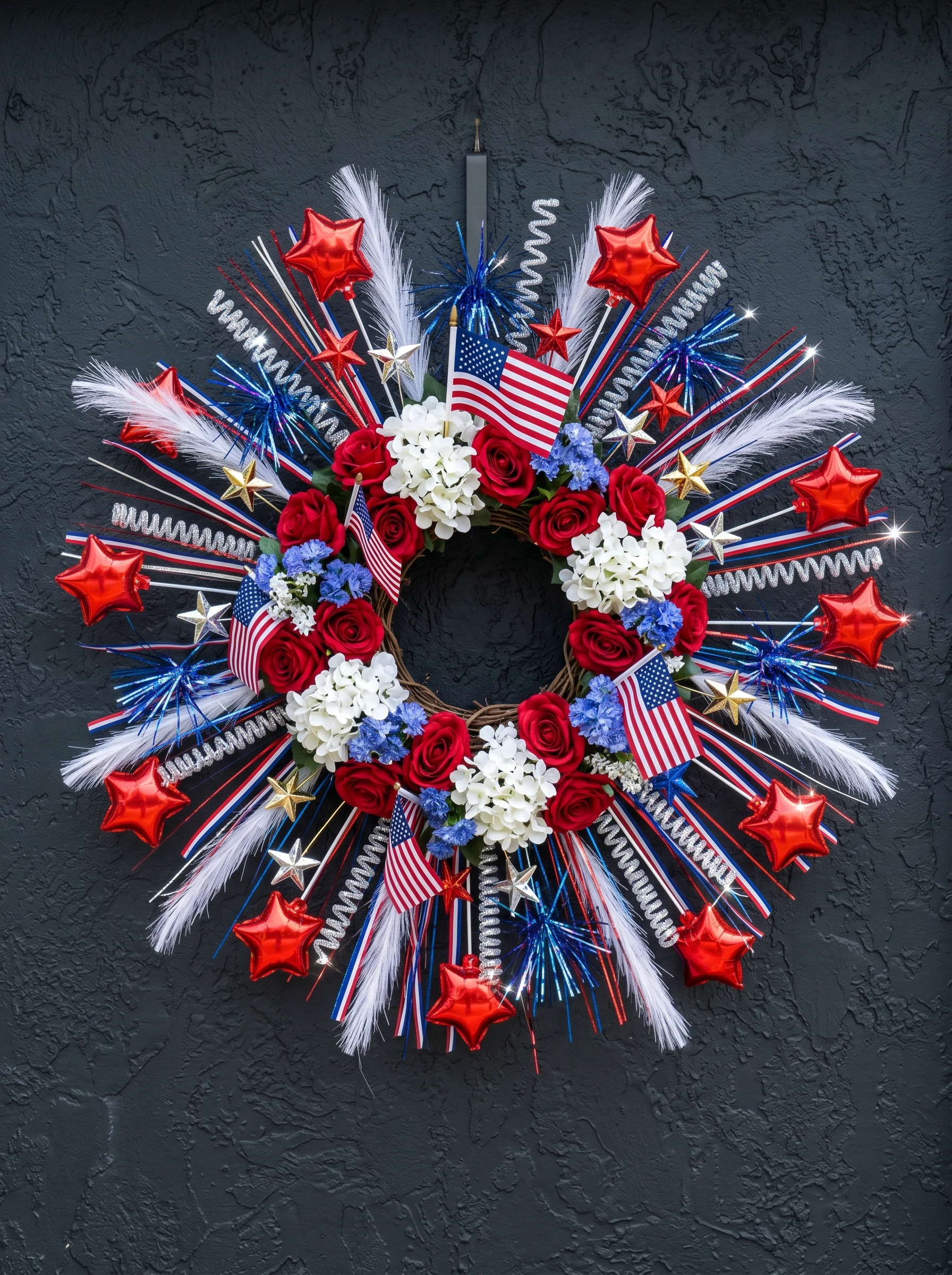
On a grapevine wreath base, insert a large number of long, straight metallic picks — blue tinsel picks, silver spiral wire picks, white feather picks, and red-and-white ribbon picks — radiating outward from the full perimeter of the wreath so the overall silhouette looks like a starburst or firework burst. In the center of the grapevine, build a tight cluster of red roses, white hydrangea, and blue cornflower as the floral core. Add small red foil star balloons on picks, gold star ornaments on wire, and small American flags woven through the floral center. The perimeter picks should extend four to eight inches beyond the wreath base. Hang on a dark charcoal or black exterior wall so the metallic elements catch light.
Gradient Hydrangea Color Ring
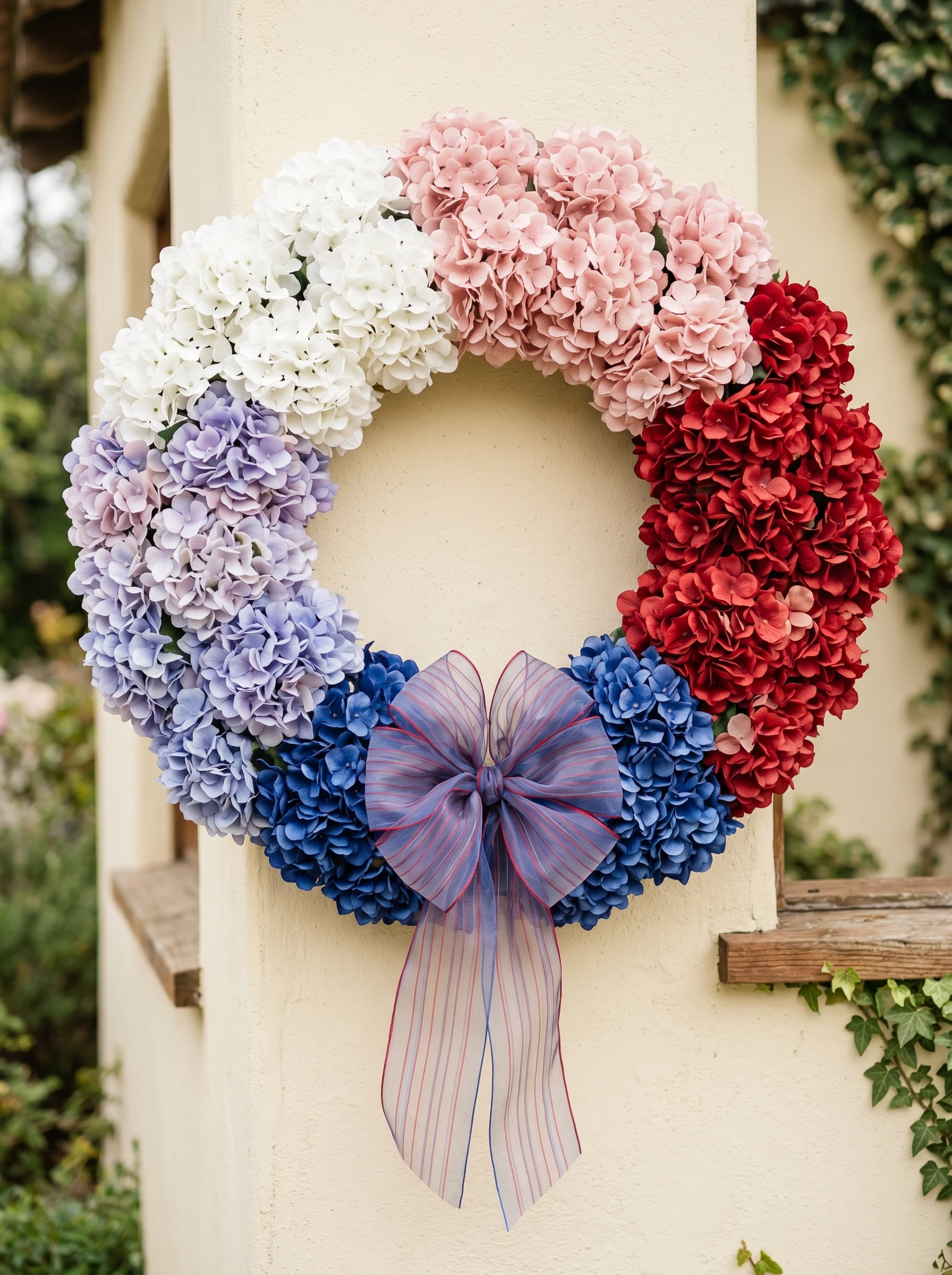
Build a foam ring wreath in a continuous color gradient using only hydrangea heads — no other flower, no foliage, no embellishment except the bow. Pack the heads tightly around the full form in this progression: cobalt blue on the bottom left arc, transitioning to periwinkle, then lavender, then soft lilac, then white, then blush pink, then warm pink, then red. Tie a sheer, wired ribbon bow in a pale blue-and-red pinstripe pattern at the six o’clock position, with long ribbon tails. Hang on a cream or warm white stucco or plaster surface so the full color gradient reads without competition from the background.
Why These Wreaths Hold Their Own
Across all of these, the ones that are most worth the effort share one quality: they knew what they were before the first stem went in.
The all-red rose wreath didn’t add hydrangea because it ran out of roses. The gradient hydrangea ring didn’t add flags because it seemed festive. The moss wreath didn’t add a bow because it felt unfinished. The decisions to leave things out are as deliberate as the decisions to put things in.
A front door wreath lasts through multiple holiday cycles if you make it with materials that age well and build it around a concept that doesn’t depend on novelty to work. The ones people still notice in year three are never the trendy ones. They’re the ones that looked like they knew exactly what they were doing from the start.