
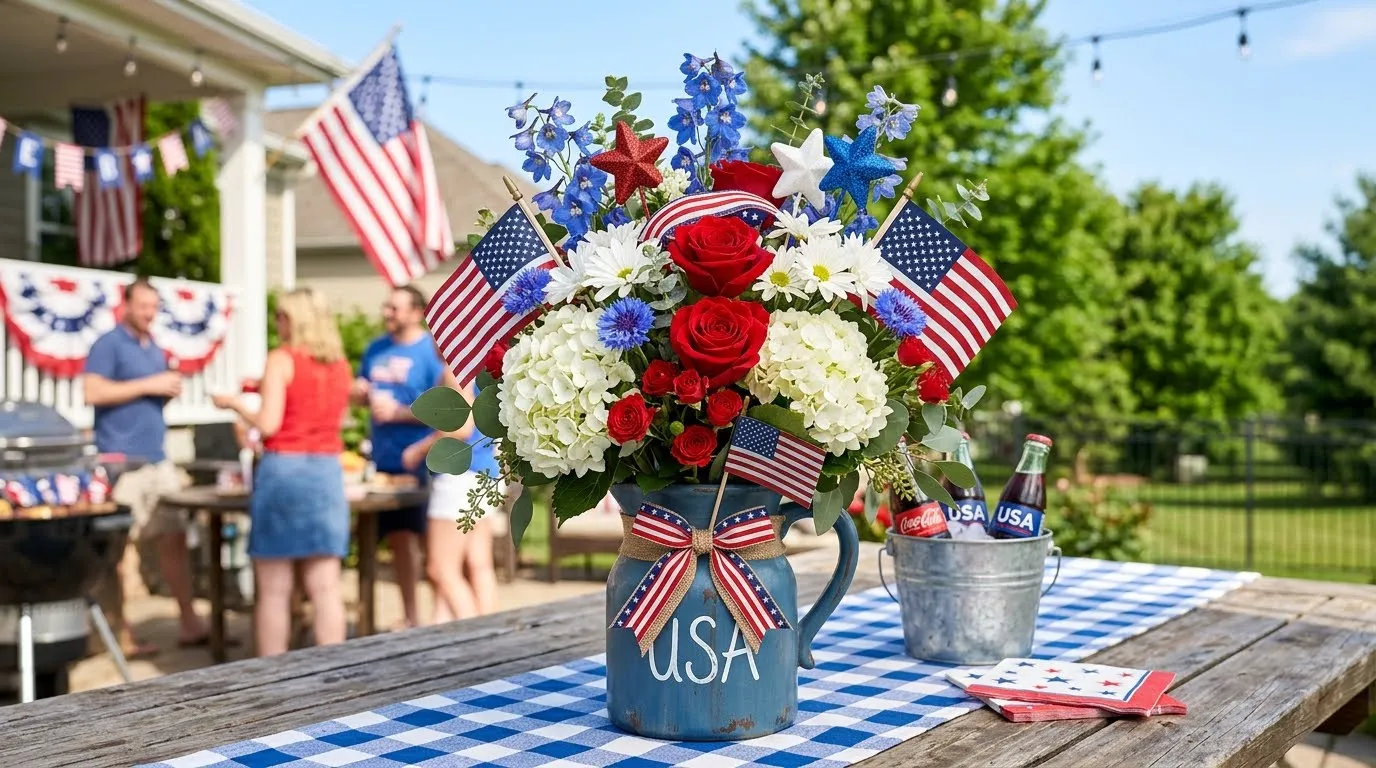
Red, white, and blue is the easiest color palette to get wrong. Three colors that all demand attention, shoved together in a vase, topped with a little flag — and suddenly your centerpiece looks like it came free with a value meal. The palette itself isn’t the problem. The problem is that most people treat it like a costume instead of a color story.
There’s a difference between patriotic and kitschy. It’s a thin line, but it’s a real one. The arrangements that land on the right side of it aren’t necessarily more expensive or more elaborate. They just make smarter decisions about vessel, scale, and flower choice.
This is not a collection of ideas for people who want their table to look like a parade float. These are arrangements for people who want their home to feel festive and still look like themselves on July 4th — and Memorial Day, and any other occasion that calls for this particular trio of colors done with some actual intention.
Making the Color Palette Work for You
Tone Is Everything
Not all reds are the same red. Not all blues are the same blue. The arrangements that feel cohesive are the ones where the designer picked a specific tone and committed to it. Crimson and navy read as rich and formal. Scarlet and cobalt skew bold and graphic. Cherry red and powder blue feel casual and summery. Mixing tones — a warm red with a cool blue, for instance — is where things start to look accidental.
Before you buy a single stem, decide which register you’re working in. Moody and saturated, or bright and airy. Then shop accordingly and don’t let the grocery store flower section talk you into something that doesn’t fit.
The Third Color Earns Its Place
White isn’t neutral in a red, white, and blue arrangement. It’s doing real work — it’s the breath between the two louder colors. Use too little and the arrangement feels heavy. Use too much and it loses its punch. The most balanced arrangements weight the white toward the middle of the composition, letting it separate the red from the blue without diluting either.
White also comes in a spectrum. Cream and ivory are warm. True white is cool and graphic. Match your white flowers to the overall temperature of your arrangement. Warm arrangements get ranunculus, peonies, garden roses. Cool, architectural ones get white cosmos, stock, or anemones.
The Vessel Sets the Register
A mason jar painted red is a craft project. A brass compote with garden roses is a statement. An antique crystal vase surrounded by votives is a party. The flowers don’t determine the formality of the arrangement — the vessel does. Lock in the vessel first, then choose flowers that match what it’s already saying.
The Container Decisions Nobody Talks About
Proportion Before Purchase
The most common reason arrangements look wrong is a proportion mismatch between container and flower volume. A wide-mouthed vessel needs mass. A tall narrow cylinder needs height. A shallow compote needs a dome. Buy the vessel, then figure out how much flower it actually requires before you spend a dollar on stems. You’ll almost always need more than you think.
Mechanics Inside the Vase
Flower frogs, floral foam, and crumpled chicken wire are not optional for anyone who wants an arrangement to stay put. A grid of clear floral tape across the mouth of a mason jar costs nothing and changes everything. Without mechanics, stems drift, the arrangement collapses to one side, and you spend the evening pushing flowers back into position instead of enjoying your party.
Material Contrast Adds Dimension
The best arrangements don’t stick to florals alone. Trailing ivy, eucalyptus, dusty miller, and bunny tail grass give the eye somewhere to rest between blooms. They also let you stretch the floral budget — a pound of eucalyptus from a wholesale market does more visual work than twice as many flowers would. Build your greenery layer first. The flowers go on top of a foundation, not into an empty vase.
Patriotic Flower Arrangements Worth Recreating
Stars-and-Stripes Tablescape
Lay a red-and-white ticking stripe tablecloth as the base layer. Place a chambray blue linen runner down the center — the two fabrics together create the flag stripes without a single flag in sight. In the center of the runner, place a low floral arrangement in a shallow dish: blue dyed chrysanthemums, white pom mums, red alstroemeria, and small red berries, all kept at a height that doesn’t block sightlines across the table.
Set each place with a star-print plate. Set a small red ceramic star-shaped bowl at the center of each plate and place a single white daisy inside it. Fold chambray napkins into a flat bow shape and set them beside the star bowls. Place tinted blue glass tumblers at each setting. Tuck small American flags at the corners of the runner where it meets the tablecloth edge.
Walnut Table Flower Runner
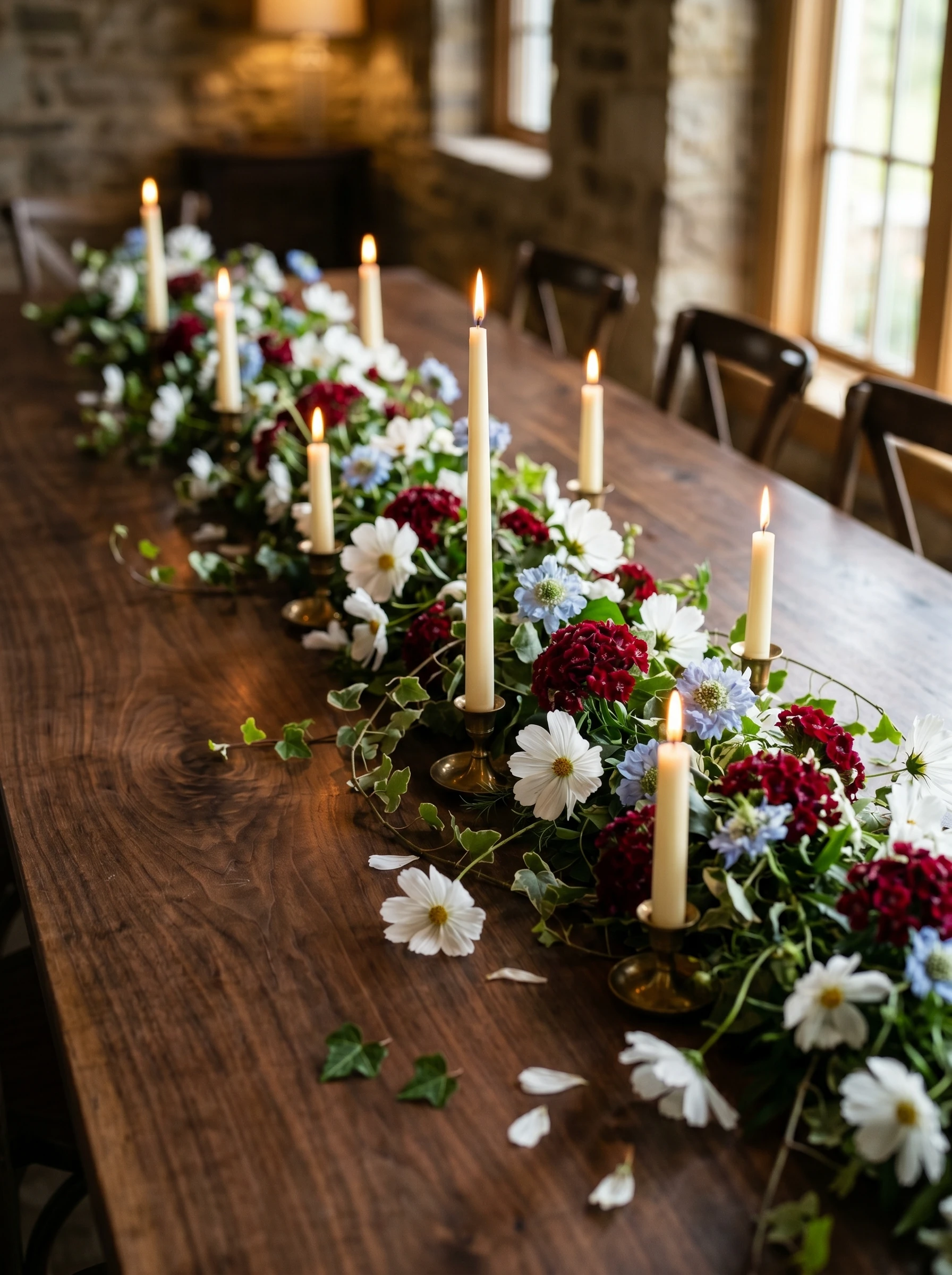
The key to a flower runner on a dark wood table is letting the blooms touch the table surface — not just the stems, but actual petals and leaves making contact with the wood. Build the base from trailing ivy laid directly on the table in a loose line. Tuck in small brass candlestick holders at irregular intervals — not evenly spaced, but grouped in ones and twos so the candles feel scattered rather than formal.
Layer in clusters of burgundy dianthus, white cosmos, and pale blue scabiosa, placing them between and around the candlesticks rather than in a strict line. Let a few petals fall. The fallen petals are part of the composition, not something to clean up.
Cowboy Boot Patriotic Centerpiece
Find a pair of decorative cowboy boots — resin or ceramic versions work better than actual leather for this application because they hold their shape. Set them side by side on a flat surface. Fill the interior of each boot with floral foam or crumpled newspaper topped with a small cup of wet foam.
Build a mixed arrangement of silk or fresh flowers in red, white, and blue, allowing stems to extend at least eight inches above the boot tops in all directions. Add glittered star picks in red, white, and blue mixed throughout. Tie a large multi-loop bow using wired patriotic ribbon — stripes on one ribbon, fireworks print on another — and attach it to the front of the boot shaft. Add a small American flag pick to one side, angled outward. The boots are the vessel. Everything else serves them.
Crystal Vase with Votives
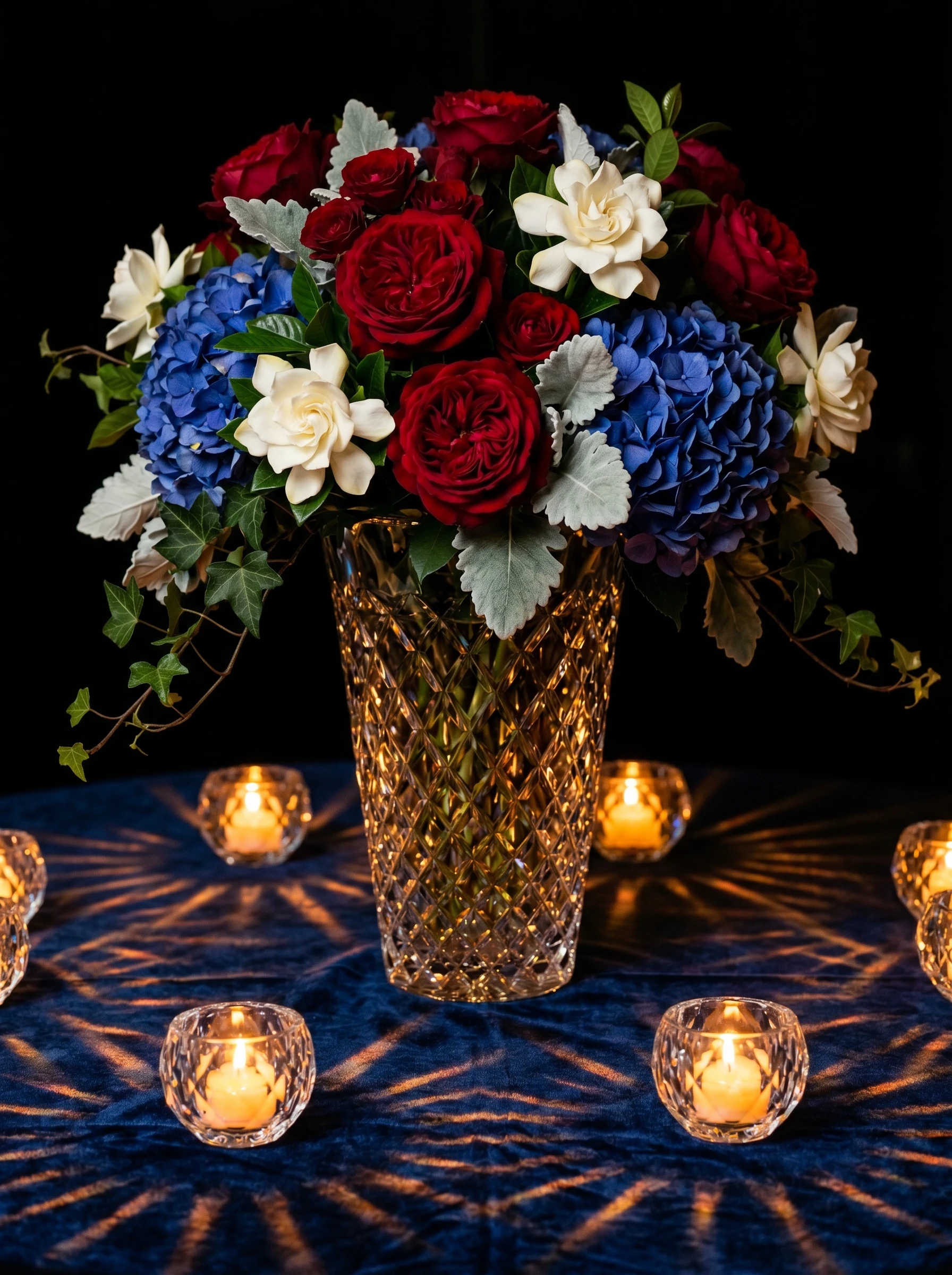
Place a large cut crystal vase at the center of a navy velvet or linen tablecloth. Fill it with a dense, overflowing arrangement of deep red garden roses, blue hydrangea, and white gardenias, finished with trailing ivy and dusty miller. The arrangement should be full enough that it looks like it is almost too much — then add three more stems.
Surround the base of the vase with eight to ten small crystal votive holders in an irregular cluster. The candlelight refracts through both the votives and the cut crystal of the vase, throwing geometric patterns across the navy cloth. This is the one arrangement in this list that is explicitly for evening. In daylight it’s beautiful. By candlelight it is a different thing entirely.
Vintage Bicycle Basket
Mount a wicker basket to the handlebars of a vintage-style cruiser bicycle — powder blue, mint, or cream colored frames work best for this. Fill the basket interior with a block of wet floral foam or a deep plastic liner packed with foam. Build a lush, overflowing arrangement using large-headed blue hydrangea as the primary volume flower, white hydrangea filling the gaps, and red or coral tulips tucked throughout at varying heights.
Add a few stems of white garden roses and some eucalyptus trailing over the basket edge. The arrangement should completely disguise the basket — when finished, you should see only flowers, not the container. Park the bicycle in a gravel garden path or propped against a fence where the outdoor setting does half the work.
Brass Compote with Garden Roses
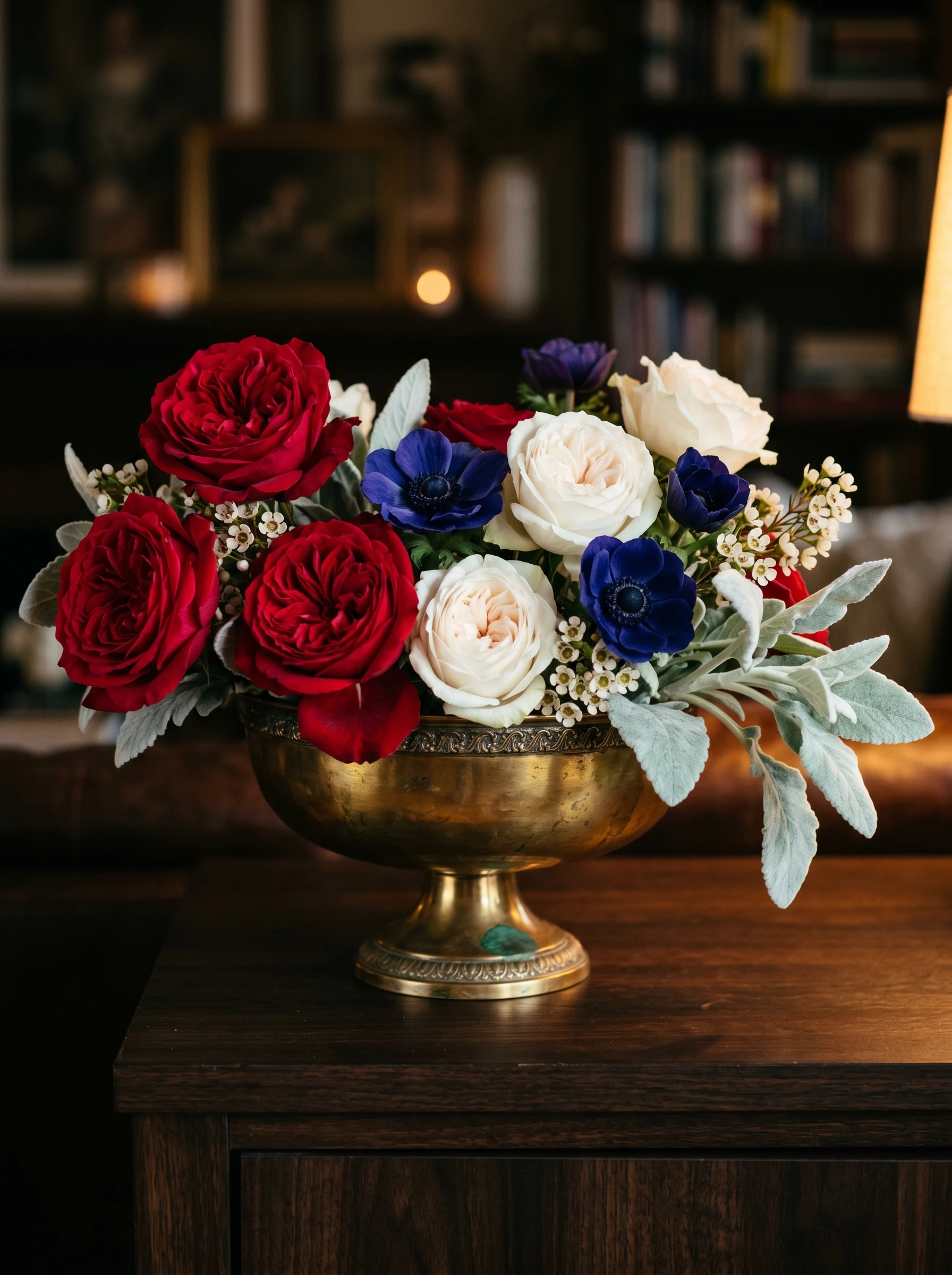
Find a low footed compote in antique or aged brass — thrift stores, estate sales, and online vintage shops are the best source. Fill it with a ball of crumpled chicken wire to hold stems in place. Build from the outside edge in: start with dusty miller leaves, which extend past the rim and give the arrangement its silvery-gray foundation, then add creamy garden roses on the left side, garden roses in deep red on the right, and deep blue anemones in the center and gaps.
Keep everything low and domed — nothing should grow taller than five inches above the rim. The compote is doing the heavy lifting visually. The arrangement sits in it rather than exploding out of it.
Full Front Porch Display
The front door is only one piece of this. Think in three zones: the door itself, the flanking containers, and the surrounding greenery. For the door, hang a wicker basket filled with a lush mixed arrangement of blue flowers, white anemones, and red blooms, finished with flag ribbon trailing from the basket opening. For the flanking containers, use two matching wicker urn planters filled with a base of trailing maidenhair fern and creeping jenny, topped with blue hydrangea, red geranium, and white flowers mixed together. Push two American flags into each planter at angled positions.
Flank the door with matching black iron lanterns on either side. Let climbing vines grow naturally around the door frame if you have them — the greenery softens the formality of the symmetrical arrangement. Lay a black-and-cream striped runner topped with a coir welcome mat at the threshold. Everything from the doorbell to the mat should read as one considered composition.
Painted Mason Jar Trio
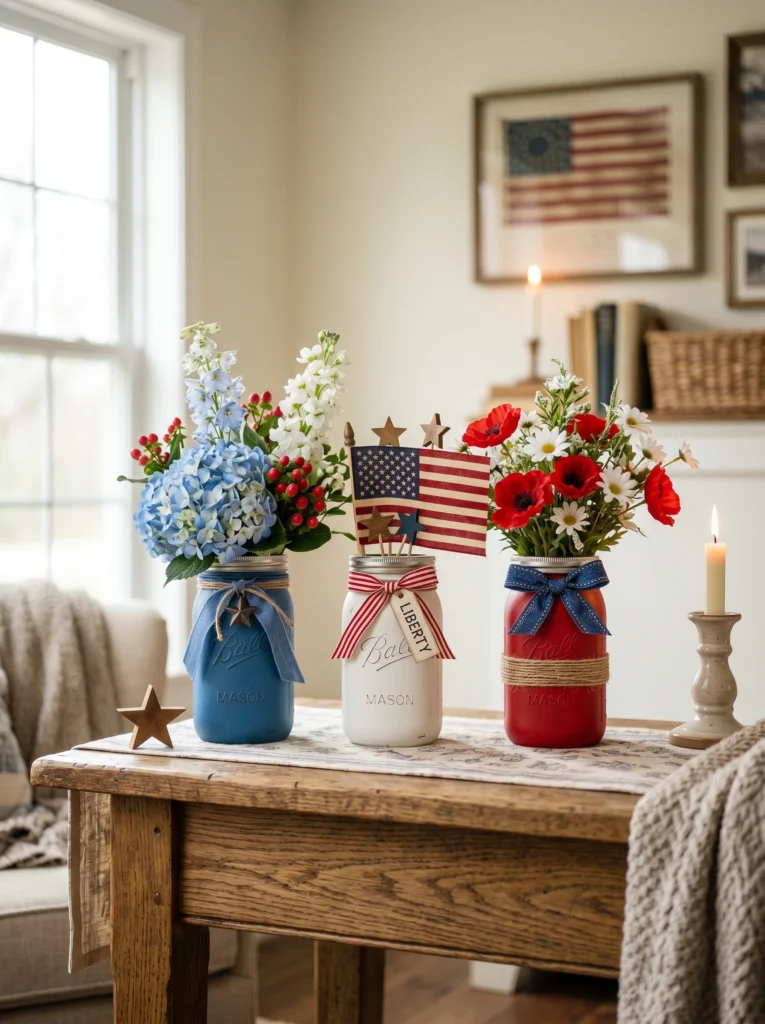
Paint three Ball mason jars in matte chalk paint — one navy, one red, one white — using two thin coats and letting each dry fully before adding a second. Wrap the neck of each with ribbon or twine appropriate to its register: a star-print ribbon on the white, a grosgrain navy bow on the red, jute twine on the blue. Fill the blue jar with hydrangea and delphinium; the white with white stock, small American flags, and wooden star picks; the red with red poppies and white daisy stems mixed together.
Group the three jars tightly on a wooden tray or directly on a farmhouse table runner. They work as a unit — keep them close enough that they read as one composition. Place a single wooden star flat on the table beside the grouping to anchor the arrangement visually without competing with it.
Garden Cut Wildflower Jar
Fill a plain clear glass bud vase — narrow at the neck, wider at the base — with a mixture of stems cut from an actual garden or sourced from a farm stand. The goal is a slightly loose, not-quite-arranged look: red zinnias, red carnations, globe thistles, white achillea, a stem or two of blue delphinium, and cream-colored dahlia mixed throughout. Tie a wide sheer red ribbon loosely around the neck and let the tails pool on the table surface.
Cut all stems to varying lengths so the arrangement has no single flat top. The globe thistle spikes extend the highest; the dahlias sit mid-height; the carnations cluster near the rim. The whole point is that it should look like you went outside and came back with a handful of whatever was blooming.
Lantern With Fairy Lights
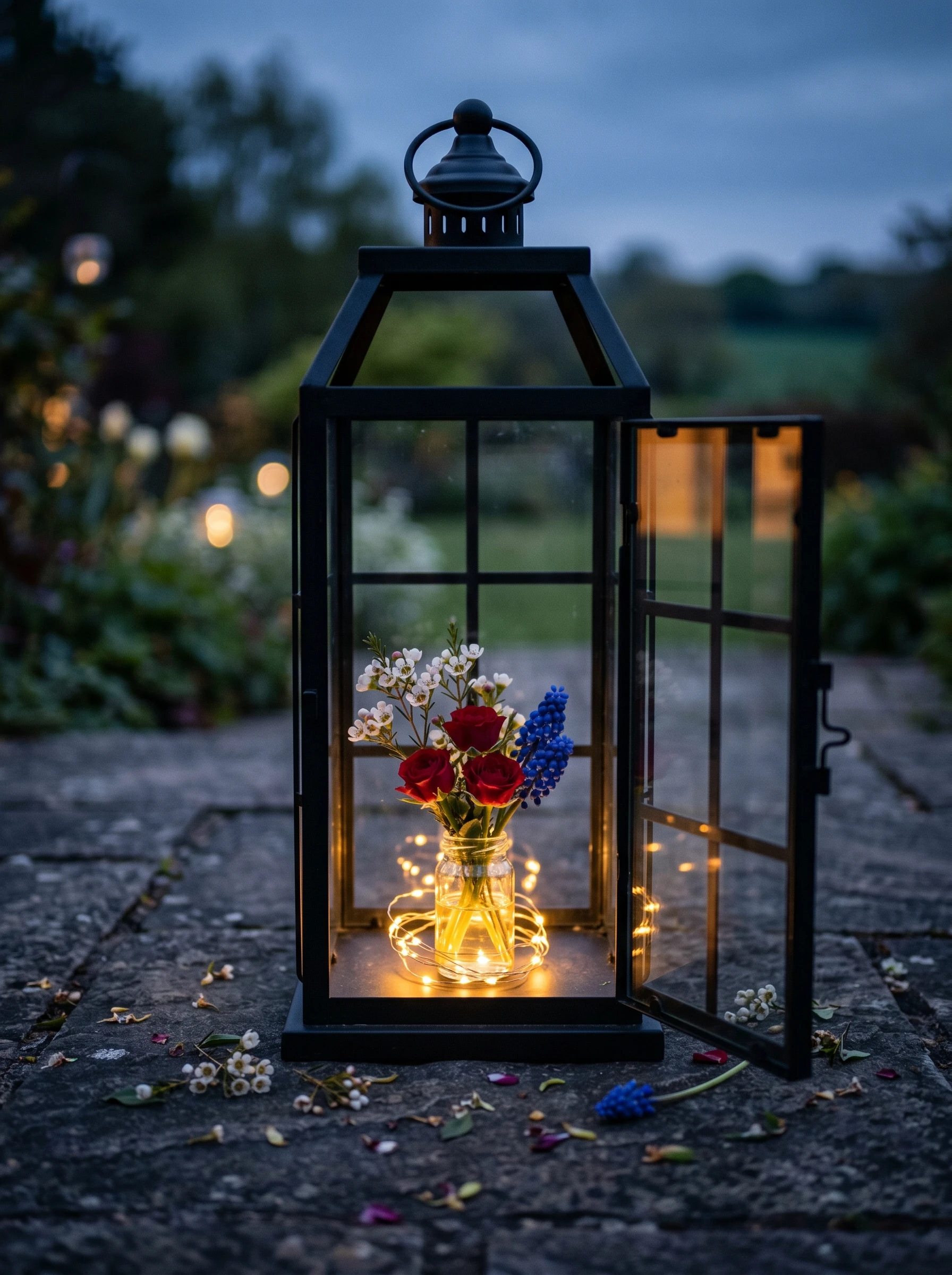
Take a large black metal lantern — the taller and more architectural the better — and set a small clear glass jar inside it. Fill the jar with a tight handful of stems: two or three red roses, a spike of muscari for blue, and a few stems of white waxflower or baby’s breath. Wrap a strand of warm LED fairy lights loosely around the jar before placing the flower arrangement inside, so the glow comes up through the vase rather than just sitting beside it.
Open one side of the lantern door slightly and leave it that way. The asymmetry reads as casual and intentional at the same time. Position the lantern at ground level on a patio or path edge rather than on a table — the low placement and soft glow turn a simple arrangement into something atmospheric.
Layered Glass Cylinder with Ivy
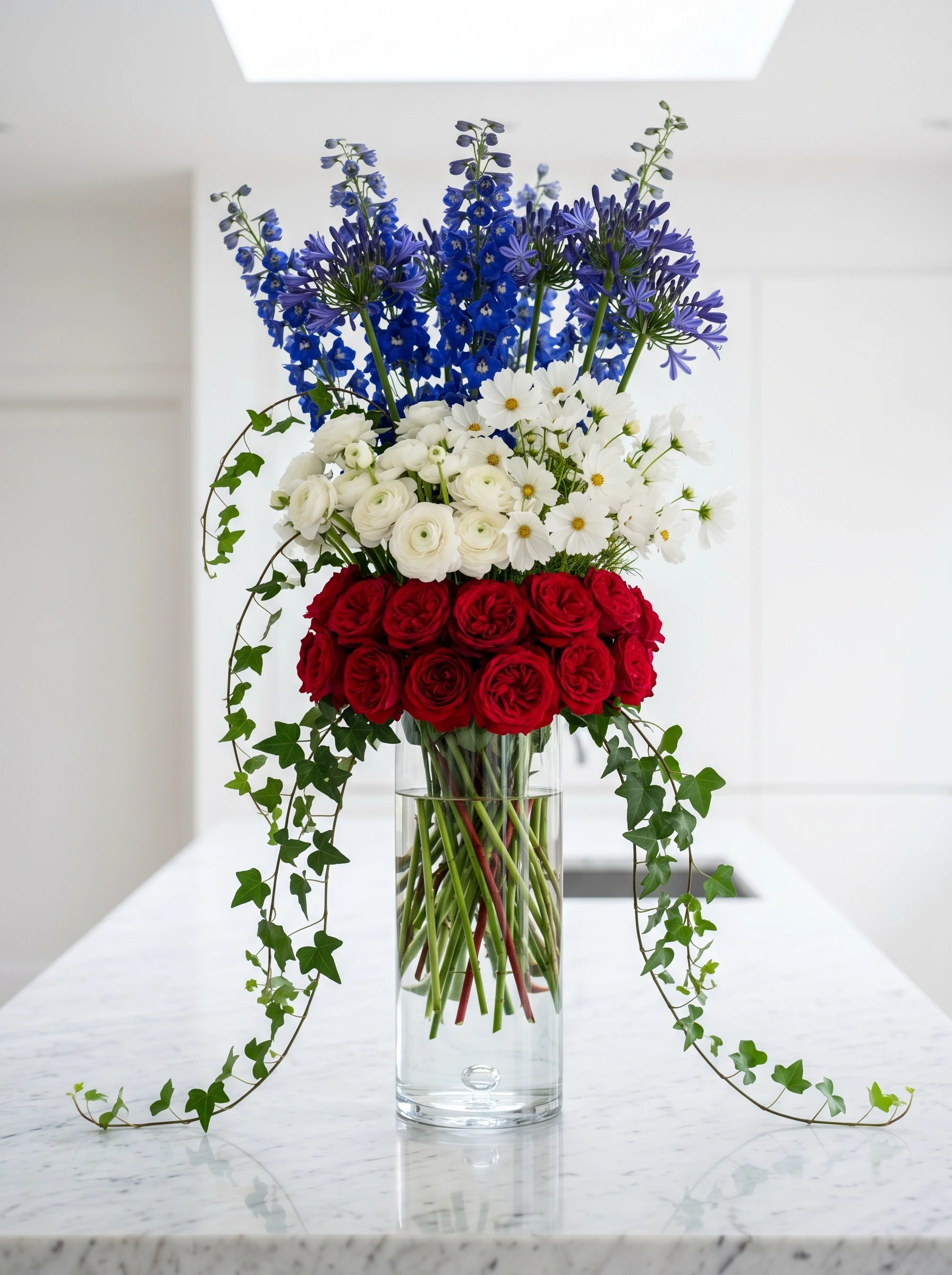
Use a tall, wide-mouthed clear glass cylinder — at least twelve inches tall. Place a dense ring of red garden roses tightly around the perimeter at mid-height, stems cut so their heads sit just at the rim. Behind and above them, layer a ring of white ranunculus and white cosmos. Above that, push tall blue delphinium and agapanthus stems upward so they tower above the white layer by at least eight inches.
The finished profile should be visibly striped — red at the base of the bloom zone, white in the middle, blue spiking upward. Let trails of ivy hang from the rim down to the table surface on both sides. The ivy drape softens the geometry and makes the whole thing feel alive rather than constructed.
Wall-Mounted Barn Door Basket
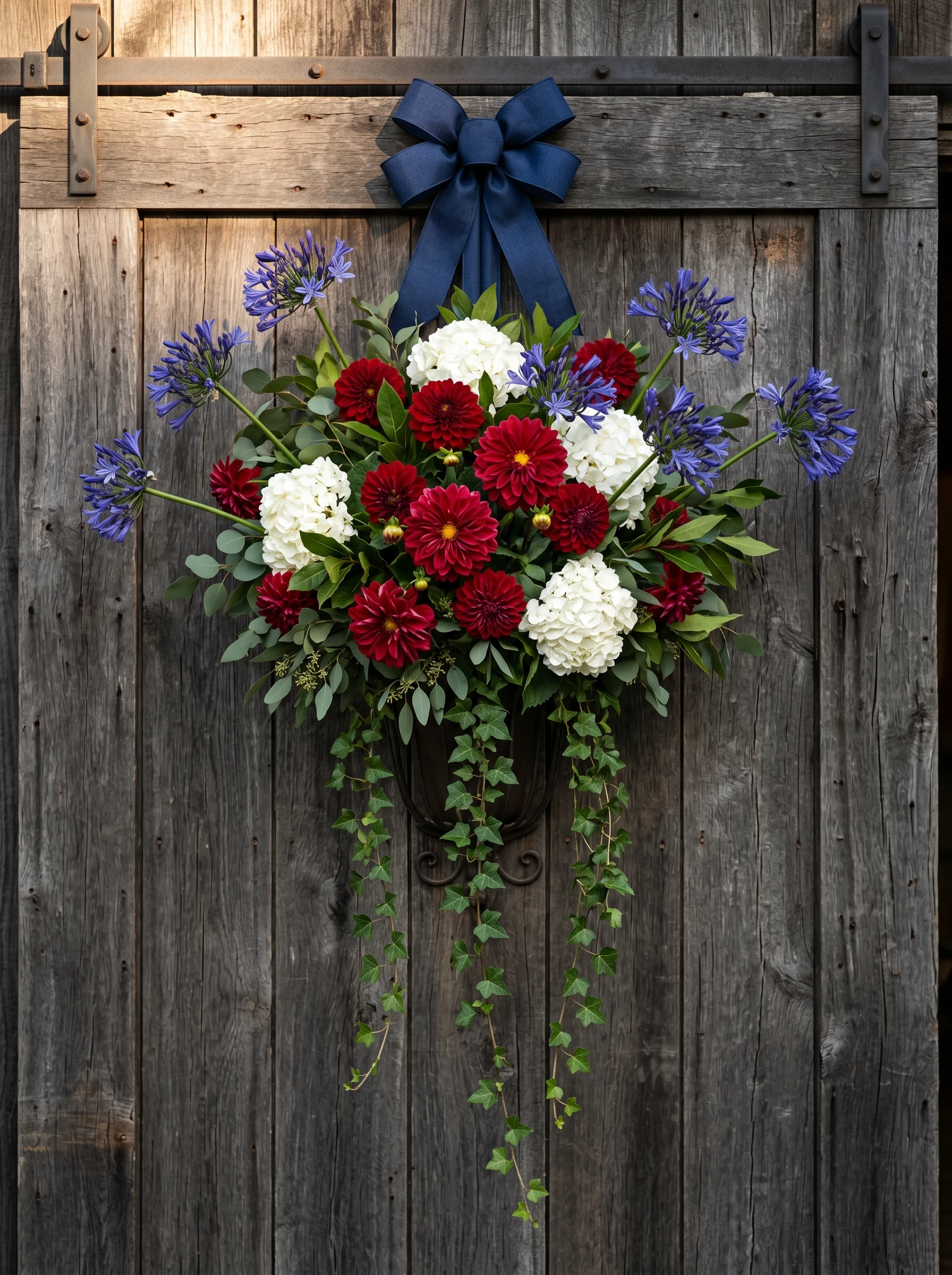
Mount a small wrought iron wall basket to a barn door or any exterior wood surface. Pack it tightly with floral foam soaked in water. Build the base using white hydrangea heads as the largest volume element, then fill gaps with deep red dahlia heads. Add agapanthus stems with the full stalk length, letting them extend well beyond the basket edge on both sides for height.
Tie a large navy grosgrain ribbon bow at the top of the door above the basket — not directly on the basket, but higher, so the basket appears to hang from the bow rather than sitting beneath it. Trail a few ivy stems from the bottom of the basket down the door face. The contrast of lush, polished flowers against weathered gray wood is the entire point.
White Ceramic Bowl Centerpiece
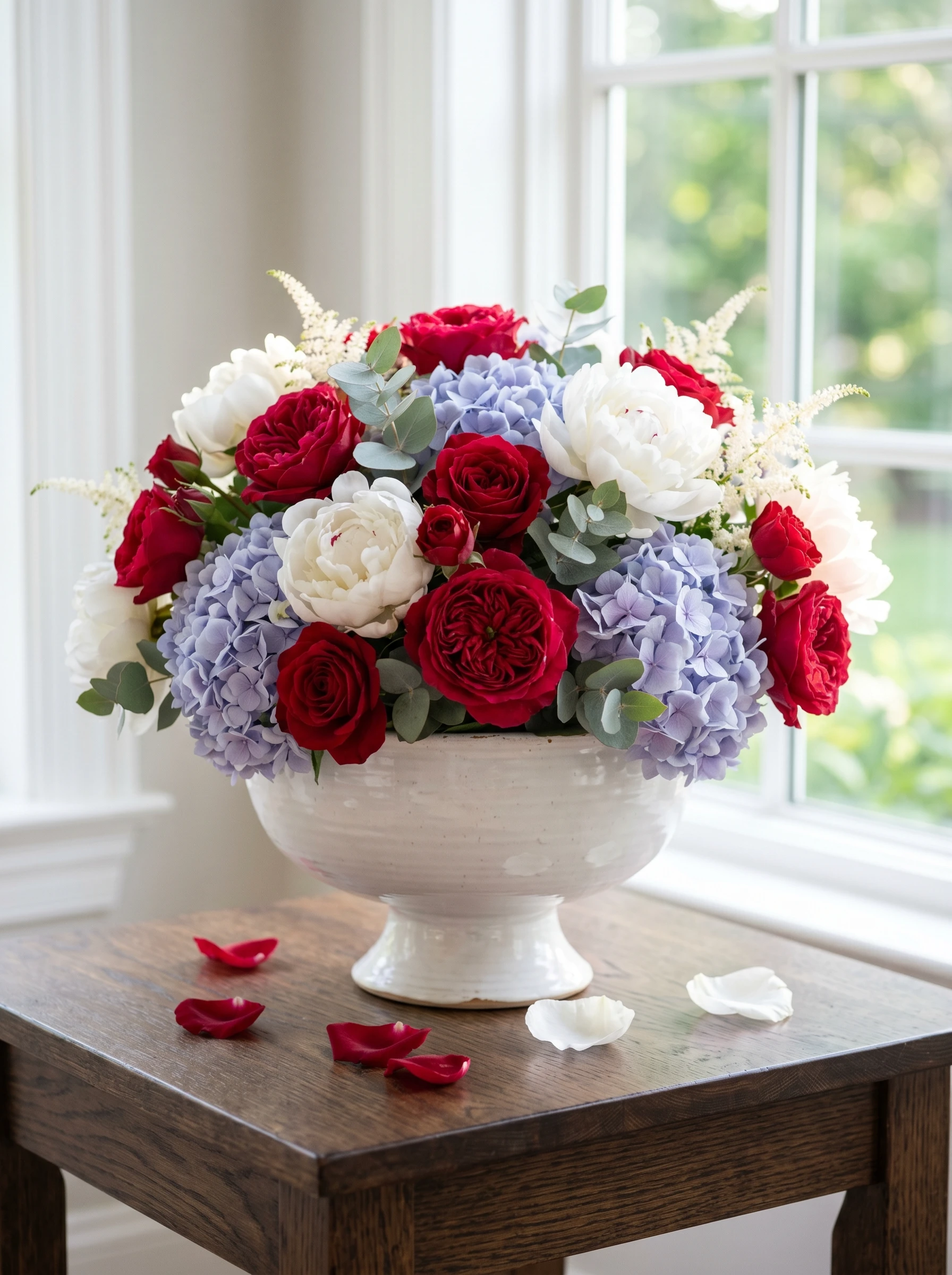
A matte white ceramic pedestal bowl — the kind with a low foot and a wide mouth — is one of the most forgiving vessels you can work with. Fill the interior with wet floral foam. Build a low, rounded dome using blue-tinged hydrangea heads as the base layer — they should cover the foam entirely and extend slightly over the rim. Add white peonies and white garden roses in clusters, pushed in at slightly different heights to create depth. Tuck red garden roses into the remaining gaps.
Finish with a few stems of white astilbe for feathery texture and three or four eucalyptus stems trailing over the rim. Scatter a handful of loose petals on the table surface around the base. The arrangement should look like it is slightly overflowing — controlled abundance rather than a tight sphere.
Full Flower Wall Installation
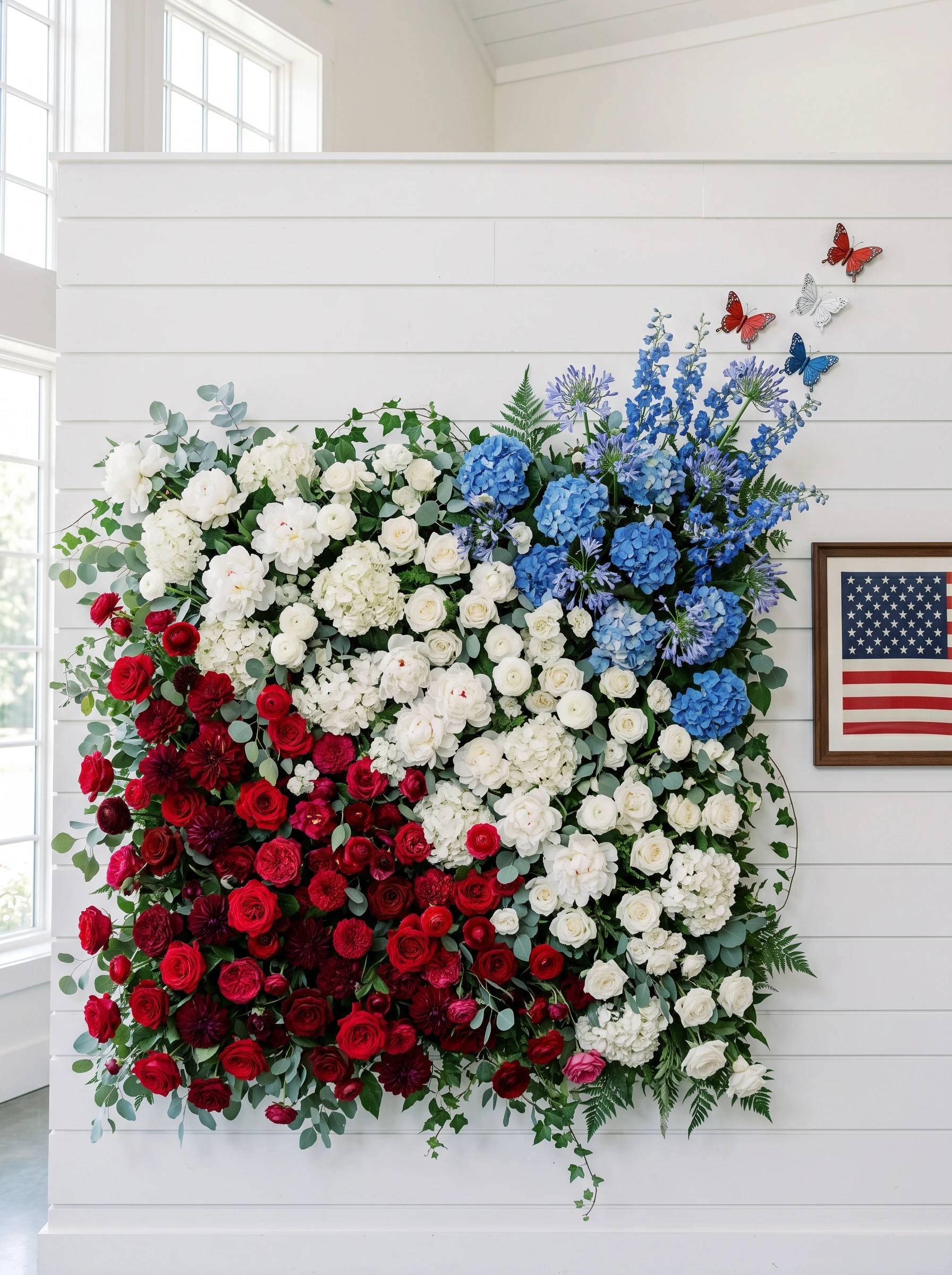
This is not a weekend craft project. Plan three to four hours and budget accordingly. Frame out a four-by-four-foot grid on your wall using horizontal strips of chicken wire stapled to a plywood backing. Attach the backing to the wall with heavy-duty hooks. Soak blocks of floral foam and secure them within the grid in a checkerboard pattern.
Build the red section in the lower left using garden roses, ranunculus, and dahlia. Build the white section across the center using white roses, peonies, and hydrangea. Build the blue section in the upper right using blue hydrangea and delphinium. Weave eucalyptus and fern throughout all sections so the color zones blend at their edges rather than cut hard lines. Add small butterfly decorations at the top corner. Hang a framed flag print beside it on the same wall — the flower installation and the flat flag image need each other.
Grapevine Wreath with Navy Bow
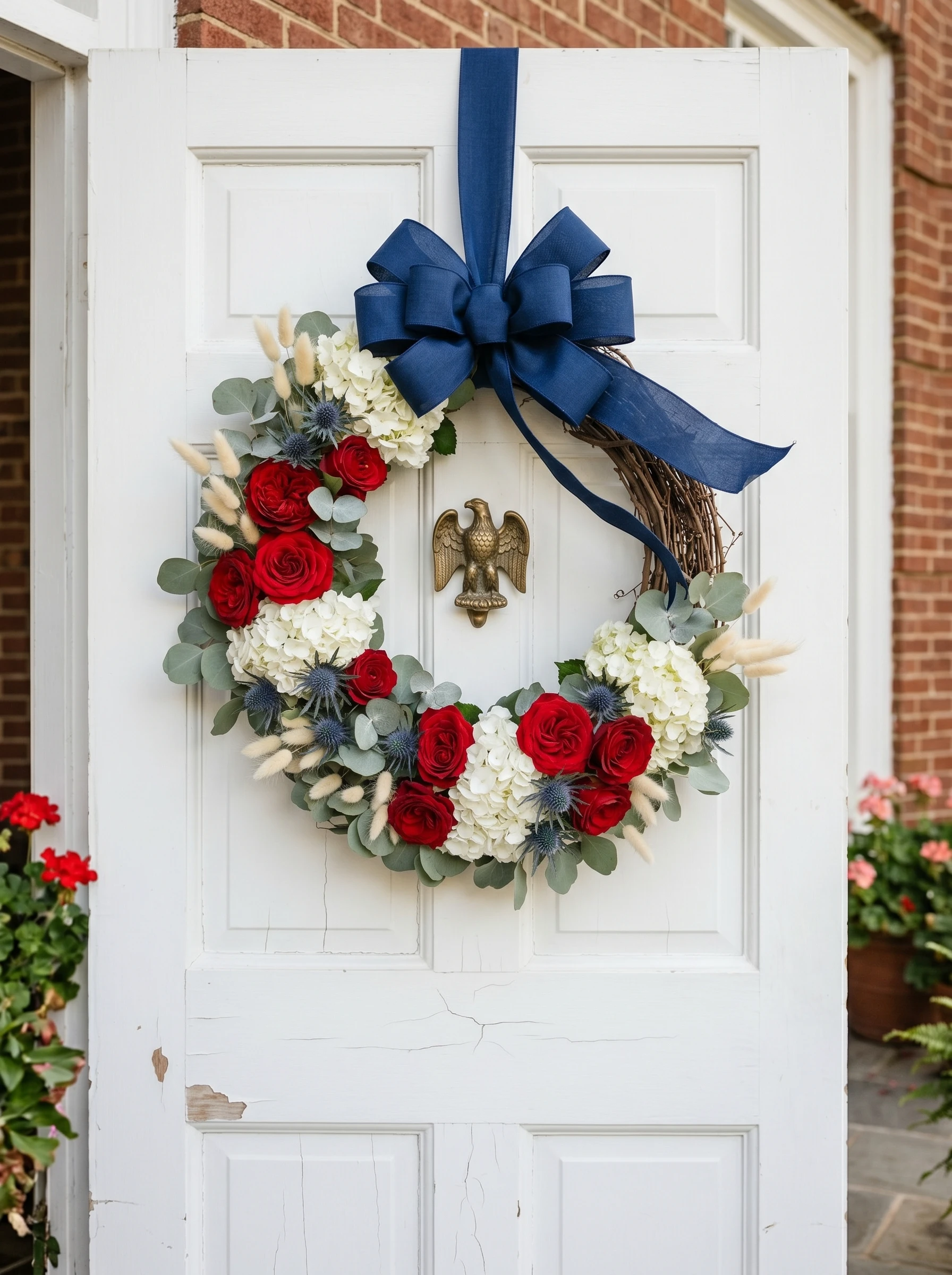
Start with a grapevine wreath base — natural tan in color, at least eighteen inches in diameter. Using floral wire, attach clusters of white hydrangea heads evenly around the bottom two-thirds of the wreath, leaving the top section open. Tuck red roses in groups of two or three between the hydrangea clusters, spacing them unevenly so they look gathered rather than placed. Add blue eryngium thistle at intervals — three or four stems total, wired in at the same depth as the roses.
Push bunny tail grass stems in between flowers throughout for texture. Finish with a few stems of eucalyptus trailing from the sides. Tie a large double-loop navy grosgrain ribbon bow at the twelve-o’clock position, with ribbon tails long enough to hang past the ten and two positions. Mount on a white door with a wrought iron eagle door knocker at the center of the wreath opening.
Green Mason Jar Trio
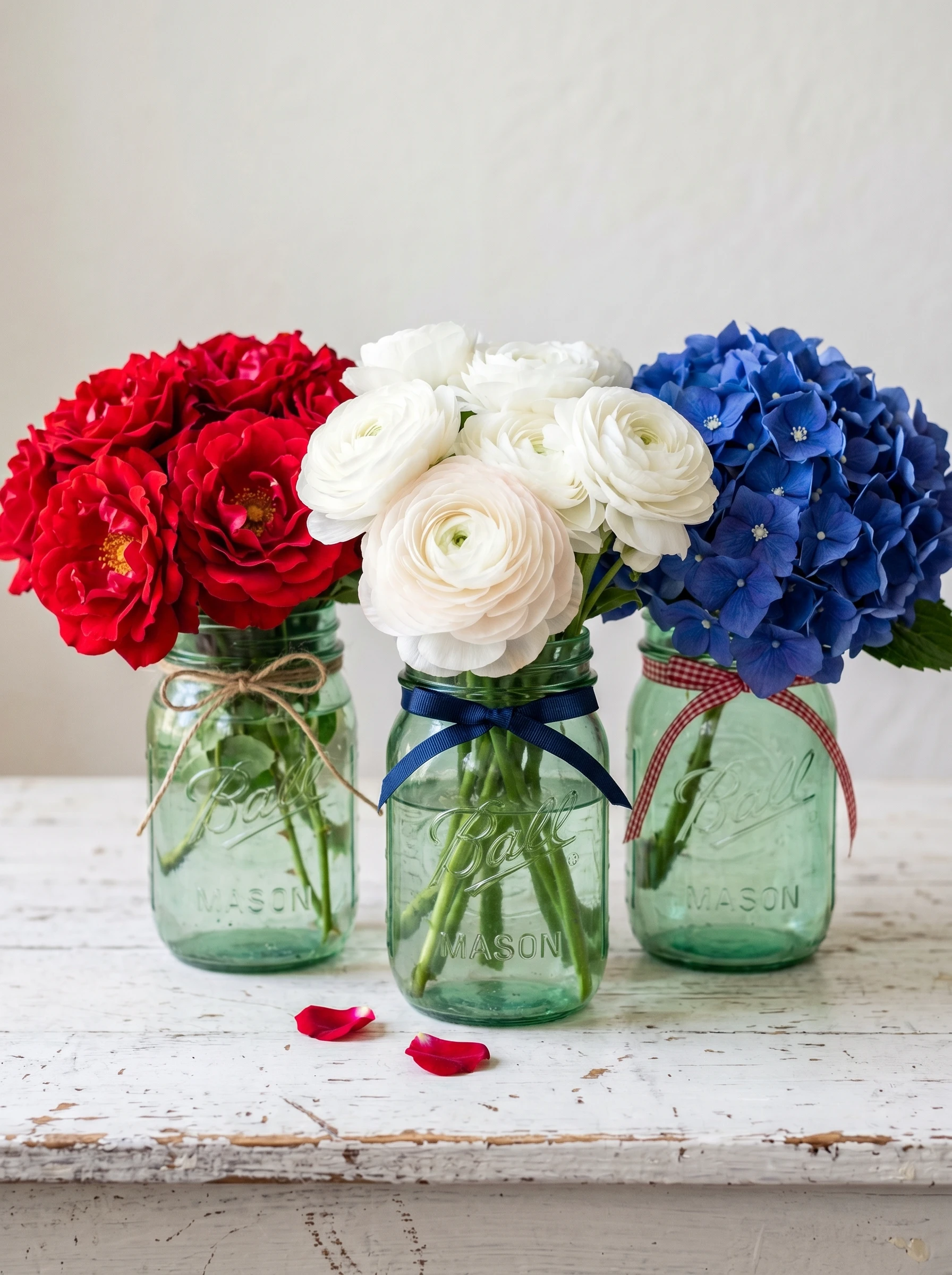
Collect three vintage green glass Ball mason jars — the blue-green glass filters and softens the colors of whatever goes inside. Tie each with a different accent: jute twine on the one with red peonies, a navy grosgrain ribbon on the one with white ranunculus, and a small red gingham check ribbon on the one with a single deep blue hydrangea head.
Keep the arrangements small and tight — the goal is a single focal flower or a very small cluster, not a full arrangement. Place the three jars in a loose row on a distressed white wood surface. Let a few petals fall naturally in front of them. The beauty of this look is its restraint. The jars carry the color; the flowers just confirm it.
Crackle Glaze Urn with Delphinium
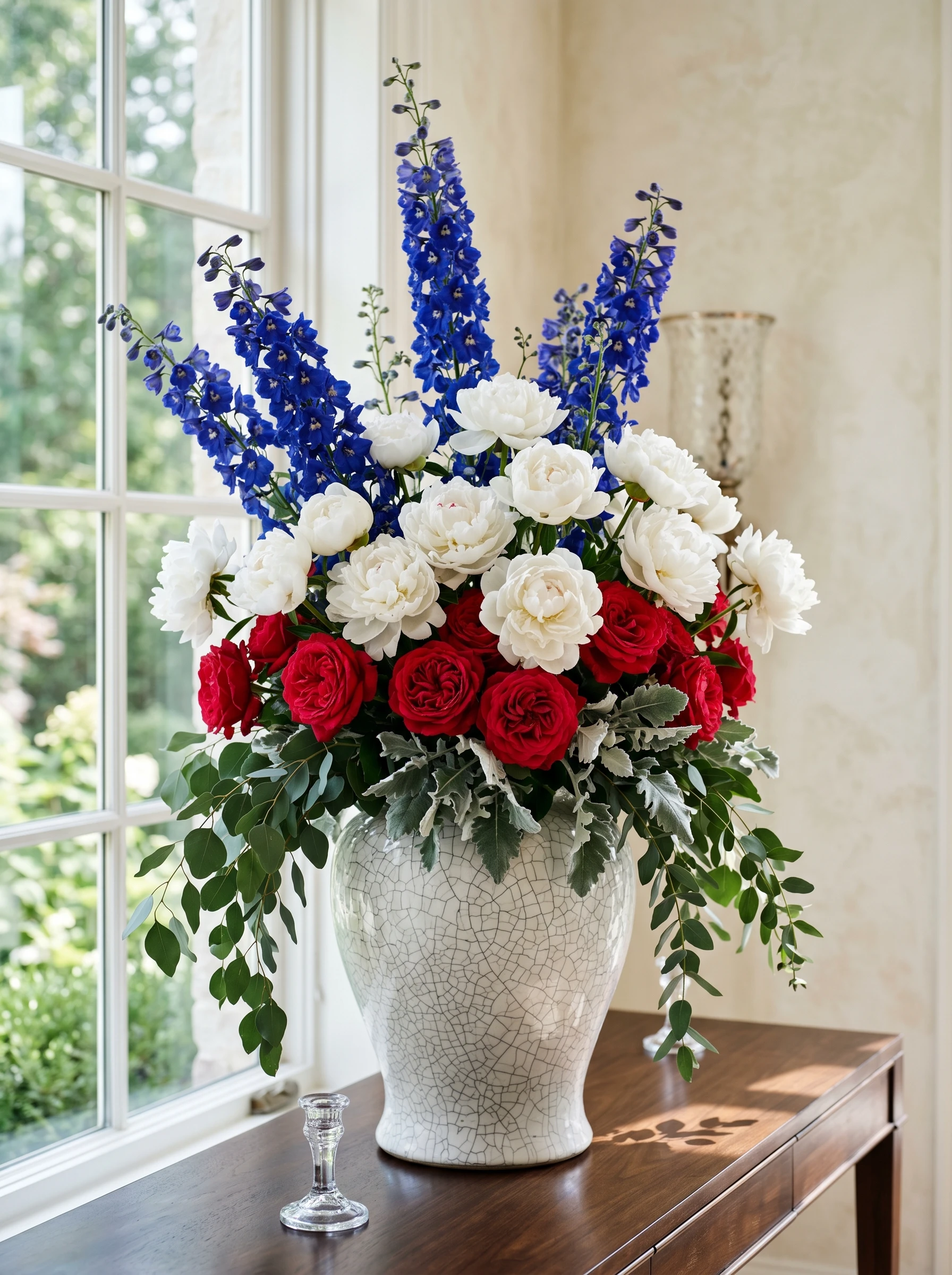
A tall, wide-mouthed white ceramic urn with a crackle glaze surface is the vessel. Fill it with wet floral foam built up above the rim. Build a low collar of dusty miller and trailing ruscus leaves around the outside of the foam at rim level. Add a dense ring of red garden roses at mid-height, packed in tightly so they form a solid band of color. Layer white peonies above and between the roses, at slightly varying heights.
Push blue delphinium stalks straight upward from the center of the arrangement — aim for three or four stalks, cut to different lengths so they stagger from twelve to twenty inches above the rim. The silhouette should be wide and lush at the base, rising to a vertical spire of blue. Place near a window so the light comes through the delphinium spikes.
What These Arrangements Have in Common
None of them are trying to win a contest. The ones that work best are the ones that committed to a single strong decision — the vessel, the scale, the specific flower — and let everything else follow from that. The mason jars commit to the vessel. The crystal vase commits to the occasion. The flower wall commits to the scale.
Red, white, and blue is a palette with a lot of cultural noise attached to it. The way to make it feel like yours is to filter it through your actual aesthetic — your home, your surfaces, your sense of formality. The patriotic part is the color. Everything else is just good design.
The best holiday decorating doesn’t announce itself. It just makes your home look like the best possible version of itself on a particular day. That’s the bar. These ideas will get you there.