
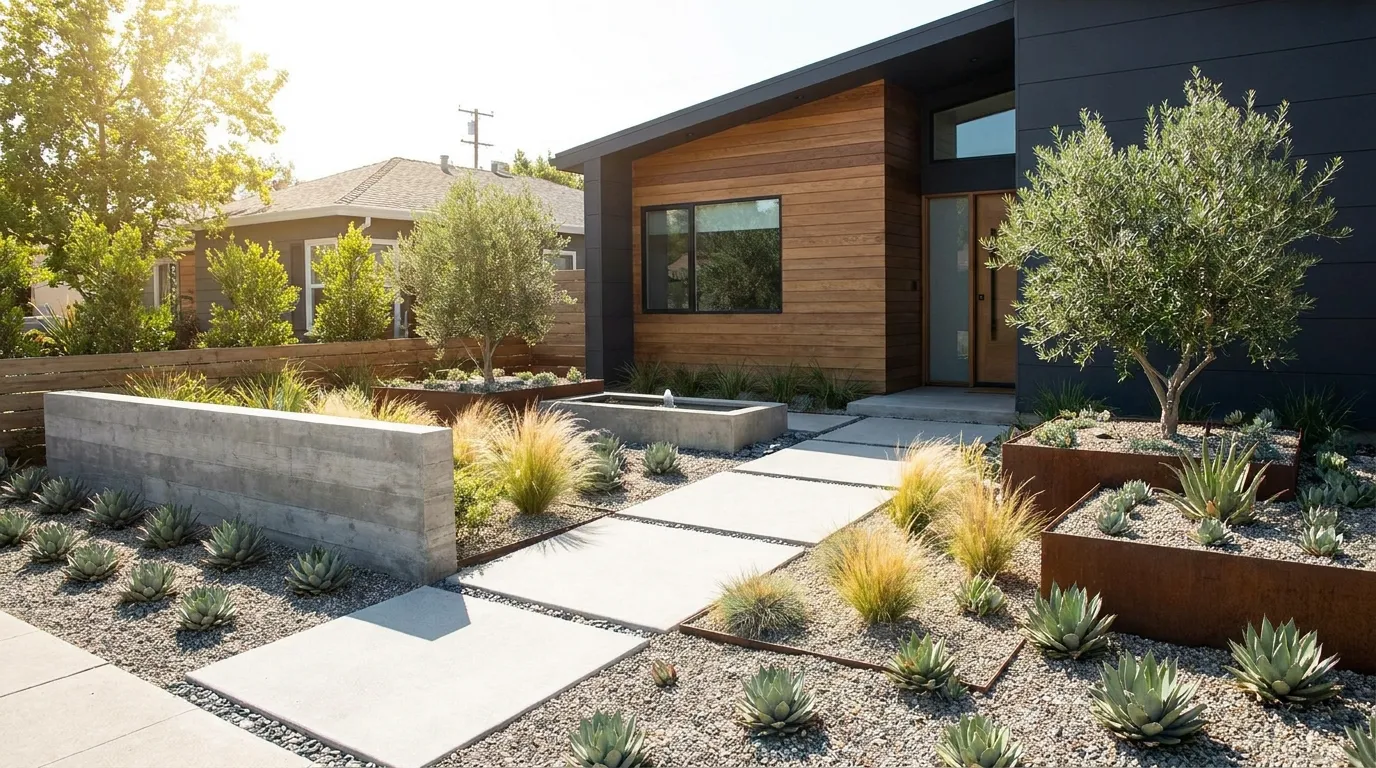
Most front yards are stuck in 1994. There is lawn. There are the two shrubs flanking the front door. There is a concrete path that runs straight to the steps. Nothing wrong with any of it exactly. Just nothing right about it either.
Modern front yard landscaping is not about adding a water feature or buying an expensive sculpture. It is about a different set of decisions — about geometry, material, restraint, and the relationship between the house facade and the ground in front of it.
The houses in these images made decisions. Clean ones. Decisive ones. Some are minimal to the point of severity. Some are lush but organised. All of them have a coherent design language that runs from the street edge to the front door without apology or ambiguity.
That design language is what this blog is about.
Why Modern Front Yards Look Like They Do and Traditional Ones Don’t
The difference between a front yard that reads as modern and one that reads as dated is not expensive plants or premium materials. It is the underlying logic of the composition.
Traditional Landscaping Accumulates. Modern Landscaping Edits.
A traditional front yard is the result of years of additions. A shrub here. A bed there. Some annuals in spring. A new path when the old one cracked.
The accumulation is visible. The eye moves from thing to thing without a unifying idea pulling them together.
Modern landscaping starts from subtraction. It asks what the irreducible composition is — the minimum that makes the space work — and removes everything else. What remains is not sparse. It is edited.
The difference between sparse and edited is intention. Sparse is when there isn’t enough. Edited is when everything that is there is exactly right.
The House Facade Is Part of the Design, Not the Background
In traditional front yards, the house is the backdrop. In modern ones, the house and the landscape are in conversation — the geometry of the planting responds to the geometry of the building.
A flat-roofed house with strong horizontal lines requires a landscape that either echoes those lines or deliberately contrasts them. A square grid of pavers and grass echoes the flat roof. A single large clumping tree in raked gravel provides the contrast. Both are intentional responses to the building. A collection of traditional shrubs and lawn is simply indifferent to it.
The Path from Street to Door Is an Opportunity Most People Waste
In a conventional front yard, the path is practical infrastructure. It gets you from the car to the door without getting your shoes muddy.
In a modern front yard, the path is a design axis. It organises the composition. Everything else — the ground material, the planting, the geometry — is positioned in relation to it.
The path can be a single slab strip that parts a gravel sea. It can be a series of large stepping pads that float across a grass grid. It can be a straight channel between two walls of structured hedging that creates a formal processional approach to the entry. In every case it is doing spatial and compositional work, not just navigational work.
What Modern Front Yard Landscaping Actually Requires
Modern doesn’t mean expensive. It doesn’t mean stark. It means consistent. The decisions have to add up.
One Ground Material Dominates Everything
In a modern front yard, there is one primary ground surface and everything else is subordinate to it. Gravel. Poured concrete. Large-format paving. Lawn defined by hard geometry. The point is that the dominant surface establishes the character of the space.
Mixed ground surfaces — a bit of lawn, a bit of gravel, some mulch beds, a brick path — read as traditional at best, chaotic at worst. Modern landscapes choose one material and use it consistently.
The secondary materials — the path, the bed edging, the accent paving — are chosen to complement or contrast with the primary ground, not to compete with it.
Plants Are Used Architecturally Rather Than Decoratively
In a traditional front yard, plants are the decoration. In a modern one, they are architectural elements — vertical screens, geometric masses, textural planes.
Clipped hedges read as walls. Standard trees read as columns. Repeated masses of ornamental grass read as a textured ground plane. These are architectural uses of plant material.
A rose bush in front of the window. A colourful annual bed under the letterbox. A novelty topiary by the gate. These are decorative uses. They belong in a traditional or cottage front yard. In a modern composition they are incongruous.
Colour Restraint Is Non-Negotiable
Modern front yards almost never use flowering plants as their primary design move. Flowering plants introduce colour that is inherently temporary and seasonally variable. Modern landscapes favour foliage — green, silver, bronze — that holds its character year-round.
When colour appears in a modern front yard, it is usually a single accent: one mass of the same species in bloom, or a single architectural specimen with coloured foliage. Never a mix of different flowering plants in different colours competing for attention.
Modern Front Yard Landscaping Ideas
The Tropical Curved Bed with Bromeliads, Black Pebble Accents, and a Matte Bowl Planter
Define the planting bed with a sweeping curved edge — not a gentle curve, but a confident arc that reads from the street. Use steel landscape edging to define this arc precisely. The bed should be wide enough to accommodate three layers of planting: a large statement specimen at the back, mid-level tropical foliage, and ground-level bromeliads.
Position a large matte charcoal fibreglass bowl planter — 800 to 1000mm diameter — as the anchor specimen vessel at the rear of the bed. Plant it with a multi-stem tropical specimen that will eventually exceed the bowl rim by at least a metre. The bowl reads as a sculptural object as much as a planter.
Plant the foreground of the bed densely with bromeliads — the fire-red varieties in the genus Aechmea or Neoregelia provide intense colour against dark foliage backdrop plants. Use scattered black volcanic pebbles as the ground cover between plants — the dark pebble against the vibrant red bromeliads is the material contrast the whole bed rests on.
Run a pale gravel path or lawn edge adjacent to the bed that follows the same curve. The bed and the path form a single fluid line through the garden.
The European Entrance Garden with Curved Stone Steps, Terracotta Urns, and Red Geraniums
This is modern in the sense of being decisively classical — fully committed to a Mediterranean register with no hedging toward anything else.
The stone steps are the primary design element. They should be generously wide — wider than the door — in a warm limestone or sandstone at consistent 175mm risers. The curve of the step faces should mirror the curve of the planting beds on either side.
Position large terracotta urns — the largest available, at 600mm diameter minimum — on the landing piers flanking the door arch. These piers are structural and visual anchors. The urns belong on them, not on the ground.
The planting beds on either side of the path use the same stone as the steps for the retaining edging. Plant in a palette of red, burgundy, and blue: red geraniums as the primary flower, blue salvia for the spire contrast, dark Alternanthera for foliage depth. River stone at the bed base transitions from the planted areas to the lawn.
The whole composition is unapologetically formal and unapologetically warm. It works because it commits completely.
The Dark Modular Paving Grid with Upright Grass Planters and a Black Entry Door
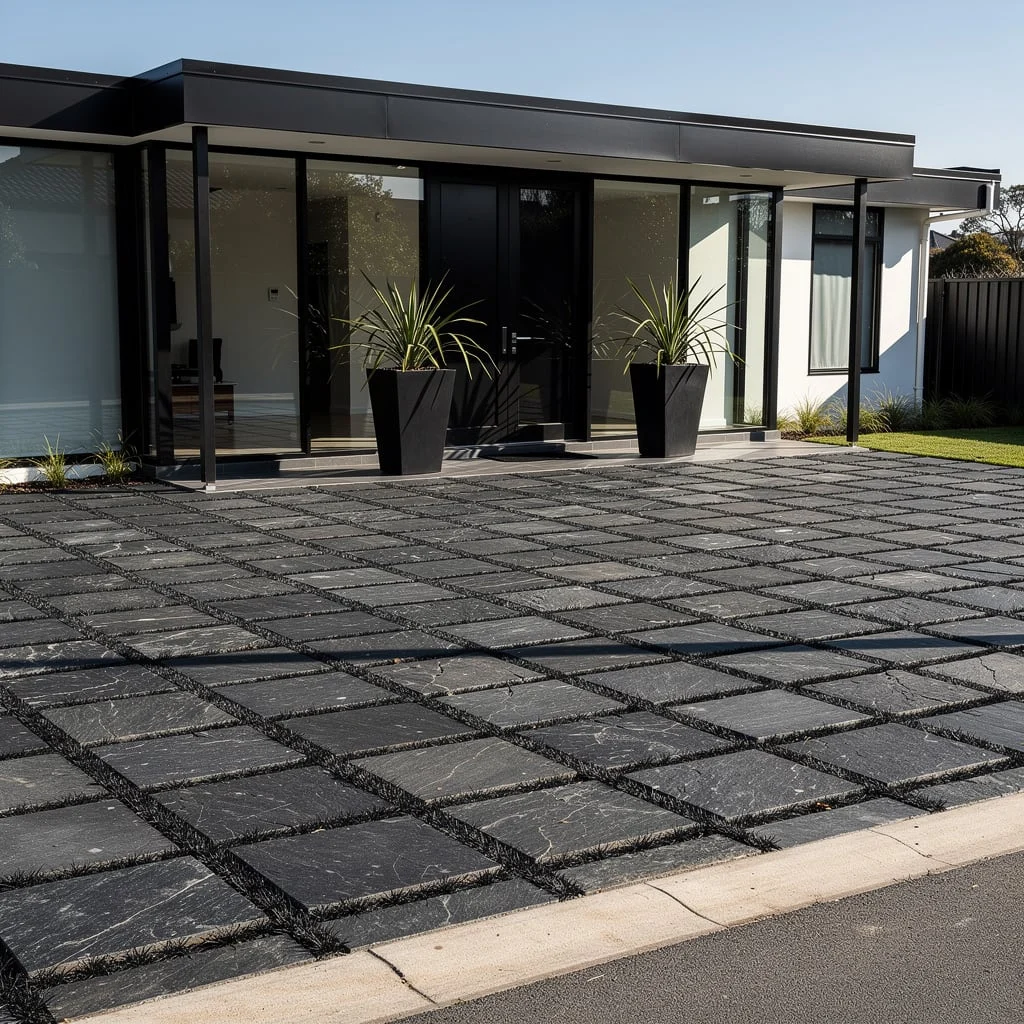
Large-format black or dark grey stone pavers — minimum 600 x 600mm, ideally in a natural stone like bluestone or a matte black porcelain — laid in a consistent square grid across the entire driveway and approach. The joints are planted with mondo grass or fine-leaved groundcover, which grows to fill the joint and creates the appearance of a living grid.
Two black metal tapered square planters flank the entry, each planted with a bold-leaved architectural plant — large Dracena marginata for the upright spear form, or Phormium tenax for the strap-leaf drama. The tapered black metal planter form echoes the dark stone paving and the black entry door and architectural framing.
Everything in this front garden is dark: the paving, the planters, the door, the cladding. The plants provide the only green. This colour discipline is what makes the composition read as considered rather than gloomy.
The Classic White Hydrangea Garden with Box Edging and a Painted Gate Entry
White Annabelle hydrangeas in mass planting — never mixed species, never mixed colours — create one of the most powerful modern-traditional front yard compositions available. The key is density: the hydrangeas need to be planted close enough that they read as a continuous mass, not as individual shrubs.
Space them at 800mm centres. Within two years they will touch. Within three they will form the abundant, billowing cloud mass that makes this look work.
In front of the hydrangeas, plant Buxus sempervirens as a low edging hedge — clip it to 300 to 400mm height in a strict flat-top profile. This clipped edge is the line that separates the formal from the informal: the controlled hedge below, the abundant hydrangeas above.
Pave the central path in large-format bluestone or grey slate in a running bond. The path should be straight, not curved — this is a formal composition.
Install a painted white gate between white columns at the street entry. The white gate, white columns, white hydrangeas, and white house trim are five instances of the same colour that create a unified composition visible from the street.
The Minimalist Dark Architecture Garden with a Reflecting Rill, White Gravel, and Grey Paving
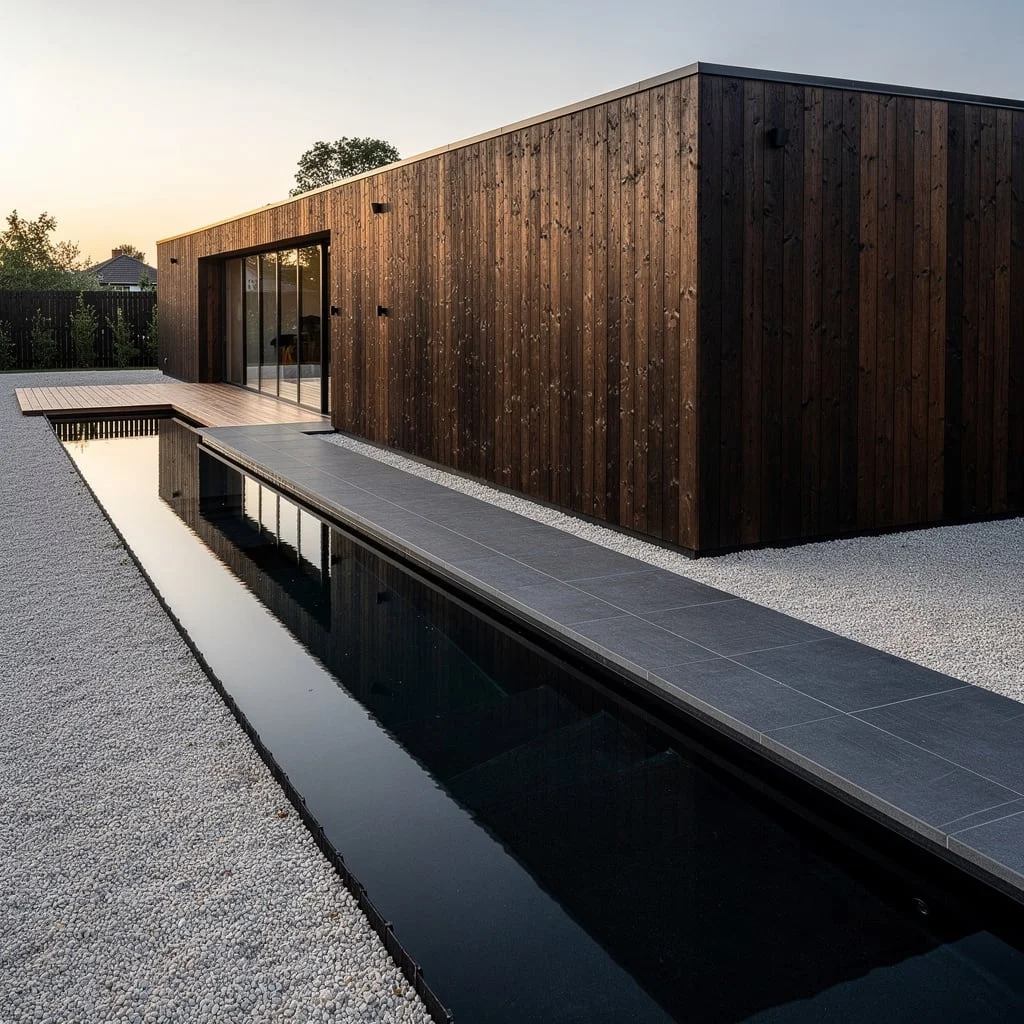
The reflecting rill — a long, narrow linear water channel — is the most powerful architectural garden feature available and also one of the most demanding to execute correctly. The rill must be perfectly level, perfectly straight, and finished in a near-black material — dark porcelain, dark engineering brick, or dark stone — so the still water reads as a mirror.
Edge the rill with grey large-format porcelain paving at 600 x 600mm or larger. The paving cantilevers slightly over the rill edge — 20 to 30mm — so the rill reads as a slot in the ground rather than a constructed channel.
Surround the entire paving and rill area with white pea gravel. The white gravel against the dark rill and the dark timber cladding of the building creates the primary contrast of the whole composition. There are no plants. There is no lawn. The architecture and the water feature are the entire garden.
This is an extreme position. It requires absolute confidence in the composition and absolute commitment to maintenance — the rill must be kept clear and level, the white gravel must be kept clean. It rewards that commitment with a front garden that stops people in the street.
The Minimalist Front Yard with Multi-Stem Birch Allee, White Gravel, and a Concrete Slab Path
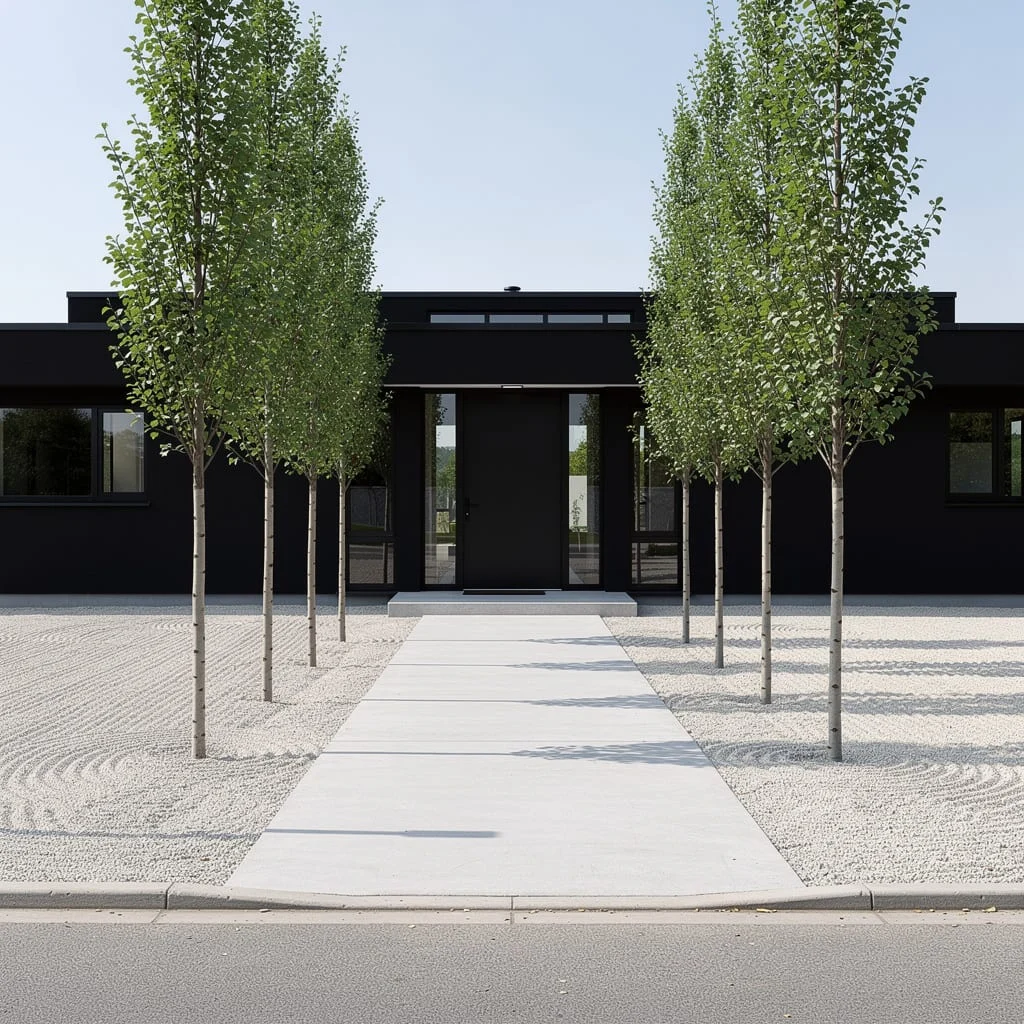
An allee is a line of trees on each side of a path. In formal gardens they are in large numbers. In a domestic front yard, three trees per side is sufficient to create the spatial effect.
Plant multi-stem white birch — Betula utilis var. jacquemontii for its exceptional white bark — in two parallel lines either side of a central concrete slab path. The path should be broad — 1.2 to 1.5 metres — not a narrow strip. Space the trees at 1.5 metres apart within each row.
Apply white or pale gravel across the entire front yard surface. No edging is needed between the gravel and the path if the path is set at the same level — the gravel simply abuts the slab edge.
No other planting. The white birch trunks rising from white gravel, against a dark house facade, is a composition of extraordinary simplicity and elegance. The seasonal change — winter bare branch tracery, spring leaf, autumn gold — provides all the variety the space needs.
The White Rendered House with Stone Standards and White Gravel Sphere Garden
Source three white or pale concrete garden spheres at varying diameters — 400mm, 500mm, and 600mm. These are the design elements. Everything else — the white pebble ground, the stone standard trees, the clipped hedge backdrop — exists in service of the spheres.
Plant standard bay trees or Lollipop-shaped standard trees in a line along the bed. Their clean clear stems and ball heads echo the sphere forms at different scales and heights.
Apply white marble chip or white quartz pebble as the ground surface across the entire bed. Install a granite or dark stone block edging ring at the bed boundary. The pale pebble, the pale spheres, and the clean-stemmed trees in their ball forms make a composition of circles and spheres at multiple scales.
The white rendered house facade amplifies all of it. Against a dark or warm brick house this composition changes character entirely — the key is the white-on-white backdrop that makes the spheres read as sculptural objects rather than garden ornaments.
The Graphic Concrete and Grass Grid with Black Shrub Edging and a White House
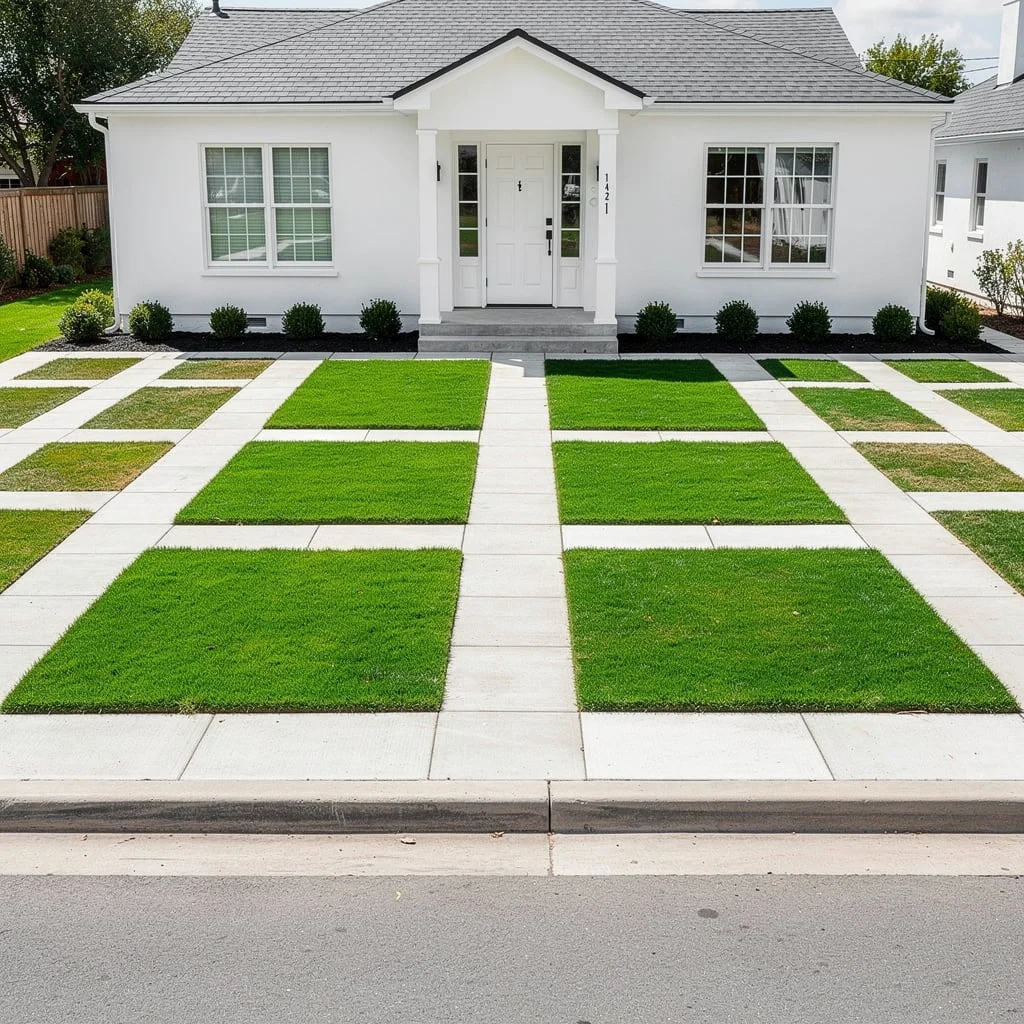
This is modern landscaping reduced to its geometric essence: a grid of square grass panels separated by concrete slab joints, with a foundation bed of black mulch and compact clipped shrubs against the house wall.
Lay large-format concrete paving at a minimum of 600 x 600mm — ideally 900 x 900mm — in a grid pattern across the entire front yard. Between each slab, plant low-growing turf grass or fine-leaved groundcover in the gaps. The grass grows level with the paving surface within one season of establishment.
The foundation bed at the house wall uses the same concrete paving as a hard edging and plants compact box or similar clipped shrubs at equal spacing. Black bark mulch fills the bed between shrubs.
The composition is two-dimensional, geometric, and completely independent of seasons. It reads as architecture rather than garden. Against a white rendered house, the grey concrete and vivid green grass grid is a graphic contrast of maximum clarity.
The Grey Rendered House with Blue Fescue, Exposed Aggregate Panels, and a Precision Concrete Path
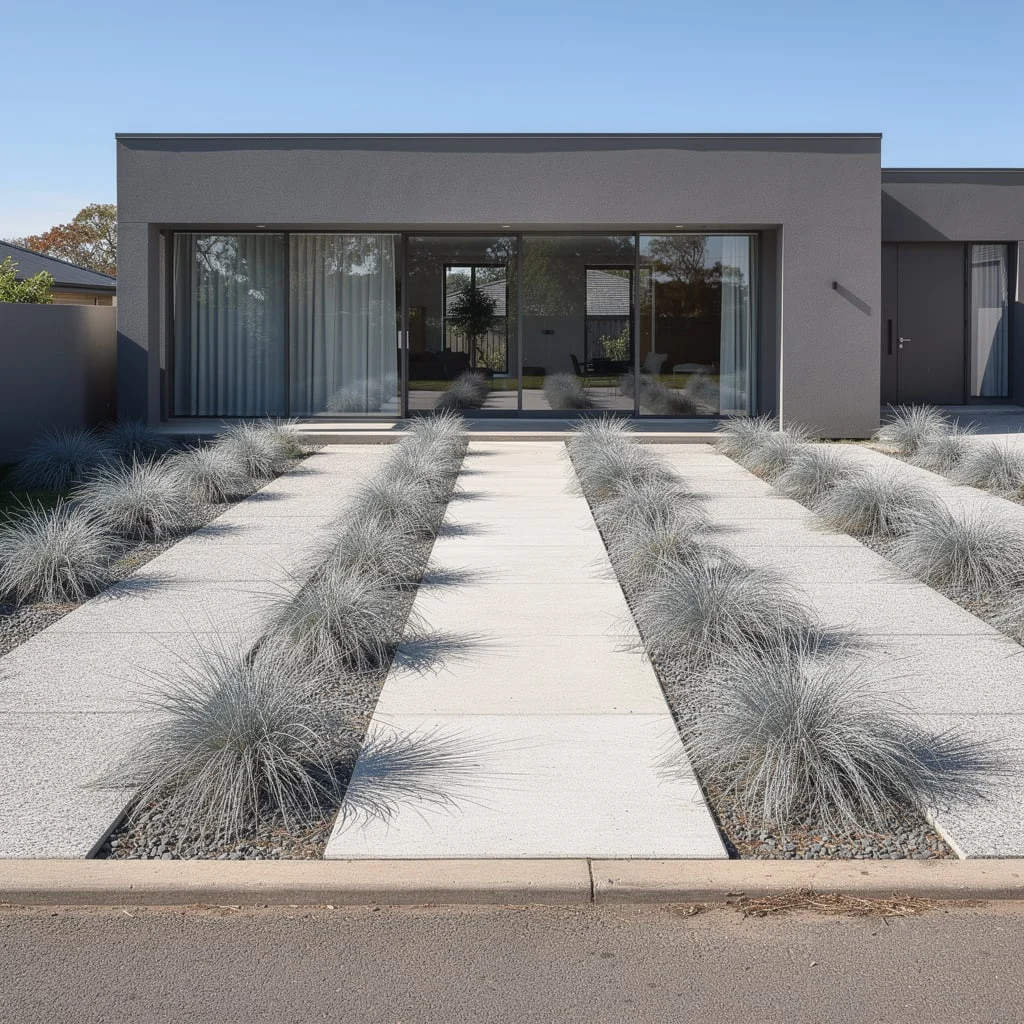
Blue fescue — Festuca glauca — planted in mass, in multiples of the same plant at regular spacing, creates the textural plane that modern low-water landscaping does better than almost anything else.
Apply white or cream exposed aggregate panels as the primary ground surface — two wide panels on either side of a central precision concrete path. The path should be polished or broom-finished in a slightly different tone to the aggregate, so the three elements (path, left panel, right panel) read as separate geometric zones.
Plant blue fescue in a regular grid across both aggregate panels — each plant at 400 to 500mm from its neighbours. The fescue grows upward in a fountain form to approximately 300mm height. From a distance, the grid of steel-grey fescue clumps against the pale aggregate reads as a textured surface rather than individual plants.
This planting is extremely drought-tolerant and requires only annual haircut clipping to maintain its form.
The Bluestone Crazy-Pave Path with Curving Dark Mulch Beds and Young Ornamental Trees
The crazy pave path in pale bluestone or grey slate is the connective tissue of this garden. Lay the slabs with consistent white mortar joints at 20 to 30mm width — the joint width and colour are as important as the slab material. A wide white joint on pale bluestone reads as bold and contemporary. A narrow dark joint reads as quieter and more traditional.
The path should curve through the garden — not a wiggle, but a deliberate arc that requires the eye to follow it. This curving path creates two planting beds: one wide, one narrow, both bordered by the path on the lawn side.
Excavate the beds, improve the soil, and apply dark bark mulch at 100mm depth. Plant the wider bed with feature shrubs at the back — Hydrangea paniculata, Viburnum, or Camellia depending on climate — and low compact species at the bed front edge.
Plant one ornamental tree — positioned in the lawn, not in the bed — with a simple mulch circle around it. The tree, the curving path, and the two beds create a composed front garden that reads as designed without being stiff.
The Corten Steel Raised Planter Allee with Clipped Box Hedging and Karl Foerster Grass
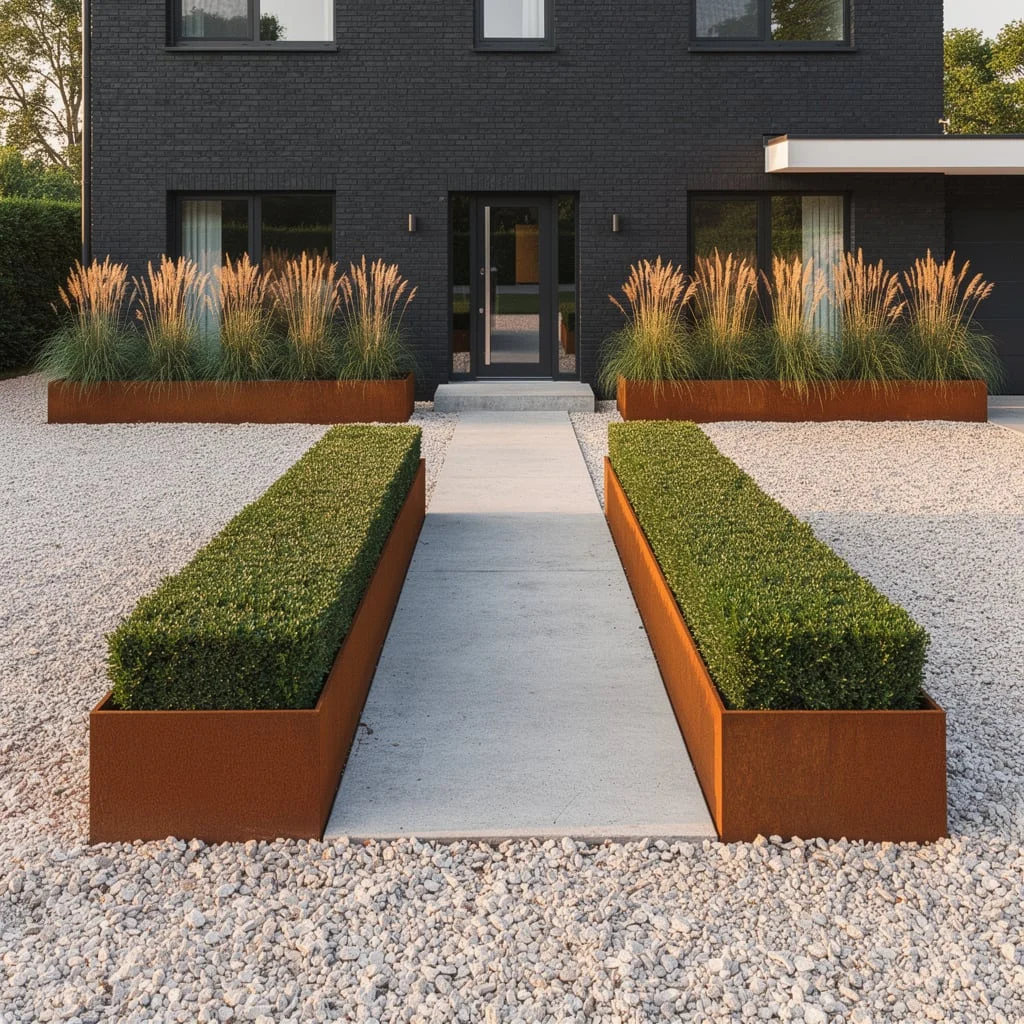
Four rectangular Corten steel planters — two close to the entry, two further back — are the structural elements of this composition. Each planter should be at least 2.5 metres long, 600mm wide, and 400mm tall. The Corten will rust to a deep amber-orange within the first season, creating a warm material that reads against white gravel and dark masonry alike.
Fill the two forward planters with clipped box hedging — a flat-top continuous hedge that runs the full length of each planter at 300mm height. These box hedges are the low, controlled foreground element.
Fill the two rear planters, positioned closer to the house, with Karl Foerster ornamental grass — planted in a single row at 400mm centres. These grasses grow to 1.5 to 1.8 metres in September, their golden plumes lit dramatically in low autumn light.
Apply white pea gravel across the entire front yard ground surface. Run a concrete path through the centre of the composition from street to door.
The composition works through sequential layering: white gravel ground, Corten steel walls, green box hedge low, tall grass plumes high. Every element is in a different height register. The eye moves through them in sequence.
The Three Ball-Head Standards in Raked White Gravel Against a Black Fence
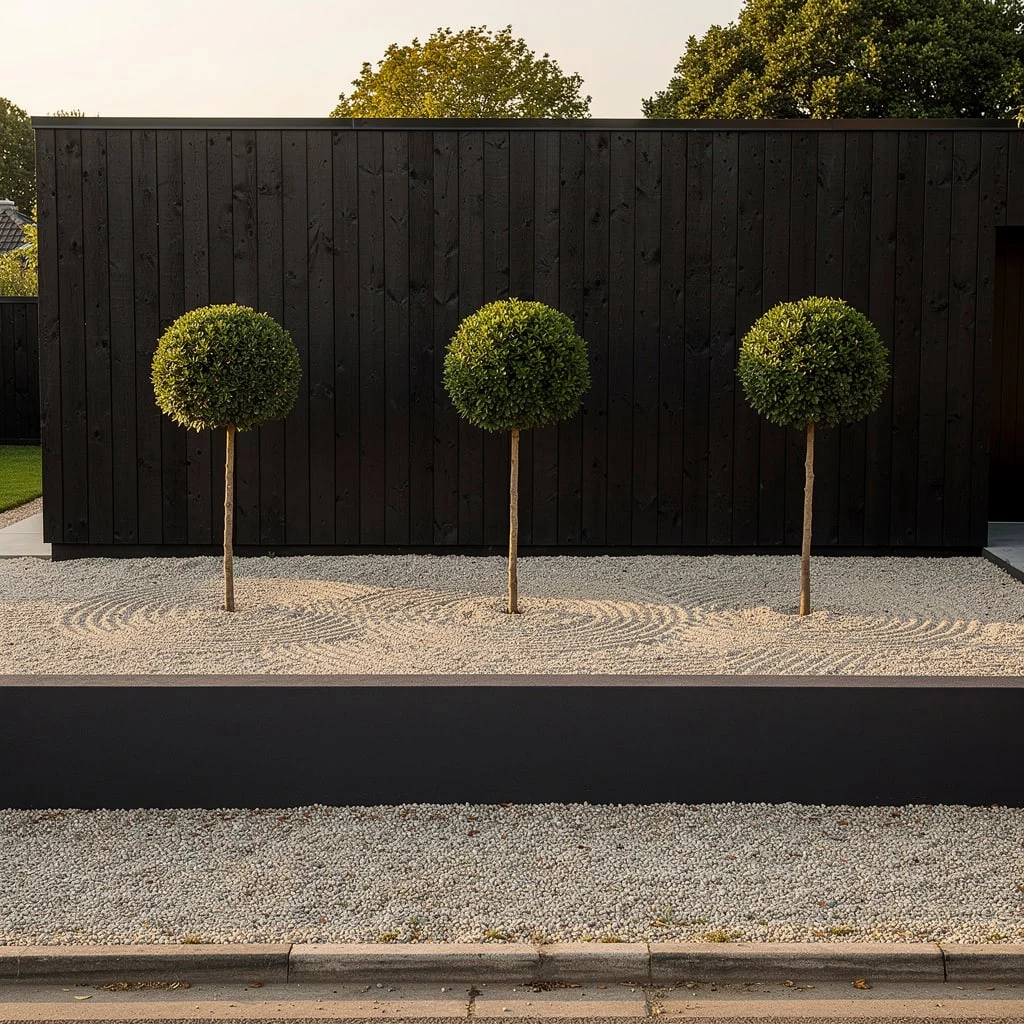
This is minimalism taken to its logical conclusion for a domestic front yard. Three standard trees — Lollipop bay, standard ball-head box, or standard photinia — planted at equal spacing in raked white gravel, against a full-height black stained timber fence. Nothing else.
The spacing of the trees must be absolutely consistent. Measure it. Stake it before planting. The three trees at irregular spacing look careless. At precise equal spacing they look intentional.
Apply white or cream marble chip at 70 to 80mm depth. This depth is critical — too shallow and the rake pattern won’t hold, too deep and the surface is unstable to walk on.
Rake concentric circles around each tree base. Extend the circles until they meet and overlap between trees, creating a zen garden pattern that reads as a single coherent ground composition.
The black fence, the white gravel, and the three green ball heads are three strong elements — dark, light, and green — at three different scales. The composition is complete. Adding anything to it would only diminish it.
The Modernist Garden with Two White Gravel Panels Framed by Clipped Box Hedging
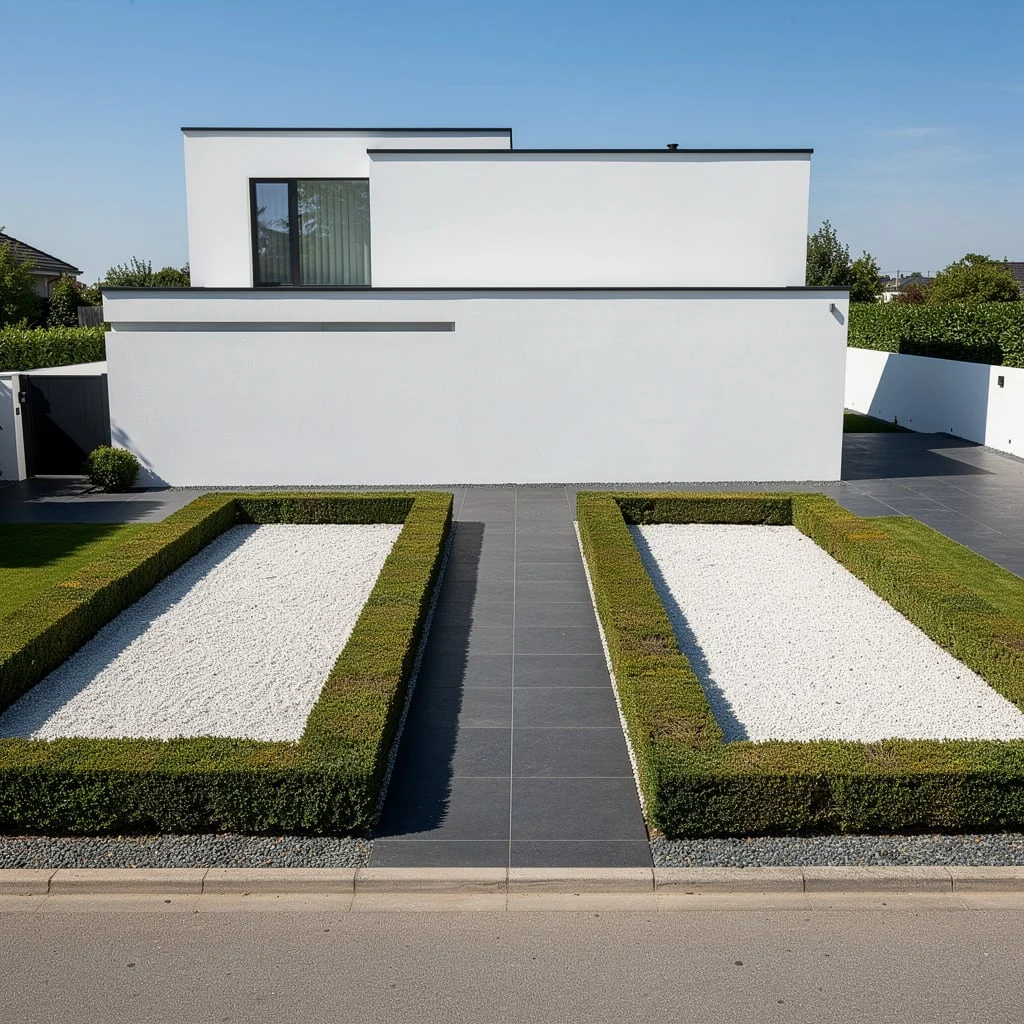
Two rectangular panels of white crushed marble, each edged on three sides by a clipped box hedge and on the path side by the central grey paving strip. The box hedging is the frame; the white gravel is the painting inside the frame.
The box hedging should be clipped to a consistent height — 400mm is ideal, tall enough to read as a significant structural element but low enough to allow the gravel interior to be visible from the street.
The central paving strip should be in a dark porcelain or grey stone that creates maximum contrast with the white gravel panels. It should run from the street to the front door without deviation.
The whole composition has a formal bilateral symmetry that is different from traditional symmetry — colder, more graphic, more resolved. It works because the materials are contemporary even if the structure is classical.
Keep the box clipping precise: flat top, vertical faces. Any softening of the line into a rounded form changes the character from contemporary to traditional.
The White Birch in Raked Gravel Against a Grey Rendered Box House
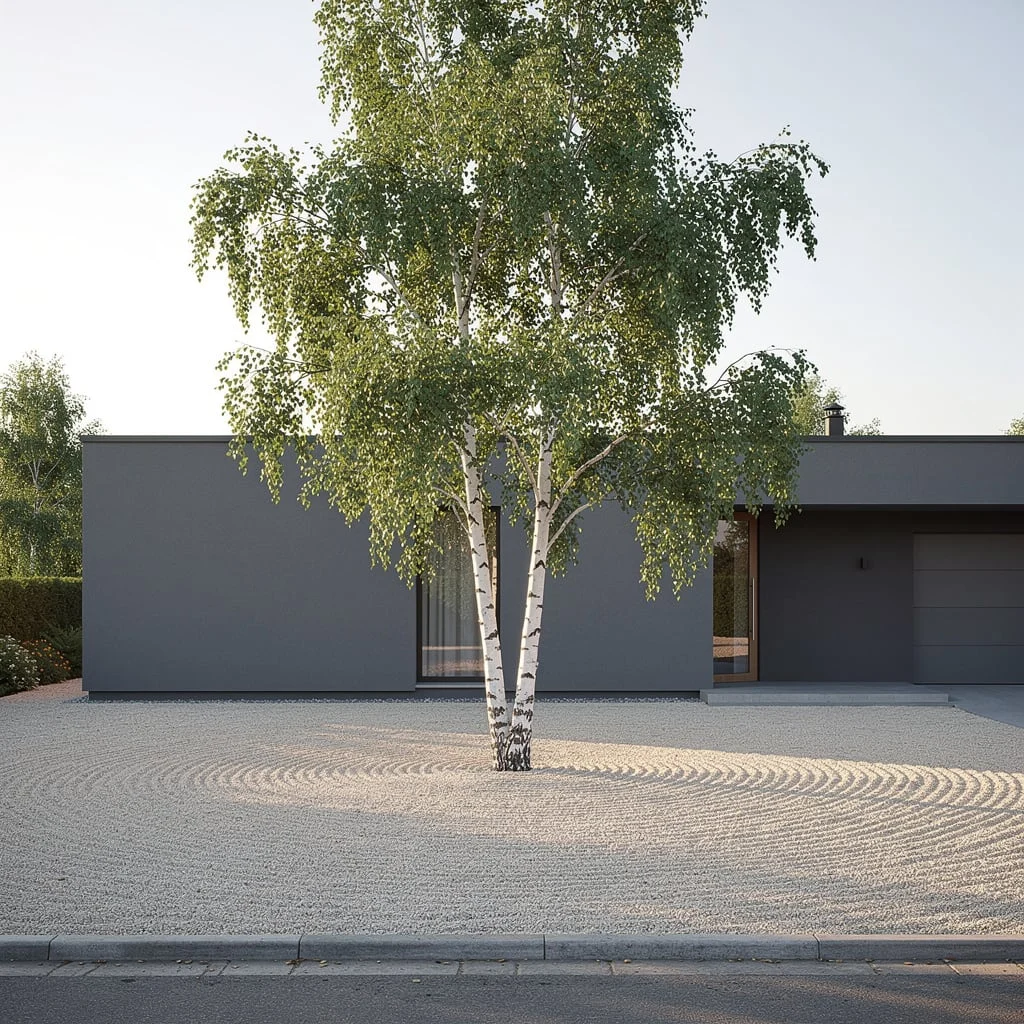
One tree. One ground material. No other planting. This is the irreducible modern front yard.
The birch should be multi-stem — two or three stems emerging from the same root ball — so the white trunks create a natural composition at ground level. A single-stem birch loses half its power.
Apply pale grey or white grit gravel — 6 to 10mm granite chip — across the entire front yard at 60mm depth. Rake in a pattern of concentric circles radiating outward from the tree base. The circles should be broad arcs rather than tight rings — the pattern reads as calm rather than mechanical at a 300 to 400mm wave spacing.
Retain a simple concrete edge strip at the street boundary. No other edging. The grey house, the grey gravel, and the white tree trunks are three values of cool tone that read as a monochrome composition with occasional flashes of green foliage.
The Dark House with Symmetrical Clumping Bamboo Entry and a Dark Slate Path
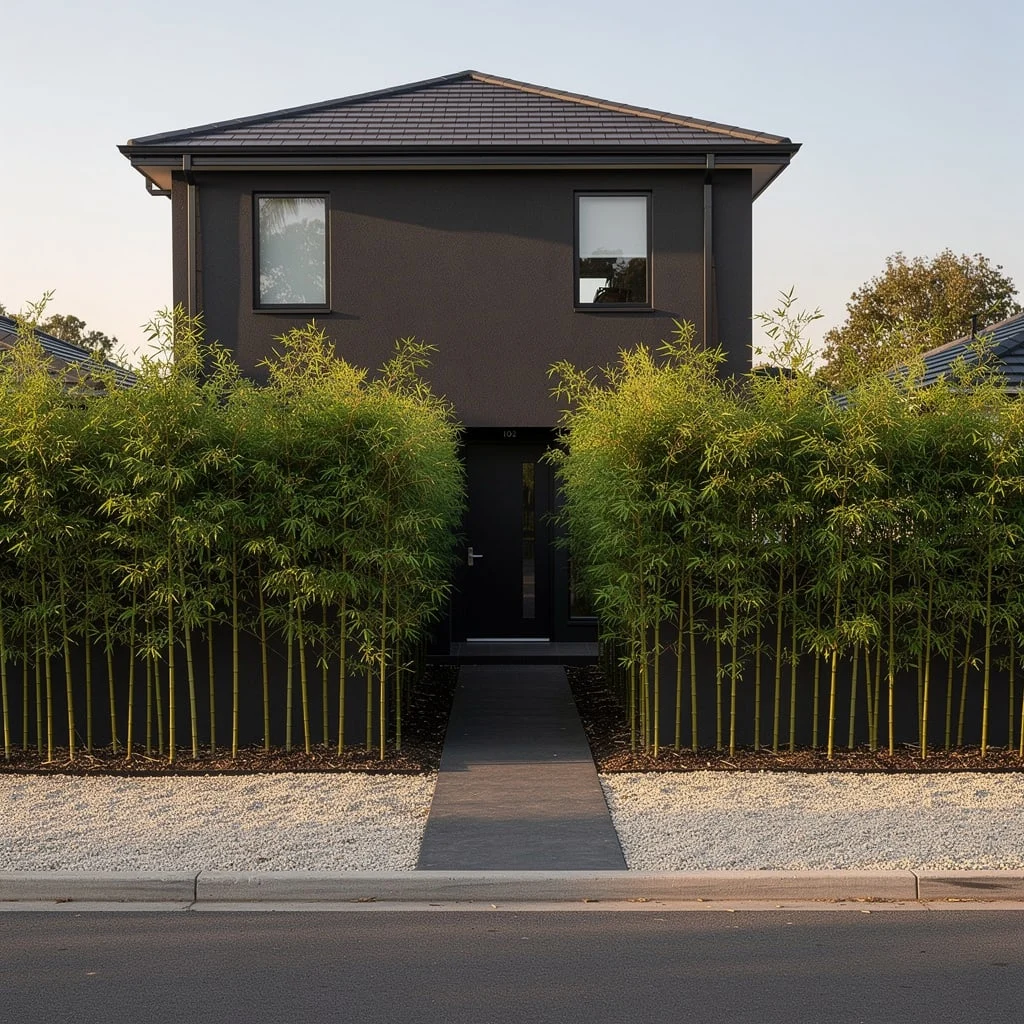
Plant two large masses of clumping bamboo — Fargesia robusta or Bambusa textilis — symmetrically on either side of the front entry path, positioned so their canopies will eventually arch toward each other above the path without touching. In three to four years from planting, this creates a living tunnel effect when approaching the front door.
At planting, establish each bamboo mass with five to seven plants at 600mm spacing within the mass. Within two seasons they will form a single continuous clump. Apply dark bark mulch or black pebble at the base of each mass.
The path should be in dark grey or charcoal slate or concrete — matching the house facade tone. The path width should be generous: 900mm to 1.2 metres so the bamboo can arch inward without making the path feel claustrophobic.
White pebble at the garden bed base, between the bamboo masses and the street boundary, creates the contrast ground plane that prevents the whole composition from reading as dark and heavy.
At night, with path lights set low at the bamboo base, the golden canes of Fargesia lit from below against a dark house is one of the most dramatic front yard compositions available.
Why Modern Front Yards Read as Modern Even When They’re Quite Different from Each Other
They don’t hedge. They pick an idea and pursue it.
The tropical bromeliad garden and the single white birch in raked gravel have almost nothing in common except this: both are the result of someone choosing one thing and following it through without apology. One chose colour and abundance, articulated precisely. The other chose reductive emptiness, committed completely.
Both read as designed. Both read as modern. Neither required expensive materials. Both required a decision about what the space was for and what it was saying.
Most front yards fail because no one ever made that decision. They grew by accumulation — this added here because it was available, that planted there because it was on sale, the path laid where it seemed convenient rather than where it was compositionally correct.
A modern front yard is the result of editing first and adding second. Of knowing what the idea is before the first plant goes in the ground. Of being willing to leave ground empty because empty, handled correctly, is more powerful than full.
That decision — to commit to an idea rather than accumulate things — is the only difference between the gardens in this post and the garden in front of most houses on most streets.
It doesn’t cost money. It costs clarity.