
There is a tree in your yard. It has been there for years, possibly decades. It provides shade, structure, and scale that no planted shrub will ever replicate. It is the most valuable living thing in your garden.
And around its base, there is nothing but a ragged patch of lawn that the mower can never quite reach, compacted soil, and maybe a ring of poorly chosen ground cover that has been slowly dying in the dry shade for three seasons.
The base of a tree is one of the most neglected and most visible spaces in any yard. You see it every time you look out the window. Every time you pull up the driveway. Every time a guest arrives.
It deserves better than benign neglect. And fixing it is not complicated — it is just a matter of choosing what you want the space around the tree to say.
Why the Ground Around a Tree Gets Ignored Until It Becomes a Problem
The mower has always been the unofficial manager of tree bases. It goes around, misses the bit it can’t reach, and calls it done. Over time, the soil compacts, the grass thins, and the base of the tree becomes the least considered space in the garden.
The Tree Already Solved the Hard Problem. The Ground Hasn’t Kept Up.
A mature tree is a resolved design problem. It has form, height, canopy, seasonal interest, and bark texture that no purchased garden feature can match. The space around it is simply waiting for someone to make a decision.
That decision is not about plants alone. It is about what the tree’s base communicates in the context of the whole front yard or garden. A tree surrounded by a clean mulch bed and a considered edging reads as the anchor of a designed landscape. The same tree surrounded by thin lawn and old leaf litter reads as something that has survived in spite of the space around it.
The tree did its job. The base just needs to catch up.
Mowing Around Trees Does More Damage Than Most People Know
Lawn mowers and string trimmers cause more damage to established trees than almost anything else. Every time a mower clips the base of a trunk or a trimmer grazes the bark, the tree’s cambium — the thin living layer just beneath the bark — is disrupted. Repeated damage creates wounds that don’t fully heal and can eventually compromise the tree’s structural integrity.
A proper mulch ring or planted bed around the base of a tree eliminates this problem entirely. No mowing in the root zone. No trimmer at the trunk. The tree gets the undisturbed soil and protection it needs, and the garden gets a space that looks intentional.
The Root Zone Has Different Conditions Than the Rest of the Garden
Under the canopy of a mature tree, the soil is drier, more acidic, more shaded, and more root-competitive than any surrounding bed. These are real conditions that require appropriate plant selection.
Most plants fail at tree bases not because the planting was wrong in principle, but because the wrong plants were chosen. Annuals that need regular watering compete with tree roots for moisture and rarely establish. Lawn grass thins because it needs more light than a dense canopy allows.
Shade-tolerant, root-competition-tolerant plants — ferns, ajuga, hostas in sheltered positions, Liriope, and many groundcovers — succeed because they were chosen for the actual conditions, not for how they look in a catalogue under optimal conditions.
The Ground Material Is the First Decision, Not the Plants
Before choosing a single plant, decide what the ground surface within the tree ring will be. This is the decision that determines everything else — the character of the space, the maintenance requirements, and which plants can survive in it.
Mulch Is the Default for Good Reason
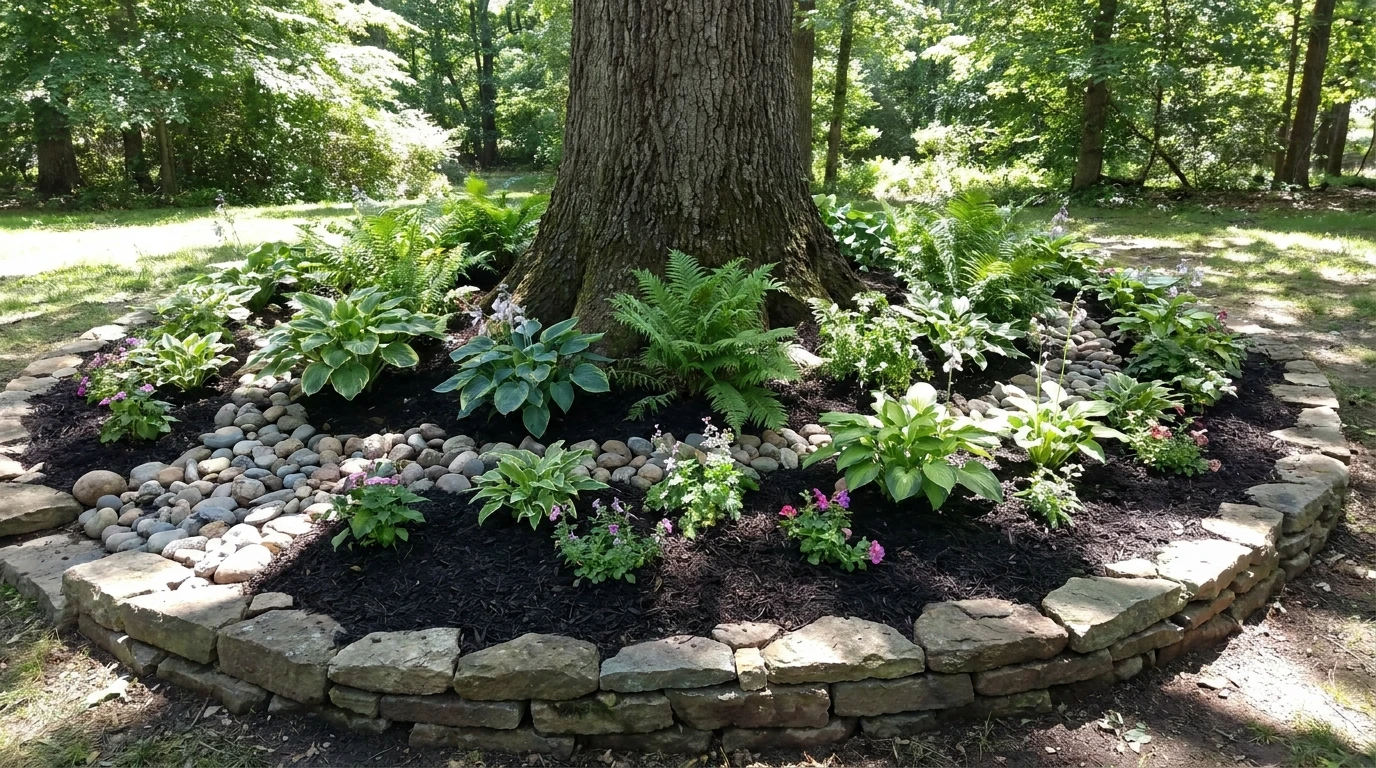
A deep mulch application — 75 to 100mm of dark bark or wood chip mulch — is the single most beneficial thing you can do for a tree’s base. It insulates the soil, suppresses weeds, retains moisture, prevents compaction from foot traffic, and improves soil structure as it breaks down.
It also looks clean and considered. A generous dark mulch circle around a tree trunk immediately reads as a designed element rather than an oversight.
Apply mulch at a minimum radius of 900mm from the trunk, and ideally at a radius that reaches the drip line of the canopy. Keep mulch 100 to 150mm clear of the trunk itself — mulch piled against bark creates the conditions for collar rot.
Decorative Stone Changes the Character Completely
Black lava rock, white marble chips, pale river pebble — each decorative stone reads differently and creates a completely different aesthetic at a tree’s base.
Stone is a permanent ground cover choice. It does not decompose, does not need refreshing seasonally, and does not compact. It does trap heat in summer, which affects the moisture profile of the soil beneath. Plants established in a gravel or stone bed need to be genuinely drought-tolerant.
Stone works best when paired with a strong edging choice — brick, granite cobble, or steel — that defines the ring cleanly and prevents the stone from creeping onto the lawn.
The Edging Is as Visible as the Ground Material
The edging of a tree ring is what the eye catches first. A ragged, undefined edge between a mulched bed and the lawn looks unfinished regardless of what is planted within it. A precise, clean edging choice — whether formal brick, informal stone, stacked masonry blocks, timber sleepers, or steel — makes the whole composition read as intentional.
Choose the edging material before anything else. It determines the character — rustic, formal, contemporary, cottage — and everything planted or laid inside it follows from that register.
Base of Tree Landscaping Ideas
The Hardwood Circular Bench on a River Stone Base with Uplight Fixtures
Commission or source a full circular tree bench in a hardwood — ipe, spotted gum, or mature cedar — with a steel subframe. The bench wraps completely around the trunk with a gap at the trunk sufficient for air circulation and future growth. The seat surface should be slatted with gaps between boards for drainage and the characteristic appearance of outdoor timber furniture.
Excavate the area beneath the bench to 150mm depth and fill with clean river pebble — rounded smooth stone at 30 to 50mm diameter. This ground cover beneath the bench reads as a base rather than a floor: earthy, natural, and appropriate to the scale of a large tree trunk.
Install two or three recessed ground-level uplighter fixtures in the pebble base before laying the stone, with cabling buried beneath. Position them to light the trunk bark from below at angles that reveal the bark texture. At dusk, the uplighting transforms the space from a daytime seating feature into a garden focal point visible from inside the house.
Edge the entire pebble circle with a fine steel landscape edging strip bent to the same radius as the bench, sitting just above the surrounding lawn surface. The clean edge is what makes this look considered rather than placed.
The White Birch Multi-Stem with River Stone Ground Cover and Fern Planting
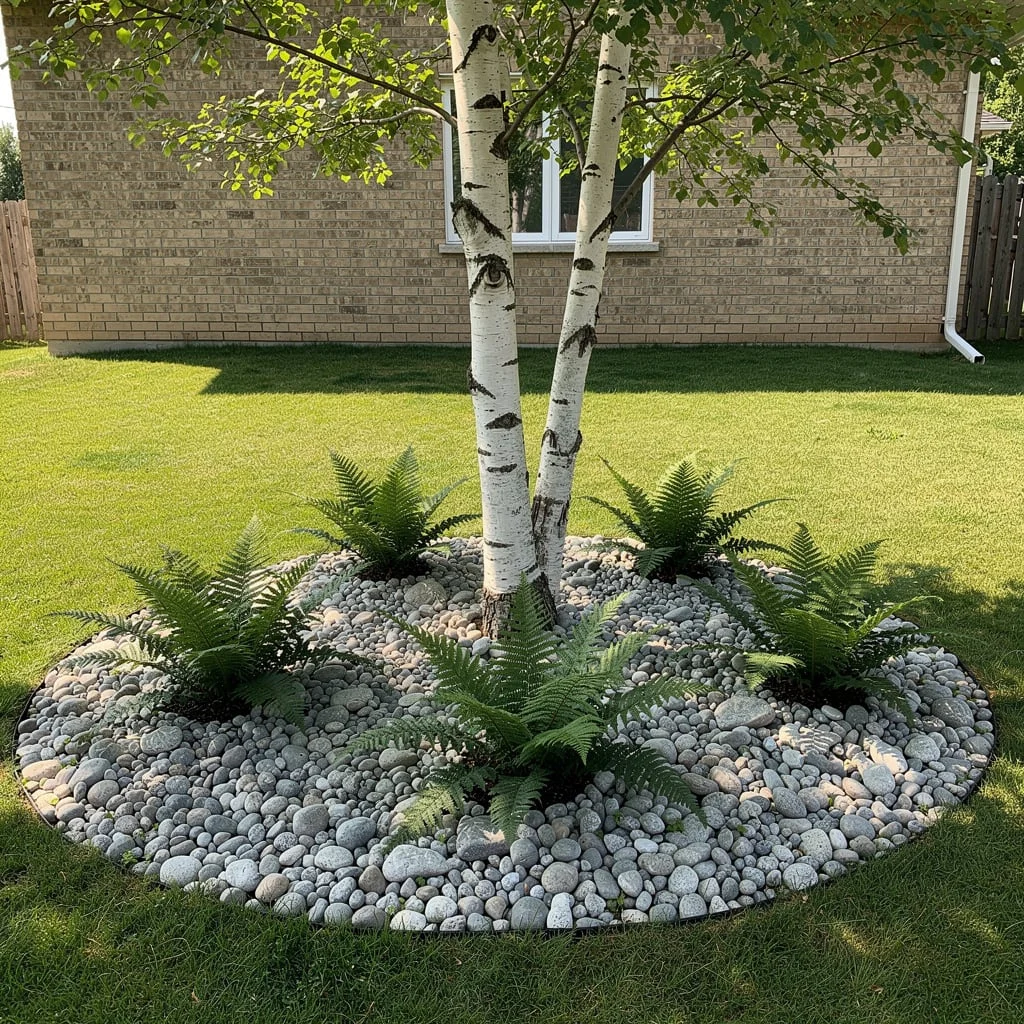
The multi-stem white birch is among the most structurally beautiful trees available for temperate gardens. Its white-peeling bark, graceful canopy, and woodland character should determine every decision about the ground beneath it.
Lay a deep base of river stone — grey rounded stone at 30 to 50mm diameter — across the entire ring to 100mm depth over weed matting. No bark mulch. The stone reads as a woodland riverbed rather than a garden bed, which suits the character of the birch.
Plant five to seven ferns — male fern, soft shield fern, or autumn fern — in the stone at irregular spacing around the trunk group. Plant them in pockets of improved soil beneath the stone layer, cutting through the weed matting to prepare each planting hole.
The white birch trunks rising through the dark fern fronds and the grey-white river stone is a complete composition in three tones — white, dark green, and grey — that requires nothing else.
The Young Tree in a Square White Gravel Bed with Dark Concrete Block Edging
For a young tree in a formal residential driveway setting, a square rather than circular tree ring makes a strong architectural statement. The geometry acknowledges the built environment — the driveway, the house facade, the path — rather than softening it with a curve.
Set dark charcoal concrete pavers on edge to form the square border, with exactly 90-degree corners. The square should be large enough to give the tree visual room within it: a minimum of 1.2 to 1.5 metres per side.
Fill the square bed with white crushed marble or white quartz gravel at 50mm depth over weed matting. The white ground surface maximises reflected light for a young tree in early establishment. It also creates the maximum contrast against the dark edging and the tree’s green foliage.
No additional planting. The young tree, the white stone, and the dark square frame are the complete composition. As the tree matures and its canopy expands, the square provides the formal foil that makes the tree read as deliberately placed rather than incidentally grown.
The White Gravel Circle with Pink Standard Roses and Granite Block Edging Ring
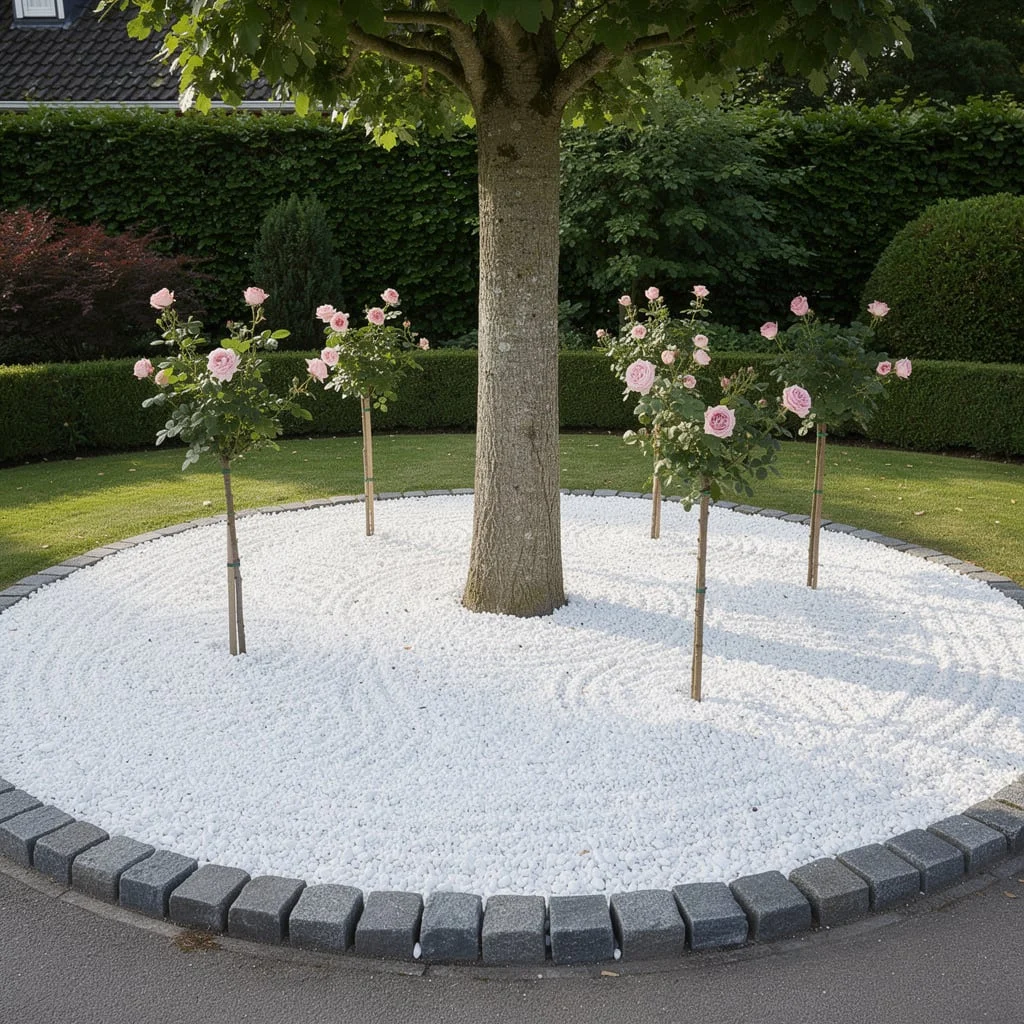
Set the granite block ring — dark grey square-cut sett pavers — in a continuous circle at the outer edge of the designed area, with a radius of 1.5 to 2 metres. These blocks form the definitive outer frame of the composition. Lay white marble chippings at 50mm depth over the entire interior.
Plant four to six standard roses — on a clear stem 600 to 750mm tall with a clipped ball head — at equal spacing within the gravel, surrounding the tree trunk. Stake each rose with a single vertical cane tied loosely. Choose a single rose variety in one colour — soft pink is most effective against white gravel — and buy matching specimens so the head sizes are consistent.
The concentric logic of this composition — dark outer cobble ring, white gravel interior, tree trunk at centre, standard roses at equal radius — is formal and classical. It works in large front gardens with mature trees where the scale can support it. In a small space, the formality is overwhelming. Know your garden’s scale before committing to this.
The Double-Ring Concrete Block Planter with Black Mulch and Mixed Annual Colour
Build two concentric circles of concrete masonry blocks — available cheaply at any builder’s merchant. The inner ring creates a raised bed at 200mm height with a radius of approximately 600mm from the trunk. The outer ring, 300 to 400mm further out, creates a lower border at one block course high — around 100mm.
Both rings should be dry-stacked without mortar. This allows root expansion and drainage and makes future adjustment possible.
Fill the inner zone with a quality soil mix improved with compost. Plant the inner zone, closest to the trunk, with taller flowering annuals — marigolds, celosias, or zinnias in yellow and orange. Plant the outer zone with shorter spreading annuals — white alyssum or pansies. The layering of height zones within the concentric rings creates a planting composition that reads as deliberately designed.
Apply dark black mulch between plants and keep it away from the trunk. The black mulch against the pale concrete block and the bright annual colour is the three-tone palette that makes this so visually effective.
The Mature Olive Tree in a Raked Gravel Circle with Lavender Perimeter
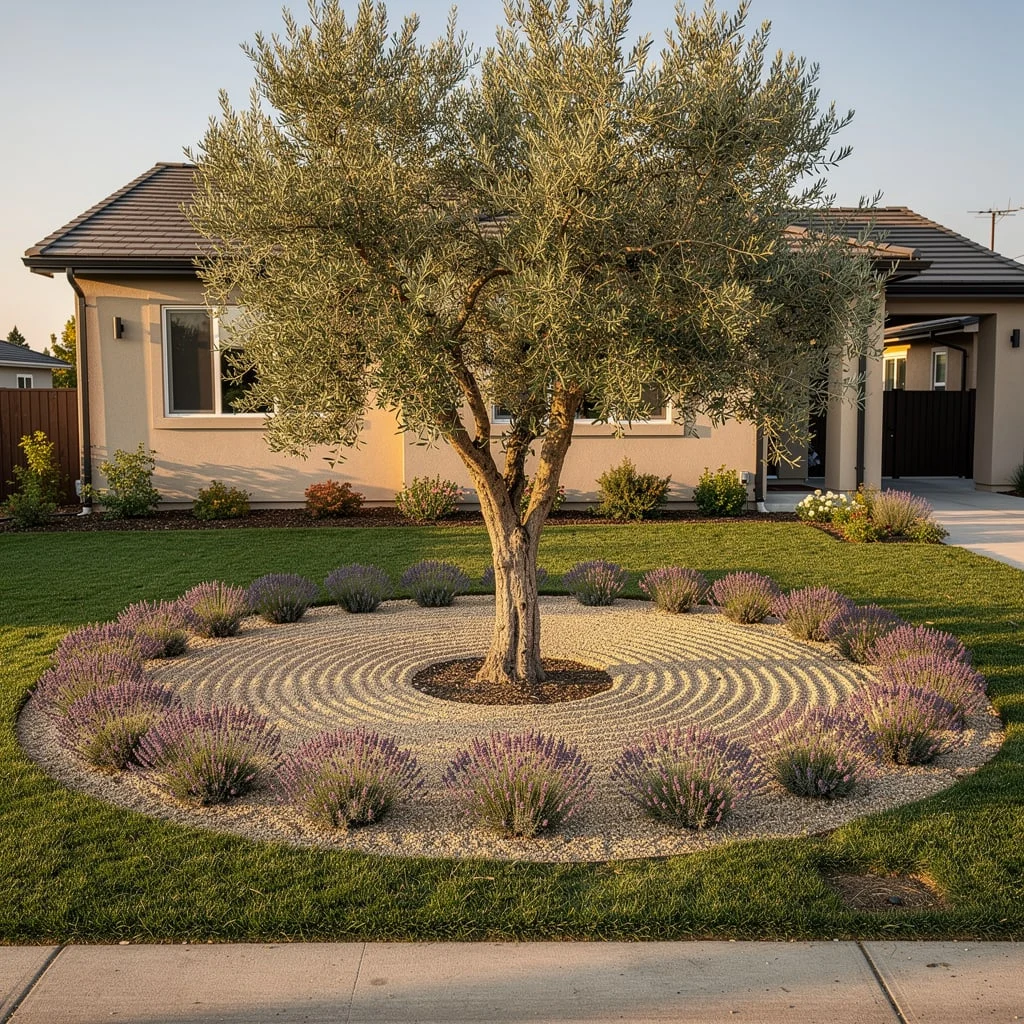
Apply pale pea gravel or white marble chip at 60 to 80mm depth within the ring — deep enough that a rake pattern holds visible definition. Edge the ring with a continuous steel landscape edging strip.
Plant lavender at the perimeter of the ring — not inside the main gravel area, but around the outer edge — as a soft transition between the gravel and the lawn. Hidcote or Munstead lavender at consistent spacing creates the purple-grey frame to the composition.
The olive tree at the centre is the vertical anchor. Its silver foliage against the pale gravel and the purple lavender border is a three-tone Mediterranean palette that needs nothing added to it.
Rake the gravel in concentric circles extending outward from the trunk. The pattern takes five minutes to apply. It communicates that this space receives regular care — which is the impression that all considered gardening is trying to create.
The Deciduous Tree with a Dense Zinnia and Marigold Carpet in Warm Red and Orange
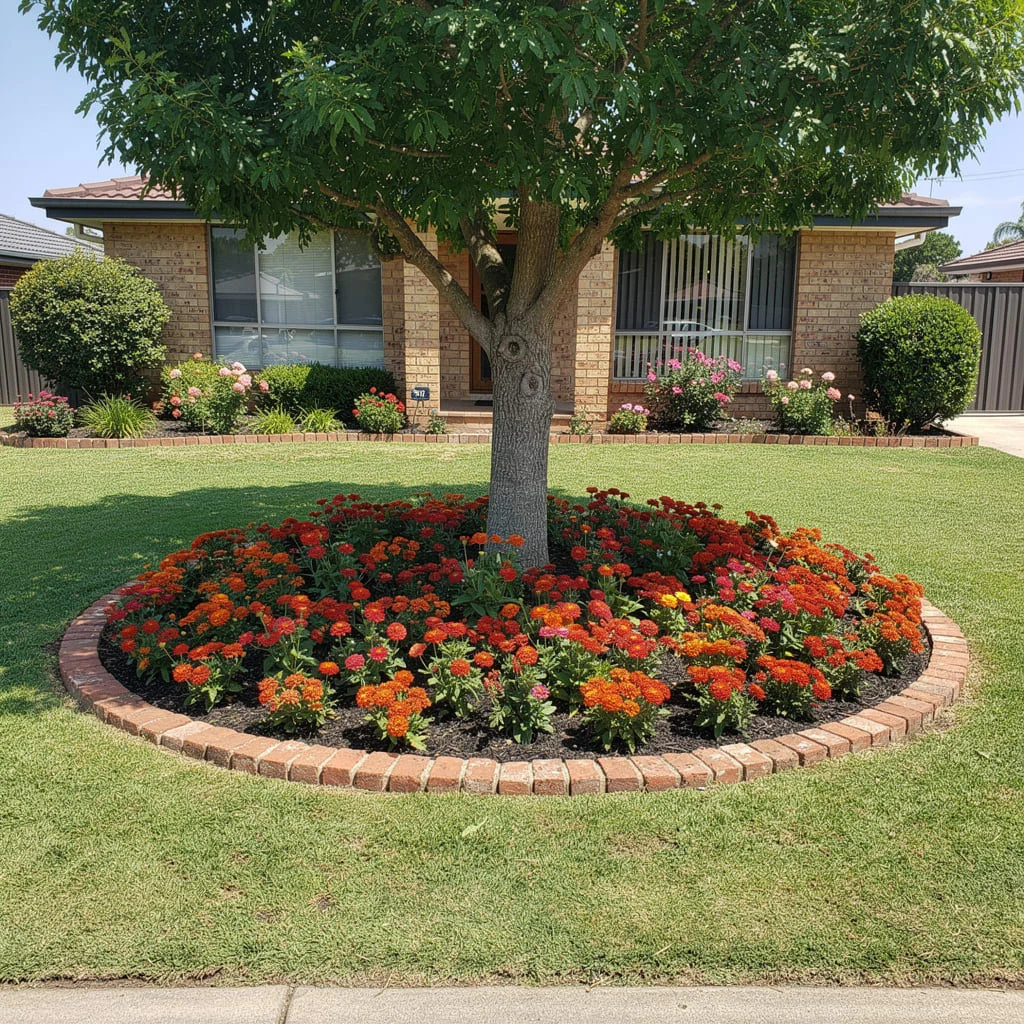
This works under a tree with an open, light canopy that admits significant direct sunlight. Under a dense shade tree, it fails.
Prepare the soil within the brick-edged ring by removing competing grass and roots, then improving with compost and slow-release fertiliser. The soil preparation determines whether this planting thrives or limps.
Plant densely in zinnias and French marigolds together — a warm red and orange carpet that reads as abundant and considered. Plant at 200mm centres. Within four weeks of establishment the plants will touch and the bed will read as a continuous colour mass.
Edge the ring with red or terracotta brick on edge, setting each brick at a consistent angle into a compacted base. The brick and the warm tones of the zinnias and marigolds are drawn from the same warm colour register. Dark bark mulch between plants at planting.
The Double Cobble Ring with Black Mulch and Clipped Box Spheres
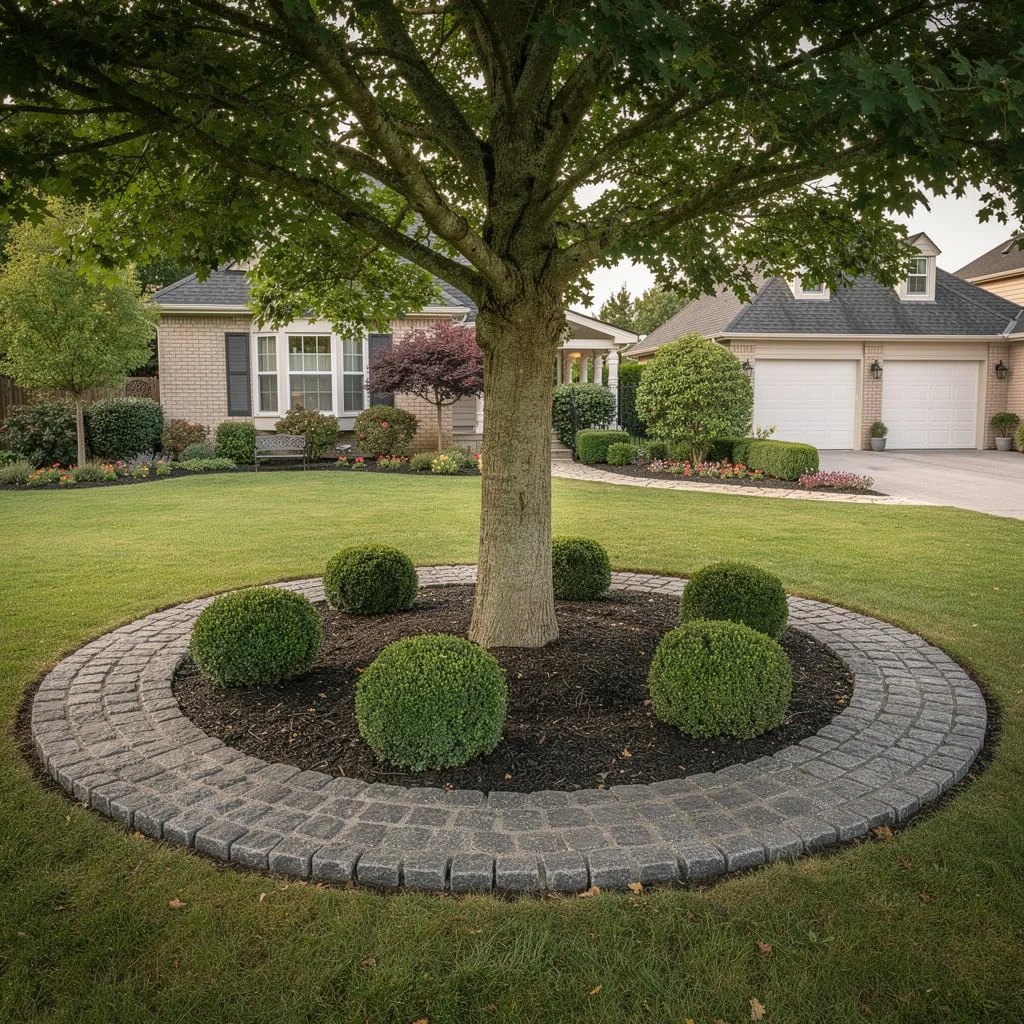
Two concentric rings of grey or charcoal cobblestone set flush with the lawn surface define the tree bed at two scales simultaneously. Between the inner and outer rings, apply black bark mulch at 75mm depth.
Place seven to nine compact box spheres — Buxus sempervirens at 200 to 250mm ball diameter — at equal spacing around the inner ring, so each sphere sits just inside the inner cobble edge. The spacing should be close enough that the spheres read as a continuous element but far enough apart that each is individually visible.
The double cobble ring, black mulch, and dark green box spheres in front of the textured tree trunk is a graphic composition that reads as formal and composed from a distance and detailed on close inspection. Clip the box spheres once in spring and once in late summer. The two-ring structure requires no maintenance beyond occasional mulch top-up.
The Established Olive Tree with Black Basalt Pebble Circle and Granite Cobble Edging
Source black basalt pebble — polished or tumbled, 20 to 30mm diameter — and apply it within a precisely defined circular edging of grey granite cobblestones. The cobblestones are set on edge in a compacted gravel base, forming a continuous ring that holds the basalt within it.
The olive tree is already the design — its gnarled multi-stem form, silver-green foliage, and rough bark texture are the visual material. The ground treatment exists only to frame the tree, not to compete with it.
No plants within the basalt circle. The graphic contrast of black stone against the grass lawn, framed by the grey granite cobble ring, is complete as it is. Any additional plant material within the ring reduces rather than enhances the composition.
The scale of the cobble ring matters. It should be large enough to reach approximately the outermost extent of the olive’s canopy drip line — at 1.5 to 2 metres radius for a mature multi-stem olive, the ring reads as a formal garden feature. At 600mm, it reads as an afterthought.
The Red-Leaf Tree with Natural Stone Block Ring and Ajuga Groundcover
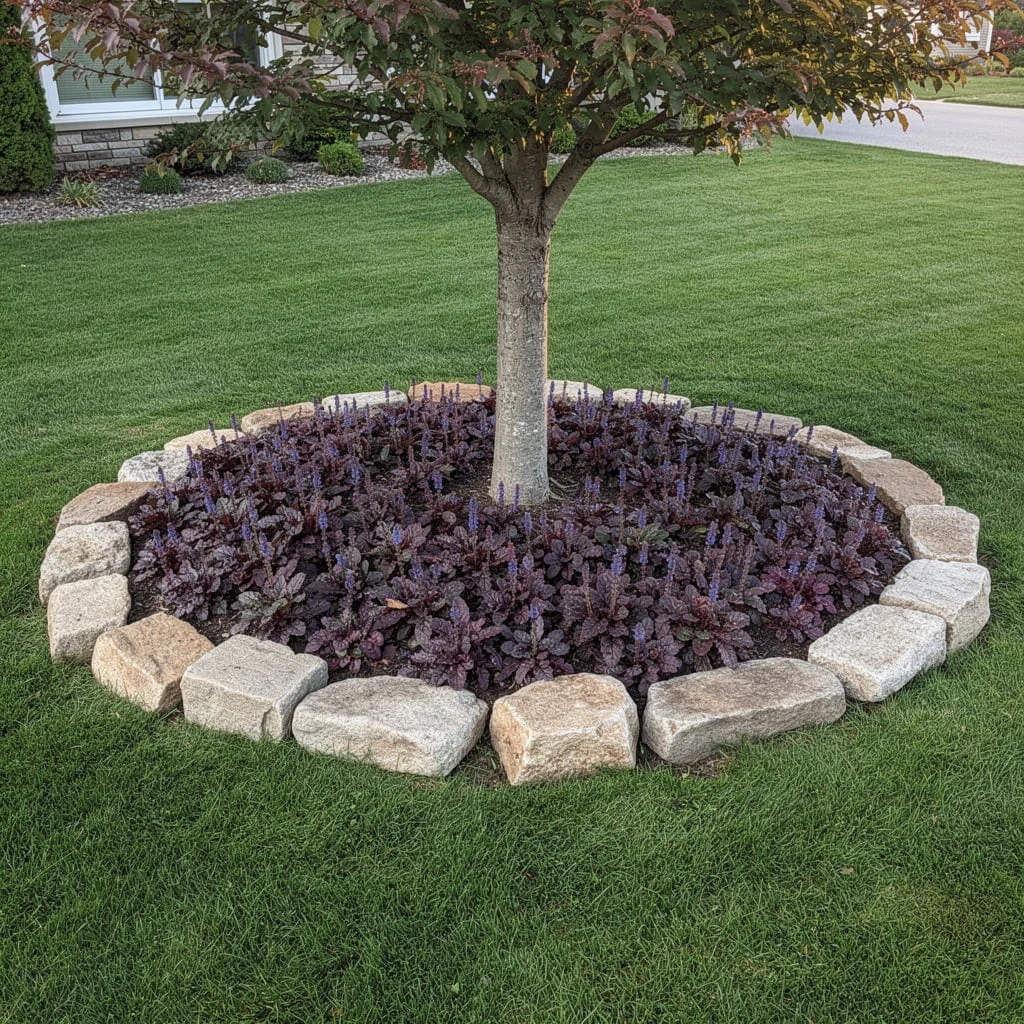
Ajuga reptans — bugleweed — is one of the most effective and most underused shade-tolerant ground covers for the base of trees. The purple-leaved variety provides deep burgundy foliage that intensifies in autumn, and short blue flower spikes in late spring.
Encircle the tree with natural tumbled limestone or sandstone blocks set flush with the lawn surface in a single ring. The warm buff-ochre tone of the stone contrasts strongly with the dark burgundy ajuga.
Plant ajuga from small plugs at 150mm centres. It establishes fast, spreads naturally, and within one season forms a continuous carpet. Apply dark mulch between plugs at establishment. The burgundy ajuga, warm stone blocks, and red-leaved canopy above create a layered composition in three shades of red that works at every season.
The Two-Course Dry-Stack Stone Wall Circle
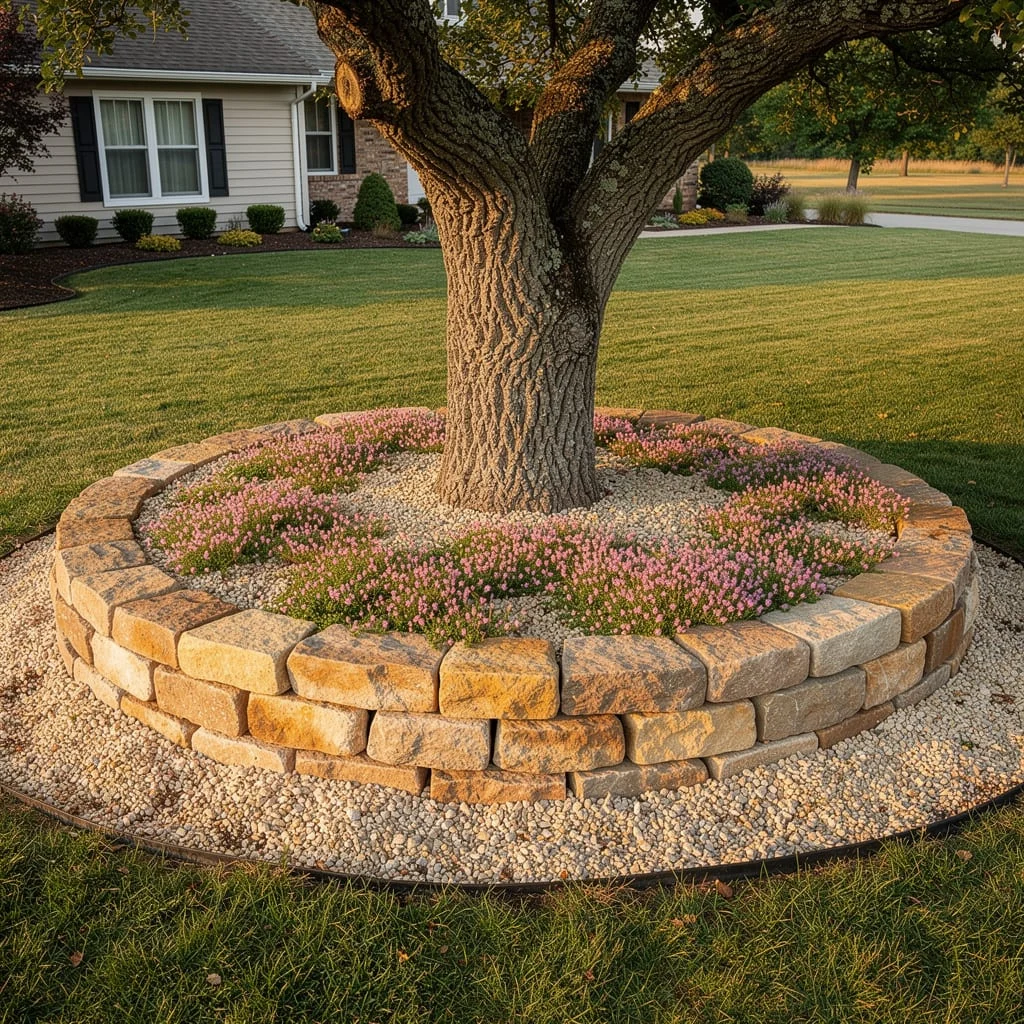
Build the retaining wall from dry-stacked masonry blocks — golden sandstone or warm buff reconstituted stone — stacked two courses to approximately 400mm height. No mortar. Lay pale gravel in the outer collar zone between the wall base and the lawn edge with a steel edging strip at the outer radius.
Plant creeping thyme — Thymus serpyllum — across the entire raised interior bed at close spacing. Thyme is extremely drought-tolerant once established, tolerates the dry root competition of a large tree, and provides fragrant low groundcover that flowers in summer in pink. The pink flowers in a raised stone bed around a large trunk is one of the most composed tree ring compositions possible.
Keep the planting away from the trunk face. The trunk flare and the first 150mm of bark above grade should be surrounded by pale gravel only.
The Cedar Timber Ring with White Impatiens Carpet
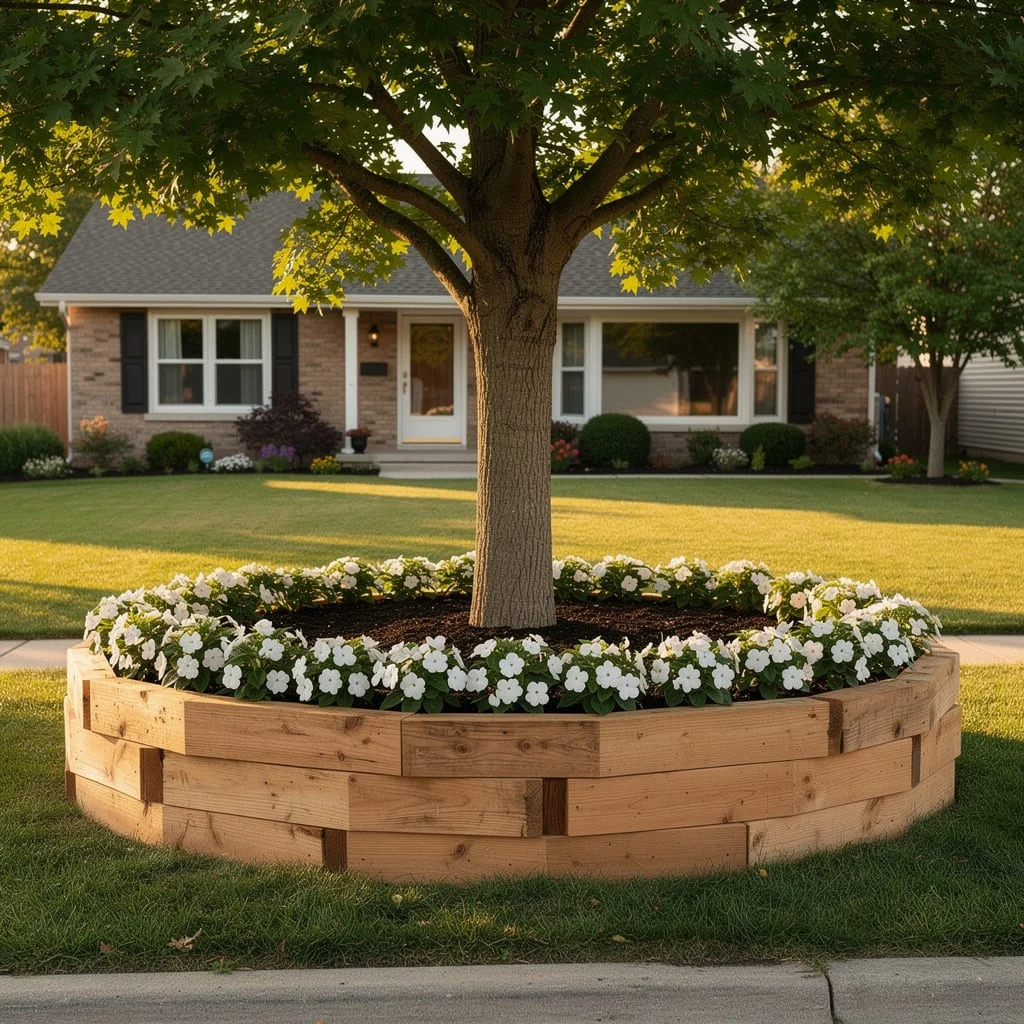
Bent cedar planks form a low circular border — use untreated cedar in 150 x 25mm planks, secured to short vertical stakes at 400mm intervals. Pre-soak the planks in water before bending to prevent splitting. The timber ring should sit 200 to 250mm above grade.
Fill the bed with improved topsoil and plant white impatiens at 200mm centres. White impatiens thrive in partial to full shade — they are one of the most reliable flowering annuals for tree base planting where light is limited.
Dark bark mulch between plants at planting. Within six weeks the impatiens will have formed a dense flowering carpet and the mulch will be largely invisible.
The warm honey cedar ring, the white flowering ground carpet, and the tree trunk rising through it is a composition that reads as cottage and resolved. It suits traditional suburban houses and older established trees equally well.
The Spring Bulb Tree Ring with Brick Edging, Allium, Daffodil, and Snowdrops
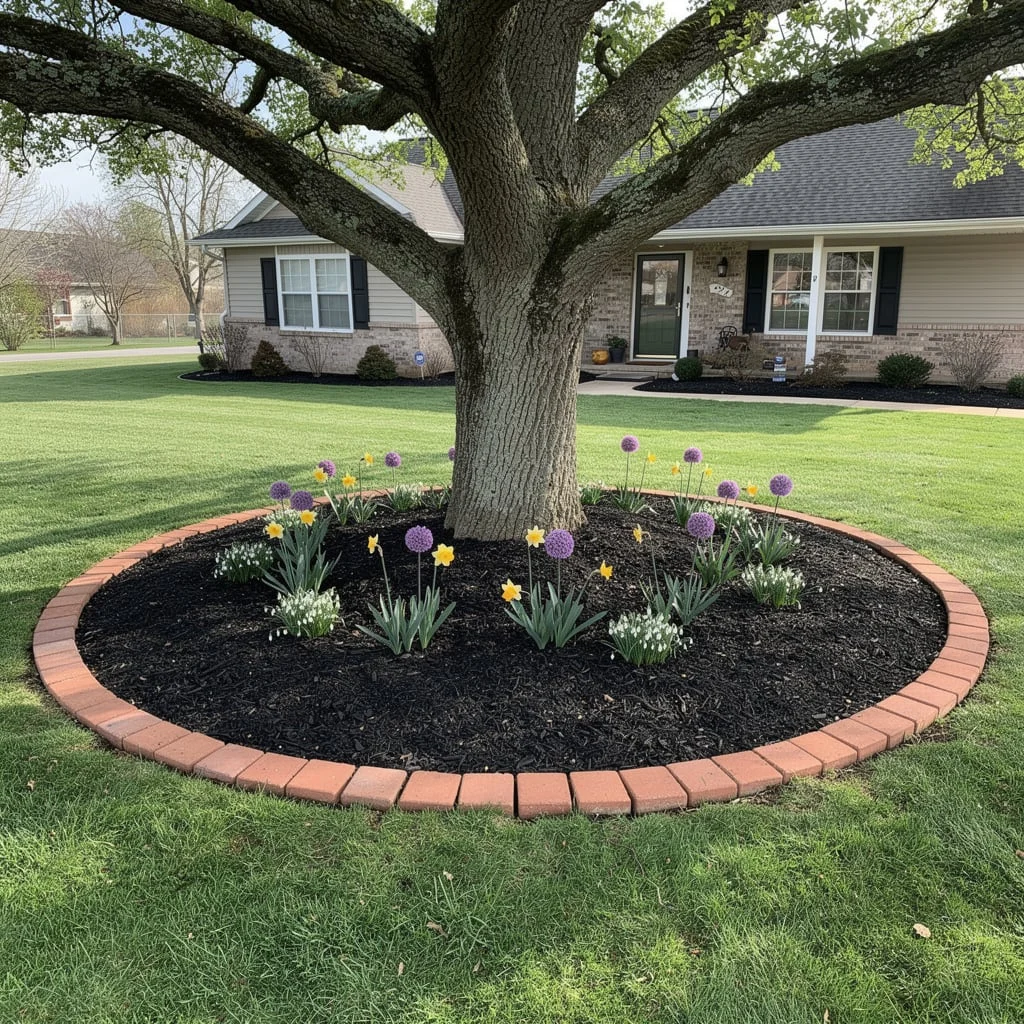
A spring bulb tree ring works best when the tree above it is deciduous — the bulbs receive the light they need before the canopy leafs out, and the display arrives exactly when the garden most needs it.
Set terracotta or red brick on edge in a continuous ring at 1.2 to 1.5 metres radius from a large tree trunk. Apply black bark mulch to 75mm depth across the entire bed interior.
Plant bulbs in autumn. For the most effective composition, plant in loose groups of five to seven: purple allium globes in the back half of the bed, yellow daffodils distributed throughout in loose clusters, and white snowdrops at the front edge closest to the brick. The sequence of flowering means the composition changes week by week from late winter through late spring.
After the bulbs finish, allow the foliage to die down naturally before cutting. The bulbs need to photosynthesise through the foliage to store energy for next year’s flowers. The mulch between the dying foliage keeps the bed looking managed rather than neglected during this dormant period.
The One Thing Every Well-Done Tree Ring Has That Every Failed One Lacks
Scale.
The most common mistake in tree ring design is not the wrong plant or the wrong edging material. It is the wrong radius.
A generous tree ring — one that extends to the drip line, that reads from the street, that gives the tree appropriate space — looks designed. A tight ring crammed close to the trunk looks apologetic.
The tree earned the space. It earned it over years, possibly decades, of growing into the thing it is. The ring around it should honour that scale.
Get the radius right and half the work is done before a single block is placed or a single plant is chosen. Everything else is the expression of an idea that the right scale has already made possible.