
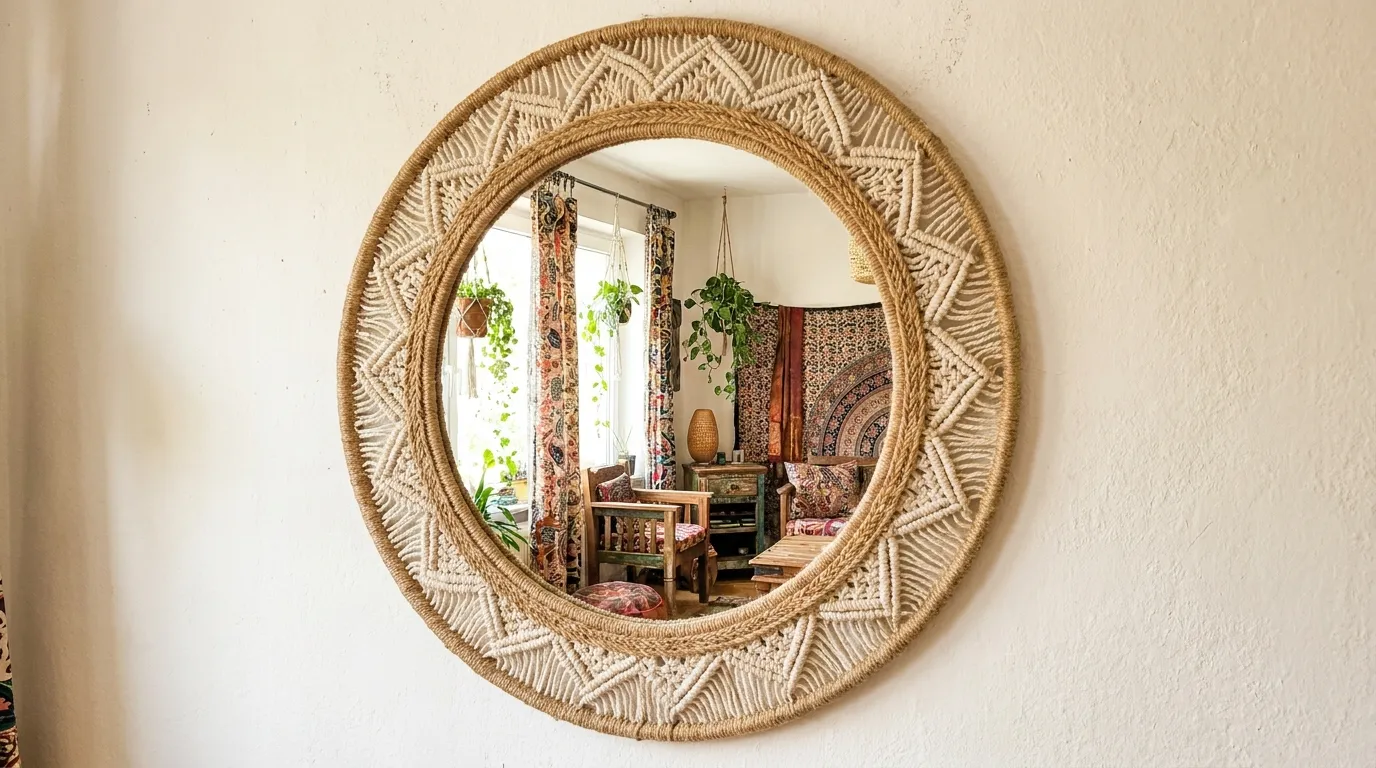
A mirror is the one piece of decor that gives back more than it takes. Every other object on a wall — art, shelving, a macramé hanging — occupies visual space. A mirror creates it. It borrows light, borrows the room, borrows the view outside the window, and returns all of it doubled.
Bohemian interiors understand this instinctively. The boho aesthetic is built on warmth, layering, and organic material — and a mirror in that context isn’t just functional. It becomes part of the room’s texture. A rattan frame, a rope border, a driftwood sunburst — the mirror and its surround become one piece, with the reflective surface as just one element of a larger object.
The problem is that most people treat mirrors as an afterthought. They hang whatever came with the apartment or buy the cheapest frameless rectangle from a flat-pack store. That’s a wasted opportunity in any room. In a boho space, it’s a missed centrepiece.
How Frames Change Everything
The frame is where a mirror becomes furniture rather than hardware. In bohemian design, frames do what walls can’t — they introduce raw material, handcraft, and visual weight without heaviness.
Material and What It Reads As
Rattan reads as relaxed and coastal. It’s lightweight visually and works in almost any room — bedroom, living room, bathroom. It ages gracefully and tolerates humidity better than most natural materials.
Rope reads as nautical or rustic depending on the colour. Natural jute sits in the warm, earthy territory. White cotton rope is crisper and suits a more minimal boho approach. Either way, rope frames signal handmade, which is exactly the signal boho interiors want to send.
Bamboo reads as tropical or craft-forward. It works in bathrooms and bedrooms better than living rooms, where it can feel too casual at scale. The green or golden-yellow of fresh bamboo adds colour that most frames don’t.
Driftwood reads as collected, coastal, and entirely unpredictable — no two are alike. That’s the point. A driftwood sunburst mirror over a fireplace is as close as home decor gets to site-specific sculpture.
Painted wood reads differently depending on execution. A hand-painted floral motif on a smooth oval frame is domestic and nostalgic. A carved wooden frame with Moroccan-influenced detail reads as globally-collected. The frame tells the story of where the mirror has been, or at least where the room wants you to think it’s been.
Scale and Proportion
Small mirrors work in groups. A single small mirror on a large wall is a punctuation mark with nothing to punctuate. Three to seven mirrors of varying sizes, hung in a loose cluster or organised arrangement, become a composition.
Large mirrors work alone or with carefully chosen companions — a plant at one side, a vase at the other. A large mirror demands breathing room. Pack objects around it and it disappears into noise.
Floor mirrors have their own logic. They don’t hang; they lean. And the leaning is the point. A floor mirror propped against a wall signals casualness and comfort. It says the room isn’t trying too hard, which in bohemian design is the highest compliment.
Placement Before Purchase
The most common mirror mistake isn’t choosing the wrong style. It’s hanging it in the wrong place.
What the Mirror Reflects
Stand at the point where you intend to hang the mirror and look at where it will be aimed. What does it reflect? A window: excellent — it borrows daylight and doubles it. An attractive corner of the room: good — it extends the space. A ceiling light or a lamp at the right angle: ideal for evening ambience. The back of a door or a blank wall: a waste.
A mirror aimed at nothing interesting is just a reflective surface. A mirror aimed at your best light source, your nicest plant, or the most visually compelling part of the room is doing real design work.
Height and Eye Line
The standard rule — centre the mirror at eye level — applies to most wall mirrors. But bohemian design is comfortable breaking it. A mirror hung deliberately high reads as architectural, making ceilings feel taller. A floor mirror leaning low does the opposite and makes rooms feel wider and more relaxed.
Groups of mirrors don’t need to sit at the same height. The composition can span from mid-height to near-ceiling, with the largest piece anchoring the centre and smaller ones scattered around it.
Bathroom Mirrors Specifically
Bathroom mirrors need to be functional first. The frame must tolerate humidity without warping, rotting, or losing its finish. Rattan and bamboo handle bathroom conditions reasonably well if the room has adequate ventilation. Natural rope degrades in constant moisture unless sealed. Sealed resin, metal, and tile-mosaic frames are the most durable options for bathrooms with poor airflow.
Size matters more in a bathroom than anywhere else. A mirror too small for the vanity is frustrating to use every day. The mirror should span at least 70% of the vanity width, and ideally more.
Bohemian Mirror Ideas to Try
Boho Bedroom Corner Vignette
The arch mirror is the most reliable format in a boho bedroom, and the gold-framed version is its most versatile incarnation. Lean it directly against the wall rather than hanging it — the lean removes formality and implies ease.
Build the corner arrangement around the mirror as the tallest element. On one side, place two or three woven seagrass baskets in descending sizes. Drape a textured throw blanket over the largest basket so it spills onto the floor. On the other side, set a tall white ceramic vase with dried pampas grass — the feathery plumes should reach roughly two-thirds of the mirror’s height. Add a small glowing table lamp between the baskets and the mirror base to create warm ambient light at floor level.
Hang a trailing plant — pothos or ivy — from a hook in the ceiling above and to one side, so the vines fall across the corner above the mirror without touching it. The layering of textures — seagrass, linen, ceramic, metal, plant — is what makes this work.
Three Hexagon Mirrors in Warm Living Room
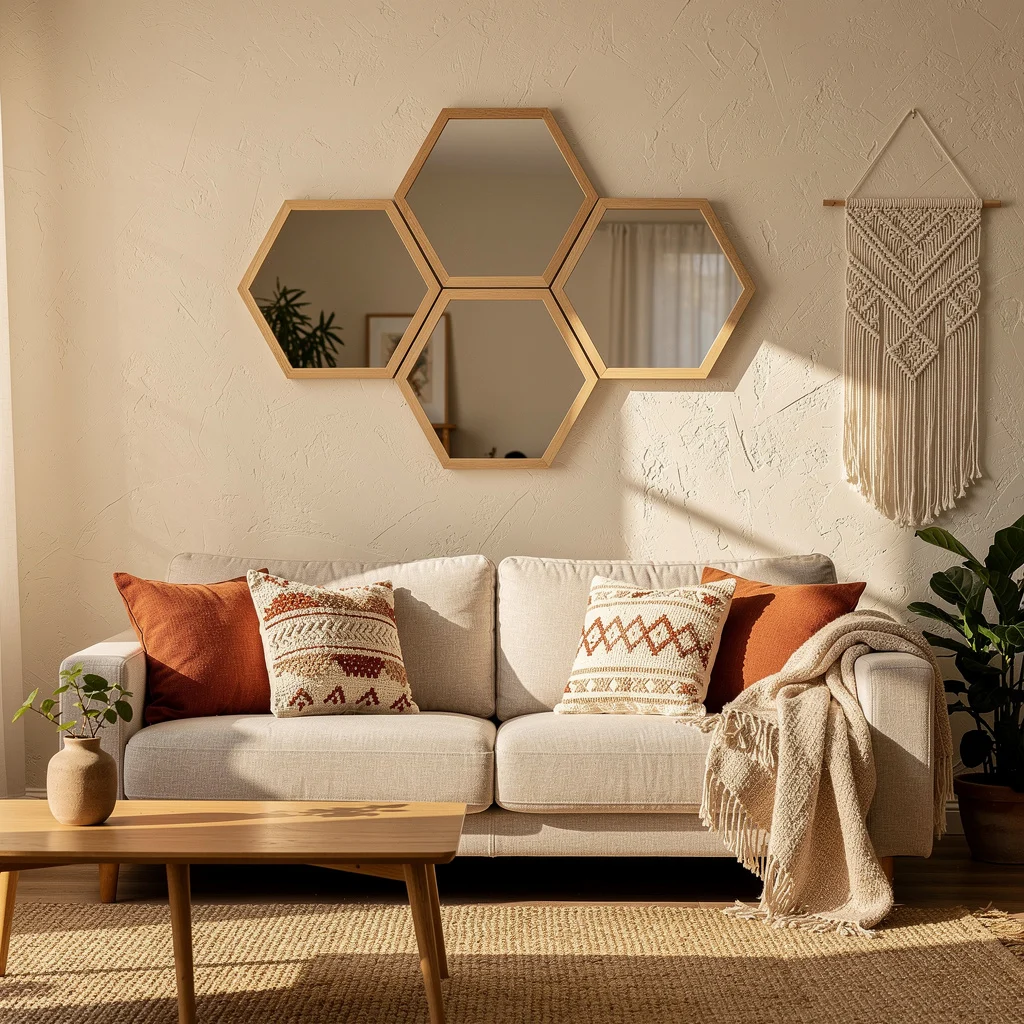
Three identical hexagonal mirrors with slim oak or pine frames, arranged in a cluster of two plus one — two touching at their sides to form a double hexagon, the third sitting above and between them — create a honeycomb shape that reads as both geometric and natural.
The key is the wall behind them. A textured lime-plaster or Venetian plaster finish in warm cream or off-white gives the slim wood frames visual purchase. On a smooth modern wall they’d look stark. On a textured surface they look considered.
Dress the sofa below with rust and terracotta cushions alongside natural linen-toned ones. Hang a simple macramé wall piece to one side of the mirror cluster — not symmetrically centred, but off to the right or left as a secondary element. The hexagons provide geometry; the macramé provides organic softness.
Jute and Cotton Rope Frame
Take a circular mirror and wrap the outer edge with natural jute rope, securing each loop with adhesive or by threading the rope through pre-drilled holes along the mirror’s edge. Build up two or three layers of rope for thickness — the frame should be substantial, not a single thin wrap.
For the hanging strap, use a heavier gauge natural rope — thick twisted jute rather than thin twine. Form a loop long enough to sit 30–40cm above the mirror top when hung from a single hook. Thread small sprigs of preserved eucalyptus or artificial vine leaves between the rope twists along the strap at irregular intervals.
The mirror frame itself uses lighter white cotton rope wound tightly against the jute. The contrast between the natural golden-brown jute on the hanging strap and the clean white rope on the mirror body creates the visual interest. Hang from a single hook on a white wall where the rope shadow pattern shows.
Mixed Mirror Gallery Wall
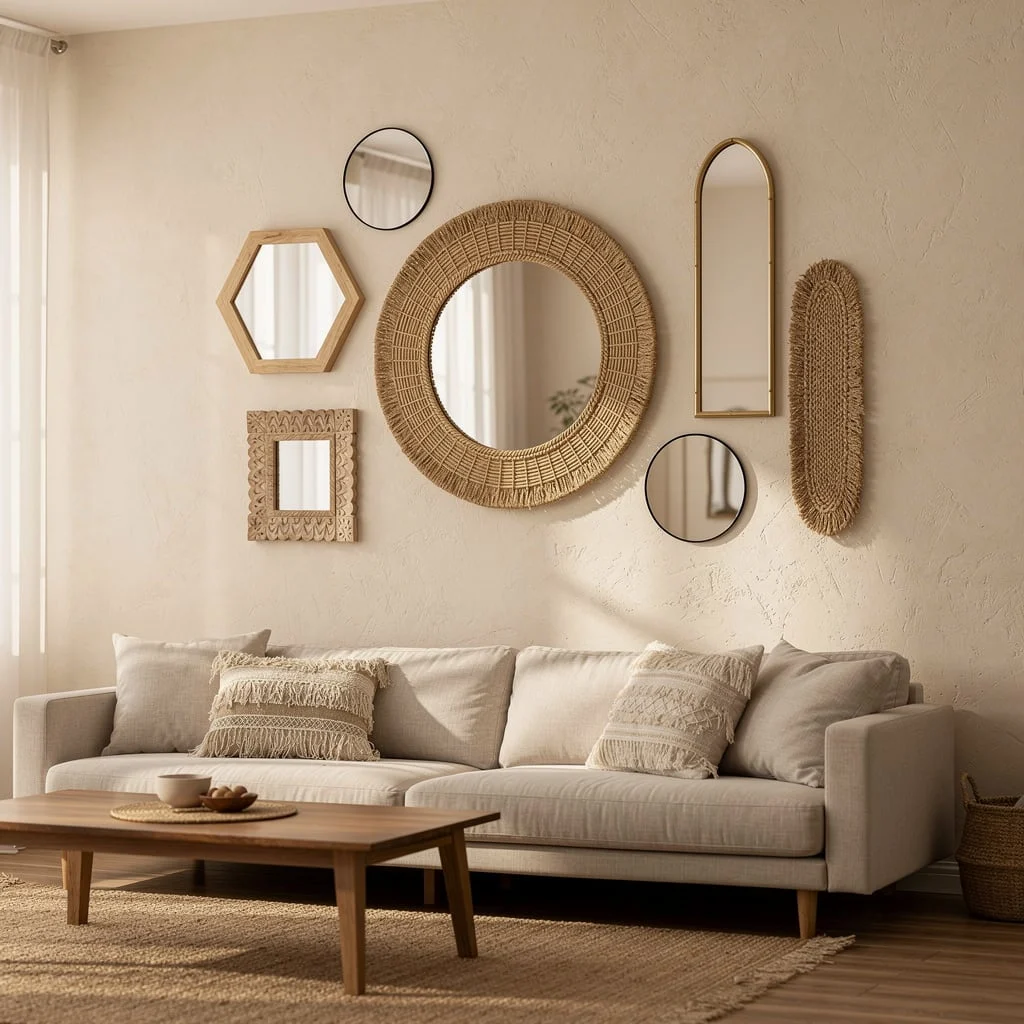
Hang five to seven mirrors of different shapes and frames across one wall above a sofa. The composition should feel curated but not symmetrical. Place the largest mirror — a seagrass-wrapped circle — at the visual centre of the arrangement, slightly above true centre. Surround it with smaller mirrors in varied shapes: a hexagonal wooden frame, a small black metal circle, a tall narrow gold arch, a woven oval. Each mirror frame should be in a different material.
The space between mirrors matters. Leave 8–12cm between each piece — close enough that they read as a group, far enough that each individual mirror has room. Don’t align tops or bottoms; let the arrangement float.
The effect is a wall that reflects the room back in fragments — different angles, different tones from the different mirror surfaces. In morning light it’s lively. At night with warm lamp light it’s intimate.
Rattan Arch, Room Filled With Life
A full-length rattan arch mirror with a cane-webbing frame is the statement piece that earns its floor space. The webbed texture of the frame adds depth beyond a simple solid border — light hits it differently across the day, casting small shadows through the weave.
Lean it against a textured plaster or limewash wall rather than hanging it. Position it in a room that already has plants and layered textiles, because the mirror will multiply all of it. Place a tall white vase with dried botanicals beside it at floor level. Scatter two or three small ceramic pots with succulents nearby. Hang a macramé wall piece at the same height as the mirror top on an adjacent wall.
The mirror here functions as a room-within-a-room. Whatever the mirror reflects behind the viewer becomes a second composition inside the frame.
Woven Arch Mirror, Terracotta Room
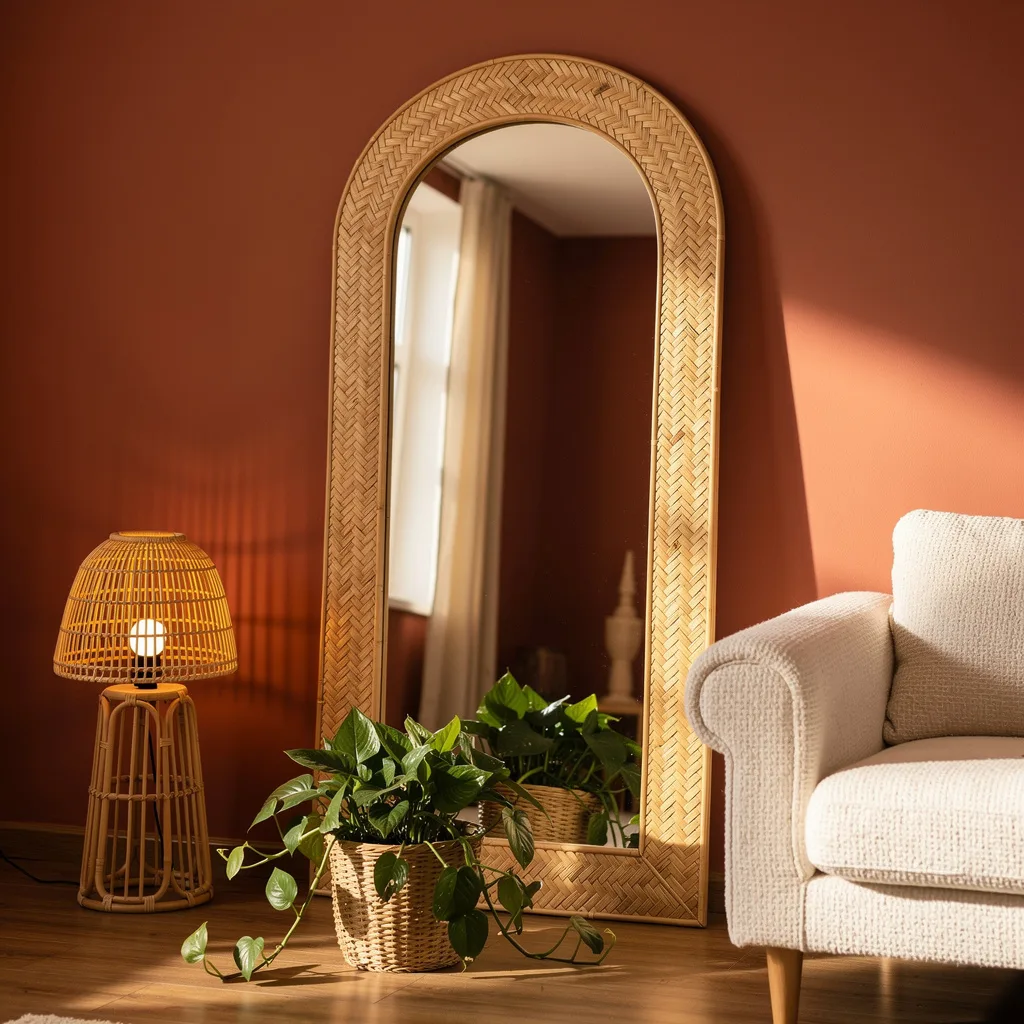
A floor-standing woven arch mirror needs a strong wall colour to work against. Terracotta, burnt sienna, deep rust — any warm dark wall gives the natural rattan frame its proper contrast. Against white it disappears; against warm colour it glows.
Pair the mirror with a wicker table lamp at floor height to one side — the cage-style base with a woven shade in a warm amber. Position a trailing pothos in a wicker basket between the lamp and the mirror base. Keep the armchair or sofa partially in frame, so the mirror shows the room being lived in rather than an empty studio.
The design principle here is warmth on warmth. The amber lamp light, the terracotta wall, the honey-coloured rattan frame, and the warm wood floor all sit in the same tonal family. The mirror amplifies all of it.
Seashell Round Mirror
Source a circular mirror — 40–60cm diameter is the right scale for this technique. Apply a strong adhesive like E6000 or a hot glue gun in small sections around the frame base. Press shells into the adhesive in a mosaic arrangement, mixing sizes and types — cowrie shells, small conch shapes, scallop pieces, round pebbles. Work in sections so the adhesive doesn’t set before the shells are placed.
Vary the shell orientation deliberately. Some face outward, some sideways, some at angles. The goal is the accumulated, organic quality of a collection rather than a pattern. Fill any gaps with very small shells or small pebbles. Allow to cure fully before hanging.
This mirror belongs in a bathroom, a hallway, or a bedroom — anywhere the boho-coastal intersection makes sense. Hang it on a plain white or pale grey wall so the shell texture reads clearly.
Bamboo Frame Bathroom Mirror
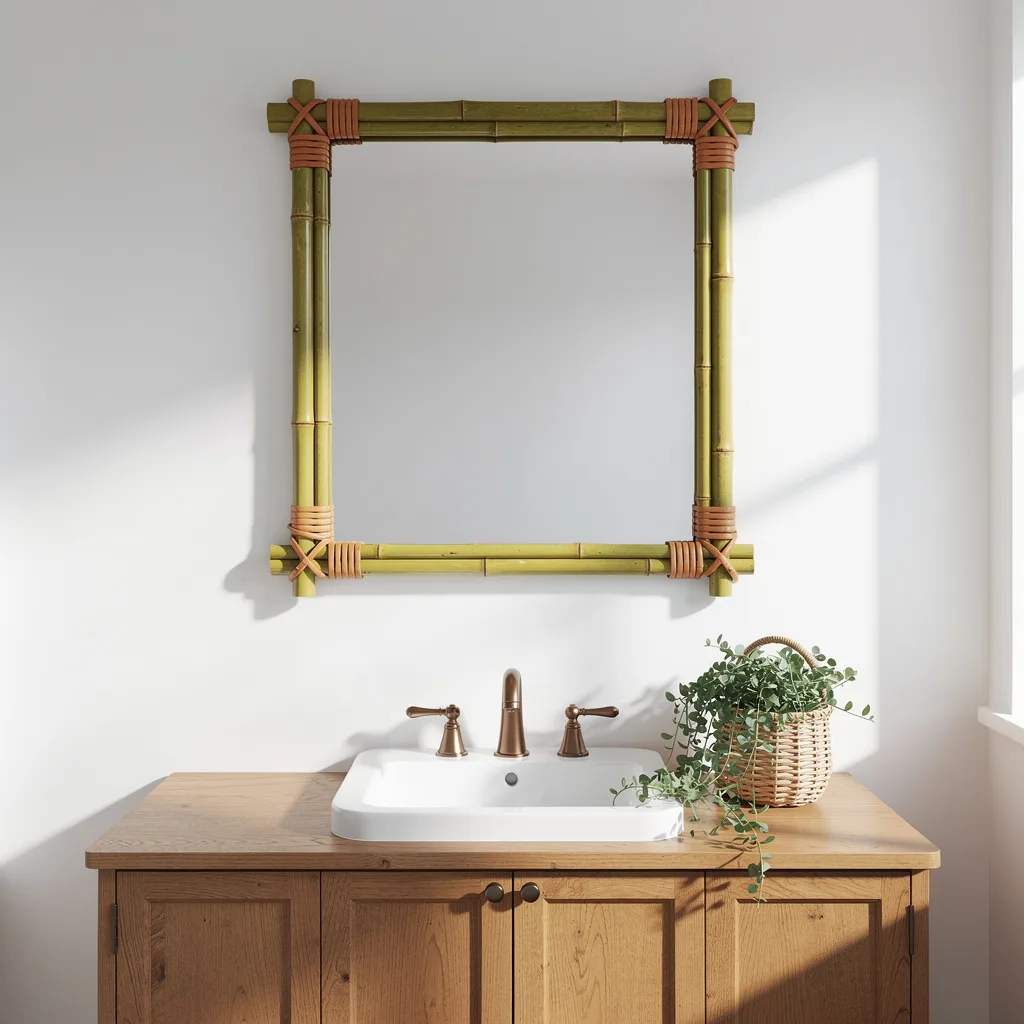
Cut four lengths of mature bamboo cane — each the length of one side of a square or rectangular mirror, plus 5–8cm overhang on each end for the joint lashing. Sand any rough nodes until smooth. If the bamboo is dry and pale, leave it natural. If it has natural green colouring, preserve it with a clear exterior varnish.
Lay the four lengths around the mirror’s edge, overlapping at the corners. At each corner, bind the cane together with leather lacing or thick waxed cord in a cross-lash pattern — wrap horizontally, then vertically, then diagonally, and knot tightly at the back. The lashing should be visible from the front as a decorative element, not hidden.
Fix the frame to the mirror back with strong adhesive or mirror clips. Hang above a timber vanity with warm-toned fixtures — bronze or antique copper rather than chrome. Add a small wicker basket for storage and a trailing plant for softness.
Clustered Round Mirrors Above Bed
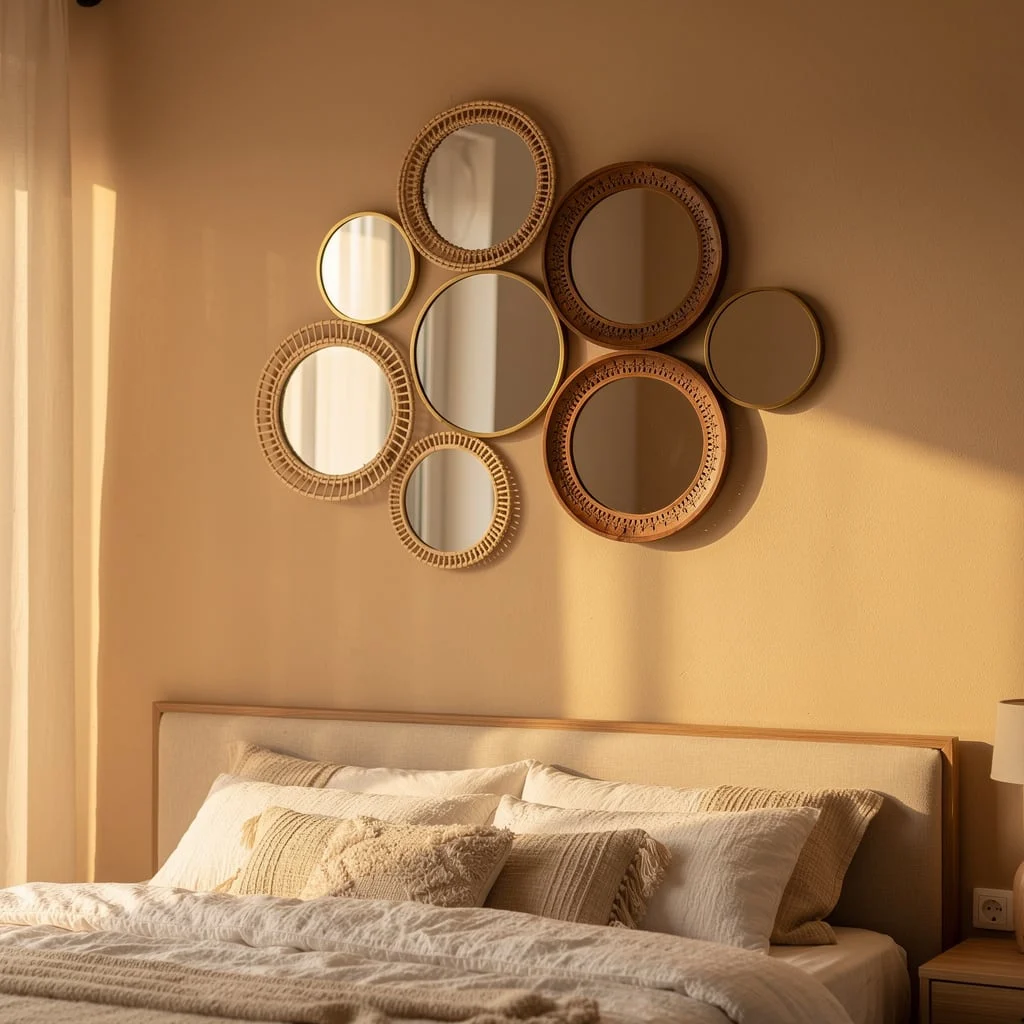
Choose seven round mirrors in two or three sizes — ranging from 25cm to 50cm diameter. Mix frame materials: light rattan weave, dark rattan, plain gold metal, and one frameless or simple dark-stained wood. The variety in frame style and colour within the same round shape is what makes the cluster read as collected rather than matched.
Arrange them on the wall above the headboard in an overlapping organic cluster — some touching, some slightly separated, with no obvious grid. The arrangement should feel like a conversation between the mirrors rather than a lineup. Put the two largest at the upper right and lower left to give the composition diagonal weight. Fill the remaining space with smaller circles.
In warm afternoon light, the clustered mirrors catch and scatter light across the ceiling and upper walls. In the morning, they reflect the window and fill the room with moving reflected light as clouds pass. The bed below should be dressed in textured linens — macramé cushions, a loosely laid throw — so the earthy quiet of the bedding contrasts with the animated wall above.
Wooden Bead Frame Mirror
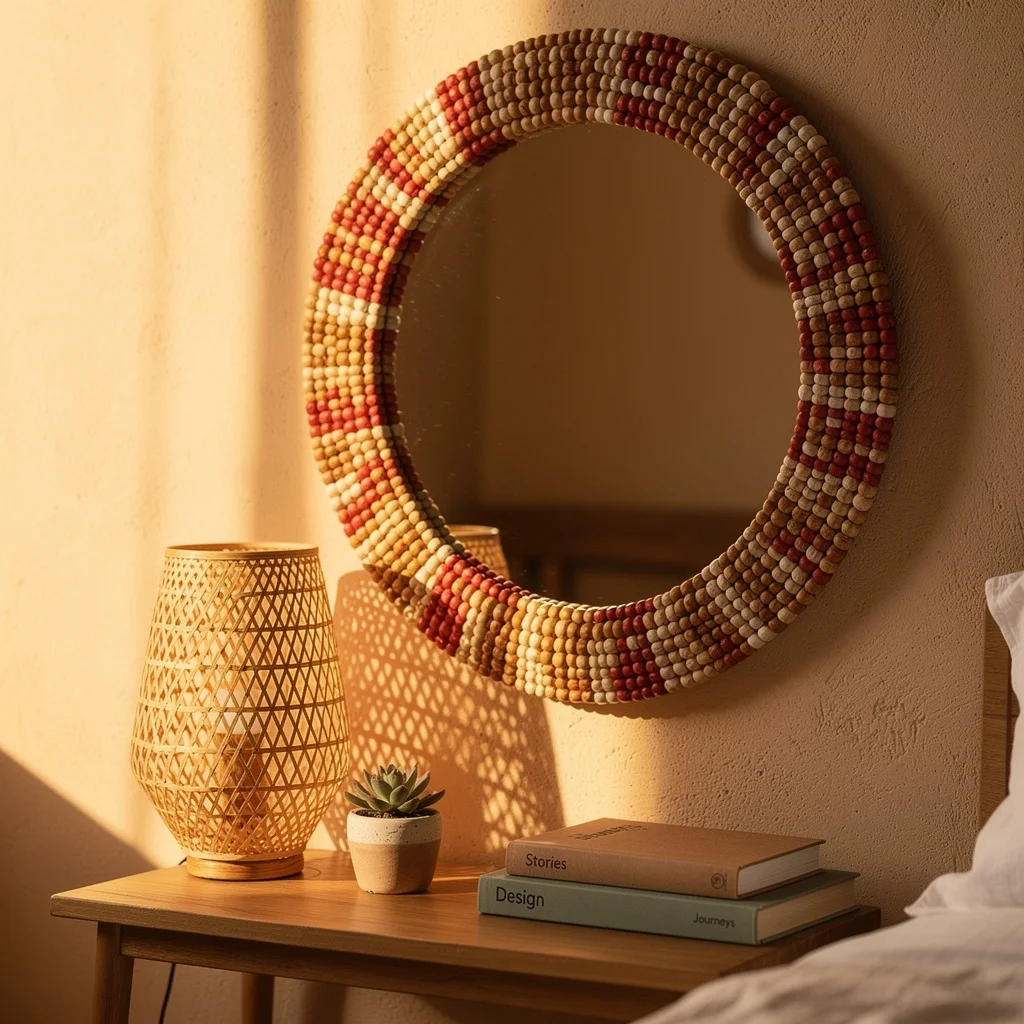
A round mirror framed in tightly wound wooden beads in terracotta, cream, rust, and warm brown is the kind of piece that makes people ask where it came from. The bead rows create a pattern like tribal textile — stripes that rotate around the circle, no two sections identical in rhythm.
Pair it with a bedside setup that understands restraint. A bamboo lattice table lamp on the nightstand, one small succulent in a rough ceramic pot, two or three books stacked flat with the spines facing up. Nothing precious, nothing arranged. The mirror does the decorative heavy lifting; the surface below it should remain calm.
This mirror works best on a warm sandy or amber wall where the earthy terracotta and rust tones of the beads can breathe. On white it looks disconnected. On a warm wall it looks like it grew there.
Open-Loop Rattan Above a Low Bed
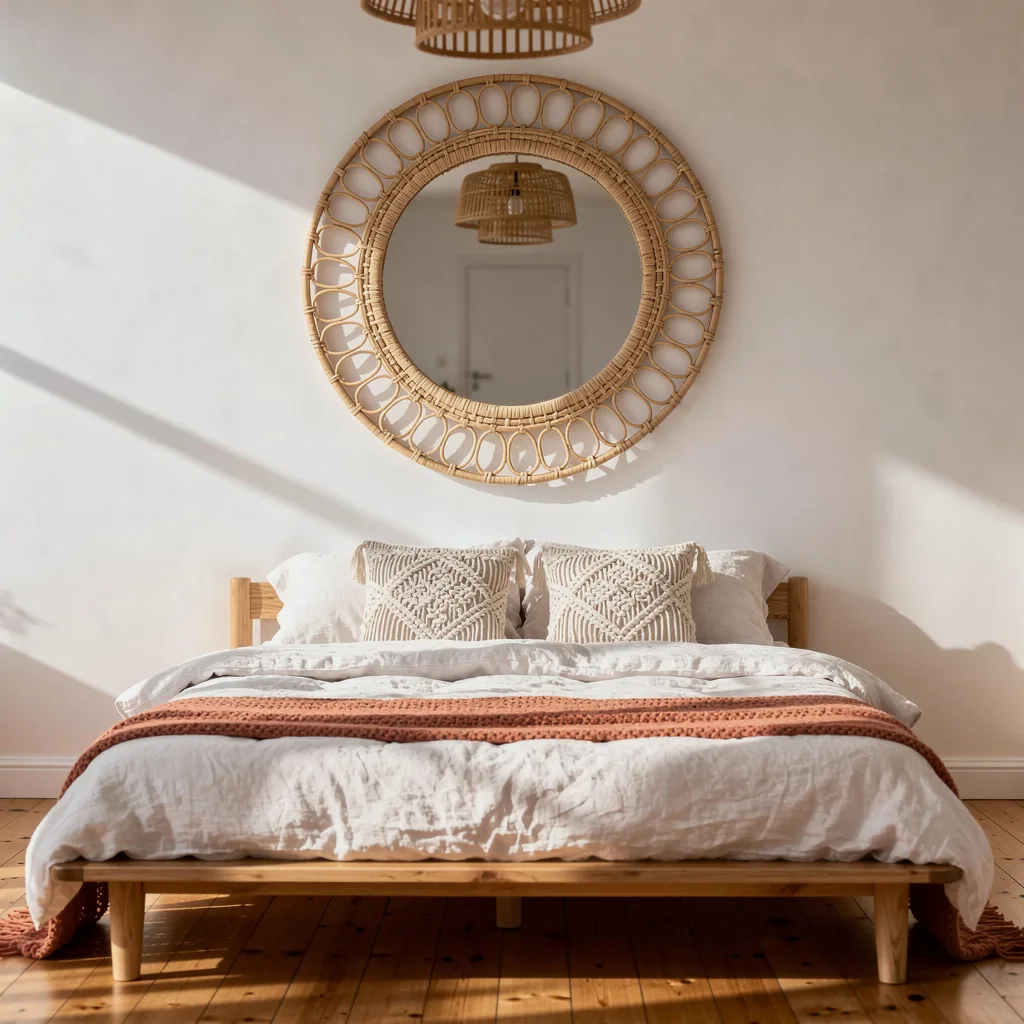
A large rattan mirror with an open-loop woven border — where the weave creates visible circular gaps rather than a solid frame — casts a distinctive shadow pattern on the wall around it when light hits at an angle. That shadow becomes part of the room’s texture.
Hang it centred above a low platform or futon-style bed. Keep the bed dressed in white linen with minimal cushions. A terracotta or dusty pink blanket folded at the foot adds the warmth the white bedding needs. Hang a matching rattan pendant light above the bed, off-centre, so the eye moves between the pendant and the mirror rather than settling.
The low bed is important. It keeps the floor clear and visible, which makes the rattan mirror — hung at standard height — feel more dominant and architectural. A tall bed would crowd the wall below the mirror and reduce its impact.
Driftwood Sunburst Over Fireplace
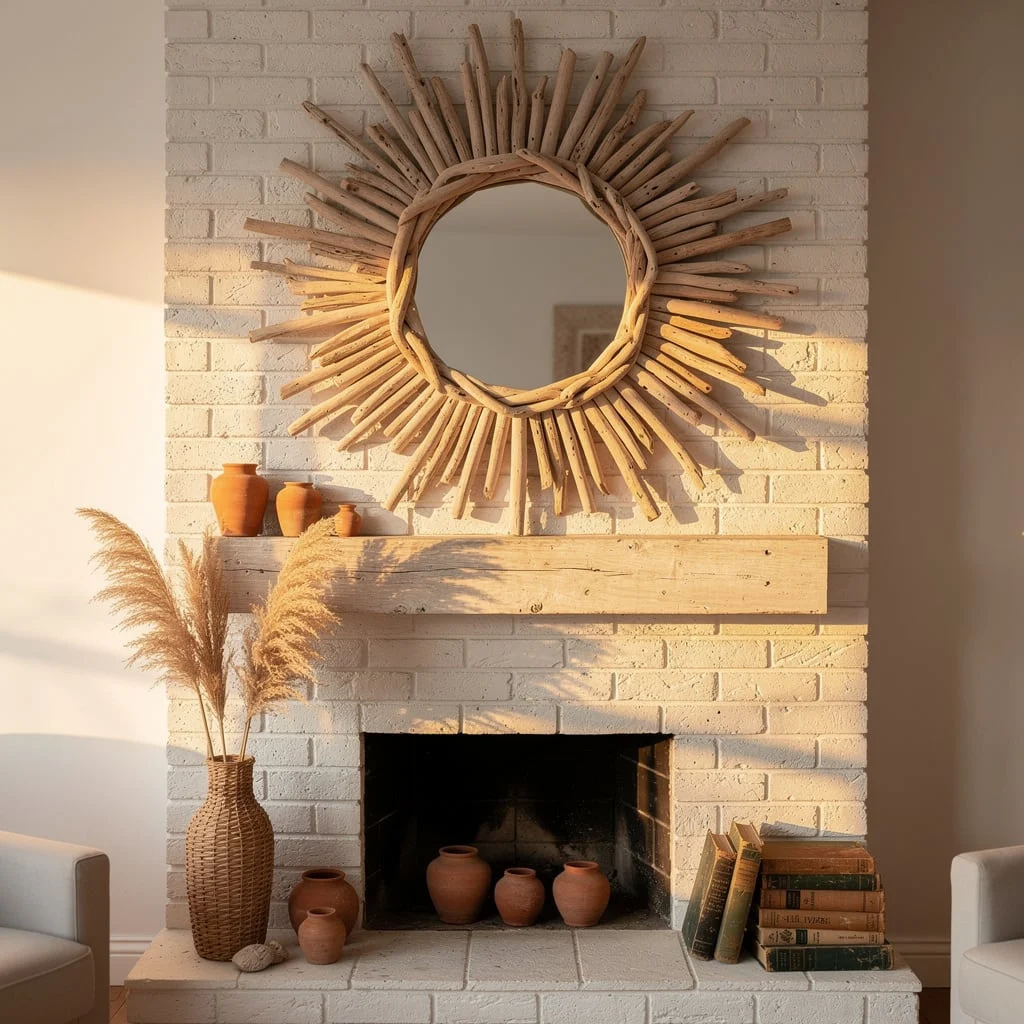
Collect driftwood pieces of varying lengths — ideally sea-smoothed, pale grey-white, with natural surface variation. A round mirror 30–40cm in diameter serves as the centre. Arrange the driftwood pieces radiating outward from the mirror edge, alternating shorter and longer pieces at irregular intervals. Secure to a circular plywood backing piece using strong construction adhesive and allow to cure fully.
Hang above a fireplace mantel where the pale driftwood contrasts with the masonry behind. The mantel itself should be sparsely dressed — a pair of small terracotta vases at one end, nothing at the other. The fireplace opening below can hold clay pots during warmer months.
The driftwood sunburst is the boho version of an antique gilt sunburst mirror — the same solar energy, the same radiating confidence, but in a material that came from a shoreline rather than a workshop. Beside it, a floor vase with dried pampas reinforces the coastal reference.
Rattan Circle with Dried Flowers
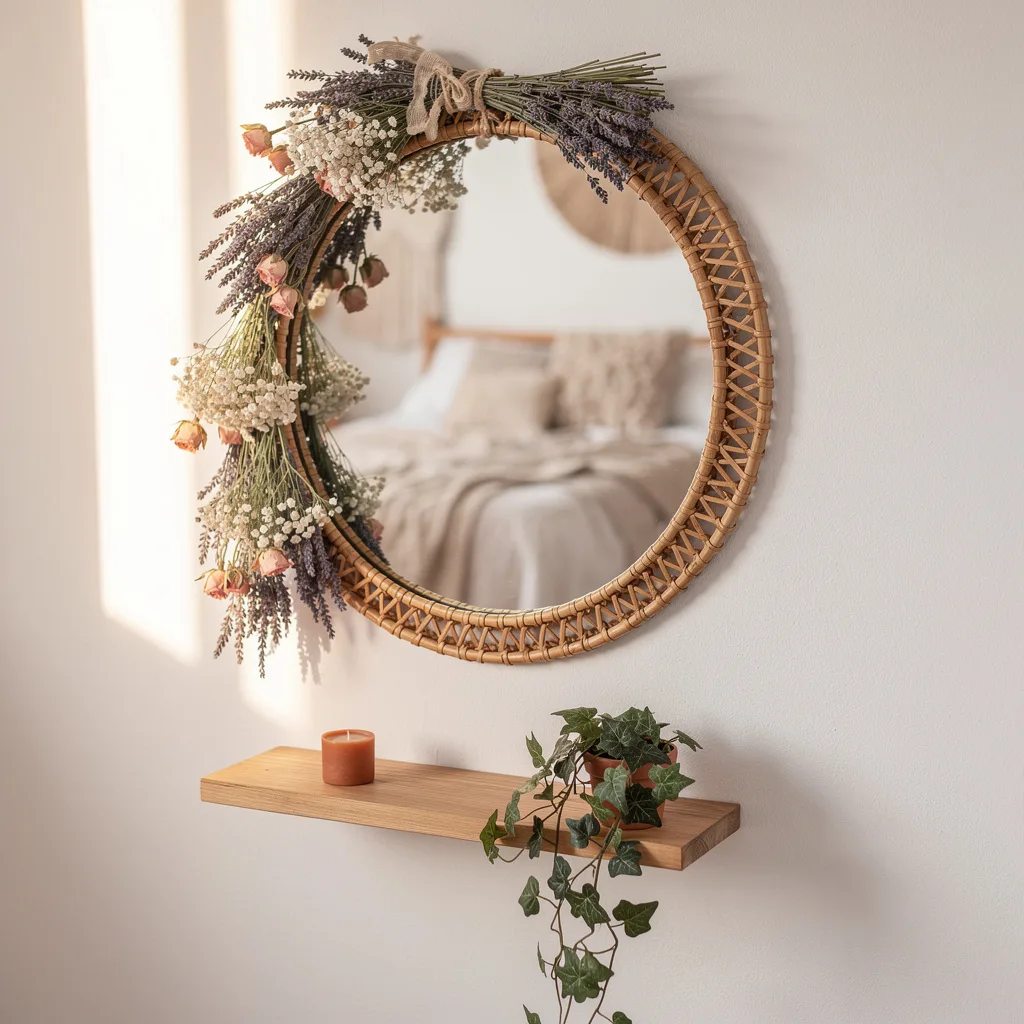
Take a circular rattan mirror and attach a sweep of dried botanicals to the upper portion of the frame — bunched tightly at the top and fanning out to either side. Use lavender stems, dried roses or rosebuds, baby’s breath, and any small dried wildflowers available. Bind each bunch with a short length of raw linen twine before attaching to the frame with wire or additional twine wrapped around the rattan.
The botanical arrangement should cover roughly the upper third of the frame and be asymmetrical — heavier on one side than the other, with some stems falling across the mirror glass. This asymmetry is not a flaw. It’s the design.
Below the mirror, float a small timber shelf — 30cm wide, 15cm deep — mounted about 15–20cm below the mirror’s base. Place a small clay candle on one end of the shelf and a small trailing plant in a terracotta pot on the other. The shelf, mirror, and botanicals function as one vertical composition.
Gold Arch Mirror with Plants
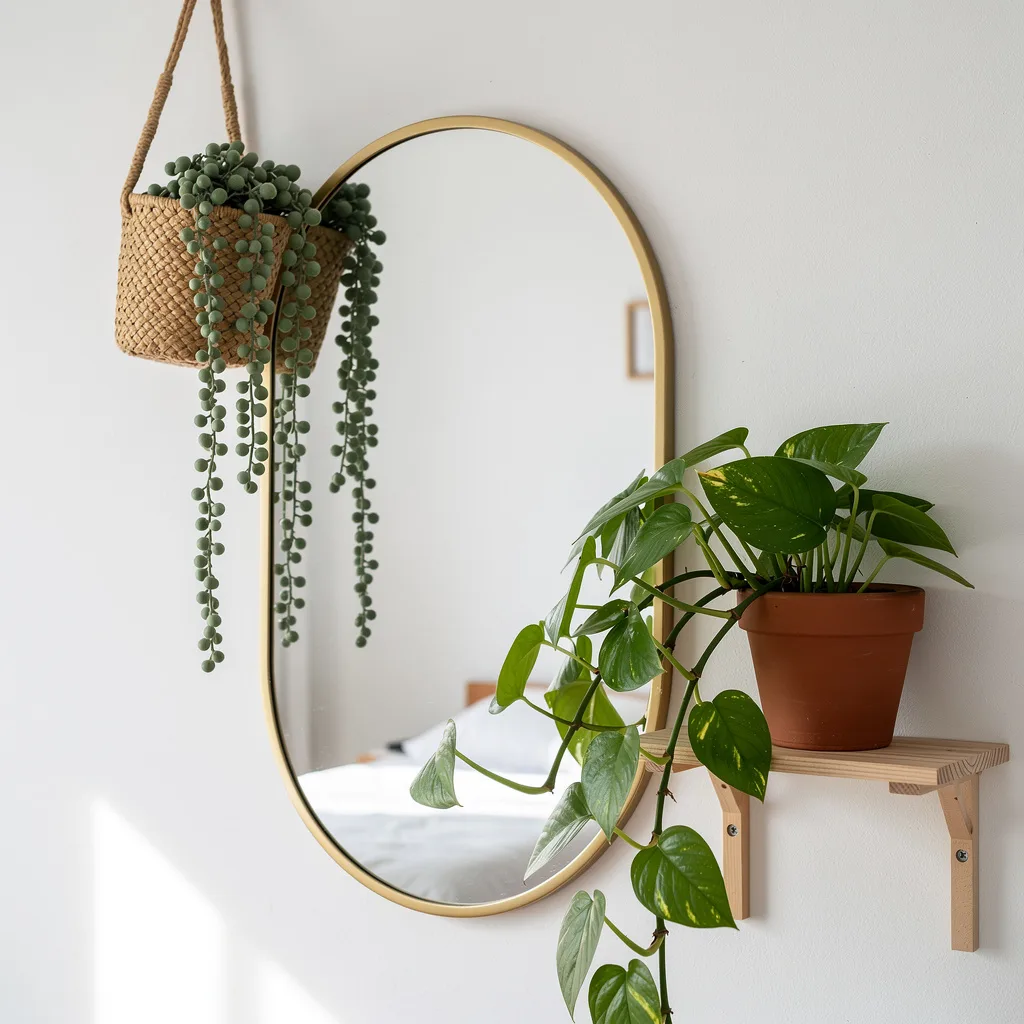
A slim gold-framed oval or arch mirror in a bright, minimal room reads as quietly sophisticated rather than flashy. The slimness of the frame is the key — a thick gold frame makes a statement, a thin one simply describes the mirror’s edge.
Hang it on a white wall and let the surrounding objects carry the boho warmth. On one side, hang a macramé basket with a string of pearls plant — the bead-like leaves trailing down in long strands. On the other side, install a small pine shelf at mirror-midpoint height and set a pothos in a terracotta pot so the vines spill over the shelf edge and trail toward the floor.
The mirror reflects both plants, creating the impression of a room more filled with green than it actually is. This is the most direct illustration of what a well-placed mirror does: it multiplies what you have without adding to it.
Large Round Mirror on the Floor
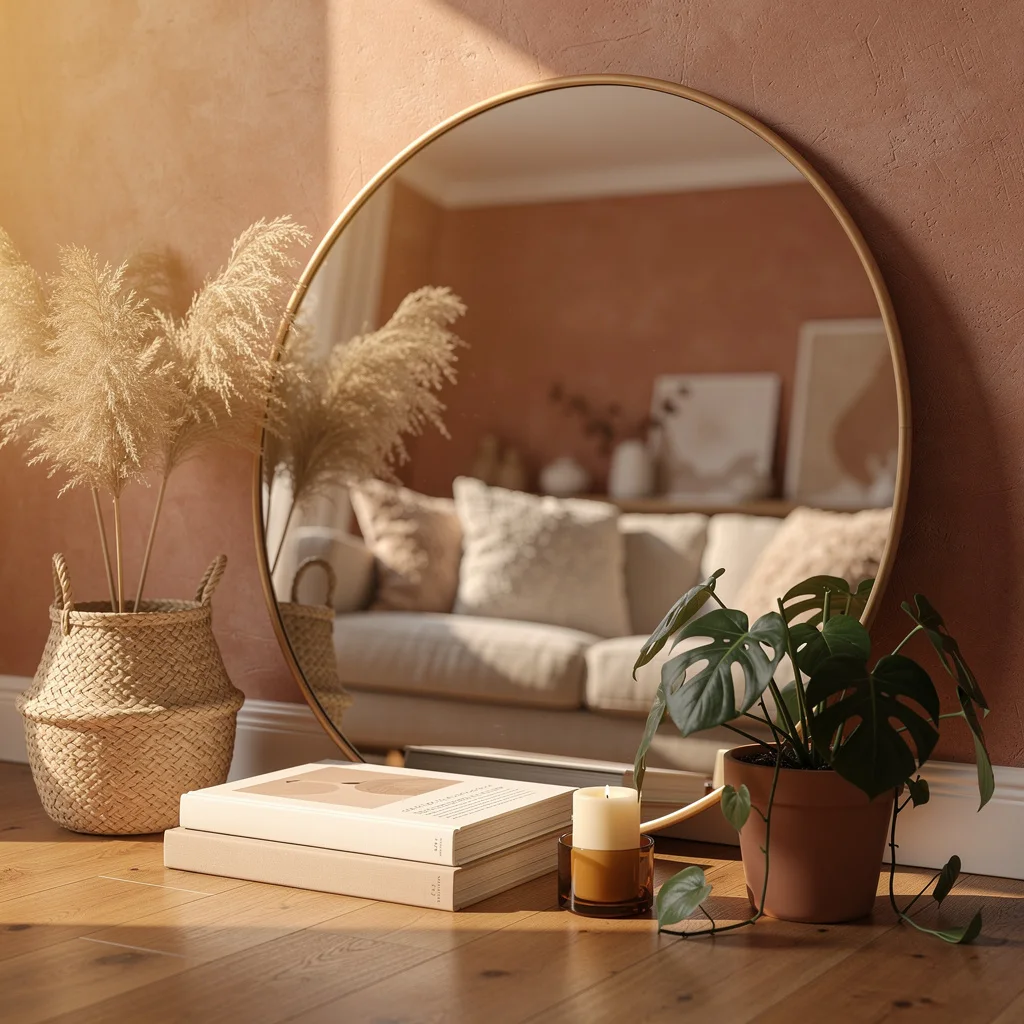
A large gold-rimmed circle mirror — 90cm diameter or more — leaning against a wall rather than hung works in any room where the floor is visible and clean. The lean implies that this might not be its permanent home, which paradoxically makes it feel more comfortable and lived-in.
Build a floor arrangement around the base of the mirror. On the left side: a seagrass basket with dried pampas grass rising to about two-thirds the mirror height. In front of the mirror’s base: a stack of two large coffee table books laid flat, a small pillar candle on a brass holder, and a small monstera cutting in a terracotta pot. Keep the monstera’s trailing stems loose rather than tied.
The terracotta wall behind amplifies the warmth of the arrangement — all the objects and the wall exist in the same amber-to-brown tonal range, with the mirror’s gold rim as the punctuation and the reflective surface as the opening.
Rattan Sunburst, Full Boho Bedroom
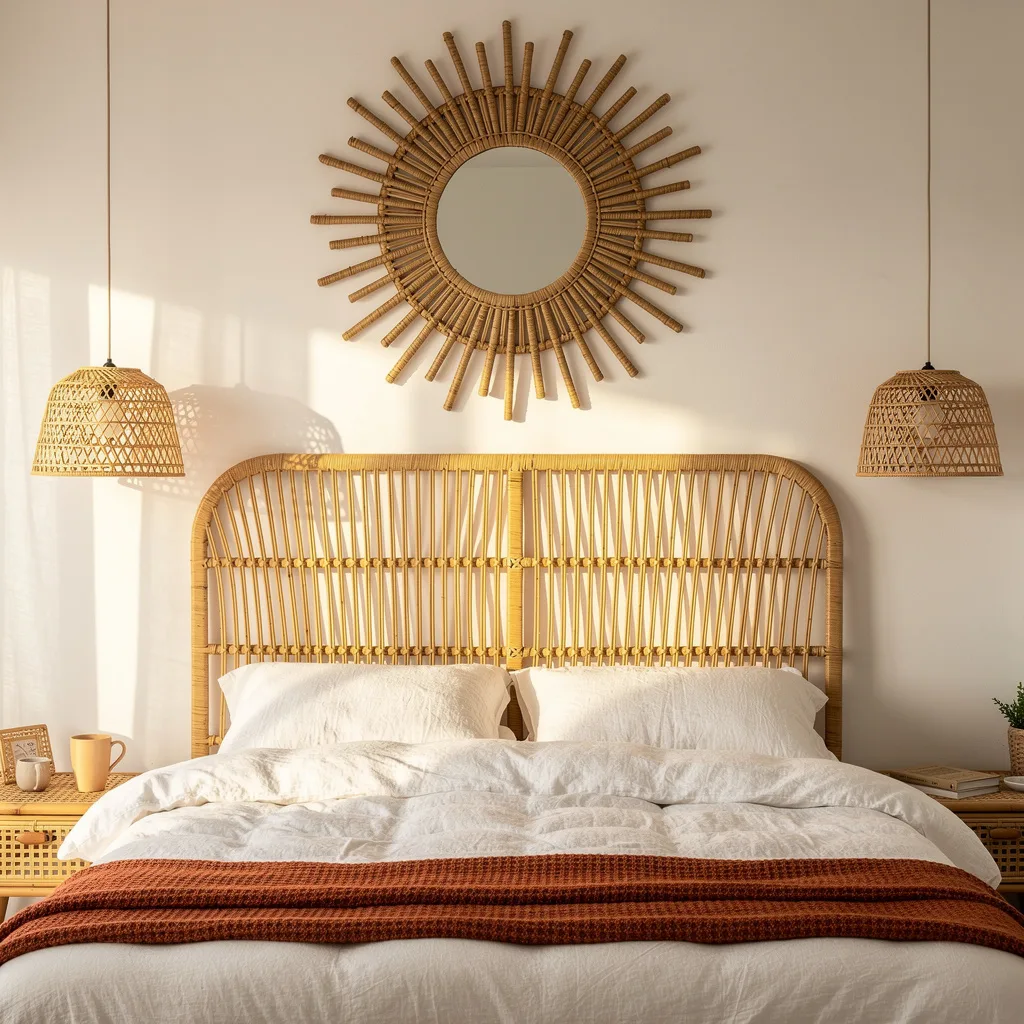
A rattan sunburst mirror above a headboard works because it mimics the shape of a rising sun — an obvious symbolic resonance for a bedroom, and one that doesn’t require explanation to register. The rattan rays radiate outward from a small central mirror, and the whole piece casts gentle warm shadows on the wall when morning light hits.
Hang it centred above the headboard, which should itself be in rattan or natural cane — the material repetition makes both pieces look intentional rather than coincidental. On either side of the bed, hang matching rattan pendant lights — dropped low enough to function as bedside lamps if needed, but positioned primarily as flanking visual elements.
Keep the bedding plain. White linen duvet, one rust or terracotta knit blanket folded across the base of the bed. The more elaborate the mirror and headboard, the simpler the textiles need to be.
Hand-Painted Oval Wood Frame
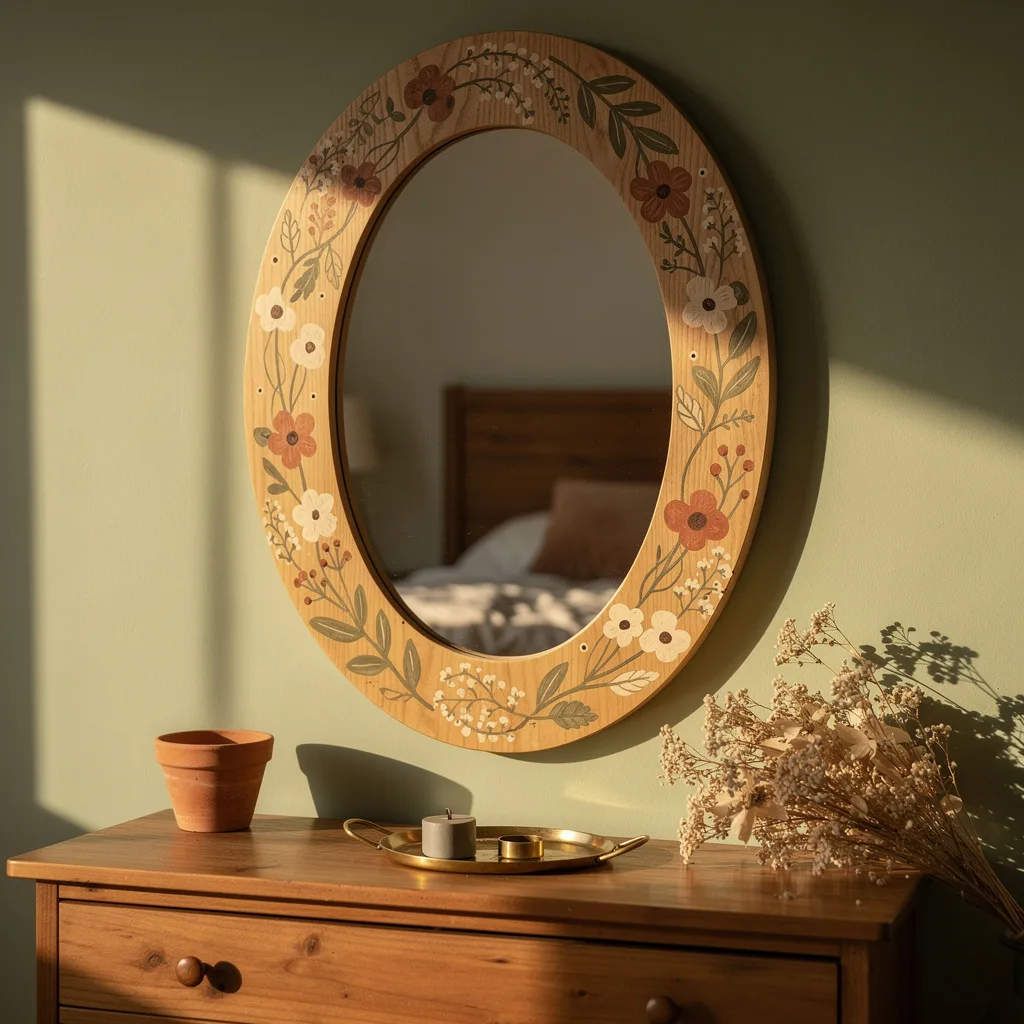
A wide oval wooden frame with hand-painted folk botanical motifs — small flowers, berries, stems, and leaves in terracotta, dusty rose, cream, and olive green — is the most personal mirror option here. No two are exactly alike, and the visible brushwork means the piece carries a human quality that manufactured goods can’t replicate.
Hang it on a sage green or olive wall where the painted florals and the wall colour exist in dialogue. Below, on a wooden chest or dresser, arrange a calm surface: a small terracotta pot without a plant in it, a shallow gold tray with a single candle, a loose bundle of dried flowers. Nothing symmetrical, nothing styled — just objects placed with loose intention.
The mirror’s painted frame is already doing significant decorative work. The surface below it should rest, not compete.
Window-Pane Mirror Over Sideboard
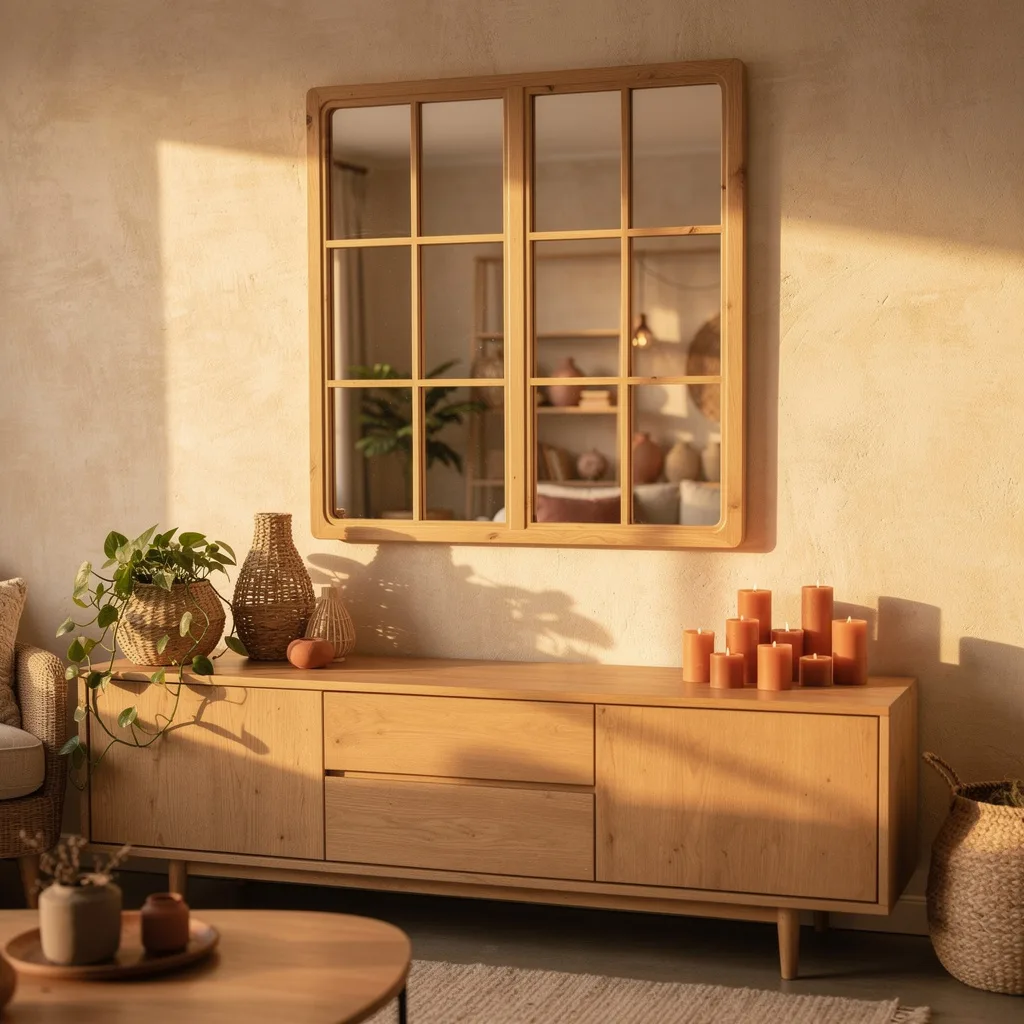
A wood-framed mirror designed to resemble a divided window — two columns of three panes each, total six reflective panels in a single frame — plays with the illusion of an interior window or a doorway into another room.
Hang it above a low sideboard or credenza, the mirror’s lower edge approximately 15–20cm above the sideboard surface. Dress the sideboard in warm objects that the mirror will reflect and multiply: a wicker vase, a ceramic vase in a warmer tone, a trailing plant in a small pot, a cluster of pillar candles in terracotta and amber.
The window-pane format suits a warm, sandy wall better than a white one. White makes it look clinical. On a limewash or textured warm wall it reads as if a real window opened there, which is the entire point of the illusion.
Hammered Brass Discs with a Mirror
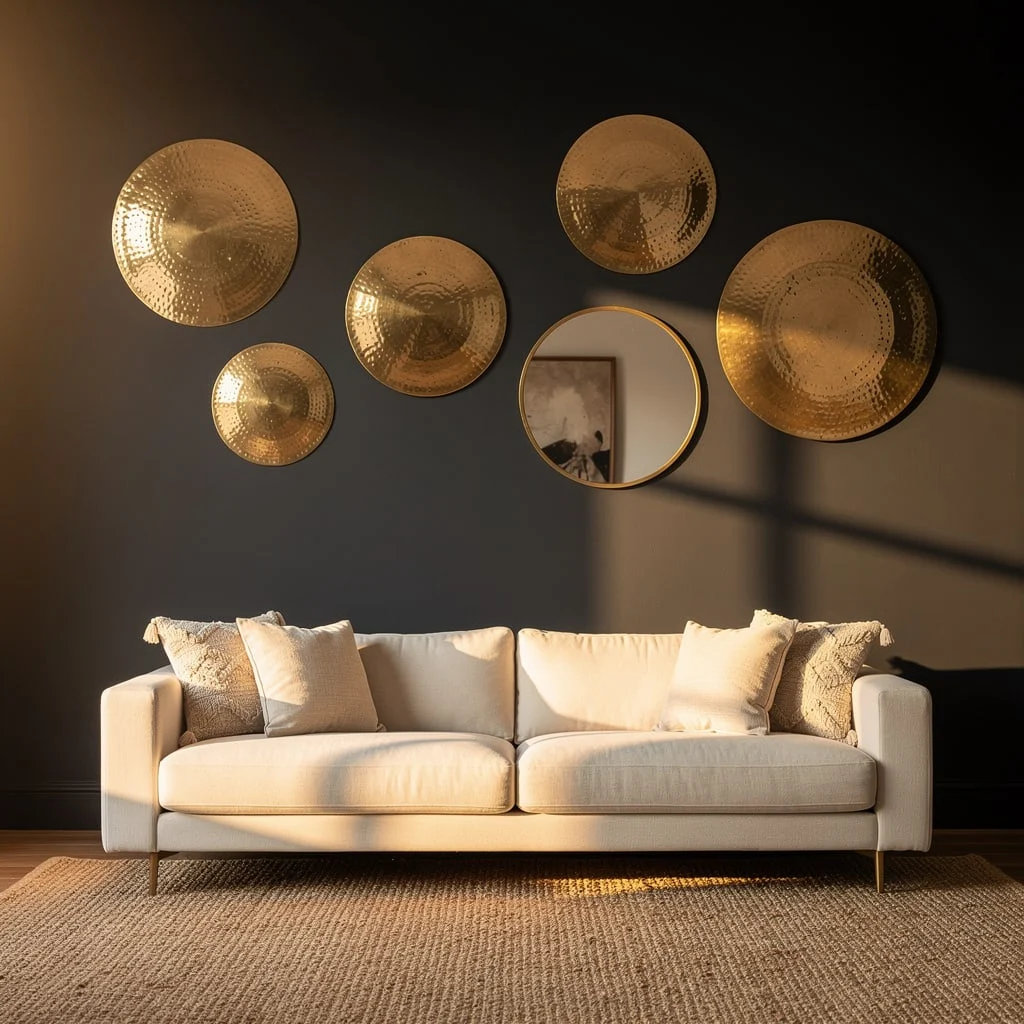
Five hammered brass discs in varying sizes — the largest 50–60cm in diameter, the smallest 20cm — arranged in a loose cluster on a dark charcoal or deep navy wall. One piece in the cluster is a round mirror with a thin gold rim. The rest are solid convex brass wall discs with hammered surface texture that catch and scatter light at every angle.
The disc arrangement should feel asymmetric and gravitational — heavier on one side, lighter on the other, as if the pieces are in slow orbit around the mirror at the centre. Space them irregularly; some close, some further apart.
Below the arrangement, a cream bouclé or linen sofa in pale neutral tones provides the contrast the dark wall needs. The brass scatters warm light across the sofa and ceiling. The single mirror in the group reflects the room’s opposite wall, creating a visual depth that the solid discs alone couldn’t achieve.
This is the only mirror idea in this list that operates closer to glam than boho — but the hammered texture, the irregular arrangement, and the organic scale variation keep it within the free-spirited territory that bohemian design occupies at its best.
The Mirror as Room Logic
Every room has a weak point. A corner that never gets enough light. A wall that feels flat. A narrow hallway that makes people hunch their shoulders. A mirror placed with intention addresses all of these things without adding bulk, cost, or complication.
The boho version of this is particularly effective because the frame itself is part of the solution. Rattan and rope and driftwood don’t just surround the mirror — they bring texture, warmth, and material richness to the wall before the reflective surface even begins its work.
That’s the real argument for a bohemian mirror: it does double duty. Frame and function, texture and light, presence and absence — all in one piece. That’s not decorating. That’s thinking.