
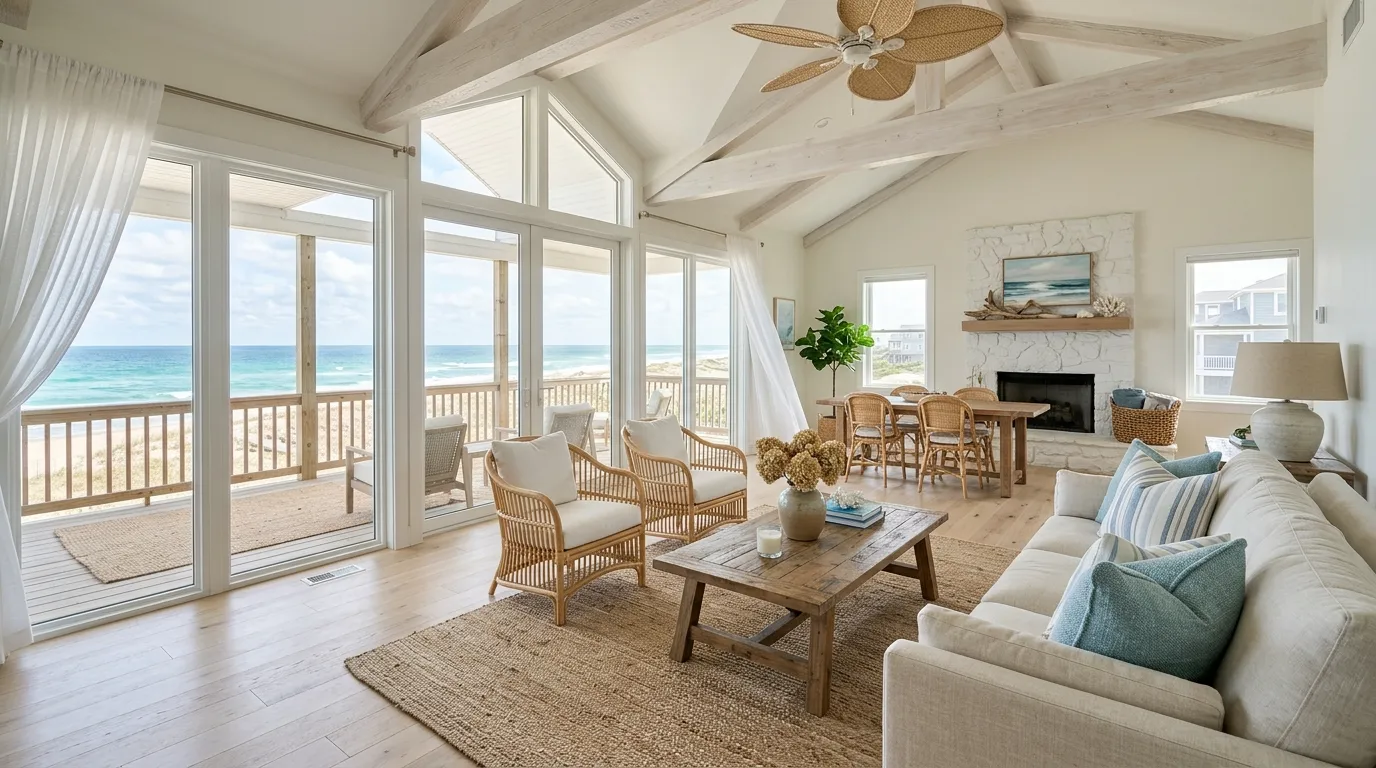
Coastal doesn’t mean blue and white stripes and a piece of driftwood on the mantel.
That’s one version of it, the one that shows up in catalogs and never seems to leave. It’s not wrong, exactly. It’s just one tiny slice of an entire design language that includes moody navy walls, hot turquoise and coral, sun-bleached neutrals, and rooms with roaring stone fireplaces that don’t have a single nautical object anywhere in sight.
What actually makes a room read as coastal has very little to do with anchors and rope and everything to do with how it handles light, texture, and a sense of being lived in by the water rather than performing a theme about it.
Twenty rooms below prove the point. Half of them would surprise anyone expecting shells in a glass jar.
Why most “coastal” living rooms feel like a theme park
Most rooms calling themselves coastal are working from a single, overused script, and it shows.
The Literal Nautical Trap
A ship’s wheel can work in a room. Five nautical references in the same room rarely do.
The mistake isn’t owning a single great piece, a real fishing float, an actual antique compass. It’s treating the entire decorating brief as “things that look like they belong on a boat,” which produces a room that reads as costume rather than home.
The rooms on this list that do include an overtly nautical object, like an actual ship’s wheel, only get away with it because everything else around it stays quiet. The wheel is allowed to be loud precisely because nothing else is competing with it.
Blue and White Tunnel Vision
Ask most people to picture a coastal living room and they’ll describe the same thing: navy and white stripes, a driftwood coffee table, maybe a lighthouse painting.
That’s one real, legitimate version of coastal design. It’s also a tiny fraction of what actually qualifies. Tropical turquoise and coral, Mediterranean cobalt and terracotta, moody stone and leather, Scandinavian sheepskin and pale wood are all coastal too, just from a different coastline.
Defaulting to the same blue-and-white formula every time isn’t wrong, but it does mean missing almost every other valid way to do this.
Color Without Texture
A wall painted the “right” shade of ocean blue, sitting behind a smooth, synthetic-looking sofa, rarely reads as coastal no matter how accurate the paint chip was.
What actually signals proximity to water has more to do with material than hue: linen that wrinkles, rattan that creaks slightly, wood that’s visibly weathered, wool that’s a little rough underfoot. These textures read as near the elements regardless of what color they happen to be.
Chase the material before the color. A room full of the right textures in the wrong palette still reads as coastal. The reverse rarely does.
Coastal Living Room Ideas
Navy Sofa White Shiplap
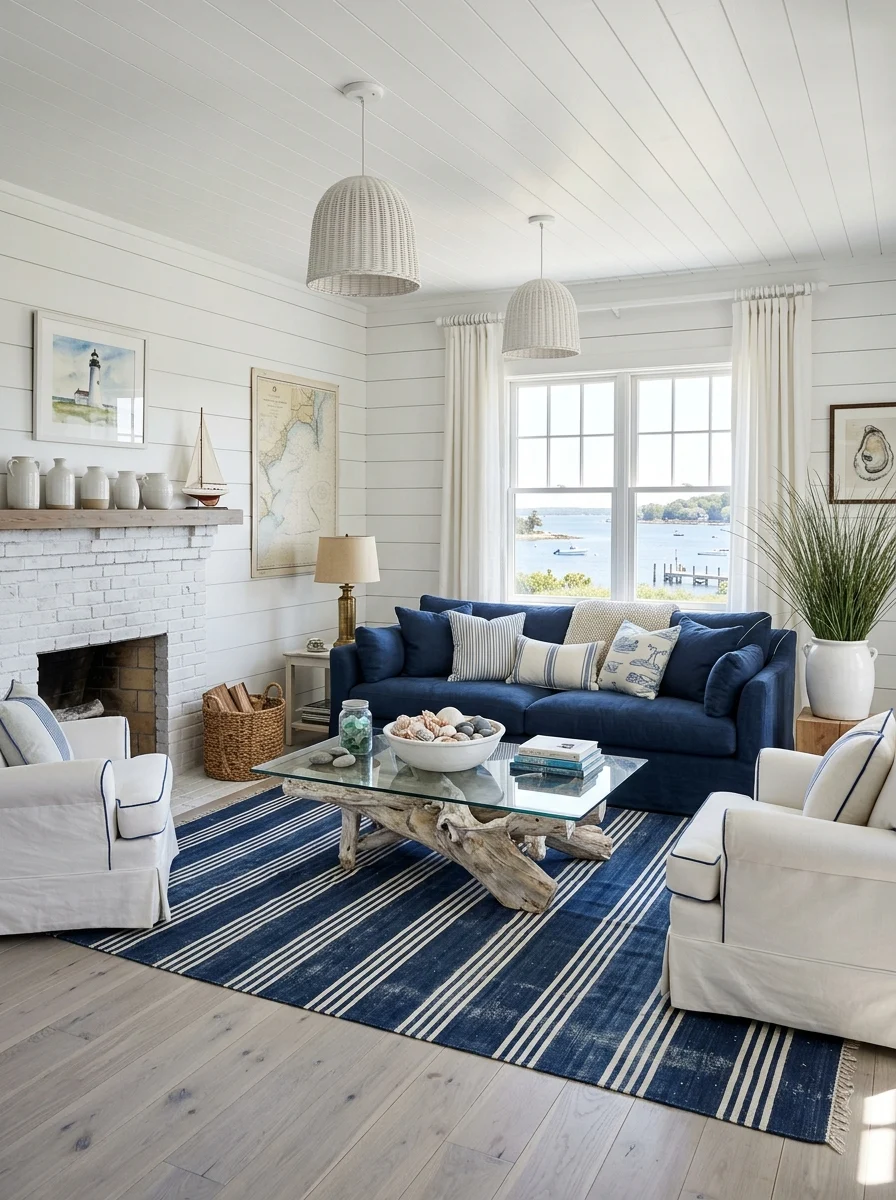
Paint walls and ceiling in crisp white shiplap, running the planks horizontally across every surface including overhead, so the room reads as one continuous, textured envelope rather than four flat walls.
Anchor the seating with a deep navy slipcovered sofa, paired with white slipcovered armchairs rather than a second navy piece. The contrast between the two keeps the navy from reading as the only decision in the room.
Layer a wide-striped navy and cream rug underneath a driftwood coffee table topped in glass. The raw, unfinished wood grounds the crisp white-and-navy palette in something that actually looks gathered from outside rather than ordered from a showroom.
Hang one or two pieces of real nautical art, a watercolor lighthouse, an antique chart, rather than a wall full of themed objects. One earned reference reads as heritage. Five reads as a gift shop.
Seafoam Walls Linen Sofa
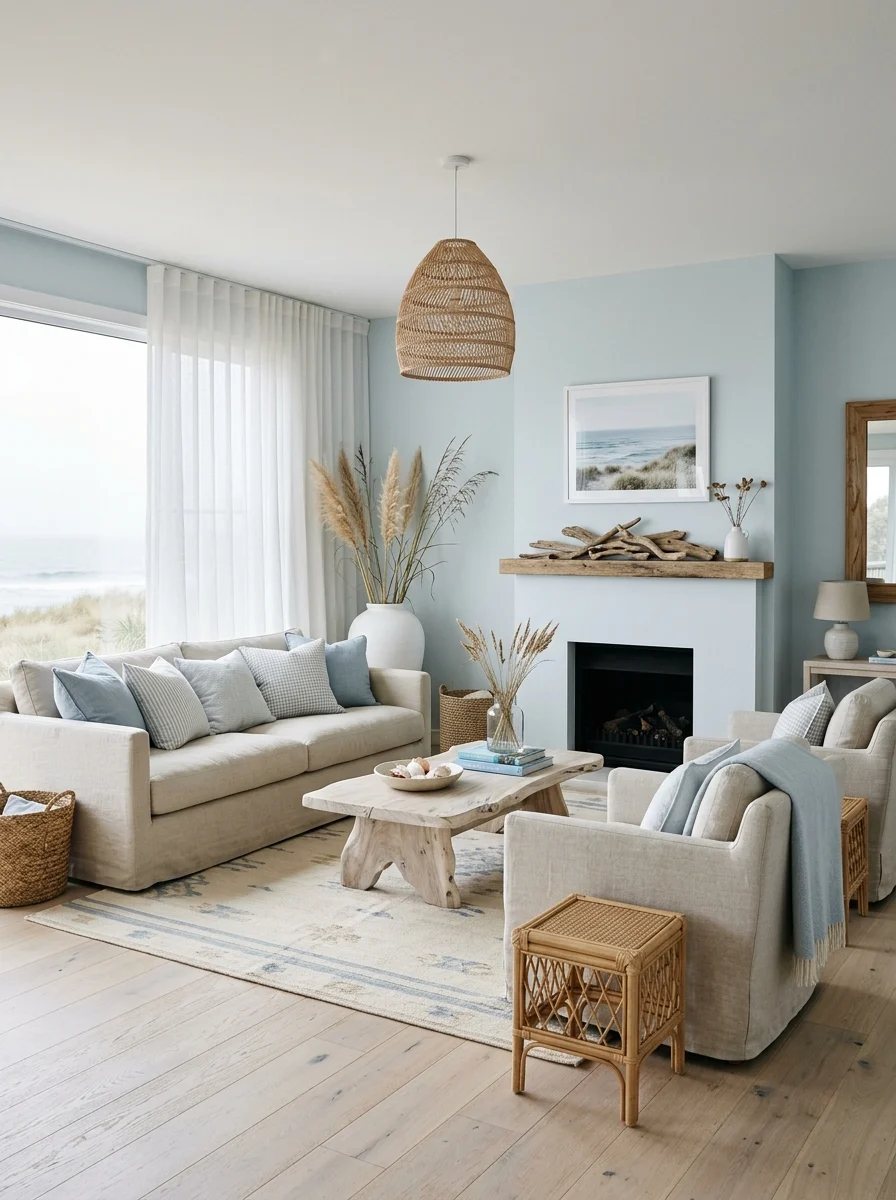
Paint the walls a pale, grayed-down seafoam rather than a true blue or a true green, choosing something quiet enough to function almost like a neutral throughout the day.
Furnish with a deep, slouchy linen sofa in unbleached natural beige rather than white or gray. Linen’s slight wrinkle and warmth keep a pale, cool wall color from feeling sterile.
Hang sheer curtains floor to ceiling at the largest window, letting them puddle slightly rather than hemming them precisely. The soft movement of sheer fabric does more to suggest sea air than any single decorative object could.
Fill a tall ceramic vase with dried pampas grass or wheat rather than fresh flowers. Dried, textural stems read as gathered from the dunes outside and never need replacing.
Moody Navy Walls Night
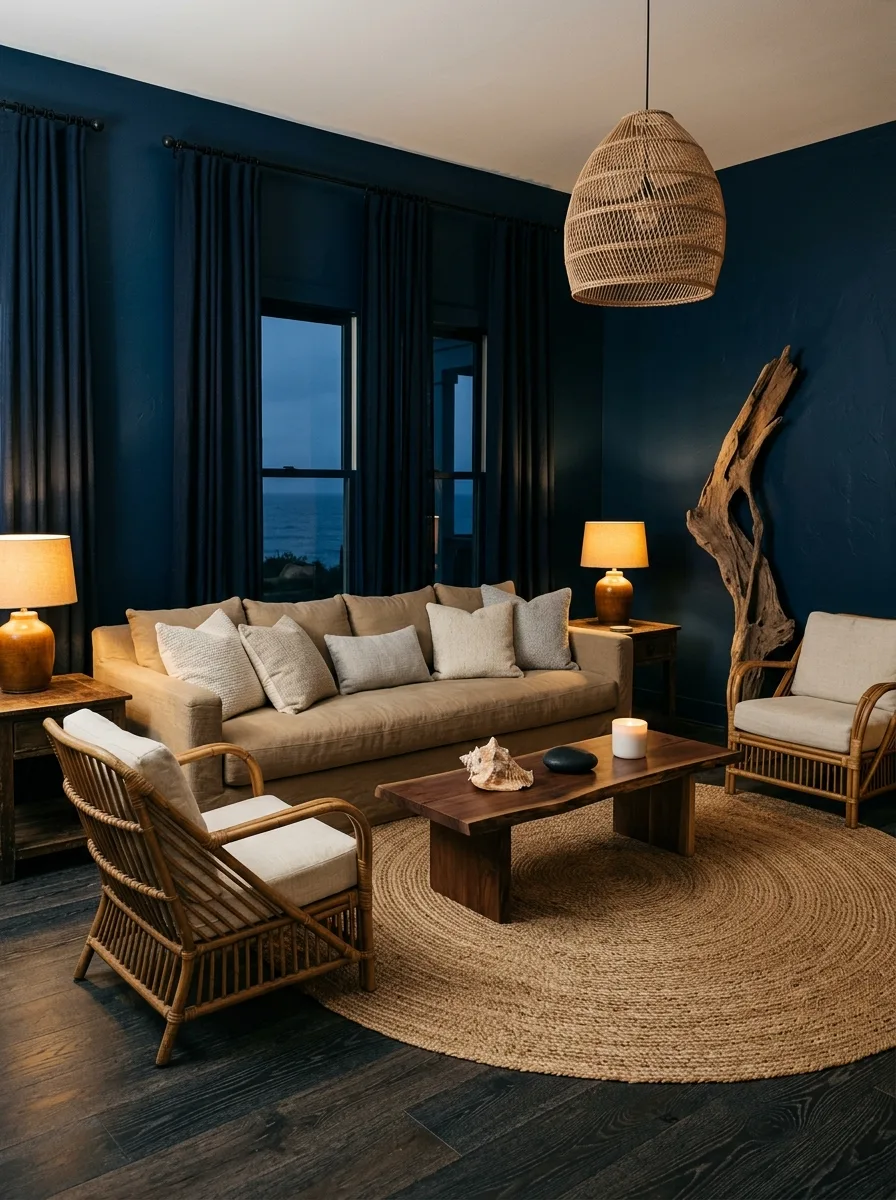
Paint every wall in a deep, near-black navy, and resist the urge to break it up with a lighter accent wall. The color needs to wrap the entire room to read as intentional rather than half-finished.
Choose warm-toned furniture to sit against it, a camel or tan sofa, rattan armchairs, anything that leans warm rather than cool. A cool gray sofa against navy walls goes cold fast; warm tones keep the room feeling inhabited after dark.
Light the room almost entirely with warm table lamps rather than overhead fixtures. This palette is built for evening, when the dark walls disappear and the warm pools of lamplight do the work instead.
Bring in one large, sculptural piece of driftwood or a raw branch as the room’s single dramatic object. Against navy walls, even one strong silhouette reads as a statement; pile on more than that and the drama disappears.
Hanging Rattan Egg Chairs
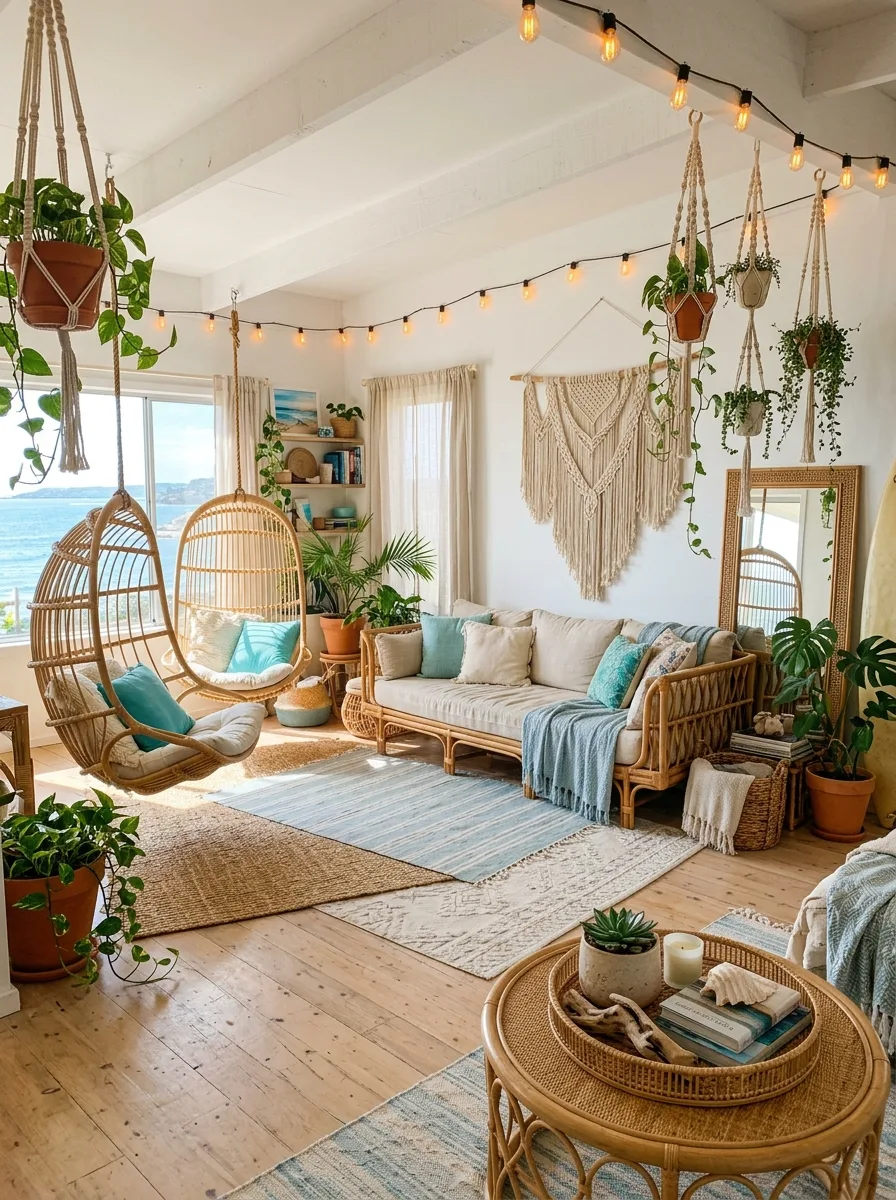
Suspend one or two rattan egg chairs from exposed ceiling beams, with chains rated for the actual weight load, positioned near a window with the best available view.
String warm-toned bulb lights along the ceiling beams between the hanging chairs and the plants, rather than relying on overhead fixtures alone. The string lights are doing as much atmospheric work here as any single piece of furniture.
Hang a large macrame wall piece on the most open wall, and suspend smaller macrame plant hangers from the ceiling at varying heights, filled with trailing pothos or philodendron rather than upright plants.
Layer two or three rugs in slightly different patterns rather than one large rug. A boho room depends on this kind of accumulated, slightly imperfect layering; a single matched rug would undercut the whole effect.
Coffered Ceiling White Sofas
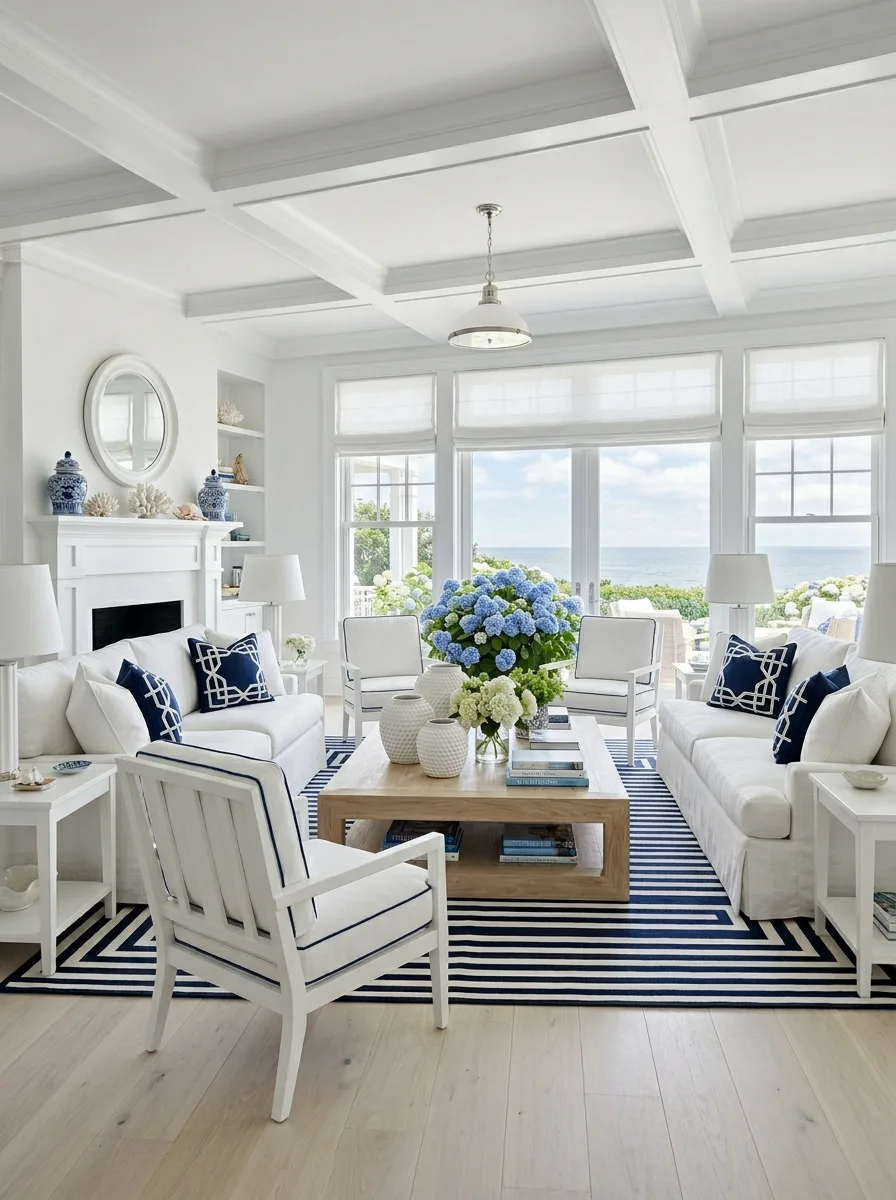
Install a coffered ceiling in crisp white, with beams deep enough to cast real shadow lines rather than a flat, painted grid. The architecture itself needs to read as substantial before any furniture goes in.
Furnish with white slipcovered sofas on every wall of the seating area, choosing a slim navy piping detail along the seams rather than leaving the upholstery plain. That single line of color is enough to keep an all-white room from reading as flat.
Lay a graphic navy-and-white striped rug in a bold geometric rather than a simple stripe. The pattern needs enough presence to anchor a room with this much white everywhere else.
Fill a large vase with fresh blue and white hydrangea together, positioned as the room’s central, changing decoration. Live flowers do more to keep a formal, all-white room feeling lived in than any permanent object would.
Turquoise Sofa Palm Mural
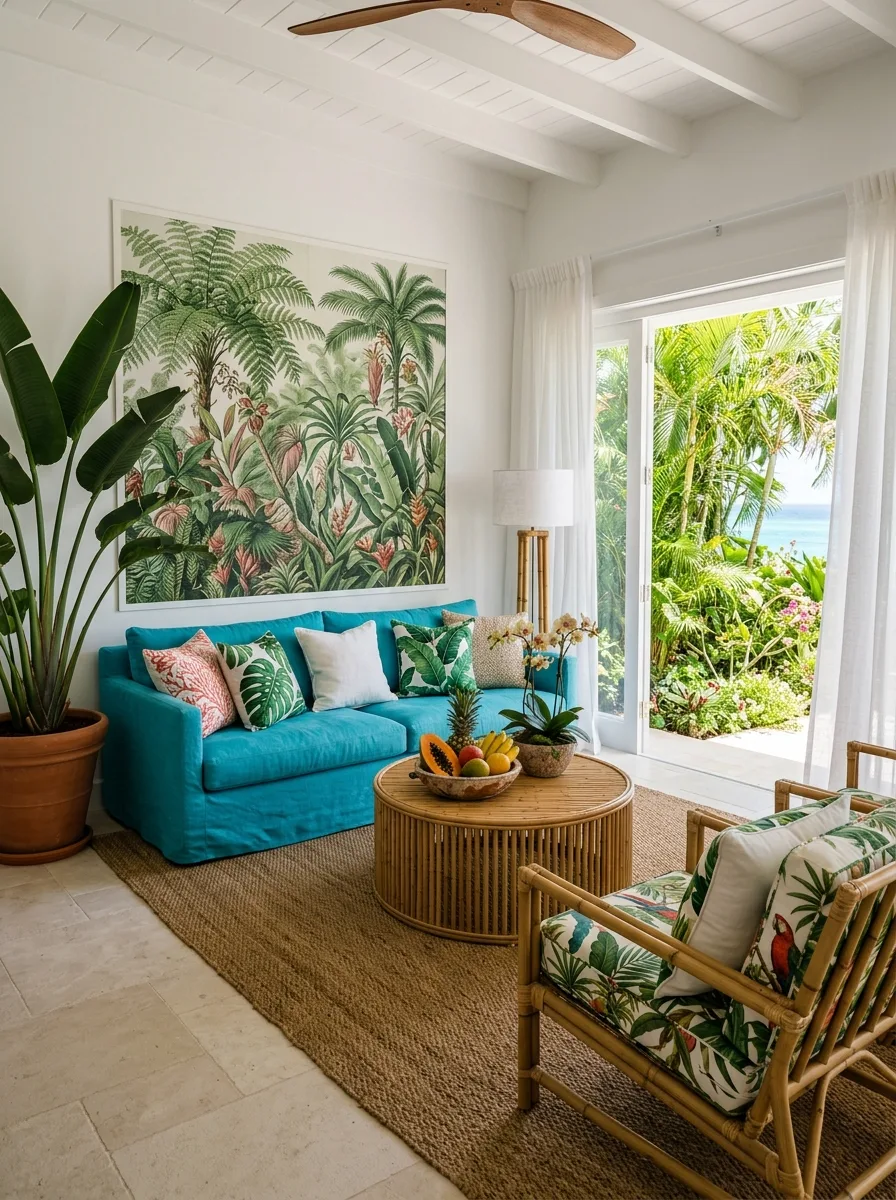
Commission or source a large-scale tropical palm leaf mural for the main wall, choosing one with enough botanical detail and scale to function as the room’s primary artwork rather than a small framed print.
Upholster the main sofa in a saturated turquoise linen, positioned directly facing the mural so the two strongest colors in the room sit across from each other rather than side by side competing.
Furnish the rest of the seating in natural rattan with tropical leaf or parrot-print cushions, and bring in real tropical fruit, papaya, mango, pineapple, displayed in a woven bowl on the coffee table rather than as a styled prop.
Run a woven sisal or jute rug underfoot rather than anything patterned. With a mural and a saturated sofa already doing the heavy lifting, the floor needs to stay completely quiet.
Sheepskin Chairs Fjord View
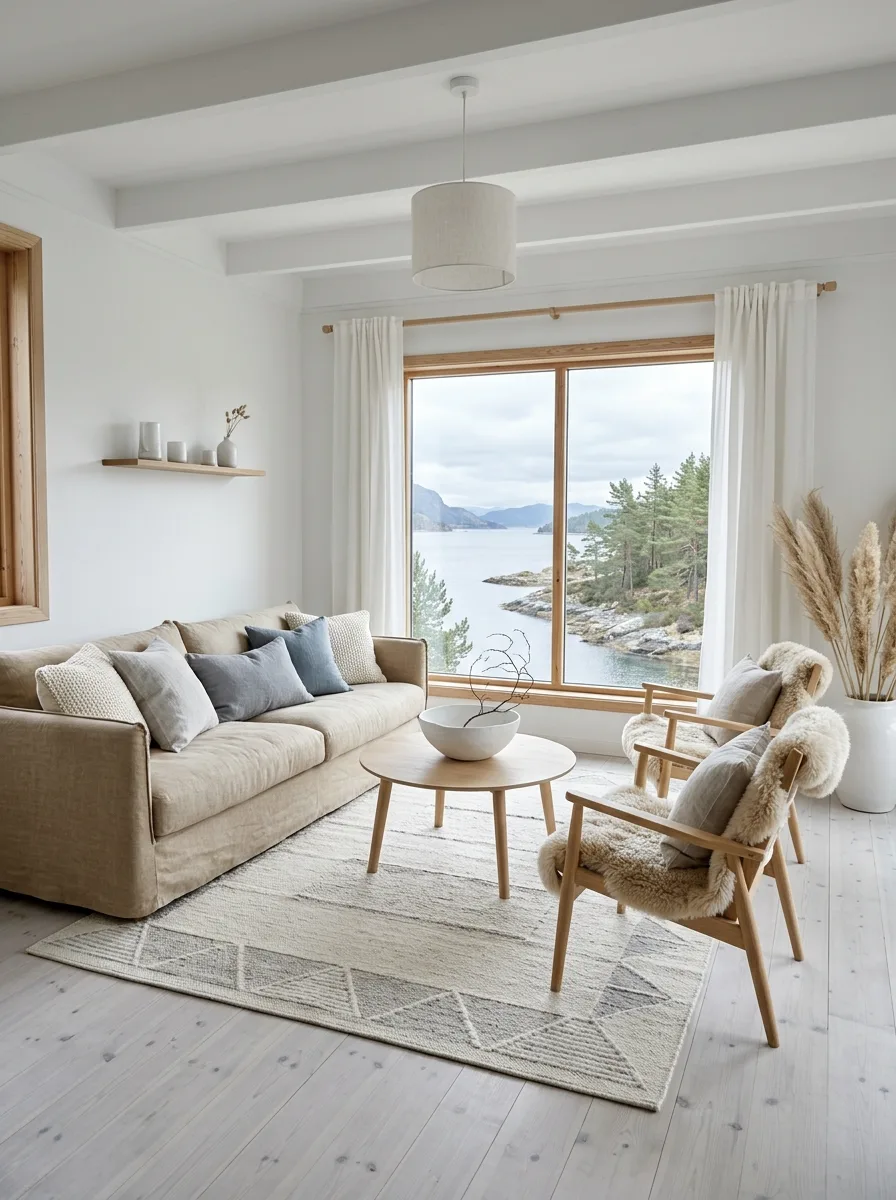
Position the main seating to face the largest window directly, treating the water and rock view outside as the room’s actual focal point rather than competing with it with a statement wall.
Choose simple, pale wood-framed chairs and drape a sheepskin throw over each one rather than upholstering them in fabric. The sheepskin adds warmth and texture without introducing a new color into an otherwise restrained palette.
Keep the sofa in an undyed, natural linen or wool blend, and limit the cushion colors to soft grays and dusty blues pulled directly from the water outside the window.
Lay a geometric wool rug in cream and gray rather than anything with a curved or floral pattern. Scandinavian coastal rooms depend on clean, architectural lines throughout, including underfoot.
Arched Blue-Framed Windows
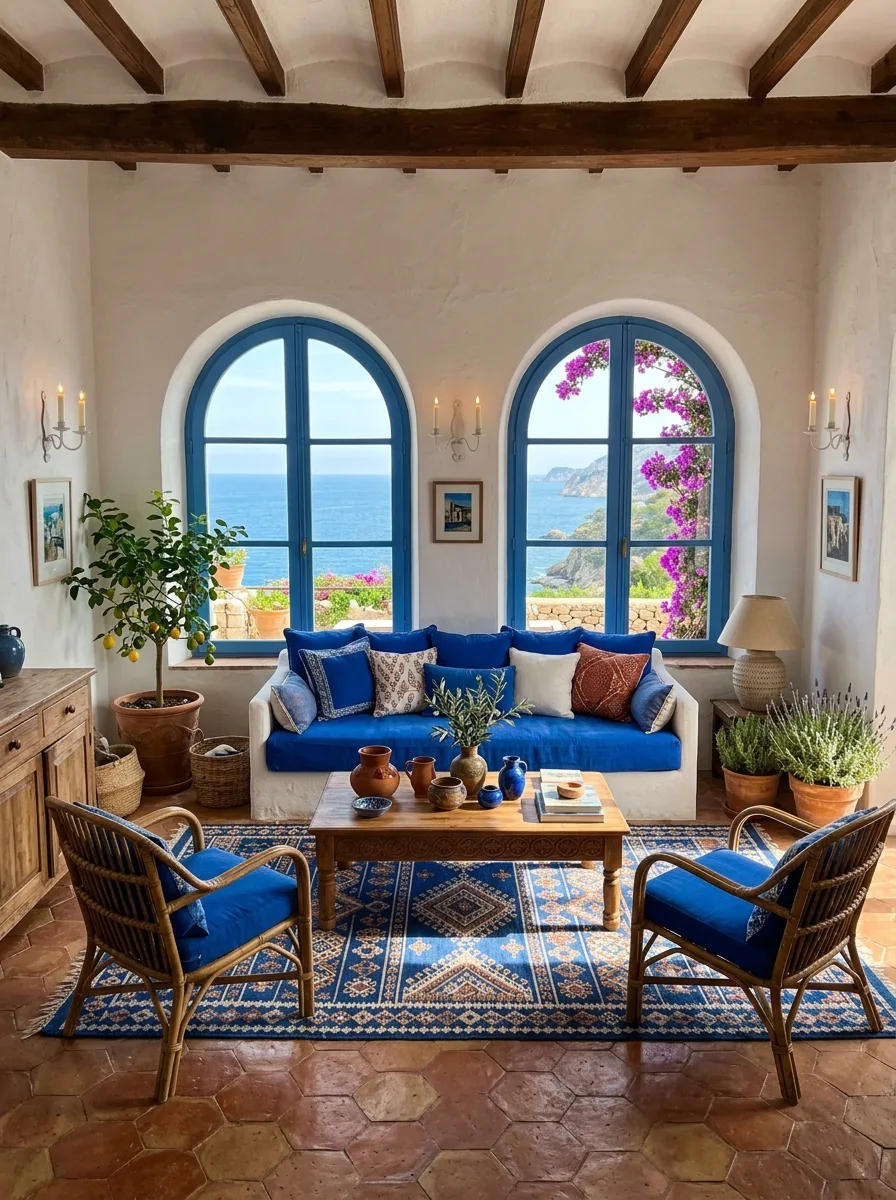
Build or specify arched window openings on the wall facing the water, and paint the window frames themselves in a saturated cobalt blue rather than leaving them white or natural wood.
Leave the surrounding walls in rough, white-washed plaster, allowing some texture and unevenness to show through rather than a flawless flat finish. The contrast between rustic plaster and the saturated blue frames is the whole effect.
Upholster the sofa cushions in the same cobalt blue as the window frames, tying the strongest color in the room to its architecture rather than introducing it only through furniture.
Floor the room in terracotta tile and layer a kilim-style rug in warm reds and blues underfoot. A potted lemon tree positioned near the window completes the sense that the room opens directly onto a Mediterranean hillside.
Ship’s Wheel Chandelier
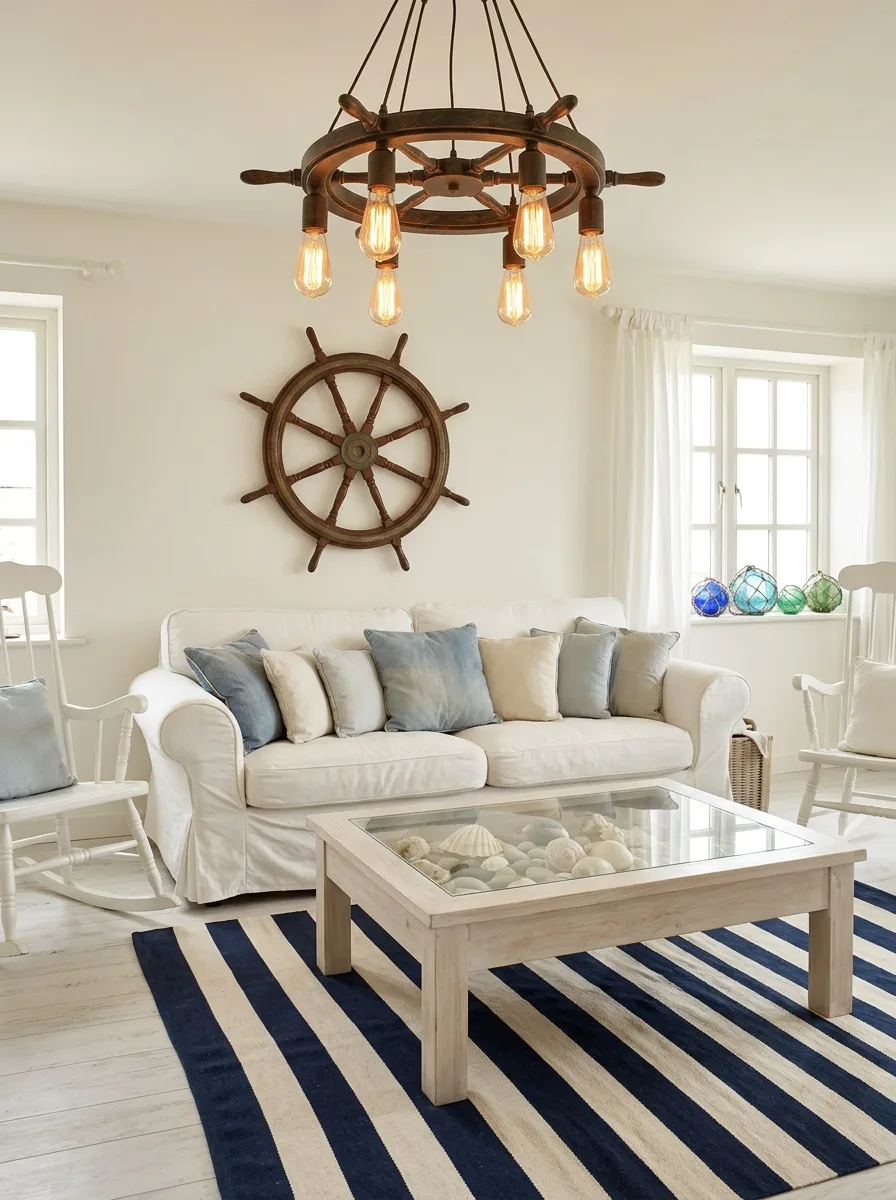
Source an authentic or well-made reproduction ship’s wheel and convert it into a hanging chandelier, with exposed bulbs mounted where the spokes meet the rim, positioned as the room’s central light fixture.
Mount a second, non-electrified ship’s wheel on the wall below it as a purely decorative echo. Repeating the same object once, deliberately, reads as a considered pair rather than two competing ideas.
Keep the rest of the room restrained: a white slipcovered sofa, a simple striped navy rug, white-painted rocking chairs. The ship’s wheel is allowed to be the one literal nautical statement precisely because nothing else in the room is competing with it.
Display glass fishing floats along a windowsill rather than scattered throughout the room. Grouped in one place, they read as a collection. Spread around individually, they start to feel like clutter.
Sage Green Boucle Seating
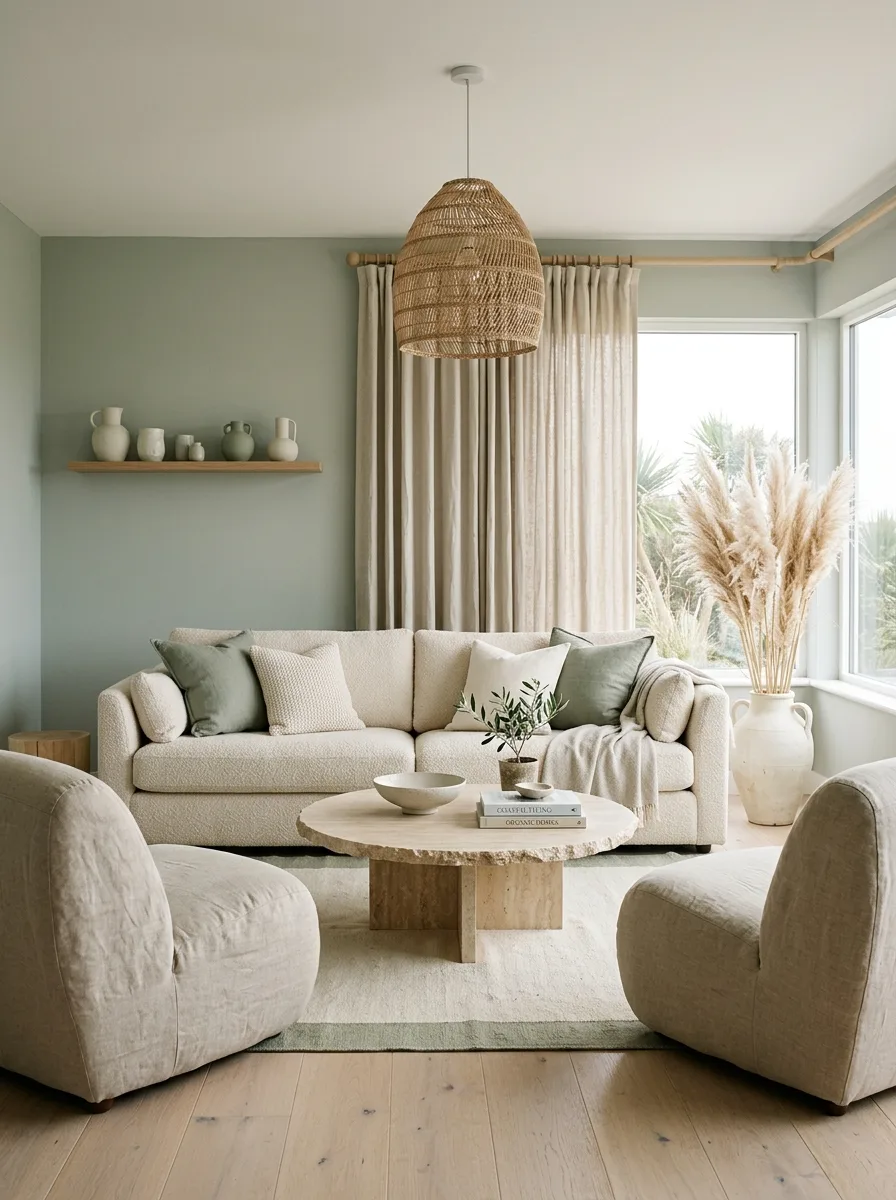
Paint the walls a muted, grayed sage green, choosing a shade closer to dried herbs than to a bright garden green. This needs to read as a backdrop neutral, not a bold accent color.
Furnish with curved, low-profile boucle armchairs and a deep boucle sofa, all in the same cream tone, so the textured upholstery does the visual work that a patterned fabric would normally do.
Hang a woven rattan pendant light at a generous scale, and fill a large ceramic vase with dried pampas grass positioned near the window. Both choices keep the room’s materials feeling organic rather than manufactured.
Top a travertine coffee table with a single ceramic bowl and a small olive tree in a terracotta pot. The olive tree is doing more to suggest a coastal, Mediterranean-adjacent feeling here than any blue object could.
Built-In Plaster Bench Seating
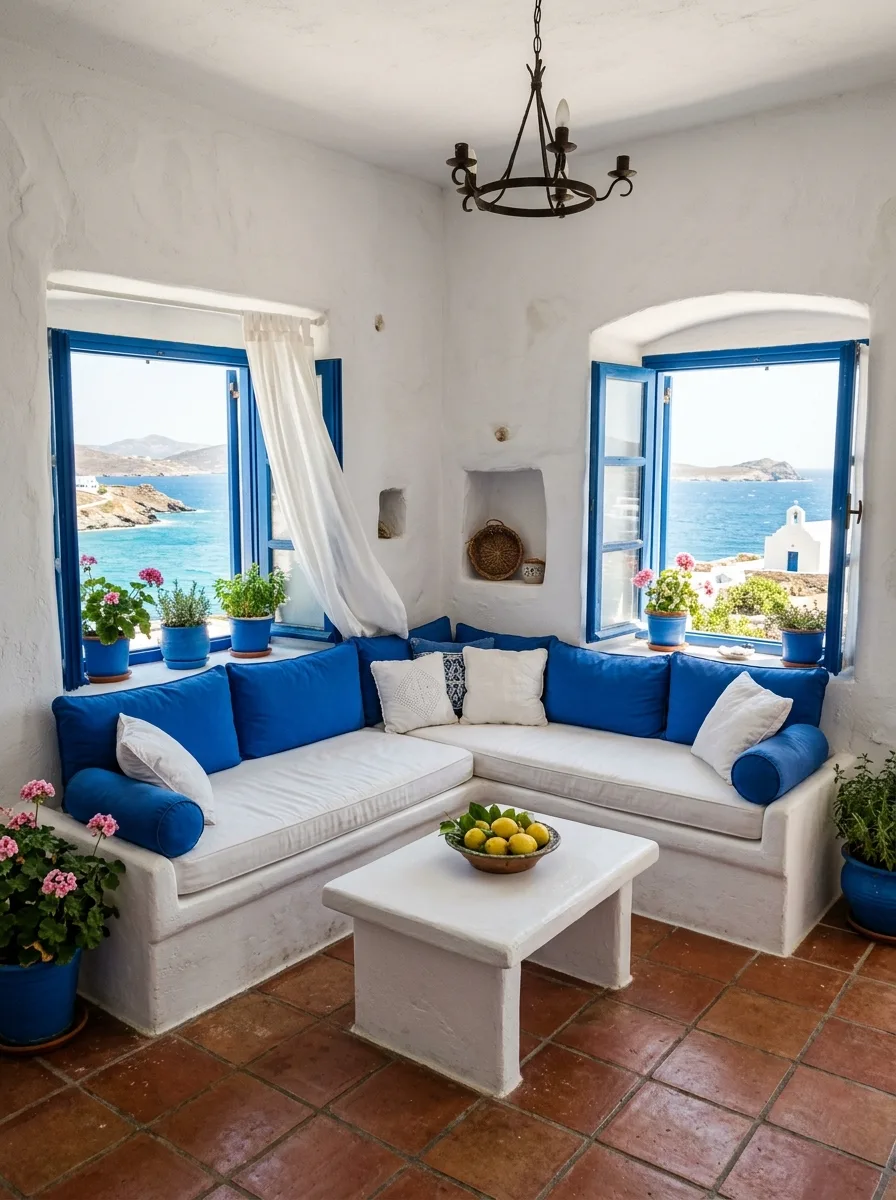
Build an L-shaped bench seat directly into two adjoining walls using plastered masonry, rather than freestanding furniture, so the seating reads as architecture rather than something that could be rearranged.
Cushion the built-in bench in white with saturated cobalt blue bolster pillows and cushions, repeating the same blue used on the window frames and shutters outside.
Leave the surrounding walls in rough white plaster, and paint a small built-in storage niche in the same white so it nearly disappears into the wall, holding a single woven basket or ceramic piece.
Floor the room in terracotta tile and place potted bright pink geraniums on every windowsill. This look depends entirely on whitewashed plaster, blue accents, and terracotta tile all appearing together; remove any one of those three and it stops reading as a Greek island.
Toile-Print Sofa Fabric
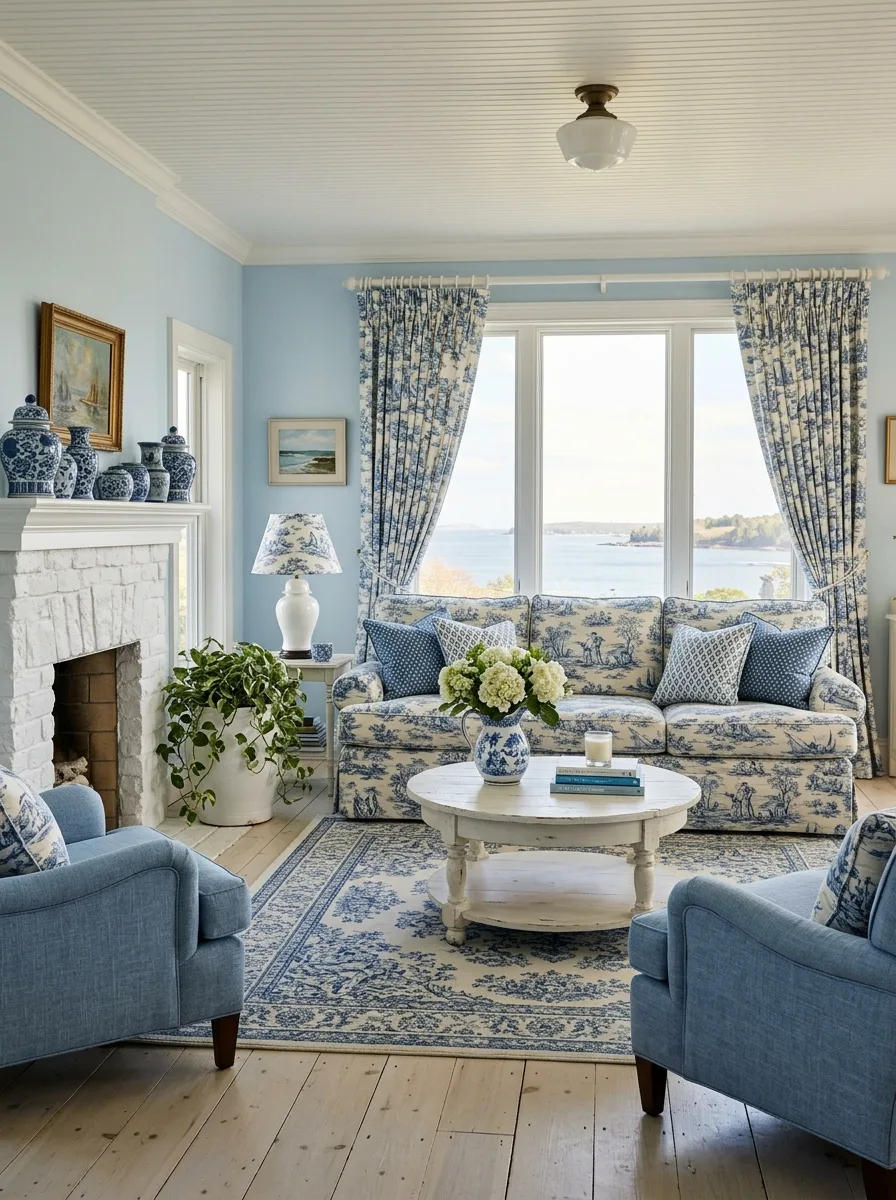
Upholster the main sofa in a classic blue-and-white toile print, depicting pastoral or maritime scenes, rather than a solid fabric or simple stripe. The print itself is the room’s main decorative gesture.
Paint the walls a pale, powder blue several shades lighter than the toile, and hang curtains in a coordinating floral print rather than a plain fabric, so the pattern repeats without exactly matching.
Pair the sofa with solid blue linen armchairs rather than a second patterned piece. One printed fabric this detailed is plenty; a second pattern in the same room would compete with it instead of supporting it.
Display a collection of blue-and-white ginger jars along the mantel, varying the sizes rather than lining up a matched set. This is a traditional, layered look, and it depends on small collected objects accumulating the same way the pattern does.
Grasscloth Wallpaper Walls
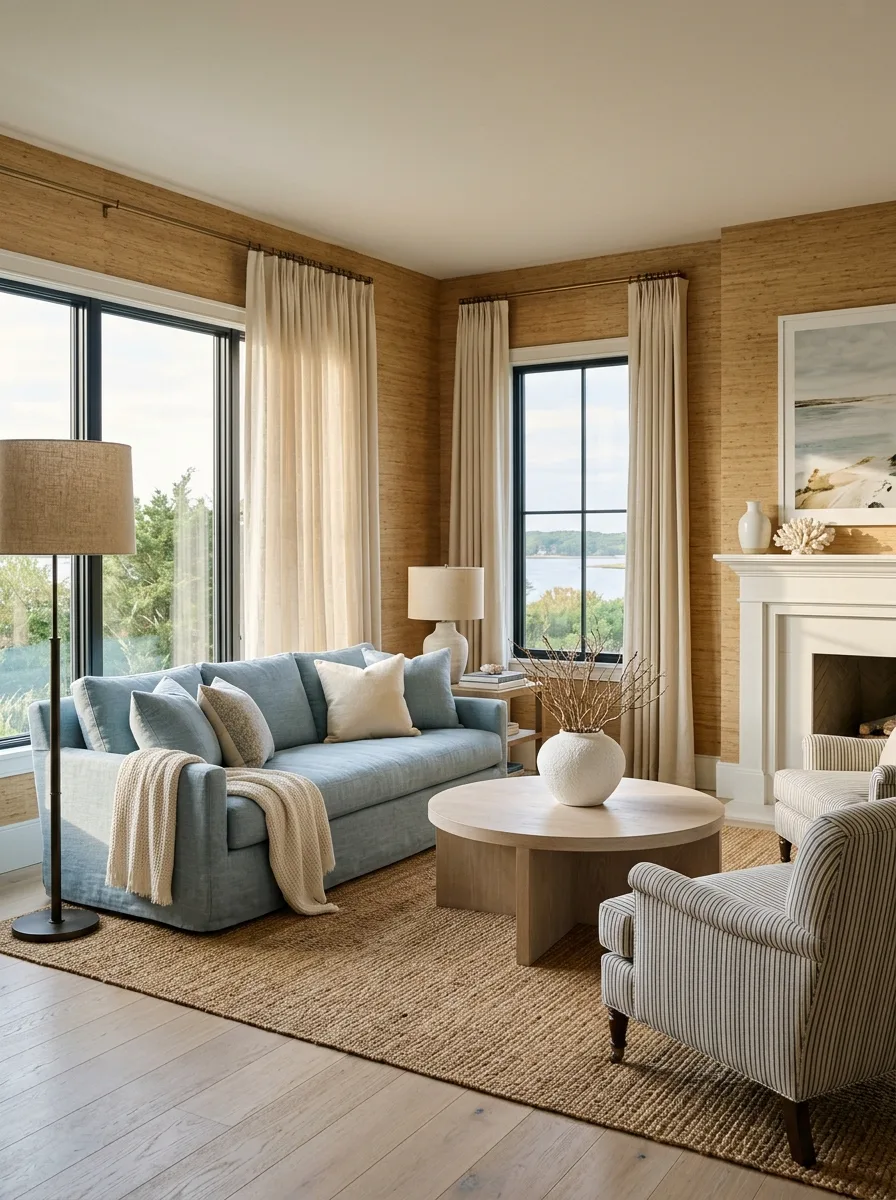
Wrap the walls in a natural grasscloth wallpaper in a warm honey tone, rather than painting them, so the walls themselves carry texture before a single piece of furniture goes in.
Choose black-framed, floor-to-ceiling windows rather than white or wood frames. The graphic black line against the warm grasscloth gives the room a more architectural, current feeling than a softer frame would.
Furnish with a dusty blue sofa and a single striped accent chair, keeping the rest of the palette neutral so the grasscloth and the black window frames stay the dominant visual decision.
Layer a natural jute rug underfoot and hang simple linen drapery in an unbleached cream. Every material in this room should feel like it could plausibly be undyed and unbleached, even the things that technically aren’t.
Glass Conservatory Plant Jungle
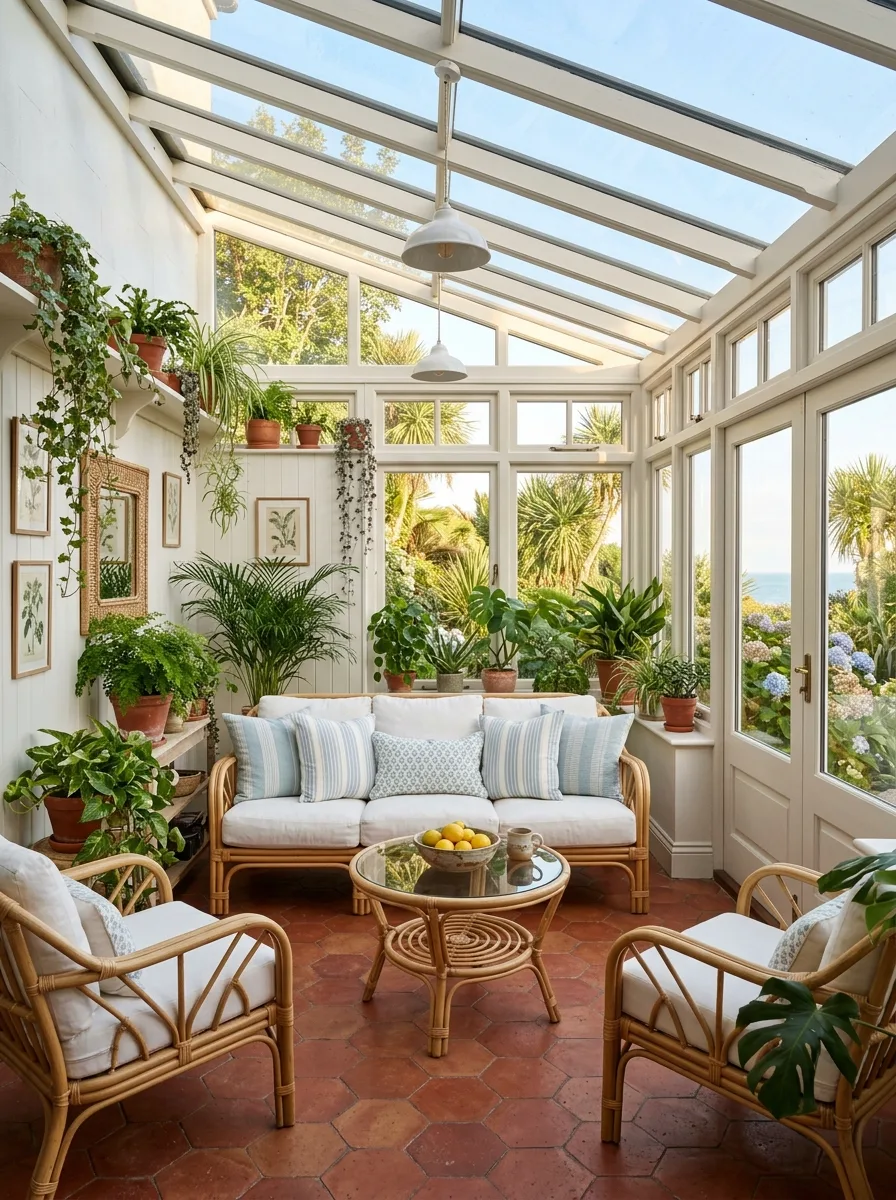
Build or specify a glass-roofed conservatory addition, allowing light to pour in from directly overhead rather than only through side windows. The overhead light is what makes a room this full of plants actually thrive rather than just look good for a season.
Fill every available shelf, windowsill, and floor corner with potted plants in varying heights, ferns, monstera, trailing ivy, rather than a few curated specimens. Density is the entire point of this look.
Furnish with simple rattan seating and white cushions, keeping the furniture itself understated since the plants are doing all the visual work. A bold patterned sofa here would compete with, rather than complement, the greenery.
Floor the room in warm terracotta hexagon tile, which handles the humidity and occasional watering spill that comes with a room this densely planted far better than wood or carpet would.
Stone Walls Roaring Fireplace
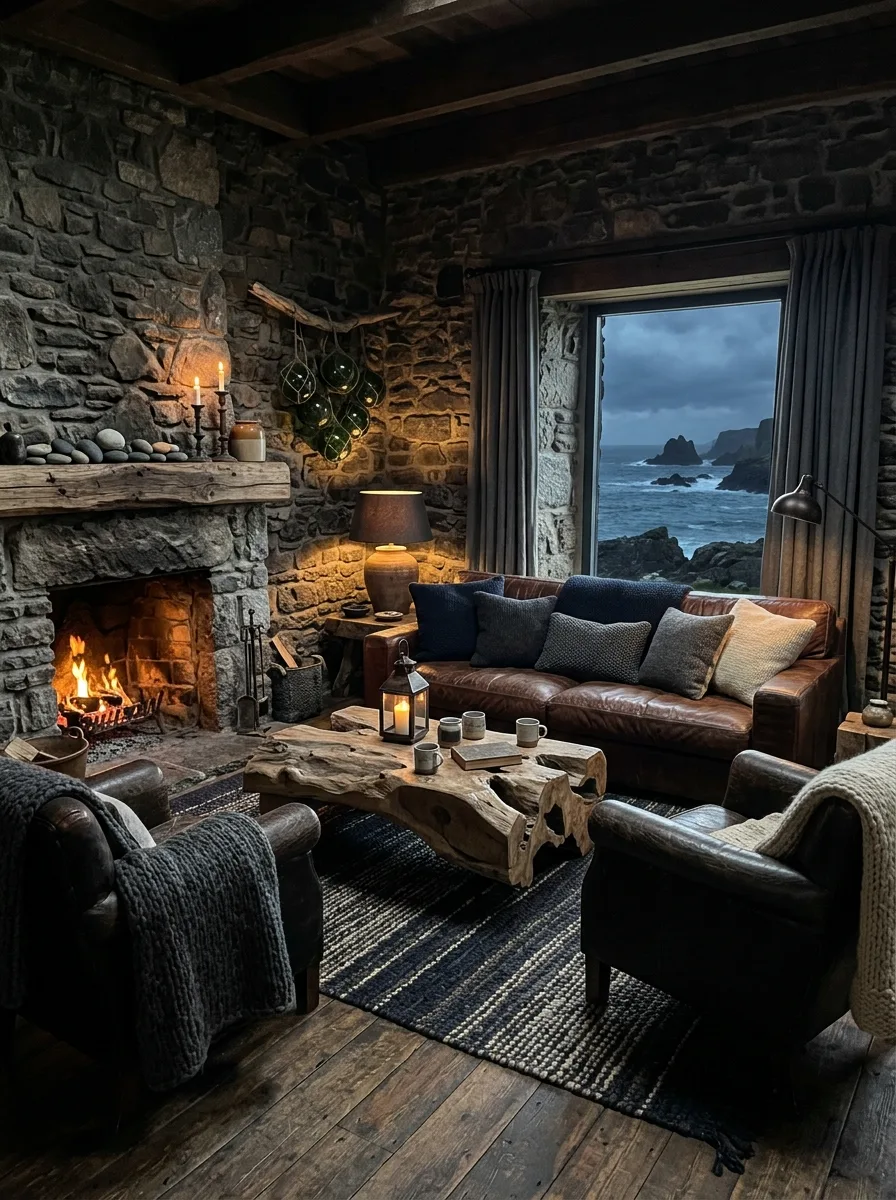
Leave the room’s stone walls exposed and unplastered, allowing the natural texture and irregularity of the stone to show. This is the single material decision that defines the entire look.
Build or restore a substantial stone fireplace as the room’s clear focal point, and keep a fire genuinely lit rather than decorative. This palette depends on real firelight, not a styled mantel.
Furnish with weathered leather sofas in a deep brown, layering in wool throws and knit blankets rather than anything sleek or polished. The leather should look like it’s earned its patina, not arrived that way from a showroom.
Hang glass fishing floats in a cluster on one section of stone wall, and light the room primarily with low table lamps rather than overhead fixtures. At night, with the fire lit and the lamps low, this room should feel like the inside of a working harbor cottage, not a styled rental.
Turquoise Walls Coral Sofa
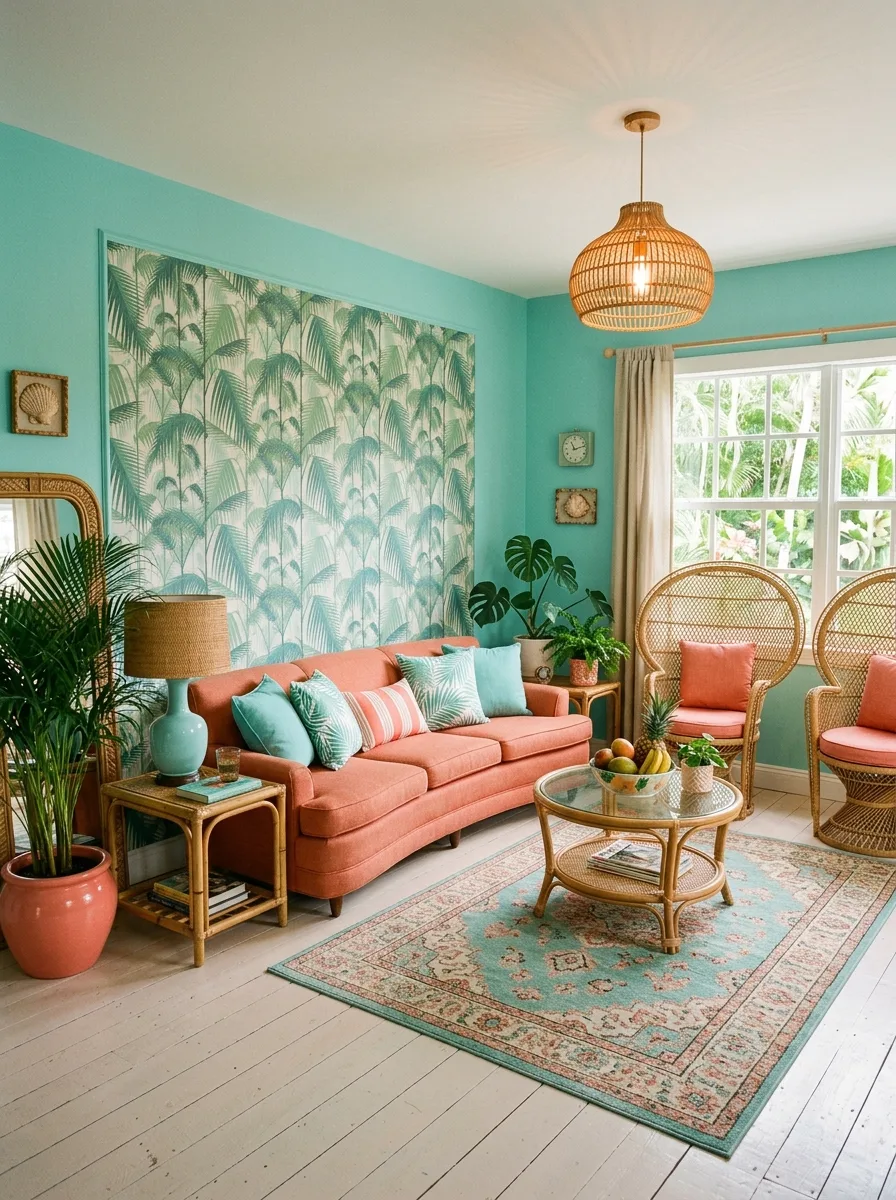
Paint the walls a saturated turquoise, choosing a shade bright enough to read as genuinely tropical rather than a muted seafoam. This palette only works at full saturation.
Upholster a curved, mid-century-shaped sofa in coral or salmon, positioning it as the direct complementary partner to the turquoise walls. The curved silhouette softens what could otherwise be an overwhelming color pairing.
Hang a large-scale tropical leaf wallpaper panel on one wall as a feature rather than wallpapering the entire room. Containing the pattern to a single panel keeps two strong colors and a busy print from fighting each other.
Furnish with rattan peacock chairs in matching coral cushions, and layer a vintage medallion rug in soft blues and pinks underfoot. This is a loud, joyful palette, and it depends on every piece committing to the same energy rather than one neutral object trying to calm it down.
Ombre Indigo Macrame Hanging
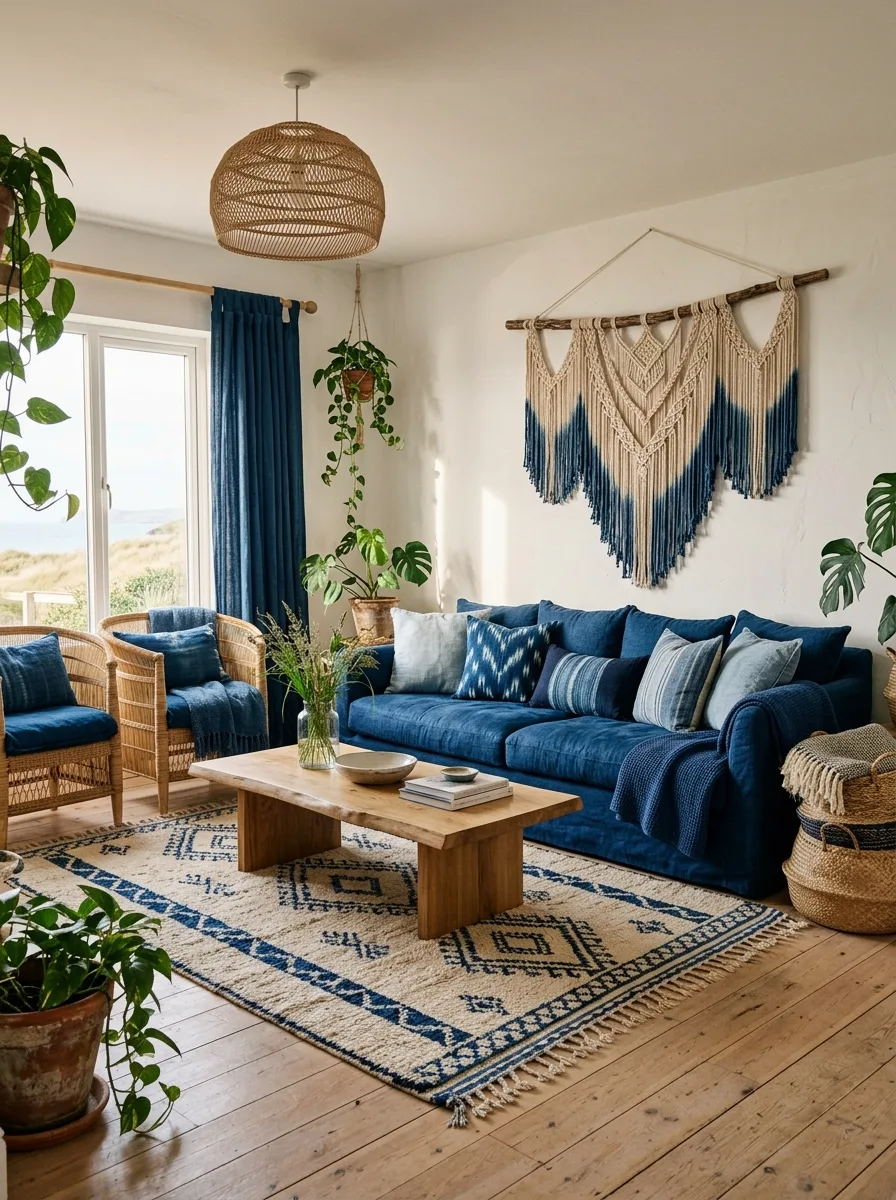
Commission or source a large macrame wall hanging dip-dyed in an ombre gradient from natural cream into deep indigo, and hang it as the room’s main piece of wall art above the sofa.
Upholster the sofa itself in a deep indigo or denim-blue linen, echoing the darkest end of the macrame’s gradient, with a mix of patterned and solid throw pillows layered across it rather than a matched set.
Bring in a rattan peacock chair as a secondary seat, and let several trailing plants, pothos or string of pearls, cascade from shelves and plant stands throughout the room rather than confining greenery to one corner.
Layer a Moroccan-style patterned rug over a plainer jute base rug, allowing the edges of the jute rug to show around the patterned one. This double-rug layering is a signature boho move and reads as considered rather than careless once both rugs are chosen to share the same color family.
Minimalist White Black Accent
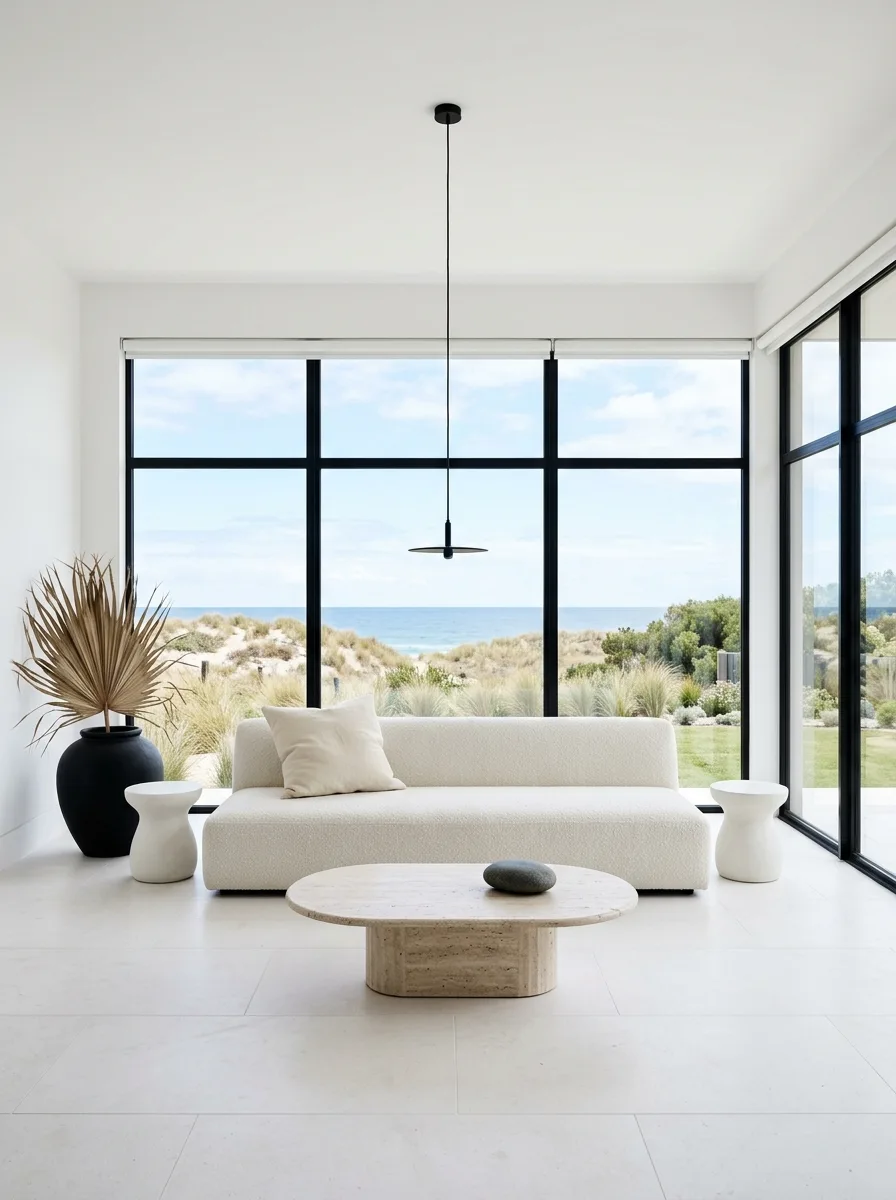
Keep every surface, walls, floor, and the low-profile boucle sofa, in the same soft, warm white, with no painted accent wall and no patterned textile anywhere in the room.
Choose floor-to-ceiling windows with black metal frames as the room’s only hard line, letting the grid of the window frame function as the room’s primary visual structure against an otherwise soft, textureless palette.
Place exactly one object in black, a ceramic vase holding a single dried palm frond, positioned where it interrupts the all-white room without crowding it. One dark object in a room this pale reads as a deliberate punctuation mark.
Finish with a single round travertine coffee table and a small stone or pebble as the only object on it. This look depends on restraint; adding a second decorative object usually means removing one to keep the balance intact.
Antique Mora Clock Corner
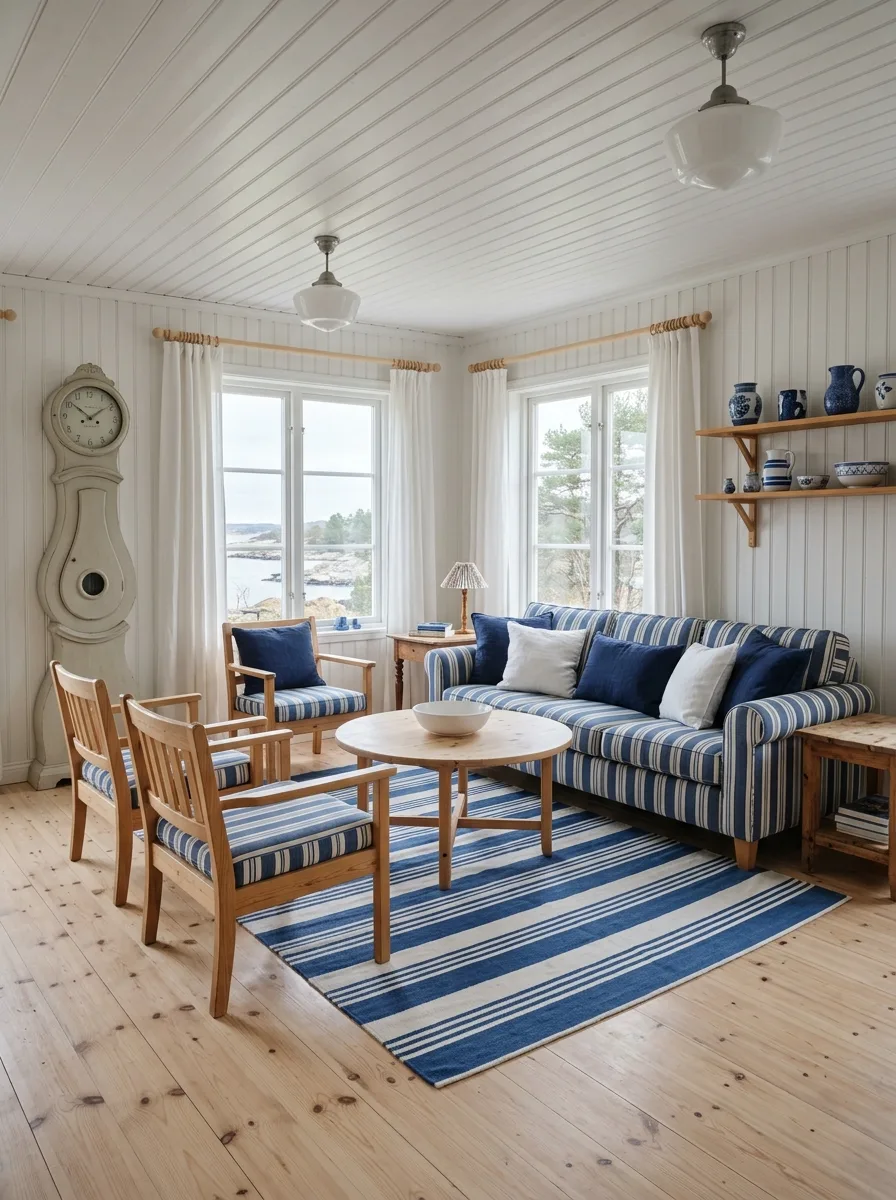
Source an antique or reproduction Mora clock, the tall, curved Swedish longcase style, and position it in a corner of the room rather than against a flat wall, letting its curved silhouette stand apart from the room’s straight lines.
Upholster the sofa and armchairs in a classic blue-and-white stripe, choosing a slightly faded or muted blue rather than a crisp navy, which reads as more cottage than nautical.
Panel the walls and ceiling in painted wood beadboard, running the boards vertically on the walls and horizontally overhead, and hang simple schoolhouse pendant lights rather than anything ornate.
Display a small collection of blue-and-white pottery on open wood shelving near the seating area, choosing pieces that look gathered over generations rather than purchased as a set.
Collected Glass Bottle Shelf
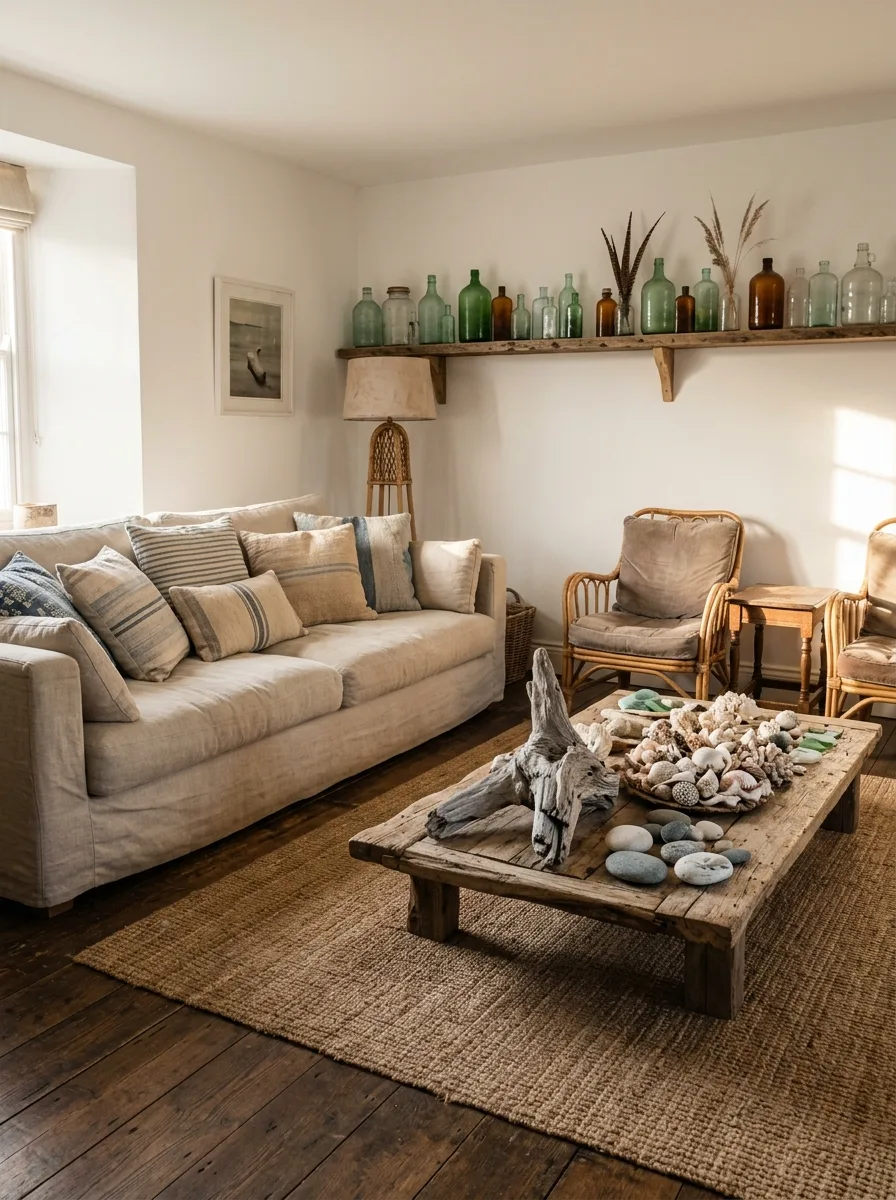
Mount a single long, weathered wood shelf high on one wall, and fill it edge to edge with collected glass bottles in varying shades of green, amber, and blue, allowing the natural light from a nearby window to pass through them.
Furnish with a simple, deep linen sofa in a neutral oatmeal tone, and pile on pillows in mismatched stripes and grain-sack patterns rather than a coordinated set.
Style the coffee table with an actual driftwood branch alongside a wide, shallow bowl of collected shells, sea glass, and smooth stones, gathered over time rather than purchased together as a styled set.
Floor the room in worn, wide-plank wood and layer a simple jute rug underfoot. Every object in this room should look like it has a story attached to it, even the ones that don’t.
Final Thoughts
None of these twenty rooms are wrong about what coastal means. That’s the actual point.
A whitewashed Greek island bench, a moody navy room lit by lamps at night, a turquoise tropical living room loud enough to need sunglasses indoors, these have almost nothing in common materially, and all of them read as unmistakably coastal anyway. What they share isn’t a color palette. It’s a relationship to light, to weathering, to a kind of unstudied comfort that no amount of rope detailing can fake.
The version everyone defaults to, blue and white stripes, a single piece of driftwood, a glass jar of shells, isn’t wrong. It’s just one regional accent in a much larger language, and treating it as the only dialect worth speaking is how a room ends up looking like a hotel lobby instead of somewhere people actually live near water.
Pick your coast. Pick the materials that actually belong to it. The anchors were never required.