
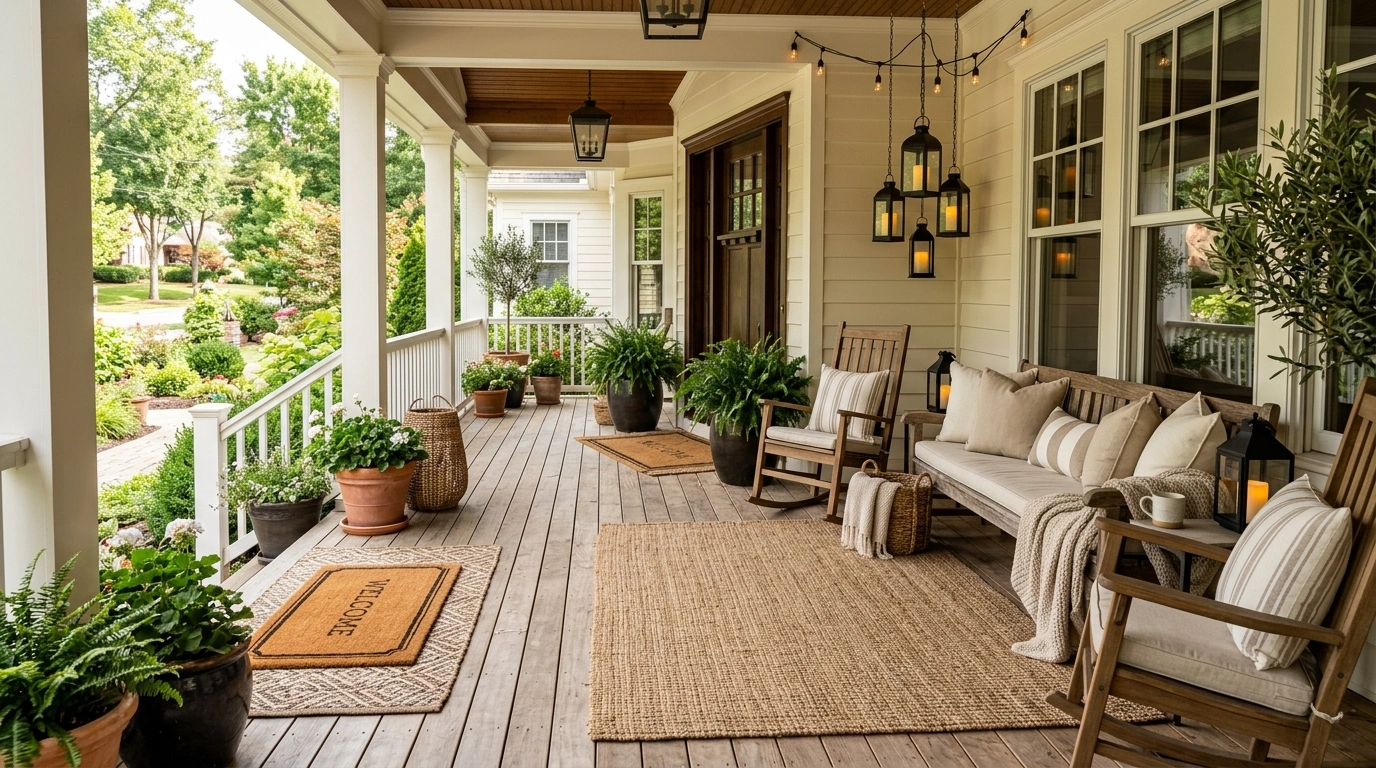
A huge porch can still look unfinished, and the problem usually isn’t a lack of decor. It’s scale.
A small loveseat floating in the middle of a wide porch won’t suddenly look substantial because it has six pillows on it. A tiny rug won’t define a sprawling seating area. And covering every available surface with lanterns, signs, and little planters only makes the space feel scattered.
Large porches need stronger decisions.
The furniture has to hold its ground. Seating needs to form real zones. Empty corners need height, not random filler. Even the front door deserves enough visual weight to stand up to all that surrounding square footage.
Big Porch Decor Ideas
Extend the seating into a grand conversation zone
A spacious porch often feels empty when furniture is pushed against the walls. Pulling a generous sofa and matching club chairs toward the center creates a welcoming hub that makes the vast floor plan feel completely intentional.
Layering in a substantial dark coffee table and a patterned outdoor rug grounds the entire arrangement. The deep blues and neutral tones tie the seating directly to the open-air surroundings without losing that cozy, finished living room vibe.
Finishing touches make all the difference:
* A heavy wooden coffee table that anchors the center * Coordinating outdoor lanterns that echo the wall sconces * Oversized pottery that stands strong next to tall columns
This thoughtful layout turns an intimidatingly large porch into an inviting outdoor retreat that begs for long afternoon gatherings.
Build the whole seating area around one oversized sofa
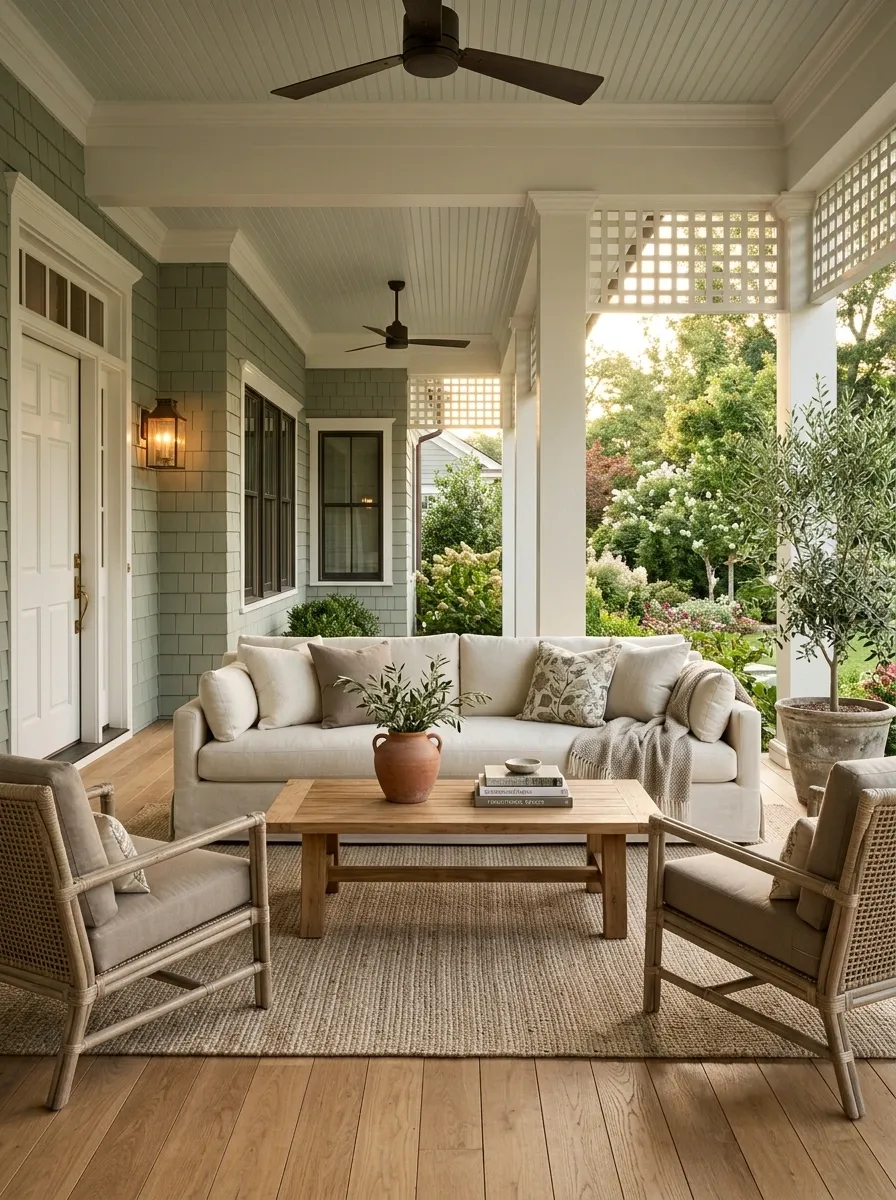
A wide porch can swallow a regular loveseat. The sofa should have enough visual weight to establish the room immediately.
Keep the surrounding pieces quieter. A substantial coffee table, one or two complementary chairs, and a large rug are enough to make the arrangement feel complete.
The strongest combination:
- Oversized sofa
- Large rectangular rug
- Solid coffee table
- Two flexible accent seats
The sofa becomes the anchor instead of leaving every piece fighting for attention.
One grounding rug
Two lighter seats
Embrace cozy autumn charm with warm layers
A long brick porch can easily feel cold and exposed when the seasons shift. Adding rich seasonal textures transforms a blank concrete slab into a welcoming walkway that practically greets guests before they even reach the front door.
Pairing a classic wooden bench with a woven jute rug instantly softens the hard surfaces. Piling on plaid pillows and a chunky knit throw brings that irresistible indoor comfort straight out to the open air.
Essential elements for this look:
* Vibrant mums in oversized heavy urns * A collection of varied pumpkins leading the path * Warm ambient lanterns glowing as dusk settles
It is all about making the transition from yard to home feel layered, deliberate, and entirely ready for crisp weather.
Anchor the seating with a rug that matches the porch scale
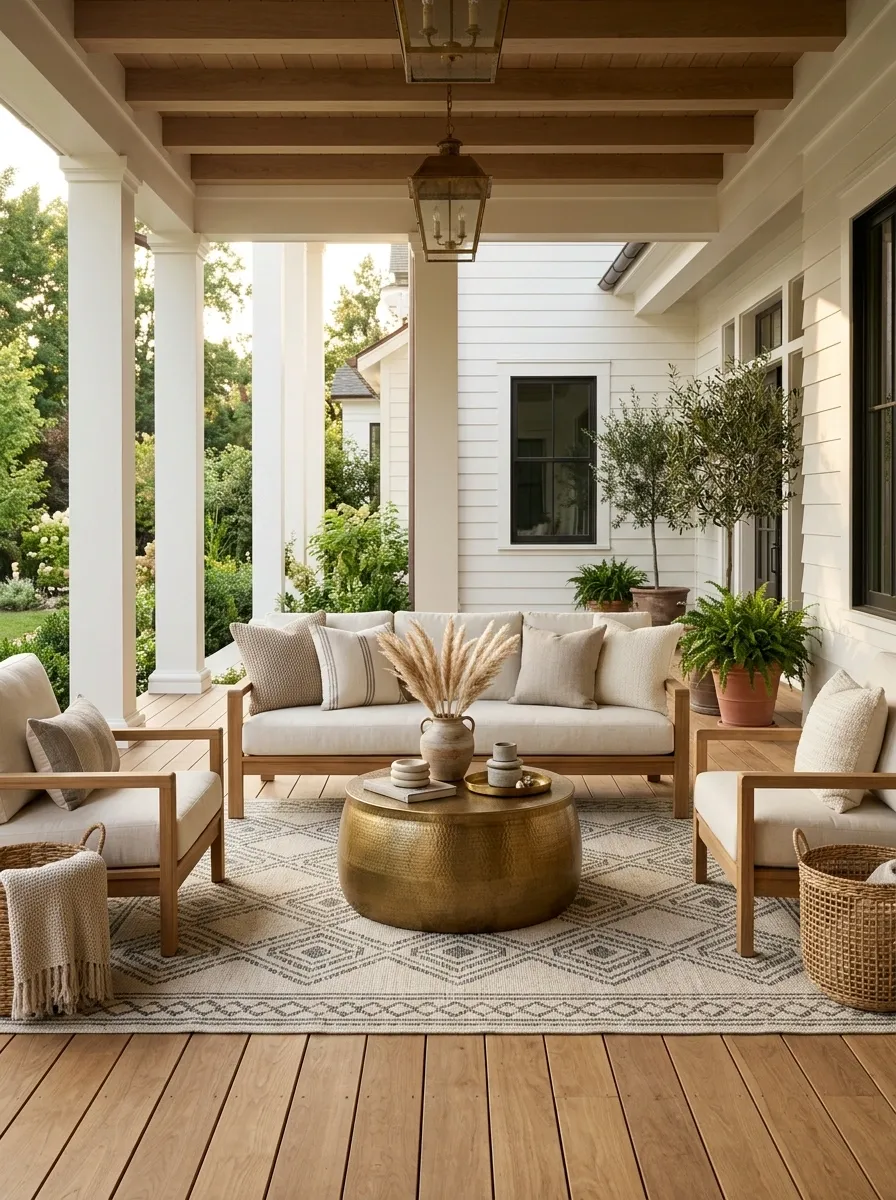
A tiny rug makes a huge seating area look disconnected.
Choose a rug large enough for the front legs of the main seating to sit comfortably on it. The floor should still show around the edges, but the rug needs to visually bind the furniture together.
Place it in this order:
- Center the rug inside the seating zone.
- Position the sofa first.
- Pull chairs toward the rug rather than toward the walls.
That simple shift makes the furniture feel like one deliberate room instead of several objects sitting apart.
Layer endless string lights for magical evening ambiance
High, expansive porch ceilings can swallow standard lighting, leaving the space feeling cavernous after dark. Crossing rows of bistro lights overhead brings the ceiling down visually while casting a warm, starry glow across the entire floor.
Combining this canopy of lights with classic wall sconces and heavy floor lanterns ensures the light hits every corner. The resulting golden hour effect makes the porch feel like an outdoor lounge you never want to leave.
Key features of this setup:
* Crisscrossing string lights spanning the full length of the roof * A mix of rattan seating and a swinging daybed * Lush potted blooms softening the rustic wooden floorboards
This lighting strategy turns a sprawling porch into a magical nighttime oasis perfect for late-night conversations.
Arrange two deep lounge chairs around a substantial central table
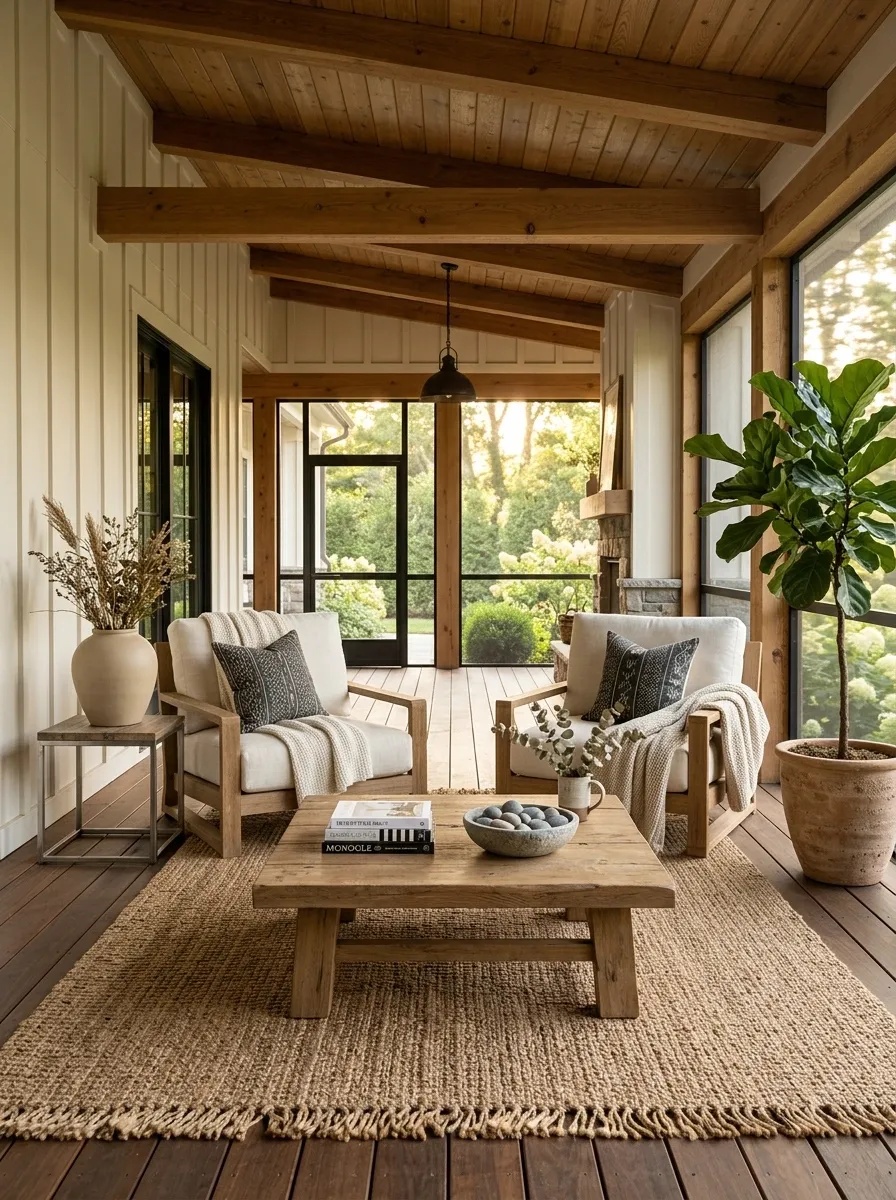
Two chairs can look lost on a giant porch when they’re pushed to opposite sides. Bring them closer and give them a table with enough mass to connect the arrangement.
The result feels more intimate without sacrificing the open footprint.
Best proportions:
- Deep chairs with broad arms
- A low, solid center table
- Enough space between seats for easy movement
- A rug underneath to visually lock the group together
The center should feel intentionally occupied, not accidentally crowded.
Create a seamless daybed lounge along the rustic rail
Long, narrow porches often struggle with a bowling-alley effect when furniture is lined up endlessly. Turning one long stretch into a built-in style daybed invites you to stretch out and enjoy the view without cluttering the walkway.
Keeping the palette entirely neutral allows the weathered wood ceiling and lush green surroundings to take center stage. A vintage runner rug breaks up the painted floorboards and defines the lounging zone beautifully.
What brings this space together:
* An extra-long upholstered bench piled with soft white linens * A distressed vintage rug adding texture and warmth * Simple glass lanterns ready for evening candle flicker
It is the ultimate spot for an afternoon nap, proving that big porches simply need furniture built for serious relaxation.
Give one end of the porch a proper dining setup
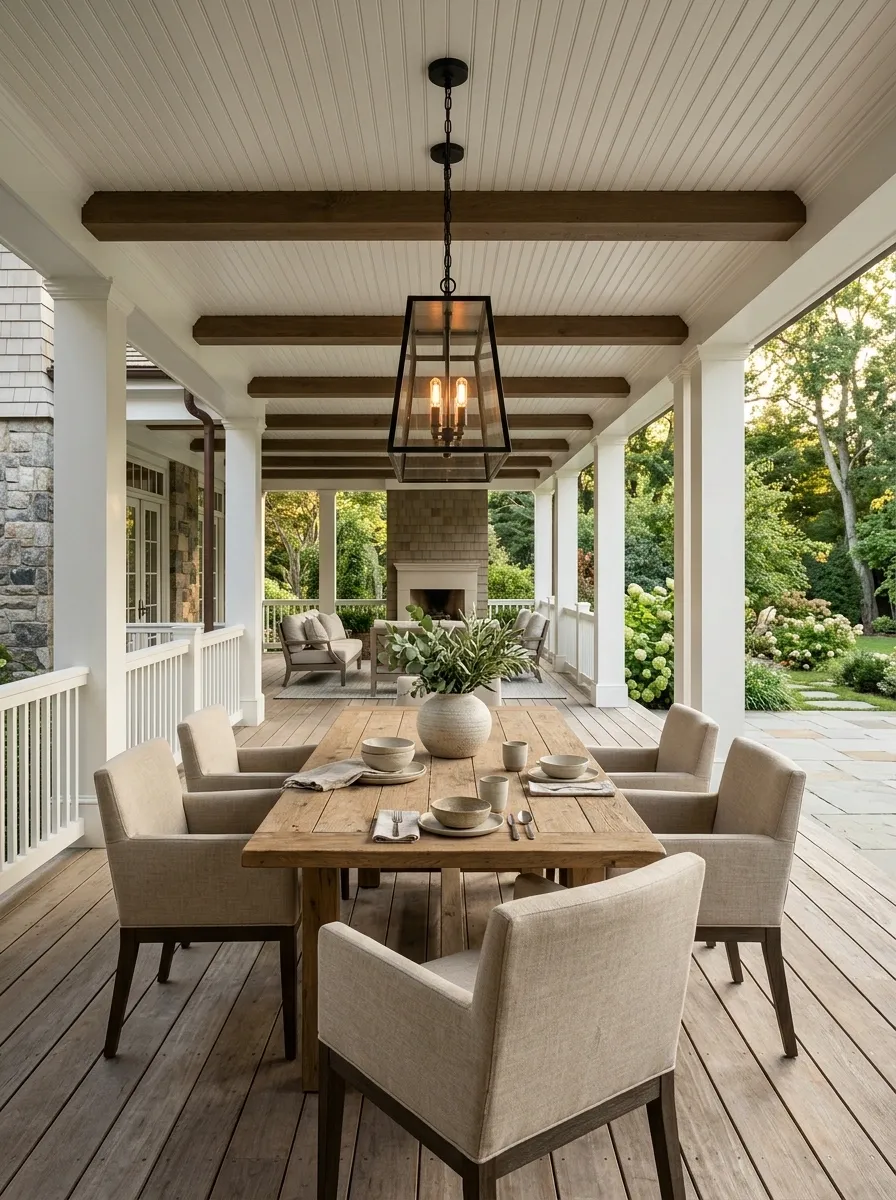
A large porch shouldn’t force every activity into one seating cluster. A dining zone gives an unused end of the porch an obvious job.
Use a long table instead of a tiny four-seat set. Add a simple pendant or lantern overhead, then keep the tabletop restrained.
A practical setup needs:
- A long weather-friendly table
- Comfortable dining chairs
- One overhead light source
- Clear walking space behind the chairs
This works especially well on porches that connect directly to a kitchen or backyard entertaining area.
Comfortable chairs
Overhead lighting
Open circulation
Hang oversized lanterns where tiny fixtures disappear
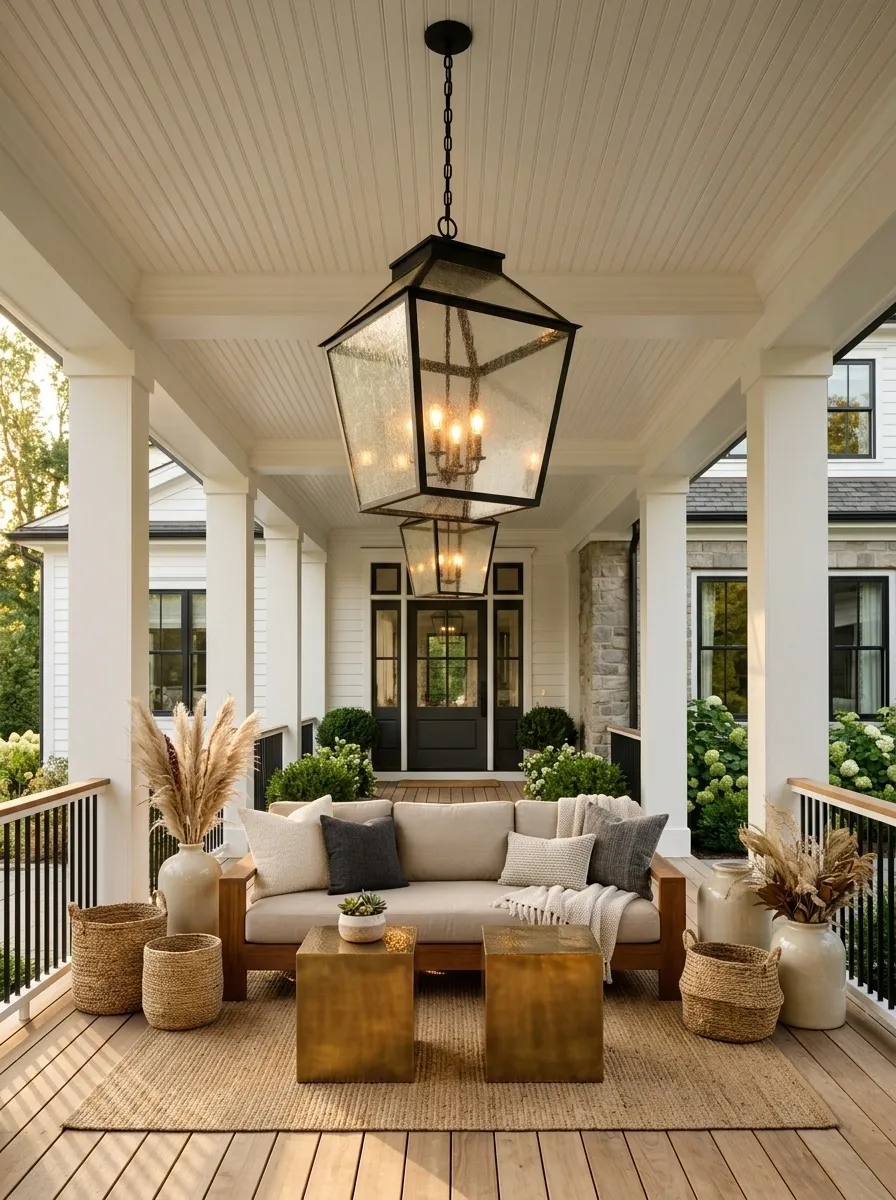
Large porches have a common lighting problem: a fixture that looked substantial indoors suddenly looks microscopic outside.
Go bigger.
Oversized lanterns create a stronger architectural presence, especially above a seating area, dining table, or entry. Repeating the same finish in another porch detail, such as hardware or a side table, makes the fixture feel intentional.
Placement matters more than quantity. One properly scaled lantern can do more than several undersized lights scattered around the ceiling.
Use tall planters to fill dead vertical space
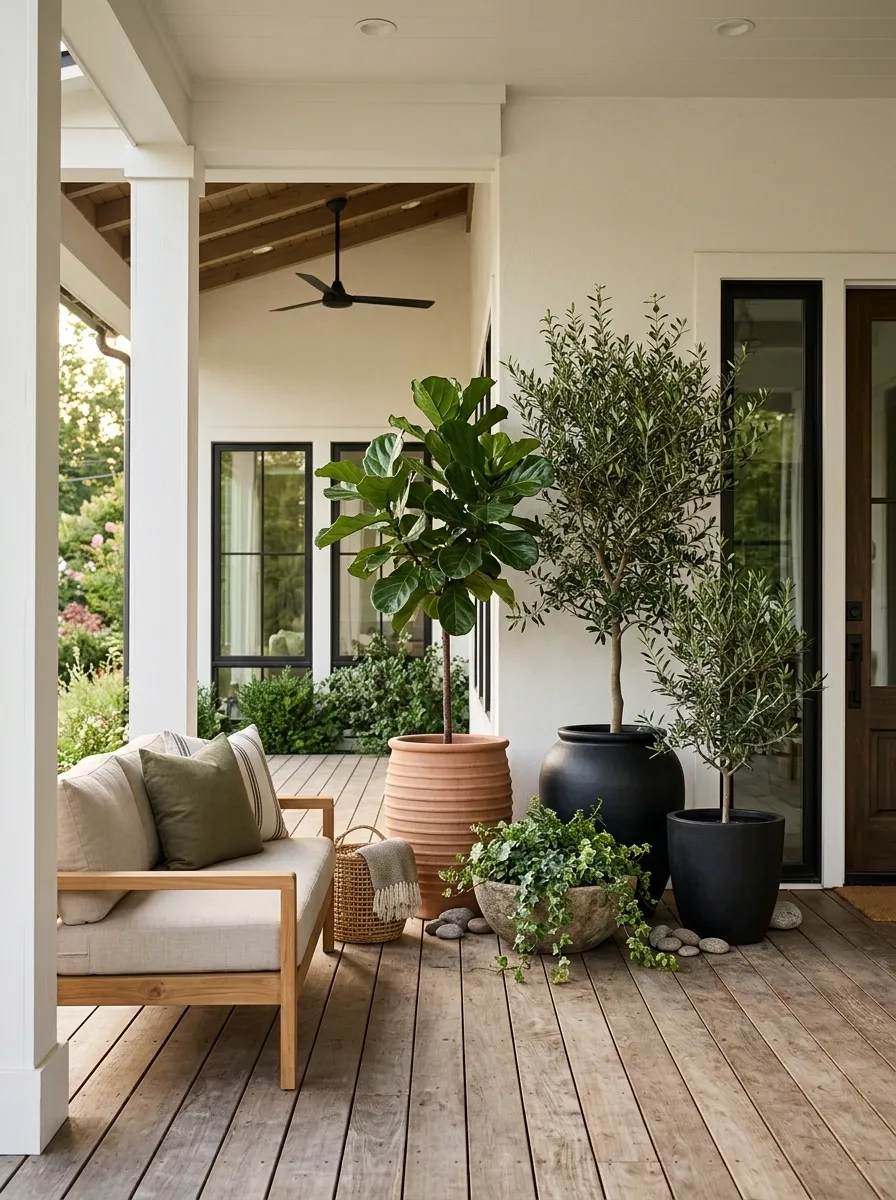
Empty corners aren’t asking for more tiny accessories. They’re asking for height.
Tall planters work because they pull the eye upward while also giving those awkward porch edges some structure. Group different heights together instead of lining identical pots along every wall.
A stronger grouping looks like this:
- One tall planter as the anchor
- One medium pot beside it
- One lower planter slightly forward
- Enough empty space around the group to keep it crisp
Large leafy plants work especially well beside columns, stairs, and furniture that already sits low.
Make a large porch swing the visual centerpiece
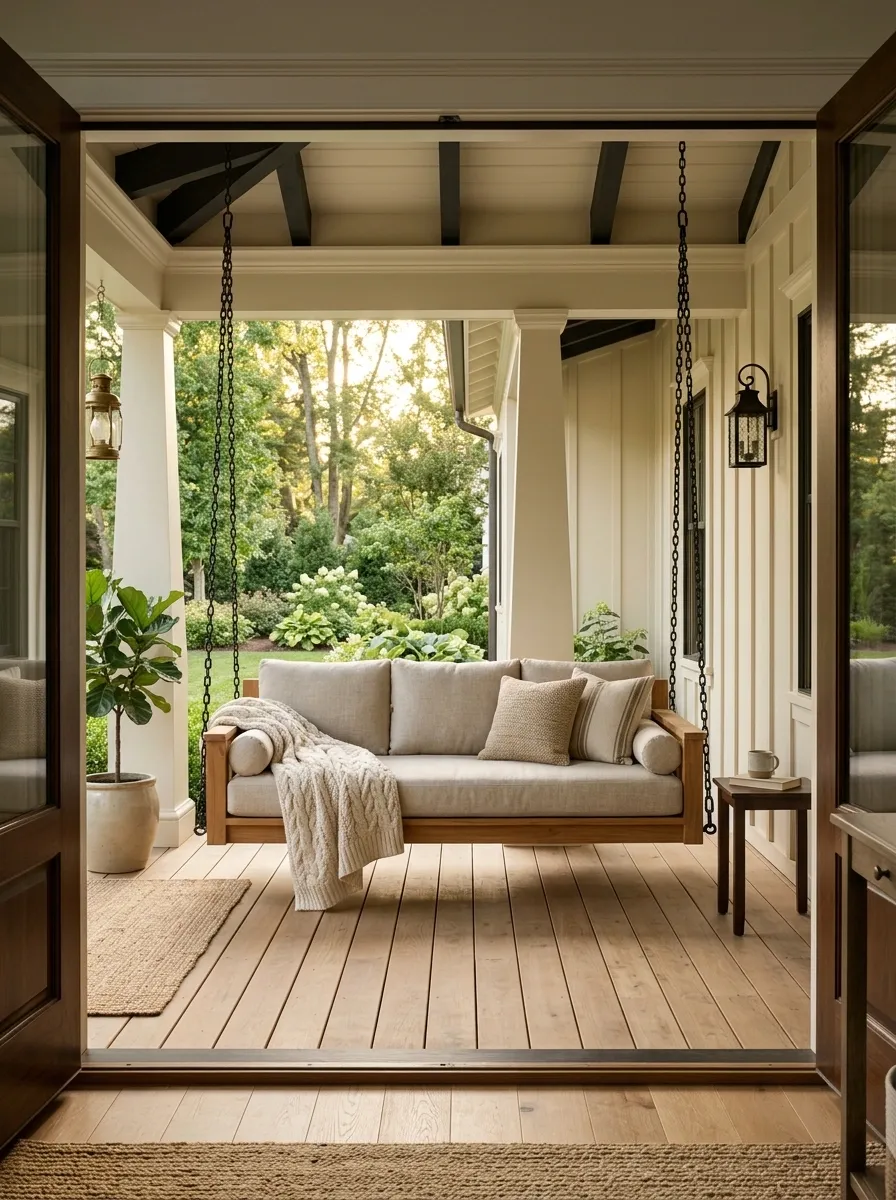
A porch swing earns its space because it does two jobs at once. It provides seating and gives the entire porch a recognizable focal point.
Go for a swing with real presence rather than a narrow decorative model. A deep seat, substantial frame, and oversized cushions make it read like furniture rather than an accessory.
Place it where it can be seen from inside the house.
That’s the detail that turns a swing from a nice addition into the feature that organizes the porch.
own the wall.
A broad swing instantly gives a large porch something to visually revolve around.
Frame the entry with matching planters and layered welcome details
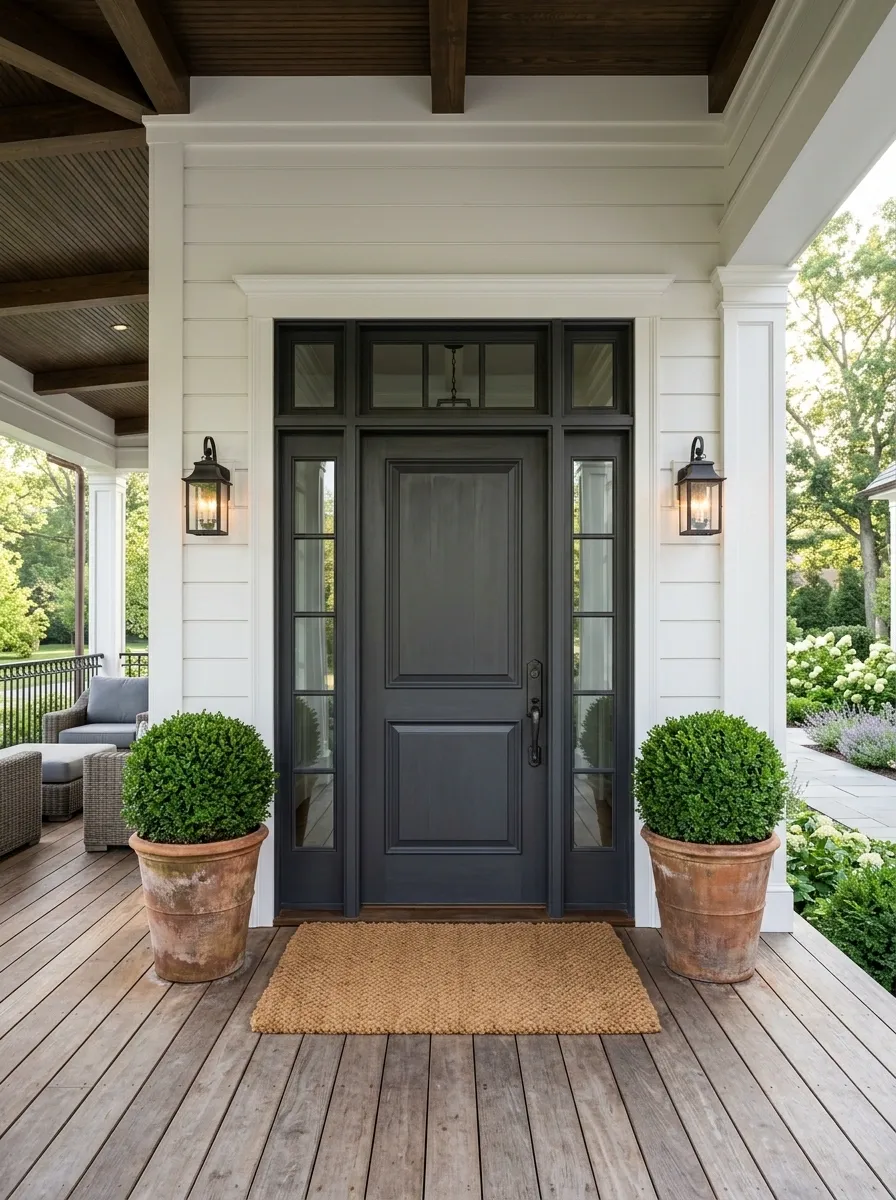
The front door is already the strongest architectural feature on most porches. Use that fact.
Matching planters on either side create instant structure, while a restrained doormat and one seasonal detail finish the entry without making it look busy.
Keep the doorway composition symmetrical:
- Tall planter
- Simple foliage
- Clean doormat
- One small seasonal accent
The entry should look finished from the sidewalk. Tiny decorations won’t do that job.
Create a conversation circle instead of pushing everything against the walls
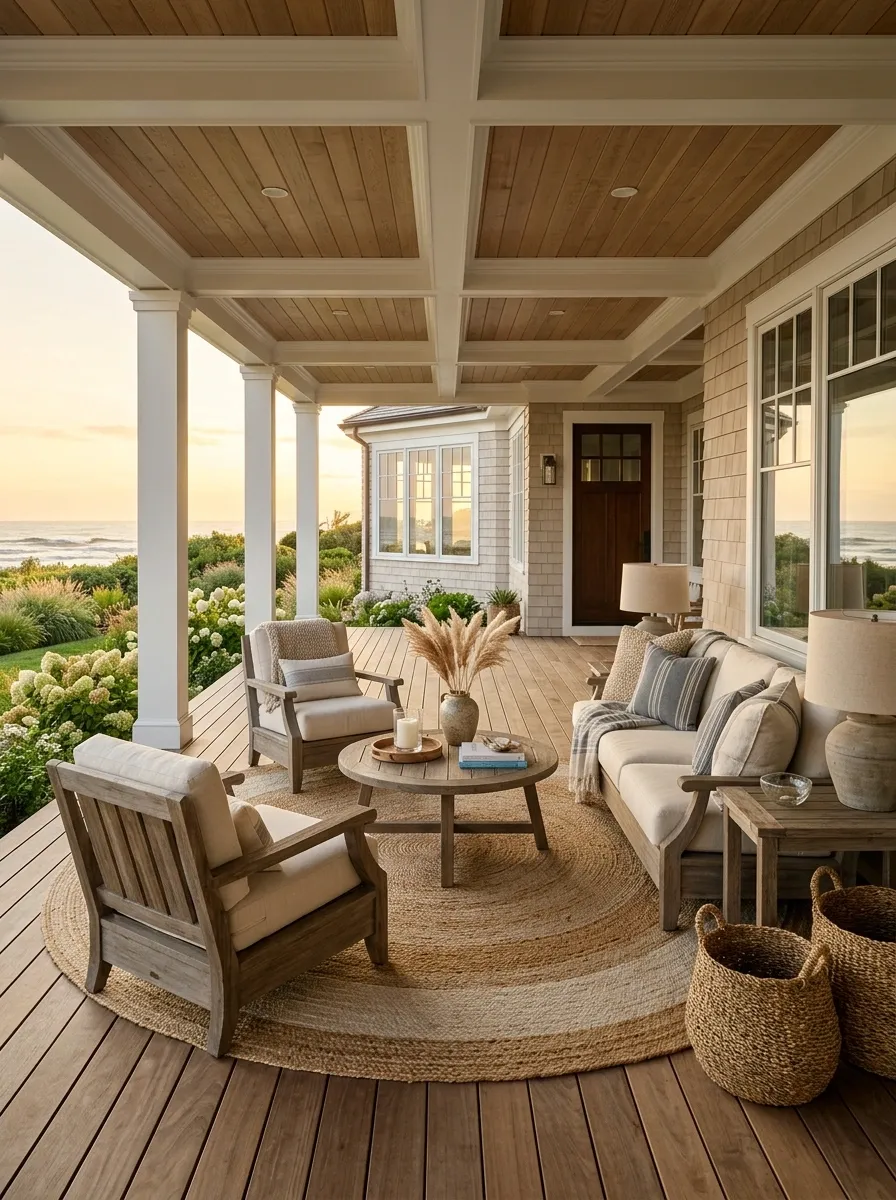
Pushing every chair against the porch walls is one of the fastest ways to make a big porch feel like a waiting room.
Bring the seating inward and let the center breathe around it. The arrangement should encourage people to face each other, not stare toward the yard from separate corners.
A strong conversation zone has:
- One large central table
- Seating on at least three sides
- A rug defining the footprint
- An open path around the outside
That empty perimeter is useful. It keeps traffic moving while the furniture gets to feel grounded.
Use full-length curtains to soften a wide open porch
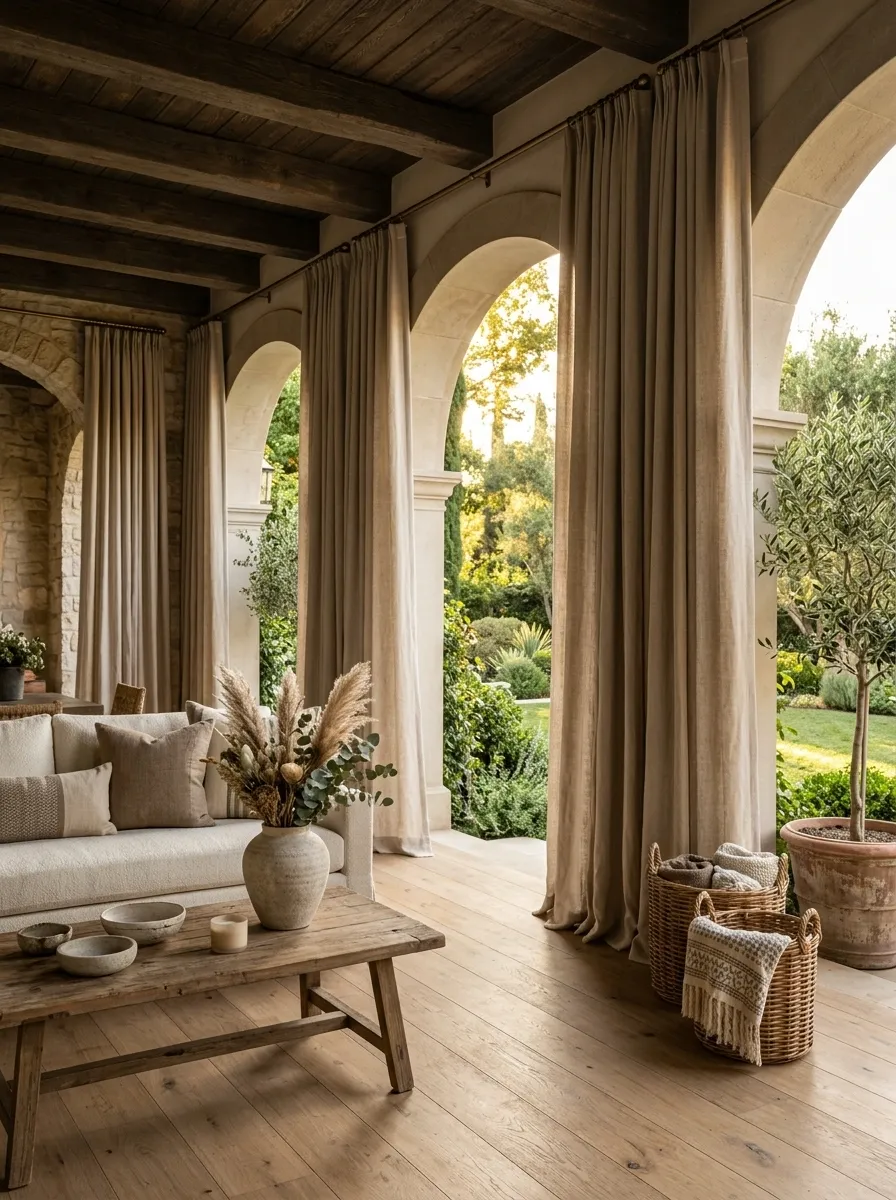
Wide, uncovered openings can make a porch feel flat even when the furniture is right.
Outdoor curtains add a vertical layer that visually lowers the ceiling and gives the porch a little privacy. Hang them high and let them fall close to the floor. Stopping them halfway down the opening makes the porch look shorter and visually choppier.
Choose a heavier outdoor fabric in a quiet neutral so the movement of the curtains becomes part of the atmosphere instead of another busy pattern.
Mix seating heights so the porch doesn’t look visually flat
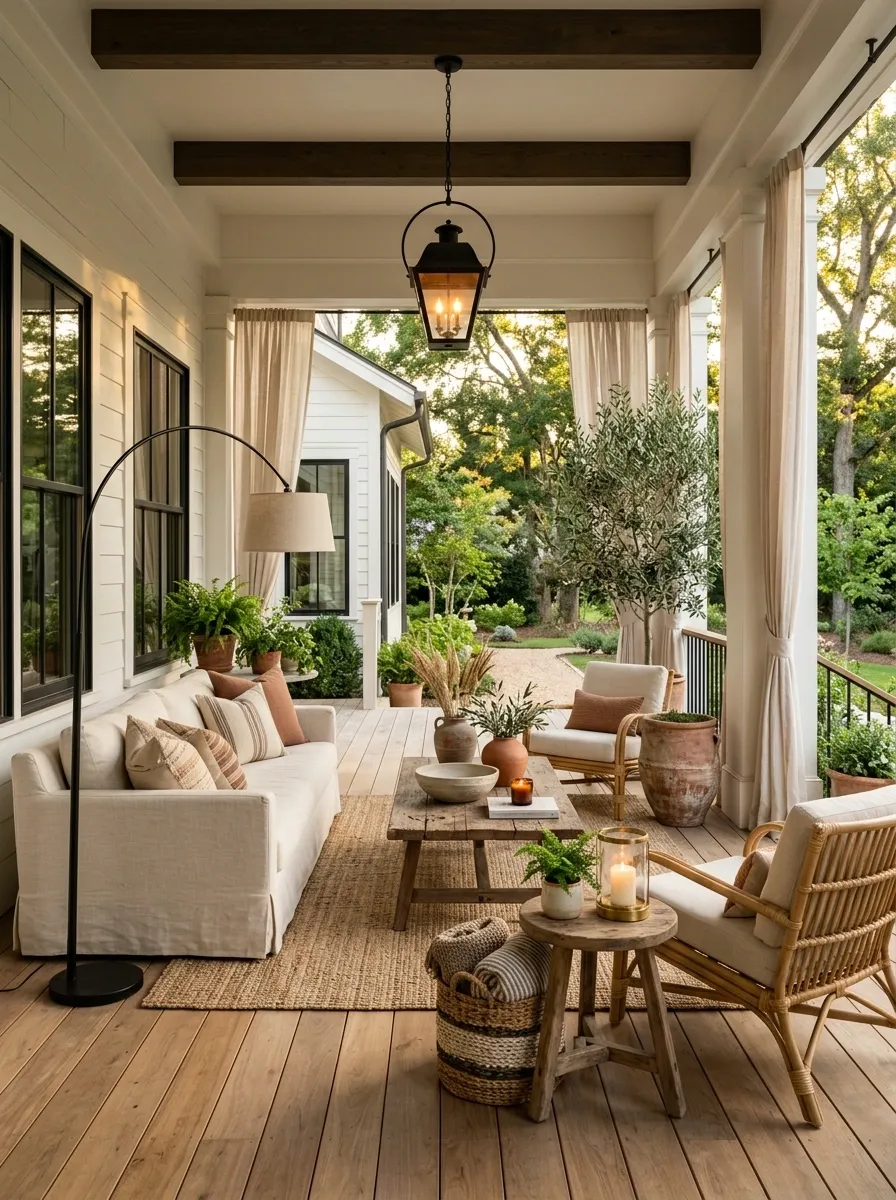
A porch filled with furniture at the same height has no rhythm.
Break that horizontal line. Pair a low sofa with taller lounge chairs, then introduce a standing planter, floor lamp, or lantern above the seating. The eye should move naturally from the floor to the furniture and then upward.
Think in three levels:
LOW
Coffee tables, ottomans, low planters
MID
Sofas, chairs, side tables
HIGH
Plants, lamps, curtains, hanging lights
That simple hierarchy makes a large porch feel layered instead of stretched out.
Place a long console behind the main seating
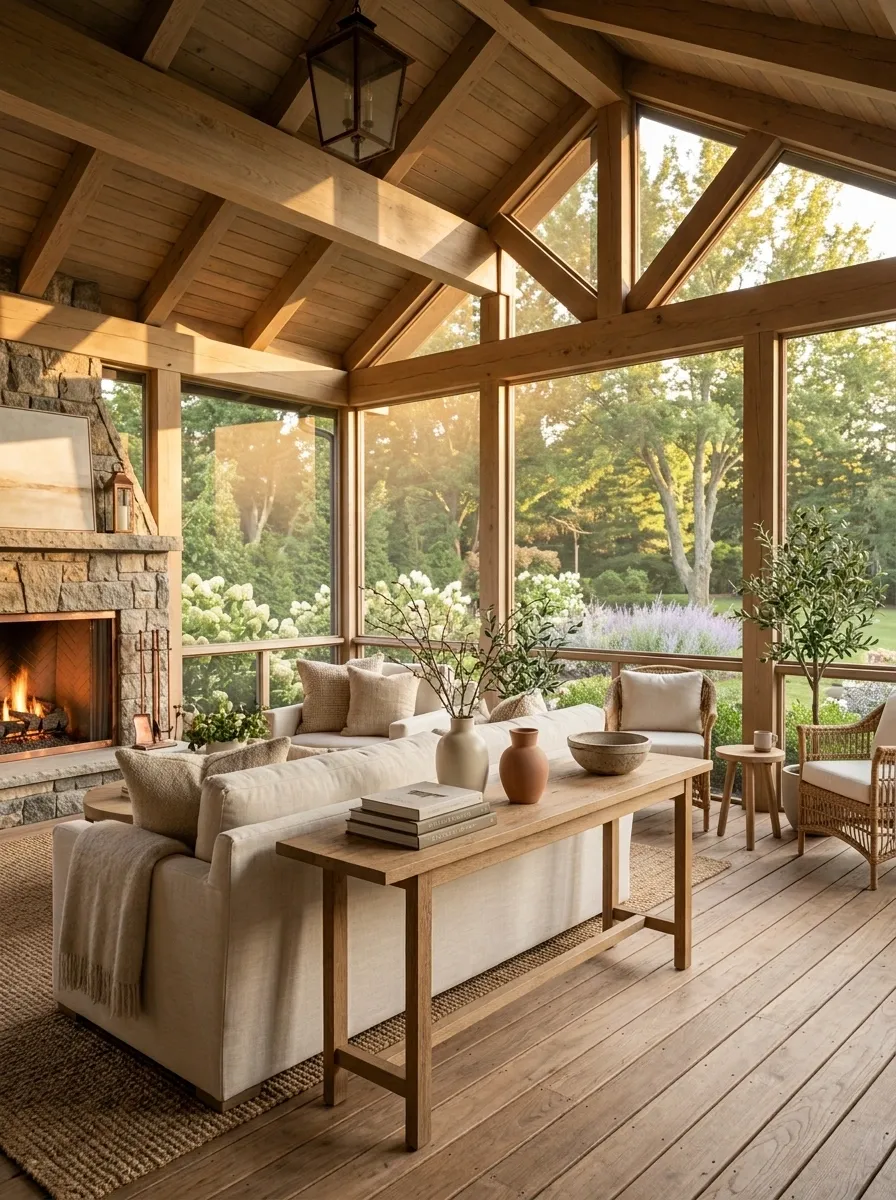
The space behind a sofa often gets ignored, especially on a deep porch. That’s valuable real estate.
A long, narrow console fills that horizontal gap without stealing the walking area. Keep its depth modest, then repeat one finish from the seating or porch structure so it feels built into the arrangement.
Style the top with restraint.
A clean console setup:
- One large planter or lamp
- A shallow tray
- One small decorative object
The furniture fills the space. The styling shouldn’t compete with it.
Build the seating around a fireplace or fire feature
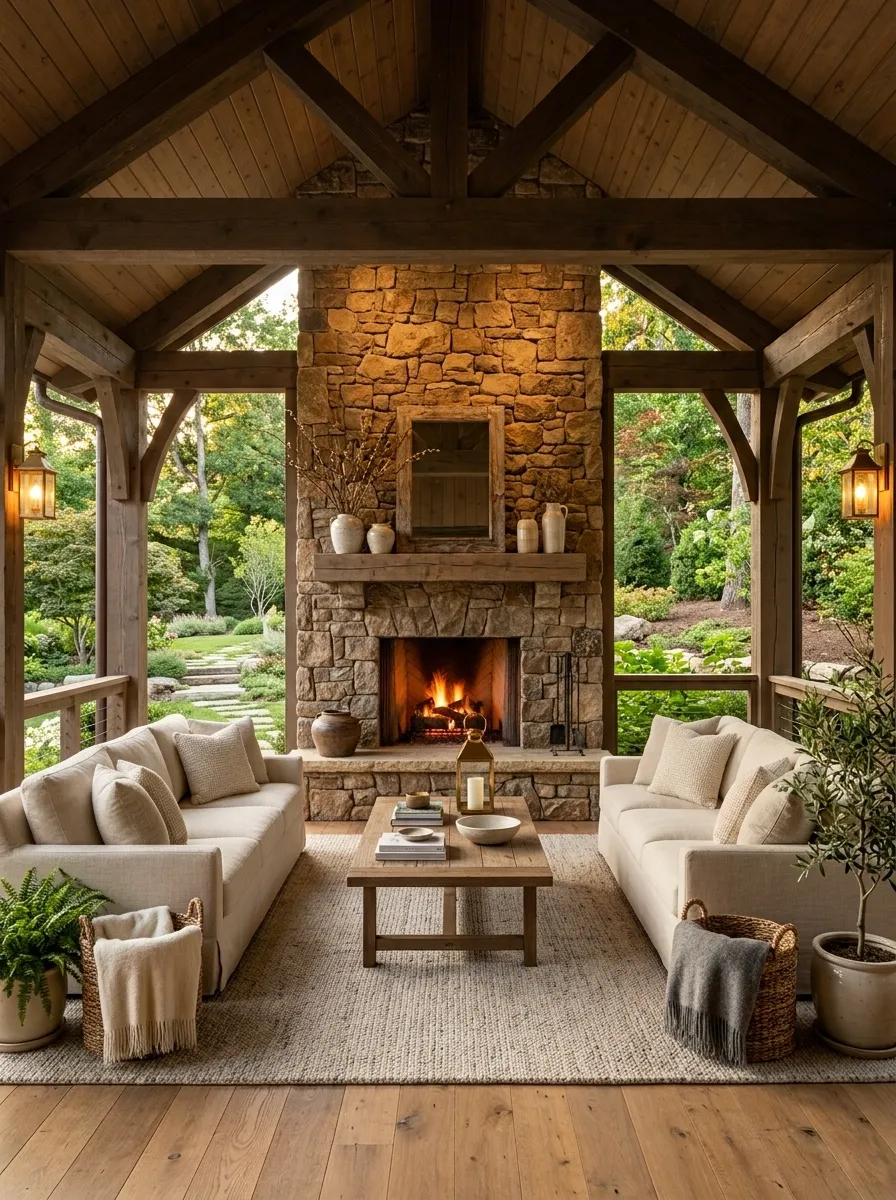
A fireplace gives the porch something powerful that furniture alone can’t provide: a natural destination.
Start with the fire feature, then point the seating toward it. Don’t push the chairs so close that the fireplace feels trapped. The strongest arrangement leaves a comfortable visual gap between the fire and the furniture.
Build outward from the focal point:
FIRE → TABLE → SEATING → WALKWAY
That order prevents the common mistake of arranging the furniture first and treating the fireplace like an afterthought.
Hang one oversized artwork instead of covering the wall with tiny pieces
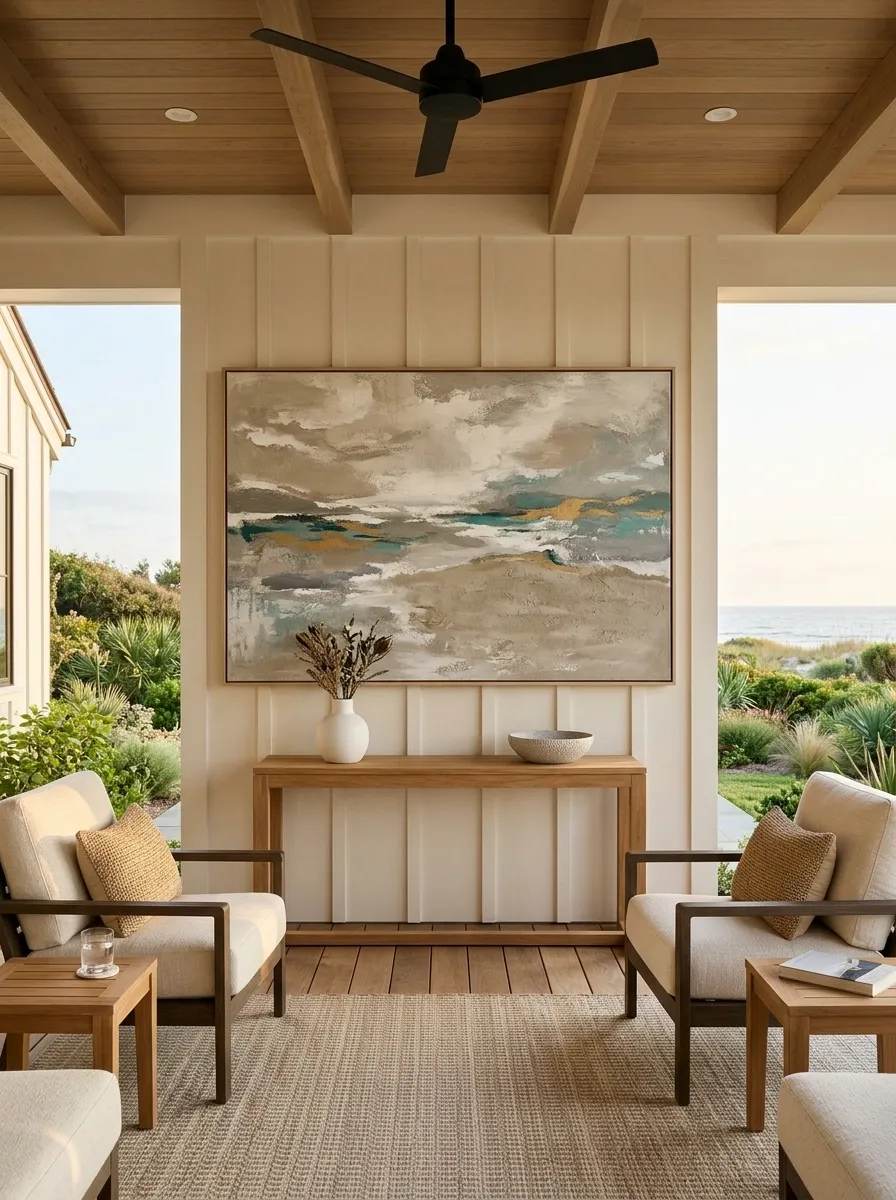
Large porch walls need scale. A collection of little signs, frames, and plaques usually makes the wall look busy without making it feel finished.
One oversized piece has the opposite effect.
Choose a large weather-safe artwork, sculptural metal piece, woven wall panel, or architectural object. Let it occupy a meaningful portion of the wall while the surrounding space stays quiet.
The rule is simple: one memorable object beats a dozen competing accents.
This is especially effective above a console, behind a sofa, or beside a tall fireplace.
Create a quiet reading corner with three key pieces
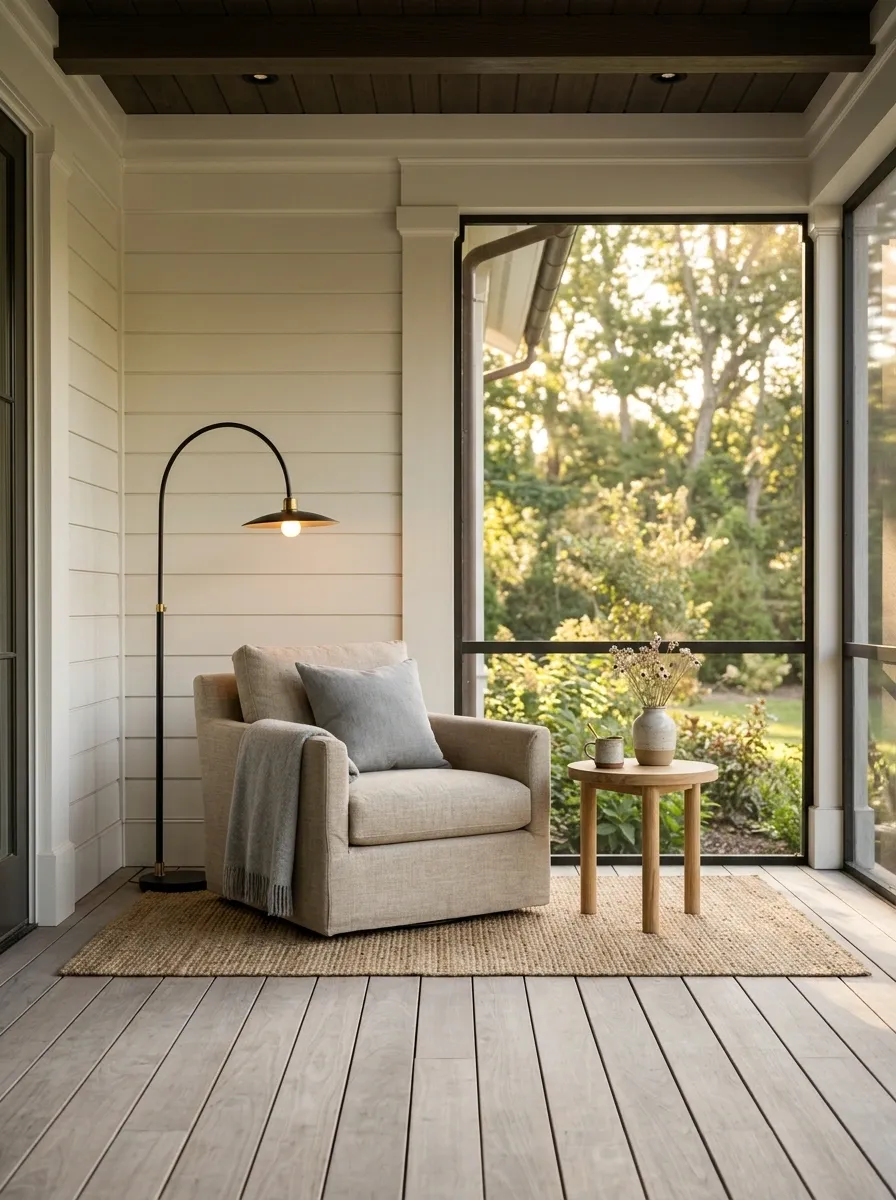
A giant porch doesn’t need every zone to handle a crowd.
A reading corner gives one overlooked section a specific purpose. Start with a comfortable chair, add a small side table, then bring in a floor lamp or hanging light for height.
That’s enough.
The three-piece formula:
Seat + surface + light
Don’t crowd the corner with an extra chair just because there is room. The open space around the setup is what makes it feel like a retreat instead of leftover furniture.
Layer floor planters around steps and corners for depth
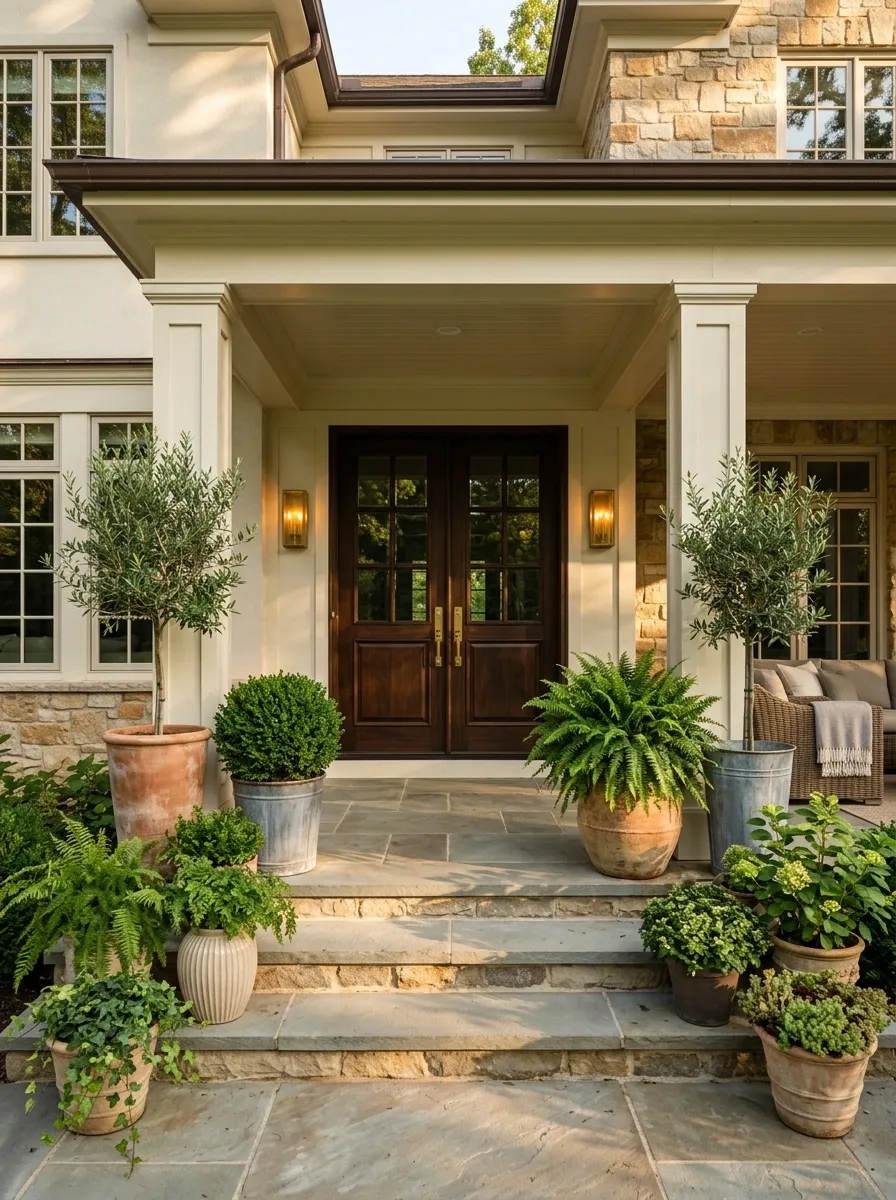
A porch can have plenty of furniture and still look two-dimensional.
Plants solve that by creating depth at the edges. Place taller foliage behind shorter pots, especially around stairs, columns, and the outside corners of seating areas.
Avoid making a perfect row.
Use a staggered rhythm instead:
Tall → low → medium → empty space → tall
That break in the pattern keeps the arrangement relaxed and prevents the porch from looking like a garden center display.
Let the heights wander.
A staggered plant arrangement creates depth along hard architectural edges.
Create a second seating zone instead of overcrowding the first
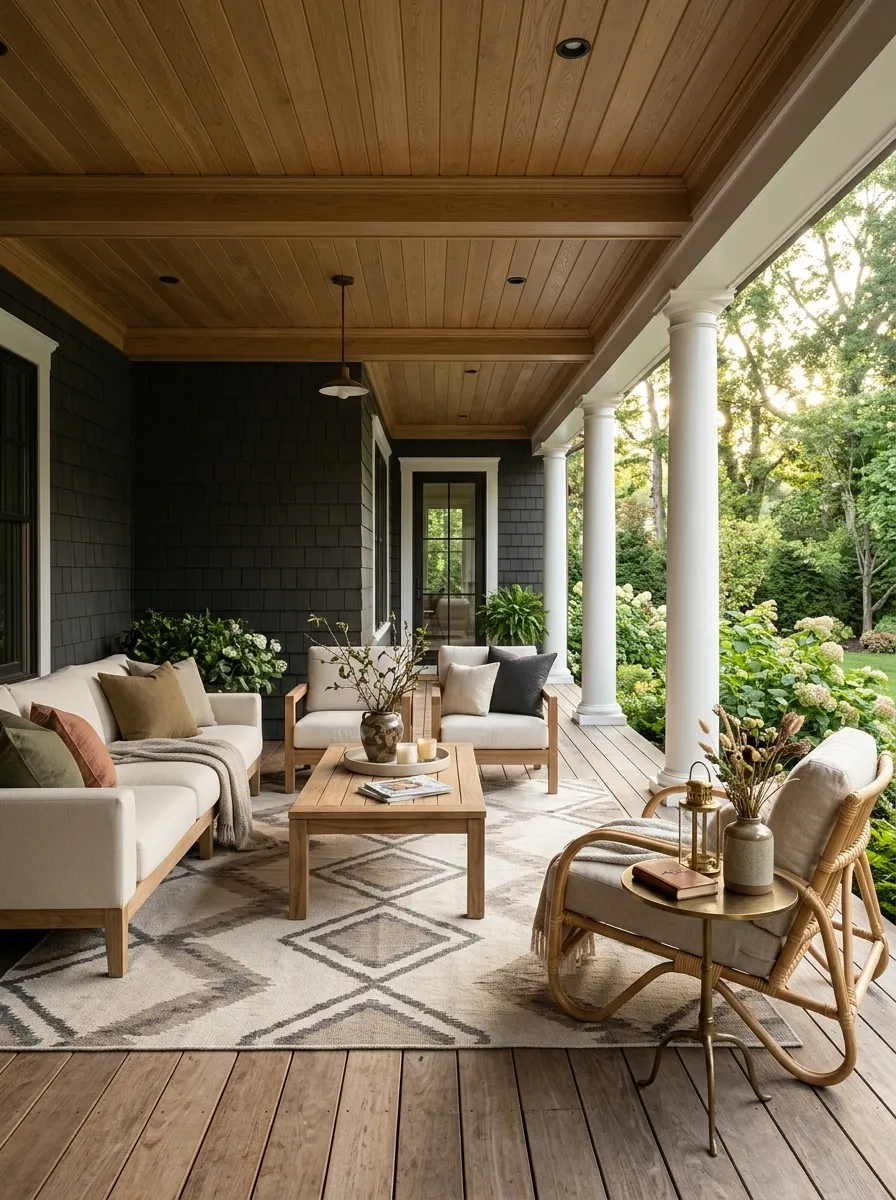
A porch that stretches far beyond the main seating area has no reason to force everything into one cluster.
Use the extra footage.
A second zone can become a pair of chairs for morning coffee, a small bench for conversation, or a compact lounge near the garden. Give it its own rug or distinct furniture arrangement so the eye reads it as a separate destination.
Zone one: social seating
Zone two: quiet seating
That separation makes a large porch feel intentionally designed rather than merely spacious.
Repeat one color story through cushions, rugs, and accessories
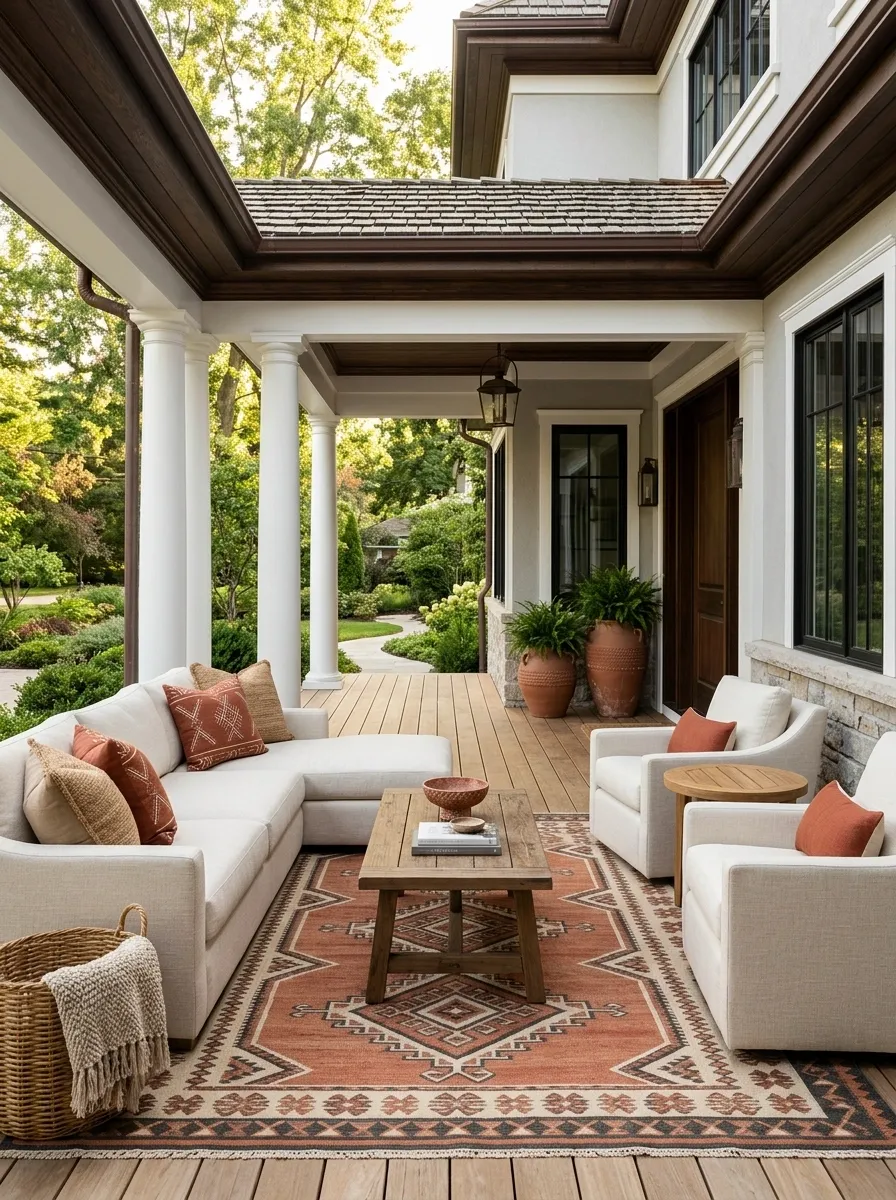
A large porch can handle more than one color, but it shouldn’t look like every piece arrived from a different house.
Pick one supporting color and repeat it across three or four touchpoints. A cushion can echo the rug. The rug can echo a planter. A throw can pick up the same tone again.
That’s enough repetition to make the porch feel connected without making everything match.
A simple color chain:
Cushion → Rug → Planter → Small accessory
Keep the large furniture neutral so the repeated color has room to stand out.
Fill a broad porch with a long outdoor dining table
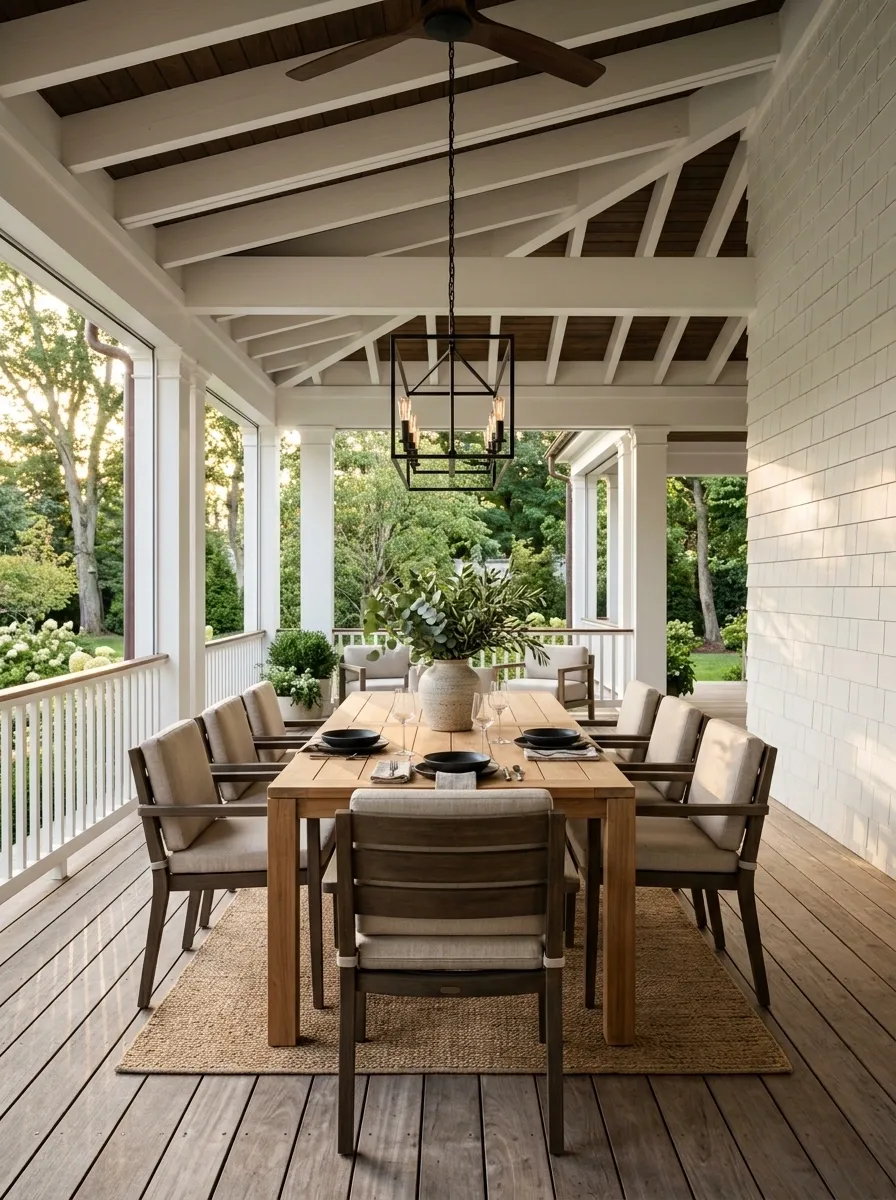
A large dining table instantly gives a wide porch more visual structure.
Choose a table with enough length to match the footprint. Short tables surrounded by empty floor make the porch feel undersized from the center outward.
Keep the chairs consistent and let the tabletop do most of the visual work. A simple centerpiece is enough.
Before adding the final accessories, check:
- Chairs pull out without hitting walls or railings.
- The table doesn’t cut across the main path.
- The lighting lines up with the table.
- Enough open space remains beyond the chairs.
That last check matters. A dining zone needs breathing room.
Turn an unused wall into an outdoor drink station
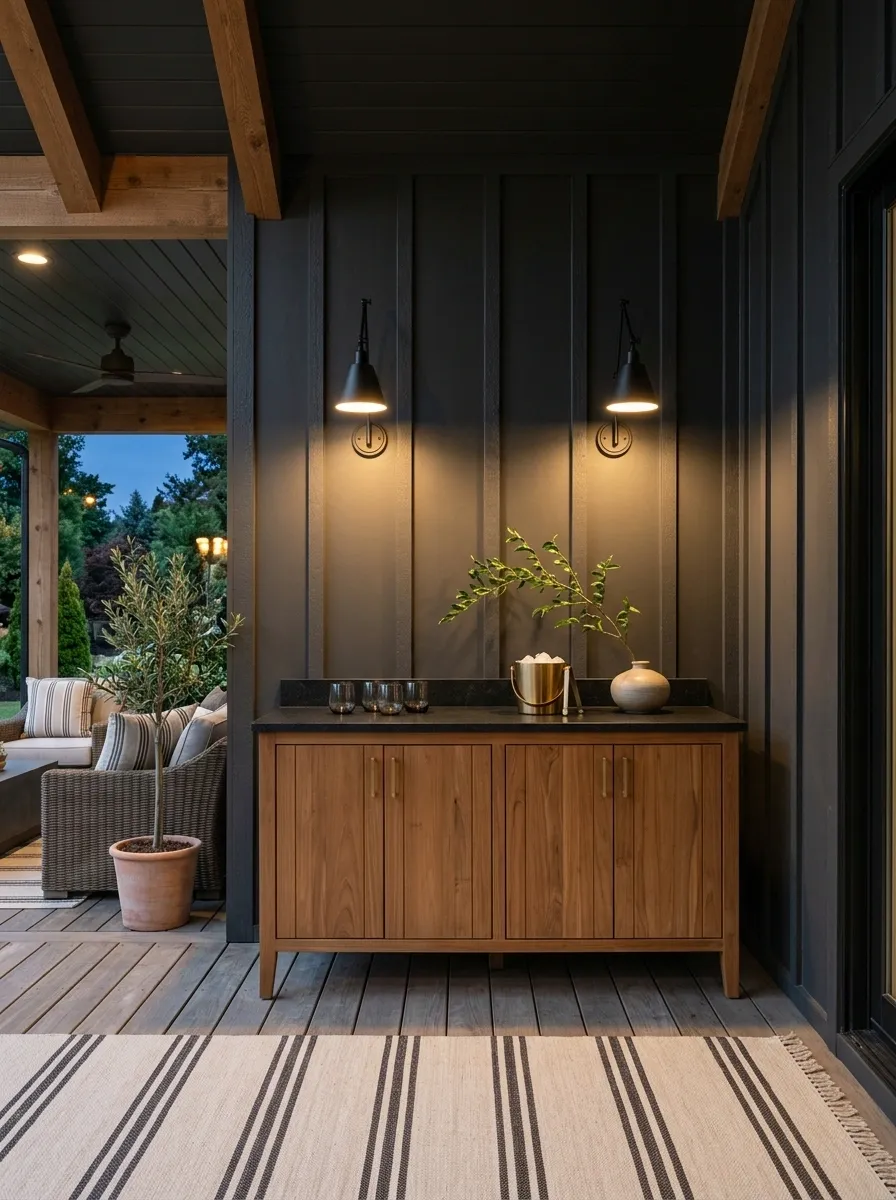
A blank porch wall doesn’t need more artwork just because it’s empty.
Turn it into a useful destination with a narrow bar cabinet, compact serving console, or wall-mounted shelf system. This works particularly well beside a dining area where drinks can be served without sending everyone back inside.
Keep the storage closed and the visible styling minimal.
Build the zone around three things:
Storage for supplies.
Surface for serving.
Lighting for evening use.
A functional wall has far more impact than another row of decorative signs.
Layer architectural lighting with smaller evening lights
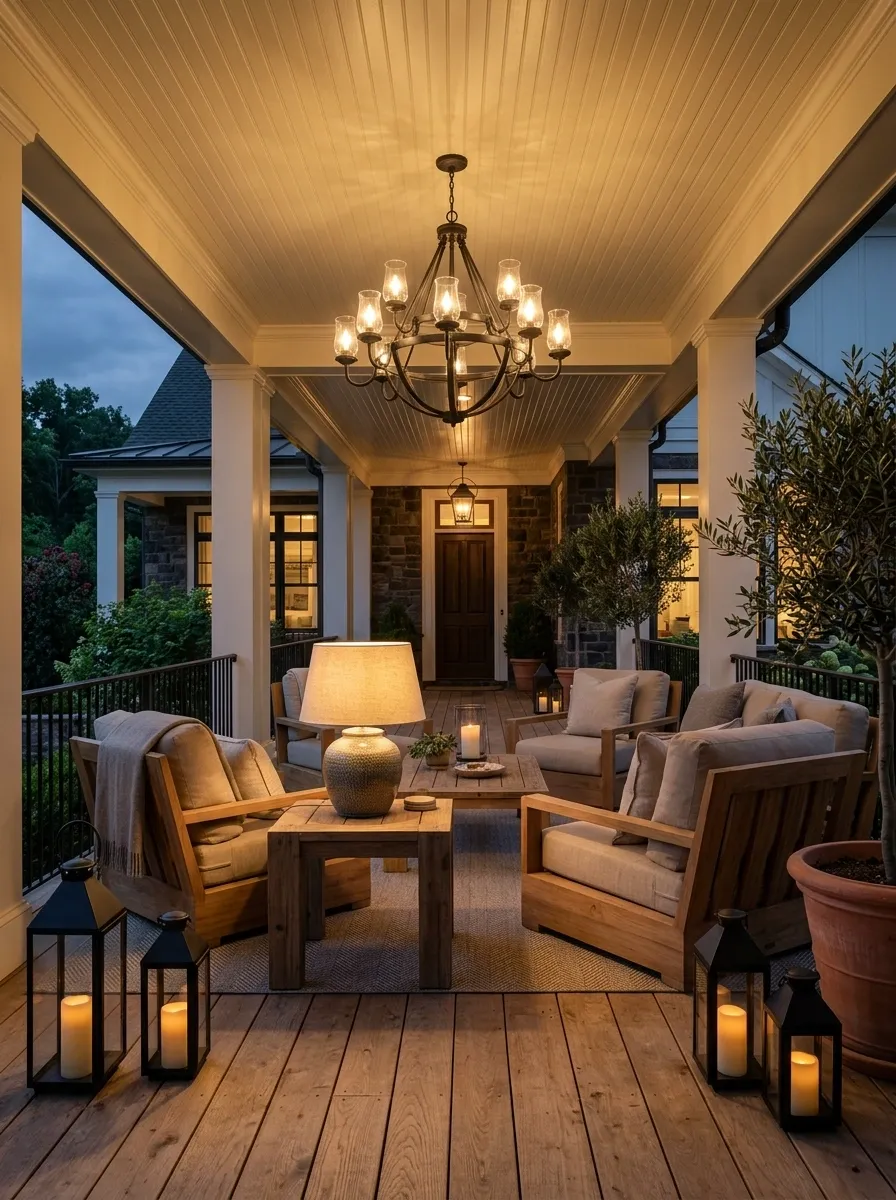
One overhead fixture can light a porch, but it usually won’t make the space feel layered after dark.
Use the main light for overall illumination, then bring smaller sources closer to the furniture. A table lamp on a suitable outdoor-rated surface, portable lanterns, or low accent lights can create separate pockets of glow.
Think in three lighting heights:
OVERHEAD for structure
TABLE LEVEL for activity
LOW LEVEL for atmosphere
Don’t scatter lights randomly. Each glow should help define a specific zone.
Use symmetry to make a wide front porch feel intentional
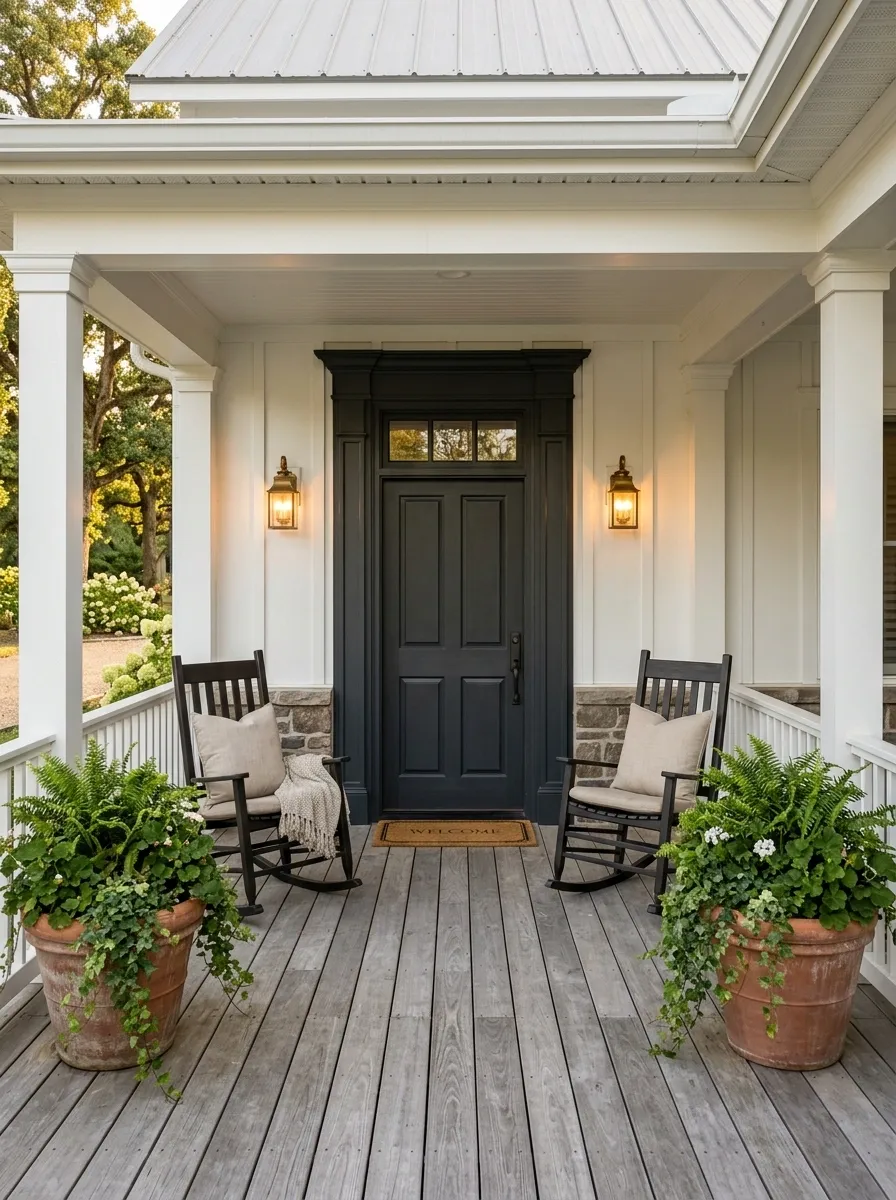
A long front porch can become visually messy when furniture is distributed without a clear pattern.
Symmetry fixes that immediately.
Center the strongest feature, then balance the two sides with matching or visually similar elements. They don’t have to be identical. What matters is that the visual weight feels even.
A reliable arrangement:
Left planter → seating → door → seating → right planter
For traditional and farmhouse-style exteriors, this approach is particularly strong. It makes the porch look deliberate before a single accessory is added.
Replace scattered little accessories with a few oversized pieces
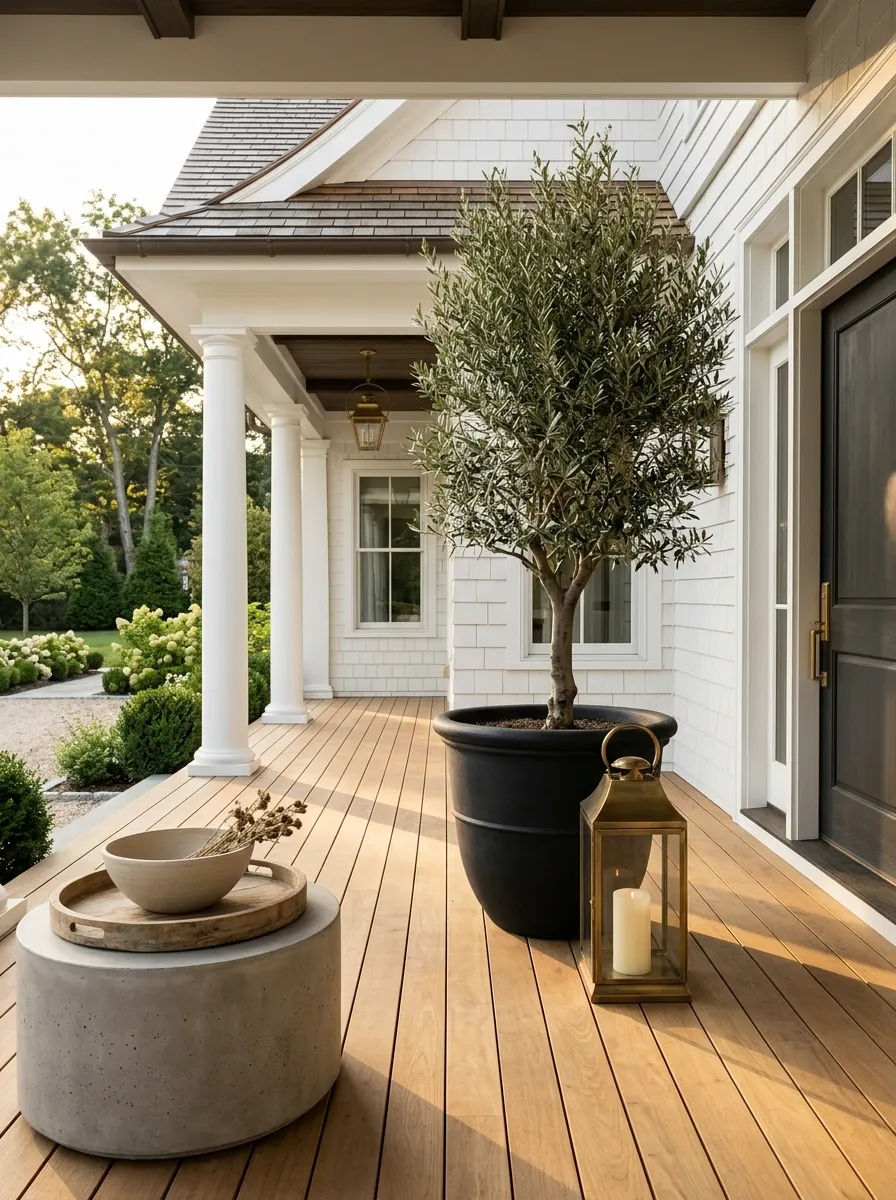
A giant porch doesn’t need more decoration just because it has more floor space.
Tiny signs, miniature pots, little lanterns, and collections of small objects disappear across a wide porch. Worse, they create visual noise once enough of them accumulate.
Scale up instead.
Keep: one large planter, one substantial lantern, one broad tray.
Remove: clusters of tiny objects that don’t serve a purpose.
Replace: several small accessories with one piece that can actually be seen from across the porch.
The goal isn’t maximum decoration. It’s enough visual weight to make the architecture feel balanced.
Finish with one dramatic focal point that commands the porch
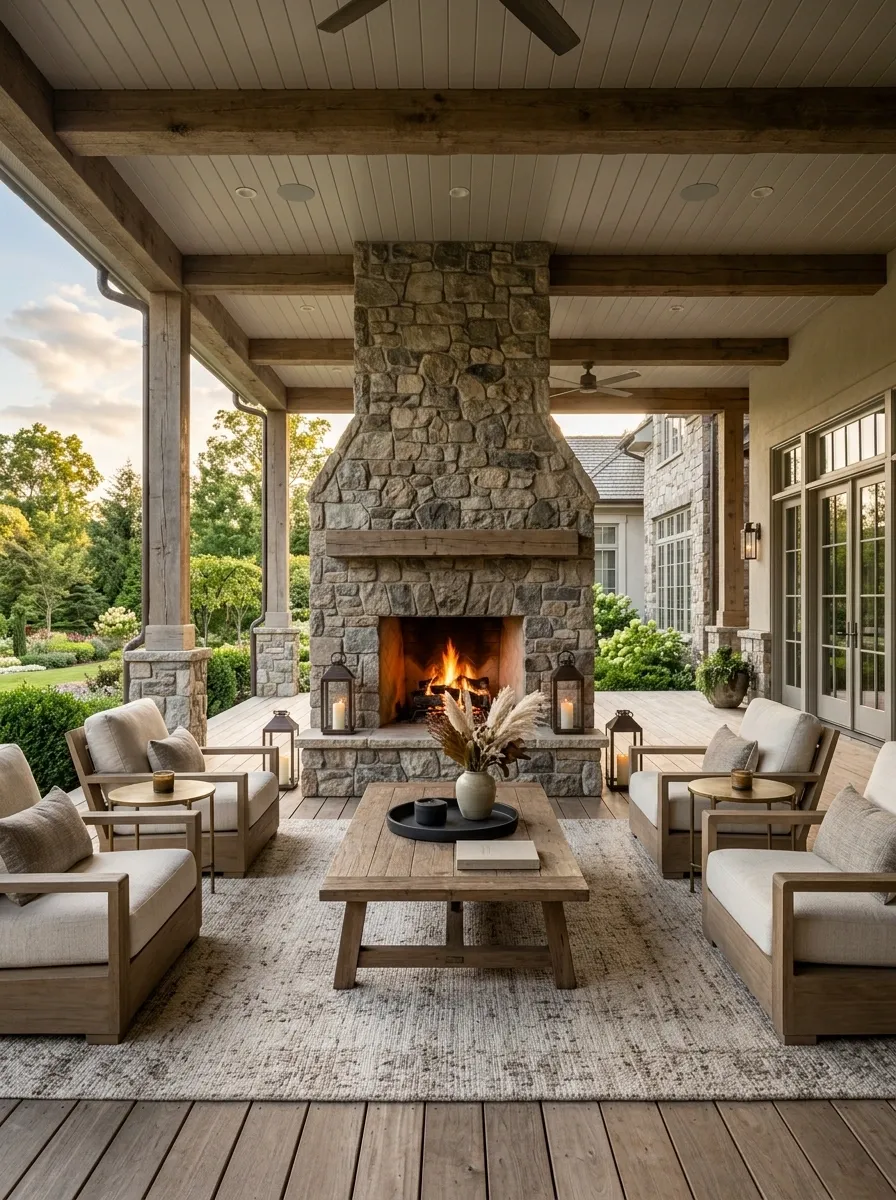
Every successful large porch has one element that makes the eye stop.
It could be a monumental fireplace, an oversized swing, a sculptural chandelier, a dramatic dining table, or a large piece of outdoor art. The feature doesn’t need to be expensive. It needs to be unmistakable.
Build the rest of the porch around it.
Keep competing elements quieter, repeat one finish elsewhere, and give the focal point enough breathing room to remain the star.
That’s the finishing move that makes the entire porch feel designed rather than simply furnished.