
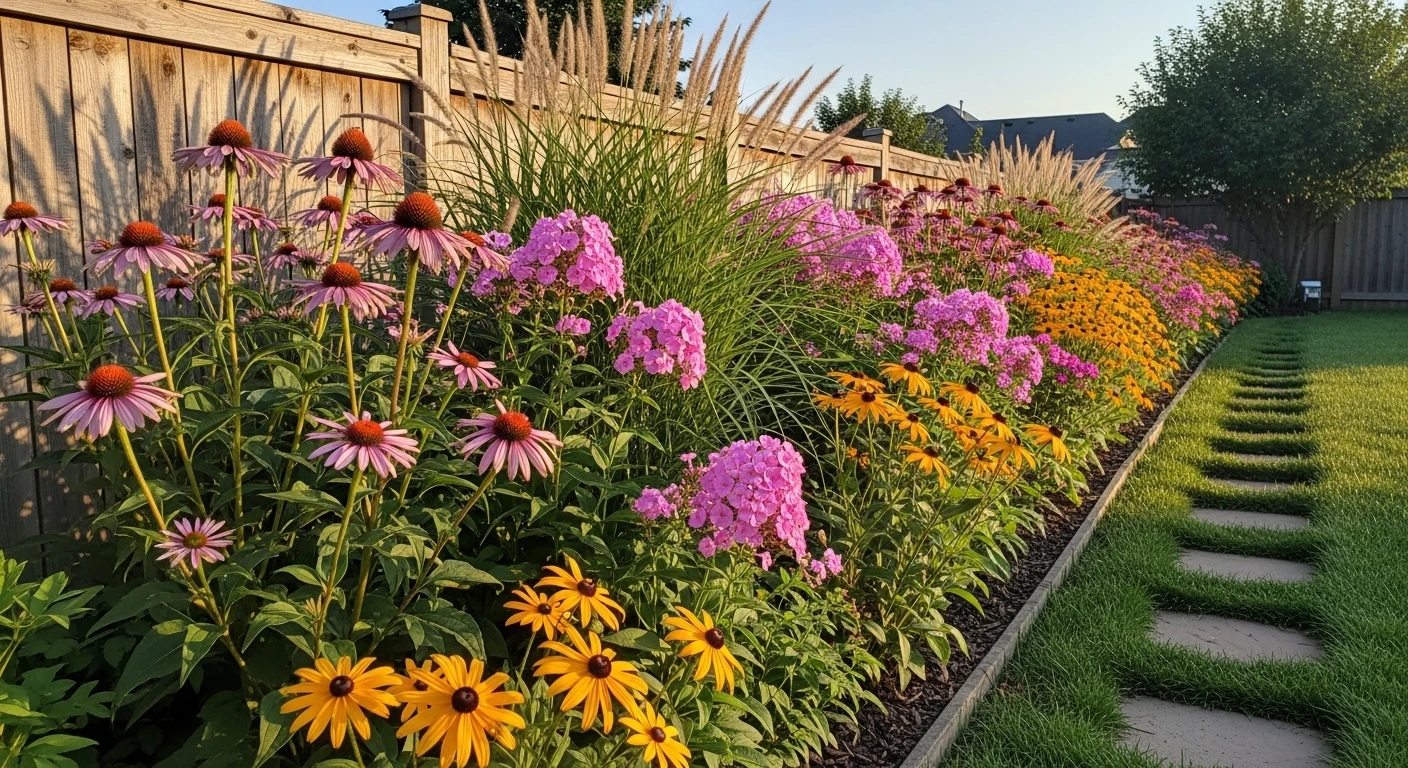
Garden borders occupy a strange position in the hierarchy of outdoor design decisions — important enough that a bad one quietly undermines everything growing behind it, yet consistently treated as the last thing to think about after the plants are already in the ground and the budget has already been spent. The result is a lot of gardens that are doing genuinely good things in the middle and completely falling apart at the edges.
The border is not decoration. It’s structure — the thing that tells the lawn where it ends and the garden where it begins, that keeps mulch from migrating onto the grass, that creates the visual line your eye follows to understand the whole composition. When that line is sharp and considered, the entire garden looks more intentional. When it’s vague, crumbling, or just sort of implied by a slight change in ground cover, even expensive planting looks like it wandered in by accident.
What’s particularly revealing about garden borders is how directly they reflect the level of thought that went into the wider design. A freshly cut edge in dark rubber against immaculate lawn signals that someone thinks about their garden in detail. A rollout log border from the garden centre signals something rather different. Neither is necessarily wrong — but only one of them is doing active design work.
From beginners finding their footing to people who’ve clearly been planning this for a while, the borders here cover the full spectrum of ambition, material choice, and commitment — and each one has something worth taking from it.
A Border Without a Plan Is Just a Trench
The number of garden borders that get installed as a practical afterthought — because something needs to stop the grass creeping in — rather than as a deliberate visual decision is staggering. And it shows, consistently, in the results.
The Border Sets the Shape of the Whole Bed — Before a single plant goes in, the edging line determines whether the border reads as organic and flowing, formal and geometric, or somewhere in between. Changing your mind about that shape after the plants are established is considerably more painful than deciding upfront, so this is the decision that needs to happen first, not last.
Material Choice Carries Aesthetic Information — Log rolls say cottage garden. Smooth cobble sets say structured traditional. Black rubber or steel strips say contemporary and precise. White marble chips say clean and modern. These associations aren’t arbitrary — they’re the visual language your border speaks before anything growing behind it gets a word in.
The Line Between Lawn and Bed Is a Design Element — Straight edges and curves have completely different effects on how a garden feels. Formal straight-edged borders create a sense of order and intentionality. Sweeping curves create movement and softness. What doesn’t work is an edge that’s trying to be a curve but ends up looking like someone drew it freehand on a bumpy surface. If you’re going curved, commit to it with a hosepipe first and cut it properly.
What Good Borders Actually Do for a Garden
Beyond keeping the grass out and the mulch in, a well-executed border is performing several pieces of design work simultaneously — most of which go completely unnoticed because they’re working correctly.
Contrast Creates Visual Definition — The most effective borders create a clear tonal contrast between the lawn, the edging material, and the mulch or ground cover behind it. Dark rubber against green grass against black mulch. White pebbles between grey decking and white fence. The contrast is what gives the composition its crispness, and without it even the most expensive edging material looks muddy and indistinct.
Height Differential Changes Everything — A border that sits flush with the lawn surface provides practical containment but minimal visual impact. Raising the bed even ten or fifteen centimetres above grade immediately adds shadow lines, dimension, and that sense of a designed layer that flat borders simply cannot produce. It also makes the planting look more deliberate, which is a return on investment that costs nothing beyond slightly more edging material.
The Border Determines How the Planting Is Read — The same plants in the same arrangement look markedly different behind a crisp cobble edge versus a vague grass transition. The edging is the frame, and frames change how the contents are perceived. A border that’s doing its job properly makes the planting inside it look better than it actually is — which, in a garden, is exactly the kind of silent contribution that earns its keep.
The Mistakes That Make Good Planting Look Bad
Even genuinely good plant choices get undermined by border decisions made carelessly or too cheaply, and these are the specific errors that appear most consistently in gardens that almost work but don’t quite get there.
Edging That Stops and Starts Reads as Unfinished — A border that runs confidently for two-thirds of the bed length and then tapers off into nothing, or gets interrupted by a poorly managed corner, announces that the job wasn’t finished. Whatever edging material you choose, it needs to complete the circuit — all the way around, every junction resolved, no trailing ends.
The Wrong Scale for the Space — Delicate metal edging strips almost disappear in a large border and provide no visual presence whatsoever. Chunky log rolls around a tiny, precise modern bed look cartoonish and out of proportion. Scale your edging to the bed size and to the surrounding materials — a border that’s visually proportionate to its context reads as designed, while one that’s mismatched in scale just looks like the wrong thing got ordered.
Neglecting Maintenance After Installation — The crispest cobble edge in the world looks mediocre six months after installation if the lawn has started to grow over it and the mulch has partially buried it. Edging requires ongoing maintenance to do its job — that’s not a flaw in the material, it’s a condition of the entire enterprise, and pretending otherwise is how beautifully edged beds turn back into vague transitions over a single growing season.
Garden Border Ideas
The “Making a Start” Border That’s More Honest Than It Looks
Garden Border Advice
by u/diffusedrap in GardeningUK
Wooden log roll edging curves along the fence line, holding back a bed of young shrubs that haven’t quite filled in yet, with a slate water feature panel propped against the fence adding a feature element that the planting isn’t quite mature enough to justify on its own — and the whole thing is wearing its work-in-progress status very visibly. There’s a pinwheel. There’s a bird feeder. There are plants at that optimistic early stage where the bare soil between them is doing most of the visible work. What this border gets completely right is the decision to edge at all — the log rolls create a genuine lawn-to-bed transition that already gives the garden more structure than a bare trench would, and the curved line is confident enough to suggest the finished version will be worth waiting for. This is a beginning, not a conclusion, and being honest about that is considerably better than trying to style out an underpopulated border with accessories.
The River Rock River That Does Functional Work Beautifully
A strip of mixed river pebbles and rounded stones runs in a clean curve between immaculate lawn and a planted border, contained on the lawn side by a low black rubber edge that disappears against the dark stone and creates a boundary so precise it looks almost drawn rather than installed. The rocks vary in size naturally — small pebbles filling the gaps between larger rounded stones — and the overall effect is of a dry river channel that separates the two ground planes with considerably more visual interest than any hard edging material would provide. The planting behind is lush and varied, and the black mulch ground cover creates a tonal connection to the rubber edging that makes the whole composition feel coordinated rather than assembled from separate decisions. It’s practical, it’s low maintenance once established, and it manages to look both deliberate and organic simultaneously — which is a surprisingly difficult combination to achieve with rocks.
The Cobblestone Curve That Treated Edging Like Architecture
Grey cobble setts follow a wide, generous S-curve that sweeps the entire length of the border, and whoever cut this lawn edge deserves some kind of recognition because the line is precise enough to look computer-generated against the striped green surface. Inside the edge, black mulch provides the dark ground plane against which hostas, salvia, marigolds, white petunias, pink impatiens, and purple liatris are all competing for attention in a colour arrangement that is dense without being confused. The stepping stones integrated into the lawn add a destination quality to the whole border — this isn’t just a feature to look at from the house window, it’s a space to walk through and be inside — and the wooden bench glimpsed beyond confirms there’s a whole composed garden moment at the far end that the border is leading toward. The cobble edging choice is doing enormous structural work here, containing all that colour abundance in a frame precise enough that none of it tips over into chaos.
The Deck Border That Understood the Assignment Was Restraint
Between grey composite decking and a white slatted fence sits a narrow planter channel filled with white marble chips, from which a small number of ornamental grasses and a single clipped boxwood emerge at measured intervals — and the whole thing is so calm and controlled it almost reads as a rebuke to every overplanted border that’s ever existed. The marble chips are very white. The decking is very grey. The fence is very white. The plants are very green and very spaced. Every decision here is about contrast, restraint, and precision, and the effect is a border that looks considerably more expensive than it is purely because nothing about it is fighting anything else. It’s the garden equivalent of a very well-edited outfit — fewer things, better chosen, arranged with more care than the complexity would suggest. Whether it’s too restrained for the season is a matter of personal threshold, but as a demonstration of what happens when the material palette is kept strictly disciplined, it makes its point without any drama whatsoever.
The New Border That’s Betting Everything on What Comes Next
Fresh dark soil curved away from the lawn in a clean arc, sparse young plants at the spacing that always looks slightly lonely before the first growing season does its work, hanging baskets on the fence posts providing the colour that the bed itself isn’t ready to supply yet, and a small propagation cold frame tucked into the corner suggesting this garden is being actively grown rather than just planted once and photographed. The fence itself is freshly treated, the lawn edge is cleanly cut, and the hanging basket brackets are new enough to still be matte black rather than weathered — everything here is in its first chapter. What makes this a useful border idea rather than just a work-in-progress snapshot is that the structural decisions are all sound: the curve is confident, the scale relative to the fence is appropriate, and the decision to use the fence vertically with hanging baskets while the ground planting establishes itself shows an understanding of how to make a border feel considered even before it’s full. Come back in two seasons and this will look entirely different.
The Front Garden Border That Uses Every Trick Simultaneously
White river pebbles define an organic curved border in front of a rendered house facade, within which dracaena spikes, conifer columns, red cordyline, clipped globe shrubs, agave, and several terracotta pots of varying heights have been arranged in a composition that is attempting — and largely succeeding at — looking both lush and orderly at the same time. The pebble ground cover provides the light, bright base that makes every green read more vividly against it, and the transition between the white stone border and the dark slate tile edging running along the path edge creates a neat material hierarchy that anchors the whole scheme to the house’s architecture. It’s a lot of plant types in a relatively small space, and the fact that it holds together comes down to the pebble ground cover doing consistent visual work underneath all of them — without that shared base material keeping everything connected, the variety would tip from curated into collected. The terracotta pots add warmth that prevents the white-grey-green palette from feeling clinical, which is exactly the job they’ve been given and the reason they work.
Get Luxe: Corten Steel Meets Boxwood for Ultimate Show-Off Edging
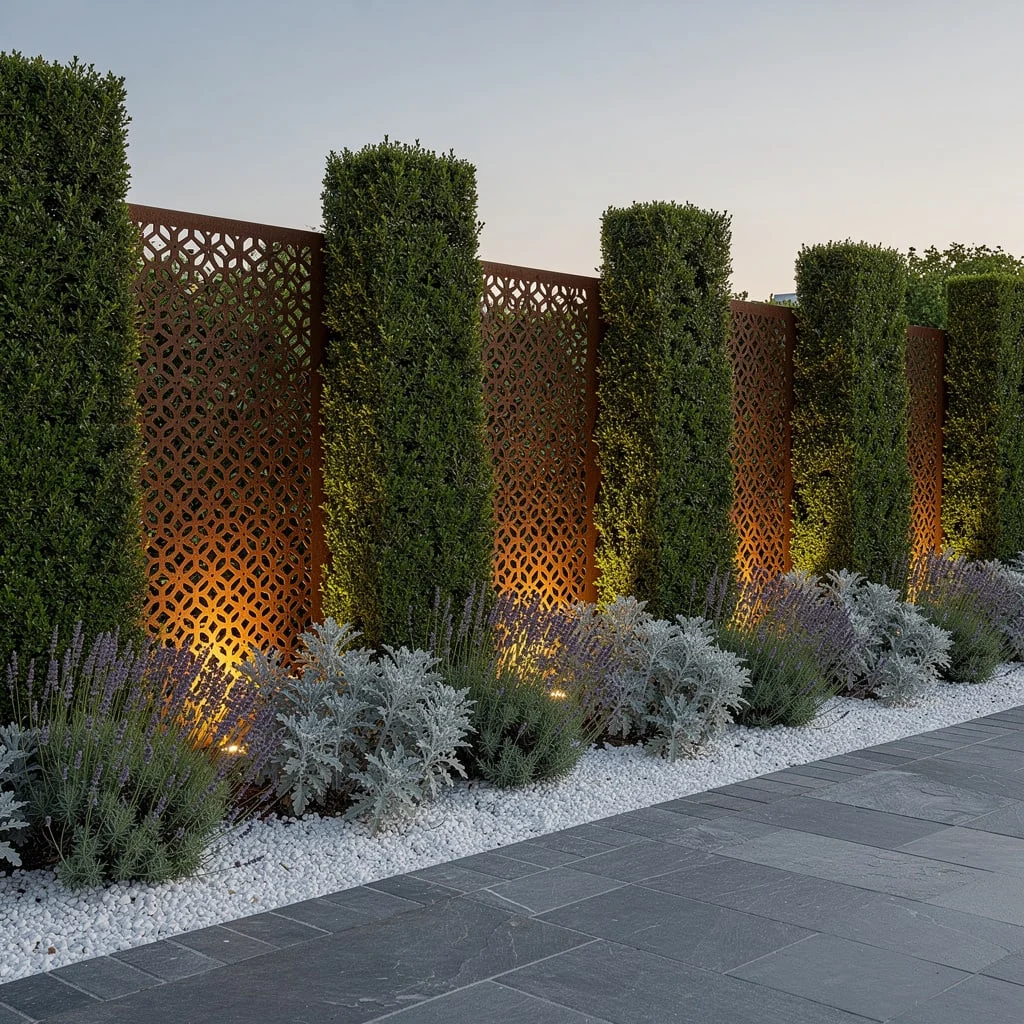
If you want a garden that screams rich without screaming ‘I’m trying,’ you need materials that slap—think laser-cut Corten steel paired with ever-classy boxwood hedges. Stagger steel panels and let boxwood weave between them to create rhythm. Illuminate those geometric cut-outs with LED uplights; don’t pretend you’re above dramatic shadows. White gravel at the base keeps the look sharp, while lavender and Artemisia at the feet keep it from feeling too stiff. Always line the whole edge with slate pavers—crooked edges? That’s a rookie move.
Bench That Boring: Curvy Laurels, River Stones, and That Big Main Character Energy
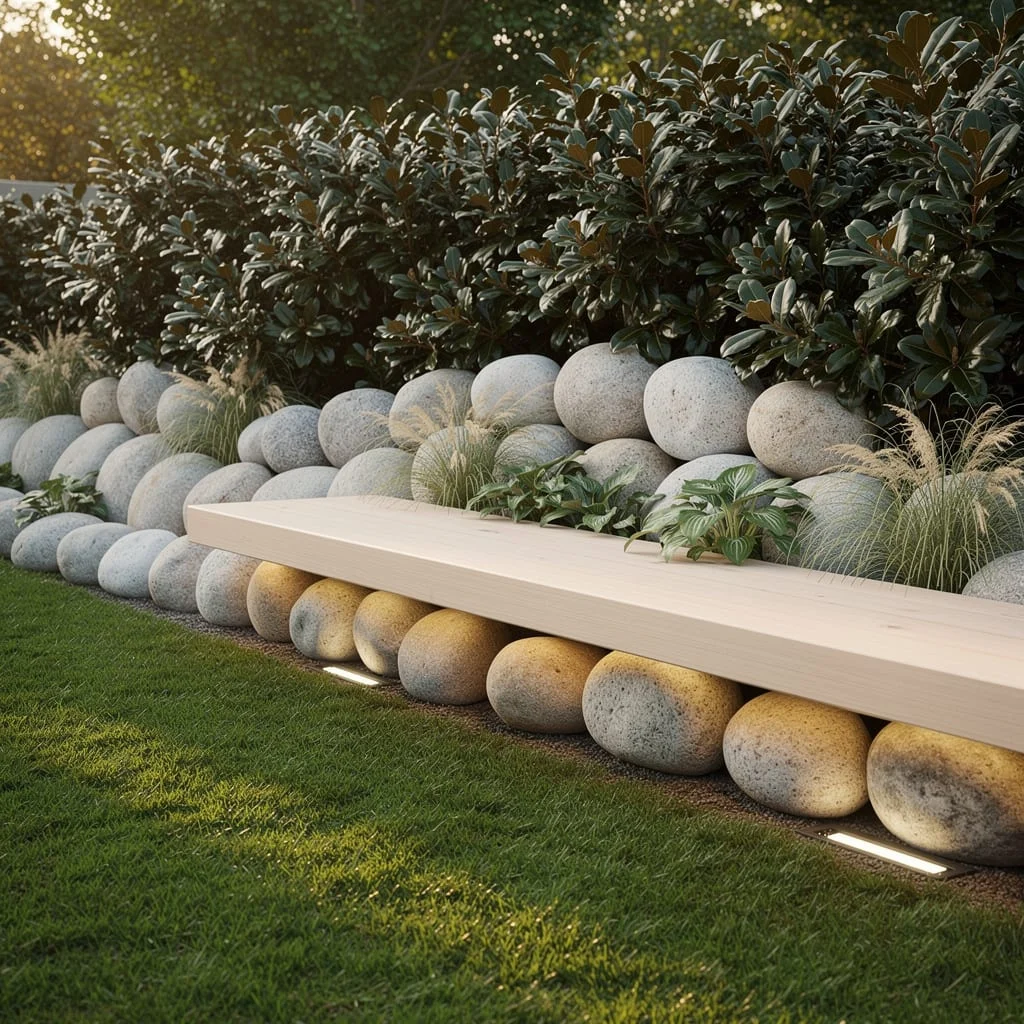
Stop using awkward wooden fences. Instead, run a pale cedar bench parallel to undulating, sculpted laurels—this is where form meets function. Jam in oversized river stones behind the bushes for that earthy, elevated vibe, and slip ground lights into the bench line so your border glows instead of hiding at dusk. Pack feathery grasses and hostas between the stones for lush spillover. And for the love of symmetry, keep your lawn laser-level and let these textured layers do the heavy visual lifting. Rule: Never let utility kill style.
Travertine Chic: Stagger, Plant, Repeat—No Boring Allowed
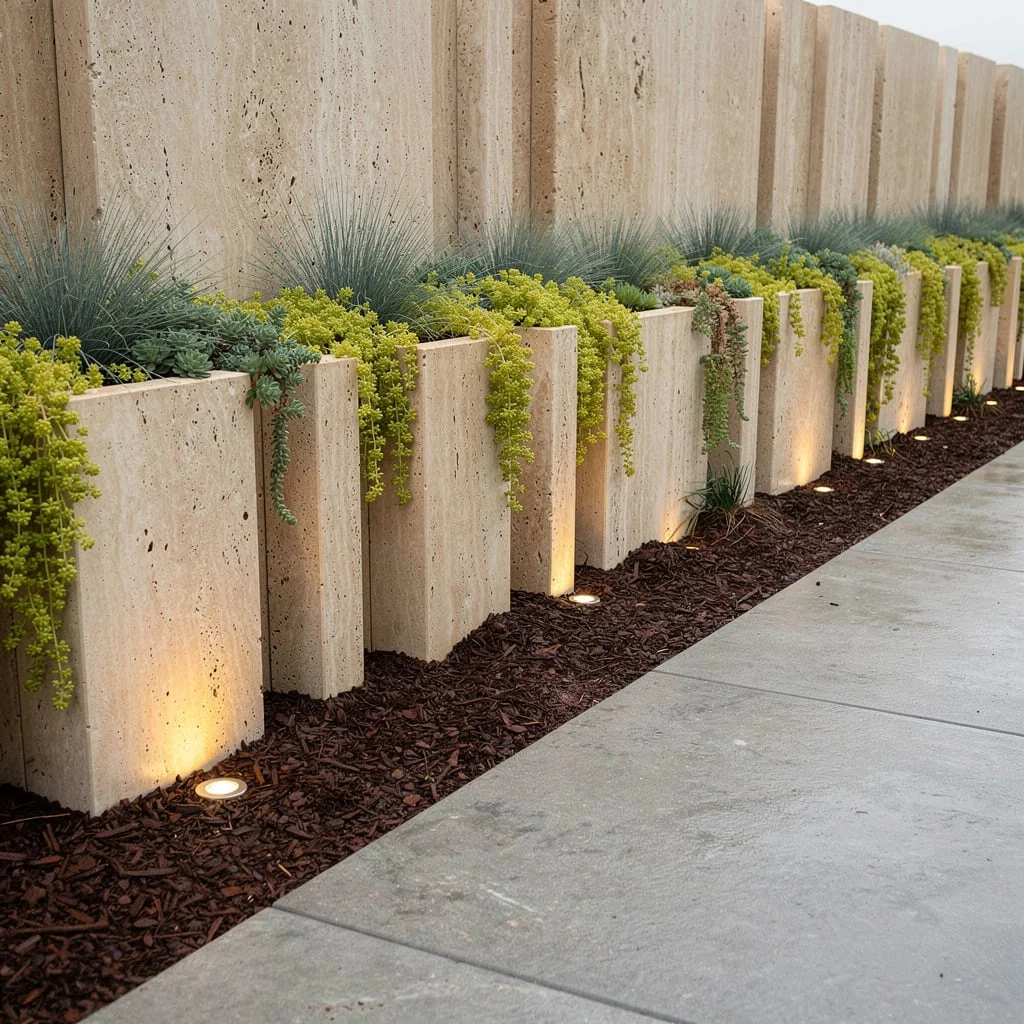
Want your garden to look like an architectural digest shoot on a Parisian budget? Stand polished travertine slabs vertically, staggered, and use them as supports for skinny planters. Overflow with sedum and fescue to keep things airy, not fussy. Ditch boring bark: go for cocoa mulch underfoot for rich contrast. Hide linear accent lights among the slabs and run a honed concrete path beside for a seamless gallery-cool finish. Never crowd the slabs—the 70cm gap is non-negotiable if you don’t want it to look like a failed fence.
Hedge Your Bets: Go Angular with Zigzag Yew
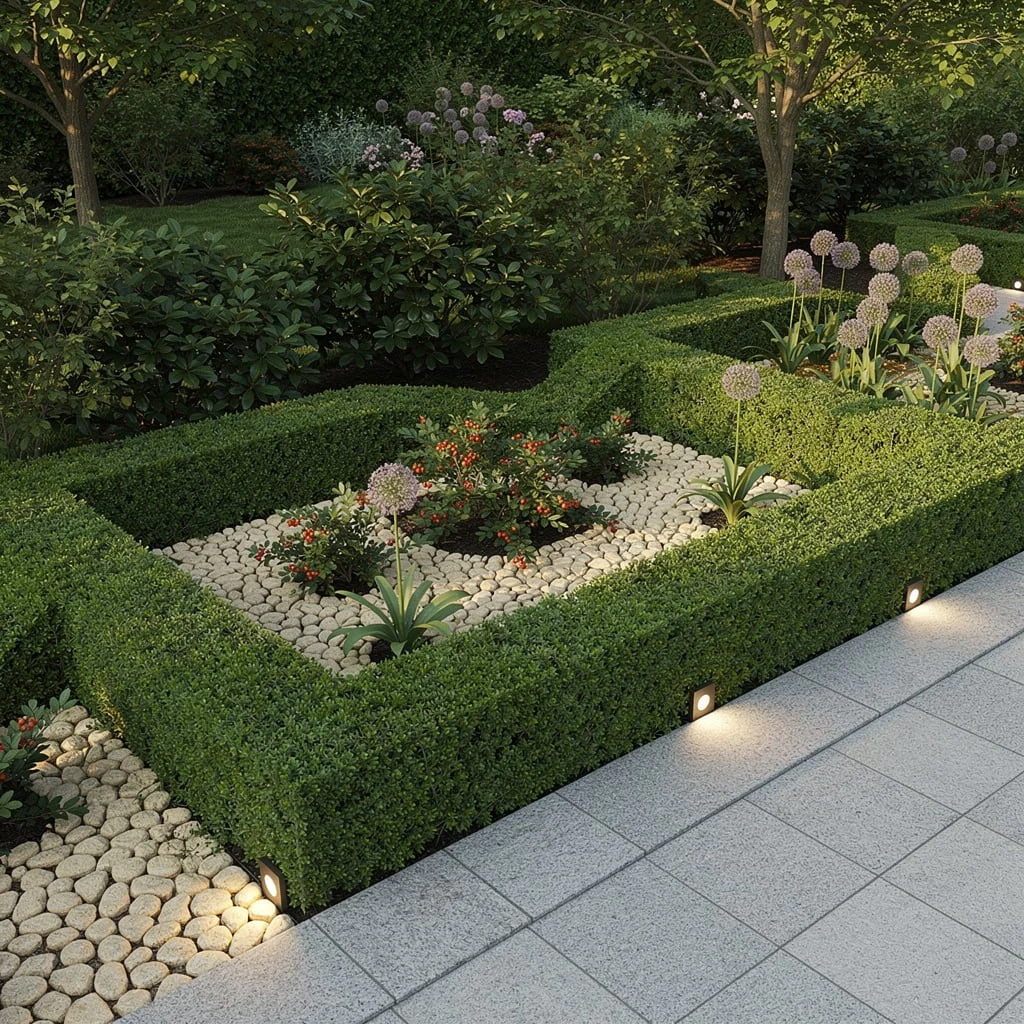
Forget the wobbly hedge blobs everyone else is rocking. Clip yew into a continuous ribbon but crank up the drama: cut sharp, angular zigzags and use each inset as a raised bed for berry shrubs and allium pokers. Tumble smooth cobbles under each one for texture and install uplighting at each corner—otherwise, what’s the point? Edge the zigzag on granite pavers to underline the precision. Discipline matters; hedge lines should be razor-sharp, not ‘close enough.’ And yes, that’s going to mean annual trimming. Get over it.
Black Magic: Basalt Block Borders with Forest Grass for the Win
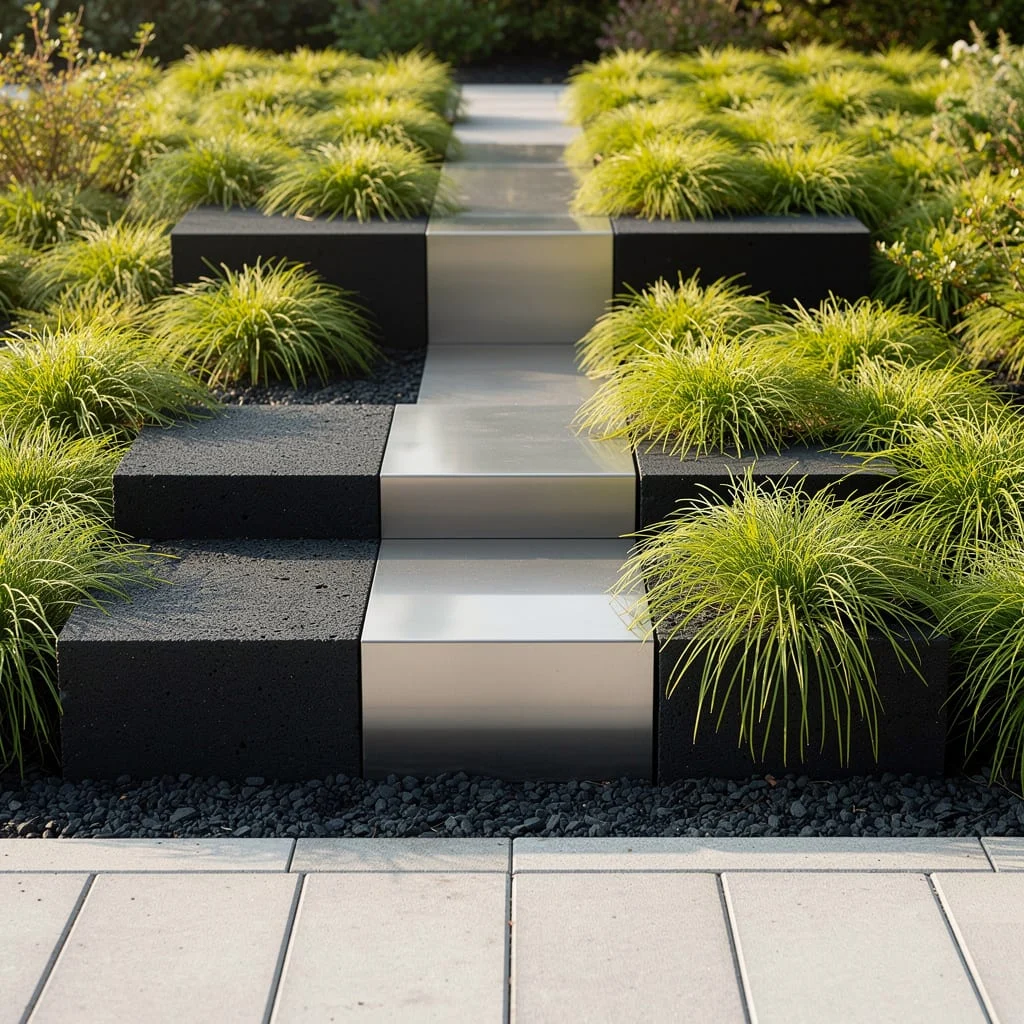
Want a border that lets everyone know you came to play, not blend in? Lay black basalt blocks horizontally in precise steps—the only thing that should vary is their height. Slip stainless-steel inlays in every gap for industrial shine, then mass Japanese forest grass along the base for a slap of bold color. Rake black decorative gravel under it all and frame with pale concrete pavers to keep things crisp. Don’t let weeds photobomb—this look only works if you keep the black gravel pristine. No excuses.
Tessellate to Dominate: Concrete Tile Geometry Meets Soft Planting
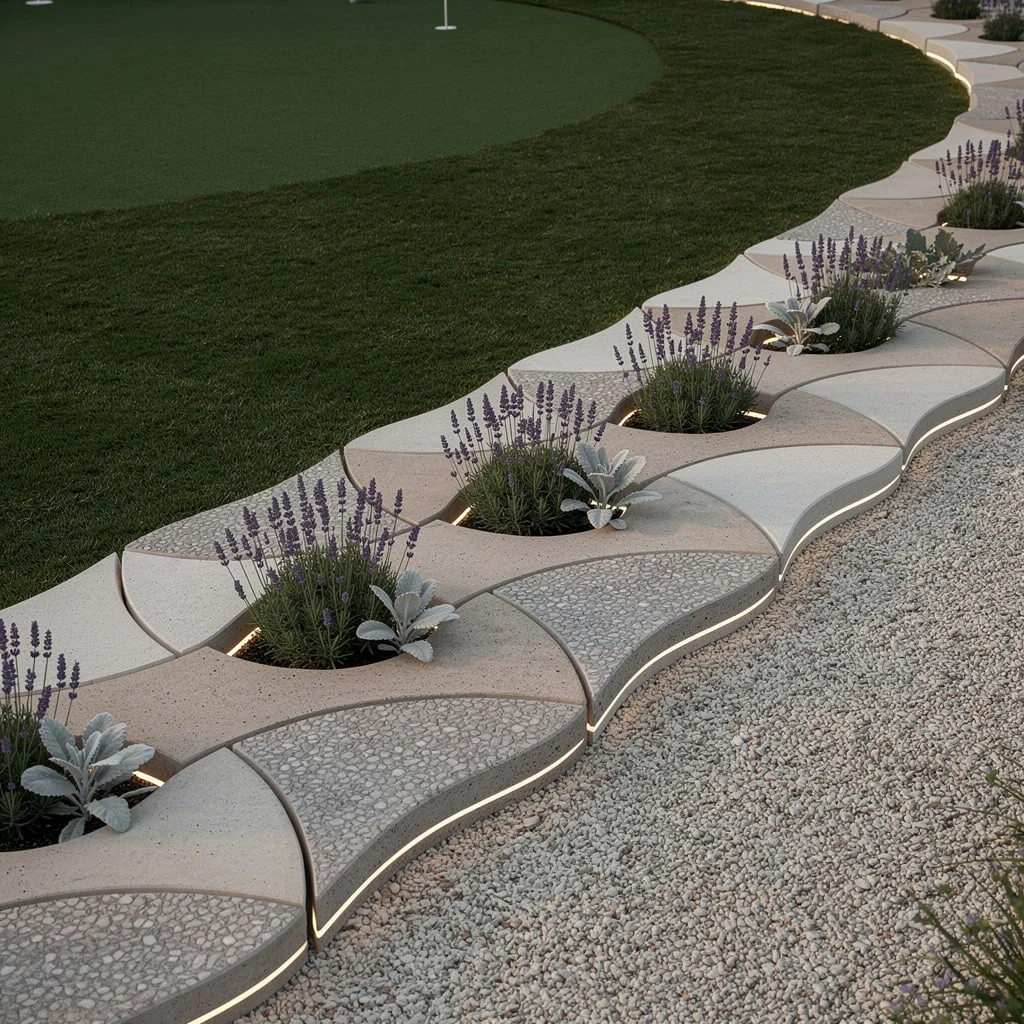
Ready to flex those math skills for real style points? Lay curved concrete tiles in alternating warm/cool tones, weaving them into an interlocking pattern people will actually notice. Put dwarf lavender and lamb’s ear in every joint—aroma plus texture equals instant ‘designer’ status. Run strip lights inside the tile curves for after-dark wow. Let one side of the border meet an immaculate putting green, and the other—a crushed quartz path, because details matter. Never let the pattern swerve at a weird angle; geometric order is the entire game.
Go Modular: Whitewashed Timber with Slate and Euonymus Baubles
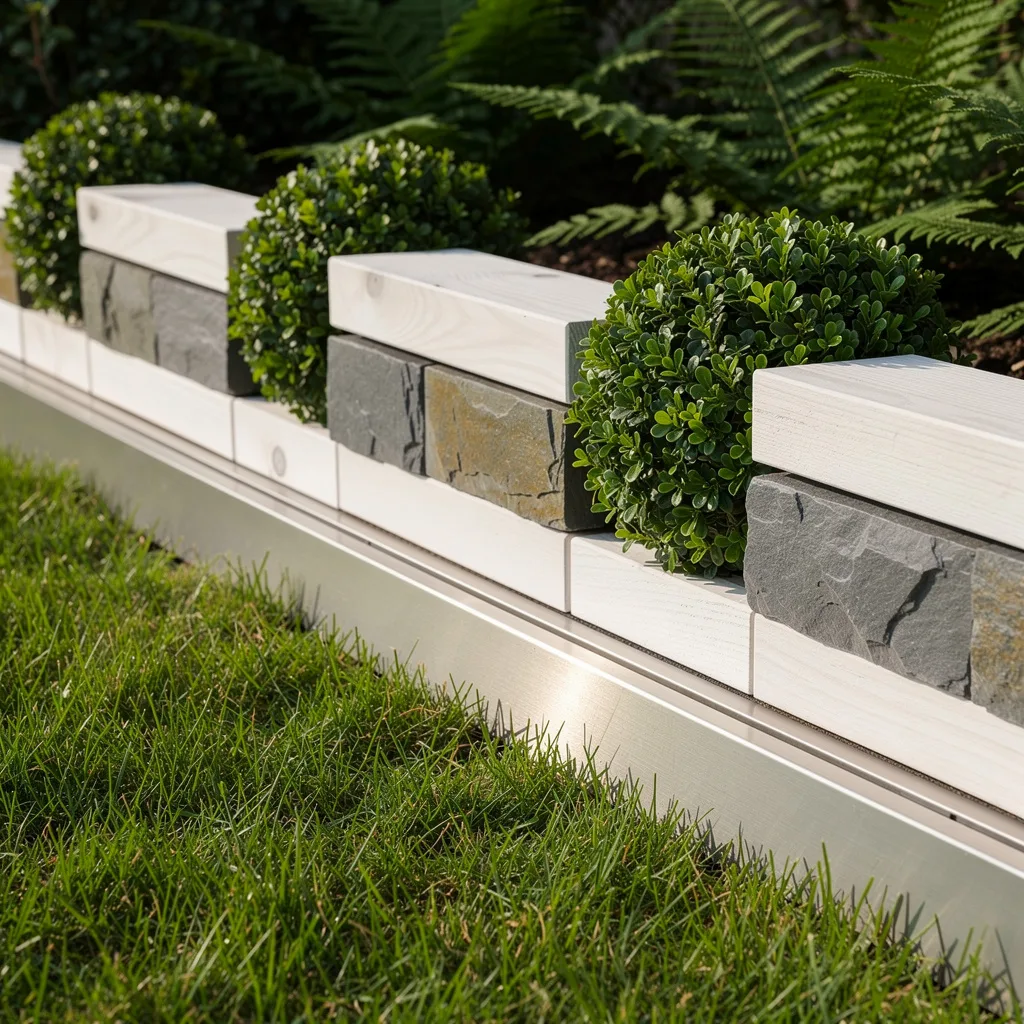
Enough with those boring, flimsy timber edges. Stack thick, whitewashed wood rectangles and alternate them with chunky slate blocks for a staggered border less than 40cm tall. Drop clipped spheres of Euonymus in the gaps for a textbook punch of emerald. Add a brushed aluminum channel for drainage—bonus points for glare in the right sunlight. Let your ferns lurk behind while that bank of fresh, mown grass runs right up to the edge. Always keep your distances and cuts neat; one wobbly timber ruins the look faster than dandelions.
Crystal Clear: Glass Panel Borders (Yes, Really)
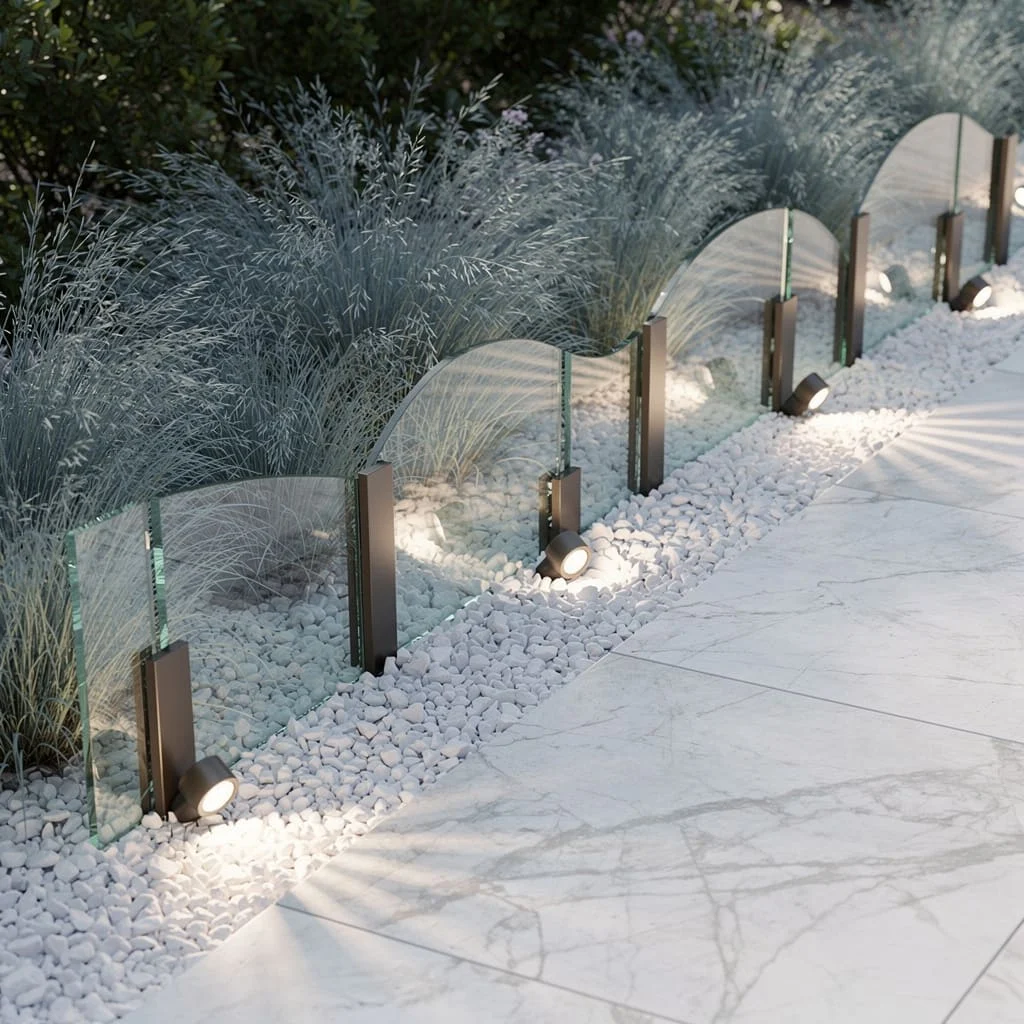
Feeling bold? Ditch heavy walls and mount clear glass panels in an undulating wave with minimalist bronze brackets. Cluster blue oat grass behind to dial up the softness. Lay a bed of white marble chips beneath—because what’s the point of glass unless it catches light? Punctuate every few meters with LED spotlights so your glass actually gets noticed (otherwise, what’s the point?). Large-format porcelain paving next to it just screams taste. Pro tip: keep everything streak-free; smudgy glass is just sad and says you’ve given up.
Gallery Lines: Charcoal Planters with Black Pebble Pools
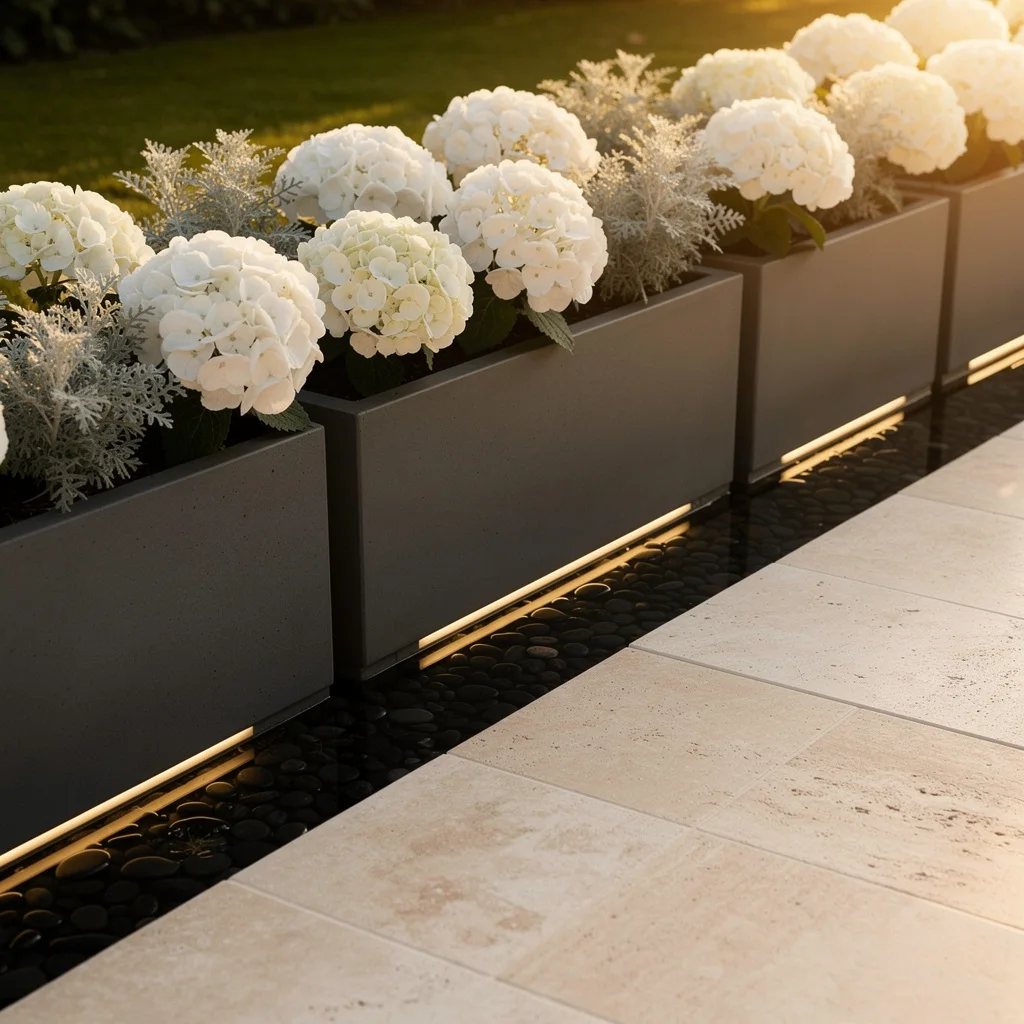
If a garden border can be ‘gallery-inspired,’ this is it. Use slim, hand-cast concrete planters finessed with charcoal microcement. Fill them tight with white hydrangeas and artemisia for a two-tone power combo. Set each planter apart with pools of polished black pebbles—no messy mulch! Plant subtle linear path lighting at planter bases for an after-sunset mood. You want those hydrangeas practically glowing out of the dark. Keep the whole thing squared off with a light paving edge—you’re after a curated, not cluttered, gallery feel here.
Go Vertical: Granite Monoliths and Purple Ajuga Rivers
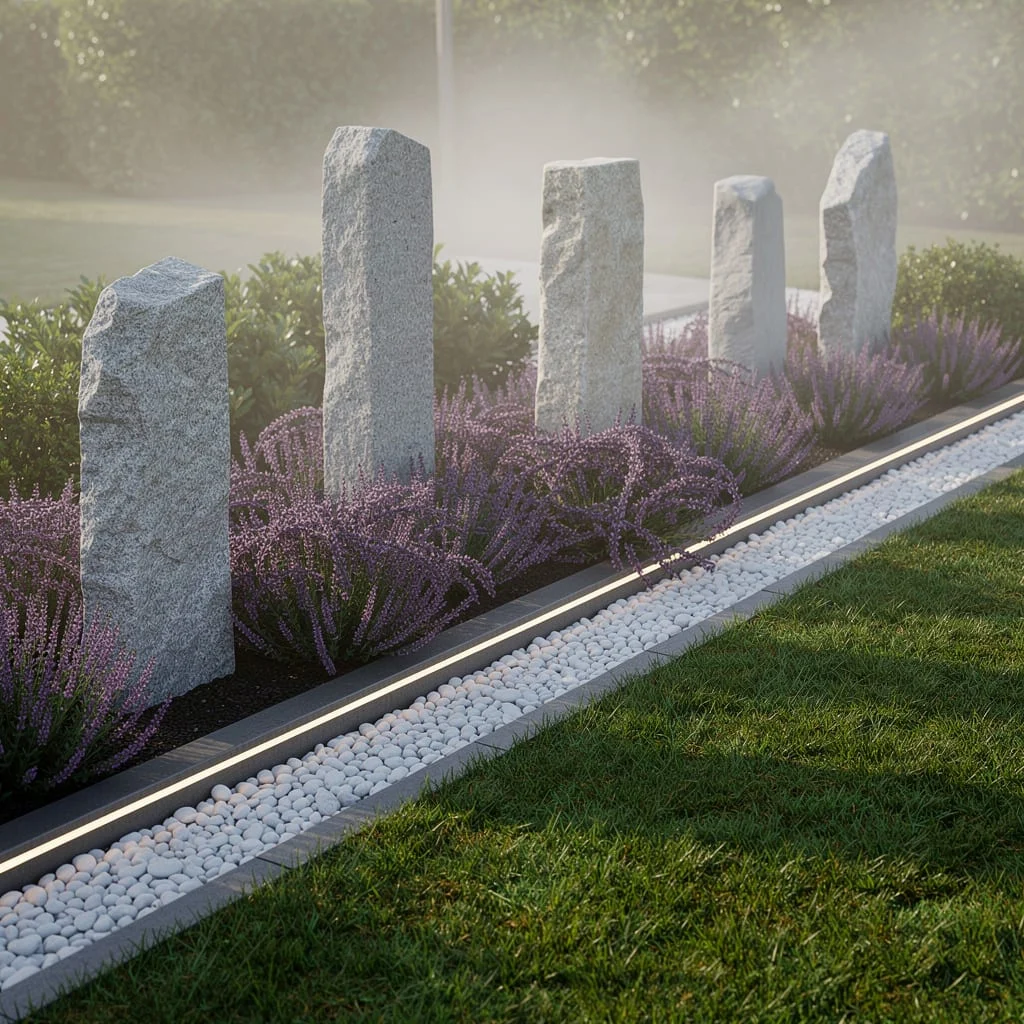
Ready for a border that’s part sculpture, part ‘come at me’? Plant upright granite monoliths at different heights like your garden’s personal skyline. Let purple ajuga dominate around the base—yes, color should swirl. Install LED strips inside the paving edge for minimal but powerful drama. Don’t cheap out on stone; polished granite is worth it for the lightplay. Always use a strip of smooth white river stones to ground the look. Remember the rule: tall pieces are accents, not a prison wall—don’t cram them.
Curve Appeal: Off-White Concrete Ribbons with Monochrome Planting
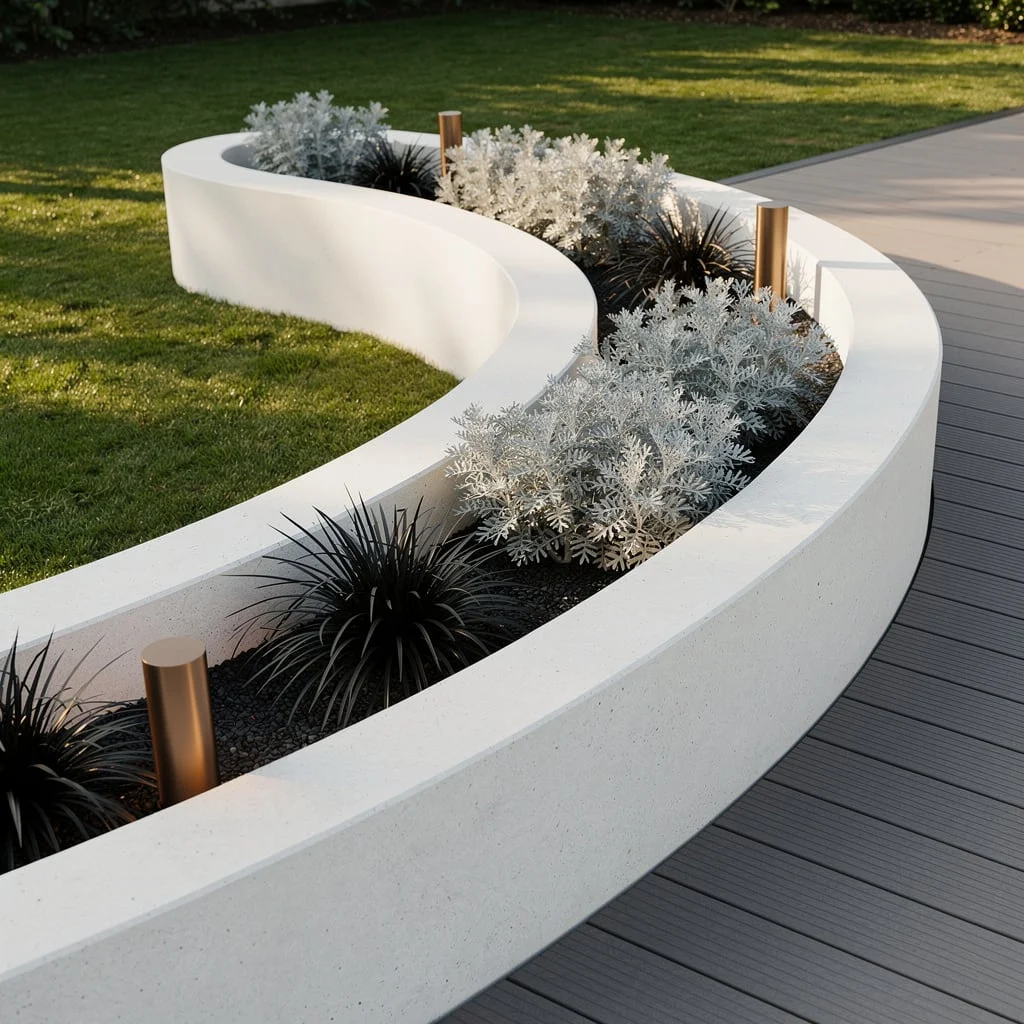
Get ahead of the design game with a continuous, curved ribbon of off-white concrete—skip choppy segments. Elevate things (literally) so it rises subtly. Plant black mondo grass and silvery wormwood in built-in pockets to keep it stark and vibe-y. Trace a composite decking path right up against it for contrast. Toss in bronze uplights to flare against the foliage, sharpening every shadow. If you let that concrete slope at weird angles, start over; precise curves are what makes this new-school, not builder-basic.
Modern Classic: Limestone Fins with Mossy Magic and Color Blasts
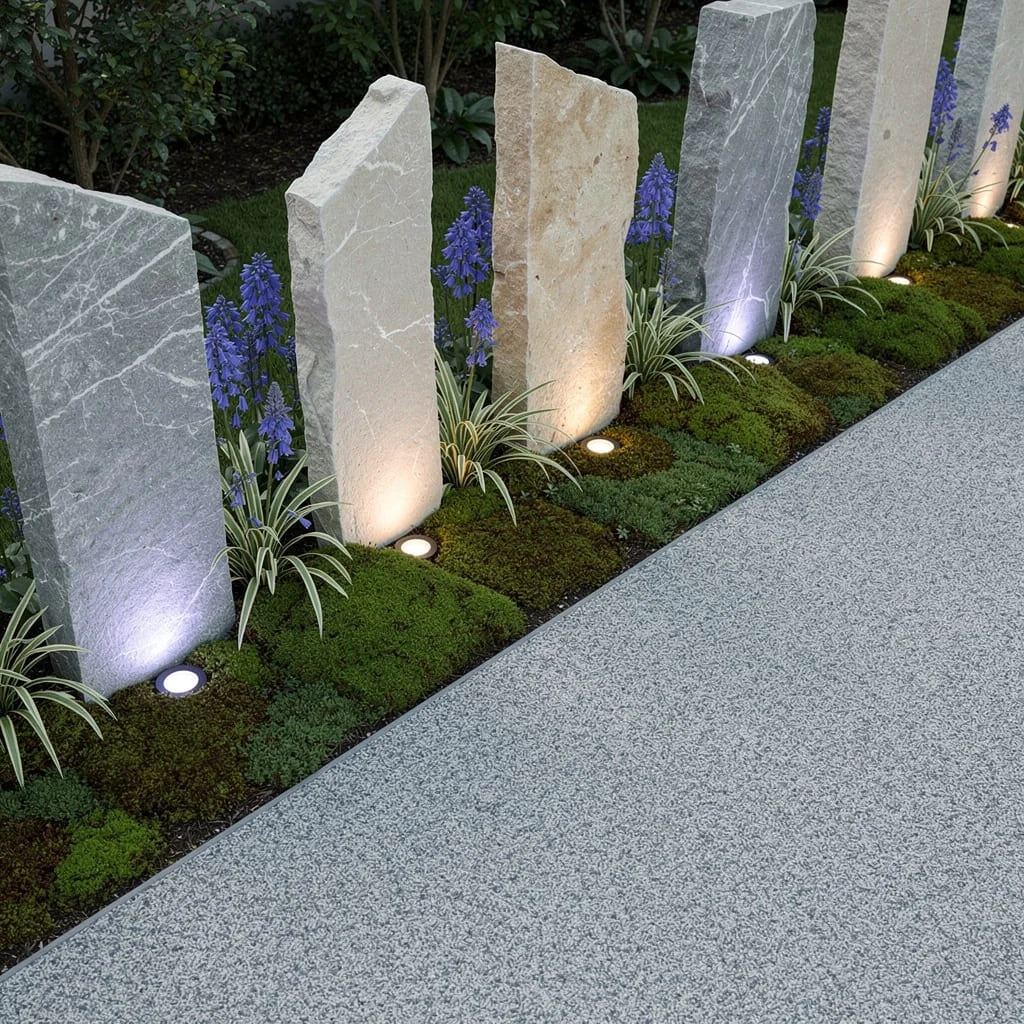
Want a border that’s classic but not a yawn-fest? Stand sandblasted limestone fins upright, spacing them irregularly for visual rhythm. Fill the gaps not with dirt (snore), but with lush blocks of moss. Drop in strips of blue bellflowers and variegated sedges for the color pop and texture combo everyone pretends they invented. Light the base with cool white washers to pop the stone’s veining at night. Edge the whole thing with flawless resin-bound gravel, and if you see a patchy bit, fix it—perfection required.
Final Thoughts
Every border on this list, from the freshly dug beginners’ bed to the architect-precise marble chip planter, is making an argument about what the garden values and how seriously it takes its own edges. The materials, the scale, the maintenance level, the relationship to the lawn and the fence and the planting — all of it communicates something before a single flower opens.
Getting the border right doesn’t require expensive materials or professional installation. It requires deciding what you want the edge to say, choosing a material that says it, and following through on that decision all the way around the bed without losing confidence halfway. The gardens that look designed rather than accumulated are almost always the ones where that edge decision was made first, made deliberately, and maintained consistently enough that it still reads as a decision rather than a suggestion.
The edge is where your garden proves it means what it says. Make it worth believing.