
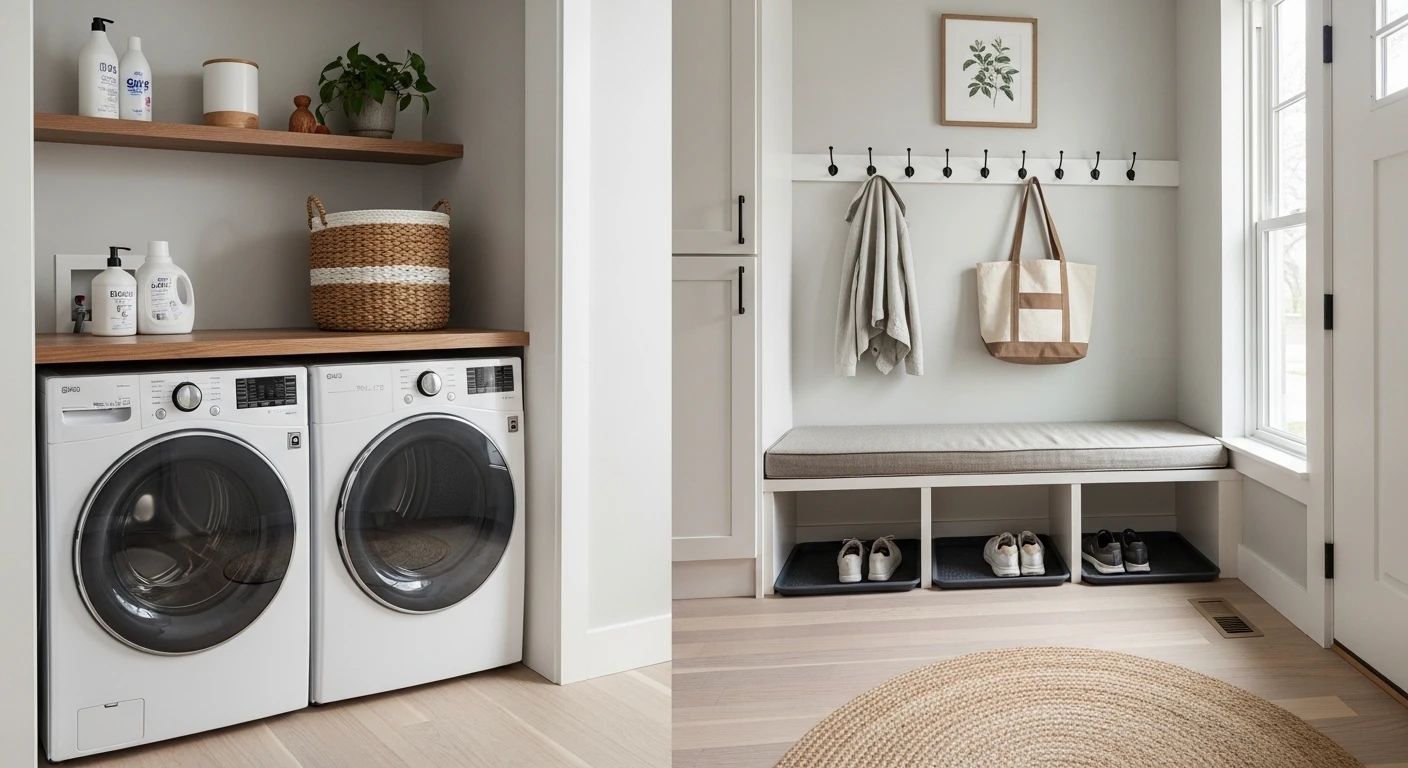
The laundry room has spent decades being treated as the house’s dirty secret — literally. Tucked away, apologetically functional, decorated with whatever survived the last renovation and a detergent bottle that’s been there so long it has a permanent ring on the shelf. The general attitude has been that laundry is a task to be endured rather than a space to be designed, and the rooms that resulted from that attitude are an accurate reflection of that philosophy.
Combining the laundry function with the entryway — whether through a purpose-built mudroom or a side entrance that handles both arrivals and washing cycles simultaneously — is the kind of practical decision that either gets executed with real thought or produces a space that does two things badly instead of one. The potential is genuinely significant. A properly designed entryway laundry handles the chaos of daily comings and goings, absorbs the mess before it reaches the rest of the house, and provides a working utility space that doesn’t feel like a punishment every time a cycle needs setting.
What separates the entryway laundries that make people genuinely envious from the ones that just technically function is the same quality that separates any well-designed space from a merely adequate one — someone made deliberate decisions about every element rather than defaulting to whatever was available in the utility fixtures aisle. The cabinetry, the sink, the lighting, the floor material, the storage system — all of it deserves the same level of consideration given to any other room in the house, and the spaces that received it prove the point without needing to argue it.
The Entryway Laundry Is Solving Multiple Problems Simultaneously
Unlike a standalone laundry room that has only one job, the entryway laundry is expected to receive people, manage outerwear and shoes, handle the washing function, and look presentable enough that guests who catch a glimpse aren’t immediately uncomfortable on your behalf.
The Entry Function and the Laundry Function Have Different Storage Needs — Hooks, benches, and shoe storage serve the arrival and departure function. Cabinetry for detergents, countertop for folding, and appliance housing serve the laundry function. Getting both right in the same space requires planning the storage system before any single element is purchased, because the two functions compete for the same wall space and the same floor area, and neither one works properly when the other has claimed everything available.
Concealment Is the Design Strategy That Makes Everything Work — An entryway laundry where the appliances, the detergent, the cleaning products, and the laundry baskets are all visible is a utility room with delusions about its own design status. The spaces here that look genuinely considered are the ones where strategic concealment — cabinet doors, panels, closed storage, sightline management — keeps the working parts of the laundry function out of view from the entry zone. What’s visible should look good. What’s necessary but not attractive should be behind a door.
The Floor Needs to Handle Everything Two Functions Throw at It — Entry floors deal with wet shoes, outdoor grit, and daily foot traffic. Laundry room floors deal with water splashes, detergent spills, and the occasional full-load emergency. The material that gets laid down needs to handle both without looking worn within a season, which rules out anything that requires babying and most things that were primarily chosen for aesthetics over durability.
Making the Combined Space Feel Designed Rather Than Doubled Up
The risk in combining two functional spaces is ending up with something that looks like two rooms collided rather than one room that was considered for dual purpose from the start. Avoiding that outcome requires treating the two zones as parts of the same design brief rather than separate installations that happen to share a floor plan.
A Consistent Palette Unifies What the Floor Plan Divides — When the cabinetry, the wall treatment, and the floor material run continuously across both the entry zone and the laundry zone without changing at an arbitrary line, the space reads as a single room with different functions rather than two awkward halves. Switching materials or colours at the invisible boundary between entry and laundry is the thing that makes combined spaces feel unresolved even when both individual zones are well executed.
The Ceiling Is the Easiest Unifying Element Available — Shiplap ceiling running the full length of a combined space, a consistent cornice detail, or simply the same paint colour from threshold to far wall creates visual continuity overhead that pulls the two functional zones into a single coherent room. It costs almost nothing relative to other finishes and produces a disproportionate sense of designed cohesion that most combined spaces lack.
Lighting Should Serve Both Functions Without Compromising Either — A pendant that looks wonderful over the entry bench provides terrible task lighting for sorting laundry. Utility lighting positioned correctly for the washer and dryer looks institutional from the entry perspective. The solution is layered lighting — ambient overhead that works for the whole space, with task lighting positioned where the folding happens and atmospheric lighting positioned where the entry zone is experienced. Both functions get what they need and the room doesn’t look like it couldn’t decide what it was.
Storage Systems That Actually Solve the Entry Laundry Problem
The storage in a combined entry laundry is doing more work than storage in almost any other room in the house — it needs to absorb outerwear, shoes, bags, cleaning products, folded laundry, utility items, and the general daily residue of household life while still looking like a designed space rather than an organised emergency.
Built-In Always Beats Freestanding in Combined Spaces — A freestanding coat rack beside a freestanding laundry shelf beside a freestanding shoe rack in a tight combined space produces layered clutter regardless of how well organised each individual piece is. Built-in cabinetry that runs the full wall height, integrates the hook system, and provides consistent closed storage for everything that would otherwise be visible transforms the same square footage from a storage area into a room. The investment is higher upfront and the return lasts the lifetime of the house.
The Bench Is Not Optional — A bench in an entryway laundry serves three functions simultaneously — it provides seating for removing shoes, a surface for setting things down during laundry transitions, and the visual anchor that gives the entry zone its furnished quality. An entryway laundry without a bench is a utility corridor. One with a bench is a room that happens to also do laundry.
Hooks at the Right Height Are Not a Detail, They’re the Point — The hook system in an entry laundry is the most used element in the entire space and the one most consistently installed at the wrong height, in the wrong quantity, or in a finish that doesn’t connect to anything else. Hooks that are too high require effort. Hooks that are too few create pile-ups on the bench. Hooks in a finish that fights the cabinet hardware create the visual noise that makes a space look unresolved even when everything else is right.
Entryway Laundry Ideas
The Farmhouse Side Entry That Made a Utility Room Worth Photographing
Newer side entrance/laundry room
by u/thewags05 in centuryhomes
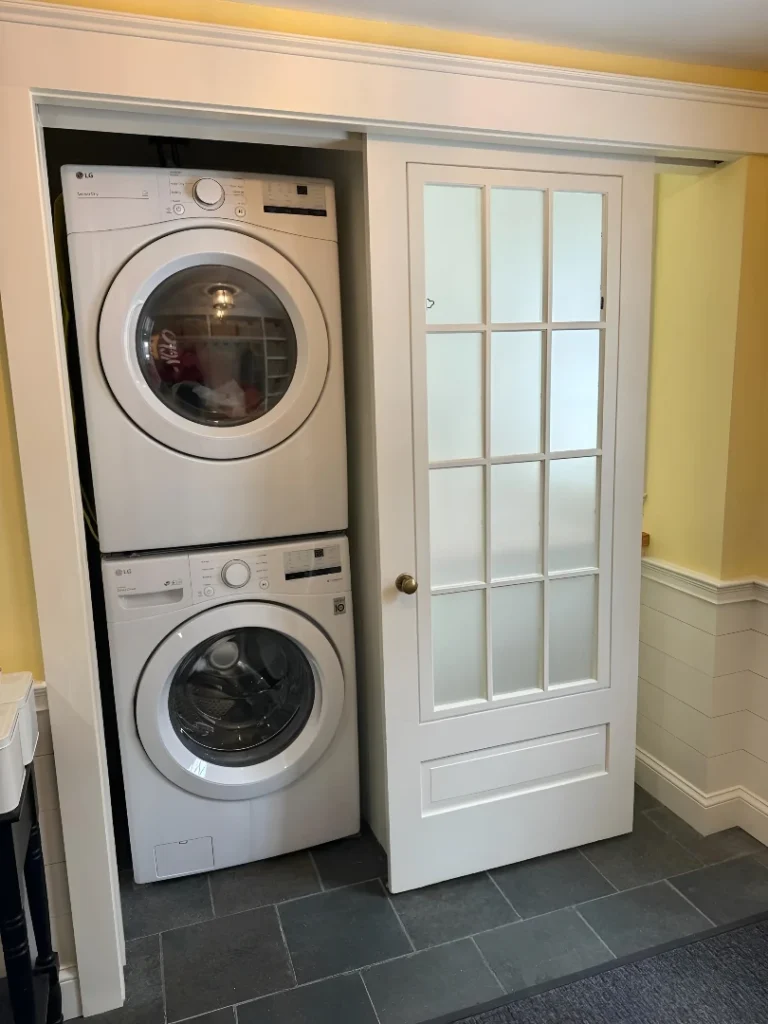
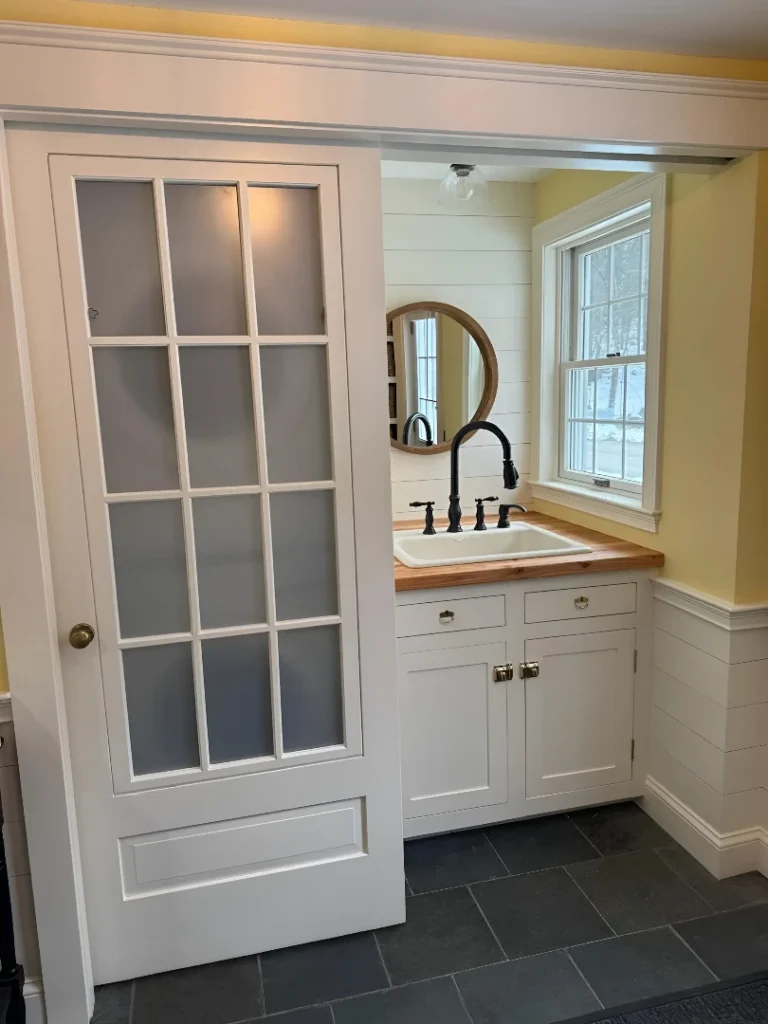
Two angles of the same room tell the whole story of what considered planning looks like in a combined side entry and laundry space. From one direction, a stacked LG washer and dryer sit in a dedicated niche beside a frosted glass French door — the appliances are fully accessible, completely functional, and the moment that door slides across, they cease to exist as far as anyone entering from outside is concerned. From the other direction, the same frosted door stands open to reveal a white shaker sink cabinet with butcher block timber countertop, a black bridge faucet over a recessed farmhouse sink, brass cup pulls, a round timber-framed mirror, and shiplap panelling running the niche walls beneath a window letting in winter light. Dark slate tile runs the full floor in both zones without breaking, and the warm butter-yellow walls of the entry surround give the white cabinetry and black hardware the tonal contrast they need to read as deliberate rather than default. The genius of this setup is entirely in the door — one piece of frosted glass on a sliding track separates a utility installation from a designed interior moment, and the space is convincingly both depending on which side of it you’re standing.
The Vintage Farmhouse Laundry That Treated Every Appliance as Part of the Story
Shiplap on walls and ceiling, warm hardwood floors, a jute rug running the full working length, front-load washer and dryer on a custom surround with a folding counter above, a vintage cast-iron utility sink on a turned-leg timber stand with a linen skirt concealing the plumbing below, open rustic timber shelves with collected objects and wicker storage, a vintage wooden drying rack mounted on the wall, a chalkboard “Same Day Laundry” sign as the wall anchor, a ceiling fan with a glass globe fixture, and a wall sconce above the chalkboard for task lighting. The appliances are neither hidden nor apologised for — they’re integrated into a composition where everything is operating in the same warm, weathered, deliberately imperfect register. The linen sink skirt is the detail that proves this room was styled rather than just decorated, because someone looked at exposed plumbing and saw an opportunity for texture rather than a problem requiring concealment.
The Sage Blue Mudroom Laundry That Justified Every Inch of Space
Dusty sage-blue shaker cabinetry runs full height on both sides of a long combined mudroom and laundry room, providing a mudroom zone on one wall with a timber bench, wicker baskets in cubbies above, and double hooks for daily coats and bags, while the laundry zone opposite houses front-load appliances under a marble countertop with cabinetry above and an airer rack mounted to the wall. Three brass dome pendant lights run the ceiling length on the shiplap panel ceiling, a patterned vintage-style runner covers the dark slate tile floor down the centre, and a ribbed glass internal door at the far end provides the entry point from the rest of the house. The cabinetry colour running continuously on both sides is the decision that makes the room — it creates a visual envelope that makes a long, narrow combined space feel like a deliberate design move rather than two functions compressed into a corridor.
The Sage Green Cottage Laundry That Found Beauty in the Ordinary
Botanical print wallpaper covers the walls in a space flooded with natural light from a full-height window framing garden views, sage green open cabinetry with timber knobs provides the storage base, a continuous butcher block timber countertop runs across the cabinetry and over side-by-side front-load appliances, a white farmhouse sink with a brass gooseneck tap sits in the counter run, open lower shelving holds stacked white towels and wicker baskets, dried botanicals and branch arrangements in glass vases cover every available counter surface, and the warm oak engineered floor reflects the afternoon light in a way that makes the whole room feel inhabited rather than utilitarian. This laundry room doesn’t hide what it is or apologise for its appliances — it simply surrounds the functional elements with enough warmth, texture, and botanical abundance that the washing machines become incidental to the overall atmosphere rather than the defining feature of it.
Go Luxe or Go Home: Polished Porcelain, Walnut, and Hidden Laundry
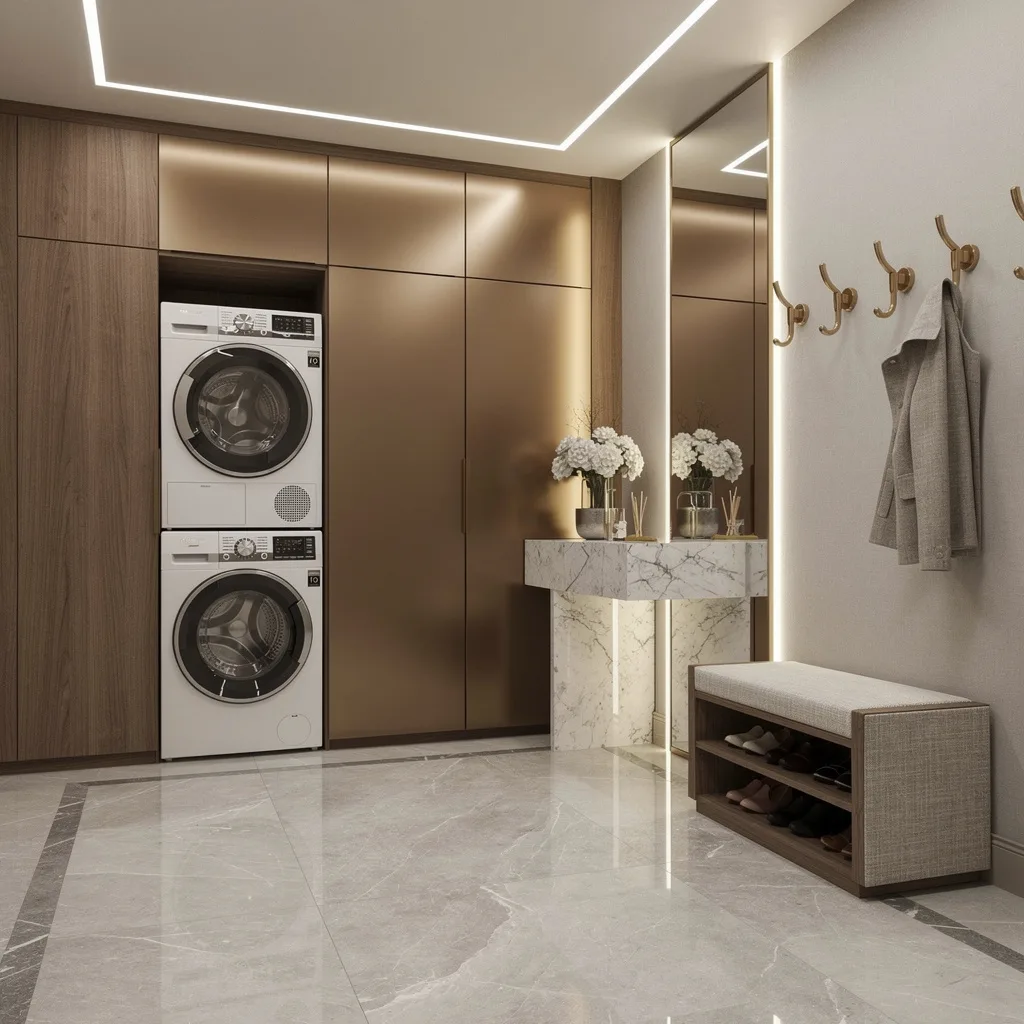
Want guests to think you have a live-in butler? Shoot for an entryway laundry worthy of a five-star hotel. Start with wide-format polished porcelain for floors—because regular tile is for quitters—and mount seamless walnut veneer cabinets on the wall. Stash a stacked washer-dryer behind matte bronze panels (if you can see your appliances, you’re doing it wrong). Drop in a custom marble console beside a huge light-up mirror and line up brushed brass hooks for instant bling. Toss in a textured linen bench. Don’t over-clutter. The pro tip: If you can see your detergent, you’ve already ruined it. Hide everything and stick to the clean lines like your reputation depends on it.
Pastel Perfection: Basalt, Ribbed Glass, and Storage Magic
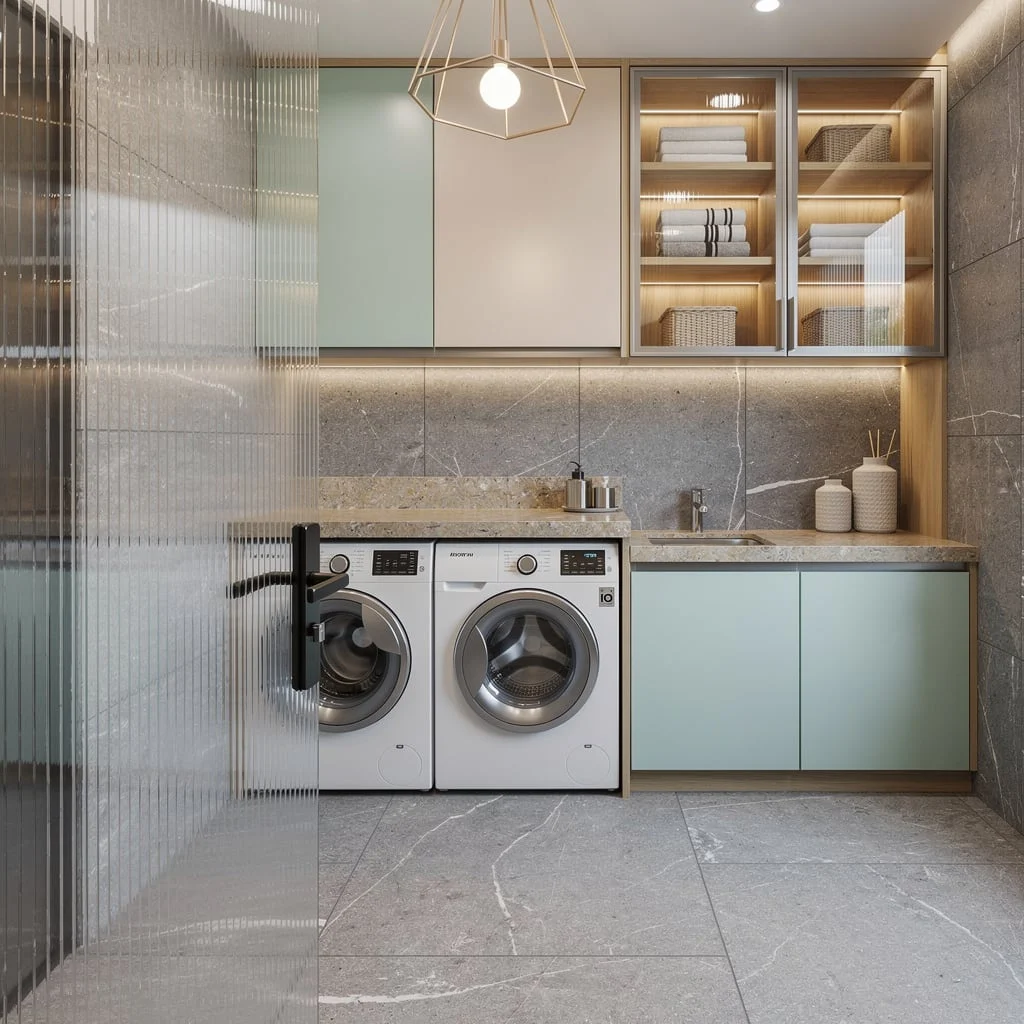
Go for a chilled-out modern vibe and make your chaos look intentional. Slam down honed basalt tiles to ground the space and pop in built-ins finished in soft pastels. Park your washer and dryer under a stone countertop—keep it front-load so you can pretend you fold stuff like a grownup—and set up a shallow utility sink. Use ribbed glass cabinets for that ‘I shop at designer stores’ energy. Show off towels and baskets on floating oak shelves, but for the love of style, keep them neat. Pro tip: Install a rain glass door, not a curtain—privacy yes, but still extra. Keep your lights soft, geometric, and absolutely not builder-basic.
Minimalist Zen: Terrazzo, Black Hardware, No Clutter Allowed
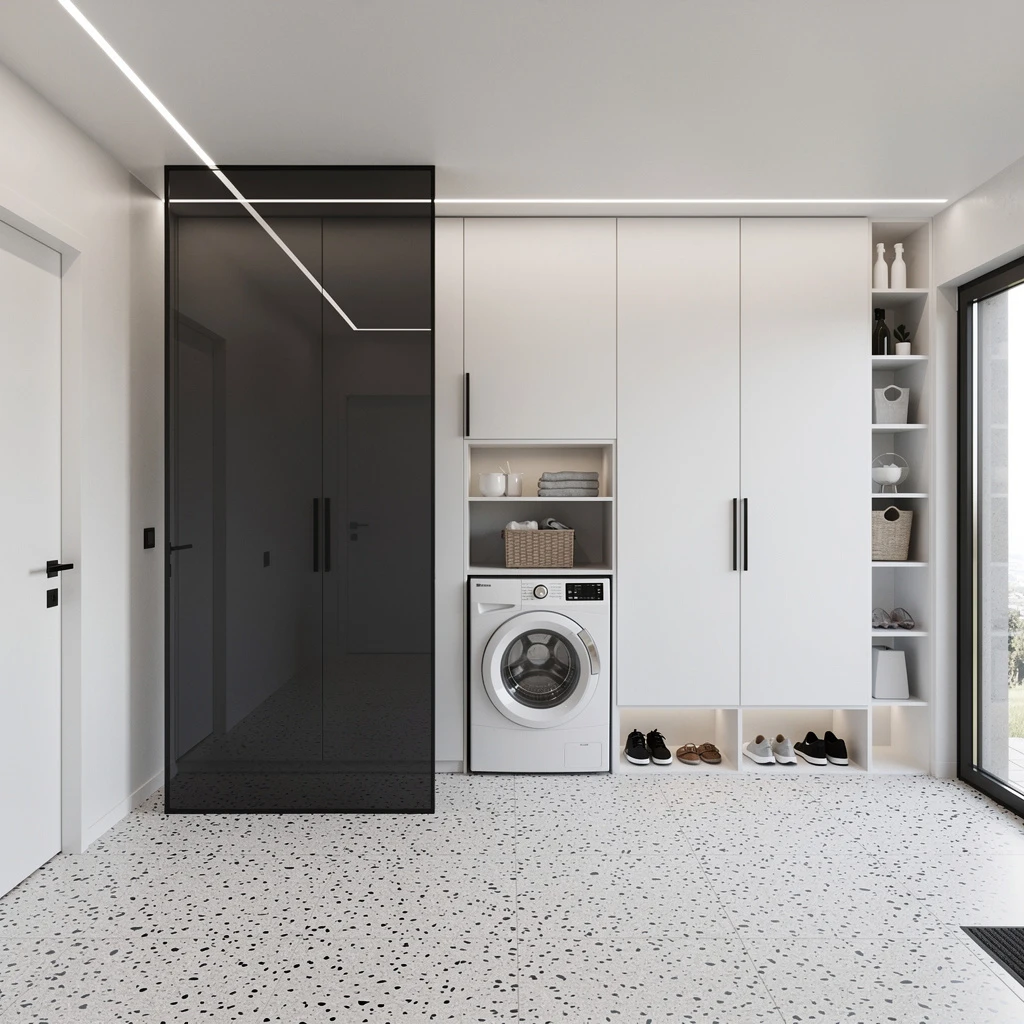
Channel your inner Scandinavian influencer and go with seamless terrazzo for the floors and white-out the walls. Build cabinetry up to the ceiling—no random baskets on top, please—and use matte black hardware for that ‘I know the assignment’ look. Hide your laundry gear behind doors. Carve out tiny cubbies for shoes and essentials so nothing touches the floor. Divide the zone with a massive smoked glass panel to block mess, but not your #aesthetic. Pro tip: Run linear LEDs parallel to your cabinets for a museum vibe. Less is more—seriously, if you buy more stuff, you’re ruining the mood.
Jewel Box Entry: Navy, Herringbone, and a Dash of Drama
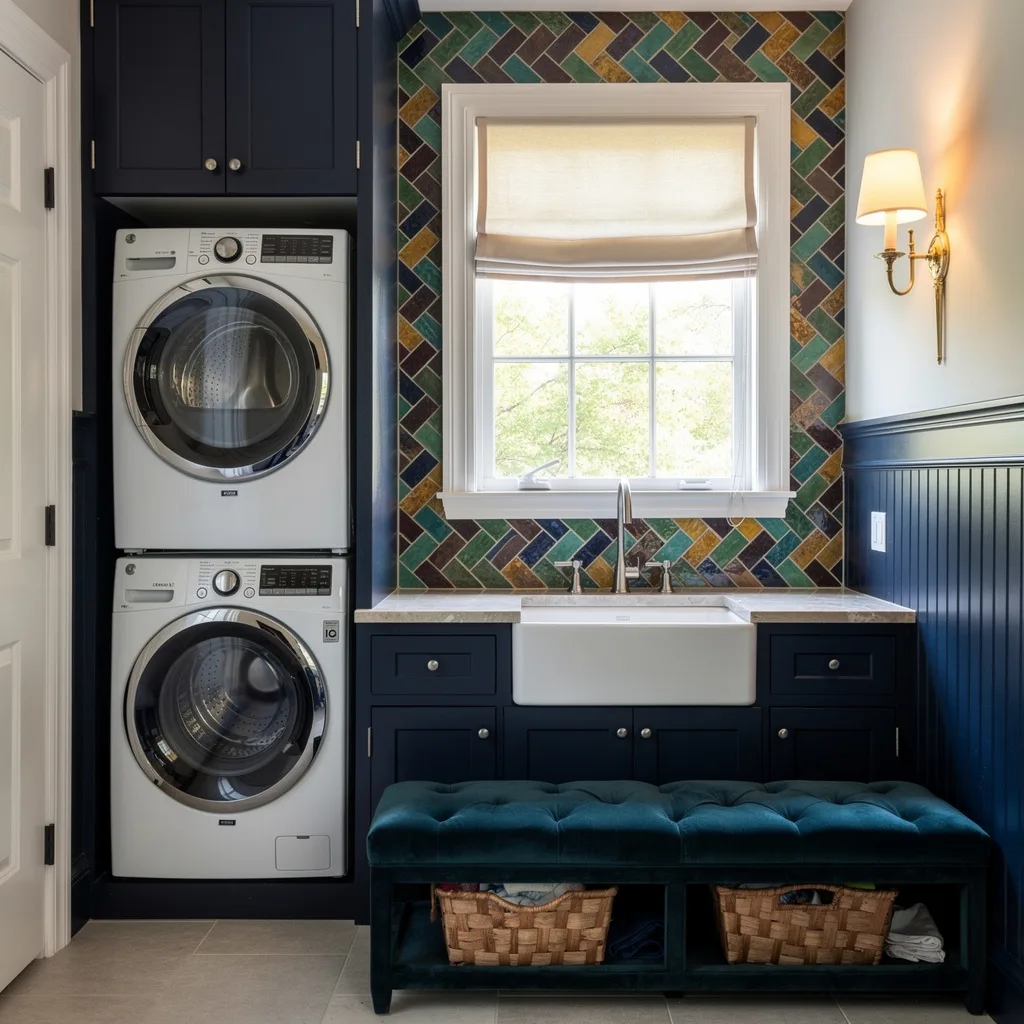
Unleash your inner maximalist with jewel-toned ceramic tiles in a herringbone pattern—because zigzags never go out of style—and tall navy blue shaker cabinetry. Stack your appliances vertically, like a city dweller with taste. Put that farmhouse sink under the window and cast some drama with Roman shades. Sneak in a velvet bench with hidden storage—no random shoes all over, thanks—and crown each side with classic sconces. Pro tip: Go full-on with the hardware—if those pulls aren’t brushed nickel and heavy, toss them out. Charm and function can live together, but only if you quit half-measures.
Eco-Chic Moves: Bamboo, Microcement, and Conscious Flex
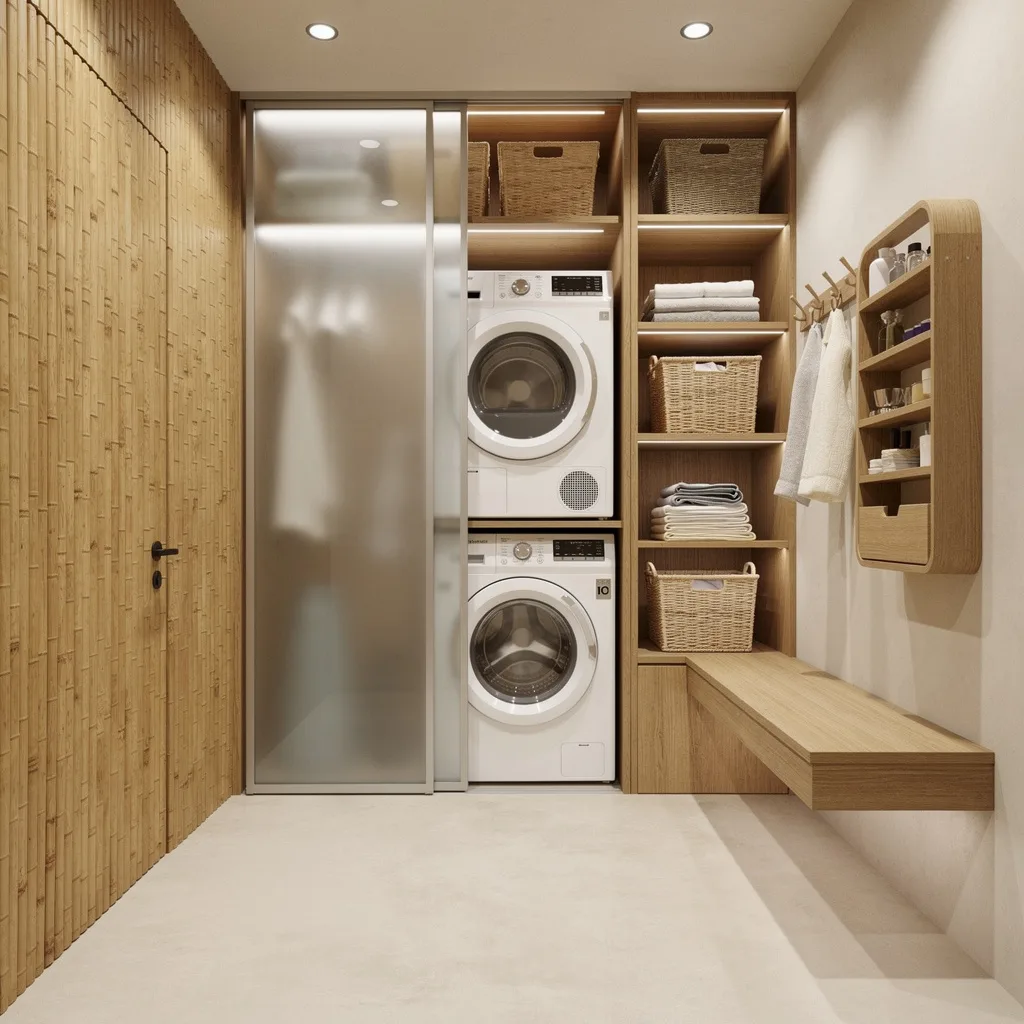
Show off your eco-cred with bamboo paneling—real or extremely convincing fake—and lay down ivory microcement for that ‘I read design magazines’ effect. Stack your wet appliances behind frosted glass sliders. Organize baskets and linens on built-in shelves, not in an ugly pile. Float a sturdy bench for dumping bags (not your insecurities) and hang a wall-mounted wood organizer. Don’t cheap out on lighting—throw in adjustable LED spots for warm, museum-caliber shine. Pro tip: Keep materials light and natural, and if it creaks, fix it. Sustainable does NOT mean ugly.
Pattern Power: Geometric Tile, Matte Gray, Shelf Game Strong
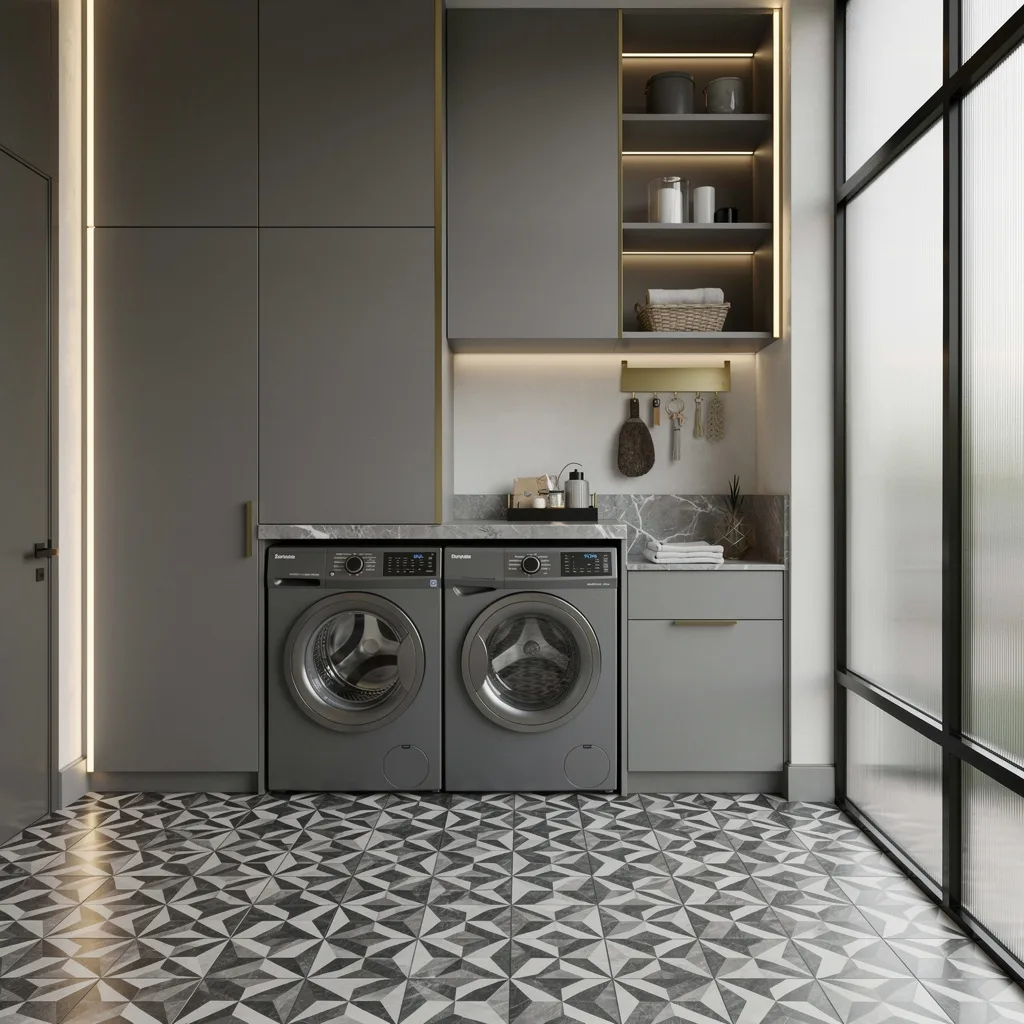
Banish boring and choose encaustic tiles with wild geometric drama for your floors. Wrap your storage in custom matte gray cabinetry—absolutely no shiny department-store stuff. Sink the appliances under a chunky marble top, then climb high with open shelving trimmed in gold. Add vertical strip lighting for effect (stop using the sad ceiling bulb), and plant a minimal console for keys so your mail isn’t stacked on the dryer. Pro tip: Let in indirect light with frosted window panels. Clutter kills pattern—so keep it tight or lose the stripes.
Sage Advice: Hardwood, Green Cabinetry, and Velvet Benches for Days
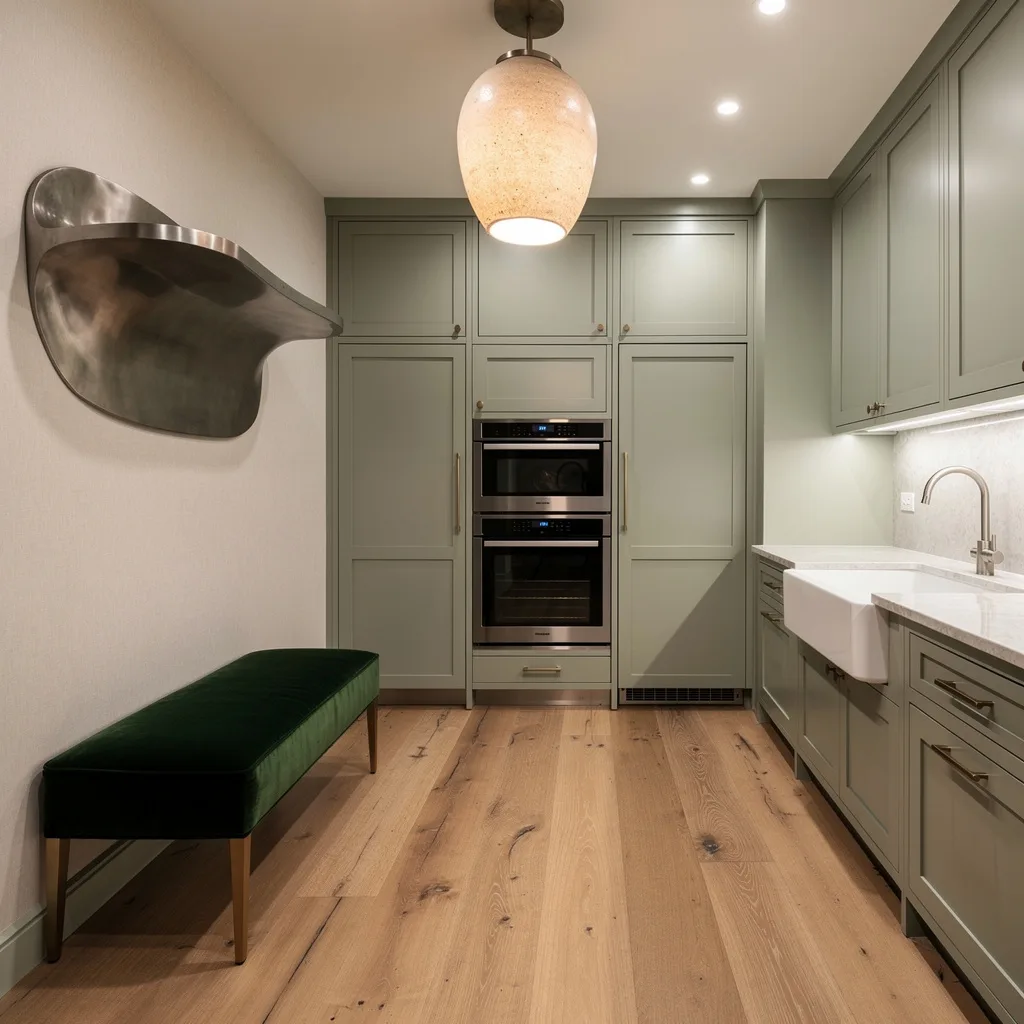
If you crave warmth but can’t stand basic, put down engineered oak floors (no, laminate doesn’t count). Camouflage your appliances with sage-colored shaker doors and invest in a slab of quartz for folding that you probably won’t use but need anyway. Drop a velvet-upholstered bench by the door—bonus points for sculptural shelf above in brushed steel. Mix subtle ceiling downlights with a show-off ceramic pendant, and keep things feeling custom. Pro tip: Always soft-close your cabinetry. Loud slamming belongs in frat houses, not your chic entryway.
Steel It: Terrazzo and Stainless Vibes That Don’t Try Too Hard
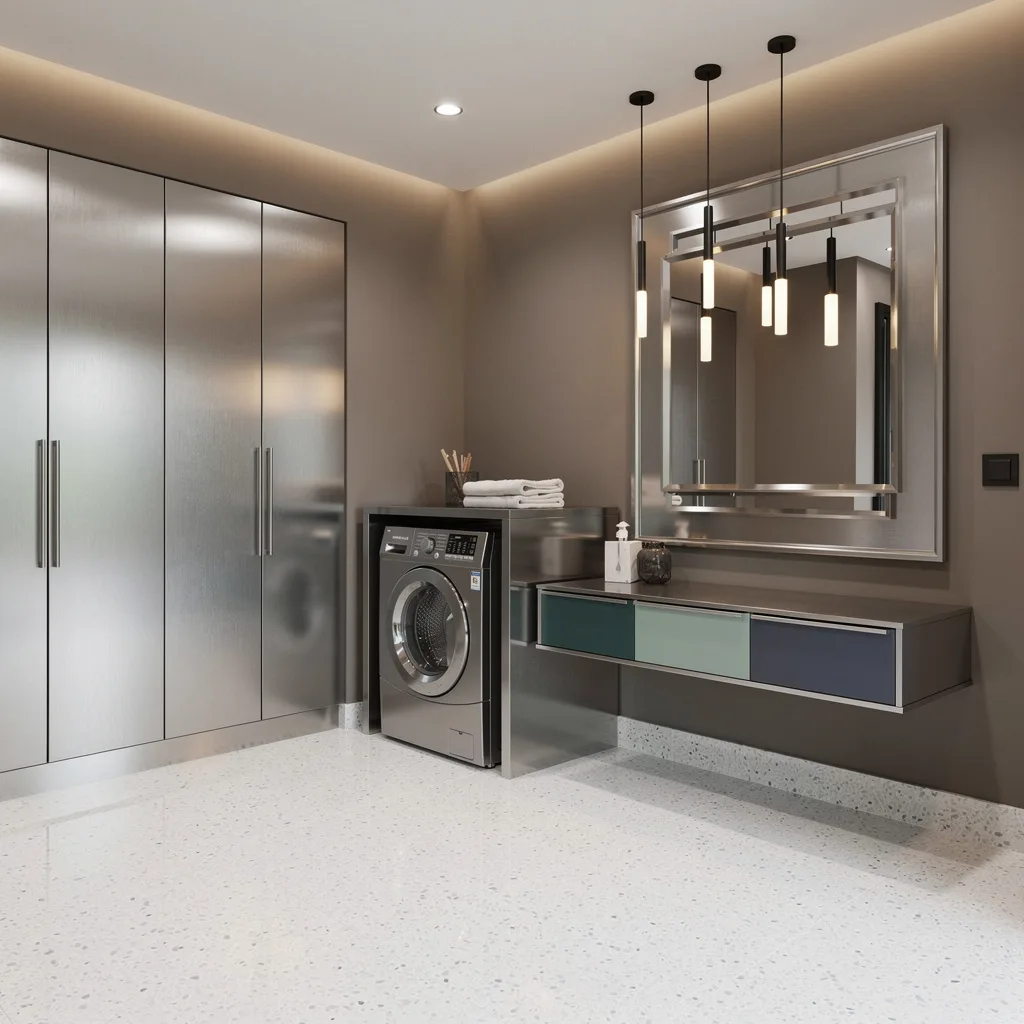
Want the crisp, clean entry of someone who has never spilled a drink? Start with polished white terrazzo on the floor, add satin steel cabinets, and set up an integrated sorting station so socks don’t launch wars. Float a console, match your storage bins, and turn on a trio of pendant lights that actually do something, instead of just looking pretty. Mount a massive mirror in stainless next to taupe walls (flat paint only please). Pro tip: Keep laundry baskets coordinated—rainbow plastic bins are illegal in this luxury zone.
Go Bold or Go Watch TV: Textural Wallpaper, Olive Cabinets, and Drama
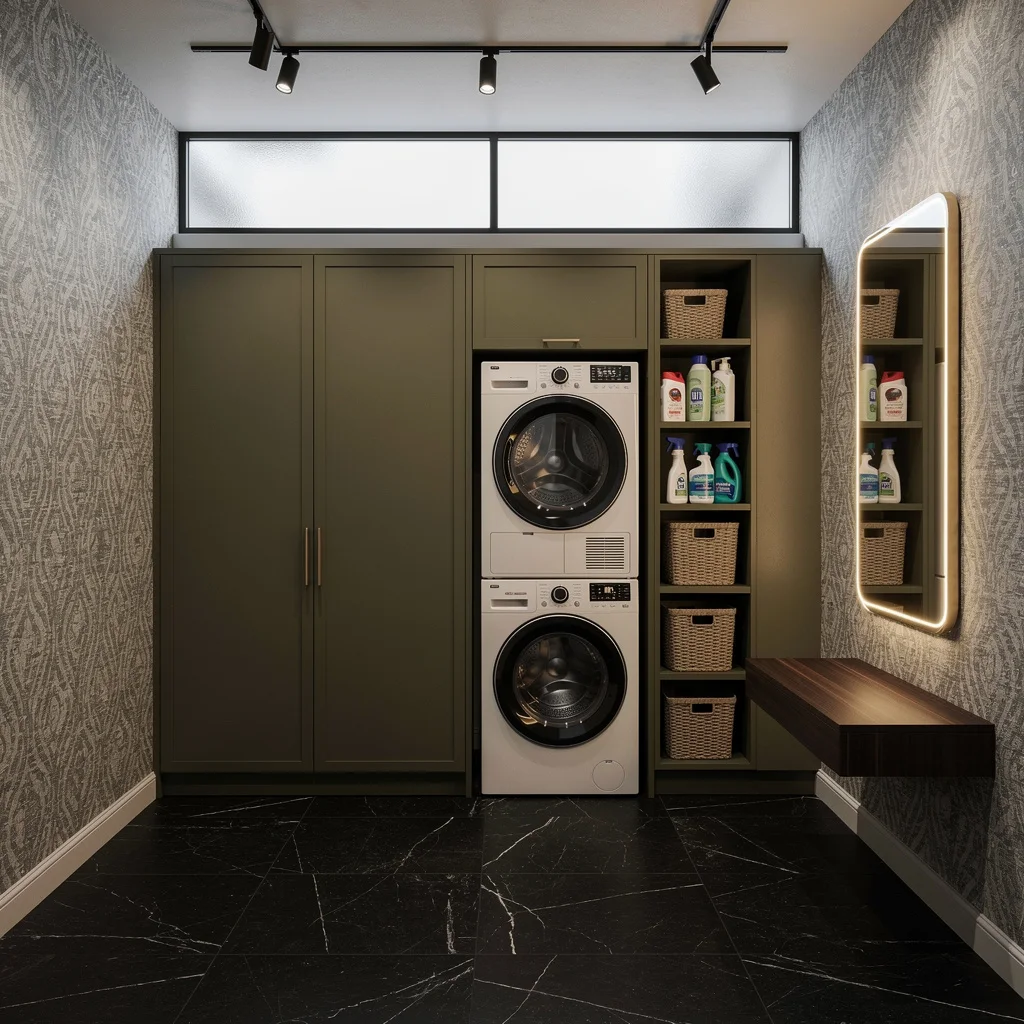
Ready for applause? Wrap your entry in a textural wallpaper with attitude and lay down black stone flooring (leave bland at the store). Choose tall, matte olive cabinetry and hide your washer-dryer like it’s state secrets. Use smoked walnut for a floating bench and face it toward a backlit LED mirror—great for last-minute selfies. Add ceiling track lighting for mood, but let frosted glass bathe the place in daylight. Pro tip: Don’t dust? Don’t even try this look; bold shows everything.
Scandi Fresh: Ash Wood, Floating Benches, and Clean Vibes Only
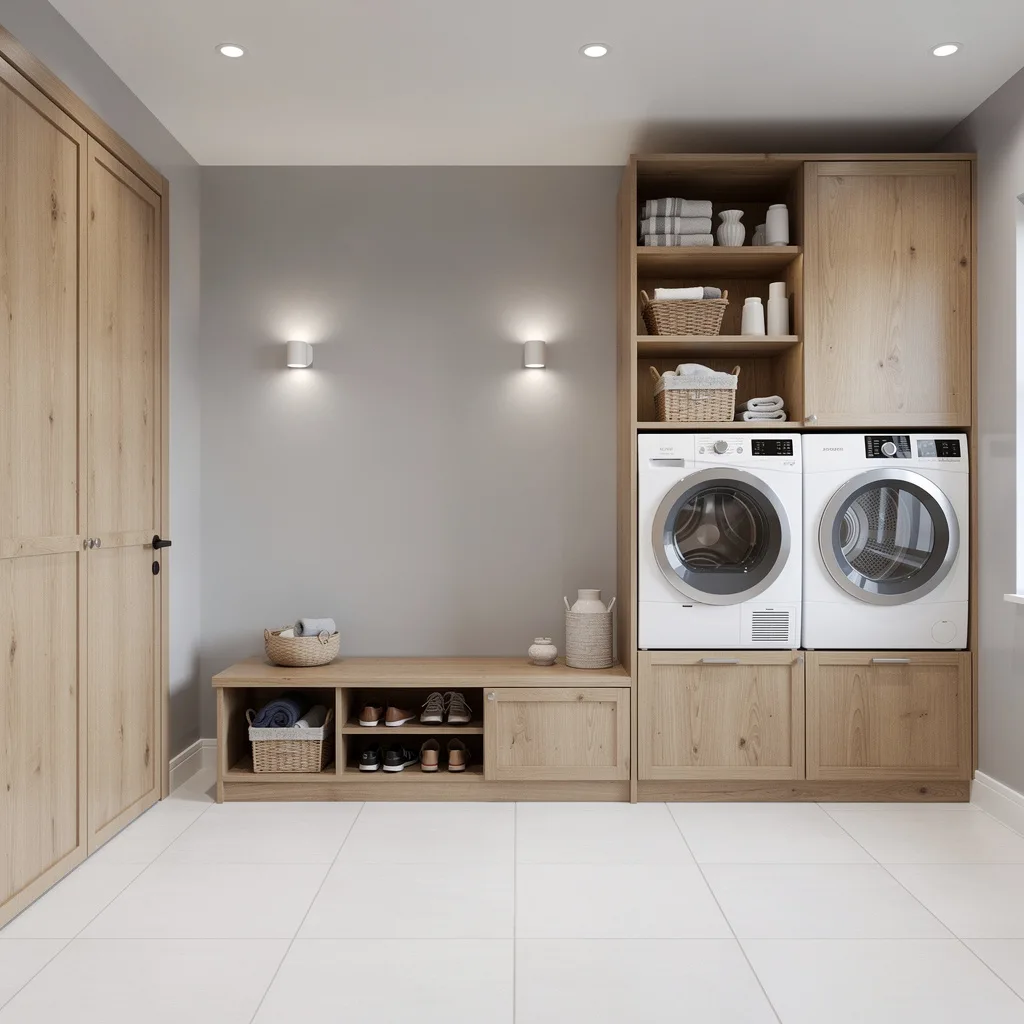
Crave serenity or just want to look organized for TikTok? Wrap your storage in ash wood, keep the floors soft white tile (not fake wood, not even once), and stash your machines inside integrated cabinetry. Float a bench with hidden compartments, and back it up with open shelving for baskets—just keep them matching. Mount clean-lined sconces and get serious with overhead LED spots for max brightness. Use super soft gray paint—not stark white—and keep everything distraction-free. Pro tip: Style with one plant max, not a jungle.
Dark & Glossy: Slate Drama Meets Travertine for Grown-Up Entry Goals
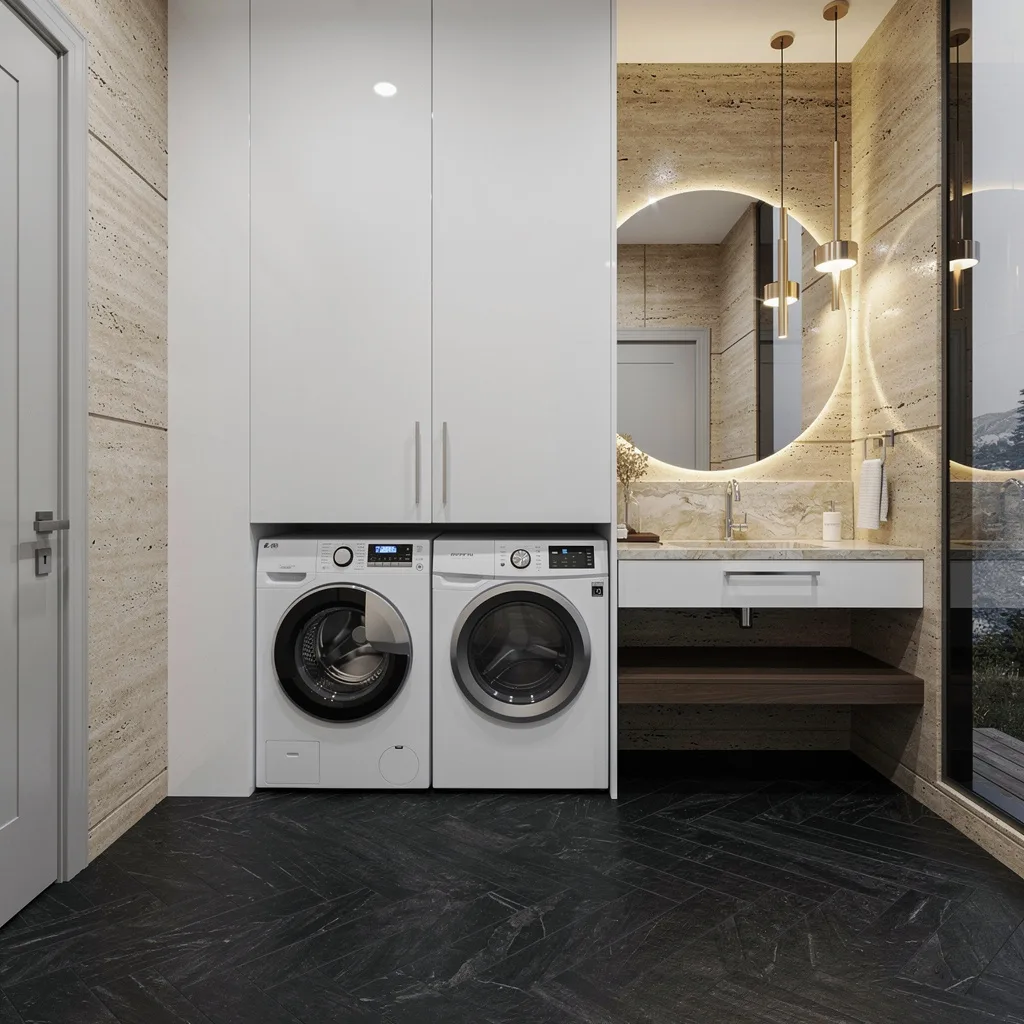
Crank up the sophistication with dark slate herringbone flooring and blast out some high-gloss white cabinetry—bonus points if it’s push-to-open. Flank the laundry with panels of natural travertine because fake stone doesn’t cut it. Float a wood bench under a giant, round, LED-backlit mirror and anchor the look with brushed chrome handles (seriously, no shiny silver). Hang contemporary pendants near the door so you look expensive coming and going. Pro tip: Keep the stone sealed and clean—nothing ruins drama faster than dusty grout lines.
Boutique Status: Concrete, Espresso, and Velvet That Means Business
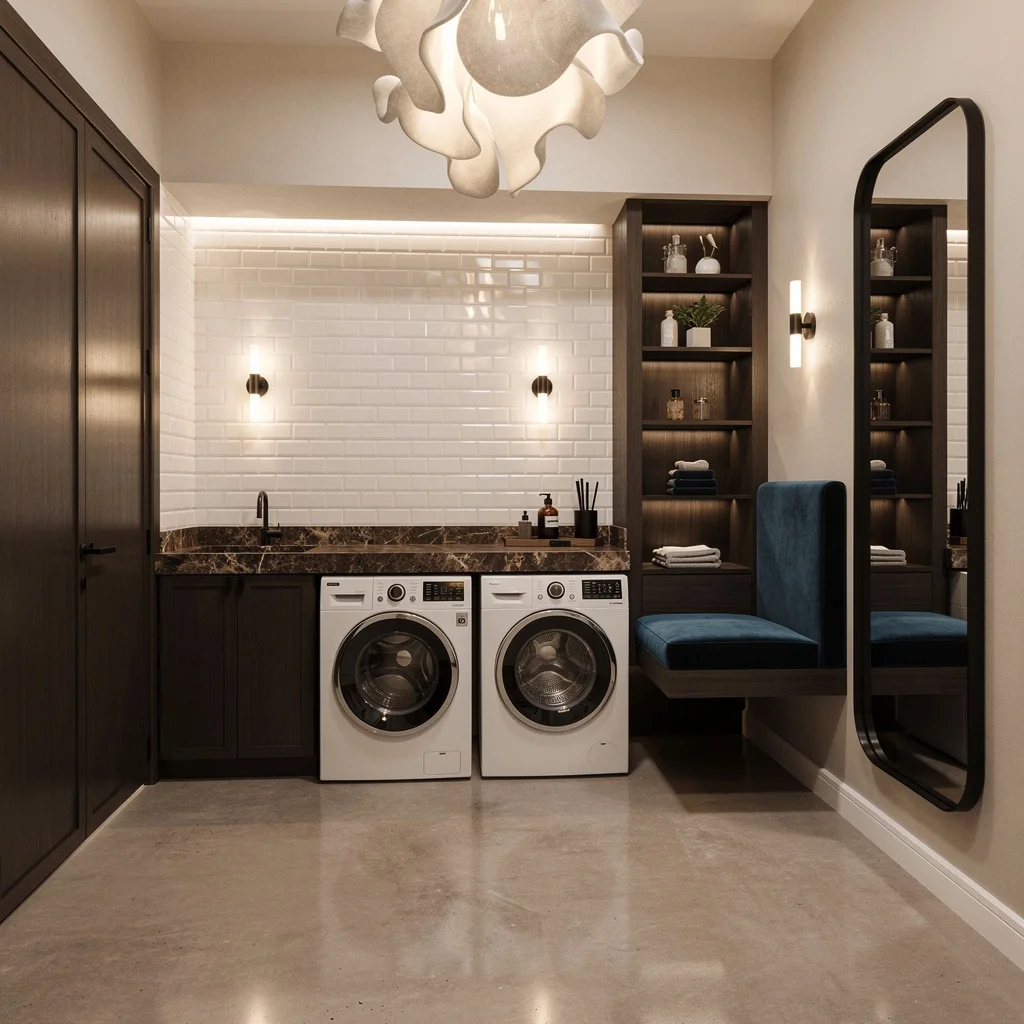
Shoot for the private client look with polished taupe concrete floors and deep espresso cabinetry. Go for glossy white subway tile at the splash zone and tuck your laundry units under fat slabs of stone. Perch a floating velvet bench by open vertical shelves—not for junk piles, just for baskets that match. Layer concealed uplights with a sculptural ceiling fixture for drama, and finish with a tall black-framed mirror. Pro tip: Don’t cheap out on hardware—matte black or nothing, and hire a cleaner if you won’t keep it spotless.
Final Thoughts
An entryway laundry that works — genuinely works, for the chaos of daily household life — is not an accident or a luxury. It’s the result of treating a dual-function space as a design brief that deserves the same level of attention as any other room in the house, then following that brief through consistently from floor to ceiling.
Every space here that succeeds does so because the functional requirements were identified first and the design choices were made in service of those requirements rather than despite them. The hooks are where coats actually land. The bench is where shoes actually get removed. The countertop is where laundry actually gets folded. The storage conceals what actually needs concealing. None of that sounds complicated because it isn’t — it just requires deciding what the space needs to do before deciding how it should look, which is the sequence that most room design gets right and most utility space design consistently reverses.
When the function is right, the design can be almost anything — farmhouse warmth, refined mudroom sophistication, cottage abundance, or quietly considered dual-purpose practicality. The aesthetic is the choice. The function is the non-negotiable. Get that order right and the entryway laundry stops being the room you apologise for and starts being the one you casually mention in conversation because you know exactly how it looks.