
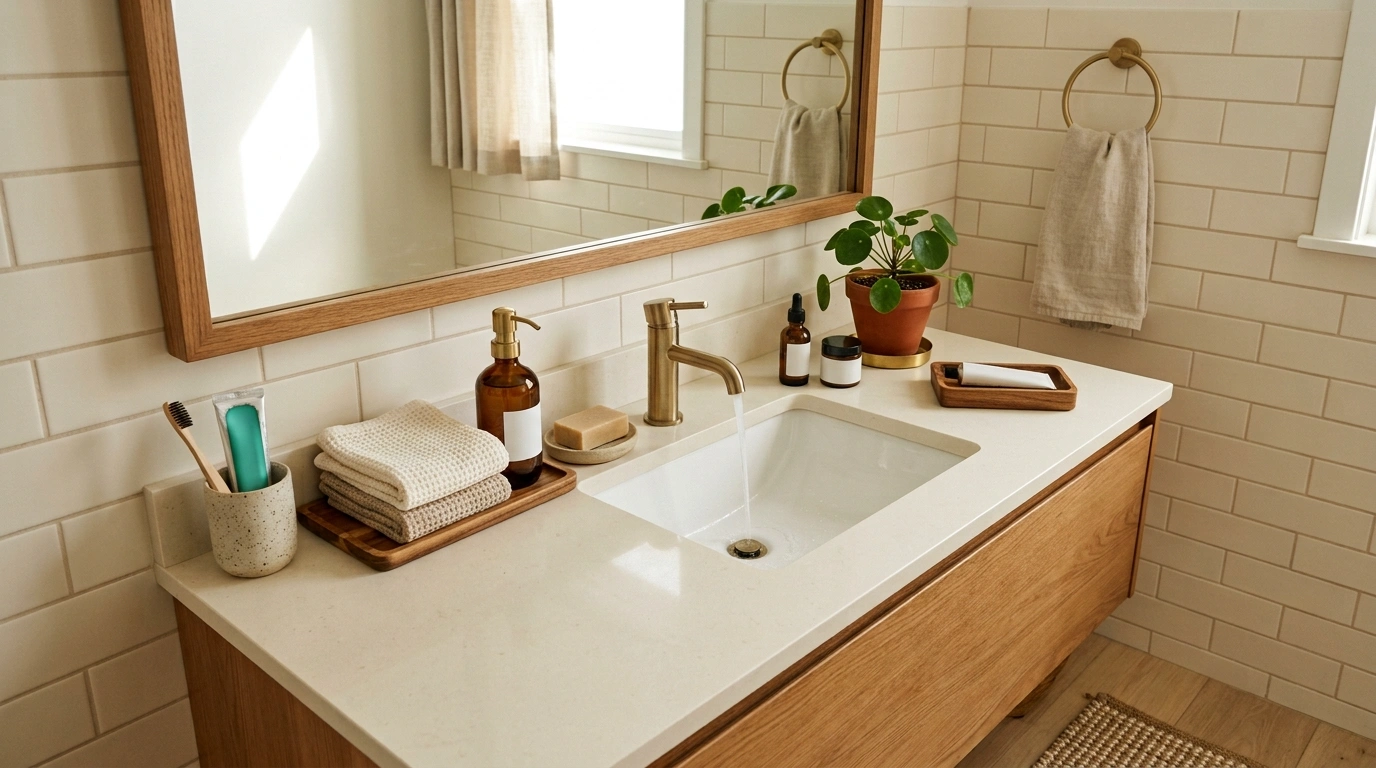
A bathroom sink can be expensive, stylish, and completely underwhelming at the same time. The vanity looks good on its own. The mirror looked good in the store. The faucet looked amazing online. Then everything gets installed together and suddenly the sink wall has the personality of a waiting room.
The problem is usually not one bad choice. It’s the relationship between all the choices. The proportions can feel off, the finishes can fight, the mirror can be too small, or the countertop can slowly become a parking lot for bottles, trays, candles, jars, and objects nobody remembers buying.
That’s why looking at complete bathroom sink ideas is much more useful than collecting random little decorating tricks. A finished design shows how the vanity, mirror, lighting, wall, materials, storage, and everyday details actually work together.
The Sink Isn’t the Problem. The Random Stuff Around It Is.
Bathroom Sink Designs
Curated Countertop Tray With Neutral Spa Essentials
Countertop clutter is the silent enemy of a peaceful bathroom, but throwing everything into a drawer isn’t always practical. The secret lies in containment. A pale marble tray anchors a ceramic soap dispenser, a soothing candle, and a delicate glass perfume bottle, giving everyday items a deliberate home.
A textured ceramic vase holds dried botanical sprigs, adding organic height next to the sleek tile backsplash. Meanwhile, a pretty pink facial roller rests right on the stone, bridging the gap between functional skincare and countertop decor.
The trick is editing down to a few cohesive pieces that share a similar color palette. Once the chaos is corralled onto a stylish tray, the whole sink area instantly graduates from messy storage to intentional styling.
Warm Oak Vanity With Cream Stone and Antique Brass
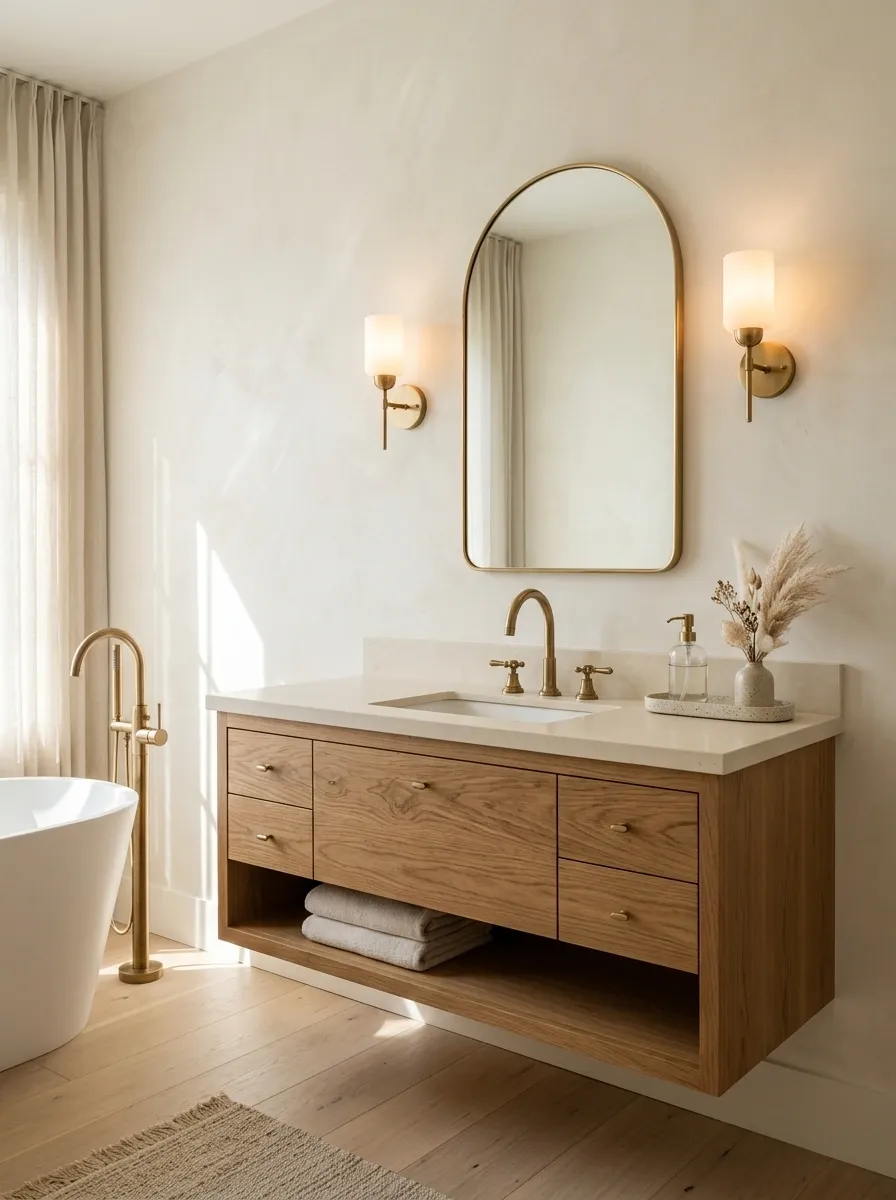
The easiest way to make a bathroom sink feel expensive without making it cold is to let warm materials do the talking. This design pairs a floating oak vanity with a creamy stone countertop, an understated undermount basin, and antique brass fixtures.
A softly rounded mirror breaks up the straight lines of the cabinetry, while two warm wall sconces keep the mirror from feeling like it was simply dropped onto the wall. The surrounding finish stays quiet, with a warm off-white wall and pale flooring.
The brass works because it appears in controlled doses. It doesn’t need to be repeated on every single object like the bathroom is collecting trophies. The oak should remain the dominant character, with the cream stone acting as the visual bridge between wood and metal.
Warm Minimalist Vanity With Floating Wood and Brass
Creating a spa-like retreat at home doesn’t require a complete structural overhaul. Sometimes, all it takes is pairing a clean white vessel sink with a floating oak vanity and brushed brass fixtures. The warm wood brings an earthy grounding effect, while the polished metal adds just enough understated shine.
Above the counter, a large round mirror reflects natural light and softens the architectural lines of the room. Flanked by matching cylindrical wall sconces, the mirror becomes an artistic focal point rather than a basic necessity. A vase of fresh eucalyptus on one side and a delicate orchid on the other bring living texture to the composition.
The open lower shelving keeps the aesthetic airy while offering a practical home for neatly rolled white towels. Nothing feels heavy or overcrowded, proving that minimalism can still feel deeply inviting when you lean into natural textures.
Soft White Sink Area With Fluted Vanity and Pale Wood
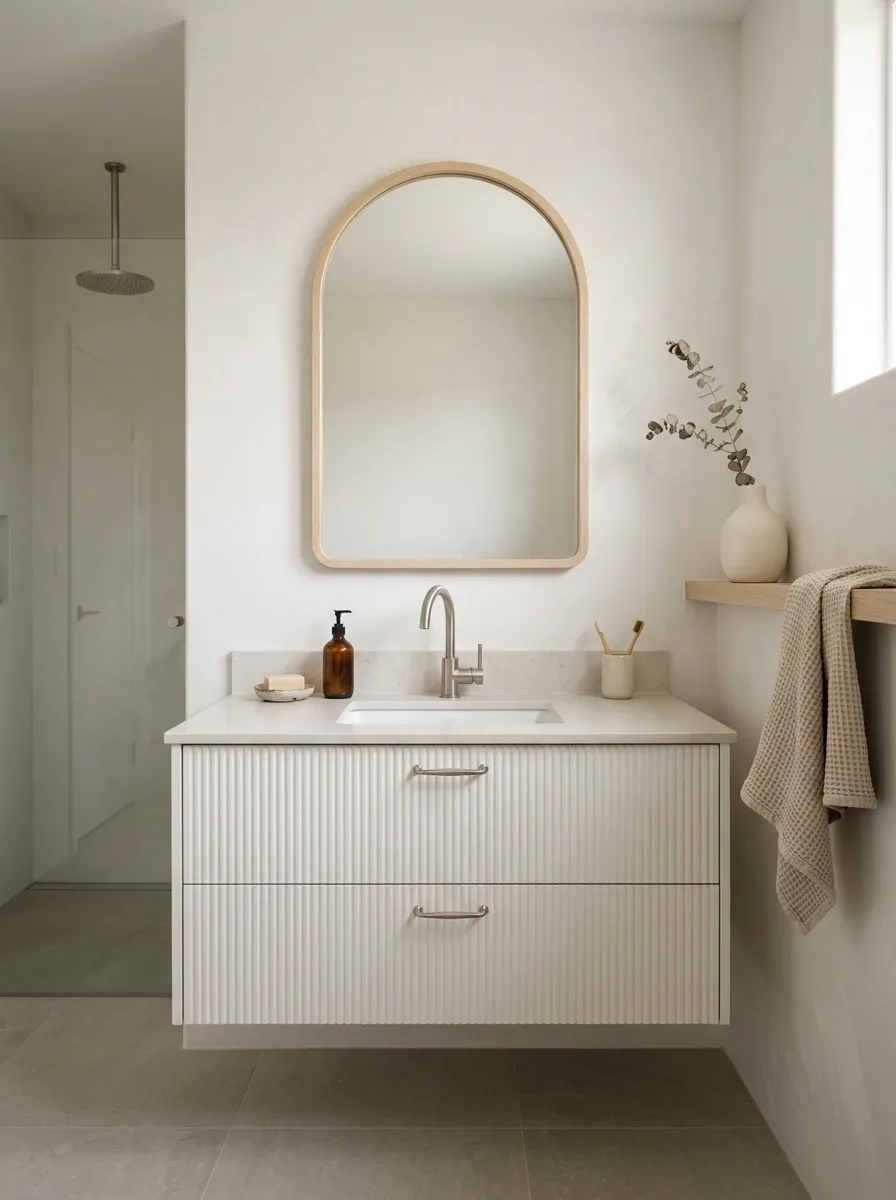
White bathrooms can easily drift into “rental listing photo” territory. The answer here isn’t more decoration. It’s texture and shape.
A fluted white vanity gives the lower half of the room some depth, while pale oak appears in the mirror frame and a slim open shelf nearby. Above the sink, a softly rounded mirror echoes the gentle vertical rhythm of the fluting. A pale stone-look counter and brushed nickel fixtures keep everything light without turning the room stark.
The wall finish stays close to warm white, and the floor uses a slightly deeper neutral tile to ground the composition. Nothing is fighting for attention.
That’s what makes this design work. The room has several textures, but almost no visual shouting. A surprisingly useful skill in a bathroom, where the countertop already has enough opportunities to become a disaster zone.
Backlit Round Mirror Above a Modern Floating Sink
If your bathroom tends to feel a bit flat, playing with hidden illumination can completely change the atmosphere. A sleek, backlit round mirror casts a soft, floating halo against the wall, highlighting the smooth curves of the basin and the clean lines of the vanity below.
The vanity itself features subtle vertical texturing on the drawer front, adding quiet dimension to the lower half of the room. A tall, slender white pillar vase stands in the corner, holding delicate white florals that draw the eye upward without competing with the glowing mirror.
Everything about this setup relies on ambient lighting and clever spatial design. By letting the mirror provide its own glow and keeping countertop accessories to an absolute minimum, the sink area feels effortlessly high-end and calm.
Moody Green Vanity With Natural Stone Countertop
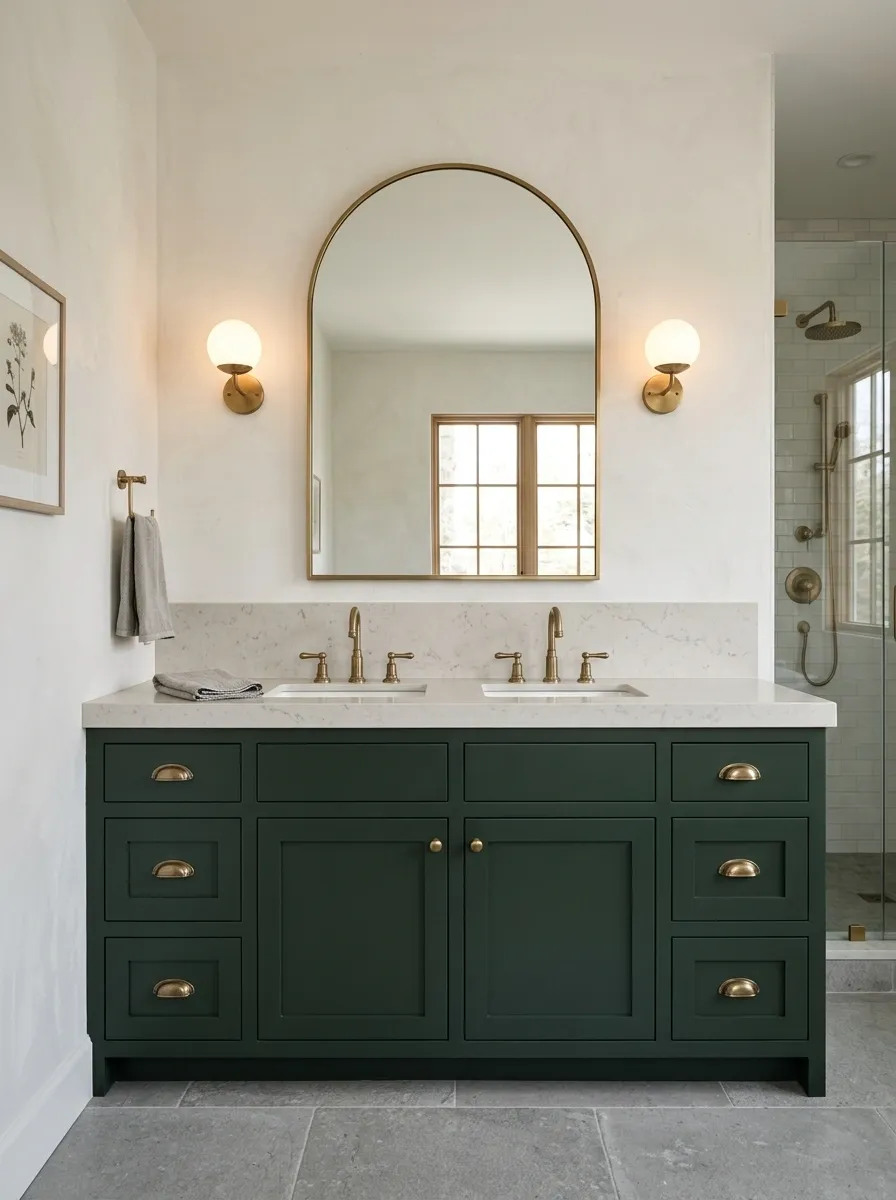
A deep green vanity changes the entire mood of the bathroom before a single accessory is added. Here, rich green cabinetry anchors the sink area beneath a pale natural-stone countertop with soft veining.
An aged brass faucet picks up the warmth in the stone, while a tall arched mirror adds a lighter shape above the darker lower half. Two compact sconces sit close to the mirror rather than spreading light across the whole wall.
The rest of the room stays deliberately restrained. Warm white walls, muted flooring, and very little countertop clutter give the green somewhere to breathe.
This is the kind of design that looks dramatic without needing theatrical decor. The cabinetry is already the statement. Adding a pile of decorative bottles on top would be like putting subtitles on a painting.
adds visual weight
creates relief
adds warmth
Elevated Wooden Tray Styling With Botanical Branches
Styling a bathroom counter often fails when you try to decorate every single square inch. The most successful spaces leave breathing room, using a single elevated wooden tray to anchor the essentials. Here, a pump bottle of hand soap, amber glass diffuser reeds, and neatly folded guest towels sit together on a rustic riser.
Behind the tray, a tall ceramic vase overflows with textured green stems, drawing height against the black-framed mirror. The natural wood tones of the tray pick up the warmth of the surrounding fixtures, tying the entire vignette together effortlessly.
This approach turns standard hand-washing supplies into an intentional design moment. It’s functional, beautiful, and ensures your countertop looks curated rather than cluttered with random bottles.
Woven Seagrass Storage Baskets for Organic Texture
Bathrooms are notoriously heavy on hard surfaces, from tile and porcelain to glass and metal. Introducing natural woven seagrass accessories is the easiest way to inject instant warmth and tactile contrast into an otherwise clinical space.
A matching set of braided baskets—holding everything from toilet paper to cotton swabs—transforms utilitarian storage into a cohesive decor statement. A slender rectangular tray corrals the daily toothbrushes, while a lidded canister keeps smaller items tucked neatly out of sight.
The look is grounded by a ceramic vase filled with slender olive branches, echoing the earthy tones of the woven containers. Paired with a simple round mirror and soft lighting, the entire vanity area feels organic, orderly, and beautifully grounded.
Classic White Vanity With Checkerboard Floor and Nickel
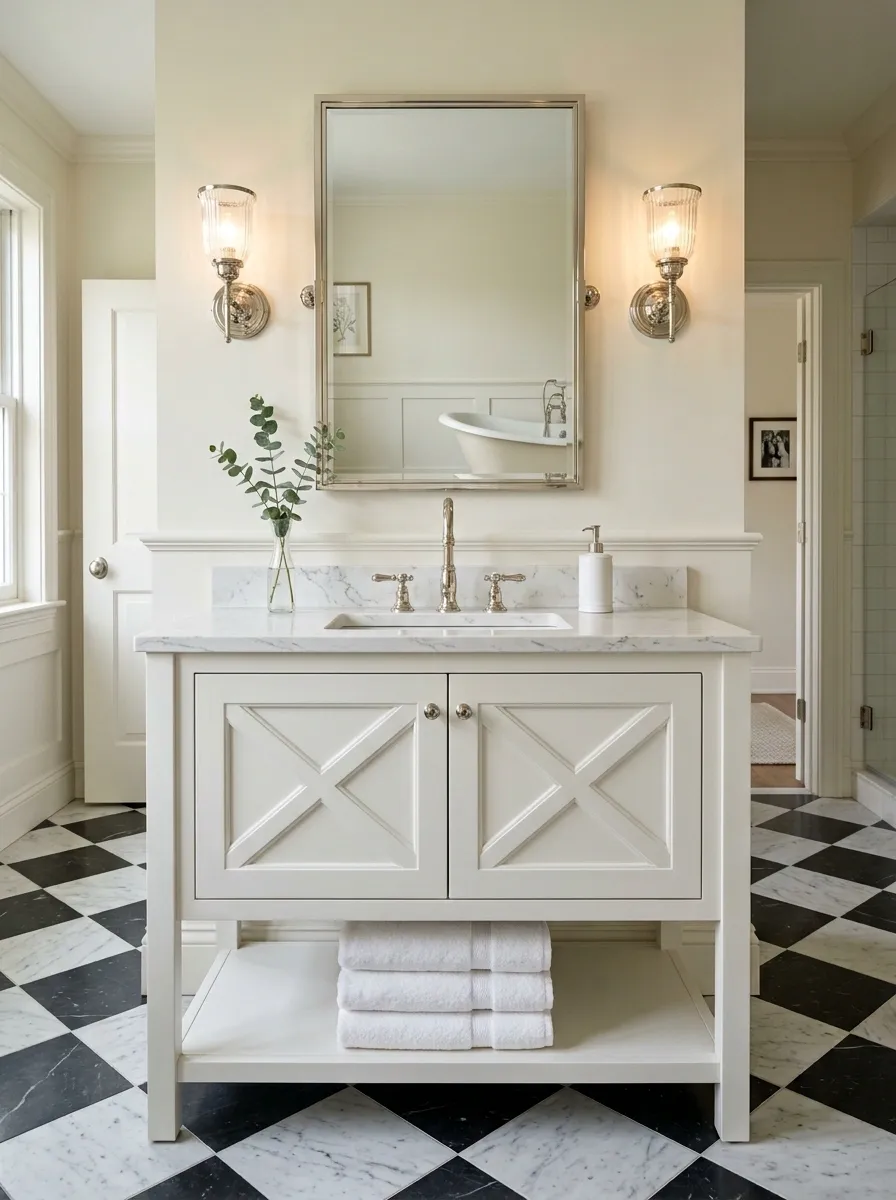
This one leans traditional without drifting into full-on period drama. A painted white vanity sits beneath a marble-look countertop, with polished nickel plumbing and a generously framed rectangular mirror above.
The visual interest comes from below. A black-and-white checkerboard floor gives the room a graphic base, while the sink wall remains calm and mostly light. Classic sconces on either side of the mirror keep the composition symmetrical without making it precious.
The important move is keeping the wall quieter than the floor. Once the same amount of pattern starts climbing the sink wall, the room gets busy fast.
The result feels established rather than trendy. It could belong in an older house, a newly renovated bathroom, or anywhere else that benefits from a little architectural confidence instead of another beige box.
Organic Modern Vanity With Travertine and Soft Taupe Walls
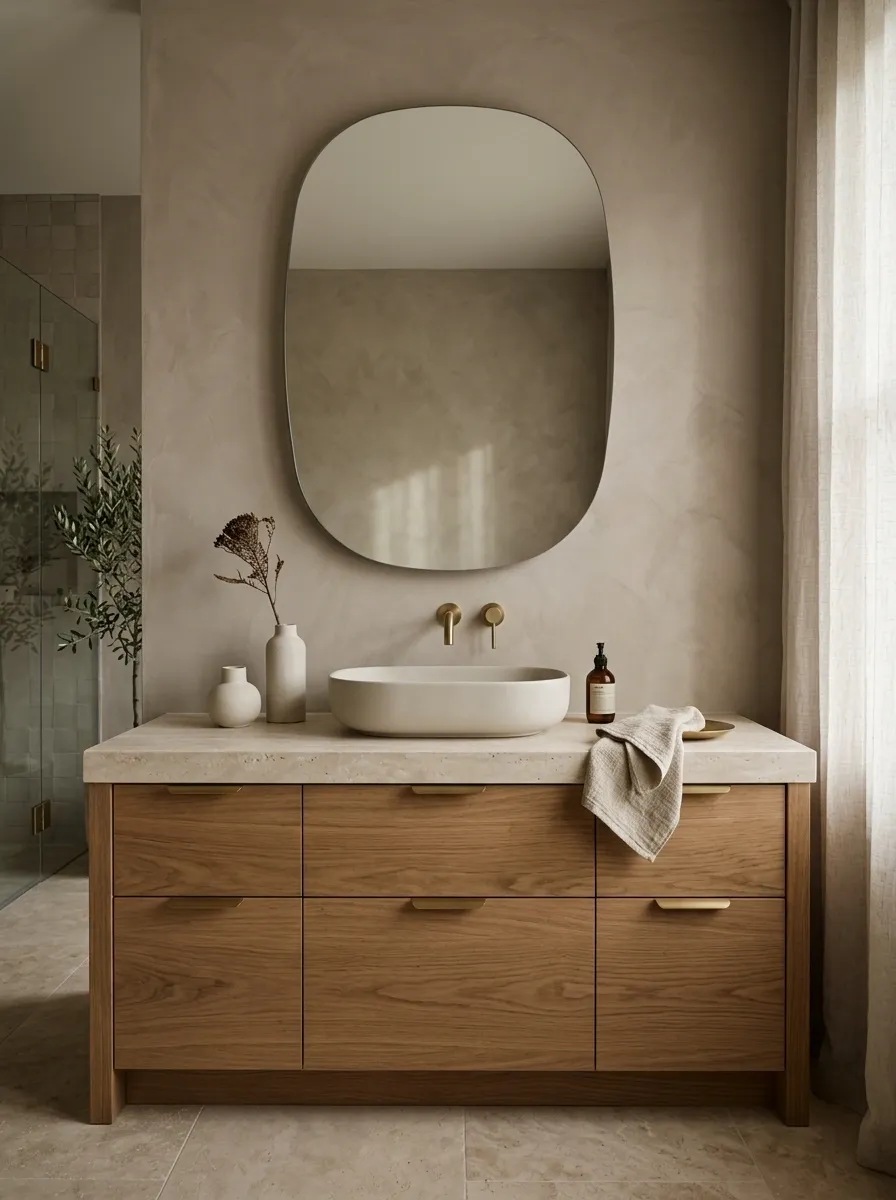
The sink area here is built around texture rather than decoration. A light oak vanity sits beneath a thick travertine countertop, with a softly rounded basin, simple brushed metal faucet, and a large irregularly shaped mirror above. The walls stay in a warm taupe that lets the stone and wood remain the stars.
Nothing feels overly matched, which is exactly why it feels cohesive. The stone has natural variation, the oak adds warmth, and the mirror introduces a softer silhouette against all those horizontal and vertical lines.
The countertop should stay fairly quiet. A soap dispenser and one low vessel are enough. Once the counter starts looking like a tiny home-goods aisle, the whole point of the material palette gets lost.
Black Vanity With Warm White Tile and Oak Accents
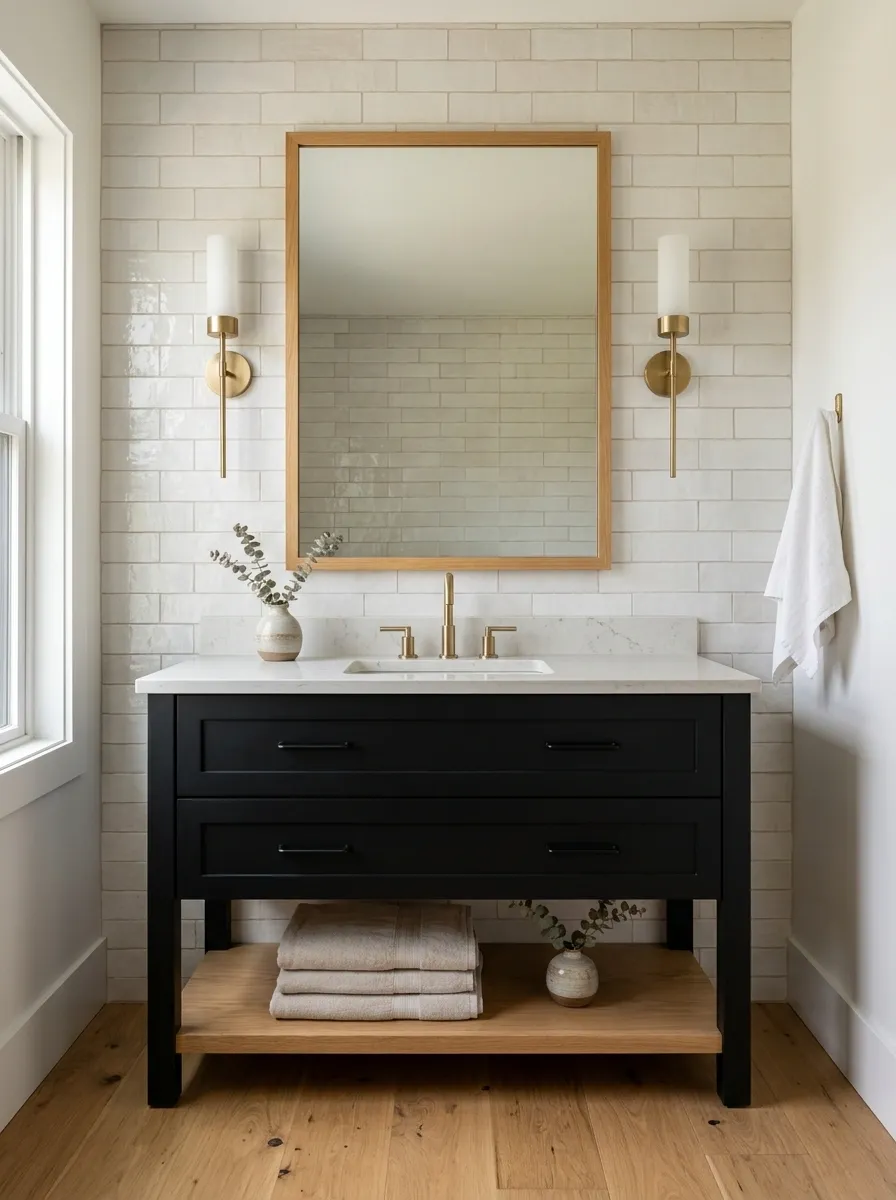
This bathroom takes a sharper route, using a matte black vanity as the anchor against warm white wall tile. Instead of pairing the dark cabinetry with an equally cold palette, warm oak appears around the mirror and in a small open storage element.
A simple rectangular mirror keeps the composition architectural, while slim brass sconces introduce just enough warmth above the sink. The countertop is light and uncomplicated, giving the dark vanity a clean break from the wall.
The trick is keeping the black concentrated low in the room. Covering every surface in dark finishes would change the mood completely. Here, the contrast feels intentional because the ceiling, walls, and counter still give the eye plenty of breathing room.
And yes, the black vanity can have personality without being accompanied by twelve black decorative objects. The vanity has already made its statement.
warm white + oak + a little brass
Vintage Dresser Vanity With Marble Top and Wall Sconces
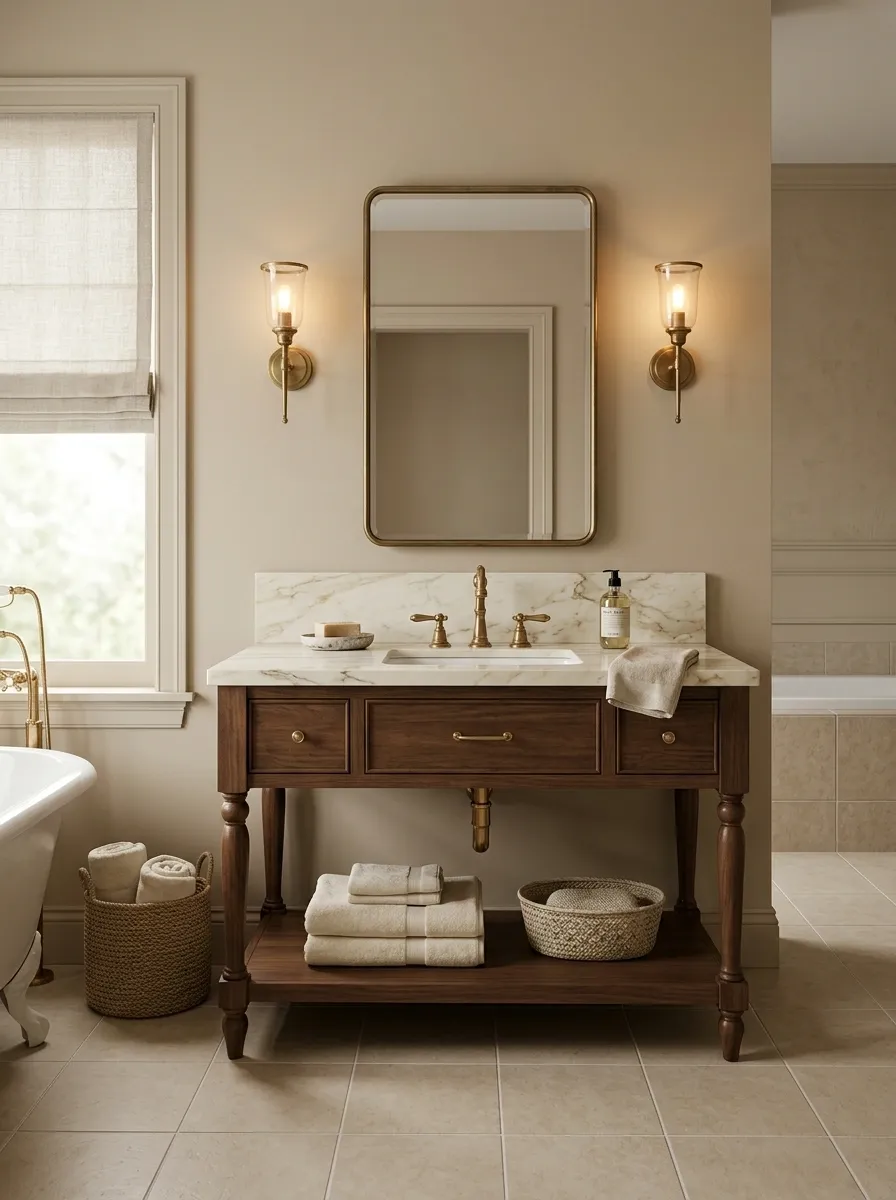
A furniture-style sink vanity completely changes the personality of a bathroom. Instead of a standard cabinet, this design uses a vintage-inspired dresser with turned legs, drawers, and a creamy marble countertop.
A traditional framed mirror sits above the basin, flanked by compact wall sconces with warm light. The floor uses a simple stone or porcelain finish so the vanity remains the strongest piece in the room.
This composition works because the cabinetry looks like furniture first and bathroom equipment second. The marble adds a refined surface without making the whole room feel formal.
The surrounding pieces should stay disciplined. Once the mirror, faucet, lighting, floor, and accessories all become equally ornate, the room starts looking like it’s trying to win an antiques competition. Let the vanity have the personality.
Organic Modern Vanity With Travertine and Soft Taupe Walls
This version feels almost sculpted. A substantial oak vanity sits against softly textured taupe walls, topped with a pale travertine counter and paired with a rounded mirror that follows the curves of the basin.
The hardware stays understated, with a warm muted metal finish that doesn’t compete with the stone. Lighting is soft and indirect, creating gentle shadows across the textured surfaces instead of flattening everything with bright overhead light.
The visual strength comes from repetition of shape and material. The rounded mirror echoes the softened basin, while the oak and travertine create enough variation to stop the wall from feeling monotone.
It’s calm without being bland, which is harder than it sounds. Beige everything is not automatically a design. Sometimes it is just beige everything.
+ softened basin
+ warm straight-lined vanity
Narrow Console Vanity With Elegant Traditional Styling
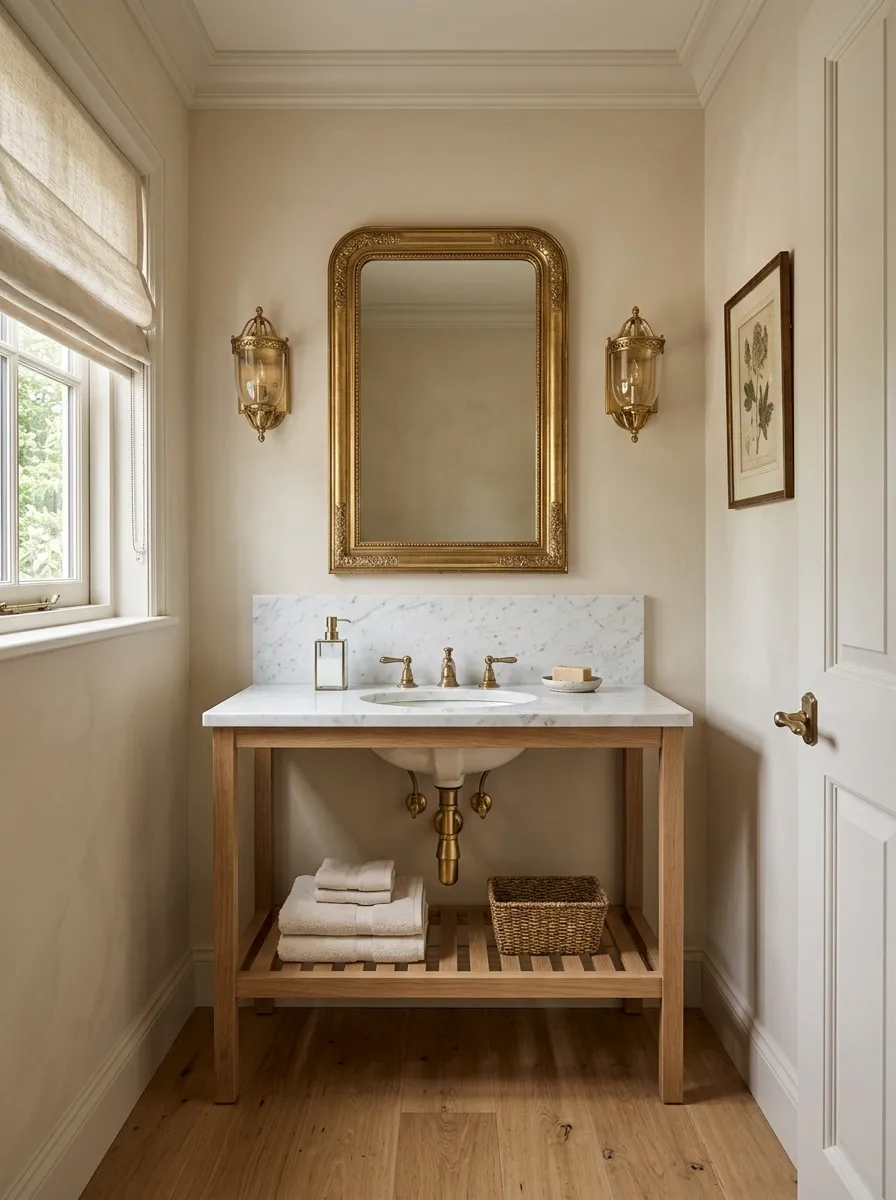
A narrow bathroom doesn’t automatically need a boring sink. This design uses a slim console-style vanity with an open lower shelf, a marble countertop, a compact undermount basin, and an elegant framed mirror.
Because the vanity is visually open below, the floor remains visible and the room feels less crowded. A pair of delicate wall sconces creates symmetry around the mirror without consuming much wall space.
The styling stays restrained: folded towels on the lower shelf, a small soap dispenser, and little else. The open structure does most of the visual work.
This is especially effective in a powder room or older bathroom where floor space is limited. The design feels intentionally slender rather than like a full vanity was squeezed into a space where it clearly did not fit.
Warm Beige Bathroom With Arched Mirror and Walnut Vanity
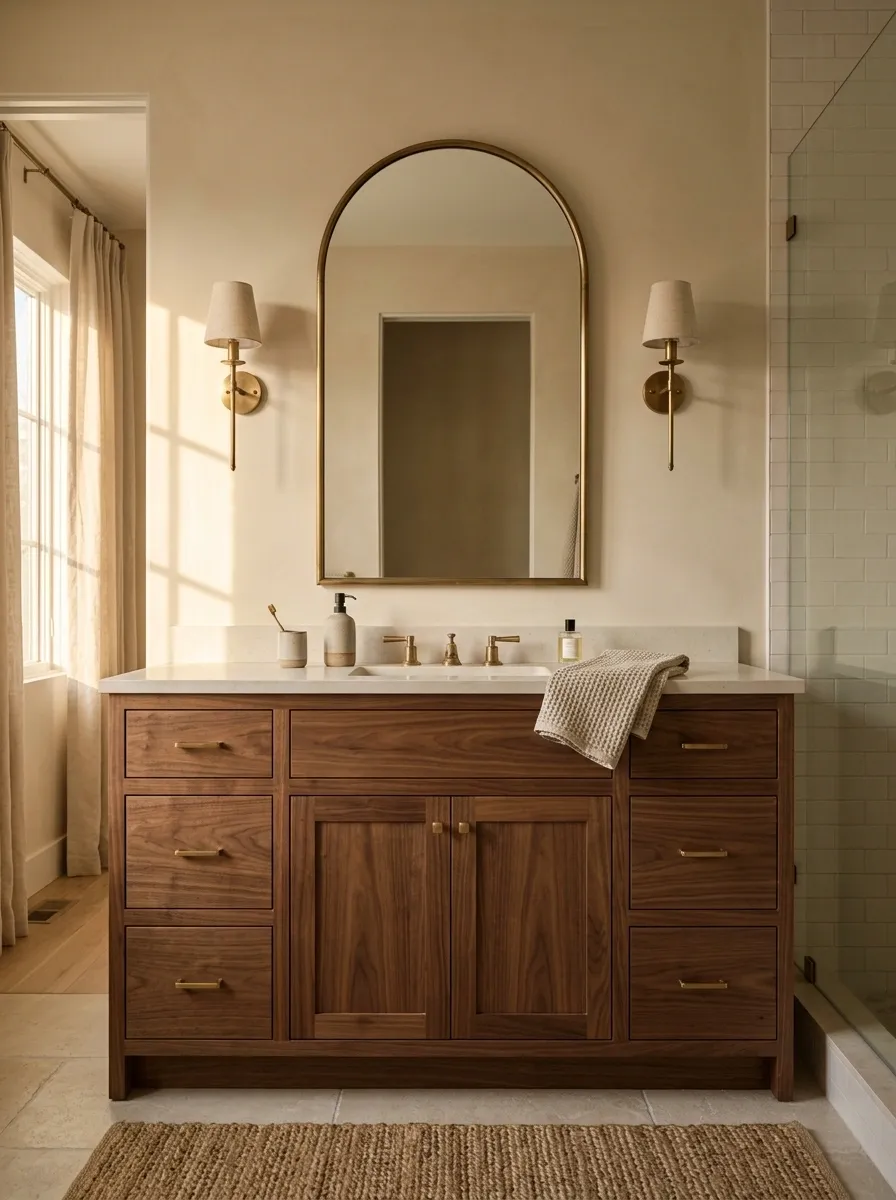
Warm beige walls give this sink area its soft foundation, while a medium walnut vanity adds enough depth to keep everything from blending into one large neutral cloud. Above it, a tall arched mirror introduces a strong vertical shape, and aged brass hardware ties the wood and wall tones together.
The countertop stays pale and fairly plain, which gives the darker vanity a clean visual break. Small wall lights sit close to the mirror, creating a tighter composition instead of leaving a giant empty zone around the sink.
The best part is the mix of shapes. The vanity is mostly straight and architectural, while the mirror brings the curve. That contrast keeps the design interesting without needing patterned tile, elaborate accessories, or the obligatory little plant sitting beside the soap for absolutely no reason.
Contemporary Concrete Sink Area With Matte Black Fixtures
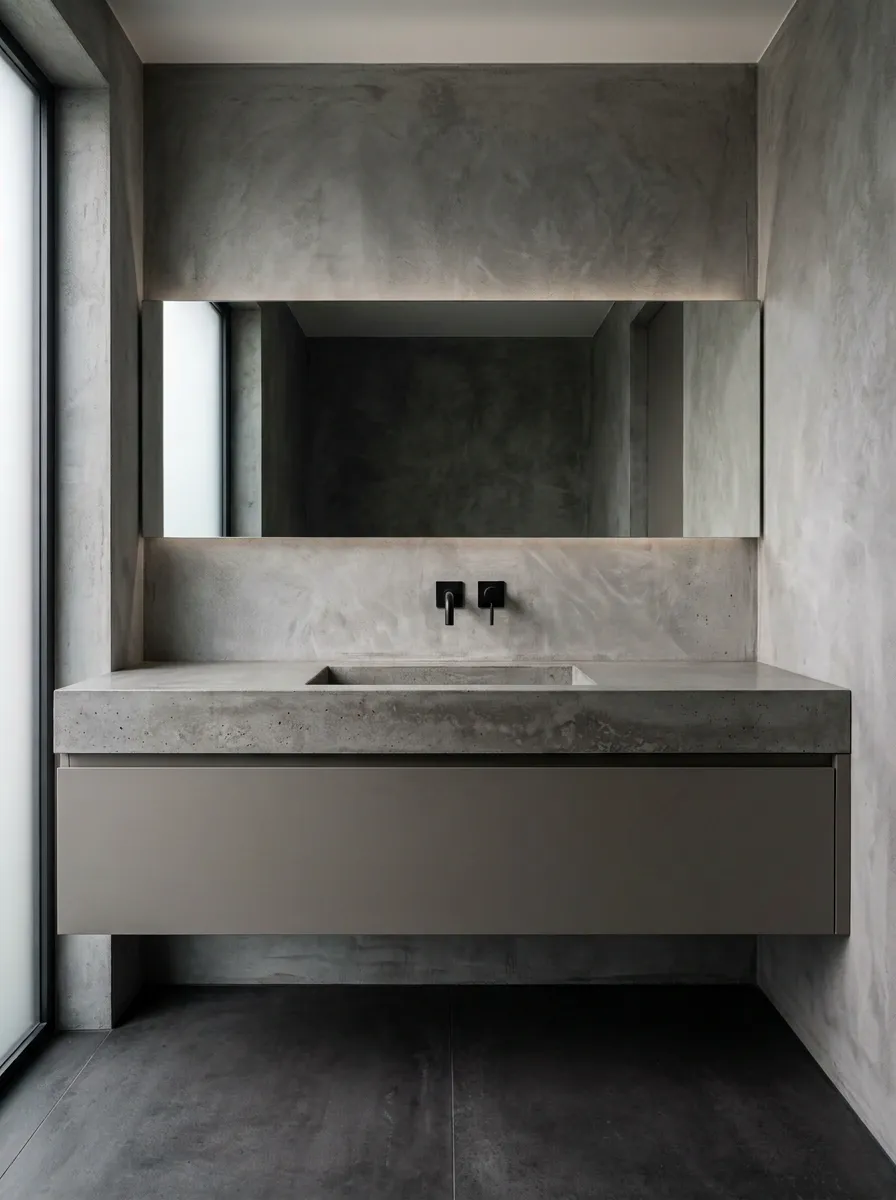
This bathroom goes deliberately cooler and more architectural. Concrete-look walls and a simple slab countertop create a monolithic background for flat-front cabinetry, a frameless mirror, and matte black plumbing.
The cabinet finish stays just a shade warmer than the concrete so the entire wall doesn’t collapse into one gray block. A long horizontal mirror reinforces the clean geometry, while black hardware provides crisp definition around the sink.
Lighting matters here. Soft side lighting creates shadows across the textured surfaces, giving the concrete enough variation to stay interesting. The room doesn’t need artwork, decorative shelves, or a miniature jungle.
That’s the beauty of a restrained material palette. The architecture gets to do the talking.
And for anyone tempted to add another black vase because the counter “needs something,” this bathroom has formally declined the invitation.
Dusty Blue Vanity With White Marble and Brass
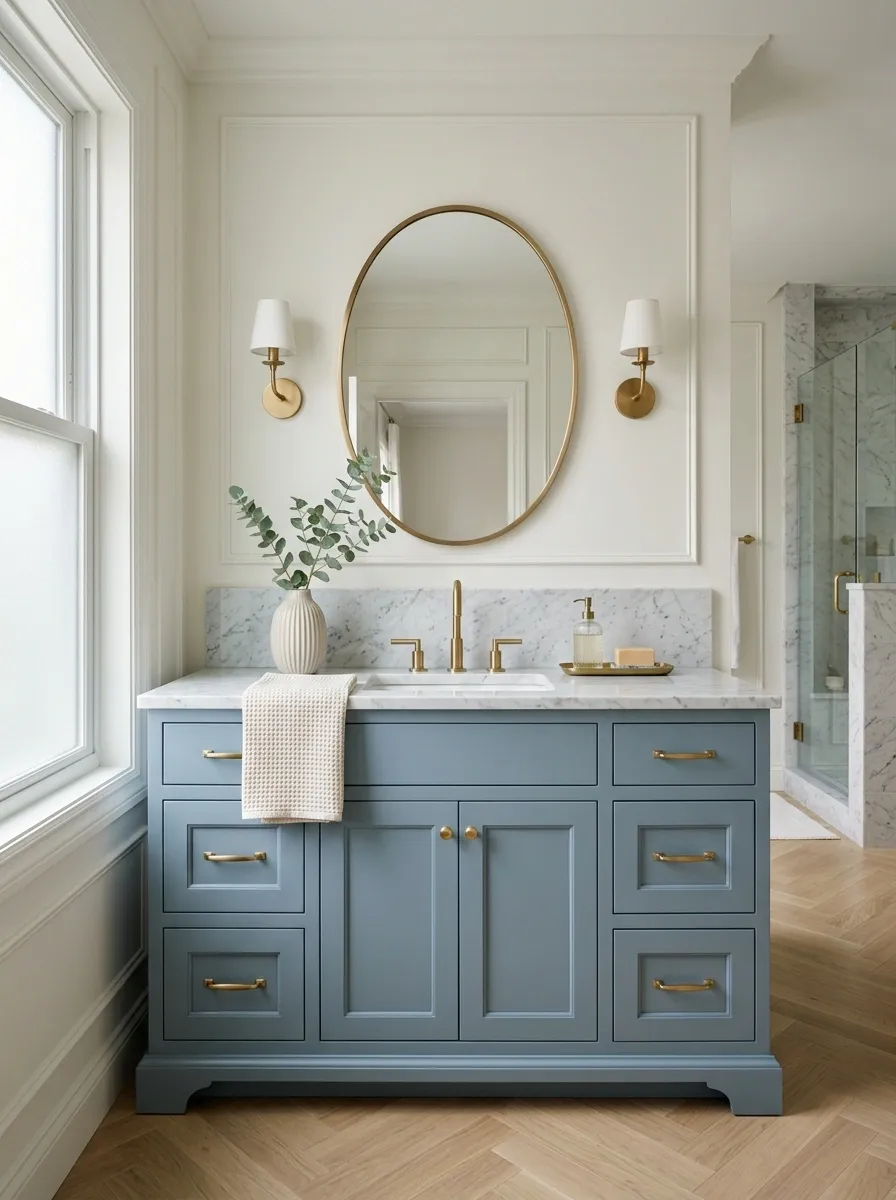
A muted dusty blue vanity gives this bathroom just enough color to feel considered without turning the sink area into a color-themed project. The cabinetry carries most of the blue, while a white marble countertop and backsplash brighten the composition.
An oval mirror sits above the basin, framed in a soft metallic finish that echoes the warm brass faucet and compact sconces. The walls remain close to white, allowing the vanity to stand out without creating a hard color block.
The design feels especially balanced because the blue is surrounded by light surfaces. There’s a clear focal point, but nothing feels visually trapped by it.
The lesson here is simple: one confident color usually does more than six timid ones.
Main character
Visual relief
Small accent
Tiny Powder Room With Pedestal Sink and Dramatic Wallpaper
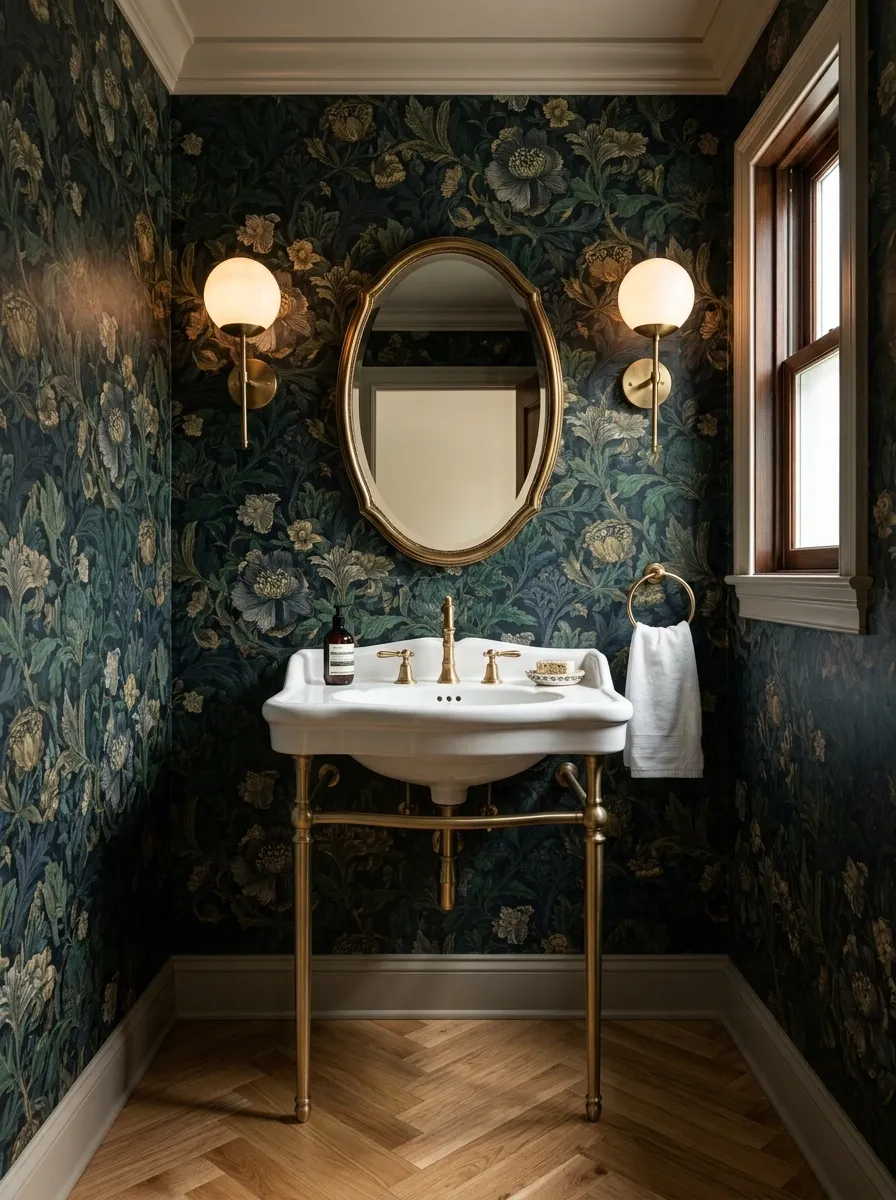
Not every tiny bathroom needs a miniature vanity. In this compact powder room, a classic pedestal sink keeps the lower half of the space open while dramatic wallpaper takes over the sink wall.
A decorative oval mirror sits above the basin, with two small wall lights adding symmetry and warmth. The floor stays simple, giving the patterned wall somewhere to stop rather than competing with it.
This is a completely different strategy from a bathroom with a large cabinet and busy countertop. The wall becomes the statement, while the sink itself remains visually light.
And honestly, this is where dramatic wallpaper earns its paycheck. In a tiny room, it doesn’t need twenty accessories to create personality. The wallpaper has already entered the group chat.
Keep the floor visually open.
Soft Black-and-Cream Transitional Vanity
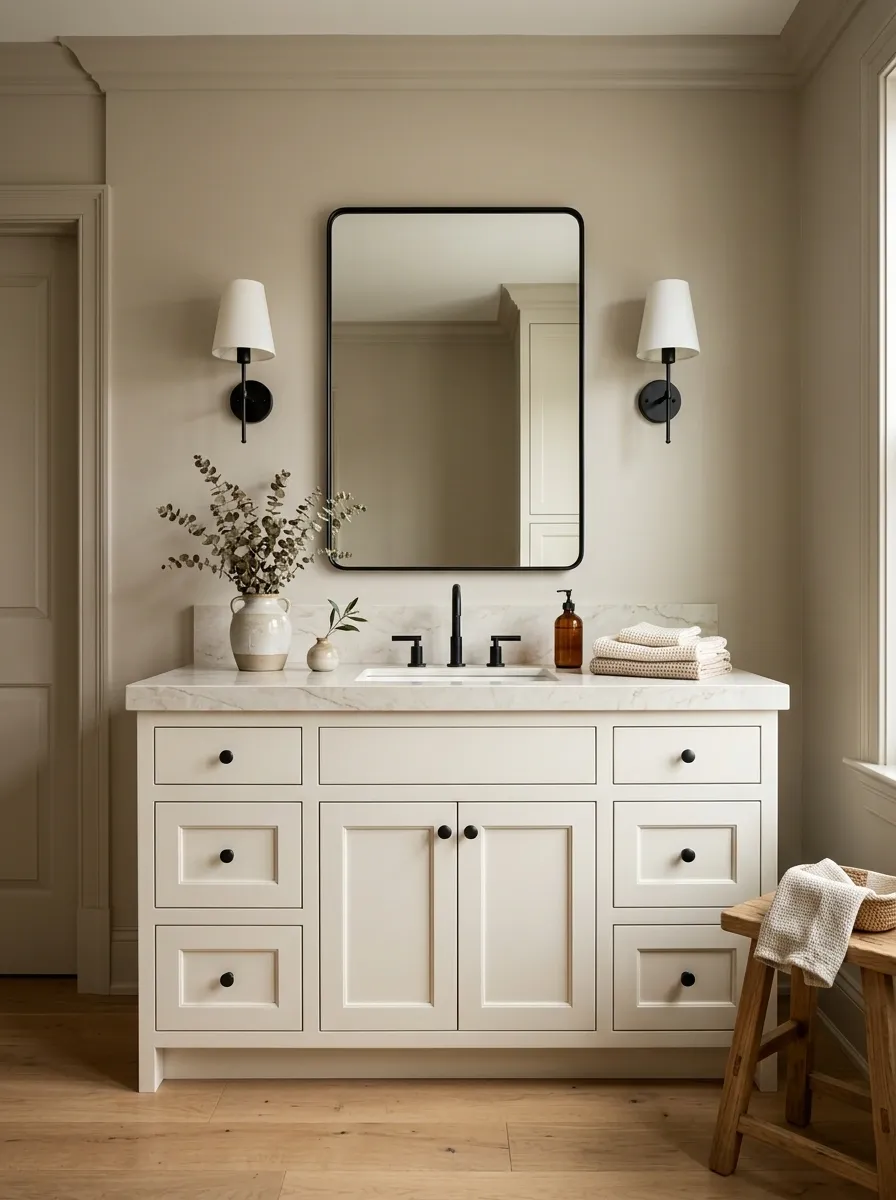
This sink area strikes a middle ground between traditional and contemporary. A creamy painted vanity sits below a black-framed rectangular mirror, while dark plumbing hardware gives the lighter cabinetry a sharper outline.
The countertop is a softly veined neutral stone, and warm wood appears in a small stool or understated accessory nearby. The lighting is classic enough to suit the cabinetry but simple enough to keep the room current.
What makes the composition work is the ratio of light to dark. Cream occupies most of the visual area, while black appears in concentrated lines around the mirror and sink. Those darker details act almost like punctuation.
Too much black and the room becomes severe. Too little and everything starts floating together. This one lands right in the useful middle.
Rustic Wood Vanity With Handmade Tile Backsplash
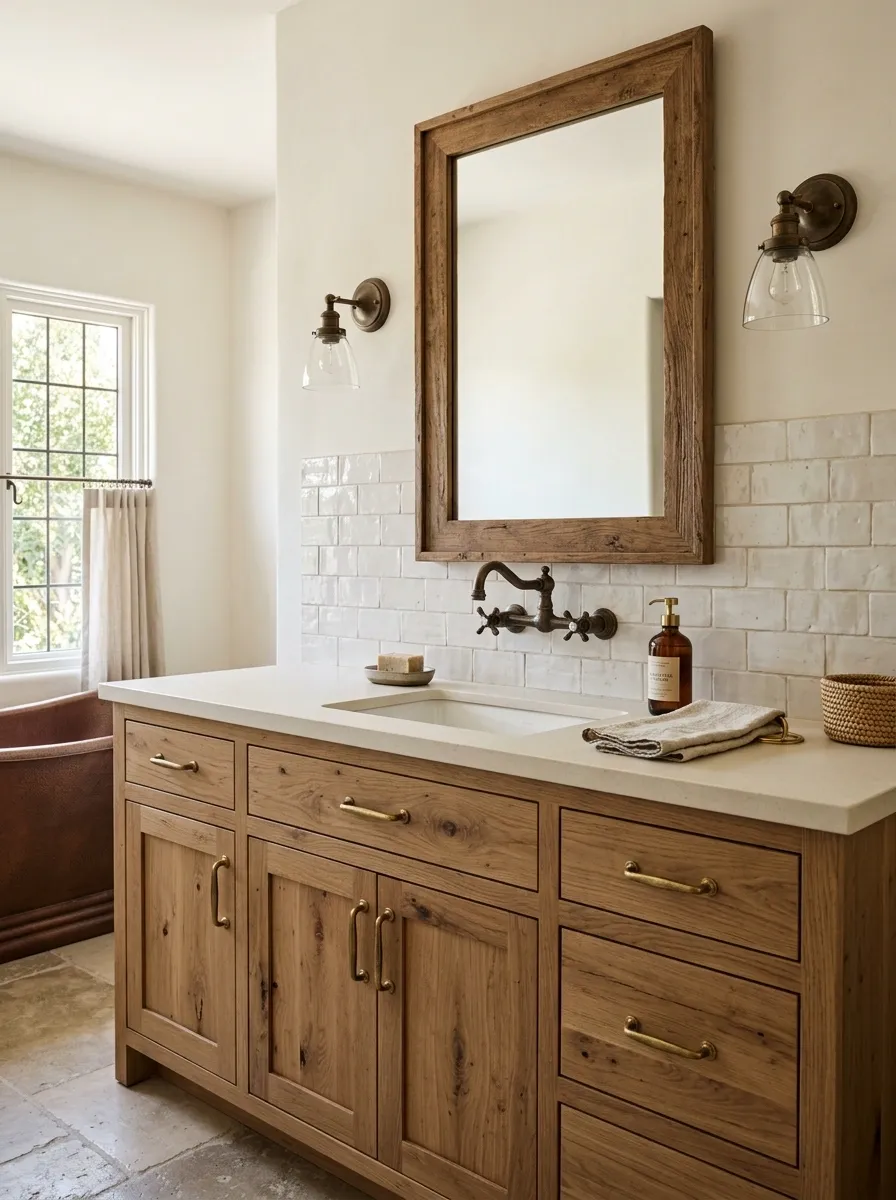
This bathroom feels collected rather than perfectly coordinated. A substantial wood vanity brings visible grain to the sink wall, while irregular handmade-look tiles create a soft backdrop in warm white.
The countertop is a simple pale stone, and aged metal fixtures add another layer of warmth. A rectangular mirror with a slightly substantial frame keeps the upper half of the wall from feeling too delicate.
The beauty here comes from variation. The wood grain isn’t perfectly uniform, and the tile isn’t perfectly identical from one piece to the next. Those small differences keep the room from looking factory-finished.
Everything doesn’t need to match. It just needs to speak the same visual language. That distinction saves a lot of bathrooms from becoming showroom beige.
Minimal White Floating Vanity With Integrated Basin
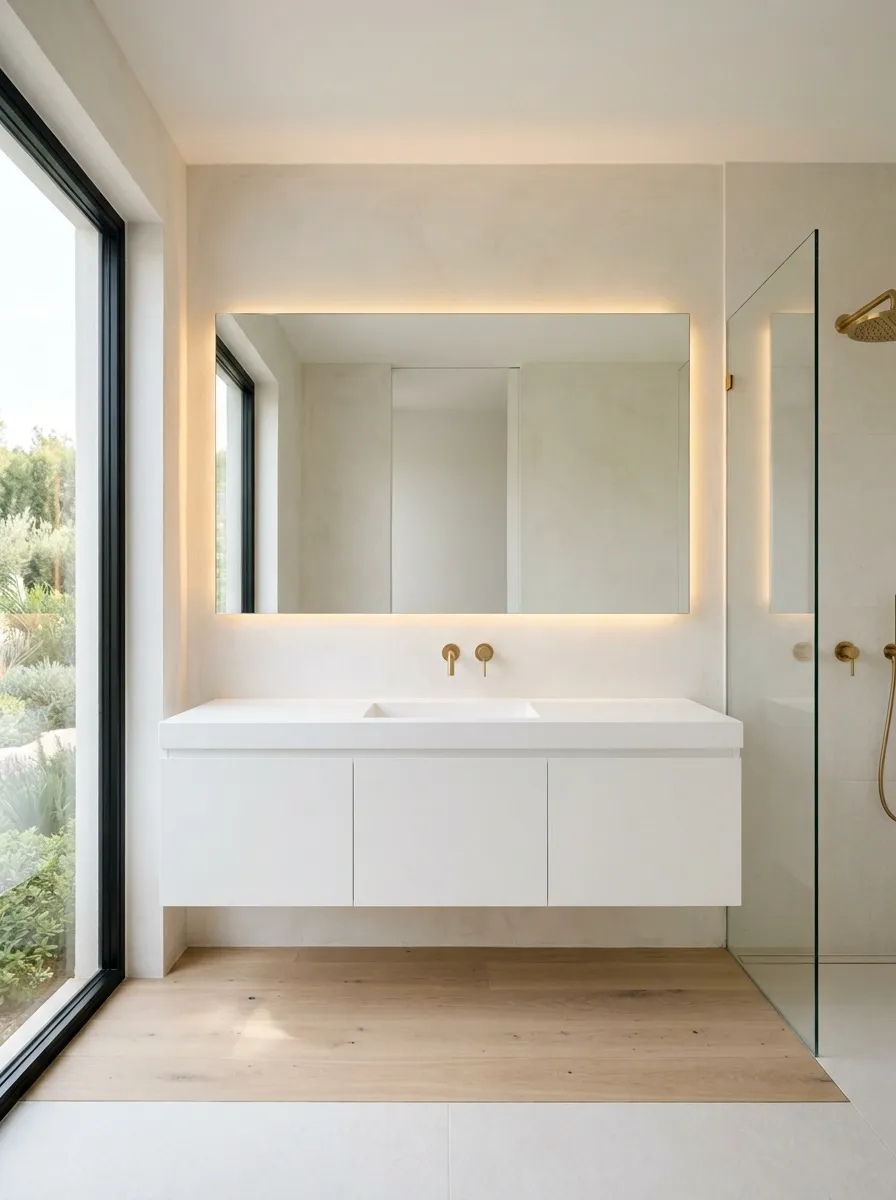
This is the bathroom sink area for anyone who looks at a countertop covered in bottles and thinks, “Absolutely not.” The floating vanity uses a seamless integrated basin, flat white cabinetry, and almost no visible hardware. A large frameless mirror sits directly above it, while concealed lighting gives the wall a soft glow.
The floor and walls stay within the same warm white family, but subtle changes in texture keep the room from looking like one giant bathroom showroom sample. Storage is hidden behind the vanity, leaving the counter almost completely clear.
The design works because nothing interrupts the clean horizontal line. There isn’t a decorative tray desperately trying to justify its existence. The empty counter is part of the design.
Warm Terracotta Vanity Wall With Oak Cabinetry
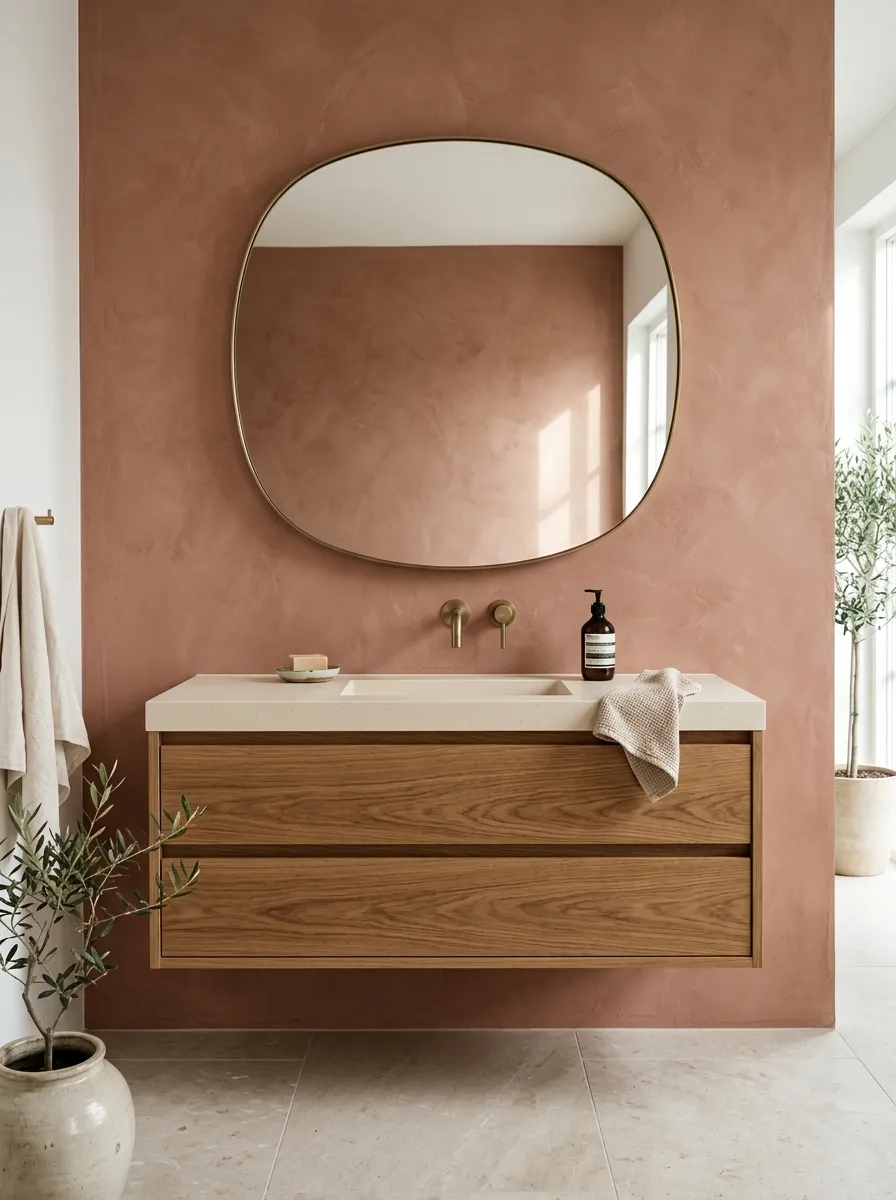
A muted terracotta wall gives this bathroom sink a completely different personality. The color covers the sink wall in a soft, earthy finish, while a simple oak vanity keeps the lower half warm and natural.
A cream countertop and integrated basin provide a light break between the wood and wall. Above the sink, a rounded mirror introduces another soft shape, while an aged brass faucet quietly echoes the warmer tones throughout the room.
The important detail is restraint. The terracotta already provides enough visual weight, so the remaining surfaces need to stay relatively quiet. Pale flooring and minimal accessories keep the wall from feeling overwhelming.
This is a good example of how one strong background can make an otherwise simple vanity look far more intentional. The wall showed up prepared. The fake palm did not need to.
Spa-Inspired Sink Area With Stone, Oak, and Soft Linen
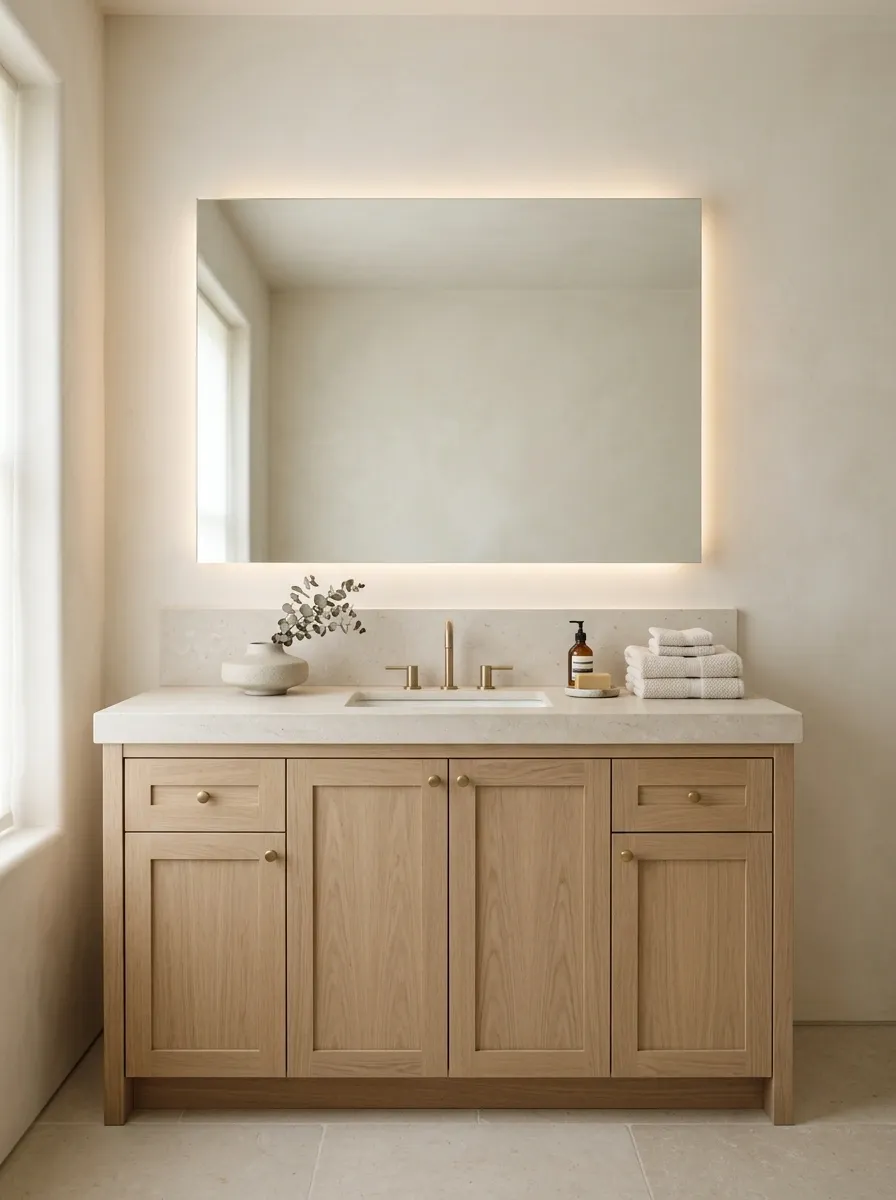
This sink area feels like a quiet hotel bathroom without the suspiciously perfect towel folding. A pale stone counter sits over a light oak vanity, while soft plaster-toned walls create a warm background.
The mirror is large and simple, with warm concealed lighting around or behind it. Linen towels bring a softer texture near the sink, and a low stone or ceramic vessel keeps the countertop from feeling completely empty without turning it into a display shelf.
The palette stays deliberately narrow: warm white, natural stone, pale wood, and muted metal. Texture does the heavy lifting instead of strong color.
The finished composition feels restful because every visible material is slightly tactile. Smooth surfaces are balanced by grain, woven fabric, and natural stone variation.
Traditional Dark Walnut Vanity With Framed Mirror
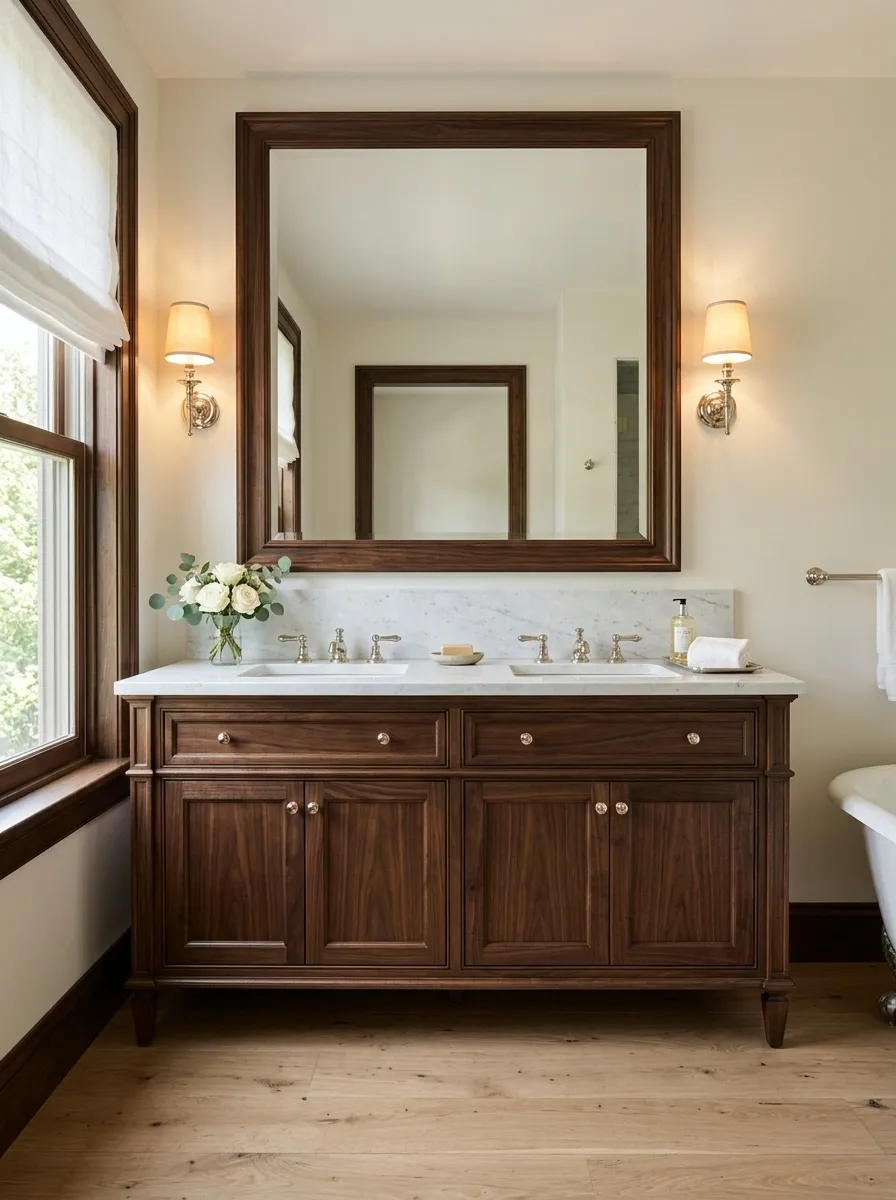
Rich walnut cabinetry makes this bathroom sink area feel substantial from the moment you see it. The vanity has a deeper furniture profile, generous drawers, and a pale marble countertop that creates a strong contrast against the dark wood.
A large framed mirror gives the upper half of the wall similar visual weight, while polished nickel fixtures and classic sconces keep the composition traditional rather than rustic. The floor stays light and uncomplicated.
The proportions matter here. A chunky vanity needs a mirror and lighting that can hold their own. Tiny accessories scattered across the countertop would only weaken the composition.
This design feels formal without becoming fussy. The dark wood, stone, and framed mirror already provide enough detail. The bathroom doesn’t need to dress up for dinner. It is the dinner.
Pale Pink Powder Room With Curved Vanity
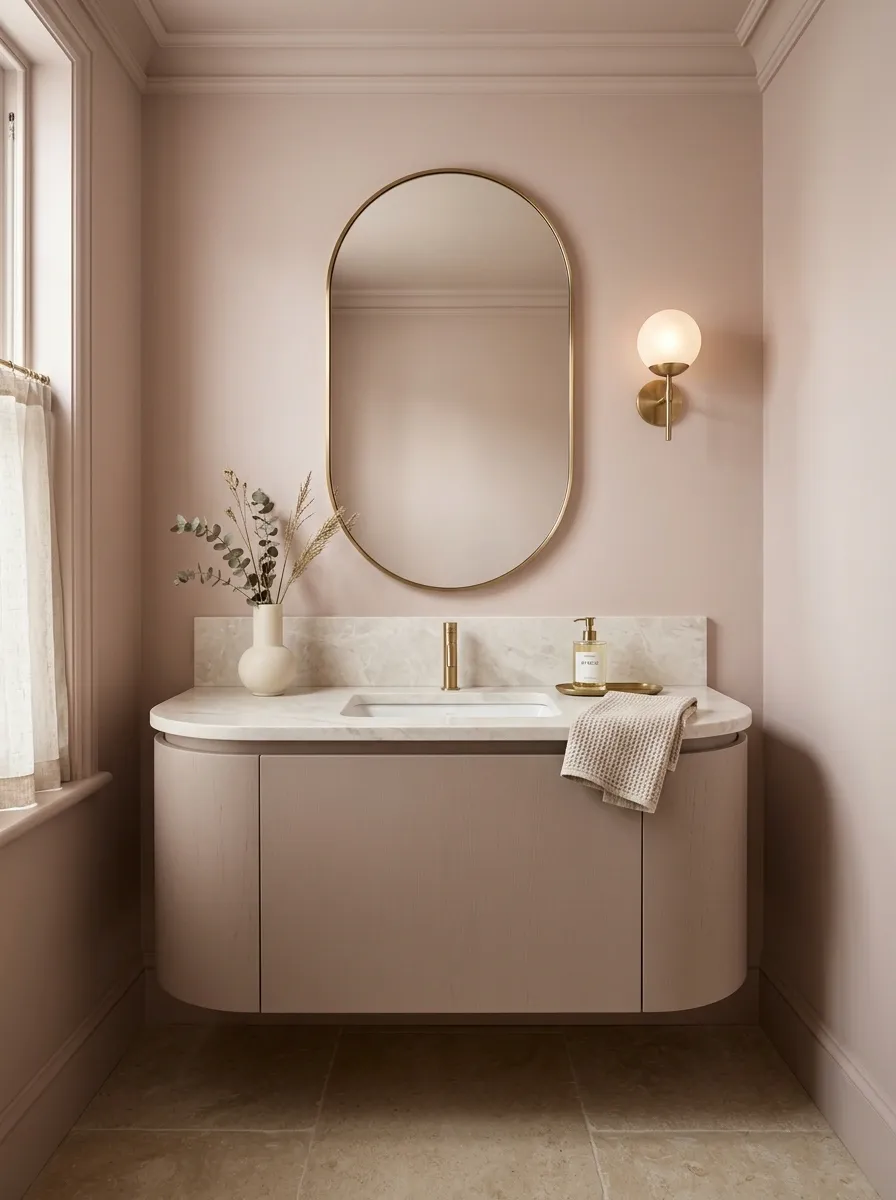
Soft blush walls turn this compact sink area into something more expressive without relying on loud pattern. A curved vanity with a pale stone countertop sits beneath an oval mirror, while a slim brass faucet and matching wall light add warmth.
The cabinetry stays rounded at the front, echoing the mirror and keeping the small room from becoming a collection of hard corners. The flooring is a warm neutral rather than another color competing with the walls.
The pink is intentionally dusty rather than sugary. That keeps the room grown-up and makes the brass and stone feel natural alongside it.
The repetition of curves is what makes the design memorable. The mirror doesn’t simply hang there. It continues the shape story started by the vanity.
Basically, the bathroom has a theme. The theme is curves. Nobody had to buy a pink flamingo.
Warm Gray Vanity With Large Limestone-Look Counter
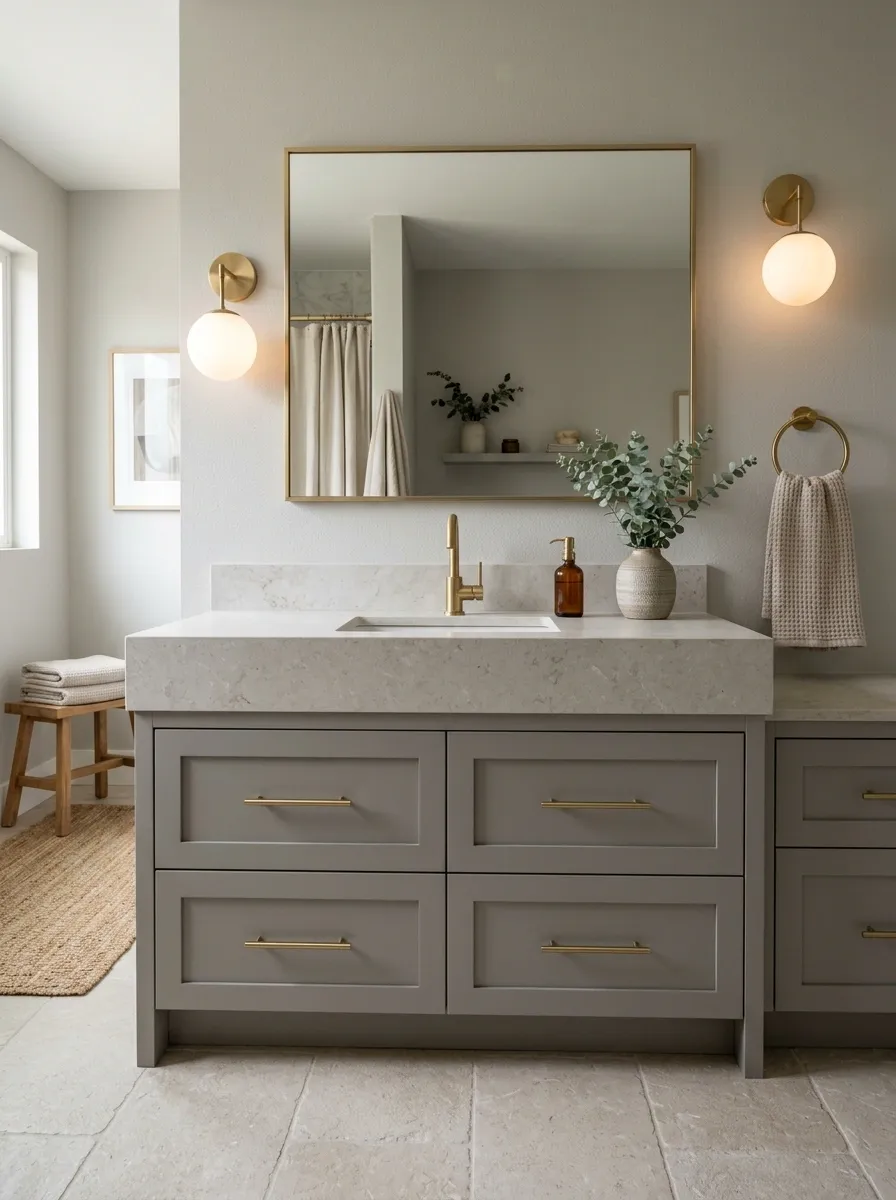
A family bathroom needs more than a pretty sink photograph. It needs a sink area that can survive actual mornings. This design uses warm gray cabinetry with a broad limestone-look counter and an integrated basin, giving the family plenty of usable landing space around the faucet.
A large rectangular mirror spans most of the vanity width, while simple wall lighting keeps the wall visually calm. Closed drawers handle the everyday clutter, so toothbrushes, skincare, and assorted bathroom mysteries don’t have to become part of the decor.
The finishes are deliberately forgiving. Warm gray hides visual noise better than stark white, while the pale counter keeps the lower half from feeling heavy.
The best feature might be the boring one: there is actually somewhere to put things.
Black-and-Wood Floating Vanity With Ribbed Detail
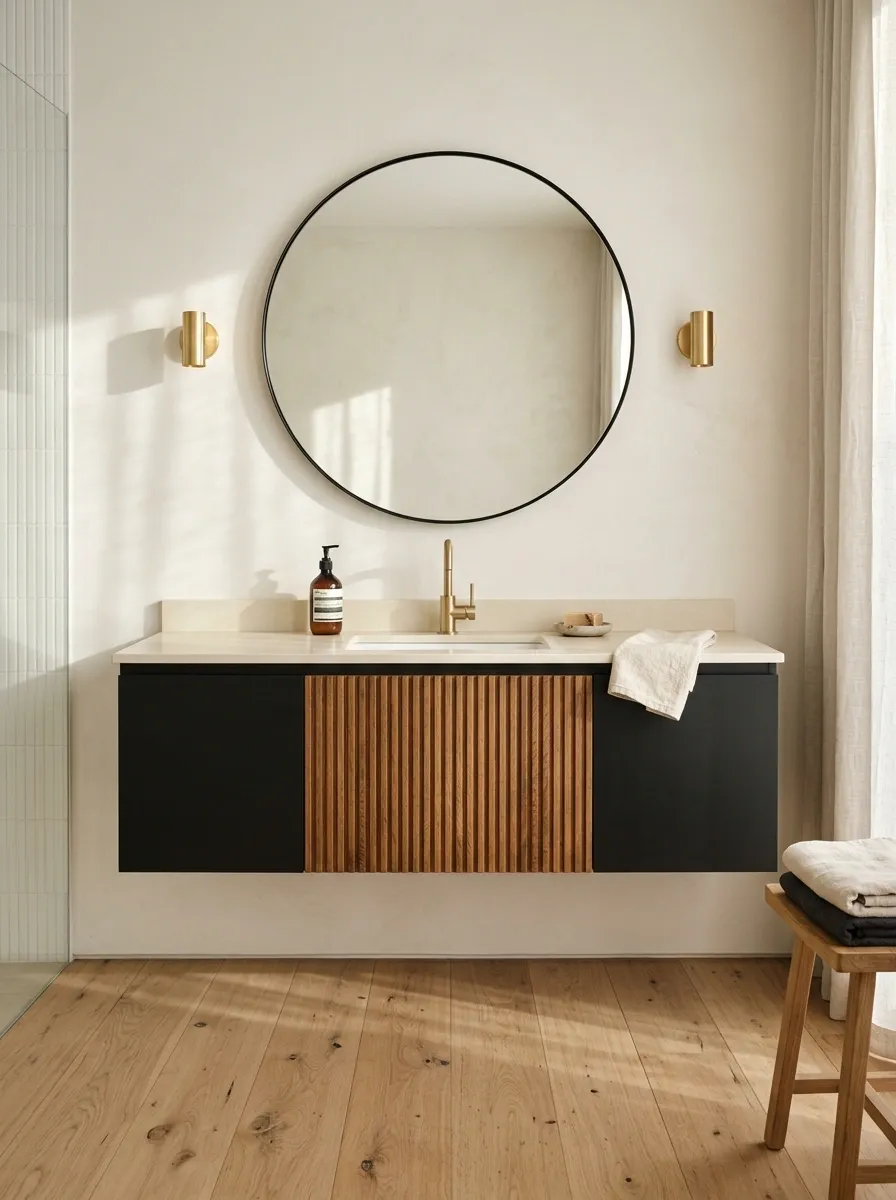
This sink area takes a more graphic approach, pairing a matte black floating vanity with warm vertical wood detailing. A slim pale stone counter sits above the cabinetry, while a large round mirror softens the strong rectangular lines below.
The ribbed wood doesn’t cover everything. It appears as a controlled feature, giving the black vanity warmth without turning the whole bathroom into a slat-wall showroom. A simple brass faucet and small matching wall lights provide just enough contrast.
The floating installation also leaves the floor visible, which keeps the substantial black cabinetry from making the room feel weighed down.
The composition has plenty going on, but none of it is competing. That’s the difference between layered and “someone discovered the home decor aisle and lost supervision.”
visual anchor
warm bridge
light relief
Coastal Bathroom Sink With White Oak and Soft Blue Tile
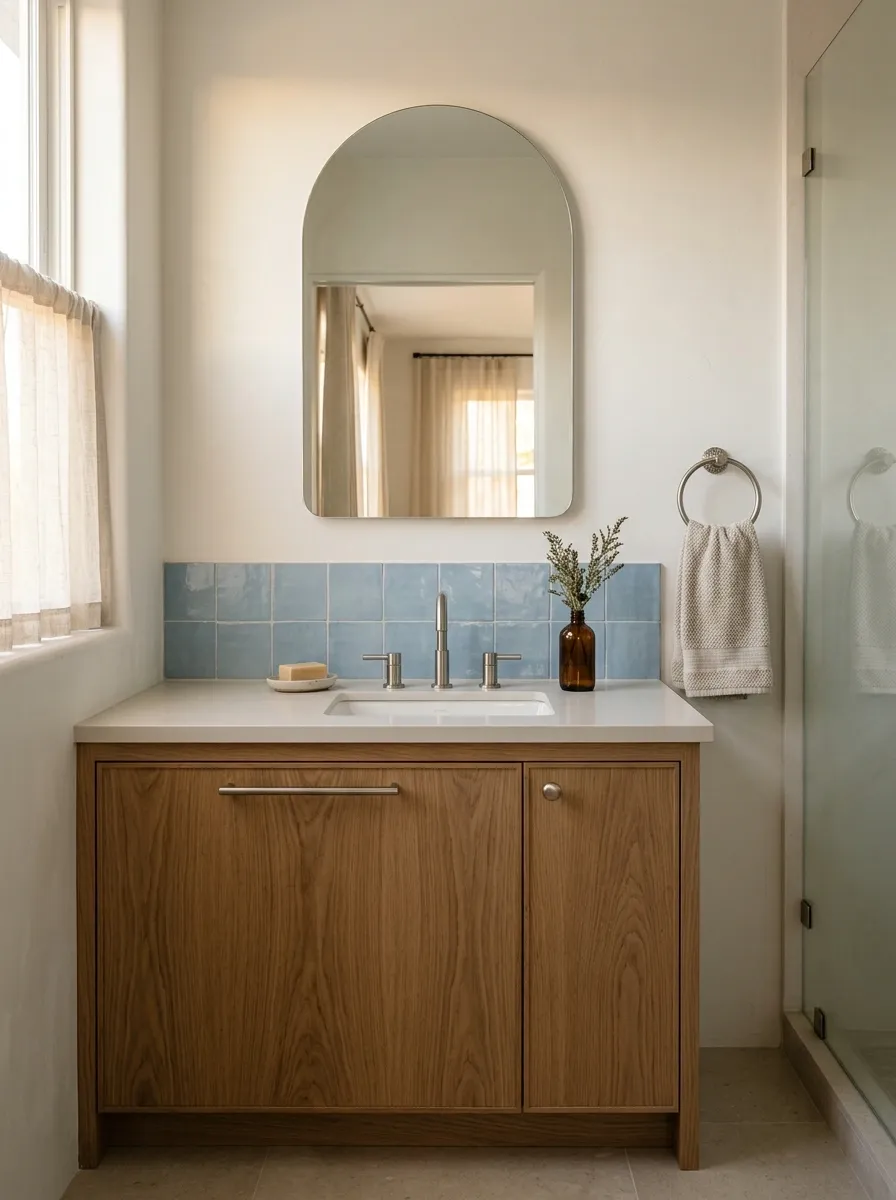
This coastal bathroom skips the usual seashell collection and leans into the colors and materials that actually make the style work. A white oak vanity sits below a soft blue tile backsplash, with a pale countertop and brushed nickel hardware keeping the whole composition fresh.
The tile has slight handmade variation rather than a glossy uniform finish. Above the sink, a simple rounded mirror adds softness, while woven towels bring a little natural texture without turning the bathroom into a souvenir shop.
The walls remain warm white and the floor stays neutral, creating a clean background around the blue.
The strongest part of this look is what it leaves out. No anchor-shaped decor. No giant “BEACH” sign. No bowl of shells that somehow has become legally required in coastal bathrooms. The materials already tell the story.
keeps the room light
creates the coastal cue
adds natural warmth
keeps hardware quiet
Statement Stone Slab Behind a Simple Vanity
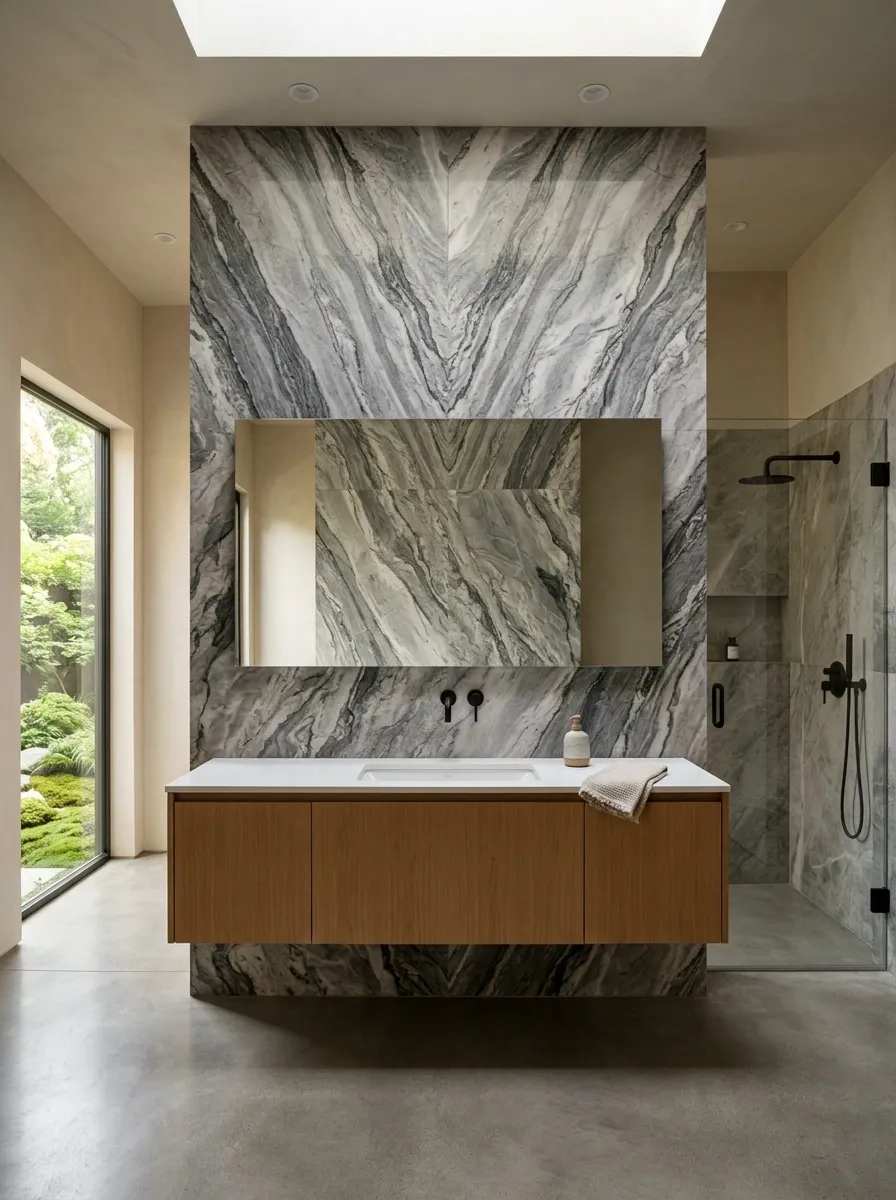
Here the sink area is intentionally restrained because the wall has something important to say. A dramatic slab of natural stone runs from countertop to ceiling, bringing strong veining directly behind a very simple floating vanity.
The cabinetry is warm neutral with almost no visible hardware. A frameless mirror sits over the basin, partly overlapping the stone so the wall reads as one continuous material rather than a backsplash with a mirror awkwardly parked in front of it.
The faucet is slim and understated. Lighting is equally quiet.
This is a design built around visual hierarchy. The stone gets the largest surface and the strongest pattern, so everything else needs to know when to sit down.
And yes, this is one of those bathrooms where adding decorative objects would actually make the design worse. Tragic for the decorative-object industry.
large surface, strong pattern
Compact Corner Sink With Custom Shelving and Mirror
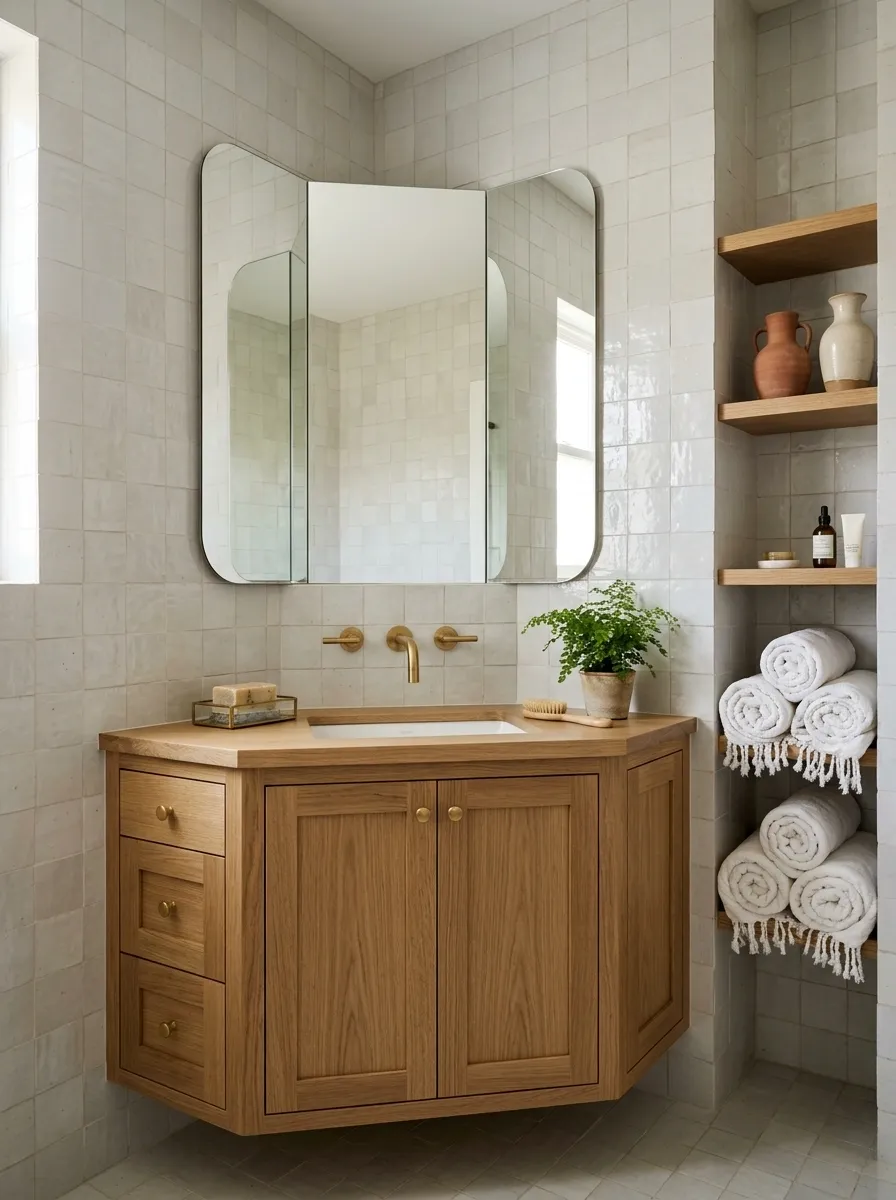
Awkward corners become much easier to handle when the vanity, shelving, and mirror are designed as one composition instead of three unrelated purchases. This compact bathroom uses a fitted corner vanity with a small basin, shallow open shelving beside it, and a mirror shaped to follow the available wall.
Warm wood cabinetry keeps the corner from feeling clinical, while pale tile reflects light around the sink. A slim wall-mounted faucet frees up the small countertop, leaving enough room for basic daily items without crowding the basin.
The shelving is deliberately narrow. It holds towels and a few useful pieces rather than becoming a permanent storage graveyard.
This layout earns its space because every element responds to the corner. Nothing is simply shoved into the leftover gap and told to behave.
sink + daily use
vertical storage
Soft Industrial Bathroom With Oak, Steel, and Zellige Tile
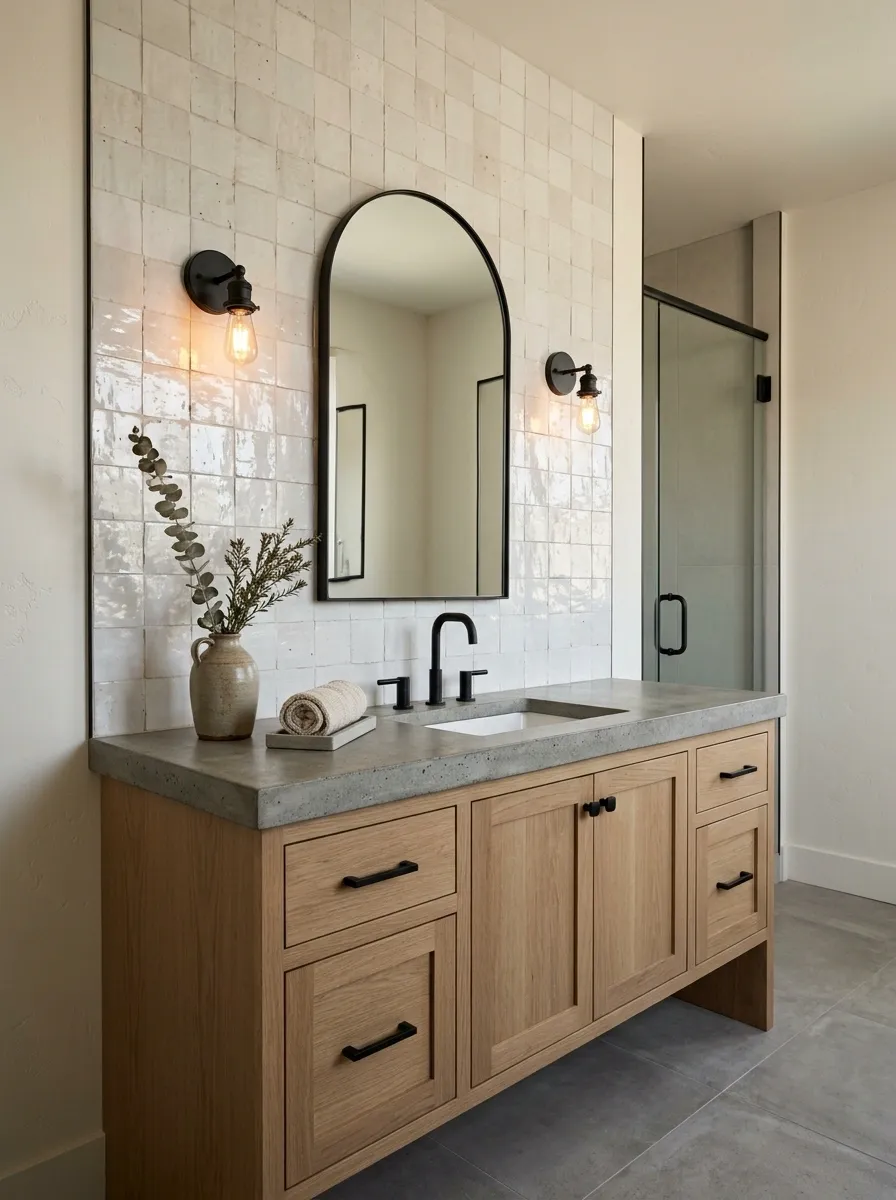
This version brings industrial details down to a residential scale. Warm oak cabinetry sits against irregular white zellige-style tile, while slim black steel framing appears around the mirror and lighting.
A concrete-look countertop adds weight, but the handmade tile and natural wood stop the room from becoming cold. The basin is simple and deep, with a matte black faucet that connects visually to the steel details above.
The lighting is warm and slightly directional, allowing the irregular tile surface to cast small shadows across the sink wall. That texture matters because a perfectly flat white backsplash would change the entire mood.
Industrial doesn’t need to mean “warehouse bathroom.” A little steel goes a long way when the other half of the composition is warm wood and imperfect tile.
Making the Sink Area Feel Intentional
A good sink design isn’t about finding one magical accessory and placing it beside the faucet. The stronger approach is deciding what should dominate, what should support it, and what should stay quiet.
A dramatic stone wall needs calmer cabinetry. A dark vanity benefits from lighter surrounding surfaces. A tiny bathroom often benefits from seeing more floor. A furniture-style vanity needs a mirror and lighting with enough visual weight to match it.
Then there is the countertop.
The countertop should have enough room for real life, but it doesn’t need to display every attractive bottle currently owned by the household. Give everyday products a place, give the design a focal point, and leave some breathing room.
The difference is surprisingly noticeable. A finished sink area feels designed because the elements have a relationship, not because there are more of them.
Use One Strong Material Relationship
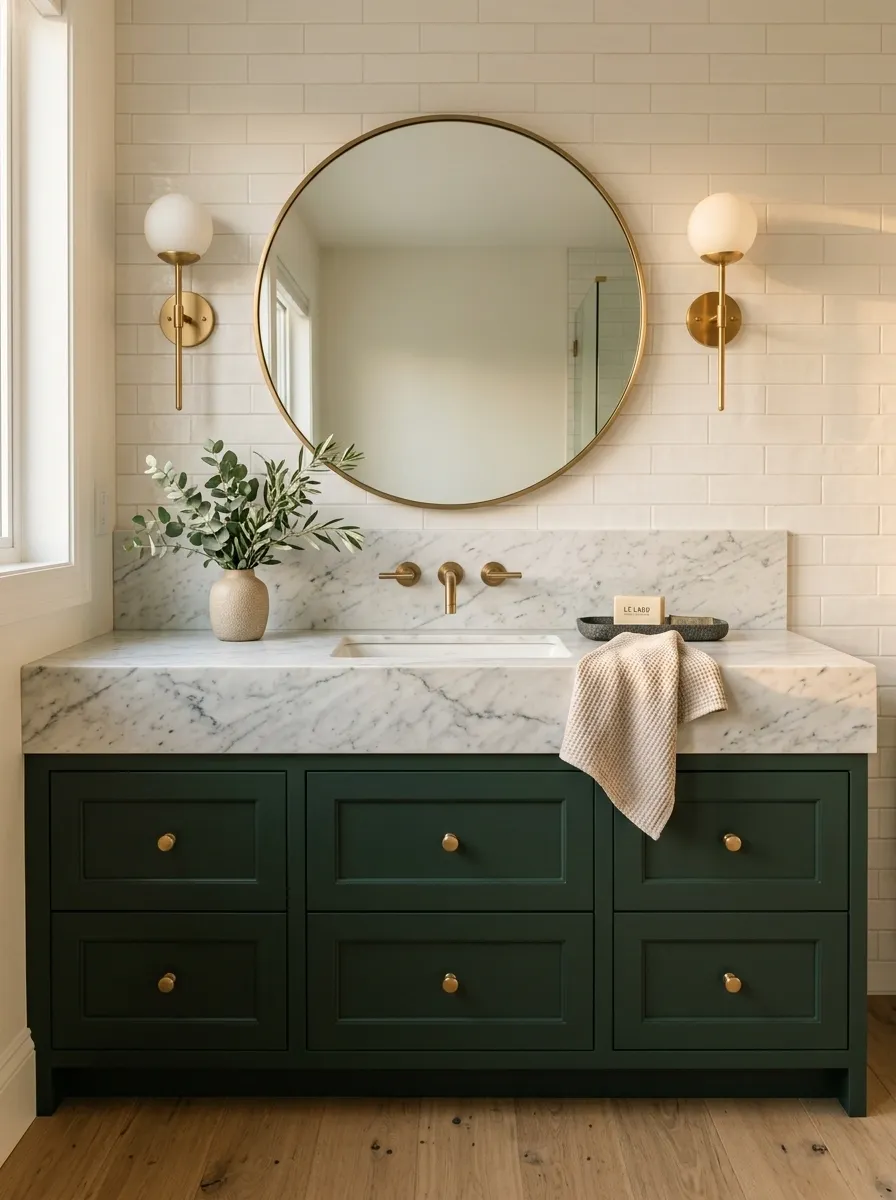
The most memorable designs usually have one combination that carries the room. It could be oak with limestone, dark green with pale marble, black with warm white tile, or terracotta with natural wood.
That relationship gives the eye something to recognize.
Let the Mirror Participate
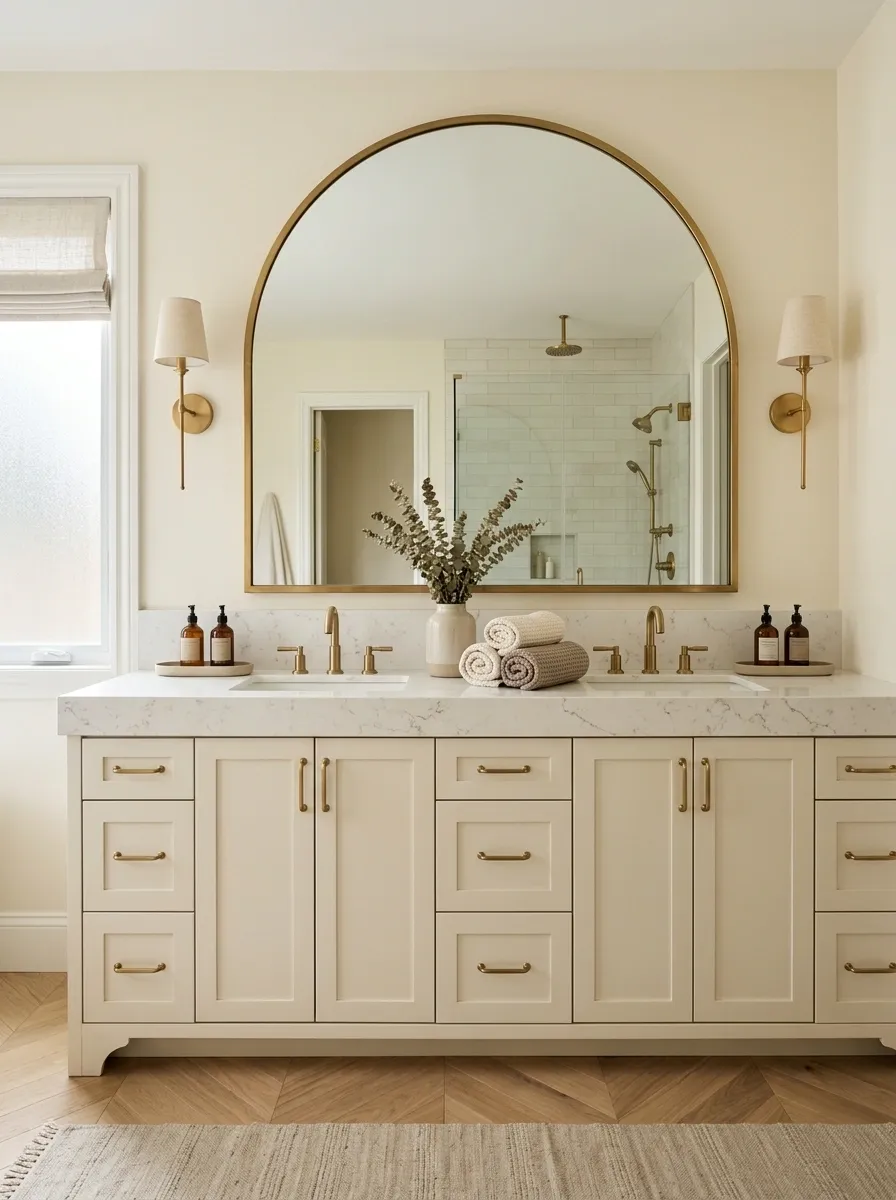
A mirror should relate to the vanity instead of floating above it like an unrelated rectangle. Rounded cabinetry can echo an arched or oval mirror. A long vanity can support a wide horizontal mirror. A furniture-style vanity can handle a more substantial frame.
The shape matters almost as much as the finish.
Treat Lighting as Part of the Composition
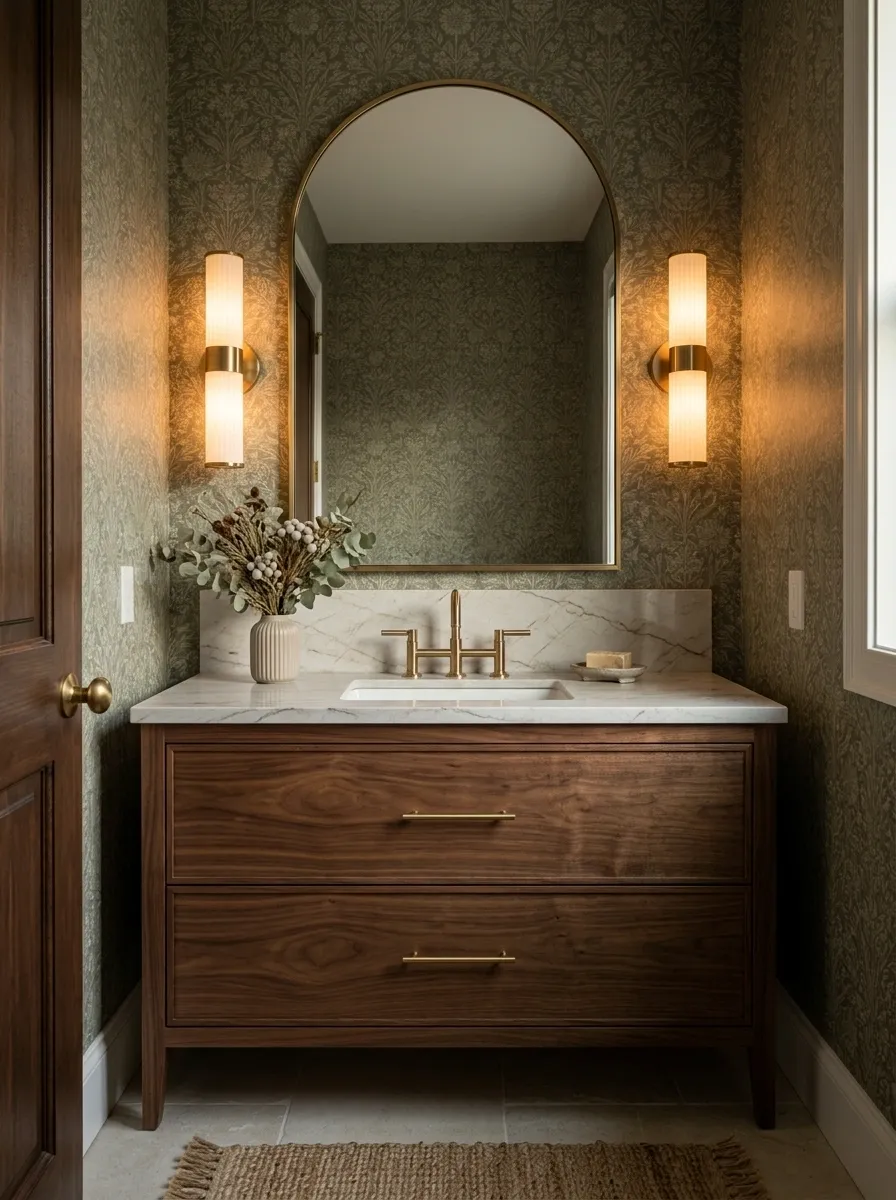
Lighting shouldn’t be an afterthought attached to the wall once everything else is finished. Wall sconces can reinforce symmetry, create vertical emphasis, or frame the mirror.
Warm lighting also changes how stone, wood, paint, and metal are perceived. A beautifully selected finish under harsh light can suddenly look like it needs an apology.
A Bathroom Sink Works Best When the Whole Wall Makes Sense
There is a certain point where adding more to a bathroom stops improving it. The sink doesn’t need another tray. The mirror doesn’t need another object nearby. The empty space isn’t necessarily unfinished.
The strongest designs in this collection work because the major pieces agree with each other. The materials share warmth, the proportions make sense, the lighting supports the mirror, and the countertop has enough restraint to let the larger composition breathe.
That doesn’t mean every bathroom should look minimal. A vintage vanity can have plenty of personality. A dramatic wallpaper can absolutely take over a powder room. A dark vanity can be bold. A colorful cabinet can be the reason the room feels memorable.
The key is making one complete decision instead of twenty disconnected little ones.
Save the sink designs that immediately make sense to you, then use them as a visual reference when choosing your vanity, mirror, finishes, and styling details. The goal isn’t to copy every piece. It’s to understand why the finished combination works.