
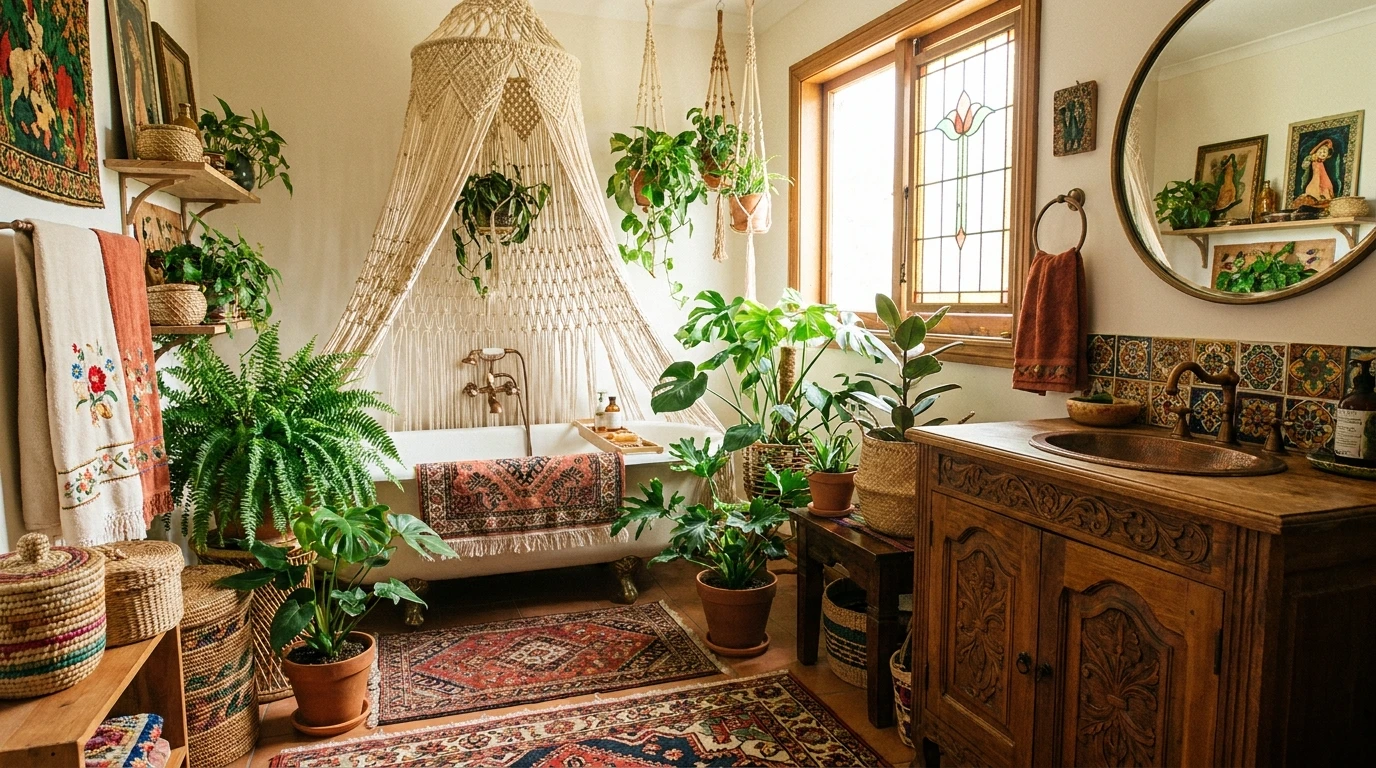
The bathroom is the one room in the house where nobody questions your decisions. Nobody walks in and says “are you sure about that?” It’s private. It’s yours. And yet most people decorate it like they’re trying to get their deposit back.
Bohemian bathrooms are different. They commit to a mood. They treat the walls like a canvas and the floor like an opportunity. They make you want to stay in there longer than necessary.
The hard part isn’t the vision. It’s knowing which decisions to make first. Tile before accessories. Hardware before mirrors. Wall colour before everything else. Get the sequence right and the rest falls into place naturally.
The Tile Does More Work Than You Think
Most bathrooms play it safe with tile. White. Rectangular. Stacked in a grid. It’s not a design decision — it’s the absence of one.
In bohemian bathrooms, the tile is the design. It sets the temperature of the entire room before a single accessory arrives.
Colour in Tile Is Not a Risk
A saturated tile colour — dusty rose, deep forest green, rich terracotta — transforms the room in a way no paint can. Paint gets wet. Paint looks tired. Tile holds its colour and its sheen for decades.
The key is committing to the full surface. Half a wall of coloured tile reads as unfinished. Floor to ceiling reads as intentional.
Pattern Tile Belongs on the Floor
Patterned floor tile is the bohemian designer’s best tool. It works even in small bathrooms. A Spanish or Moroccan encaustic pattern in a muted palette makes the floor feel like it was always there — like the room was built around it.
Keep the wall tile quieter when the floor is busy. The contrast is the composition.
Grout Colour Changes Everything
White grout on dark tile looks clinical. Matching grout on patterned tile disappears the lines. Dark grout on white tile turns a plain wall into a graphic pattern.
Choose the grout colour last, after the tile is selected. It’s the detail most people overlook and the one that separates a thoughtful result from an average one.
Hardware Is the Jewellery of the Room
Brass hardware in a bathroom does what gold jewellery does on a person. It warms everything around it.
Chrome is cold. Matte black is sharp. Brushed brass is the one finish that works across every bohemian palette — warm or cool, minimal or maximal.
One Finish, Used Consistently
The mistake is mixing. Brass taps with chrome towel rails and matte black cabinet handles. The room ends up with no point of view.
Pick one finish and use it on every piece of hardware in the room — taps, towel rails, shower fittings, cabinet handles, mirror brackets. Consistency reads as intention.
Exposed Plumbing Is Not a Problem
In a rustic or natural bathroom, exposed pipe work in brass or black iron becomes part of the aesthetic. Concealing it is not always the right move.
A wall-mounted tap with visible pipe work on a rough timber vanity looks deliberate and interesting. The same fitting on a polished white vanity looks like a mistake. Context is everything.
Before You Touch Anything Else
Decide on the vanity before you decide on anything else. It is the largest freestanding object in the room and the one everything else responds to.
Timber, stone, raw wood, reclaimed material — the vanity material sets the room’s material language. Once it’s chosen, every other decision becomes easier.
The Mirror Earns Its Place
Most bathroom mirrors are round, frameless, and forgettable. A mirror with character — carved wood frame, organic irregular shape, woven rattan surround — becomes a design object.
Size matters too. A small mirror above a wide vanity looks like an afterthought. The mirror should be wide enough to feel proportionate to the surface beneath it.
Storage That Doesn’t Look Like Storage
Wicker baskets under a vanity, open shelves with folded towels, rattan boxes on a shelf — these are storage solutions that add texture to the room while holding things.
Closed white cabinets solve the storage problem and kill the aesthetic in the same move. In a bohemian bathroom, everything visible is part of the design.
Bohemian Bathroom Ideas
Pink Tile, Gold Hardware, Jungle
Tile the walls entirely in square dusty rose or deep blush tiles — not pastel, not candy, but the muted rose that reads as architectural rather than sweet. Use a grout in a shade slightly darker than the tile, so the grid pattern is visible but quiet.
Fit every hardware piece in brushed brass: shower fittings, taps, towel rail, shelf brackets. The warm gold against the cool-pink tile is the visual contrast that makes the room work.
Bring plants in at every height. Floor plants in wicker baskets at the base of the bath, a hanging plant above the shower in a macramé hanger, a trailing plant on the wall shelf. The green against the pink is the room’s third colour. It doesn’t need a fourth.
Dusty Rose Walls, Fluted Vanity
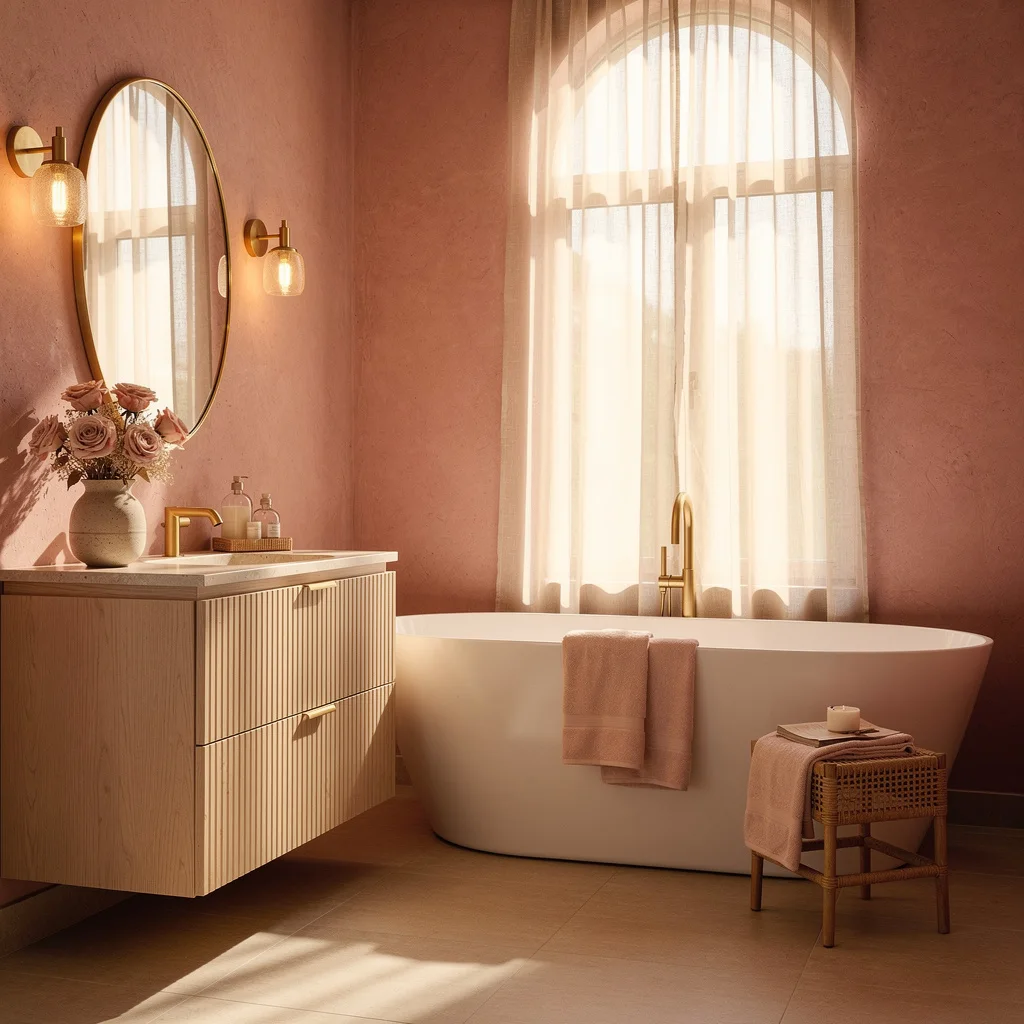
Paint the walls in a deep dusty rose with a limewash or textured finish — not smooth emulsion, but something with visible variation in depth and tone. The texture makes the colour read as warm and dimensional rather than flat.
Mount a wall-hung vanity unit with fluted or ribbed timber drawer fronts in pale natural wood — ash or light oak. The vertical ribbing on the cabinet door fronts introduces a tactile detail that contrasts well with the textured plaster behind it.
Pair the vanity with a large oval mirror in a thin brushed brass frame, flanked by two small brass wall sconces with amber glass shades. Hang the sconces at eye height rather than above the mirror. Position a freestanding bath beneath an arched window with sheer linen curtains that diffuse rather than block the light. The room should feel like late afternoon at all times of day.
Limewash Walls, Rattan Shade, Candles
Apply limewash plaster to all walls in a warm sand or camel tone — not smooth, not uniform, but with the visible brush marks and tonal variation that give the material its character. The texture reads as ancient and warm at the same time.
Install a woven rattan or bamboo pendant shade above the central space, hung low enough to cast its shadow pattern across the walls and ceiling. Use a low-wattage warm bulb — the shade is doing the decorative work, not the light output.
Place candles throughout rather than relying on the pendant alone. A glass lantern on a low wooden stool inside the shower area, votives on floating shelves beside the window, and a hurricane pillar candle near the bath. The room should feel different lit by candlelight than by daylight — that shift in atmosphere is the point.
Macramé Over the Toilet
Install a simple floating wooden shelf above the cistern — 20cm deep, in oak or pine — and place three terracotta pots with trailing plants along it. The plants should hang down over the cistern rather than sitting upright.
Below the shelf and above the cistern, hang three small macramé pieces from a single wooden dowel. Choose pieces with matching knotwork — diamond patterns in natural cotton — so they read as a set rather than a collection of different objects.
On the floor beside the toilet, place a wide seagrass basket that doubles as storage. In front of the toilet, a patterned tile runner rug with warm earthy tones grounds the arrangement. Hang a dark brown or deep mocha towel on the rail opposite. The palette stays in sand, natural, terracotta, and deep brown throughout.
Tadelakt Shower with Pebble Floor
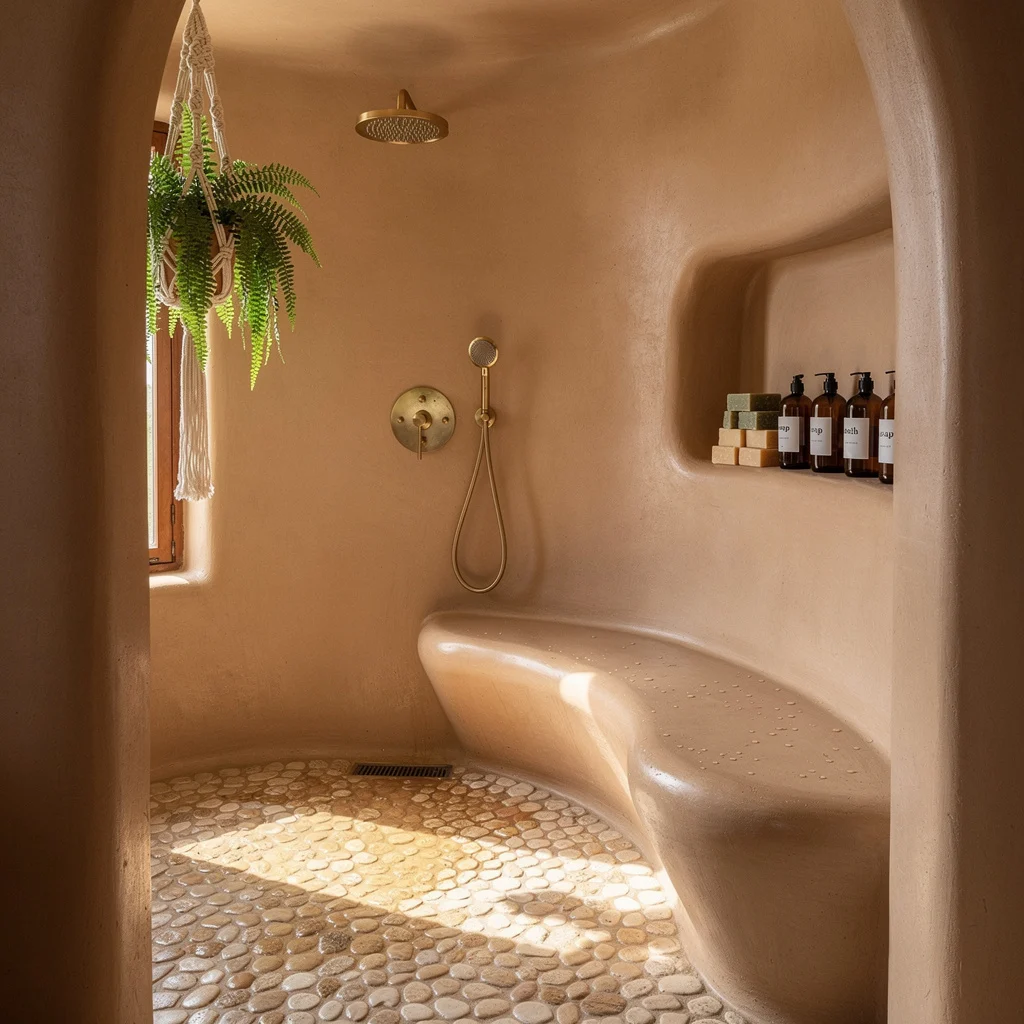
Apply tadelakt plaster — or a good lime render alternative — to every shower surface: floor, walls, bench, and the arch framing the entrance. Tadelakt is naturally water-resistant when sealed with black soap, which makes it genuinely functional as well as beautiful. The colour should be warm and pale — sand, shell, or bone — with no two areas looking identical.
Lay river pebble tiles across the shower floor. Use small, smooth, pale cream or beige stones set in a mosaic mesh on a waterproof substrate. The pebbles create a gentle texture underfoot and reinforce the organic quality of the plastered walls.
Build a low integrated bench into one wall of the shower in the same tadelakt material. Cut a niche into the opposite wall for product storage — plaster the niche interior to match. Fit a round gold rain shower head from the ceiling. The result is a shower that looks sculpted rather than built.
Dark Green Herringbone, Pink Bath
Tile the shower wall entirely in dark forest or emerald green in a herringbone pattern — lay the tiles at 45 degrees, not horizontal. The diagonal orientation gives the wall a more dynamic quality than a standard herringbone run.
The bath should be a freestanding roll-top in a contrasting colour. A soft blush or rose pink against the dark green creates a complementary tension that the eye finds interesting without being jarring.
Lay patterned encaustic tiles on the floor in a botanical design. Choose a pattern in pink, green, and cream so it references both the bath and the shower wall. Let it run from wall to wall, right up to the base of the bath and into the shower tray.
Reclaimed Wood Vanity, Carved Mirror
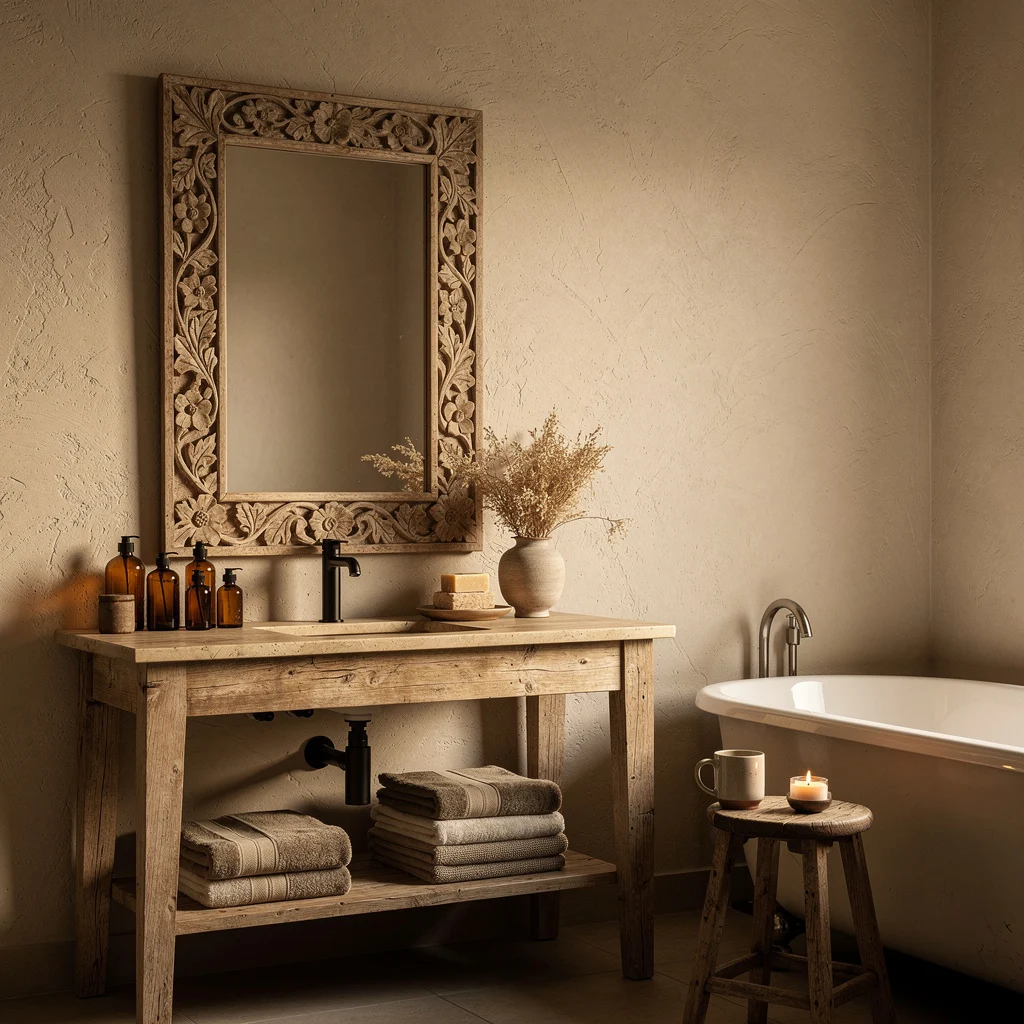
Source a reclaimed timber console table — the rougher the wood, the better — and have a stone or concrete sink inset into the top, or use a vessel sink in natural stone placed on the surface. The exposed table legs, visible grain, and raw edges are the design.
Above it, hang a mirror with a deeply carved wooden frame in a floral or botanical pattern. The frame should be substantial — 8 to 10cm deep — and the carving should be detailed enough to hold the eye. Position it centred above the sink.
On the vanity surface, arrange amber glass bottles of varying heights for toiletries, a matte ceramic soap dish, and a small rough ceramic vase with a single stem of dried grass. Fold stacked towels on the shelf below. To the right of the vanity, place a small rough-hewn wooden stool with a lit pillar candle and a ceramic mug.
All-Over Patchwork Tile
Source a mix of hand-painted ceramic tiles in a warm, jewel-toned palette — teal, red, yellow, green, cobalt, ochre. They should all be the same size but carry different painted motifs: florals, geometric patterns, abstract shapes, borders. No two tiles need to match.
Apply them floor to ceiling on every surface — walls, bath surround, floor — treating the room as a single continuous canvas. This only works as total commitment. One patchwork wall with plain tiles elsewhere looks like a sample board.
Keep fittings and fixtures plain and white — the bath, the sink, the toilet. They become the neutral breaks that allow the tile to breathe. One large botanical artwork framed simply on the patchwork wall adds a layer without competing.
Arched Niches with Warm Lighting
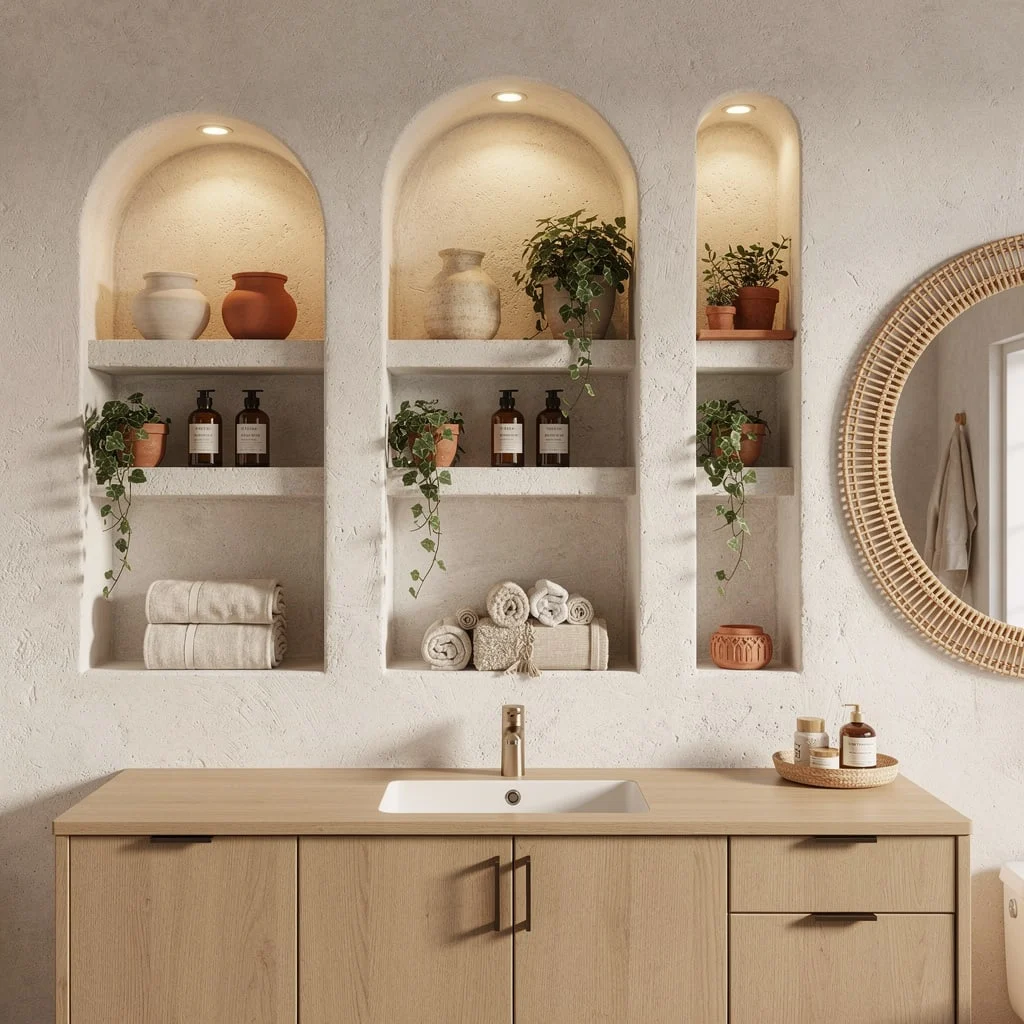
Build or carve three arched niches side by side into the wall above the vanity. Each arch should be tall and narrow — approximately 30cm wide and 60–70cm tall with a rounded top. Install a small recessed downlight inside the top curve of each niche so the interior glows with warm amber light.
In the top shelf of the first niche, place two or three ceramic vessels in white and terracotta. In the second, a raw clay vase and a small trailing plant. In the third, two small terracotta pots. On the lower shelves of each niche, store rolled towels in neutral linen tones, small amber glass bottles, and one or two terracotta tea light holders.
Mount a round rattan-framed mirror to the side wall rather than above the niches. The rattan frame gives the mirror enough warmth to sit comfortably alongside the terracotta ceramics. Below the niches, use a light timber vanity unit in a simple, clean profile — the architectural drama of the niches is the room’s entire visual argument. The vanity should support it, not compete with it.
Terracotta Walls, Live-Edge Shelf
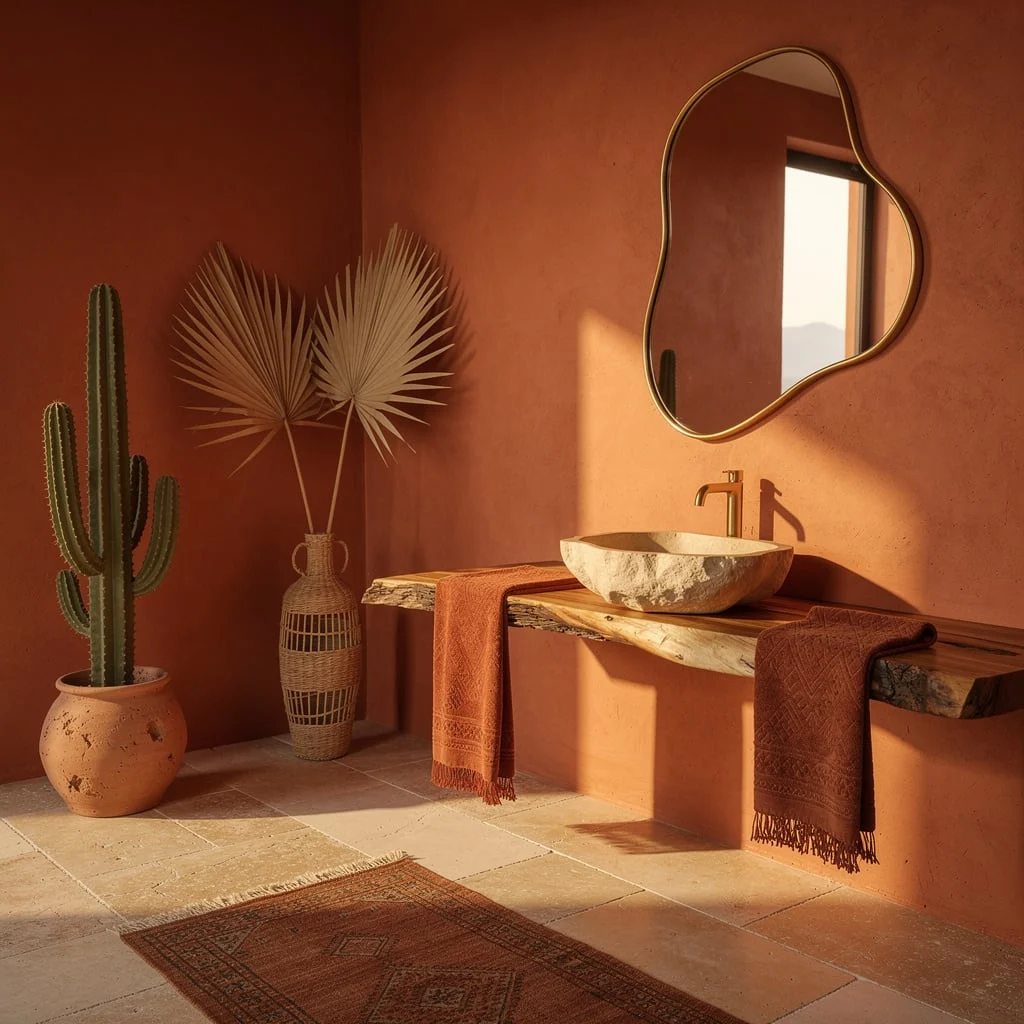
Apply a deep terracotta or burnt clay tone to every wall surface — not paint, but a limewash or natural pigment plaster that allows light and shadow to change how the colour reads across the day. The same colour on every wall turns the room into an experience rather than a space.
Float a live-edge timber shelf at 90–100cm height, supported on the terracotta wall with simple black iron brackets. Place a stone vessel sink on the shelf, positioned toward one end rather than centred. Fit a tall, slender brass tap. The deliberate asymmetry of the sink placement keeps the arrangement from looking like catalogue furniture.
On the wall, hang a large organic-shaped mirror with a thin gold frame — the kind where the outline of the mirror does not follow any geometric shape. Below the shelf and to the left, stand a tall saguaro cactus in a raw terracotta pot. In a large wicker-wrapped vase, lean two dried fan palms against the wall. Lay a kilim rug in rust and dark brown on the travertine or stone tile floor.
Linen Curtain, Layered Rugs, Jute
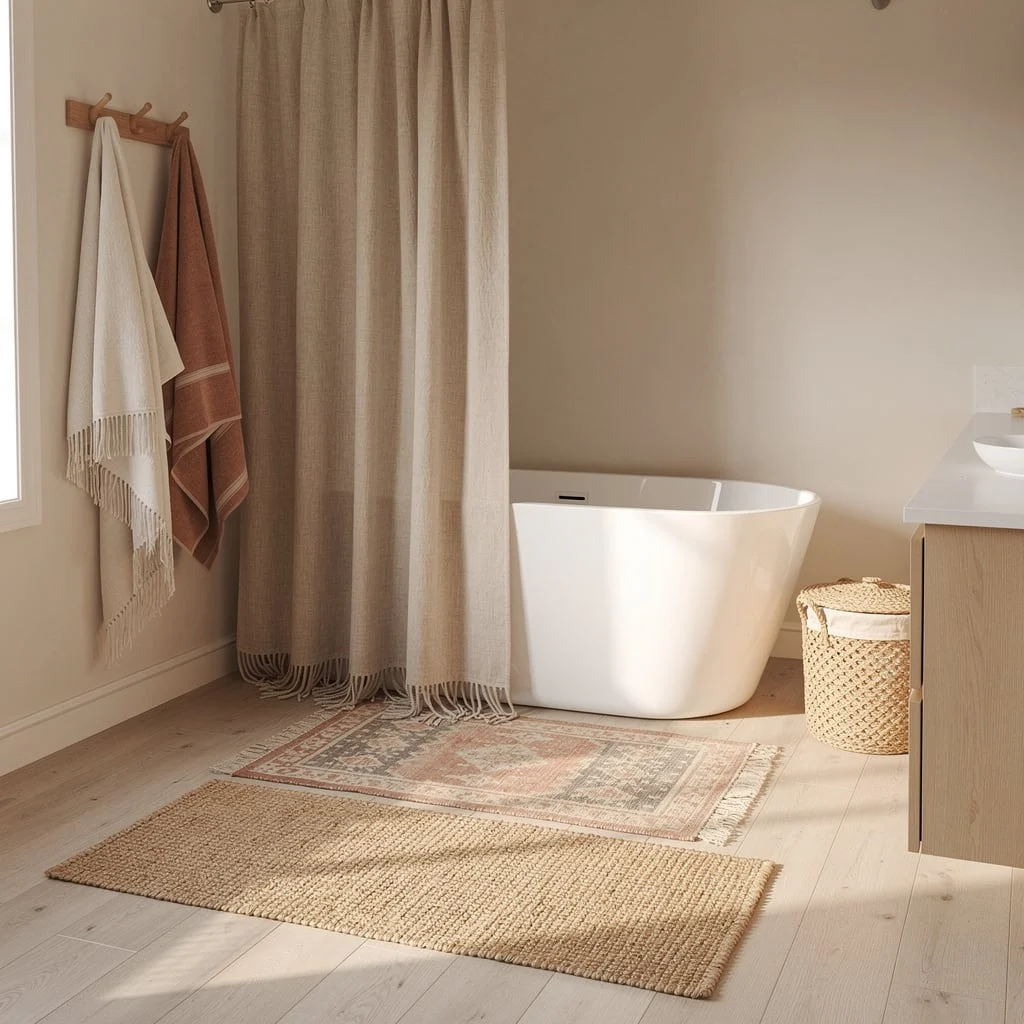
Use a full-length linen shower curtain in a natural, undyed or warm oatmeal tone — hung from a ceiling-height rail so the curtain falls from as high as possible and pools slightly at the floor. The extra length creates a softness that a standard-length curtain never manages.
In front of the bath, layer two rugs: a natural jute runner as the base, with a smaller vintage or overdyed medallion rug on top. The layering reads differently from a single rug — more collected, more deliberate. Make sure the medallion rug is oriented toward the bath rather than the door.
On the wall beside the window, install a simple wooden peg rail — five or six pegs in a row — and hang two or three towels from it: one ivory, one cinnamon brown. Use a wicker lidded basket beside the vanity for towel storage. A small rattan cabinet beside the bath holds a second basket inside. Every storage solution should be natural material, open, or both.
Squoval Mirror, Fluted Cabinet, Travertine
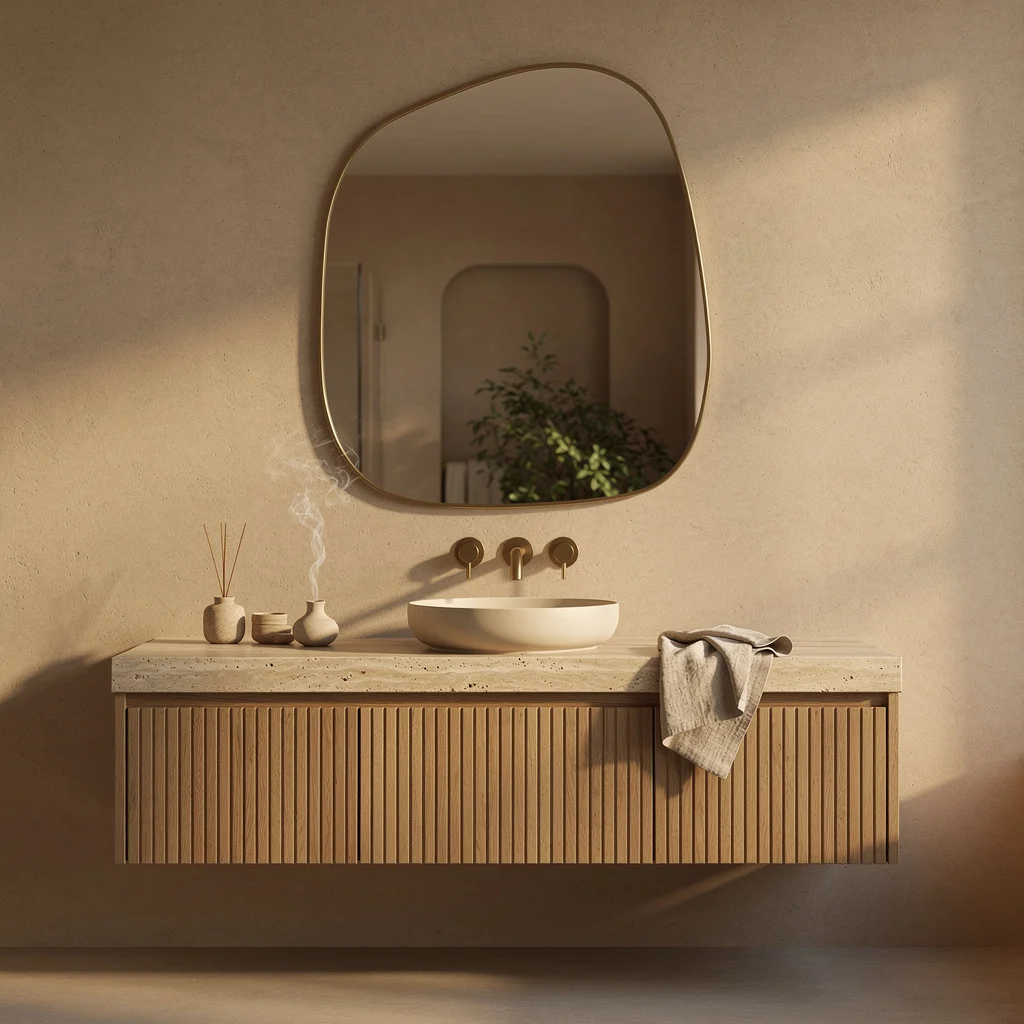
Select a wall-hung vanity unit with a vertically ribbed or fluted timber front in a pale honey or natural oak tone, topped with a travertine or speckled stone slab. The travertine introduces natural variation — fossil marks, tonal shifts, veining — that manufactured surfaces cannot replicate.
Mount a wall-mounted tap with two separate levers directly into the wall above the basin rather than fitting taps to the basin itself. Choose brushed brass or aged brass fittings. On the stone countertop, place only three objects: a small ceramic vase, a reed diffuser, and a stacked set of two ceramic cups or bowls in raw clay finish.
Above the vanity, hang a large organic-shaped mirror — somewhere between square and oval — in a slim brass frame. The irregular outline breaks the rigidity of the rectangular cabinet below. Drape a loose linen hand towel over the edge of the stone top. Keep the wall bare and textured — limewash plaster in warm bone or cream — so the vanity reads as a standalone composition.
Skylight Bath, All the Plants
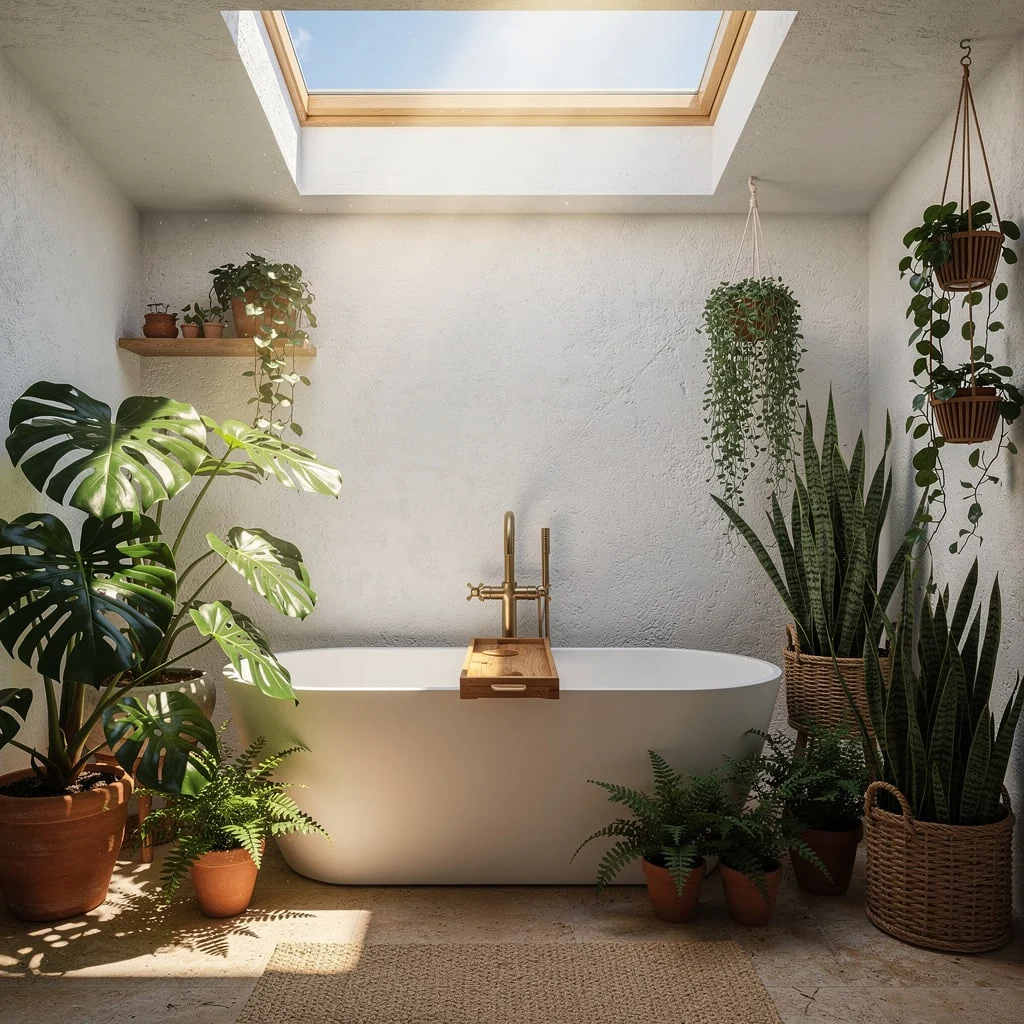
Position a freestanding bath directly beneath a rooflight or skylight so natural light falls directly into the tub. This is the single best thing you can do with a bathroom that has overhead glazing. Everything else is secondary.
Surround the bath at floor level with plants in terracotta pots: a large monstera on the left, ferns at the base, and one or two compact plants on the right. Install a narrow floating shelf on the side wall and arrange small terracotta pots with trailing plants along it, letting the vines fall below the shelf edge.
On the right side, hang plants from the ceiling at two different heights using macramé hangers — a string-of-pearls or similar trailing plant in a hanging basket above, a mid-height hanging plant below. The arrangement should feel like a greenhouse around a bathtub. Keep the walls white or very pale plaster. The plants provide every colour the room needs.
Moroccan Lanterns, Wall of Candles
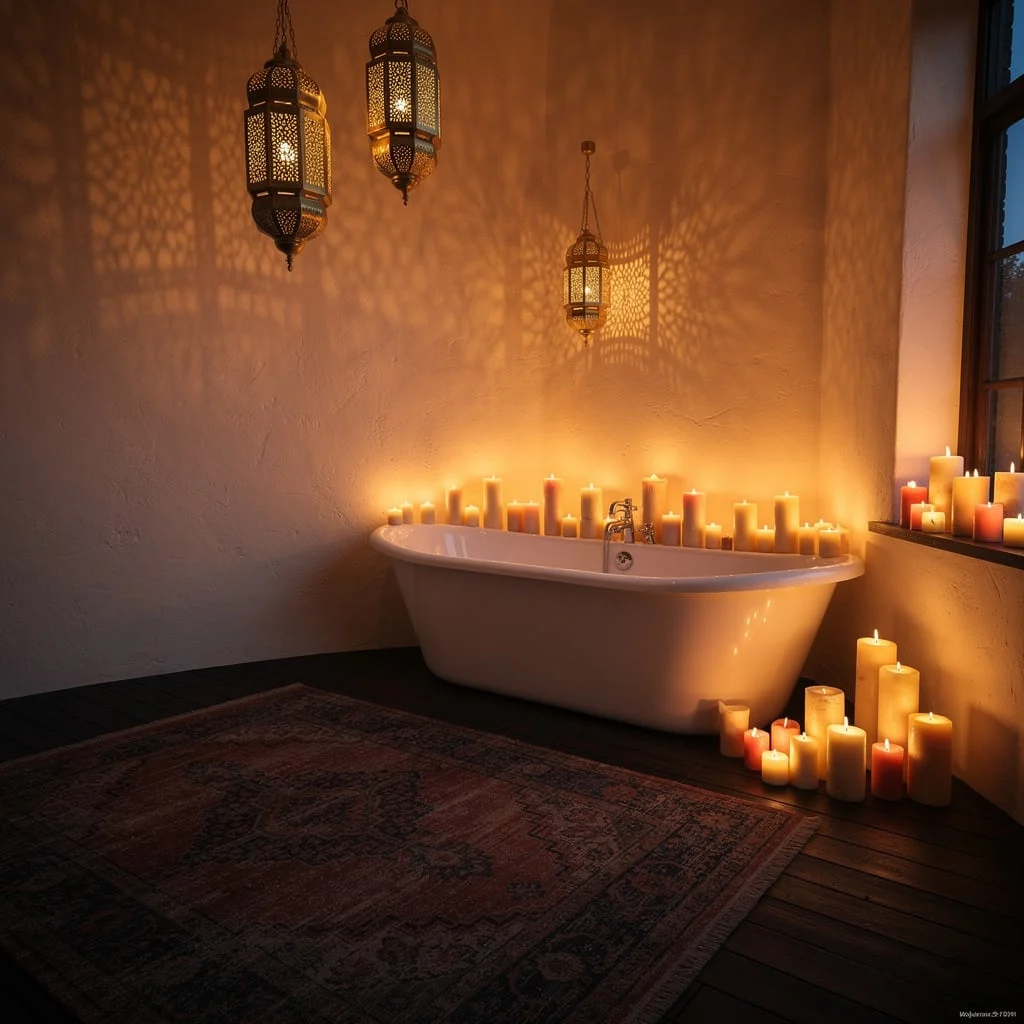
Hang three Moroccan pierced-metal lanterns from the ceiling above the bath at varying drop lengths — 60cm, 90cm, and 120cm from the ceiling. The lanterns should be genuine metalwork with geometric cutout patterns, not smooth pressed-metal reproductions. When lit, they throw lace-like shadow patterns across every wall and ceiling surface.
Line the full perimeter of the bath surround with pillar candles in cream and white at varying heights. Use two rows where there’s space — a back row of taller candles, a front row of shorter ones. Allow different heights and diameters to mix. On the window ledge, add more candles in glass holders and let them spill onto the floor in groups of three.
Lay a large vintage or vintage-style kilim rug on a dark-stained timber floor beside the bath — the rug’s warm tones ground the arrangement and soften the floor. The room should be used primarily at night. In daylight it is a bathroom. After dark with the lanterns and candles lit, it is something else entirely.
Dried Herbs, Clawfoot Tub, Adobe
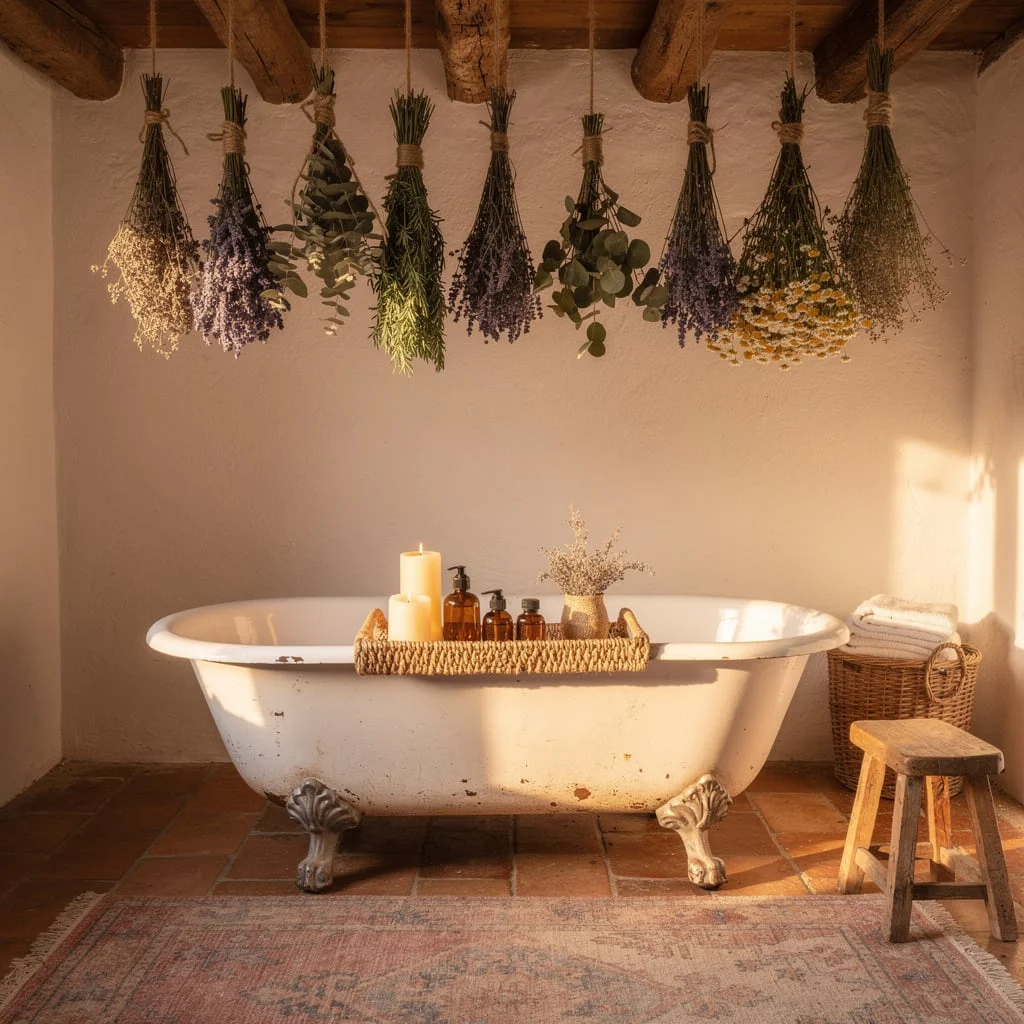
Tie bunches of dried herbs and botanicals with natural twine — lavender, eucalyptus, rosemary, chamomile, dried pampas, lunaria — and hang them from the exposed ceiling beams or a series of hooks at uniform height. The bunches should be dense enough to read as a canopy above the bath. Mix at least six to eight different varieties.
The bath should be a cast iron roll-top or clawfoot tub in aged white — a tub with imperfections in the enamel, water marks on the exterior, paint wear on the feet. The signs of age are part of the aesthetic, not problems to correct. Sit it on terracotta tile floor with a faded vintage runner rug beside it.
On one side of the bath, place a low rough wooden stool holding a woven bath tray with pillar candles, amber product bottles, and a small raw ceramic vase with a single dried stem. On the other side, a wicker basket with spare rolled towels in ivory. The walls should be warm plaster or lime render in pale blush or cream — smooth enough not to distract from the botanical canopy overhead.
Driftwood Ladder, Terracotta Floor
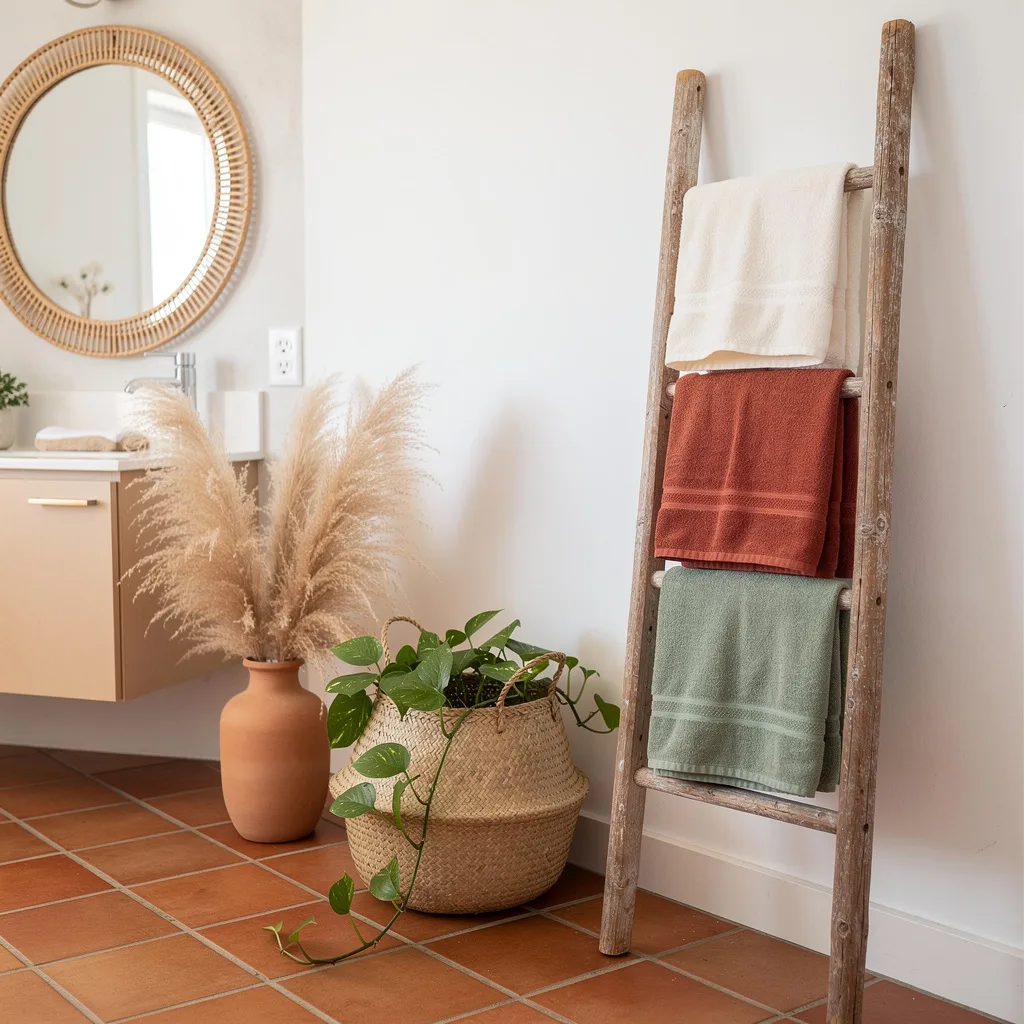
Source a genuine driftwood or weathered branch ladder — two uprights with rungs spaced at 30cm intervals, roughly 160–180cm tall. Lean it against the wall at a slight angle and hang towels over three of the rungs: one ivory at the top, one terracotta in the middle, one sage green below. The colour gradient reads as intentional when the tones are placed in order from light to warm to cool.
Beside the ladder base, place a tall terracotta vase with dried pampas grass. In front of it, a wide-mouth seagrass basket with a trailing pothos plant. The plant trails onto the terracotta tile floor, which should be a warm, unglazed terracotta square tile — not polished, not sealed beyond a light protective coat.
Across the room, a round rattan-framed mirror hangs above a wall-mounted vanity unit in a warm muted tone. The mirror’s rattan frame echoes the natural quality of the driftwood ladder and keeps the palette consistent. Keep the walls white or very pale. The floor tile and the ladder carry the warmth — the walls just hold everything together.
Tropical Open Shower, Stone Basin
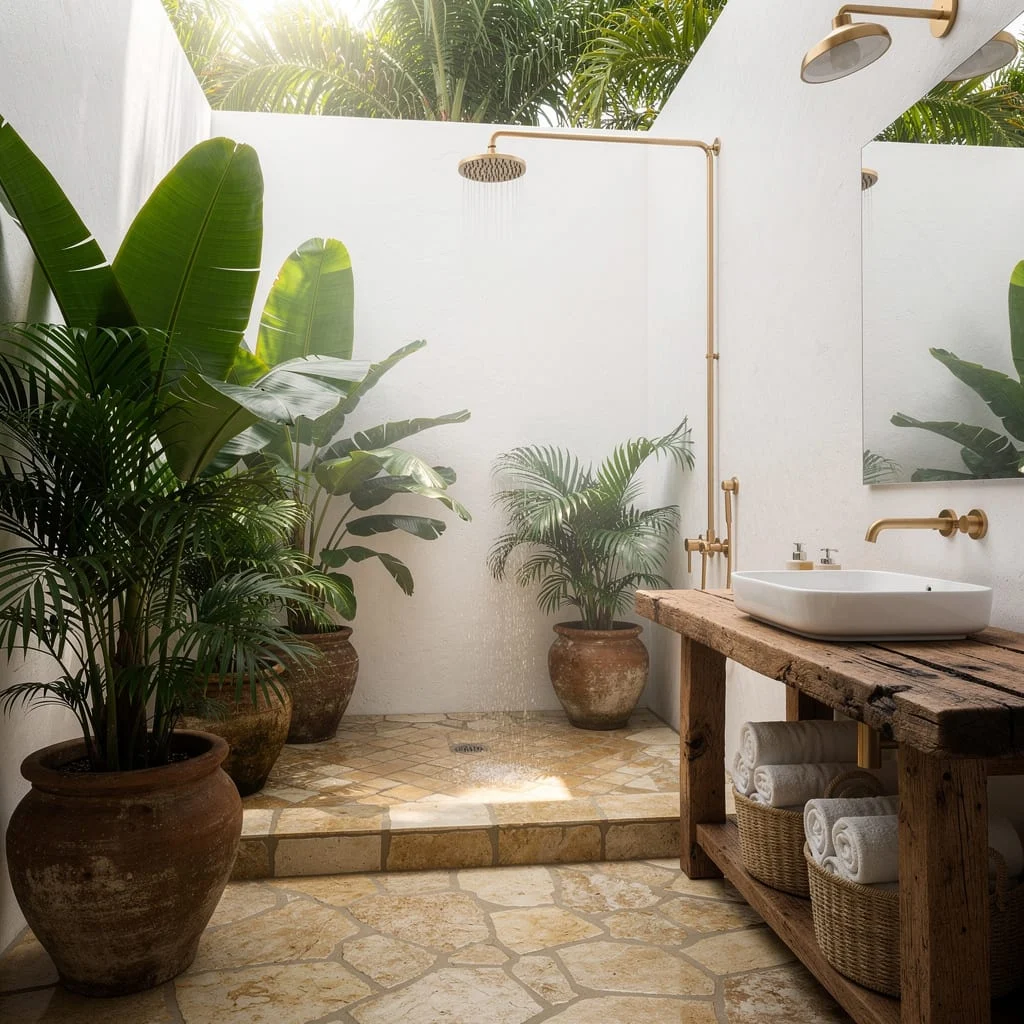
Build an outdoor or semi-outdoor shower space with whitewashed rendered walls on two sides, open to the sky above. Lay irregular flagstone or travertine tiles on the floor with the natural edge retained — the uncut perimeter gives the floor an archaeological quality that smooth-cut tiles can’t replicate.
Position large ceramic or clay urns — the kind with rough, textured exterior and curved form — beside the shower area and plant banana palms or bird of paradise inside them. The scale of the plants should be generous: at least 1.5 metres, ideally taller. Install a floor-standing brass shower column with a round overhead head.
On the vanity side, use a reclaimed scaffold-board or rough-sawn hardwood table as the vanity surface, with a white ceramic vessel sink positioned toward one end. Fit wall-mounted brass taps. Below the vanity surface, store rolled towels in a wicker basket. The entire space should feel like a resort in a country with very good weather — abundant, warm, and deliberately unbothered.
Basket Wall, White Bath
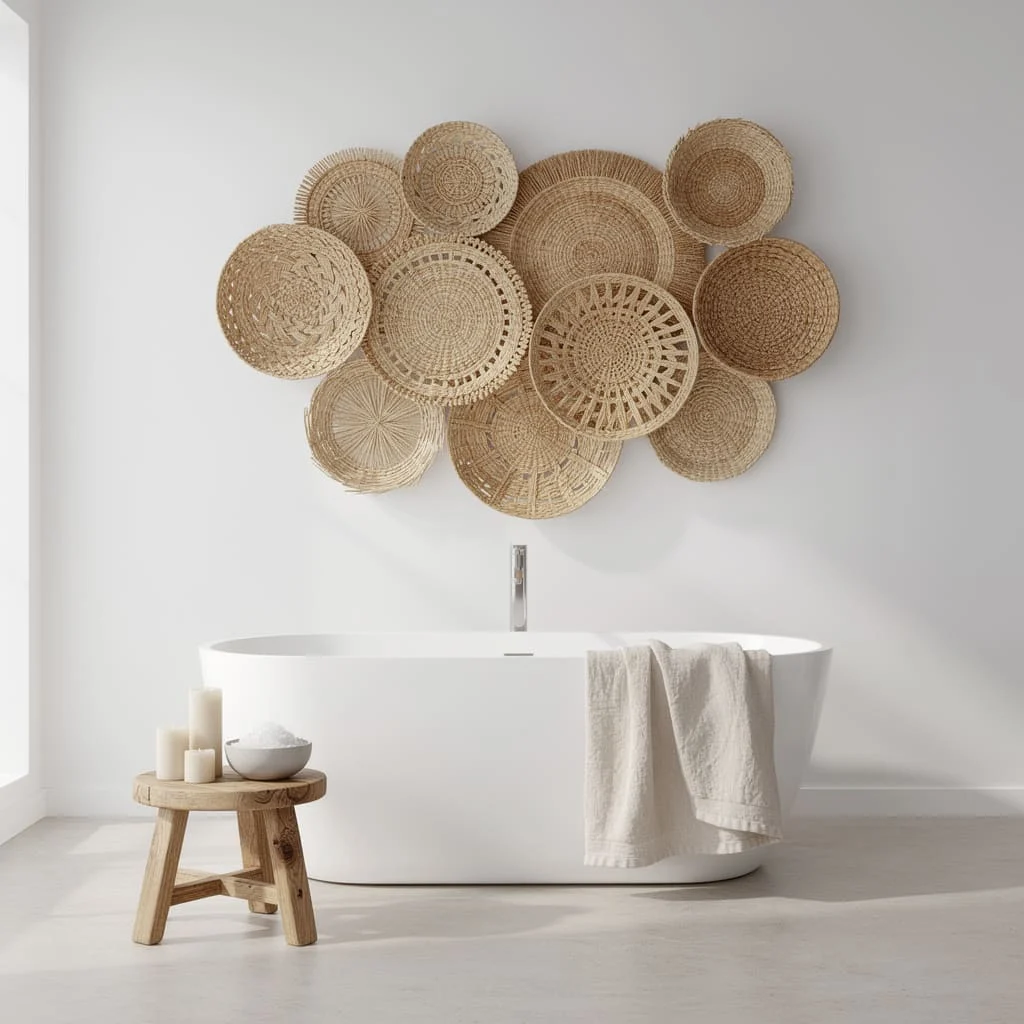
Source a collection of flat woven seagrass or rattan wall plates in varying diameters — from 20cm up to 50cm — all in natural undyed tones. You need a minimum of ten, ideally twelve to fifteen. Hang them in a tight organic cluster above the bath, overlapping the edges slightly so they read as a single sculptural composition rather than a grid of individual objects.
The bath should be a contemporary freestanding oval or rectangular tub in white or off-white with a clean, modern profile. The simplicity of the bath allows the woven wall composition to be the entire visual argument. Do not add anything else to the wall.
On a small rough wooden stool beside the bath, arrange three pillar candles in cream and white at different heights alongside a ceramic bowl holding a small amount of salt or dried botanicals. A single linen towel draped over the edge of the tub. Keep the floor pale — white-washed timber or light stone — and the walls white. The natural basket tones against the white room is enough.
Bamboo Pendant, Plastered Bath Platform
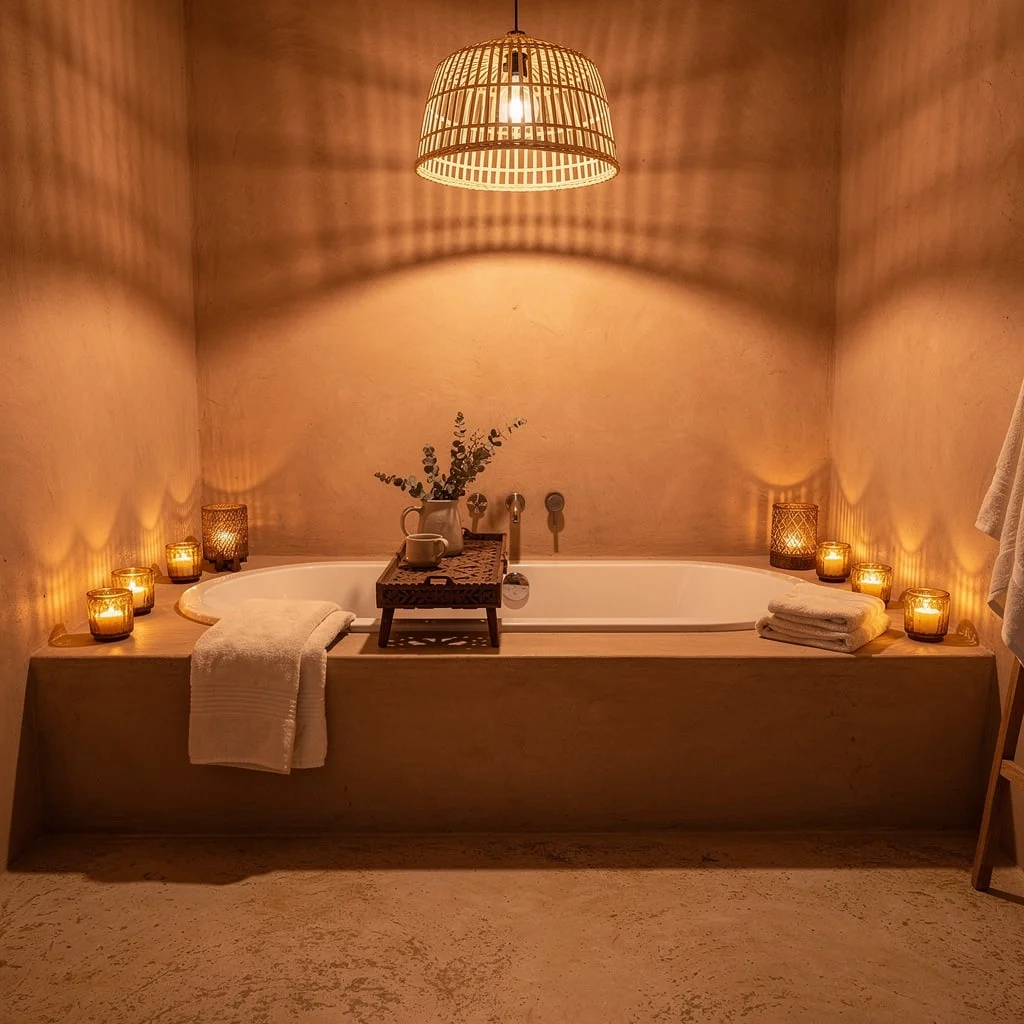
Build a bath platform from lime plaster or microcement in a warm sand or biscuit tone — flush with the floor on three sides, raised approximately 30cm, with the bath dropped into it so only the interior is visible above the platform edge. The platform extends 20–25cm beyond the bath perimeter on all sides to create a ledge.
On the ledge, place groups of glass votives with lit tealights — two or three on each side — plus a wooden carved tray holding a ceramic jug with a eucalyptus stem and a folded hand towel. Install wall-mounted taps and controls in a matte or satin finish directly into the plaster wall behind the bath.
Hang a wide bamboo or rattan pendant shade above the bath from a ceiling hook — the kind with a tight diagonal weave that throws strong shadow lines when lit. Use a filament bulb at low wattage. The slat-pattern shadow the pendant casts across the warm plaster walls is the room’s defining atmospheric quality. Turn off any other light source and the space transforms completely.
Terracotta Ceramics, Wicker Shade, Rust Curtain
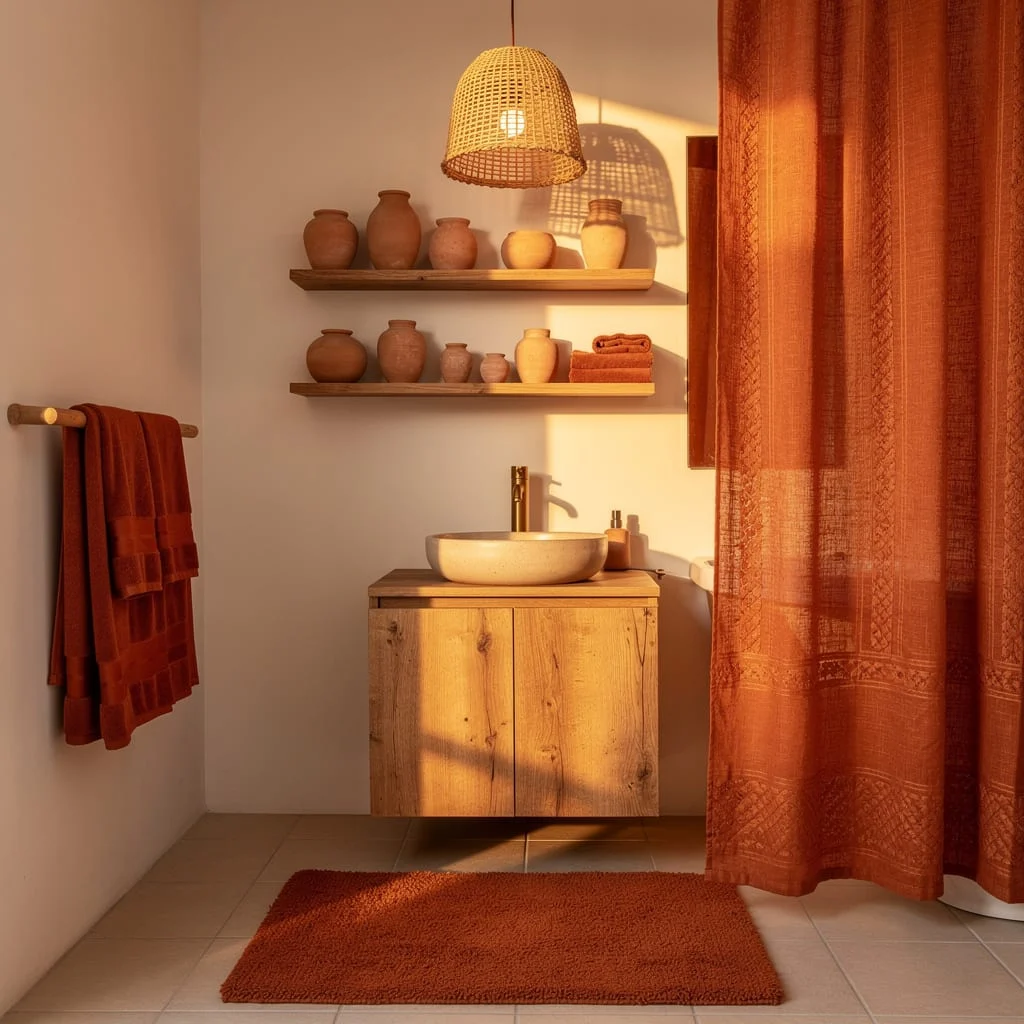
Install two floating shelves in warm oak or walnut directly beside the vanity, positioned at different heights. Arrange a collection of raw terracotta vessels on them — jugs, vases, wide-mouthed pots, narrow-necked bottles — all in natural clay tones ranging from pale sand to deep rust. Mix sizes deliberately and allow some pieces to sit sideways or at an angle.
Above the vanity, hang a woven rattan or bamboo pendant shade on a long drop cord. Use an Edison filament bulb at low wattage so the shade is visible even when lit. On the left wall, mount a simple wooden dowel or brass bar as a towel rail and hang two or three deep rust-coloured towels from it.
Choose a shower curtain in a deep burnt orange or rust linen with a block-print or woven border pattern — hang it from a ceiling-height rail so the fabric pools at the floor. A stone vessel sink on a natural oak floating cabinet completes the vanity. Put a deep rust bath mat on the floor. Every warm tone in the room should be in the same family: clay, rust, terracotta, amber. The palette doesn’t fight itself.
A Room That Earns Its Reputation
Most bathrooms are finished, not designed. Tile goes up, cabinet goes in, mirror gets hung, done. You end up with a room that works but doesn’t feel like anything.
Bohemian bathrooms take longer to get right because the decisions compound. The tile informs the hardware. The hardware informs the mirror. The mirror informs the vanity. Pull one thread and the whole thing shifts.
That’s not a problem. That’s the point.
The rooms in this post all have one thing in common beyond the obvious surface-level styling. They were built by people who cared about how they felt in the morning. Not just how they looked. The feeling of stepping into a candlelit room with plaster walls and plants and warm brass. The smell of dried lavender above a bath.
Those things are not accidental. They are designed. And they are available to you, in whatever bathroom you currently have, if you’re willing to make some decisions and hold to them.
Start with one wall. Start with the hardware. Start with the mirror. It doesn’t matter where — it matters that you start with intention.