
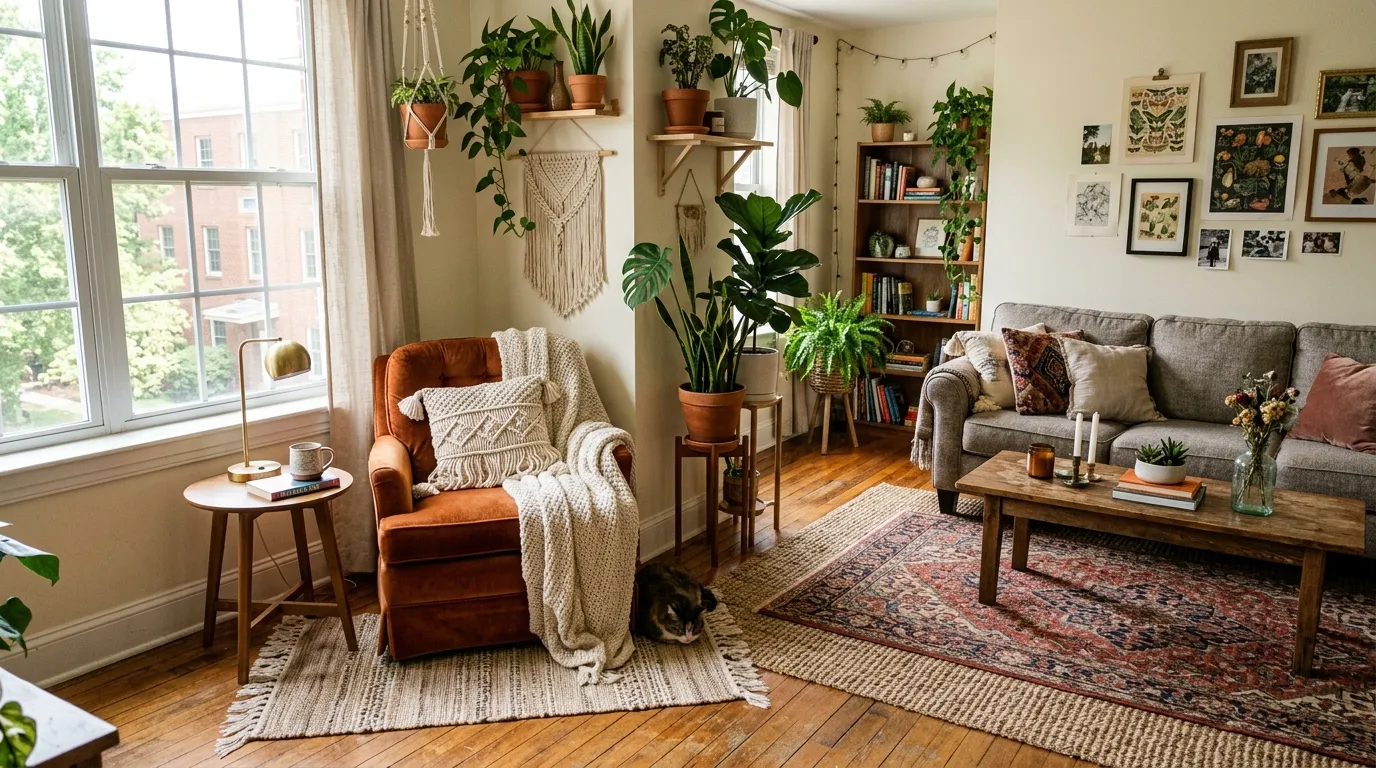
You moved out of the dorm. Congratulations. Now you have a real door that locks, a kitchen with more than a hot plate, and absolutely no idea how to make any of it look like an adult lives there.
Most people solve this by doing nothing. A futon shows up. A poster gets taped, not framed. Three years pass and the apartment still looks like move-in day, except now there’s mold in one specific corner of the shower.
That’s not a budget problem. It’s a decision problem. You don’t need more money to stop your entryway from swallowing your keys every single morning. You need a system, and you need to actually commit to it instead of buying a cute basket and calling it done.
This is the blueprint. Not inspiration — instructions.
What You Need To Know About Small Spaces
Vertical Space Is Free Real Estate
You’re paying rent on the floor. The wall above your desk, the space above your toilet, the six feet of air above your dresser — that’s all free. Almost nobody uses it.
Shelving units, wall-mounted racks, and stacked storage cubes turn dead air into square footage you didn’t know you had. This matters most in kitchens and bathrooms, where counter space is basically theoretical.
If you’re still stacking things on the floor because you “ran out of room,” you didn’t run out of room. You ran out of walls you’d used.
One Light Source Is Never Enough
A single overhead fixture makes any room feel like a waiting room. It’s flat, it’s harsh, and it makes even a nice space look institutional.
Layer your light. A desk lamp for tasks, string lights or an LED branch for ambiance, a floor lamp for the corners the ceiling light can’t reach. Warm bulbs over cool ones, always, unless you’re specifically trying to feel awake at 2 a.m.
The rooms that feel the coziest in every photo you’ve ever saved almost never rely on the ceiling light alone.
Entry Points Decide Whether You’ll Actually Maintain the System
Whatever storage system is closest to your front door is the only one that will survive past week two. If putting your shoes away requires walking to the closet at the other end of the apartment, they will live by the door forever, system or no system.
Build your organization around your actual habits, not your aspirational ones. If you drop your bag the second you walk in, put the hook there. Don’t fight your own behavior.
The best-organized apartments aren’t the most disciplined ones. They’re the ones where doing the right thing takes the least effort.
College Apartment Ideas Worth Actually Copying
LED Cherry Blossom Branch
Mount a flowering LED branch light directly onto the wall above your desk, angled so it sweeps outward like it’s actually growing from one point near an outlet. Most versions come with flexible wire branches you shape yourself, so bend it asymmetrically instead of centering it like a Christmas wreath.
Run the cord down cleanly and tuck it behind a stack of books or a shelf edge so the light looks wireless. Plug it into a cheap outlet timer so it comes on automatically at dusk.
Keep the rest of that wall empty. This piece is the entire event — nothing else competes with it.
Sage Green Entry Wall
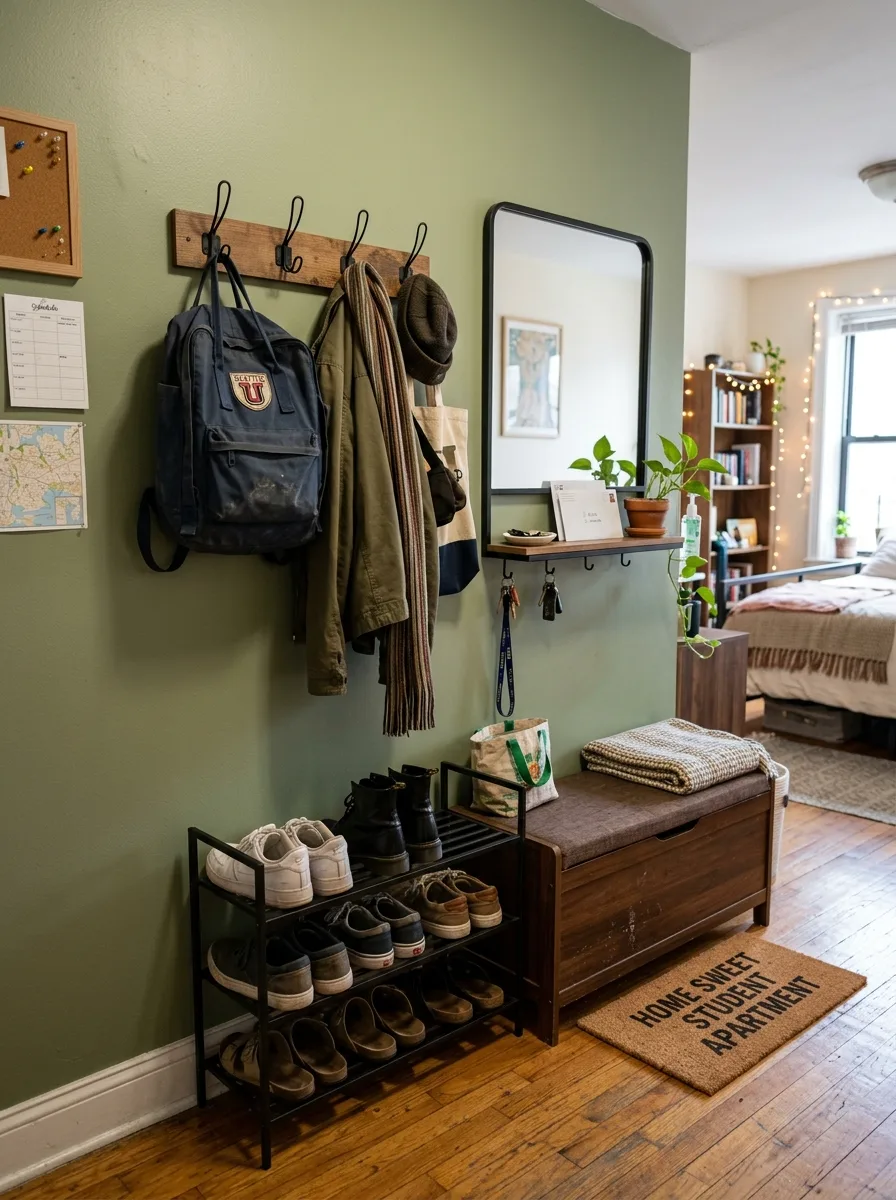
Paint or apply removable wallpaper to just the entry wall in a deep sage or olive green, leaving the rest of the space neutral. Mount a row of wall hooks at jacket height and a low bench with built-in shoe storage directly beneath a round or arched mirror.
Add a floating shelf above the hooks for a mail tray and a small plant, and keep everything else off that wall entirely. A textured door mat with a phrase on it finishes the transition from outside to inside.
Color-blocking one wall like this does more for a rental than any framed art will. It signals “we live here” the second the door opens.
Neon Sports Silhouette Sign
Choose a single-shape LED neon sign — a football, a basketball, whatever your sport is — and mount it on the wall with the most visual weight in the room, usually above a TV or shelf unit. Go for warm white or a single team color, never multicolor; a rainbow sign reads as a dorm, a single-tone sign reads as a fixture.
Pair it with a wood slat floor lamp nearby so the room has two warm light sources instead of one harsh one. Keep the shelf below it simple — a console, a plant, a speaker — so the sign stays the focal point.
Skip the twelve other posters. One statement piece beats a wall of them every time.
Over-Toilet Shelf Tower
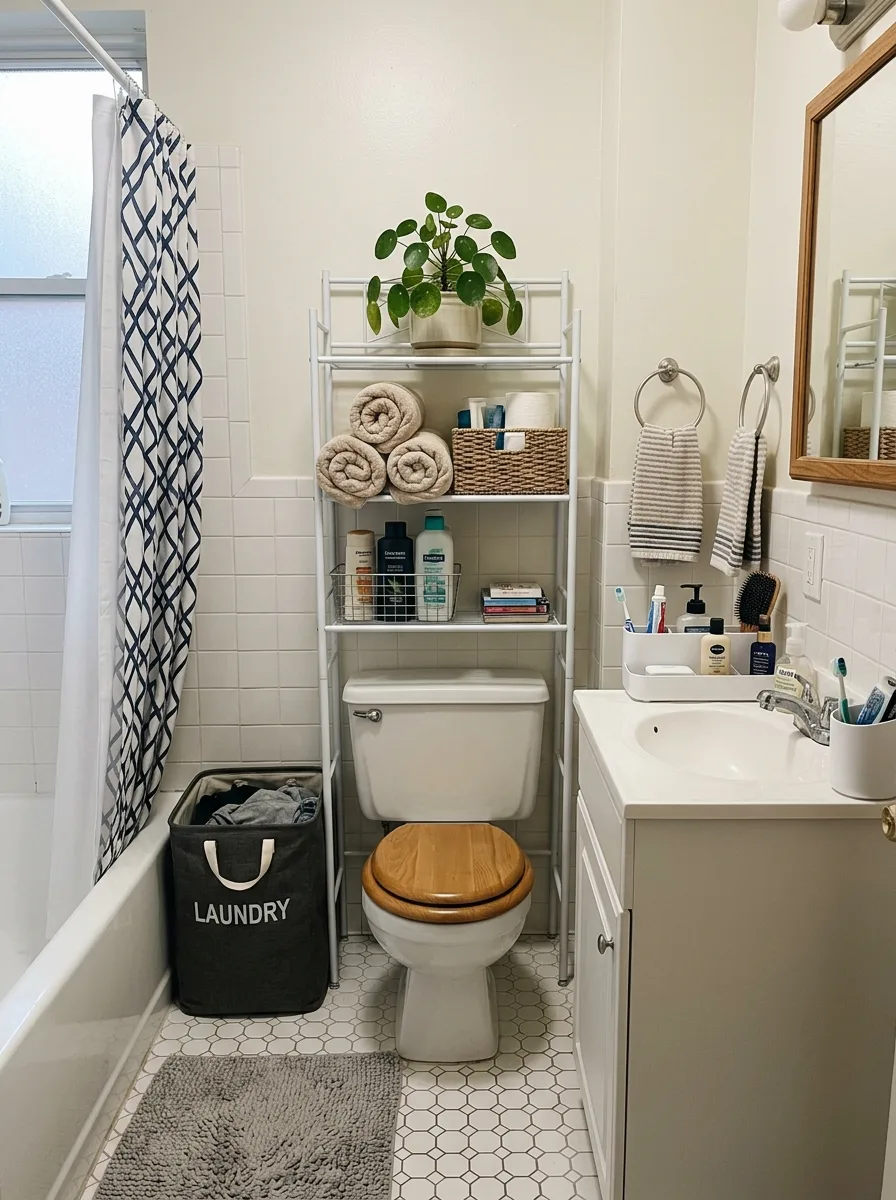
Install a slim over-toilet storage tower that straddles the tank, using the one dead zone every small bathroom has. Fill the top shelf with a trailing plant that can handle humidity, stack the middle shelf with rolled towels and a woven basket for toiletries, and use the bottom shelf for daily products in a wire caddy.
Keep a matching hand towel and hook set on the wall beside it so the palette stays unified instead of mismatched. Add a bath mat in a pattern that echoes the shower curtain so the small room reads as coordinated, not thrown together.
A shared bathroom with four toothbrushes and one shelf is a disaster waiting to happen. This is the fix.
Floor-to-Ceiling Library Wall
Build out a full wall of matching white cube shelving from floor to ceiling and fill it edge to edge with actual books, spines out, grouped loosely by color or height rather than alphabetized. Clip a small swing-arm reading lamp directly to one of the shelf edges at eye level instead of relying on a lamp table you don’t have room for.
Break up the rows with a handful of non-book objects — a small sculpture, a mug, a stack of coasters — spaced every few shelves so the wall doesn’t read as a wall of spines with nothing to land on. Keep the shelving itself painted to match the wall behind it so the books, not the furniture, do the visual work.
Hang an oversized paper lantern pendant in front of the shelving rather than beside it, letting it partially overlap the bookshelf sightline. That layering is what keeps a wall this large from feeling like a library display and starts feeling like a room someone actually reads in.
Anchor the seating low and neutral — a boulcé sectional, a stone-topped coffee table — so the bookshelf stays the tallest, boldest thing in the room and nothing competes with it for attention.
Fold-Down Wall Desk
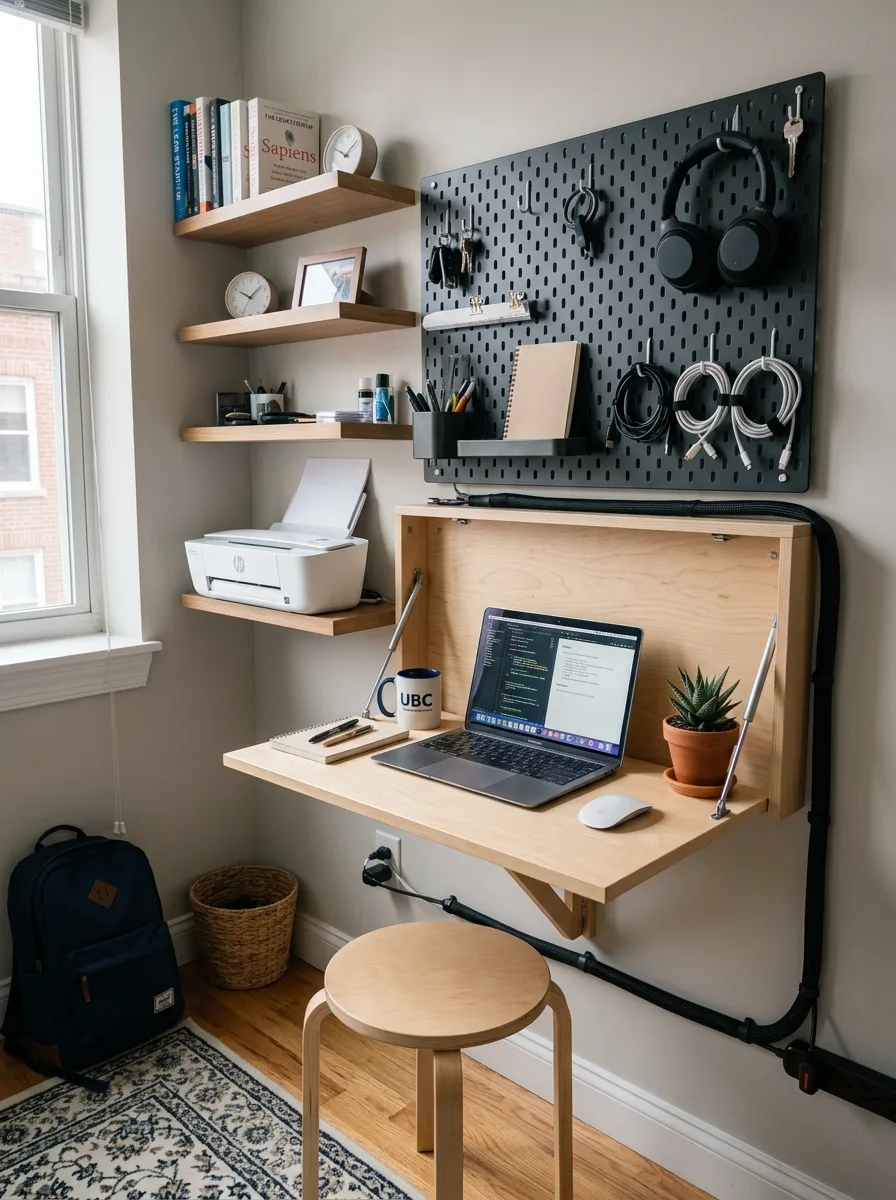
Install a fold-down wall-mounted desk in a room too small for a standalone one, using the wall space above it for a pegboard instead of a bulletin board. Hang headphones, keys, and coiled cables on pegboard hooks so cords never touch the desk surface itself.
Add two floating shelves above the pegboard for books and a small clock, keeping the desk surface itself reserved only for what you’re actively using. Fold it down only when you need it, and fold it back up when you don’t — that’s the entire point of the piece.
This is the move for a studio or a room that has to serve three functions. A desk that disappears when you’re done with it effectively doubles your square footage.
Stacked Cube Kitchen Station
Build a mini kitchen out of stacked open cube shelving instead of a single flimsy cart. Slide a compact fridge into the bottom-center cube so it reads as built-in, then stack a microwave directly on top of it to use the vertical space above.
Fill the surrounding cubes with a mix of closed woven baskets on the bottom rows and open display on top — mugs, a kettle, snacks — so the whole unit doesn’t read as one giant visual block. Add battery LED puck lights inside a couple of the open cubes for the effect of built-in cabinetry.
Keep appliances confined to the center column only. Baskets on both sides do the heavy lifting of hiding what you don’t want seen.
Rolling Bins Under Bed
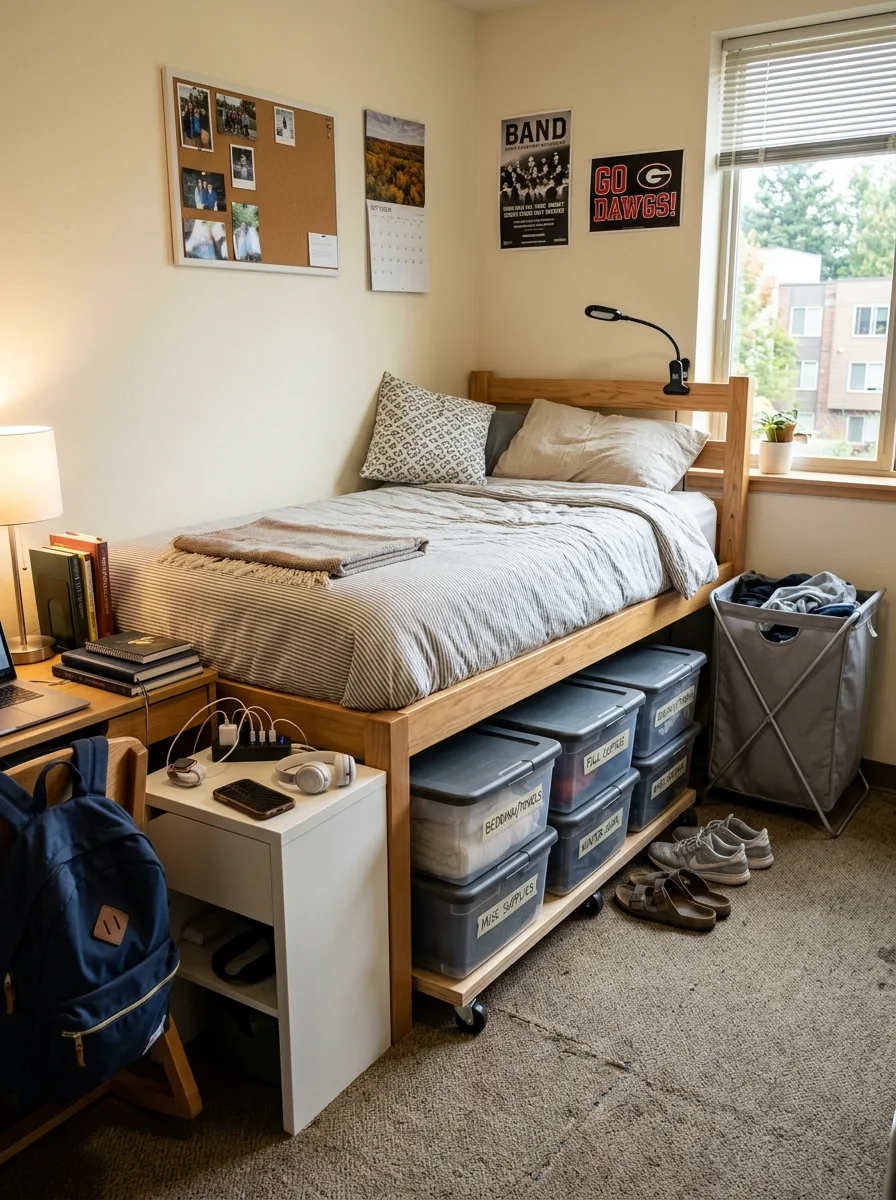
Buy matching clear or opaque storage bins sized to fit the exact clearance under your bed frame, then label each one by category — bedding, off-season clothes, misc supplies — with a printed label, not handwriting. Add wheels or a rolling platform underneath so the whole set can slide out without you having to crawl.
Use the bed frame’s natural height as your only closet expansion; if your frame sits low, look into bed risers before buying bins that won’t fit. Keep the labels facing outward and readable from where you’re standing, not tucked toward the wall.
This is the single highest storage-to-effort ratio move in a shared bedroom. Do this before buying a single other organizer.
Magnetic Knife Rail Setup
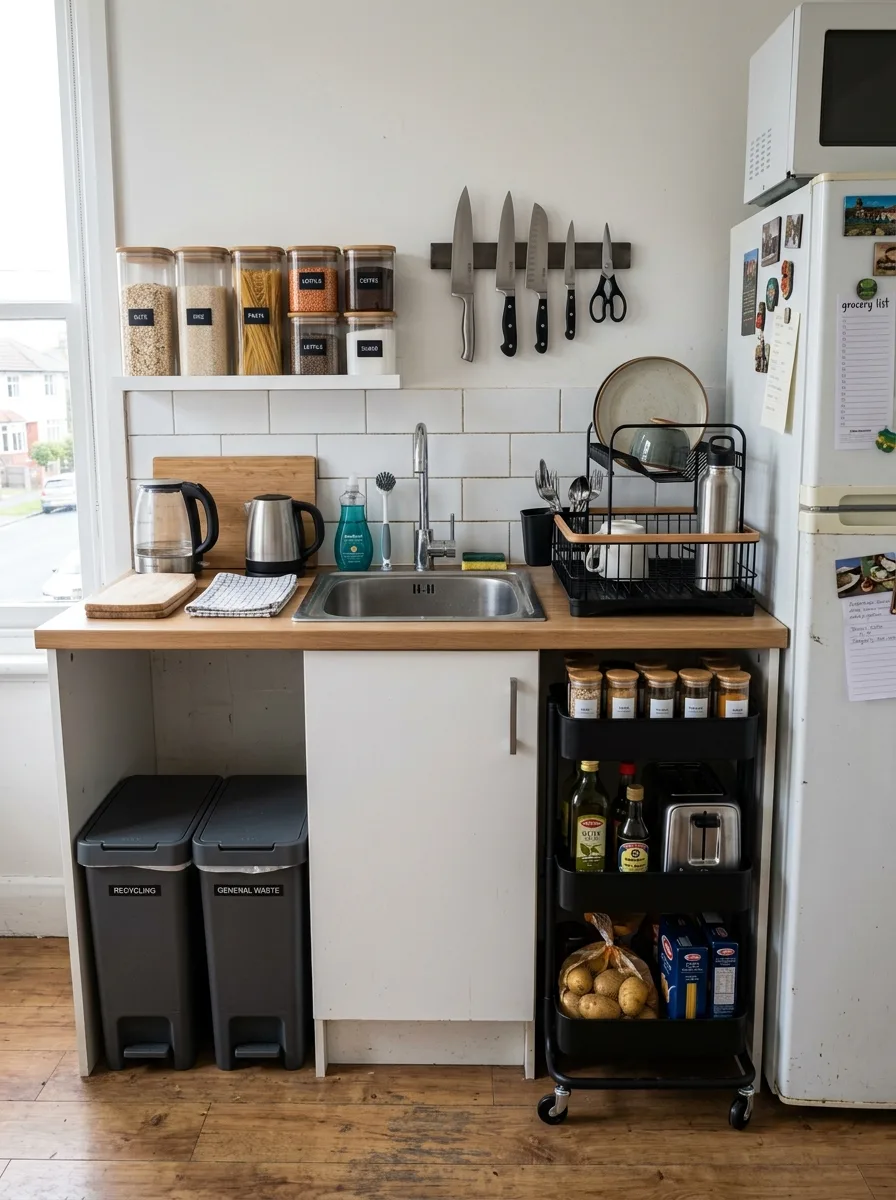
Mount a magnetic knife strip directly above your kitchen counter and use it for actual knives and kitchen scissors, not decoration. Below it, line up matching glass or ceramic canisters with printed labels for dry goods — pasta, oats, lentils — on an open shelf rather than hidden in a cabinet you don’t have.
Add a rolling utility cart beside the counter for anything that doesn’t fit — oils, spices, a toaster — so your actual counter space stays clear for prep. Keep the cart’s tiers organized by use, top shelf for daily items, bottom for bulk.
A tiny kitchen only works when the vertical wall space is doing as much as the counter. Stop treating the wall above your sink as empty.
Backpack Hook Row Bench
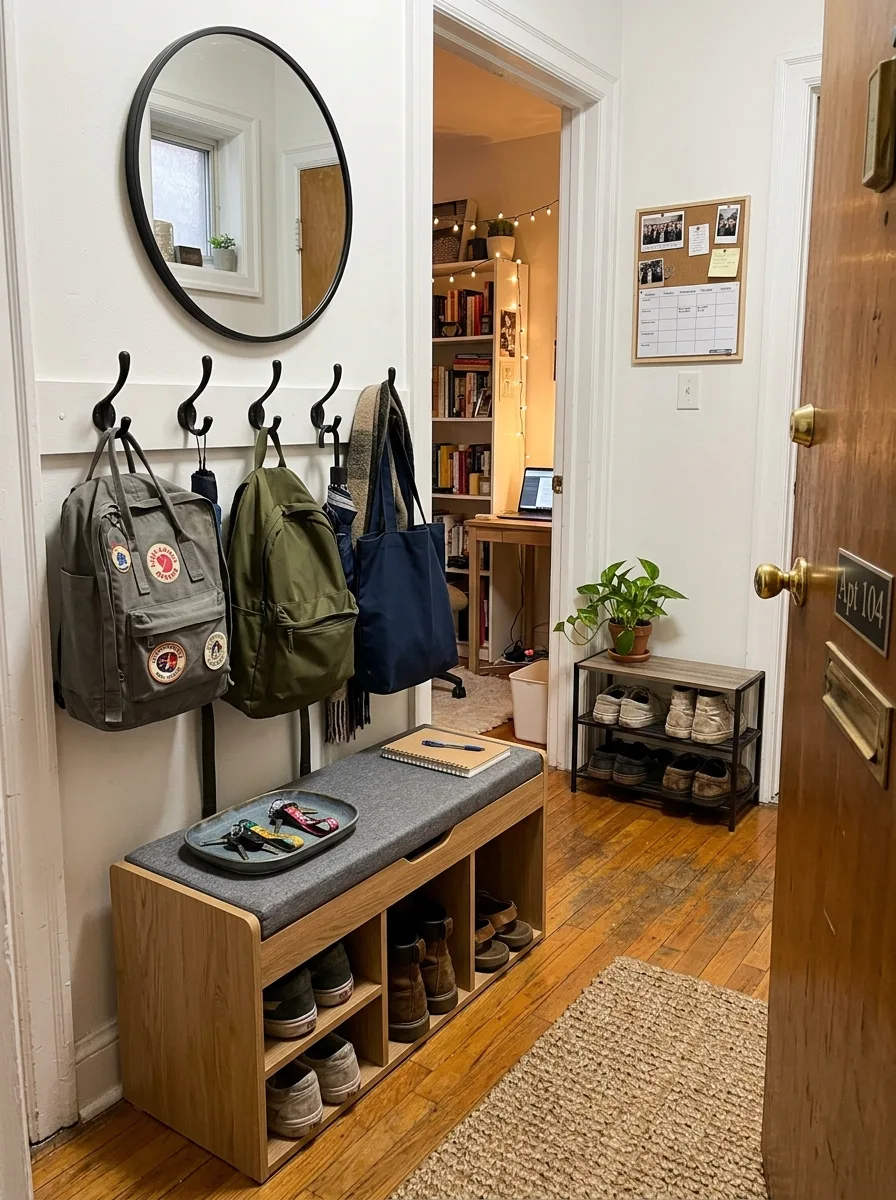
Install four evenly spaced wall hooks at shoulder height in your entryway, sized for backpacks and jackets, not delicate coat hangers. Under them, place a low storage bench with built-in shoe cubbies so shoes go in a slot instead of a pile.
Hang a round mirror centered above the hooks so the entry doubles as a last-look-before-you-leave spot. Add a corkboard on an adjacent wall for schedules and reminders, keeping that function separate from the coat wall.
This setup works because every single object has one designated spot. Nothing about it depends on willpower.
Corkboard Command Center Desk
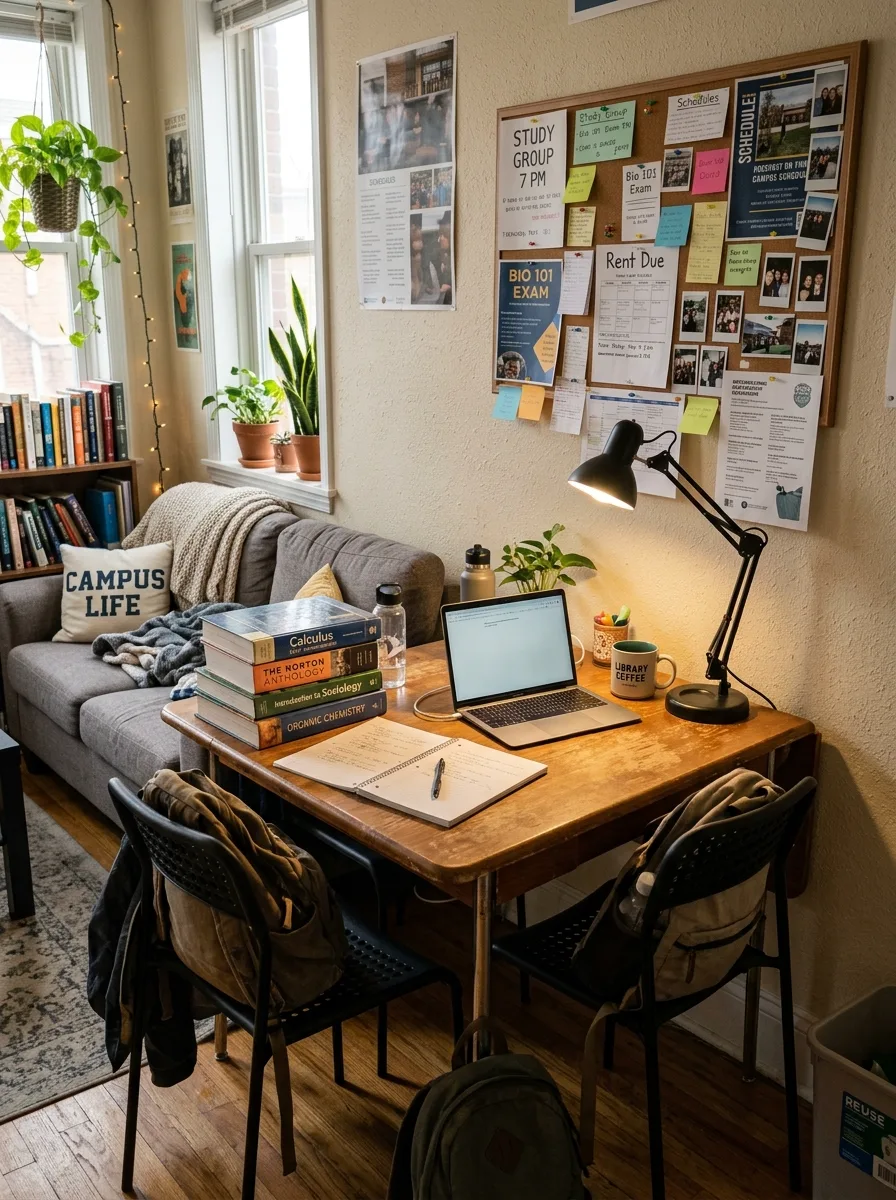
Push a small desk against the wall directly under a large corkboard, and treat the board like a control panel: study group times, exam dates, a physical calendar, photos, all pinned with intention instead of randomly. Use color-coded sticky notes by category — deadlines in one color, social in another.
Add a single adjustable task lamp clipped to the desk edge instead of relying on ceiling light, angled to hit the work surface directly. Keep a small planter and a water bottle on the desk itself so the surface has warmth, not just papers.
The corkboard only works if you actually update it. A stale corkboard is just wallpaper with thumbtacks.
Three-Tier Rolling Nightstand Cart
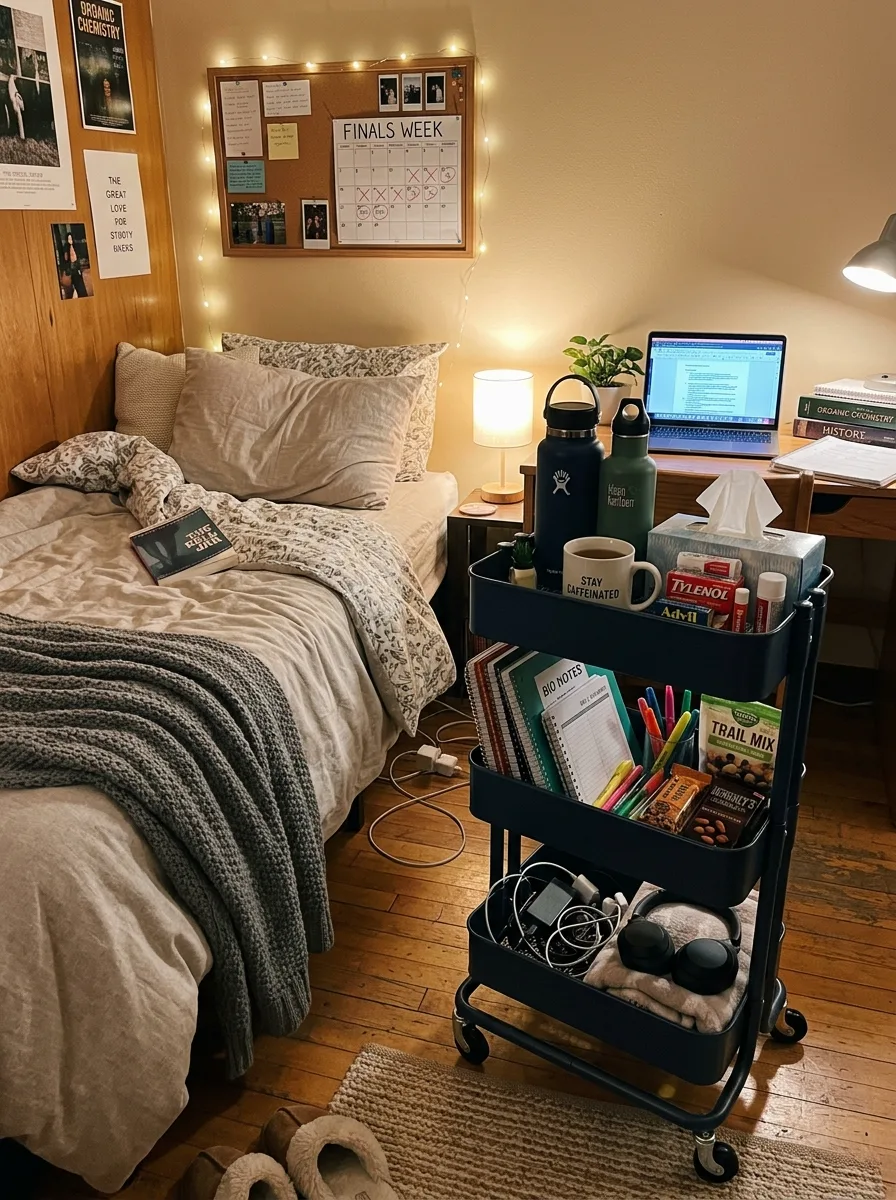
Replace a traditional nightstand with a three-tier rolling cart positioned beside the bed, and assign each tier a job. Top tier holds a lamp, water bottles, and daily medicine. Middle tier holds notebooks, pens, and study snacks. Bottom tier holds chargers, headphones, and a folded blanket.
Keep the top tier the most visually calm of the three since it’s what you see right before sleep and right after waking up. Let the lower tiers get a little more chaotic — that’s what they’re for.
A cart beats a fixed nightstand because it rolls exactly where you need it, whether that’s beside the bed during finals week or beside the desk the rest of the semester.
Labeled Laundry Sorting Cart
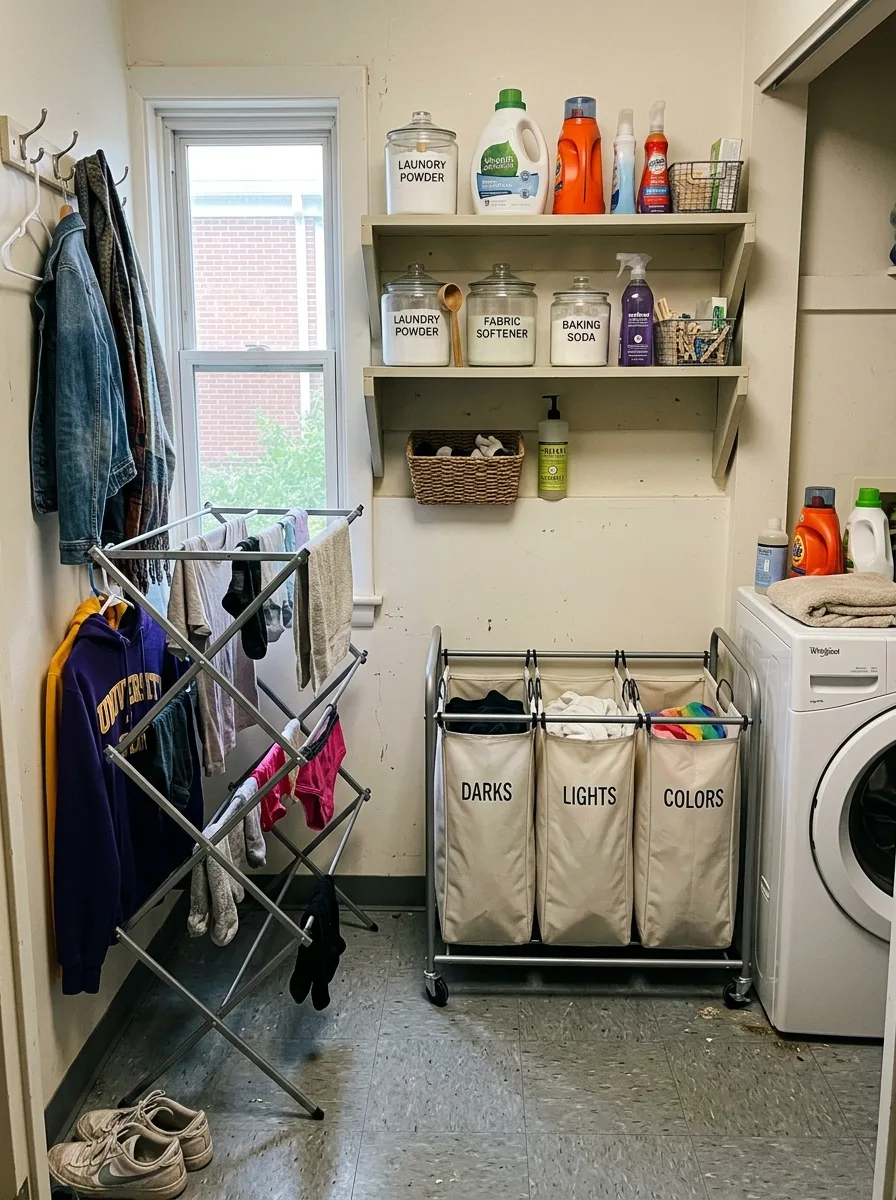
Set up a three-bag rolling laundry sorter labeled darks, lights, and colors directly beside the washer, and actually use all three bins instead of tossing everything in one hamper. Mount two floating shelves above it stocked with labeled glass jars for detergent, softener, and baking soda, plus a small caddy for stain sticks and dryer sheets.
Add a collapsible drying rack that folds flat against the wall when not in use, so it doesn’t eat floor space between loads. Keep a small basket of loose socks and misplaced items on the bottom shelf so the inevitable stragglers have a home too.
Sorting only works if it happens before the wash, not during it. The bins have to be as close to your hamper as your hamper is to your floor.
Round Table Plant Corner
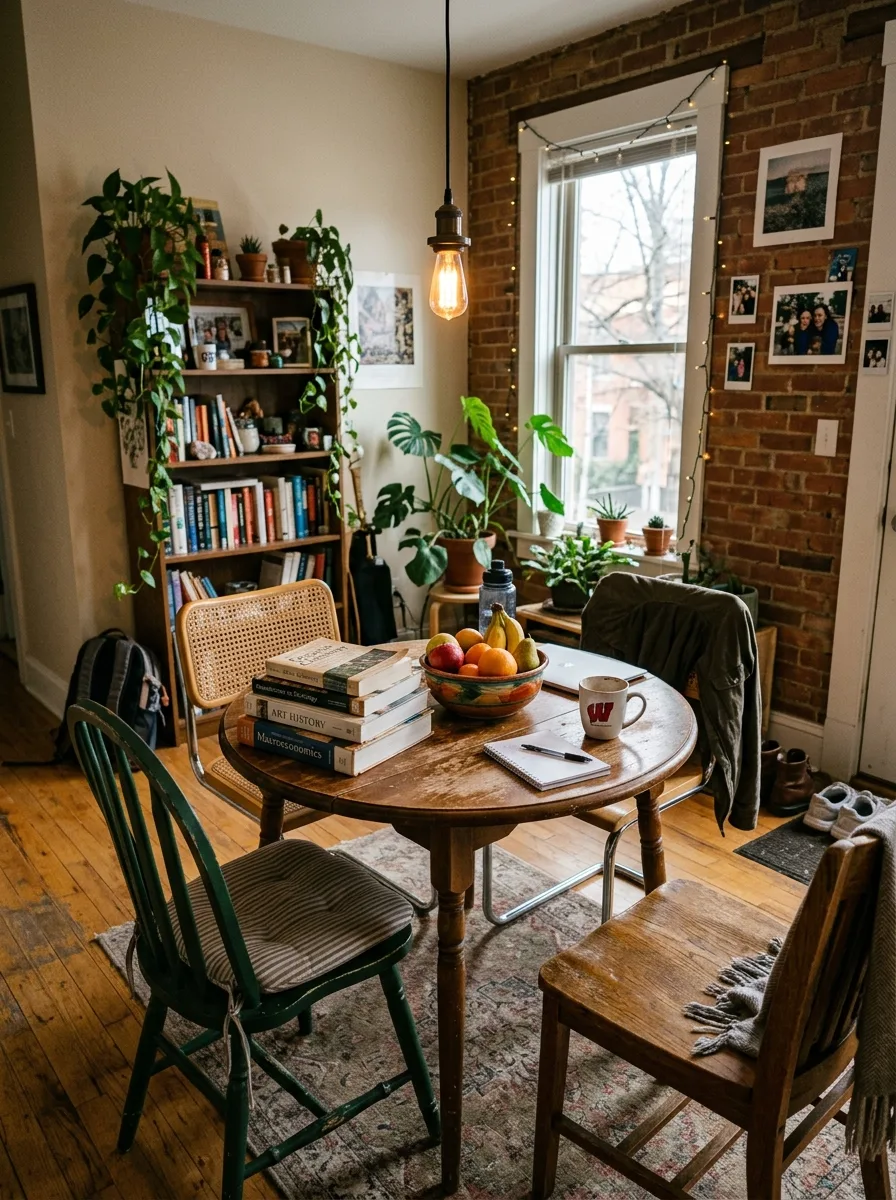
Anchor a small round wood table in the corner nearest your best natural light, surrounded by a mismatched but tonally coordinated set of chairs — a cane-back, a couple of painted wood chairs, whatever you’ve collected. Build a plant shelf ladder directly behind one chair, mixing trailing vines with larger leafy plants at different heights.
Keep a bowl of real fruit on the table at all times, not for eating, for color. Hang a single pendant light directly over the center of the table instead of relying on a floor lamp nearby.
A round table in a corner makes an awkward dead zone feel intentional. Square tables in tight corners never do.
Vertical Vacuum Closet Storage
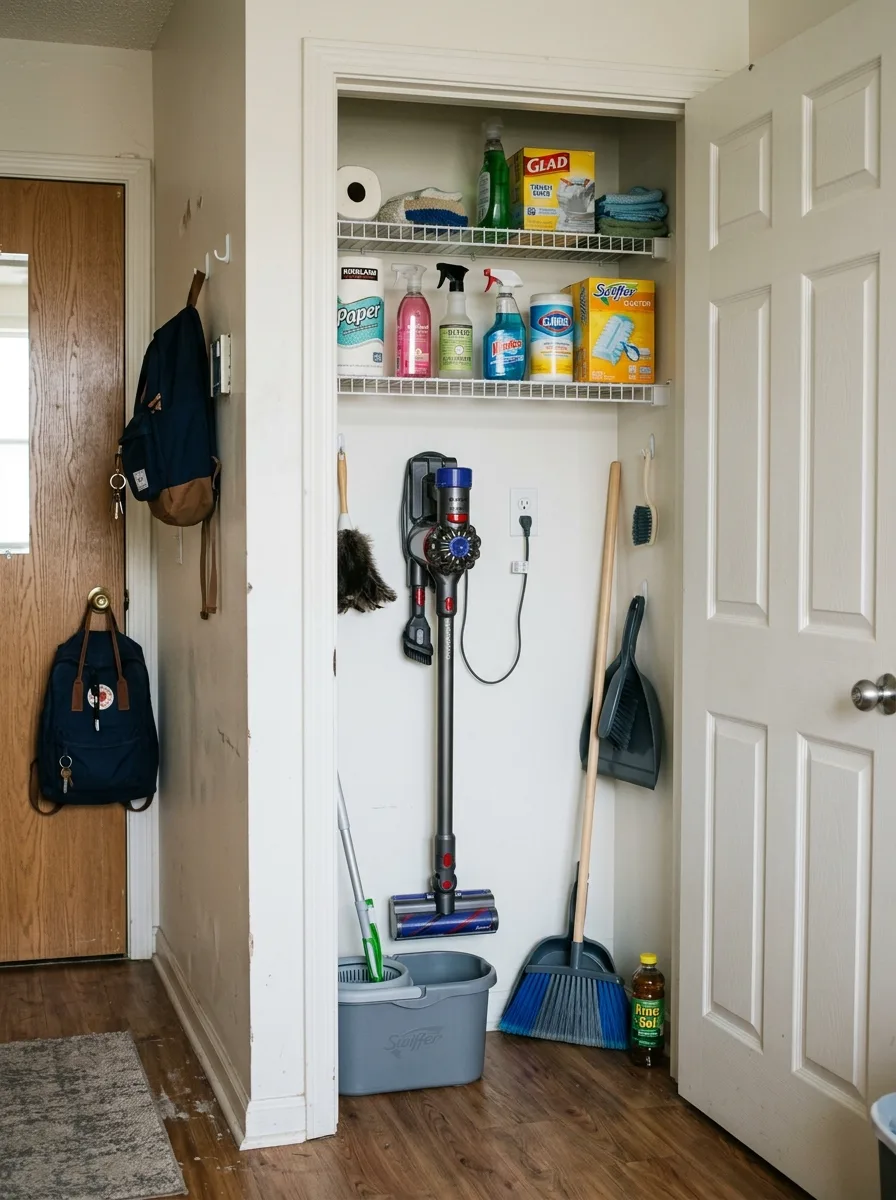
Mount a wall bracket for your vacuum inside a narrow entry closet so it charges upright instead of leaning in a corner. Hang a broom and dustpan on hooks along the opposite wall, and use a wire shelf above for cleaning supplies grouped by task — paper products on one side, sprays and wipes on the other.
Keep a small bucket and mop stored on the floor directly beneath the vacuum bracket so everything cleaning-related lives in one square foot of the apartment. Label nothing here — the grouping by task does the organizing for you.
A cleaning closet only stays organized if putting things back is easier than leaving them out. Vertical mounting makes that true.
Mail Sorter Console Table
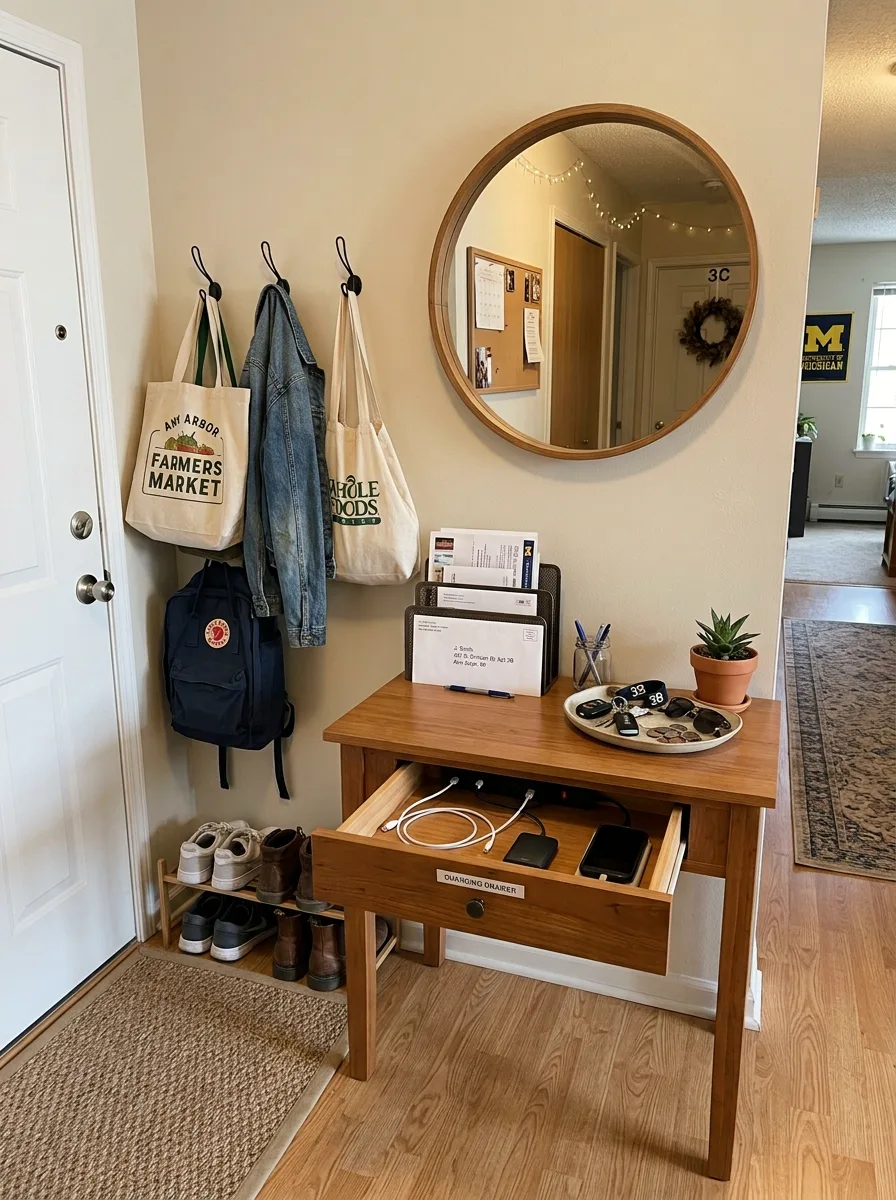
Place a narrow wood console table just inside the front door with a vertical mail sorter on top, sorted by category or by roommate name. Add a round mirror above it and a shallow catch-all tray beside the sorter for keys, sunglasses, and loose change.
Use the table’s bottom drawer, if it has one, exclusively for chargers and cables so they’re accessible but out of sight. Keep a small shoe rack tucked beneath the table itself so the entry stays a single cohesive unit instead of three separate pieces.
Mail is the single most common source of entryway clutter in a shared apartment. Give it an actual assigned spot and it stops colonizing every other surface.
Floating Shelf Entry Bench
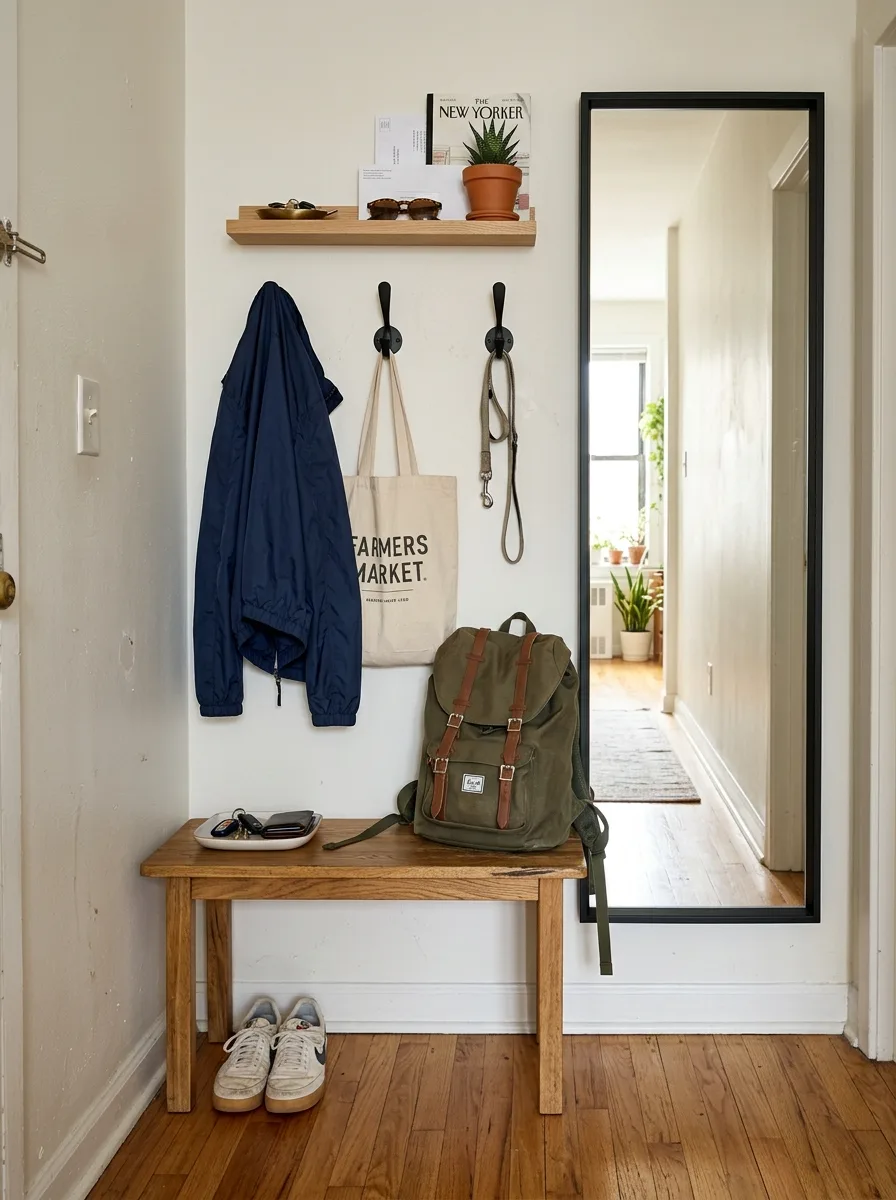
Pair a low storage bench with cubby slots for shoes with a floating shelf mounted directly above it, styled with a single framed item and a small potted plant. Add two or three matte black hooks below the shelf, spaced for jackets and tote bags rather than crowded together.
Keep a shallow bowl on the shelf for keys and sunglasses so the surface has a job beyond decoration. Anchor the whole grouping with a jute or woven rug at the base so the entry has visual warmth at floor level too.
A bench under hooks does double duty — sit to put your shoes on, and store the shoes at the same time. That’s the entire reason it beats a single coat rack.
Espresso Bar Console Cabinet
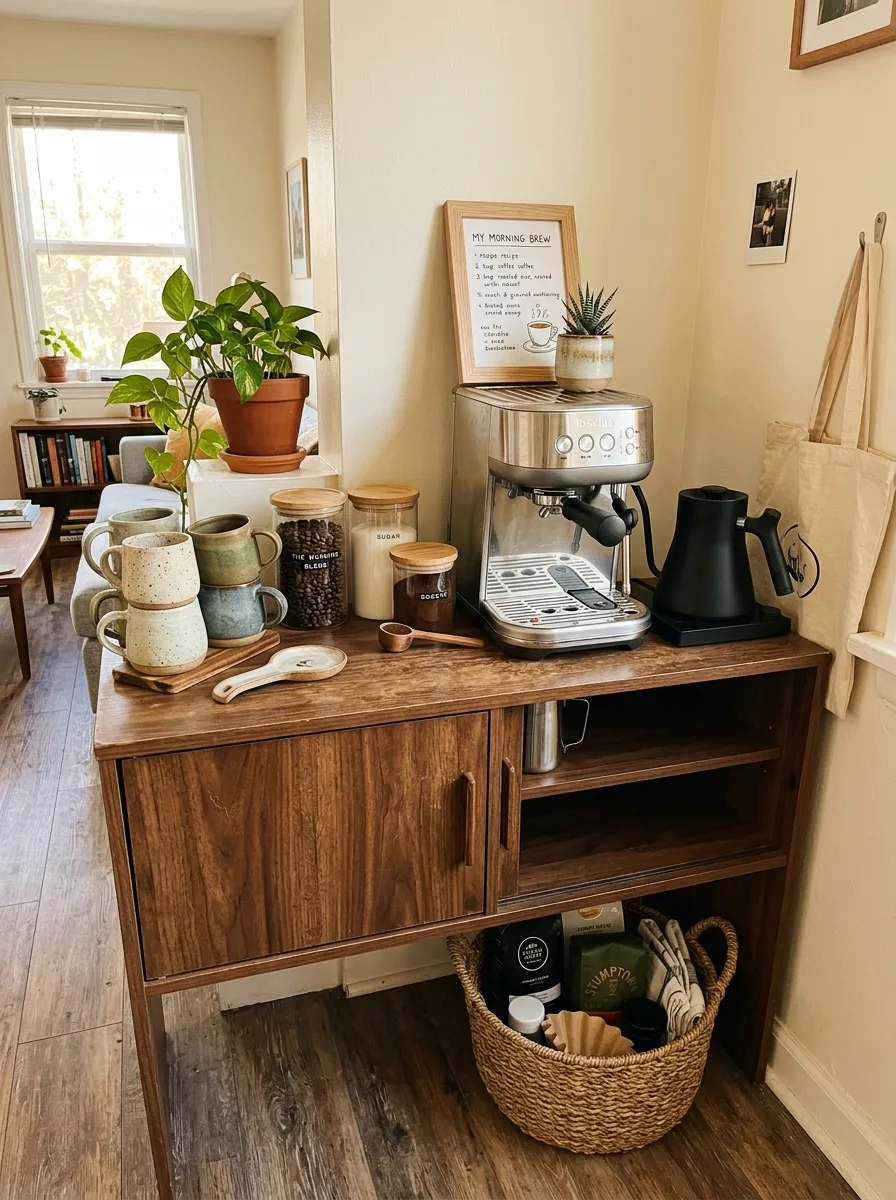
Dedicate one console cabinet entirely to coffee, with the espresso machine and kettle positioned at the back so cords stay hidden, and mugs lined up in front by type — everyday mugs together, special-occasion ones together. Store beans, sugar, and syrup in matching glass canisters with labels so the surface stays visually unified even with a dozen items on it.
Use the closed cabinet section below for anything you don’t want seen — filters, extra bags, cleaning supplies — and a woven basket on the open shelf for less precious daily items. Frame a simple printed recipe card nearby as the one piece of wall decor, tying the whole station together.
A coffee station only feels intentional when everything on it is actually used weekly. Skip anything that’s just there to look nice.
Open Shelf Closet System
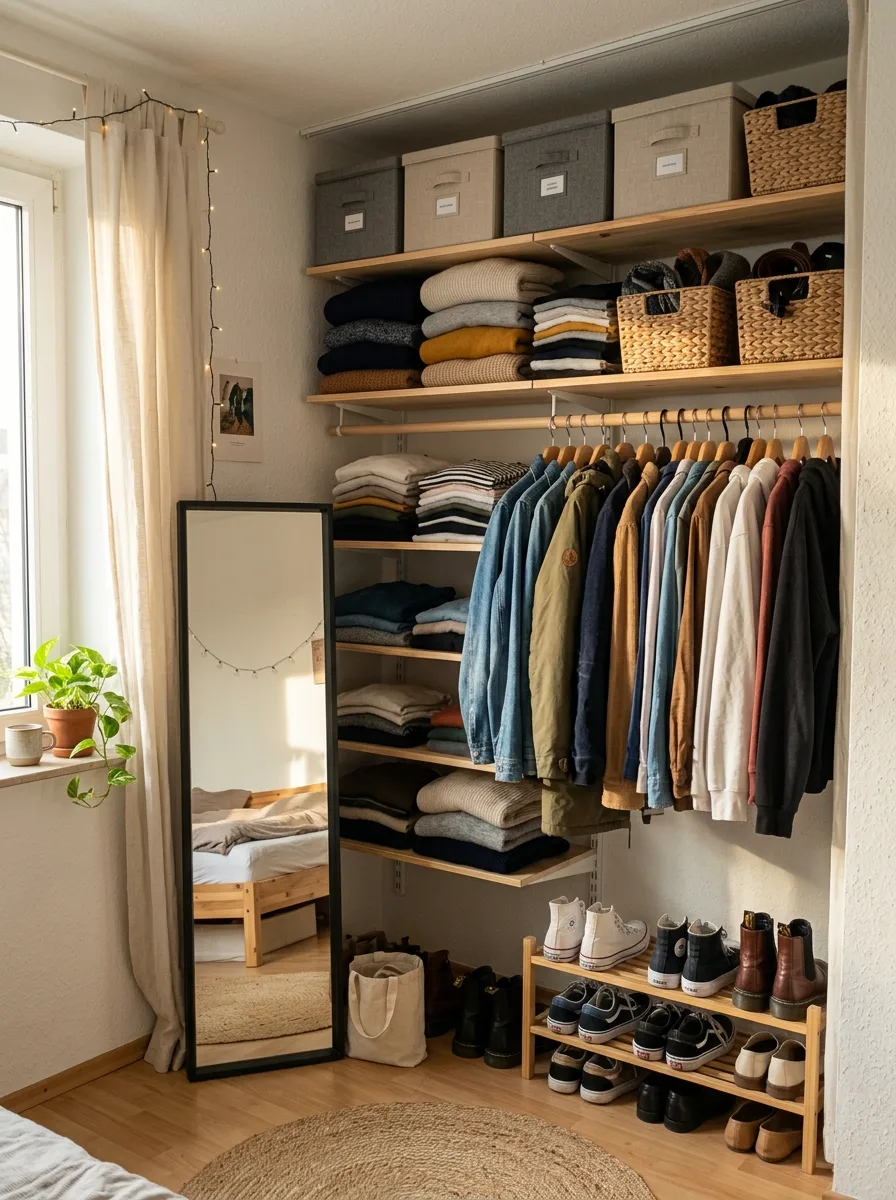
Convert an open closet into a full system by mounting two wood shelves above a hanging rod, using the top shelf for labeled fabric bins and the shelf below it for folded sweaters in stacks no taller than six items. Keep the hanging rod for anything that wrinkles — button-ups, jackets — and fold everything else.
Add a slim shoe rack directly beneath the hanging clothes so the floor stays completely clear, and lean a full-length mirror against the nearest wall since a door-mounted one usually isn’t an option in a shared space. String battery-powered lights along the shelf edge for a soft glow that beats the closet’s single overhead bulb.
An open closet without shelving is just a pile with a door. The shelving is what turns it into storage.
Final Thoughts
None of this required a bigger apartment. It required deciding, room by room, what each surface and wall and corner was actually for, and then refusing to let it become a catch-all instead.
You don’t need to move to have a better apartment. You need to stop treating the one you have as temporary, because the temporary mindset is the actual thing making it look unfinished.
Do the walk-through this weekend. Assign every dead corner a purpose. The apartment was never the problem — the absence of a plan was.