
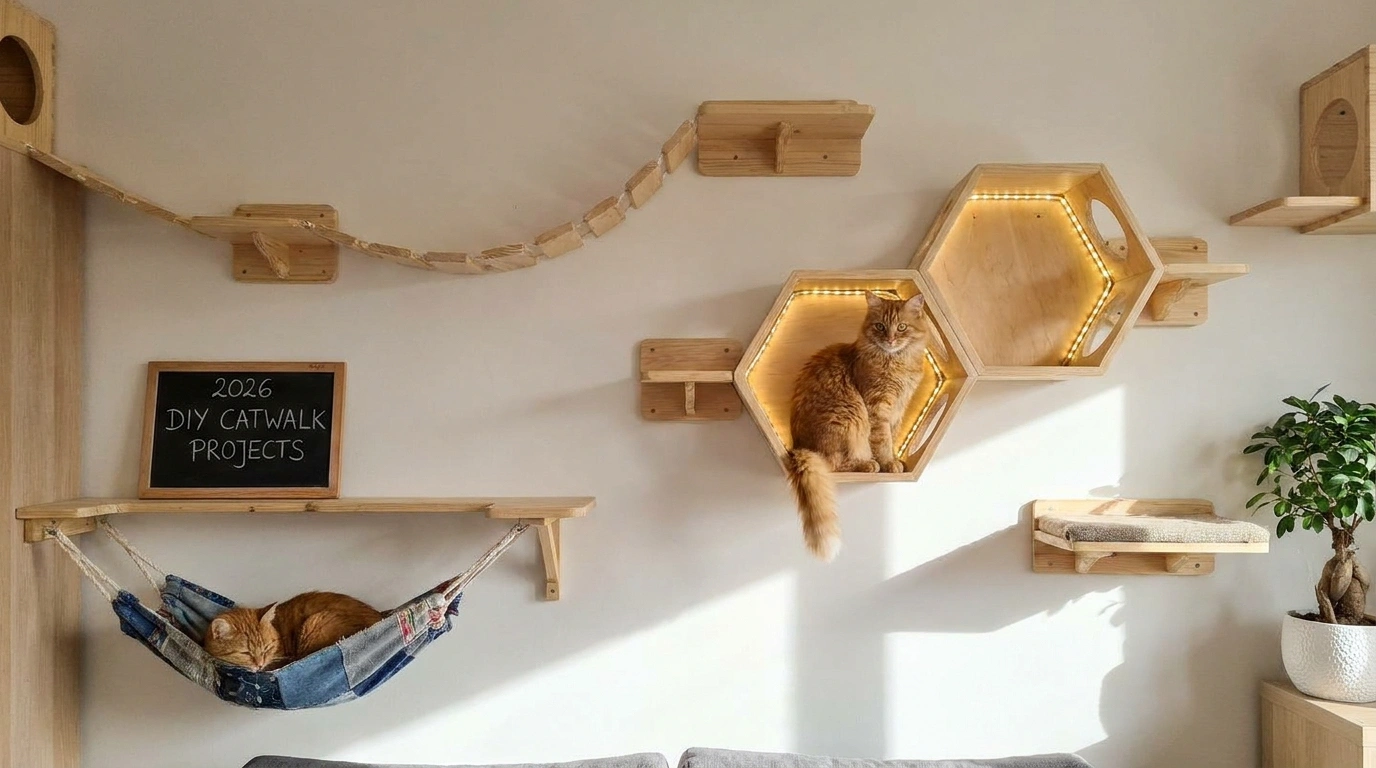
Your cat has probably already tested the highest piece of furniture in the room. You may have called it a bookshelf. The cat apparently understood it as a raised observation platform with inconvenient paper obstacles.
Giving that ambition a planned route can be kinder to the furniture and more useful to the cat. The route needs places to land, turn, rest, and descend. It also needs to suit the animal using it, which is inconvenient news for anyone hoping one dramatic leap would solve the entire wall.
DIY cat shelves can fit a living room, bedroom, office, or awkward corner without looking like an accidental pet shop installation. The design work is deciding how the cat moves through the room and how the humans continue living underneath.
Let the Cat’s Abilities Set the Route
The AAFP/ISFM environmental-needs guidelines discuss raised resting places, enough perch space to stretch, and lower or ramp-accessible options for cats with limited mobility. The FelineVMA owner guide also emphasizes separate safe places and ways out when a cat feels threatened.
Plan around your own cat. Use secure, appropriately designed supports and grippy, cleanable surfaces. Keep windows secure, blind cords inaccessible, and routes away from cooking, heat, fragile objects, and dangerous drop zones. Don’t create unassessed step-shaped entrapment gaps or dangling loops. Introduce the finished route gradually, and have it checked if you’re unsure about the structure.
Wall Routes Worth Building Around
A Low Stair Route to a Wide Window Perch
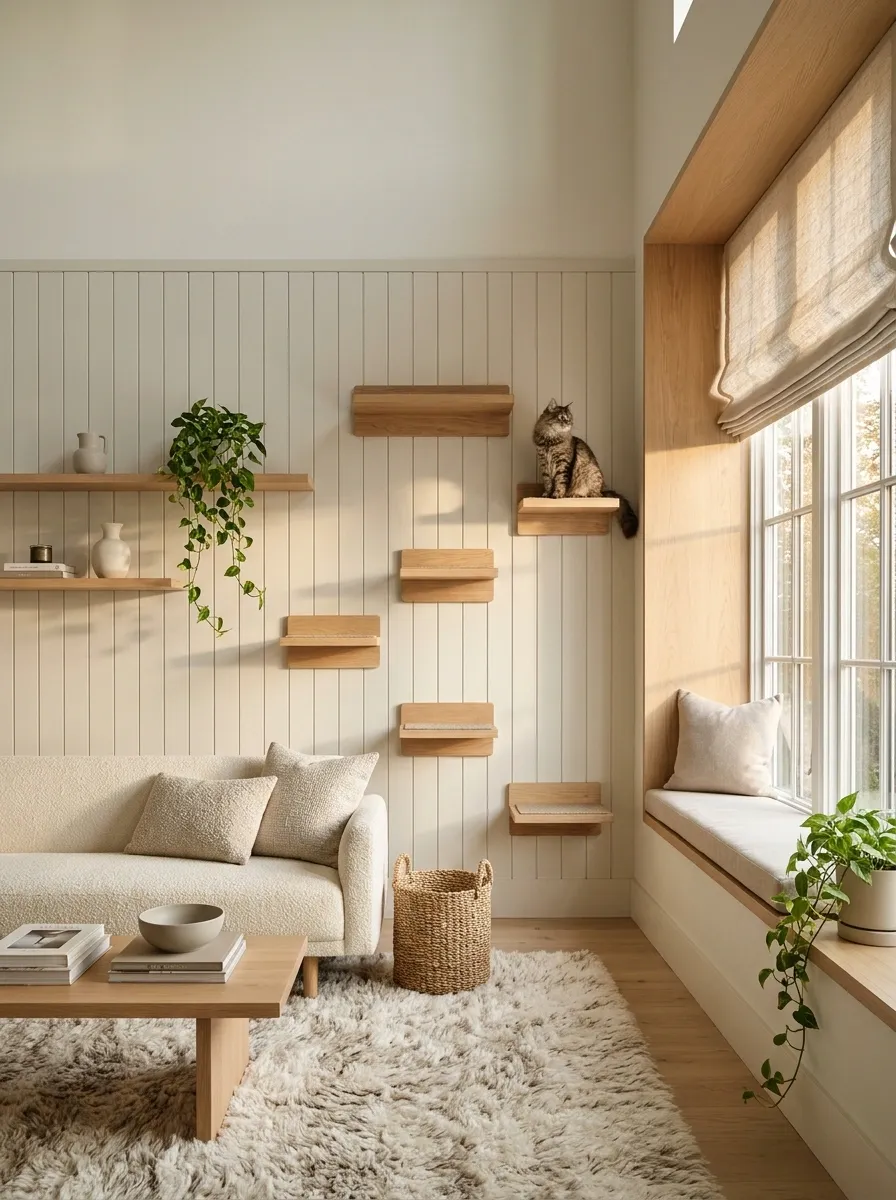
A series of accessible platforms can lead to a broad resting perch beside a secure window. Keep the lower approach clear of furniture and use a quiet wall finish so the route feels integrated into the living room.
The resting area should let the cat settle and turn without balancing at an edge. Protect the window controls and keep coverings’ cords inaccessible. Start at a height and spacing the individual cat can manage. A view is an excellent destination, but it should not require an entrance exam in competitive jumping.
Destination first. Route second.
Conceptual route only; spacing follows the cat, not the graphic.
A Corner Route With a Rest Platform on the Return Wall
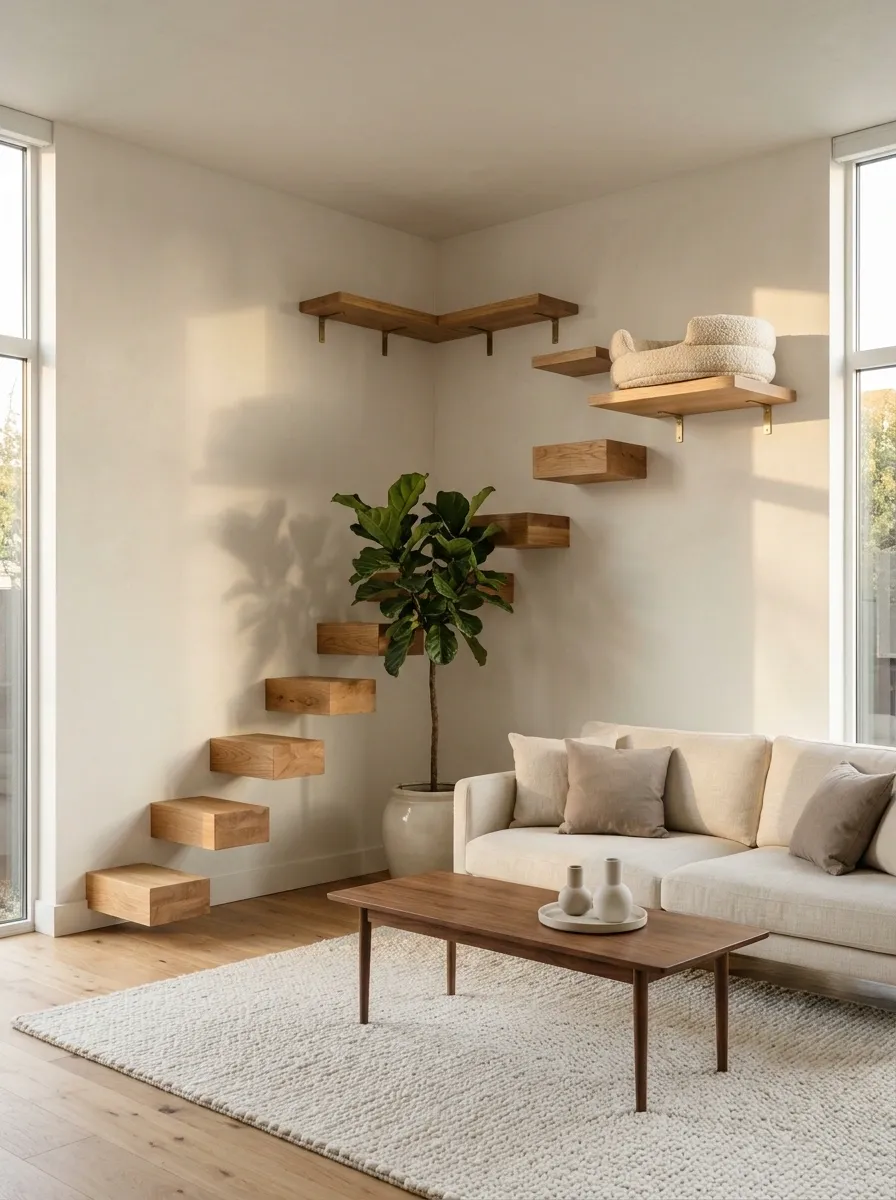
Platforms can turn an inside corner and end at a resting area on the quieter wall. Keep the room below simple, with low furniture that doesn’t obstruct the approach or create a collision point.
The turning platform needs room for the cat’s body, not just paws. Plan how the animal descends rather than treating the top as a final destination. A corner route can make good use of an awkward wall, provided the structure and clearances are properly resolved. The cat should not have to reverse around the bend like a delivery truck.
Allow room to land, turn, and choose the next move without being squeezed against the wall.
A Two-Route Wall for Cats Who Don’t Always Share Nicely
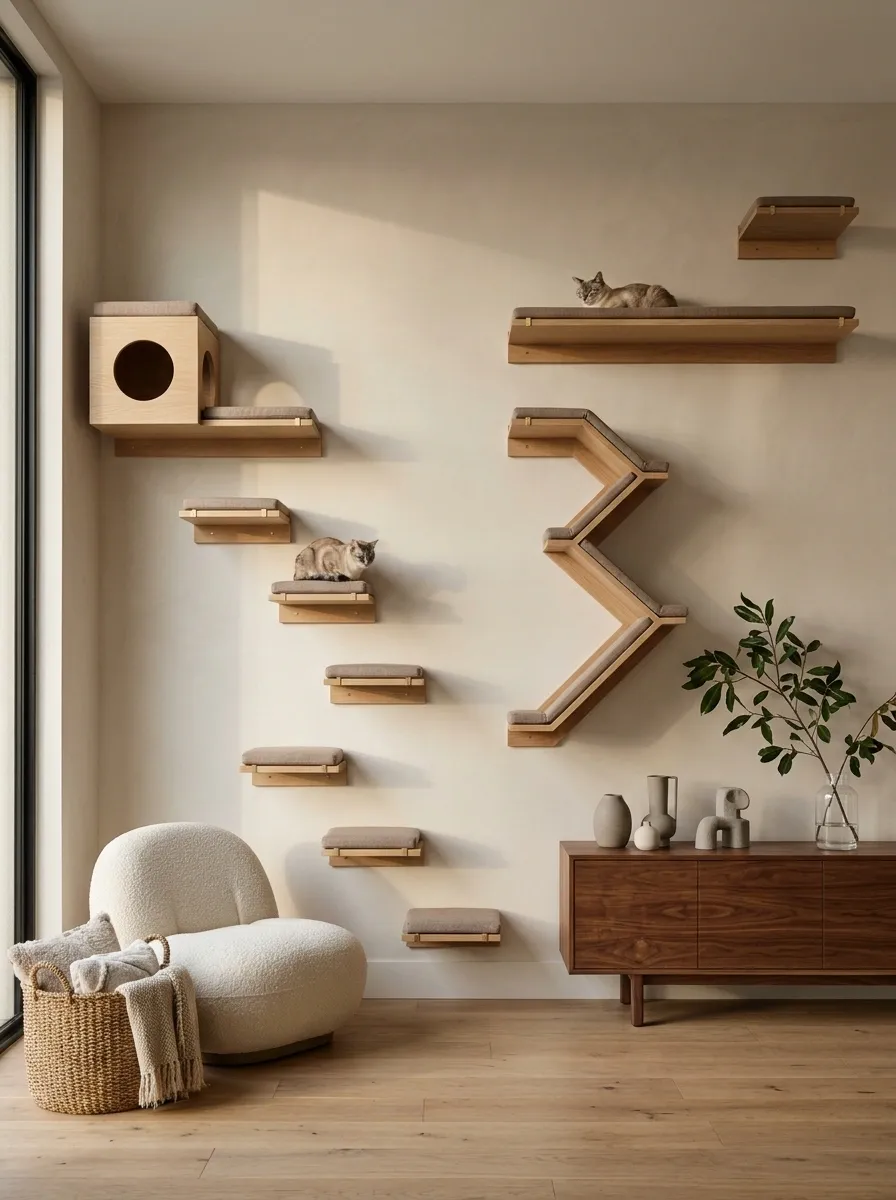
Give a larger wall two separated approaches and distinct resting positions instead of one narrow path to a single prized perch. Plain platforms and a restrained finish keep the installation visually coherent.
The layout should reduce opportunities for one cat to block another’s only exit. Observe the cats’ behavior and keep resources elsewhere in the home too. Matching shelf cushions do not negotiate household relationships. Separate routes and resting choices are more useful than insisting everyone enjoy the same dramatic top platform at the same time.
Own approach and resting choice.
An alternative that doesn’t require passing a gatekeeper.
A Quiet Bedroom Wall With a Sheltered Resting Cubby
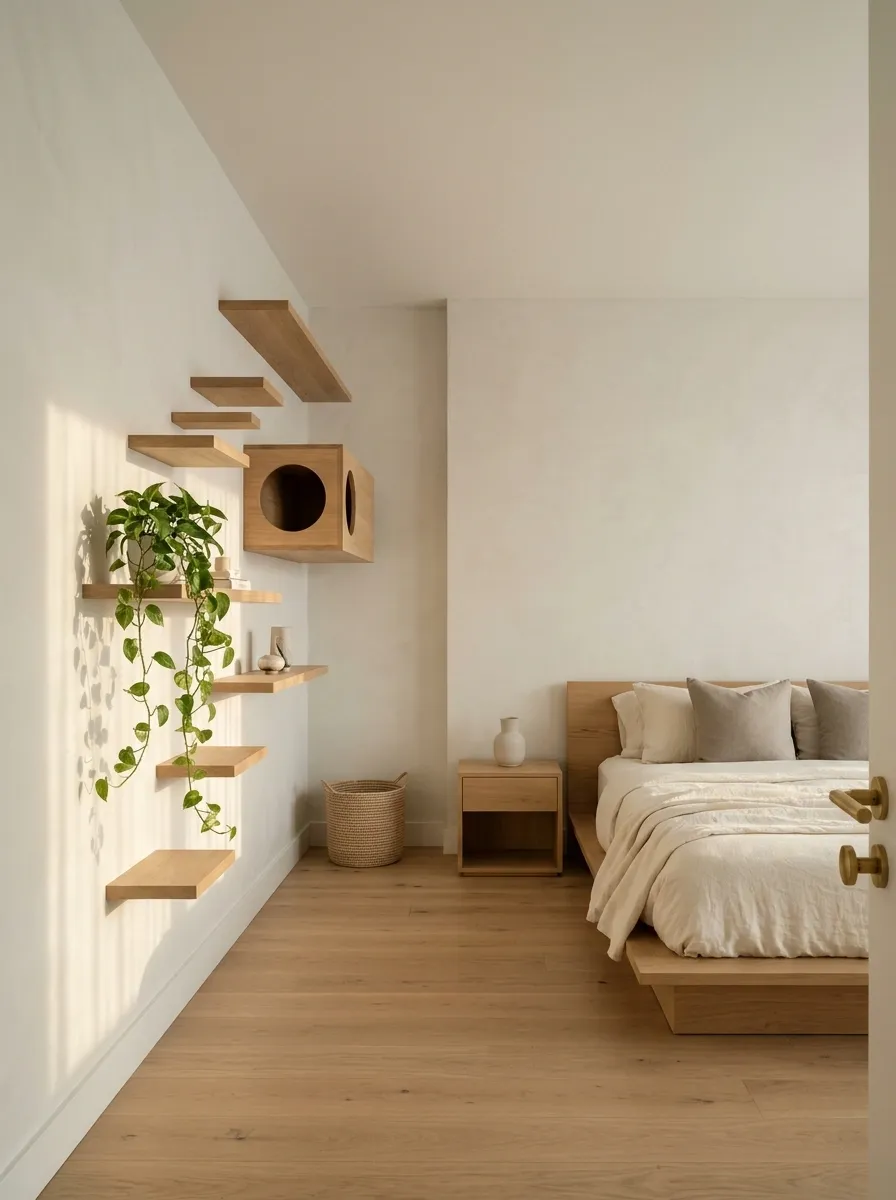
A sheltered resting cubby can sit at the end of a manageable shelf route on a quiet bedroom wall. Keep the bed and bedside lighting clear of the route, with the cat’s approach on the less busy side of the room.
The resting space needs suitable size, ventilation, safe openings, and a practical exit arrangement. Avoid placing it above a sleeping person’s head or turning the bedside lamp into a launch obstacle. Use a simple finish related to the furniture so the installation belongs to the room. A cat retreat can look calm without becoming a tiny themed hotel.
Keep cleaning, observation, ventilation, and the cat’s exit route practical when choosing the cubby position.
A Low-Level Route for a Cat With Limited Mobility
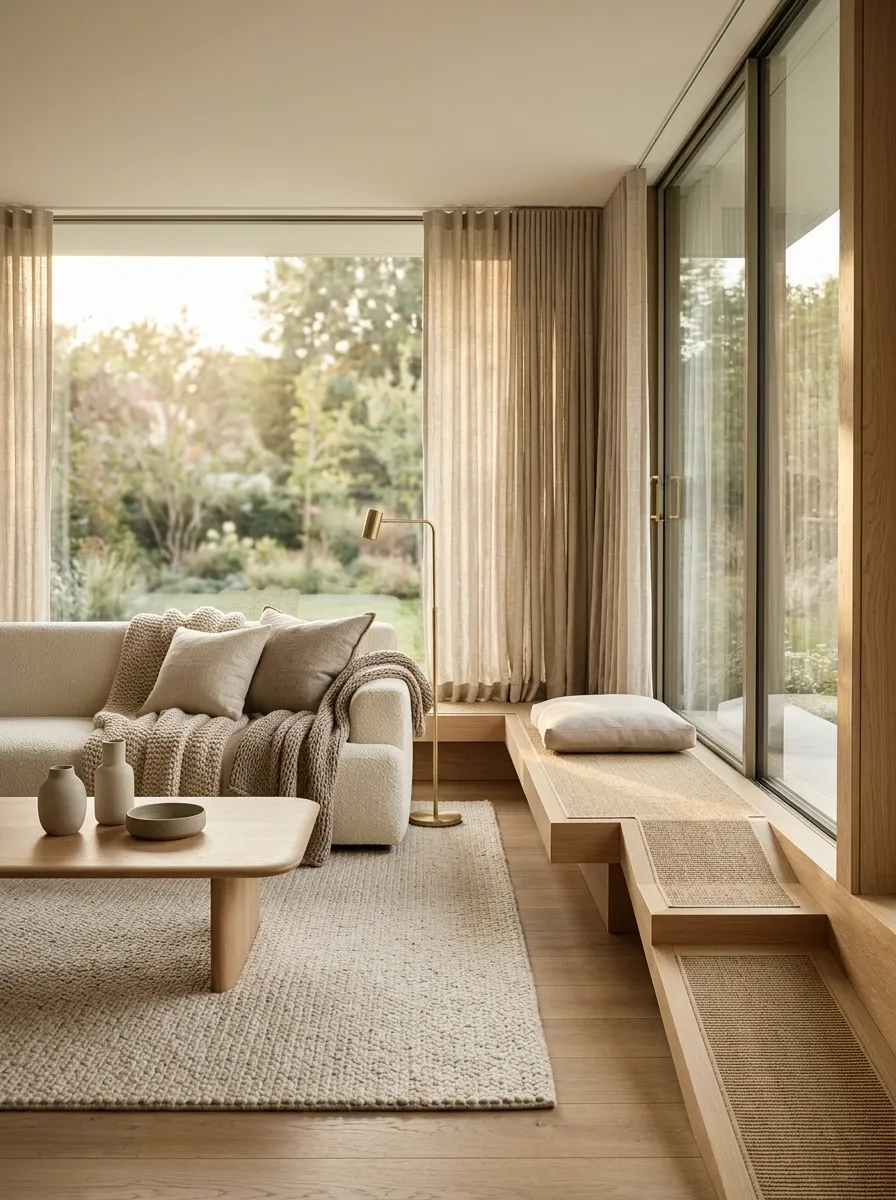
Keep platforms lower and use appropriately designed ramps or close, manageable transitions according to the cat’s abilities. A broad resting area near a secure window can provide a satisfying destination without a tall climb.
Work with veterinary advice where pain, balance, or mobility is a concern. The design should make access easier, not persuade the cat to attempt a route it finds uncomfortable. Keep surfaces grippy and approaches uncluttered. A lower installation can be fully useful; elevation is not a competition, and the cat has not asked for a personal best.
Choose the route around mobility, grip, and confidence. Height comes afterward.
A Bookcase-Adjacent Route With Dedicated Cat Platforms
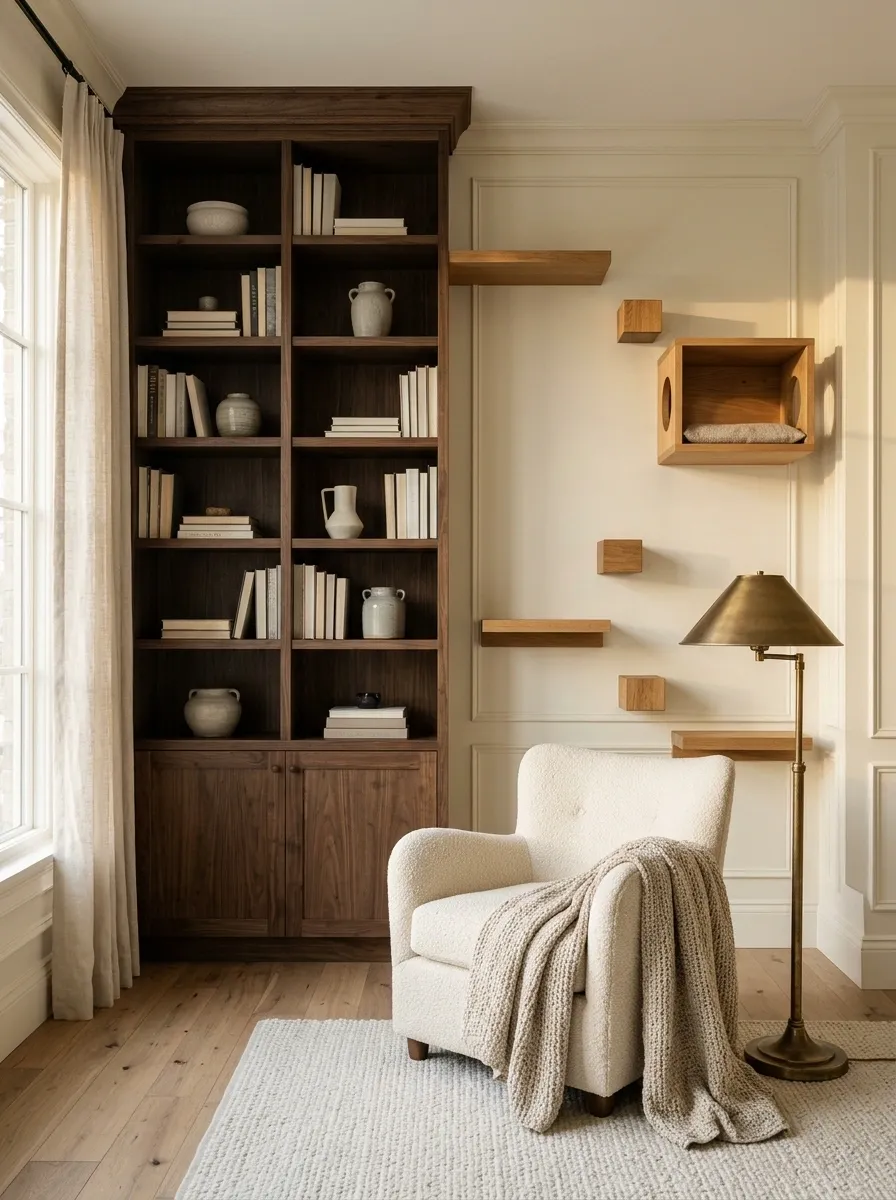
Build a separate cat route beside a properly secured bookcase, keeping the platforms and resting shelf distinct from the books. Use a related timber tone so the two systems feel connected without sharing unstable surfaces.
The shelves holding books aren’t automatically suitable as jumping stages. Keep the cat’s path free of objects and make the supporting structure explicit. A dedicated route protects both the books and the animal from a poorly arranged landing. The cat can supervise your reading habits without conducting a small demolition project every time it changes position.
Books and display.
Clear landings and a supported rest.
A Desk-Side Observation Perch
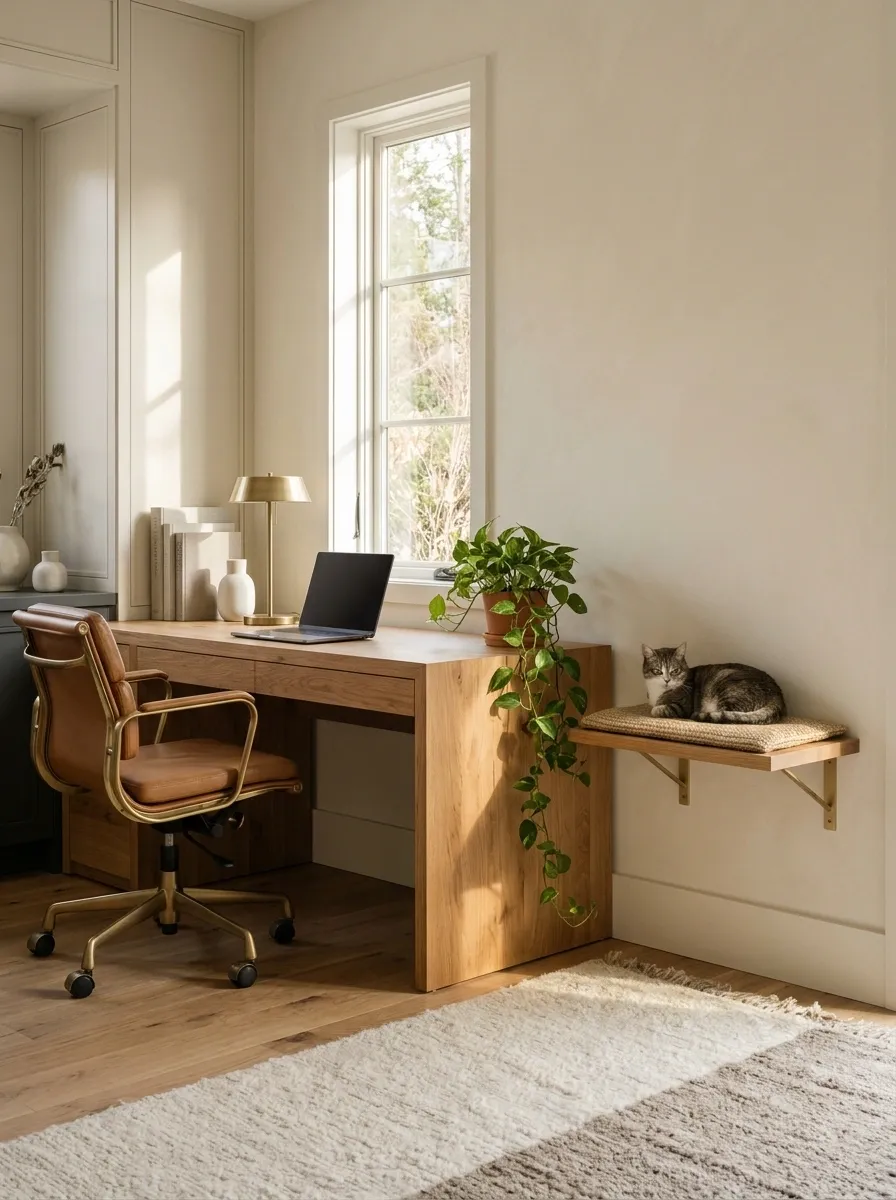
A perch beside the home-office desk can give the cat a nearby resting position without occupying the keyboard. Use a short accessible route, a clear platform, and a finish related to the desk or wall.
Position the route away from cables, hot equipment, and unstable desk objects. The perch should be close enough for company without forcing you to reach around the cat during work. Keep a separate way down. The arrangement offers an alternative to sitting on the laptop, although no reasonable design should promise to abolish that deeply held management practice.
Keep the route clear of screens, cables, and the chair’s movement.
A Long Horizontal Lounge With Access at Both Ends
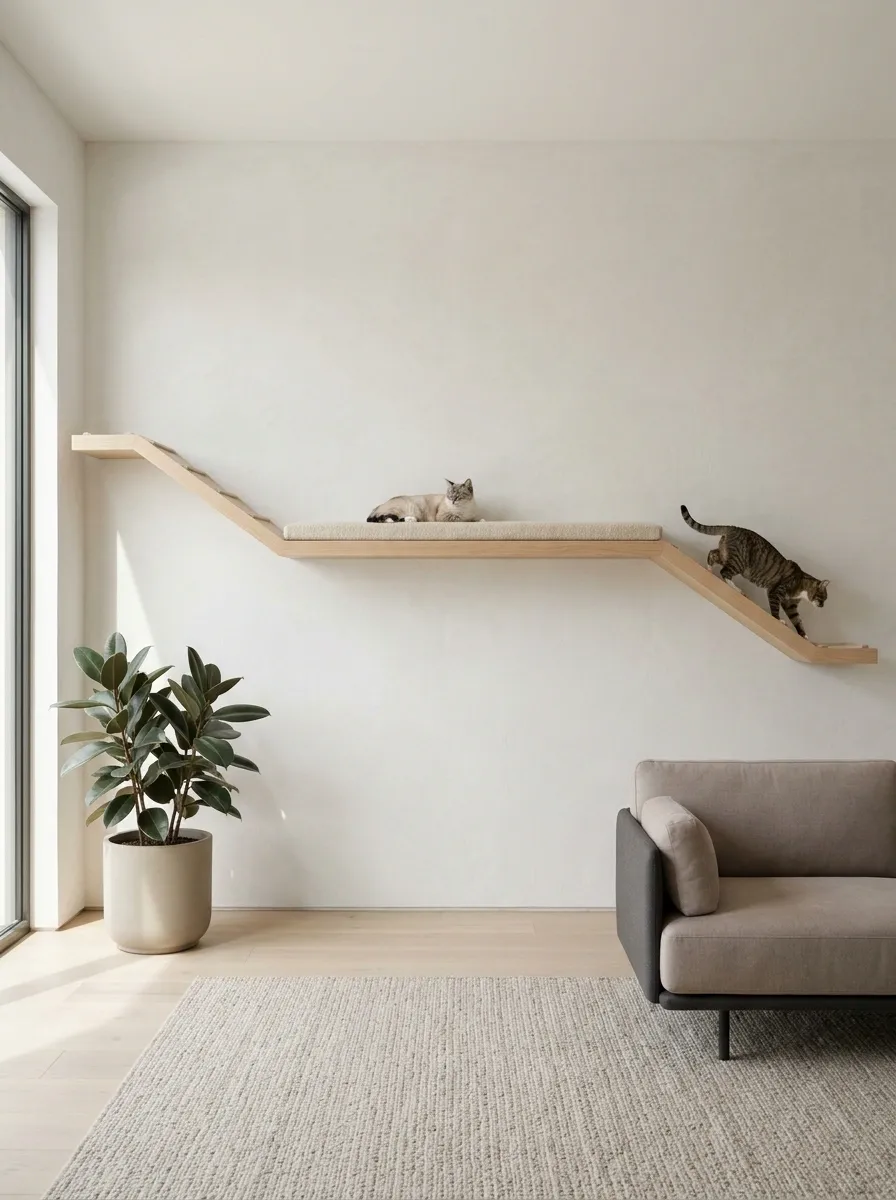
A broad horizontal resting shelf can work along a quiet wall when it has appropriately designed access and descent at both ends. Keep the room below free of fragile furniture and use plain colors so the long line feels architectural.
The shelf needs a suitable support design across its length and enough depth for the cat’s use. Avoid treating a long decorative plank as a complete structural specification. Access at both ends gives more choice than a single narrow approach. The installation should make lounging easy, not create an elevated corridor with nowhere comfortable to turn around.
A Modular Wall That Can Expand With Observed Use
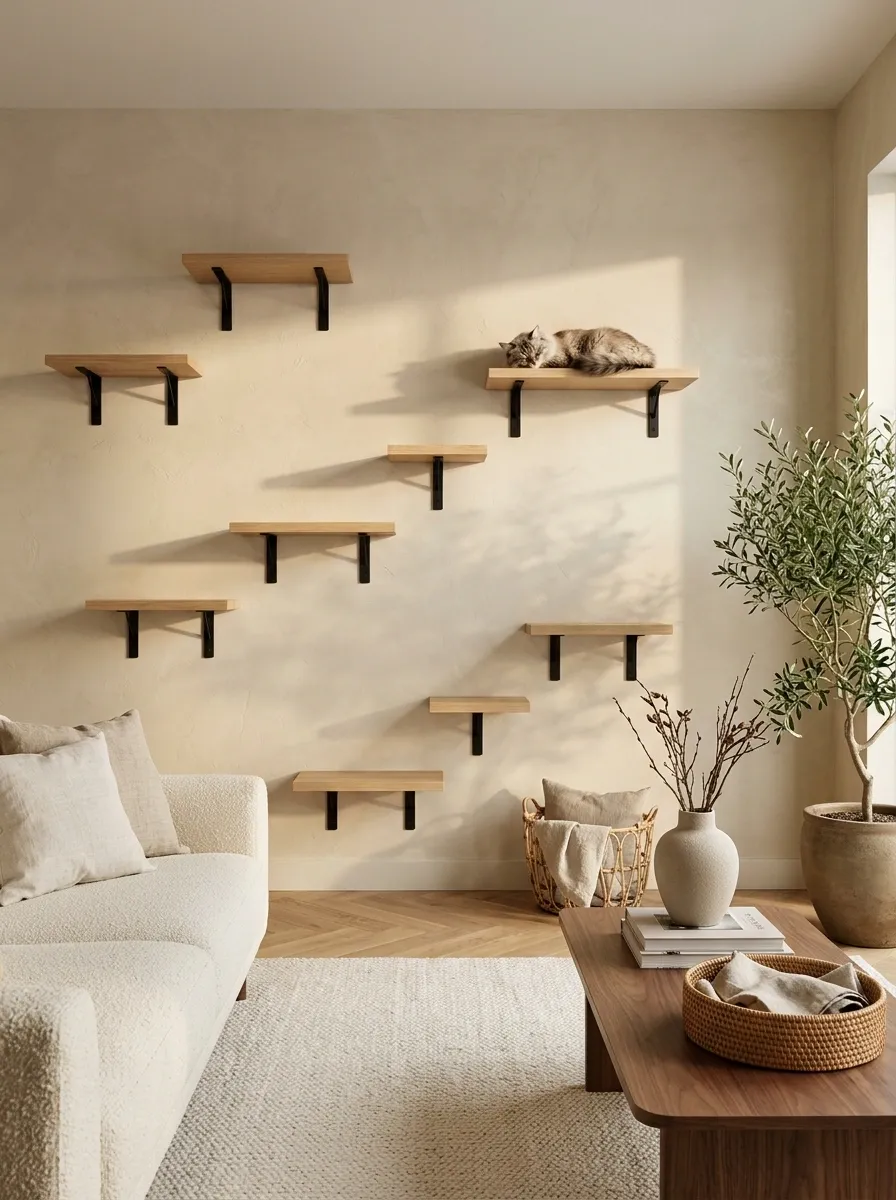
Start with a short useful route and one generous perch, leaving planned wall space for later additions. A consistent material and simple supports can make the installation look complete before it becomes larger.
Watch where the cat actually goes. Expand toward preferred resting positions rather than filling the wall because more platforms fit on the drawing. Every new module still needs appropriate support and clearances. A phased layout lets behavior inform the next stage. It also avoids building a magnificent wall course that the cat ignores in favor of the cardboard packaging.
What has the cat chosen to use?
Record favorite approaches, resting positions, and avoided transitions before adding more shelves.
A Low Reading-Corner Perch Beside an Armchair
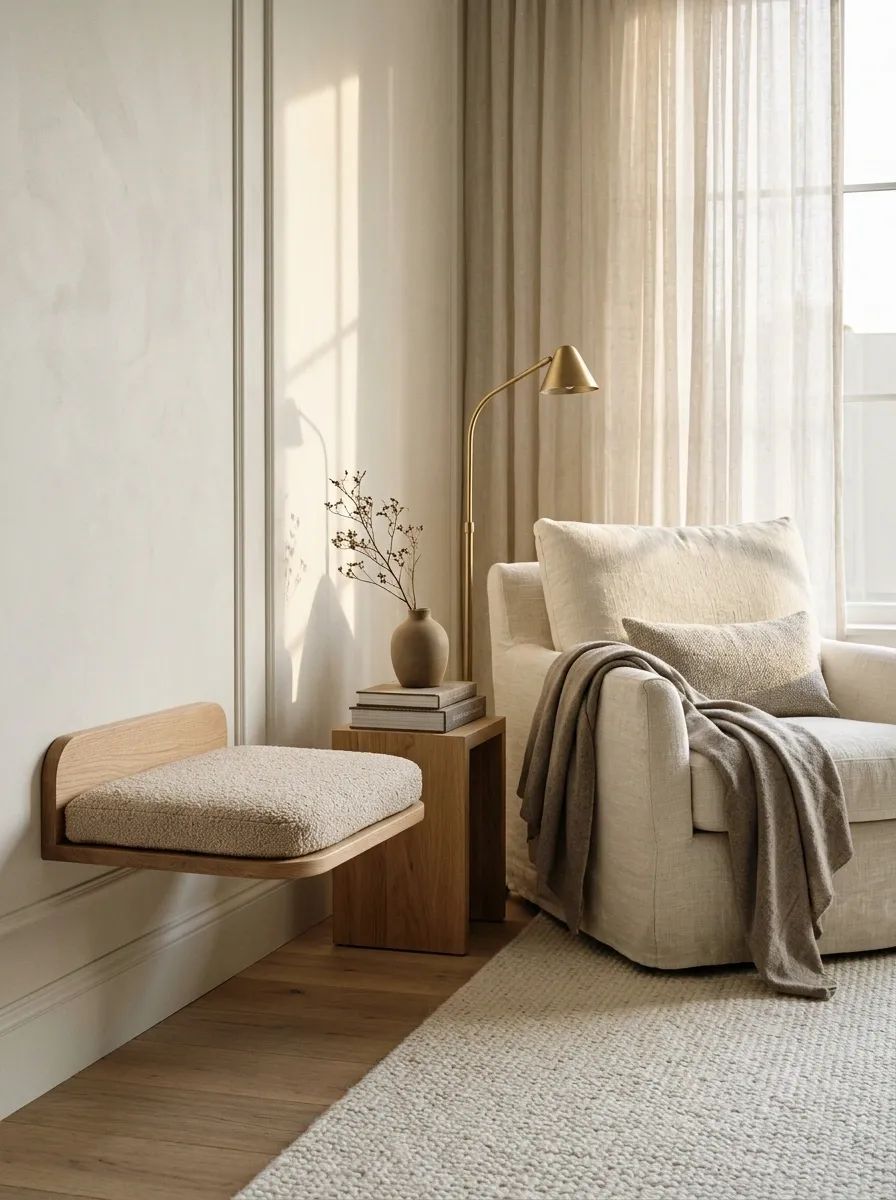
A cat perch beside a reading chair can make a shared corner useful without sending the route toward the ceiling. Keep the platform clear of the lamp and side table, with a short approach suited to the animal.
This is for companionship at a comfortable level, not a test of maximum height. Choose a removable, securely fitted surface that can be cleaned without dismantling the whole shelf. The chair should still work for the human using it. A cat-friendly room can accommodate both occupants, even if one has a more confident interpretation of ownership.
Cat resting, person seated, lamp in use, table reachable. Keep their routes from colliding.
A Solid-Platform Route Beside a Secure Balcony Door
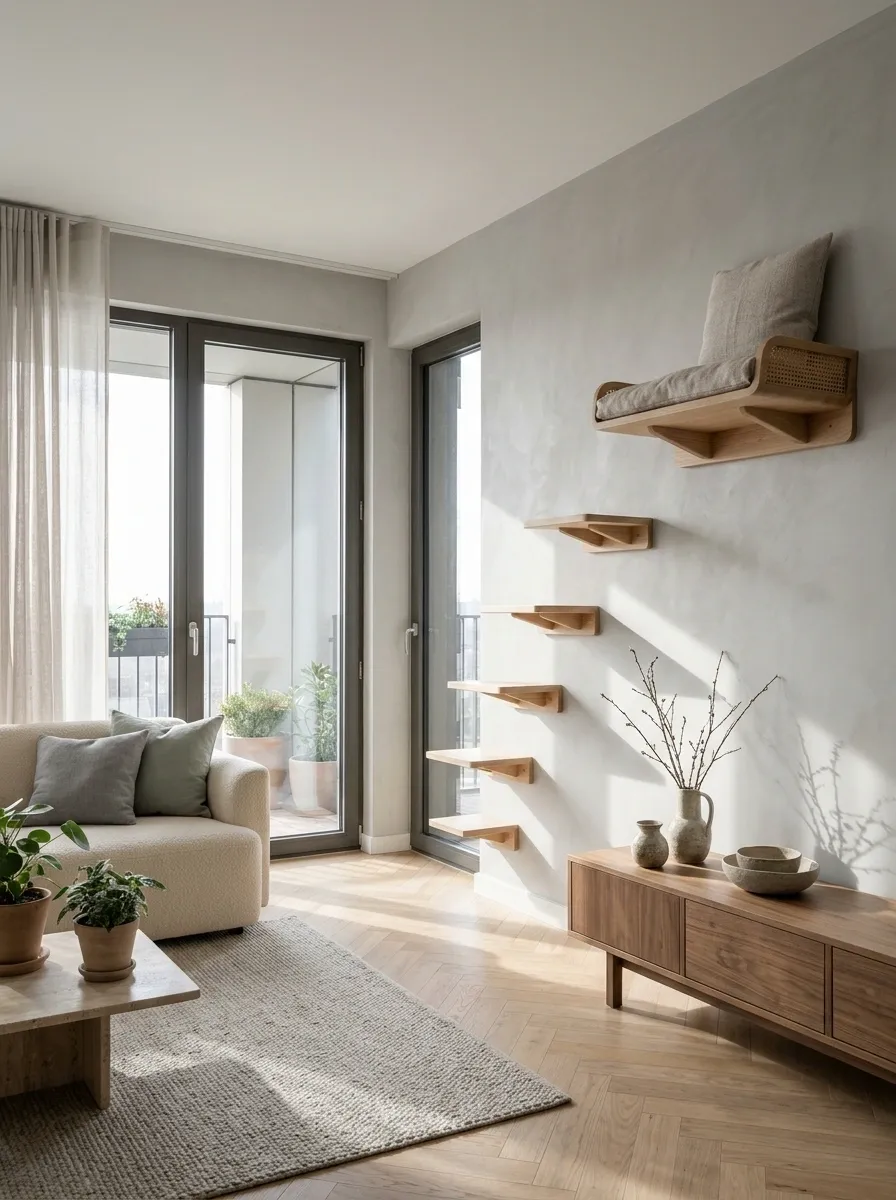
A short shelf route can end beside a secure glazed door, giving the cat an outlook without placing the route over the door itself. Use a quiet wall finish and keep furniture away from the approach.
The installation needs to preserve door operation and avoid creating access to an unsecured opening. Keep blind cords and handles outside the route. The resting platform should have a clear place within the room rather than becoming a launch point toward an unsafe edge. The view is the feature; unexpected outdoor access is not a bonus design service.
Plan the perch and the opening’s security together. Preserve door controls and safe operation.
A Pair of Separate Resting Shelves in a Large Living Room
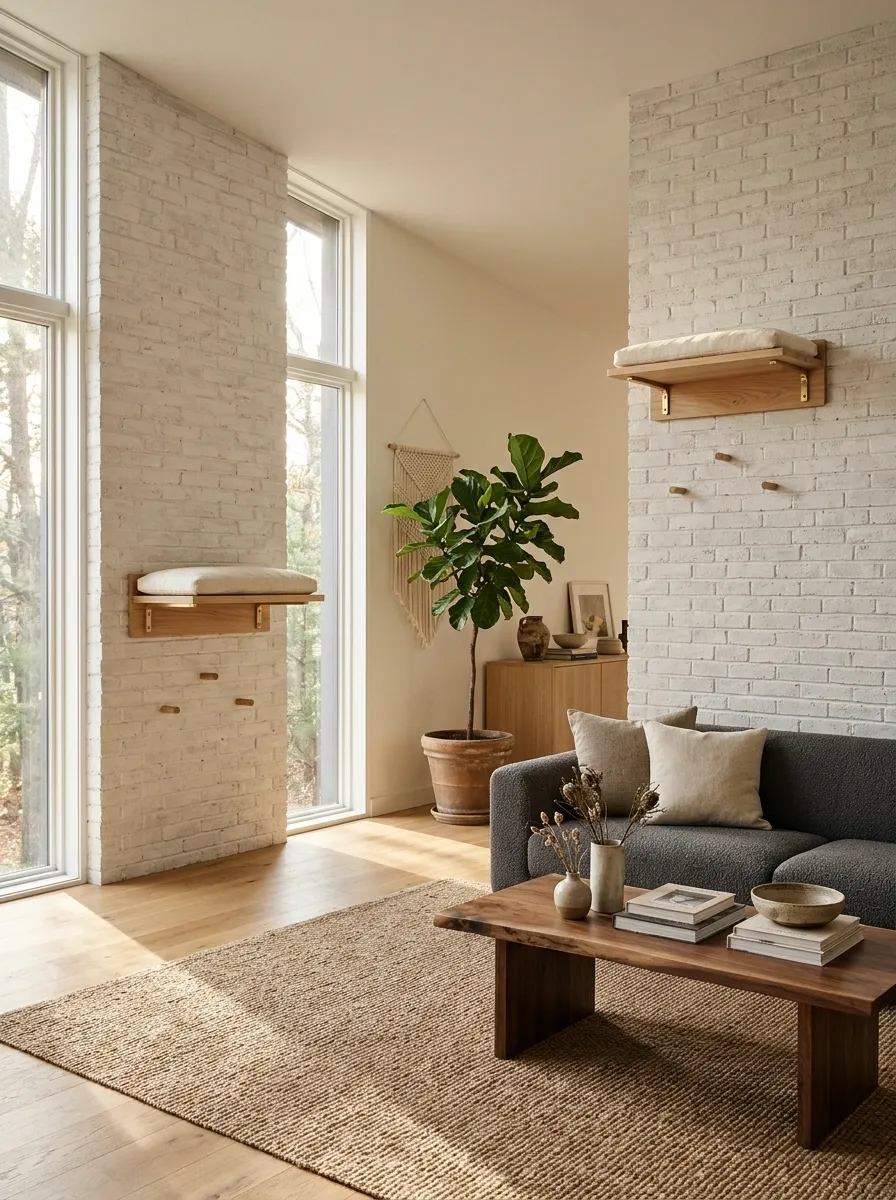
Two resting shelves on different walls can provide alternatives without connecting every surface into one continuous course. Give each a suitable approach and keep the room’s furniture arrangement clear underneath.
This works when the goal is choice rather than a spectacular wall display. Observe which locations feel comfortable to the individual cats and avoid concentrating every desirable resting place at one contested point. A related material palette can make the separate shelves feel intentional. They don’t need to be mirror images; the animals are unlikely to submit a formal complaint about the lack of symmetry.
Own approach.
Separate location.
A Ramp-Led Route Beneath a Wide Resting Platform
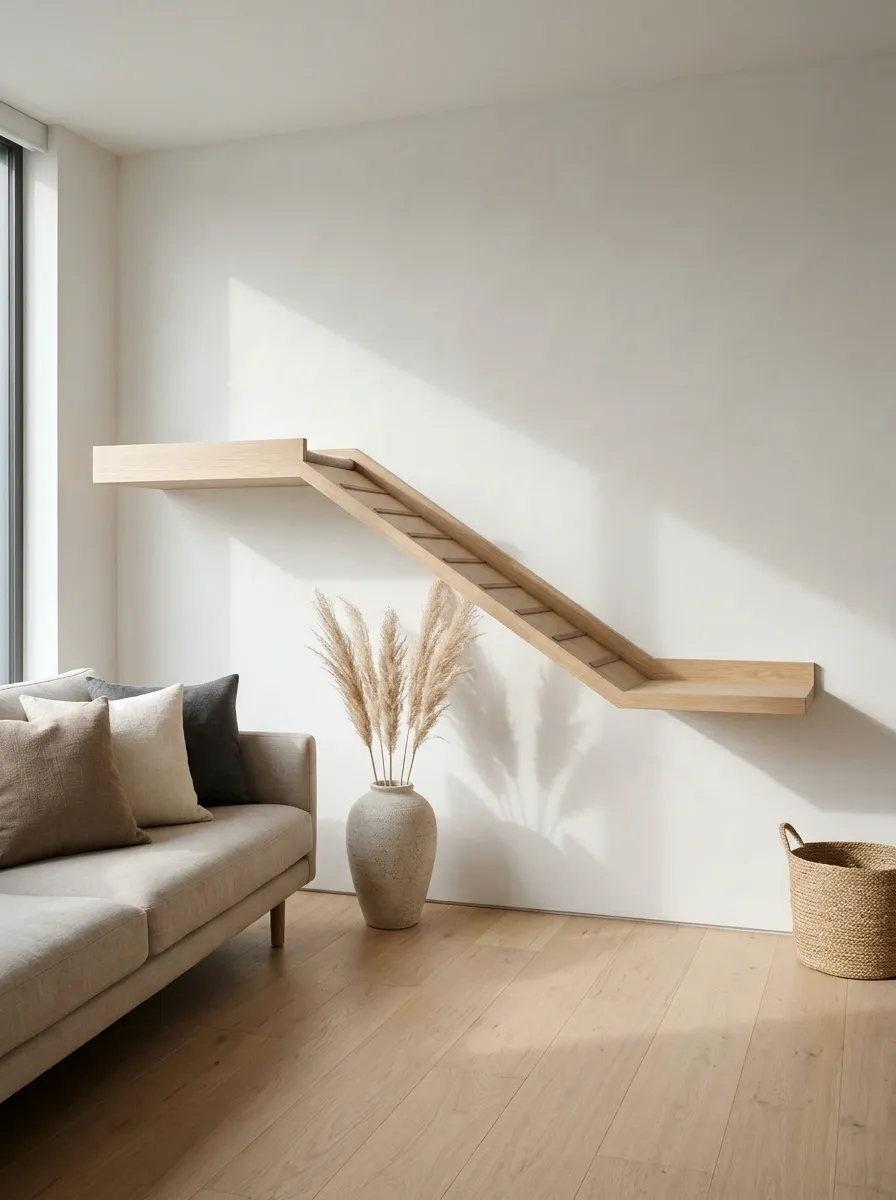
A purpose-designed ramp can connect a lower approach to a broad resting shelf, with a clear landing at each transition. Keep the surrounding wall plain and use the platform as the destination rather than adding several unnecessary levels above it.
Ramp angle, grip, width, support, and the cat’s abilities need to be considered together. Don’t assume a board becomes accessible because it slopes. The transition onto the shelf should feel manageable, and the way down needs equal attention. This is a functional route, not a decorative diagonal line installed to improve the wall composition.
A ramp is a whole detail.
Resolve these for the cat and the support system.
A Shelf-and-Cubby Wall With an Open Bypass
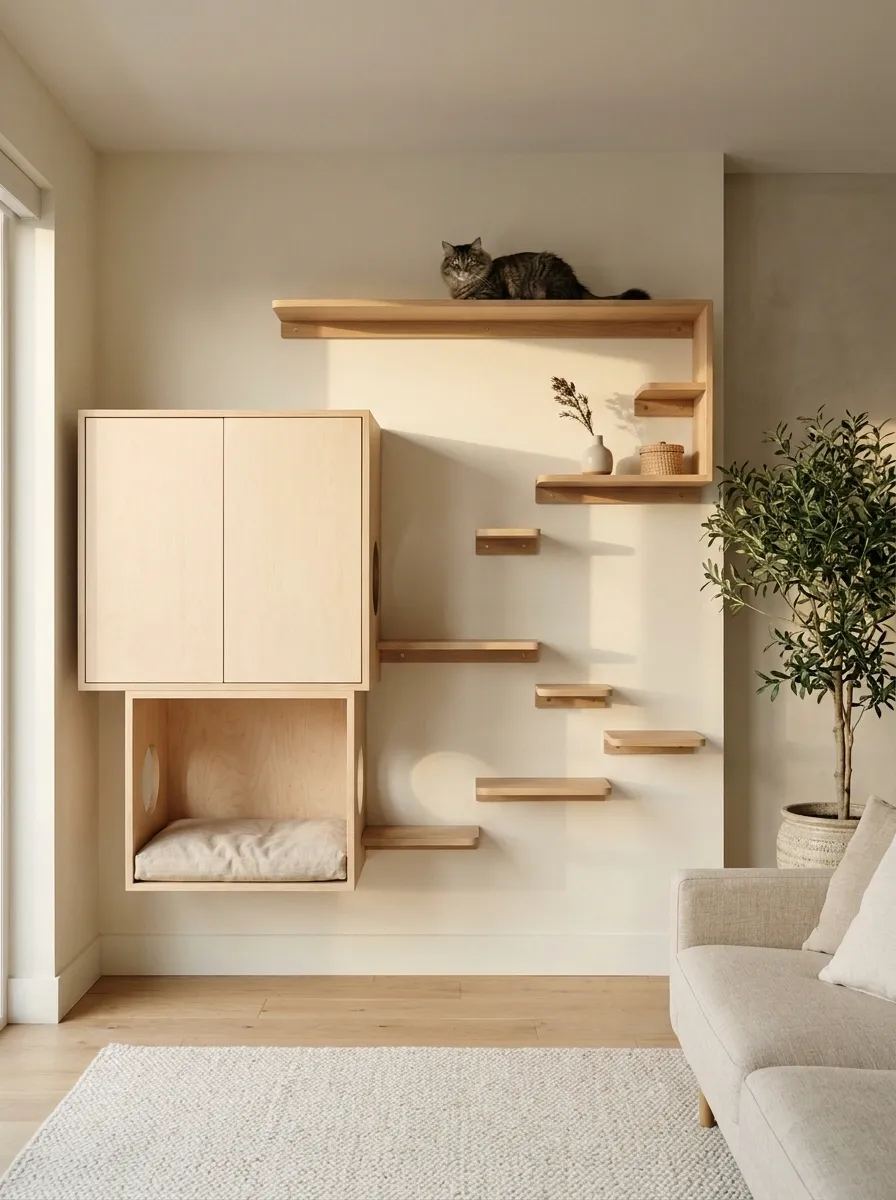
Combine a sheltered cubby with an open route that passes it, so the resting space isn’t the only way through the installation. Plain fronts and a restrained cushion keep the wall calm.
The bypass should remain usable without forcing a cat to enter another’s resting place. Check openings, support, ventilation, and cleaning access as part of the design. Keep the cubby large enough for comfortable use rather than shaping it around a decorative motif. A house-shaped cutout can be charming, but the animal inside is more interested in fitting than in the exterior’s property values.
A Plain Timber Route on a Painted Feature Wall
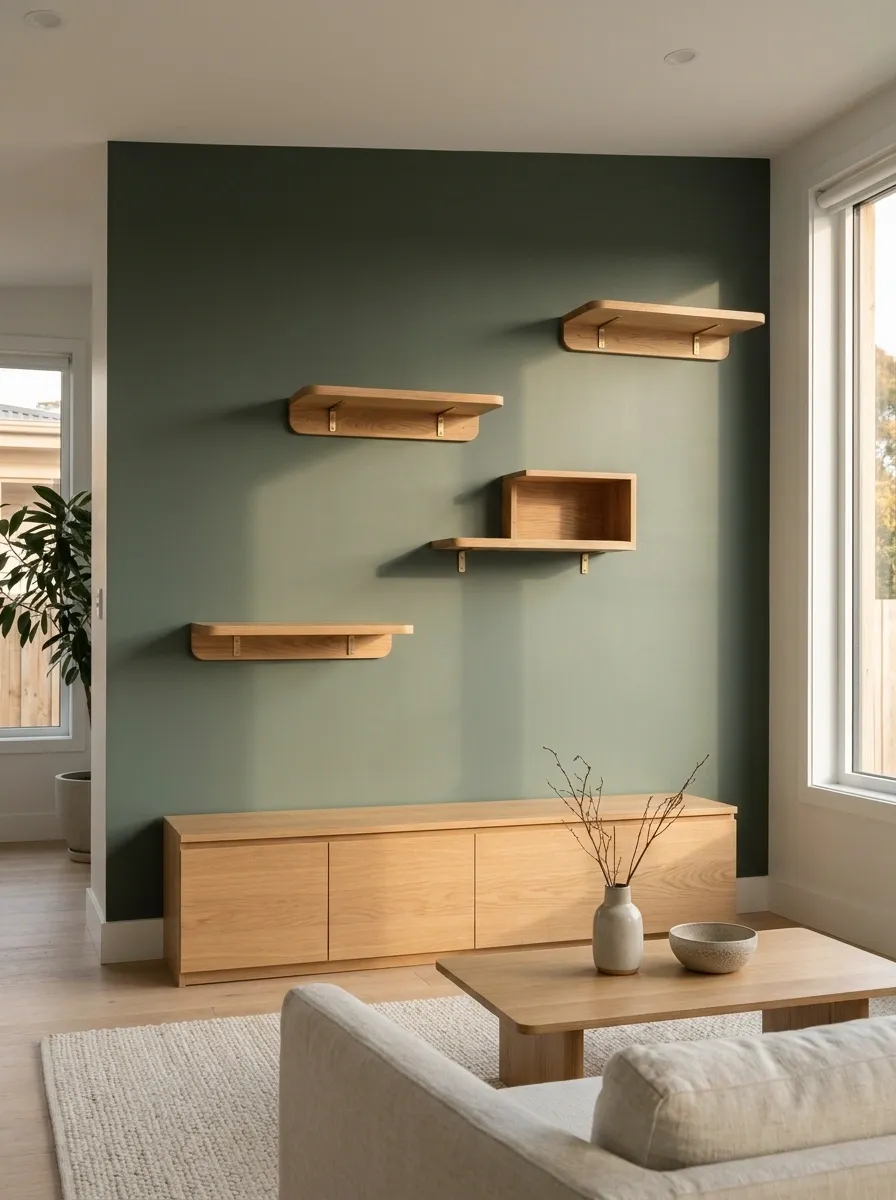
A restrained timber shelf route can stand against one painted wall, with the cat’s movement determining the platform positions. Keep the furniture below low and uncomplicated so the installation has a clear setting.
Use color to connect the shelves to the room, not to justify unsafe spacing. The platforms don’t need to form a perfect decorative staircase if the animal would benefit from a different route. Choose a suitable finish and let it cure as required before use. The wall can look composed without turning the cat into an unpaid participant in a geometric arrangement.
A shared material can connect different platform sizes without forcing decorative symmetry.
A Wide Corner Lounge With Two Short Approaches
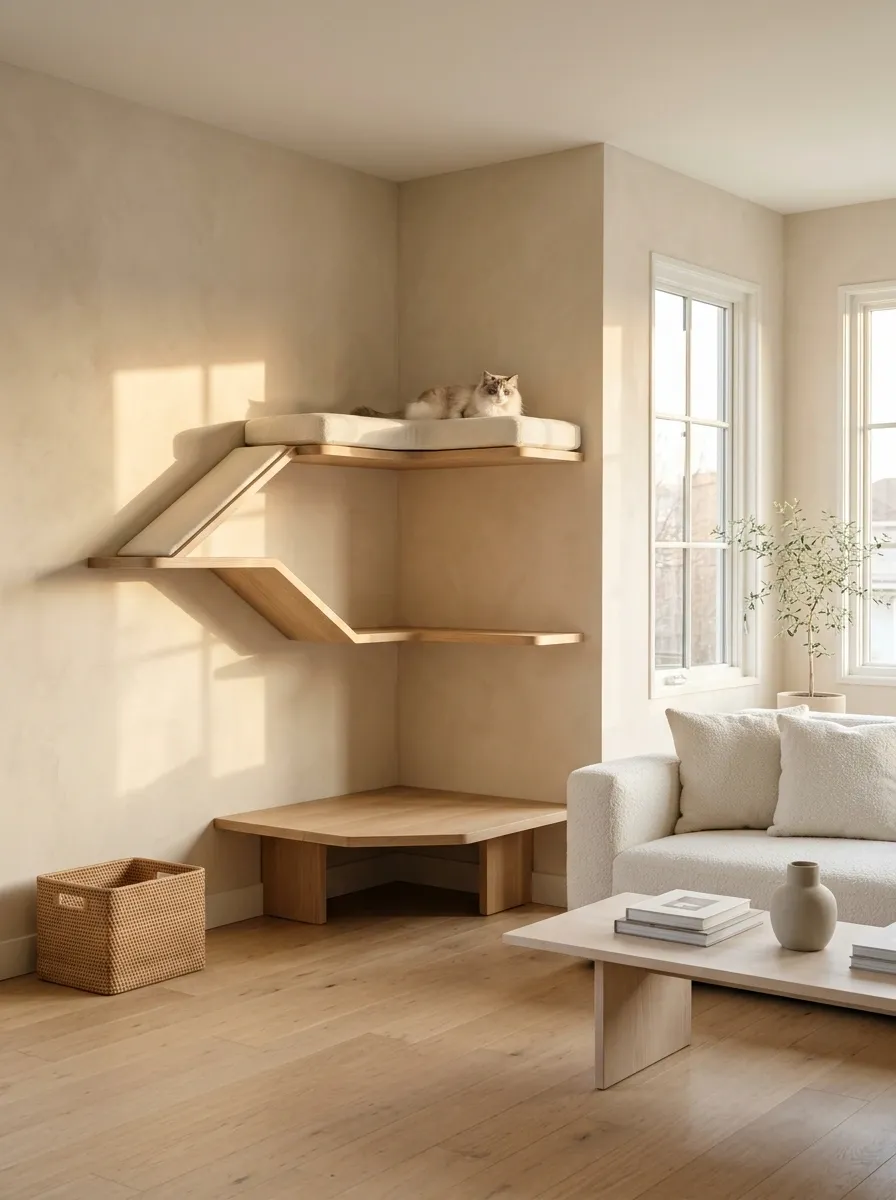
A broad corner lounge can have short approaches from both adjoining walls. Keep the resting area sufficiently generous and the paths clear of surrounding furniture, with a plain wall finish reducing visual clutter.
This suits a corner where the destination matters more than a tall climb. The corner platform needs an appropriate support design, and its junctions should not create awkward gaps. Plan cleaning access before choosing fixed upholstery. A resting shelf is useful when you can maintain it; an unreachable cushion collecting fur is simply a new form of household architecture.
Check turning space and cleanable surfaces at the corner itself.
A Compact Route Beside an Existing Cat Tree
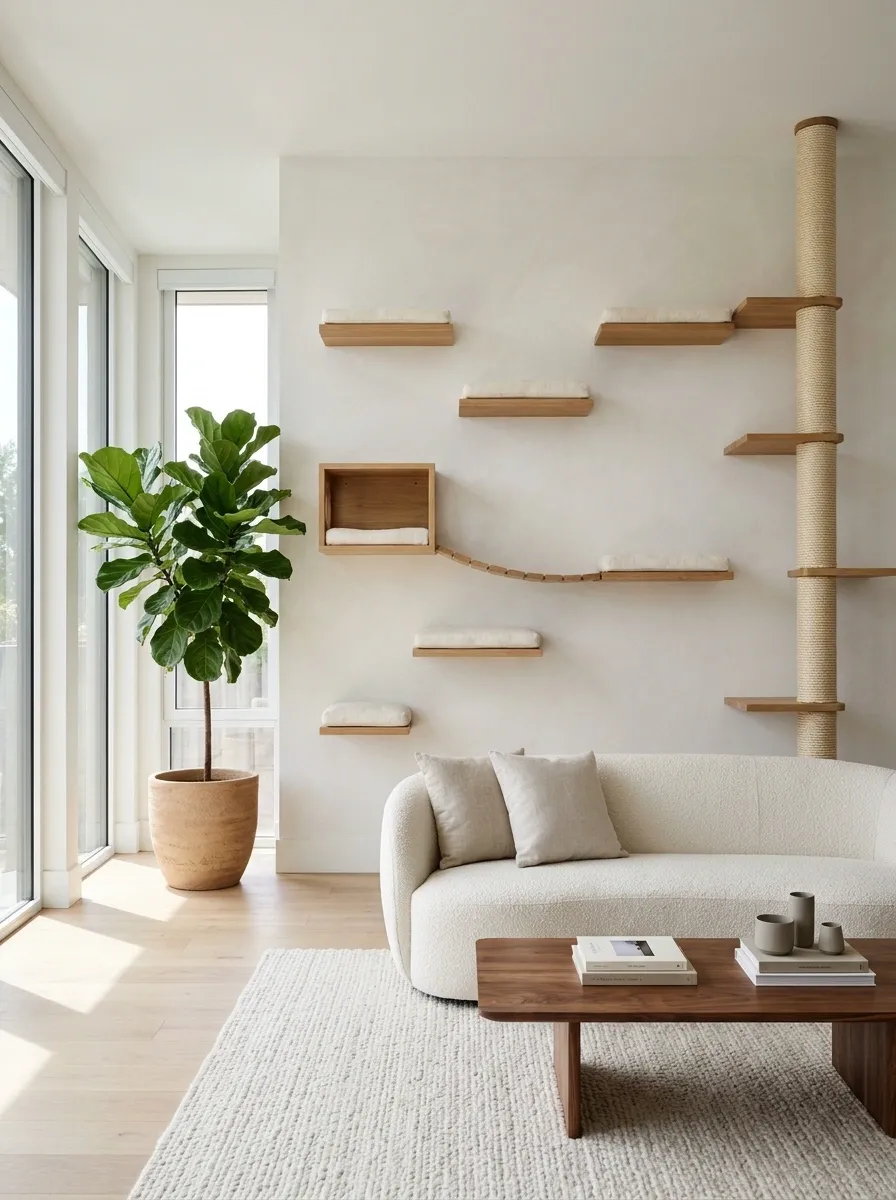
A stable, suitable cat tree can provide the starting context for a separately designed wall route. Keep transitions manageable and end at a proper resting platform, with the surrounding furniture clear of the path.
Check the tree’s condition, stability, and relationship to the wall system rather than assuming it can act as structural support. The shelf installation needs its own appropriate fixing design. This approach can extend equipment the cat already uses, which is more persuasive than building an entirely new course and expecting immediate enthusiasm. Familiar access can be useful without becoming a shortcut around installation planning.
Assess stability and condition.
Independently designed support.
A Window Bench With a Separate Upper Cat Perch
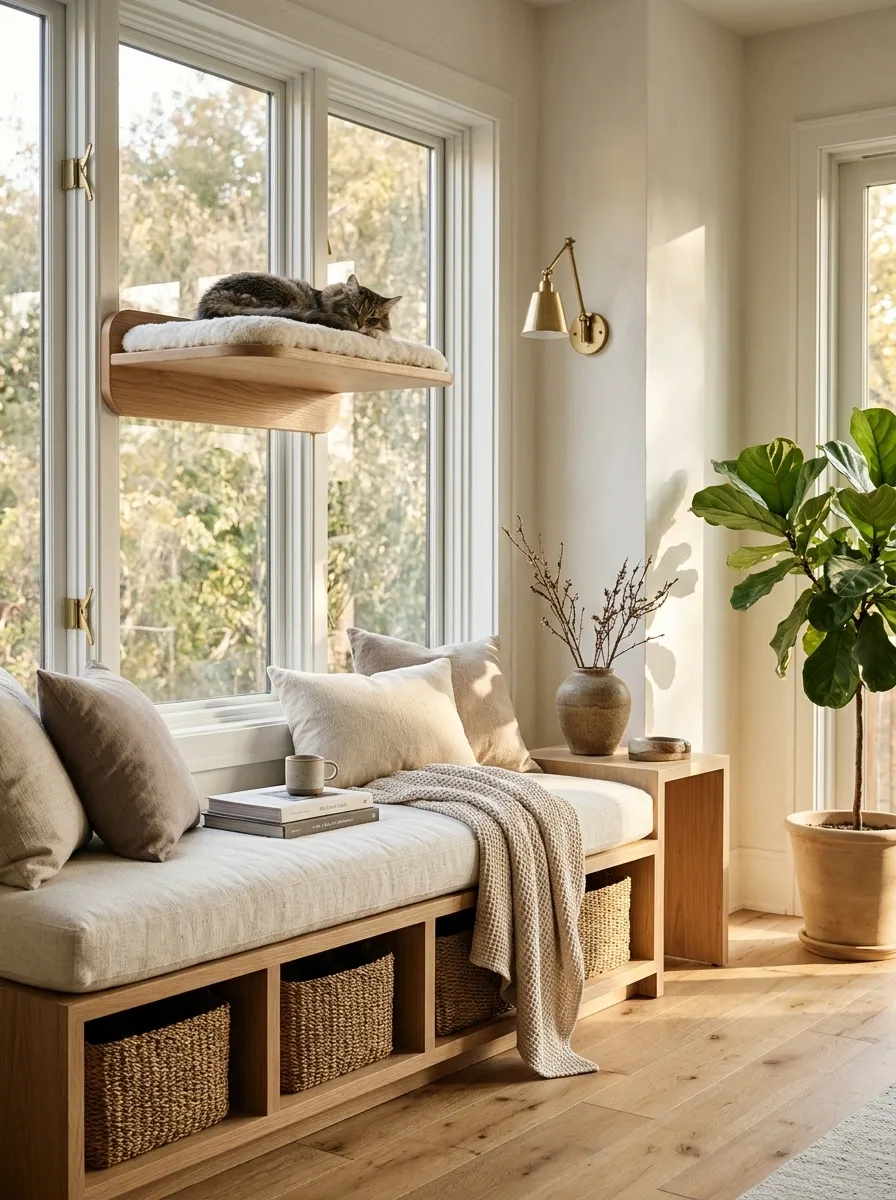
A low human window bench can sit below a dedicated cat perch, with the animal’s approach on a separate side. Keep the upper platform clear of window coverings and preserve comfortable seating below.
The vertical relationship needs planning so the cat isn’t repeatedly landing over a person’s head or onto occupied seating. The bench can remain a place to read while the perch provides an outlook. Choose removable surfaces and clear the sill of fragile objects. Sharing the window is possible; sharing one precarious landing spot is less convincing.
A human seat and a cat perch can share the wall without sharing the same jumping path.
A Short Route for a Cautious New Climber
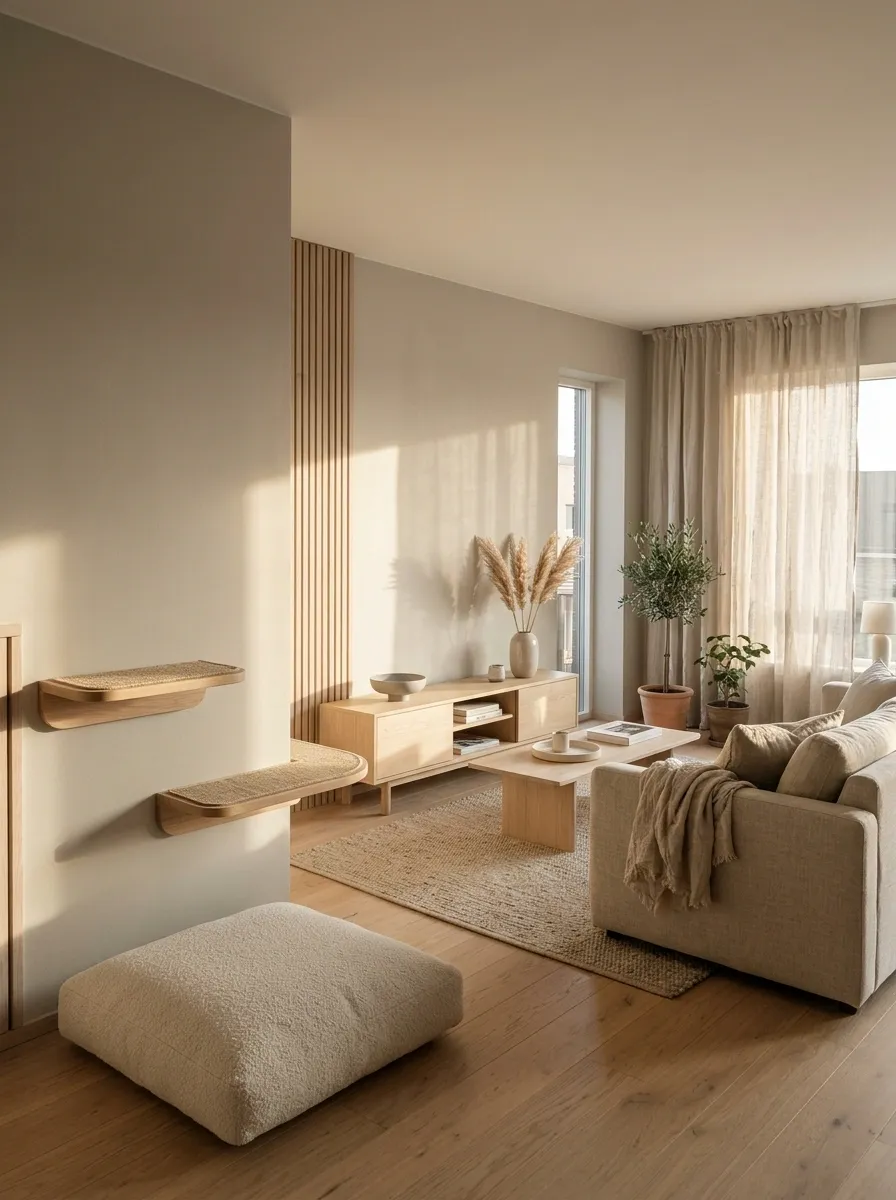
Start a cautious cat with a low, short route and a comfortable landing rather than a wall of ambitious platforms. Keep the room quiet and the floor approach uncluttered so the animal can investigate without pressure.
Let observed confidence guide any later changes. Avoid carrying the cat onto a high platform and treating the descent as a character-building exercise. The design can remain modest while still adding a useful resting choice. A small installation the cat willingly uses is a better result than a spectacular one that becomes a permanent display of your carpentry enthusiasm.
The route is being avoided. Now what?
Review comfort, access, grip, surroundings, and the cat’s abilities before making the installation taller.
A Route Around the End of a Room Divider
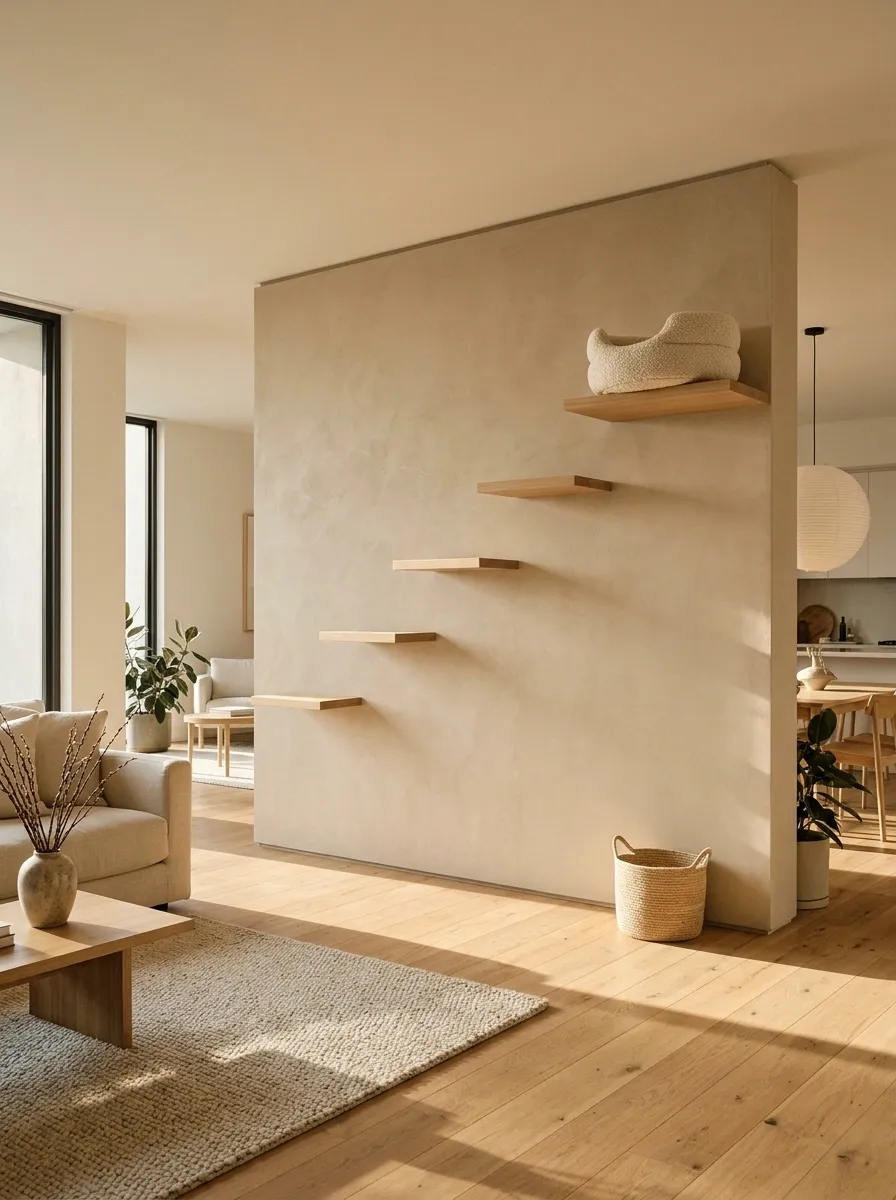
A suitable solid room-divider wall can host a short route that turns toward a quieter resting side. Keep the human passage clear and use the same restrained finish on both faces so the installation feels connected.
Confirm the wall’s actual construction and capacity before designing supports. A partition is not automatically a structural anchor because it looks substantial after painting. Keep platforms away from head space in the passage and provide a straightforward return route. The divider can separate activities for people and offer choices for the cat without becoming an overhead traffic hazard.
Wall construction, services, fixing design, and passage clearance determine whether this location is suitable.
A Quiet Perch Away From the Busiest Window
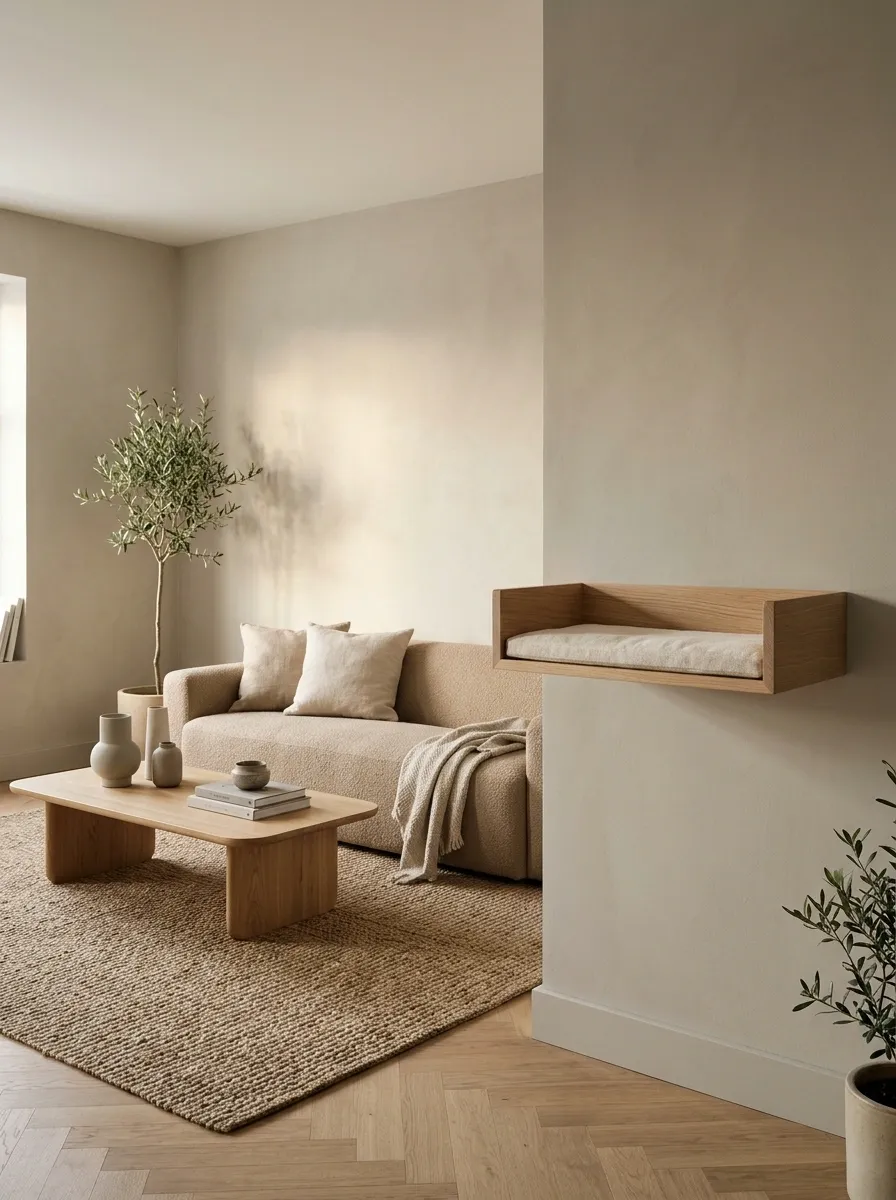
Not every cat wants the most exposed viewpoint. A resting shelf on a quieter wall, with a manageable approach and a sheltered side, can provide an alternative to the busy window route.
Observe where the cat already settles rather than deciding every perch must overlook the street. Keep the platform accessible for cleaning and the room below uncluttered. The design can use a simple timber finish and a securely fitted resting surface. A comfortable retreat doesn’t need to be the room’s highest or most dramatic feature to earn its place.
Use the cat’s preferred resting locations as design evidence instead of automatically choosing the busiest view.
A Cleanable Shelf Route for a Sunny Room
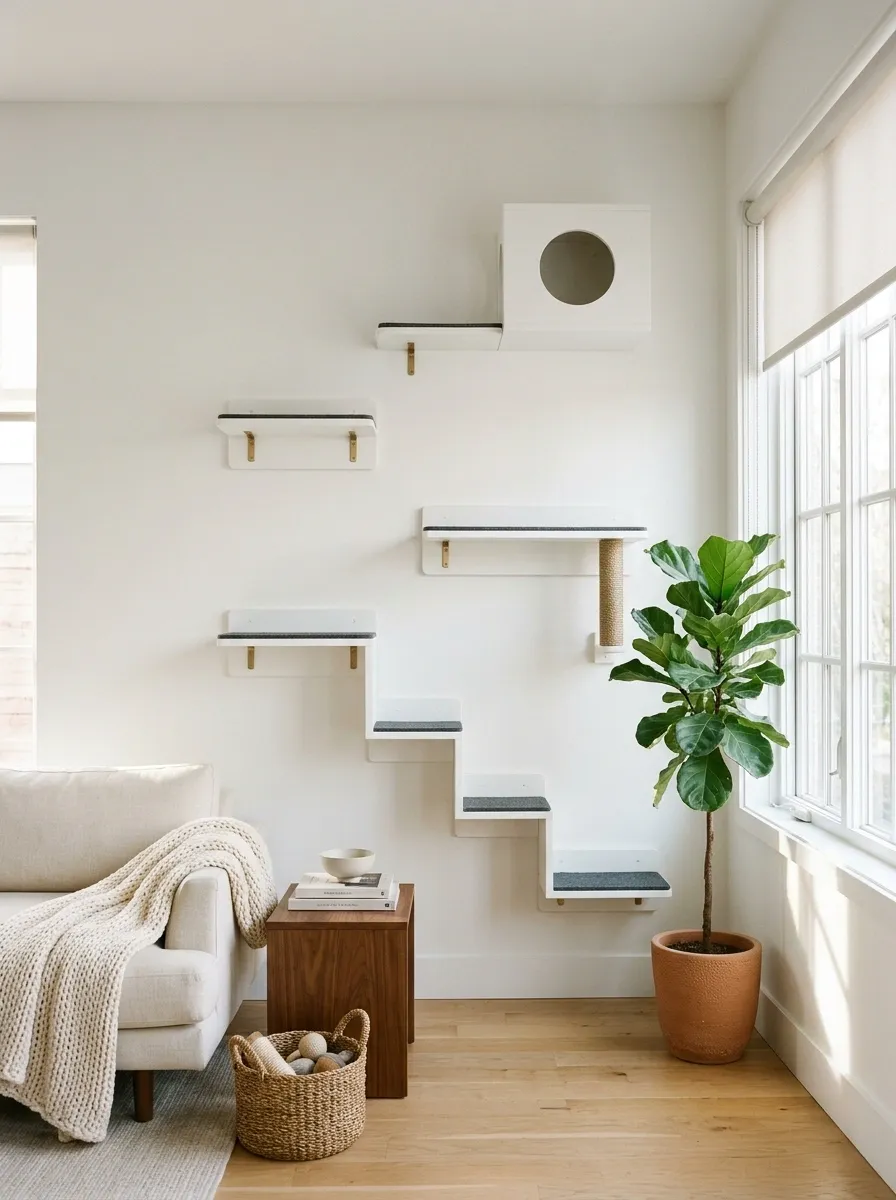
A sunlit room can use a modest shelf route with removable, securely fitted surfaces that are easy to clean. Keep the resting area positioned so the cat has a choice beyond the brightest patch, and preserve window security.
The installation shouldn’t depend on permanently glued decorative fabric that becomes impossible to maintain. Plan access to each shelf before fixing it. Keep cords and window treatments out of reach along the whole route. The sunny perch can be the attractive feature, but the cleaning routine determines how pleasant it remains after the first enthusiastic week.
A Freestanding Alternative When Wall Fixing Isn’t Suitable
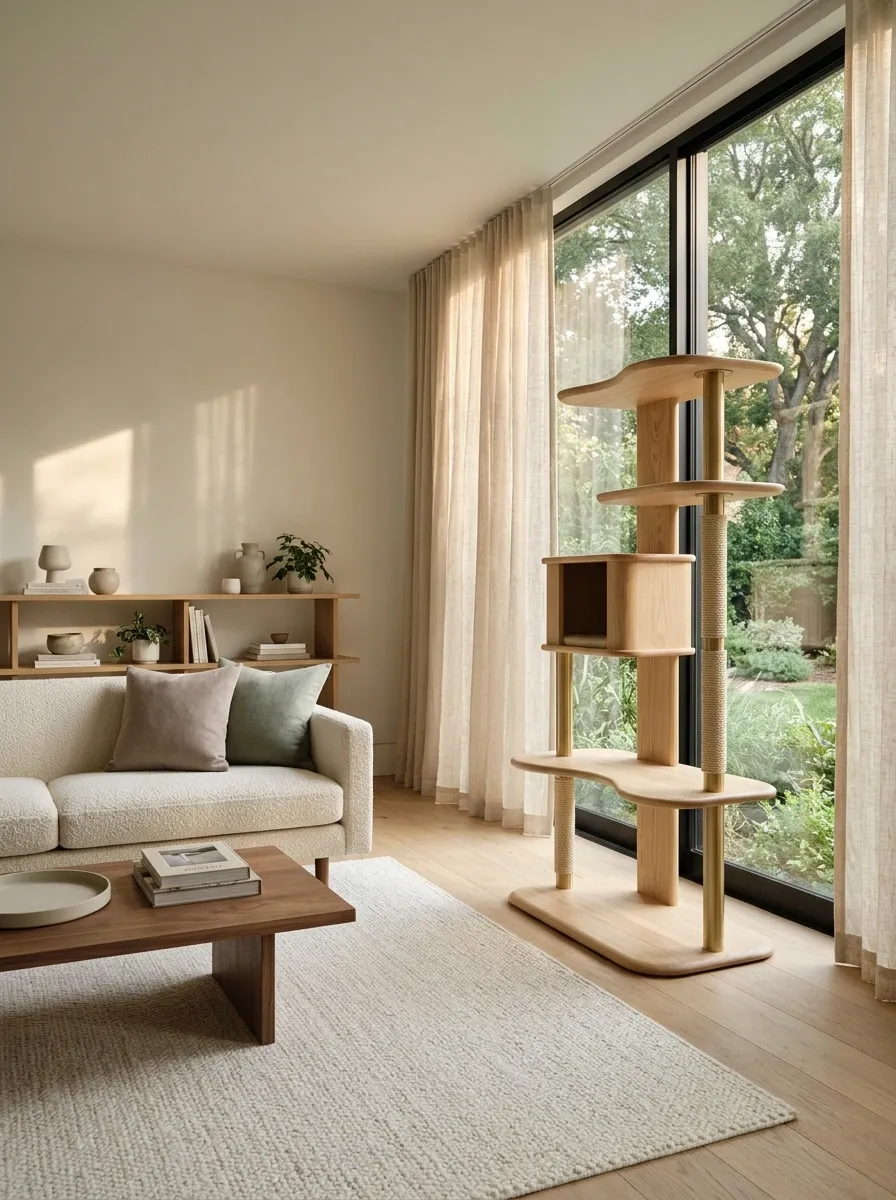
A properly designed, stable cat structure with suitable platforms can provide a similar route when the wall cannot safely accept shelves. Keep it near a useful view and choose a restrained material palette so it belongs to the room.
Follow its fixing and stability requirements; freestanding doesn’t necessarily mean it can remain unsecured. This is the honest alternative to pretending a few removable adhesive strips can support a jumping cat. Keep the approach and surrounding floor clear. The goal is useful elevated space, not proving that every inspiration photo can be recreated on every wall.
Choose a suitable alternative when wall installation isn’t feasible. Don’t improvise the support to preserve the look.
A Simple Route With One Excellent Resting Shelf
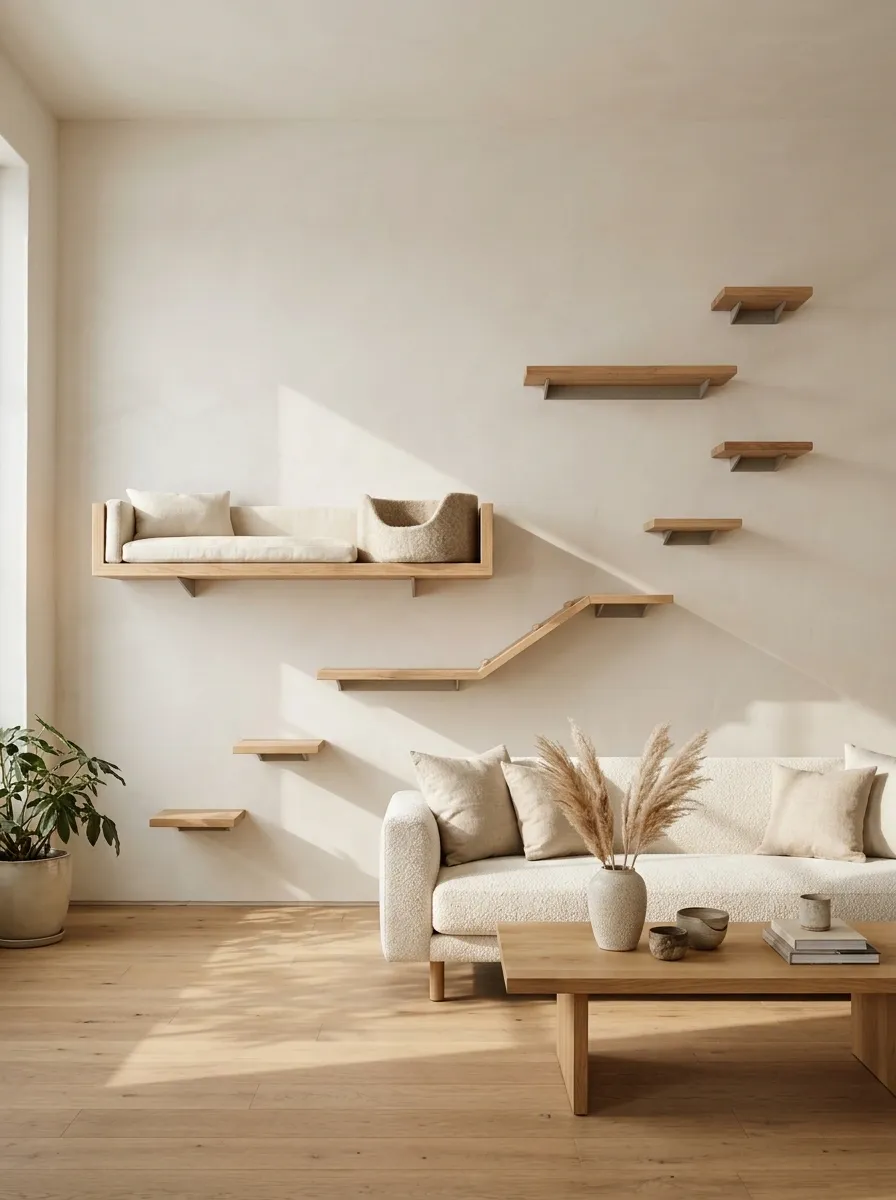
A short series of well-placed platforms ending at one generous resting shelf can be enough for a single cat’s preferred corner. Plain finishes and a clear wall give it a complete outline without adding unnecessary modules.
Spend the effort on secure construction, comfortable transitions, and a destination worth using. Leave room to observe and adapt rather than covering every available wall immediately. The cat doesn’t award points for installation size. A modest route that fits its habits is more useful than a complicated course built mainly to impress the humans scrolling past it.
Comfortable rest, a manageable route, and a practical way down matter more than platform count.
Let the Supervisor Inspect It
Build the route properly, keep the first introduction low-pressure, and watch. Does the cat turn comfortably? Avoid a transition? Prefer the lower shelf? Those observations are useful. Your original sketch does not need to win the argument.
Keep checking fixings, surfaces, and wear, and reassess the route as the cat’s abilities change. Put the attractive cubby where it works rather than where it completes a symmetrical wall.
Save the layout that suits your cat and your room. Then accept that the packaging may still receive the first favorable review. That is not a construction defect; it’s a familiar management style.