
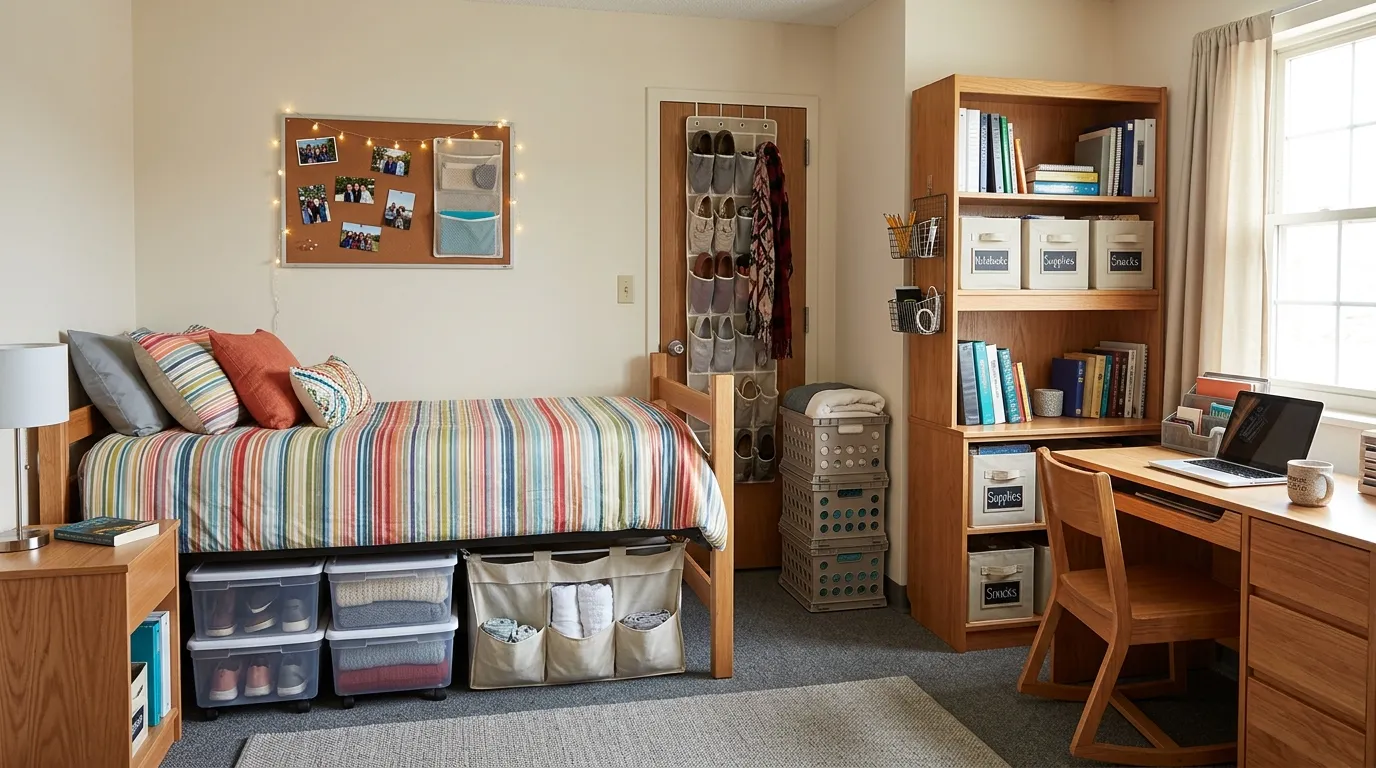
The assumption most people bring to college move-in day is that more stuff equals more comfort. They pack their entire childhood bedroom into a minivan and show up expecting to fit it into a room the size of a generous walk-in closet. Then they stand there, surrounded by boxes, wondering why it feels like a storage unit exploded.
What nobody tells you about dorm storage is that the vertical dimension is where most of the opportunity lives. Everyone treats the floor like prime real estate and then complains there’s no room. The walls, the backs of doors, the space under a raised bed — that’s where a dorm room actually happens.
Here’s how to use every square inch without making your room feel like a very organized closet.
Homework Before Move-In Day
Measure Everything Before You Buy Anything
The worst dorm storage mistake costs money. Someone buys a four-tier shelving unit, hauls it up three flights of stairs, opens it in the room, and discovers it’s six inches too tall or three inches too wide for the wall they needed it on. Dorm rooms have weird architectural quirks: a HVAC unit that sticks out from the wall, a window placement that eats into where a shelf would go, a closet door that swings directly into where a dresser would live.
Get the room dimensions from your university housing office before you arrive. Most post them. If they don’t, ask. Know where the outlets are. Know which walls are usable. Show up with a measuring tape on move-in day before a single piece of furniture gets positioned.
Assign Storage Zones Before You Unpack
Stand in the empty room and decide where each category of stuff lives before any of it comes out of boxes. The zone next to the bed is for nighttime things — phone, lamp, book, sleep mask. The desk zone is for academic life only. The closet and under-bed zone is for clothes and seasonal items. The corner unit or shelving is for beauty and personal care.
Write it down if you need to. The five minutes it takes to plan the zones will save you three weeks of reshuffling.
Invest in Matching Bins Before the Other Stuff
An inexpensive shelf looks expensive when it holds matching bins. A nice shelf looks chaotic when it holds whatever containers you grabbed. The containers matter more than the shelving. Buy a set of matching fabric bins or clear acrylic containers first and everything else after. Keeping them in the same color family — all white, all natural canvas, all clear — makes any storage system look intentional regardless of cost.
Dorm Room Storage Ideas Worth Stealing
Lofted Bed Smeg Station
Raise your bed to its maximum loft height and treat the space underneath as a fully furnished room. On the left side, position a three or four-drawer dresser — a low-profile unit with simple brushed hardware that fits the clearance. In the gap where the dresser ends and the bed frame continues, tuck a compact retro-style mini fridge. A cream or white Smeg reads as a design object rather than a dorm appliance, and that distinction matters in a room this small.
On the right side of the frame, build in a short ladder shelf unit for shoes, a hanging camera strap, and small accessories. Use the vertical wall behind the bed — in dark charcoal grey paneling or peel-and-stick shiplap if your university allows temporary treatments — as the backdrop for a large black-and-white photo grid. Print photos in uniform 4×6 size, pin them in a loose grid covering most of the wall, and add a single neon rectangle lamp on the adjacent wall as the only ambient light source.
The whole setup operates like a loft apartment. The sleeping surface is elevated, the storage is underneath, and the aesthetic reads intentional because every element is coordinated in tone — white bed frame, white dresser, cream fridge, monochrome wall art.
Labeled Over-Door Canvas Organizer
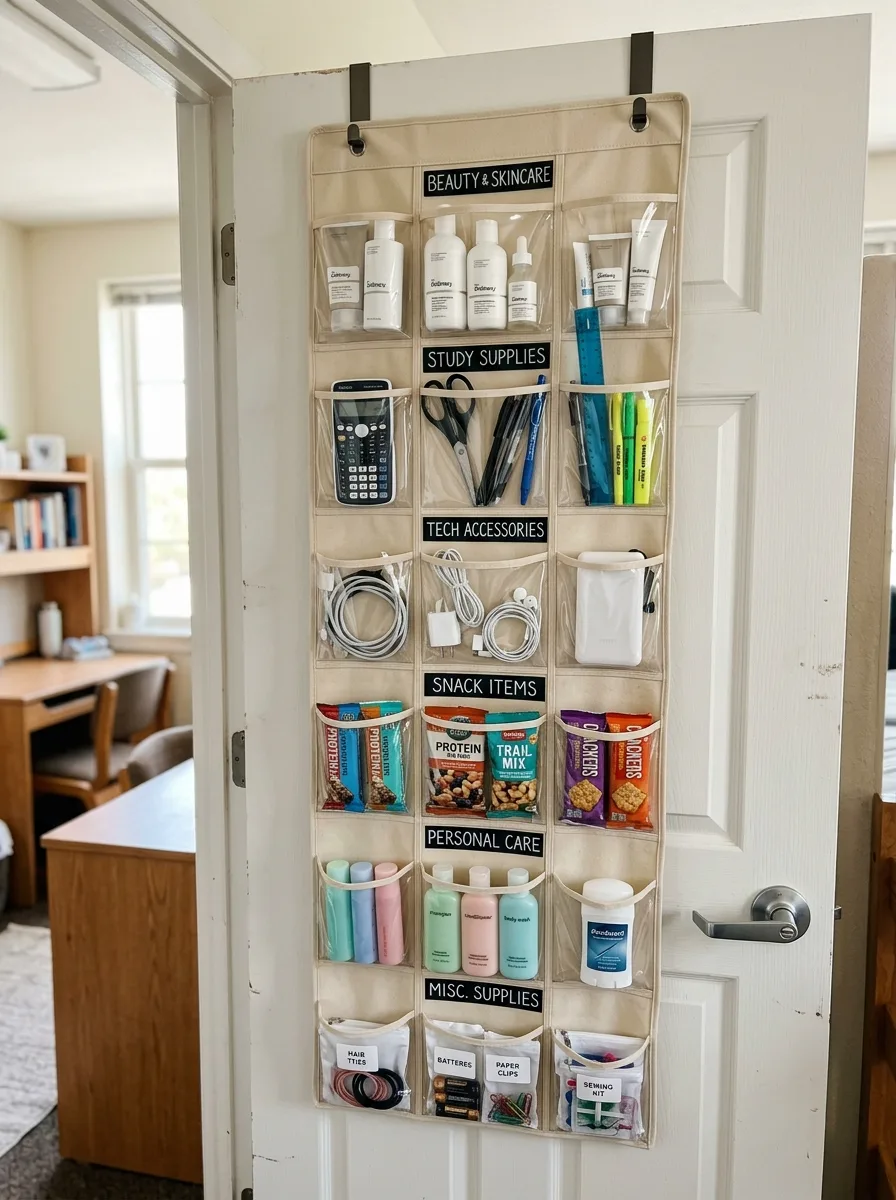
Buy a wide canvas over-the-door organizer with clear-front pockets — at least six horizontal rows, wide enough to span the full door width. Print label tags for each row: Beauty and Skincare across the top, then Study Supplies, then Tech Accessories, then Snack Items, then Personal Care, then Miscellaneous Supplies at the bottom.
Load each row with only the items from that category and nothing else. Skincare serums and SPF in the top row. Calculator, scissors, highlighters in the second. Charging cables, earbuds, power brick in the third. Protein bars and trail mix in the fourth. Travel-size body wash, deodorant, and hair ties in the fifth. Batteries, paper clips, a small sewing kit at the bottom.
The categories keep the system working after move-in. Without them, the pockets refill with random objects within two weeks and the organizer becomes a junk wall. Print the labels and use them. The front door of a dorm room is the largest completely unused storage surface in the room. This is how you use it.
Boho Loft Living Room Below
Take a full-height loft bed with a natural wood frame and treat everything beneath it as a separate living zone. Push a white cube bookcase — the nine or twelve-cube Kallax style — under one side of the bed frame flush against the wall. Load matching natural linen fabric bins into most of the cubes and leave two open for a microwave and small appliances.
In the remaining floor space beneath the loft, position a dark sofa or loveseat facing outward into the room with a small coffee table in front of it. Layer a cream Moroccan-style rug under the sofa zone and add a yellow tufted floor cushion or pouf as extra seating. Hang a macramé wall piece on the wall facing the bed and drape a string of warm Edison lights across the window frame.
On the windowsill, cluster three or four terracotta pots in varying sizes with trailing plants and small leafy greens. The density of organic textures — jute rug, linen bins, macramé, terracotta — does the work that paint and built-ins do in larger rooms. This is a studio apartment aesthetic achieved entirely through layering and intentional furniture placement.
Bamboo Labeled Drawer Organizer
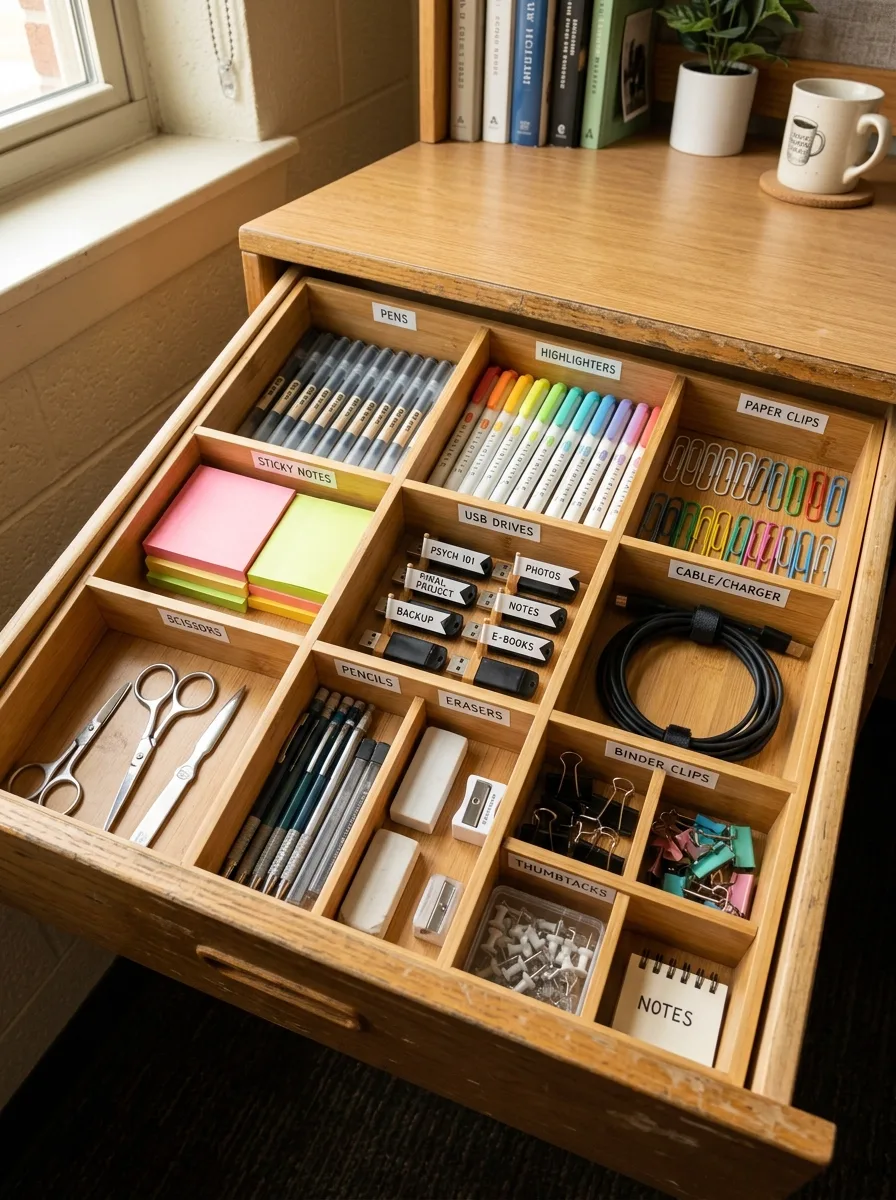
If the dorm desk has one large drawer, which most do, buy a bamboo expandable drawer organizer that fits its interior dimensions precisely. Measure the drawer before ordering. Fill every compartment with a specific category and print small label tags to attach to the front edge of each divider: pens along the back top row, highlighters in a color gradient next to them, paper clips to the right. Sticky notes in a bright color stack on the left middle row, USB drives labeled by course in the center, cables coiled neatly on the right. Scissors in the bottom left corner, pencils and erasers center bottom, binder clips and thumbtacks to the right.
The labeling is not optional. Without it, the drawer refills with chaos in under a week because nothing has a designated home, only a general region. With labels, every item goes back to the same specific pocket every time. Get color-coordinated supplies while you’re assembling this: a highlighter set that runs warm to cool, paper clips in matching metallics, binder clips in a single accent color. The organization becomes its own visual element when the drawer is open.
Shared Room Drawer Tower System
In a double room where two people are sharing 200 square feet, the temptation is to split the room down the middle and retreat to opposite corners. That works, but it wastes the center of the room entirely. Instead, build a shared storage wall between the two beds using matching drawer towers flanking a mini fridge.
Position two ten-drawer ALEX-style units from either side with a compact stainless fridge centered between them. The tops of both towers become a shared surface: a lamp in the center, a wire basket on each side for each person’s daily items. Run a set of matching curtain panels on a single rod across the window directly behind the entire configuration to frame it as one cohesive furniture moment.
Keep both bed setups in the same tonal range — grey on one side, cream on the other works well — and use matching arched headboards in the same metal finish. The monogram wall medallion or personal decor each person chooses above their own bed is where individuality lives. The center storage zone stays neutral and shared.
Labeled Canvas Under-Bed Bins
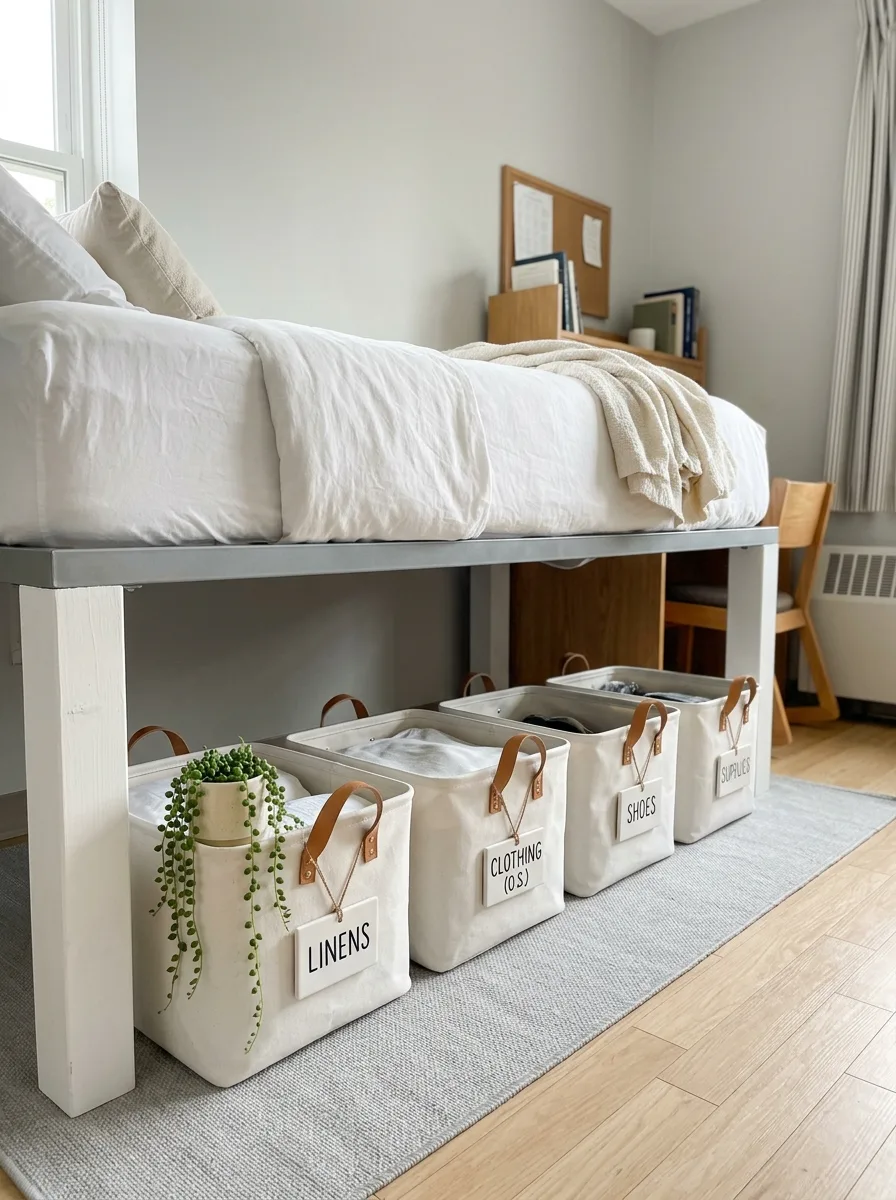
Raise the dorm bed and line the floor beneath it with matching canvas tote bins — the structured kind with stiff sides, tan leather loop handles, and a small label card window on the front face. Order them in a set so they match exactly. Fill each one with a single category: linens in the first, out-of-season clothing in the second, shoes in the third, supplies in the fourth.
Print category labels on white card stock in a clean sans-serif font, trim them to fit the card windows, and slide them in. Place a small trailing plant — string of pearls works particularly well because it stays low and trails over the bin edge slightly — on top of or directly in front of the first bin. That single plant is what makes the under-bed zone look finished rather than like overflow storage that didn’t fit anywhere else.
This system only functions if the bed is raised high enough that you can see and access the bins without getting on your hands and knees. If you have to crouch to reach them, you won’t use them and they’ll fill with forgotten items by November.
String Light Photo Ledge
Build or buy a simple wooden frame — roughly 24 by 36 inches — in a raw pine or whitewashed finish. Fill the interior with corkboard and pin photographs edge to edge in a dense, salon-style grid. Every photo should be the same size. Every photo should be pinned at the same angle. The density is the point — sparse arrangements on corkboard always look like an afterthought.
Mount the entire piece above the bed using large command strip picture hangers rated for the weight. Then run two or three strands of warm globe string lights from the top corners of the frame outward to the opposite corners of the room, securing each strand with a single command hook where the wall meets the ceiling. The lights trace the room’s perimeter overhead in a warm arc.
Keep the bedding underneath deliberately simple — a white or cream duvet, one dark accent pillow, nothing competing with the wall. The photo ledge and the string lights are the room. Let them be.
Five-Zone White Corner Shelf Tower
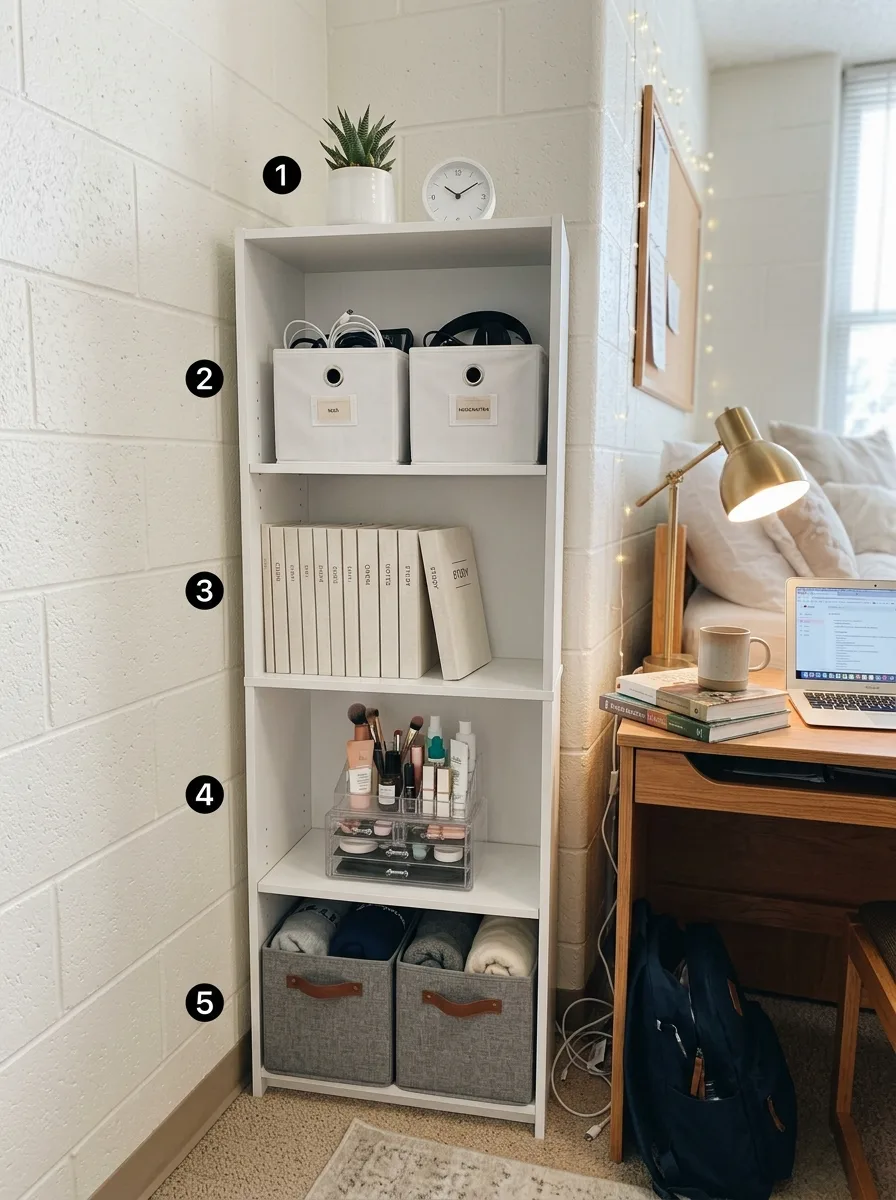
A narrow four or five-shelf bookcase — roughly 14 inches deep, 55 to 60 inches tall — can handle five completely different storage functions if each shelf is assigned one specific job and treated as a finished zone. Top shelf: one compact plant in a white ceramic pot and a round white minimalist clock, nothing else.
Second shelf: two matching white fabric bins with small eye-hole cutouts and printed labels, closed, holding tech cables and miscellaneous items. Third shelf: a row of matching white or cream magazine file boxes, all the same height, all labeled by subject, standing upright like books.
Fourth shelf: a clear acrylic stackable makeup organizer with products arranged by type and color. Fifth shelf: two grey linen bins with cognac leather tab handles holding extra linens or seasonal clothing.
The plant and the clock on top signal that this is furniture, not storage. Without them, the unit reads as a shelf that ran out of time. The cohesion of the bins matters as much as the shelf itself — five different bins from five different stores will look like five different decisions. Order them together from one place.
Blush Boho Pegboard Bedroom
Cover most of a single wall — ideally the desk wall — in a natural wood pegboard panel, floor-to-ceiling if possible, or at minimum from desk height to ceiling. The pegboard becomes the structural element that holds everything: small shelves at varying heights for plants, candles, small ceramic vessels, a clock, a wide-brimmed hat on a single peg. Install a warm wall sconce or globe pendant lamp on the adjacent wall rather than using an overhead fixture.
Push a light wood desk in front of the pegboard with a cream velvet office chair on gold casters — the casters matter, they elevate the chair from student to intentional. Layer the bed in white textural bedding: a tufted or boucle white duvet, a blush knit chunky throw draped across the lower third, and three or four layers of mixed white and blush pillows. Hang framed art prints above the headboard in a loose horizontal row of three — botanical, abstract, typographic — all in matching natural wood frames.
On the wall to the right of the bed, build a small vertical photo gallery in a grid using Polaroids or printed 4×4 photos on a warm blush or cream background wall. The room works because it commits entirely to one palette — blush, cream, natural wood — and doesn’t introduce any other color anywhere. Not even the plants break it; they stay behind the desk in the pegboard zone. Commitment to a palette is the single design decision that separates a room that looks finished from one that looks assembled.
Three-Tier Floating Desk Shelves
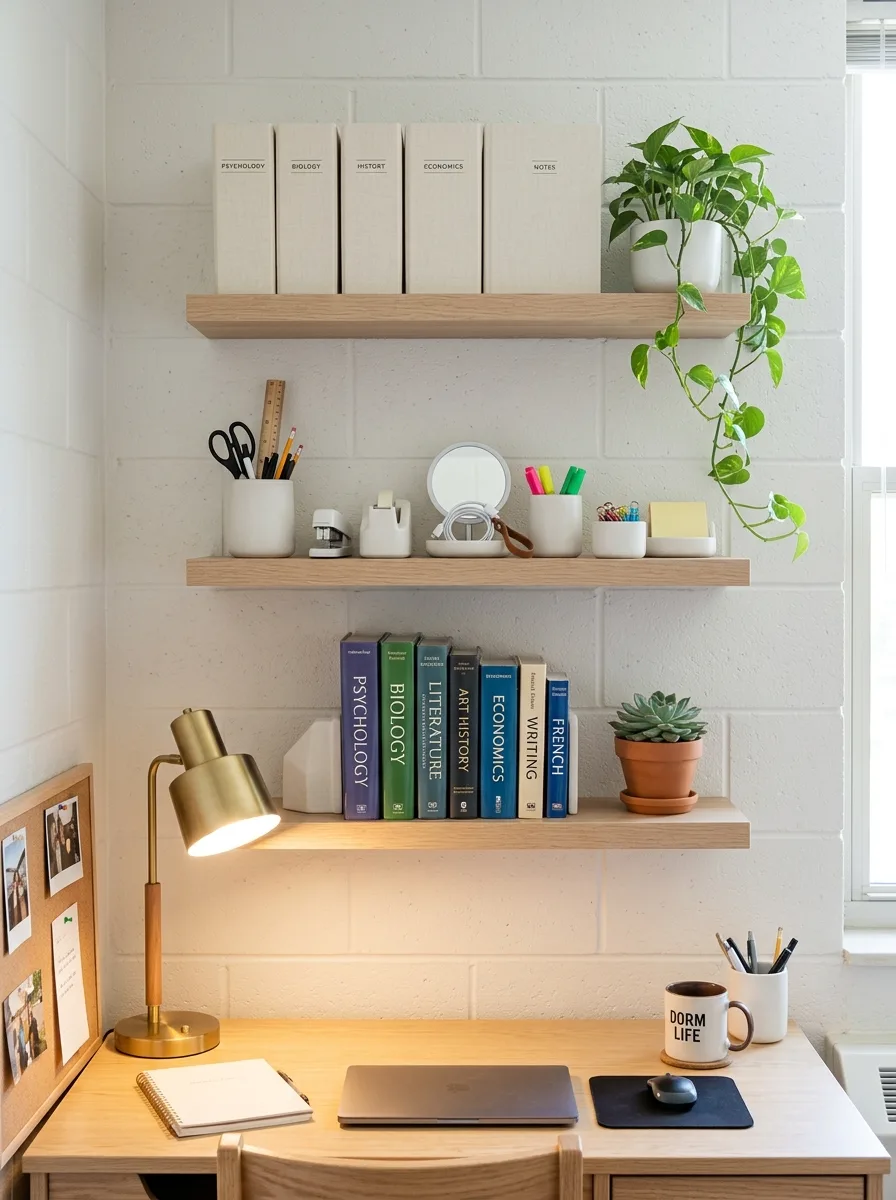
Install three floating shelves above your desk using removable adhesive shelf brackets or the permanent hardware your university permits. Space them roughly ten to twelve inches apart vertically. On the top shelf, arrange kraft or cream binders labeled by subject in matching spine-out order, then add a trailing pothos on the far end whose vines will grow downward over subsequent weeks. On the middle shelf, cluster white ceramic vessels holding pens, scissors, tape, and highlighters alongside a compact mirror and a small cable management dish. On the bottom shelf, position your actual textbooks spine-out organized by color from light to dark.
Leave the desk surface beneath all three shelves almost entirely clear. A brass or warm gold task lamp on the left side. Your laptop directly centered in front of your chair. Nothing else on the surface. The lamp is the most important element in this setup. Get one with a warm filament or warm-white bulb — not daylight, not cool white — because warm light in the evening is the difference between a space that feels like a study hall and one that feels like yours.
Sage Pegboard Desk Station
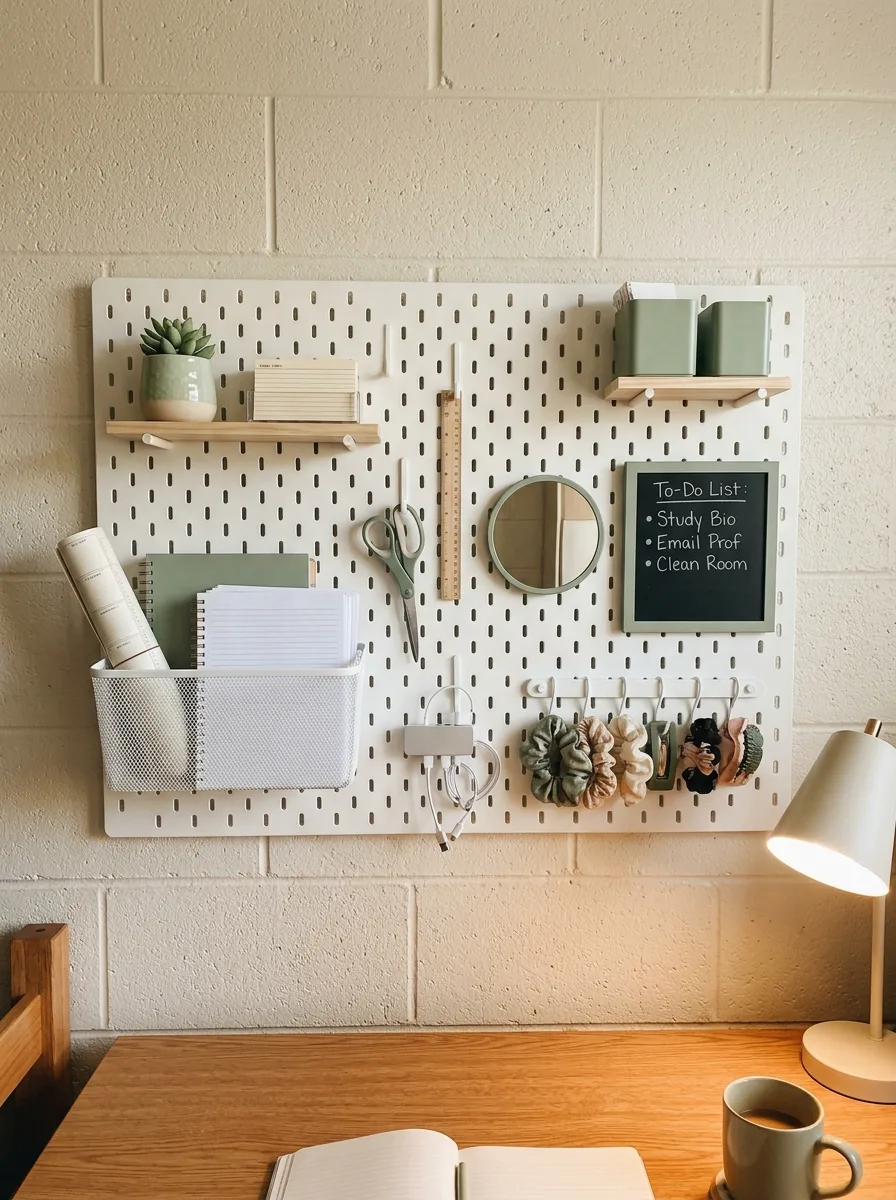
Mount a white pegboard panel — roughly 24 by 32 inches — directly above your desk using the mounting method your university allows. Lay out the configuration before attaching anything: top left gets a small wood peg shelf holding a succulent in a sage green pot and a slim card file box. Center row gets scissors on a hook, a wooden ruler, and a round compact mirror. Top right gets a wood shelf with two sage green metal storage boxes. Bottom left gets a white mesh basket mounted on pegs holding notebooks, papers, and a rolled magazine. Bottom center gets a power strip clipped to a peg hook with cables running neatly through. Bottom right gets a row of small S-hooks holding scrunchies, hair clips, and ties.
The color palette is doing all the work here: white pegboard, sage green accents, natural wood shelves. Three elements only. Every accessory that goes on the board should be one of those three. One rogue item in the wrong color visually breaks the whole system. The small chalkboard frame in the corner for a to-do list should be framed in black or natural wood — not colored. Discipline with the palette is what separates a pegboard that looks designed from one that looks like a hardware store display.
Wood Crate Nightstand with Bamboo Drawer
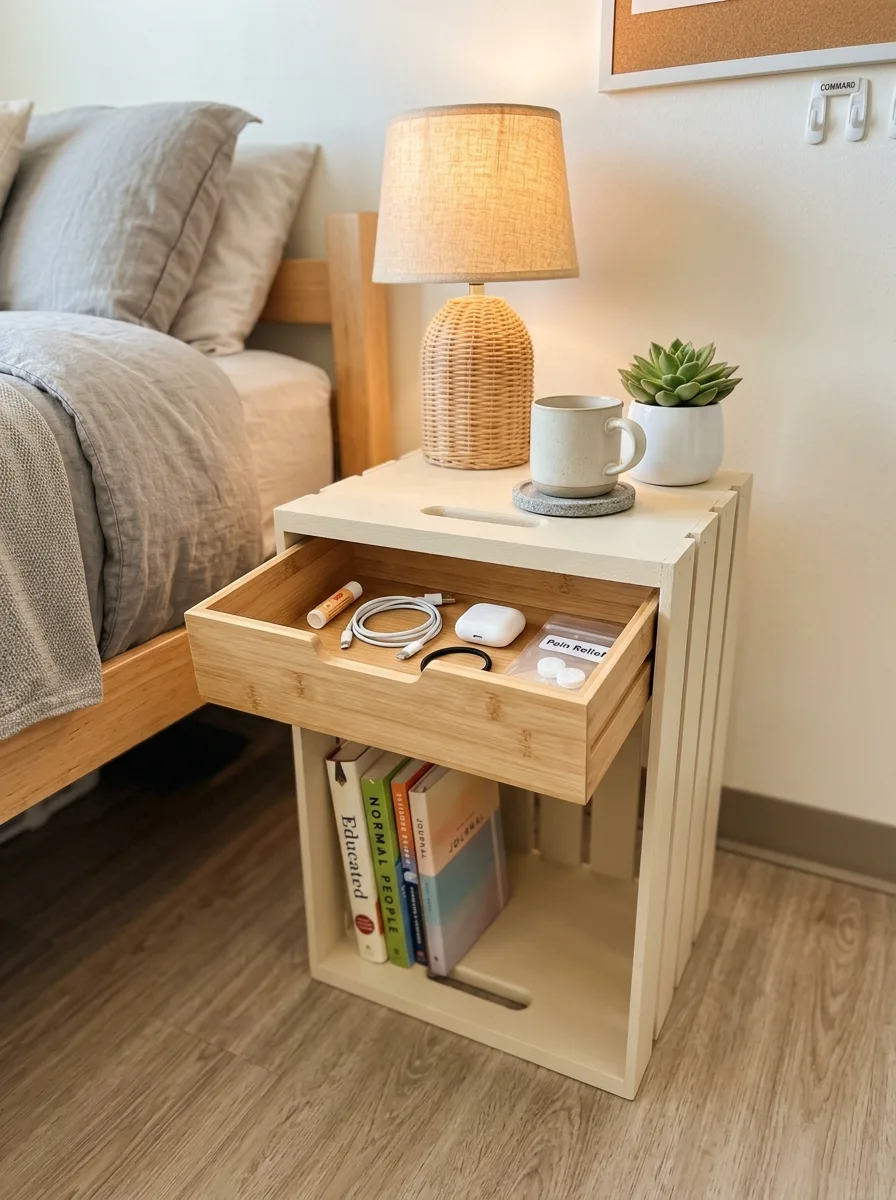
Paint or stain a large unfinished wood crate — the slatted kind sold at craft stores — in a warm cream or natural finish and stand it on one end so the open face points outward. The open bottom shelf holds the books you’re currently reading. Slide a standalone bamboo tray with shallow sides into the mid-section of the crate as a makeshift drawer. Keep its contents minimal: phone charger, earbuds case, a lip balm, and a small labeled pain relief packet.
On top of the crate, place a rattan or wicker lamp with a linen shade — the organic weave texture softens the cinder block wall behind it — alongside a ceramic mug and a single small succulent. The wicker lamp is a specific call, not a stylistic suggestion. A plastic lamp, an LED strip, or a generic metal gooseneck lamp would work functionally and wreck the warmth of the whole setup. Material choices in a small room have an outsized effect. The crate nightstand only reads as furniture rather than a craft project because the lamp on top looks intentional.
Gold Command Hook Entry Wall
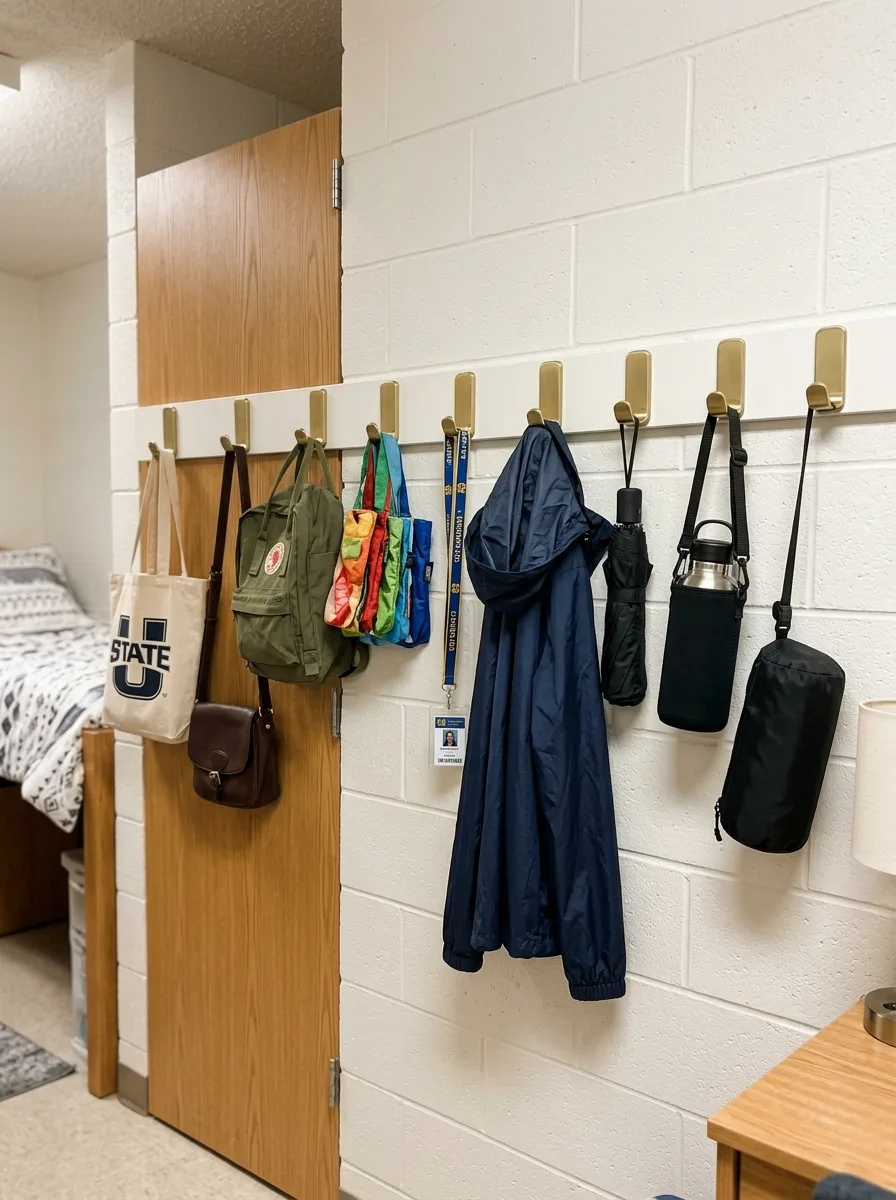
Line the wall directly beside or behind your dorm door with a single horizontal row of adhesive command hooks in brushed gold or champagne finish. Space them six inches apart. Install them all at the same height — roughly 65 to 68 inches from the floor, which puts the hooks within easy reach but keeps everything hung above the floor without dragging.
From these hooks hang only the items that travel in and out with you daily: backpack, tote bag, rain jacket, lanyard and ID, umbrella, insulated water bottle with a carry strap. Everything that you pick up when you leave and take off when you return has a home the moment you walk through the door.
The uniformity of the hardware is everything. Mix metals, mix hook sizes, or space them inconsistently and this wall becomes visual clutter. Keep them matching, keep them evenly spaced, and the daily grab-and-go items become an organized display rather than a pile on the floor.
Stacked Acrylic Makeup Organizer Tower
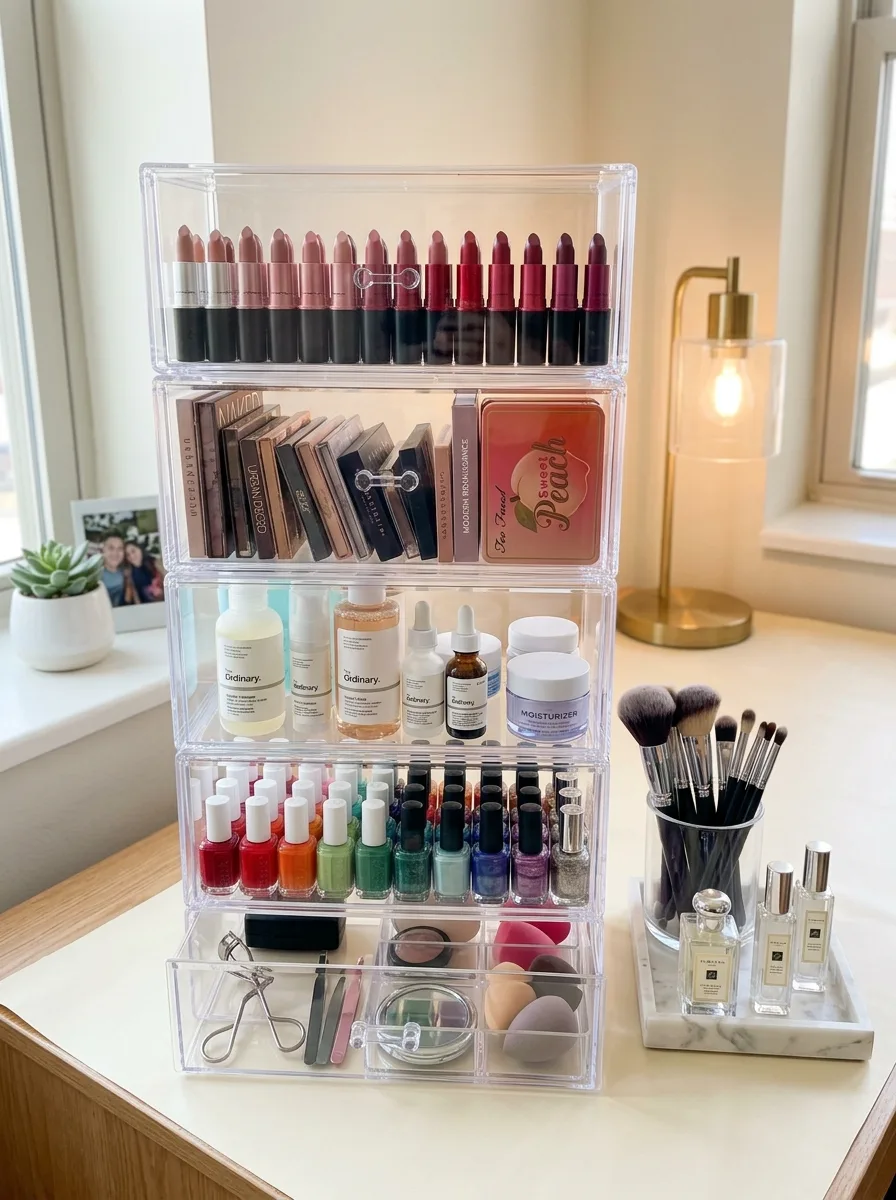
Build a vertical makeup storage tower from stackable clear acrylic drawers in graduated heights. Stack five tiers in order of product type: tallest top drawer for lipsticks standing upright in a color-graduated row from nude to berry to deep red; next drawer for eyeshadow palettes standing spine-up like books; middle drawer for skincare serums and moisturizers upright with labels facing out; fourth drawer for nail polishes in a full color-spectrum row; bottom wide shallow drawer for tools — lash curler, nail file, beauty sponges, powder compacts.
Position the tower on the desk or dresser surface where you do your makeup. Next to it, stand a clear acrylic brush holder with all brushes upright, bristles up. To the right of that, place a small marble or mirrored tray holding two or three perfume bottles. The tray frames the perfumes as a deliberate display rather than a random cluster. The transparency of the entire system — acrylic tower, acrylic brush cup, mirrored tray — means everything is visible, nothing is forgotten, and you stop buying the third tube of the same concealer because you couldn’t find the first two.
Rod-Hung Closet Shoe Organizer
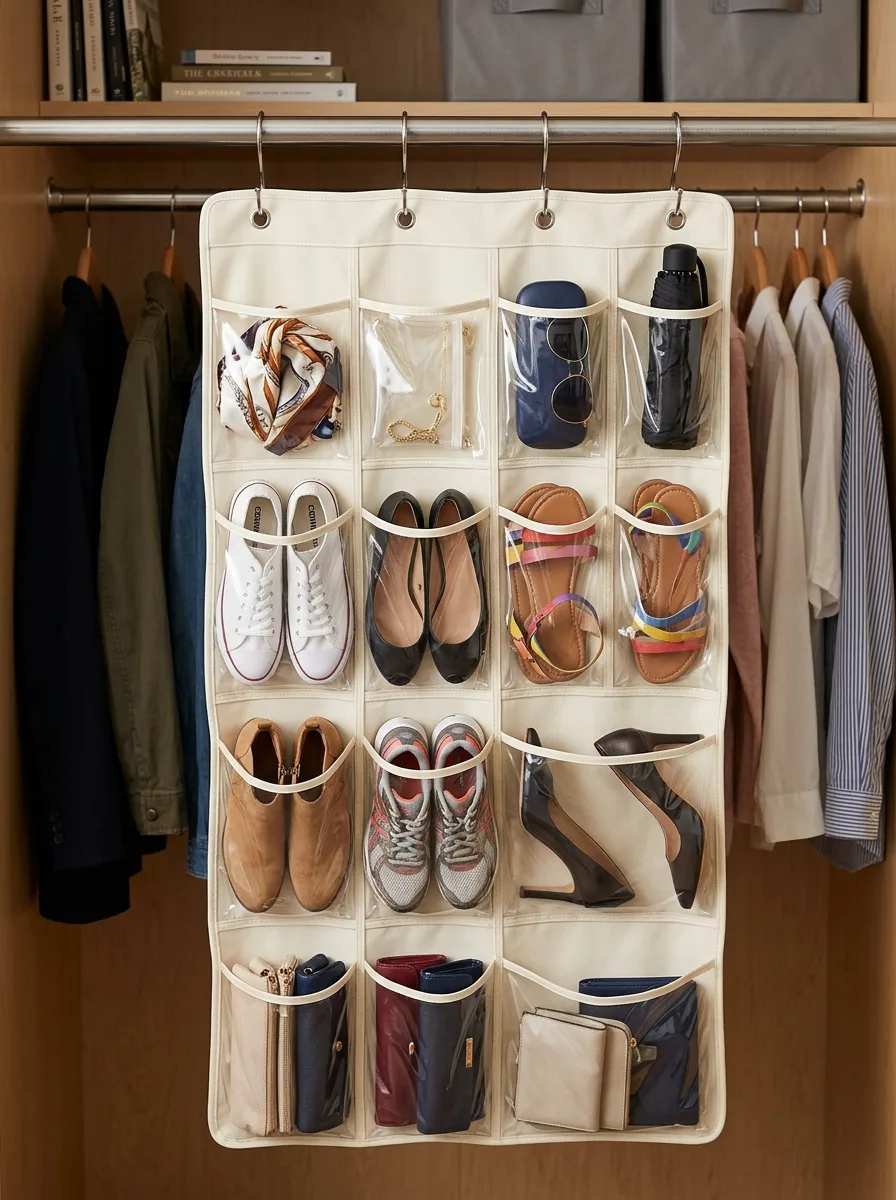
Hang a canvas dual-pocket shoe organizer directly from your closet rod using the metal ring loops at the top — no adhesive, no hardware, no command strips needed, which keeps it fully removable. This is important: it means you can take it with you at the end of the year without losing a security deposit.
Load the top row with small accessories that tend to disappear: a folded silk scarf, a small bag of jewelry, sunglasses in a soft case, a compact umbrella. The middle two rows hold shoes — one pair per pocket, laid flat with the toe facing out so you can see the shoe at a glance. The bottom row holds flat wallets, clutches, and folded pouches. Order the shoes by frequency of use: shoes you wear most often at eye level, less-used pairs toward the top or bottom.
Measure from your closet rod to the floor before ordering the organizer. The panel needs to clear the floor by at least two to three inches. An organizer that drags or bunches on the floor loses the shoes in the bottom pockets immediately.
Canvas Loft Bed Pocket Caddy
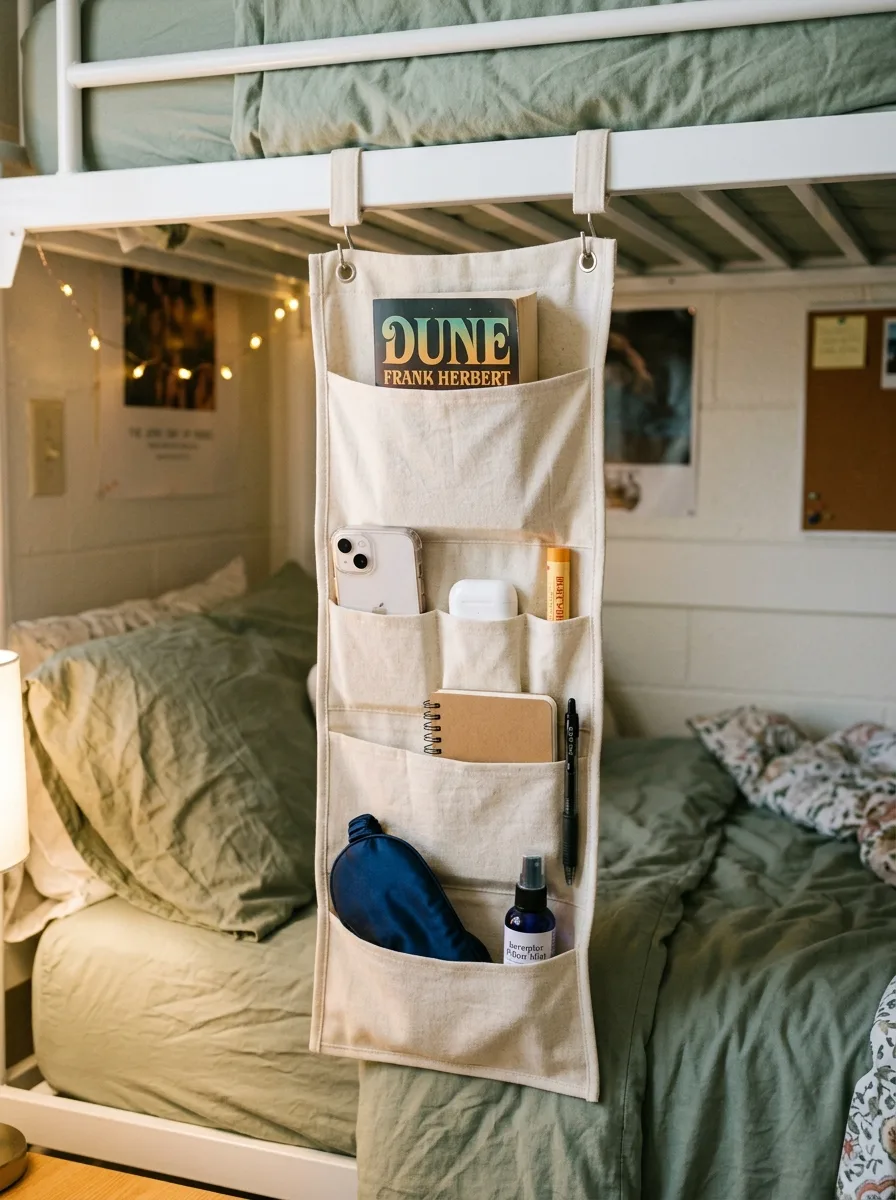
Clip a three-row canvas caddy to the metal frame of your loft bed using the small S-hooks or carabiner clips it comes with. Hang it on the side of the frame closest to where your head rests. The top pocket — the widest — holds one book. The middle row of three pockets holds your phone, your earbuds case, and a lip balm or small essential. The bottom wide pocket holds a sleep mask and a small pillow mist spray.
That is the full content list. Nothing else goes in the caddy. The constraint is the system. Everything you reach for in the last ten minutes before sleep and the first five minutes after waking up lives at arm’s reach without requiring you to climb down a ladder in the dark. Use undyed natural canvas or cream linen for the caddy material — not black nylon, not mesh, not bright color. The material choice is what keeps it feeling like a considered addition to the room rather than camping gear.
Green Folding Storage Ottoman
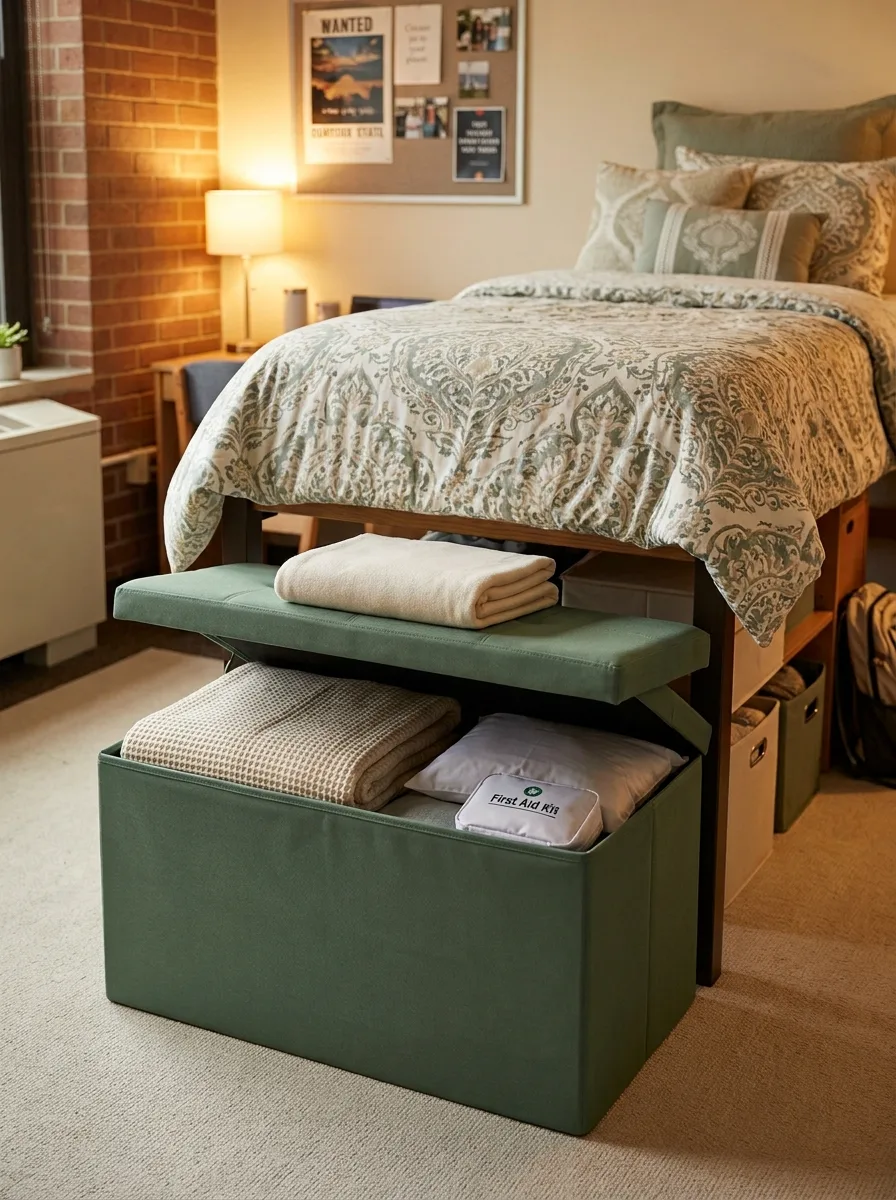
Position a folding storage ottoman at the foot of the bed in a muted olive or forest green fabric. The color is a deliberate choice — green grounds a room in the way neutrals often can’t, and olive in particular reads as sophisticated rather than decorative. It should be the flip-top style so the entire interior is accessible from above when the lid is open.
Store inside it only the items that don’t belong anywhere else: an extra throw blanket, a spare pillow, a compact first aid kit. Keep the top surface clear when the ottoman is closed so it functions as a bench for putting on shoes or as extra seating. A folded cream or oatmeal throw draped over the top edge when the lid is slightly open makes it look styled rather than like a box.
In the space on the elevated bed platform directly above and behind the ottoman, keep one additional folded blanket in a cream or warm white. The layered textiles — green ottoman, cream blanket on the platform, patterned duvet above — create depth in what would otherwise be a visually flat foot-of-bed zone.
Inner Closet Door Accessories System
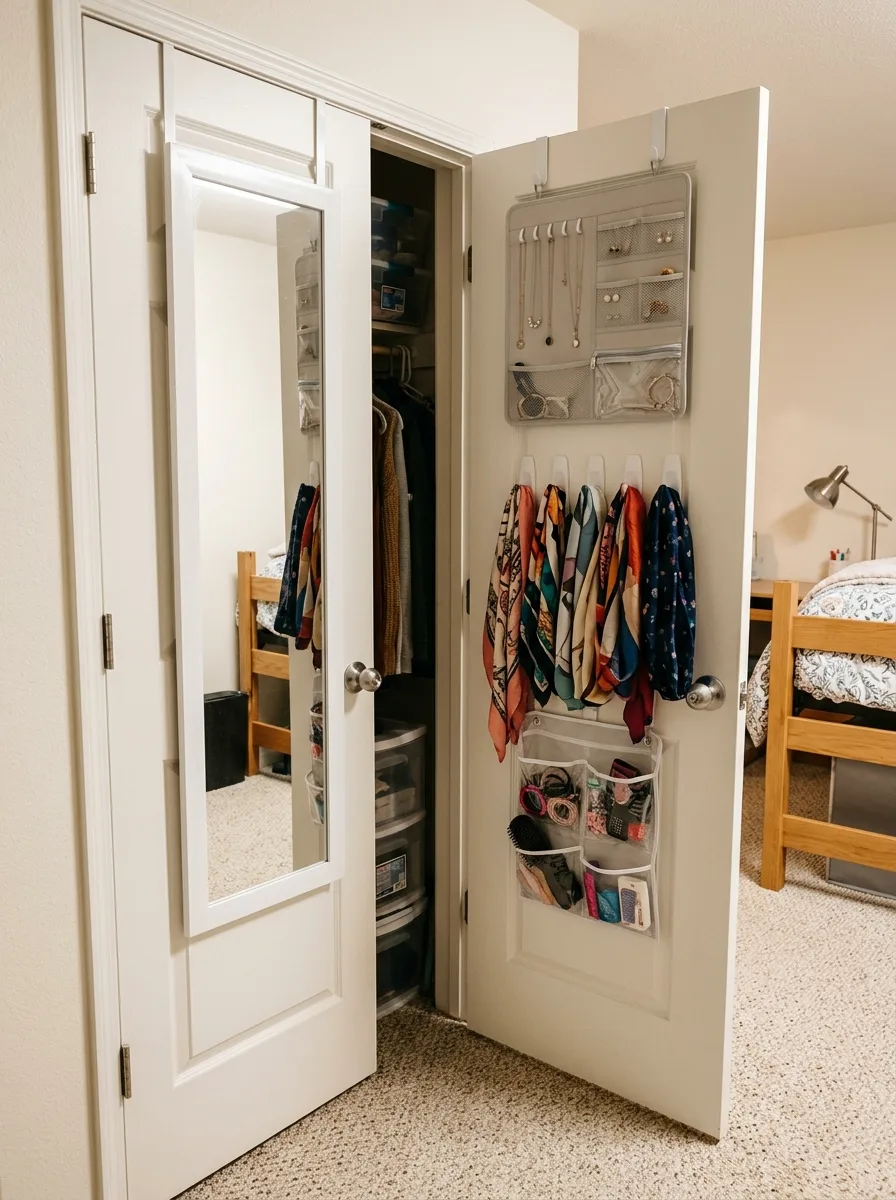
Turn the inside face of your closet door into a stacked accessories station running from top to bottom. Mount a flat fabric jewellery organizer at the top — the kind with small hook loops along the upper edge for necklaces, mesh grid pockets for earrings and rings, and a clear pocket for bracelets. Below that, install five or six command hooks or a small adhesive towel bar and hang folded silk or satin scarves over individual hooks so each one is fully visible and accessible without unfolding.
Below the scarves, attach a small clear mesh pocket organizer with three or four pockets for hair accessories — brushes, clips, extra ties, a compact mirror. On the other panel of the closet door, adhere a full-length mirror using removable mirror mounting tape. The result is that opening the closet gives you your jewellery, your scarves, your hair tools, and a full-length outfit check in a single motion. Nothing needs a dedicated surface elsewhere in the room.
Gold Shower Caddy Refillable System
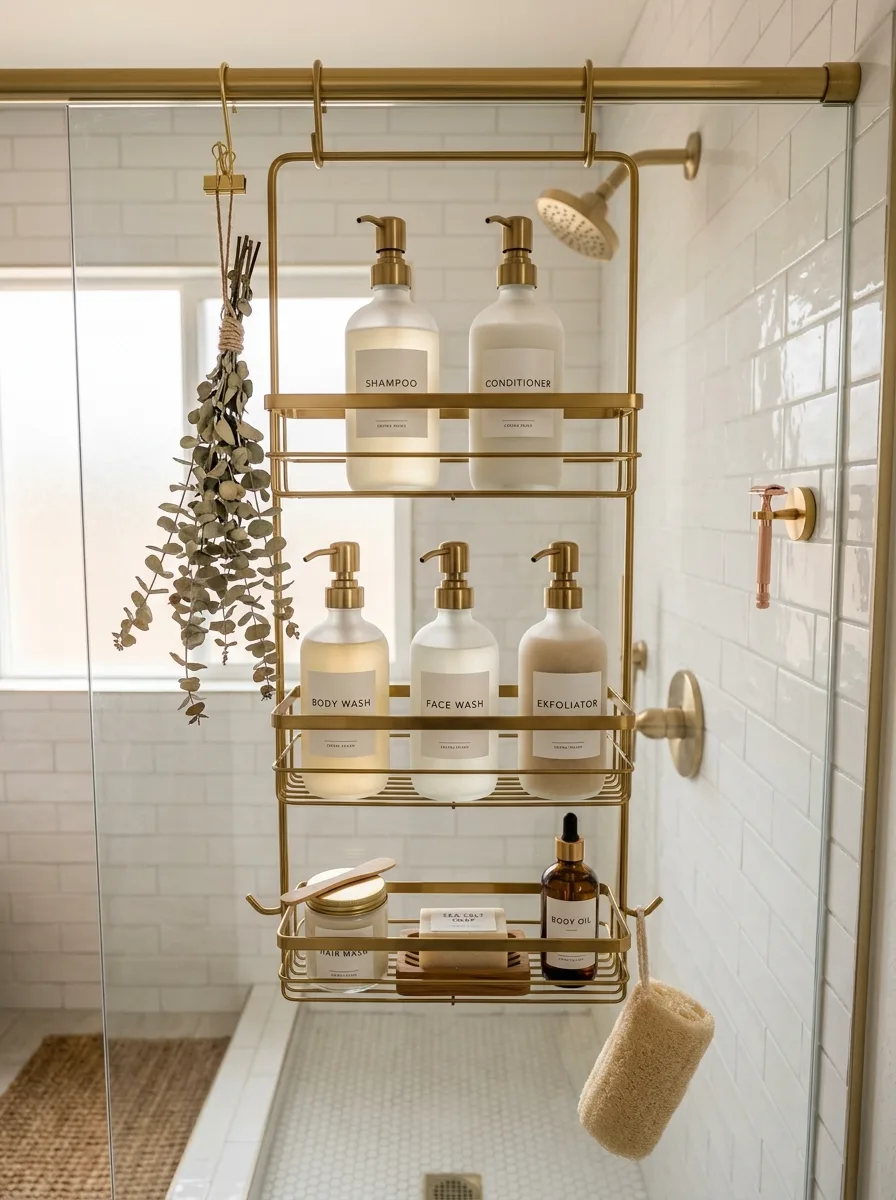
Replace the plastic shower caddy entirely. Buy a brushed gold metal caddy in the over-the-showerhead tension style with three or four open wire tiers. Transfer every product into matching frosted pump bottles — not clear, frosted — with clean printed label tags: Shampoo, Conditioner, Body Wash, Face Wash, Exfoliator. The matching bottles are non-negotiable. Mismatched originals in different sizes and colors on a gold caddy look like a yard sale.
On the lowest shelf, add a small wooden soap dish, a compact jar of hair mask, and a brown glass dropper bottle for body oil. Clip a bundle of dried eucalyptus to one of the caddy’s side hooks using a small binder clip. It will gradually dry further in the shower humidity and release scent with every hot shower. The eucalyptus bundle is the one item that costs almost nothing and disproportionately elevates the entire setup. A shared dorm bathroom shower stall with a gold caddy and matching frosted bottles feels like a decision was made. That is exactly the point.
Desk Wall Pegboard with Floating Shelves
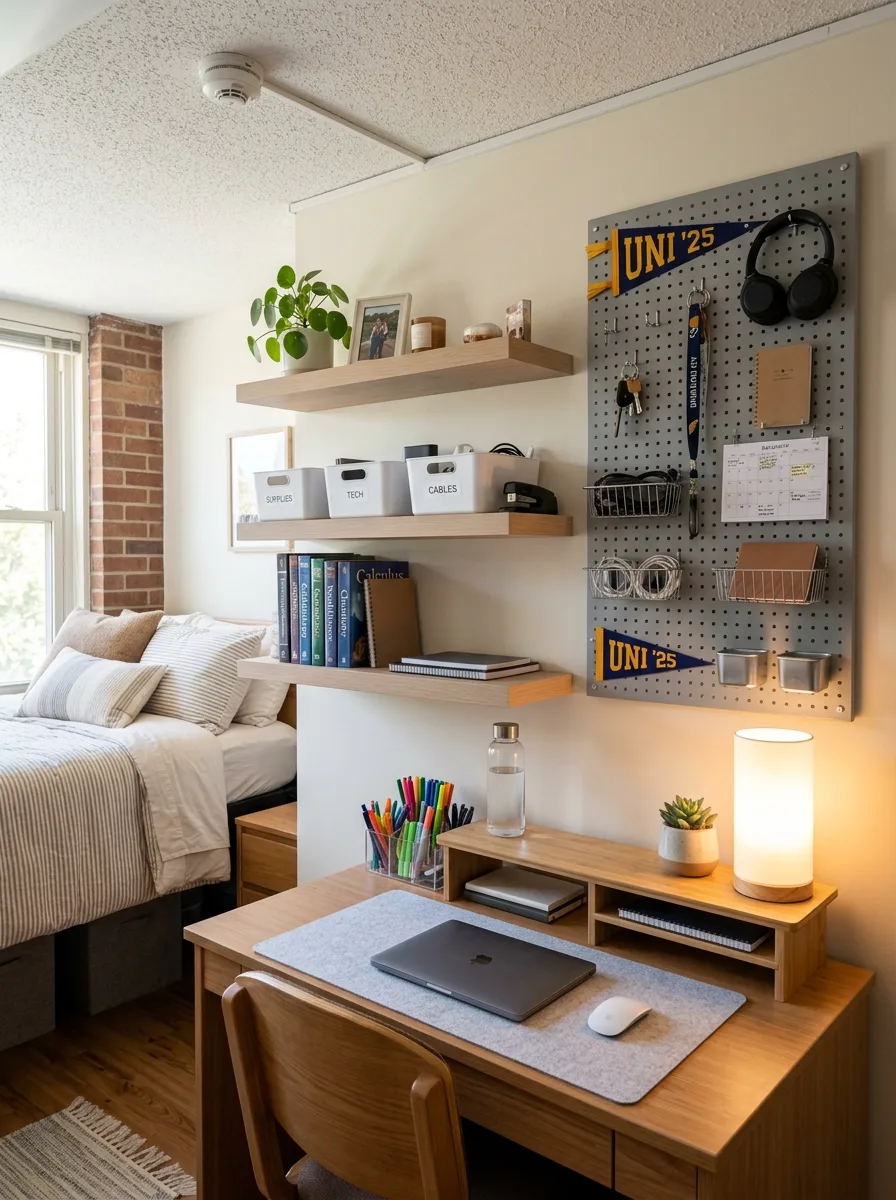
Above the desk, layer two systems instead of one. Install two or three floating shelves on the left side of the wall — labeled bins for Supplies, Tech, and Cables on the upper shelves; textbooks spine-out on the lower — and mount a vertical pegboard panel on the right side of the wall. The pegboard holds the functional daily tools: headphones on a hook at the top, keys on a small hook below that, a calendar page in a wire basket frame, a notebook clipped to the board, a metal cup for pens at desk level, cable management hooks running down the right edge.
Add two pennant flags in school colors to the pegboard — they humanize the wall and make the whole setup feel like it belongs to someone rather than to a productivity tutorial. On the desk surface, keep only a laptop, a grey felt desk mat, a small succulent, and a warm bedside lamp — not a harsh overhead style, a soft warm lamp. A water bottle and a small cup of colorful pens can live on the desk surface too, but nothing else. The wall does all the holding. The surface stays clear.
Final Thoughts
Every room in this post is working with the same structural limitations — concrete block walls, institutional furniture, less than 200 square feet, and a lease that prohibits anything permanent. The gap between the rooms that feel designed and the rooms that feel like temporary arrangements comes down entirely to decisions made before anything was unpacked.
Dorm storage done well isn’t about buying expensive things. It’s about deciding where everything lives before anything has a chance to land somewhere random. Random is how rooms stay chaotic forever.
The through line in every image here is that nothing is accidental. The bins match. The hooks are consistent. The shelves have a logic. Committing to even one or two of these systems — the under-bed zone, the door organization, the desk wall — changes how the whole room feels to live in.
A dorm room is small. That’s not the problem. The problem is usually that it’s being treated like a temporary situation instead of a place worth taking seriously.