
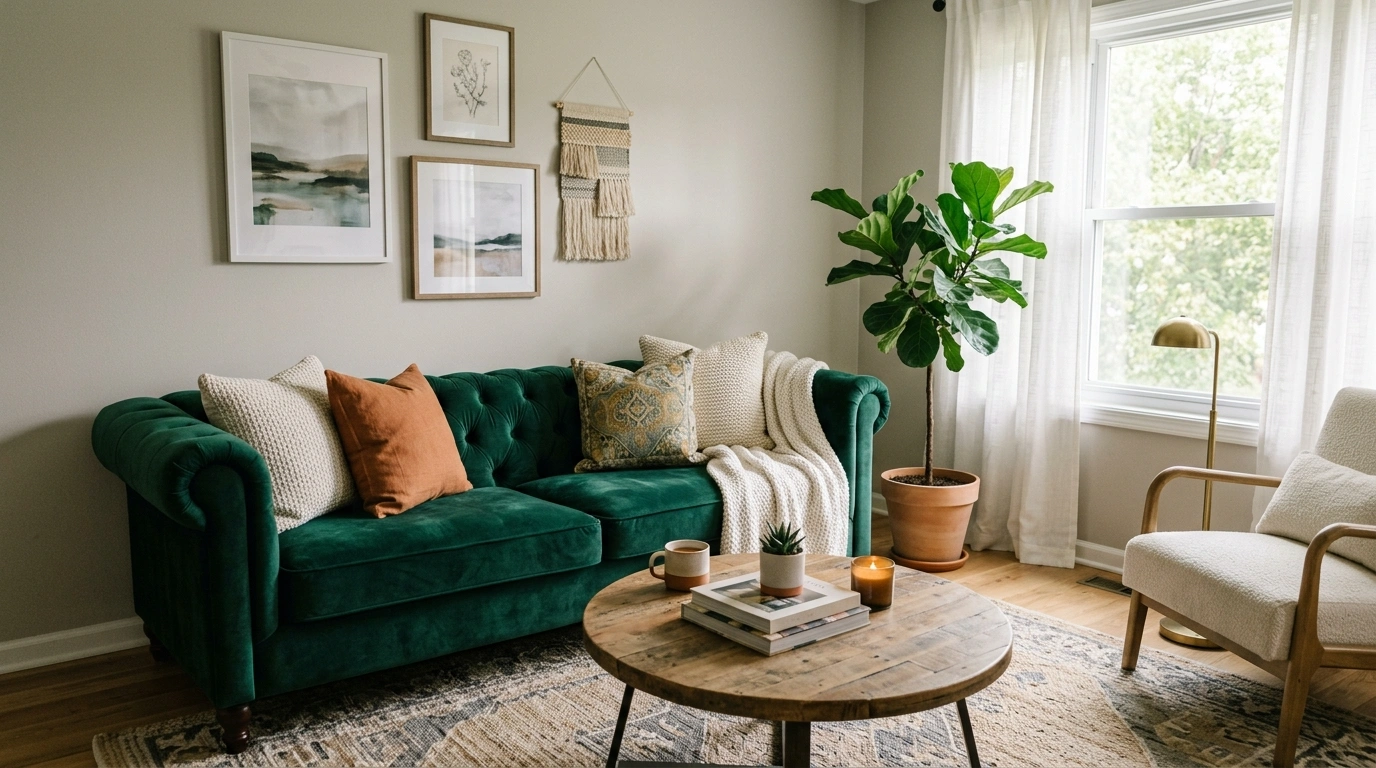
A green couch has a funny habit of exposing everything else in the room.
Put it beside warm wood, good lighting, a thoughtful rug, and walls with the right undertone, and it can make the whole living room feel layered and expensive. Put it next to a random gray rug, a too-small coffee table, three unrelated accent colors, and whatever throw pillows happened to be on sale, and suddenly the sofa gets blamed for the crime.
That’s why decorating around a green couch works better as a whole-room exercise. The shade of green matters, but so do the furniture proportions, wall color, flooring, window treatments, lighting, artwork, and the amount of visual noise competing with the sofa.
Some rooms below are restrained. Others are dark, colorful, traditional, modern, eclectic, or deliberately dramatic. The point isn’t to find one universal formula. It’s to see how different complete compositions can make the same basic piece of furniture feel completely different.
The stuff around it usually is.
A green sofa can look expensive, relaxed, dramatic, traditional, modern, or painfully random. The sofa didn’t change. The supporting cast did.
Living Room Ideas With a Green Couch
Textured Green Sectional With Boho Wall Baskets
This cozy corner pairs a plush green sectional with an earthy wall display that draws the eye upward without relying on standard framed art. Woven baskets of various sizes create a textured gallery wall that warms up the neutral plaster backdrop.
A live-edge wooden coffee table adds an organic element, while floating shelves packed with plants and books bring life to the upper corners of the room. A heavily textured diamond-pattern rug ties the soft elements together beneath the seating area.
The secret here is mixing tactile materials like woven fibers, smooth wood, and plush velvet. Everything feels effortlessly gathered over time rather than purchased in a single matching set.
Olive Green Sofa With Warm White Walls and Walnut Furniture
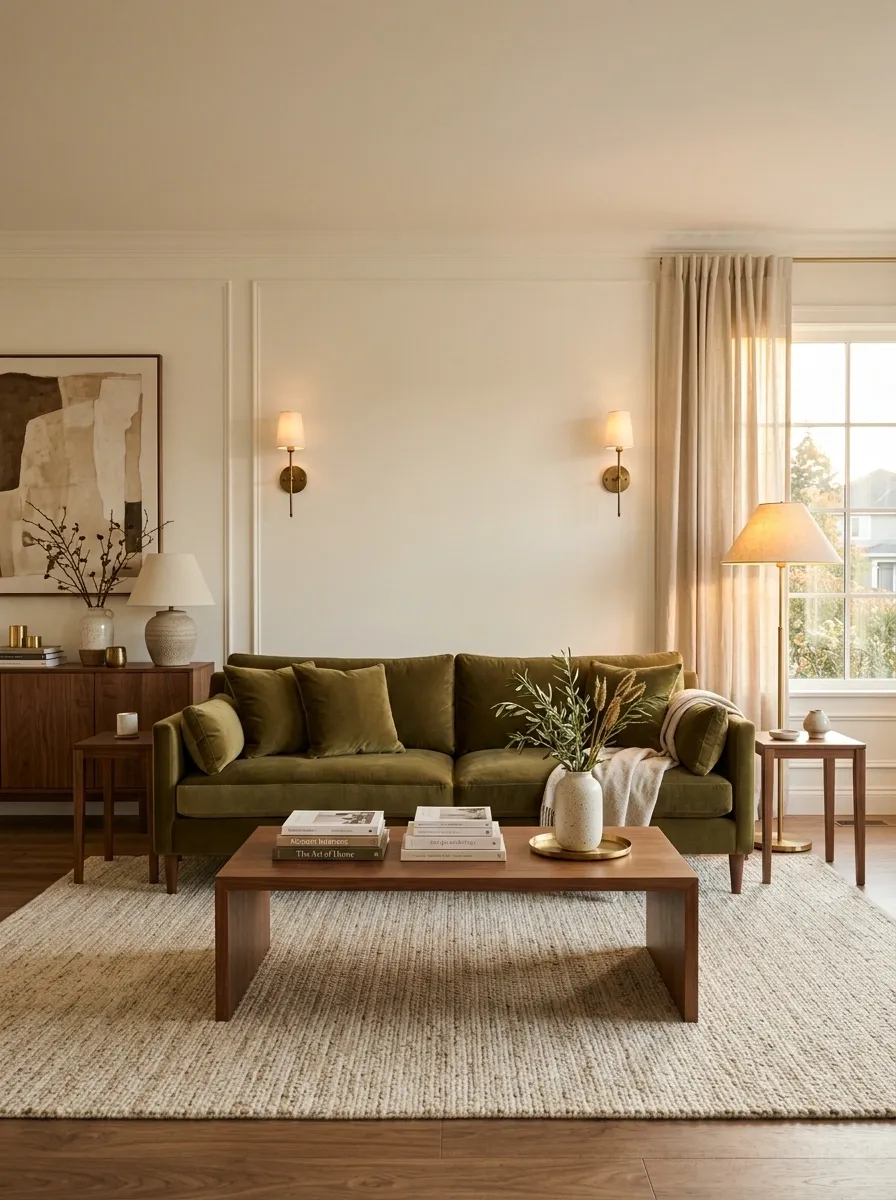
This room keeps the green sofa firmly in the spotlight without surrounding it with a circus of competing colors. An earthy olive couch sits against warm white walls, while medium walnut furniture brings enough depth to stop the pale backdrop from feeling flat.
A large textured neutral rug connects the seating pieces, and linen curtains soften the windows without introducing another strong color. Aged brass lighting adds a little polish, but it stays secondary to the sofa and wood.
The important part is the temperature of the room. Warm white and walnut make olive feel richer and more sophisticated. Bright white and cold gray would push the same sofa in a completely different direction.
focal color Warm white
visual breathing room Walnut
grounding warmth Brass
small finishing note
Archway Built-Ins Framing a Green Sofa
A rich green velvet sectional anchors this sophisticated space, flanked by custom arched built-ins painted in a matching dark green tone. The monochromatic shelving creates depth and provides a dramatic frame for the abstract artwork hanging above the sofa.
Warm brass sconces and a clean-lined marble coffee table introduce subtle metallics and polish, preventing the heavy greens and dark woods from feeling overwhelming. A tall potted palm near the window softens the architectural lines with natural movement.
This design succeeds because the architecture and the furniture work as a single cohesive unit. The matching built-ins make the green sofa look like it was always meant to live right there.
Deep Forest Green Sofa in a Moody Library-Style Living Room
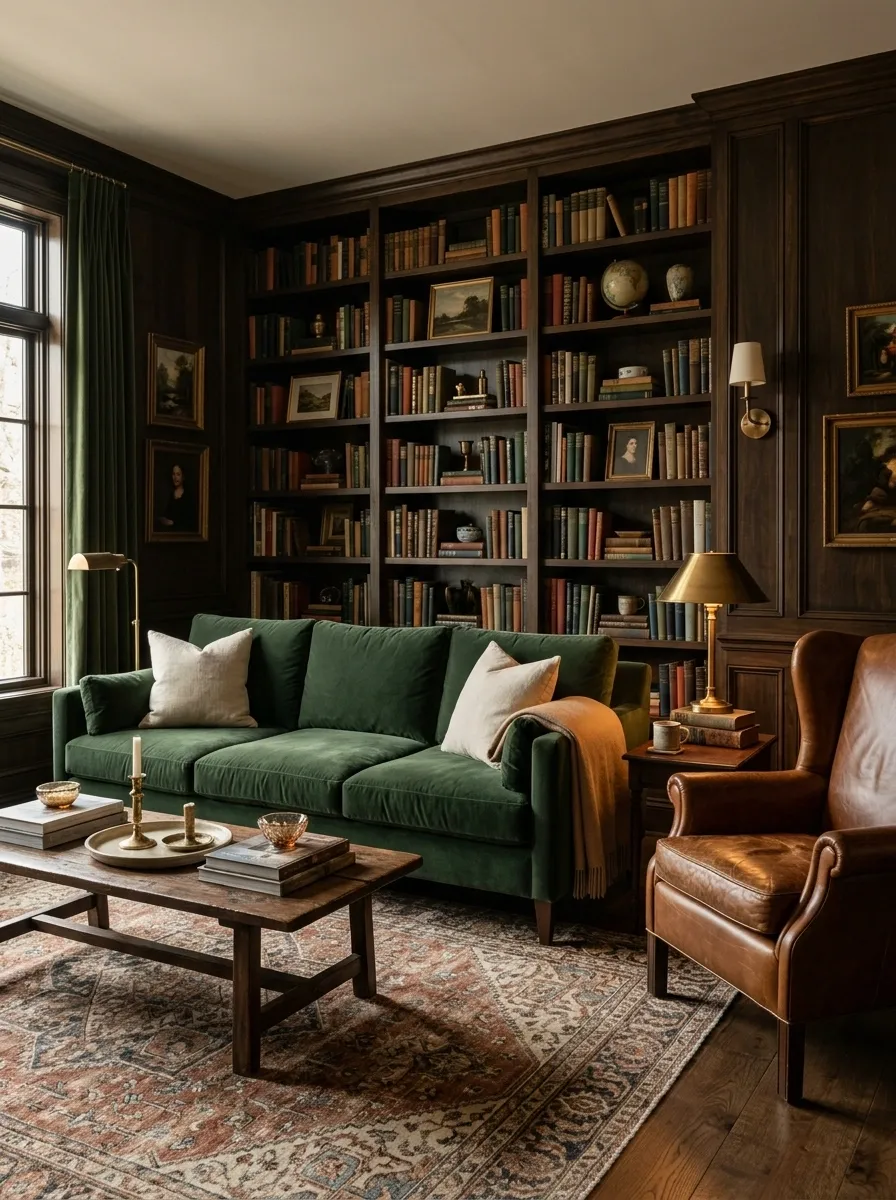
A deep forest sofa becomes much more convincing when the room is willing to go dark with it. Here, warm brown walls, dark shelving, vintage-style lamps, a patterned rug, and a leather accent chair create a library-like atmosphere around the sofa.
The trick is keeping the upholstery from disappearing. Cream or camel textiles, warm lamp light, and a few lighter objects create small areas of relief against the darker shell.
This room doesn’t need a giant gallery wall, ten decorative pillows, and seventeen objects on every shelf. The architecture and materials are already doing the work. More clutter would only muddy the composition.
Retro Green Velvet Couch With Warm Wood Tones
Nodding to mid-century style, this vibrant green couch stands out against warm white walls and a whimsical, organic-patterned rug. The space leans heavily into retro charm with bold mustard accents, atomic-style lighting, and playful typography posters.
A low wooden coffee table and a neighboring caramel leather lounge chair keep the sightlines open and airy. The entire arrangement feels remarkably fun without tipping over into a chaotic theme room.
The trick is letting the iconic furniture shapes do the heavy lifting while keeping the color palette tightly controlled. The green upholstery bridges the gap between natural wood tones and the warm orange hues scattered around the room.
Sage Green Couch With Soft Beige and Natural Oak
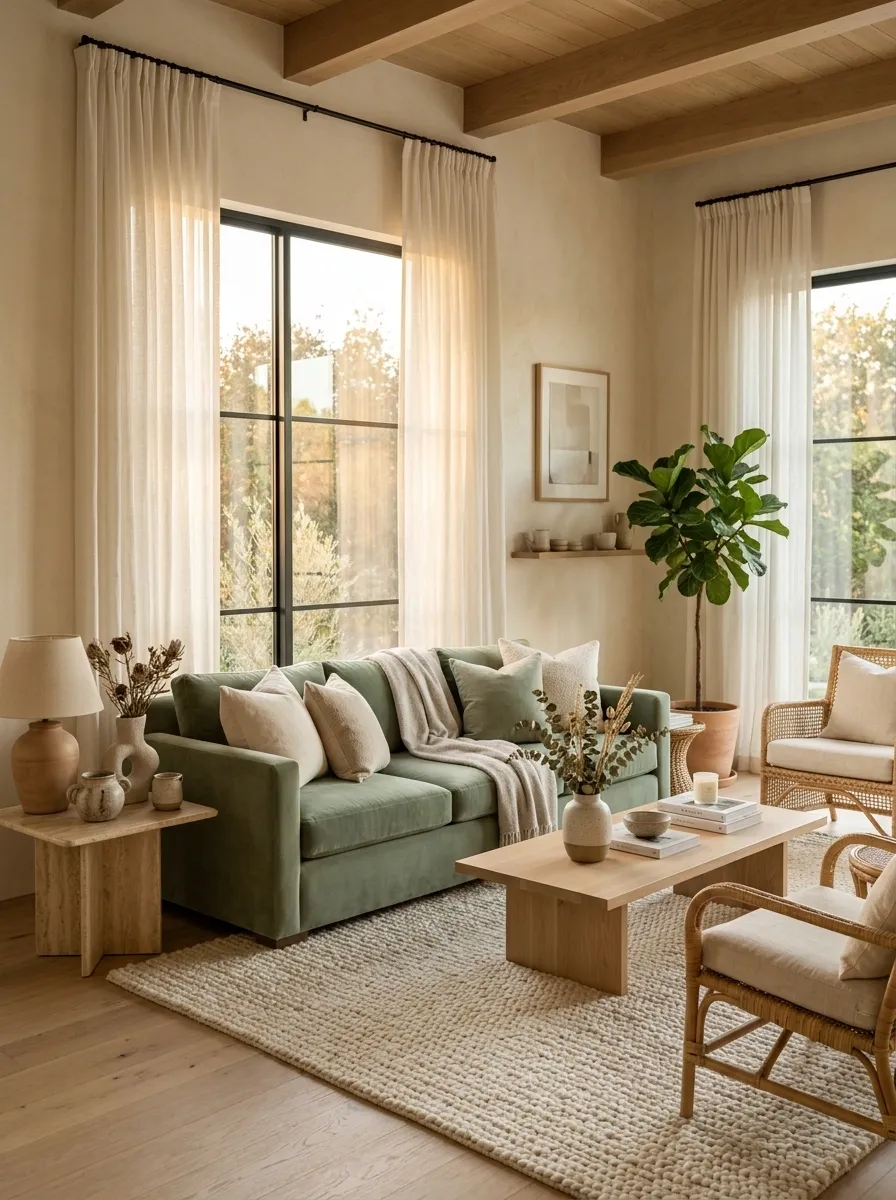
Sage green gets an entirely different personality in a light organic-modern room. A muted sage sofa sits against creamy beige walls, with pale oak furniture, woven accents, stone details, and soft off-white curtains filling out the composition.
There isn’t much hard contrast here, and that’s exactly why texture matters. Smooth walls, natural oak, woven fibers, upholstery, and stone each catch light differently.
This room works because the palette stays quiet while the materials keep it from becoming boring. The couch adds color without demanding that everything else coordinate with it.
Dark Academia Green Velvet Tufted Sofa
This dramatic living room commits fully to a moody aesthetic, featuring a deep green tufted Chesterfield sofa against dark paneled walls. A massive, moody floral canvas hangs above the seating, echoing the rich botanical tones of the velvet upholstery.
A distressed vintage rug and understated black accent chairs complete the shadowy, intimate atmosphere. There is no need for bright colors or cheerful knick-knacks here because the atmosphere relies entirely on shadow and texture.
The success of this space lies in its unwavering commitment to darkness. By refusing to water down the moody color palette with bright white trim, the room achieves a genuinely immersive, library-like richness.
Evening Amiance With Lanterns and Green Seating
As daylight fades, this sprawling green sectional takes on an entirely different mood, surrounded by dozens of flickering candles and rustic lanterns. An arched iron mirror reflects the warm glow, bouncing light across the deep green walls.
A massive jute rug grounds the large L-shaped sofa, while fresh floral arrangements on the coffee table add a soft, romantic touch. The combination of twinkling candlelight and plush velvet seating makes the entire room feel like an enchanted evening retreat.
The magic here is all about lighting strategy. By turning off harsh overhead fixtures and relying solely on warm lanterns, sconces, and candles, the green sofa transforms from a simple piece of furniture into the coziest spot in the house.
Mid-Century Green Sofa With Teak and Warm Neutrals
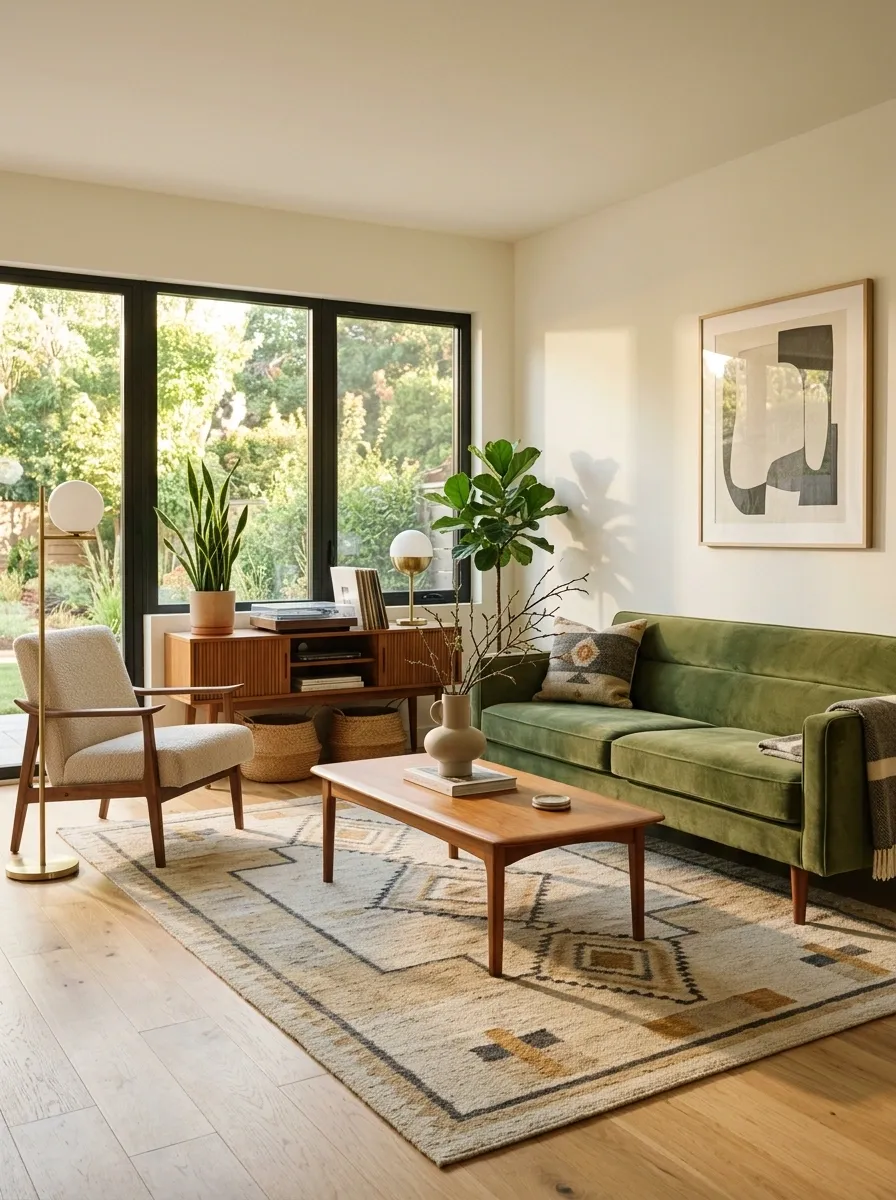
The easiest way to recognize this room is by its strong horizontal lines. A low-profile moss-green sofa sits beside teak furniture, a sculptural lounge chair, a vintage-style rug, and globe lighting that reinforces the mid-century direction.
Nothing needs to be oversized. In fact, oversized pieces would fight the proportions.
The room feels finished because the sofa, coffee table, media furniture, and rug all operate at a similar visual scale. The green becomes part of the furniture language rather than a random splash of color dropped into an otherwise generic room.
And yes, the plants can stay. Just don’t turn the living room into a botanical exhibit because the sofa happens to be green.
Black, White, and Green Contemporary Living Room
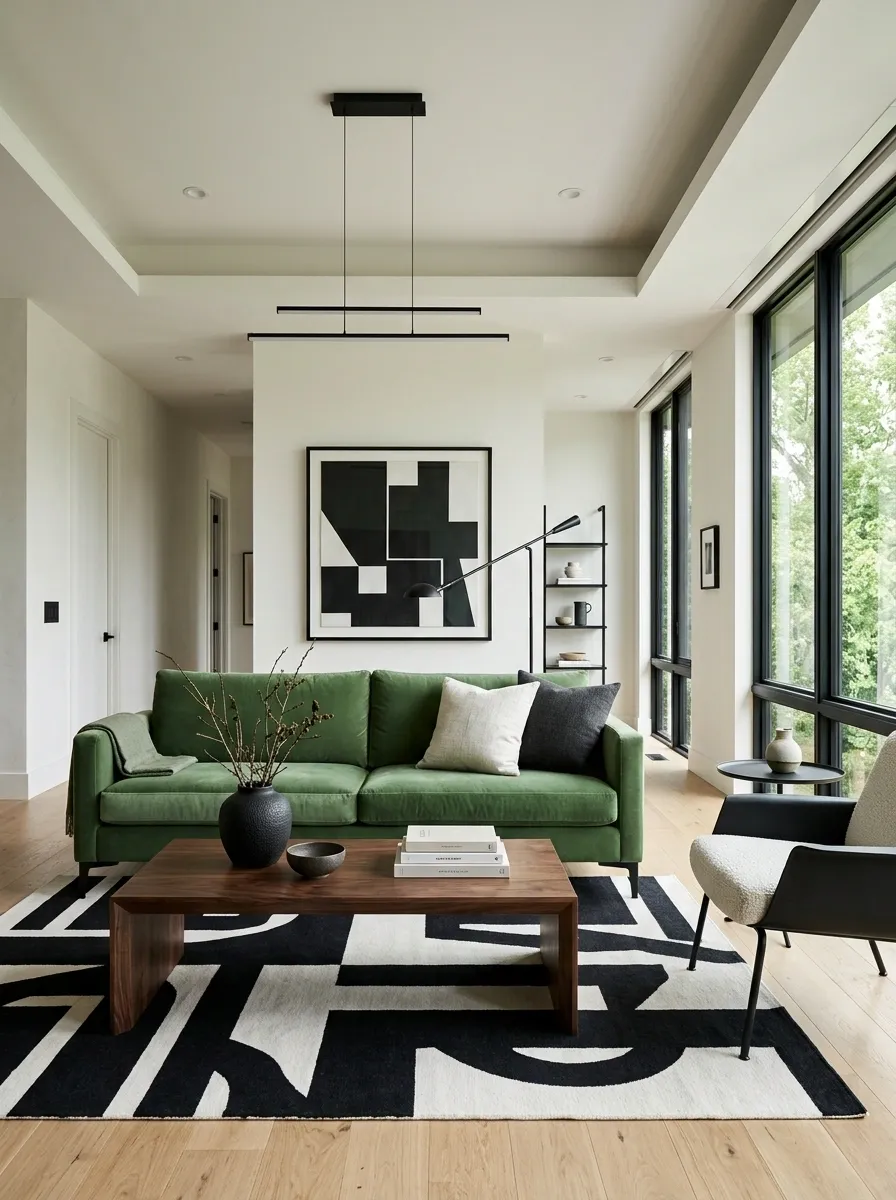
For a sharper look, strip the room back to three major players: green, black, and off-white. A medium green sofa anchors the seating area while crisp walls, black lighting, a dark coffee table, and a graphic rug create a cleaner architectural backdrop.
This is where a green couch can look surprisingly modern. There isn’t a parade of coordinating accessories competing for attention. The color does the work.
Keep the black accents intentional. Too little contrast and the room looks unfinished. Too much and it starts resembling a waiting room designed by someone with a grudge against color.
open background Green
main focal element Black
architectural grounding
Terracotta and Olive Living Room With Mediterranean Warmth
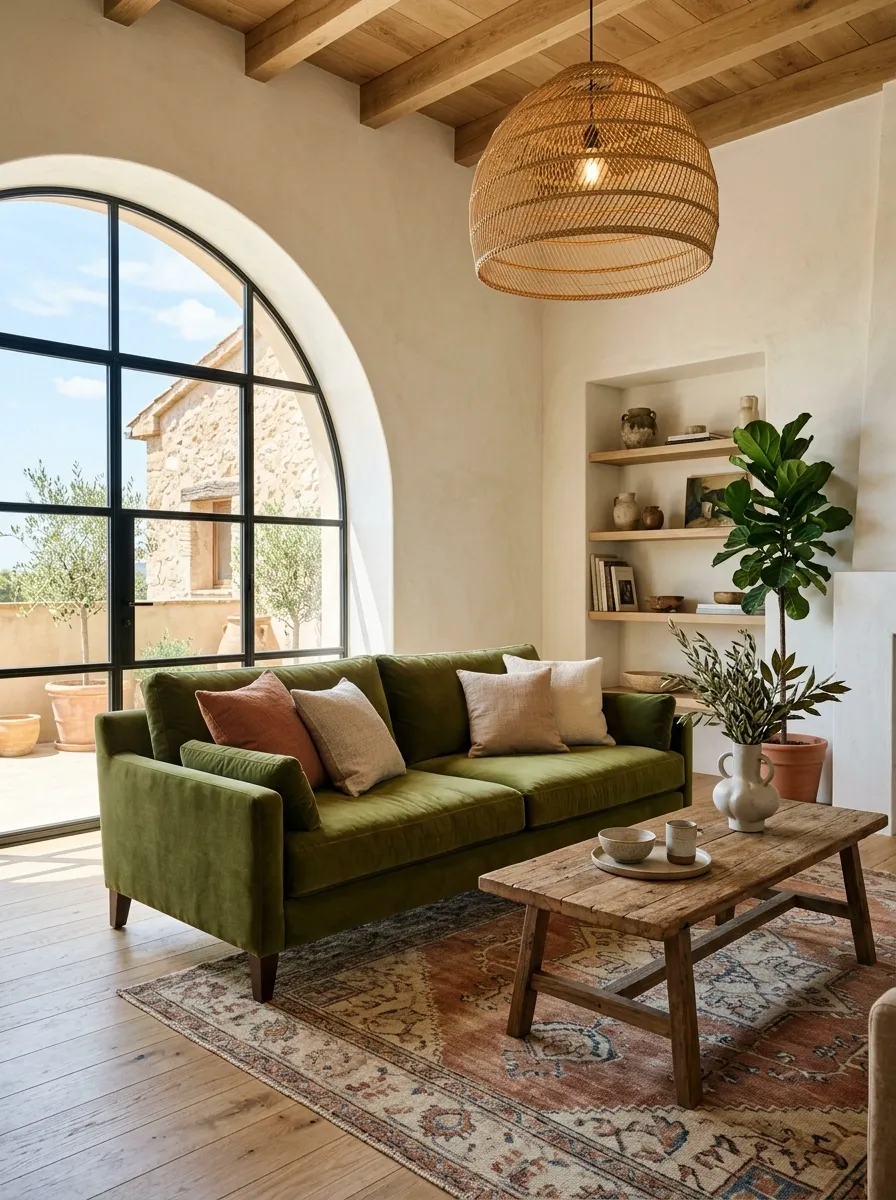
Olive and terracotta have no business looking this good together, yet here they are. The room uses an olive green sofa, creamy walls, terracotta textiles, rustic wood, woven lighting, and a patterned rug to create a warm, sun-washed composition.
The important part is keeping the terracotta slightly quieter than the sofa. Repeating it through a few textiles and smaller surfaces is enough.
The room should feel earthy, not themed. There is a difference between Mediterranean influence and covering the coffee table with souvenirs from a vacation nobody else remembers.
focal Terracotta
counterpoint Cream
visual buffer
Small Apartment Living Room With a Compact Sage Sofa
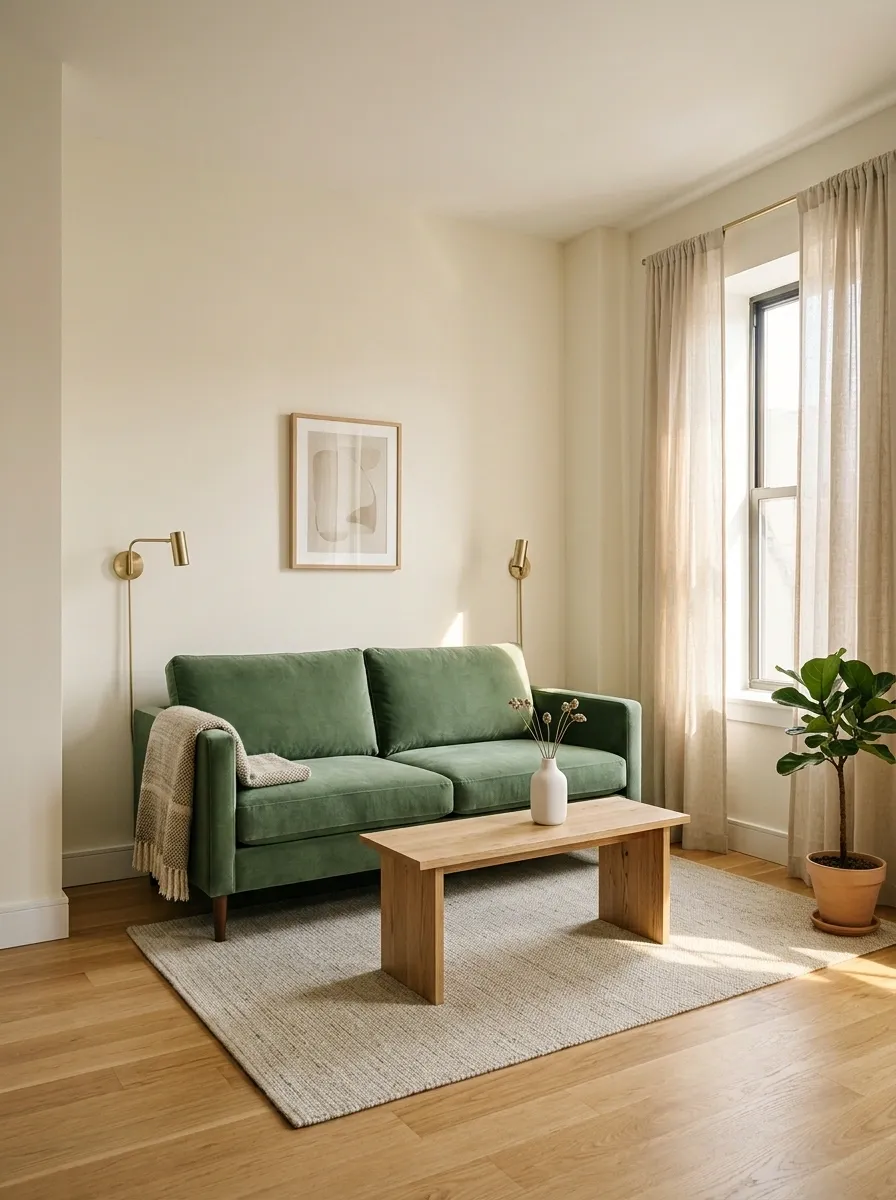
Small rooms don’t need oversized furniture to prove they are living rooms. This compact composition uses a slim sage sofa, pale walls, a narrow oak coffee table, wall-mounted lighting, light curtains, and a modest rug that keeps the floor visually open.
The sofa provides enough color to give the room personality without making the limited square footage feel even tighter.
This approach also proves an important point: a green couch does not have to be massive to anchor a room. Give the furniture some breathing space and suddenly the apartment stops looking like every available inch was claimed during a furniture sale.
English-Style Living Room With Deep Green Sofa and Floral Textiles
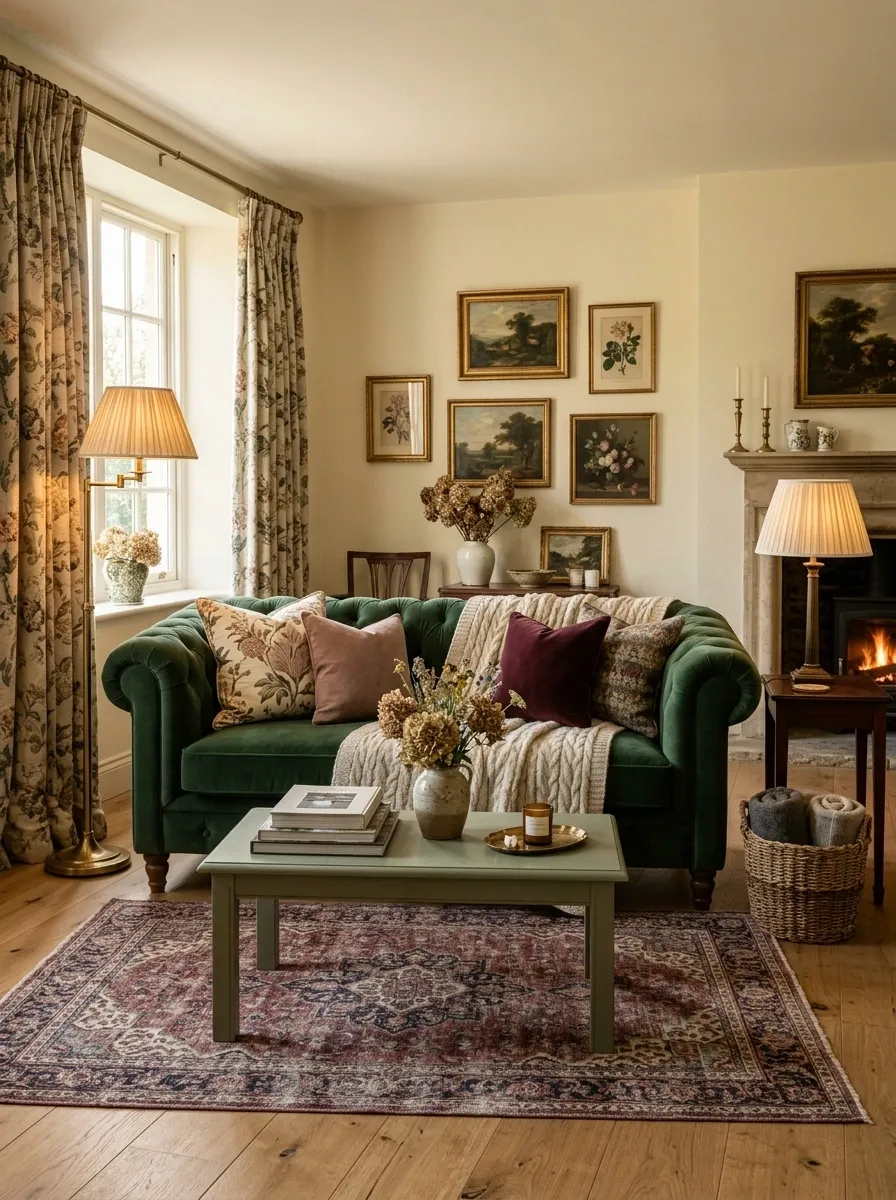
A deep green sofa fits beautifully into an English-inspired room when pattern is allowed to join the conversation. Floral curtains, a traditional rug, painted wood furniture, layered framed art, and warm lamps surround the sofa without trying to copy its exact green.
The result feels collected and slightly old-fashioned in the best possible way.
The trick is variation. Use several patterns at different scales instead of repeating one floral print everywhere. Otherwise the room starts looking less “English country house” and more “fabric department having a difficult afternoon.”
Main sofa
Rug or curtains
Accent textile
Dusty Green Sofa in a Quiet Japandi Living Room
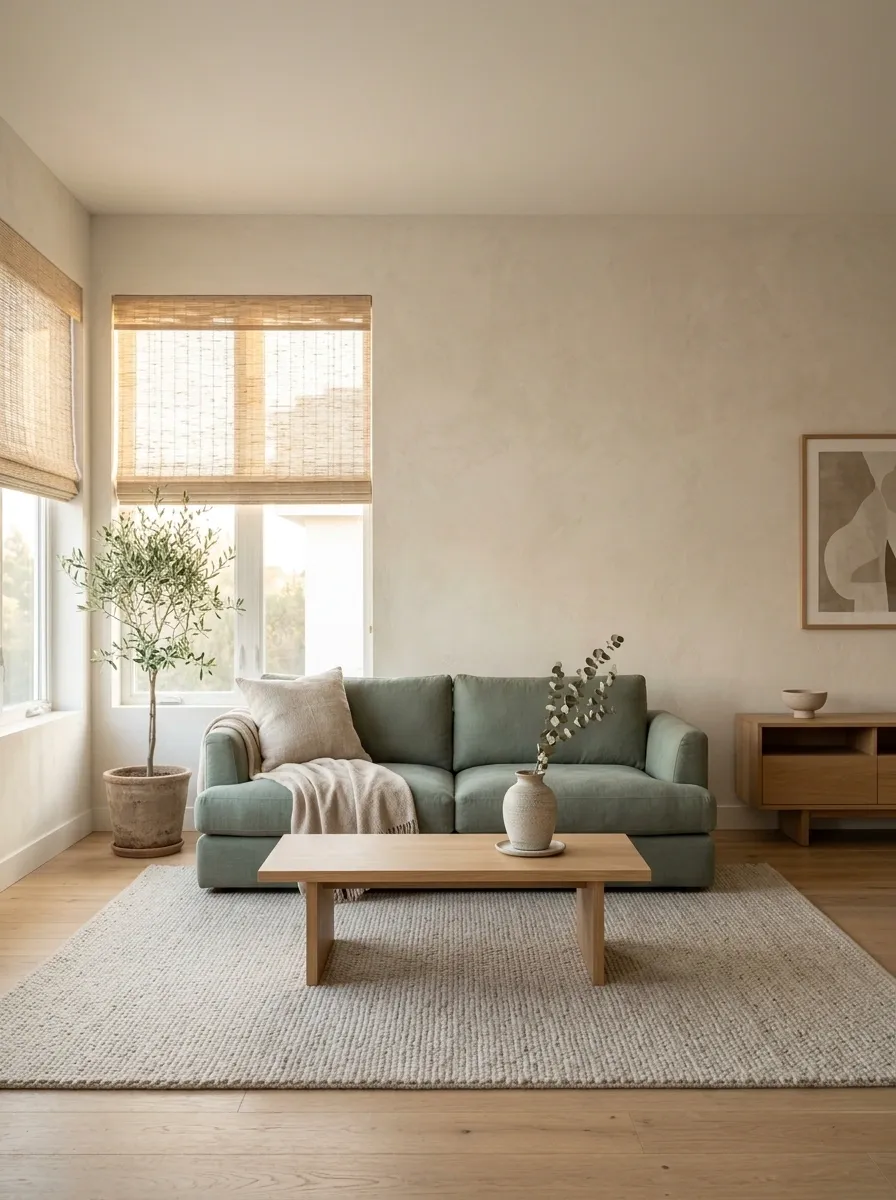
This version takes the green sofa in the opposite direction. No gallery-wall explosion. No pile of decorative objects pretending to be personality. Just a dusty green sofa, pale plaster-like walls, light oak, low furniture, woven shades, and a handful of carefully placed pieces.
The low profile keeps the room visually calm, while the muted green adds just enough depth to prevent the neutral palette from becoming painfully bland.
The restraint is the whole point. Once the room already has this much quiet confidence, adding more “decor” isn’t improvement. It’s just noise.
Charcoal Walls With Moss Sofa and Warm Layered Lighting
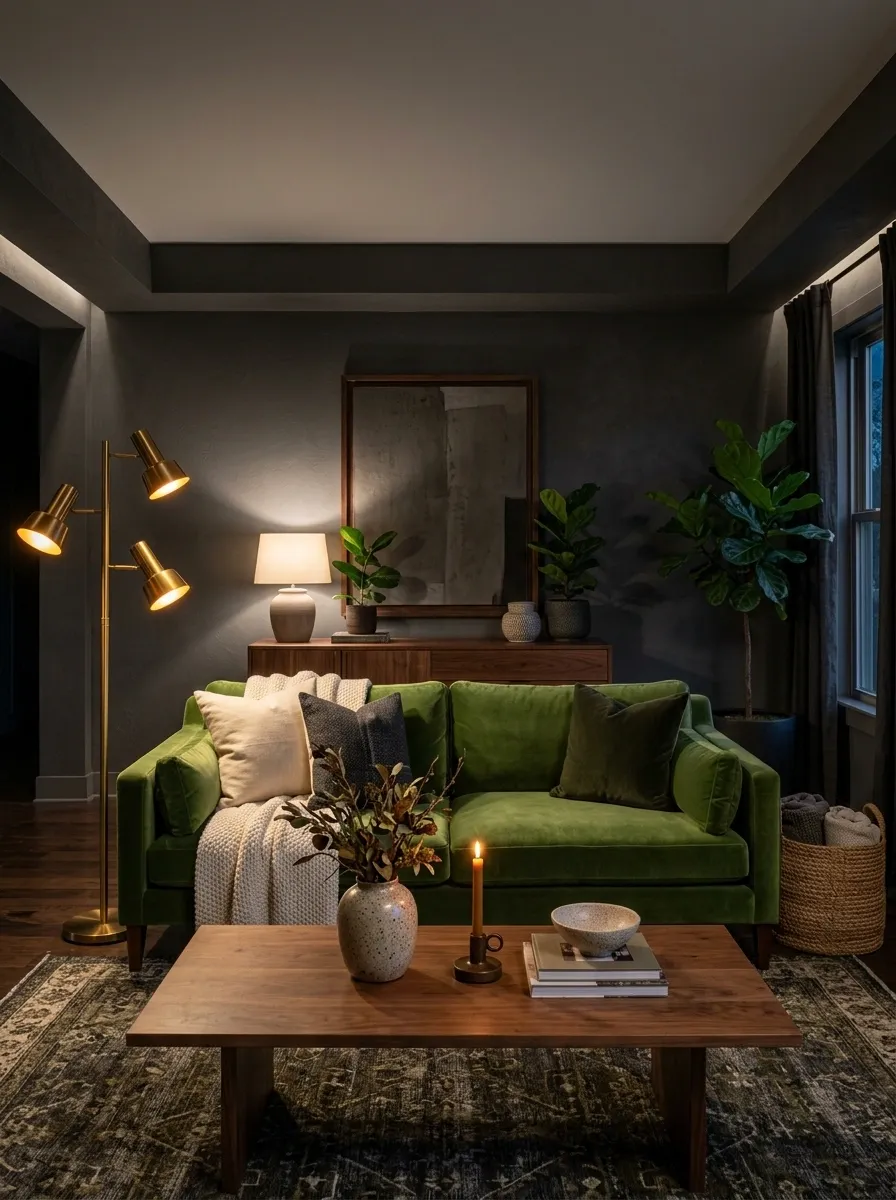
A moss-green sofa looks unexpectedly rich against charcoal walls. Add walnut furniture, cream textiles, dark accents, and warm lamps, and the room becomes dramatic without becoming gloomy.
Lighting is the secret weapon here. One ceiling fixture isn’t enough. Table lamps, floor lamps, and controlled accent lighting create pools of warmth that keep the darker palette dimensional.
This is an evening room. It doesn’t need to pretend otherwise.
Coastal Living Room With a Soft Sea-Green Sofa
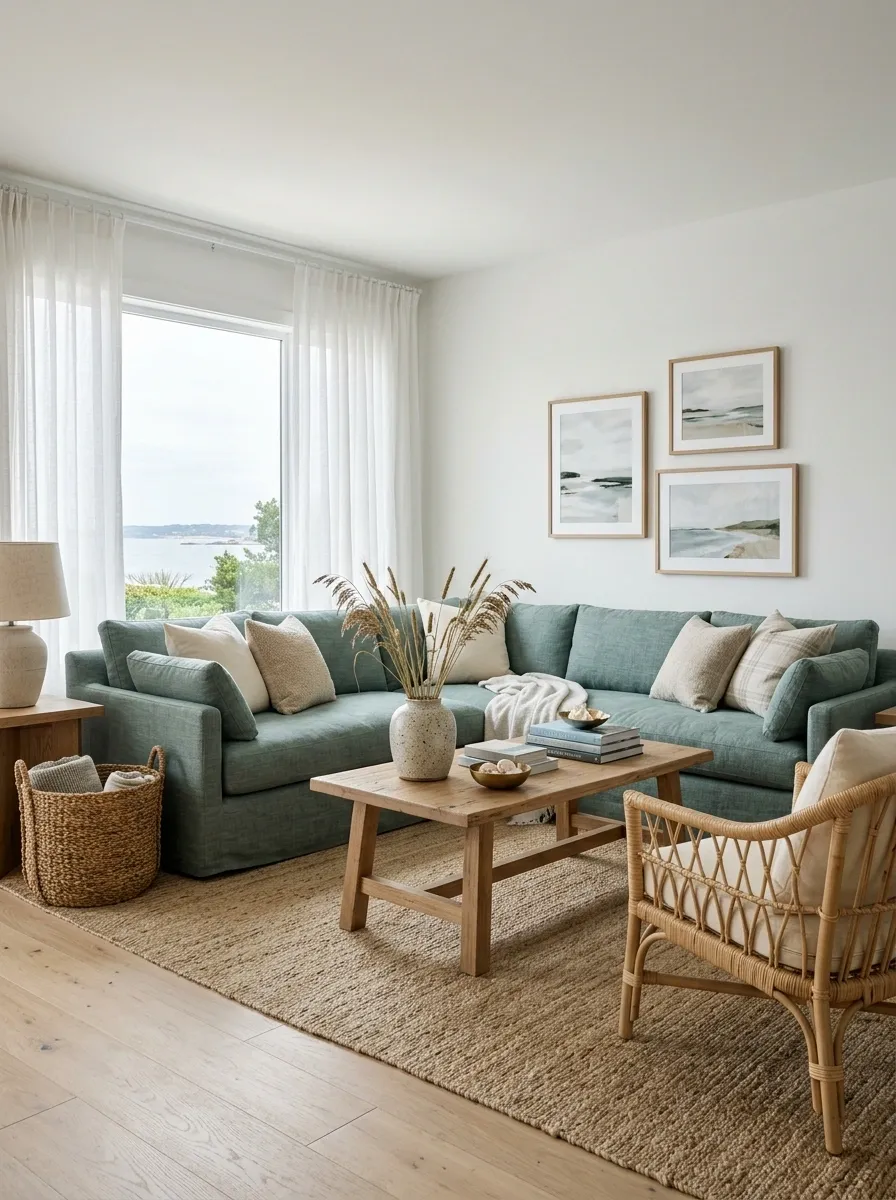
Not every green sofa needs to look earthy. A softer blue-green couch can take a coastal room in a completely different direction when paired with chalky white walls, pale oak, linen curtains, woven textures, and restrained artwork.
The room avoids the usual beach-house clichés. There are no anchors begging for attention and no collection of seashells that somehow needs to explain itself.
Instead, color and texture carry the coastal feeling. The blue-green upholstery supplies the water reference while natural wood and woven materials keep the space warm.
cool focal White
light backdrop Oak
warm counterweight
Curved Green Sofa With Creamy Transitional Layers
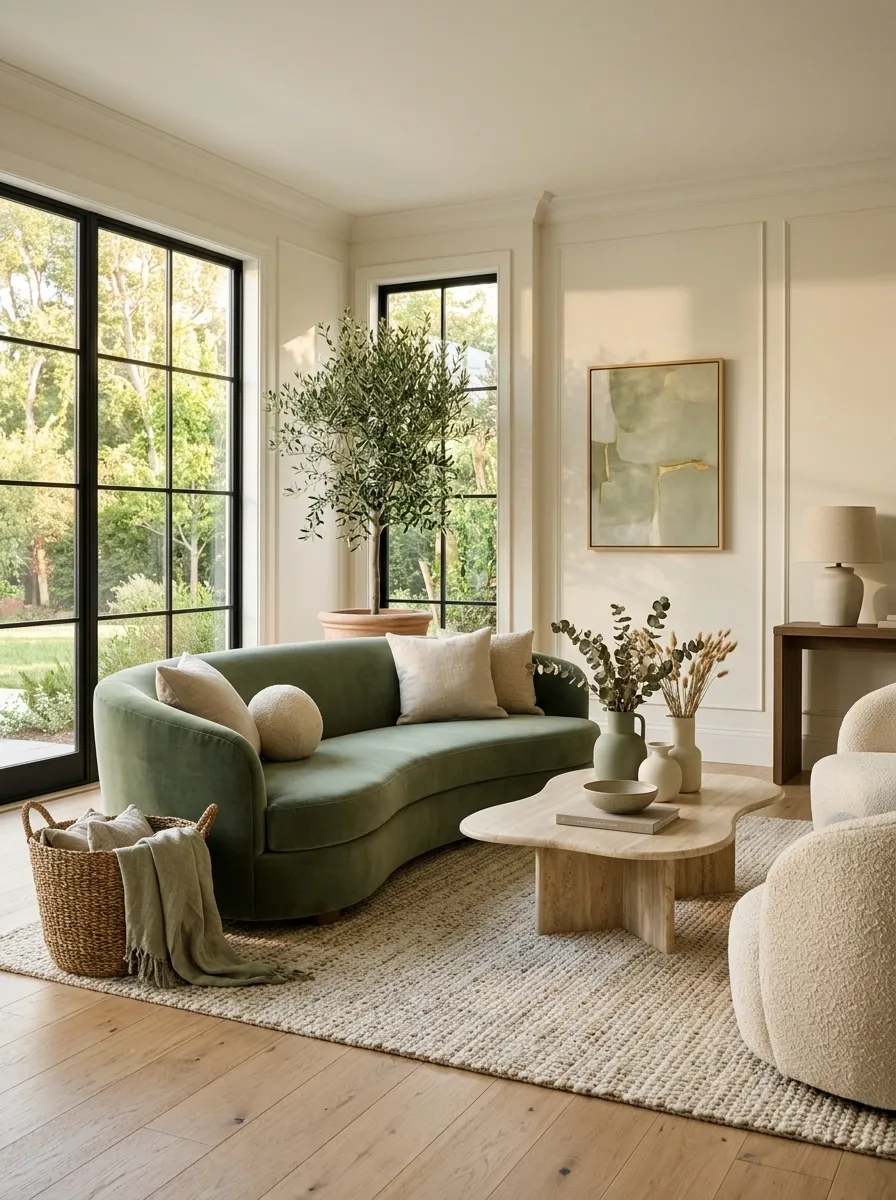
A curved green sofa changes the entire geometry of a living room. Instead of building the composition around hard rectangular furniture, this version repeats softer shapes through rounded accent chairs, circular lighting, a gently shaped coffee table, and quiet cream walls.
Light wood and stone keep the room grounded while the green sofa provides the color.
The curves should be noticeable, not ridiculous. One sculptural sofa can be memorable. Six rounded objects lined up together starts looking like furniture was designed by a bowl collection.
Rounded lighting echoes it lightly.
Straight walls and flooring keep the room grounded.
Large Open-Plan Room With an Olive Green Sectional
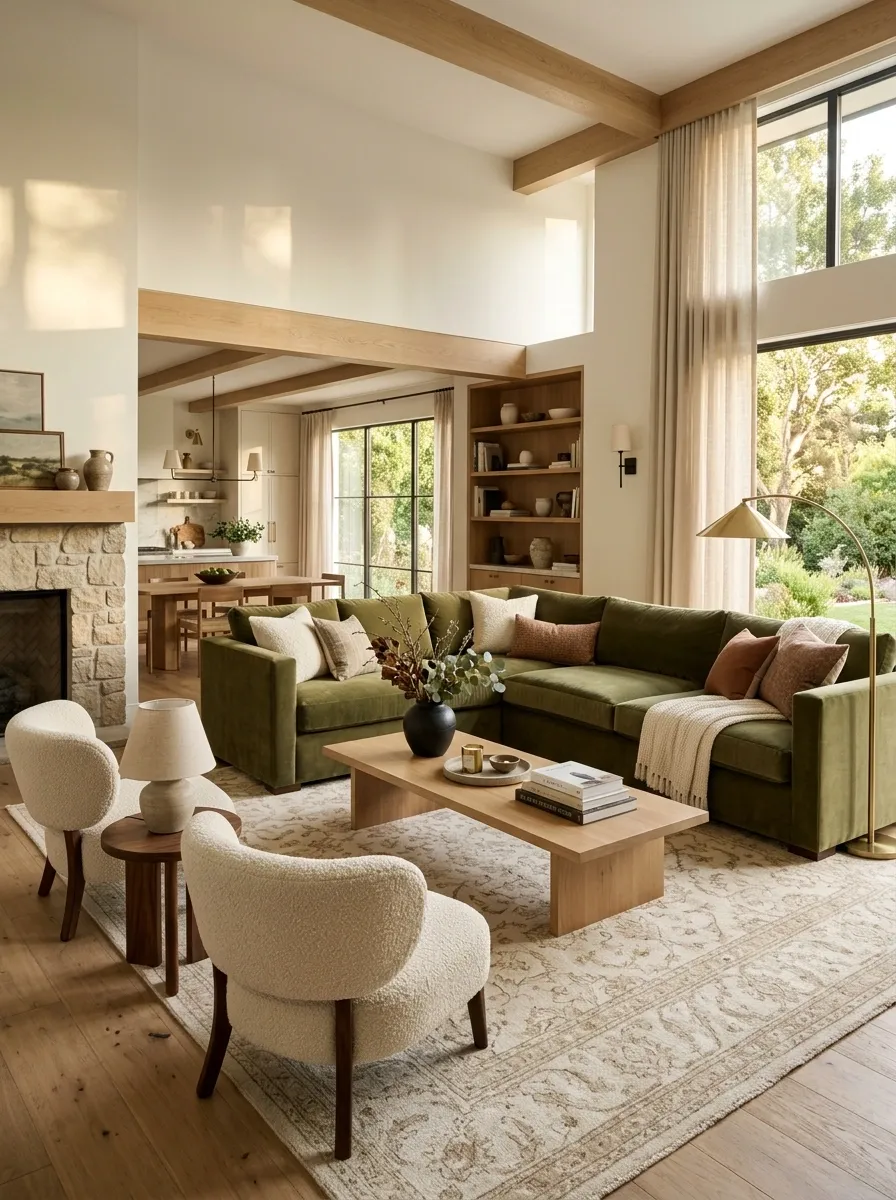
A huge open-plan room needs furniture with enough visual weight to hold its ground. A substantial olive sectional does that here, paired with an oversized rug, long wood coffee table, two contrasting chairs, and layered lighting.
The sectional defines the living zone without needing walls to announce where one space ends and another begins. The rug reinforces the boundary, while the long coffee table follows the sofa’s shape and keeps the arrangement conversational.
This is a useful reminder that open-plan doesn’t mean furniture should float around randomly like it’s waiting for instructions.
Large rug visually gathers the furniture.
Coffee table connects the seating.
Lighting reinforces the zone after dark.
Soft Moss Sofa With Painted Furniture in a Cottage Living Room
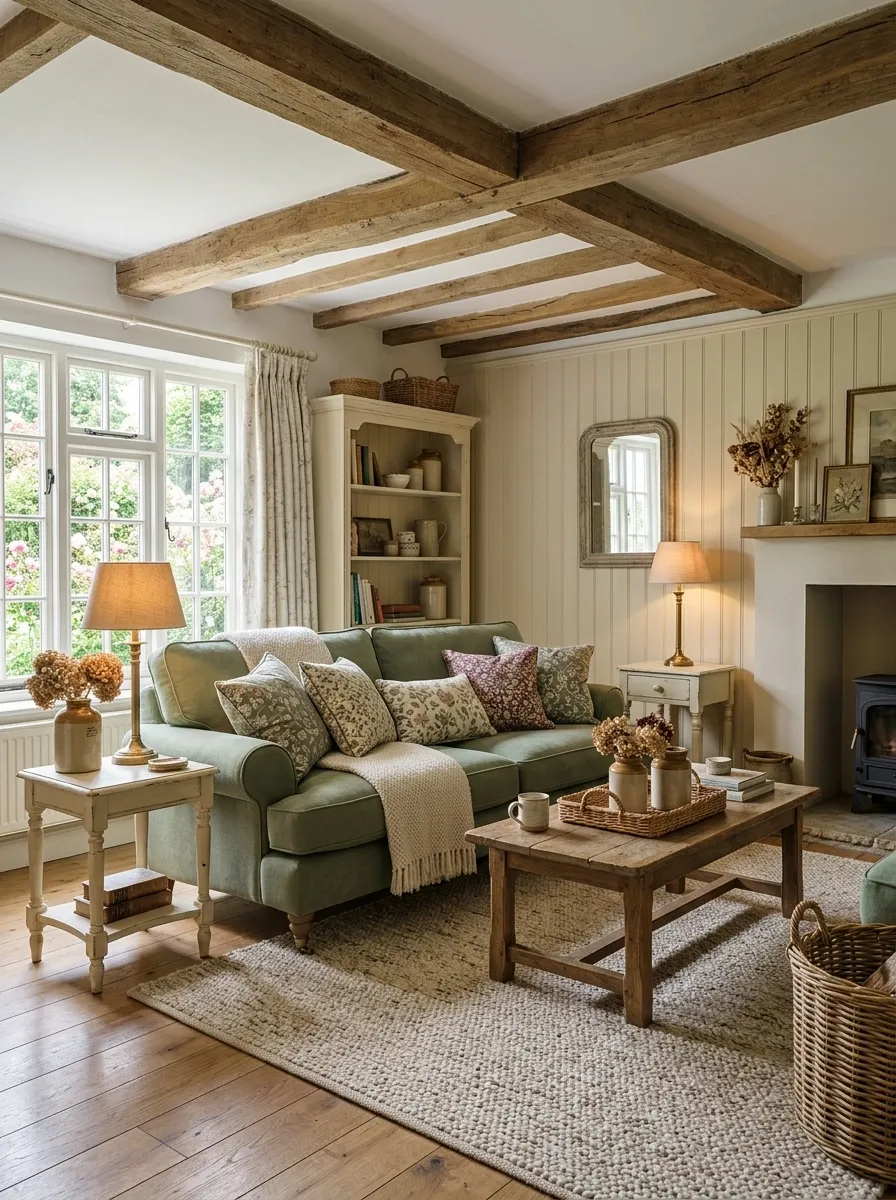
This cottage-inspired room keeps the green sofa soft and relaxed with painted wood furniture, floral textiles, warm lamps, woven baskets, and visible architectural character.
The furniture isn’t overly formal, and the patterns stay small enough to feel collected rather than theatrical. A warm neutral rug gives all the separate pieces somewhere to land.
There’s no need to make every surface distressed, chipped, or aggressively “rustic.” One or two aged finishes have more credibility than a room full of objects desperately trying to prove they have seen a barn.
upholstery
wood
textiles
lighting
Dark Green Leather Sofa With Industrial Wood and Metal
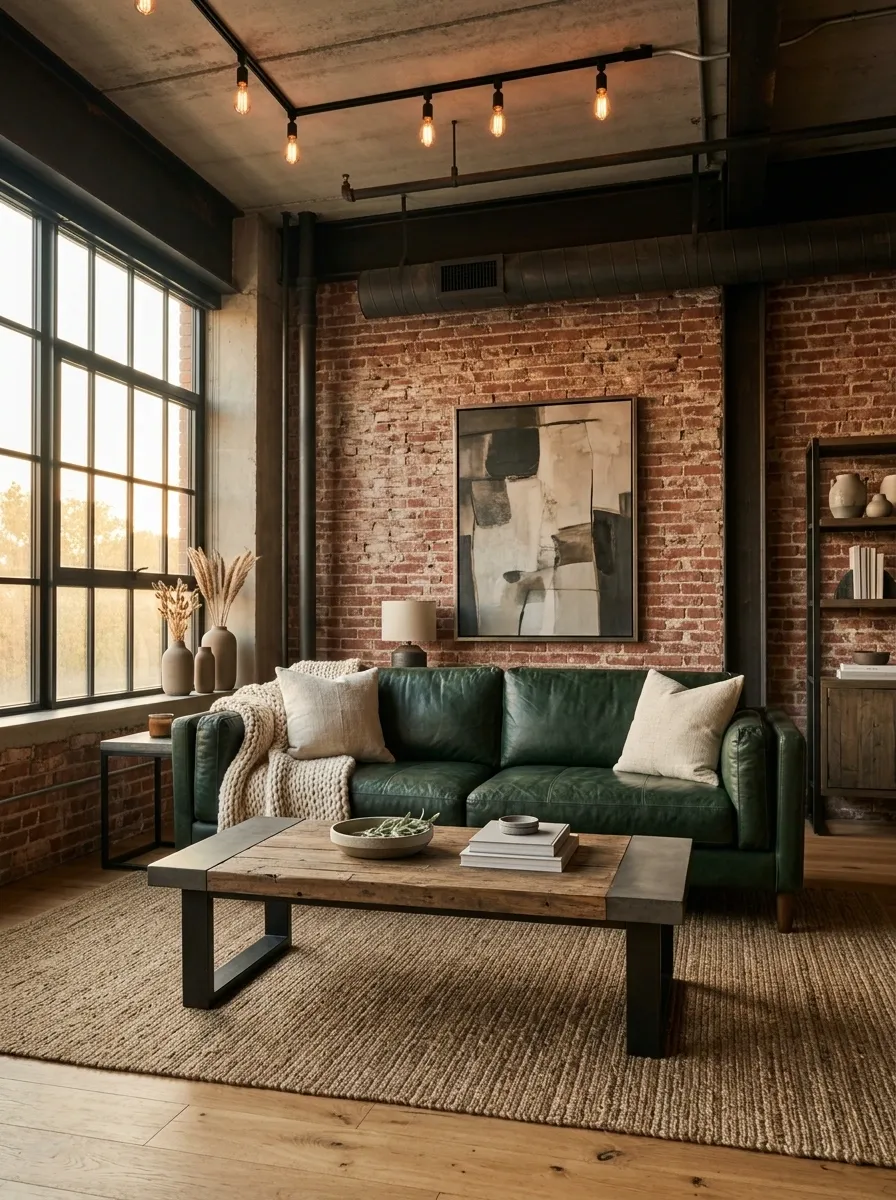
Green leather gives an industrial room something it badly needs: softness. The composition combines a deep green leather sofa with aged wood, black metal, concrete-toned surfaces, exposed architectural details, and warm lighting.
The leather becomes the bridge between the hard finishes. It adds color and texture without making the space feel overly decorated.
Keep the supporting palette controlled. Industrial rooms can handle visual weight, but piling on every available metal, brick, pipe, and vintage object is how a living room starts auditioning for a restaurant franchise.
Light-Filled Scandinavian Living Room With a Muted Green Sofa
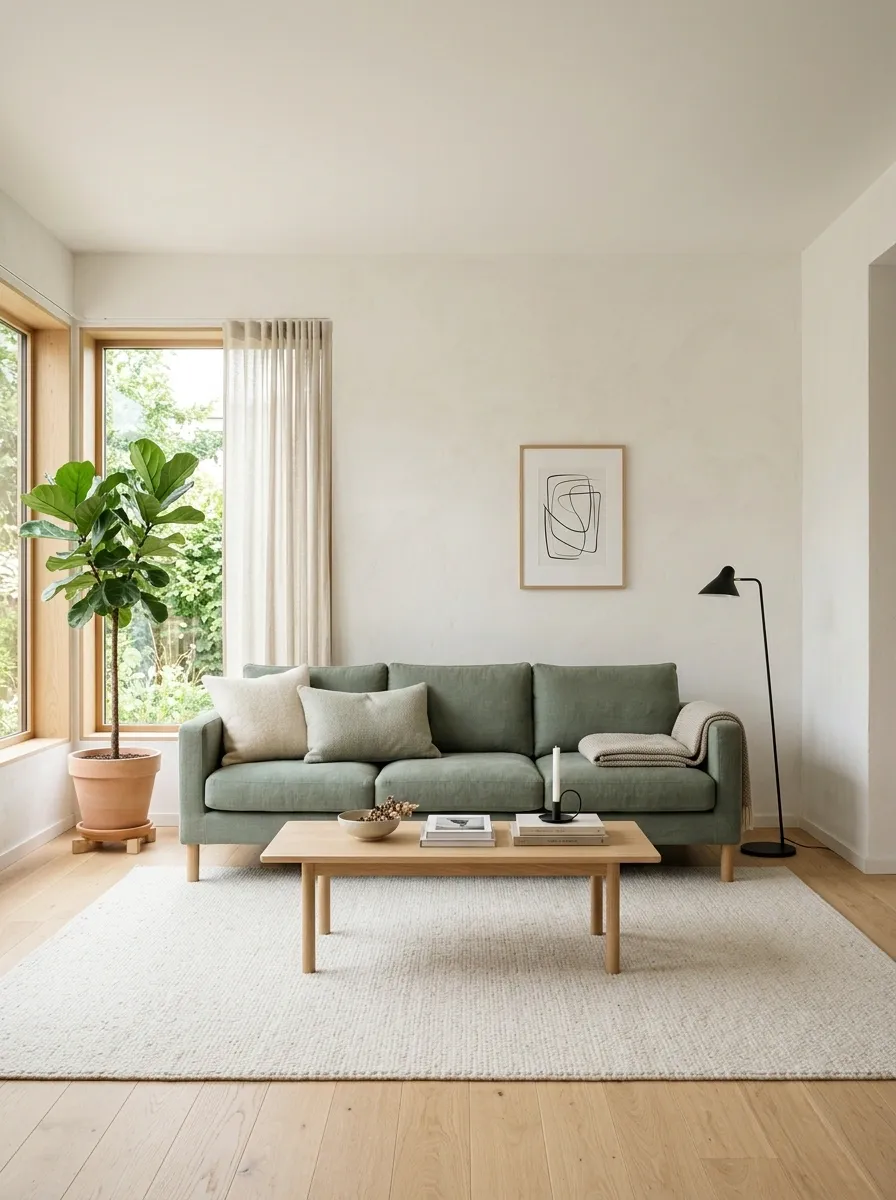
A muted green sofa can look remarkably fresh when nearly everything around it stays pale. This room uses blond wood, warm white walls, a soft wool rug, simple lighting, and sparse artwork to create a light Scandinavian composition.
The sofa becomes the only substantial color event, which keeps the room clean without making it sterile.
The furniture should stay visually light too. Thick, bulky pieces would kill the airy quality. Let the room breathe rather than filling every corner because an empty corner apparently offended someone.
Dusty Green Sofa With Blush, Cream, and Warm Wood
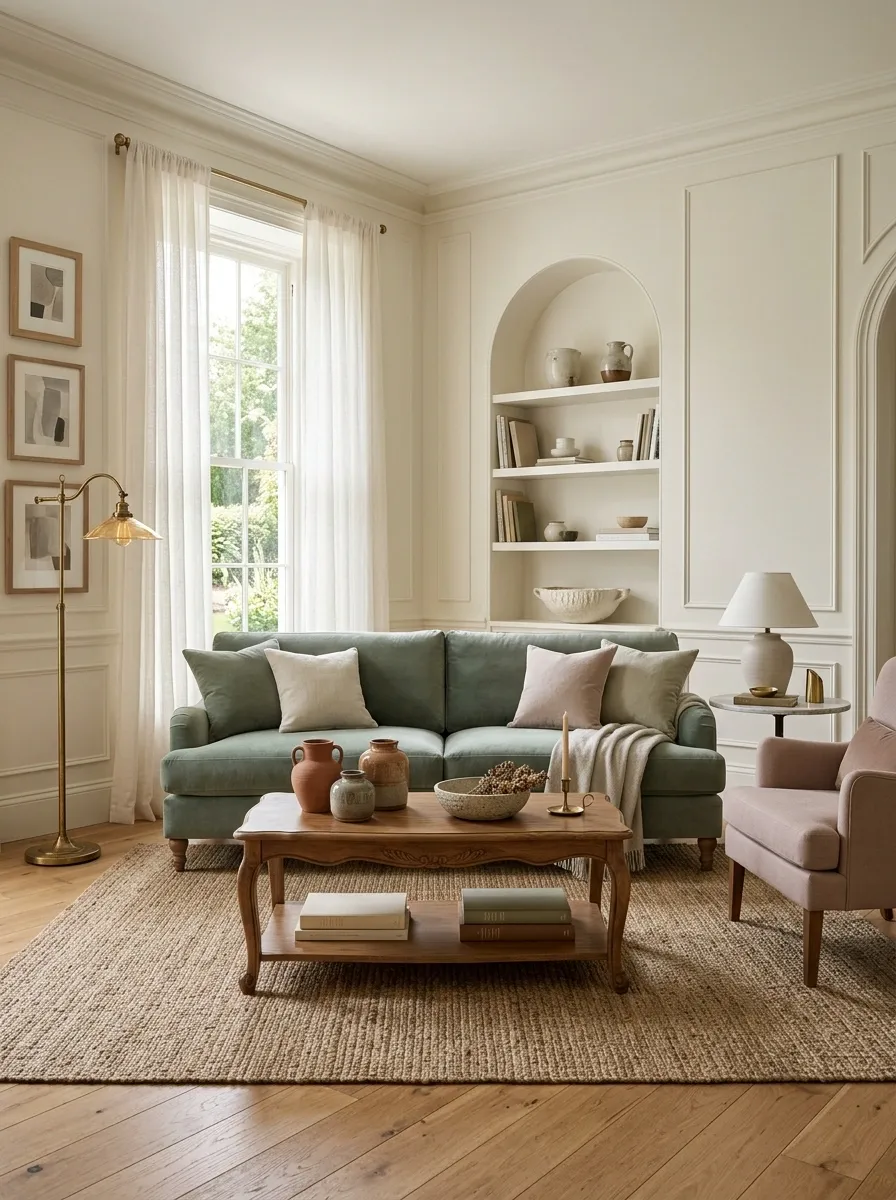
Green and blush can look dated when they’re pushed too hard. Used in muted versions with creamy walls and warm wood, they become much more sophisticated.
The sofa stays dusty green rather than jewel-toned, while blush appears through one or two supporting textiles or an upholstered chair. Warm wood keeps the palette grounded, and antique-inspired lighting adds just enough character.
The winning move is keeping the blush secondary. The room needs contrast, not a pink-green tug-of-war.
Modern Farmhouse Living Room With Olive Sofa and Black Accents
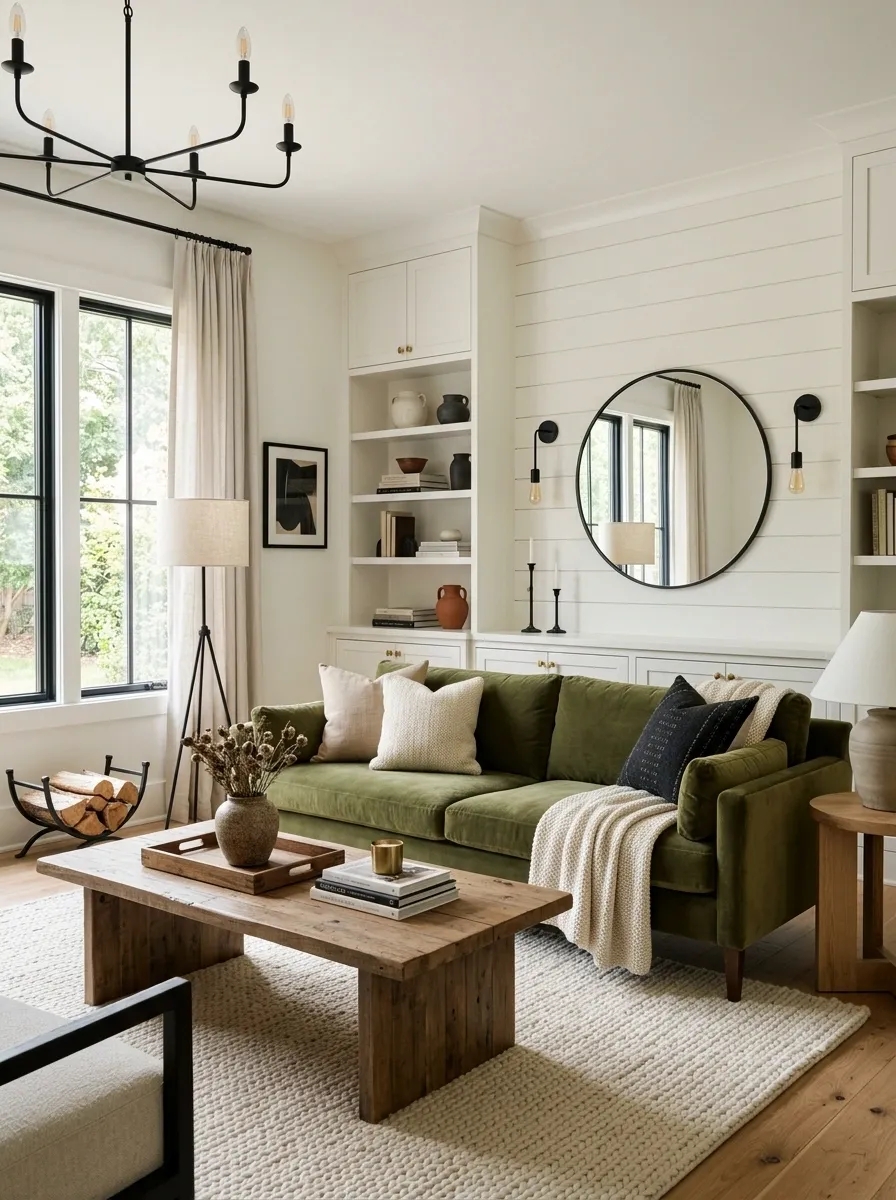
This version skips the overly rustic farmhouse routine and keeps the architecture cleaner. An olive sofa sits against warm white walls with a substantial wood coffee table, black lighting, simple cabinetry, textured rug, and understated ceramic pieces.
The black accents sharpen the room while the wood keeps it from feeling cold. The sofa adds more character than a neutral version would, but it still sits comfortably inside the farmhouse palette.
The result is farmhouse without turning the living room into a catalog of faux nostalgia.
color
warmth
contrast
softness
Small Traditional Living Room With a Dark Sage Sofa
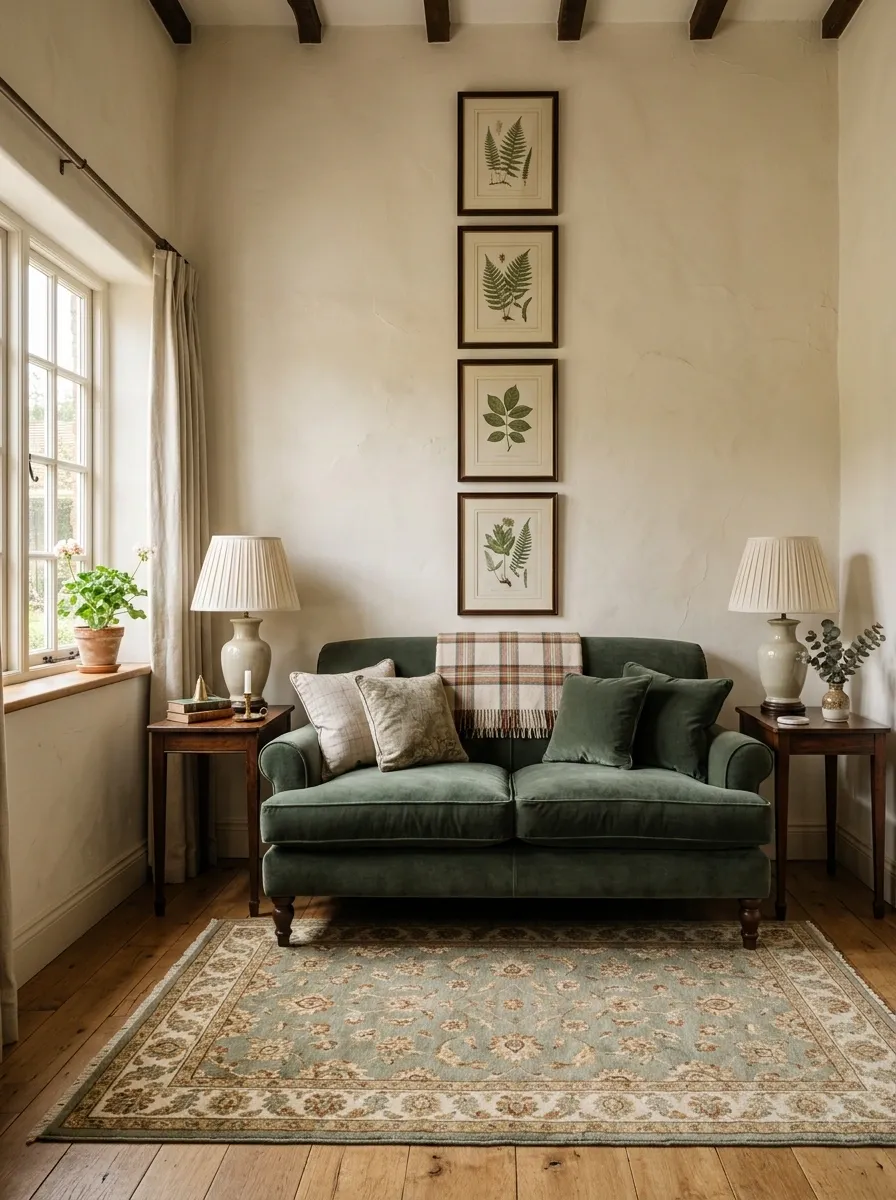
Traditional furniture doesn’t have to disappear just because the room is small. A dark sage sofa works beautifully with cream walls, a scaled traditional rug, narrow wood tables, classic lamps, and vertically oriented artwork.
The important word here is scale. A tiny room cannot support furniture chosen for a ballroom.
The artwork climbs vertically, the furniture stays relatively compact, and the rug gives the seating area enough visual weight without swallowing the floor. Traditional character stays intact without making the room feel stuffed.
Vertical artwork uses wall height.
Scaled rug gathers the seating without taking over.
Dark sage adds depth without requiring extra decoration.
Monochromatic Green Living Room With Layered Shades
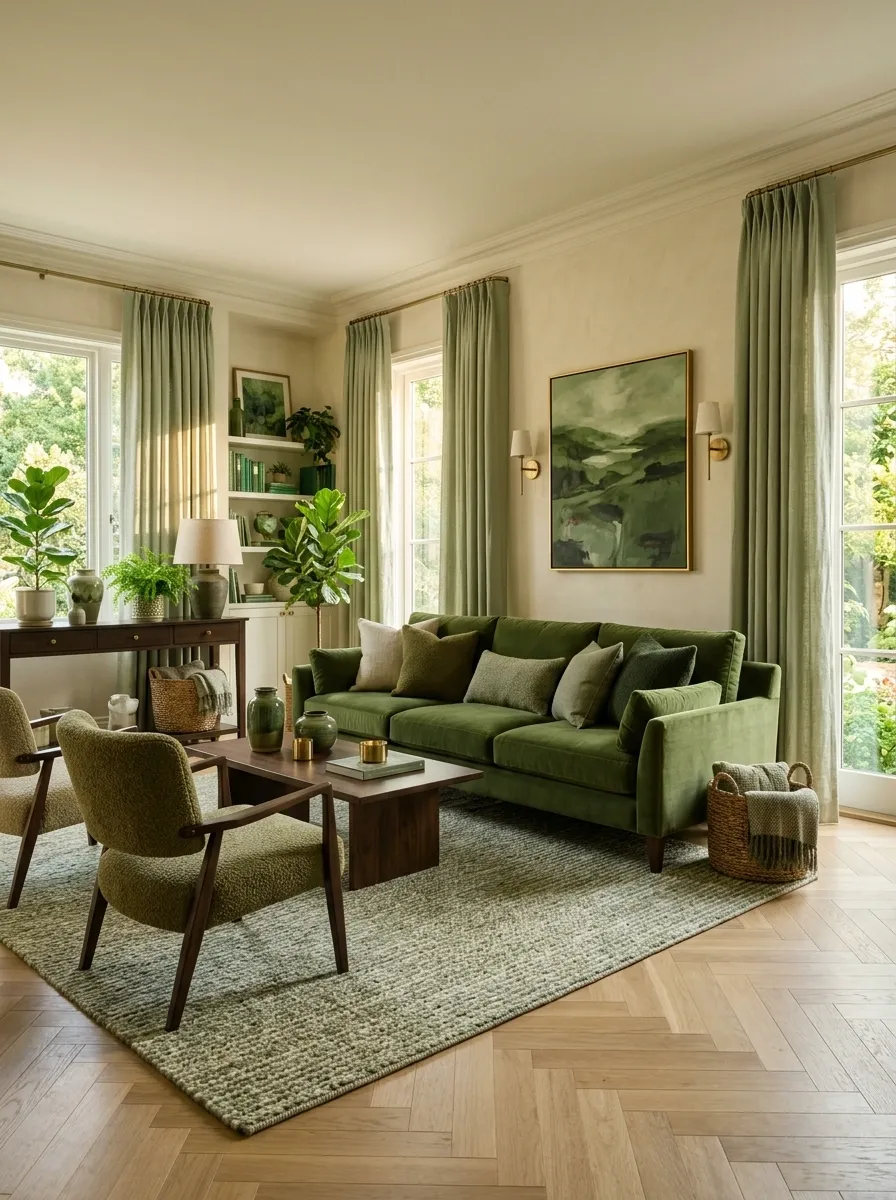
Why stop at one green when the shades can do the interesting work? This room layers sage, moss, olive, and deeper forest tones across the sofa, curtains, artwork, occasional upholstery, and smaller accents.
The surrounding neutrals remain warm and quiet so the different greens don’t turn into a competition.
The secret is changing value and texture, not simply buying five objects in five versions of green. Otherwise the room starts looking less layered and more like someone discovered a paint fan and lost their sense of proportion.
Green Sofa With Cream Companion Chairs and a Strong Conversation Layout
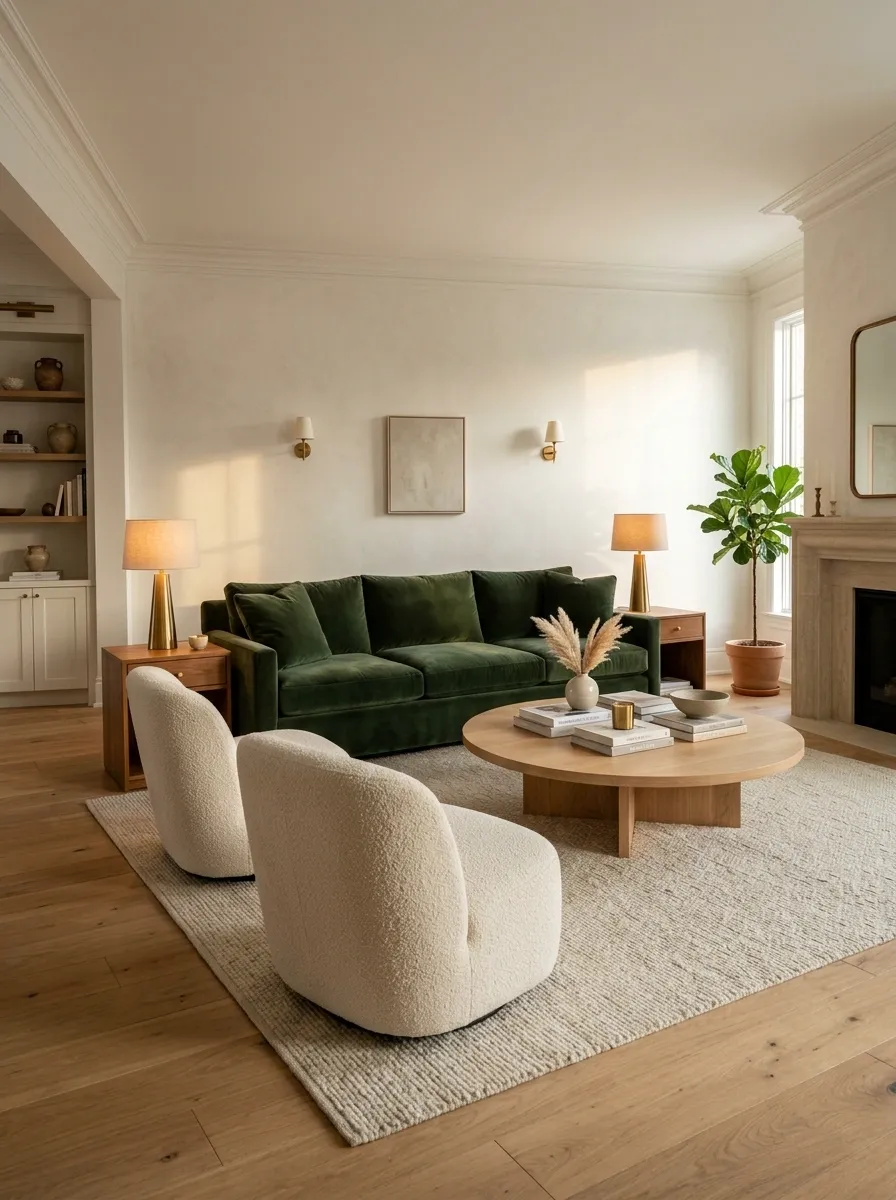
This room is built around conversation rather than a television taking command of the entire furniture plan. A substantial green sofa faces two cream lounge chairs, with a generous coffee table and large neutral rug connecting the group.
Warm wood tables and soft lighting keep the seating arrangement approachable, while the green couch gives the composition a clear focal point.
The trick is leaving enough space between the pieces for people to actually move. Revolutionary concept, apparently.
main seating and visual anchor Cream chairs
secondary seating and visual relief Central table
keeps the entire arrangement connected
Olive and Rust Living Room With Southwestern Influence
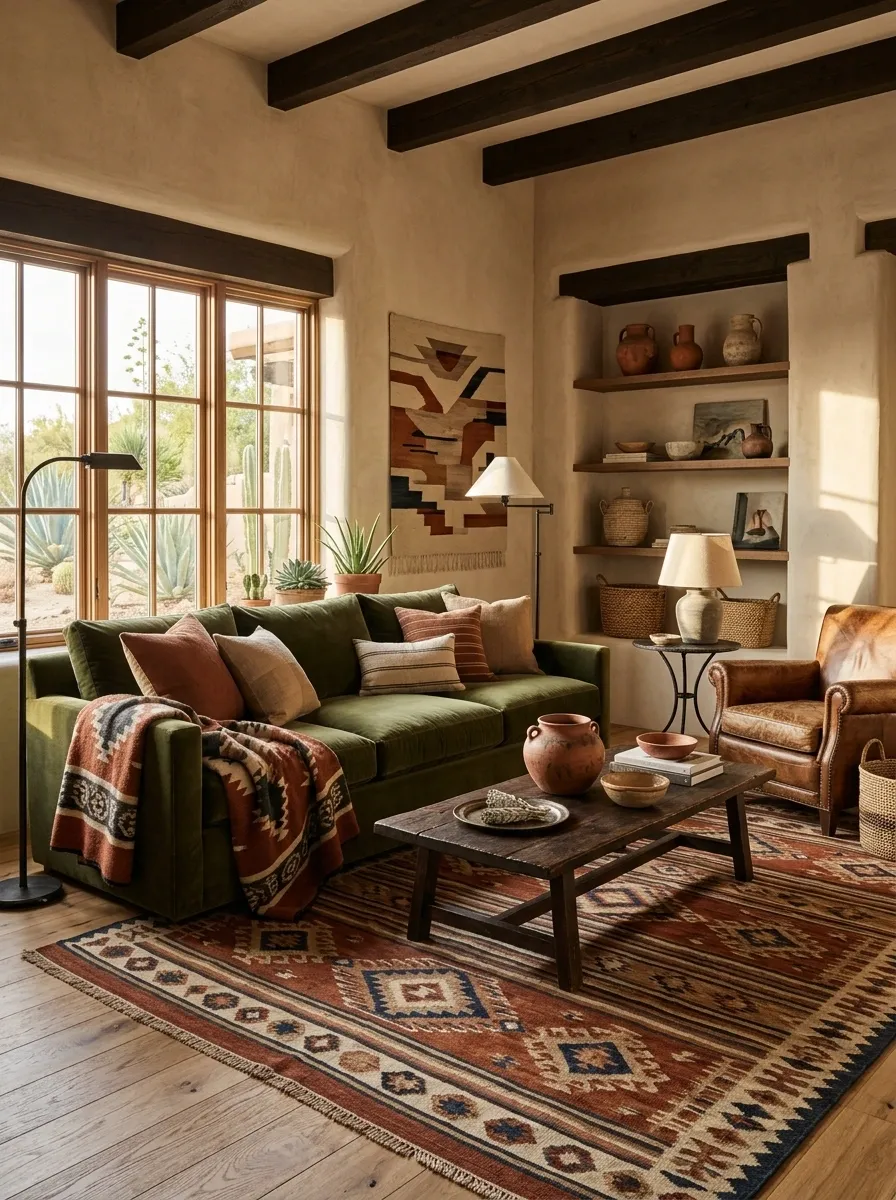
Olive green becomes warmer and more relaxed when rust, sand, dark wood, woven materials, and earthy patterns join it. This room uses those relationships to create a Southwestern-influenced look without turning every surface into a desert-themed prop.
The sofa provides the large block of color. Rust appears in textiles, the rug adds pattern, and dark wood gives the room some visual weight.
Texture matters more than decoration here. Woven fibers, leather, pottery, and wool can carry the theme without spelling it out.
anchor Rust
heat Sand
lightness Dark wood
weight
Soft Gray-Green Sofa in a Minimal Contemporary Room
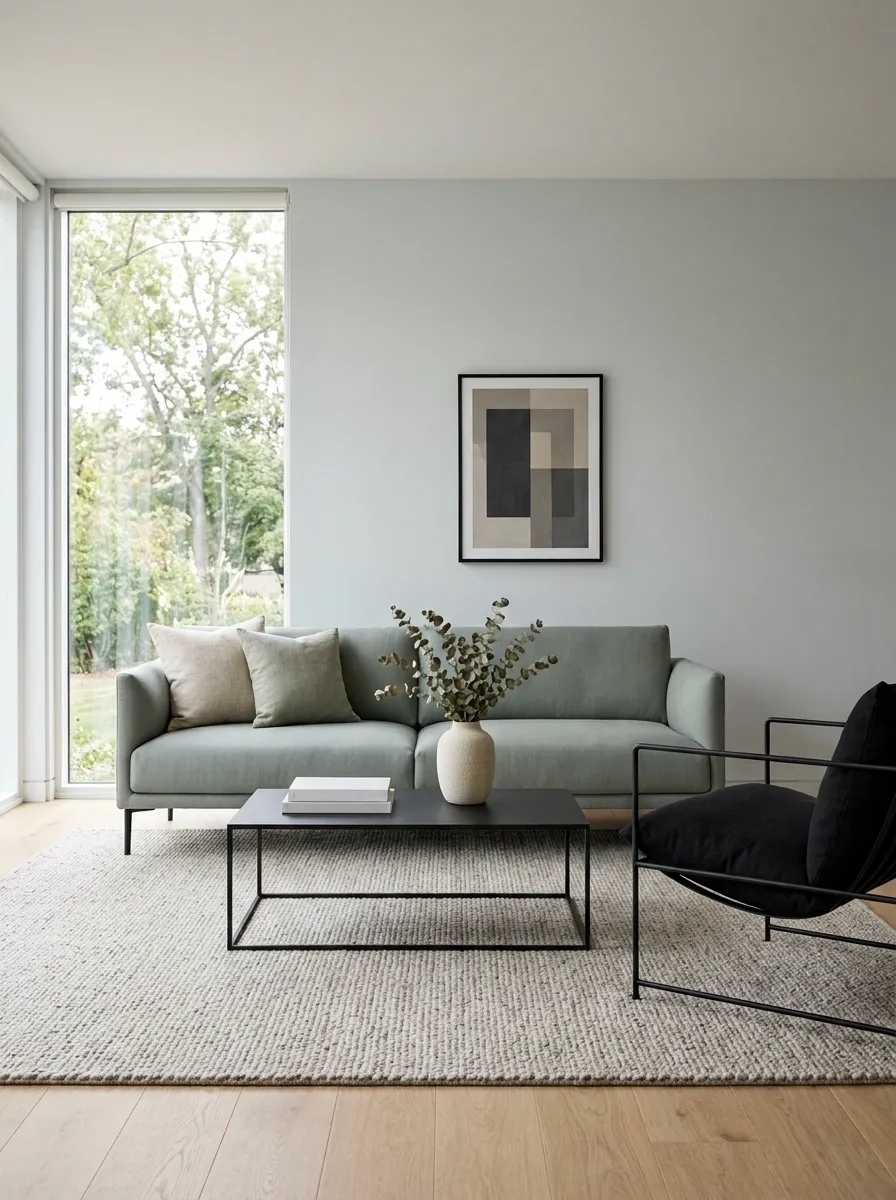
Gray-green is the quiet overachiever of the green sofa family. It gives the room color without demanding that everyone notice it from three rooms away.
This composition pairs a soft gray-green sofa with pale gray walls, simple black furniture, a broad neutral rug, and minimal artwork. The result is restrained, but not lifeless. Slight shifts between the gray, green, cream, and black create enough contrast to keep the room interesting.
The furniture should stay clean-lined. Throwing a rustic coffee table and six decorative baskets into this room would defeat the entire exercise.
Large Open-Plan Room With an Olive Green Sectional
A huge open-plan room needs furniture with enough visual weight to hold its ground. A substantial olive sectional does that here, paired with an oversized rug, long wood coffee table, two contrasting chairs, and layered lighting.
The sectional defines the living zone without needing walls to announce where one space ends and another begins. The rug reinforces the boundary, while the long coffee table follows the sofa’s shape and keeps the arrangement conversational.
This is a useful reminder that open-plan doesn’t mean furniture should float around randomly like it’s waiting for instructions.
Large rug visually gathers the furniture.
Coffee table connects the seating.
Lighting reinforces the zone after dark.
Soft Moss Sofa With Painted Furniture in a Cottage Living Room
This cottage-inspired room keeps the green sofa soft and relaxed with painted wood furniture, floral textiles, warm lamps, woven baskets, and visible architectural character.
The furniture isn’t overly formal, and the patterns stay small enough to feel collected rather than theatrical. A warm neutral rug gives all the separate pieces somewhere to land.
There’s no need to make every surface distressed, chipped, or aggressively “rustic.” One or two aged finishes have more credibility than a room full of objects desperately trying to prove they have seen a barn.
upholstery
wood
textiles
lighting
Dark Green Leather Sofa With Industrial Wood and Metal
Green leather gives an industrial room something it badly needs: softness. The composition combines a deep green leather sofa with aged wood, black metal, concrete-toned surfaces, exposed architectural details, and warm lighting.
The leather becomes the bridge between the hard finishes. It adds color and texture without making the space feel overly decorated.
Keep the supporting palette controlled. Industrial rooms can handle visual weight, but piling on every available metal, brick, pipe, and vintage object is how a living room starts auditioning for a restaurant franchise.
Light-Filled Scandinavian Living Room With a Muted Green Sofa
A muted green sofa can look remarkably fresh when nearly everything around it stays pale. This room uses blond wood, warm white walls, a soft wool rug, simple lighting, and sparse artwork to create a light Scandinavian composition.
The sofa becomes the only substantial color event, which keeps the room clean without making it sterile.
The furniture should stay visually light too. Thick, bulky pieces would kill the airy quality. Let the room breathe rather than filling every corner because an empty corner apparently offended someone.
Dusty Green Sofa With Blush, Cream, and Warm Wood
Green and blush can look dated when they’re pushed too hard. Used in muted versions with creamy walls and warm wood, they become much more sophisticated.
The sofa stays dusty green rather than jewel-toned, while blush appears through one or two supporting textiles or an upholstered chair. Warm wood keeps the palette grounded, and antique-inspired lighting adds just enough character.
The winning move is keeping the blush secondary. The room needs contrast, not a pink-green tug-of-war.
Modern Farmhouse Living Room With Olive Sofa and Black Accents
This version skips the overly rustic farmhouse routine and keeps the architecture cleaner. An olive sofa sits against warm white walls with a substantial wood coffee table, black lighting, simple cabinetry, textured rug, and understated ceramic pieces.
The black accents sharpen the room while the wood keeps it from feeling cold. The sofa adds more character than a neutral version would, but it still sits comfortably inside the farmhouse palette.
The result is farmhouse without turning the living room into a catalog of faux nostalgia.
color
warmth
contrast
softness
Small Traditional Living Room With a Dark Sage Sofa
Traditional furniture doesn’t have to disappear just because the room is small. A dark sage sofa works beautifully with cream walls, a scaled traditional rug, narrow wood tables, classic lamps, and vertically oriented artwork.
The important word here is scale. A tiny room cannot support furniture chosen for a ballroom.
The artwork climbs vertically, the furniture stays relatively compact, and the rug gives the seating area enough visual weight without swallowing the floor. Traditional character stays intact without making the room feel stuffed.
Vertical artwork uses wall height.
Scaled rug gathers the seating without taking over.
Dark sage adds depth without requiring extra decoration.
Monochromatic Green Living Room With Layered Shades
Why stop at one green when the shades can do the interesting work? This room layers sage, moss, olive, and deeper forest tones across the sofa, curtains, artwork, occasional upholstery, and smaller accents.
The surrounding neutrals remain warm and quiet so the different greens don’t turn into a competition.
The secret is changing value and texture, not simply buying five objects in five versions of green. Otherwise the room starts looking less layered and more like someone discovered a paint fan and lost their sense of proportion.
Green Sofa With Cream Companion Chairs and a Strong Conversation Layout
This room is built around conversation rather than a television taking command of the entire furniture plan. A substantial green sofa faces two cream lounge chairs, with a generous coffee table and large neutral rug connecting the group.
Warm wood tables and soft lighting keep the seating arrangement approachable, while the green couch gives the composition a clear focal point.
The trick is leaving enough space between the pieces for people to actually move. Revolutionary concept, apparently.
main seating and visual anchor Cream chairs
secondary seating and visual relief Central table
keeps the entire arrangement connected
Olive and Rust Living Room With Southwestern Influence
Olive green becomes warmer and more relaxed when rust, sand, dark wood, woven materials, and earthy patterns join it. This room uses those relationships to create a Southwestern-influenced look without turning every surface into a desert-themed prop.
The sofa provides the large block of color. Rust appears in textiles, the rug adds pattern, and dark wood gives the room some visual weight.
Texture matters more than decoration here. Woven fibers, leather, pottery, and wool can carry the theme without spelling it out.
anchor Rust
heat Sand
lightness Dark wood
weight
Soft Gray-Green Sofa in a Minimal Contemporary Room
Gray-green is the quiet overachiever of the green sofa family. It gives the room color without demanding that everyone notice it from three rooms away.
This composition pairs a soft gray-green sofa with pale gray walls, simple black furniture, a broad neutral rug, and minimal artwork. The result is restrained, but not lifeless. Slight shifts between the gray, green, cream, and black create enough contrast to keep the room interesting.
The furniture should stay clean-lined. Throwing a rustic coffee table and six decorative baskets into this room would defeat the entire exercise.
Green Sofa With Warm Stone Tones and Pale Oak
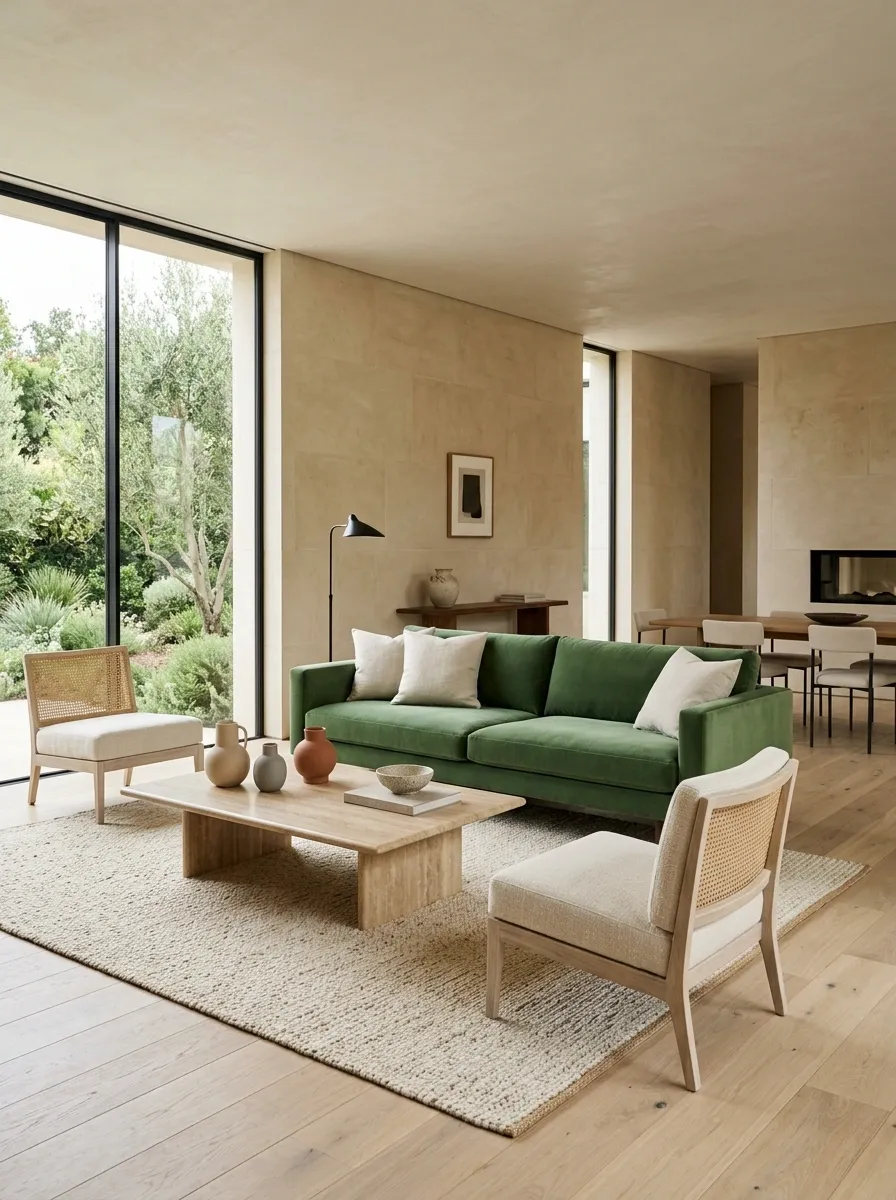
This is the green couch for people who want color but don’t want the room to become a color project. A medium green sofa sits inside a warm palette of limestone-like neutrals, pale oak, textured surfaces, and understated black lighting.
The room gets its interest from material variation rather than a pile of decorative objects. Stone, wood, upholstery, and matte metal create different visual surfaces while staying within a restrained palette.
It feels polished because the materials are doing enough. There is no need for a decorative object on every available horizontal surface just because the surfaces exist.
Family-Friendly Living Room With an Olive Sofa and Practical Layers
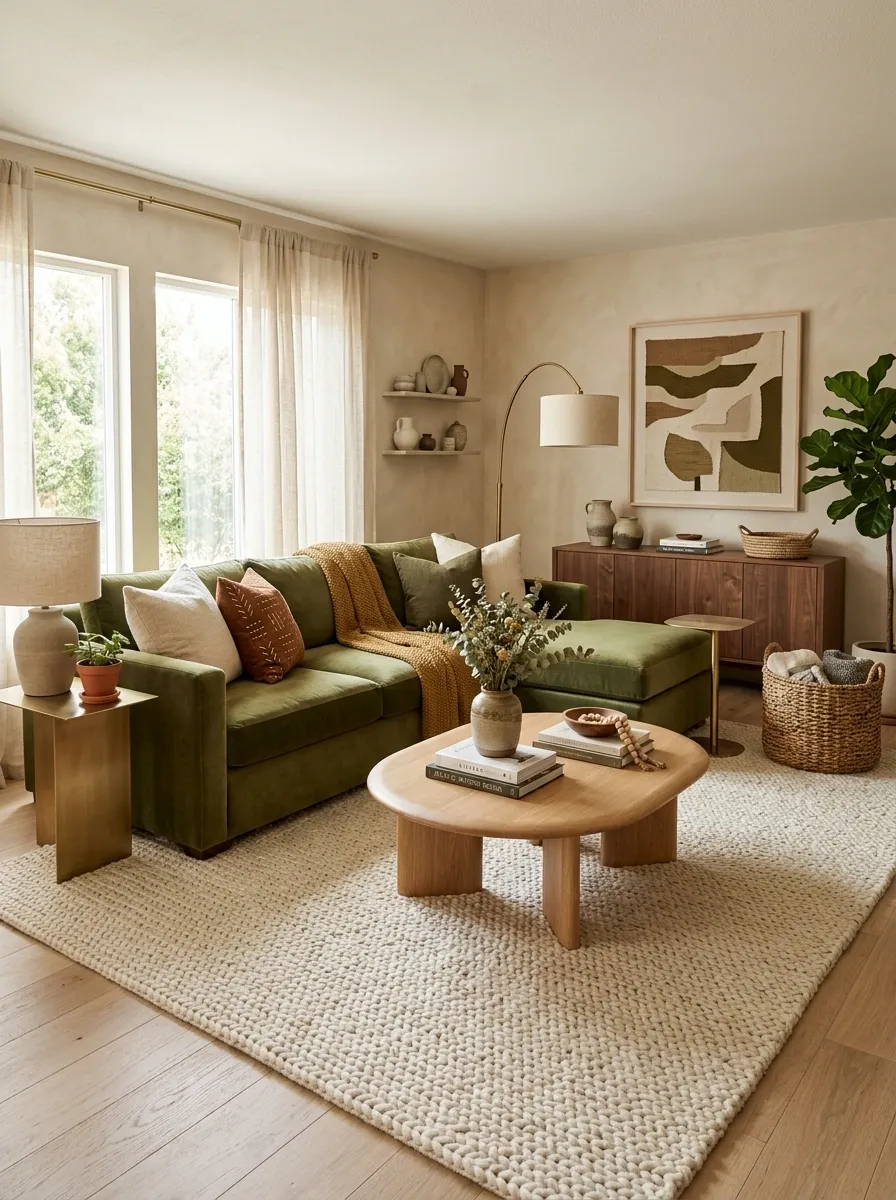
A family room doesn’t have to look like every attractive object is kept behind glass. This design starts with an olive sofa, a substantial textured rug, rounded coffee table, closed storage, practical side tables, and layered lighting.
The furniture arrangement leaves room to move through the space, while storage keeps the visual clutter under control. The palette stays warm enough that everyday objects don’t instantly look like they have invaded the room.
The goal isn’t perfection. It is a room that can survive actual people and still look pulled together five minutes after everyone leaves.
keeps visual clutter contained
softens the circulation zone
anchors the seating group
keeps evening light useful
Collected Modern Living Room With a Rich Green Sofa and Oversized Art
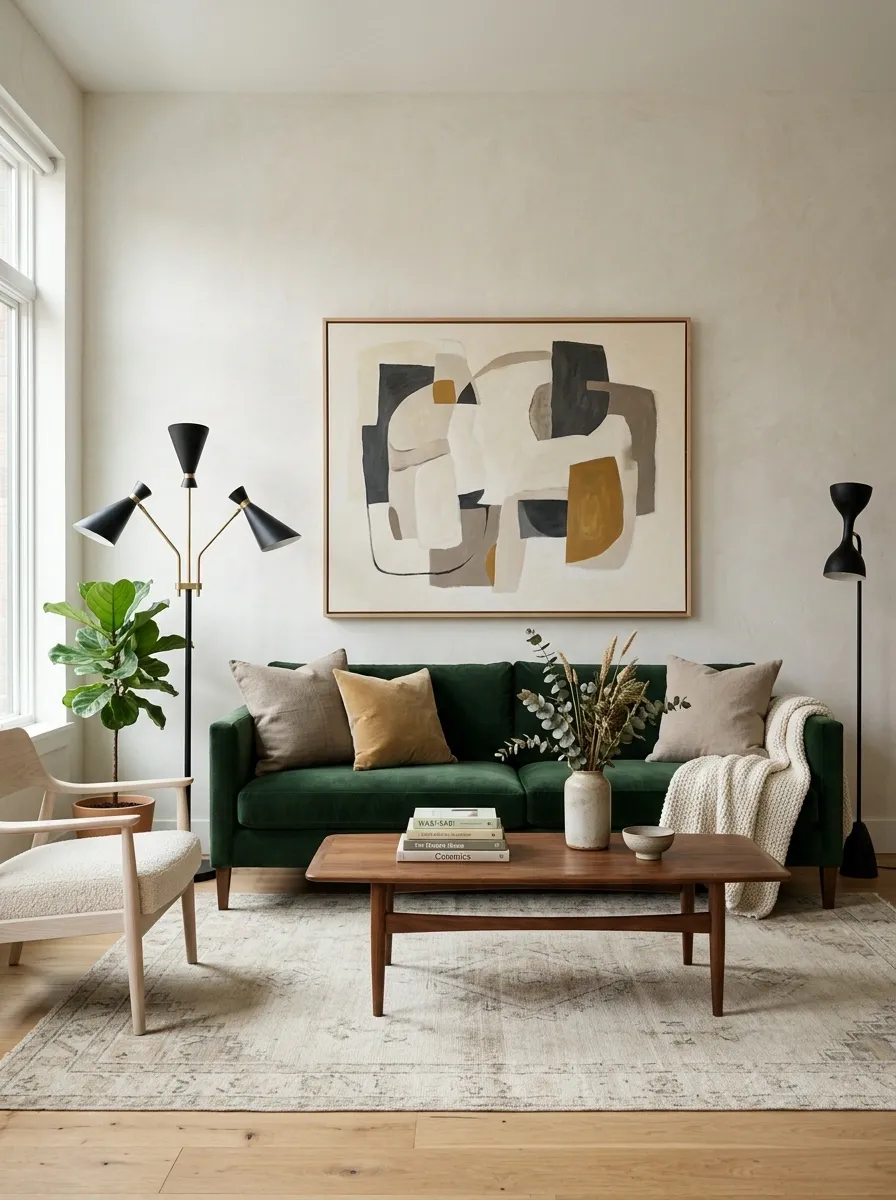
The final look goes for personality without tipping into clutter. A rich green sofa anchors a room filled with mixed wood tones, oversized artwork, sculptural lighting, neutral textiles, and a handful of carefully selected objects.
The furniture doesn’t match, but the proportions feel related. The artwork creates a strong secondary focal point, while the green sofa remains the visual anchor.
This is the room that proves a green couch doesn’t require a specific decorating style. It can sit inside a modern, collected space and still feel completely at home.
The secret is giving every major piece a reason to be there. Randomness is not the same thing as personality.
One secondary statement.
Plenty of room for everything else to breathe.
Oversized art adds personality without multiplying small objects.
Mixed woods and neutral textiles keep the composition grounded.
The Green Couch Doesn’t Need to Be the Whole Story
A green sofa is already doing more visual work than a beige one. That doesn’t mean the rest of the room needs to shout over it.
Some of the strongest rooms above keep the walls nearly quiet and let wood, texture, and lighting build the atmosphere. Others go completely in the opposite direction with dark walls, saturated colors, traditional patterns, or layered vintage pieces.
That’s the useful part of working from complete rooms instead of isolated decorating tricks. The question stops being “What goes with a green couch?” and becomes “What kind of room should this green couch belong to?”
Once that decision is clear, the rug, walls, tables, lighting, artwork, and textiles become much easier to choose.