
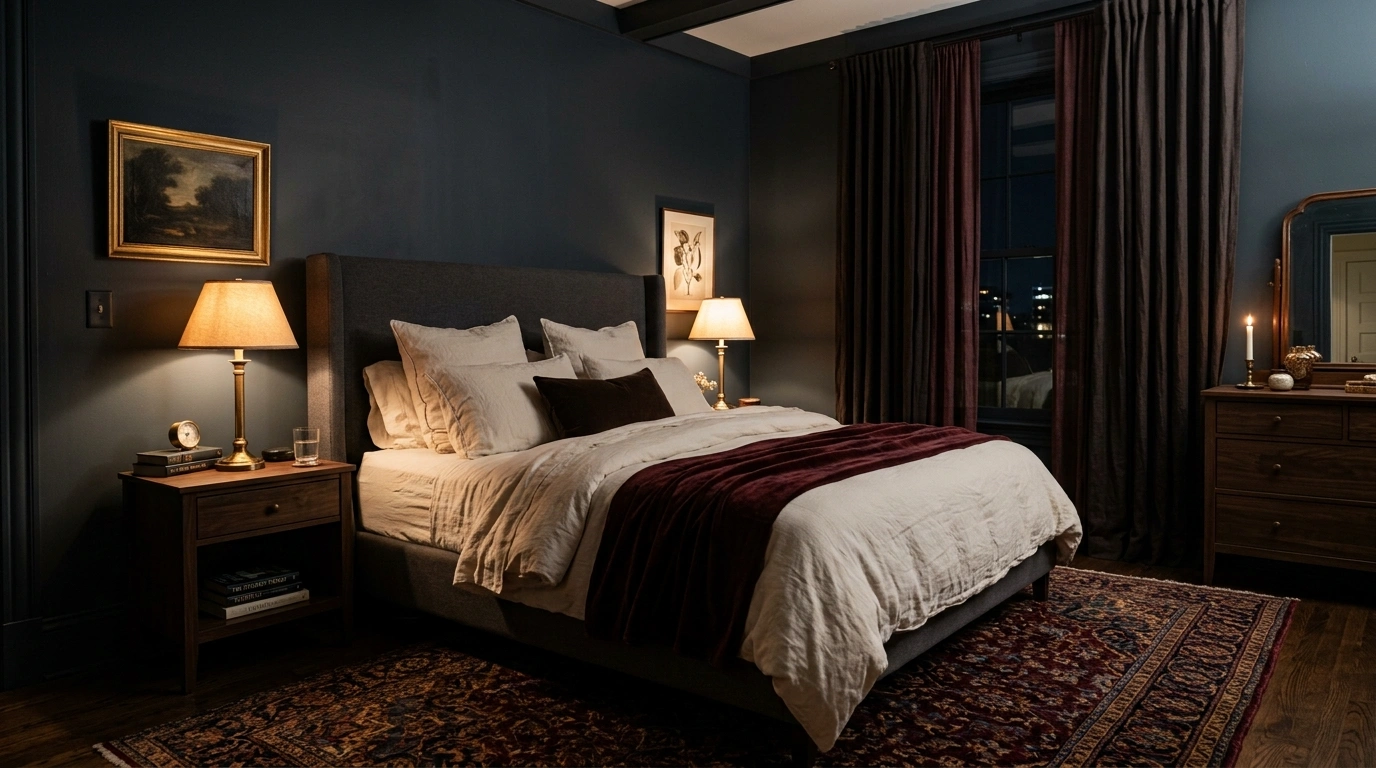
A bedroom can have expensive furniture, beautiful bedding, and the right paint color and still feel completely wrong.
The usual problem isn’t that the room is too dark. It’s that nothing inside the darkness has enough contrast to stand apart. The bed melts into the wall. The curtains flatten the windows. The furniture looks heavier than it actually is. By evening, the whole room becomes one vague block of gray, brown, and black.
That’s where good design gets interesting.
A truly moody bedroom has tension. Something soft sits against something hard. Something warm interrupts something cool. A pale duvet pushes forward from a deep wall. A tiny lamp creates a warm pocket of light while the corners stay shadowy. Every surface plays a different role.
The Moody Bedroom Formula: Dark Is Only Half the Story
A moody room works best when the darkness has somewhere to go. Let the walls create the depth, then break that darkness with materials that catch light differently.
The easiest formula is simple: deep color, soft contrast, warm material, low glow, layered texture.
The visual below shows how those layers work together before the individual ideas begin.
Moody Bedroom Ideas
Drench the Walls in Deep Burgundy
Monochromatic dark rooms can sometimes fall flat if every surface matches too perfectly, but rich wine tones instantly elevate a bedroom into a masterclass of moody drama. Wrap the molding, walls, and doors in the exact same velvety shade to blur the boundaries of the space.
Layer in contrasting textures to keep the darkness from feeling heavy. Deep plum linen bedding paired with taupe accents and a classic floral oil painting brings an effortless, gallery-like sophistication to the entire setup.
Finish the look with subtle metallic touches, like a slim black side table with warm brass legs. It adds a necessary glint of light that grounds the deep, romantic color palette without breaking the spell.
Paint the Walls Smoky Charcoal and Keep the Trim Soft White
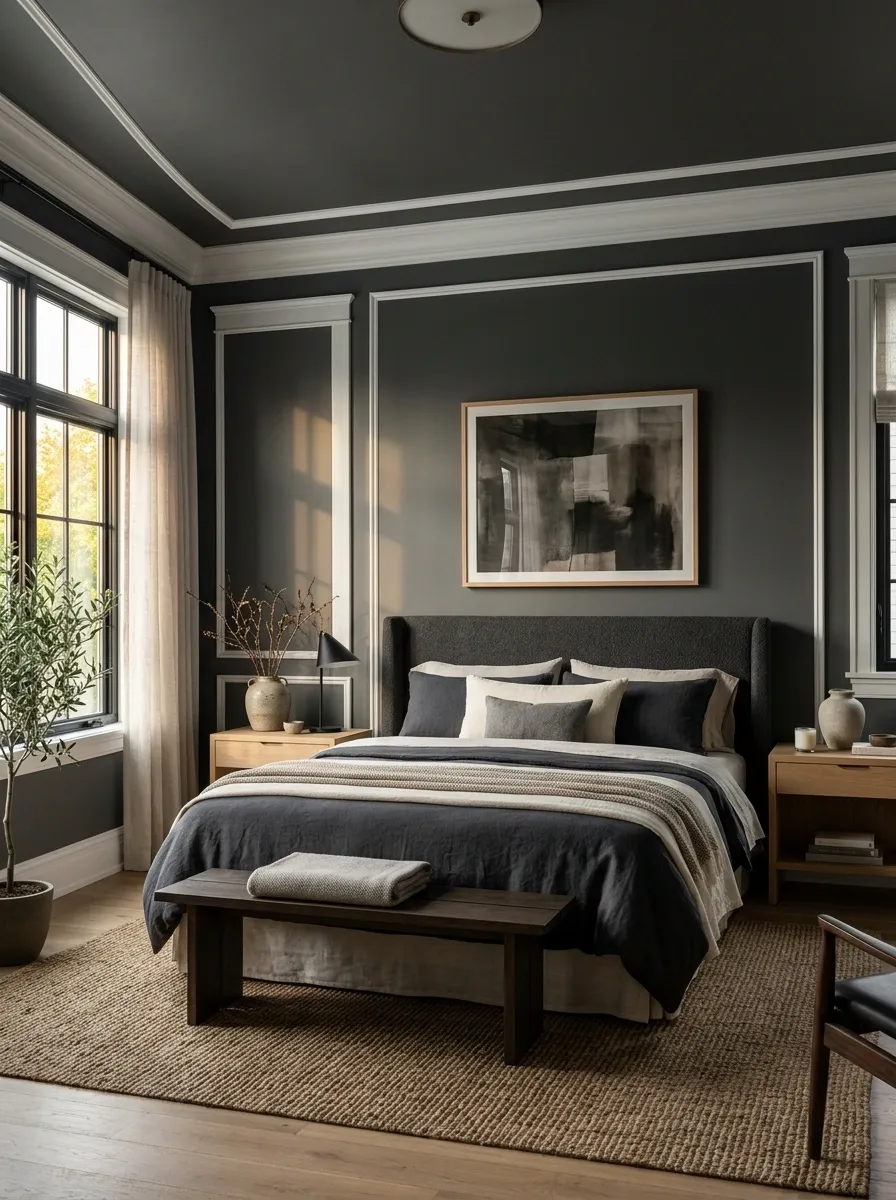
A smoky charcoal wall has more depth than flat black, especially when daylight still needs to work in the room.
Keep the trim noticeably lighter. That narrow strip around the door, window, or ceiling gives the dark paint a clean edge instead of letting the whole room blur together.
Best wall pairing
- Charcoal with warm white
- Charcoal with muted cream
- Charcoal with pale mushroom
Use a matte or low-sheen finish so reflections don’t break up the color. The result feels intentional even before furniture and styling enter the room.
Quiet edge.
#403A40
Soft white
Layer Warm Ambient Lighting Everywhere
A dark bedroom relies entirely on how you handle light sources after the sun goes down. Instead of relying on a single overhead fixture, scatter small lamps, candles, and accent lights across different heights to create a glowing, cocoon-like atmosphere.
Textured taupe walls and heavy drapery absorb the illumination just enough to cast soft shadows across the room. This makes even a compact space feel intensely intimate rather than cramped or gloomy.
Keep bedside styling minimal so the warm pools of light can do the heavy lifting. A sleek black nightstand holding a single glowing candle creates instant focal points that draw the eye comfortably around the room.
Build the Bed Around Rumpled Linen Instead of a Matching Set
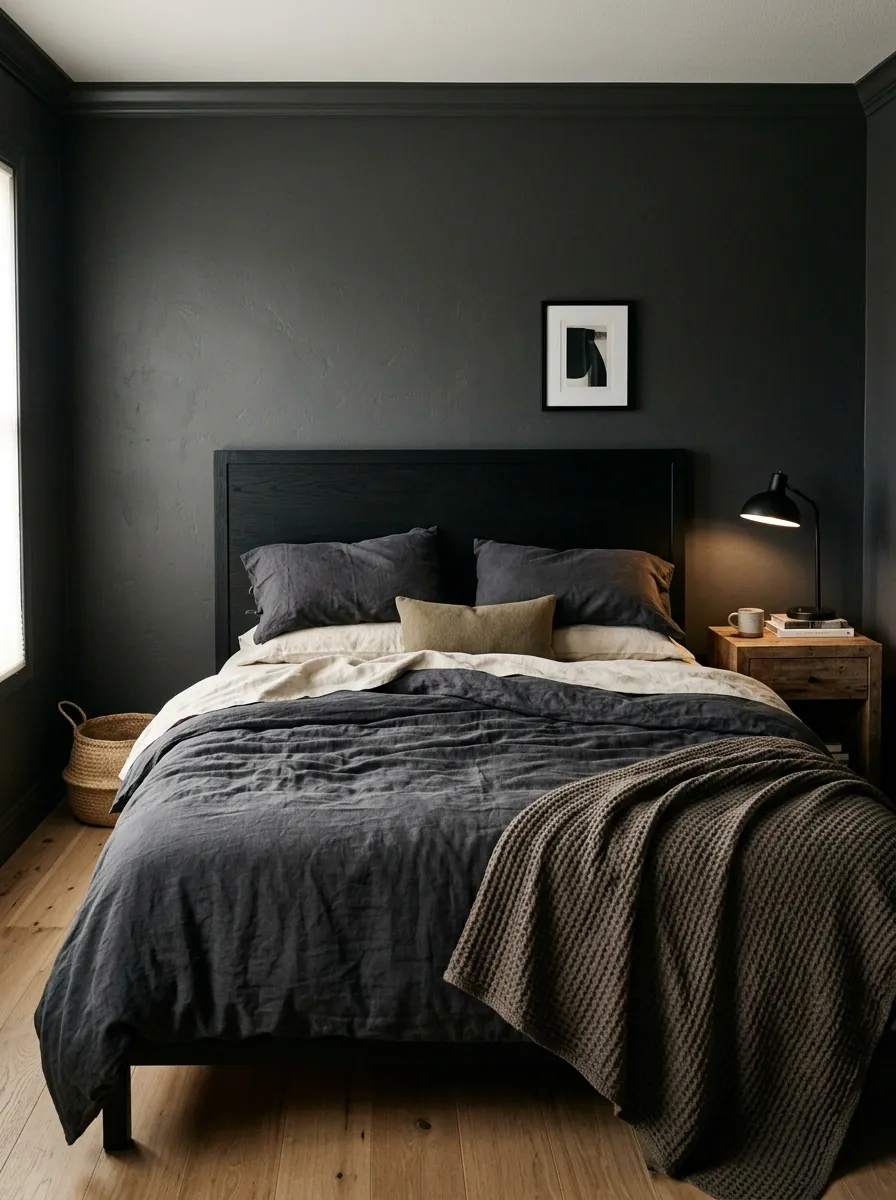
A perfectly matched bedding set can make a moody room look staged.
Linen fixes that fast. Its uneven texture catches side light and creates small shadows across the bed, which gives dark rooms much-needed movement.
Layer it instead of matching it:
- washed duvet
- slightly darker flat sheet
- loose coverlet
- two oversized sleeping pillows
- one smaller textured lumbar pillow
Don’t smooth every wrinkle. A little disorder keeps the bed from looking showroom-perfect, and the softer surface balances hard materials like painted walls, metal lamps, or dark wood.
Pair Mustard Velvet With Dark Chocolate
Chocolate brown walls create an enveloping backdrop, but they desperately need a contrasting warmth to keep the room from feeling like a cave. A tufted mustard or caramel headboard slices right through the dark tones with a rich, inviting pop of color.
Pile on patterned lumbar pillows and deep plum shams to break up the expanses of solid fabric. The subtle print introduces movement, ensuring the bed looks collected over time rather than styled straight out of a catalog.
Anchor the space with a striking burl wood nightstand that brings organic grain and earthy warmth into the mix. Topped with a modern dark-shaded lamp, it ties the entire rich color story together with effortless style.
Use One Oversized Dark Headboard to Anchor the Whole Room
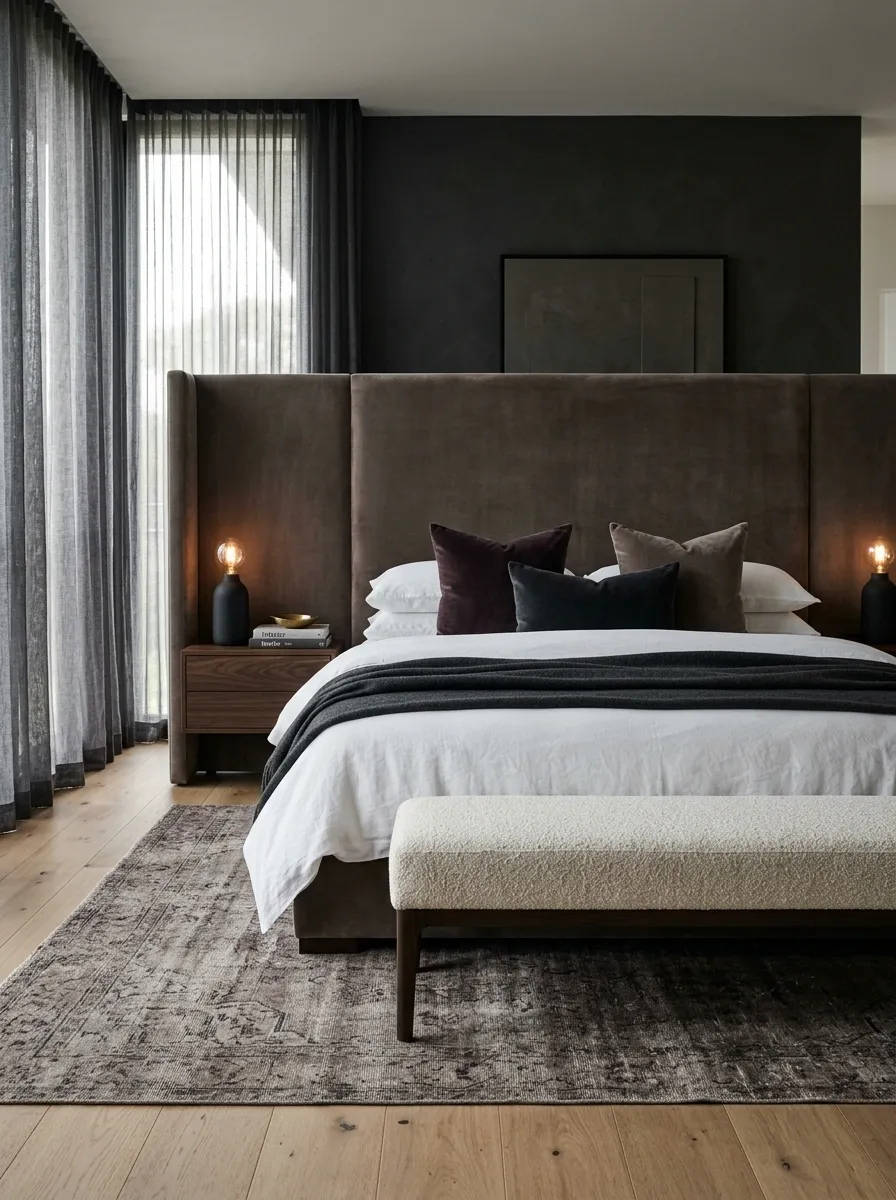
A tiny headboard gets swallowed by a dark wall.
Go large instead. A tall upholstered headboard creates a strong vertical shape behind the bed and gives the eye one obvious place to land.
The strongest version usually reaches well above the pillows and extends wider than the mattress. Choose charcoal, espresso, deep taupe, or muted plum rather than shiny black.
The rest of the furniture can stay relatively quiet. One oversized element carries enough visual weight that the room doesn’t need a pile of decorative objects competing with it.
own the wall.
Frame the Bed With Vertical Wood Slats
Flat dark walls are great, but adding dimensional texture takes a moody bedroom to an entirely different level. A slatted wooden accent wall behind the bed introduces clean, rhythmic lines that draw the eye upward and instantly expand the vertical space.
Conceal LED strip lighting behind the slats to create a soft, glowing halo effect against the dark finish. This architectural lighting trick adds incredible depth, making the entire bed frame look as though it is floating off the wall.
Keep the bedding simple in charcoal tones, allowing the dramatic wall treatment and sleek pendant lighting to command attention. A matching textured round ottoman at the foot of the bed completes the clean, contemporary aesthetic.
Warm Gray Walls With Walnut Nightstands
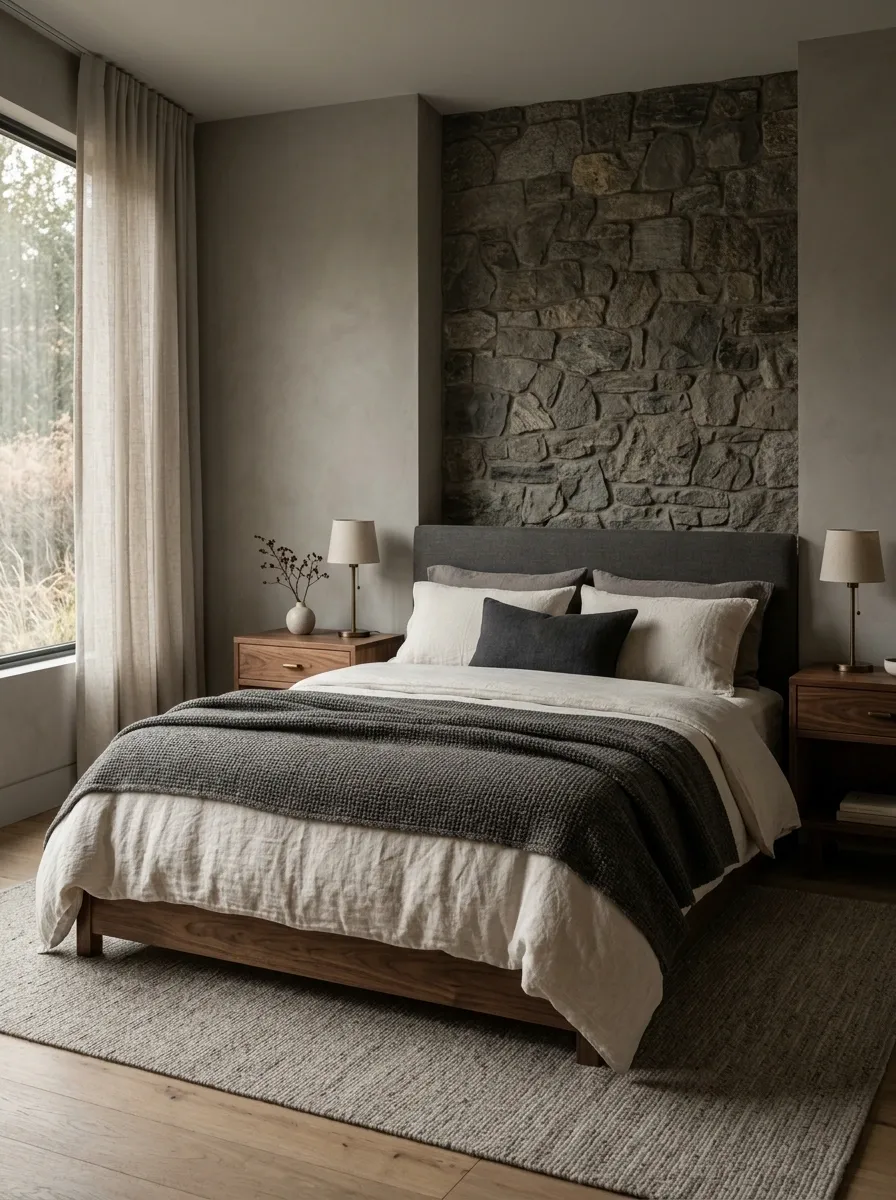
Cool gray can make a dark bedroom feel lifeless, especially beside black furniture.
Walnut changes the temperature immediately. Its brown undertones give gray walls something warm to sit against without introducing a loud accent color.
Keep the nightstands simple. A solid wood drawer, a small lamp, and a little breathing room look stronger than shelves packed with accessories.
Best material mix: gray wall + walnut wood + aged brass or bronze.
That combination works particularly well beside stone, linen, and woven fabrics because every surface reflects light differently.
Hang Full-Length Curtains Wider Than the Windows
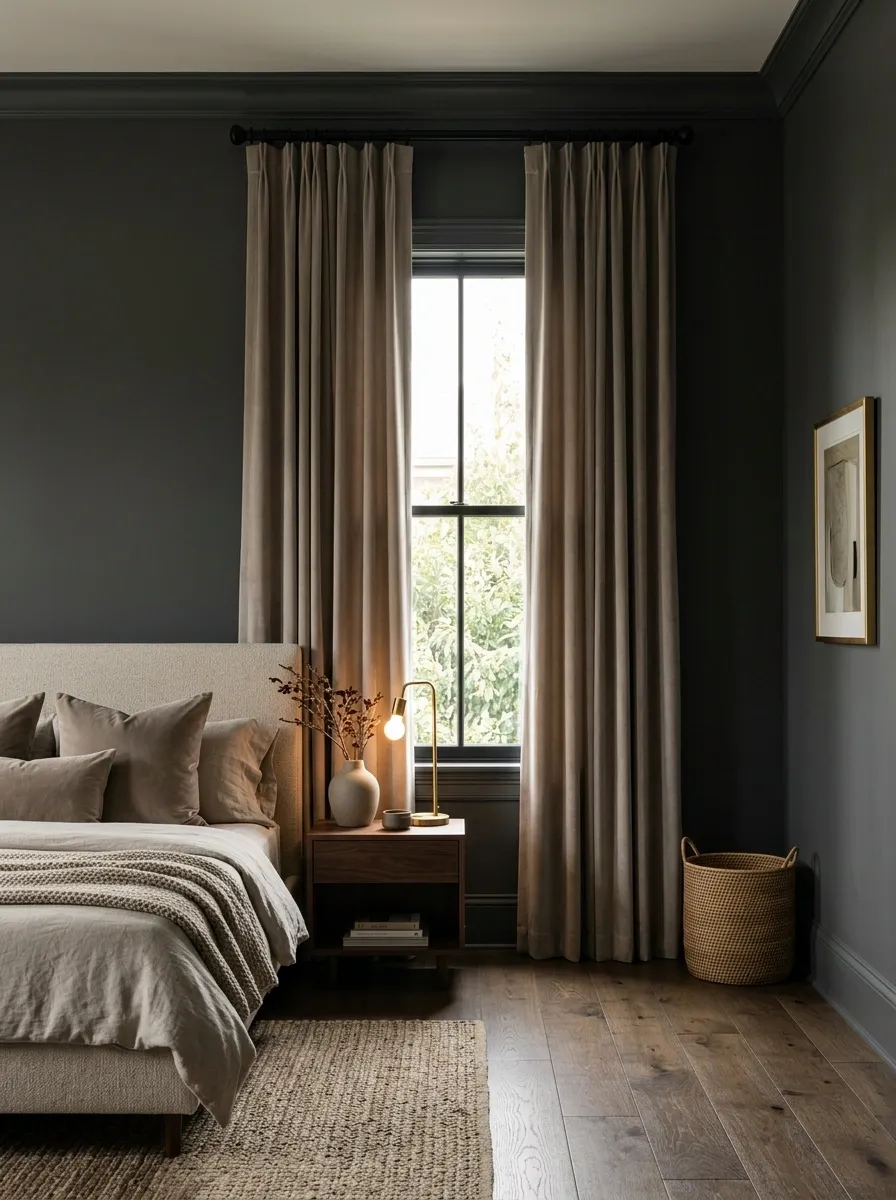
Short curtains make a dark bedroom look chopped up.
Mount the rod high and extend it beyond the window frame so the fabric can sit partly on the wall instead of covering the glass. The room immediately feels taller and more finished.
Choose a fabric with weight, but don’t go so heavy that daylight disappears. Oatmeal linen, mushroom cotton, taupe velvet, or warm gray woven fabric all work with smoky walls.
The practical rule: let the curtains nearly kiss the floor.
That extra length creates a clean vertical line, while the wider rod keeps the window from becoming a dark visual hole in the wall.
Replace Cool Bulbs With Warm Bedside Lighting
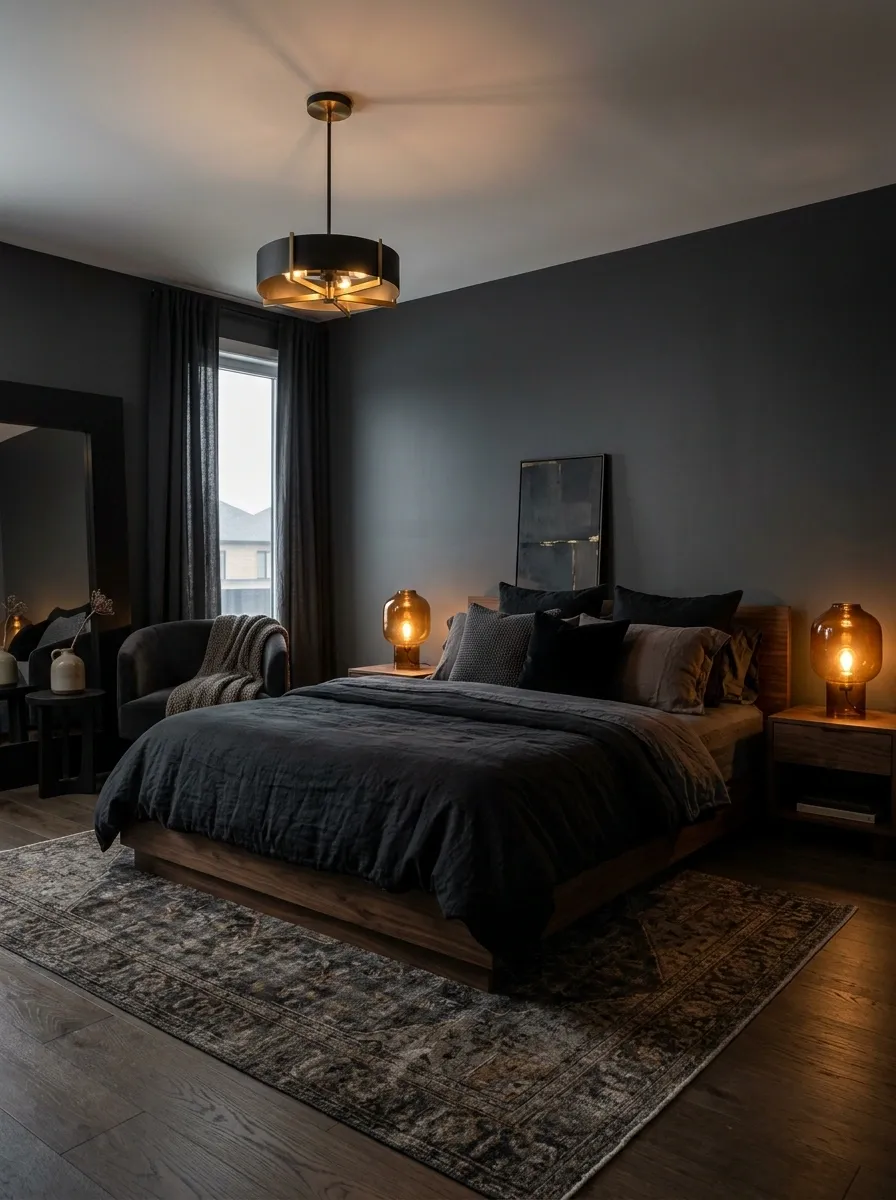
A dark bedroom lives or dies by its lighting.
Cool white bulbs can make charcoal, gray, and brown surfaces look harsh. Warm light does the opposite. It pulls out the softer undertones in wood, fabric, and painted walls and makes the bed area feel calmer after sunset.
Use bedside lamps rather than relying on one ceiling fixture.
Lighting mix
- Warm bedside lamps for the evening
- A dimmable overhead fixture for general light
- One low lamp or wall light for a darker corner
The goal isn’t to make every corner bright. A little shadow actually helps the room feel deeper.
get darker gently.
warm + low
dimmable
tiny pool of light
Layer Three Shades of One Deep Neutral
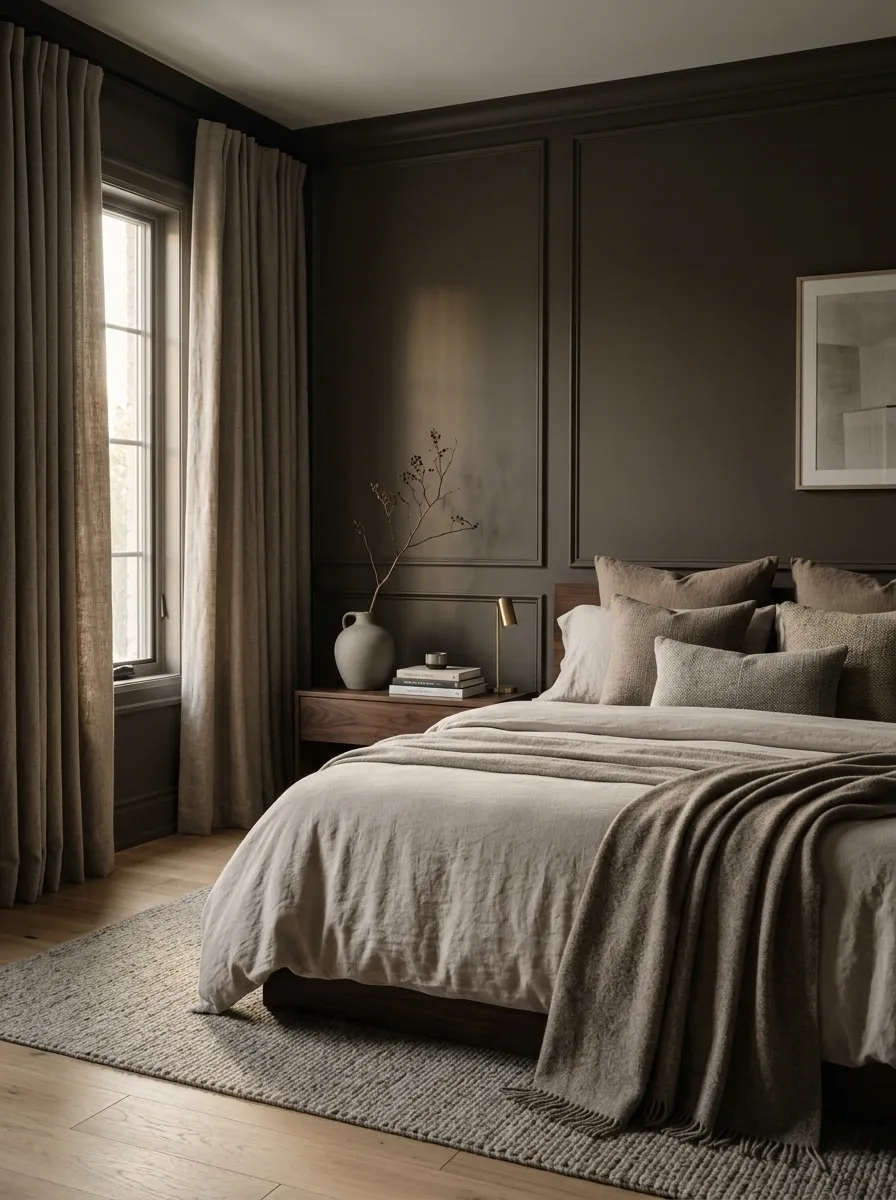
Matching everything exactly makes a dark room look flat.
The stronger approach is tonal layering. Keep the same color family, but move slightly lighter or deeper across different surfaces.
For example, pair a deep mushroom wall with medium taupe curtains and a smoky beige bedspread. The colors stay related, yet each surface remains visible.
Think in layers:
- Deepest tone on the largest surface
- Middle tone on fabric or furniture
- Lightest related tone close to the bed
That’s enough contrast to create depth without introducing a rainbow of competing colors.
Put a Large Vintage-Style Rug Under the Bed
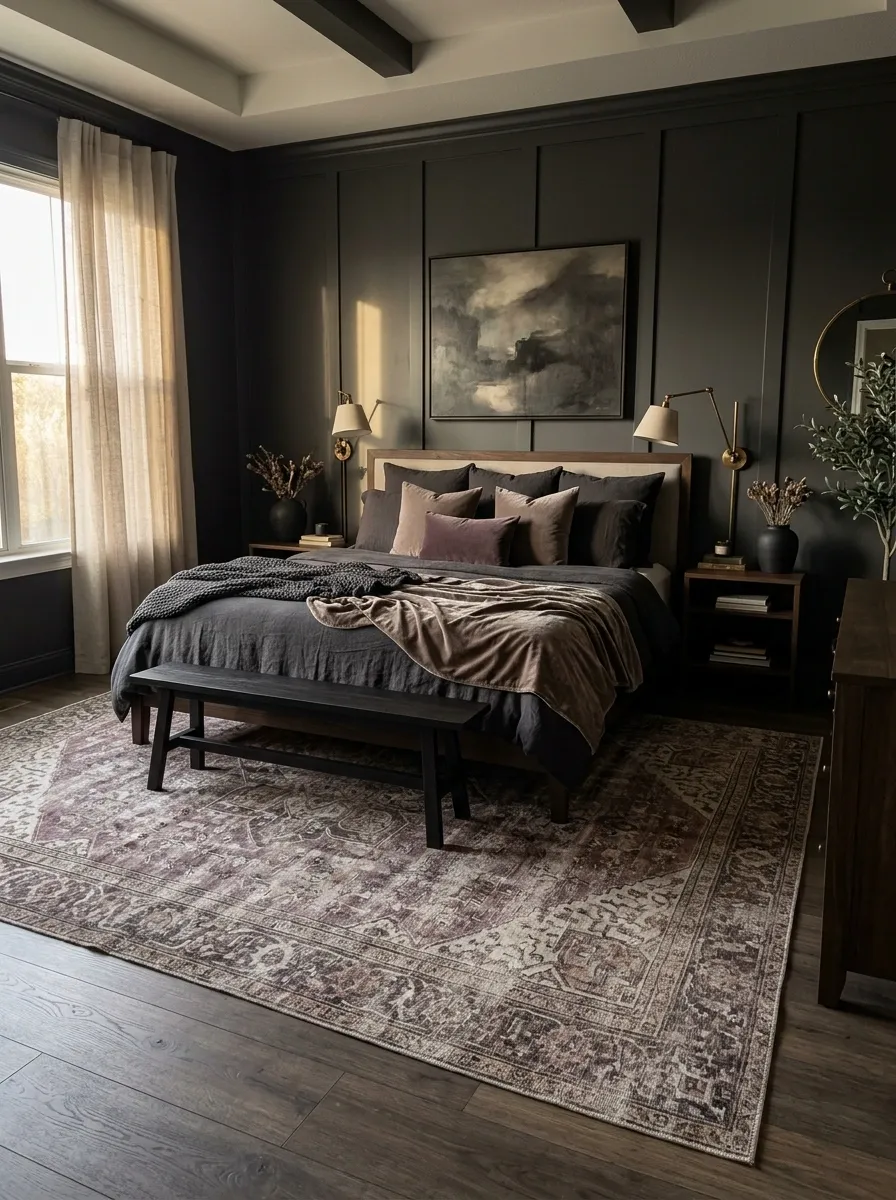
A small rug floating in the middle of a dark bedroom looks accidental.
The rug should visually connect the bed to the floor. A larger vintage-style pattern works especially well because it introduces muted variation without fighting the darker walls.
Look for faded taupe, dusty plum, cream, brown, or gray rather than a high-contrast pattern.
Let the rug extend beyond the sides of the bed and far enough toward the foot that getting out of bed lands on something soft. That practical detail also makes the whole sleeping area feel more grounded.
Quick check: if the rug looks like an island, it’s too small.
rather than floats above it.
rather than loud.
beyond the sleeping zone.
Use Black Accents Without Turning Everything Black
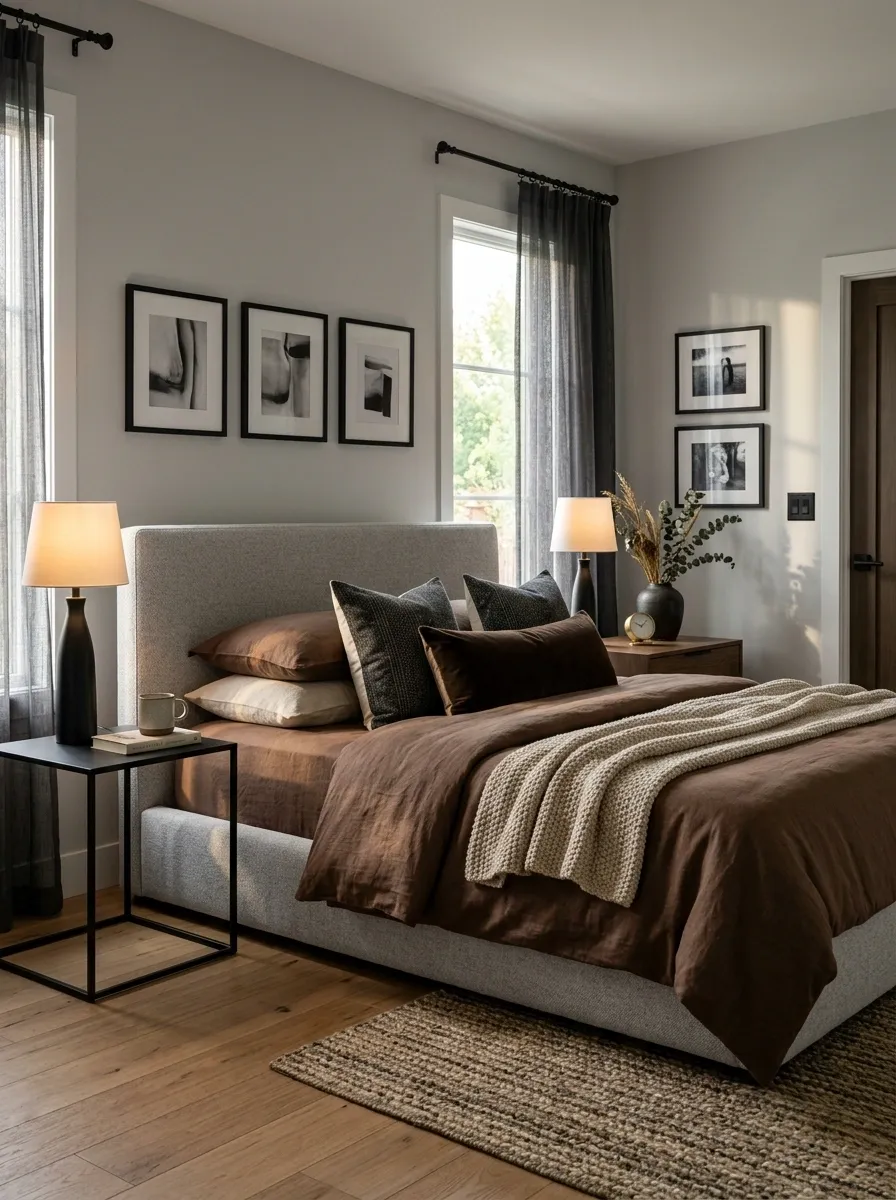
Black works best as punctuation.
A black lamp, picture frame, curtain rod, door handle, or small side table can sharpen a room that already has plenty of softer gray and brown. Covering every major surface in black has the opposite effect. The room loses its visual rhythm.
Choose a few repeated black details and stop there.
Good places for the dark hit:
- lamp frame
- thin picture frame
- hardware
- mirror edge
- small decorative object
That repetition helps the room feel connected without making the furniture look heavy.
can organize the room.
Break Up Gray With One Earthy Accent Color
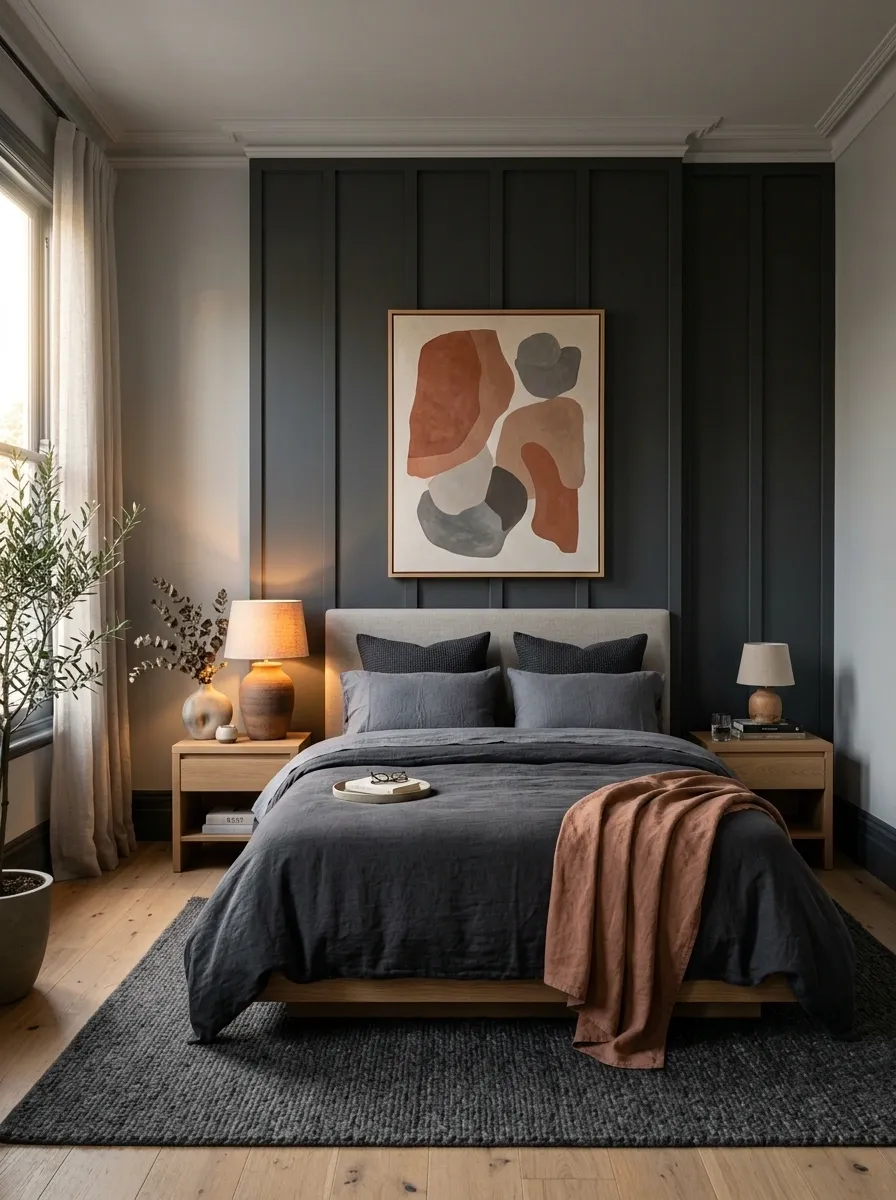
Gray gets much easier to live with when one warm color interrupts it.
Terracotta, muted clay, olive, cinnamon, dusty rose, or brown can do the job. Pick one. Spreading several accent colors around the room turns the calm palette into visual noise.
The accent doesn’t need to dominate. A throw, artwork, ceramic lamp, or small upholstered chair is enough.
The sweet spot: repeat the same earthy note in at least two places, then leave it alone. That repetition makes the color look intentional instead of randomly dropped into the room.
Create a Dramatic Focal Wall Behind the Bed
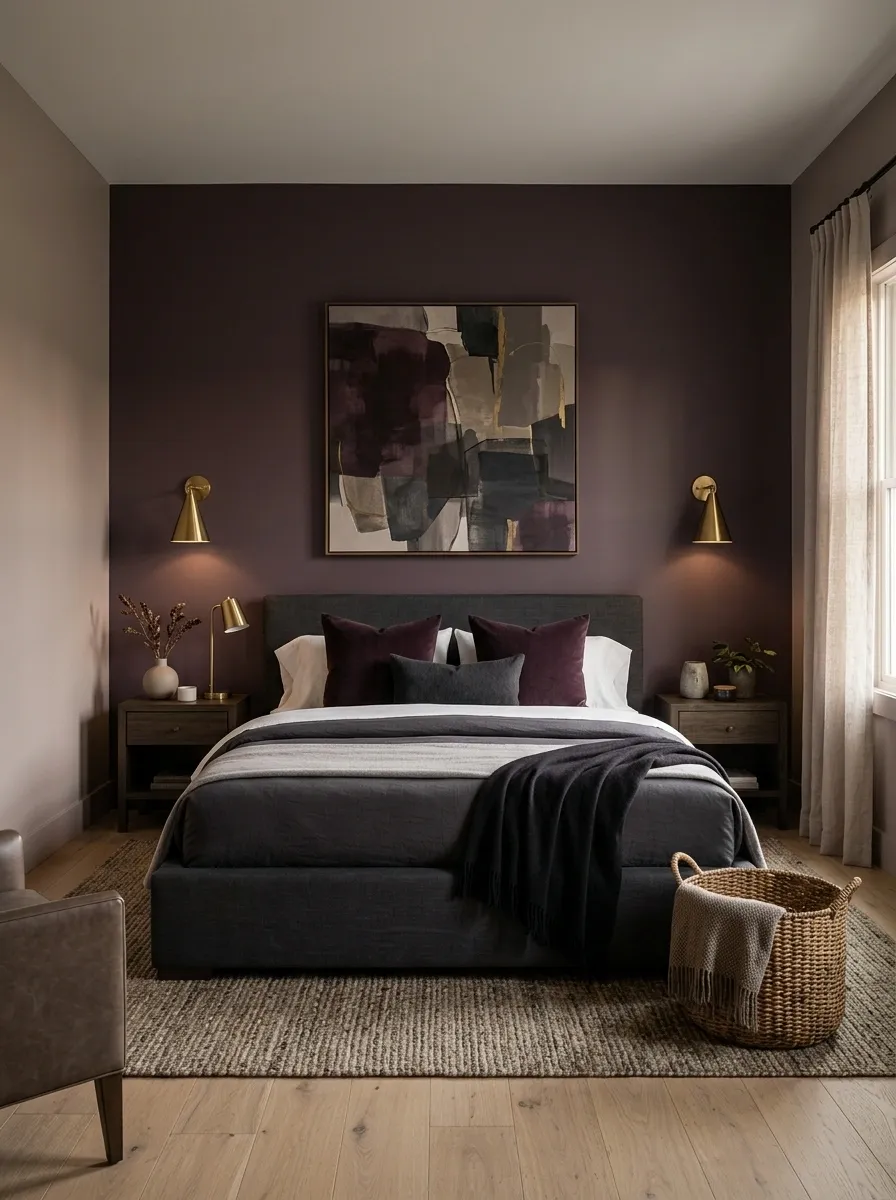
A moody bedroom doesn’t need dark walls everywhere.
Sometimes the strongest result comes from concentrating the deepest color behind the bed and allowing the surrounding walls to step back. It gives the room an obvious visual anchor without making a smaller bedroom feel boxed in.
Try smoky plum, charcoal brown, deep olive, or muted graphite on the bed wall. Keep the other walls a shade lighter.
Then repeat one small detail from the focal wall elsewhere, such as the bedding, artwork, or a lamp base. That tiny connection makes the wall feel integrated rather than randomly painted.
Replace Tiny Decor With One Oversized Piece of Art
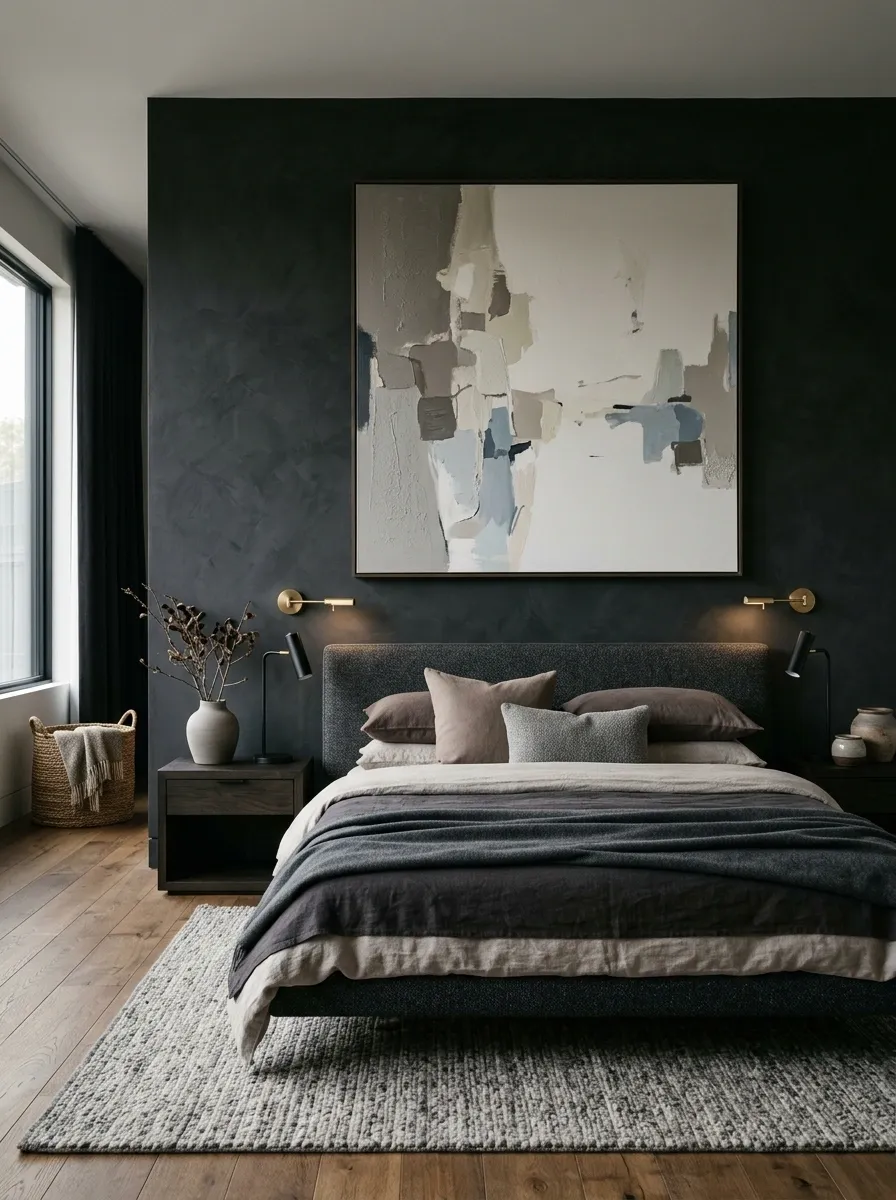
Small artwork scattered across a dark wall often creates more clutter than character.
One oversized piece has much more presence. Choose something with a quiet palette and enough empty space to let the image breathe against the darker background.
A large abstract painting, muted landscape, charcoal sketch, or oversized textile can work beautifully.
Swap this:
- three tiny prints
- small floating shelves
- several decorative objects
For this:
- one large artwork
- simple frame
- clear space around it
The wall feels calmer, and the oversized scale gives the bed zone a finished look without covering every inch.
More presence.
Mix Aged Metal Finishes Instead of Matching Everything
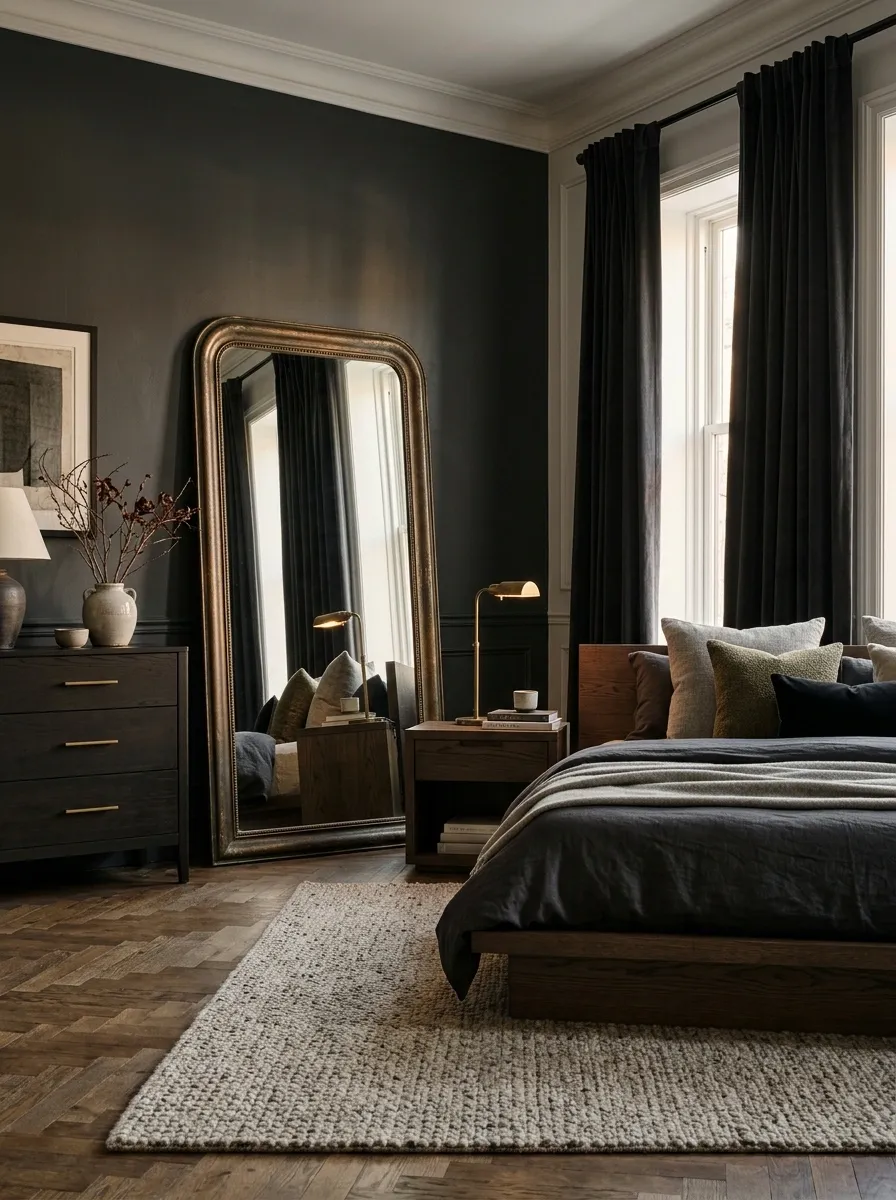
Perfectly matching metal finishes can make a bedroom feel like it came from one furniture catalog.
Aged finishes are much more forgiving. Brass, bronze, blackened metal, and slightly weathered iron can sit together when the rest of the palette stays restrained.
The trick is repetition, not matching.
Use one finish as the dominant note, then let the others appear in smaller doses. Aged brass on the lamps can pair with a black curtain rod and an old bronze mirror frame without looking messy.
Keep the shapes simple. Let the finishes provide the variation.
not the metal.
Keep the Floor Warmer Than the Walls
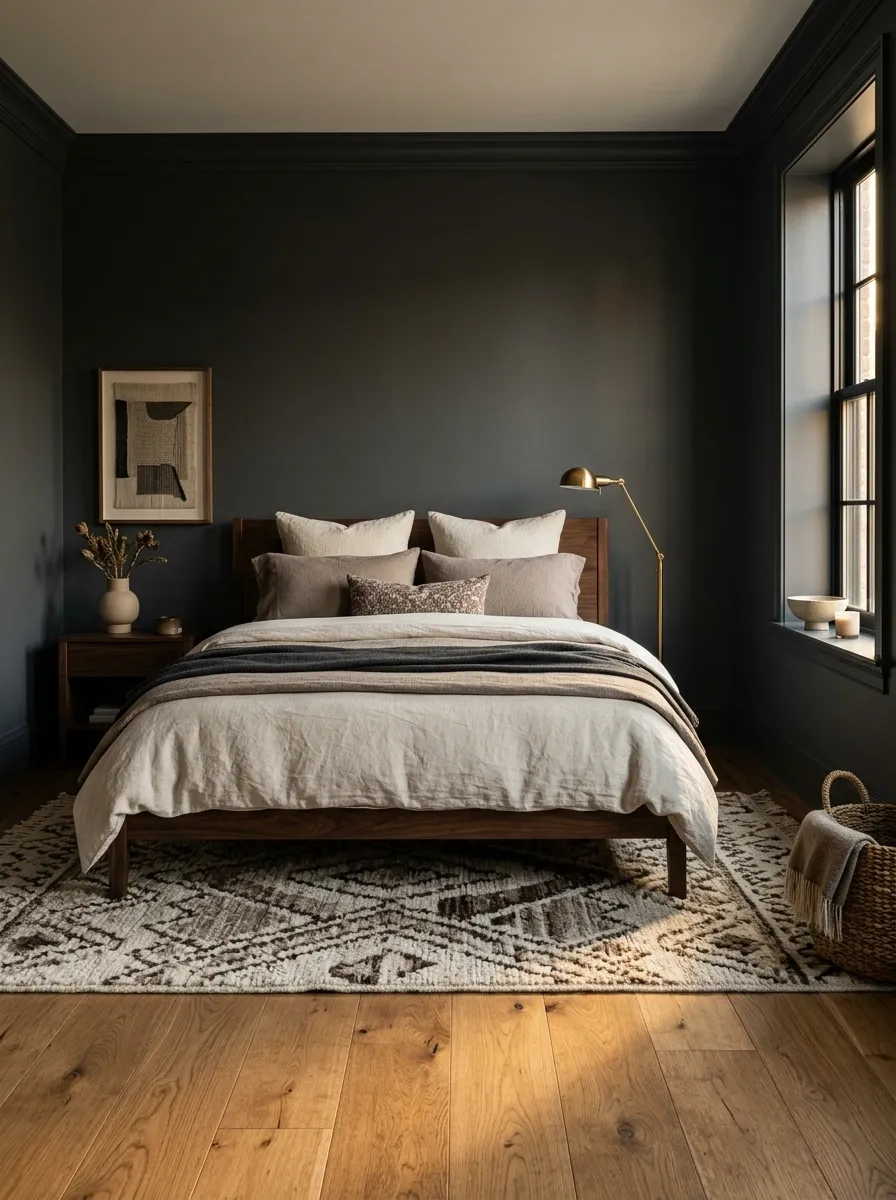
A bedroom with dark cool walls and a cool gray floor can feel strangely cold, even when the furniture is soft.
A warmer floor fixes that imbalance.
Think medium oak, walnut, warm laminate, natural cork, or a rug with brown and cream undertones. The floor doesn’t have to be dramatically orange. It simply needs enough warmth to separate itself from the cooler wall color.
This is especially useful in bedrooms with charcoal or blue-gray paint.
Cold above, warm below creates a natural visual balance and gives bare feet a more inviting place to land in the morning.
Layer Sheer Curtains Under Heavier Drapes
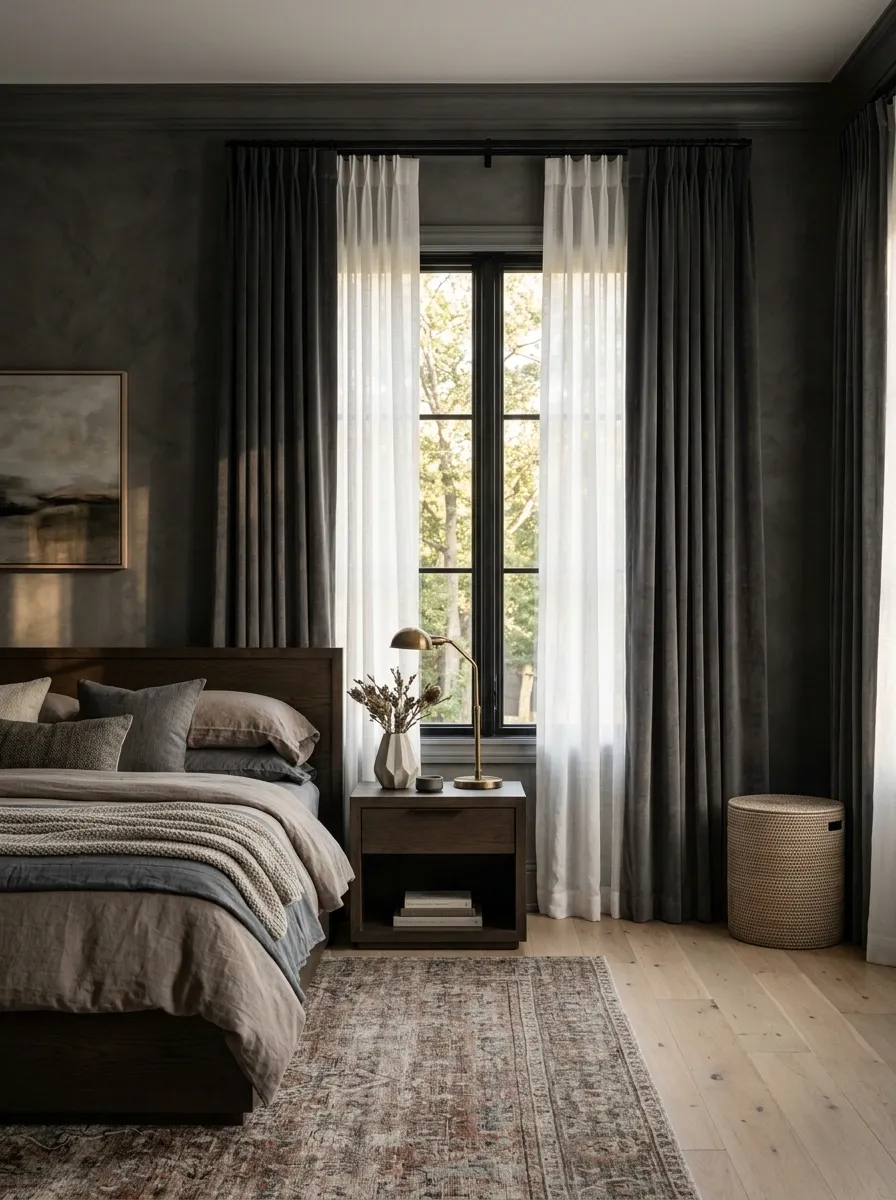
A single heavy curtain can make a moody bedroom feel closed off during the day.
Two layers create much better control. Keep a sheer or lightweight panel closest to the glass, then add a heavier curtain outside it for evening privacy and depth.
The sheer catches daylight and softens it before it reaches the darker walls. The outer curtain adds enough weight to make the window feel substantial after sunset.
Use the layers differently:
- Sheer open during daylight
- Outer drape closed at night
- Both closed when the room needs to feel cocooned
Choose fabrics that share an undertone rather than forcing a perfect color match.
Enclosed by night.
Give the Ceiling a Subtle Smoky Tone
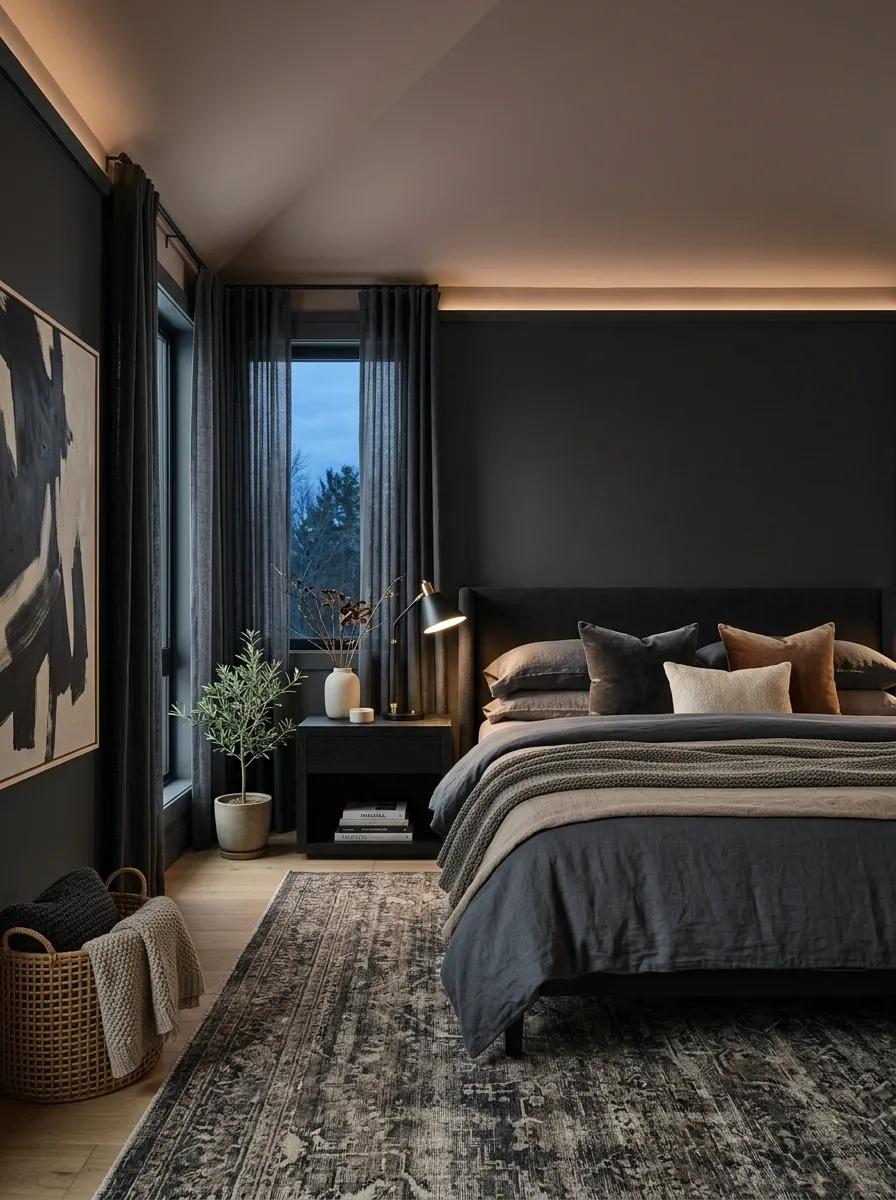
Leaving a stark white ceiling above deep walls can create a harsh visual cutoff.
A ceiling doesn’t need to be as dark as the walls. A softened version of the wall color can make the entire room feel more enveloping without making the ceiling visually heavy.
Think a diluted charcoal, dusty taupe, faded gray, or very soft mauve.
The change should be subtle. The goal is to reduce the bright rectangle overhead, not create a dramatic fifth wall that competes with the bed.
Best move: keep the ceiling lighter than the main wall but darker than a traditional bright white.
Bring in Boucle, Wool, Velvet, and Woven Texture
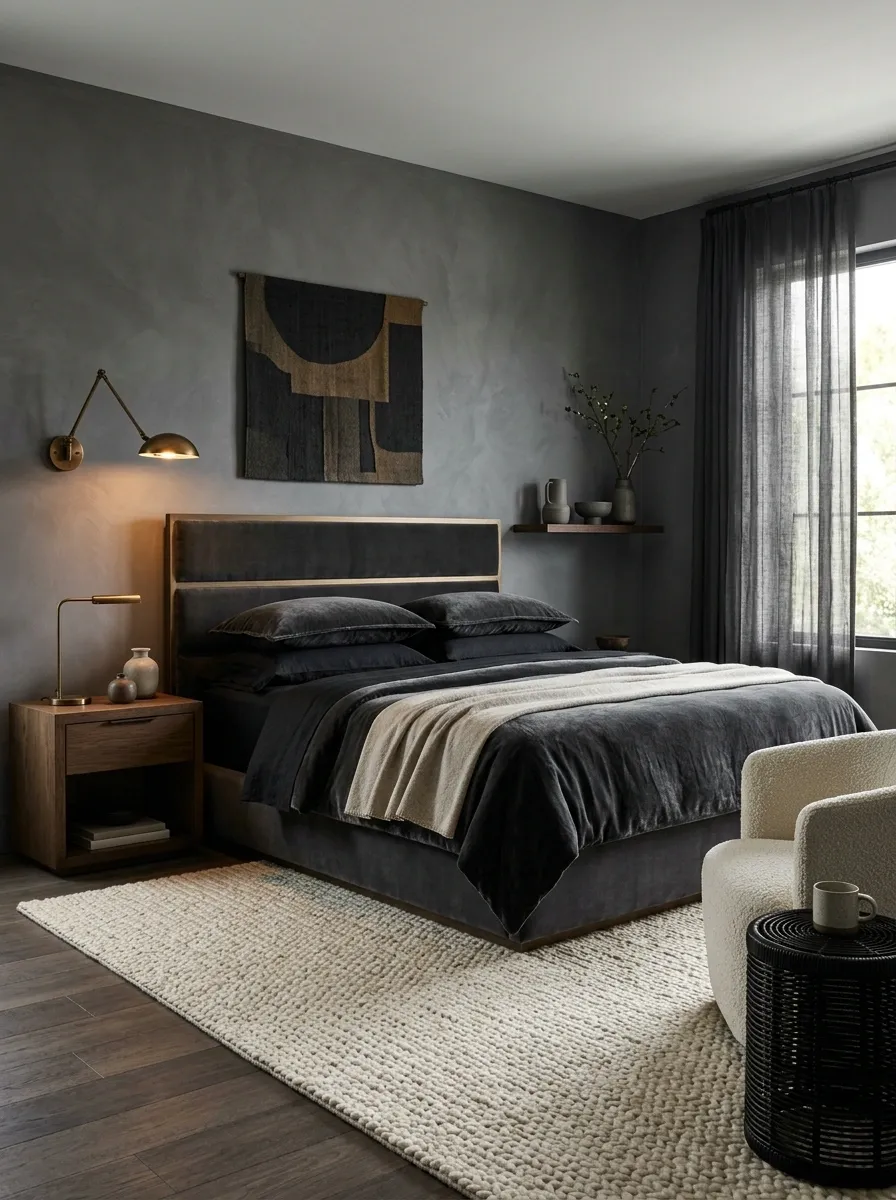
Dark color alone can’t give a bedroom enough depth.
Texture is what makes the same shade look different across the room. Put velvet beside linen, wool beside smooth wood, or boucle beside aged metal. The surfaces catch and absorb light differently, so the room stays interesting even when the palette is restrained.
Don’t introduce every texture in equal amounts.
Use a simple hierarchy:
- Rough woven material for visual grit
- Soft fabric for the bed
- One plush texture for comfort
- Smooth wood or metal for contrast
That’s plenty. Too many competing textures can make the room feel busy rather than layered.
Turn One Corner Into a Low-Light Reading Spot
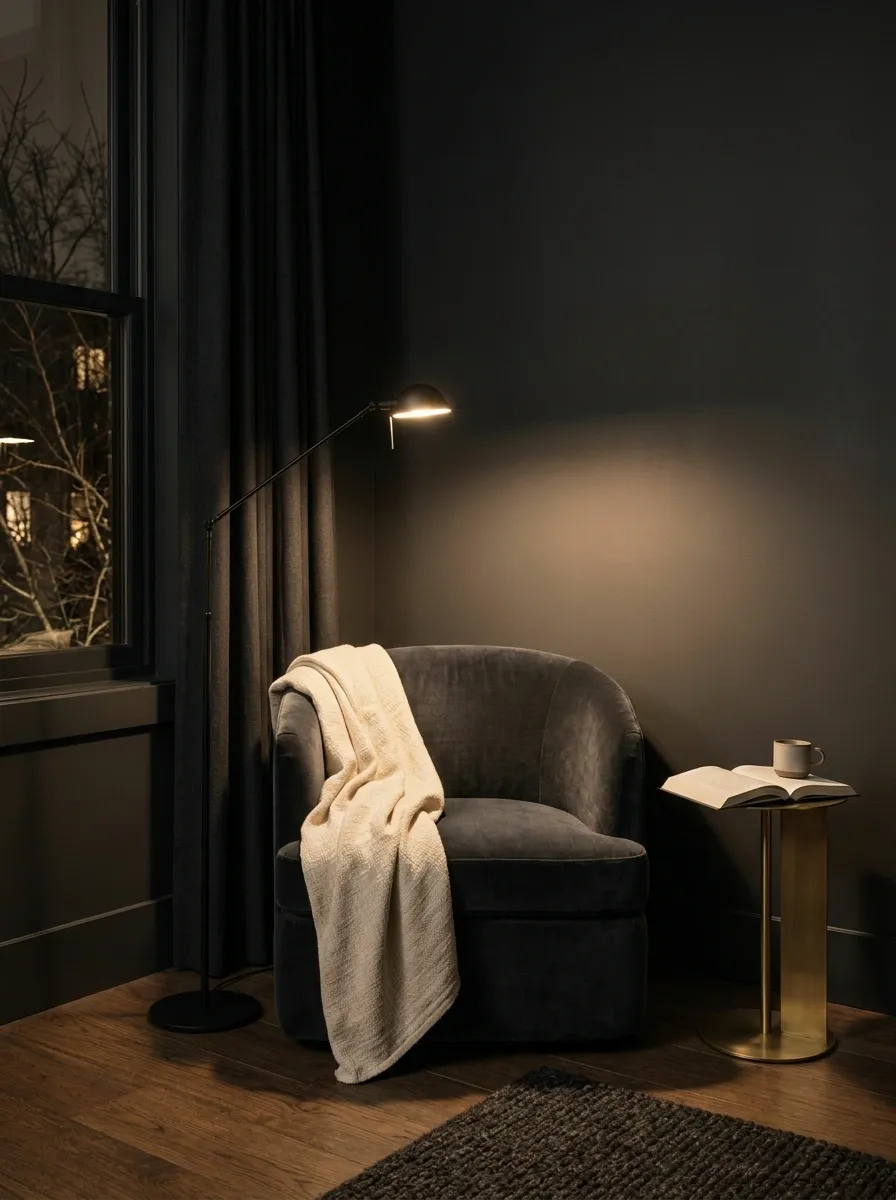
One underused corner can make a bedroom feel much more complete.
Skip the oversized furniture arrangement and create a small destination instead: a compact lounge chair, slim floor lamp, and tiny side table are enough.
Keep the lighting lower than the main bedside lamps. That difference in brightness creates a layered room rather than a space where every fixture shouts for attention.
A reading corner also gives the eye somewhere to travel beyond the bed.
Small footprint, big effect: chair + lamp + surface + a little empty space.
Lamp.
Nothing else.
Choose Bedside Tables That Visually Recede
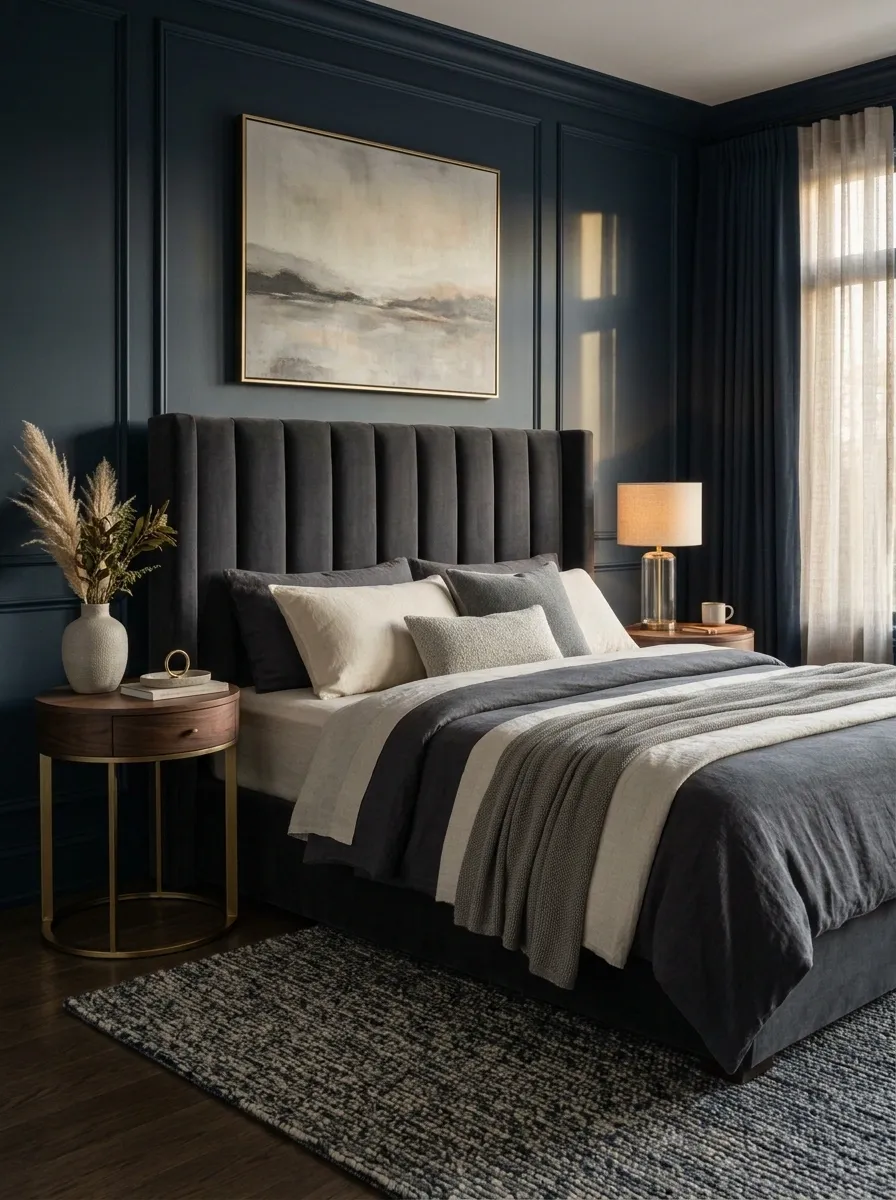
A heavy nightstand can make a moody bedroom feel crowded, especially when the bed already has a tall headboard.
Choose tables with enough storage to be useful but a shape that doesn’t dominate the bed wall. Slim legs, open bases, rounded edges, and medium-height silhouettes work well.
The tabletop should sit close to the mattress height.
That alignment matters more than most decorative details. When the lamp, table, and mattress form a controlled horizontal line, the entire sleeping zone looks calmer.
The best nightstand is useful without becoming the second focal point.
Repeat One Dark Tone Across Three Different Materials
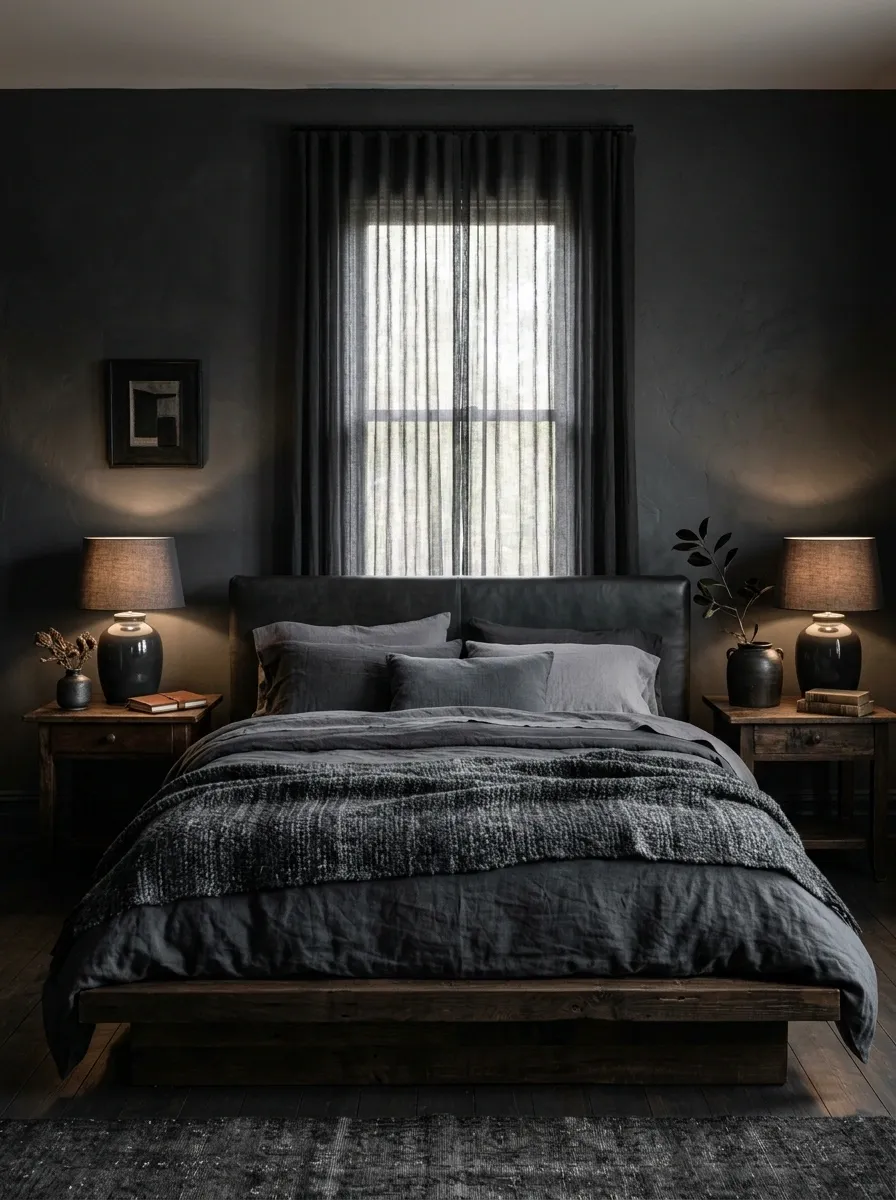
Repetition makes a bedroom feel designed without requiring matching furniture.
Pick one deep tone and repeat it in three unrelated materials. Deep charcoal could appear in painted walls, a ceramic lamp, and a woven throw. Espresso brown could show up in wood, leather, and a small framed detail.
The important part is that the materials aren’t identical.
One color + three textures = visual connection.
This trick is particularly useful when the bedroom contains thrifted pieces or furniture collected at different times. The repeated color ties the unrelated objects together without making the room look like a matching set.
Different surface.
Use Mirrors to Bounce Light Without Adding Shine
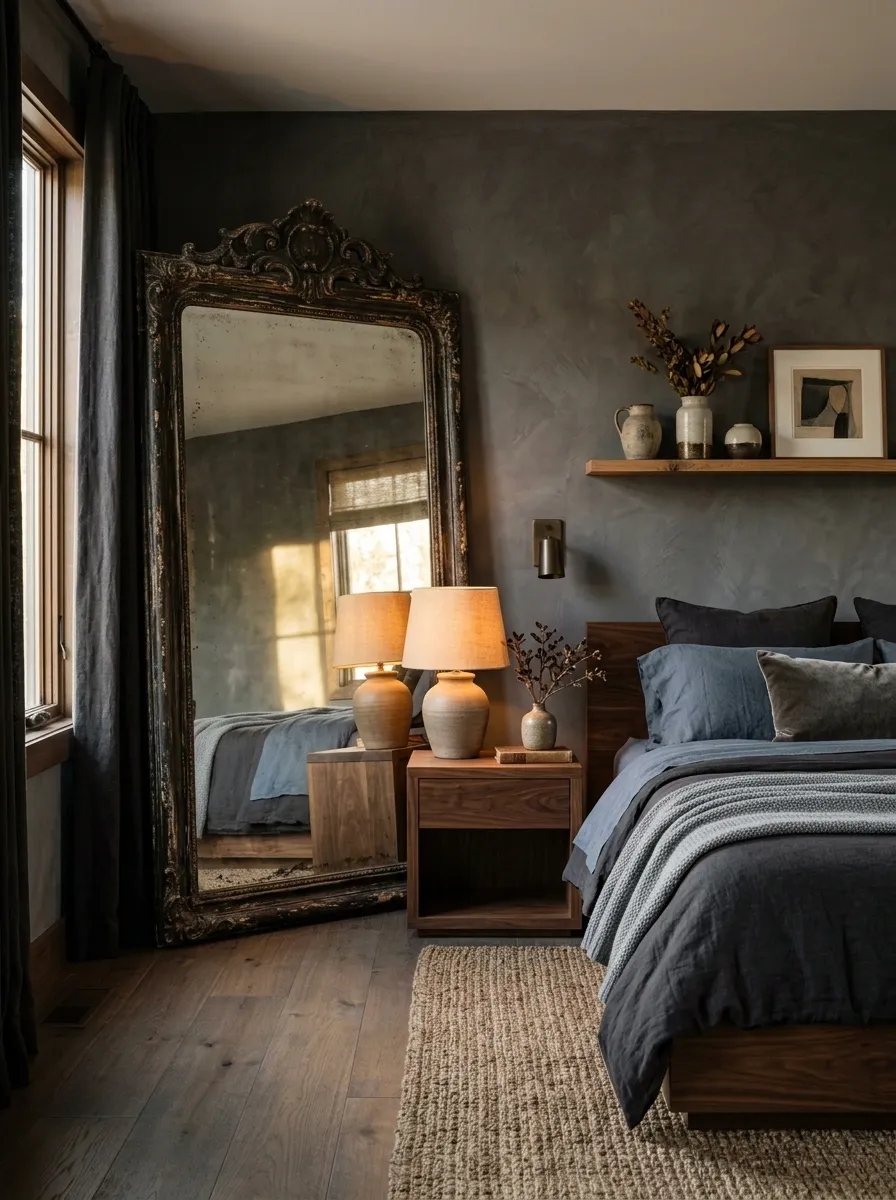
A mirror can brighten a moody bedroom, but a huge glossy surface can quickly make it feel more formal than cozy.
Choose a mirror with an aged, dark, wood, or softly metallic frame. Place it where it can catch daylight or reflect a lamp rather than pointing it directly at another decorative wall.
The reflection should serve the room.
Better reflections include:
- window light
- a warm lamp
- a soft curtain
- part of the bed
Avoid reflecting clutter. A beautiful mirror pointed at an overloaded dresser simply doubles the mess.
Keep the Bedding Lighter Than the Darkest Wall
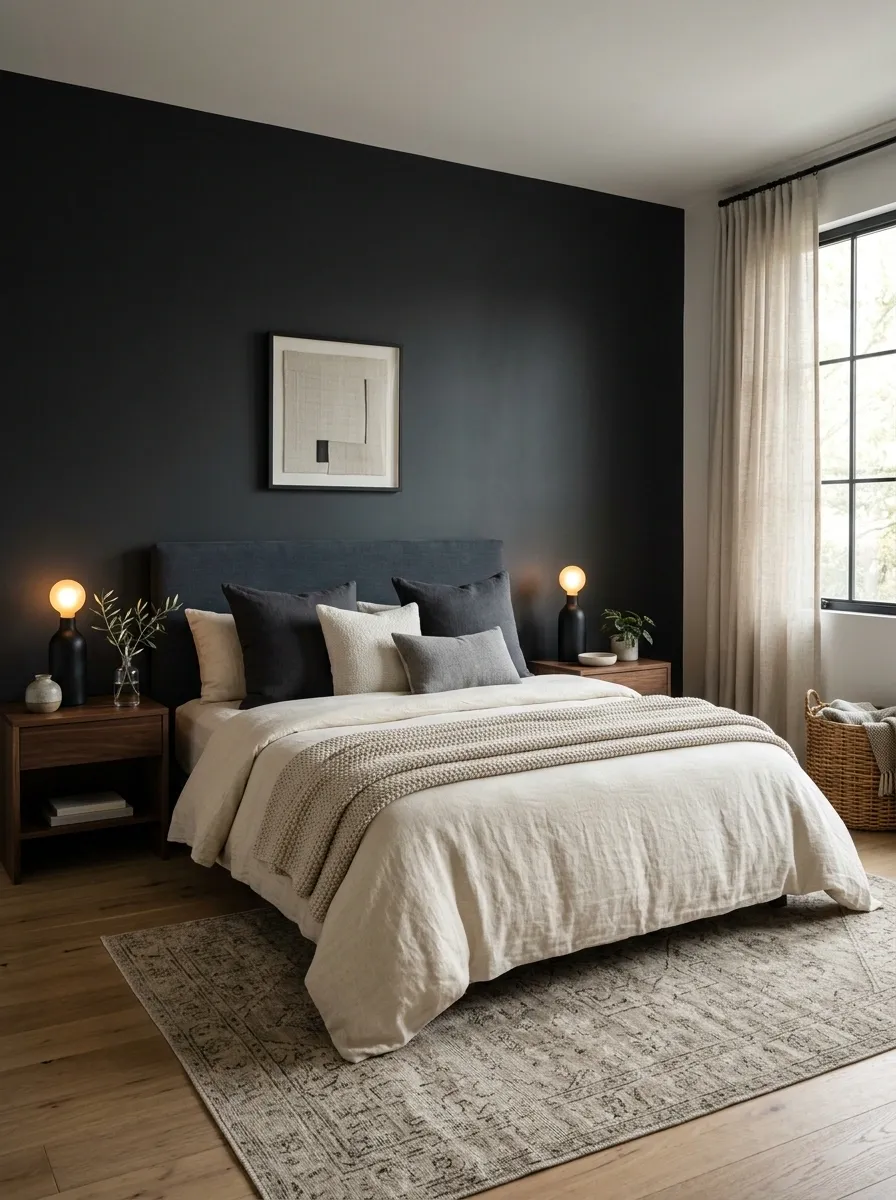
The bed should still be visible against the wall behind it.
When the bedding and wall are nearly identical in tone, the bed loses its shape and the entire sleeping area becomes one dark mass. A lighter duvet solves that without forcing the room into a bright palette.
Try warm ivory, mushroom, oatmeal, stone, or muted gray.
Then bring the wall color back through smaller pillows, a throw, or the headboard. The result is much more layered because the dark wall provides the backdrop while the bedding creates the foreground.
Let the bed interrupt the darkness.
Finish With Restrained Natural Accents
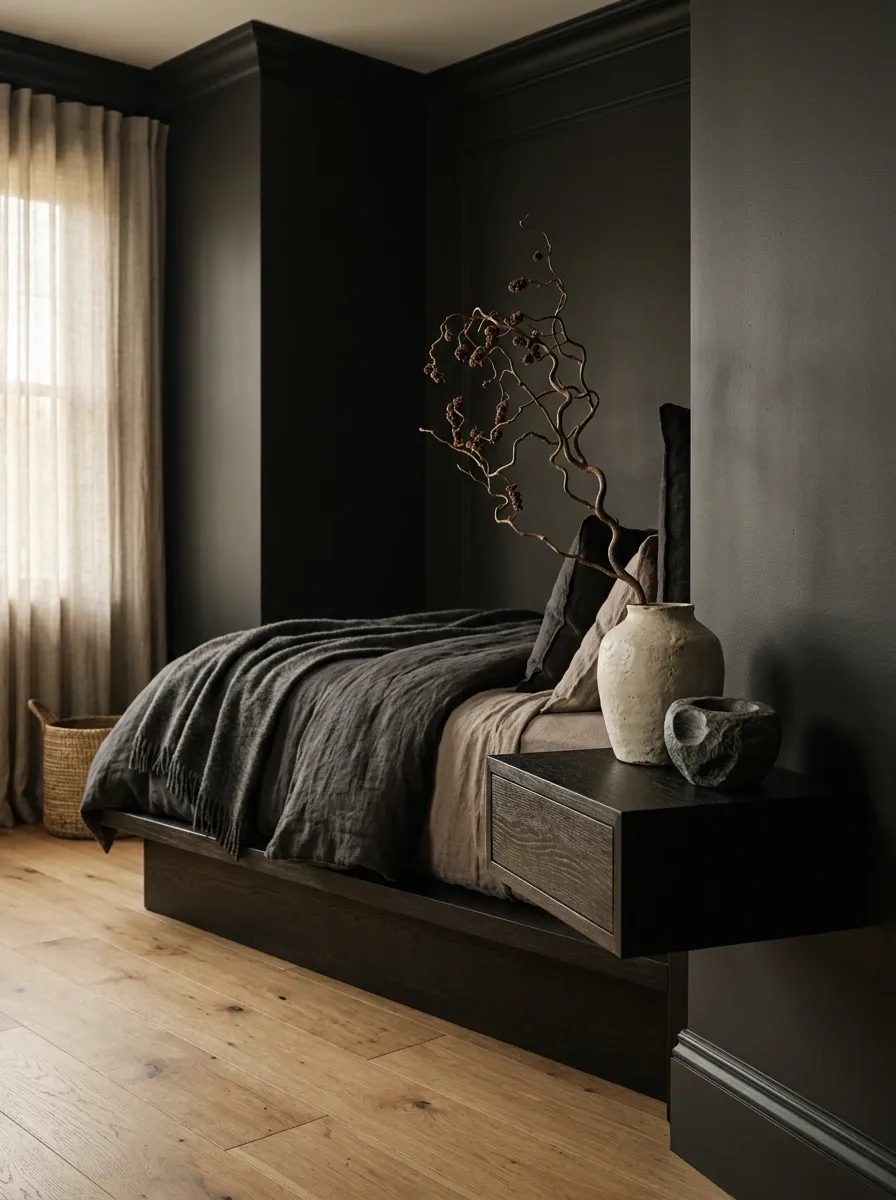
The final layer doesn’t need more decoration. It needs something that makes the room feel less manufactured.
Natural accents do that quickly. A branch in a rough ceramic vase, a woven basket, a stone object, raw wood, or a small plant can soften the harder geometry of dark walls and furniture.
Keep the shapes organic and the quantity low.
A strong finishing mix: one natural material, one irregular shape, one living element.
That’s enough to prevent the bedroom from feeling overly polished while still keeping the palette controlled.
Layer the Final Details Until the Room Feels Collected
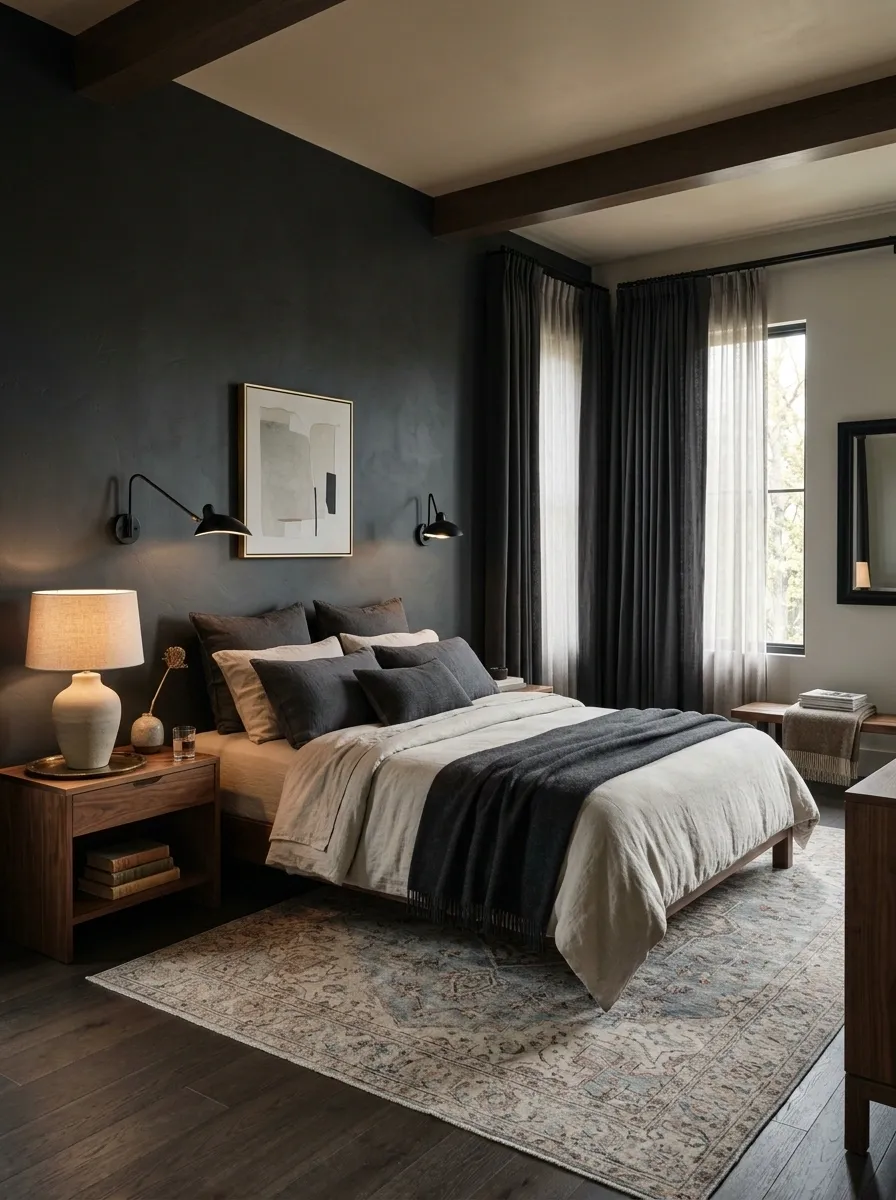
The strongest moody bedrooms aren’t stuffed with accessories. They have enough layers to make every surface feel considered, then stop.
Start with the large shapes: walls, bed, curtains, rug, and main furniture. Add lighting. Then bring in texture. Only after those pieces work should the small details enter the room.
Use the final pass to remove things, too. A lamp that’s too small, a decorative object with no purpose, or a pillow in the wrong color can weaken the entire composition.
The last step isn’t adding more. It’s editing harder.
Let the Bedroom Stay Dark Without Letting It Feel Heavy
The difference between a forgettable dark bedroom and a memorable one usually comes down to restraint.
The walls can be dramatic. The bed can be oversized. The lighting can stay low. But every one of those choices needs something nearby that pushes against it.
Warm walnut keeps gray from feeling cold. Pale linen gives a dark wall definition. A faded rug breaks up a heavy floor. A small amount of black sharpens softer neutrals. A warmer ceiling prevents the room from splitting into a dark wall and a bright rectangle overhead.
That’s what makes the room feel layered instead of simply dark.