
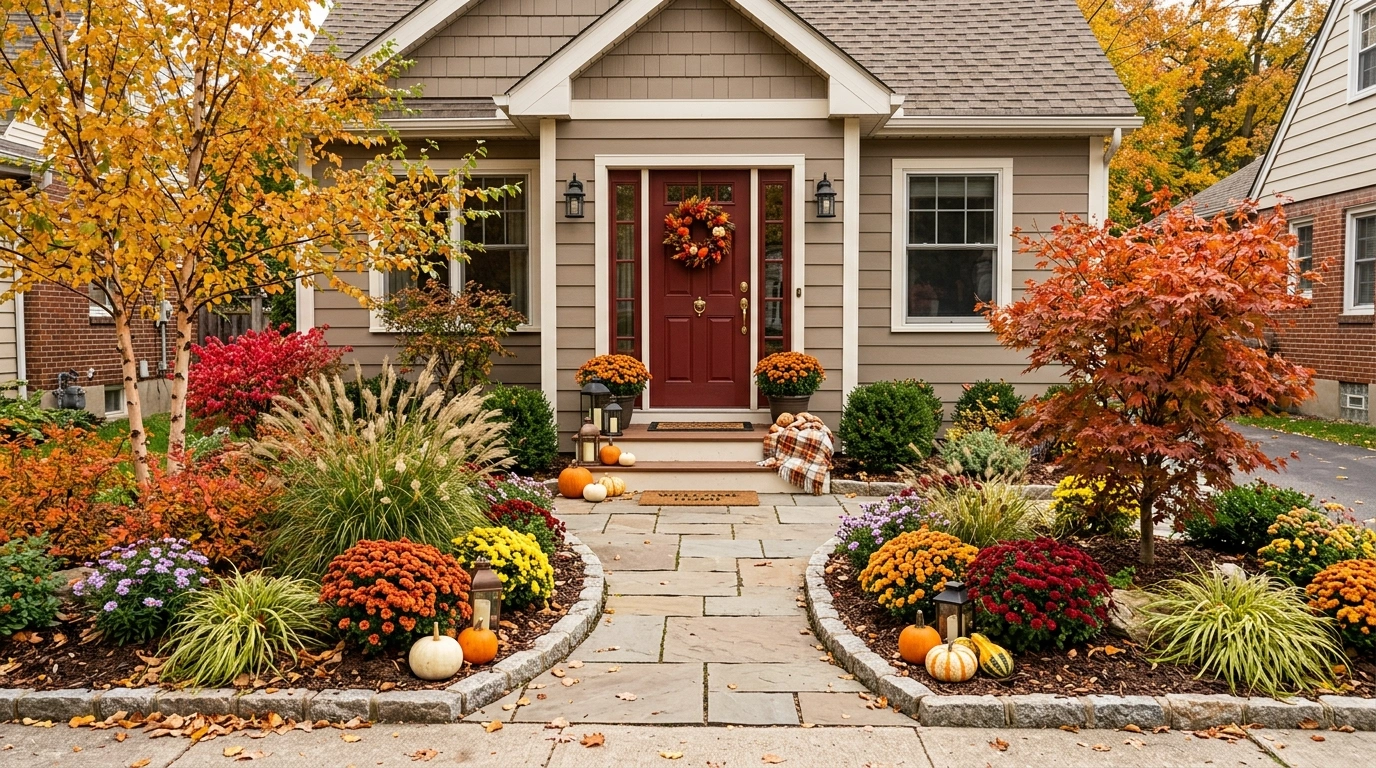
A small front yard can lose its sense of shape quickly once fall arrives. Plants change color, flowers disappear, grasses become taller and softer, and the spaces that looked balanced in summer can suddenly feel patchy or overcrowded. Adding more seasonal color usually isn’t the answer.
The stronger approach is to design the whole frontage as one composition. The path, planting beds, facade, front door, hardscape, evergreen structure, and autumn foliage should relate to one another rather than compete for attention. A compact yard has less room for mistakes, which makes proportion especially important.
Small Front Yard Landscaping for Fall
Classic Fall Foliage Entry
A canopy of brilliant orange and gold sets the seasonal tone for this traditional entrance, framing the white facade and double doors with natural warmth. Neatly clipped evergreen hedges line the stone path below, providing a crisp geometric contrast to the loose canopy overhead and the fallen leaves dusting the ground.
The careful curation of structured boxwood globes and soft seasonal blooms in classic urns creates an intentional entryway that feels both abundant and orderly. A slender white address post anchors the composition, offering a bright structural element amid the rich autumnal colors.
This design excels by letting mature trees do the heavy lifting for autumn color while keeping the foundation planting restrained. The result is a welcoming facade that celebrates seasonal change without feeling cluttered or overwhelmed by the transition.
Warm Cottage Entry With Curved Planting Beds
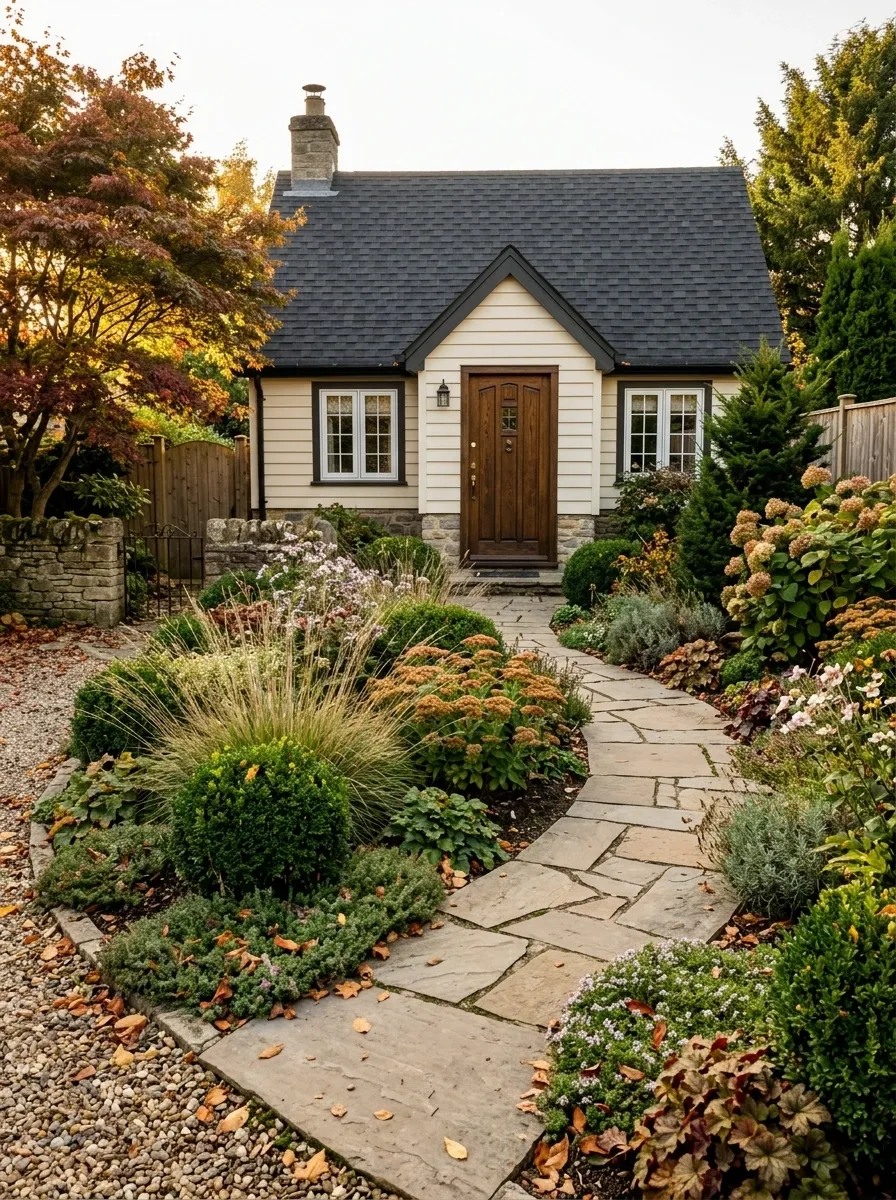
The strongest feature here is the curved planting bed that softens the straight lines of a compact facade. A narrow stone path approaches the front door through layers of ornamental grass, rounded shrubs, small evergreen forms, and pockets of rust and muted gold foliage. The planting looks abundant without spilling into the walking route.
The curved edge prevents the yard from reading as a collection of rigid rectangles. Lower plants stay close to the path, medium shrubs create the middle layer, and evergreen shapes provide year-round weight. A restrained exterior palette lets the fall foliage supply the seasonal change.
The important balance is between softness and structure. Too many loose plants would make the little yard look untidy, while too much clipping would remove the cottage character.
Warm Brick Porch With Mums
Red brick siding meets modern comfort in this layered porch design, featuring a neutral jute rug, a wooden bench, and carefully placed autumn elements. Deep bronze mums in oversized ceramic vessels anchor the corners of the concrete landing, while smaller pumpkins and glowing lanterns line the walkway.
The soft gray concrete path is framed by neat garden beds filled with fine textures and low shrubs, creating a seamless transition from the lawn to the front door. Warm lighting from black wall sconces and ground-level fixtures highlights the rich tones of the brick and the welcoming seating area.
This composition proves that a modest front porch can feel deeply intentional through thoughtful accessorizing and textural variety. Keeping the color palette centered around rust, copper, and warm neutrals ensures the space feels cohesive rather than chaotic.
Narrow Walkway With Burnished Fall Grasses
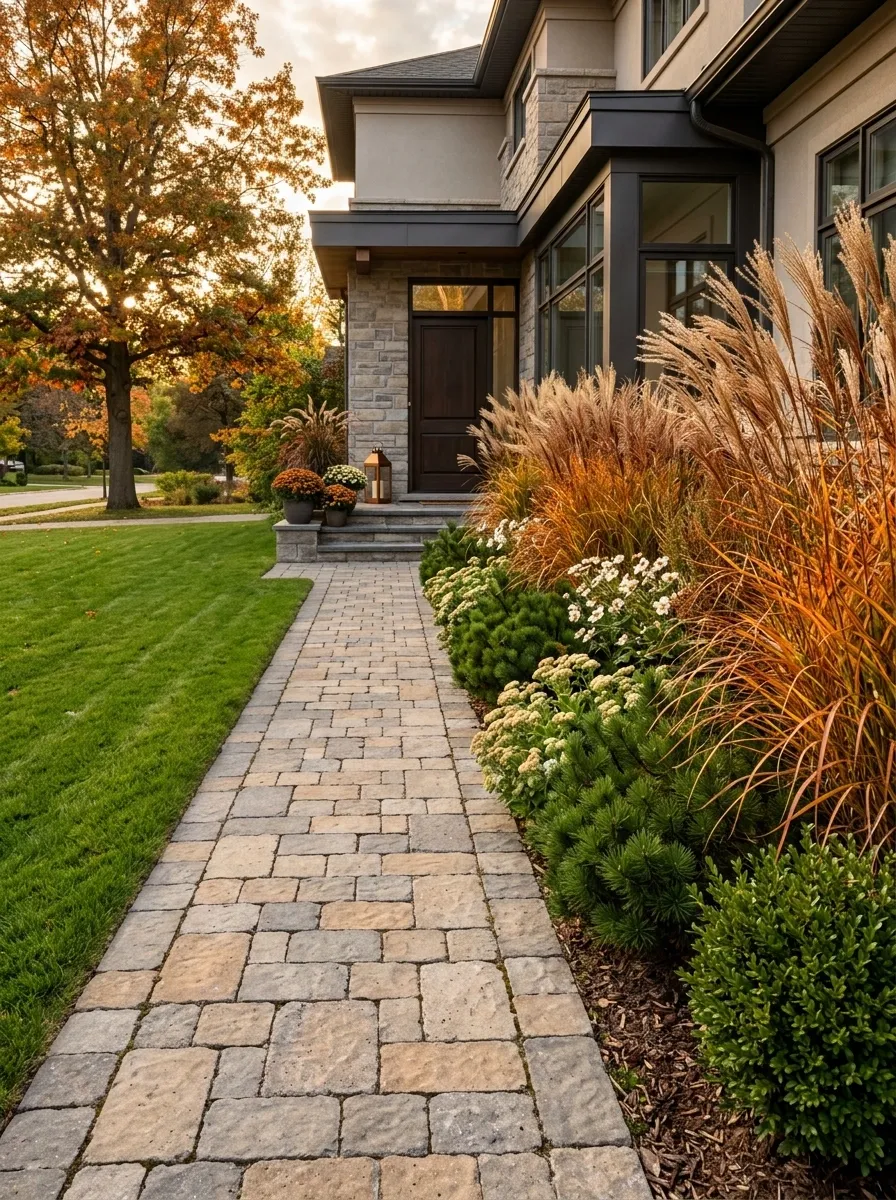
A narrow side-facing front yard benefits from treating the walkway as part of the landscape instead of squeezing plants around it. Here, warm stone paving runs toward the entry while burnished grasses rise along one edge, backed by compact shrubs in olive and deep green. Small pockets of cream-toned planting interrupt the darker foliage.
The result has a stronger sense of movement than a straight bed packed with individual plants. The grasses create a loose vertical rhythm, while the paving remains visually dominant enough to keep circulation obvious.
This composition works especially well where the house sits close to the sidewalk. The landscape becomes a narrow framed passage rather than a miniature version of a larger suburban yard. Keeping the planting concentrated on one side also preserves useful visual width.
Evening Glow Autumn Pathway
As dusk settles, this classic front porch comes alive with the warm glow of hidden lanterns and glowing windows, framed entirely by a sea of fallen autumn leaves. Tall white columns support the deep porch roof, overlooking a dense collection of mums, grasses, and rustic pumpkins scattered along the steps.
The rich dark exterior of the home provides a dramatic backdrop for the sea of gold and copper foliage resting on the ground. Simple rocking chairs and cozy textiles on the porch invite lingering, while lanterns cast a soft amber light across the uneven stepping stones.
This enchanting setup captures the peak of autumn coziness by combining natural seasonal debris with structured architectural lighting. The balance of wild, falling leaves with manicured porch decor creates an inviting atmosphere that feels effortlessly charming.
Black Front Door Framed by Autumn Planting
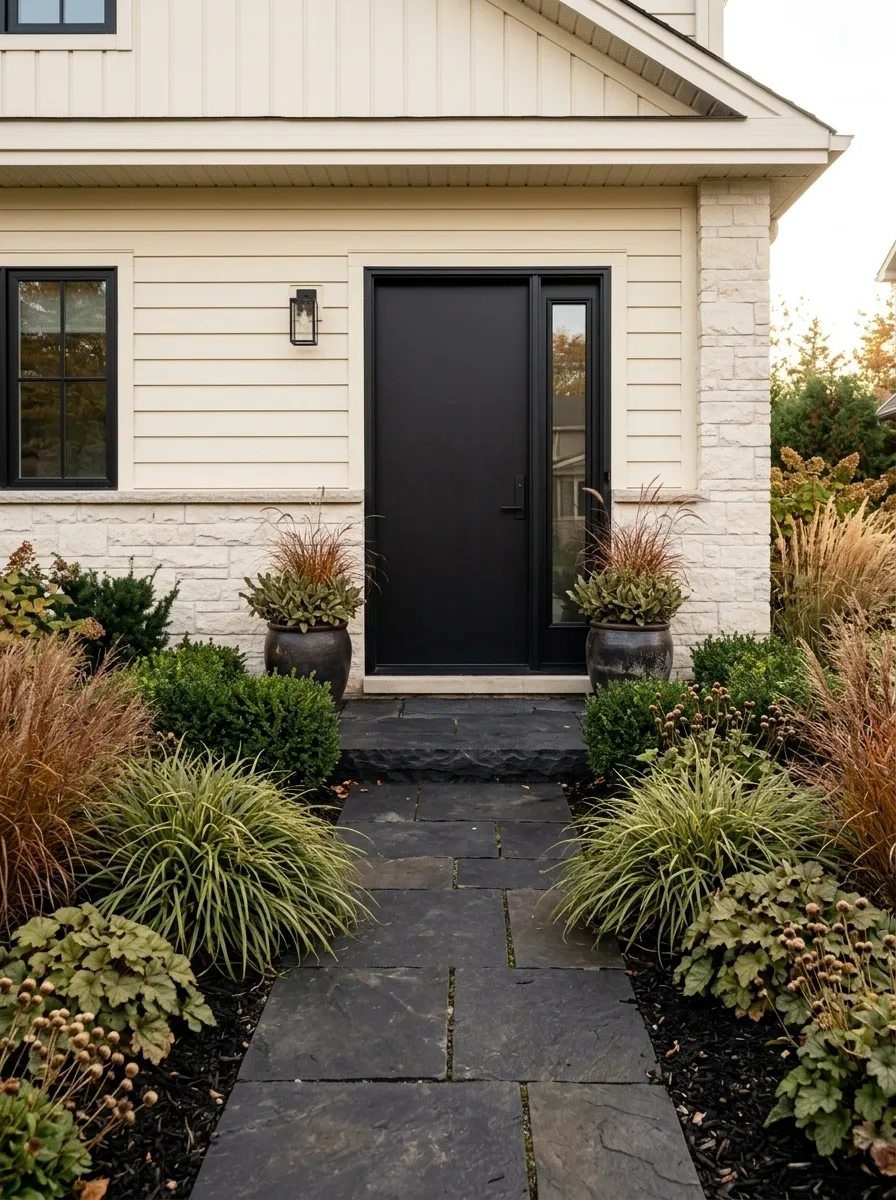
A black front door becomes the visual anchor in this compact contemporary composition. Pale masonry or warm cream siding provides the light background, while olive foliage, rust-toned grasses, and dark paving build a controlled frame around the entrance.
The planting is quieter near the door and fuller toward the outer edges. That creates a natural visual funnel without requiring a large path or oversized planting bed. A pair of low structural shrubs can establish the lower frame, with taller grasses positioned farther from the threshold.
Fall color is used sparingly here. The rust foliage appears as an accent rather than a dominant theme, which keeps the design architectural. The dark door, dark ground elements, and evergreen foliage create enough continuity that the seasonal plants feel integrated.
Layered Corner Bed With Compact Evergreen Structure
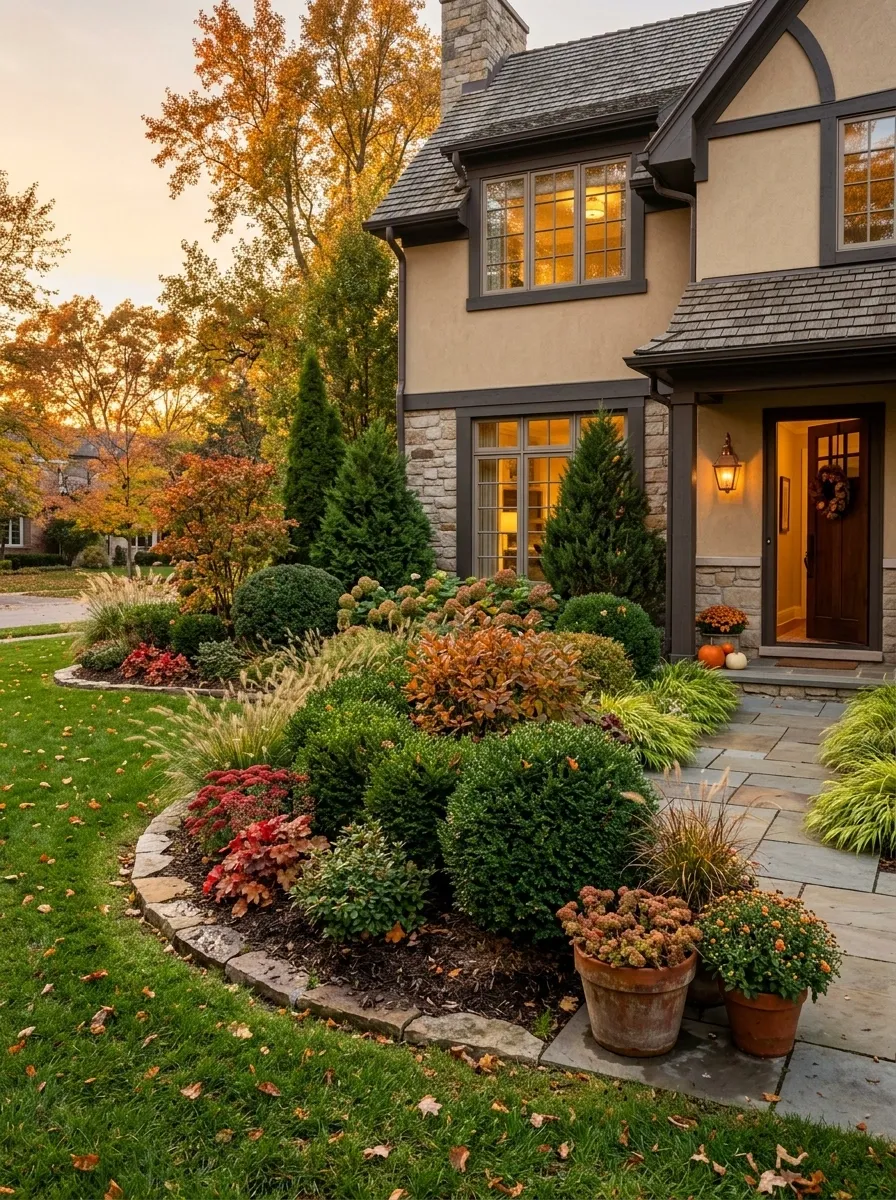
The unused corner of a small front yard can become the most important planting zone when it is given enough depth. This design builds outward from compact evergreen forms, rounded shrubs, fine-textured grasses, and small clusters of reddish fall foliage.
Instead of distributing plants evenly across the entire yard, the planting mass is concentrated toward the corner. That creates a stronger sense of depth while keeping the doorway and pathway visually open. The evergreen structure also gives the composition something to hold onto once the most colorful foliage fades.
Broad evergreen shapes create the foundation, rounded shrubs soften the middle, and finer grasses supply movement at the front. A limited palette makes the different textures easier to appreciate.
Rustic Gravel Yard With Oversized Planters
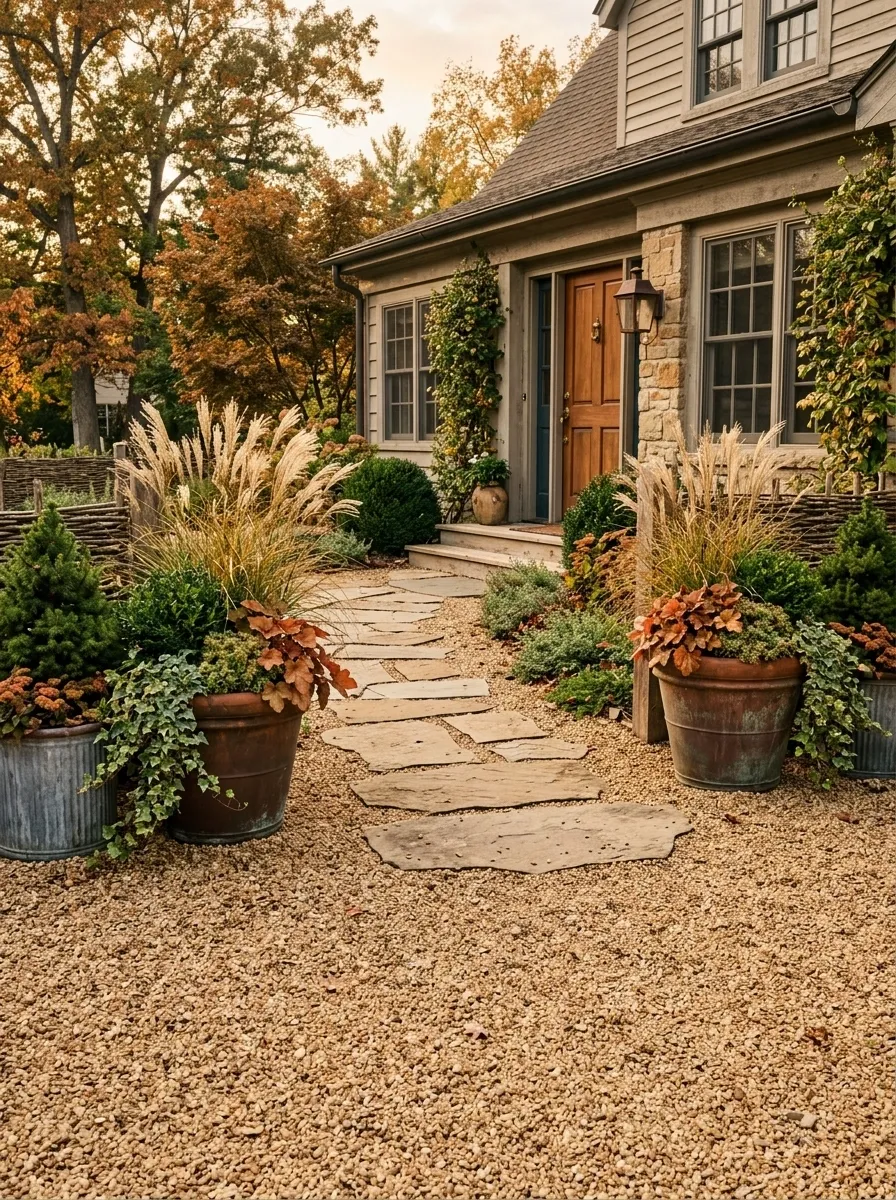
A small yard does not need a conventional lawn to feel finished. This rustic composition replaces most of the grass with warm gravel, irregular stepping stones, compact shrubs, grasses, and a few substantial planters. The larger containers become part of the architecture rather than seasonal accessories.
The gravel supplies a consistent visual base, which allows the different foliage forms to stand apart without creating a crowded planting bed. A broad stepping-stone route leads to the door while leaving generous open areas around it.
Fall color stays earthy here: copper, faded gold, olive, weathered brown, and deep green. With several hard surfaces already present, too many bright seasonal accents would make the small footprint feel fragmented.
Soft Contemporary Yard With Cream and Copper Planting
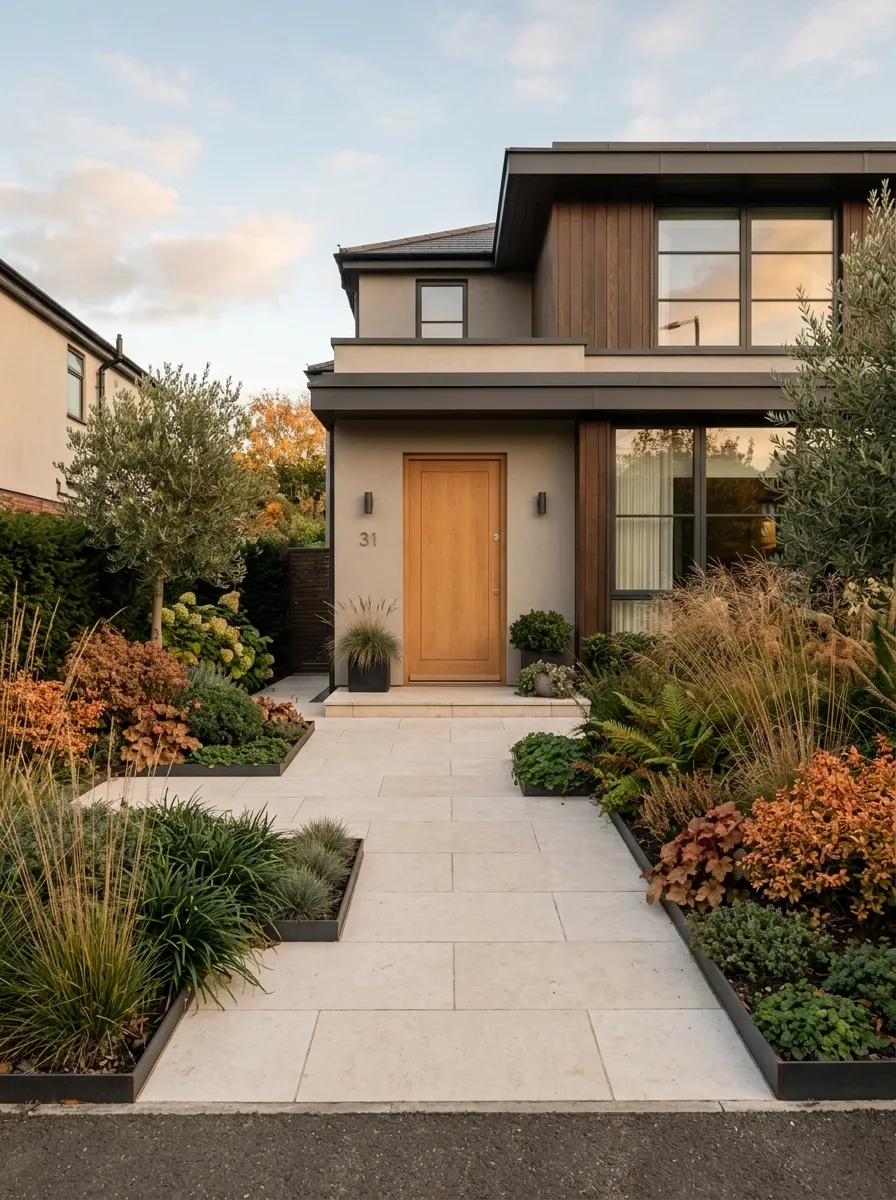
A small contemporary frontage looks strongest when the landscape echoes the home’s clean geometry without becoming rigid. This version uses pale paving, crisp planting edges, architectural grasses, muted copper foliage, and a simple timber-toned front door.
The base stays quiet, with cream stone and olive greenery carrying most of the composition. Copper appears in concentrated pockets rather than across the whole yard, giving the fall palette more impact. Fine-textured grasses soften the hard surfaces and keep the architecture from feeling severe.
The planting should remain lower near the walkway and rise toward the outer boundary. That shift creates depth without making the entrance feel enclosed.
Tiny Lawn Framed by Full Fall Borders
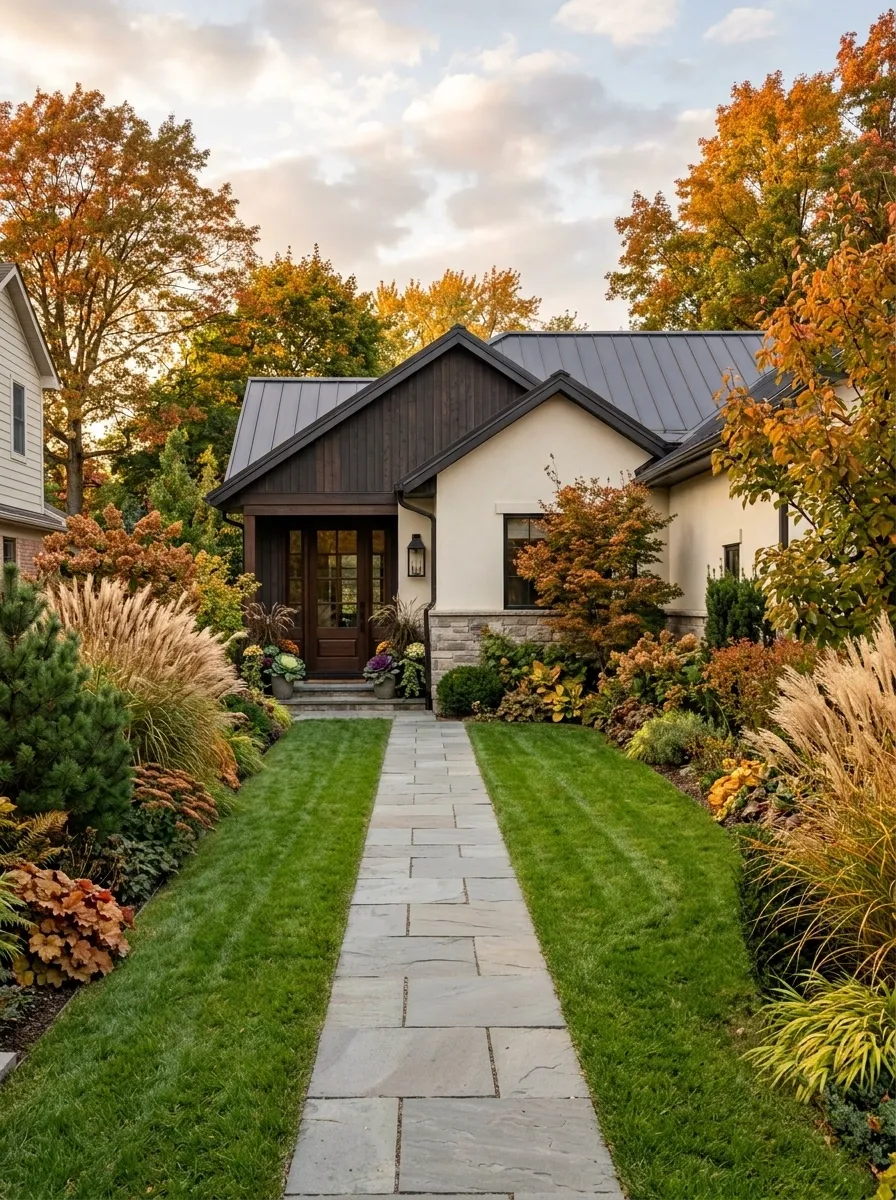
Keeping a small patch of lawn can make a compact front yard feel larger when the surrounding planting is dense enough to define it. This composition leaves a simple green center while building deep borders along the perimeter with shrubs, grasses, evergreen forms, and restrained autumn color.
The open center acts as negative space, giving the eye somewhere to rest. The planting is fuller at the outer edges, particularly near the property boundaries, so the yard gains depth without filling every square foot.
A narrow walkway cuts through the composition toward the front door. Its simplicity is important. There is already enough color and texture around it, so elaborate paving would only compete with the planting.
Stone Path Through a Woodland-Inspired Front Yard
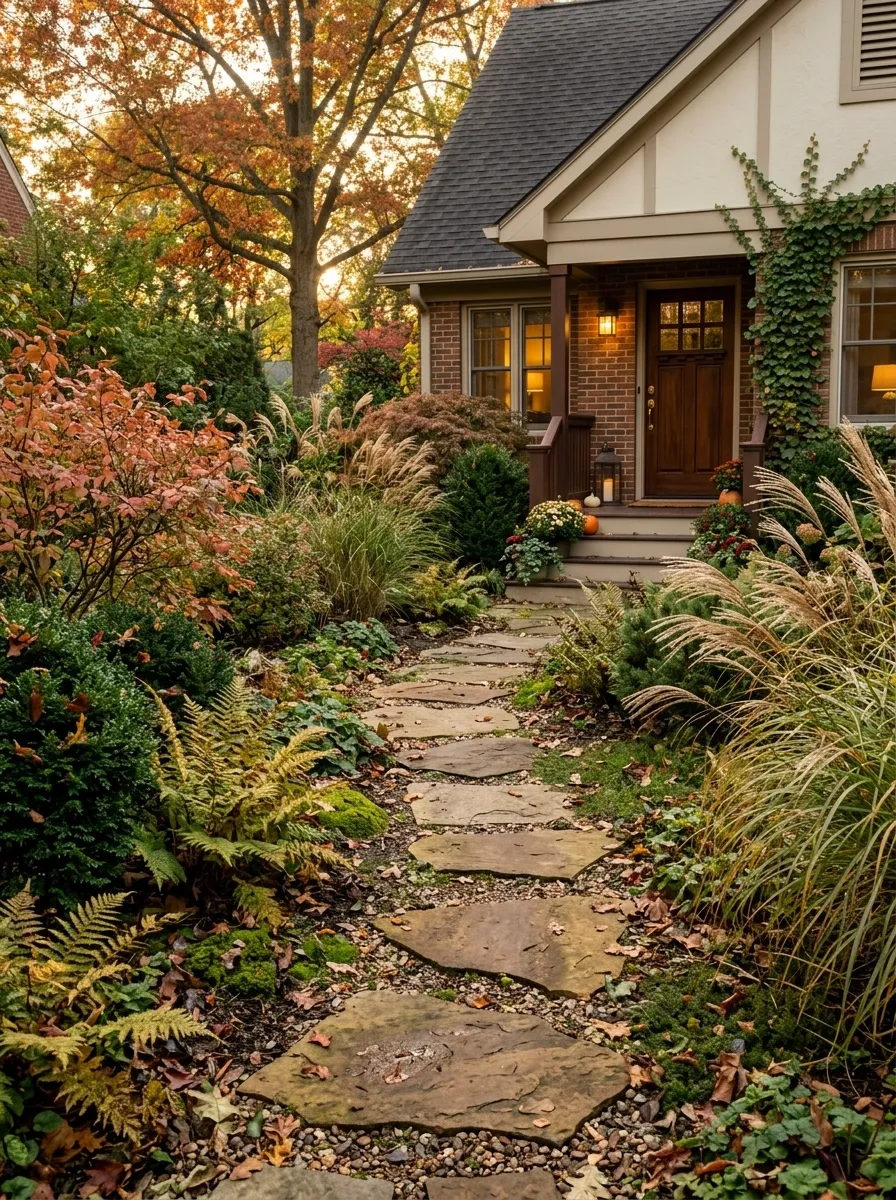
A woodland-inspired front yard gives a small space a more natural rhythm by replacing rigid rows with overlapping textures. Irregular stepping stones lead through low greenery, fern-like foliage, compact evergreens, reddish leaves, and a few taller seed-head forms.
The planting can feel loose farther from the door, but the entry itself needs a cleaner visual edge. That contrast makes the composition feel designed rather than neglected.
Natural stone carries the pathway while the plants provide softness around it. Different foliage shapes become more important than a large number of flower colors, especially in fall. Deep green, muted red, faded gold, and brown create a quiet woodland palette that works with brick, stone, or painted facades.
Symmetrical Entry With Deep Burgundy Foliage
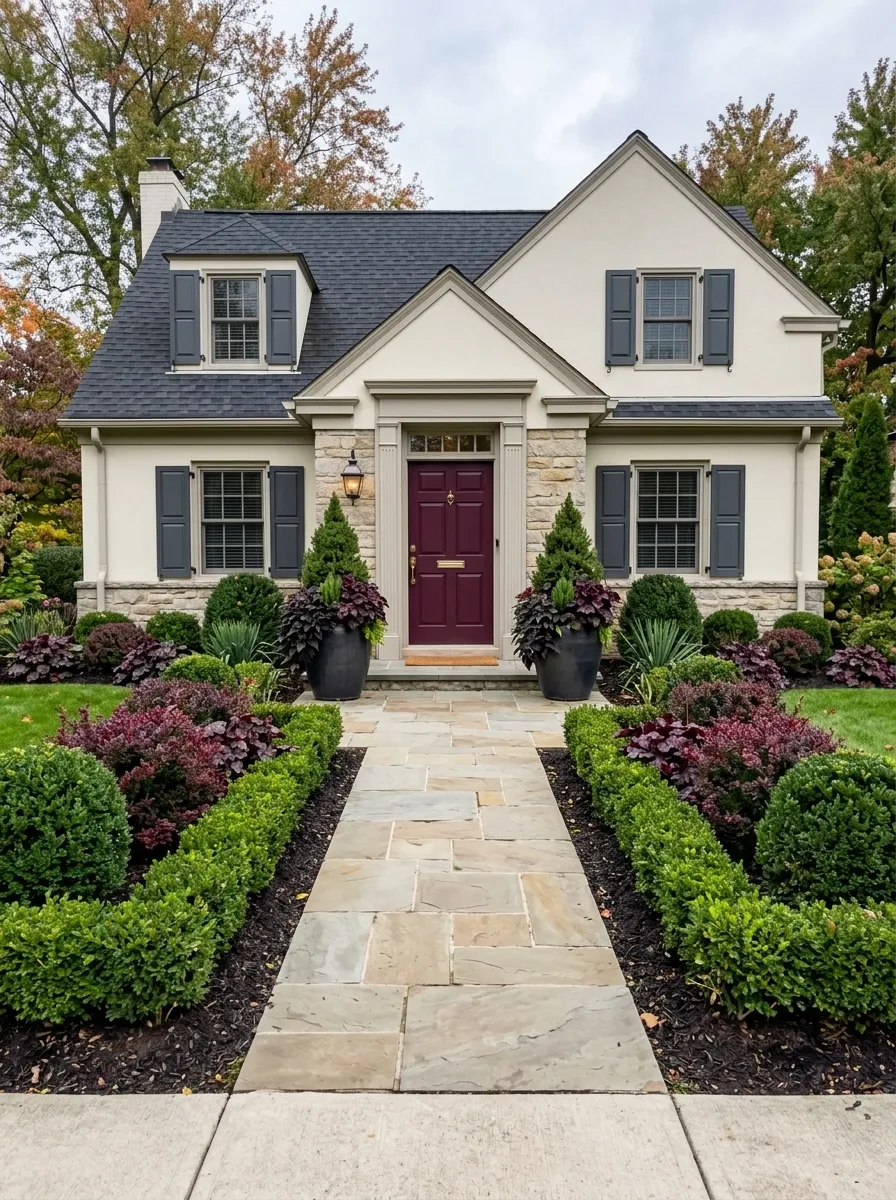
Symmetry is particularly useful in a small front yard because it gives the eye a clear structure. This formal composition centers the landscape around the front door, using matching containers or shrubs, clipped evergreen forms, deep burgundy foliage, and a straightforward paved approach.
The symmetry does most of the organizational work, so the fall planting can remain restrained. Burgundy provides a stronger seasonal note than bright orange while still sitting comfortably beside deep greens and neutral stone.
The entry remains visually open, with the largest planting masses positioned farther from the threshold. That keeps the doorway prominent while making the frontage feel fuller toward the edges.
Front Steps Surrounded by Amber Grasses
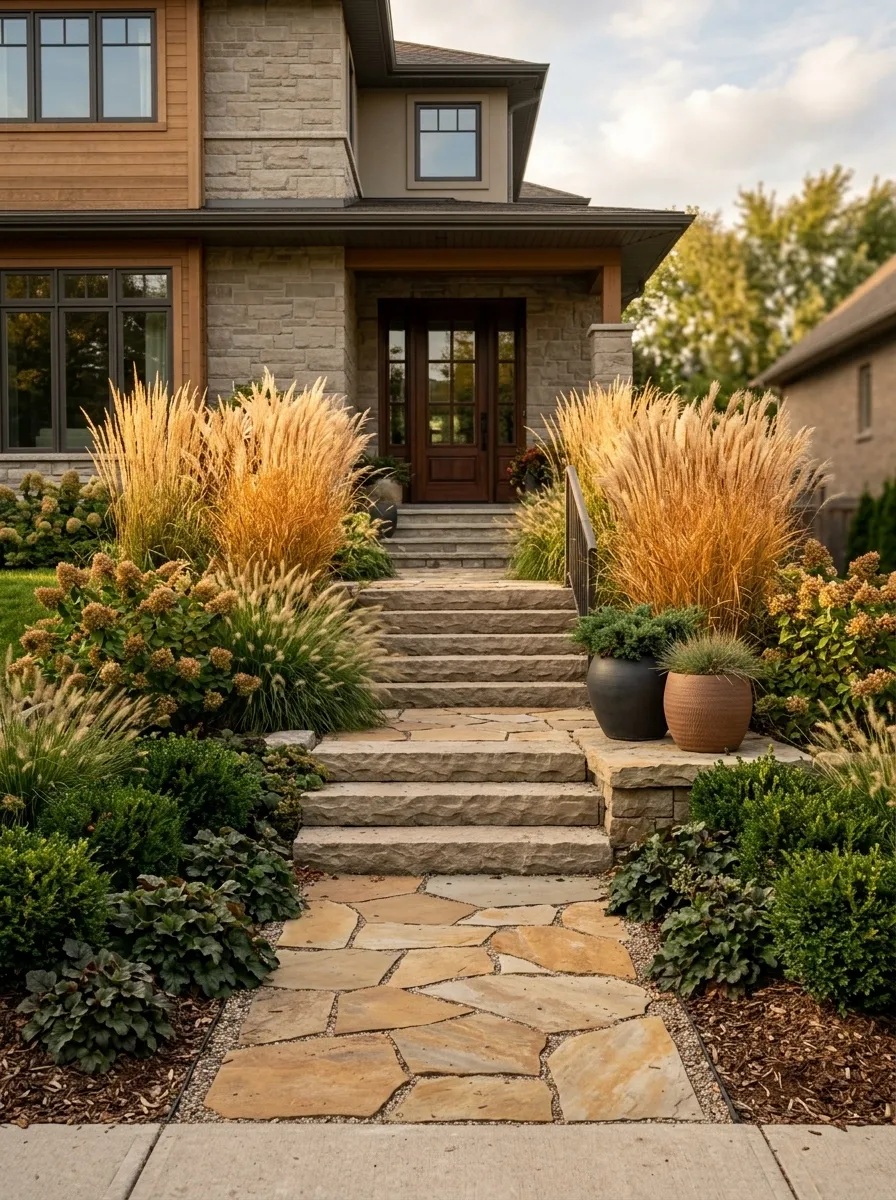
Front steps can easily become visually harsh when the surrounding yard is small. This design softens the elevation with amber-toned grasses, compact evergreen shrubs, warm stone, and a few low planters positioned beside rather than directly in front of the steps.
The grasses rise alongside the staircase, following its vertical movement without narrowing the actual route. Evergreen planting gives the composition enough density to remain interesting after the grasses lose their color, while the warm paving connects the steps to the landscape below.
The strongest feature is the gradual change in height. Low planting begins near the path, medium forms sit beside the lower steps, and taller grasses frame the upper portion.
Modern White Facade With Olive and Rust Planting
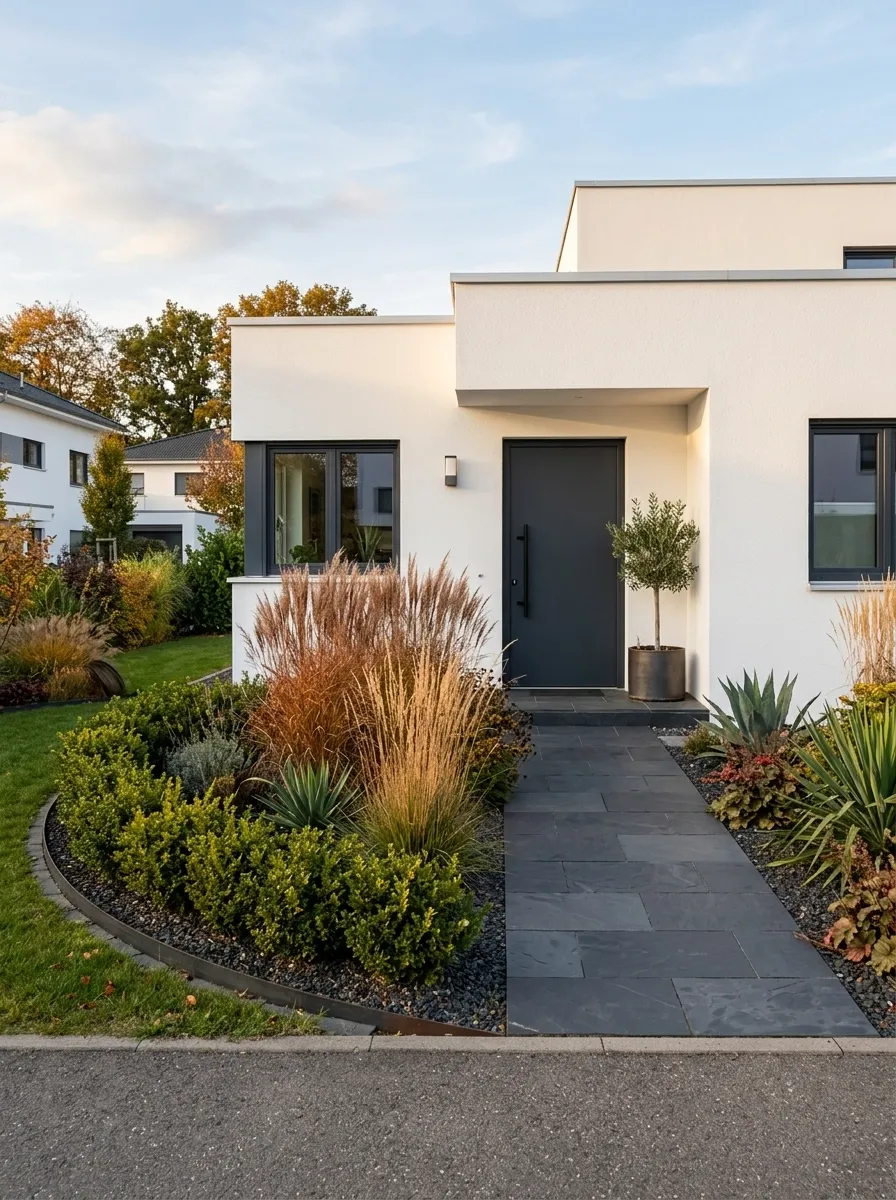
A crisp white facade gives a compact front yard a strong architectural backdrop. The landscape uses that simplicity to its advantage, combining olive-green shrubs, rust-colored grasses, dark paving, and a few sculptural plants rather than filling the space with many competing species.
The planting beds stay sharply defined against the pale exterior. Low greenery follows the walkway, while taller forms gather toward the sides, creating a framed view of the entrance. Rust appears in narrow vertical accents, giving the fall palette enough warmth without turning the yard orange.
The dark architectural details matter just as much as the planting. A charcoal door, dark window trim, or slim metal edging can connect the landscape to the facade and make the entire composition feel deliberate.
Tiny Front Yard With a Single Statement Tree
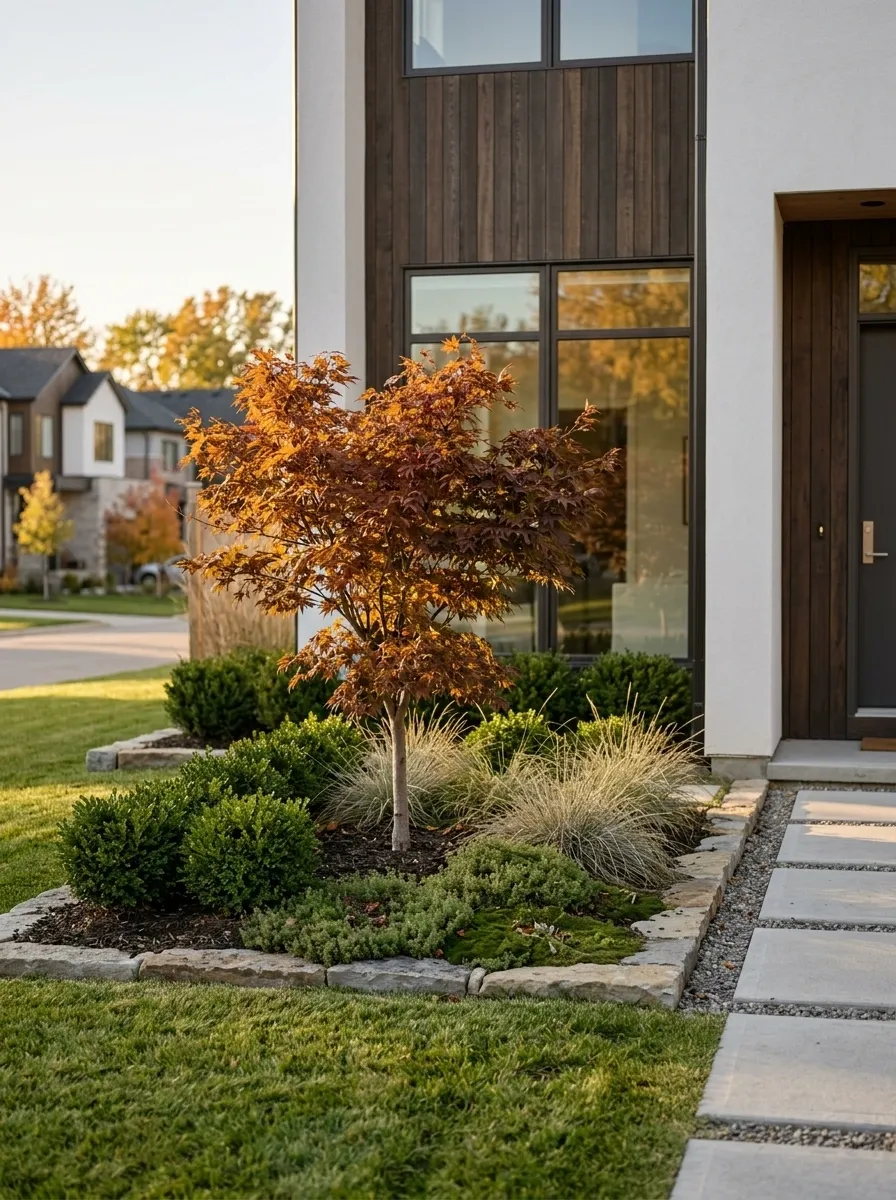
One carefully chosen small tree can provide more visual impact than an assortment of smaller seasonal plants. This composition places a compact ornamental tree slightly off-center, giving the yard a clear focal point while keeping the surrounding planting understated.
Evergreen shrubs form the base, low groundcover softens the edges, and a few muted grasses provide movement around the trunk. The fall display comes primarily from the tree’s foliage, so the rest of the landscape stays restrained.
That restraint is what makes the concept work. A small yard already has limited visual space, and competing focal points make it look smaller. The tree creates a vertical landmark while the low planting leaves enough open ground around it.
Compact Colonial Entry With Traditional Fall Planting
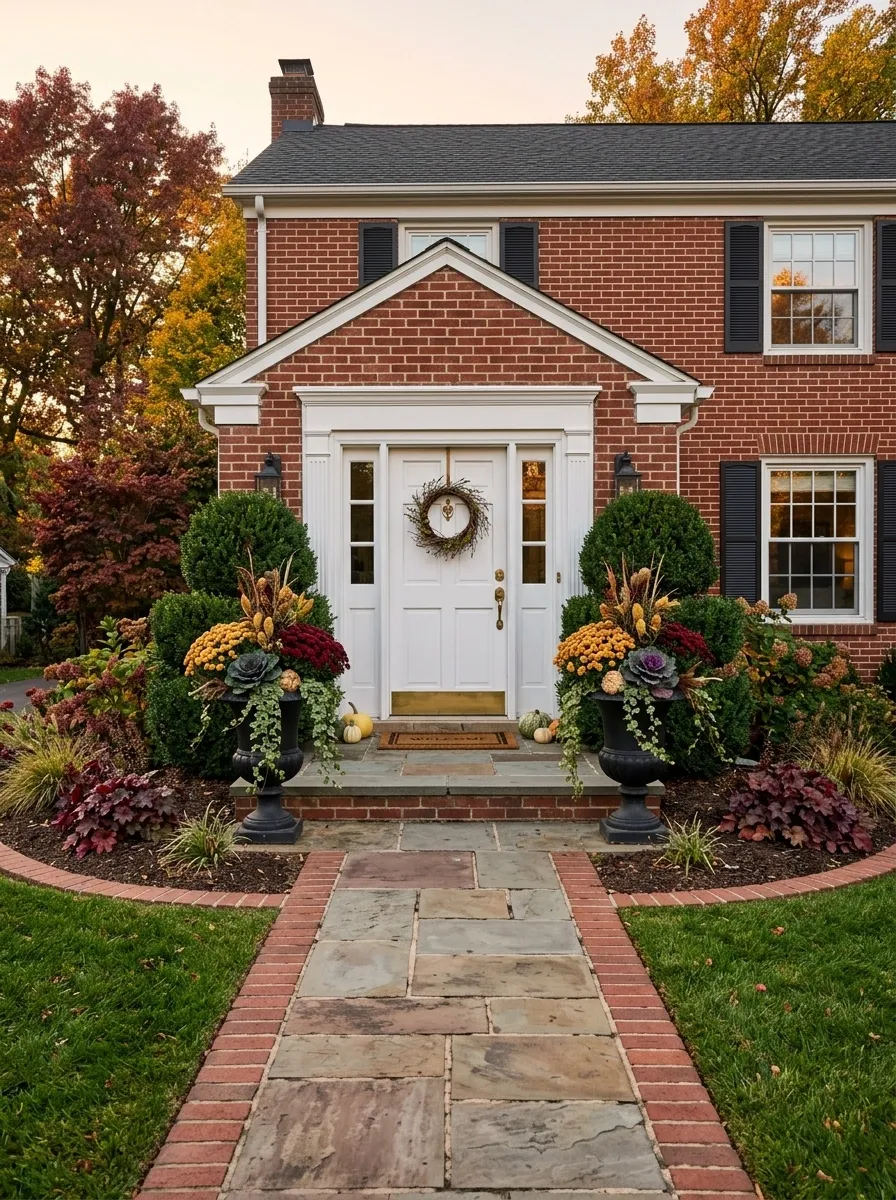
A traditional front elevation benefits from a more ordered landscape. This compact design uses clipped greenery, symmetrical seasonal containers, dark evergreen forms, brick edging, and a restrained autumn palette around a centered entry.
The strongest relationship is between the architecture and the planting. Matching forms echo the proportions of the doorway, while brick or warm stone edging connects the yard to the facade. Deep green keeps the design anchored after brighter seasonal foliage fades.
Seasonal color remains concentrated in containers and low planting rather than spread across every bed. That gives the yard a distinctly autumn character without losing the formal structure that makes the traditional architecture feel coherent.
Curved Path With Golden Groundcover
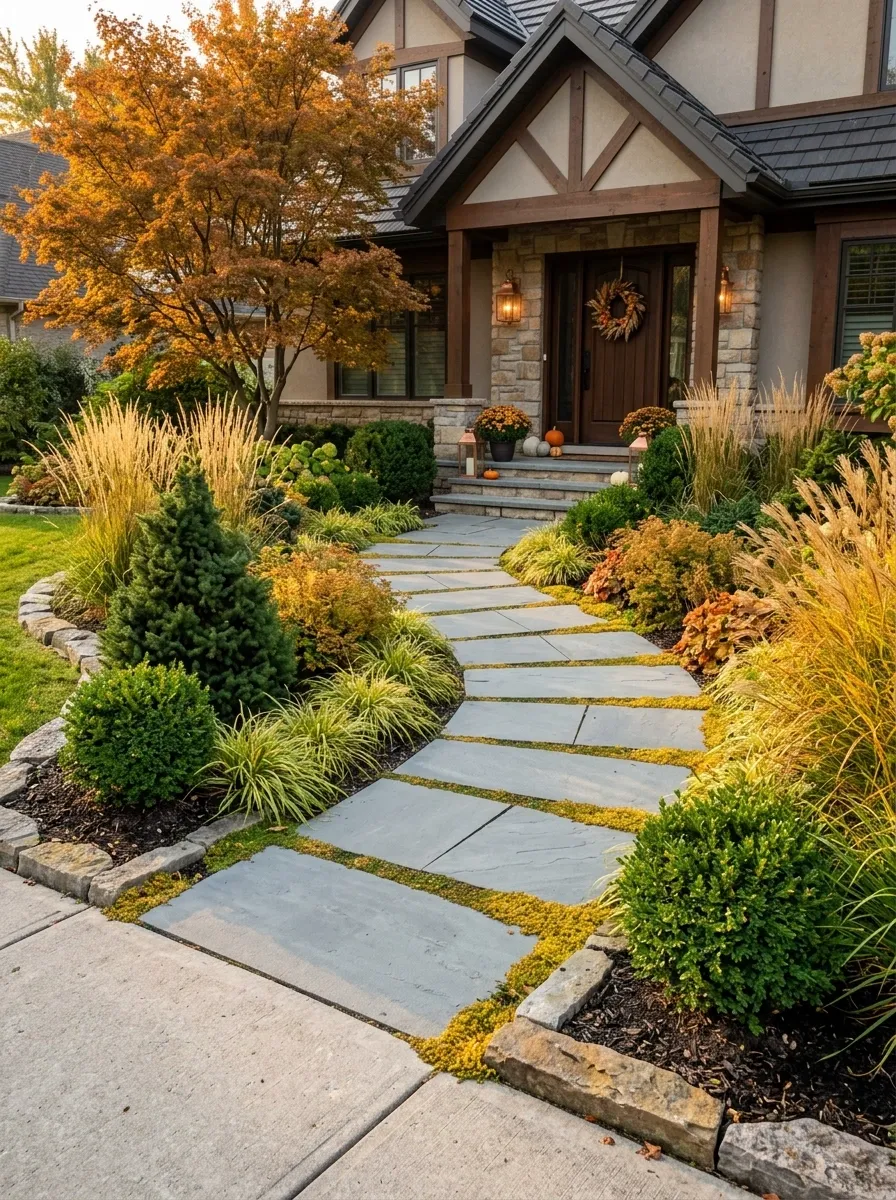
A curving path gives a small rectangular front yard a sense of movement. Instead of walking in a straight line from sidewalk to door, the route bends gently through low golden groundcover, compact shrubs, ornamental grasses, and a few evergreen anchors.
The curve does not need to be dramatic. Even a subtle change in direction can make the landscape feel deeper because the full destination is not revealed immediately. Low planting stays close to the path, while taller forms gather toward the outer edge.
Warm fall tones work especially well against the green foundation. The result feels relaxed without becoming overly rustic, particularly when the path uses a clean, consistent material such as stone or brick.
Tiered Front Bed for a Sloped Yard
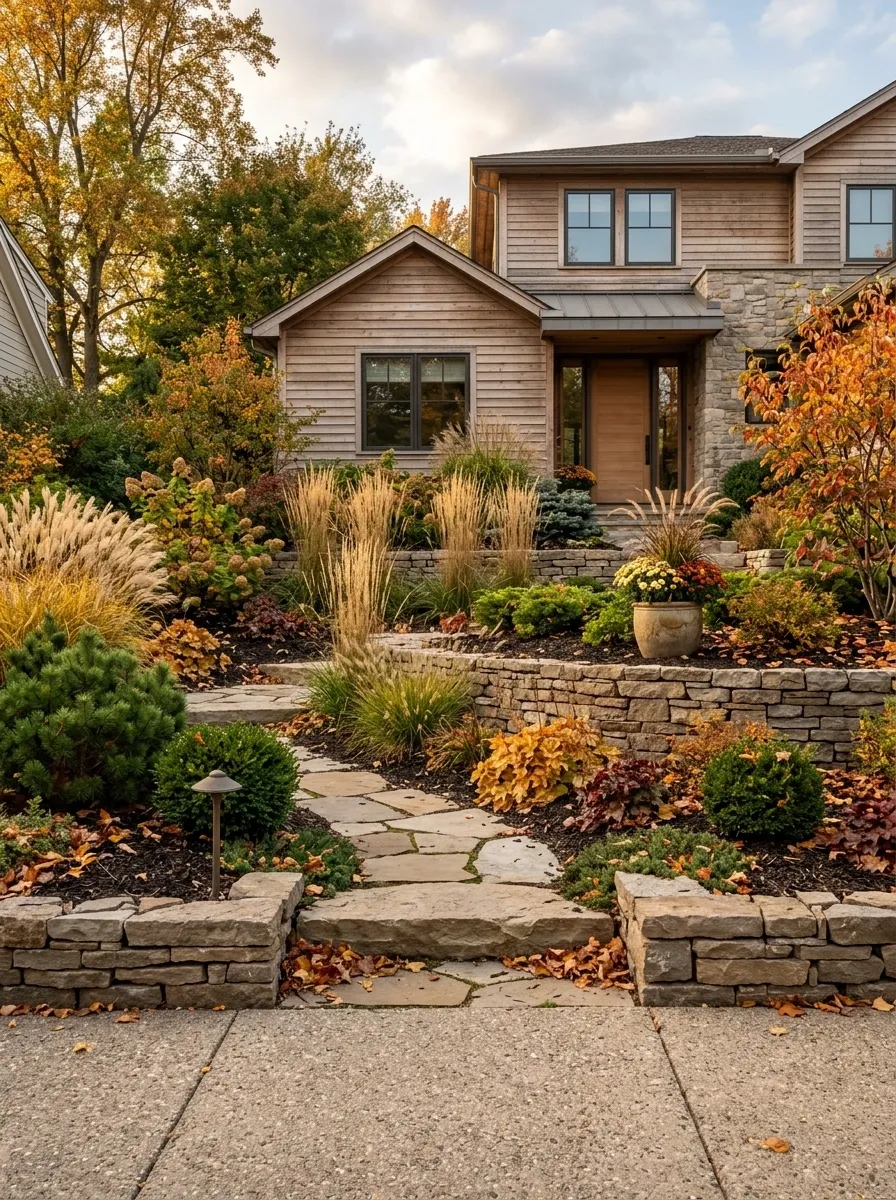
A slope can become the organizing feature of a small front yard when it is divided into simple planting levels. This design uses low stone retaining edges to create shallow terraces filled with compact shrubs, evergreen structure, ornamental grasses, and warm autumn foliage.
Instead of fighting the grade with one large planting plane, the design acknowledges it. Each level has a slightly different visual role, creating depth from the sidewalk upward toward the house. The stone edges repeat a warm natural material so the terraces feel connected.
Plant height should remain controlled around the entry. The tallest forms belong toward the upper or rear sections, while lower planting sits closer to the walkway. That keeps the house visible and makes the slope appear intentional rather than crowded.
Deep Green and Copper Entry With Natural Stone
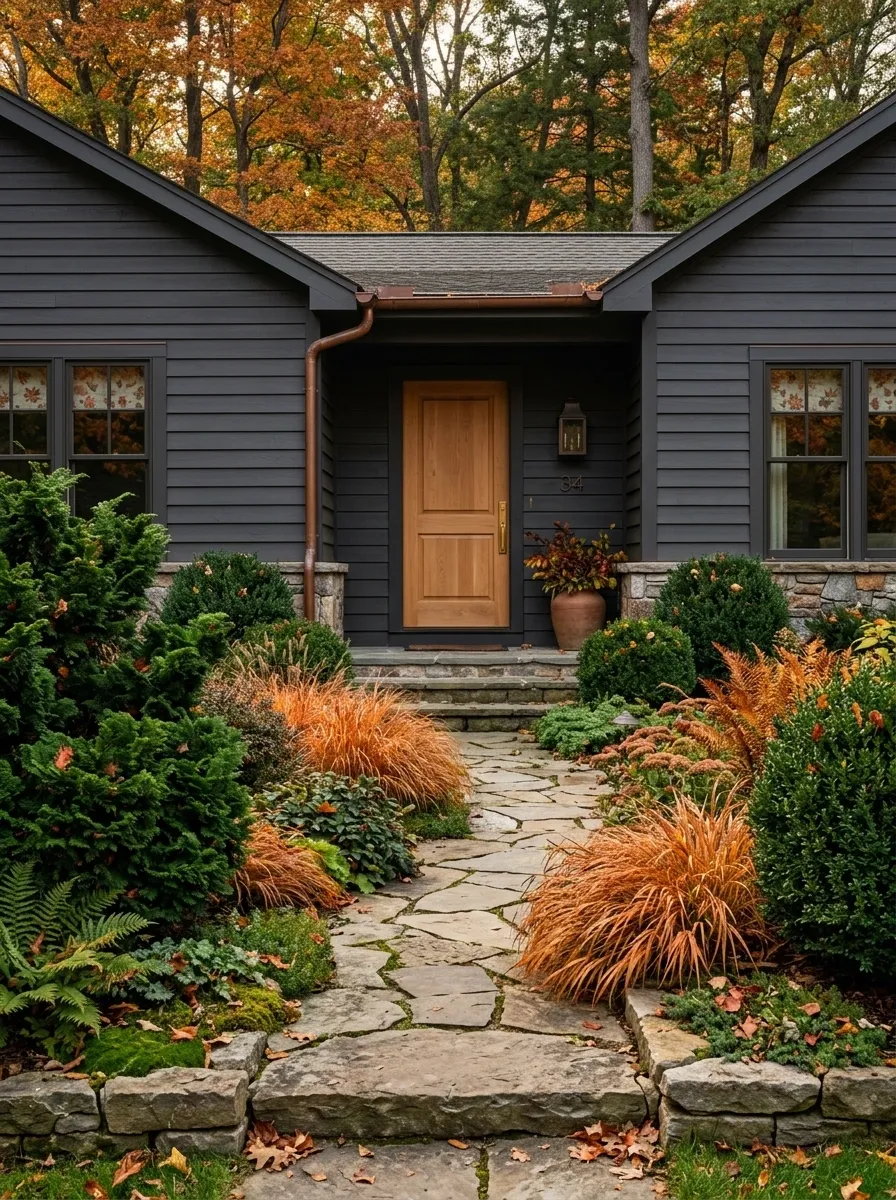
Deep evergreen planting gives this compact front yard a grounded, almost woodland-like character. The composition pairs dark shrubs with copper grasses, weathered natural stone, and a warm wood front door. Instead of spreading autumn color everywhere, the copper appears in a few concentrated groups that catch the eye against the darker foliage.
The stone is equally important. Low irregular edging and a simple stone path give the planting a visual foundation, while the wood door introduces warmth higher up in the composition. Together, the materials create a layered palette without requiring a large variety of plants.
Keeping the greenery dominant makes the seasonal accents feel richer. The yard still has a strong identity after the brightest autumn colors disappear.
Minimalist Gravel Strip Along a Modern Home
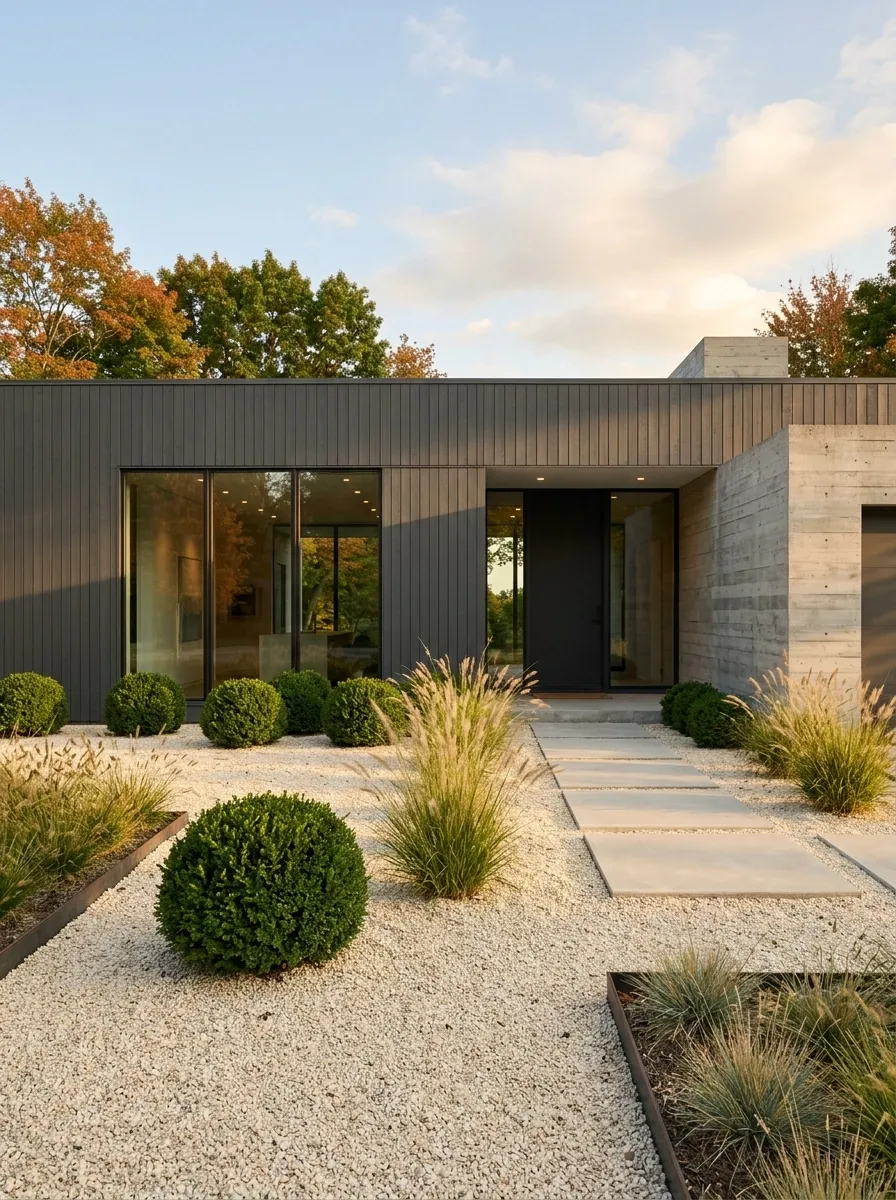
A narrow strip of gravel can become a complete landscape when every element has a clear spatial role. This modern version combines pale gravel, large stepping stones, sculptural shrubs, narrow grasses, and a dark architectural backdrop.
There is deliberately very little planting. The open gravel becomes part of the composition rather than empty filler, allowing the individual plant shapes to read clearly. Large stepping stones create a measured route while keeping the surface visually calm.
This approach works particularly well alongside a modern facade with broad windows, simple siding, or concrete elements. The landscape mirrors the architecture through restraint, but the grasses and organic shrub shapes stop it from feeling sterile.
The strength of the design comes from scale and negative space.
Front Porch Garden With Layered Containers
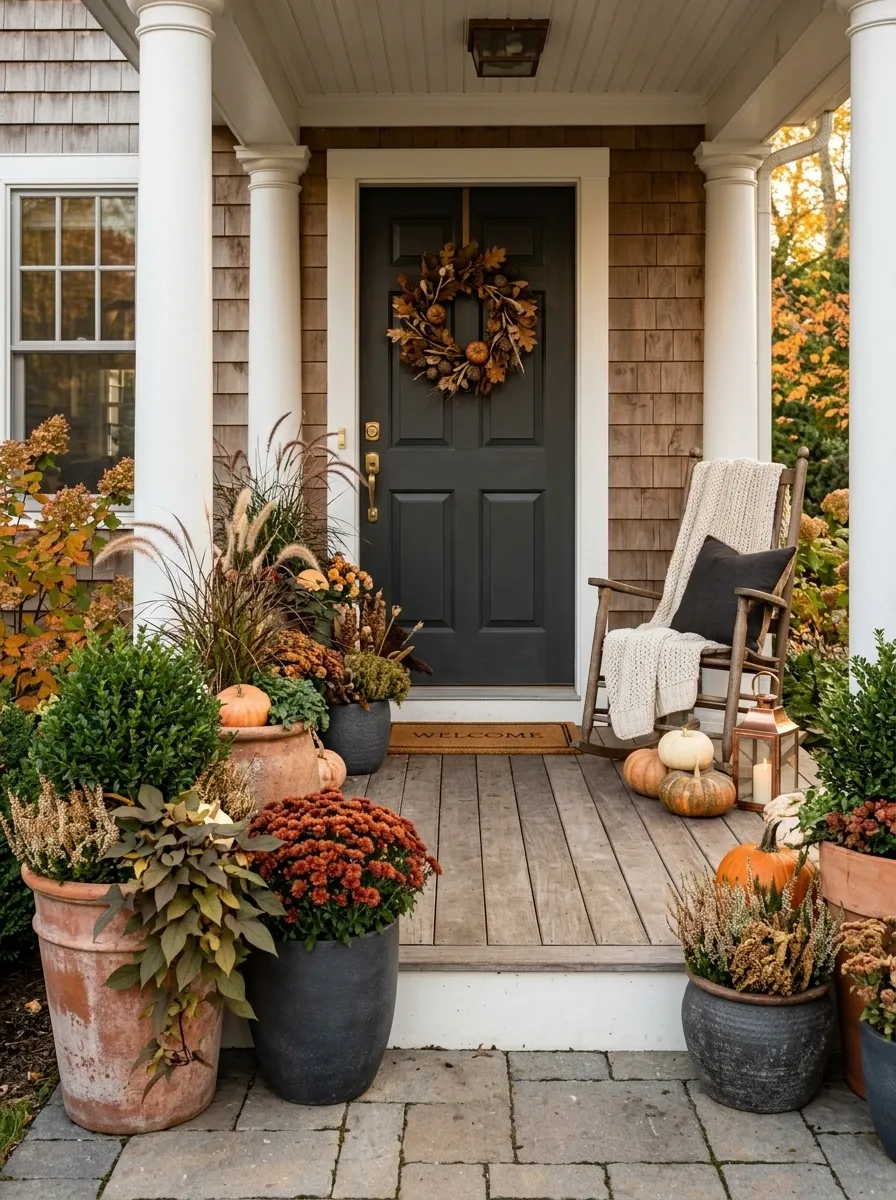
A small front porch can carry the entire fall landscape when containers are treated as a cohesive garden rather than scattered pots. This concept places vessels at different heights around the porch, combining compact evergreen plants, grasses, trailing foliage, and muted copper accents.
The largest containers sit toward the outer edges, while lower vessels move inward toward the doorway. That creates a gentle visual funnel and prevents the entrance from feeling blocked. The porch itself becomes the transition point between architecture and planting.
Using related materials keeps the arrangement unified. Weathered terracotta, charcoal ceramic, or warm stone-toned containers can share a palette without matching exactly.
Soft Cottage Frontage With Dusty Plum Foliage
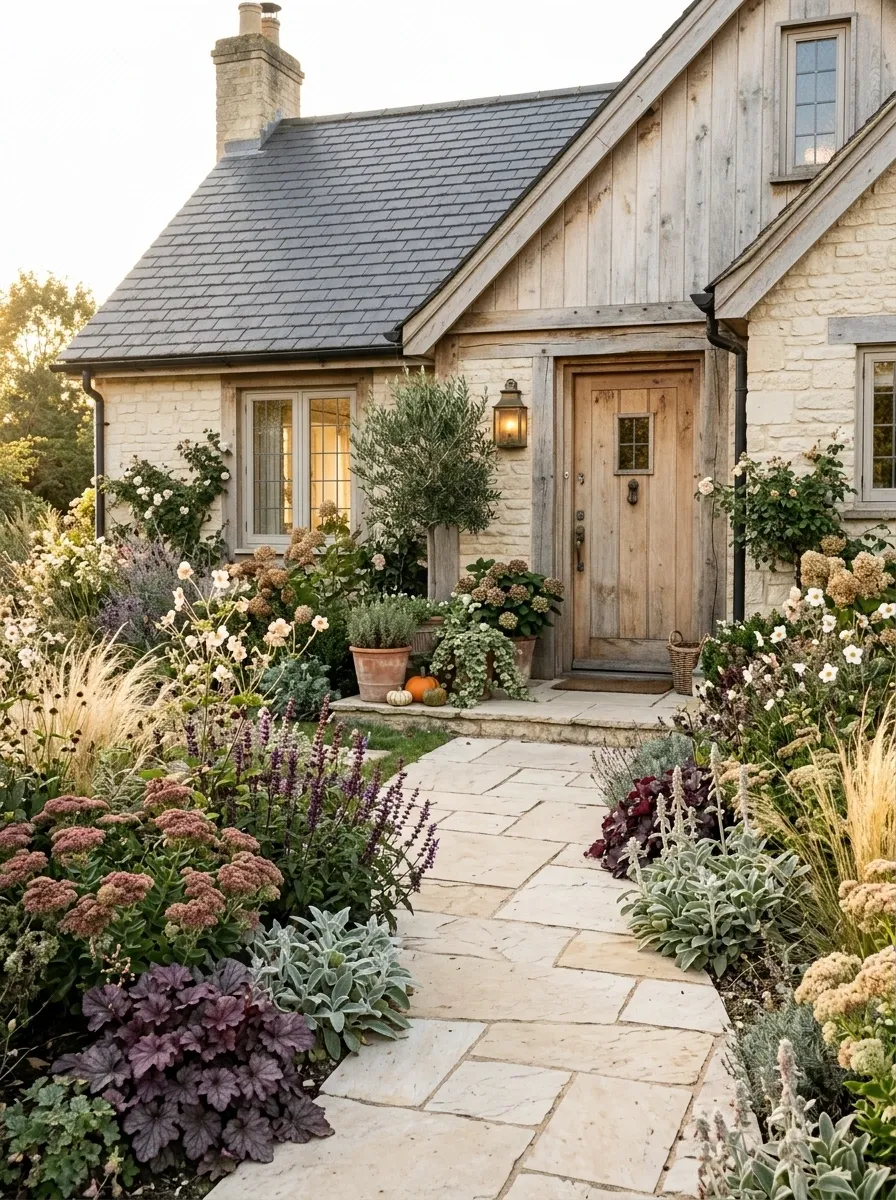
Not every fall landscape needs orange and red. A muted plum palette creates a softer frontage when paired with cream stone, dusty green foliage, pale wood, and faded grasses.
The composition combines loose cottage-style planting with enough structure to keep the small yard orderly. A narrow path approaches the door through low foliage, while plum-toned plants appear in several small clusters rather than one heavy mass. Cream flowers or pale seed heads provide visual lightness between the darker foliage.
The color relationship is what makes this design memorable. Plum adds depth, while the dusty greens and warm neutrals prevent the palette from becoming too dark. It suits homes with light brick, warm white siding, pale stone, or muted wood.
Evergreen Foundation With Seasonal Underplanting
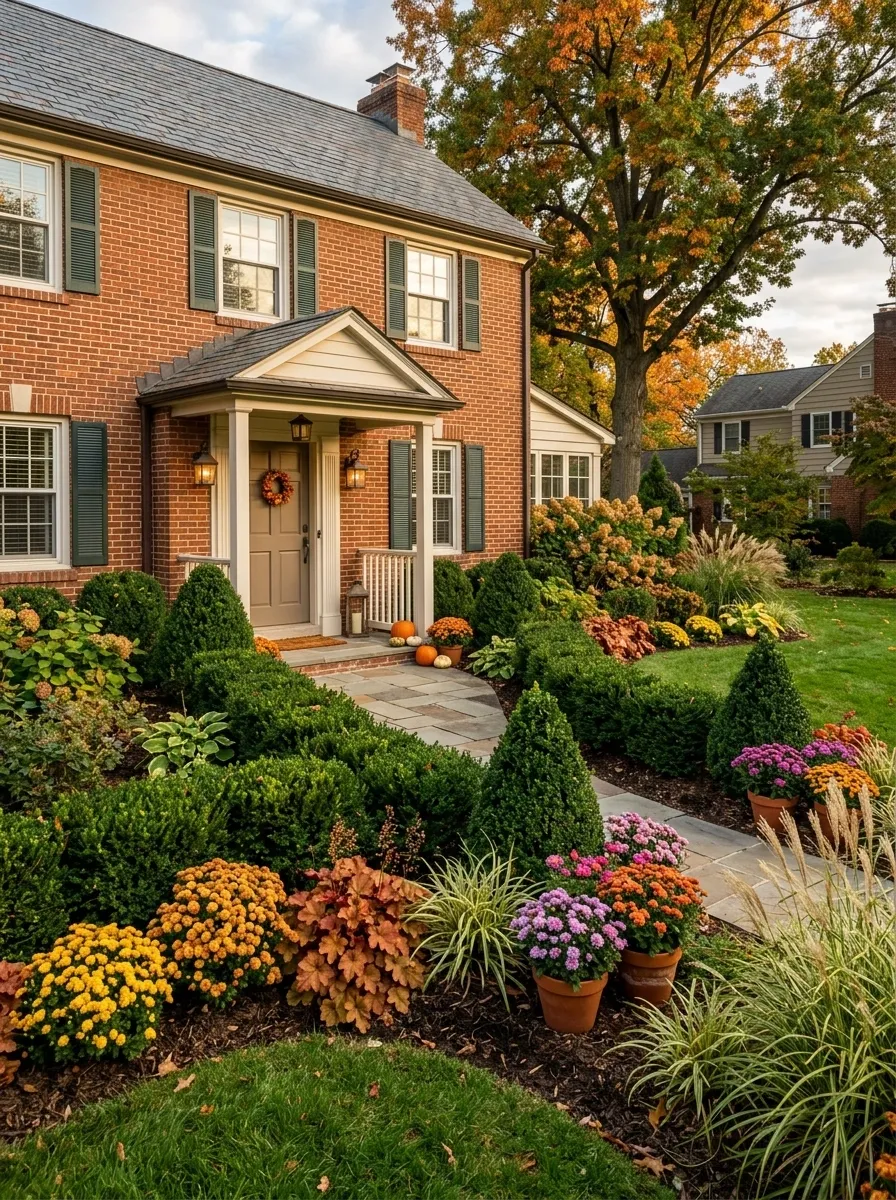
A small front yard becomes easier to maintain visually when the permanent structure does most of the work. This design starts with compact evergreen shrubs and carefully shaped greenery, then layers seasonal planting beneath and between them for autumn color.
The result changes through the year without losing its overall composition. The evergreen masses establish the boundaries and main visual weight, while the seasonal layer supplies temporary color, texture, and movement.
This approach is particularly useful when the landscape should remain attractive after fall ends. The seasonal plants can fade away without exposing a collection of empty beds because the larger evergreen framework remains intact.
The key is to avoid distributing seasonal color evenly. Small clusters create rhythm and make the permanent planting feel intentional.
Small Urban Front Yard With Raised Beds
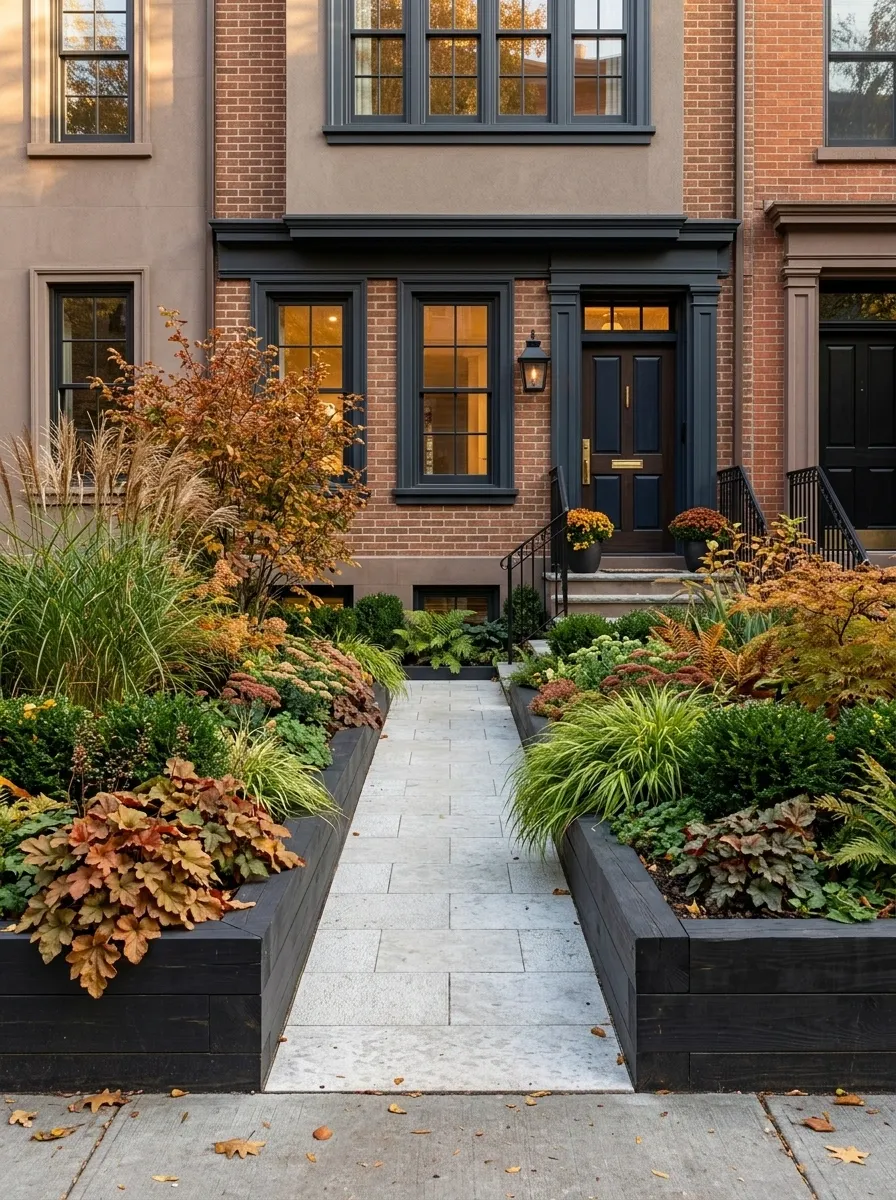
A compact urban frontage often benefits from giving the landscape more vertical definition. Raised beds create a clear boundary between sidewalk and garden while providing enough depth for layered shrubs, grasses, and seasonal foliage.
This design uses crisp masonry or timber-edged beds along the property line, with a narrow entry route cutting through the center. The raised geometry gives even a shallow planting area a stronger sense of depth. A few taller plants rise toward the rear, while low greenery remains close to the pedestrian zone.
The facade stays visible above the planting, which prevents the garden from feeling enclosed. Dark trim, pale paving, and warm fall foliage provide a simple visual language suited to townhouses and compact urban homes.
Narrow Yard With Vertical Planting and Wall Texture
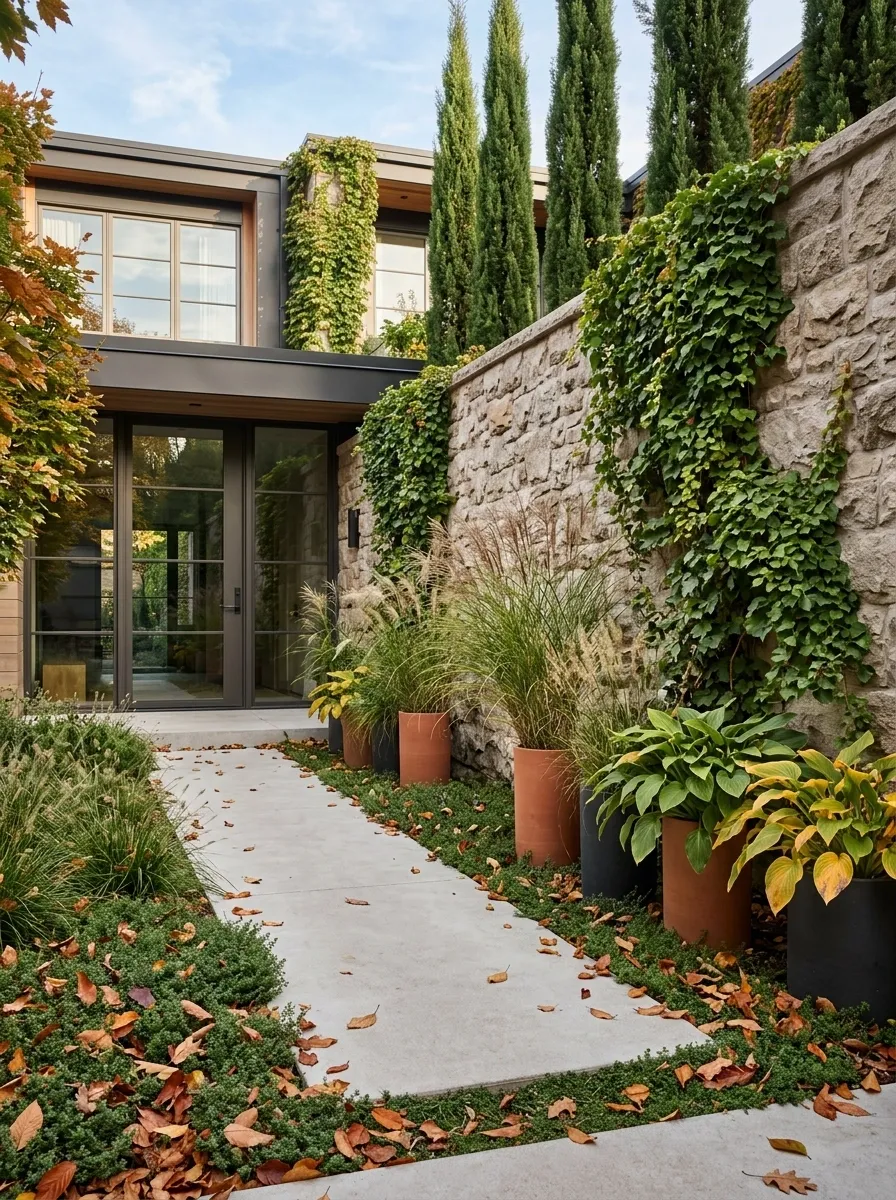
A very narrow front yard does not have to rely on horizontal planting beds. This composition uses a textured exterior wall, slim trees or tall planting, narrow containers, climbing greenery, and low groundcover to build visual layers upward.
The bottom zone remains simple so the walkway stays open. Middle-height foliage provides privacy and softness, while taller plants and climbing greenery give the eye somewhere to travel above the narrow footprint. The textured wall becomes part of the garden rather than an empty boundary.
The strongest result comes from varying texture more than color. Rough masonry, fine grasses, broad leaves, and slim stems create depth even when the palette stays mostly green with a few rust-colored fall accents.
Warm Entry Garden With Lantern Lighting
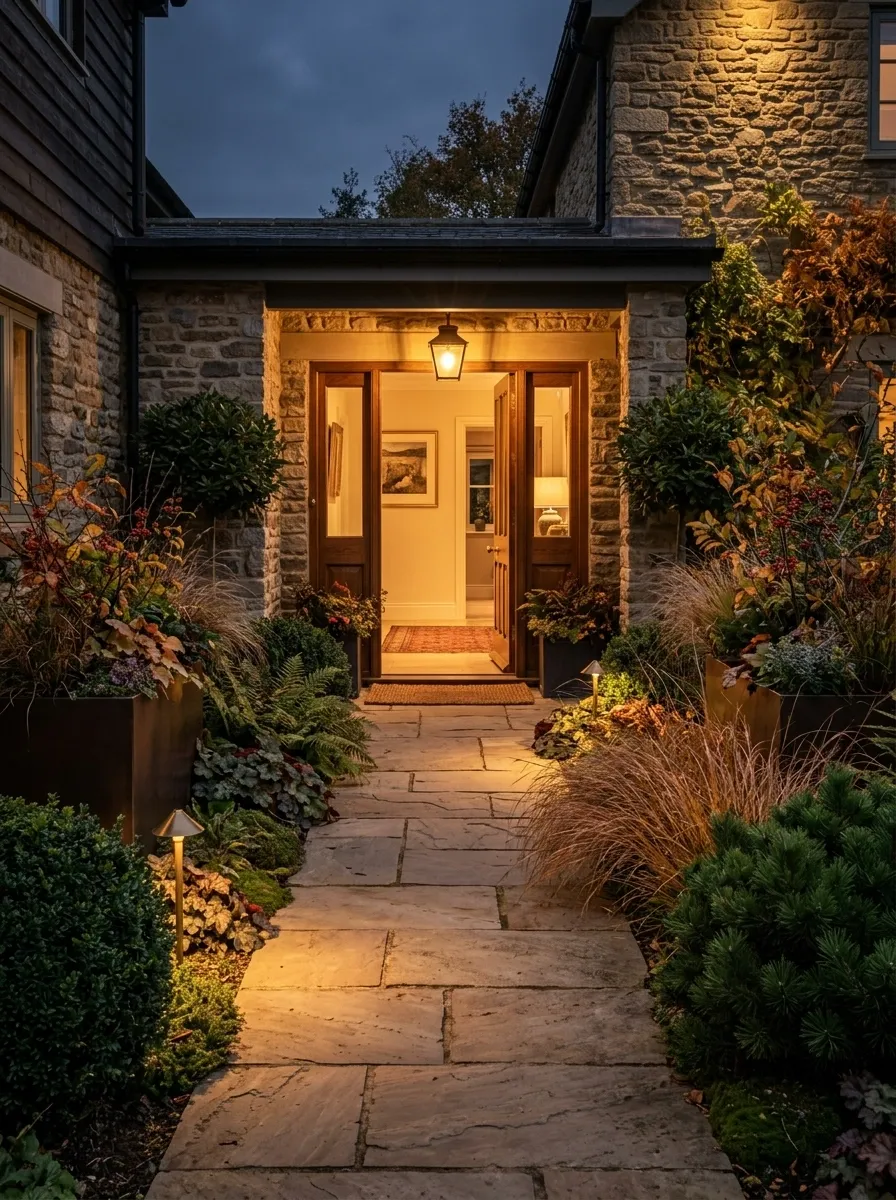
A small front yard can become especially inviting in late fall when the landscape is designed for both daylight and evening. This entry composition combines warm stone paving, compact evergreens, copper grasses, restrained planters, and low-output lighting concentrated around the route to the door.
The lighting is subtle rather than theatrical. A few warm pools along the pathway make the circulation legible, while softer illumination catches the planting masses and brings out their texture. The front door receives the clearest visual emphasis.
During daylight, the same composition reads as an earthy garden. After sunset, the lighting changes the hierarchy without changing the underlying landscape.
Small Front Yard With a Natural Stone Focus
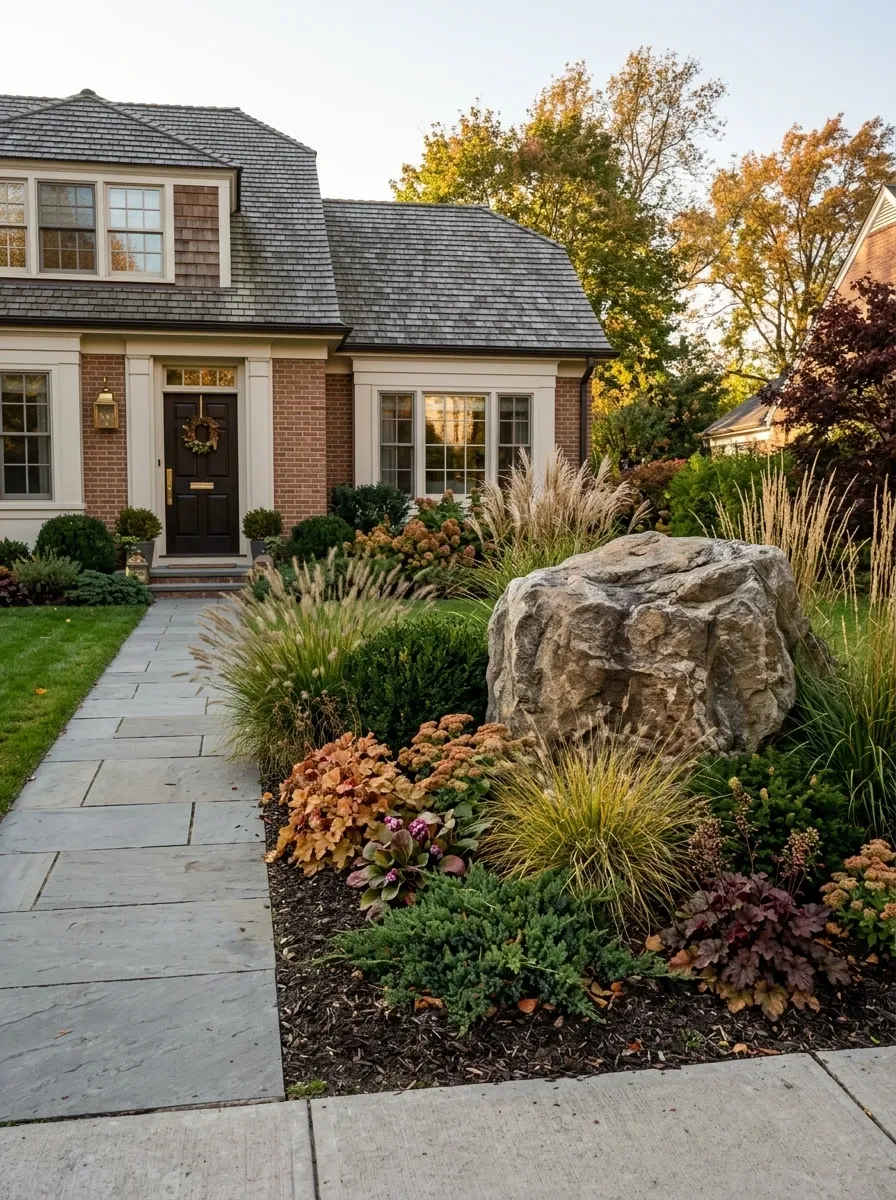
A single substantial stone feature can give a compact landscape the visual weight that several small decorations cannot. This design places a broad natural boulder near one side of the planting bed, surrounded by fine grasses, low evergreen shrubs, groundcover, and muted autumn foliage.
The stone acts as a fixed focal point while the plants soften its edges. Its irregular shape introduces a useful contrast against a straight walkway or geometric facade. Rather than filling the space with multiple decorative elements, the landscape lets one strong natural form carry the composition.
Fall color stays close to the ground in small clusters of copper, faded gold, and burgundy. The rest of the planting remains predominantly green, allowing the stone and seasonal accents to work together without competing for attention.
Modern Cottage Blend With Black, Green, and Rust
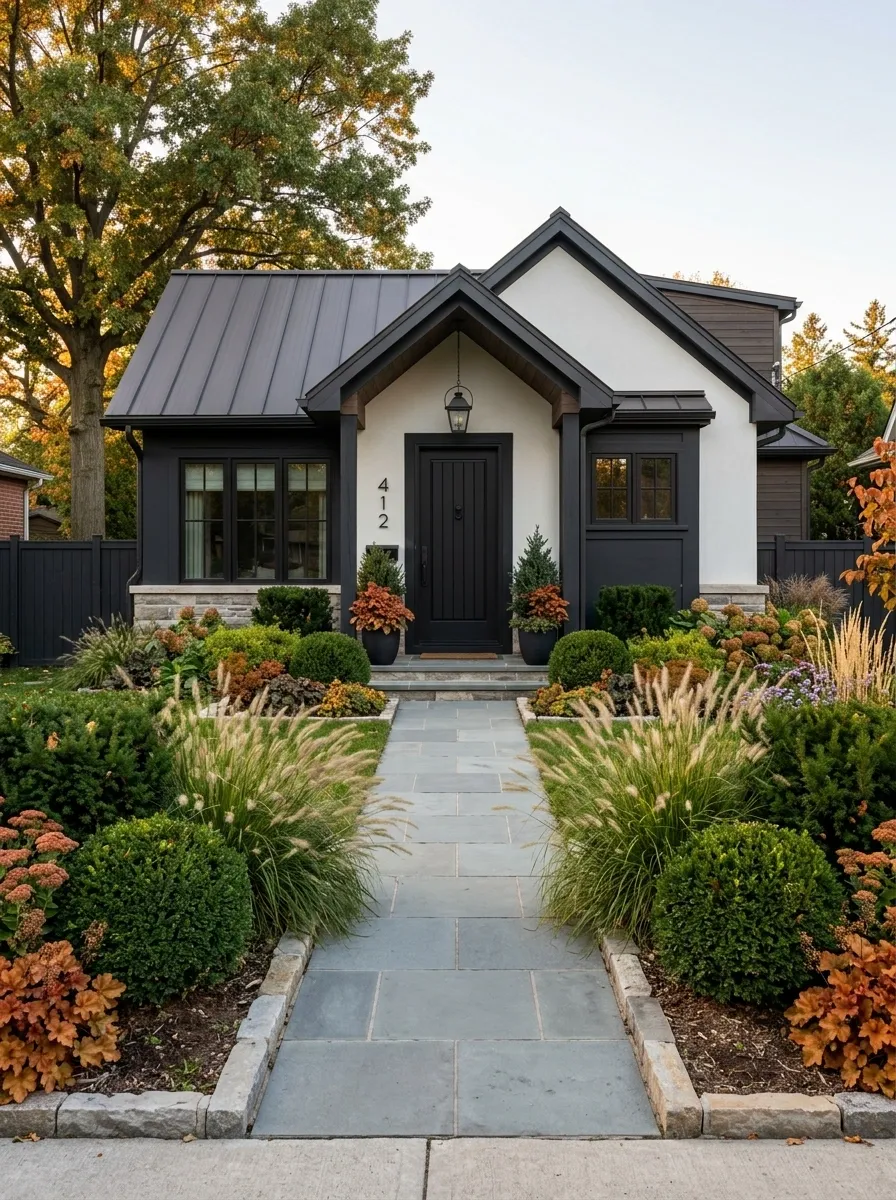
This front yard sits between formal modern landscaping and relaxed cottage planting. The house provides crisp lines through a black door, dark trim, or simple paving, while the garden introduces rounded shrubs, airy grasses, evergreen masses, and rust-colored autumn foliage.
The contrast keeps the small space interesting. The clipped elements establish order, while the looser plants prevent the composition from feeling overly rigid. A clean walkway provides a visual spine through the softer planting.
Rust appears in only a few repeated pockets, giving the eye a path through the garden. Deep green connects those accents back to the dark architectural details.
The result is neither fully formal nor traditionally cottage-like. It sits comfortably between the two, which makes it useful for newer homes that need softer landscaping.
Compact Courtyard-Style Fall Entry
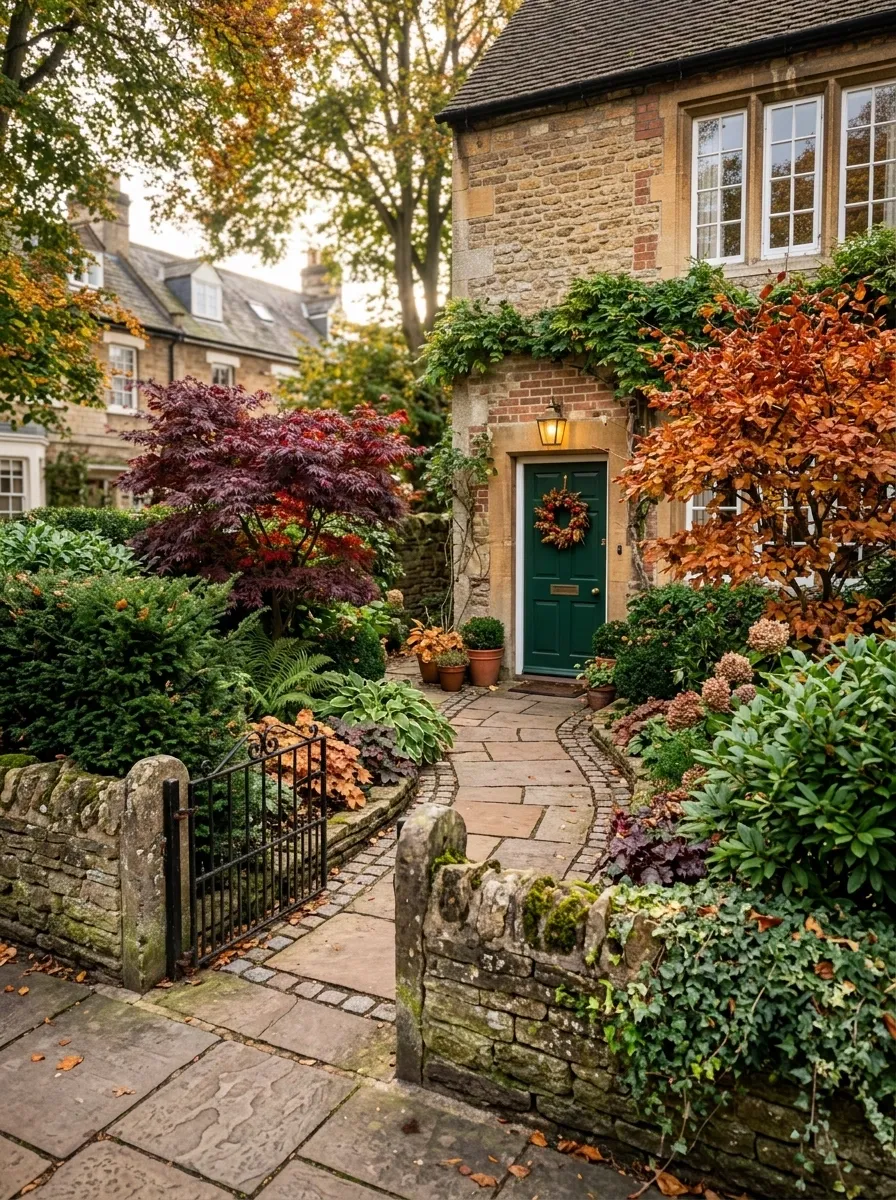
A tiny front yard can feel considerably more substantial when it is designed like an outdoor room. This arrangement establishes a defined entrance zone with warm paving, low stone or masonry boundaries, layered shrubs, compact trees, and autumn foliage tucked into the edges.
The central route stays visually clear, while the planting becomes denser toward the boundaries. That contrast creates enclosure without sacrificing access. The house acts as the backdrop, and the garden becomes a deliberate transition between sidewalk and front door.
Warm stone establishes the permanent base. Deep evergreen provides year-round structure, while copper and burgundy foliage bring the fall season into the composition. The result feels intimate rather than crowded.
This layout is particularly effective for narrow urban frontages where a traditional lawn would leave too little room for meaningful planting.
Layered Fall Planting Around a Brick Walkway
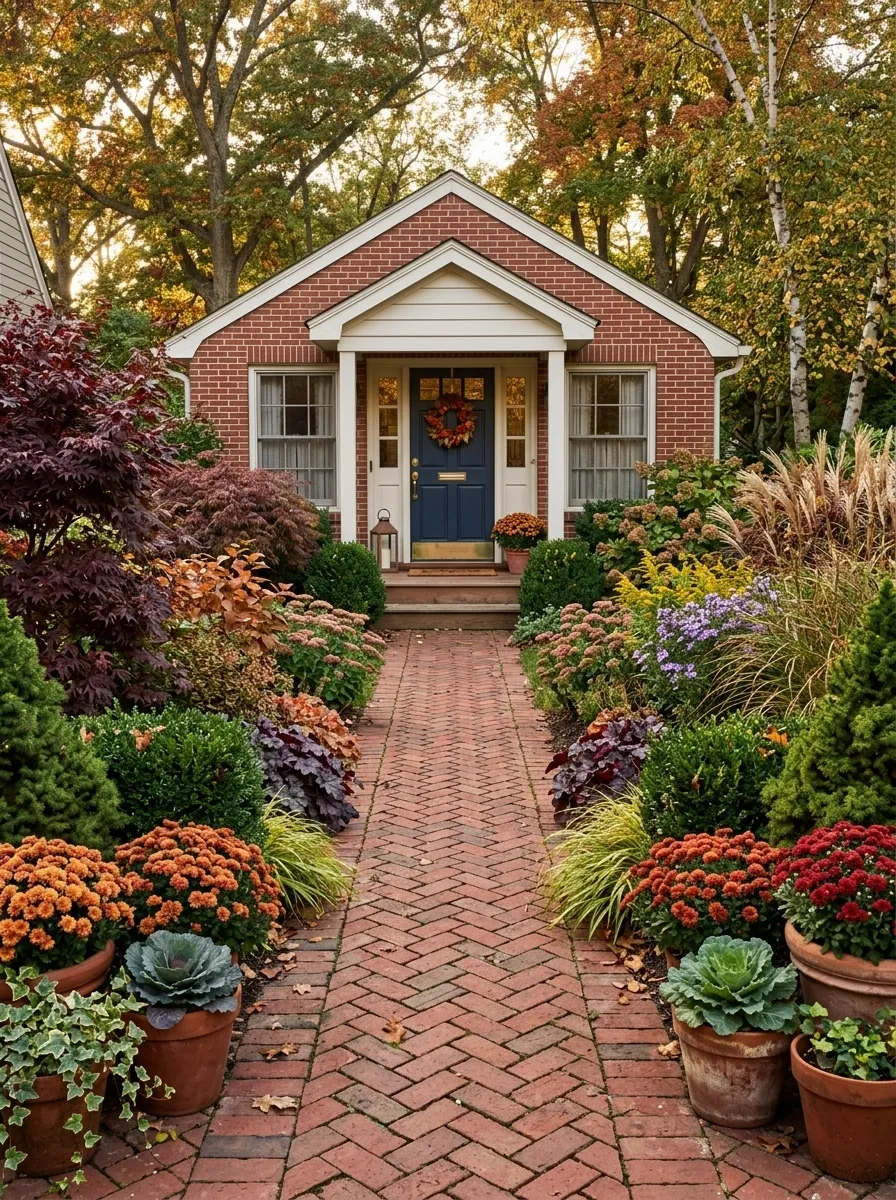
Brick becomes more than a practical walking surface in this traditional composition. Its warm reddish undertone is repeated throughout the surrounding landscape, linking the walkway to copper foliage, burgundy leaves, and warm-toned planting containers.
The path runs directly toward the front door, while the planting borders become gradually fuller as they move away from the entrance. Evergreen shrubs establish the foundation, with grasses and autumn foliage filling the spaces between them.
The repeated brick tone creates continuity even though the planting contains several different textures. That makes the small yard feel more unified than a collection of unrelated plants would.
Keeping the seasonal colors close to the brick family is the key detail. Bright orange, yellow, and purple accents would introduce too many competing directions.
Soft Autumn Frontage With Low-Maintenance Naturalistic Planting
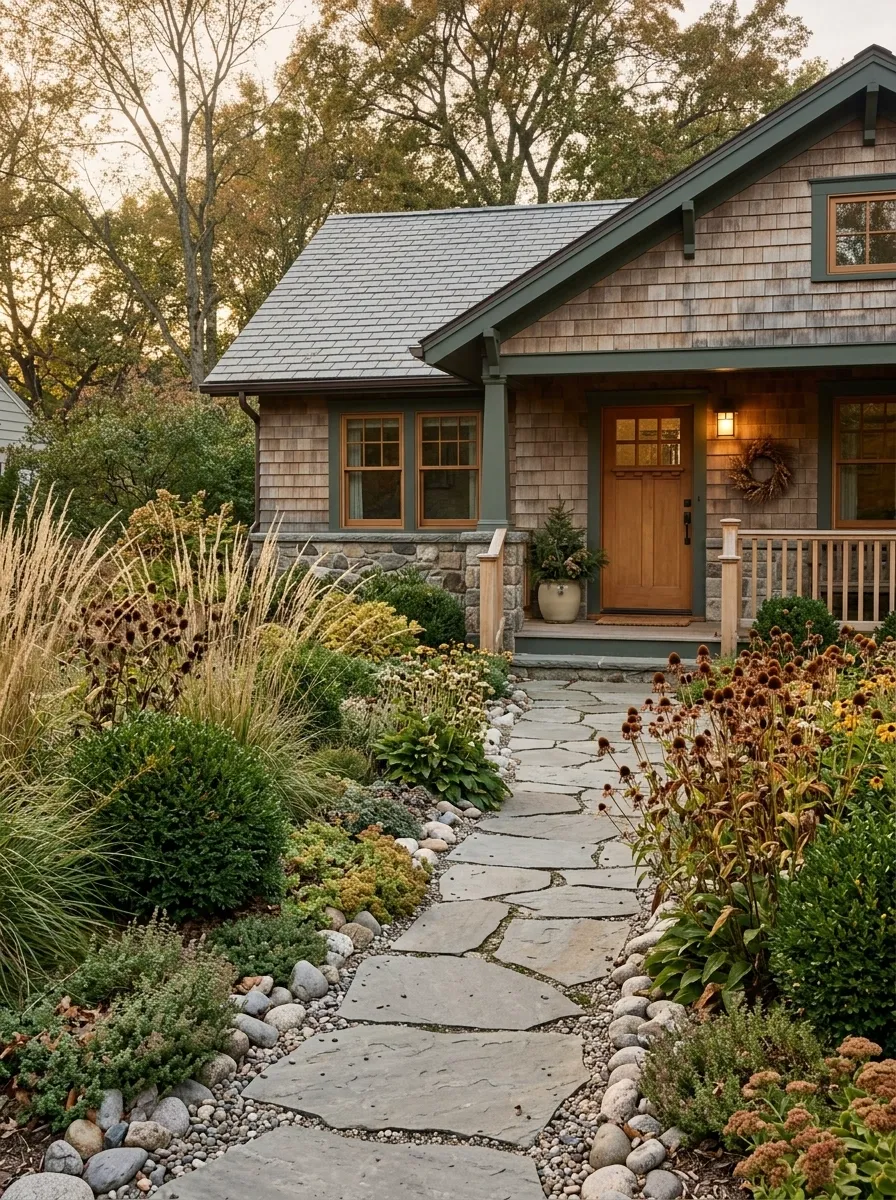
A naturalistic front yard can still look composed when the planting is chosen around structure rather than constant bloom. This version combines ornamental grasses, sturdy shrubs, low groundcover, seed-head textures, and evergreen forms in a loose arrangement that feels abundant without becoming unruly.
The strongest areas of seasonal color are placed in clusters, leaving portions of the garden quieter. That variation gives the eye a rhythm and keeps the small footprint from looking uniformly dense.
The grasses provide movement and height, while the evergreen forms keep the landscape visually anchored. Seed heads and faded foliage contribute texture even as the season progresses.
The design is especially suited to a softer, less formal frontage without creating a high-maintenance collection of individual planting pockets.
A Small Yard Works Best When the Composition Does More Work
The strongest landscapes here aren’t necessarily the ones with the most planting. They succeed because every major element has a relationship to something else. A path creates movement, a tree creates height, evergreen foliage provides permanence, and a seasonal accent supplies just enough change to make the yard feel unmistakably autumnal.
That is particularly valuable in a compact frontage. There is less room to hide awkward proportions or disconnected features, so a complete visual direction usually produces a better result than collecting individual ideas one at a time.
The practical next step is to choose one overall composition before selecting plants or finishes. Once the desired structure is clear, the smaller decisions become much easier.
Save the designs that feel closest to the architecture and keep them nearby when planning the fall landscape.