
Kids don’t need more square footage. They need more permission.
The best outdoor play spaces in existence are not the ones with the biggest budget or the most floor space. They’re the ones where someone sat down and thought about what a child actually does outside — and then made deliberate choices to support that, rather than just throwing a plastic slide in the corner and calling it a garden.
Most parents get this backwards. They buy the biggest play structure they can fit, plonk it on the lawn, and wonder why the kids are back inside within forty minutes. The structure itself is rarely the problem. Everything around it is.
This guide is for the gardens that aren’t large. The small courtyards, the narrow terraced backyards, the walled town gardens that feel more like outdoor rooms than open spaces. Because those spaces, approached correctly, can do more for a child’s development and imagination than a sprawling lawn with nothing thought about it.
The Ground Beneath Their Feet: Why Your Surface Choice Shapes Everything Else
Nobody talks about this enough. The surface is the first decision and the one that affects every other choice — safety, maintenance, play type, and how much you’ll be washing at the end of the day. Most people treat it as an afterthought.
The Safety Calculation People Get Wrong
Every parent instinctively knows that a child falling onto concrete is bad. Most people then overestimate how much cushioning they actually need for a given play structure. If you have a low-level playhouse or a mud kitchen, grass is perfectly adequate. If you have a swing set or a climbing frame where children will be achieving any real height, you need impact-absorbing surface underneath and around it — and you need more of it than you think.
The fall zone extends in every direction from the equipment, not just underneath it. A swing needs six feet of safe surface in front of and behind the seat at full arc. A slide needs the same at its base. Rubber mulch, wood chips, and wet-pour rubber are all rated for this purpose. Pea gravel in a deep enough layer works. Decorative stones do not count, regardless of how they look.
The Artificial Turf Question
Artificial turf has taken over the small garden play space, and there are genuine reasons for this. It stays green through heavy use, it drains reasonably well, it doesn’t create mud, and it gives children a consistent soft surface underfoot for the cost of a one-time installation. For a small enclosed garden that will be used by multiple children regularly, it is hard to argue with the logic.
The downsides are real though. It gets hot in direct summer sun — genuinely uncomfortably hot on bare feet during a heatwave. It doesn’t offer the sensory richness of real grass, soil, and the small ecosystem that comes with a natural lawn. And it won’t biodegrade when you eventually want to change it.
The answer is usually a compromise: artificial turf for the central active area, a preserved patch of real grass or a raised bed where children can dig and touch actual soil. Sensory richness matters for development, and removing all access to natural materials in pursuit of a clean garden removes something important.
Rubber Mulch, Wood Chips, and the Defined Play Zone
Both rubber mulch and wood chips do something beyond just cushioning falls: they define the play area. The edged rectangle of an impact-absorbing surface signals clearly — to the child and to the garden — that this is the zone. It belongs to play.
Treated timber edging at the border of a rubber mulch zone is one of the most cost-effective upgrades to a garden play space. It contains the material, gives the area visual definition, and separates the play zone from the rest of the garden in a way that makes both spaces function better. Children work better within a defined space. Adults feel less like the whole garden has been consumed.
What Open-Ended Play Actually Looks Like (And Why Your Kids Need More of It)
There is a type of play that makes parents feel slightly uncomfortable because it looks like mess, noise, and nothing in particular. A child digging a hole. A child pouring water between containers. A child building something out of planks and tyres that has no resemblance to anything you can name.
This is the most developmentally valuable play your child will do all week. It is also the play that outdoor spaces tend to eliminate in the pursuit of looking tidy.
Why the Mud Kitchen Earns Its Place
The mud kitchen is one of the highest-return investments in a child’s outdoor play life, and it is essentially a workbench with a sink and some props. The child who has a mud kitchen outside will stay engaged in outdoor play for longer, in more complex ways, than a child with a plastic playhouse and nowhere to actually do anything.
The ingredients are sensory, open-ended, and endlessly combinable: water, soil, sand, natural loose parts like stones, shells, and pinecones, and the tools of a kitchen — pots, jugs, spoons, sieves, moulds. Children will mix, pour, measure, fill, empty, and narrate elaborate scenarios without any adult input for astonishing amounts of time.
A mud kitchen built from reclaimed timber pallets is more robust and interesting than anything you can buy flat-packed. Build in a sink basin connected to a simple tap or water container. Add a chalkboard panel. Hang utensils from hooks. Put a shelf above for pots and collected objects. The detail that makes this magical rather than merely functional is the quality of the loose parts — pine cones, interesting stones, small containers of different sizes, real metal pots that feel like genuine tools rather than toys.
The Loose Parts Principle Applied to Tyres, Planks, and Blocks
Old tyres get an unfair reputation. A collection of clean car tyres in a garden, filled with wooden blocks, planks, and building materials, is one of the most powerful invitations to constructive and physical play you can give a group of children. They roll, they stack, they become containers, they become stepping stones, they become the foundations of elaborate structures children build and immediately want to dismantle to rebuild differently.
The same principle applies to wooden planks on A-frame sawhorses. The child who has a set of planks they can position across supports at varying heights is doing physics. They are problem-solving. They are working out load and span and balance in a completely embodied way. The outdoor car track made from interlocking road sections on the ground invites a completely different kind of play — purposeful arrangement, narrative, the pleasure of small vehicles moving through a system they control.
None of this is expensive. All of it is more durable than plastic play equipment and more developmentally rich than a screen.
Outdoor Play Area Ideas
The Victorian Dollhouse Playhouse with a Slide and Climbing Platform
This is the investment piece — the kind of playhouse that becomes the central feature of a garden for a decade. The key is building up, not out. A raised platform level with an internal playhouse above and a deck level below doubles the play value without doubling the floor space. The lower deck becomes the kitchen, the mechanics workshop, the post office, the tea shop — whatever the prevailing narrative demands. The upper house becomes the home, the hideout, the lookout.
For the exterior: paint the whole structure white with a dark roof — charcoal shingles, a simple dark shingled panel, anything that creates contrast. Add arched window openings to the playhouse walls rather than rectangular ones — this is the single most impactful visual upgrade and costs nothing extra in a custom build. Detail the eaves with decorative trim. Mount a small window box and fill it with trailing white flowers.
Connect upper and lower levels with a natural timber ladder and a curved spiral slide rather than a straight one — the tube slide or curved slide turns the descent into an event rather than just a way down. Add climbing rungs or a knotted rope ladder on the side for a second ascent route. Keep the lower deck furnished with children-scale Adirondack chairs in white and a scattering of outdoor cushions in primary and multicolour patterns.
The Artificial Turf Multi-Station Small Garden
The compact urban garden where space is genuinely limited needs a different logic: prioritise surface quality first, then create multiple play stations around the perimeter that children rotate between.
Lay artificial turf from fence to fence as the central ground surface. Then build the play value into the edges and walls. A chalkboard easel with a mirror panel on one fence. A water table in the near corner. A small slide positioned against rather than in the middle of the turf. A water play fountain table further along. A raised herb or vegetable bed as a growing corner. Small timber balance bridges laid as pathways across the turf for proprioceptive play.
The result is a garden with a clear open centre — plenty of room to run, kick a ball, do cartwheels — and a perimeter of different activity stations, each giving a different type of play. Children self-direct between stations. The adult has lines of sight to all of it from one position.
The Minimalist Modern Cubby House with Grown-Up Interior
The best playhouses understand that what happens inside is the whole point. The exterior can be restrained — clean white timber, dark charcoal roof peak, standard casement windows with dark trim, no gingerbread or fussy ornament. It is the interior that makes a child want to inhabit it.
Warm timber cladding on the interior walls, the kind that glows in the late afternoon light coming through the window. A small side table with a ceramic lamp on it. A soft toy placed deliberately on a shelf, as if it lives there. A blanket hung casually on the door handle.
This approach takes twenty minutes to execute if the basic cubby is already in place, and it transforms the space from a plastic box the children lose interest in after a week to a miniature world they actually live in during outdoor play.
The Recycled Pallet Mud Kitchen with Full Accessories
Build from two or three wooden pallets, sealed or painted. One pallet stands upright against the fence as the back wall — this gives you the hanging rail for utensils, the shelf for pots and collected objects, and the mounting surface for a chalkboard panel. One or two more pallets form the workbench surface and storage frame below, with room for large container buckets and pull-out tray storage.
Cut a hole in the work surface for an embedded sink basin — a deep rectangular bowl, nothing fancy. Connect a simple tap to an outdoor water supply or a filled container with a gravity tap. Attach a small freestanding water dispenser to one end of the bench for children to pour from themselves.
The loose parts table alongside the kitchen — a round sensory tray on a stand, filled with potting soil, play vegetables, seed pots, and small garden tools — extends the kitchen play into the garden narrative. Children farm, harvest, prepare, and cook in an unbroken imaginative loop.
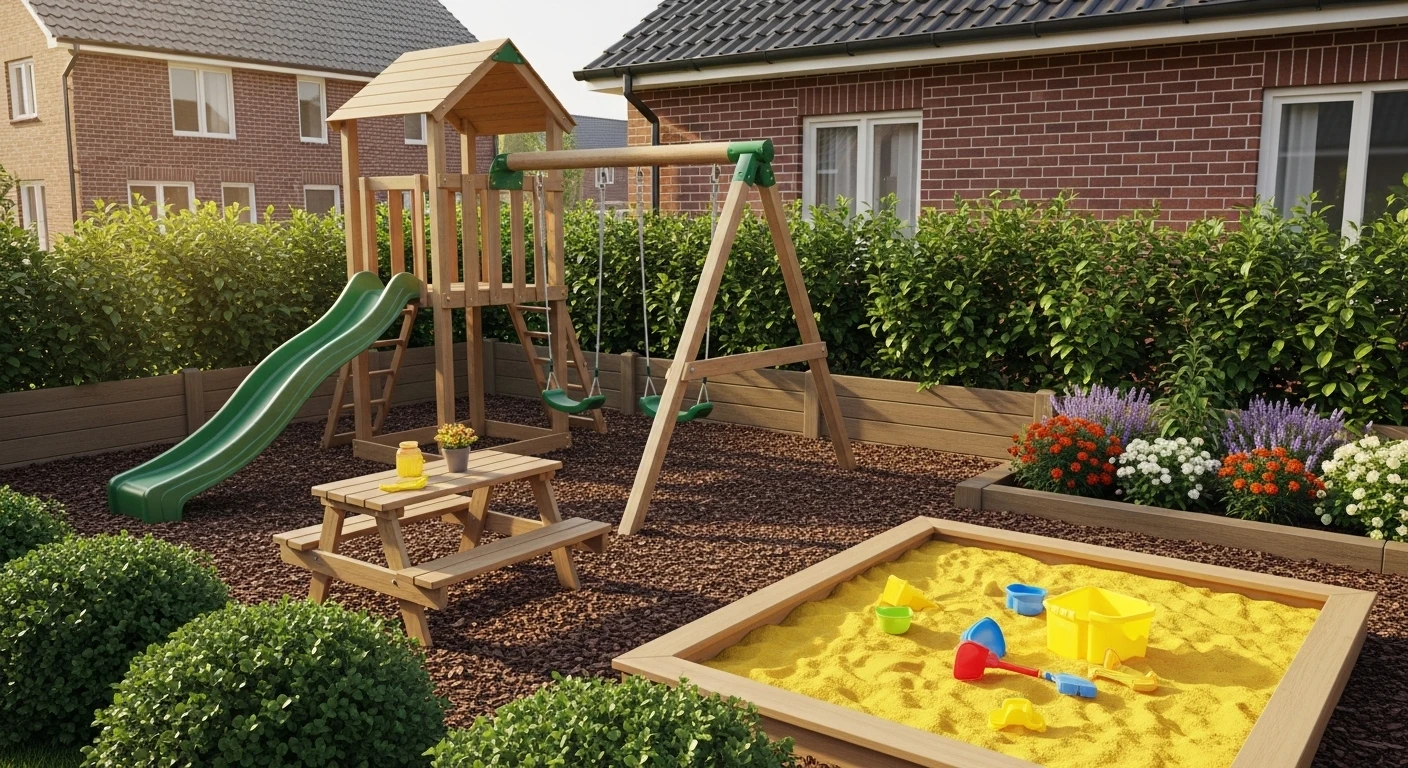
The Rubber Mulch Playground with Swing Set and Defined Zone
The suburban backyard swing set gets transformed by one decision: edged containment with impact-absorbing surface. Frame the play structure zone with treated timber sleepers to create a defined rectangular area. Fill it to the recommended depth — a minimum of six inches — with rubber mulch or premium wood chips.
Choose the play structure for the actual size of your children now and in the next five years, not for the aspirational children of a catalogue. A structure with a single lower fort level, a climbing ladder, a standard straight slide, and a two-swing frame is appropriate for a small garden. The tunnel slide — a full enclosed green tube slide — is the upgrade worth spending money on if the budget allows. The difference in a child’s relationship to the slide experience is significant.
Keep the mulch zone edged and maintained. Top it up annually. This is low-maintenance but not no-maintenance. The visual effect of a properly contained, well-maintained play zone in a fenced garden is a space that looks intentional, which is another way of saying it looks like you thought about your children enough to design something for them.
The Sensory-Rich Mud Kitchen Setup with Soil Play Station
The pallet mud kitchen here is styled for maximum sensory invitation, which is a specific philosophy: everything on the surface should suggest a different type of play without prescribing it.
On the bench: a metal sink basin, coloured measuring cups, pine cones on a woven mat, a water dispenser with amber-tinted water (just water with some food colouring — it looks different and children respond to that difference by playing differently). On the back shelf: white enamel dishes, small pots, a wire dish rack, a small vase of artificial flowers in a brass vessel. All of these are real objects, functioning objects, not toy versions. Children know the difference and they respond to being given the real thing.
Beside the kitchen: a round sensory table on a stand, filled with potting soil and embedded with play vegetables, seed pots, and garden tools. A second lower tray underneath holds a lidded storage pot. The soil table sits on the artificial turf for easy cleanup.
This is the setup that earns the most extended play sessions of any configuration in this list. The combination of water play, cooking play, growing play, and loose parts is enough to hold a child for the better part of a morning.
The Large Sand Garden with Natural Play Elements
The full sand garden — not a contained sandpit but an actual sand area that functions as ground surface — is an underused idea in residential gardens. In a school or community setting, it is well established: the sand garden with a picnic table, a seating area, and small furniture sitting directly in the sand allows children to play at scale. They can dig trenches, build landscapes, run vehicles through terrain they create themselves.
Frame the sand area with woven willow hurdles or natural hedge to give it a soft boundary that feels organic rather than fenced. Leave the planting around the edges — trees arching overhead, climbers on the back fence — to create the sense of a contained natural world rather than a constructed play zone. An old wooden picnic bench placed in the sand becomes a farmyard, a beach cafe, a building site headquarters, depending entirely on who is using it and what morning it is.
The loose parts here are construction-oriented: small sand diggers and dumpers, a galvanised watering can, a collection of metal pans and sieves. Avoid colourful plastic in a natural sand garden — metal and timber objects read as belonging in a way that primary coloured plastic never will.
The Upcycled Tyre and Block Construction Zone
Collect clean car tyres — garages and tyre depots often have them free for the asking. Paint them or leave them natural. Arrange a cluster against the fence, varying the sizes if possible. Fill each tyre with a collection of wooden unit blocks, wooden off-cuts, or natural wooden sections — anything that children can stack, build with, and fill the tyre interior with.
In the centre of the tyre cluster, create a contained construction zone: a bordered rectangle of pea gravel with construction vehicles and tools, small spades, coloured building materials. The tyres become the seating, the storage, and the boundary of the zone simultaneously.
This costs almost nothing and provides the kind of open-ended construction play that plastic building toys cannot replicate because the pieces are heavy, irregular, and unforgiving in the best possible way. A plank balanced across two tyre stacks requires genuine spatial reasoning to achieve. The child who figures it out learns something that no app will teach.
The Outdoor Car Track and Ramp System
The interlocking road track sections — grey modular pieces with white road markings that click together on the ground surface — is a genuine design object. Laid out in a large rectangle with internal road divisions on a flat artificial turf surface, with wooden ramp systems made from pine planks on A-frame sawhorse supports set at different heights, the whole installation becomes a physics experiment dressed as a car track.
Children adjust the height of the ramps. They experiment with which vehicles roll fastest, furthest, most accurately. They build narratives around the track — a race circuit, a city, a stunt show. The basket of wooden cars alongside provides the rolling elements in natural wood and primary painted colours.
This is an installation that works indoors on a rainy day as much as outdoors, which means the investment crosses seasons. The ramps are the part most children return to longest: the relationship between height and speed is genuinely absorbing, and the ability to change the ramp configuration keeps the play fresh.
The Dark Stained Multi-Level Adventure Climbing Frame
When the garden is large enough to accommodate a serious physical play structure, the custom-built dark-stained timber climbing frame earns its place as the centrepiece. Three elements of ascent — a rope ladder on one side, a climbing cargo net in the centre, a rock wall panel on the other — give children multiple ways up. The elevated deck platform above connects to a rope swing platform on one side.
The dark walnut or charcoal-tinted stain on the timber is the design decision that elevates this from a playground structure to a garden feature. Natural pale timber in a garden disappears or looks temporary. Dark stained timber looks anchored, as if it grew there. Against a pale grey sky or a green hill backdrop, it is genuinely beautiful.
The artificial turf surface beneath and around it keeps the space low-maintenance and mud-free. Keep the zone free of any other equipment — this structure is designed to command space and to allow movement around it, and it needs the clearance.
The Multi-Level Swing Set and Play Fort with Tunnel Slide
The two-tower configuration — a central play fort with lower level and upper deck, a long beam connecting it to an A-frame swing set on one side, and a separate elevated tower with tube slide on the other — is the layout that maximises play variety within the footprint of a single structure.
The swings offer the most different options in the least space: a flat swing, a toddler bucket swing, a glider or seesaw attachment. The central fort gives the enclosed play space that children need for role play and retreat. The climbing ladder and tunnel tube slide give the physical ascent-and-descent loop that children will repeat for the sheer pleasure of it.
Coloured canvas shade panels over the deck roofs do double duty: they protect children from direct summer sun, and they mark the structure as a play space that someone has thought about — the green against the warm timber creates a camp-like, purposeful aesthetic that children respond to by treating the space as special.
Edge the rubber mulch zone with curved natural stone blocks rather than straight timber. This gives the play area an organic boundary that reads as landscape rather than construction site.
The Sensory Discovery Wall with Water Table
Mount a wooden pallet onto the fence and paint it a warm olive green or sage. Into the slats, attach coloured metal buckets for planting — small, medium, and large, scattered at different heights across the face of the pallet. Some buckets hold plants. Some are empty and invite filling, pouring, and collecting.
Through the slats and between the buckets, attach sections of flexible corrugated tubing — the kind sold for drainage or as garden hose connectors — in multiple colours. Children thread, pour, direct. The water flows down through the tubes, filling whatever container is positioned to catch it below. This is engineering disguised as play, and it holds children for longer than any electronic toy ever has.
On the fence beside the pallet, hang mirror sections cut to different shapes — circle, semicircle, square, diamond. At child height, with morning light hitting them at an angle, these create light play and reflection that is endlessly interesting to young children. A water table with a clear lid beside the wall completes the sensory circuit.
Wood chip mulch on the ground absorbs water and splash. It smells good, which is underrated as a design factor. Sensory experience includes smell, and a play area that smells of damp wood chips and soil is more inviting than one that smells of hot plastic and nothing else.
The Family Garden That Works for Adults and Children Equally
The garden that divides neatly into an adult zone and a children’s zone, each doing its job well, is rarer than it should be. The mistake is trying to hide the children’s play from the adult view, or to make the children’s space look like it doesn’t belong in the same garden as the adult furniture.
A glass-top metal table with four metal chairs in a warm aged finish occupies one corner — close enough to the house to be convenient, angled toward the play zone. The children’s space faces it: a compact plastic playhouse as the central element, a rocker and slide for active play, a basketball hoop and dart board mounted on the bamboo screen fence for older children.
The black fence at the back creates visual unity between the zones. The matching dark fence and the warm aged metal of the furniture sit in the same tonal family — they belong to the same palette. The bamboo screen fence on the side wall adds a different texture while staying in the warm neutral range. The whole garden reads as coherent because someone decided on a colour story for the adults’ furniture and the structural boundaries, and let the children’s bright primary equipment read as deliberate contrast against it rather than colour confusion.
The Scandinavian Chalkboard Corner with Sand Play
The house-shaped chalkboard panel is the hero piece here: a large black chalkboard surface framed in pale natural timber, cut to a gable-ended house silhouette, mounted on a low platform beside an open-top sandbox. String lights with glass jar pendants drape across from the wall above it.
The platform serves as the sitting, working, and display surface. The child stands or sits in front of the chalkboard. The sand tray beside them gives a second sensory option without moving. Chalk is in a small pot. Books are fanned open on the platform surface. Soft toys arranged deliberately suggest habitation.
This is the corner of the garden where slow, imaginative, and artistic play happens. Not running, not climbing, not digging. Thinking, drawing, world-building. Every garden benefits from having a space where the default invitation is quiet concentration. Most gardens for children don’t include one.
The pale grey painted fence behind provides a clean, calm backdrop that makes the black chalkboard pop without busy competition. The potted palm beside it brings life and shadow. This entire installation can be built from a wooden pallet, chalkboard paint, and some timber framing for under a hundred pounds — and it is the corner children will photograph themselves standing in front of without being asked.
The Maximalist Outdoor Play Garden Where Colour Is the Whole Philosophy
Some children live in full colour and the space should reflect that completely. The garden where multicoloured fairy lights string along the fence, where pot plants bloom in every shade simultaneously, where a rainbow-painted pallet forms the low table and mismatched coloured chairs surround it — this space is not trying to be tasteful. It is trying to be joyful. Those are different goals and this one achieves its goal completely.
The gravel ground surface in pale grey-white makes every colour above it brighter. Stuffed animals sit on a white bookshelf holding colourful books. Children’s artwork is pinned across the fence between the hanging flower pots. A woven hammock in pastel tones hangs between supports. A basketball hoop on a freestanding post and a chalkboard sports board complete the active end of the garden.
The design logic here is: no editing. Every thing the child loves gets to be in the garden. The space belongs to them entirely, without apology for the brightness or the abundance.
This works because the structural elements — gravel, white fence posts, pale furniture frames — are restrained, and the colour lives in the portable, changeable, child-chosen layers. The garden could be quietened for a party or rearranged in an afternoon. The bones are neutral. The life is fully, deliberately, theirs.
The Things Worth Spending Money On
Most outdoor play equipment depreciates fast and gets ignored faster. Before you buy, ask whether the thing you’re considering allows for open-ended play or has only one use. A swing has one use — swinging — but it’s a use children return to throughout childhood for the vestibular input and the pleasure of momentum, which makes it worth the cost. A plastic playhouse that can be customised, furnished, and re-themed earns its place. A battery-operated toy car with a specific track does not belong in an outdoor space because it removes the child from making any decisions.
The places worth the investment, in rough order of return: impact-absorbing surface for wherever height is involved, a quality timber play structure sized appropriately for your garden rather than the largest one available, a mud kitchen of any form, a genuine sand or sensory area with real materials, and one piece of creative infrastructure — a chalkboard, a water wall, a loose parts store.
Everything else is optional. Start with the ground and work upward. Literally.
Final Thought
The garden that sees the most outdoor play is not the one with the most equipment. It is the one with the most open-ended possibility. The best play spaces for children have something to climb, something to dig, something to pour and mix and make with, and enough clear space to run.
That’s the entire brief. The rest is detail.
Your garden — whatever size it is — can meet that brief. The only question is which details you choose.
I learned a lot from this insightful and well-crafted post.
This site is an incredibly useful resource for my studies.