
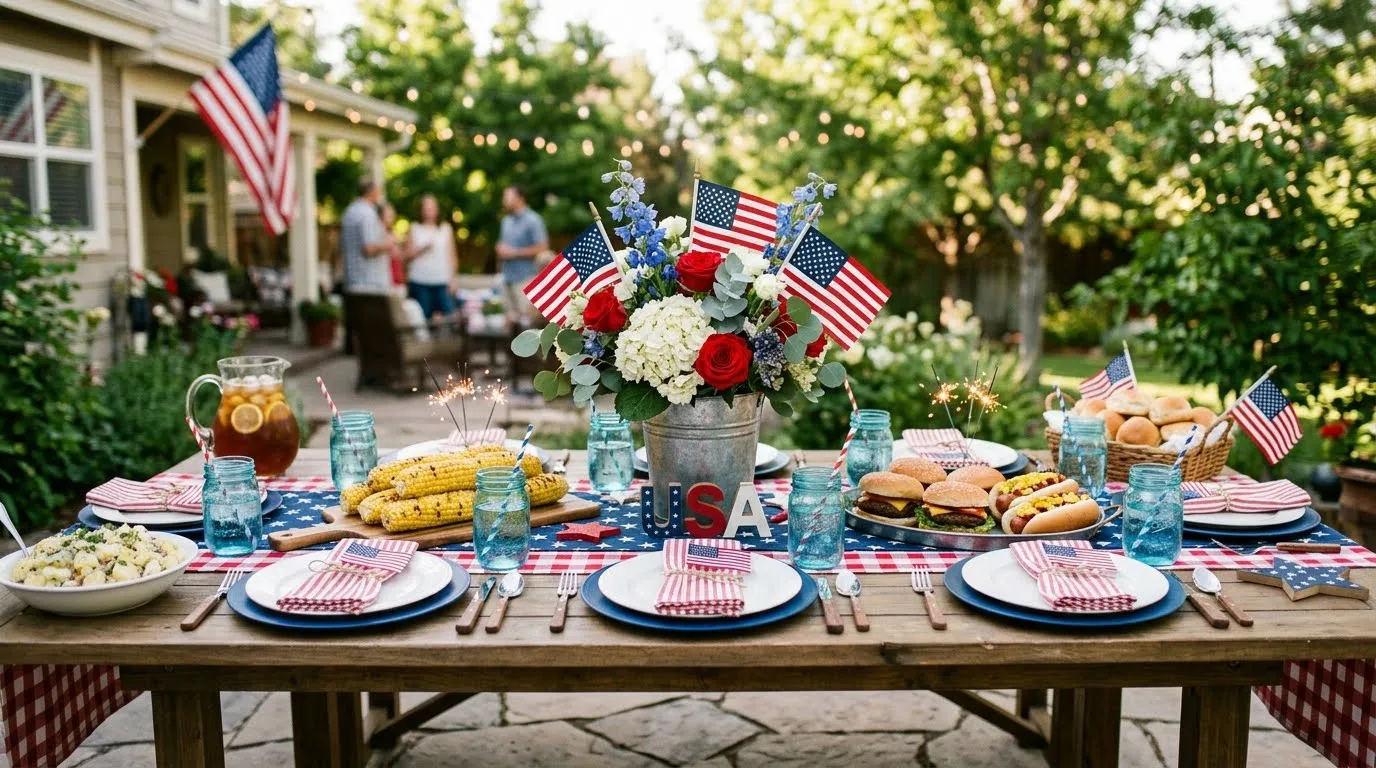
The table is the party. Everything else — the fireworks, the food, the playlist — is peripheral. People gather around a table. They stay at a table. They remember a table long after they’ve forgotten what was on it.
And yet. Most people spend forty-five minutes on the food and twelve minutes on how the table looks. Then they’re genuinely confused why the whole thing feels like a company picnic.
The patriotic palette is not your enemy here. Red, white, and blue done correctly is actually one of the easier color stories to tell — the contrast is built in, the emotional resonance is already there. What makes most holiday tables fall flat isn’t the colors. It’s the lack of a single guiding decision. One committed choice, executed fully, is always better than six half-measures competing for attention. These twenty tablescapes each made that choice. Here’s how to recreate what they actually did.
The Surface Comes Before Everything
Fabric Does the Heavy Lifting
The tablecloth or runner is not the background. It is the decision. Gingham and ticking stripes read casual, warm, and American without trying. Solid white linen reads elegant and lets the tableware and centerpiece speak. Navy-and-white awning stripe reads preppy and put-together. Blue-and-white block print reads worldly and layered. Before you buy a single flower, decide what your surface fabric is saying — and then make sure everything on top agrees with it.
The single biggest mistake people make at holiday tables is mixing fabric registers. A formal floral block-print cloth under plastic star plates. A striped ticking runner under crystal stemware. The fabric and the tableware need to be speaking the same language. Spend the same amount of time choosing your cloth as you spend choosing your centerpiece.
Texture at Every Layer
A flat table — one fabric, one plate, no variation in height or material — feels thin. The tables that photograph well and feel genuinely inviting in person always have at least three layers of texture working. Woven chargers under ceramic plates. Linen napkins under silver cutlery. A rough burlap runner under weathered galvanized buckets. The contrast between surfaces is what makes a table look considered rather than assembled.
If your current table plan is one cloth and a centerpiece, add a runner in a different texture over the cloth, even if it’s just a strip of burlap or a length of chambray. It breaks the flatness immediately.
Height Is a Structural Decision
A table with everything at the same level reads as unfinished. Vary the height deliberately. A tall statement centerpiece flanked by low votives. Three galvanized buckets in different sizes. Taper candles rising out of a low flower arrangement. The eye needs somewhere to travel, and height variation gives it a path. Whatever your centerpiece is, identify the tallest element and the lowest element, and make sure the difference between them is meaningful — not two inches, but six or more.
Fabric and China Pairings Nobody Explains
Pattern Mixing Has Rules
Mixing patterns on a holiday table works when the patterns share a color but differ in scale. A large-scale red gingham cloth with a small-scale red-stripe napkin — that works. Blue-and-white toile plates on a red floral cloth — that works, because the plates and cloth share the blue-and-white language at different scales. What doesn’t work is two patterns of the same scale competing with each other. If your cloth is busy, your plate should be simple. If your plate is patterned, your cloth should anchor it in a solid or near-solid.
Vintage blue-and-white transferware is particularly forgiving on a holiday table because the blue reads patriotic without being literal about it. Set it on anything with red and you’ve got the palette without a flag in sight.
Napkin Folding Is Underrated
A napkin folded into a bow — the chambray bow fold — changes the entire register of a place setting. It turns a napkin from a utility item into a design decision. It also signals care to the person sitting down, which is the whole point of a considered table. A simple bow fold requires no special skill: fold the napkin into a long rectangle, pinch the center, wrap a thin strip of the same fabric around the pinch, and fan both ends. That’s it. Takes ninety seconds. Does more than any centerpiece topper.
The Case for Restraint on the Plate
Not every place setting needs a centerpiece element at the plate. A small ceramic bowl in a star shape at each place, or a single small flag tucked under a napkin, or a simple ribbon bow — one element, not three. The plate is where food goes. The more you crowd it before the meal, the more complicated the setup and the less elegant the reset. Pick one per-plate detail and commit.
4th of July Tablescape Ideas
Flag Backdrop Dinner Table
Hang a large American flag — standard nylon parade size or larger — flat against an exterior white wall. Run two horizontal strings of Edison bulbs across the face of the flag at different heights, pinned loosely so they sway. Set a long farm table in front of the flag and cover it end-to-end in a red-and-white gingham cloth. Use rattan charger plates and white ceramic dinner plates at each setting. For the centerpiece, place several low glass vases filled with white hydrangea heads only, arranged at irregular intervals down the center of the table. Tuck small American flags between the vases. The flag wall does the patriotic work — the table itself stays clean and unfussy.
White Porch Breakfast Table
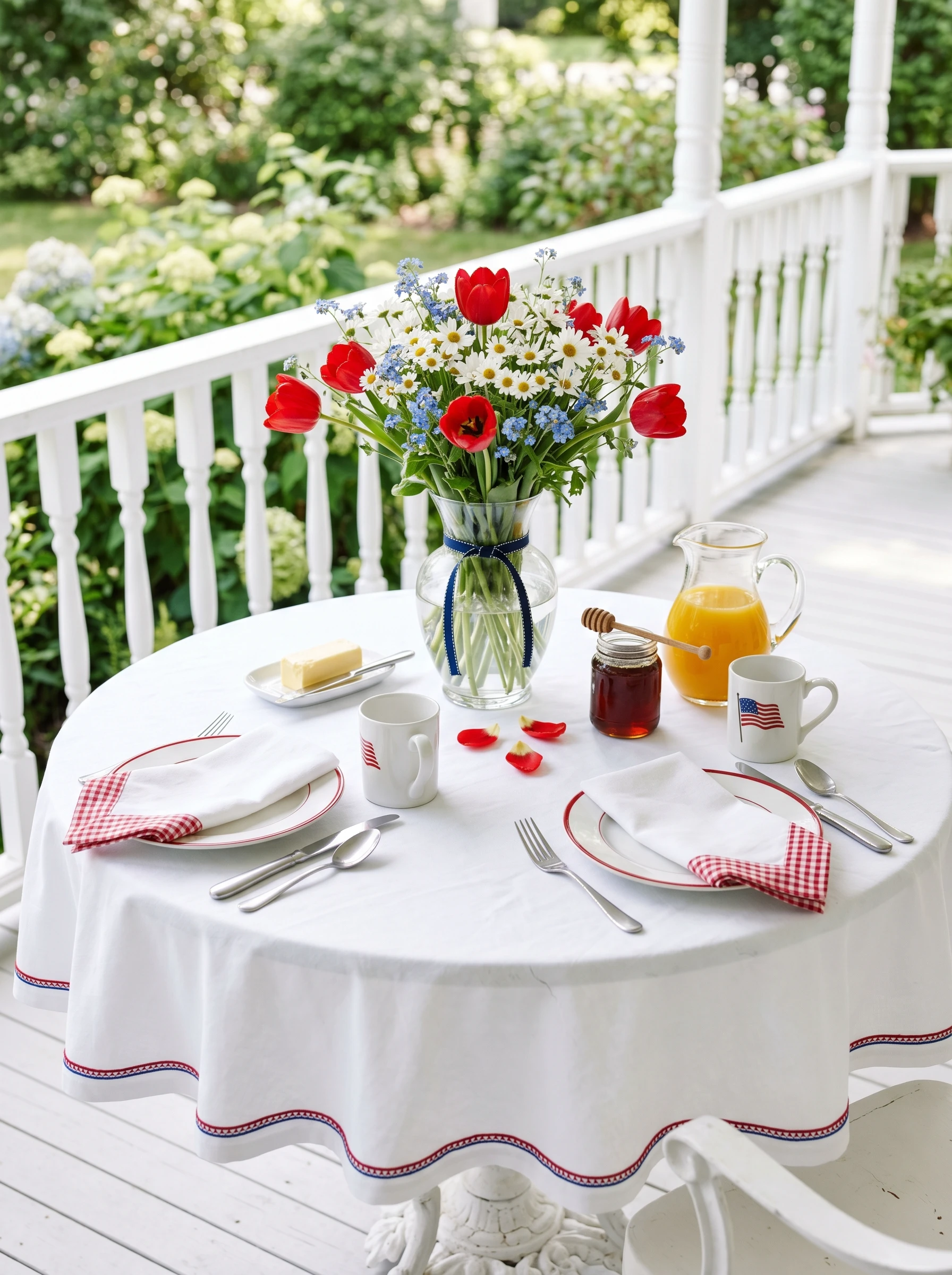
On a small round table with a white linen cloth edged in a fine red-and-blue ribbon trim, set plain white plates with a thin red rim. Lay red gingham napkins flat at each place. For the centerpiece, place a clear glass vase with a loose arrangement of red tulips, white Shasta daisies, and blue forget-me-nots — stems cut to the same height so the arrangement reads like a gathered handful, not a designed piece. Tie a small navy ribbon around the vase neck. Add a jar of honey with a wooden dipper, a glass pitcher of orange juice, and American flag mugs to complete the table. This is a breakfast table, not a dinner table. It’s designed for morning light and should feel effortless.
Chambray Runner Stars Tablescape
On a white or cream surface, lay a chambray blue linen runner down the center. Set red-and-white stripe or ticking placemats at each seat, overlapping the runner edge. Use white star-print plates at each setting. Fold chambray napkins into a flat bow and place one on each plate. Set a small red ceramic star-shaped dish at the center of each plate with a single daisy inside it. For the centerpiece, place a low, tight cluster of mixed patriotic flowers — blue-dyed chrysanthemum, white pom mums, red alstroemeria — in a shallow dish at the runner’s center. Use blue-tinted glass tumblers at each place. Every element is doing color duty. Nothing is redundant.
Picnic Table Mason Jar Collection
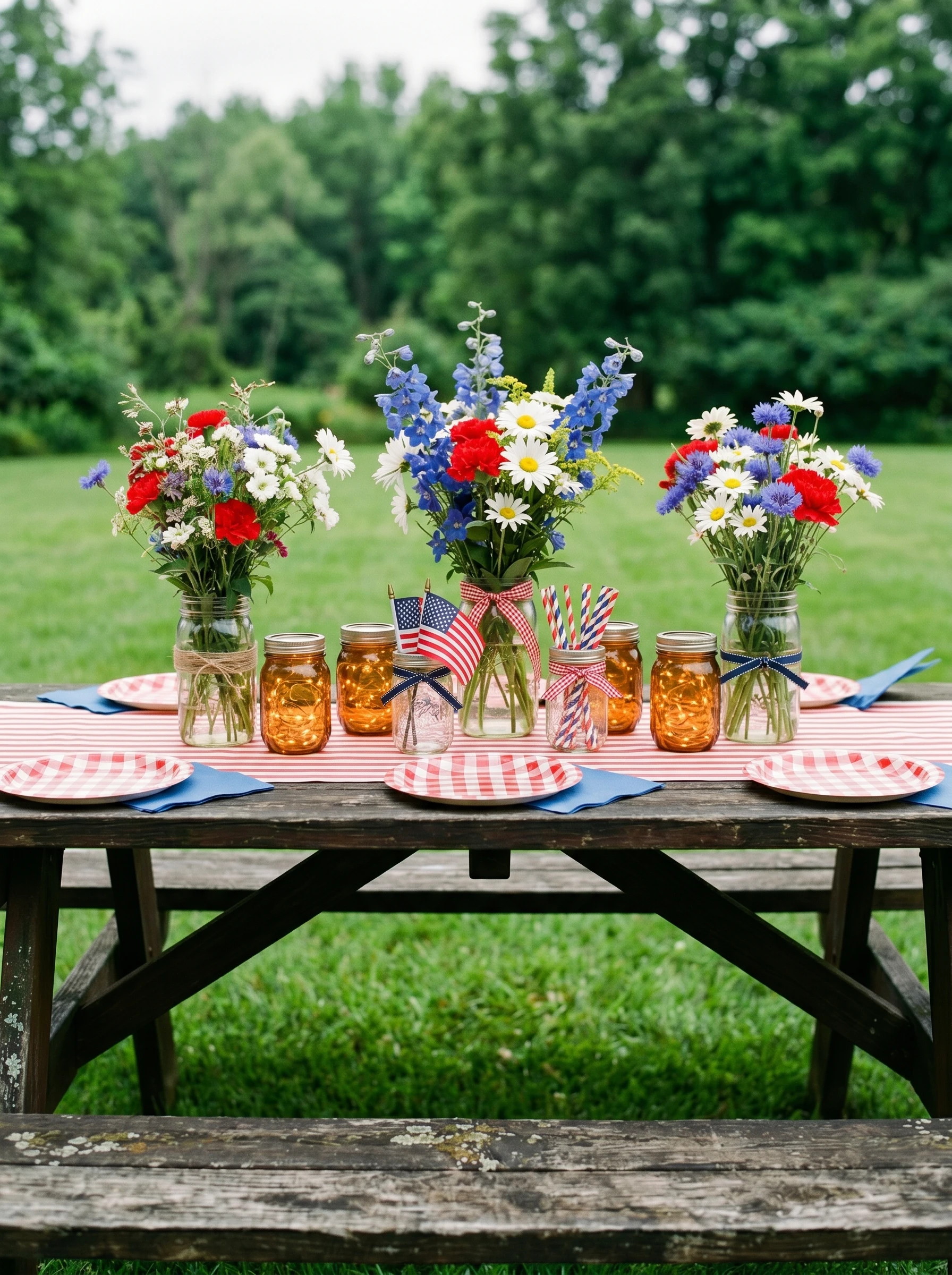
On a dark wood picnic table, lay a red-and-white gingham runner down the center. Collect six to eight clear and amber glass mason jars in different sizes. Fill three of the larger jars with loose wildflower arrangements — one with red carnations, daisies, and cornflowers; one with blue delphinium and white daisies; one with a mixed red, white, and blue cutting garden mix. Fill the smaller amber jars with battery-operated fairy lights and seal the lids. Tuck small American flags between the jars. Set blue paper napkins under red-and-white paper gingham plates at each place. The amber glow of the fairy light jars among the flower jars is the thing that makes this look intentional rather than improvised.
Grand Porch Stripe Table
Cover a long porch table entirely in navy-and-white awning stripe — cloth, and chair cushion slipcovers to match if possible. Set white patriotic-print dinner plates at each place, with red glass goblets for wine and clear glass for water. Place low, rounded arrangements of dense crimson carnations in white ceramic compotes at intervals down the table — three or four arrangements, evenly spaced. Between each floral arrangement, add a cluster of three to five small American flags fanned open. The monochromatic navy stripe surface is the foundation; the saturated red flower masses against it do all the visual work. Keep the place settings simple so they don’t compete.
Coastal Sand Tray Table
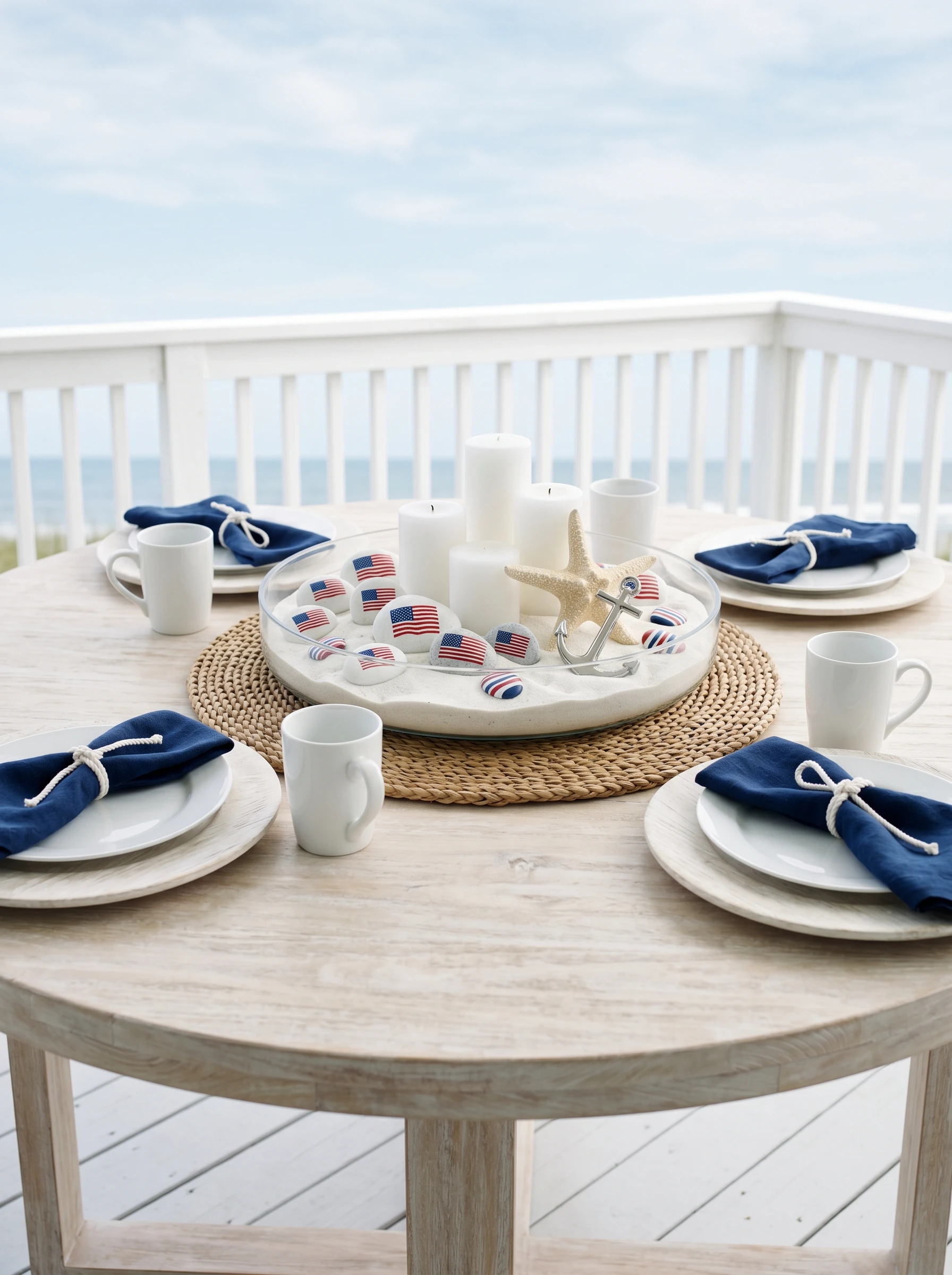
On a weathered teak or driftwood-finish round table, set round seagrass chargers at each place. Use simple white ceramic plates and white mugs — no pattern. Fold navy linen napkins and tie each with a length of white rope or cotton twine in a simple knot. For the centerpiece, fill a wide, low clear glass or ceramic tray with white sand. Set three white pillar candles of varying heights in the sand. Tuck a natural starfish and a small silver anchor ornament between the candles. Scatter small flag-printed river stones throughout the sand. Nothing in this centerpiece is alive, which means it takes zero maintenance and looks exactly the same at hour six as it did at hour one.
Blue Hydrangea Garden Table
Lay a red block-print or red floral tablecloth — something with a pattern, not a solid — over a garden table. Place round woven seagrass chargers at each setting. Use vintage blue-and-white transferware dinner plates, stacked with a smaller salad plate on top. Set blue-and-white patterned napkins under each setting. For the centerpiece, fill a clear glass compote or footed vase with as many blue hydrangea heads as it will hold — no other flower, just hydrangea packed tightly. Add two or three small American flags angled into the blooms. The blue plate on red cloth does the entire color job. The hydrangea centerpiece is just confirmation.
Marble Minimal Anemone Line
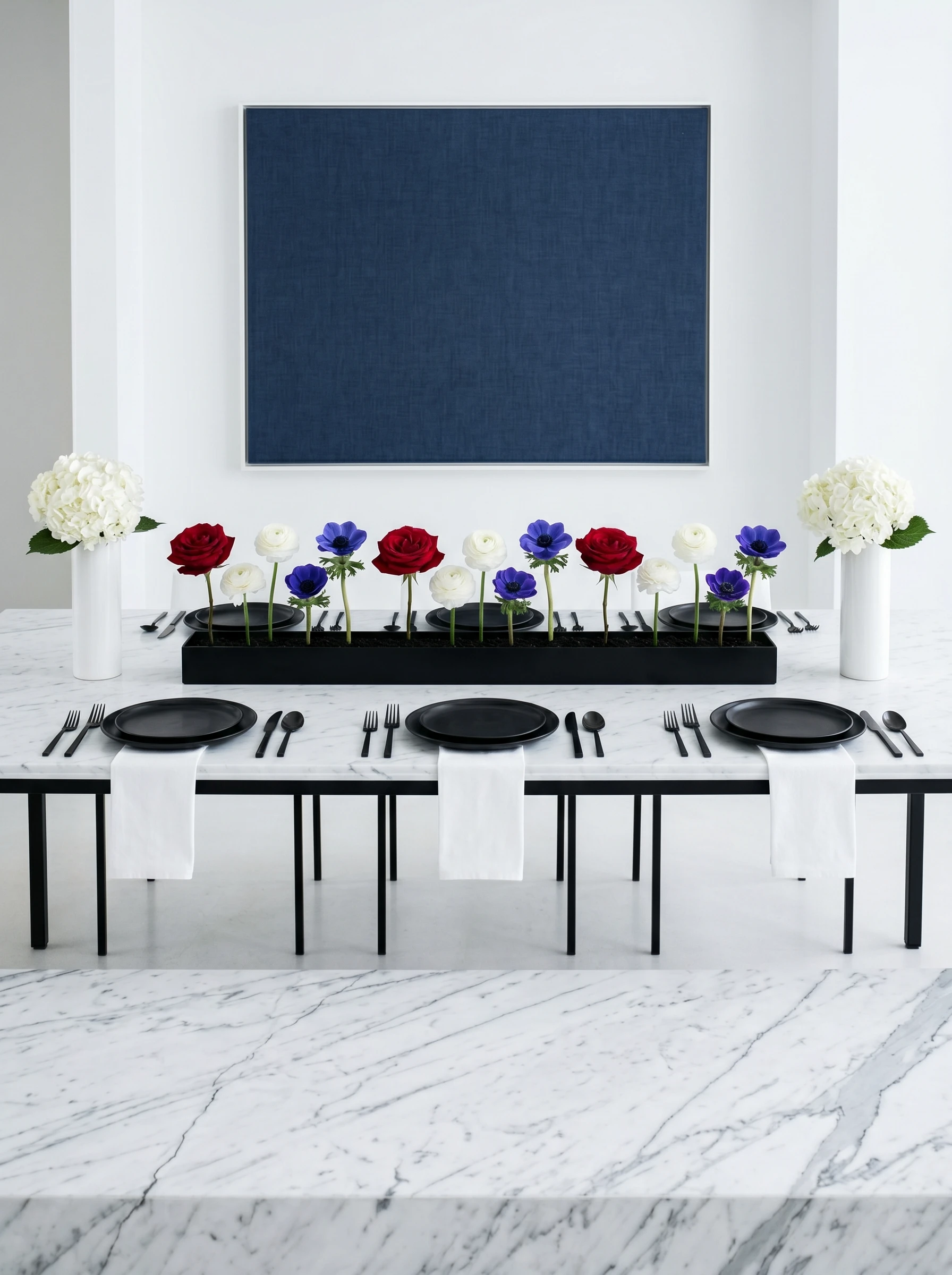
On a white marble or marble-look surface, set matte black dinner plates at each place with white linen napkins folded flat underneath them. Use matte black flatware. Place a long, narrow black trough planter down the center of the table — the kind used for herbs or succulents. Fill it with wet floral foam and insert single-stem flowers in a repeating sequence: one deep red rose, one white ranunculus, one cobalt blue anemone, repeat. Every stem cut to the same height, spaced evenly, so the row reads like a graphic pattern. Flank the trough at each end with a tall white cylinder vase holding a dense ball of white hydrangea. This is a table that has no tolerance for clutter. It works because of its precision.
Blue Transferware Round Table
Set a warm wood round table with rattan charger plates at each seat, then layer: a white scallop-edged plate, then a blue transferware dinner plate, then the same blue transferware in a smaller salad size. Set red gingham napkins horizontally across the plates. Use clear pressed-glass stemware. Place a small colored candy or ceramic star ornament inside each glass as a surprise detail. In the center of the table, set a single tall white ceramic vase with a tight arrangement of white hydrangea, white stock, and a few stems of blue delphinium, with a small American flag angled into the blooms. The layers of chinaware make the whole setting feel genuinely collected rather than purchased as a set.
Dessert Table with Tissue Pom Backdrop
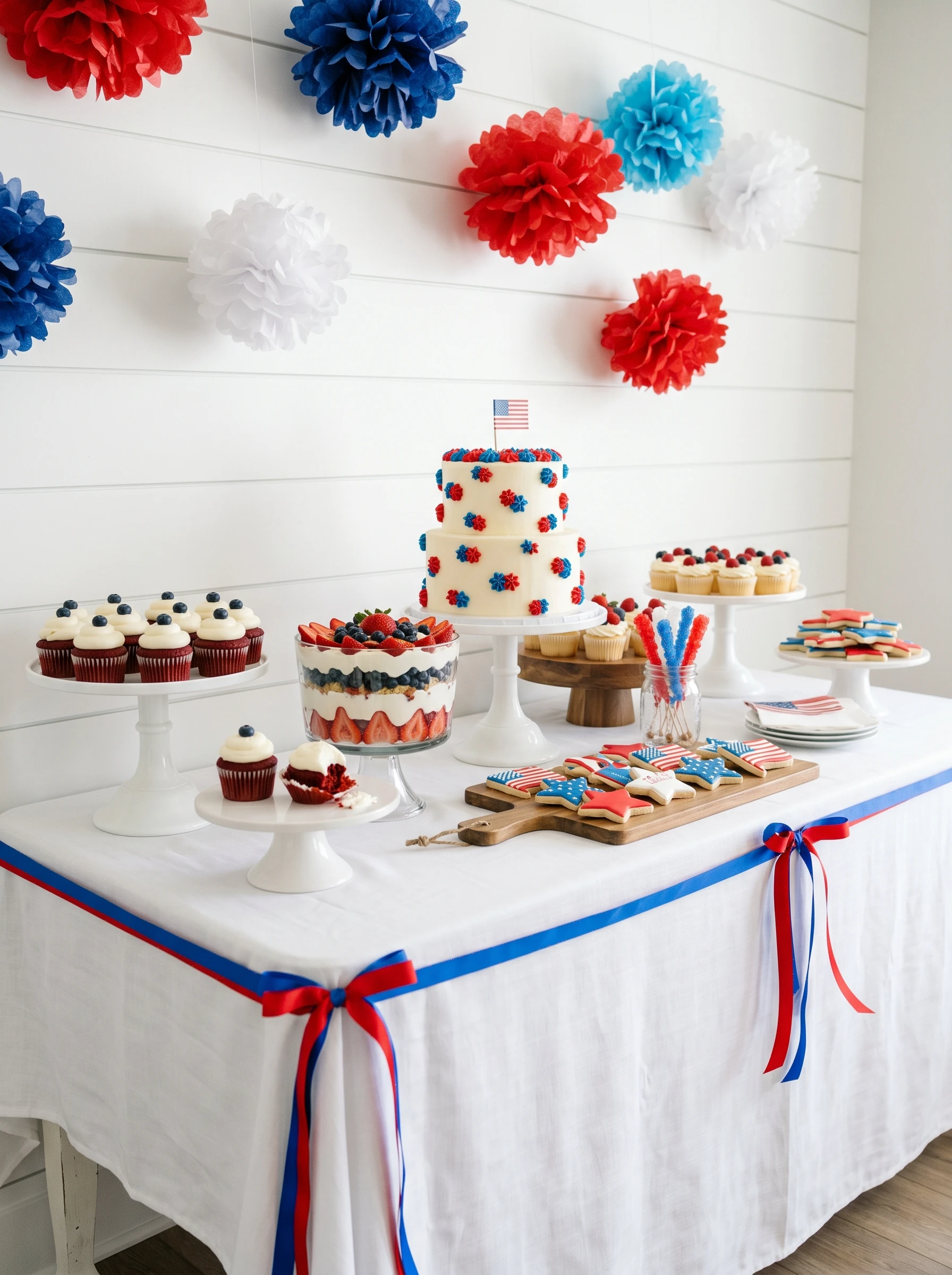
Cover a long buffet or dessert table with a white linen tablecloth, then add a border of red grosgrain ribbon and a blue satin ribbon along the hem edges, tied in bows at the front corners. On the white shiplap or wall behind the table, hang an assortment of tissue paper pom-poms in red, white, and blue — varied sizes, clustered at different heights rather than in a straight line. On the table surface, set white ceramic cake stands at three different heights. Place a two-tier white frosted cake at the tallest stand center, red velvet cupcakes on a lower stand to the left, and vanilla cupcakes on a wooden stand to the right. Lay star-shaped and flag-shaped cookies on a flat wooden serving board. Add a clear trifle dish with a layered strawberry, cream, and blueberry parfait. Fill a mason jar with red, white, and blue rock candy sticks.
Pom-Pom Ice Cream Buffet
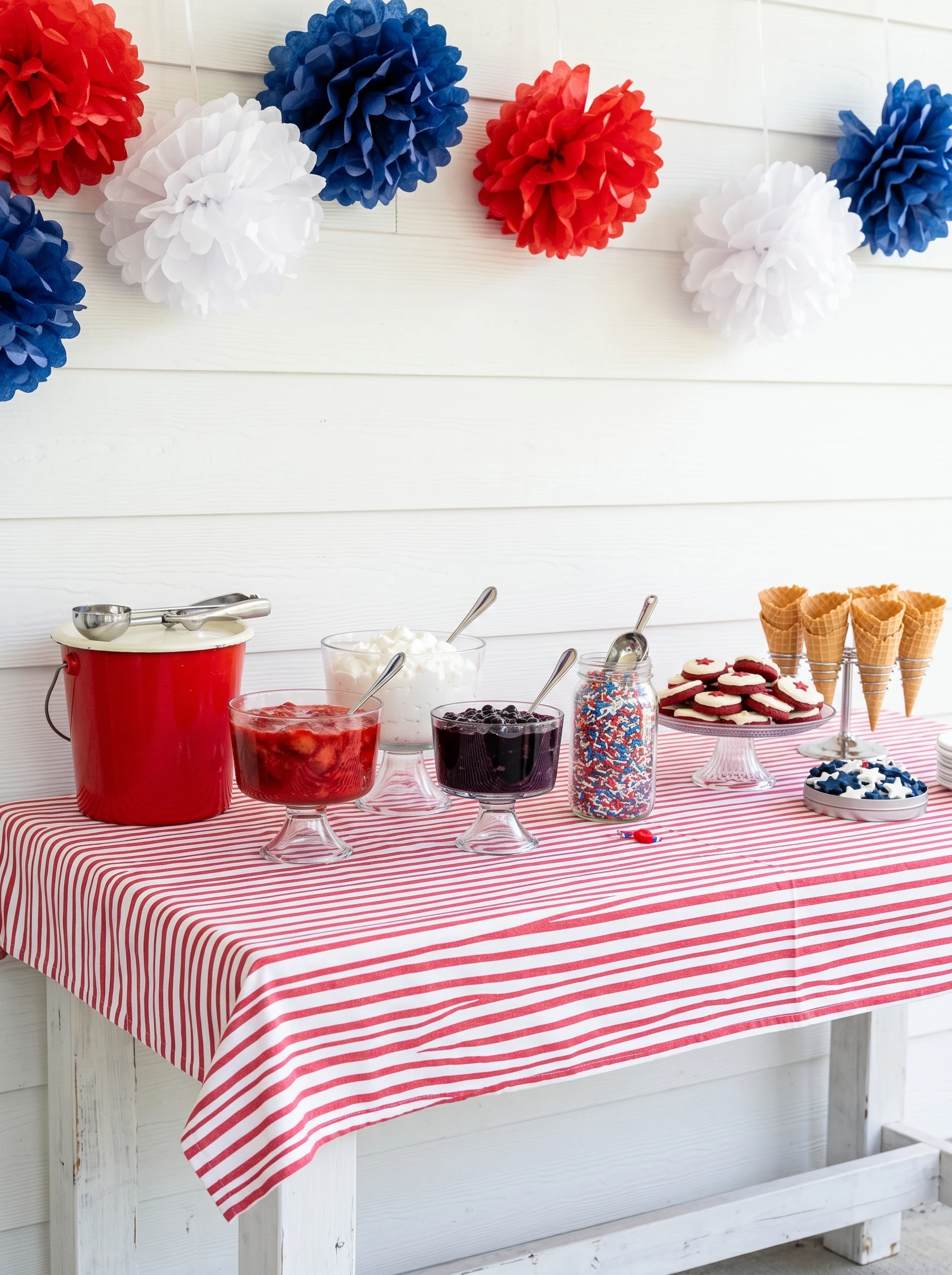
Against a white shiplap wall, hang tissue pom-poms in red, white, and blue — this time in a horizontal garland rather than a loose cluster, at a consistent height about twelve inches below the ceiling. Cover a white painted farm table with a red-and-white ticking stripe tablecloth. Line the table with the ice cream bar components in order from left to right: a red enamel ice cream tub on the far left, then a footed glass bowl of strawberry compote, a footed glass bowl of whipped cream, a footed glass bowl of blueberry sauce, a jar of red-white-and-blue sprinkles, a cake stand of red velvet sandwich cookies, and a cone display stand on the far right. Leave generous space between each item. Everything is visible and reachable from the front. The pom-pom backdrop is the only decoration this table needs.
White Linen Garden Centerpiece
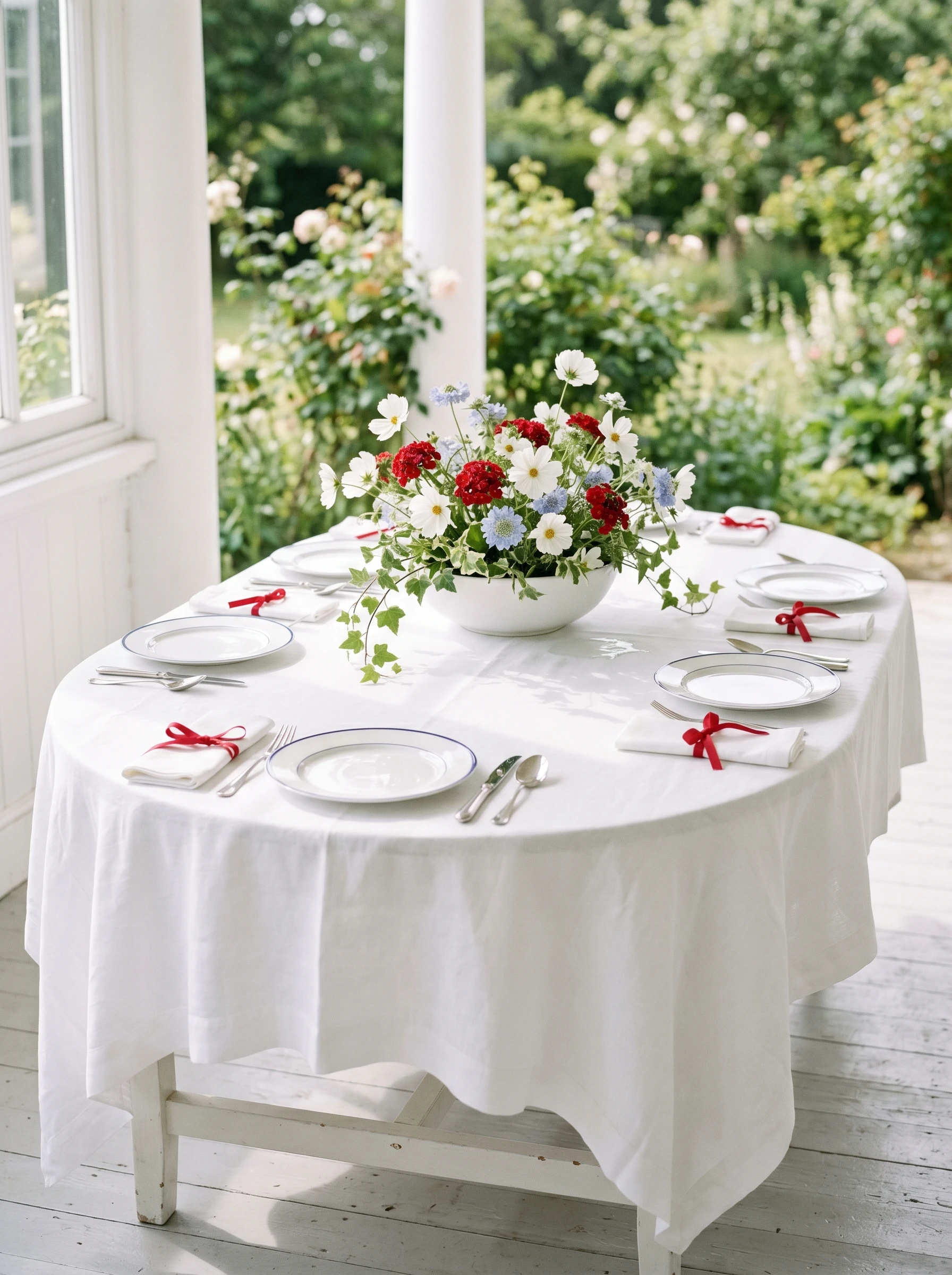
Set a round or oval table in crisp white linen — nothing on the cloth except the place settings. Use white plates with a single thin cobalt blue rim. Set silver flatware. Tie each white napkin with a small red satin bow — nothing else at the place settings. For the centerpiece, fill a wide white ceramic bowl with wet floral foam. Build a low, domed arrangement of red dianthus and carnation, white cosmos, pale blue scabiosa, and trailing ivy that drapes over the bowl edge and onto the tablecloth in several directions. The ivy on the white cloth is the move. The whole table is white and silver except for that single bowl of flowers — which is exactly the right proportion.
All-Candle Evening Table
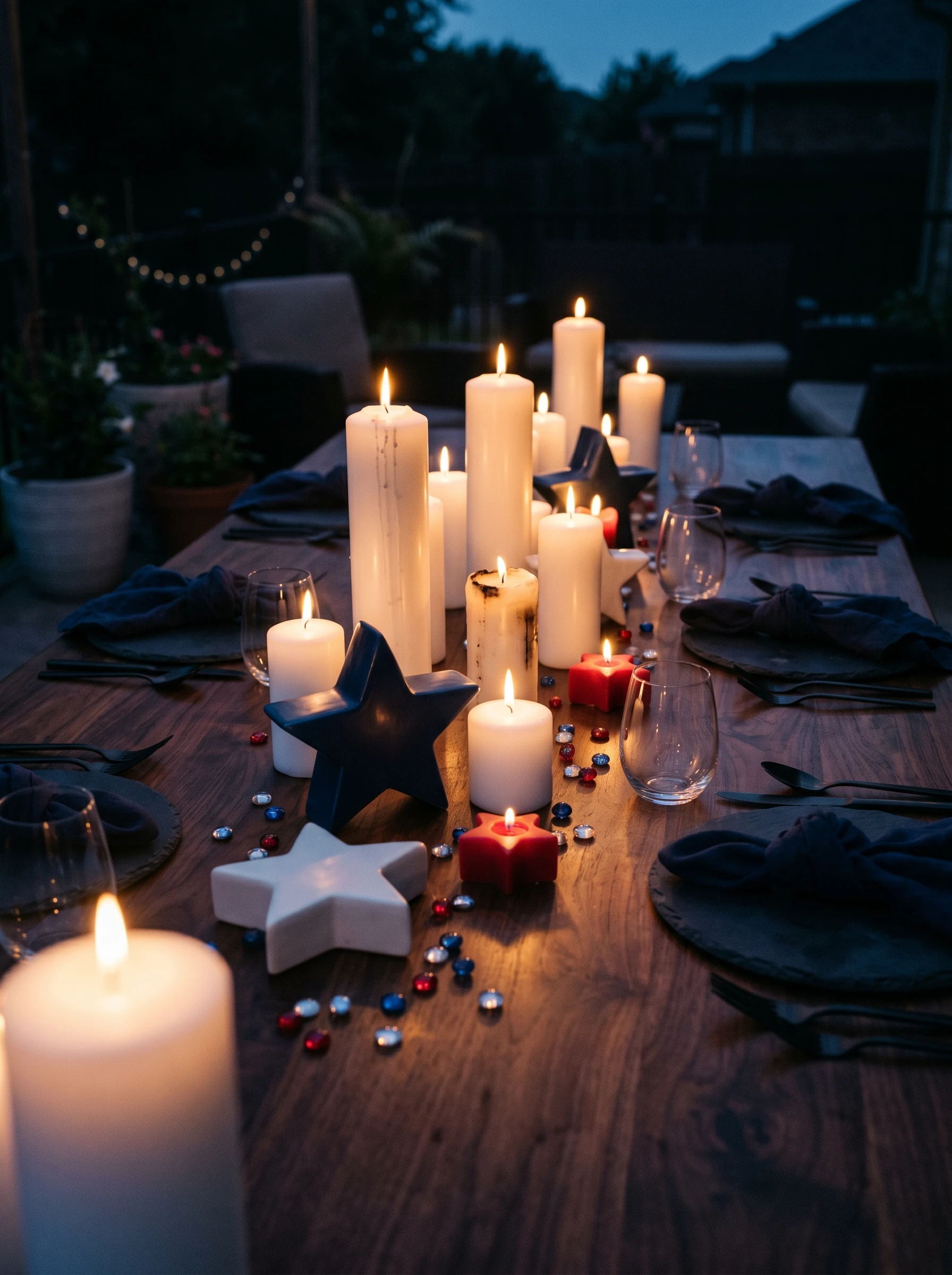
On a bare dark wood table — no cloth, no runner — scatter the centerpiece elements directly on the wood surface. Group white pillar candles of five different heights in the center of the table, touching and overlapping rather than evenly spaced. Between and around them, place matte navy ceramic star figures of two sizes. Add small square red wax votive candles. Scatter translucent acrylic gems in red, white, and blue across the wood surface around the base of the candles. Set dark slate charger plates at each place with navy linen napkins folded flat. Use clear stemless wine glasses and matte black flatware. Light the candles. This table is entirely different lit versus unlit, and it is designed for after dark, when the bare wood surface reflects the flame light and the scattered gems catch and scatter it.
Boho Low Floor Table
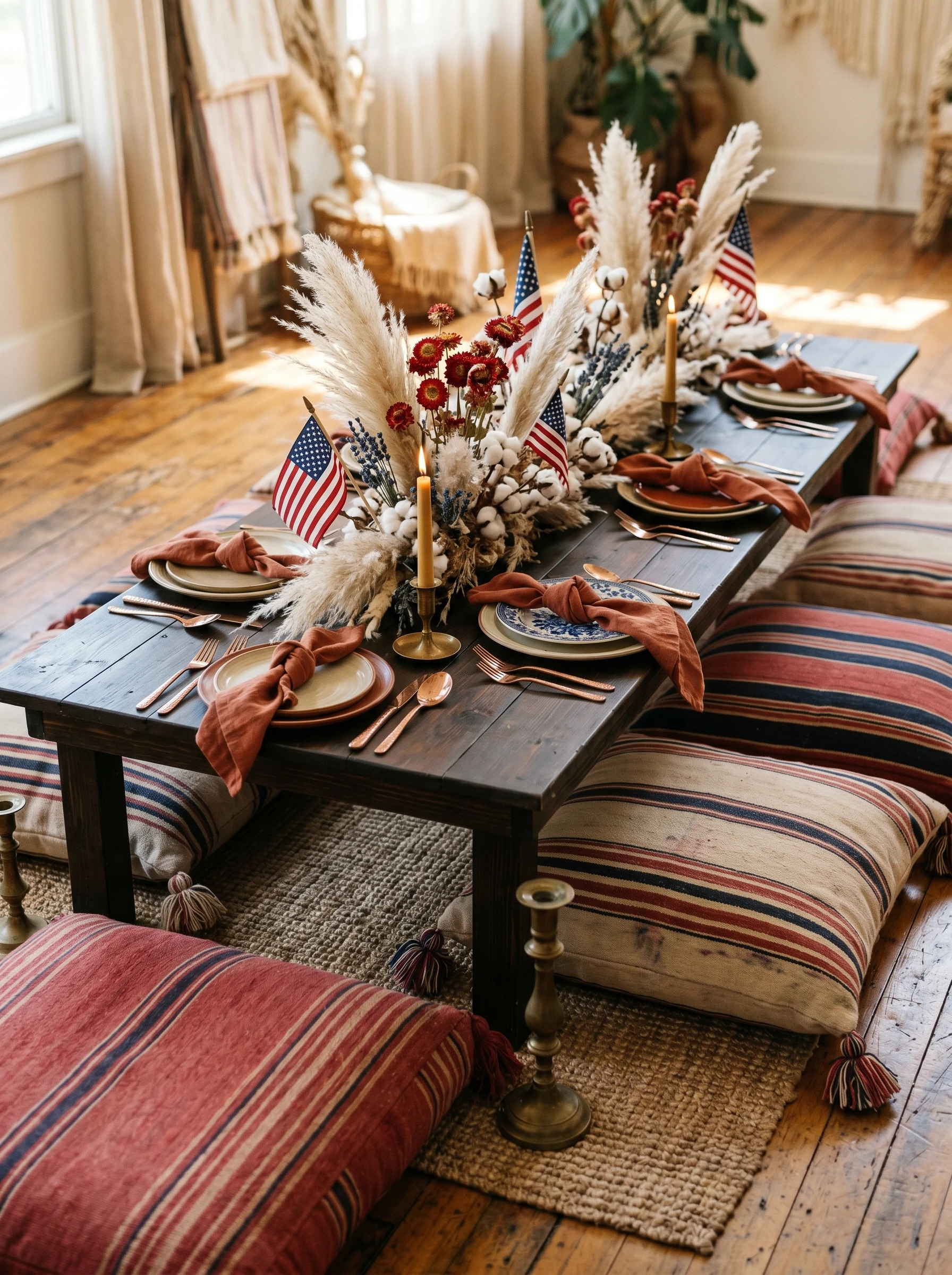
Set a low dark wood coffee table or a door laid flat on the floor, surrounded by oversized floor cushions covered in faded red-navy-cream stripe fabric with tassel trim. Cover the table surface in a loose, overflowing dried and fresh arrangement down the center: pampas grass plumes at the tallest points, cotton stem branches for volume and texture, dried red strawflowers and burgundy globe amaranth for color, dried lavender for blue, and scattered American flags angled throughout. Set brass taper candlestick holders at each end with cream beeswax tapers. Use stoneware plates in warm sand tones. Set terracotta linen napkins in a loose fold at each place and use gold or bronze flatware. This tablescape is patriotic entirely through the red-navy-cream color story of the cushions — the centerpiece itself is botanical and earthy, not flag-themed.
Galvanized Tub Farmhouse Table
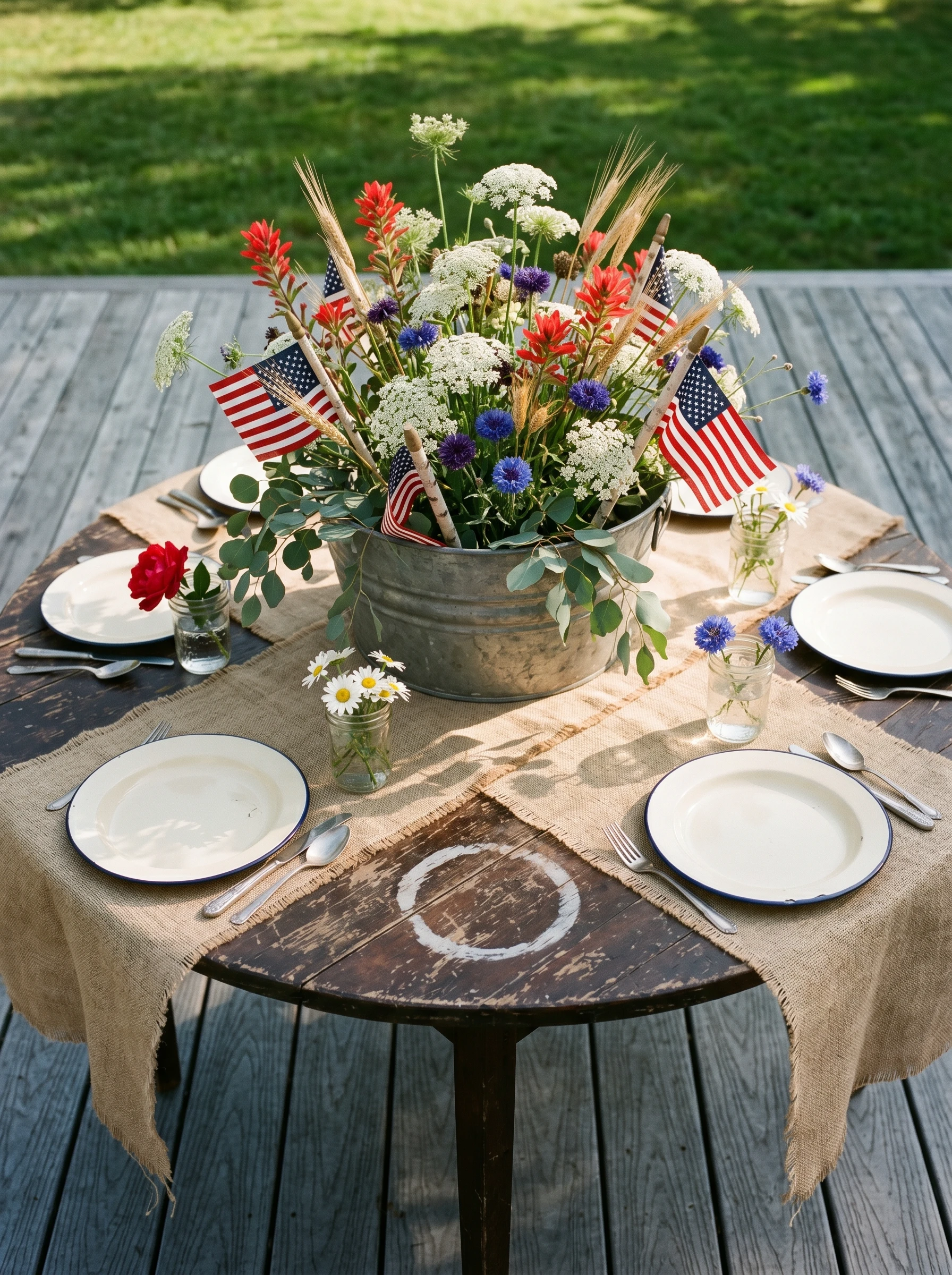
Cover a long plank farm table with a red-and-white ticking stripe runner — raw linen underneath if the table surface is beautiful wood, which it should remain visible. Set simple white enamel-rim plates at each place with red gingham napkins folded in a square. Use bamboo or bone-handled flatware for the rustic register. For the centerpiece, set three galvanized metal flower buckets in a line — one tall, two shorter — each filled tightly with flowers: all red garden roses and red peonies in the tallest, all white peonies and white blooms in the middle, and a mix of blue hydrangea with red roses in the third. Between each bucket, set a simple glass cylinder with a single white pillar candle. Hang a vintage American flag horizontally on the wall behind the table where it catches the afternoon light.
Wildflower Prairie Runner Table
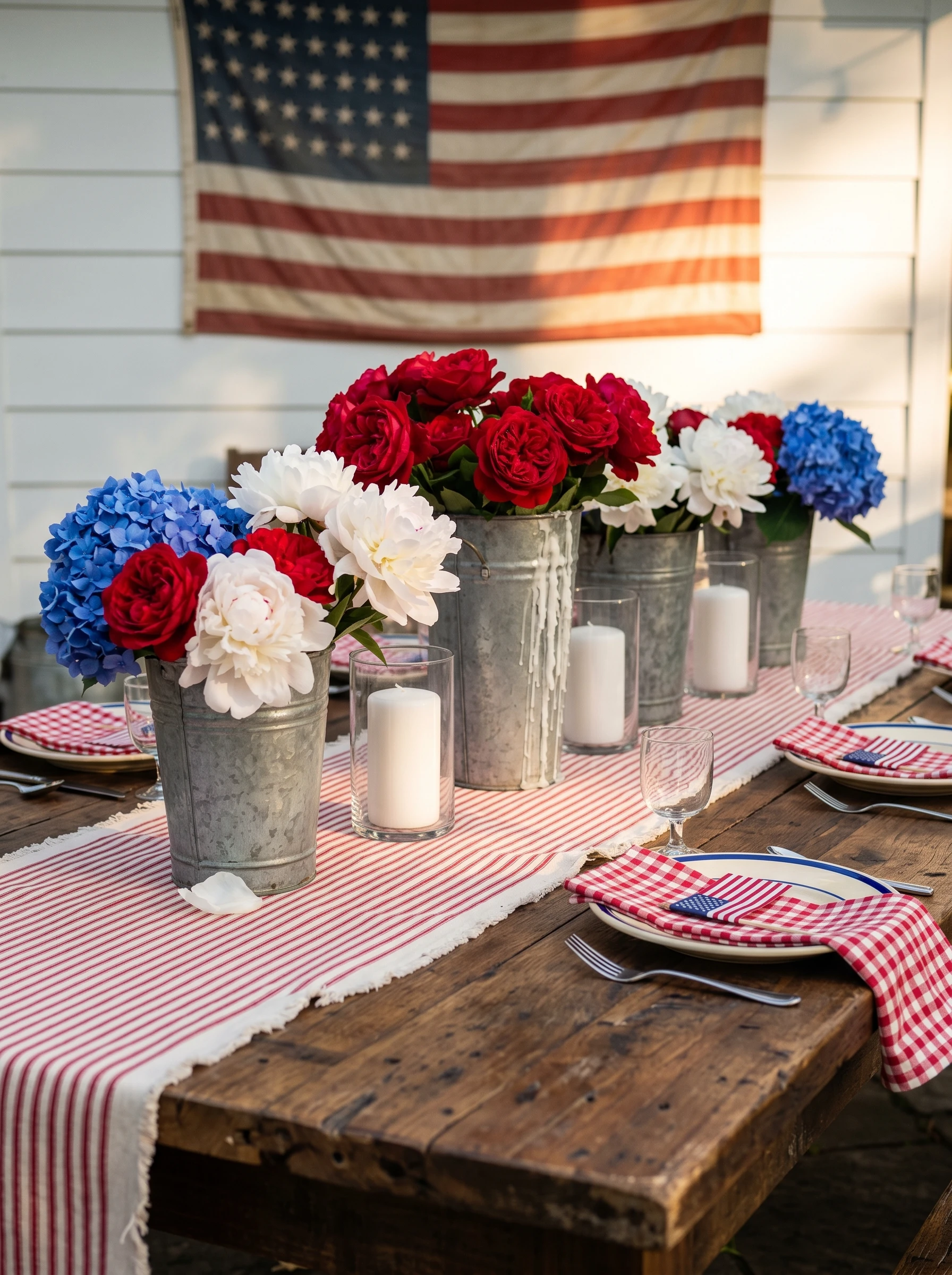
On a bare pine plank farm table, lay large fern fronds flat down the center as the base layer — they function as a living runner. Over the ferns, place a loose arrangement of stems directly on the table without a container: orange-red field poppies, white Shasta daisies, purple-blue cornflowers, and wheat stalks woven throughout. Tuck small American flags at irregular intervals along the length of the runner. Place small red and blue glass votive holders among the flowers. Set simple white plates on linen napkins at each place, with plain silver flatware. This is an outside-only table, built for a long summer lunch in direct sun. The poppies and cornflowers dehydrate over the course of the day and start to look intentionally pressed by evening.
String Light Candle Runner Table
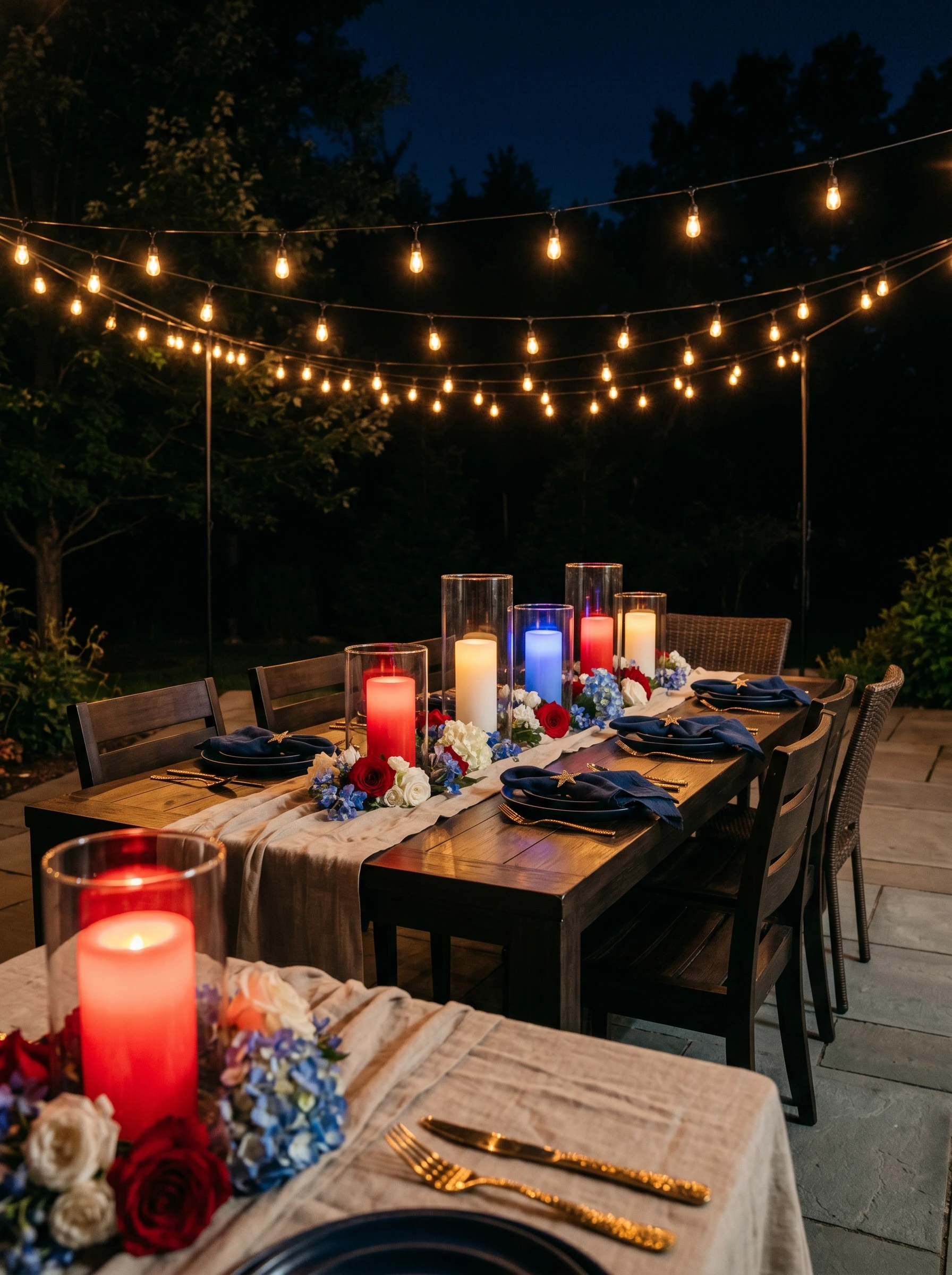
Overhead, run four to five strands of Edison-filament string lights in a loose grid over the table, suspended from poles or hooks at the corners — not draped prettily but strung with some tension so the bulbs hang at a consistent height about two feet above the table surface. On the table, lay a natural linen runner down the center. Set tall hurricane glass cylinders at intervals — four or five down the runner — and place colored pillar candles inside: red in the outermost cylinders, one blue in the center. Between the cylinders, place short stem fresh flowers: blue hydrangea, red garden roses, white spray roses, in loose handfuls directly on the runner with no vase. Set navy linen napkins with a small gold star detail at each place, on matte black plates with gold flatware. This table belongs entirely to the night. Do not photograph it in daylight.
Planter Box Cottage Table
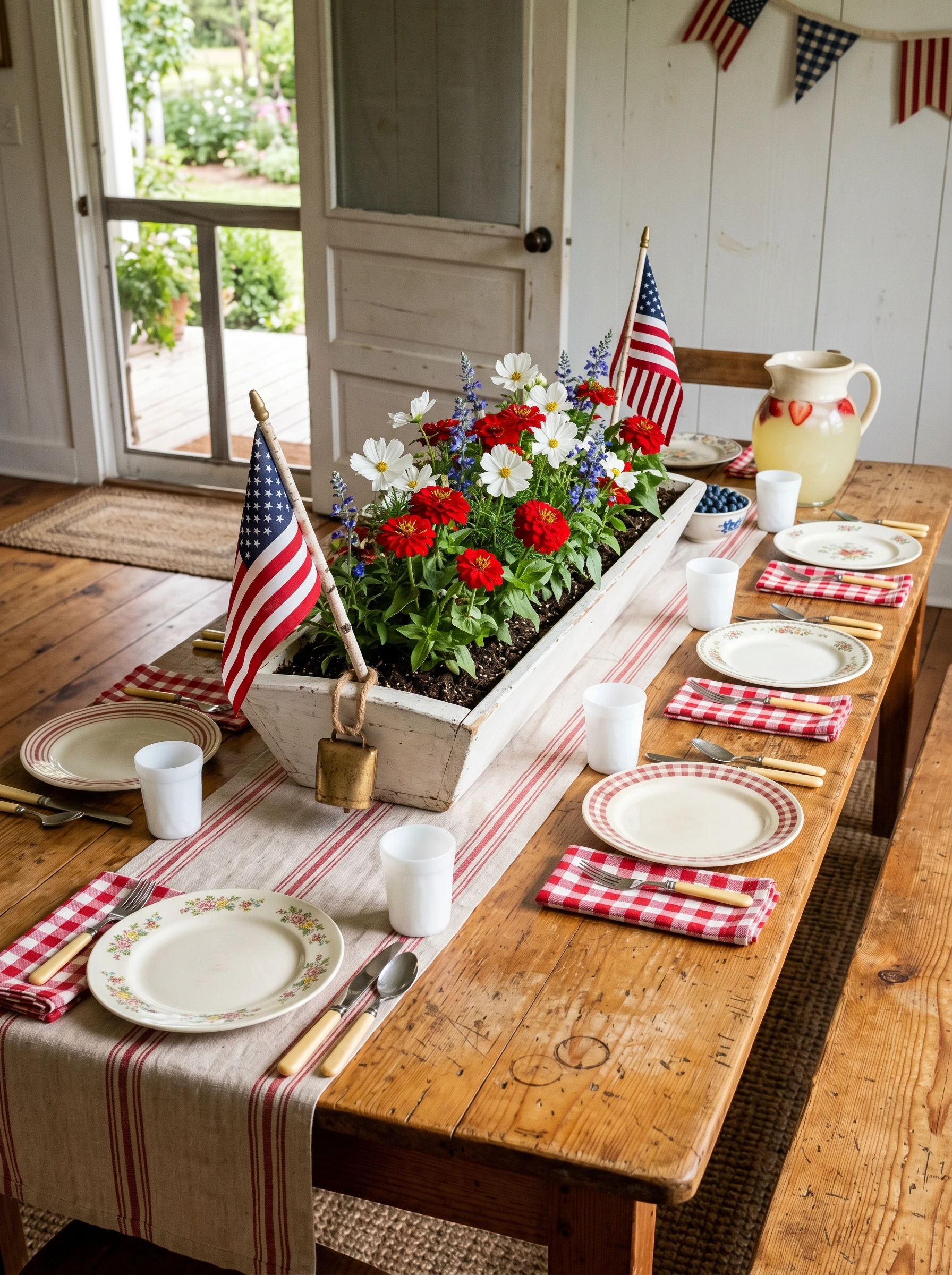
Find or build a long shallow wooden planter box — paint it white and let it dry completely, then sand lightly for a weathered look. Drill drainage holes and fill with potting mix. Plant living red zinnia seedlings, white cosmos seedlings, and blue salvia plugs directly into the soil, mixed together rather than in color sections. Tuck two or three small American flags on wooden stakes into the planting at intervals. Set the planter as the table centerpiece on a ticking stripe runner. Use mix-and-match vintage floral china plates, white milk glass cups, and bone-handled cutlery. Add a ceramic pitcher of lemonade and a small bowl of blueberries as props. This is the only centerpiece in this collection that gets better over the course of the summer.
Patriotic Grazing Board Table
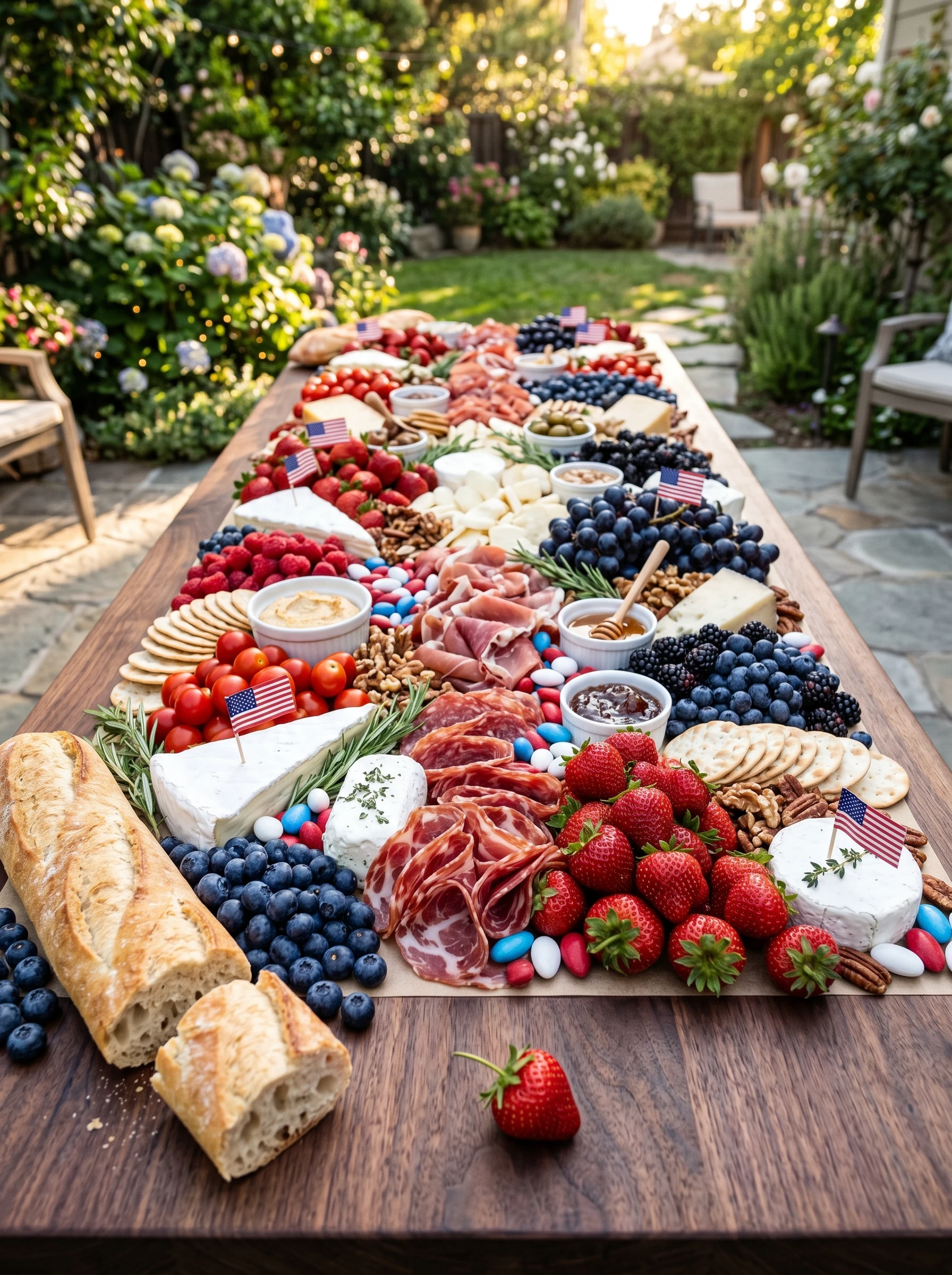
On a long outdoor dining table, set the grazing board as both centerpiece and conversation — meaning it runs the full length of the table and guests graze from it before plates are set. Line the table surface with unbleached parchment paper. Build the board from the center outward: large cheese wedges first — a whole brie, a block of aged white cheddar, crumbled goat cheese — then folded prosciutto and salami in loose rose folds between the cheese. Fill in with strawberries, raspberries, and blackberries in red-to-blue color progression. Add blueberries in dense clusters. Scatter crackers in fans. Fill small white ramekins with honey, hummus, and jam at intervals. Tuck American flags on toothpicks into the cheese wedges. Lay a baguette diagonally at one end. Nothing on this table is decoration in the traditional sense — every element is edible.
Poppy Wildflower Outdoor Feast Table
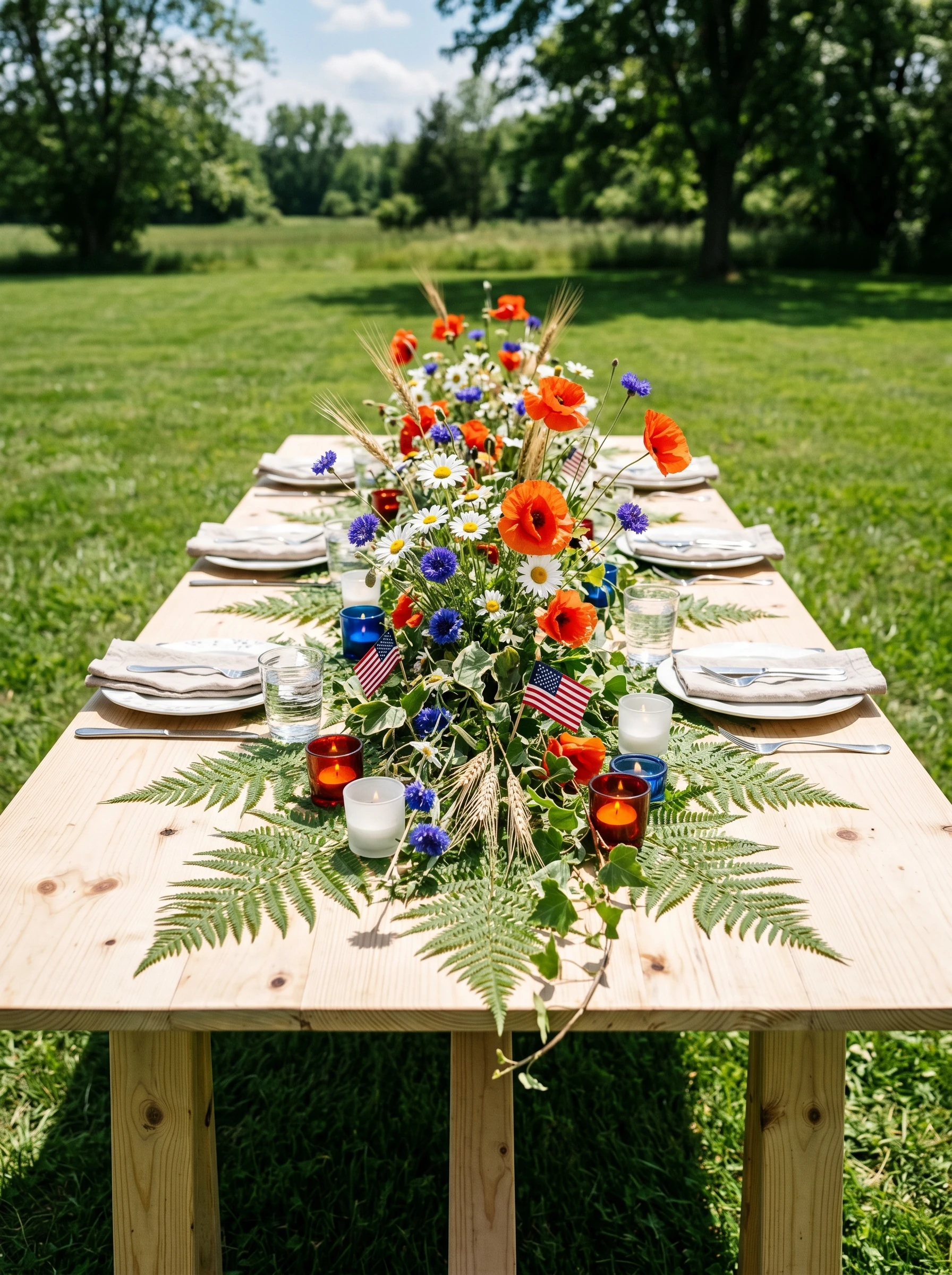
Build a garland runner directly on a new pine plank table using no vases. Lay bunches of fresh fern fronds flat, overlapping, down the table’s center. On top of the fern base, scatter loose flower clusters at intervals: bunches of orange-red poppies, blue cornflowers, white Shasta daisies, and dried wheat stalks woven through. Place colored glass votive holders — red, white, and navy — directly on the fern surface between the flower clusters, distributed unevenly so they feel scattered rather than placed. Tuck small American flags throughout. Set linen napkins flat under simple white plates with no charger. The table’s material — raw pale pine — is part of the composition. It does not need a cloth.
What These Tables Have in Common
Every one of them committed to a register. Rustic didn’t mix with formal. Minimal didn’t mix with maximalist. The boho floor table didn’t apologize for the floor cushions, and the marble minimal table didn’t apologize for the single color-pop row of flowers. Confidence in a single direction is what separates a considered table from a collage.
Holiday decorating has a tendency to pile it on — more flags, more stars, more red-white-and-blue everything — until the table stops being a table and starts being a theme park installation. The most memorable tables here are the ones that decided what to leave out. The coastal sand table has no flowers. The white garden table has almost nothing on the cloth except the place settings. The all-candle table has no cloth at all.
Set the table for the people sitting at it. Not for the photo. The ones that photograph best are always the ones designed first and photographed second.