
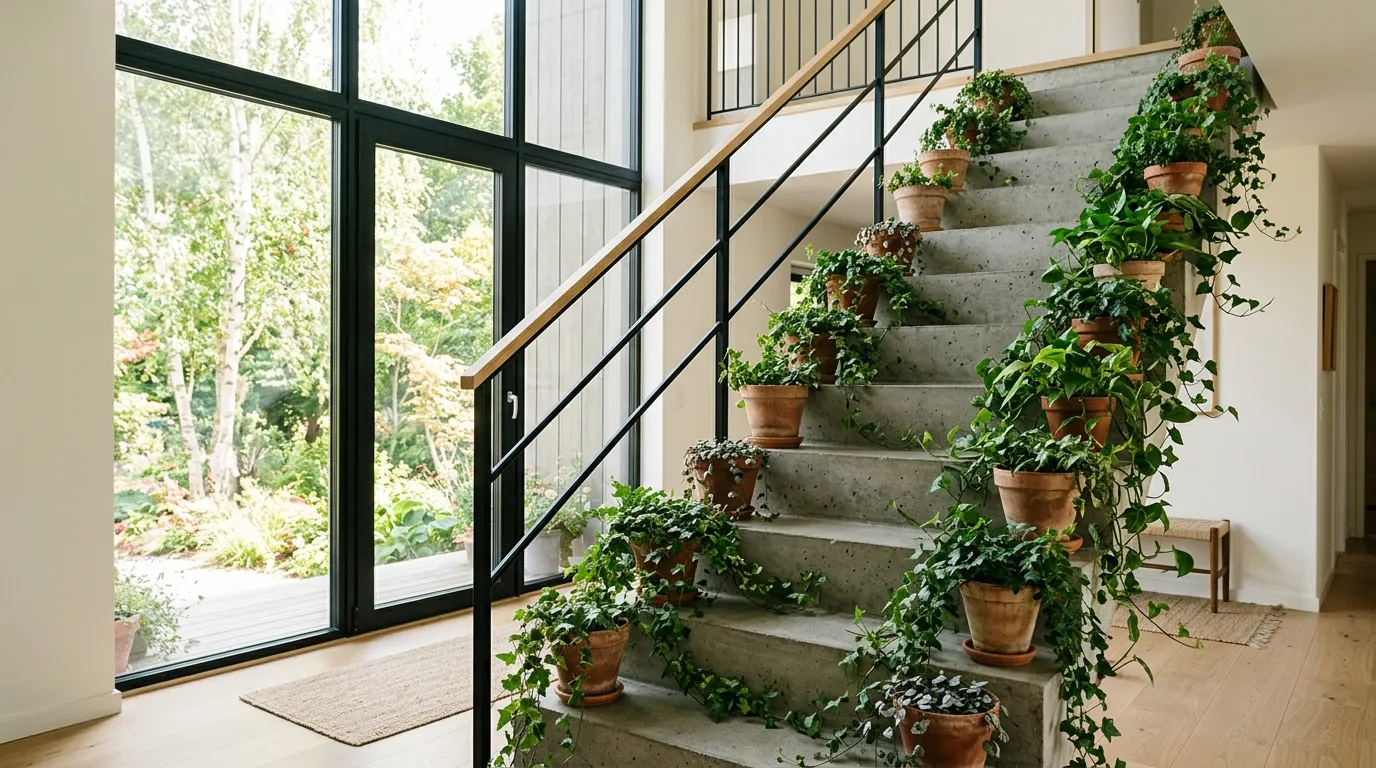
Staircase is the space you walk past twenty times a day and never actually design. That’s exactly why it works so well for plants. Indoor staircase gardens turn a hallway you ignore into one of the most photographed spots in the house, and most people are missing it completely.
Here’s the problem. Staircases get treated like leftover space, so people either leave them bare or clutter them with a single sad plant that never gets enough light. Neither approach works. A staircase has more usable light, more vertical space, and more visual impact than almost any other spot in a home, but only if you treat it like an actual room instead of a hallway.
This list skips the vague advice. Every idea here is specific enough to act on today, whether you’ve got a straight run of stairs, a spiral staircase, or a landing that’s been empty since you moved in. Pick two or three, and that staircase stops being wasted space.
Why Most Staircases Waste Their Best Growing Space
The Light Everyone Ignores On A Staircase
Most staircases have a window or a skylight nobody else in the house pays attention to. That landing window gets hours of shifting light that never reaches your living room, and it changes completely from morning to afternoon. People walk past it every day without ever mapping how the light actually moves. Spend one day watching it before you buy a single plant. The direction that window faces decides more about your success than any amount of fertilizer or care.
Why Straight Rows Of Pots Look Cluttered Instead Of Intentional
Lining up identical pots on every step doesn’t read as a garden. It reads as clutter, because there’s no rhythm to it. A designed staircase garden staggers heights, mixes trailing plants with upright ones, and leaves gaps on purpose. Repetition without variation is what makes a space feel busy instead of built. The fix isn’t more plants. It’s fewer plants placed with intention at different levels.
The Real Reason Plants Die On Stairs (And It’s Not Neglect)
Staircases near front doors take a beating from temperature swings every time that door opens. Add a nearby heating vent and you’ve got dry air on top of drafts, which is a rough combination for most houseplants. This has nothing to do with how often you water. It’s about picking plants that can handle inconsistency, and placing them away from the draft zone near entry points.
Once you understand where the light falls and where the drafts hit, the rest is just placement. That’s where these ideas come in.
Indoor Staircase Garden Ideas
Install An Indoor Rock Garden
If you are tired of tripping over potted plants, just build a permanent rock garden under your stairs. It turns a boring floor space into a glorified terrarium that requires a professional lighting setup to keep everything from rotting in the shadows. Congratulations, you now have a dusty gravel bed that will inevitably become a magnet for loose change and lost keys.
Use rounded river stones to create a clean aesthetic that screams I spend way too much time on design blogs. Just remember that once those rocks are placed, you are stuck with them until you decide to remodel your entire foyer. It is the perfect low-maintenance commitment for people who enjoy moving heavy boulders just to reach a stray sock.
Adding spherical floor lamps adds that mid-century modern flair that makes your staircase look like a posh hotel lobby. Because nothing says homey comfort like bright, orb-shaped lights glaring at you from the base of your stairs at three in the morning. Enjoy the aesthetic, provided you can handle the constant dusting of every single pebble.
Turn The Landing Window Into A Sun Trap For Plants
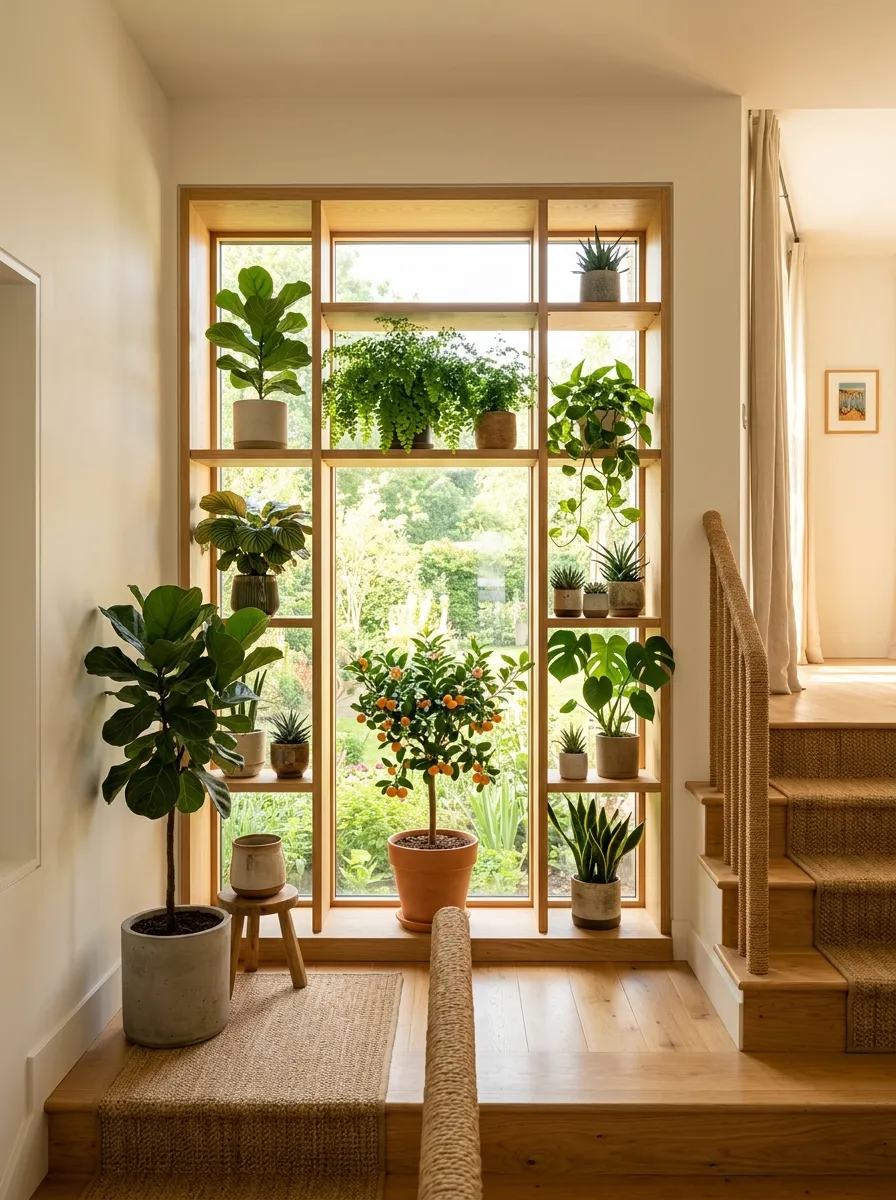
Map your landing window’s light before you place a single pot there. Morning-facing windows suit ferns and calatheas. South-facing landings can handle succulents and even a small citrus tree. Set a shelf directly in the window’s path instead of a few feet back, since even three feet changes light intensity dramatically. Rotate pots weekly so growth stays even on all sides instead of leaning toward the glass.
Create A Sculptural Bonsai Corner
Why have a houseplant when you can have a tree that looks like it is judging your life choices? Positioning a specimen tree under a staircase is the ultimate flex for people who want to pretend they live in an arboretum rather than a standard suburban home. It occupies valuable floor space, but at least it gives you something to stare at while you contemplate why you bought such a finicky plant.
Surround the base with white decorative gravel to make the contrast pop, assuming you enjoy vacuuming up tiny stones every time you walk by. It provides a minimalist look that is totally worth the effort of explaining to every guest why you are growing a tree inside your hallway. It is definitely a statement piece, mostly stating that you have too much free time for horticultural therapy.
Don’t forget the uplighting, because a tree in the dark is just a tree. Illuminating the trunk from below casts dramatic, slightly ominous shadows on your walls that will keep your house looking like the set of a low-budget psychological thriller. It is the perfect touch for those who find normal interior lighting far too flattering.
Let A Trailing Pothos Cascade Down The Railing
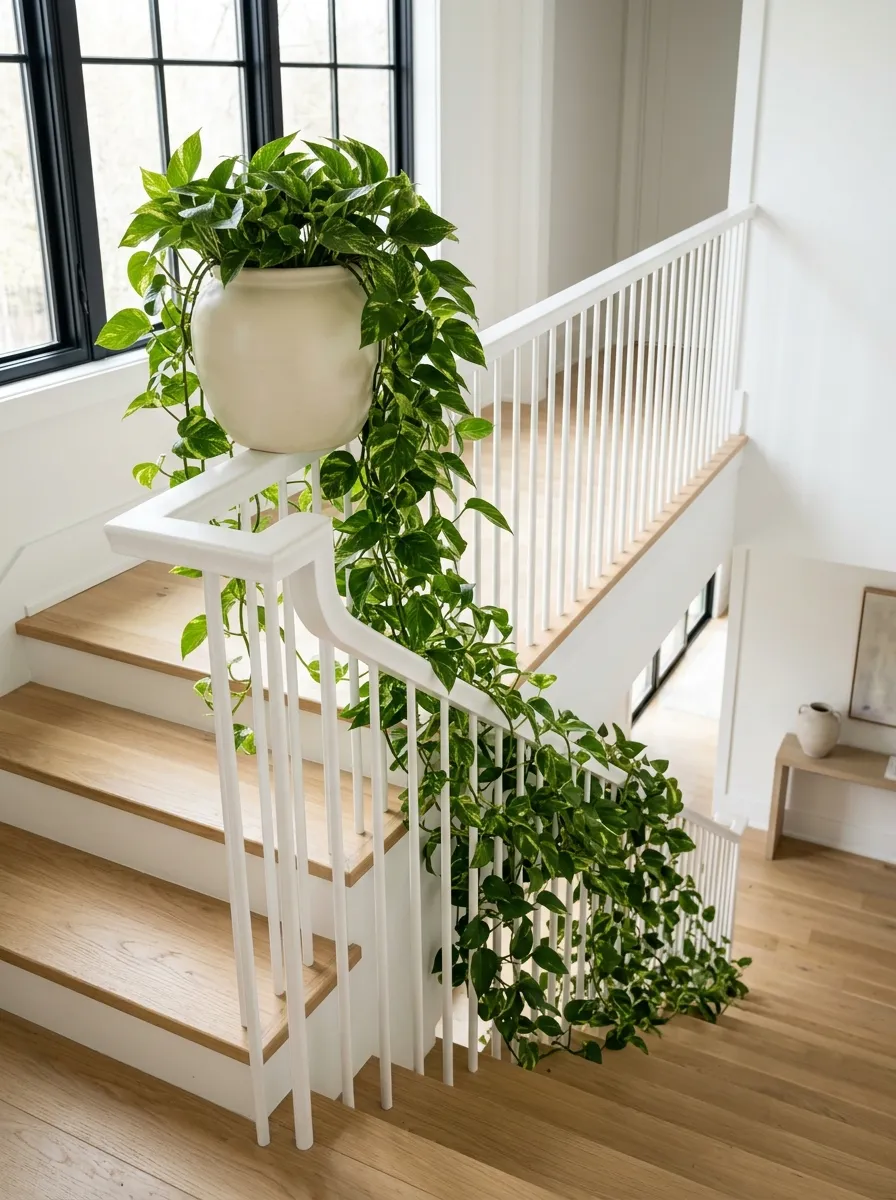
A pothos hanging off the top of the railing does something no floor plant can. It draws the eye down the whole staircase in one motion instead of stopping at a single point. Set it in a pot with a wide base so it can’t tip when someone brushes past. Let the vines run six to eight feet before trimming.
Feature An Illuminated Stairwell Bed
Nothing screams excess quite like installing LED strip lighting beneath your stair treads to highlight a miniature jungle floor. It ensures that every speck of dirt you track into the house is perfectly showcased for all to see. It is a bold way to prove that you care more about the visual impact of your stairs than the actual ease of navigating them.
Mix in some large river rocks and ferns to create a look that demands constant tidying. You will need to treat your staircase like a botanical sanctuary, constantly pruning leaves that dare to obstruct your path. It is essentially a hobby that happens to double as a tripping hazard for anyone not paying attention to where they step.
This setup essentially turns your staircase into a high-maintenance gallery piece. You will spend more time adjusting the pebble arrangement and dusting the leaves than you will actually walking up the steps. If you are aiming for that look of sophisticated struggle, this is absolutely the right interior design choice for your home.
Build A Vertical Garden Wall Under The Stair
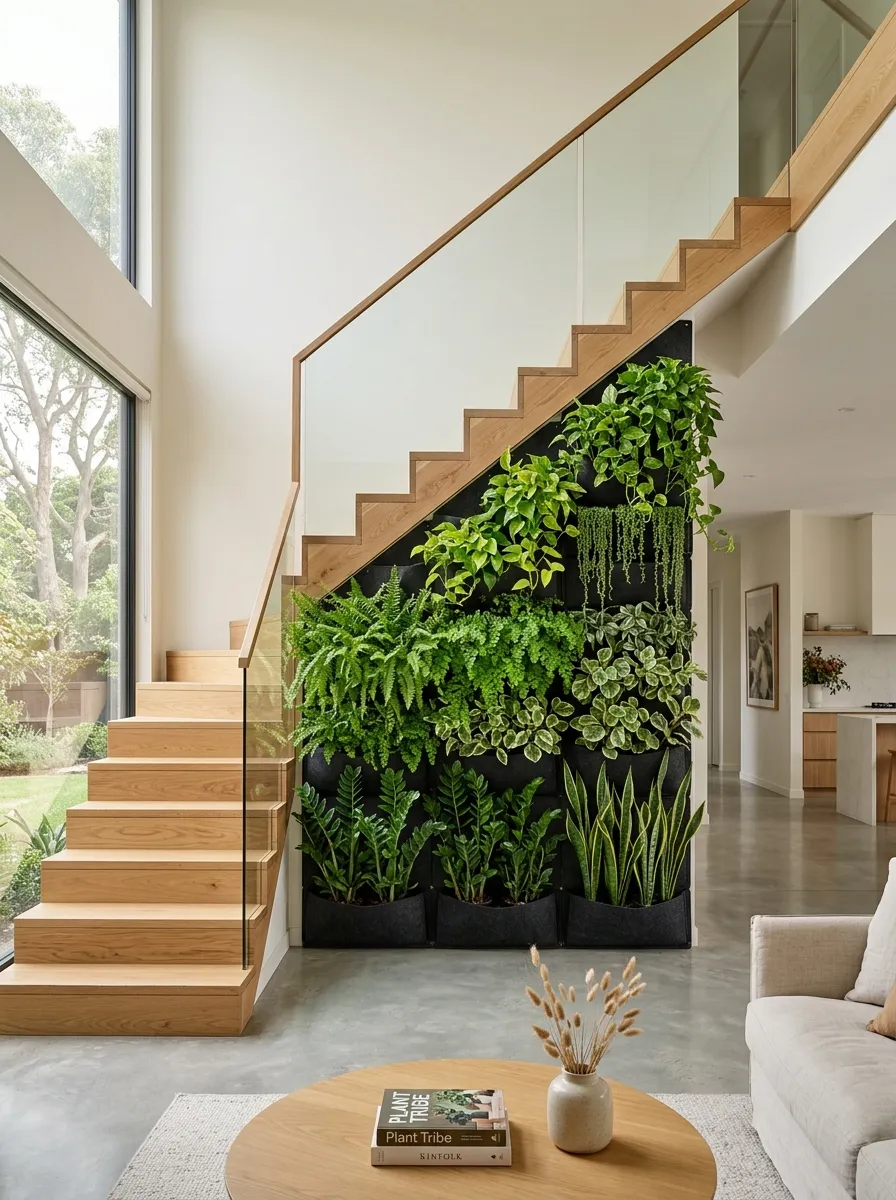
That triangular dead zone under most staircases is wasted square footage. Instead of a closet nobody opens, build a shallow vertical planting wall using stacked wall-mounted pockets or a modular felt panel system. Layer three to four rows, denser plants at the bottom, trailing varieties up top. This one move solves two problems at once. It fills awkward space and gives you a living wall without sacrificing any floor room.
Hang A Row Of Macrame Planters From The Handrail
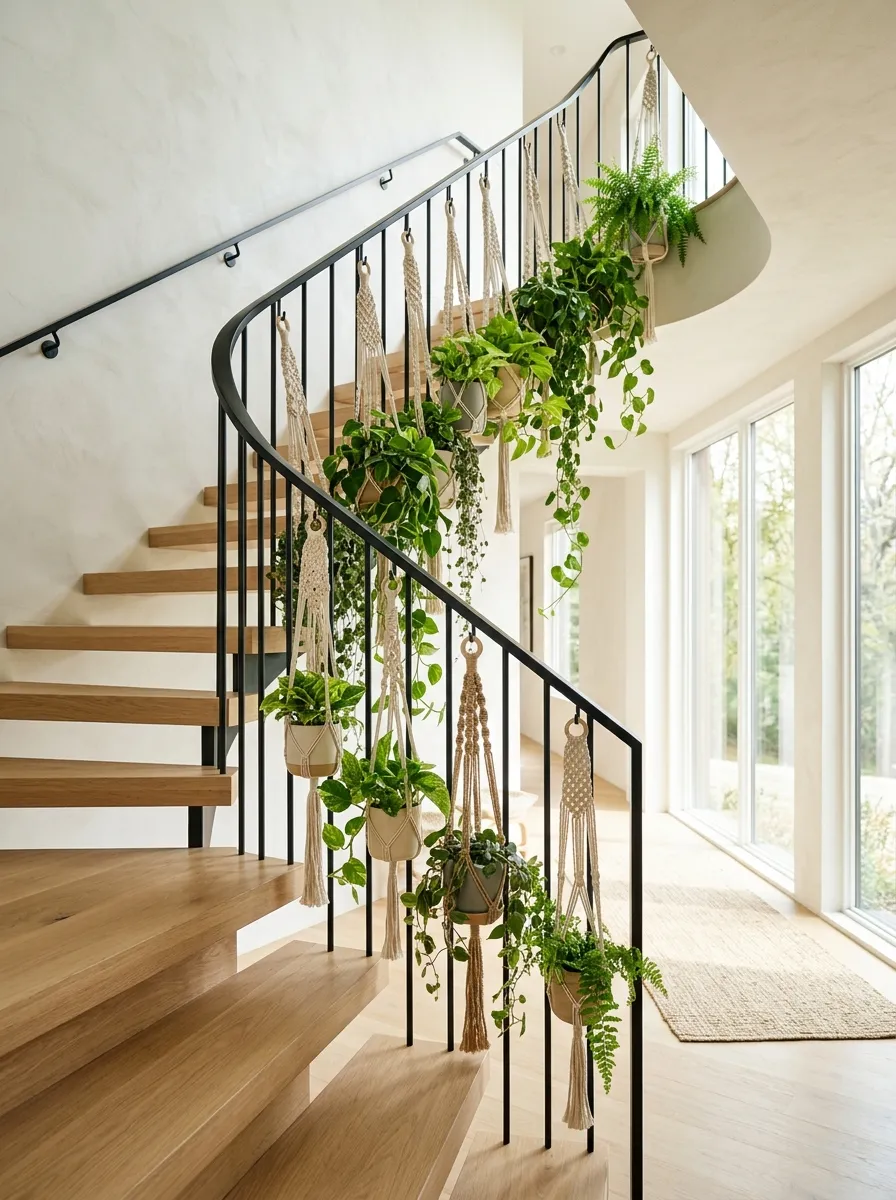
Skip the drilling entirely. A macrame hanger looped over a sturdy handrail bracket holds weight fine as long as you check the knot every few months. This works best on staircases with open sides, where there’s nothing below to block the hang. Space them unevenly, not in a perfect row, so the eye moves naturally instead of counting matching pots.
Stack A Plant Ladder Beside The Bottom Step
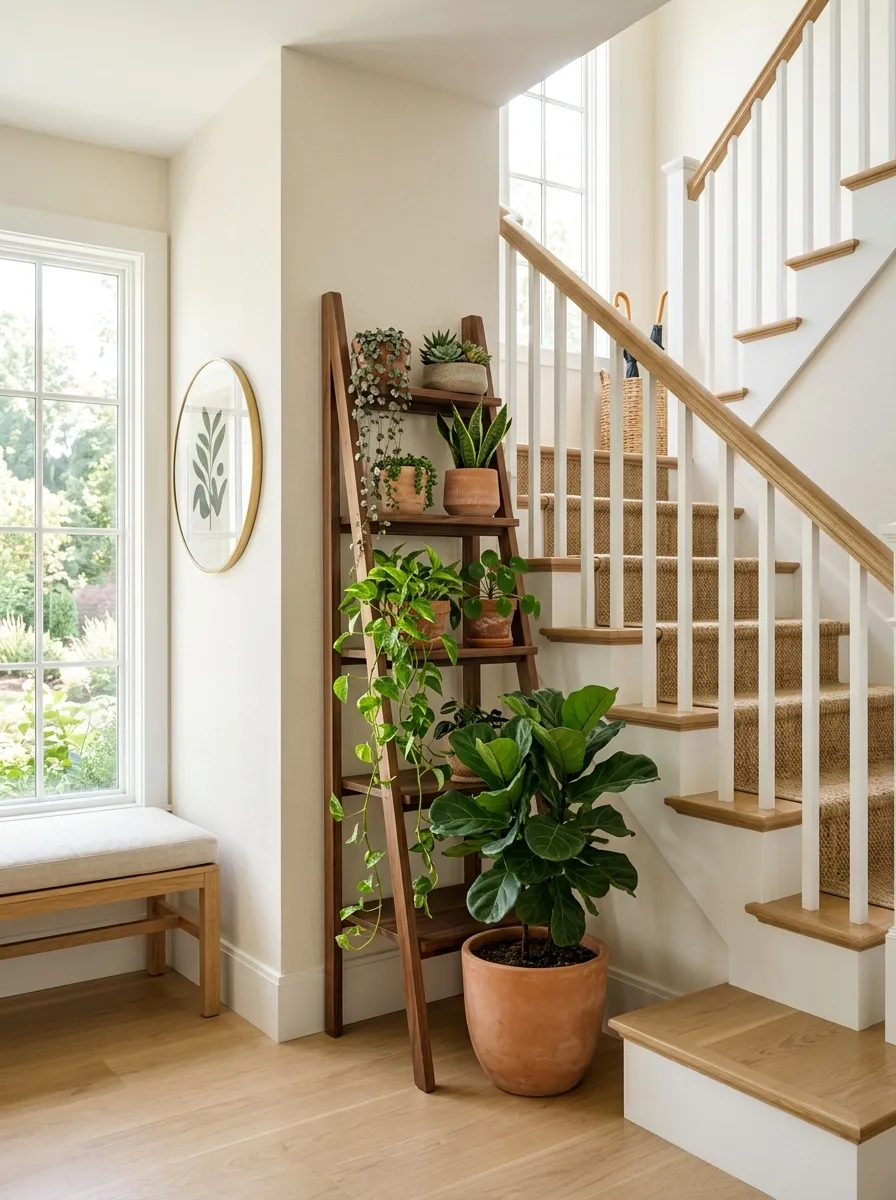
The bottom step usually has a few feet of dead floor space next to it. A tiered wooden ladder stand fits there without blocking foot traffic, and it gives you three or four height levels in one narrow footprint. Put your tallest, hardiest plant on the bottom tier and smaller trailing ones up top. It reads as one designed piece instead of a cluster of random pots.
Mount Floating Shelves On The Stairwell Wall
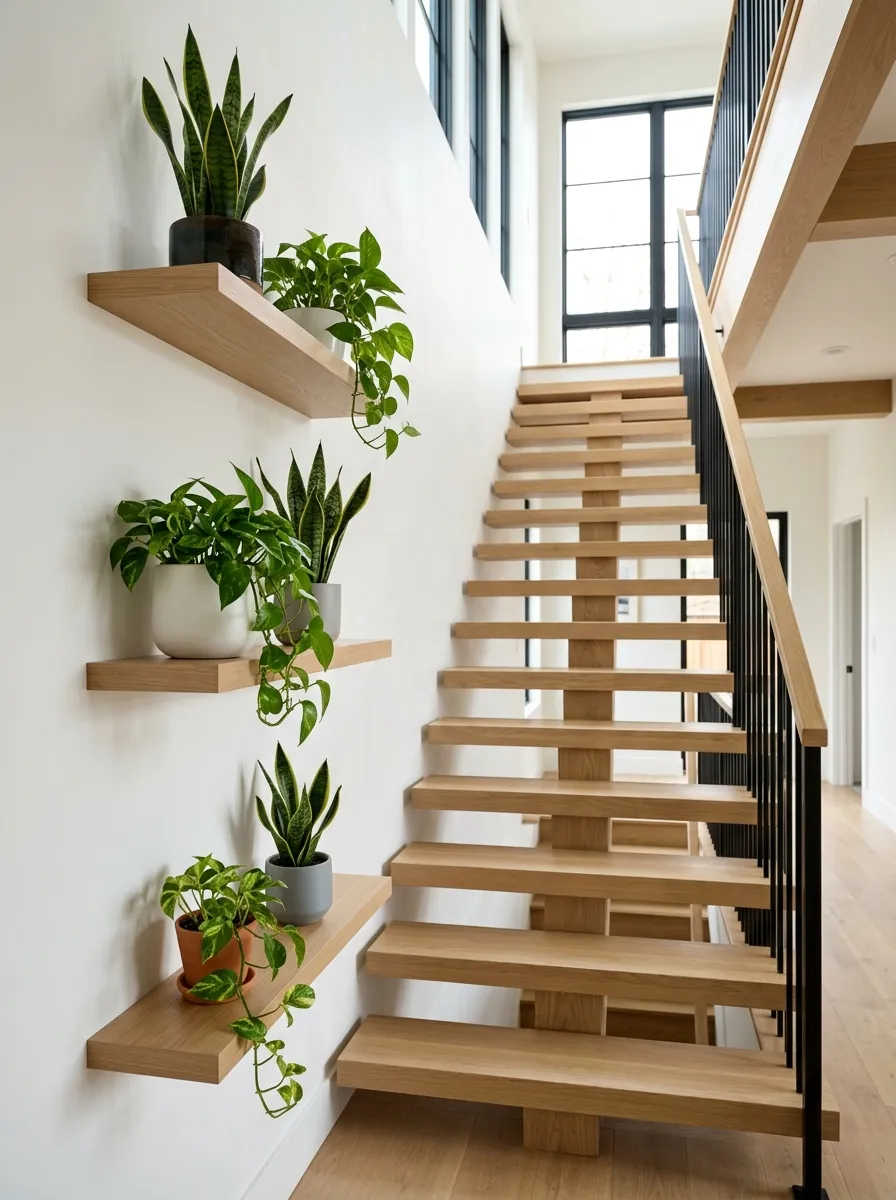
People skip stairwell walls because they assume there’s no room. There’s always room for a four-inch-deep floating shelf. Mount two or three at staggered heights along the ascent, not in a straight line. Keep the brackets hidden so the shelf looks like it’s holding the plant with nothing underneath. This works especially well on the wall opposite an open railing, where there’s blank space begging for something.
Install A Skylight-Facing Shelf At The Top Landing
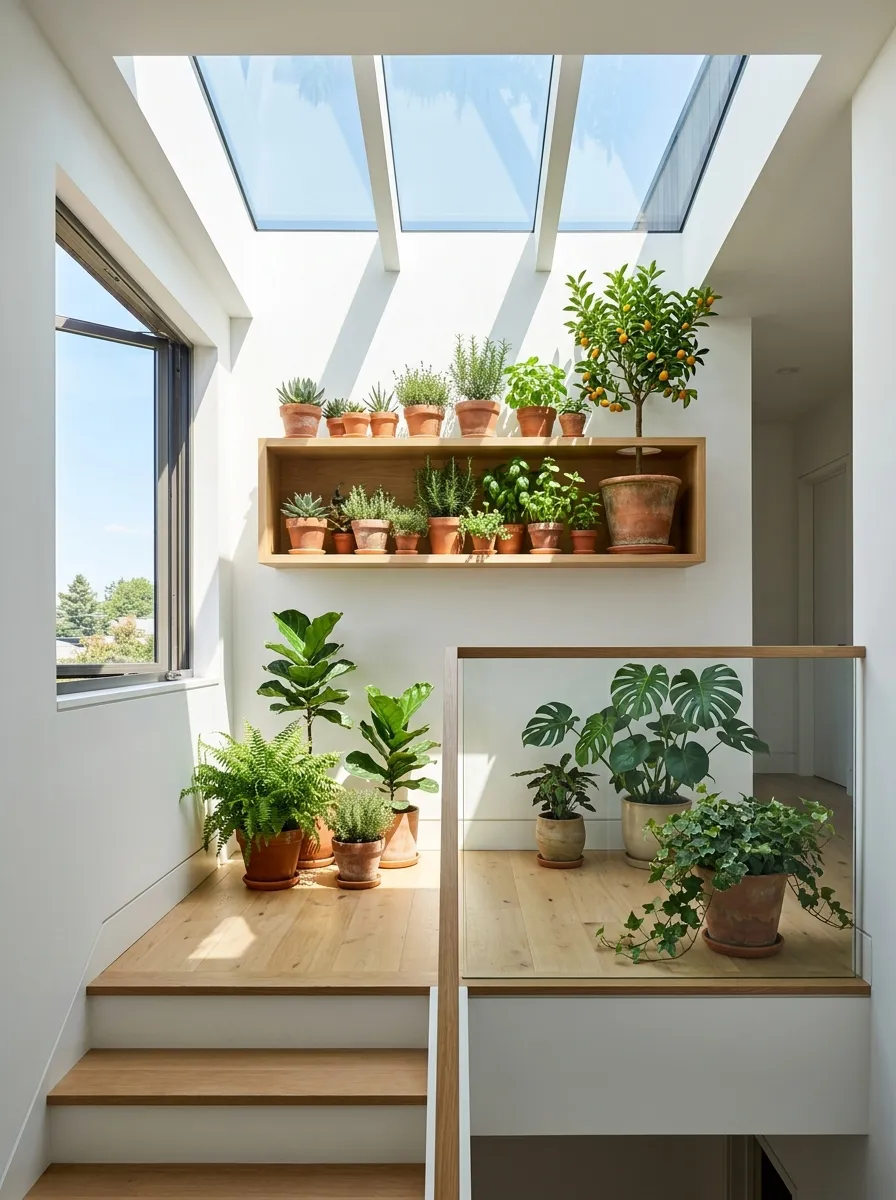
People assume the top landing is too warm for plants because heat rises. That’s only true if there’s no ventilation. A skylight above the top flight actually gives you some of the strongest light in the house, and if the landing has even a cracked window nearby, the heat stays manageable. Install a narrow shelf directly under that skylight and treat it like a mini greenhouse shelf, not an afterthought spot.
Group A Terrarium Cluster On The Mid-Landing
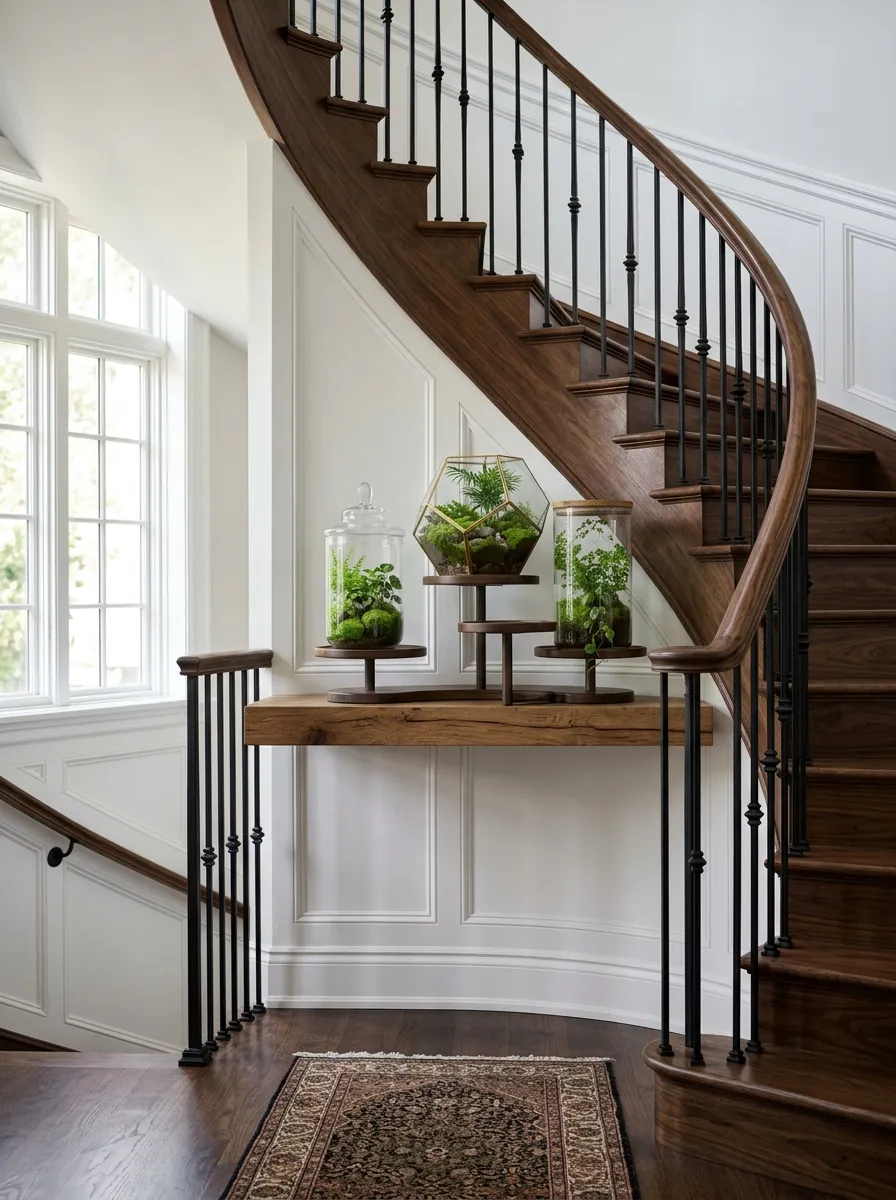
I’ve seen mid-landings sit completely bare in houses with gorgeous staircases, just because nobody thought to stop there. A cluster of three closed terrariums at different heights turns that pause point into a feature. They need almost nothing once sealed. Wipe condensation occasionally and rotate quarterly for even growth.
Wrap A Vine Around The Banister Post
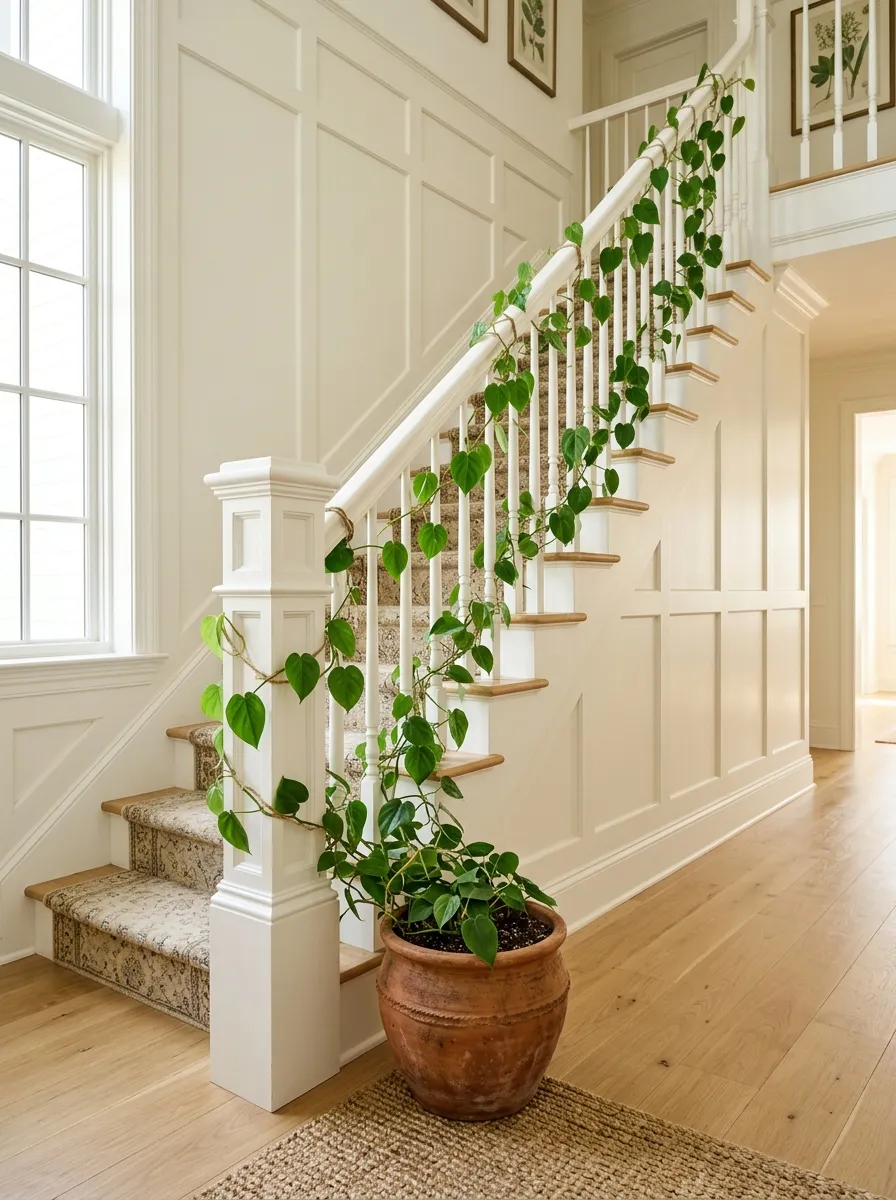
One rule here: use a plant that actually vines, not one that just trails. A pothos or philodendron will wrap loosely around a banister post and hold its shape without ties. Anchor the base pot at the bottom of the post, then guide the vine upward and loop it loosely every eight to ten inches. Skip anything with heavy leaves. The post can’t support real weight, only light climbers.
Use Stair Riser Planters Instead Of Decorative Tile
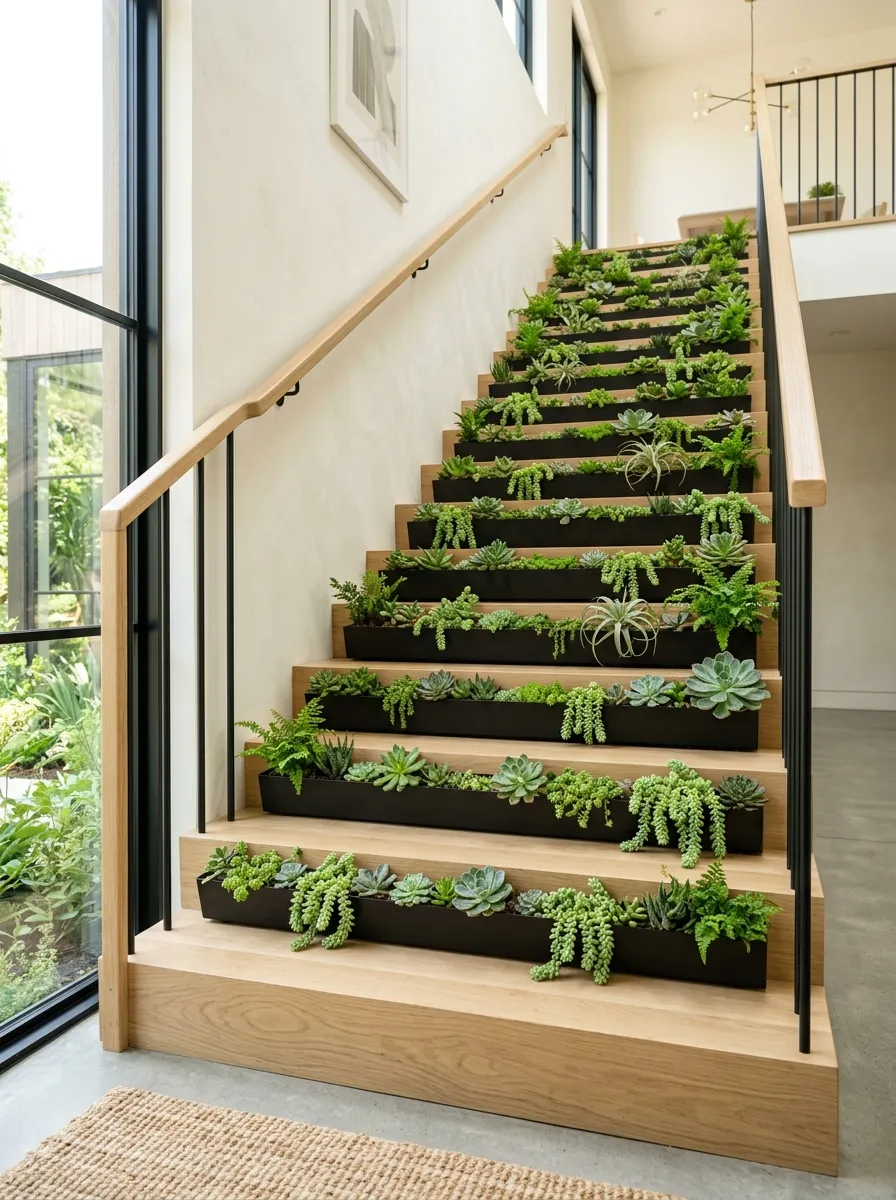
Everyone paints or tiles stair risers to add personality. Slim riser-mounted planter boxes do the same job while actually growing something. They clip onto the vertical face of each step, out of the walking path entirely, and hold small succulents or air plants that don’t need deep soil. Skip anything that needs regular watering here since access is awkward once installed.
Set A Potted Tree At The Base Of The Staircase
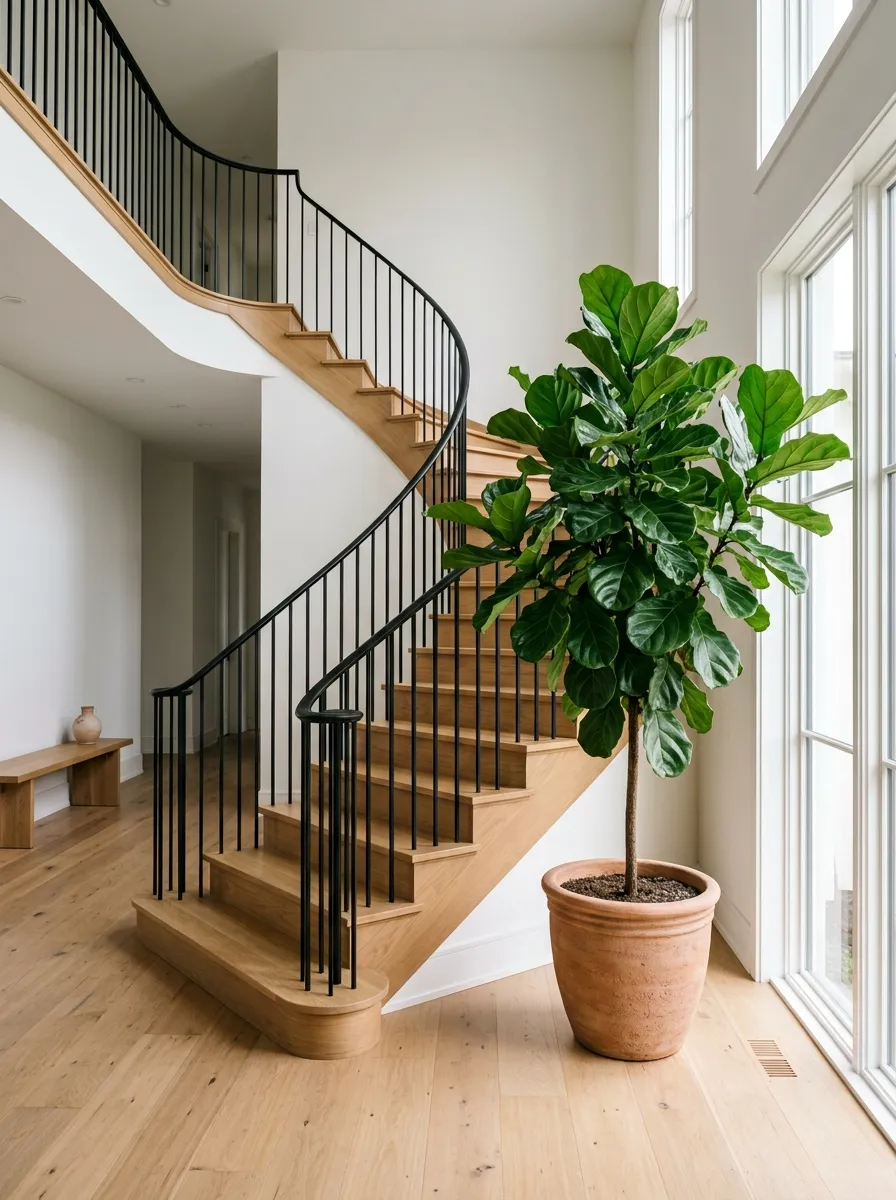
A fiddle leaf fig or a dracaena at the bottom of the stairs anchors the whole space the second you walk in. It needs floor room most other ideas on this list don’t require, so measure first. Give it at least two feet of clearance from the first step. Anything tighter and it becomes an obstacle instead of a feature.
Add A Slim LED Grow Light Under The Handrail
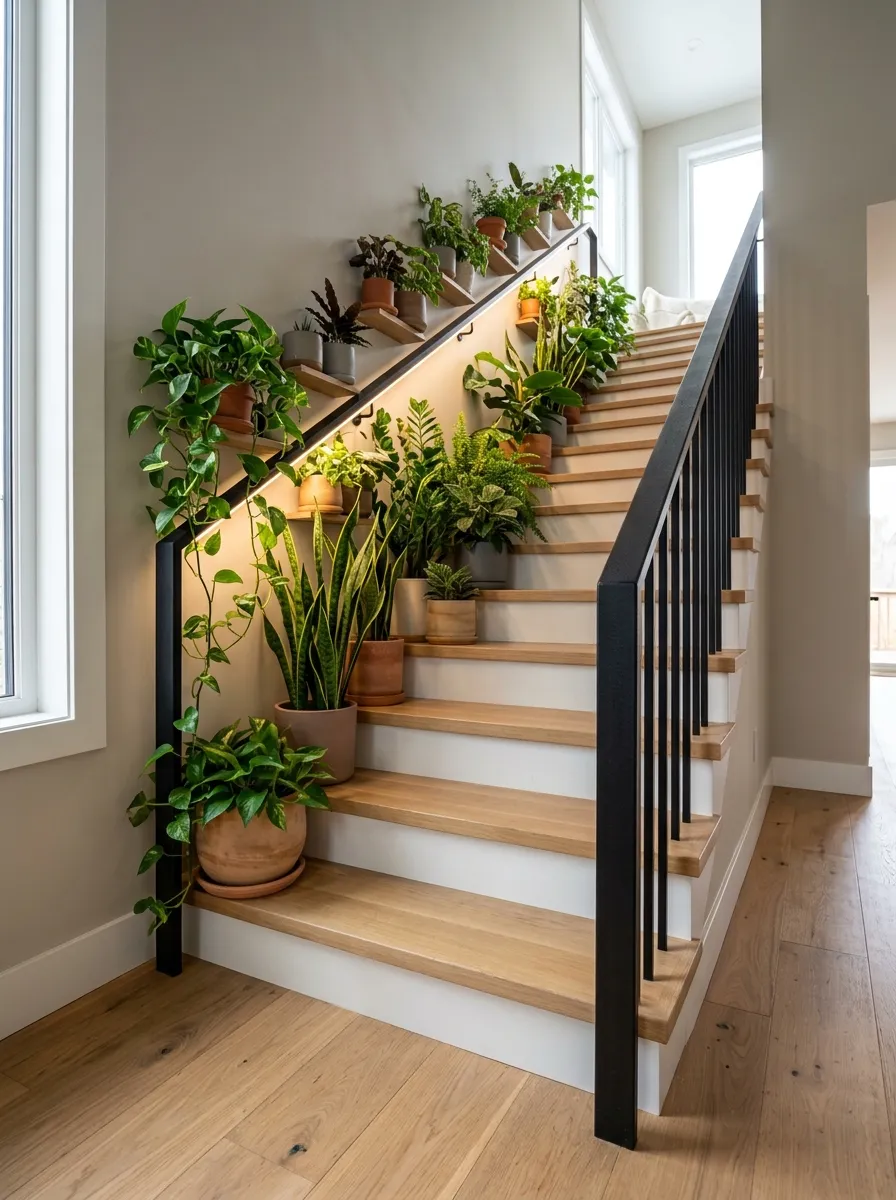
North-facing staircases rarely get enough natural light no matter what you place there. A slim LED grow strip mounted under the handrail solves that without an ugly floor lamp taking up space. Run it on a timer for eight hours a day. The difference between a struggling plant and a thriving one on a dark staircase almost always comes down to this one fix.
Choose A Color-Matched Pot System For Every Level
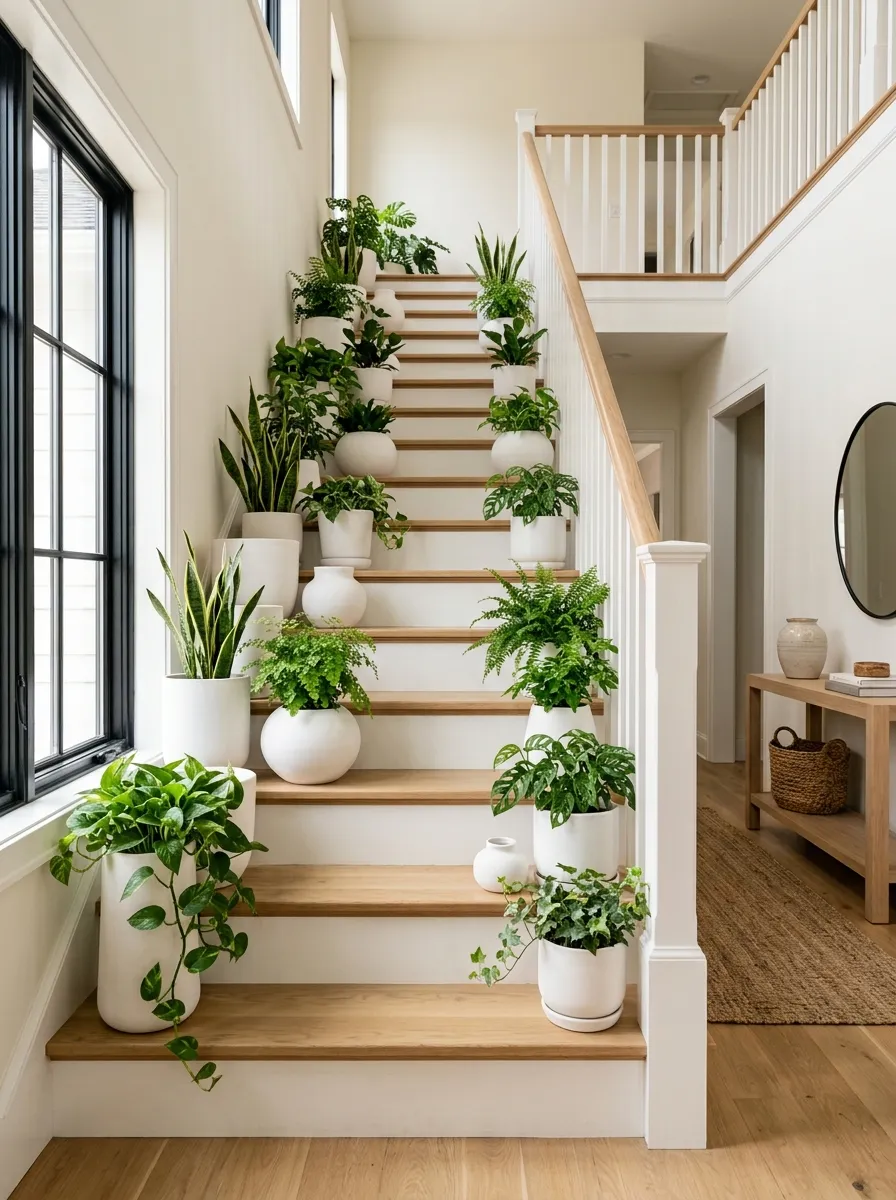
Random pots grabbed over the years is the fastest way to make a staircase garden look unplanned. Pick one material and one color family, then vary only the size and shape as you go up. Terracotta with a matte white glaze reads as intentional. A mix of ceramic, plastic, and woven baskets reads as leftovers.
Turn A Spiral Staircase Center Pole Into A Planter Column
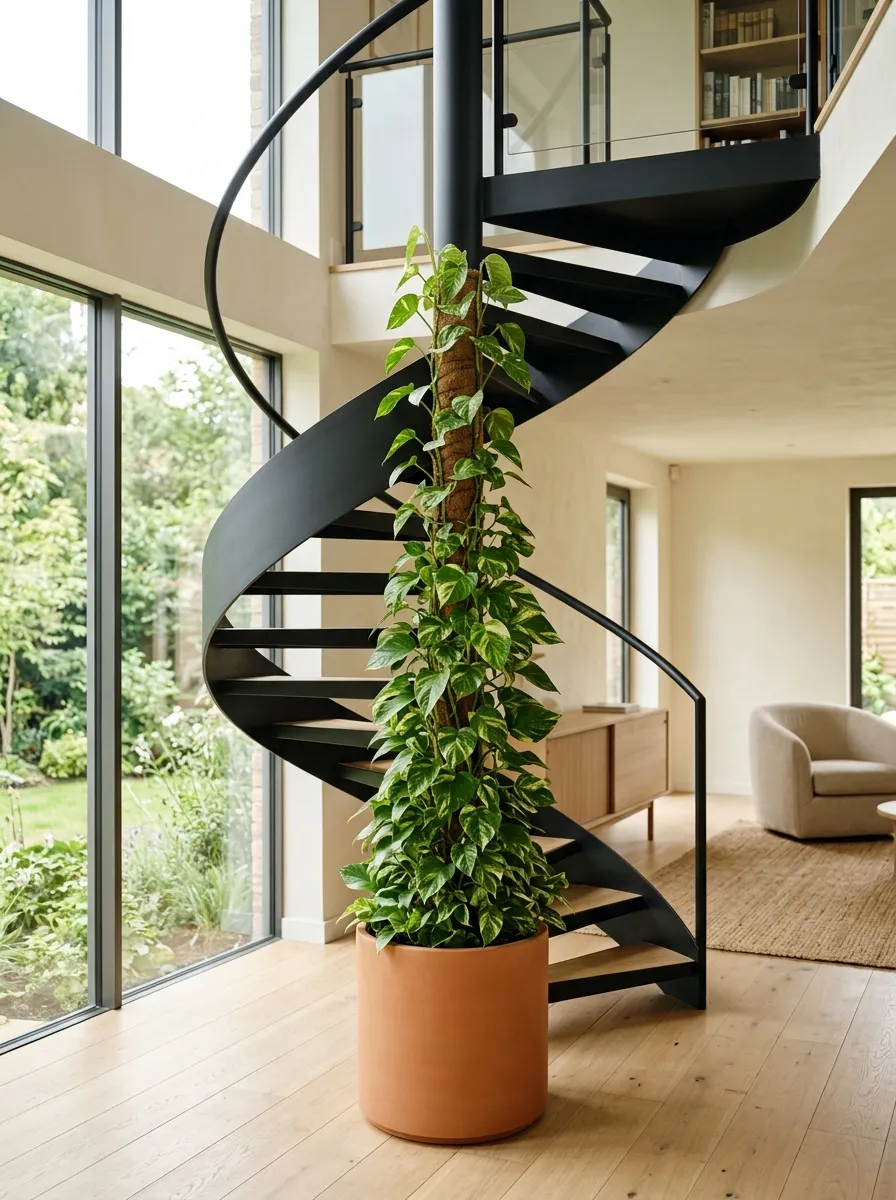
Spiral staircases have a center pole that’s usually just structural. Wrap a slim moss pole or a cylindrical planter tower around the base of it, and let a climbing plant like a pothos or philodendron hilo work its way up. This uses zero floor space beyond what the staircase already occupies. It’s one of the only ideas on this list built specifically for spiral layouts.
Line The Landing With A Glass Shelf Greenhouse
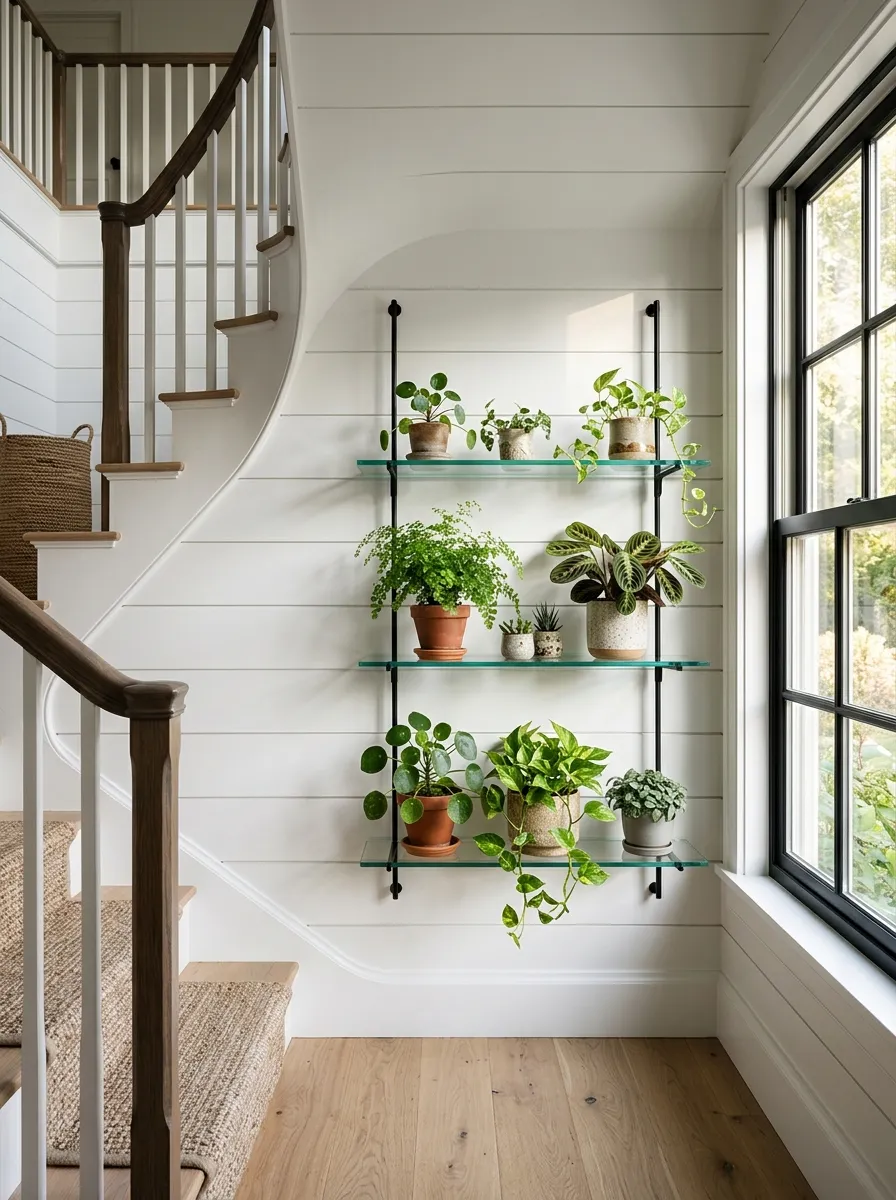
A narrow glass shelving unit set against the landing wall works like a mini greenhouse without any actual construction. Stack three shelves close enough that humidity builds slightly between them. This setup suits moisture-loving plants that struggle in regular room air, like ferns or nerve plants. Keep it away from direct heating vents so the humidity doesn’t just evaporate immediately.
Install A Drip Tray System To Protect Wood Steps
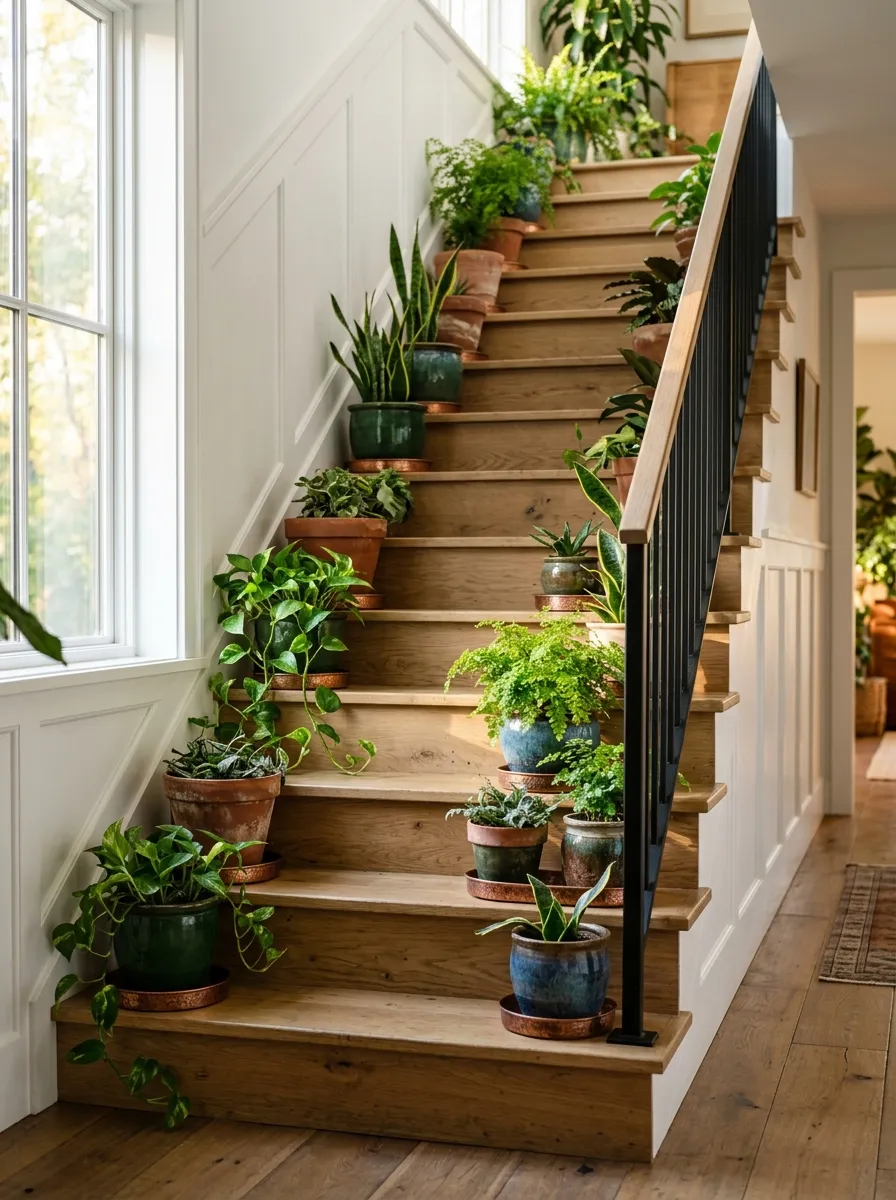
Wood steps and water don’t mix, and one overlooked drip can warp a stair tread permanently. Every pot on or near a wooden step needs a proper drip tray underneath, not just a saucer balanced on top. Check trays weekly during regular watering weeks. This is the detail people skip and regret most.
Pick Low Light Plants For The Bottom Flight
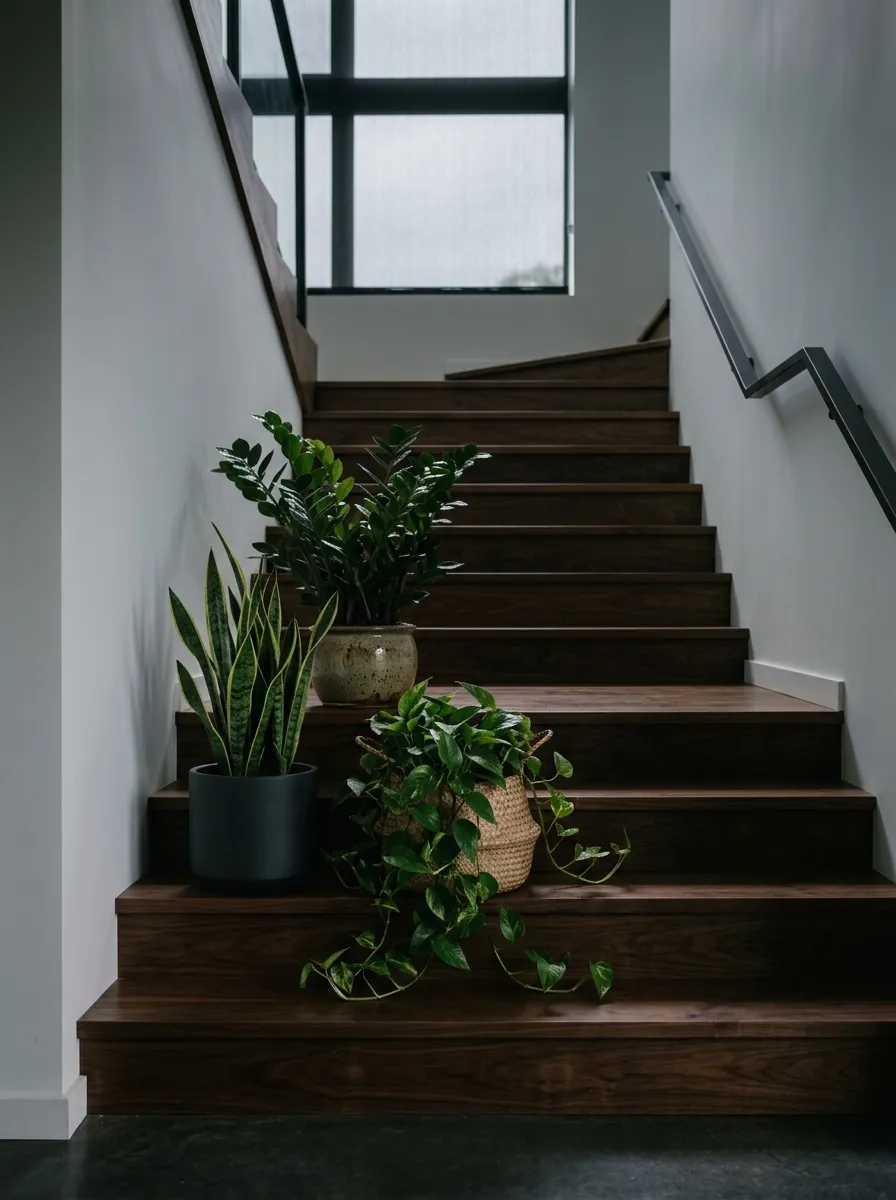
Bottom flights near an entryway usually sit farthest from any window, and that’s fine as long as you pick the right plants instead of fighting the space. ZZ plants, snake plants, and pothos tolerate low light better than almost anything else you’d put on a staircase. Skip flowering plants here entirely. They need more light than a bottom flight can give.
Reserve The Top Flight For Sun Loving Varieties
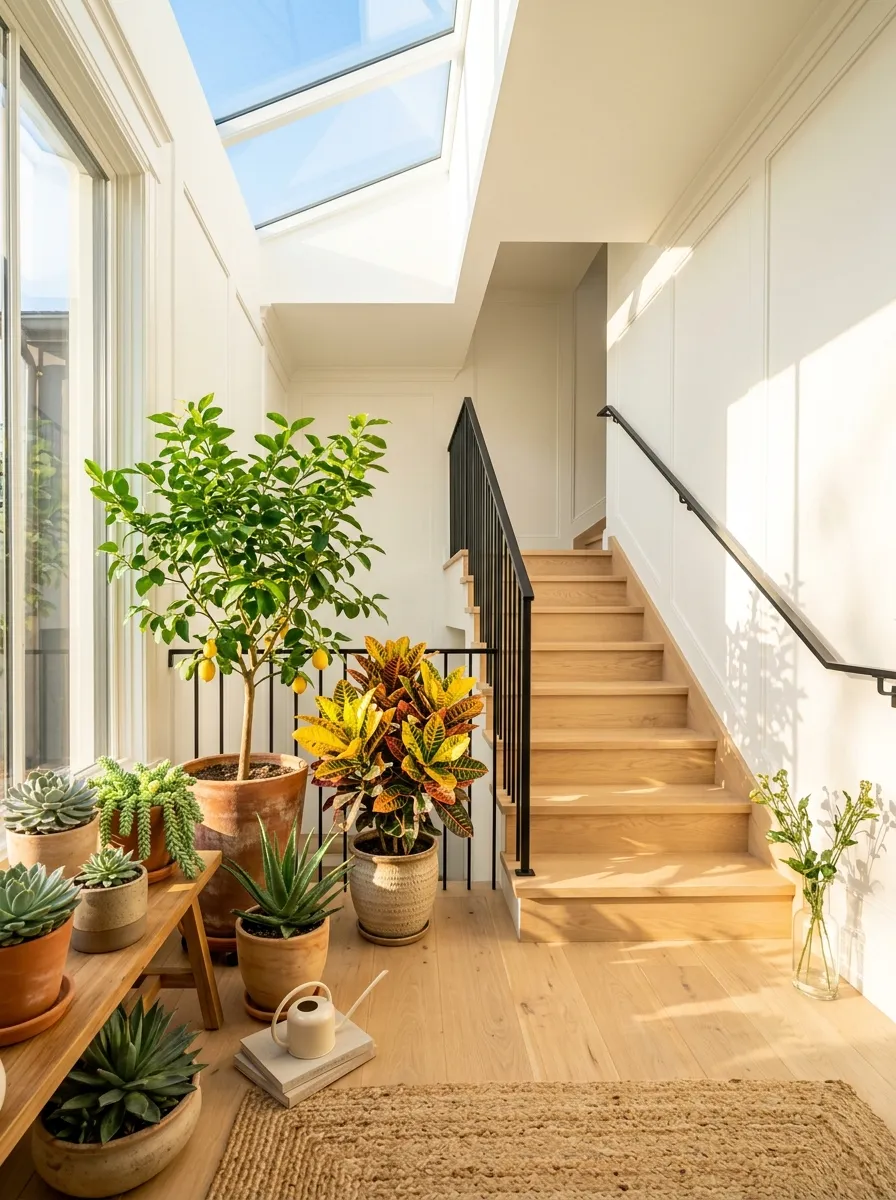
Heat rises, and so does light near an upper landing window. The top flight is usually the brightest, warmest stretch of the whole staircase, which makes it the wrong spot for shade-tolerant plants and the right spot for anything that craves direct sun. Succulents, small citrus, and croton all do well here.
Add A Single Statement Plant On The Widest Step
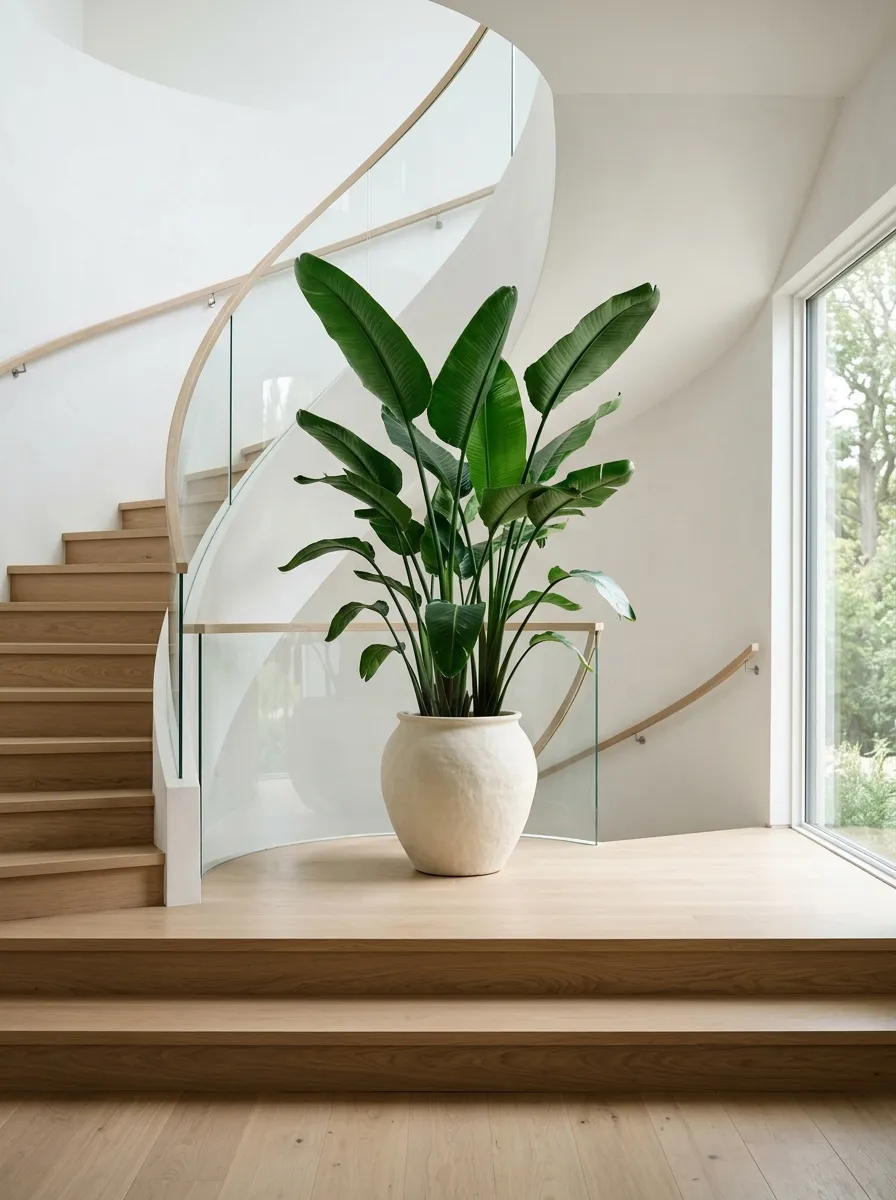
Not every step needs a plant, and that’s the point people miss. Find the one widest step or landing on your staircase and give it a single dramatic plant, like a bird of paradise or a large monstera, with nothing else competing nearby. Restraint reads as confidence. A staircase covered top to bottom in plants actually looks less intentional than one with a single bold statement piece.
Build A Corner Herb Shelf On The Landing
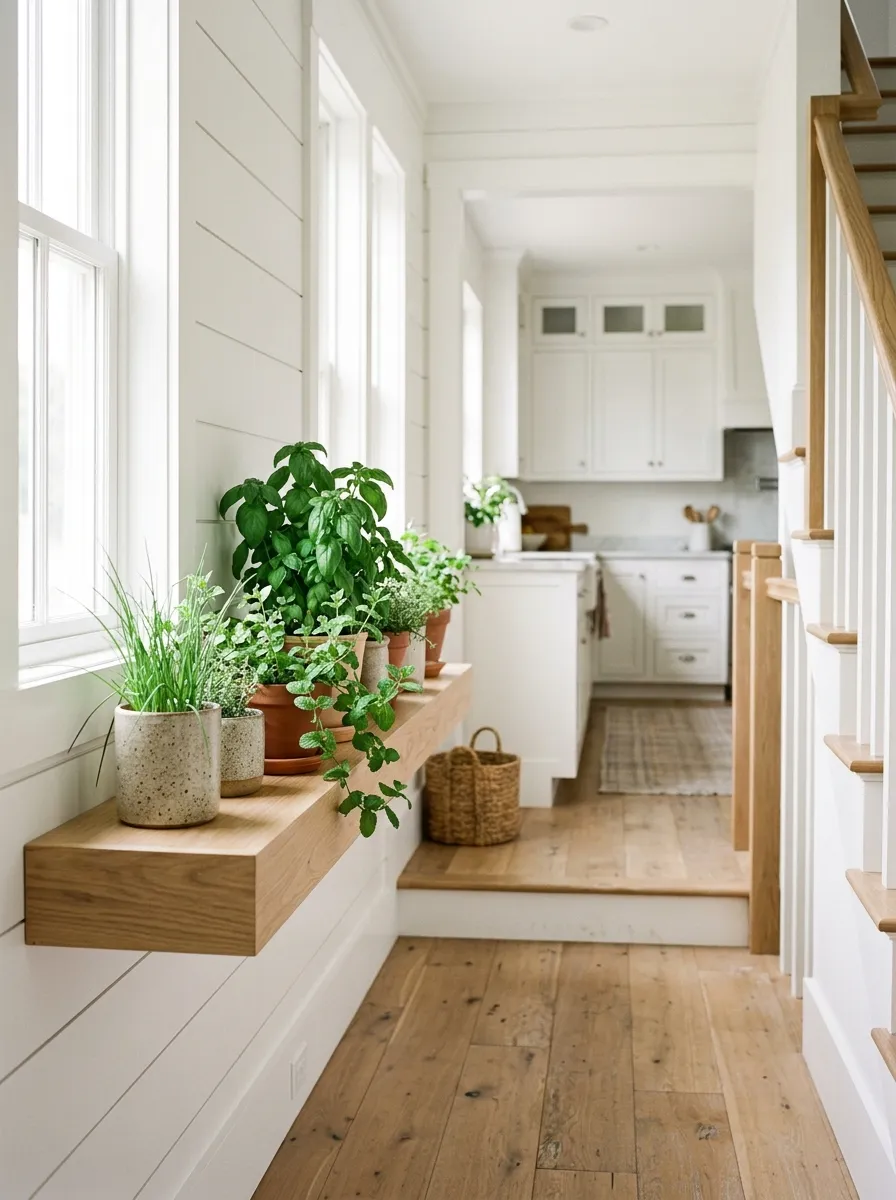
A landing near a kitchen-adjacent staircase is a natural spot for a compact herb shelf. Basil, mint, and chives all do fine with a few hours of indirect light and a quick trim each week. This only works if the landing gets real light, so check before committing. A dark landing will grow leggy, flavorless herbs no matter how often you water them.
Use Command Hooks For A No-Drill Hanging Garden
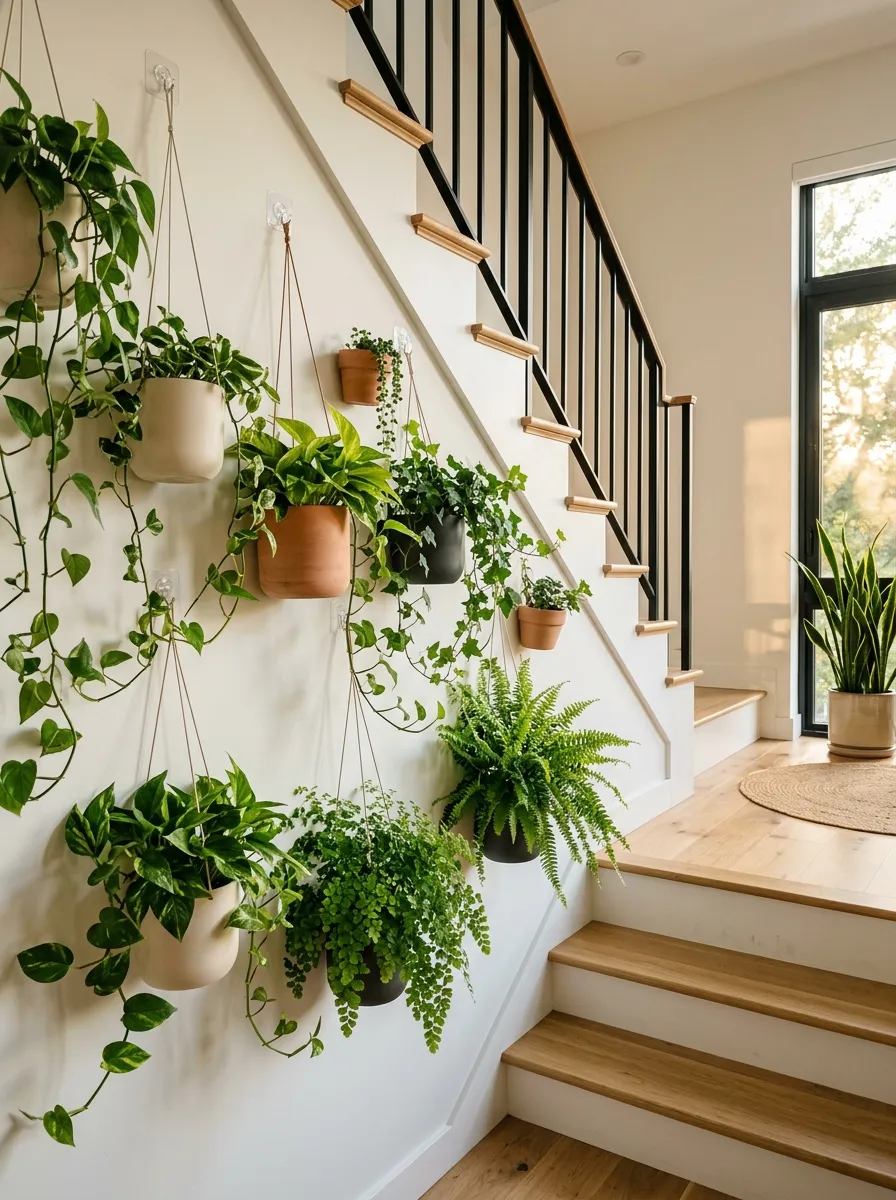
Renters get shut out of half these ideas because they involve drilling into a railing or wall. Heavy-duty command hooks rated for at least five pounds solve that completely for hanging planters. Test the hook’s weight rating against the pot and soil combined, not just the empty pot. Wet soil after watering adds real weight fast.
Add A Small Bench With Potted Plants On The Landing
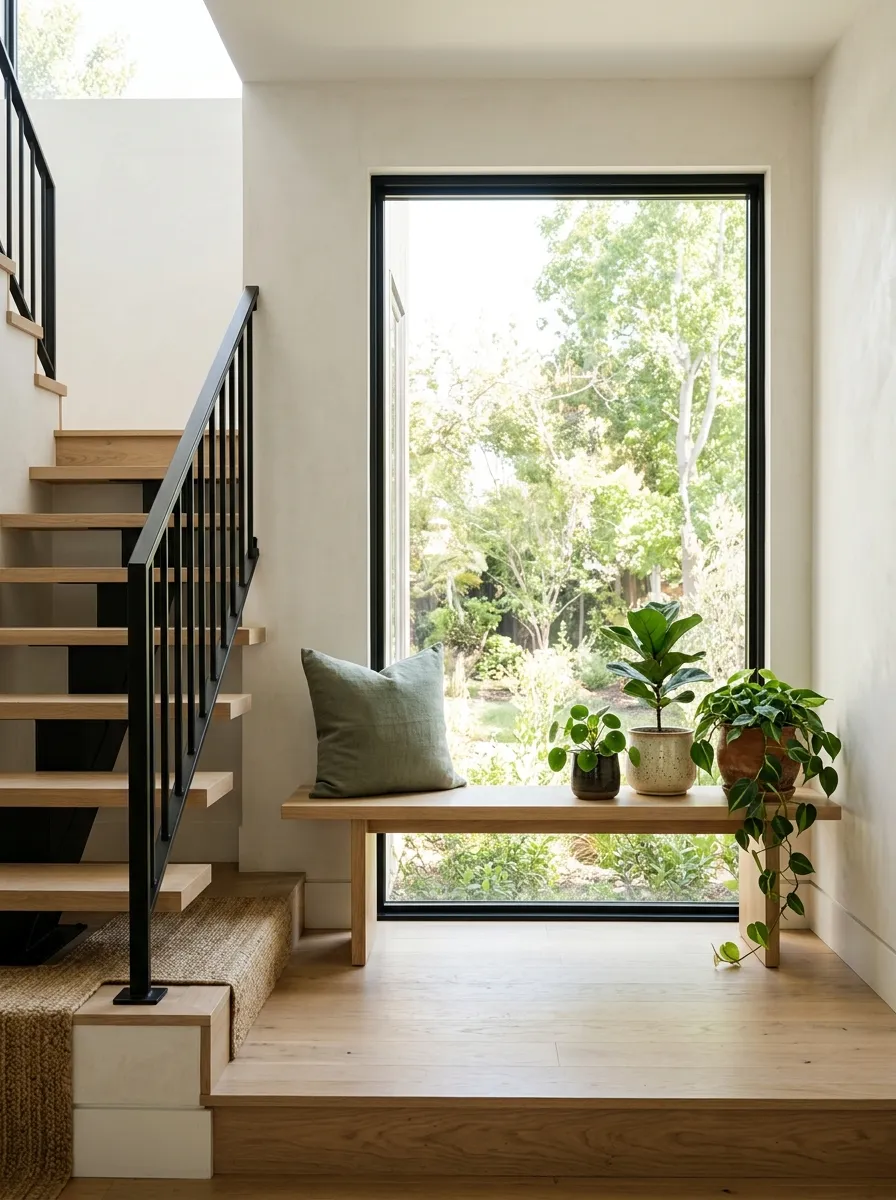
A wide enough landing can fit a narrow bench, and once it’s there, it becomes the obvious spot for a small grouping of pots at seated height. This works especially well on landings with a window seat feel already. Keep the plant count to three or four so the bench still functions as a place to sit, not just a shelf.
Finish With A Cohesive Plant Stand Style Across Every Level
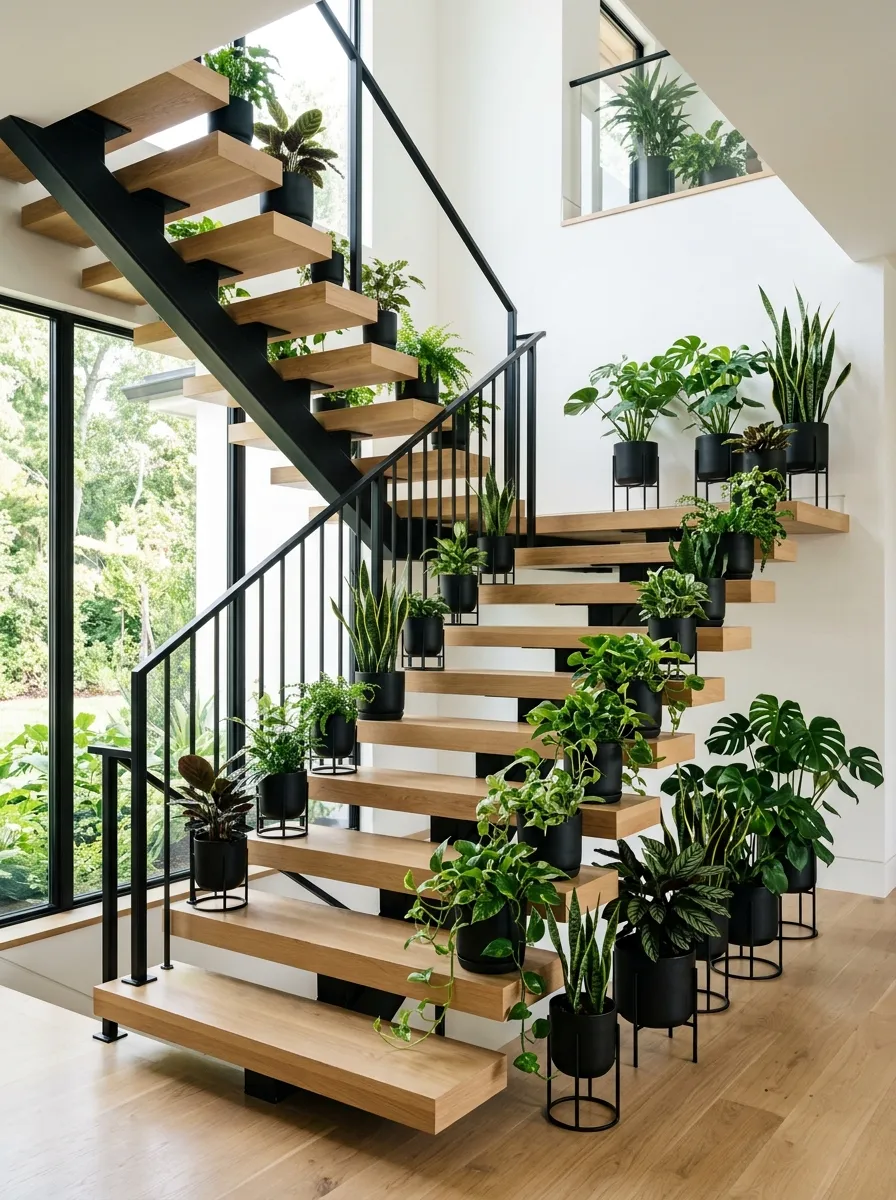
Twenty-four ideas mean nothing if the stands, shelves, and hooks all clash in style. Before you finalize anything, pick one material finish, matte black, natural wood, or brushed brass, and use it for every visible stand or bracket on the staircase. This single decision does more to make the whole thing look designed than any individual plant choice on this list.
Conclusion
A staircase doesn’t have to be dead space between floors. Once you map the light, pick a consistent pot system, and place plants with actual intention instead of random placement, it becomes one of the most distinct spots in the house. Indoor staircase gardens work because they use vertical space nobody else is competing for.
You don’t need all 25 ideas. Pick a handful that fit your light, your layout, and your staircase style, and build from there. Save this list for the next time you’re standing on your stairs wondering what to do with all that empty wall and railing space.