
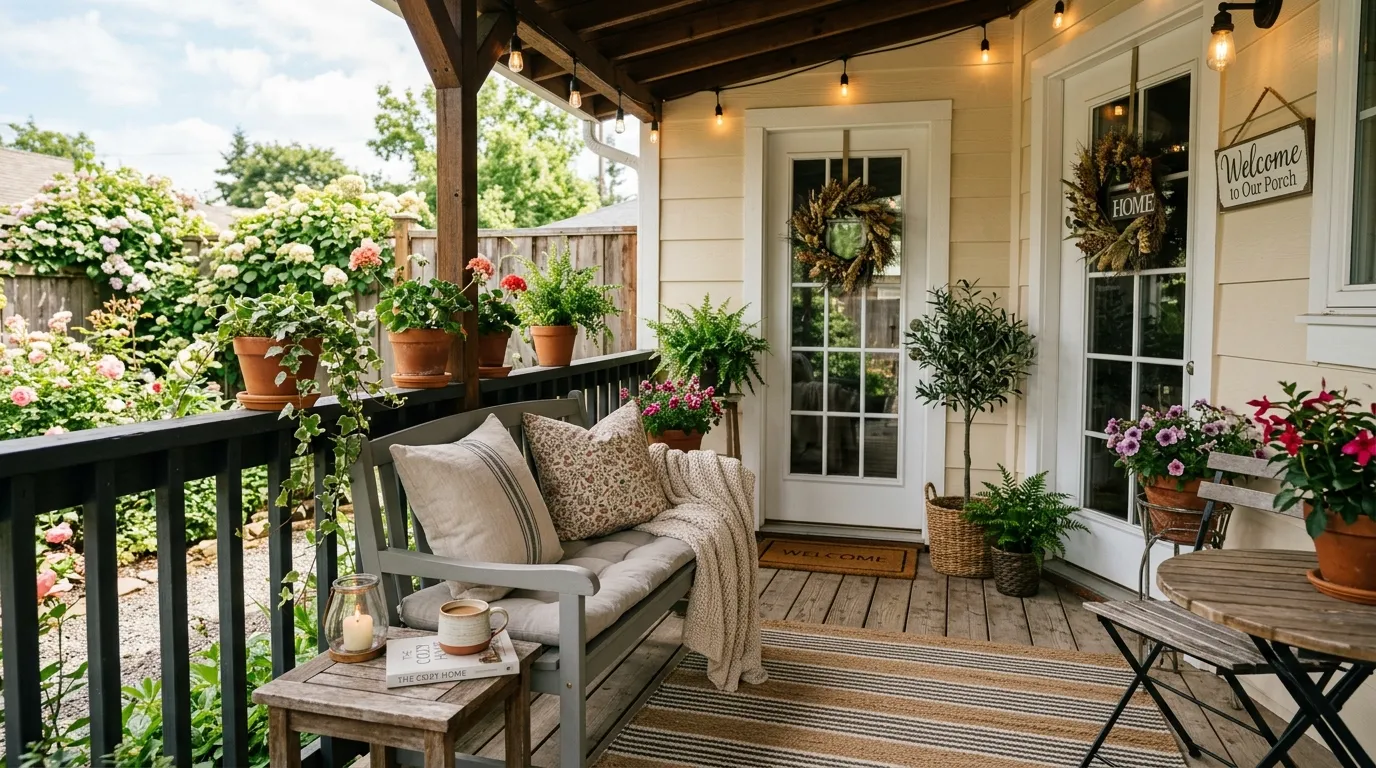
You have a back porch. You also have a folding chair from 2009 and a dying plant you keep meaning to water. These two facts are related.
The porch is one of the most underused spaces in residential design. It sits right there — connected to your home, covered from the elements, already framed as its own room — and most people treat it like a mudroom without walls. It deserves better. You deserve better.
The problem isn’t budget. It isn’t square footage. The problem is that most people approach a porch the same way they approach a garage: functionally, without intention. They buy a chair, then another chair, then something from a clearance sale, and wonder why it never feels like anywhere in particular.
These twenty spaces prove what a porch can be when someone actually commits to a vision. Here’s how to steal each one.
Why Your Back Porch Feels Like an Afterthought
You Treated Lighting as an Accessory, Not Architecture
Lighting is the single most transformative decision you can make on a porch. It determines whether the space feels like a room or a storage area after dark. Most people hang a single overhead fixture, call it done, and lose the porch entirely once the sun sets.
The spaces that feel genuinely special are the ones where light is layered. String lights pulled across the ceiling at irregular tension points. A pendant or lantern that drops from the center. Candles at table height. Each source operates at a different elevation, and together they create depth that no single fixture can.
String lights, specifically, are doing more work than people give them credit for. Run them in parallel lines across exposed beams. Run them in a grid. Run them loose and slightly drooping from hooks mounted at the perimeter — the sag is the point. Taut string lights look institutional. Relaxed string lights look intentional.
You Bought Outdoor Furniture Instead of Making a Room
The outdoor furniture section of every big-box store is a trap. Everything matches. Everything is weather-proof. Everything is beige or charcoal and sized in a way that suggests it was designed for no porch in particular.
Good porch design borrows from interior design logic. You need a rug that defines the seating area. You need furniture at different heights — not just chairs around a table, but a sofa-level piece, a side table, and something lower for a coffee surface. You need texture contrast: wicker against solid wood, linen against jute, metal against rattan.
The porch that feels like a room has a center of gravity. Everything in it points somewhere — toward the fireplace, toward the view, toward each other. The porch that feels like a furniture showroom has no center. It’s just stuff that fits.
You Forgot That the Ceiling Is Half the Room
Look up. That’s half your room. On most porches, it’s painted white and ignored. On the best porches, it’s doing real work.
Tongue-and-groove wood planking on a porch ceiling changes the entire character of the space. It adds warmth, visual texture, and a sense of enclosure that makes the porch feel intentional. Paint it the same color as the trim for a classic wraparound effect. Go natural cedar for warmth. Paint it a soft blue-grey — called “haint blue” in Southern porch tradition — for something that photographs beautifully and reads as sky from below.
Beadboard is the budget version and works nearly as well in most styles. Whatever you choose, treat the ceiling as a design surface, not a lid.
Back Porch Ideas
Edison Deck Dinner Party
String vintage Edison-style bulbs across your open deck using a simple hook-and-cable system. The cable attaches to the house fascia on one side and a freestanding post or existing tree on the other. Use black coated outdoor-rated cable — not the clear plastic kind — and space bulbs every 18 to 24 inches. Go for the warm 2200K filament bulbs rather than LED replicas. The quality of light is categorically different.
Anchor the dining area with a natural fiber rug — jute or sisal — large enough that all chair legs sit on it when pulled out. The table itself should be tile-topped or weather-sealed wood, not glass. Glass tables on decks collect leaves, show every watermark, and blow over in wind. Center a lantern-style hurricane with a pillar candle at the table rather than flowers. Add a single potted shrub at the corner of the railing and resist the urge to do more.
Urban Vertical Garden Porch
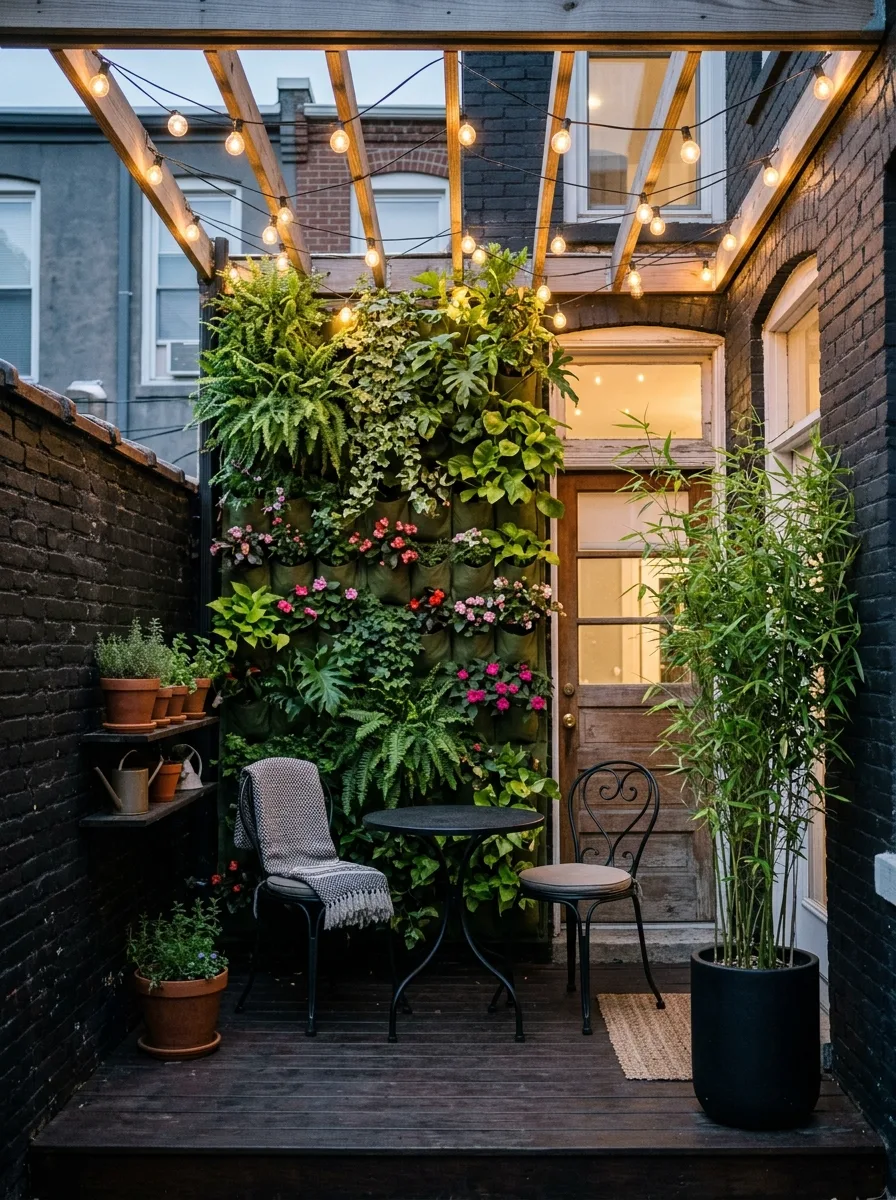
When the footprint is small, go vertical. Install a pocket-style living wall panel — choose a felt or recycled fabric version that holds moisture — on the back wall or fence of a narrow porch or urban terrace. Fill it with ferns, impatiens, pothos, and creeping jenny. Water deeply once or twice weekly. Fertilize monthly from spring through fall.
Add a tall clumping bamboo in a large dark pot beside the door for additional height and privacy. Install a simple wooden pergola frame — two posts and two crossbeams — over the porch if there is no existing overhead structure, and run string lights across the beams.
Two iron bistro chairs and a small round iron table. No cushions — the vertical garden is the softness. A wooden shelf on the brick wall for terracotta herb pots. A single woven throw on one chair. The entire space is about the contrast between the dark urban brick and the aggressive living green, and every decision should serve that tension.
Boho Candlelit Greenhouse Porch
Turn a covered back porch into a plant-filled, candlelit room by treating every surface as a display opportunity. Mount lattice or rope-netting along the back wall to hang macramé plant holders at varying lengths. Suspend additional plants from the pergola beams alongside your string lights — the lights and the foliage should share the same plane, tangled together at the ceiling level.
Use a raw wooden farm table as your dining surface. Metal folding bistro chairs in a vintage style — not the modern stackable kind — work better here than upholstered pieces. The texture contrast is the point. Layer a black-and-white geometric rug underneath at a slight angle.
For ambient light, cluster pillar candles on a low wooden tray at the center of the table and add additional groupings on the floor near the seating area. Battery-operated candles work outdoors in wind. Real ones are worth the trouble in calm weather.
Blue Stripe Wicker Screened Porch
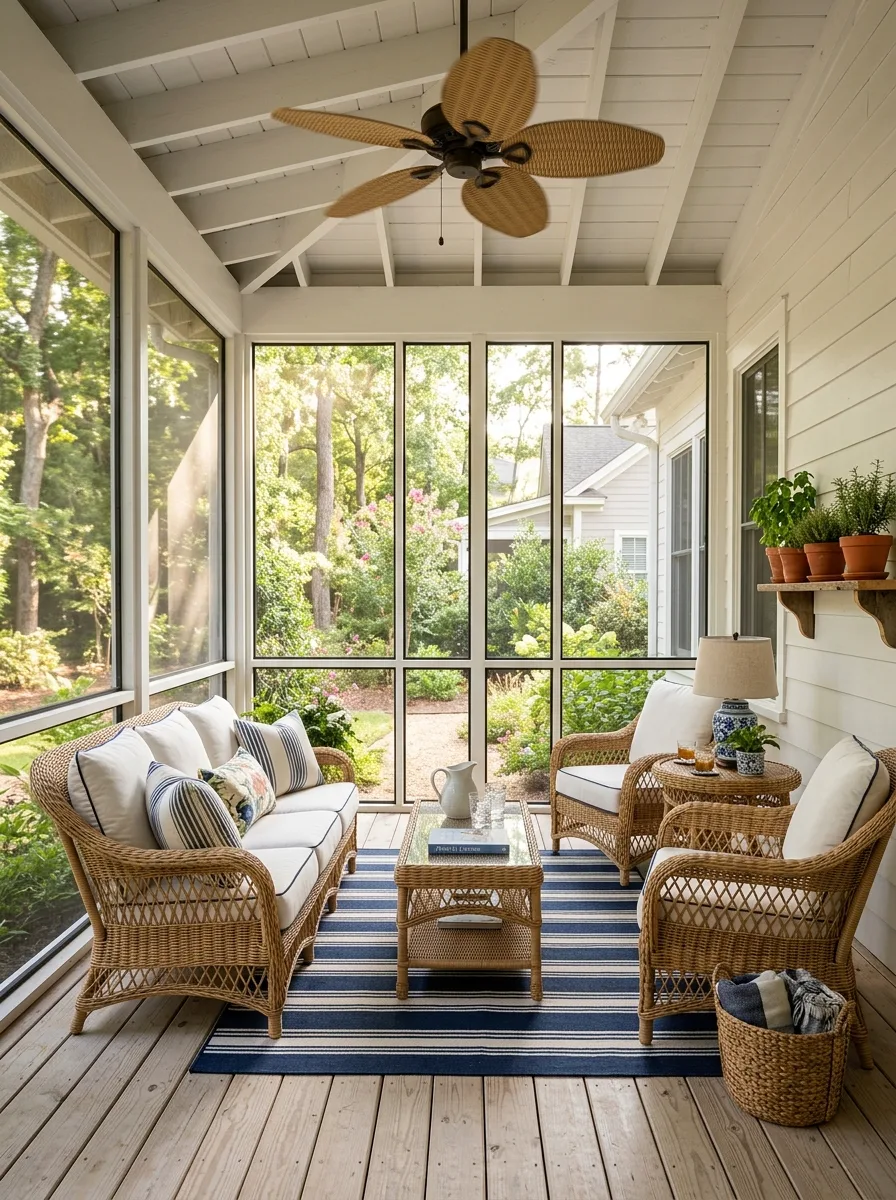
A screened porch should be furnished as a room, not a patio. Start with wicker — full wicker, not resin wicker — in a natural honey tone. Choose a sofa, two armchairs, and an additional accent chair. Cushion everything in white with navy blue trim or piping.
Lay a navy and cream ticking-stripe rug large enough to ground the entire furniture arrangement. The rug defines the room the same way it would indoors. Add a small glass-topped wicker coffee table at the center and a wicker side table beside one chair.
Place terracotta pots on a wooden bracket shelf attached to the house wall — herbs work well here because the screened environment limits pests. Install a rattan-bladed ceiling fan. The humidity on a screened porch warrants it.
Beadboard Lantern Farmhouse Porch
On a traditional front or back porch with a beadboard ceiling, the design decision is restraint. Paint the ceiling, the columns, and the railings all the same white. Use a hardwood decking stain in a warm honey tone for the floor. The contrast between white structure and warm wood is the entire palette.
Hang a large-scale black steel pendant lantern at the center — not a flush mount, not a fan-light combo, but a proper pendant that drops 18 to 24 inches. Add a matching wall-mounted lantern beside the door at eye height. Two fixtures, matched, at different scales. That’s the lighting plan.
Use teak or eucalyptus cane-back dining chairs around a simple teak table. Place a ceramic vessel with dried or fresh stems at the center — nothing elaborate. Flank the porch steps with identical hydrangea plantings in large matching containers. Symmetry is the logic of this porch, and every detail should honor it.
Farmhouse Swing and Rockers
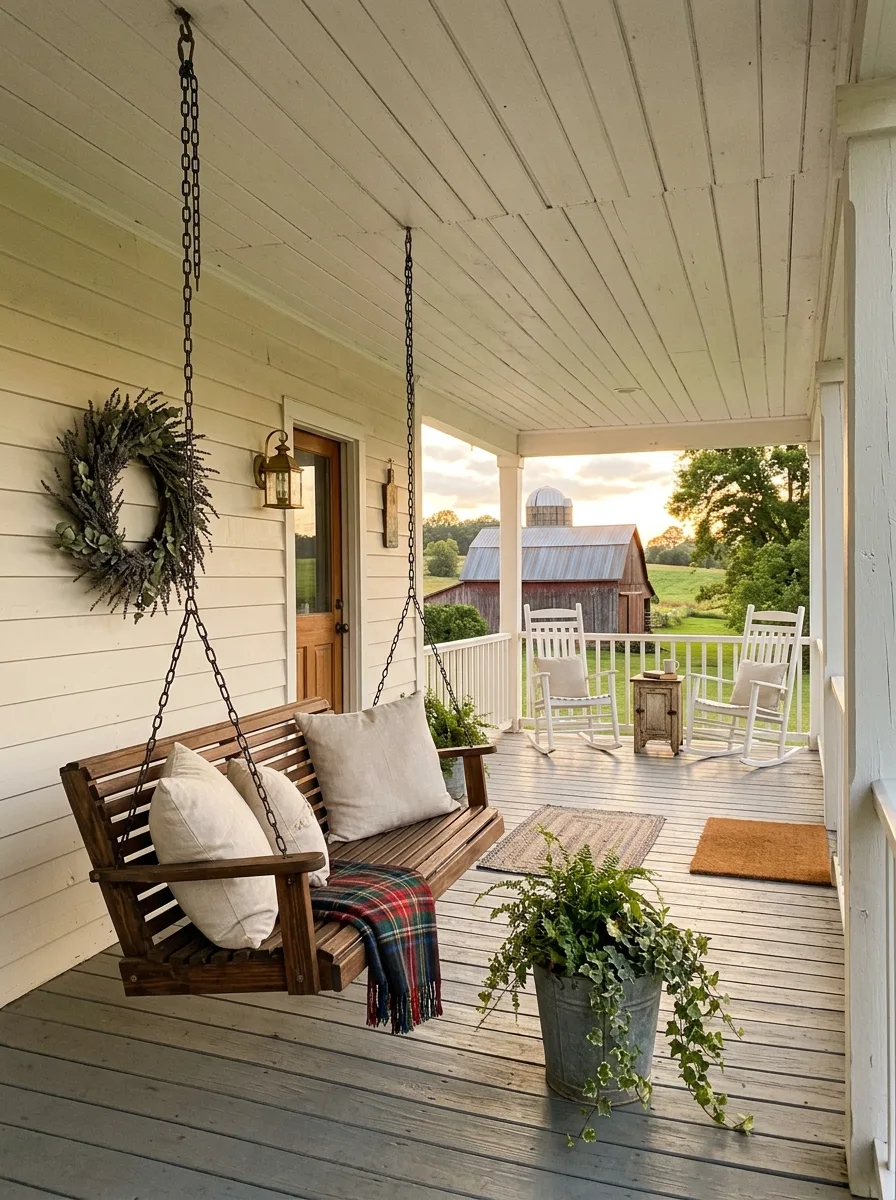
Hang a wooden porch swing from the ceiling joists using heavy-gauge black chain — not rope, not decorative cord, but proper steel chain that communicates weight and permanence. The swing should be solid wood, stained rather than painted, and wide enough for two adults to sit with distance between them.
Load it with linen cushions and a plaid wool throw draped casually over one arm. Place a galvanized metal bucket planter near the base of the swing, filled with trailing ivy or ferns. Add a braided jute mat in front of the door.
Pair the swing with two traditional white rocking chairs further down the porch, positioned to face the view with a small wooden accent table between them. The table should hold exactly one mug and one book. This porch does not need more than that.
Brick Fireplace Living Room
Build or source a wood-burning or gas outdoor fireplace in full-scale red brick, floor-to-ceiling, on a covered porch with a cedar tongue-and-groove ceiling and exposed white structural beams. This is not a weekend project — it is a renovation. Hire a mason. The result is a porch that functions as a genuine room twelve months a year.
Furnish it entirely in upholstered pieces with all-weather cushions in a cream or light grey performance fabric. Choose iron-framed chairs — not wicker, not plastic — for structural contrast against the brick. Add a round concrete or plaster cocktail table at sofa height. Resist matching furniture sets. Pull pieces that read as a room, not as a patio collection.
Dress the mantel simply: trailing greenery in place of garland, a woven basket for firewood storage beside the hearth, a pair of throw pillows in a botanical print on each seat. Keep the television mount clean — no media console, no visible cables.
Climbing Rose Stone Fireplace
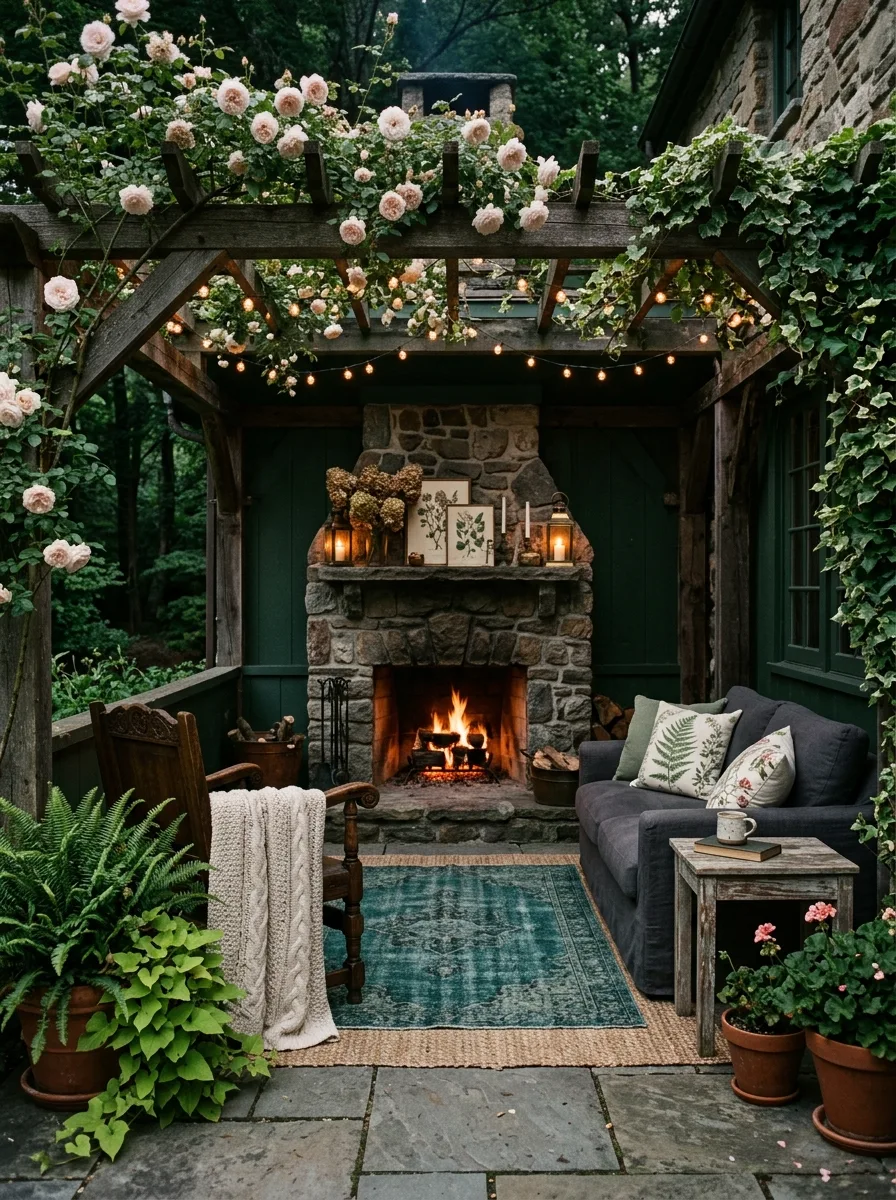
This is a space that requires years, not weeks. Build or restore a rough stone fireplace at the back of a pergola structure with heavy timber framing. Train climbing roses — choose a repeat-blooming variety in blush or white — up and over the pergola frame, understanding that the full effect takes two to three growing seasons.
Run string lights beneath the roses, attached to the timber frame. The lights at night and the roses during the day occupy the same visual layer — the ceiling becomes a living installation.
Furnish with a dark charcoal linen outdoor sofa, a vintage wooden armchair with a knit throw, and a distressed wood side table. Use a Turkish-style overdyed rug in teal or slate blue on stone pavers. The mantel gets botanically-illustrated framed prints, lanterns, and nothing else. Resist the impulse to over-style it.
Wicker Sectional Fire Pit Porch
Install a covered porch with a white-painted tongue-and-groove ceiling and a ceiling fan in a dark bronze finish. Choose a woven all-weather sectional with cream-colored cushions large enough to take up three-quarters of the floor area. This is not the place for small furniture.
Place a rectangular propane fire pit table at the center of the sectional arrangement rather than a coffee table. The fire pit becomes the focal point, the heat source, and the reason to stay outside past 9pm. Mount the television on the house wall at a height that allows viewing from the sofa — not too high, not centered on the wall, but positioned so seated guests can see it without craning.
Dress the surface behind the sectional with a dresser or sideboard repurposed for outdoor use — painted white, sealed against moisture — and style it with a table lamp on an outdoor-rated cord, a few plants, and a tray. The unexpected indoor piece in an outdoor context reads as intentional rather than accidental.
Modern Tropical White Porch
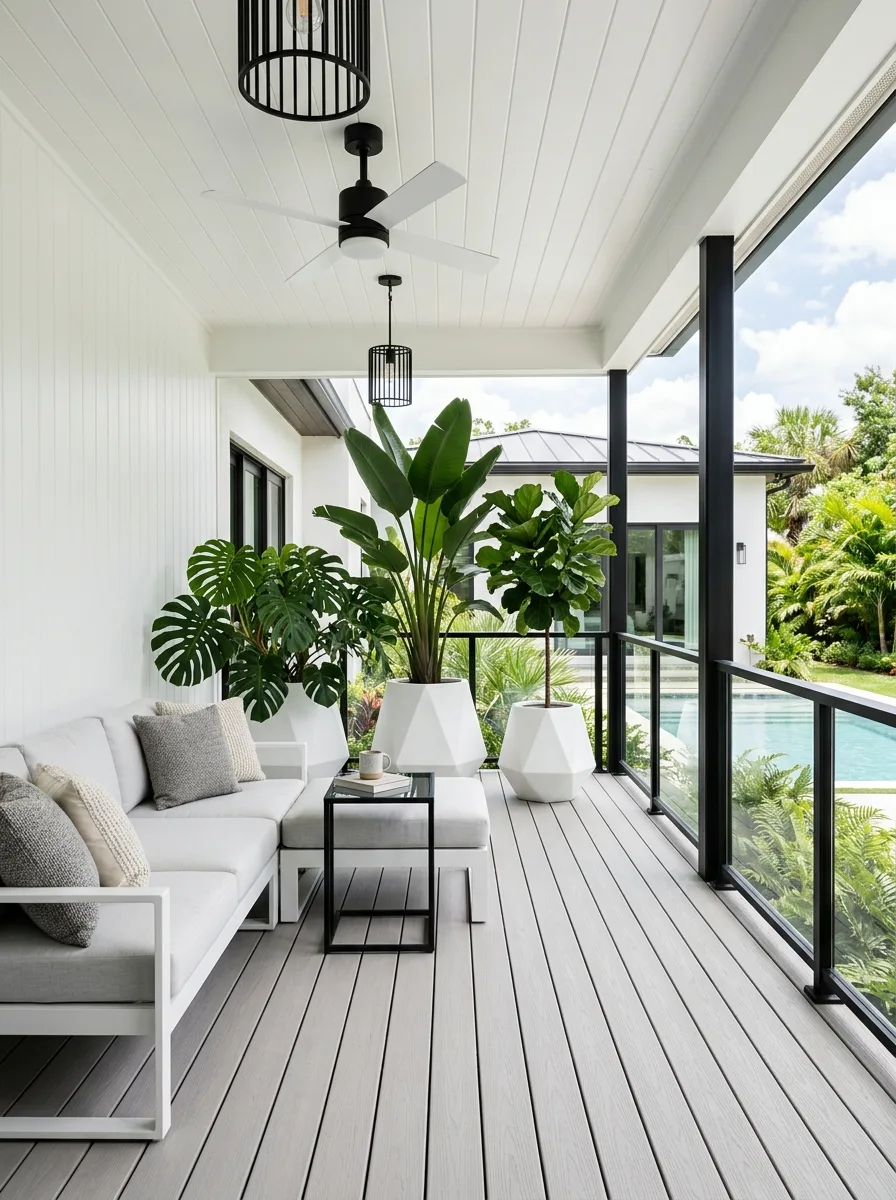
Start with a grey composite deck and white vertical shiplap or board-and-batten on every enclosed wall surface. Install black powder-coated steel railing — cable or glass infill — along the open perimeter. The contrast between white and black structural elements is the entire design system. Every other decision should reinforce it.
Choose white powder-coated aluminum outdoor furniture with light grey all-weather cushions. White geometric planters — tall faceted concrete pots — in two or three sizes hold a monstera, a bird of paradise, and a fiddle-leaf fig. Outdoors, these species need bright light but dislike direct afternoon sun. Position them along the open railing where they get morning light.
Add a black cage pendant or fan for the ceiling. That is the only ornamental element needed. The plants do the rest.
Swedish Farmhouse Bench Porch
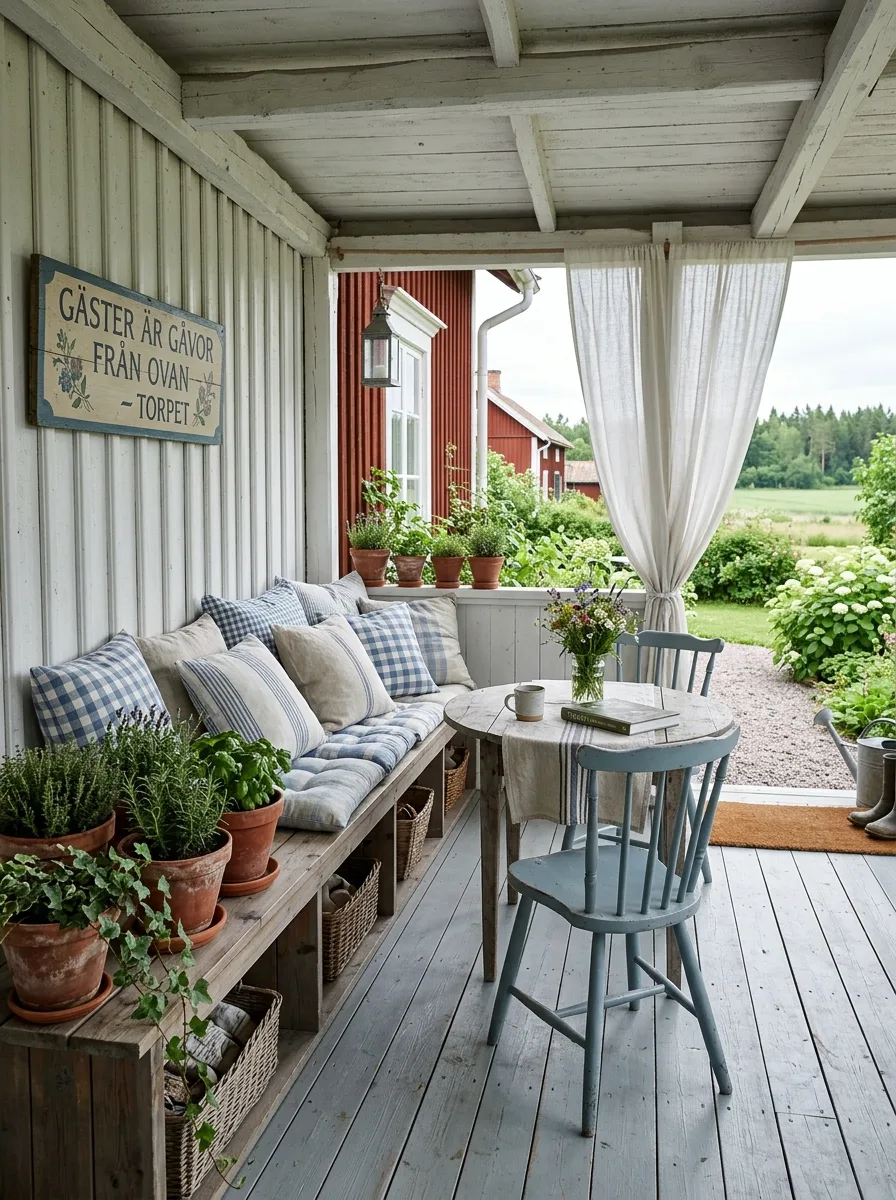
Build or source a simple wooden storage bench — slatted top, open lower shelf for baskets — and run it the full length of one porch wall. Paint it the same faded grey-green as the porch structure, so it reads as built-in rather than placed.
Cushion the bench seat in a simple mattress-style pad in natural linen, and pile it with gingham and ticking-stripe pillows in blue and grey. Stack wicker baskets on the lower shelf for firewood, blankets, or gardening tools.
Pair the bench with a round bistro table and two painted wood chairs in a soft dusty blue. The chairs should be painted, not stained — painted furniture reads differently on a porch than in a kitchen and both things are true. Hang a sheer linen curtain on a tension rod at the open side for privacy and wind control.
Place terracotta pots of growing herbs along the bench and windowsill. Keep wildflowers — not arranged, just gathered — in a simple vase on the table. The entire ethos of this porch is tended abundance without effort.
Cedar Boho Hammock Deck
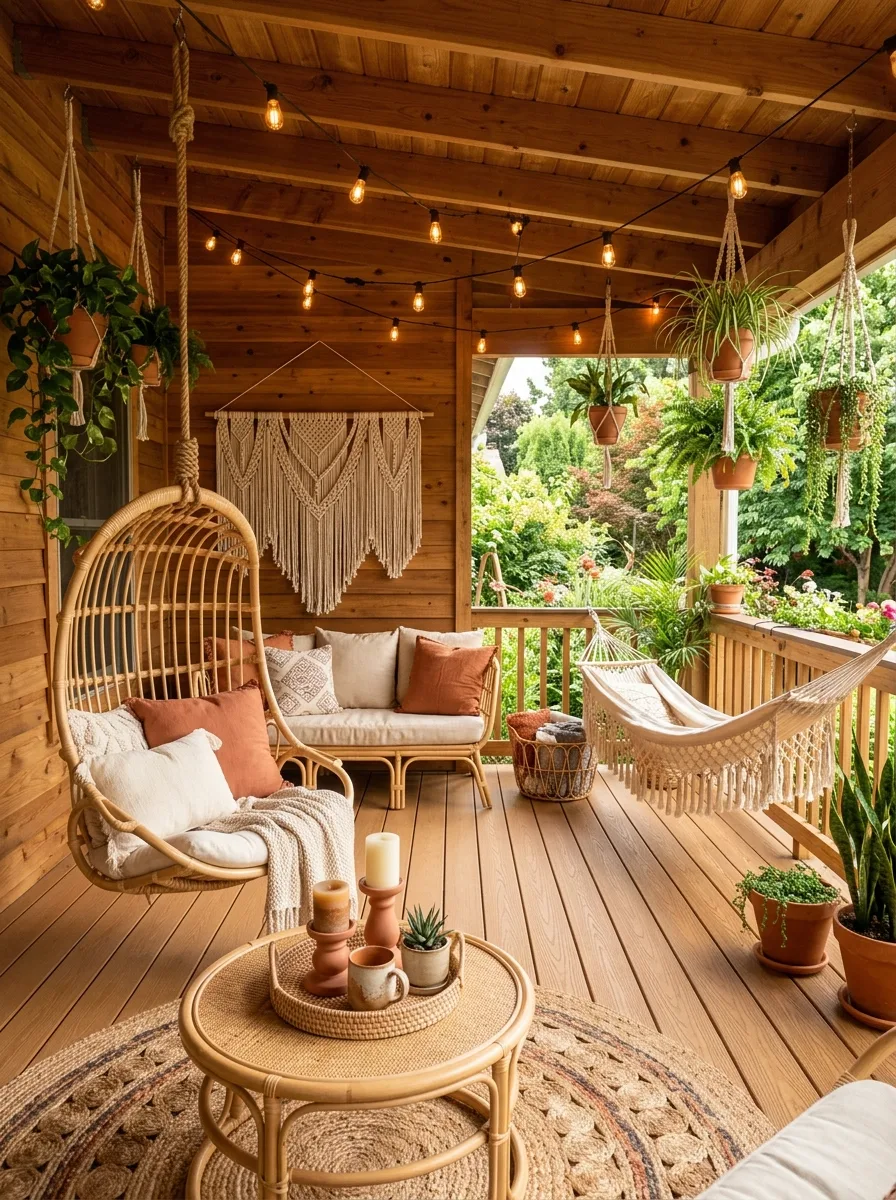
Clad the walls and ceiling of a covered back porch entirely in cedar boards, left natural and unfinished. Cedar weathers to a silver-grey and smells remarkable. This is not a rental-friendly choice. It is a commitment.
Hang a large macramé wall hanging from a ceiling hook on the back wall — choose a substantial one, at least 24 inches wide, with long fringe. This is your art. Everything else should support it.
Suspend a rattan egg chair from a ceiling beam using a properly weight-rated hanging kit. A rattan hammock between posts at the porch’s open edge. A small round rattan coffee table on a jute rug at the center. Terracotta pots with trailing plants in macramé hangers at varying heights.
String Edison bulbs across the beam grid. Keep the color palette in warm earth tones: terracotta, rust, cream, natural wood. This porch has one mood and it commits to it entirely.
Navy Adirondack Coastal Porch
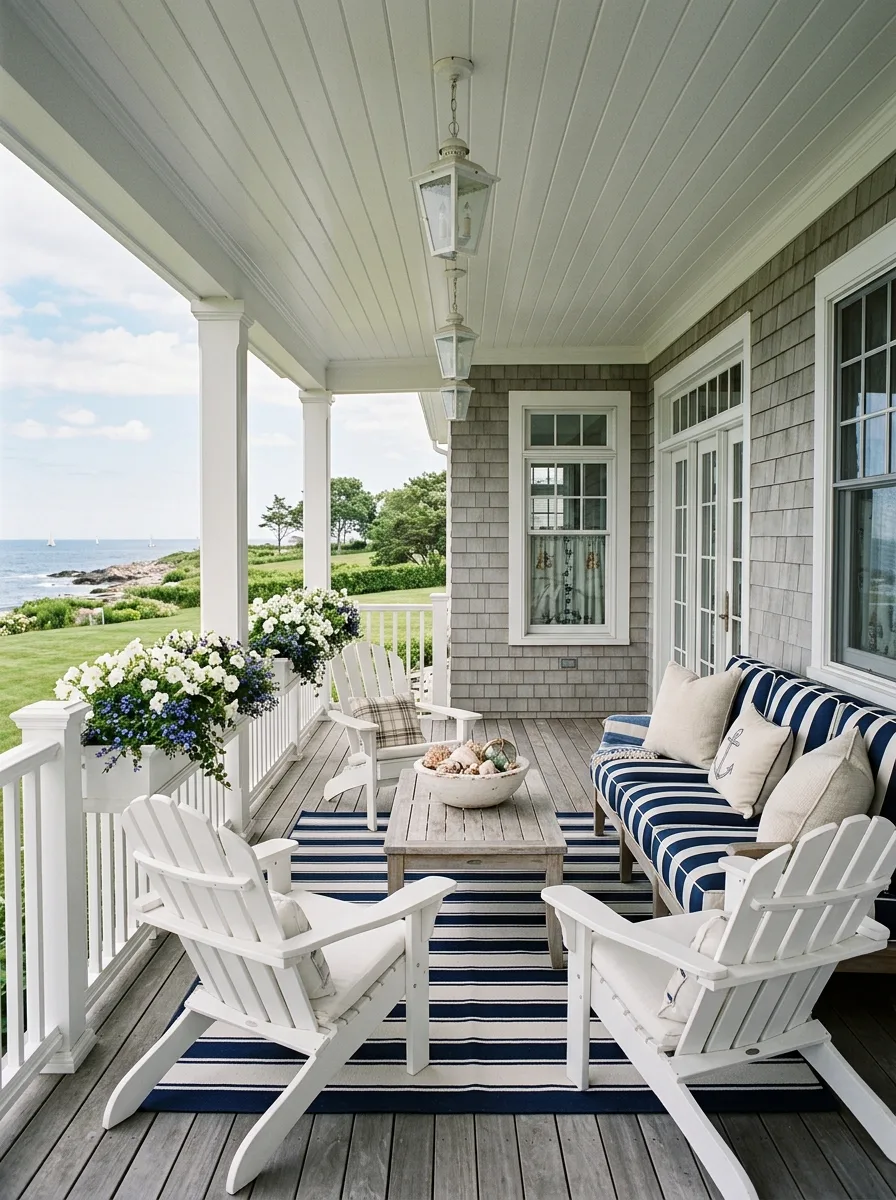
Paint your Adirondack chairs white. This is non-negotiable. Grey-weathered cedar Adirondacks have their place — this is not it.
Group four white Adirondacks around a long weathered-wood coffee table on a navy and cream horizontal-stripe rug. Pair with a blue-stripe cushioned bench sofa along the railing for additional seating. The sofa cushion and the rug should share the same two stripes — the repetition is what gives the palette coherence rather than noise.
A white ceramic bowl filled with shells, driftwood, or smooth stones on the coffee table. A planter box on the railing with a mass of white and blue flowers — white petunia and blue lobelia work well in sun. No other accessories. Coastal restraint is still restraint.
Mediterranean Arched Terrace
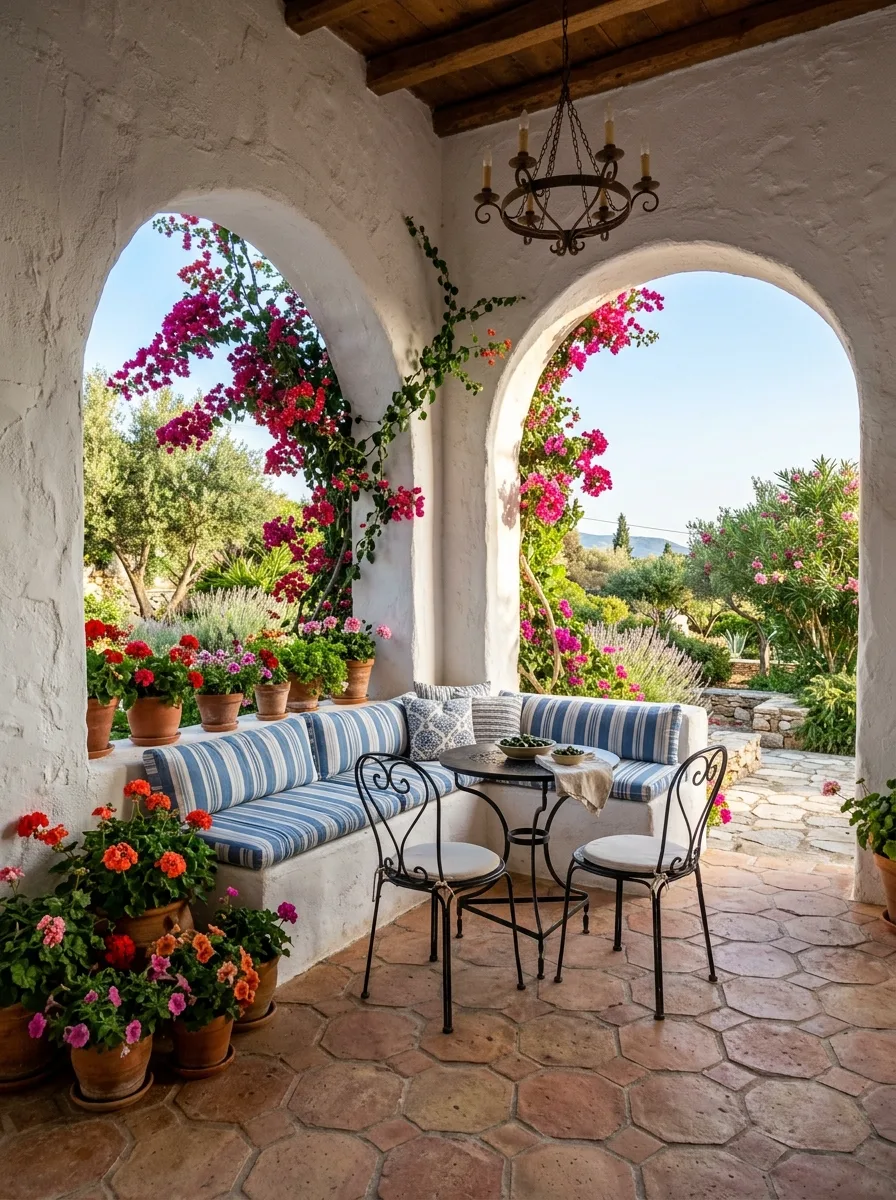
This look lives or dies on the architecture. If you don’t have whitewashed stucco walls and Roman arches, this isn’t the porch you’re recreating — and that’s fine. But if you have a covered terrace against a stucco or masonry wall, here’s how to push it.
Build a banquette seat directly into the wall — either construct a simple wooden frame and cushion it, or source a low upholstered bench — and run it along two walls in an L-shape. Cushion it in a blue and white wide-stripe cotton, and add indigo and woven accent pillows. Place a black wrought-iron bistro table and matching chairs in front.
Hang a wrought-iron chandelier from the ceiling — candelabra style, not wired with shades. Terracotta pots everywhere: on ledges, on the floor, massed at the base of the arches. Mix geraniums, lavender, trailing rosemary, and whatever else is blooming. Let the bougainvillea climb the arch if you’re in a warm climate. Train it. Tie it. Do not let it just sprawl.
Log Cabin Mountain Porch
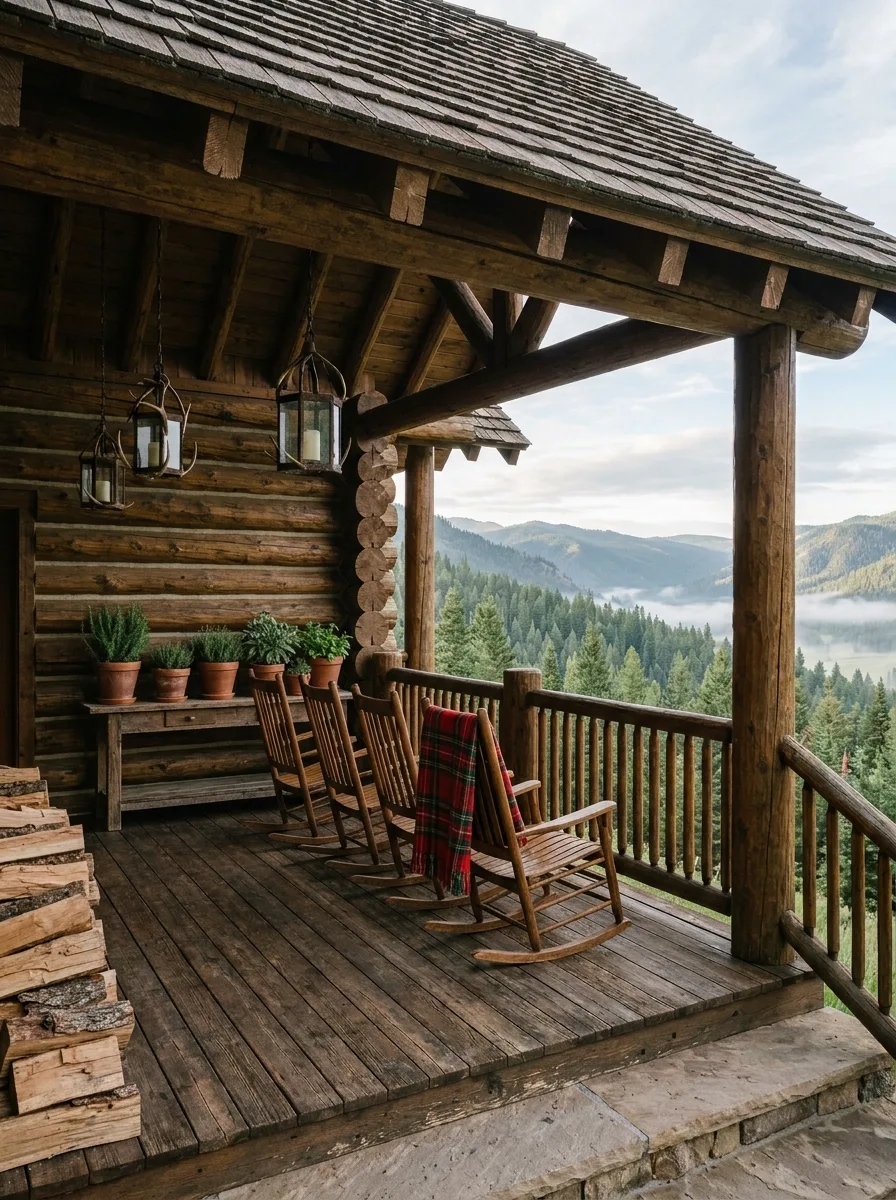
Do nothing that fights the logs. That is the first rule of a log cabin porch. Do not add white paint, do not install modern fixtures, do not bring in pieces that look like they came from the city.
Place two or three traditional rocking chairs on the raw wood deck. They should be dark stained wood, not white, not painted. Drape a red plaid wool blanket over one. Add a rough-hewn wooden console table against the cabin wall holding three or four terracotta pots of lavender and herbs.
Hang antler or iron pendant lanterns from the ceiling at varying heights — two lanterns is enough. Stack split firewood against the side wall in an amount that looks functional, not decorative. The view is the design. The porch exists to frame it. Stand back and stop adding things.
Southern Colonial Grand Porch
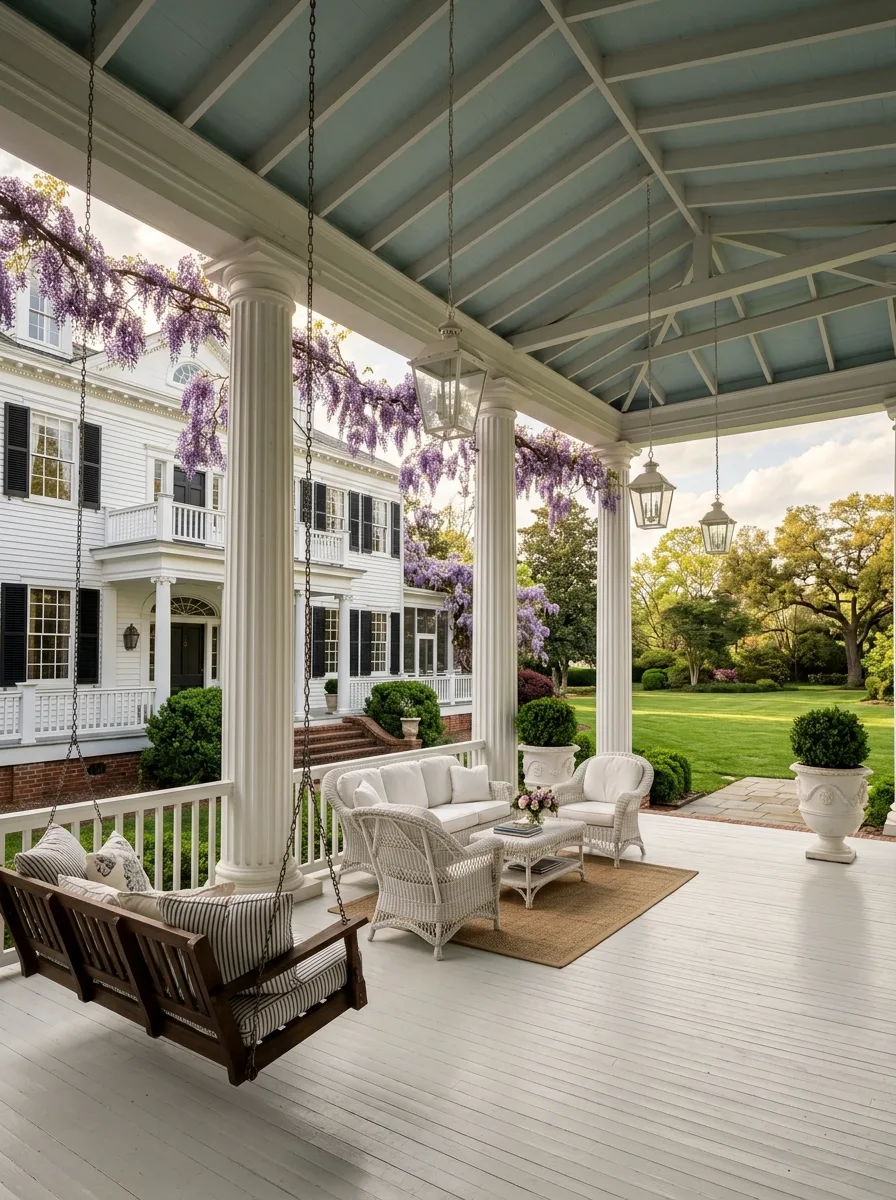
Scale up. A grand porch demands grand gestures. Install a porch swing with full upholstered cushions in a classic ticking stripe. The swing should be dark wood against a white floor, a contrast that registers from across the yard.
Arrange white wicker furniture — a proper sofa and two armchairs, with a natural fiber rug beneath — on the main portion of the porch. Keep cushions in cream with minimal accent pillows. A small bouquet of roses on the coffee table. Two hanging gas-style lanterns, wired, at the ceiling. Matching urns at the base of each column with topiary.
The ceiling is painted haint blue. The floors are painted white. Every column is classical, with proper capitals. This porch does not apologize for itself.
Dark Green Candlelit Cottage Porch
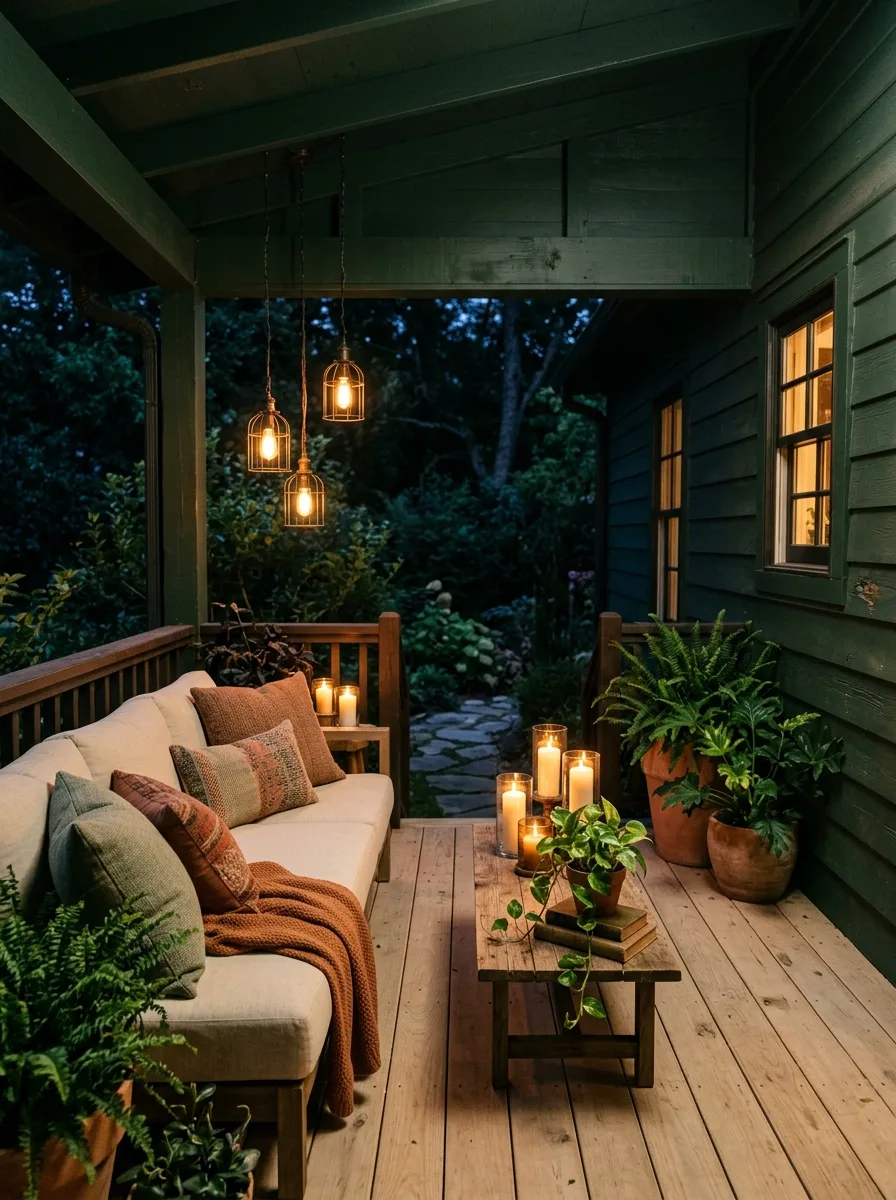
Paint the exterior walls and ceiling a deep forest green — Benjamin Moore’s Tarrytown Green or something in that family. It should be dark enough that the warmth of the candlelight at night creates genuine drama.
Install three iron cage pendant lights at staggered heights rather than a single central fixture. Hang them from the same junction point, at 6-inch intervals, so they read as a cluster rather than as separate lights. At night, the warm filament bulbs against the dark green ceiling is the entire atmosphere.
Furnish with a long outdoor sofa in a natural linen or canvas fabric with terracotta and sage-colored throw pillows. A low wooden coffee table — rough, unfinished, something that looks found — on the floor with a grouping of varying-height pillar candles. Ferns in terracotta pots at each end of the porch. The candles should be grouped in odd numbers. It’s the kind of thing that sounds superstitious but reads as intentional.
Victorian Gingerbread Porch
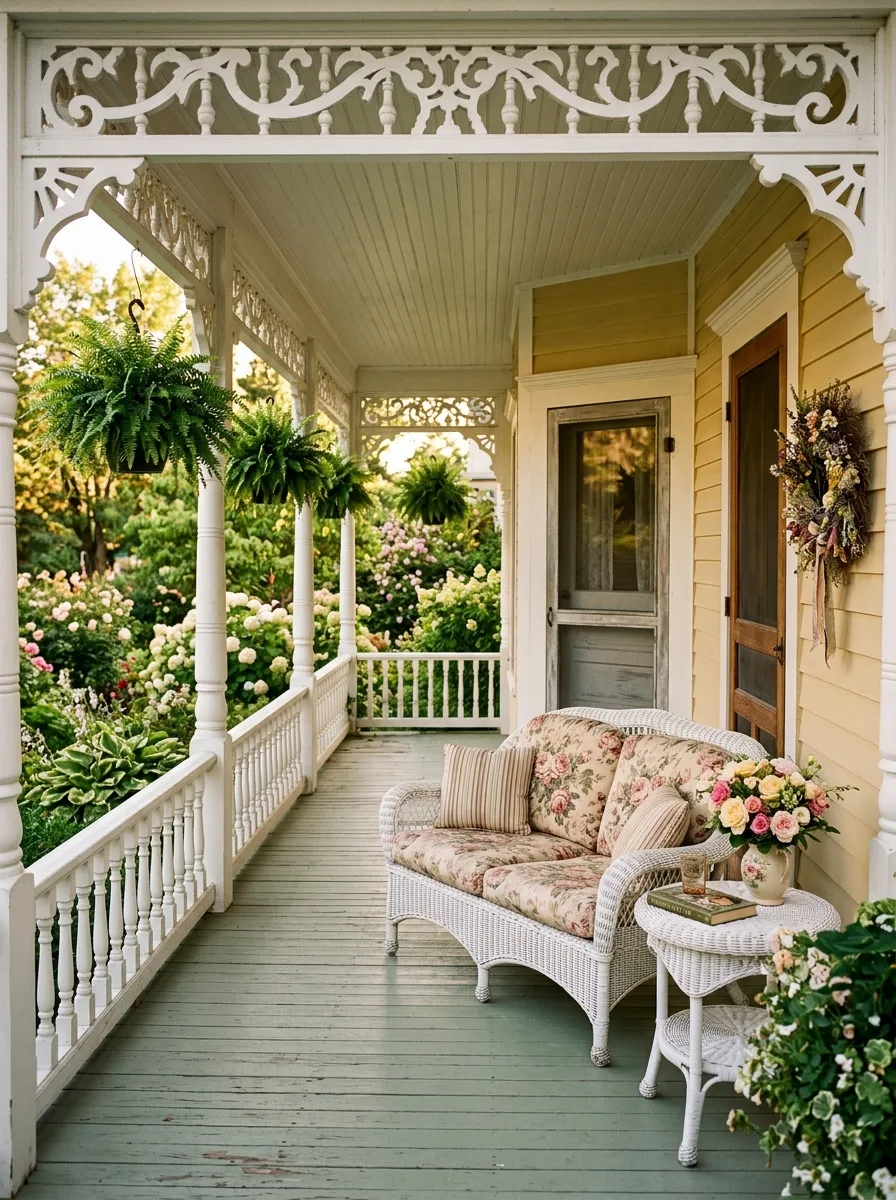
The gingerbread trim on a Victorian porch is the architecture. Do not compete with it. Do not paint it a different color than the porch structure. Keep it white, keep it clean, and let it do its job.
Install white wicker furniture with floral-print cushions — actual chintz florals in pink, cream, and green. This is the one style where pattern on pattern is the correct choice. Add a bouquet of mixed roses in a ceramic pitcher on the wicker side table.
Hang Boston ferns in wire baskets from the ceiling hooks between the columns. Choose ferns over all other plants — they have the right scale, the right drape, and the right historical accuracy. Paint the porch floor a faded sage green. It is one of the only situations where a painted outdoor floor is the right answer rather than a stained or natural one.
Tropical Peacock Chair Porch
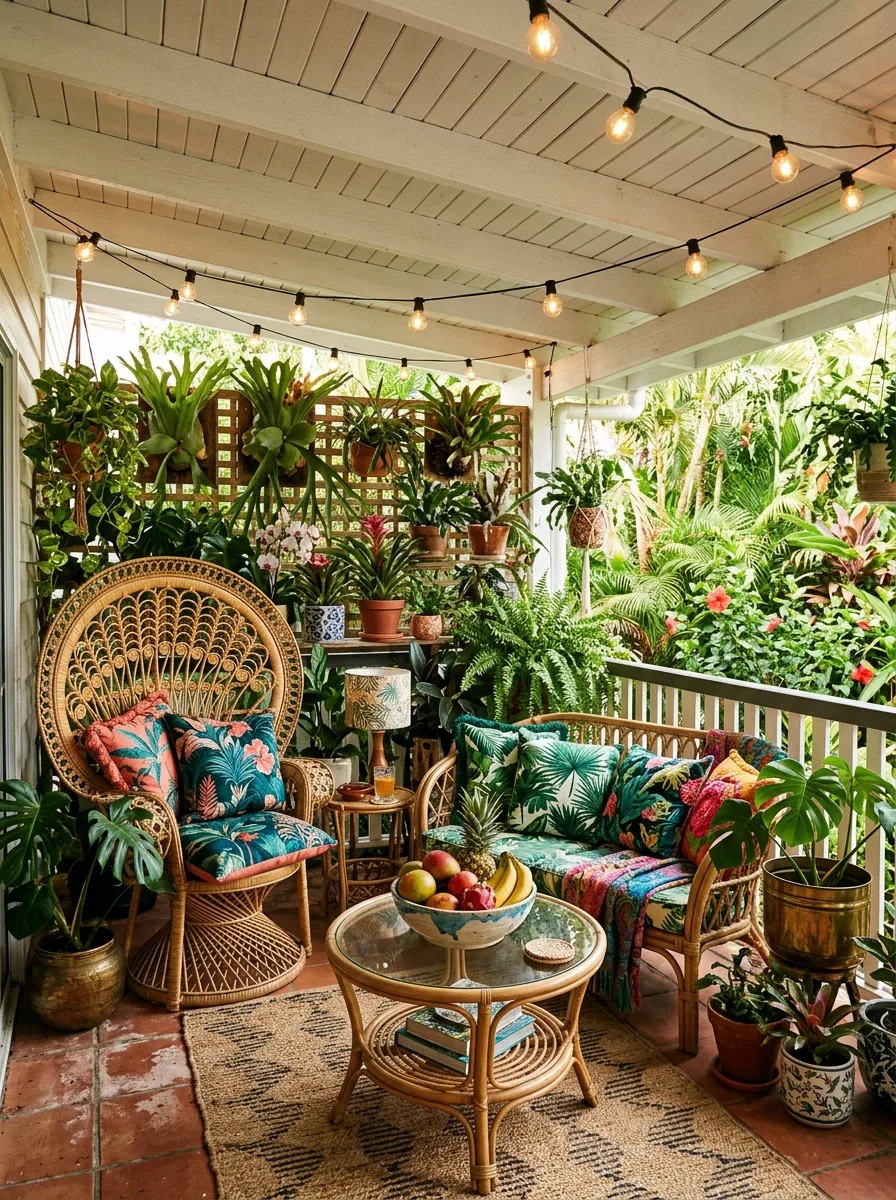
Install a wood lattice panel — the kind used for climbing plants — as a partial privacy wall along one side of the porch. Mount it securely to posts or an existing railing. Plant staghorn ferns, pothos, or climbing philodendron directly into mounted pockets or macramé hangers attached to the lattice. Give it a season. The result is a living wall.
Place a peacock chair — rattan, with the full fan back — as the primary seating piece. Not an egg chair, not a hanging chair. A peacock chair with bold tropical-print cushions in teal and pink. Add a rattan loveseat with matching fabric for a second seating option and a small round glass rattan table between them.
Run string lights across the ceiling. The more abundant the plants become, the less the lights matter — but during establishment, they carry the ambiance. Mix in a tall floor lamp with a tropical-print shade if the porch needs additional light. Brass accents in pots and accessories, never chrome.
Provence Bistro Terrace
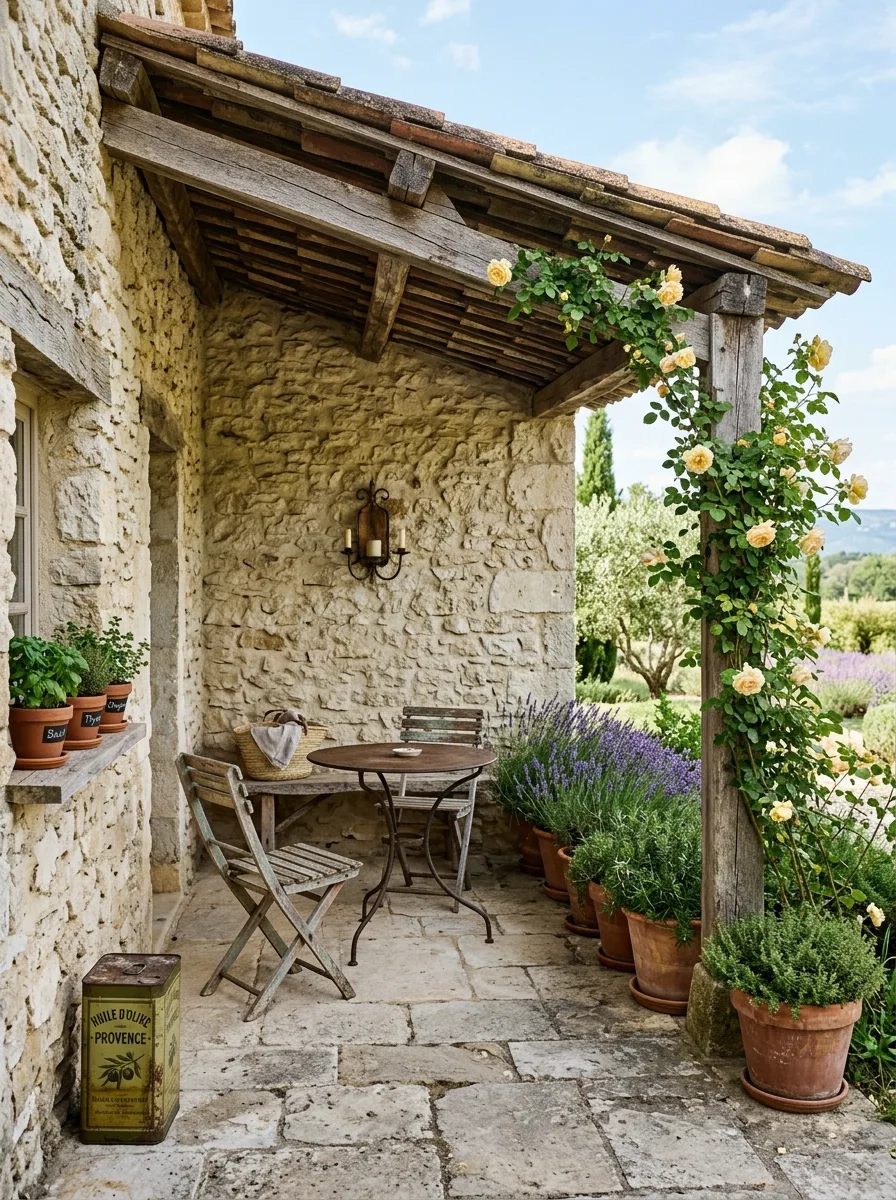
Source a small round bistro table in a rust or black finish — not new, or convincingly old. The chairs should be matching vintage-style folding bistro chairs, painted in a faded grey or sage, the kind that look like they have been on this particular terrace for a long time.
Place them against a rough stone or textured wall. If your wall is stucco, paint it a warm sand tone and texture it with a skip-trowel technique — it is achievable with the right roller and primer. Mount a single wrought-iron wall sconce at eye height. Do not add string lights. One sconce.
Edge the terrace with terracotta pots of lavender, thyme, rosemary, and a climbing rose trained up a simple timber post. Let one vintage olive oil tin serve as a planter. The entire sensibility is that this terrace has been here for decades and belongs to no particular decade.
Final Thoughts
The porches that stay with you — the ones you photograph in passing, the ones you sit on for three hours without realizing — have one thing in common. They commit.
They are not trying to be neutral. They are not trying to appeal to everyone. They made a decision about what kind of place they were and they followed that decision through every surface, every material, every plant choice.
The farmhouse porch with the swing leans into slowness. The Mediterranean terrace leans into heat and bloom. The dark green cottage porch leans into drama. None of them are apologizing for their point of view.
Your porch has a point of view too. The job is to find it and stop decorating around it.