
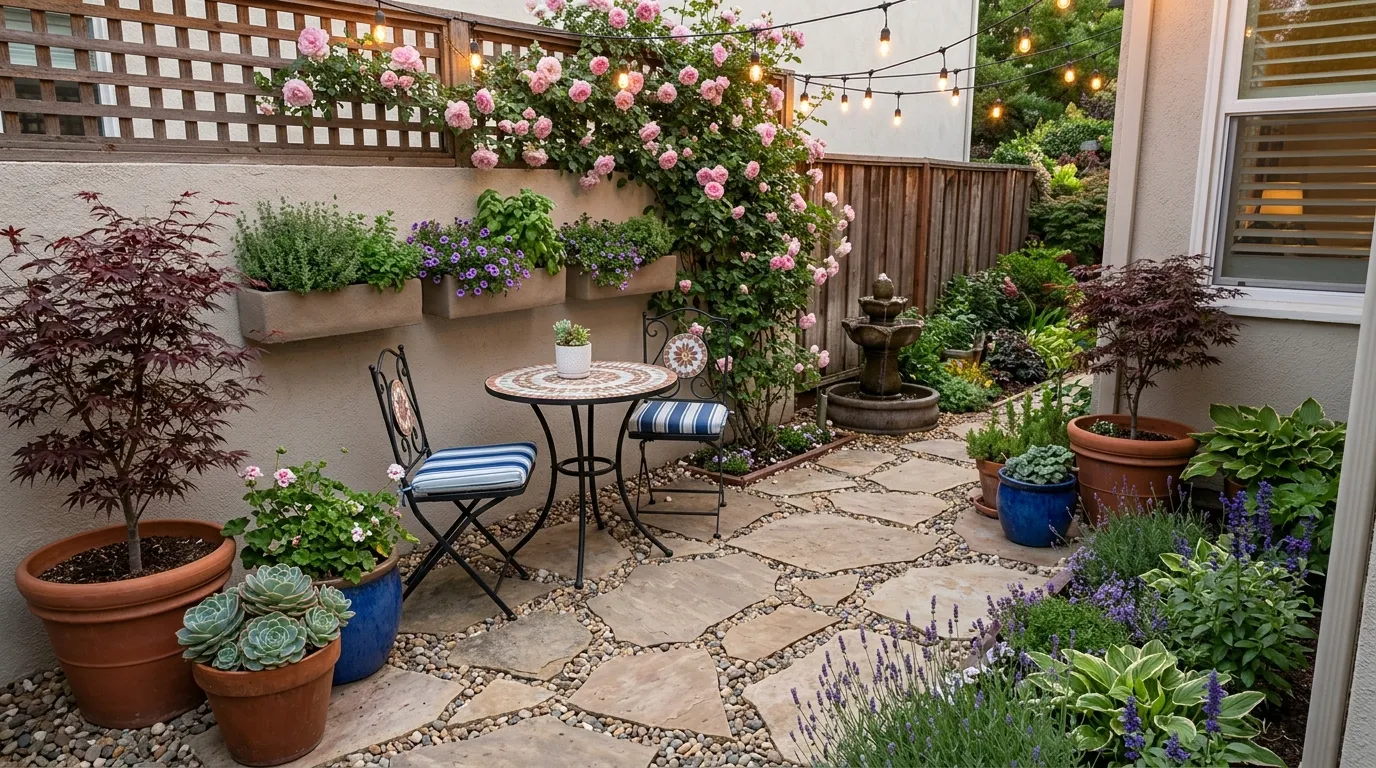
The grass ends. The concrete begins. A folding chair appears sometime in June and disappears again in September. This is not a patio. It’s a holding pattern.
The difference between a backyard that gets used and one that doesn’t isn’t square footage or budget. It’s decision-making. Specifically: the decision to treat the outdoor space as a room with a real function, real materials, and a reason to be in it. Most backyards fail because nobody made that decision. They just let the space exist.
These twenty ideas cover every style, climate, and budget in the conversation. What they share is conviction. Each one committed to a clear design direction and followed through on it. That commitment is what you’re actually looking at when you think a garden looks good.
Here’s how to develop one of your own.
Why Most Patio Landscaping Goes Wrong
The Single Zone Problem
One patio, one purpose. A seating area off the back of the house, surrounded by lawn, with nowhere else to go. You sit in the chairs. You look at the lawn. You go inside.
The backyards in this collection that feel most alive all have zones — distinct areas that serve different functions and create a sense of journey. A lounge area near the house. A dining space further out. A fire pit in a circular clearing at the far end. A path that connects them.
Zones don’t require a large garden. They require the decision to divide the space rather than leave it as one undifferentiated area. Even in a small garden, a step up to a raised platform, or a gravel circle separated from the lawn by a stone edging, creates the sense of moving from one place to another.
Materials Without Relationship
A concrete patio. A wooden deck. A gravel path. A lawn edging in black plastic. Each of these from a different supplier, in a different tone, with no conversation between them.
Materials in a well-designed outdoor space refer to each other. The warm teak of the furniture echoes the deck boards. The rust-orange of the corten steel planters picks up the warm tone of the brick. The white gravel in the Japanese-style bed ties back to the pale concrete paving slabs.
This doesn’t mean everything matches. It means everything is chosen with the other elements in mind. That’s a different kind of exercise and a more demanding one, but the result is a space that reads as composed rather than assembled.
The Lighting Afterthought
Every single nighttime photograph in this collection looks better than the daylight version of a typical suburban patio. That is not a coincidence.
Outdoor lighting is the most underinvested element in most garden design. Not because it’s expensive — a few well-positioned solar stake lights, a run of festoon bulbs, and a couple of lanterns are cheap. But because most people don’t think about the garden after dark when they’re planning it.
The garden is used at night. Summer evenings, late dinners, sitting by a fire. Plan the lighting in the same conversation as the paving and the planting, not as an afterthought in October when you realize you can’t see anything.
Patio Landscaping Ideas
Japanese Maple Water Garden
The Japanese maple is the painting. Everything else is the frame.
Plant a single mature Acer palmatum dissectum — the weeping, deeply cut-leaf variety — in a position where it can be seen from both inside the house and from the primary seating position outdoors. Allow it to grow without pruning, other than removing crossing or dead wood.
Around the base of the maple, lay a combination of white pea gravel and small dark river pebbles in bands, separating them with buried metal edging. Place large flat stepping stones through the gravel.
Include a large black glazed ceramic bowl planted with water lilies, positioned in the gravel as a low focal point near the maple.
Set black iron lanterns at path-edge positions — low, not tall. Flank the boundary with a bamboo screen fence.
The seating: a simple bench or pair of chairs in a secondary position, looking toward the maple. The tree is the destination.
English Cottage Border Bench Patio
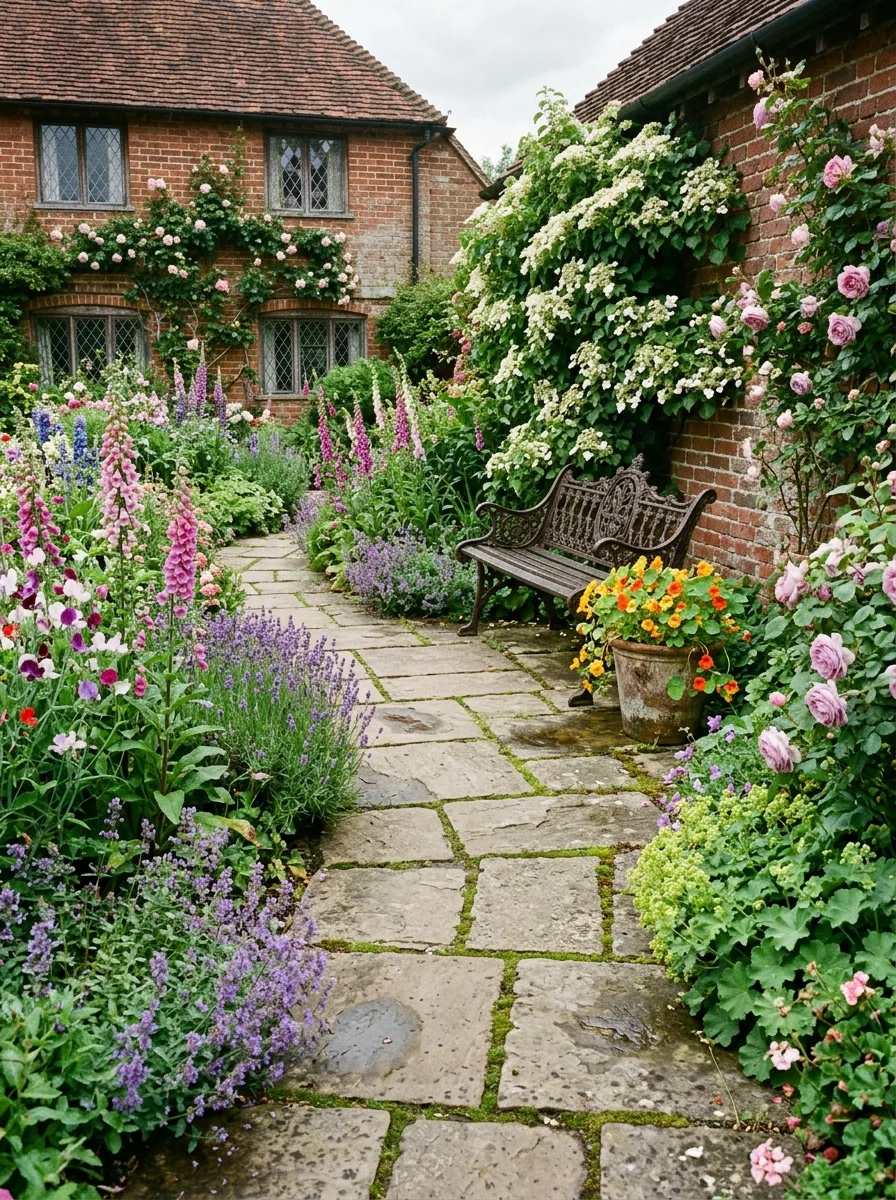
This is assembled, not installed. It accumulates rather than arrives.
Find the most sheltered section of a south-facing wall. Lay irregular limestone or sandstone flags in an approximately rectangular area, allowing the joints to be wide enough for creeping thyme or alyssum to establish between them. Don’t seal the joints.
Place a single cast-iron bench against the wall — the ornate Victorian type, allowed to weather and rust at its own pace. In front of it, a long narrow border planted densely with cottage flowers that can spill forward onto the stone: foxgloves, delphiniums, sweet william, lavender, catmint, and salvia.
Repeat all border plants in terracotta pots of different sizes clustered at the ends of the bench. A watering can left beside the bench. A gardening trowel on the wall. A climbing rose and wisteria on the wall above.
Nothing about this space should look like it was placed. It should look as though it grew.
Curved Paver Fire Pit and Lounge Zones
This is a master plan for the whole backyard, not a single feature.
From the house, the upper zone is a rectangular paved seating area in large-format concrete pavers — neutral in colour, generous in size. Furnish with a sofa and two chairs in cream weatherproof fabric on a dark frame.
From this upper zone, a curving path in a contrasting darker paver leads through a planted border bed to a circular lower zone: a large flat circle of matching pavers with a round stone or cast-iron fire pit at the centre. Four Adirondack or modern lounge chairs around it.
The border beds between the zones are planted in a consistent palette — ornamental grasses, lavender, and seasonal perennials in a single colour register (all blue-purple, or all white and green, not mixed).
The circles and curves are the design vocabulary. Repeat them in the planting bed edges, the fire pit, and the fire pit seating arrangement.
Tropical Deck Fire Pit Terrace
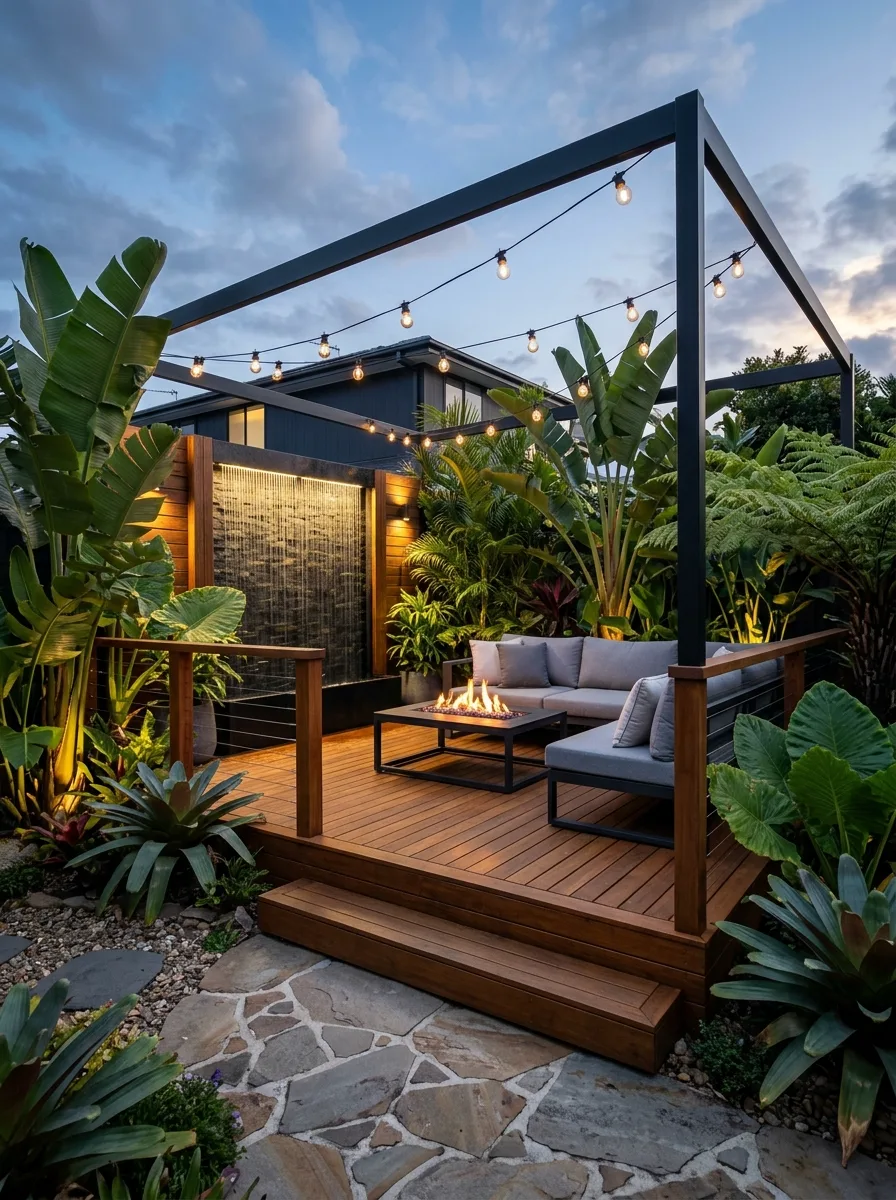
Build a raised hardwood deck platform with a step up from the surrounding ground level — this separation is important. The deck is a stage. Everything around it is the setting.
Use ipe or similar dense hardwood in wide boards, left to weather naturally to silver-grey or treated with a brown tinted oil to preserve the warmth. Install a powder-coated black steel pergola frame above the deck — no infill panels, just the posts and horizontal beams. Thread warm white festoon lights from beam to beam in loose catenary curves.
Set a low rectangular gas fire pit coffee table at the centre of a corner sectional sofa in grey weatherproof fabric. The fire needs to be visible from all seating positions.
Install a water wall feature on the back fence behind the deck — a stainless steel panel or a bamboo-clad feature with water sheeting down its face — and light it from below with warm LED uplighters.
Surround the deck at ground level with large-leaf tropical planting: banana, elephant ears, tree ferns, and bromeliads. Light these from ground level so they glow at night.
Luxury Tropical Night Garden
This is a space designed primarily to be experienced after dark.
Build a raised hardwood deck platform with clean-cut edges and a step down to a flagstone and pebble approach path. Install a wood-slat privacy screen along the rear wall with integrated warm LED strip lighting along the top edge.
Install a full-height water curtain feature — a stainless or steel-framed panel with a rain curtain effect — lit from below and above with warm LED.
Set a modular outdoor sofa in warm grey fabric with low-profile design. Add a central fire table in dark steel. Include a hanging egg chair in rattan at one corner on a floor-mounted stand.
For plants: tall specimens of banana, bird of paradise, and areca palm to create a canopy effect overhead. At ground level, bromeliads in saturated pink and orange, orchids in glazed ceramic pots, and elephant ear alocasia for large-leaf textural drama.
Light every plant from below ground level with warm coloured LED spotlights — amber for the palms, cool white for the water feature, warm amber throughout the seating area.
This garden is not visible in daylight. At ten o’clock on a warm evening, it is the only place you will want to be.
Wisteria Pergola Stone Dining Room
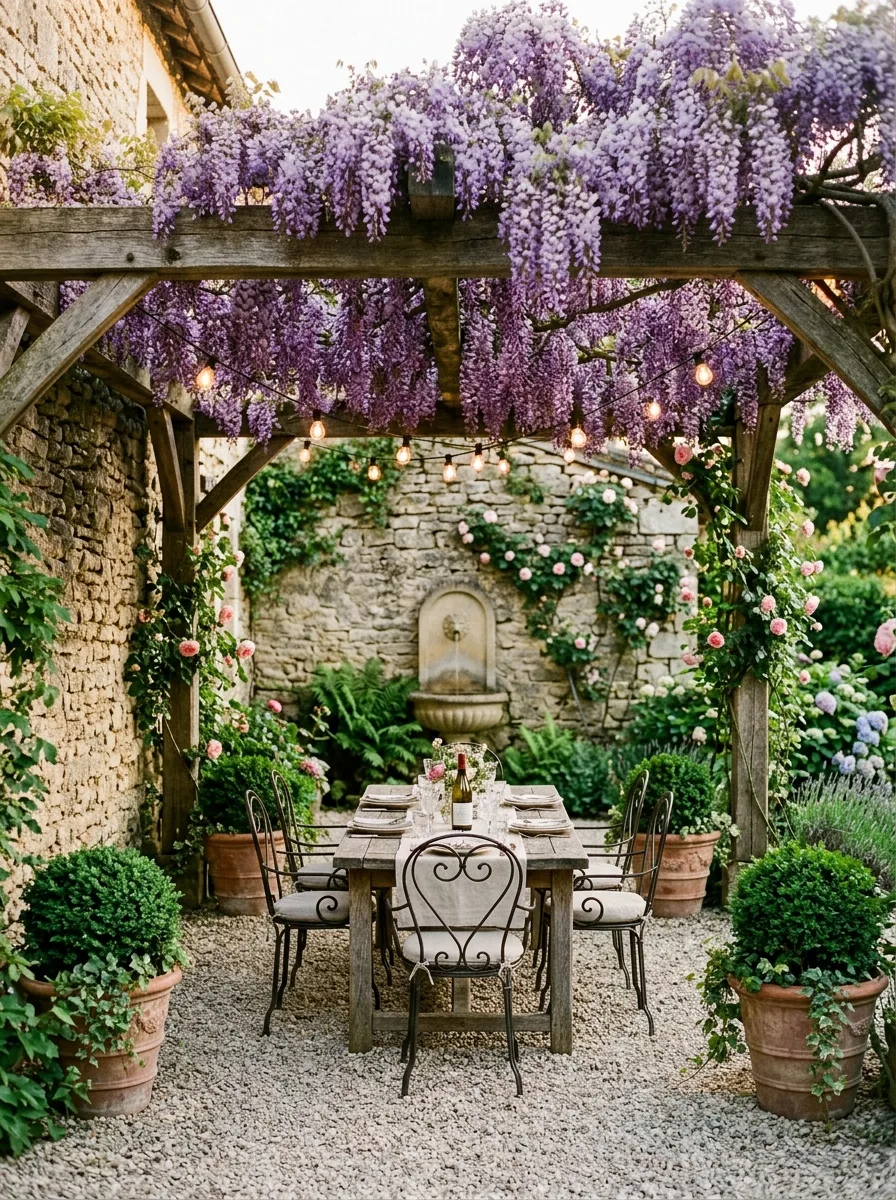
Build a timber pergola using rough-sawn oak posts and beams — not treated softwood, which turns grey in a flat, uniform way that looks cheap. Oak weathers to the same silvery tone but with texture and variation that reads as age rather than neglect.
Plant Wisteria sinensis at the base of each post and train the main stems horizontally along the underside of the beams using wire fixed with vine eyes. Allow the flowering spurs to hang downward freely. This takes four to five years to cover properly and is worth every year of waiting.
Floor the space in fine pale gravel — champagne or oyster toned, well-compacted and edged. Set a long wooden farmhouse table under the pergola, dress it with a loose linen cloth, and use iron bistro chairs — several matched, or mixed — around it.
Thread festoon lights along the pergola beams. Put a carved stone wall fountain at the rear wall as the visual terminator.
Add terracotta pots of clipped box spheres at the pergola entrance corners. Plant hydrangeas, lavender, and roses in the surrounding beds, allowing them to billow against the gravel.
Circular Paver Lilac Garden
Sometimes the geometry does all the work.
Lay a full circle of concrete or natural stone pavers in the centre of the garden, edged with a contrasting darker soldier course of brick. The circle should be large enough to hold a small table and four chairs with comfortable clearance.
Surround the circle with a crescent of lawn that wraps one half, and a crescent of black mulch border on the other. Plant the mulch border with a single lilac tree as the key specimen — positioned so it partially overhangs the circle — and underplant with low shrubs and perennials in white and soft purple.
Set a single stepping stone disk in the mulch to break the transition.
No furniture in the circle yet. That decision belongs to the owner of the garden, not the design.
Minimal Charcoal Courtyard
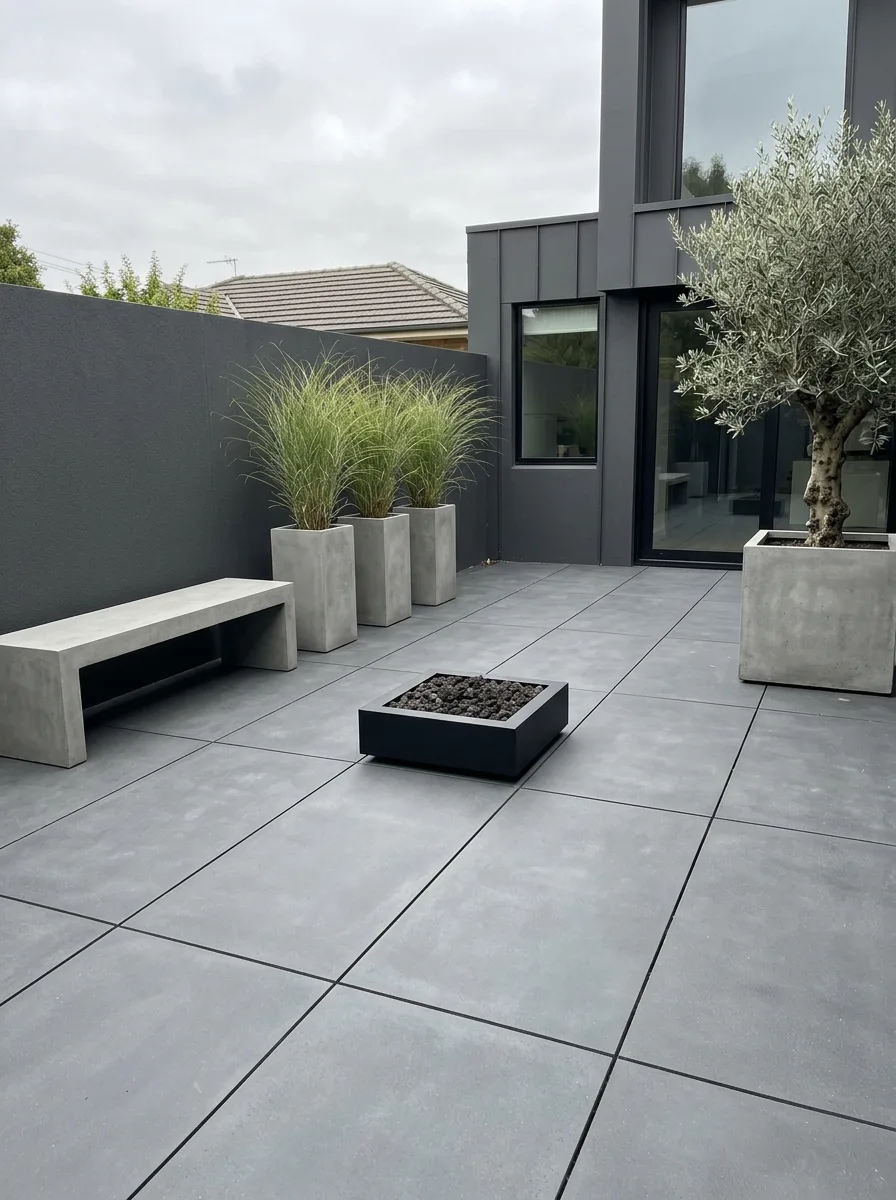
Three specimen plants. One bench. One fire bowl. Nothing else.
Lay large-format dark charcoal porcelain tiles across the full courtyard area, with a consistent tight joint line. The surface should be completely flat.
Against the rear wall, set three tall rectangular concrete planters of equal height in a row, each containing a single specimen of feather grass (Stipa tenuissima) — airy, pale, and in constant motion in any breeze. Against the side wall, one larger square concrete planter with a semi-mature olive tree.
Set a single concrete bench — the minimal, no-back kind — parallel to the planter row.
In the centre of the space, a small low square black fire bowl. No other furniture.
Leave the walls entirely bare. No lighting except a single recessed in-ground uplighter beneath the olive tree.
The confidence of this space comes entirely from what is left out.
Gravel Fire Pit Adirondack Lounge
This is the most achievable patio in this collection. It requires almost no construction skill.
Mark a circle approximately four metres across in the backyard. Excavate to ten centimetres, lay landscape fabric, fill with white pea gravel and compact.
Build or purchase a round stone fire pit at the centre — dry-stacked natural stone in a circle, approximately sixty centimetres across.
Place four Adirondack chairs in weathered teak or stained cedar equally spaced around the fire pit. Thread festoon lights from the nearest fence post or tree branch overhead.
Plant one large specimen grass — Miscanthus sinensis or Cortaderia — in a large black pot behind one chair as a vertical accent. Plant hostas and large-leaf shade plants around the border edges.
Add two or three boulder-sized rocks at irregular positions in the gravel.
Done. This is it. This is the whole project.
Japanese Gravel Garden with Deck Platform
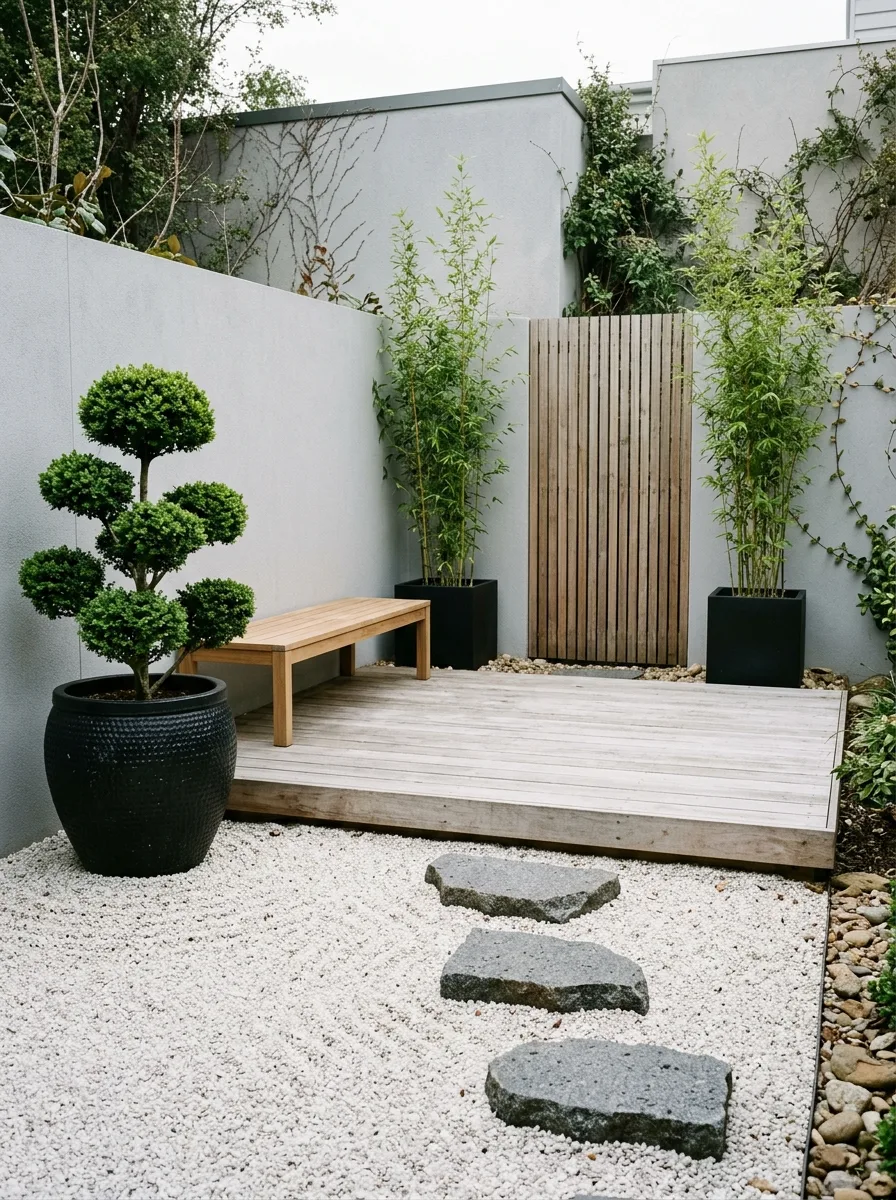
Lay white granite or quartz pea gravel to a depth of eight to ten centimetres over a weed-suppressing membrane across the full garden area. Contain the gravel within black powder-coated metal edging at all boundaries.
Into the gravel, set three irregular stepping stones of dark basalt — significant stones, each at least sixty centimetres across — positioned to lead the eye from the entrance to the deck platform.
Build the platform in pale grey silver-aged hardwood, set slightly proud of the gravel at one end of the garden. Install a vertical timber slat screen behind it as a privacy panel and backdrop.
Place two black ceramic planters on the gravel: one with a cloud-pruned box tree, one with a stand of black bamboo. These are the only plants.
Set a single simple teak bench on the platform. No other furniture.
Provençal Knot Garden with Stone Fountain
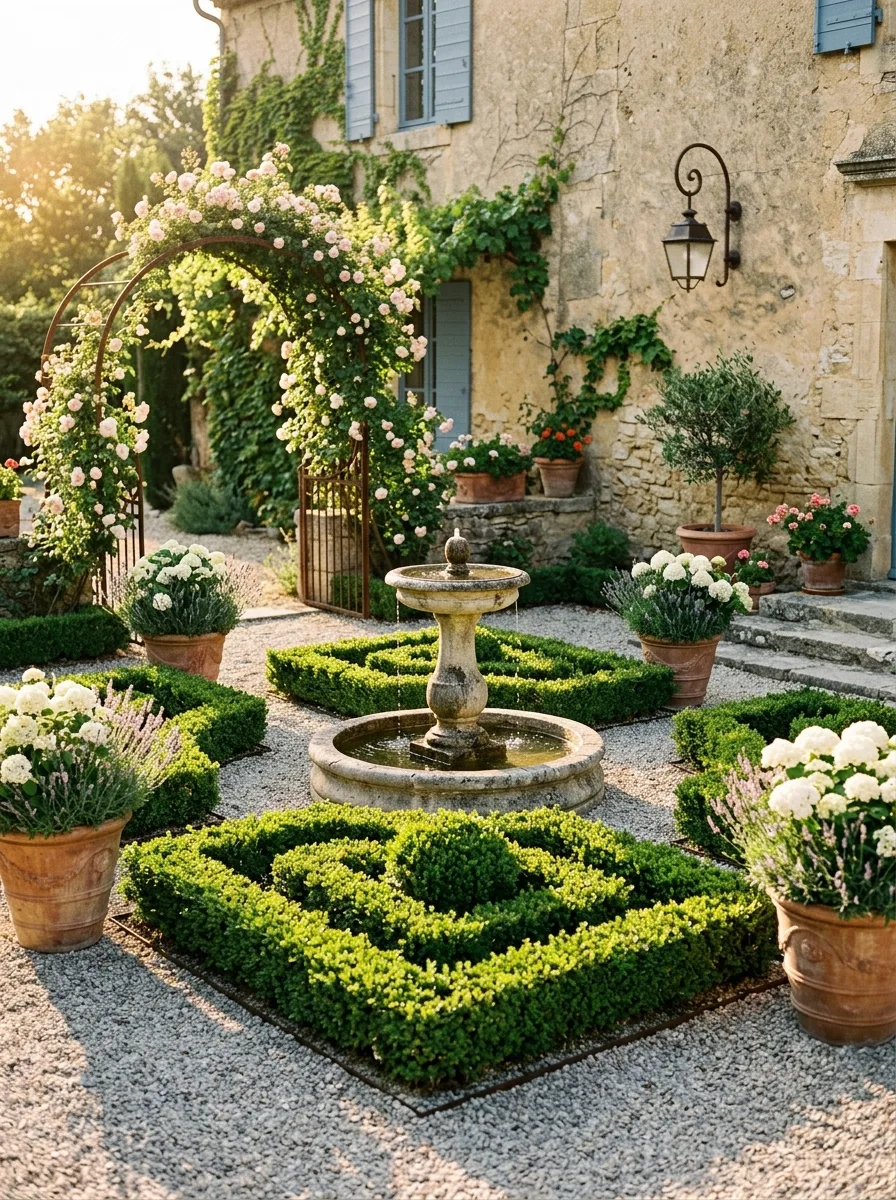
This is a formal parterre and requires commitment to maintenance. Done properly, it’s one of the most beautiful patio styles in this collection.
Lay fine pale gravel across the full garden area. Into the gravel, establish a low box hedge pattern in a traditional knot design — interlocking geometric shapes, each section approximately one metre square, all hedging maintained at thirty centimetres height.
In the centre of the whole composition, set a carved stone tiered fountain in a pale limestone or concrete with a naturally weathered finish. The fountain should be running continuously.
Install a curved iron arch at the garden entrance and train a climbing rose over it — blush pink or apricot. At the garden corners, place large terracotta urns of varying sizes planted with standard roses, lavender, and white hydrangeas.
Flank the house wall with a wall-mounted iron lantern on each side.
The key to this style: the box hedging must be immaculate, cut twice yearly. Everything else can be relaxed. The contrast between the tight formal hedging and the tumbling roses is the design tension that makes it work.
Contemporary Corten and Gravel Garden
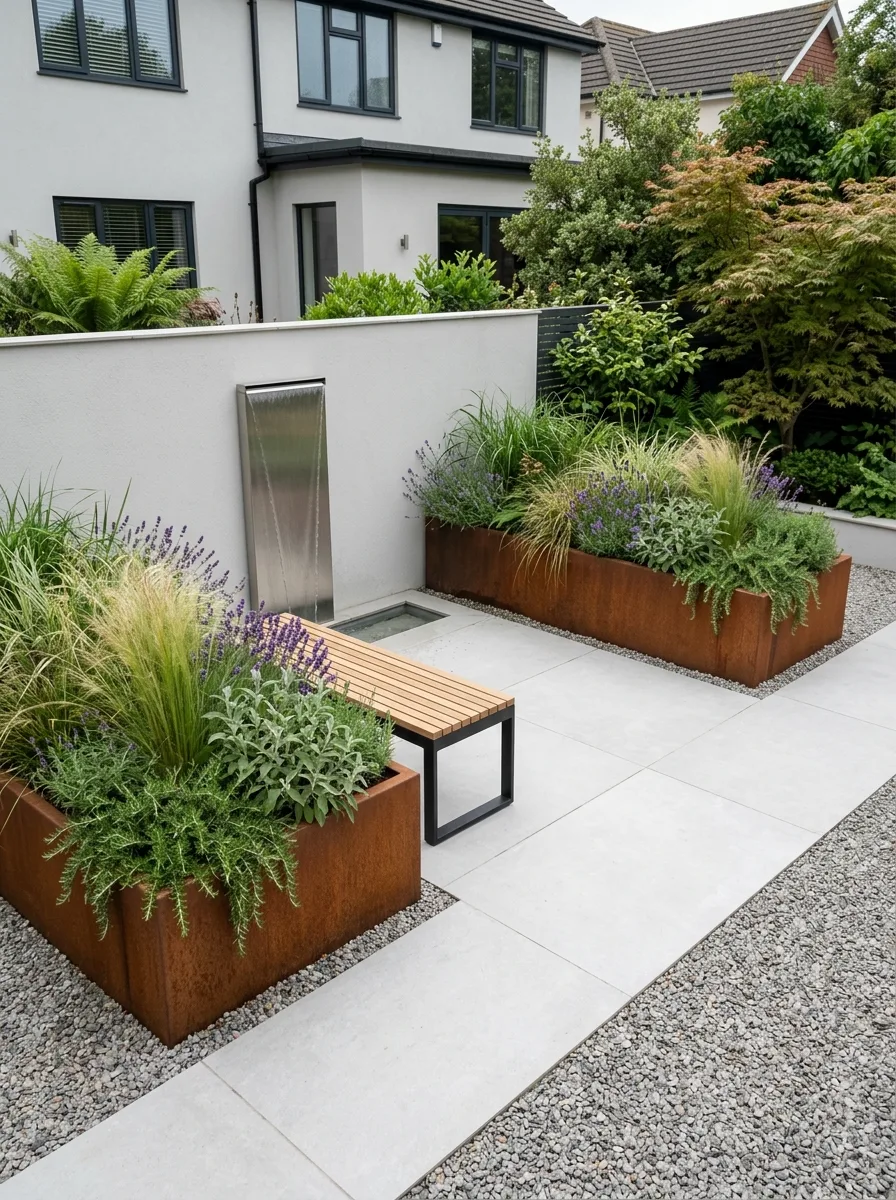
Corten steel planters — the kind that develops a rich rust-orange patina — are the design anchor. Everything else is chosen to support or contrast with that colour.
Lay large-format pale grey concrete or porcelain paving in a grid pattern, with gravel infill between the paving runs creating a deliberate mixed-surface effect.
Source two or three large rectangular corten planters, each a different length but all the same height. Plant with a mixture of structural and soft: feather grass and lavender at the front, Stipa tenuissima for movement, sage for colour and scent.
Install a stainless steel blade water feature mounted flush to the rendered wall — a single panel approximately one metre tall and thirty centimetres wide, with water sheeting down the face into a recessed channel. This sound element is as important as the visual.
Set a bench in a black powder-coated steel frame with a teak seat slat. The combination of corten, teak, and steel is the material palette.
Irish Moorland Bistro Corner
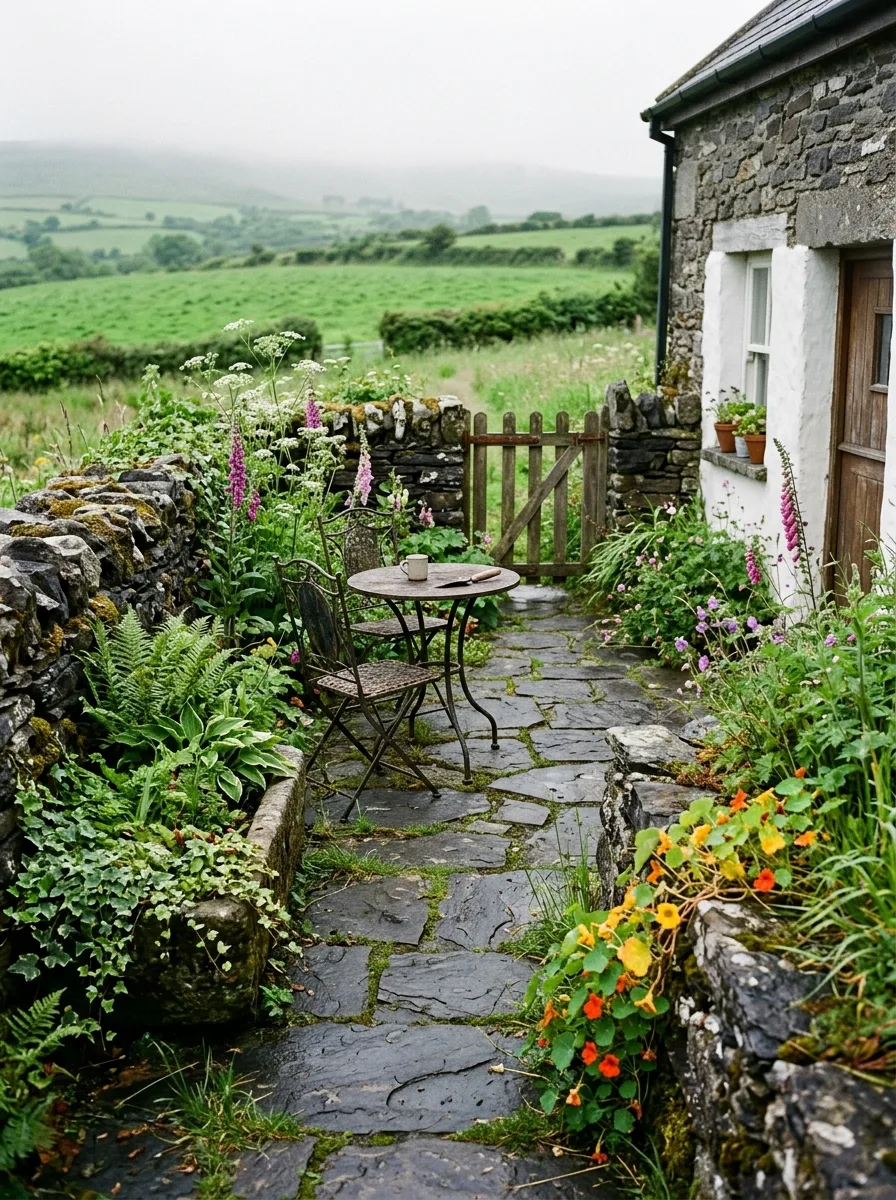
Two chairs. One table. A cup of coffee. Everything else is the landscape.
Lay dark irregular slate flagstones across a small area beside the house wall — allow the stones to be irregular and let moss establish freely in the joints. Never use a pressure washer on this paving.
Source a pair of French iron bistro chairs — the folding kind that have clearly been left outside through several winters. An iron round table to match, with the paint in various stages of departure.
Allow every surrounding plant to do whatever it wants. Ferns, hostas, nasturtiums cascading from a cracked stone urn, foxgloves self-seeded in the gaps between the flags. A climbing rose going sideways rather than up.
The one formal gesture: a dry-stone wall boundary, or the suggestion of one using large irregular rocks. And a wooden gate that opens onto the rest of the garden — slightly off vertical, slightly mossy at the base.
Modern Corten and Blade Fountain Garden
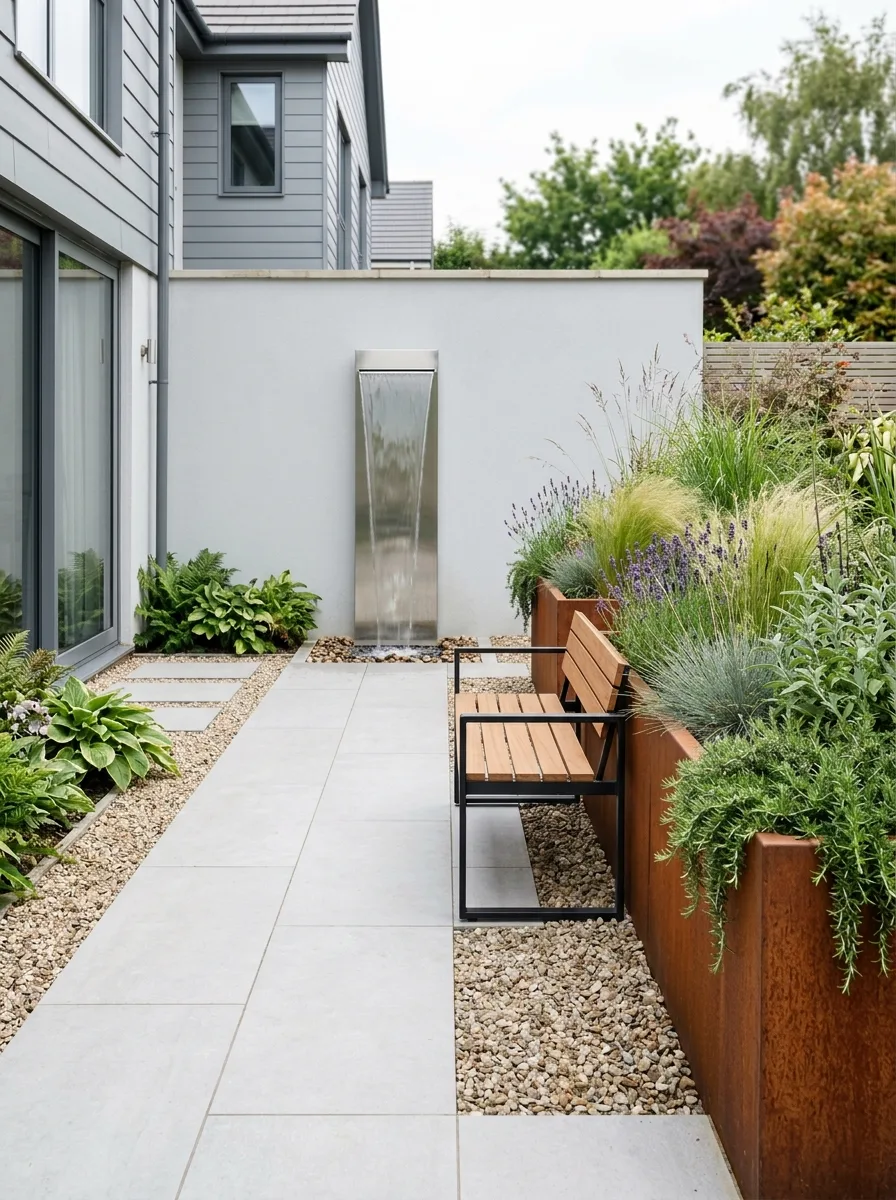
A variation on the corten planter theme, but more emphatically contemporary and quieter in the planting palette.
Lay large-format pale concrete slabs as the primary surface, with a gravel margin of matching tone separating the slabs from the boundary walls.
Set two or three corten steel rectangular planters of varied sizes in the gravel margin, planted exclusively with ornamental grasses and lavender — no flowering annuals, nothing too exuberant.
Mount a tall stainless steel blade water feature on the rendered wall: a single narrow vertical panel with water emerging from the top and running silently down the surface into a trough at the base. Install a single LED uplighter beneath it.
The bench: black powder-coated steel frame, teak slat seat, positioned to face the water feature.
This is a low-maintenance garden. The grasses need cutting once in spring. The lavender needs trimming in late summer. The corten needs nothing. The water feature runs continuously.
Andalusian Bougainvillea Courtyard
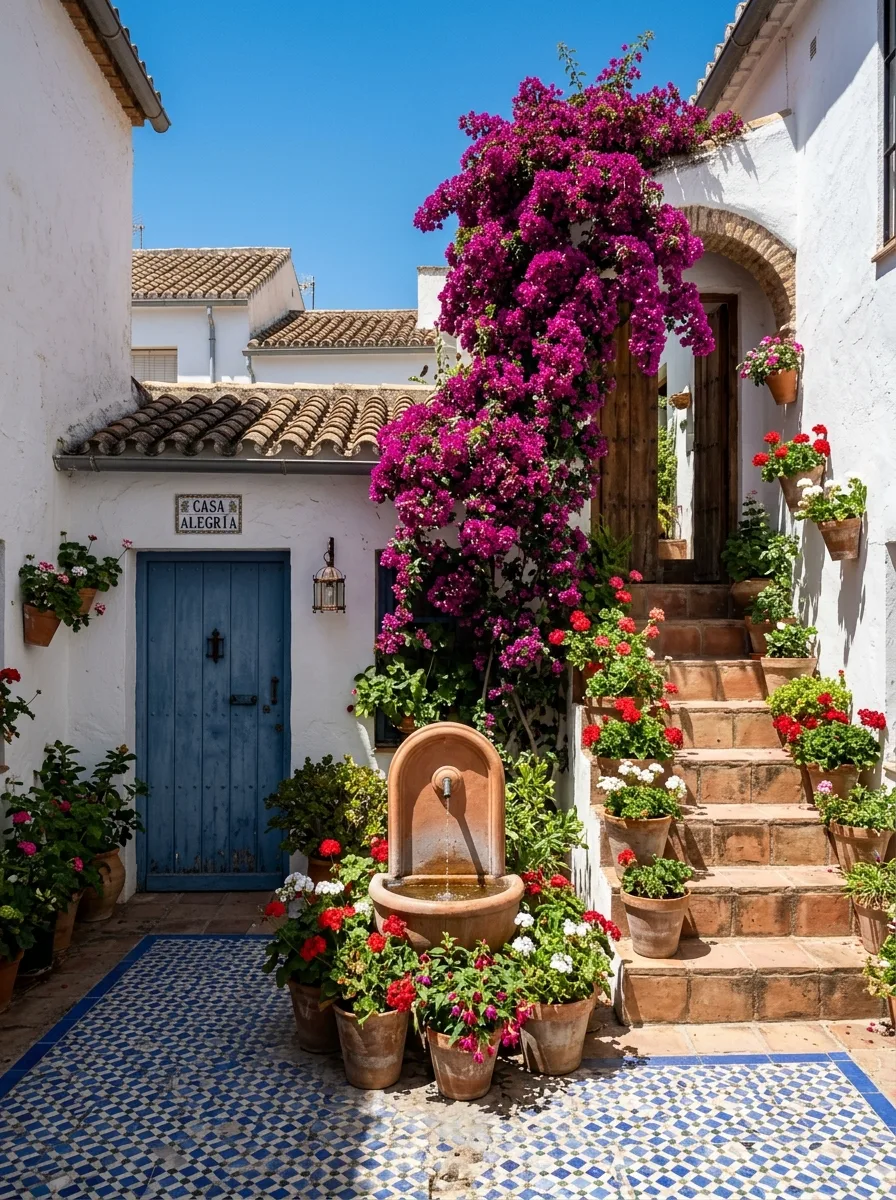
White render — true white, not cream — is the canvas. Everything else is the painting.
Render all walls in lime plaster to a smooth finish and paint bright white. Lay the floor in blue-and-white encaustic tile in a geometric diamond pattern.
The bougainvillea is the architecture. Train a single established specimen up the corner of the building where two white walls meet, allowing it to grow as high as the building and as wide as it wants. The scale is important — a small pot of bougainvillea does not make this look. A mature plant covering several square metres of wall does.
Cluster terracotta pots of red geraniums along the base of every wall — not a few pots, but dozens. Stack them at different heights using simple stone plinths.
Install a wall-mounted terracotta fountain in a Moorish-arched tile panel: a simple spout into a half-basin, running continuously.
Add a blue-painted door and a single iron wall lantern. Nothing else is needed.
Tuscan Vine Pergola Terrace
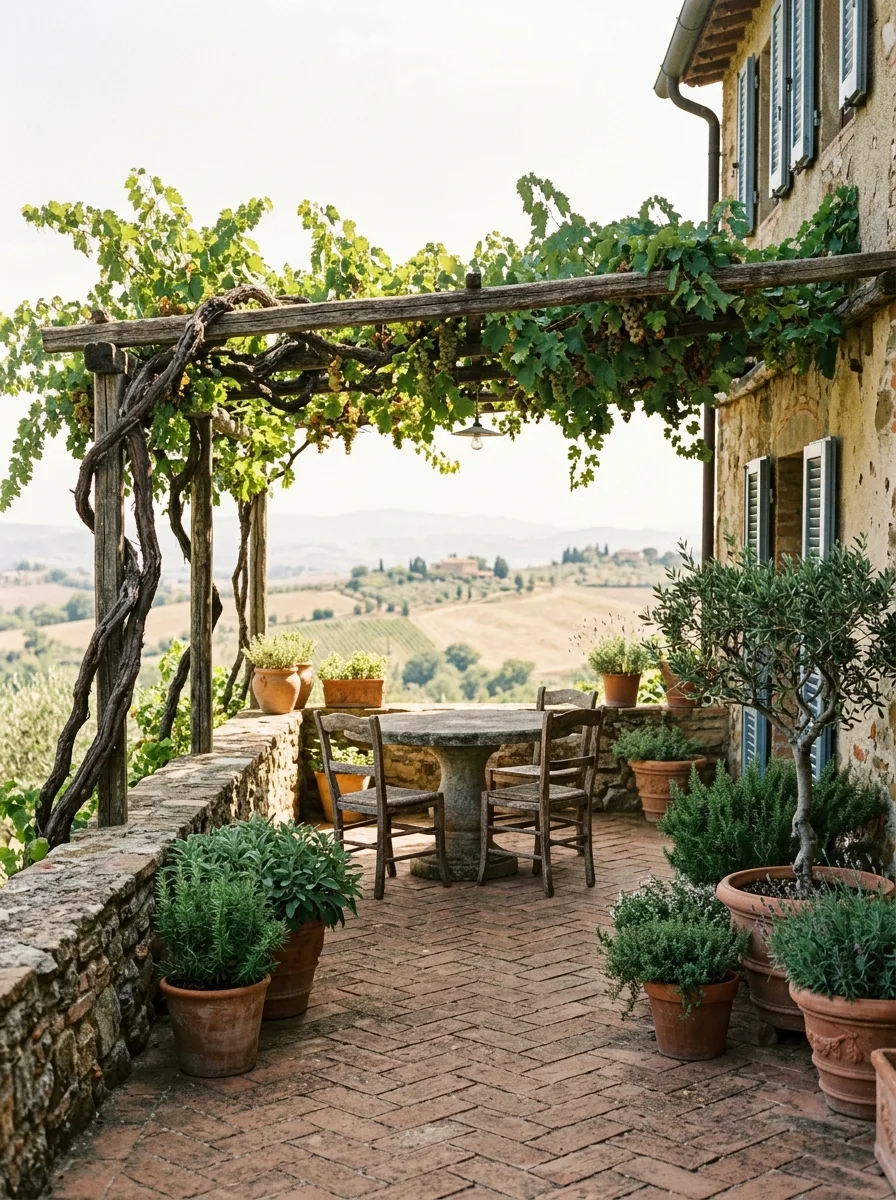
This look requires a view. Or if you don’t have one, it requires borrowed landscape — trees, a garden beyond the boundary, anything that extends the eye further than the garden walls.
Lay reclaimed terracotta brick in herringbone across the terrace floor, allowing the weathered surface to be exactly as it is.
Build a simple timber pergola lean-to against the house wall: four posts, open beams, no infill. Plant Vitis vinifera at the base of each post and allow the grape vine to cover the structure completely over three to four seasons.
Set a round stone-topped table — a thick slab of rough limestone on a low stone base — in the centre. Use simple wooden ladder-back chairs with woven rush seats.
Line the terrace wall with terracotta pots of herbs: rosemary, sage, thyme, and lavender — all large and well-established. Include one or two small olive trees in large pots.
Hang a single pendant light from the pergola centre.
The terrace faces the view. The vine and the light will do the rest.
French Rose Garden Bistro
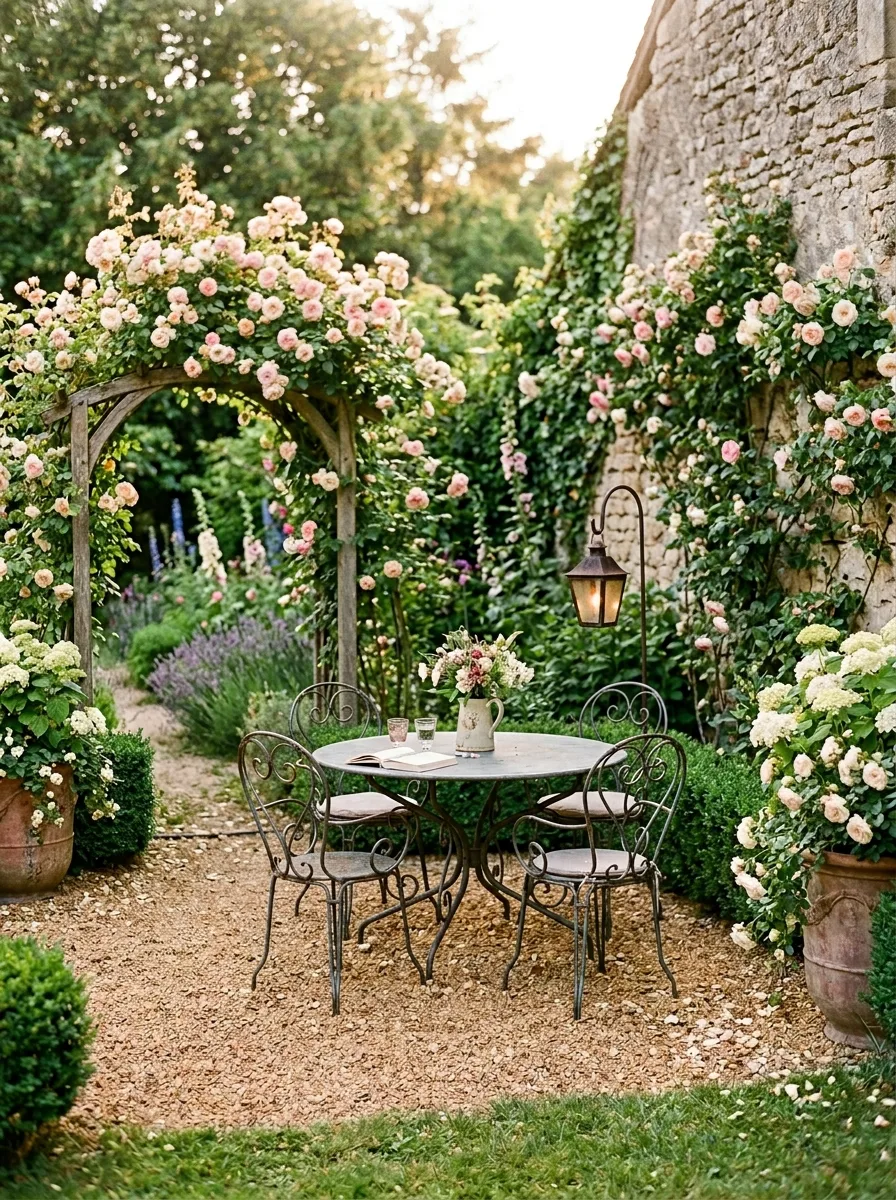
This is entirely about the roses. Every other decision is in service of them.
Lay fine golden gravel across the seating area and beyond. Set a round iron bistro table and four iron chairs — the classic scrollwork variety, dark grey-green in finish, weathered at the natural pace.
Plant climbing roses in large terracotta urns and against every available wall and structure. Dress a timber arch at the garden entrance with a single variety of blush or pale apricot rose trained symmetrically on both sides. Plant box spheres and low hedging at the borders of the gravel to provide formality that offsets the romance of the roses.
Hang a shepherd’s crook iron lantern beside the table, at head height, with a candle or battery lantern inside.
The table setting: a white ceramic jug of garden-cut roses. A book. Two glasses.
That is the entire brief.
Belgian Formal Urban Courtyard
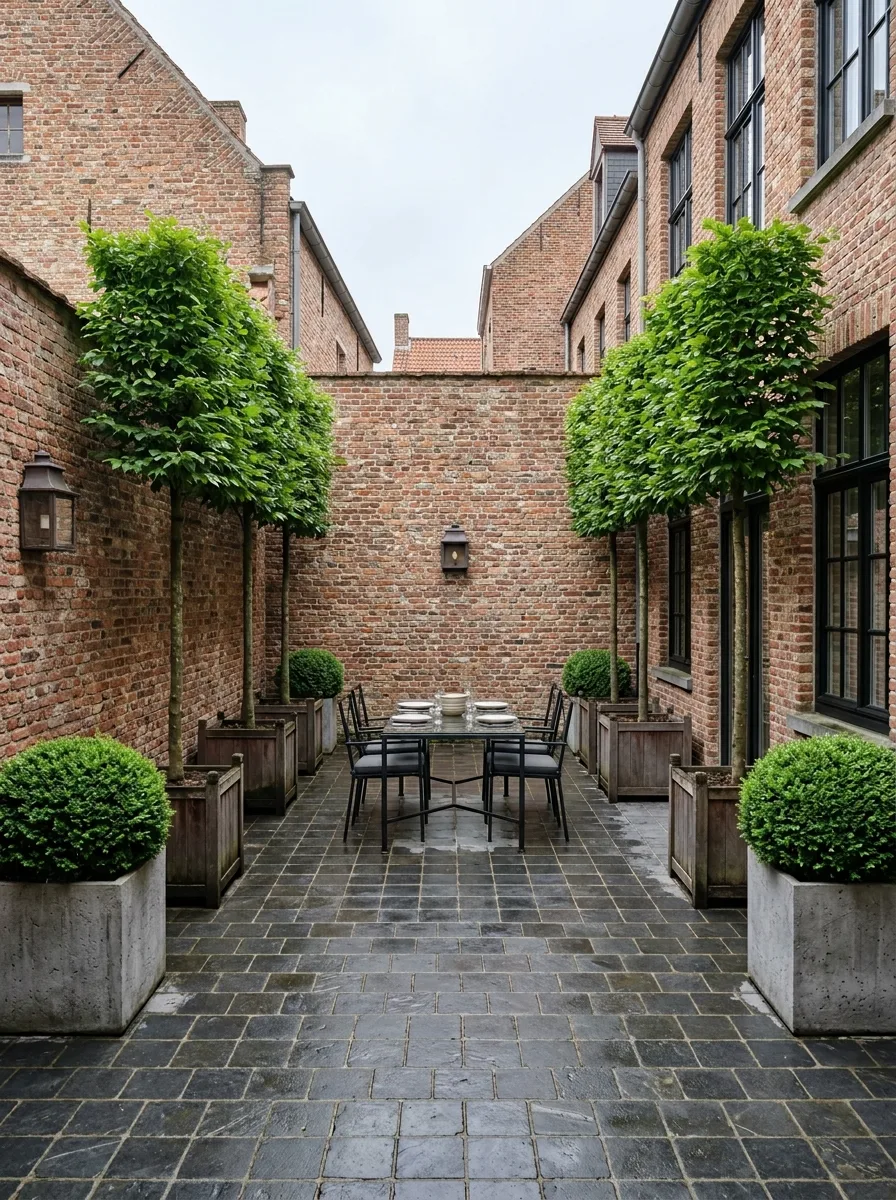
Symmetry. Repetition. Restraint.
Source four mature standard lollipop trees — Carpinus betulus or Prunus lusitanica are both appropriate — and plant them in four matching timber or concrete planters positioned symmetrically: two flanking the entry into the courtyard, two flanking the far wall.
Between and below each standard tree, place a clipped box sphere in a smaller matching planter.
Lay the floor in dark blue-grey Belgium block or slate tile in a simple grid pattern. Set one rectangular dining table in dark iron or steel, with minimal black chairs, at the far end of the courtyard facing the entrance axis.
Mount a single iron wall lantern on the rear wall at head height above the table.
No other planting. No added decoration. The architecture is the garden.
English Romantic Rose Fireplace Room
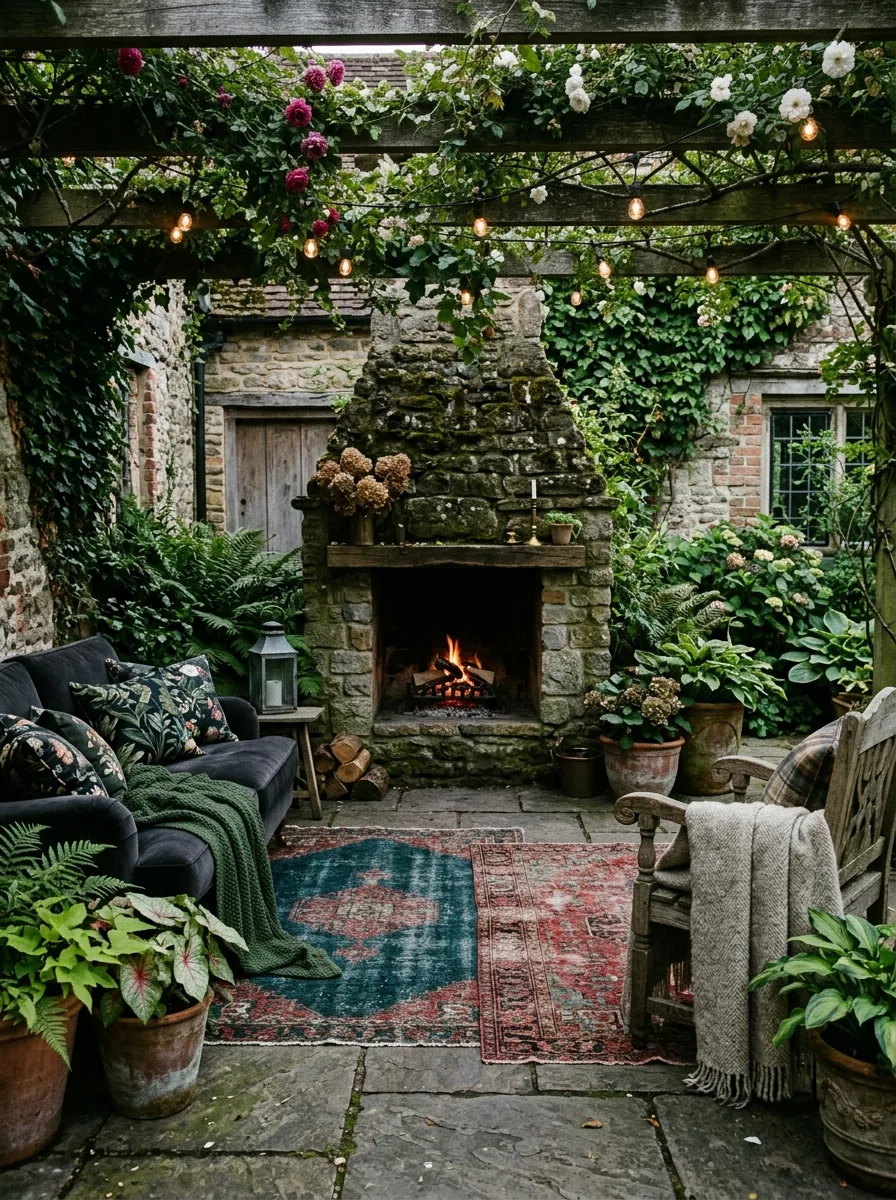
Repeat the stone fireplace from Image 14 — a proper masonry structure in irregular fieldstone, allowed to acquire moss and age in its joints over years.
Above and around the fireplace, install a timber pergola and plant climbing roses over it — deep red and blush pink, allowed to grow freely rather than being rigorously trained. Set festoon lights through the rose growth along the beams.
Furnish with mismatched upholstered seating: a dark velvet sofa, a weathered wooden armchair with a wool throw, an overdyed Persian rug on the flagstone floor. The mismatch is correct.
Cluster terracotta pots of ferns, caladiums, and hostas at the base of the fireplace and along the patio edges. The foliage should be dense and overlapping.
Add a shepherd’s crook lantern beside one chair and a small side table with a candle.
The fire and the fairy lights above are the only light source needed in the evening.
Provençal Gravel Garden Full Table Setting
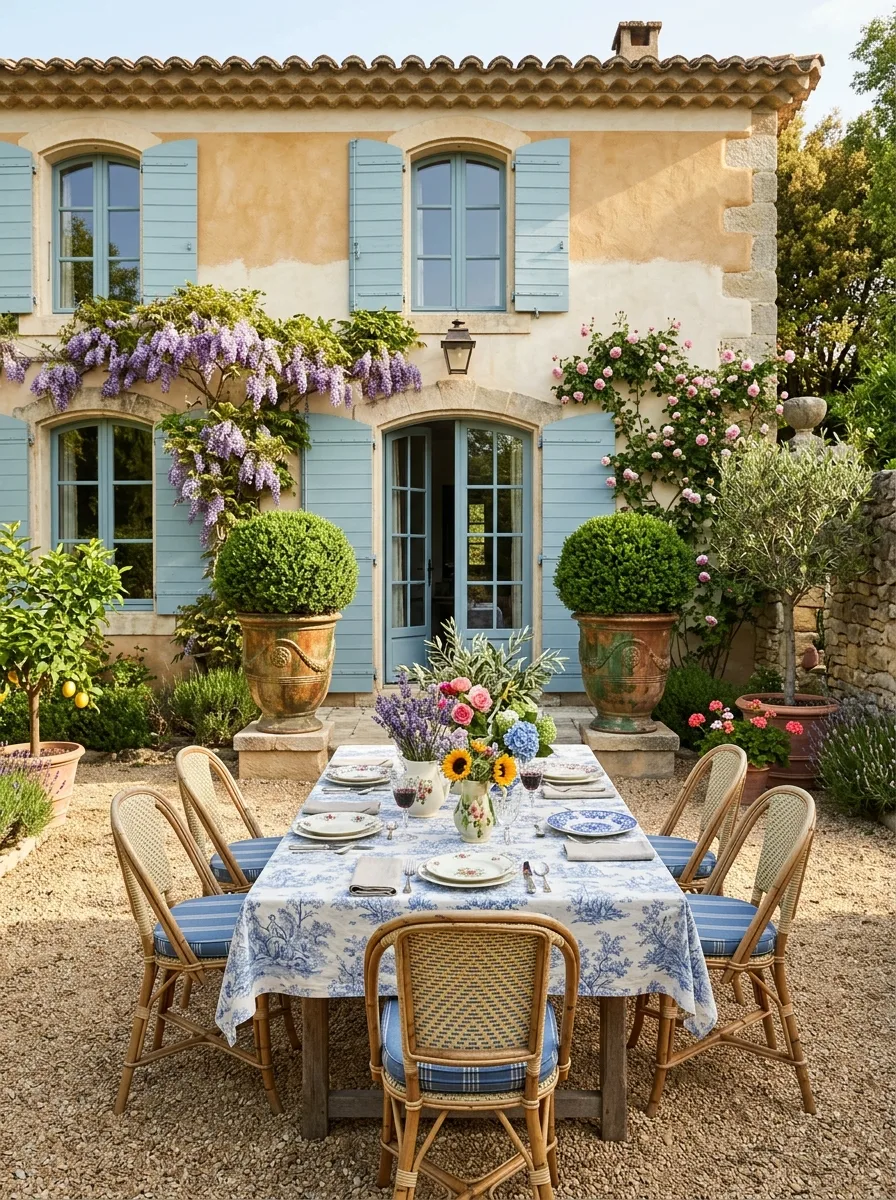
The distinction here is the dress: the full table setting in the outdoor context is the design statement.
Set up on pale gravel, in front of a stucco or rendered house facade with blue-grey painted shutters. Place large ornate terracotta urns of clipped box spheres flanking the French doors symmetrically.
Set a long wooden dining table with a full toile or botanical-print tablecloth in blue and white, hanging to mid-thigh length on all sides. Dress with rattan or bamboo bistro chairs with blue striped cushions.
Centre the table with a ceramic jug of mixed garden flowers: lavender, roses, sunflowers, hydrangeas in a loose generous arrangement. Use good plates and glasses. Fold linen napkins.
Set a lemon tree and a small potted olive in terracotta on one side of the setting.
This is outdoor dining as a theatrical event, not a casual lunch. Set the table accordingly.
Final Thoughts
The backyard that gets used is the one you were willing to make a decision about.
Every space in this collection made a clear choice — romantic or minimal, formal or wild, European or contemporary — and committed to it fully. None of them tried to be everything. None of them left the decision open.
The most paralyzing thing in garden design is the feeling that choosing one thing means losing everything else. It doesn’t. It means your garden has a character. And a garden with a clear character is always more livable than one without.
Choose the version that fits how you actually want to spend time outside. Not how you imagine you might, on the best possible summer afternoon. How you really use that space — morning coffee, evening fire, summer dinners, Sunday afternoons with a book.
Design for that life. It’s the only one that will use the garden.