
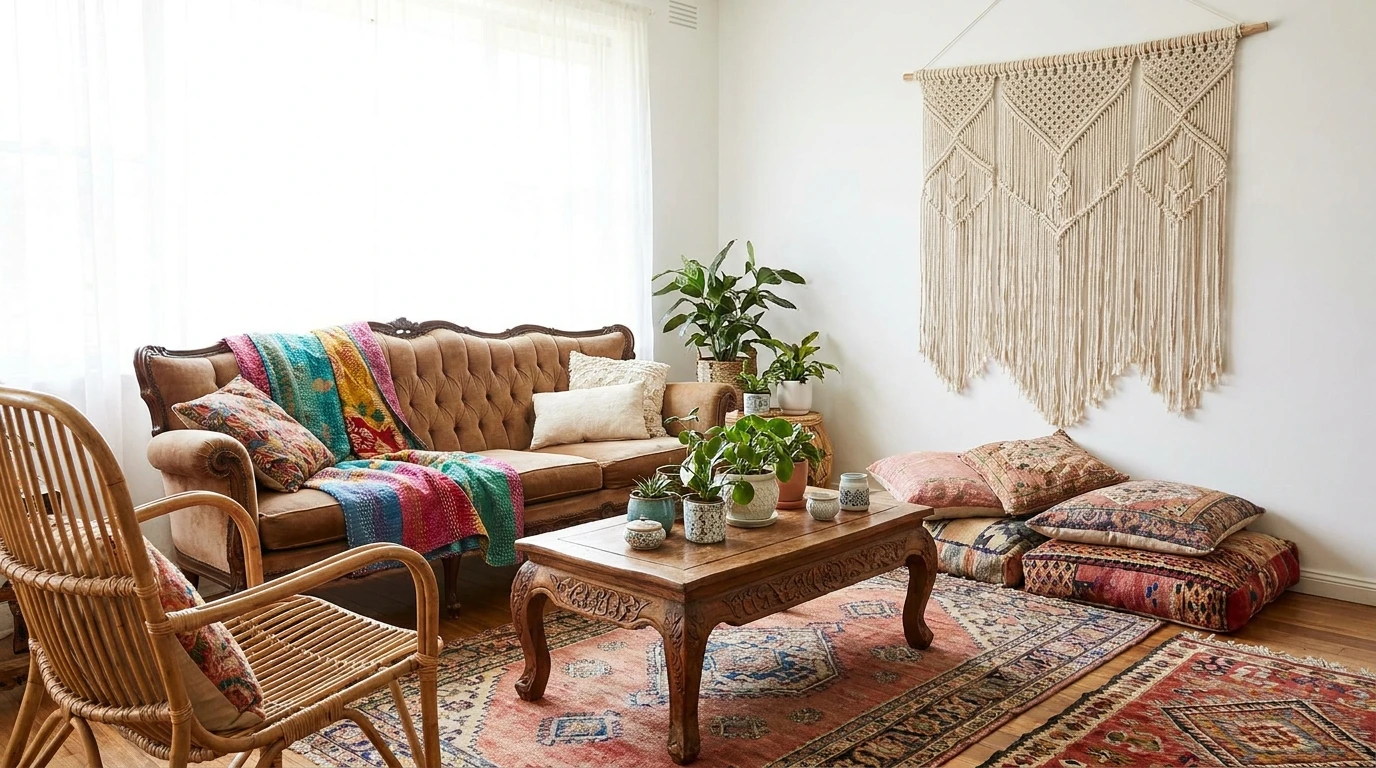
There’s a very specific kind of tired that comes from staring at a living room that has nothing in it. A sofa. A rug. A throw pillow in a shade described as “oatmeal.” A single plant, chosen because it’s hard to kill, doing its best in the corner. Technically a room. Technically fine.
Fine is not the point.
Bohemian interiors get dismissed as messy or overwhelming by people who don’t understand what they’re actually doing. What they’re doing is committing. Every layered rug, every woven wall hanging, every terracotta pot is a decision made with intent. The mess isn’t an accident. It’s the whole idea.
The trouble is that most people who want a boho living room approach it like a shopping list. They buy the macramé. They buy the rattan. They wonder why it looks like a props room instead of a home. Bohemian design isn’t about objects — it’s about how those objects talk to each other. This post will show you how to make them speak the same language.
Texture Is Doing All the Heavy Lifting
Color gets all the credit in bohemian spaces. Look again. What’s actually making these rooms feel rich and alive isn’t the palette — it’s the texture layered so thoroughly that every surface has something to say.
When Everything Is Smooth, Nothing Is Interesting
Smooth walls, smooth sofa, smooth cushions. It reads as a showroom, not a home. The moment you introduce something rough — a jute rug, a terracotta pot, a chunky knit throw — everything else in the room wakes up. Texture works by contrast. One woven piece does almost nothing. The fourth woven piece is when the room starts to feel genuinely alive.
The mistake most people make is concentrating texture in one place. A macramé wall hanging over a linen sofa with silk pillows and a glass coffee table. The macramé looks like a costume in a room that doesn’t want it there. Spread texture across every layer — walls, floor, seating, surfaces — so the room feels consistent rather than decorated.
Natural Materials Over Manufactured Ones
Rattan, bamboo, jute, cotton, linen, dried grasses, raw clay, unfinished wood. These materials carry warmth in their surfaces the way synthetic versions never can. They age well. They soften. They develop character over time instead of just getting old.
This isn’t a rules issue — it’s a sensory one. Your hand on a rattan chair arm feels different from your hand on a lacquered MDF substitute. The room registers that. Guests register that. Commit to natural materials wherever possible, especially in the major pieces: sofa frame, coffee table, pendant shades, storage baskets.
The Floor Deserves More Than One Rug
A single flat-weave rug does the job and nothing else. Layer a vintage kilim over a jute base and suddenly the floor becomes part of the design. The key to layering rugs without chaos is scale — the base rug should be significantly larger, at least a foot of border visible on all sides. A worn vintage rug over a natural fibre base works almost without exception.
Colour in Bohemian Rooms Is a Relationship, Not a Rule
People reach for Pinterest boards labelled “neutral boho” and end up in a beige fog. Or they go the other direction, throw every warm tone they own at the walls, and wonder why it looks tiring. Neither of these is how colour actually works in bohemian design.
The Anchor Colour Does the Work
Every successful bohemian room has one colour that anchors everything else. In warm schemes it’s usually terracotta, rust, or deep burgundy. In cooler ones it might be teal, sage, or dusty violet. This colour appears more than once — in the rug, in a cushion, in a pot — but it never dominates. It holds the room together quietly while everything else gets to be interesting.
Pick the anchor colour first. Everything else is chosen in relationship to it.
Warm Tones Versus Warm Tones
The most common bohemian colour mistake is treating all warm tones as interchangeable. Mustard and terracotta fight unless there’s enough neutral between them. Rust and blush work because one is muted and one is deep. Before buying another cushion in a warm colour, put it next to what you already have. The room will tell you whether it fits.
Neutrals Are Not Boring Choices
White walls in a bohemian room are not a design failure. They’re a foundation. Cream walls with a warm undertone make every warm-toned object pop. Cool grey walls cool the room down and make jewel tones sing. The wall colour sets the temperature of the entire room. Choose it deliberately — it’s doing more work than any individual object you’ll place against it.
Bohemian Living Room Ideas
Midcentury Meets Maximalist Boho
Start with the floor. Herringbone parquet in warm honey oak is the design decision that makes everything else possible in this room — it brings midcentury energy before a single piece of furniture arrives. Lay a large Moroccan Beni Ourain rug with a cream ground and dark geometric linework at the centre of the room, partially overlapping with a second smaller kilim rug in warm rust and amber tones near one edge. The double-rug layering on parquet is intentional; the floor becomes a pattern conversation the furniture sits on top of.
Place a grey or mid-tone neutral L-shaped sofa as the foundation — the cool neutral is what allows the warm accessories to be as loud as they need to be. Layer the sofa with cushions in mustard velvet, blush velvet circles with pom-pom trim, and woven geometric cotton in beige and white. Drape a mustard wool blanket loosely over one end. Position a low teak or walnut rectangular coffee table in front, midcentury in its tapered legs and clean profile. A round burnt orange velvet pouf sits at one end of the arrangement as a free-standing colour anchor.
Along one wall, a vintage teak sideboard holds a record player, stacked art books, a few ceramics in terracotta and sage, and a table lamp with a warm amber-toned shade. Tall cacti and tropical plants at window level and in the corners create the density that pulls the room away from midcentury precision and into bohemian warmth. Two framed abstract prints in blush and orange lean against the wall above the sideboard rather than being hung — this keeps the arrangement feeling lived-in and adjustable.
Basket Gallery with Botanicals
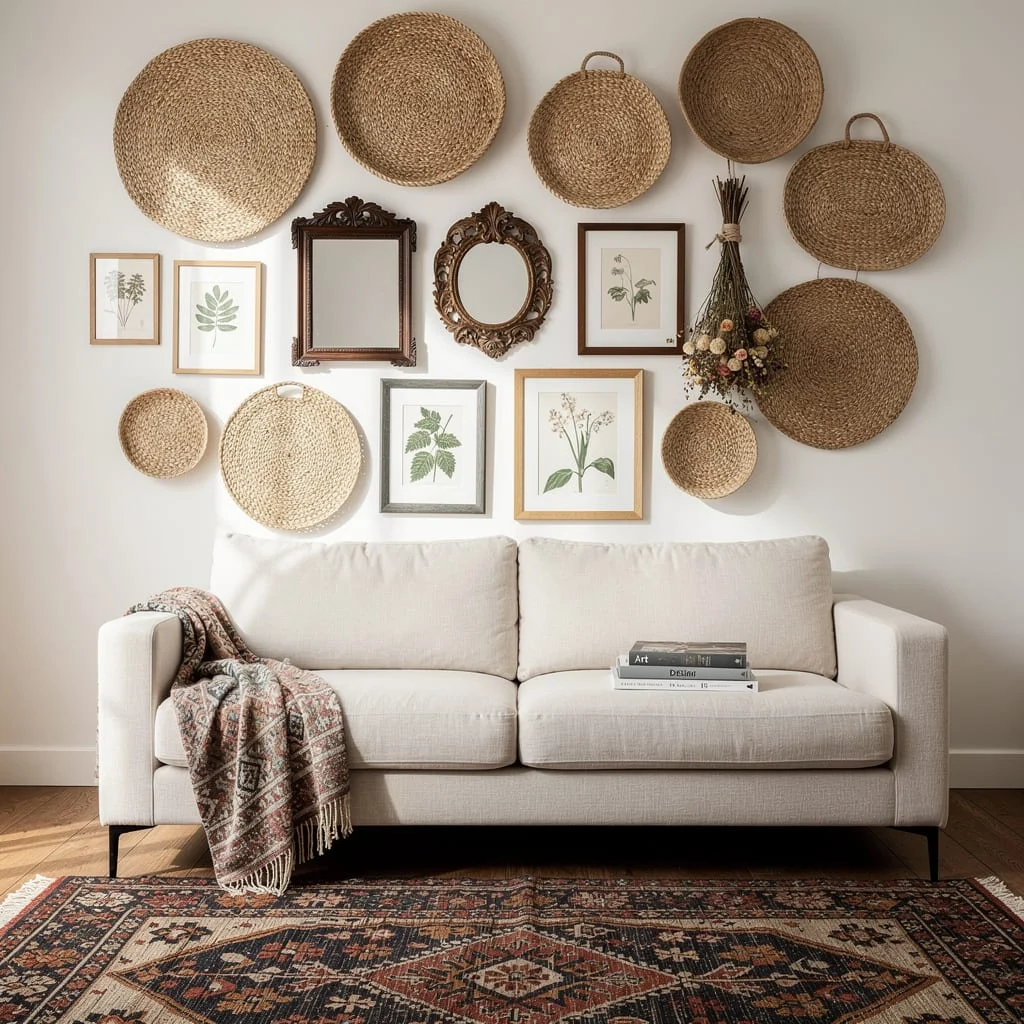
Collect woven wall baskets in three sizes: large round seagrass plates at 45–60cm diameter, medium oval or round baskets at 25–35cm, and smaller accent pieces with handles or decorative weaving. You need at minimum eight pieces, ideally twelve, to achieve the density that makes this wall feel considered rather than random. Hang them in an organic, asymmetric arrangement beginning just above sofa height and extending upward toward the ceiling, leaving deliberate breathing room between each object.
Intersperse the baskets with vintage frames in dark wood — carved oval mirrors, simple rectangular frames, and one ornate gilded frame — and two or three small botanical prints in mismatched frame sizes. The mixture of reflective surfaces and flat art among the woven baskets creates depth the baskets alone cannot. Wire a small bunch of dried flowers through one basket handle as a colour break in the arrangement; dried lunaria or pampas sprigs work well without overpowering.
Below the wall arrangement, place a contemporary white or cream sofa with clean modern lines and slim black legs. The pale, structured sofa creates deliberate contrast that allows the wall composition to perform. Add a single woven throw draped over one arm and a stack of two coffee table books on the seat cushion. A large dark-toned vintage kilim rug anchors the seating area and repeats the warm earthy tones from the dried botanicals above.
Pallet Coffee Table Attic Room
In an attic or loft space with exposed A-frame beams and a rooflight, the architecture already has personality — your job is to furnish in a way that works with the angles rather than against them. Source a pallet coffee table or one made from reclaimed scaffold boards or rough-sawn timber, with visible grain and knots left untreated or finished with a single coat of matte oil rather than varnish. Place it at the centre of a large Beni Ourain rug — cream ground, dark hand-drawn geometric lines — and cluster candles in glass hurricane holders on its surface at two or three heights, adding one small trailing plant in a terracotta pot.
The sofa should be a large, low, overstuffed sectional or deep-cushioned corner unit in off-white or cream. It needs to feel like it can absorb you — deep cushions, loose back pillows, arms low enough to sleep on. Layer it with cushions in charcoal grey, natural undyed linen, and woven cotton with a subtle geometric print. A knit pouf in oatmeal or warm grey sits at one end of the coffee table. Small wooden side tables on either end of the sofa hold individual candles and a glass of water.
From the beams, hang one or two small pendant lights on long fabric cables so they drop low enough to create intimacy overhead despite the high pitch of the roof. Use warm amber filament bulbs. Line the lower walls — below the point where the roofline begins to angle — with plants: pothos, ferns, and rubber plants in a mix of terracotta and dark ceramic pots. The skylight is your primary light source during the day; at night the candles, pendant lights, and one floor lamp with a warm shade take over completely. The room should feel entirely different after dark.
Terracotta Arch with Bead Curtain
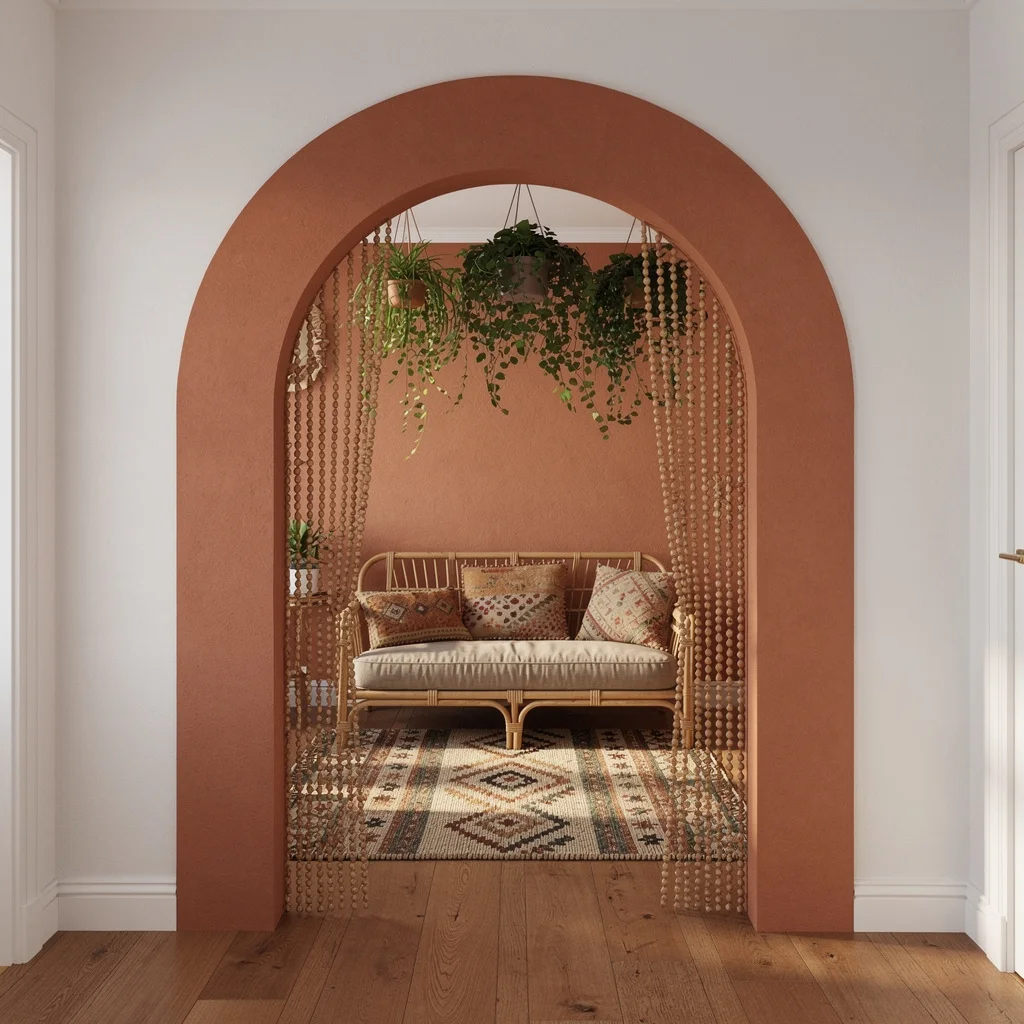
If you have an open doorway or archway between rooms, this is where the design investment goes. Paint the entire arch surround in terracotta or Venetian clay — not just the interior curve but extending outward at least 30cm onto the adjacent wall on all sides. This creates a colour block that frames the opening as an architectural moment rather than a functional gap. Use a flat or limewash finish for a textured, plaster-like result that reads as structural rather than painted.
Hang a wooden bead curtain — natural beads in a warm honey or pale natural finish — from a ceiling-mounted track set just inside the arch opening so the curtain falls within the terracotta frame. The beads should be round and consistently sized, not mixed decorative styles. Allow the curtain to part slightly in the centre rather than hanging straight across; this gives a glimpse of the room beyond and creates layered depth when viewed from either side.
Inside the room behind the arch, paint the walls in the same terracotta tone and furnish it sparingly: a rattan or cane daybed with cotton cushions, a small patterned kilim rug in warm geometric tones, and two or three hanging plants suspended from ceiling hooks at different heights. When viewed through the beaded curtain and arch from the adjacent room, the effect is of a warm, private inner space — a room glimpsed rather than entered. That sense of partial reveal is the whole point.
Sage Green Walls with Orange Sofa
Paint the walls in a muted sage or eucalyptus green — aim specifically for a grey-green rather than a bright botanical green. The grey undertone is what allows the orange sofa to pop without the room becoming chaotic; pure botanical green would fight the warm tones rather than set them off. Apply the colour in a flat or eggshell finish and check it against your floor tone — pale timber reads warm against sage, which is ideal.
Install open wooden shelving on the main wall using simple bracket-and-board shelves in warm walnut or stained pine, running floor to near-ceiling at intervals. Style the shelves with a layered mix: books in warm spine tones, terracotta pots of varying sizes with trailing plants, small framed oil paintings leaned against the shelf back, and a few ceramic objects scattered between. On the windowsill, line terracotta pots with herbs and compact-leafed plants. If a climbing plant can be trained to frame one side of the window opening, do it — the indoor-garden quality is central to the look.
Against the sage walls and warm wood shelving, position a wide, low sofa in deep mustard gold or burnt orange velvet. The complementary contrast — cool grey-green against warm orange — is the room’s thesis. Add large red cushions on the sofa to push the warmth further and create a colour gradient from the rust-orange sofa body to the deeper red of the cushions. Keep the floor in pale-toned timber boards and use no additional rug — the floor lightness stops the room becoming too heavy across the lower half and lets the wall colour read clearly from any seat in the room.
Macramé Over Rattan Sofa
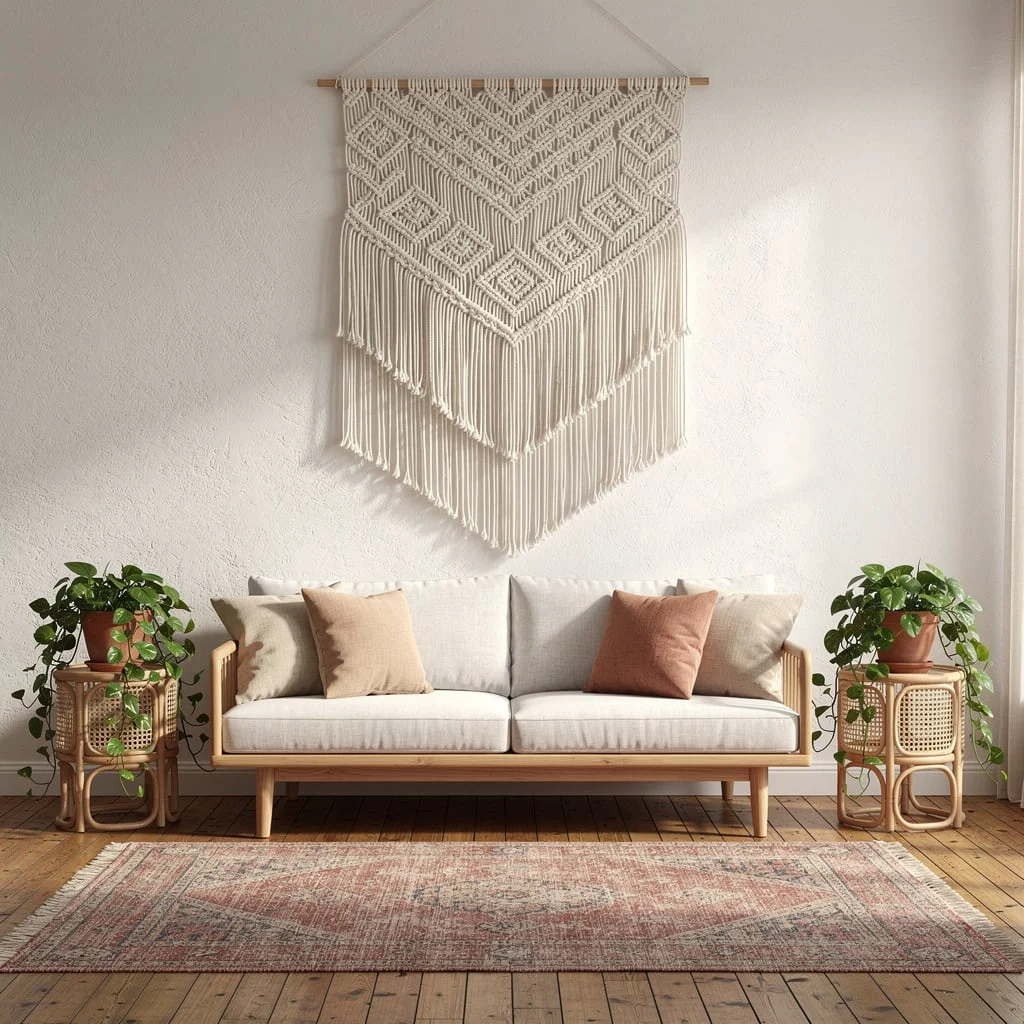
Hang a large macramé piece — minimum 60cm wide, ideally wider — from a natural wood dowel positioned directly above the sofa. The dowel should sit at least 30cm above the sofa back so the fringe has room to fall before it meets the cushions. Choose a macramé with geometric diamond knotting rather than simple fringe-only designs; the layered pattern earns its wall space in a way that a plain fringe never does. Mount the dowel with two small brass hooks drilled directly into the wall — the hardware should be visible and intentional, not hidden.
Below, use a rattan sofa with an exposed frame in natural or honey-stained wood, fitted with linen or cotton seat cushions in ivory or warm white. Add throw cushions in dusty blush and natural linen, keeping the tones quiet so the macramé stays the focal point. Flank the sofa with matching rattan side tables or plant stands at arm height, each holding a trailing pothos in a terracotta pot.
On the floor, lay a faded medallion rug in dusty rose and terracotta — the worn tones pull the warm blush from the cushions down to ground level and tie the whole vertical arrangement together. The rug should be large enough that the sofa sits fully on it with at least 30cm of rug visible in front of the sofa legs. Two plants, one on either side of the sofa, keep the arrangement grounded without cluttering it.
Orange Tufted Chair in Purple Room
Paint the walls in a deep, saturated violet — not lilac, not dusty lavender, but a committed jewel-toned purple with a blue undertone. A pure amethyst or grape works; add a small amount of cobalt in the mix if the paint leans too red. Use a flat or matte finish so the colour reads as rich and enveloping rather than shiny and hard. Apply two full coats and check in both natural and artificial light before committing — violet shifts significantly depending on the light source.
Against this wall, position a large tufted armchair in burnt orange velvet — deep button-tufted cushioning, low rolled arms, and claw or bun feet if possible. The orange-on-purple is a direct complementary contrast that registers immediately and confidently. On the chair, layer two cushions: one in a mixed painterly blue-purple textile and one in a flat deep purple velvet. Surround the chair on the floor with large-leafed tropical plants in terracotta pots — bird of paradise, split-leaf philodendron, or large palms. The density of the plants softens the intensity of the wall colour without diluting it.
On the wall above and around the chair, hang botanical and floral oil paintings in mismatched dark wood frames — gilded oval, simple rectangular, ornate carved — arranged informally so they read as accumulated rather than installed. Leave the frames at slightly varying heights. On a narrow ledge or shelf at one side, add pots of flowers and a ceramic vase. The window and door frames should be painted in dark teal or forest green to complete the jewel-tone palette and frame the space as a deliberate colour environment rather than a single saturated accent.
White Brick Fireplace With Earthy Vases
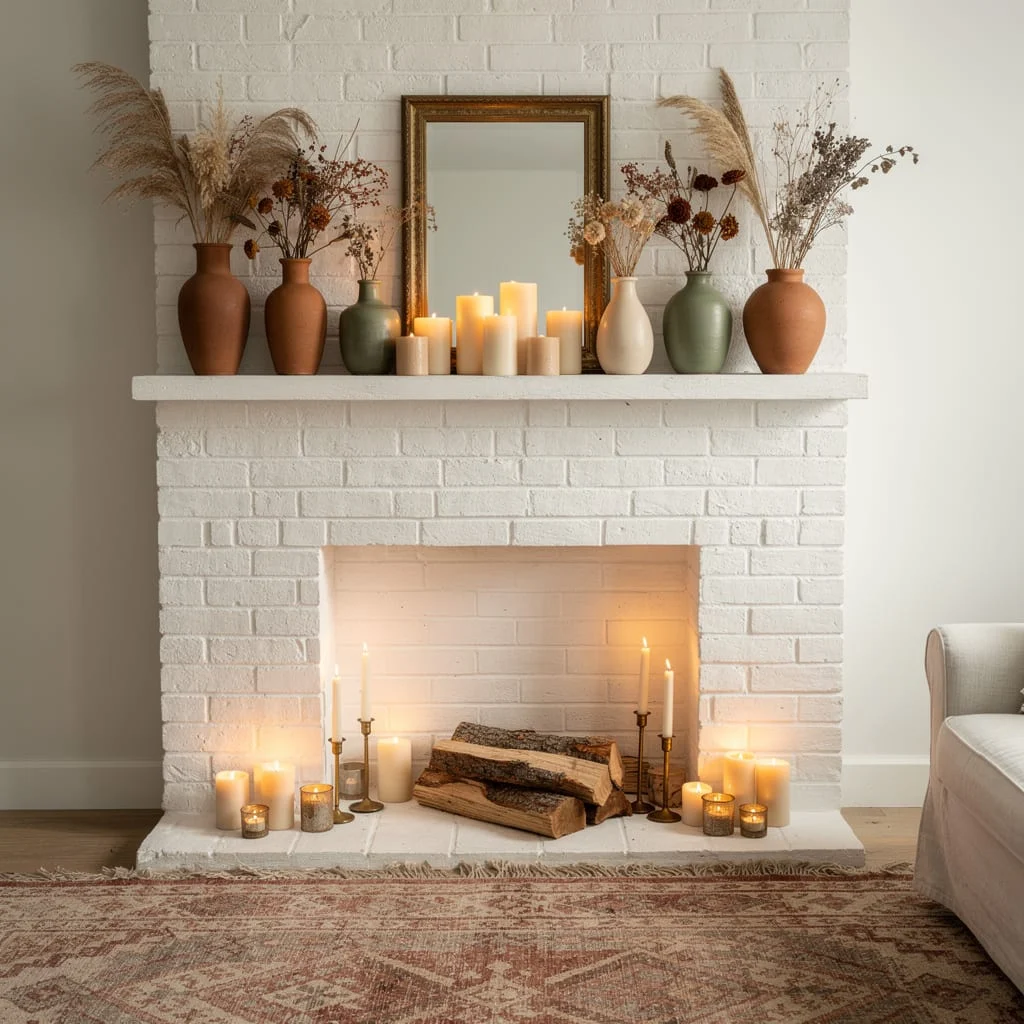
Paint the entire fireplace structure white — not just the mantel shelf but the full brick surround, the inside face of the firebox opening, and the hearth platform. Use masonry paint in a flat or matte finish in pure white with no warm undertone; the warmth will come entirely from the objects placed on and around it. Two coats are usually sufficient on existing brick; three if the original brick is very dark.
On the mantel, arrange a mix of ceramic and clay vases at varying heights — tall-necked terracotta forms at the ends, medium sage green or matte olive vessels toward the centre, and one slim white ceramic as a neutral break. Fill each with dried botanicals: pampas grass in the tall pieces, dried dahlias and seed heads in the medium vases, and small dried herb bunches in the shorter ones. Lean a gold or gilt-framed mirror, modestly sized, slightly off-centre among the vases rather than centred above the mantel — the asymmetry makes the arrangement feel collected rather than staged.
Inside the firebox, build a full candle installation rather than relying on logs alone. Lay two or three split logs flat on the hearth floor as a base, then cluster pillar candles in cream and white at varying heights around and in front of them. Add two tall brass taper candlesticks on either side and scatter several small mercury glass votives across the hearth platform. The combination of white brick, warm candlelight, and organic dried botanicals makes the fireplace the visual anchor of the entire room without a single item of furniture.
Coloured Glass French Doors
The single most transformative element in this look is doors fitted with coloured textured glass panels. Source or commission French doors — double doors with a full-height grid of small panes — and replace the standard glass with a mix of coloured textured panels: red, yellow, teal, green, and frosted clear, arranged asymmetrically across the grid. Use cathedral glass or hand-rolled glass rather than smooth flat coloured glass; the texture diffuses and shifts the light in a way smooth panes don’t. When afternoon sun moves through, the room fills with coloured light that changes as the day progresses.
Keep everything else in the room deliberately calm so the doors perform without competition. Use a cream or off-white sofa with a low profile, and style it with cushions in warm tones — soft green, dusty pink, and one stripe pattern in coral and sage. On the coffee table, a green glass vase with fresh flowers, a small ceramic bowl, and a single lit candle. Underfoot, a large rug with a faded floral or geometric pattern in rose, rust, and cream grounds the seating area without introducing a competing focal point.
On the wall beside the doors, frame two Matisse-style botanical poster prints in thin natural wood or warm gold frames. Install a simple floating shelf at one end of the room with a trailing plant, a small terracotta pot, and a red ceramic vessel that picks up the red glass in the doors. A single pendant lamp in matte olive or dark green hangs above the coffee table and reinforces the warm botanical palette. The room works because every other decision is in service of the doors — not competing with them.
Curved Sofa with Woven Pendants
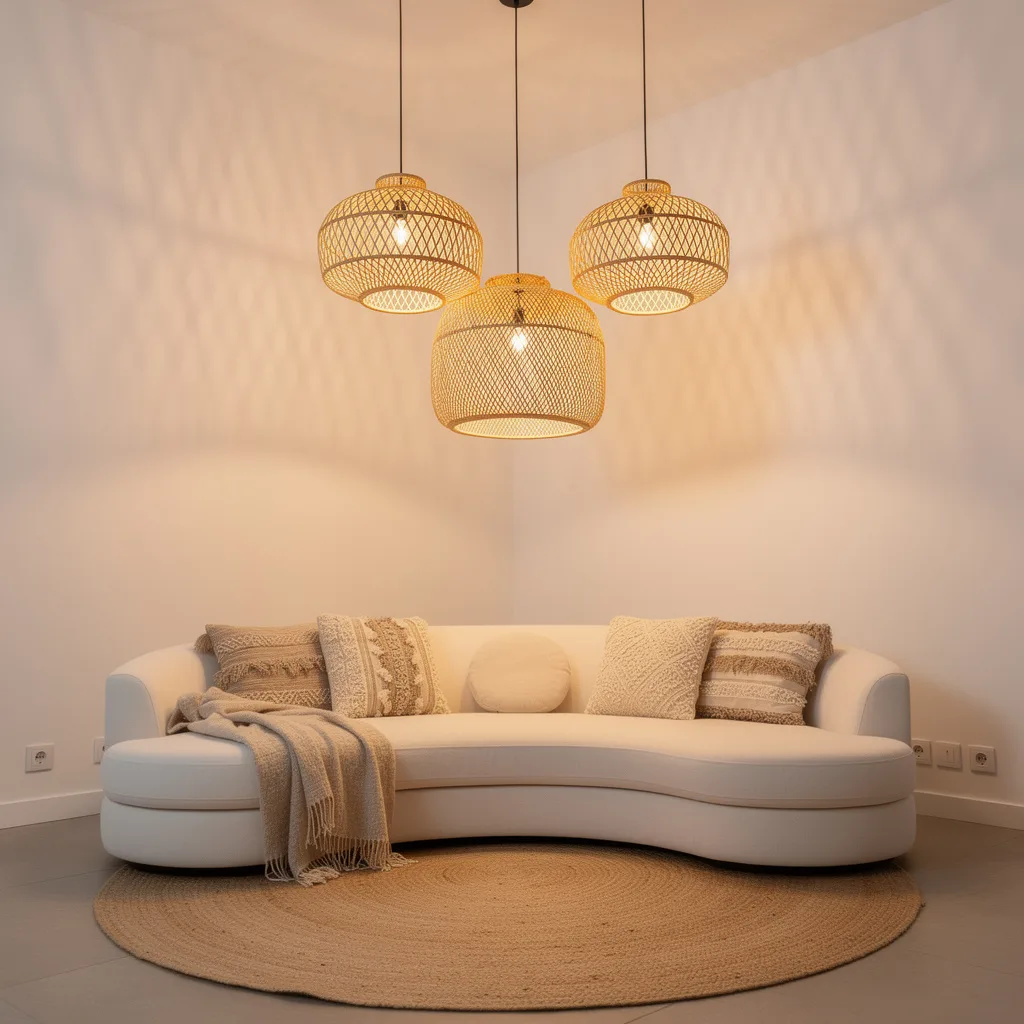
Source a curved or kidney-shaped sofa in off-white, cream, or warm ivory — the rounded silhouette is what separates this look from a standard neutral living room. Position it on a round jute rug sized generously enough that the sofa sits fully on it with the rug extending past the sofa’s curve on all sides. Avoid square or rectangular rugs here; the round rug reinforces the curved logic of the sofa and keeps the composition coherent.
Above the sofa, install a cluster of three rattan or tightly woven bamboo pendant shades on separate ceiling hooks or a single cluster canopy. Hang the central shade lowest — around 120–130cm from the floor — with the two outer pendants 15–20cm higher. The asymmetric drop creates movement overhead. Use Edison-style filament bulbs at a low wattage; the warm amber glow combined with the woven shade casts latticed shadows across the walls and ceiling that change quality throughout the day.
Keep the cushion styling tonal and textural rather than colourful. Layered cushions in oatmeal, undyed cotton, fringe-trimmed natural weave, and one small cylindrical bolster in the same family of tones give the sofa enough dimension without introducing colour that would compete with the pendant installation above. A single woven throw in warm grey-beige drapes over one curved arm. The room should feel like a single material palette — all natural fibre, warm light, pale walls — with the only drama coming from the pendant cluster and the sofa’s shape.
All-Rattan Living Suite
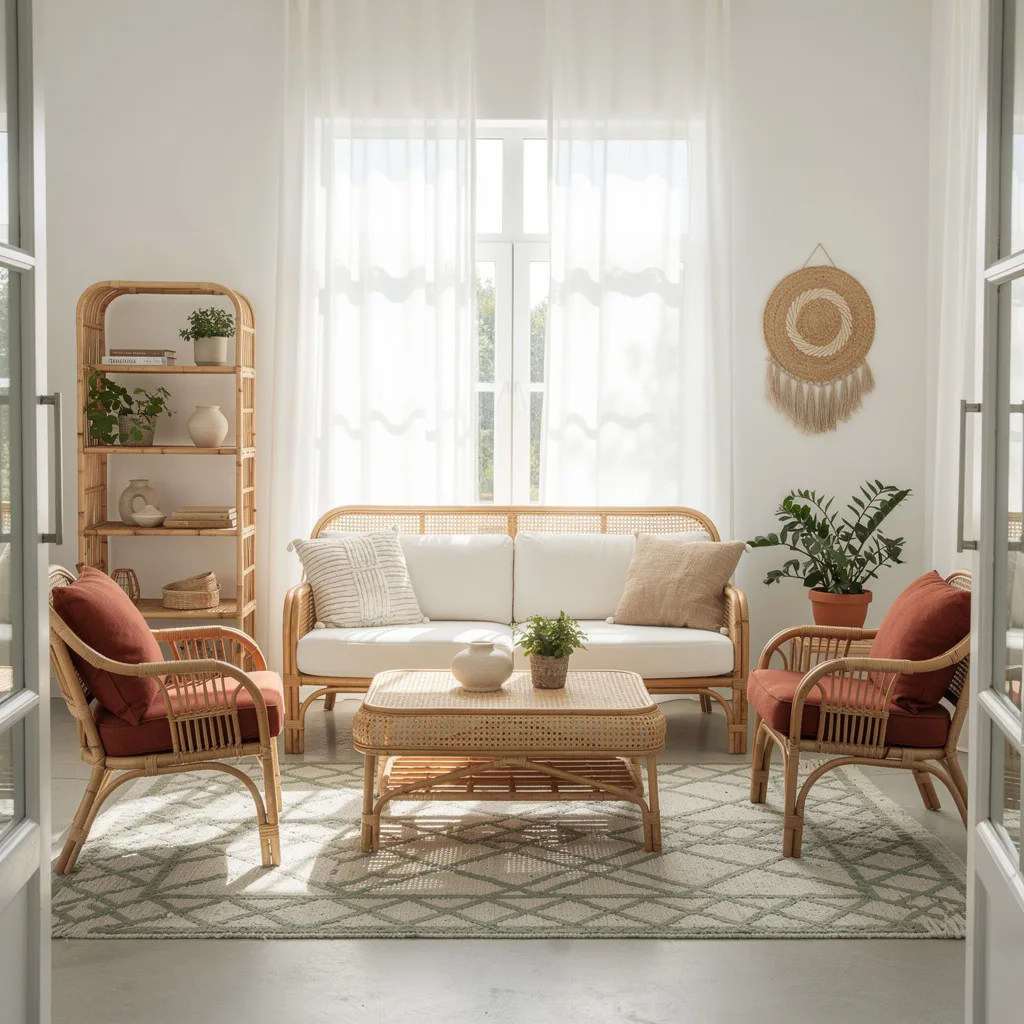
Commit to rattan across every major piece in the room — the sofa frame, two armchairs, the coffee table, and a tall open bookshelf along one wall. This only works if all the rattan shares the same tone; natural honey or pale straw is the most versatile. Avoid mixing dark-stained rattan with natural pieces in the same room — the tonal inconsistency undermines the material unity that makes this look cohesive.
For upholstery, use clean white on the sofa cushion pads and choose a deep rust or terracotta for the armchair seat pads. This creates a visual hierarchy — the sofa reads as the calm anchor, the chairs as the warm accent — without introducing any material that breaks from the natural palette. Keep the coffee table bare or with one small ceramic object and a low potted plant in a terracotta pot.
The walls need to stay very pale — near-white or warm cream — and the window treatments should be sheer white linen that diffuses light rather than blocking it. A single small round woven wall hanging hung on the wall opposite the windows and one large-leafed plant in a terracotta pot in a corner keep the room feeling alive without adding visual noise. This is a room where restraint does the heavy lifting; the material consistency is the statement.
Floor Cushion Seating Corner
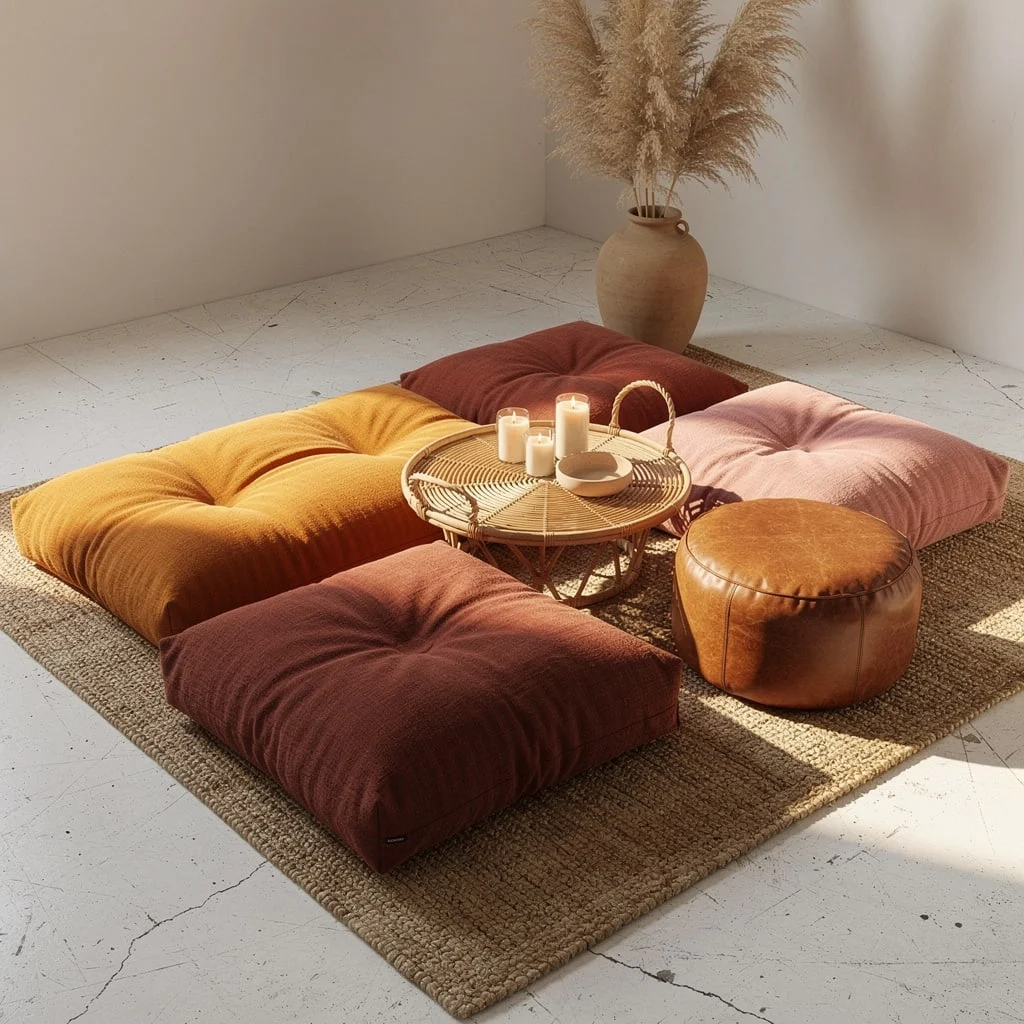
Source four large floor cushions in a tufted or bouclé-weave fabric — minimum 70x70cm each, ideally 80x80cm — in a spice palette: deep burgundy, mustard yellow, faded rust, and dusty pink. Arrange them in a loose square on a jute or sisal rug, leaving a gap at the centre large enough for a low rattan tray table. The cushions should not be arranged in a precise grid — slight variation in alignment makes the corner feel inhabited rather than set-dressed.
On the rattan tray table, cluster three unscented pillar candles at varying heights — one tall, one medium, one squat — alongside a small ceramic bowl and a long match holder or matchbox. In the corner behind the arrangement, place a tall terracotta floor vase at 1.5 to 1.8 metres height filled with dried pampas grass. This becomes the vertical anchor that stops the low-floor arrangement from looking unfinished.
A small tan leather pouf tucked between two of the cushions doubles as extra seating or a surface for a drink. Keep everything else in the immediate area out of the frame — this corner works as a secondary seating space in a larger room, or as the primary living arrangement in a compact flat. The quality of the cushion fabric matters more than most people realise; cheap hollow-fill cushions will collapse under use and look deflated within weeks. Choose a dense fill — cotton batting or kapok — so they hold their shape and look full even after sitting on them.
Blue Velvet Sofa, Layered Richly
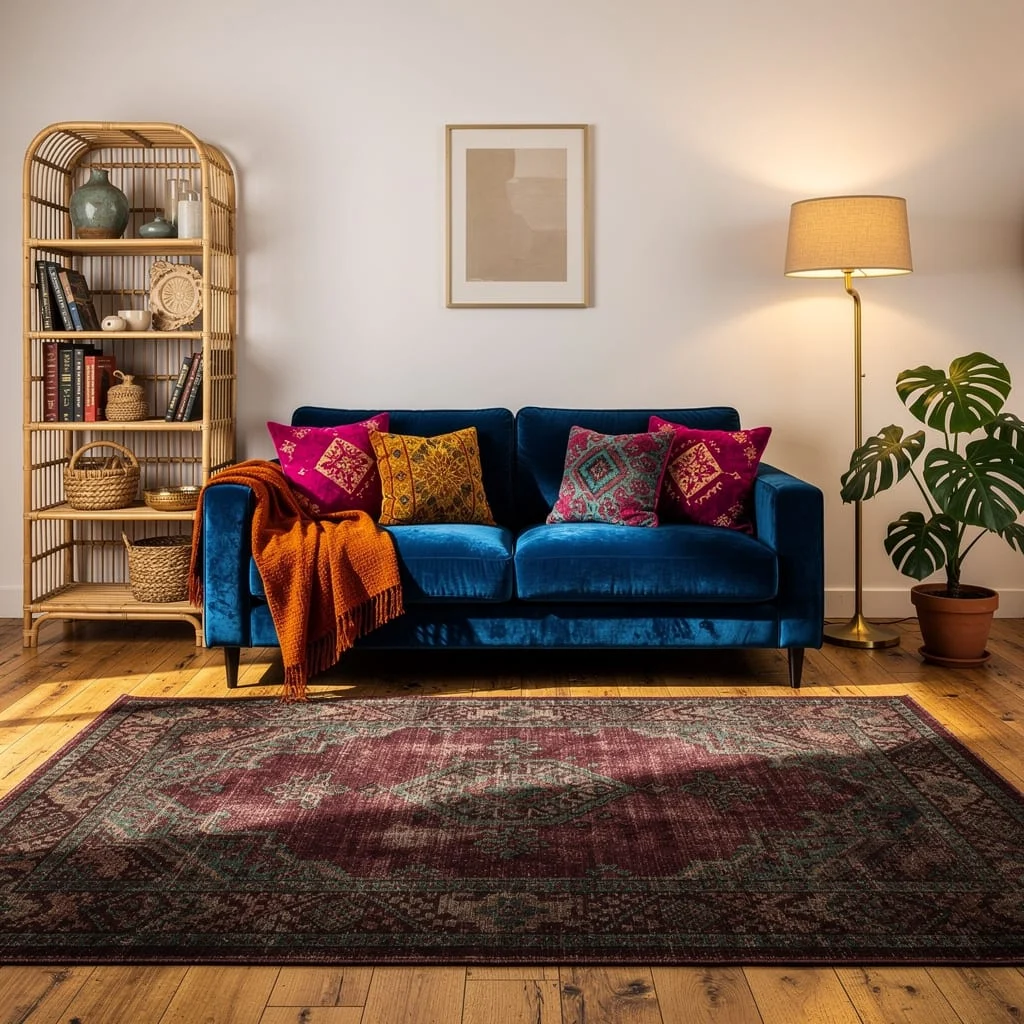
Start with a deep sapphire or indigo velvet sofa — this is the investment piece the entire room responds to, so choose the colour carefully. It needs to be genuinely saturated, not dusty or greyed-down. Position it against a pale wall, ideally white or warm cream, so the depth of the velvet reads clearly. In front, lay a large vintage or vintage-style medallion rug with a dark burgundy or wine-toned field — the rug ties the jewel tones of the cushions and sofa to the floor without competing.
On the sofa, layer cushions in a mix of fuchsia, mustard, and teal — combining embroidered silk or cotton with woven geometric patterns and one smaller solid velvet in a contrasting tone. Use five to six cushions in total, mixing sizes between large square, medium square, and one long rectangular lumbar. Drape a deep orange or burnt amber throw loosely over one arm; the orange against the blue is a direct complementary contrast that reads as intentional rather than accidental.
Flank the sofa with a tall rattan bookshelf on one side, styled casually with books in warm-toned spines, a few ceramics, and one trailing plant. On the other side, position a warm brass or aged-gold floor lamp with a fabric shade in natural linen. Keep the rest of the room spare — the sofa is doing all the work, and the more you add around it, the less it lands. One large plant in the corner opposite the bookshelf is enough.
Boucle Sofa with Brass Coffee Table
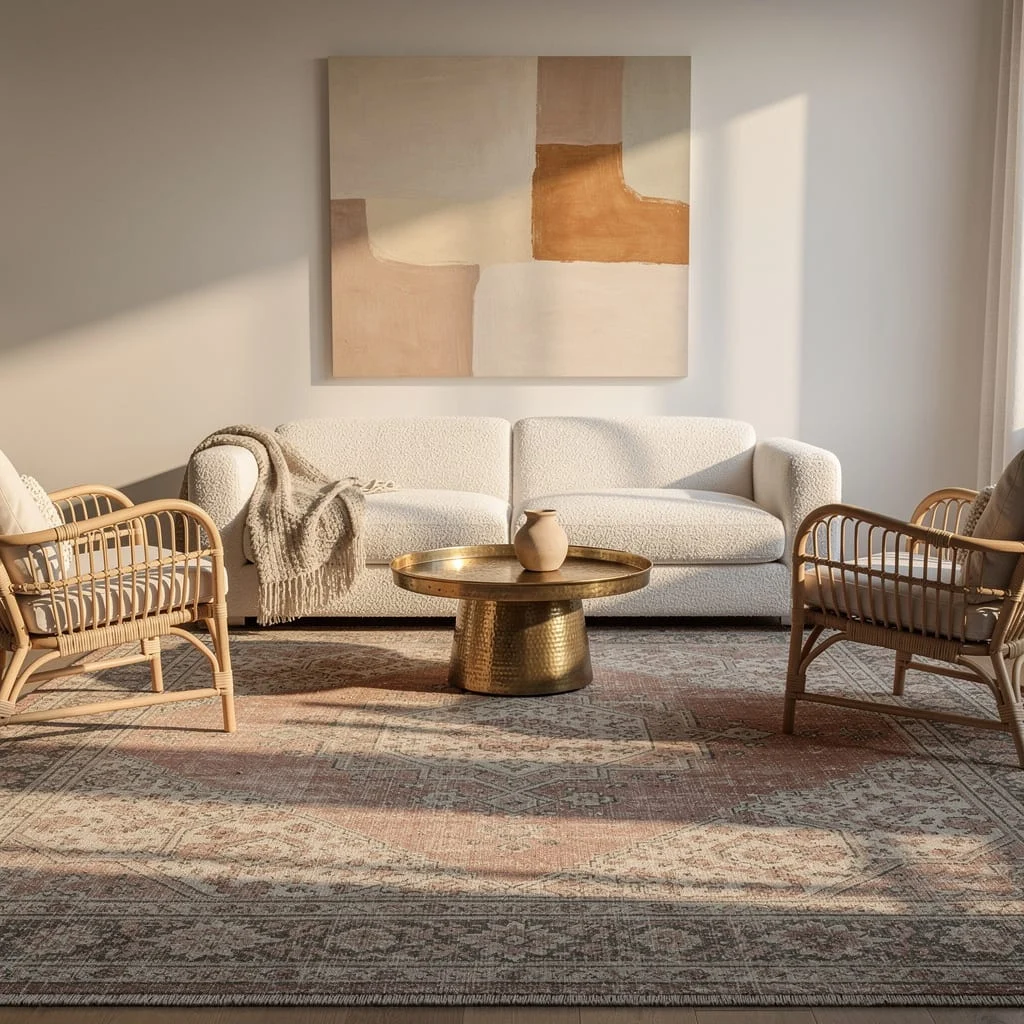
Choose a boucle or heavily textured cream sofa with a low, modern profile and clean lines — the restrained silhouette counterbalances the warmth of everything around it. Position it against a pale wall and pair it with two rattan armchairs placed on either side, angled slightly inward to create a conversation arrangement rather than a row. The rattan chairs carry the natural-material texture while the boucle sofa stays refined.
At the centre of the arrangement, place a hammered brass coffee table with a shallow rimmed top and tapered legs. The hammered surface is the specific detail that matters — smooth polished brass reads as conventional, but the hammered texture resonates with the woven chairs and grounds the table in the natural-material palette of the room. On the table, a single small raw ceramic vase with one or two dried stems. Nothing else.
Behind the sofa, hang one large-format painting with gestural, loose shapes in blush, ochre, and ivory — something that reads as abstract but warm. Size matters: the painting should be at least two-thirds the width of the sofa. Underfoot, a large faded medallion rug in dusty rose and pale terracotta anchors the seating group and introduces a softly patterned layer beneath the clean furniture lines. This is the quietest end of bohemian design. It doesn’t announce itself. But every element is deliberate.
Layered Plant Corner
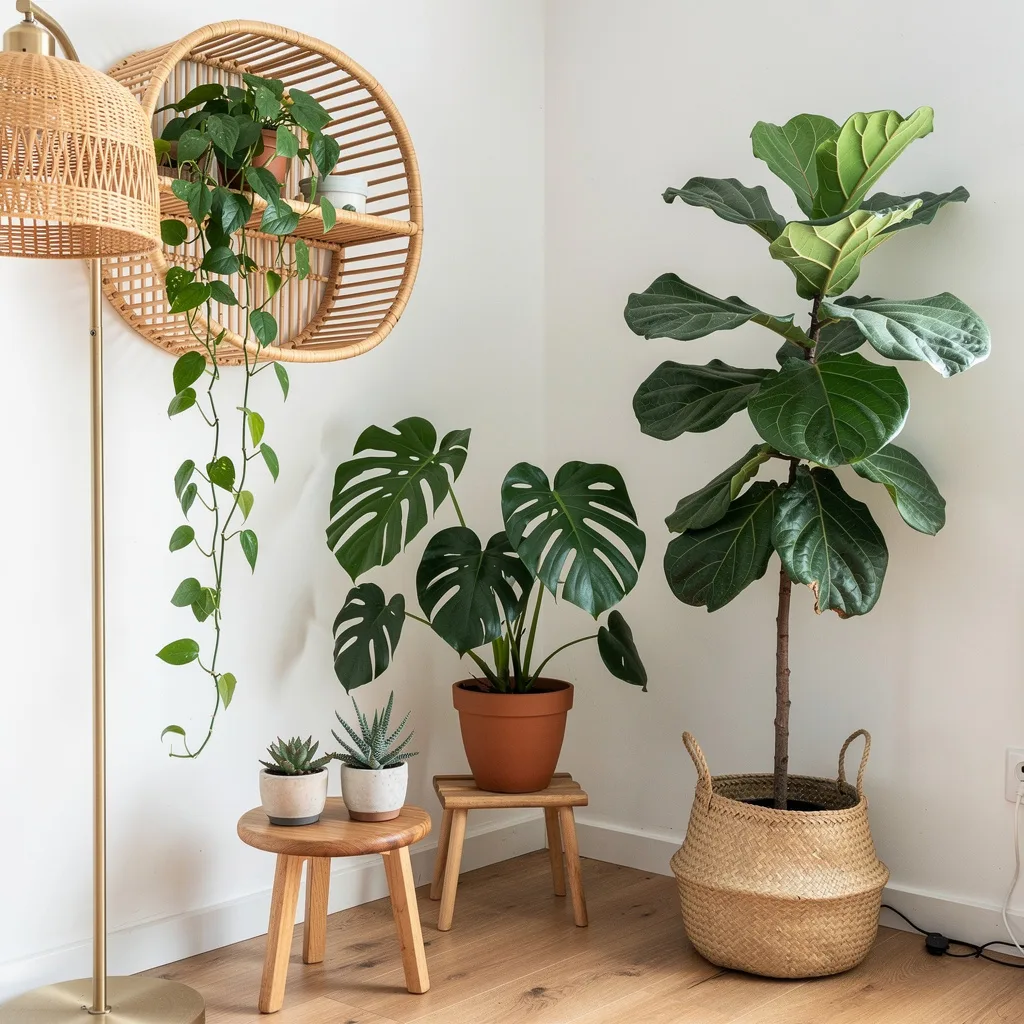
Select one corner of the room and commit to filling it with plants at three distinct heights. At floor level, a tall fiddle-leaf fig in a wide-mouth seagrass basket is the vertical anchor — it should reach 1.5 to 1.8 metres and have full, healthy foliage. Beside it at mid-level, place a monstera on a low three-legged wooden stool and two smaller succulents or a haworthia in white ceramic pots on the same surface or on a second step stool nearby.
At height, mount a round rattan wall shelf to the wall above the mid-level plants and trail a golden pothos from it, allowing the vines to hang freely down the wall behind the lower plants. This hanging trail is the element that transforms a plant collection into a designed corner — the vertical movement gives the arrangement life. A brass floor lamp with a woven or rattan shade stands on the left edge of the arrangement, framing the corner and providing focused warm light in the evening.
The pots should mix materials deliberately: one seagrass basket for the floor plant, one terracotta for the monstera, one ceramic for the small succulents. The variation in vessel keeps the arrangement from looking like a garden centre display. Water marks, soil traces, and mineral deposits on terracotta are not problems to be corrected — they are the evidence of a real, living room. Leave them.
Floor-to-Ceiling Warm Bookshelf
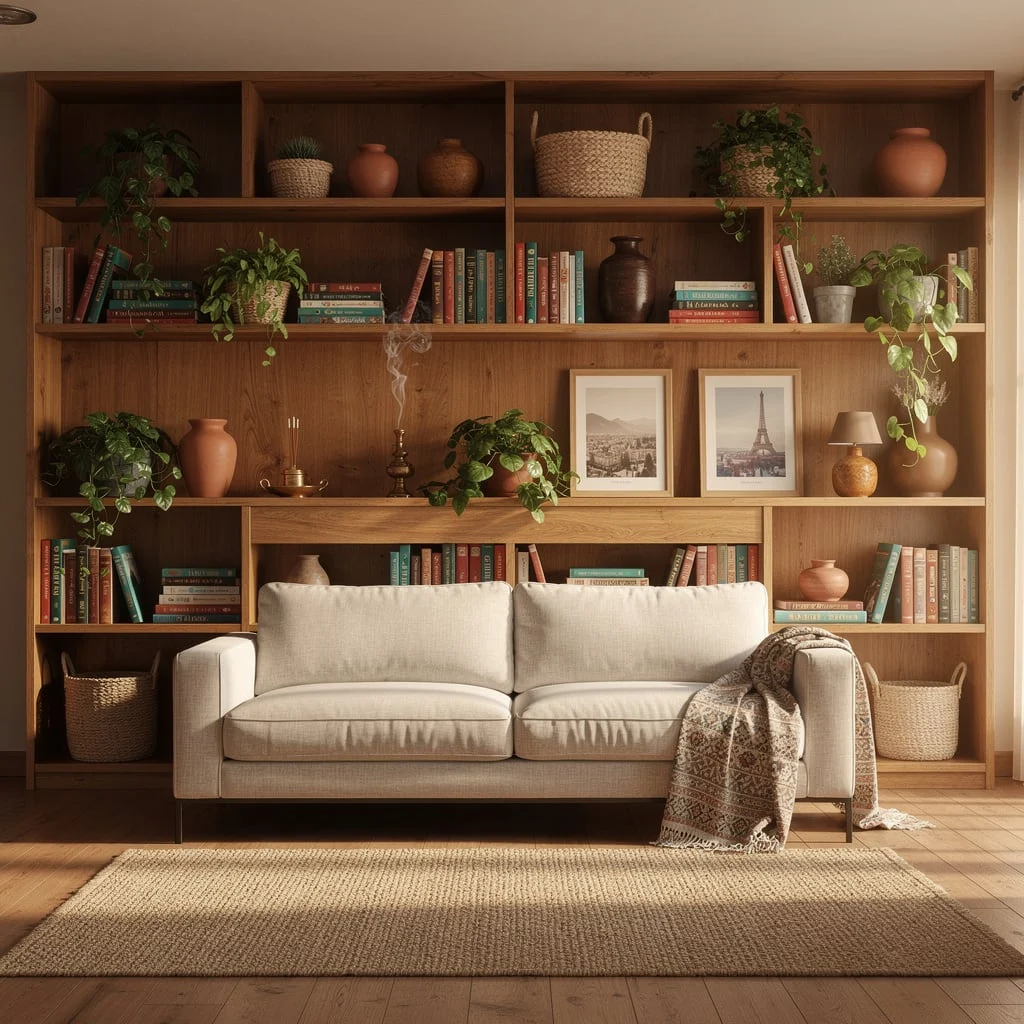
Commission or purchase a built-in shelf unit that covers the entire wall behind the sofa from floor to ceiling in warm walnut or medium-toned oak. The shelves should be open, between 30 and 35cm deep, and spaced irregularly — taller gaps for objects and plants, shallower gaps for books — rather than uniformly divided. Uniformly spaced shelves look like office storage. Variable shelf heights look like a library that has been used.
Style each zone differently so the eye travels across the wall rather than scanning it uniformly. Dedicate one shelf entirely to books organised loosely by colour: warm reds and terracottas at one end, greens and blues shifting toward the other. The shelf above holds three terracotta pots with trailing pothos or philodendron. A middle shelf holds framed travel prints leaned against the shelf back rather than hung, with a small brass incense holder and a ceramic beside them. Another shelf holds a large woven basket, a ceramic table lamp with a linen shade, and a cluster of small glass vessels.
Place a pale cream or ivory sofa in front of the shelving with its back to the wall unit — close enough that the shelves feel like an extension of the seating rather than a separate wall of stuff. A jute rug in natural tone grounds the sofa area, and a woven blanket thrown over one arm introduces softness without adding more visual information. The room’s warmth comes entirely from the wood tones and the carefully layered shelving behind you.
Hammered Brass Tray Table
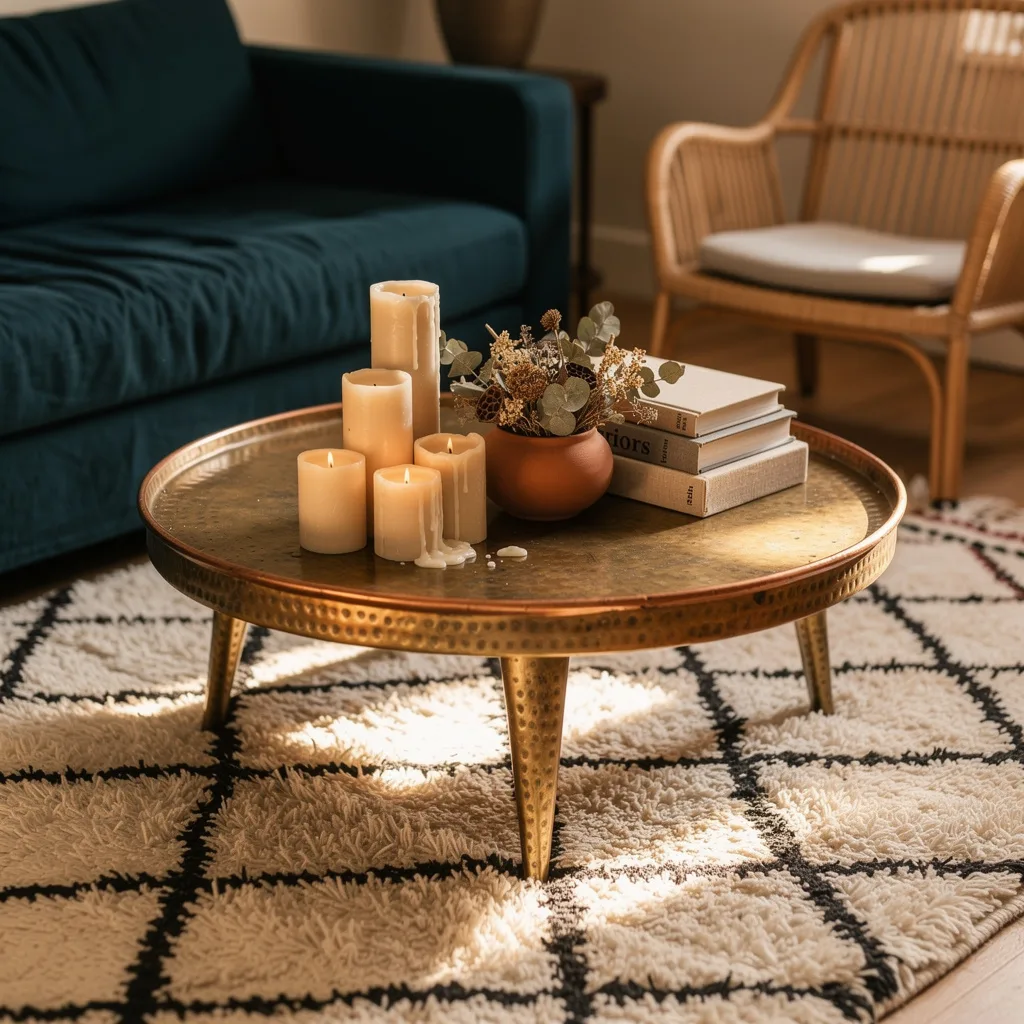
Source a round hammered brass tray table with tapered legs — the hammered finish is the defining detail and it needs to be genuine hammering, not a machine-pressed pattern. The surface should have visible variation in depth and strike marks. The legs should be slender and slightly angled outward; a heavy or straight-legged base will undermine the delicate quality of the top.
On the table surface, arrange five to seven pillar candles in cream and off-white at varying heights: two tall candles that have been burned and carry wax drip trails, two medium, two squat, and one small votive in a mercury glass holder. The used candles are not a sign of neglect — the wax drips are part of the aesthetic and evidence that the space is actually lived in. Alongside the candles, add a small terracotta pot holding a single stem arrangement of dried eucalyptus and lunaria, and a small stack of two art books with matte or cloth-bound covers placed at the far edge of the table.
Beneath the table, a Beni Ourain-style rug with a cream base and dark hand-drawn geometric linework provides grounding contrast to the warm metallic surface above. The Moroccan rug and the hammered brass together create a consistent material language across the floor and table that holds the arrangement together. A navy or teal sofa in the background — visible but not centred — completes the composition with a deep colour anchor.
Exposed Beams with Hanging Plants
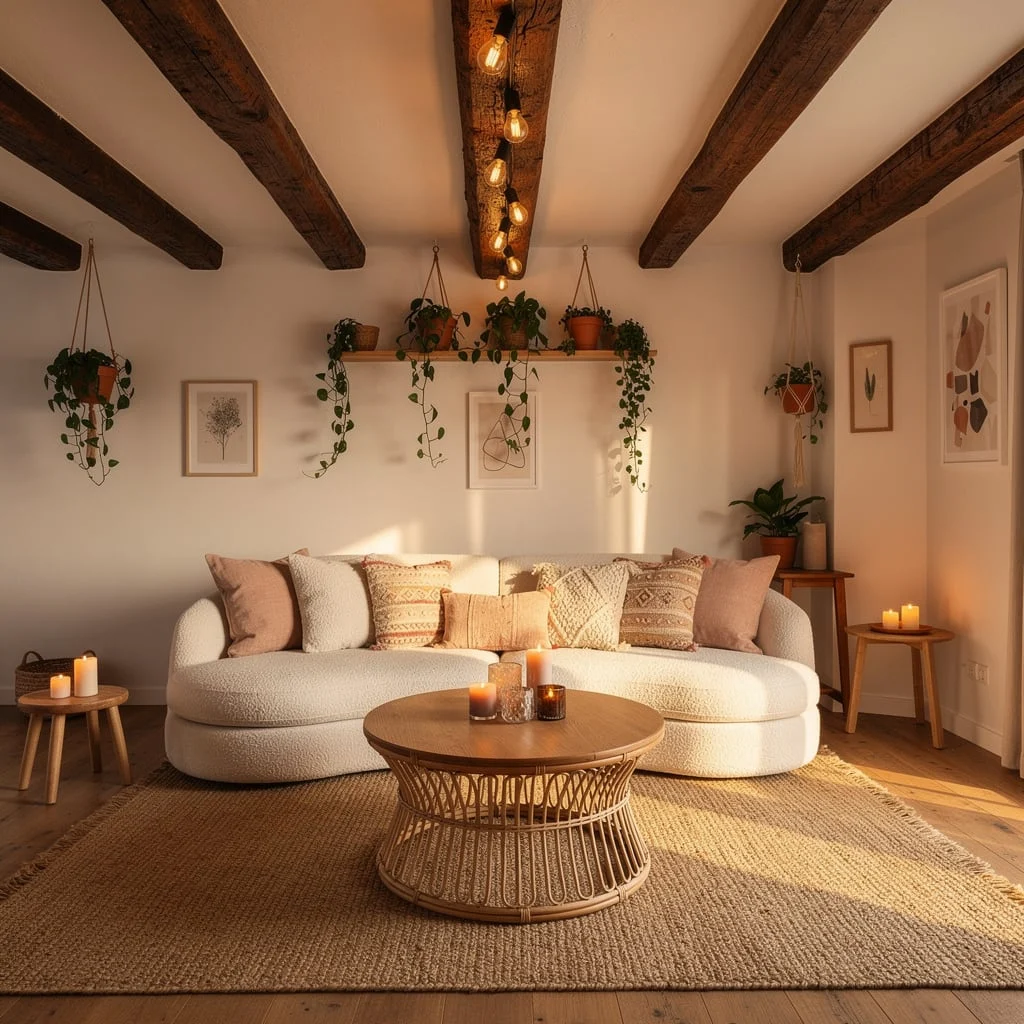
If the ceiling has exposed beams in dark-stained wood — or if you’re adding faux beams — this becomes the architectural element the entire room responds to. Install a simple floating shelf at 160–170cm height on the main wall running the length of the sofa. Use a shelf in warm walnut or raw wood that coordinates with the beam tone. Place trailing plants along the shelf spaced at 40–50cm intervals — pothos, string of pearls, and devil’s ivy all trail well — and allow the vines to hang down at different lengths so the wall below the shelf has organic movement.
From the beams themselves, hang two or three individual potted plants from lengths of jute rope at varying heights. Position them roughly above the sofa so the plants are visible from the seating area and create a canopy-like quality overhead. Between the hanging plants, drop a cluster of Edison filament bulbs on separate fabric-wrapped cables from one central beam hook, with the bulbs at three different lengths. This replaces a conventional pendant shade and allows the light source to integrate with the plants rather than competing with them.
Below, place a rounded cream or off-white boucle sectional sofa layered with cushions in dusty blush, warm beige, and one or two with subtle terracotta or ochre print. A low rattan coffee table at seat height holds three candles in glass holders and a small plant. On the floor, a large jute rug with a tasselled edge grounds the entire arrangement. The room should read as warm and slightly dim — a place that changes quality in the evening rather than staying the same under overhead light.
Final Thoughts
Every one of these rooms has something in common that isn’t immediately obvious when you’re looking at the individual objects. They’re all confident.
Confidence in a room isn’t about having the most expensive pieces. It’s about making choices that commit. Choosing a colour and going deep into it. Choosing a material and using it more than once. Deciding what the room is about and then making sure everything in it says so.
Bohemian design is forgiving of imperfection in ways that minimal design never is. A chip in a terracotta pot is fine. Wax drips on a candle are fine. Plants that have grown into each other’s space are fine. None of these things damage the room. What damages a room is ambivalence — half-committed colours, one lone textural piece surrounded by smooth surfaces, objects that don’t know why they’re there.
Know why things are there. Make choices that mean something. Your living room should feel like it belongs to someone with a point of view.
You have one. Use it.