
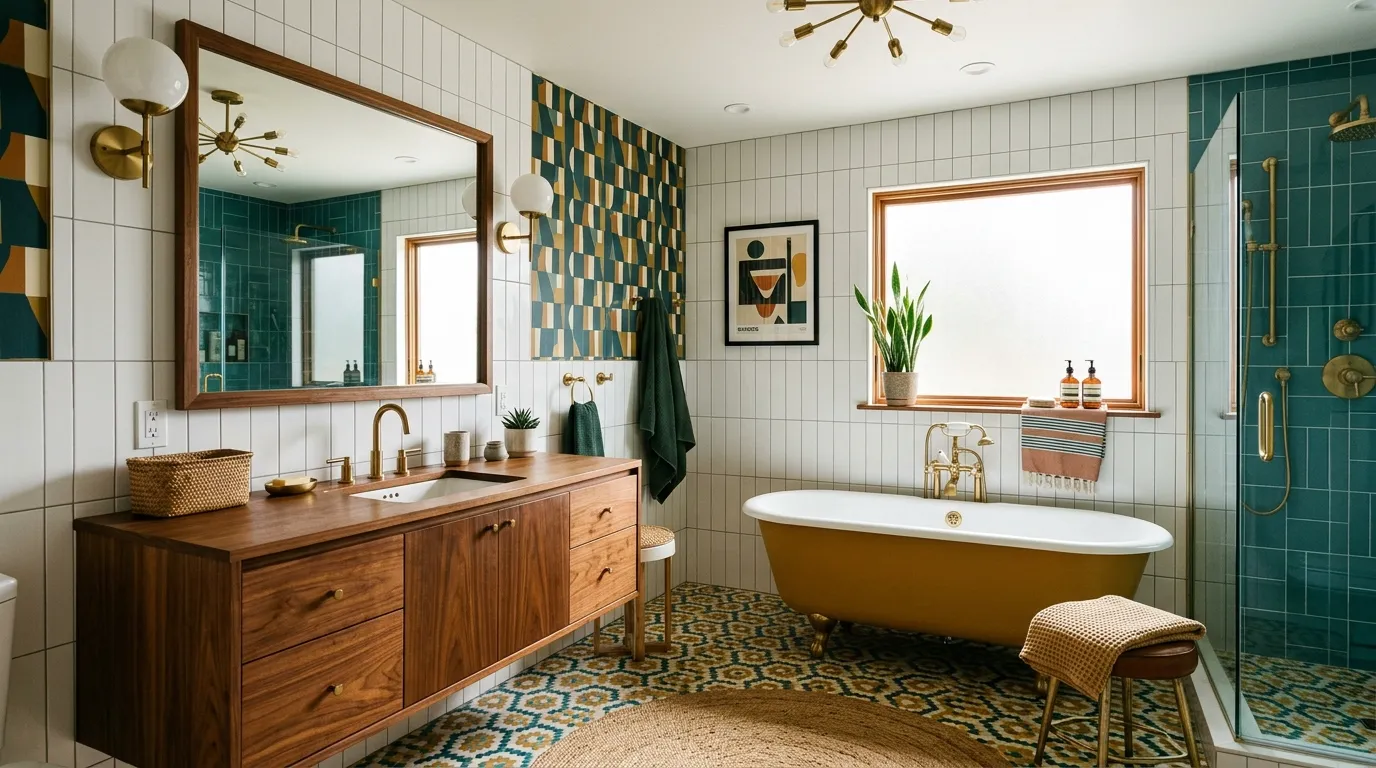
Most bathrooms don’t need more decoration. They need better decisions. That’s especially true with a mid century modern bathroom, where the wrong vanity, lighting fixture, or tile can make the room feel like a themed set instead of a real home.
The style works because it balances clean geometry with warm materials. Wood keeps white tile from feeling sterile. Rounded mirrors soften straight lines. Brass adds warmth without shouting for attention. The trick is knowing when to stop.
You don’t need every classic MCM detail in one room, either. In fact, that’s usually where the design goes wrong. Pick a few strong elements and let them carry the room.
The five ideas below start with the pieces that have the biggest visual impact. Get these right first, then layer in smaller details.
What Actually Makes a Bathroom Feel Mid Century Modern?
Clean Lines Matter More Than Retro Decorations
Mid-century style isn’t created by throwing vintage objects into a bathroom.
The strongest rooms use simple shapes, tapered forms, flat surfaces, and uncluttered layouts. A clean vanity with warm wood often says more than a shelf packed with retro accessories.
Think in shapes first:
- Straight vanity lines
- Rounded mirrors
- Simple cabinet fronts
- Slim hardware
- Unfussy lighting
That restraint gives the room room to breathe.
Warm Materials Keep the Bathroom From Feeling Cold
Bathrooms already contain plenty of hard surfaces. Tile, glass, porcelain, and stone can quickly make the room feel clinical.
Wood changes that.
Walnut, teak, and medium oak bring visual warmth without fighting the clean geometry that makes MCM work. Pair one strong wood tone with cream, warm white, or muted earthy tile and the room immediately feels more grounded.
The goal isn’t to make the bathroom rustic. It’s to give all those hard surfaces something warm to sit beside.
The Right Fixtures Do More Work Than a Theme
A single strong fixture can establish the style faster than ten decorative accessories.
A globe sconce, slim brass faucet, rounded mirror, or walnut vanity gives the eye something intentional to notice. The rest of the room can stay quiet.
That matters in a bathroom because clutter shows quickly. Keep the main pieces distinctive, then let the supporting finishes stay simple.
Mid Century Modern Bathroom Ideas
Embrace the Wood Paneling
Most people run from wood paneling like it is a contagious rash, but mid-century design demands you lean into the cringe. If you have the original, leave it. If you are faking it, commit to the darkness instead of trying to paint it white to save your soul.
That green tile is doing a lot of heavy lifting here. It creates a mood that says you appreciate history, even if your actual house was built in 2012. The key is using that intense green to anchor the space so the wood doesn’t feel like you are trapped inside a cedar chest.
Those slim linear sconces are better than standard globes for a change. They bridge the gap between the modern vanity and the vintage wall treatment. Just keep the vanity hardware simple, unless you really want your bathroom to look like a poorly curated antique store.
Pair a Walnut Vanity With Warm White Walls
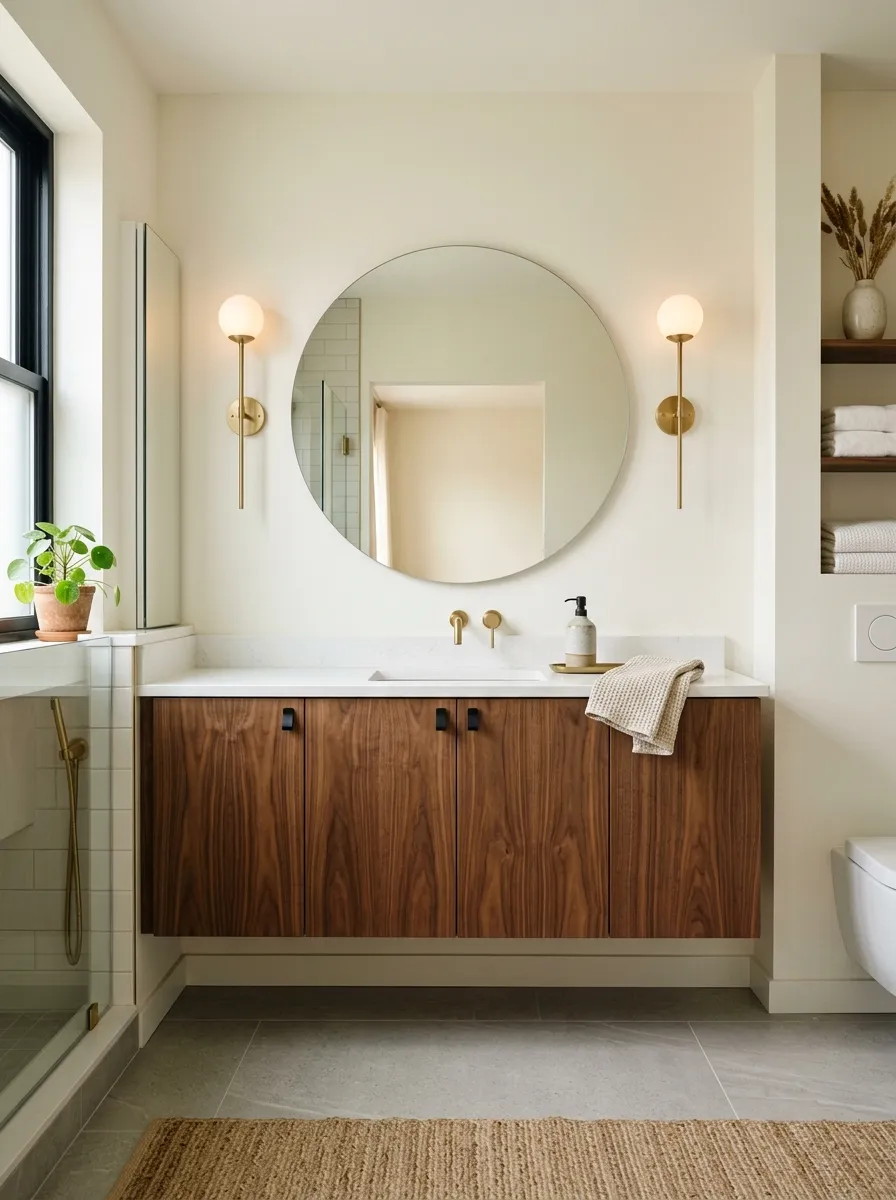
Walnut is one of the easiest ways to bring genuine mid-century warmth into a bathroom.
Against stark white, though, it can look harsher than intended. Use a warm white or soft cream instead. The small temperature shift makes the wood feel richer and keeps the room from looking like a showroom.
Keep the vanity front simple. Flat panels or minimal hardware work better than ornate doors.
Green Monochromatic Drama
If you are going to commit to one color, you better make sure you actually like it. This bathroom is aggressively green, but it works because it avoids the typical white subway tile trap that everyone else is obsessed with.
Open shelving is a bold choice for anyone who actually uses their bathroom for, you know, bathroom things. It forces you to keep your clutter hidden or curated, so choose your shampoo bottles wisely. Nobody needs to see your half-empty bottle of generic conditioner.
That shower setup with the dark tiles is essentially a sensory deprivation tank. It is moody, it is dark, and it is a nightmare to clean if you have hard water. Enjoy the aesthetic, but pray your cleaning lady appreciates your dedication to the mid-century look.
Use a Floating Vanity to Keep the Floor Visually Open
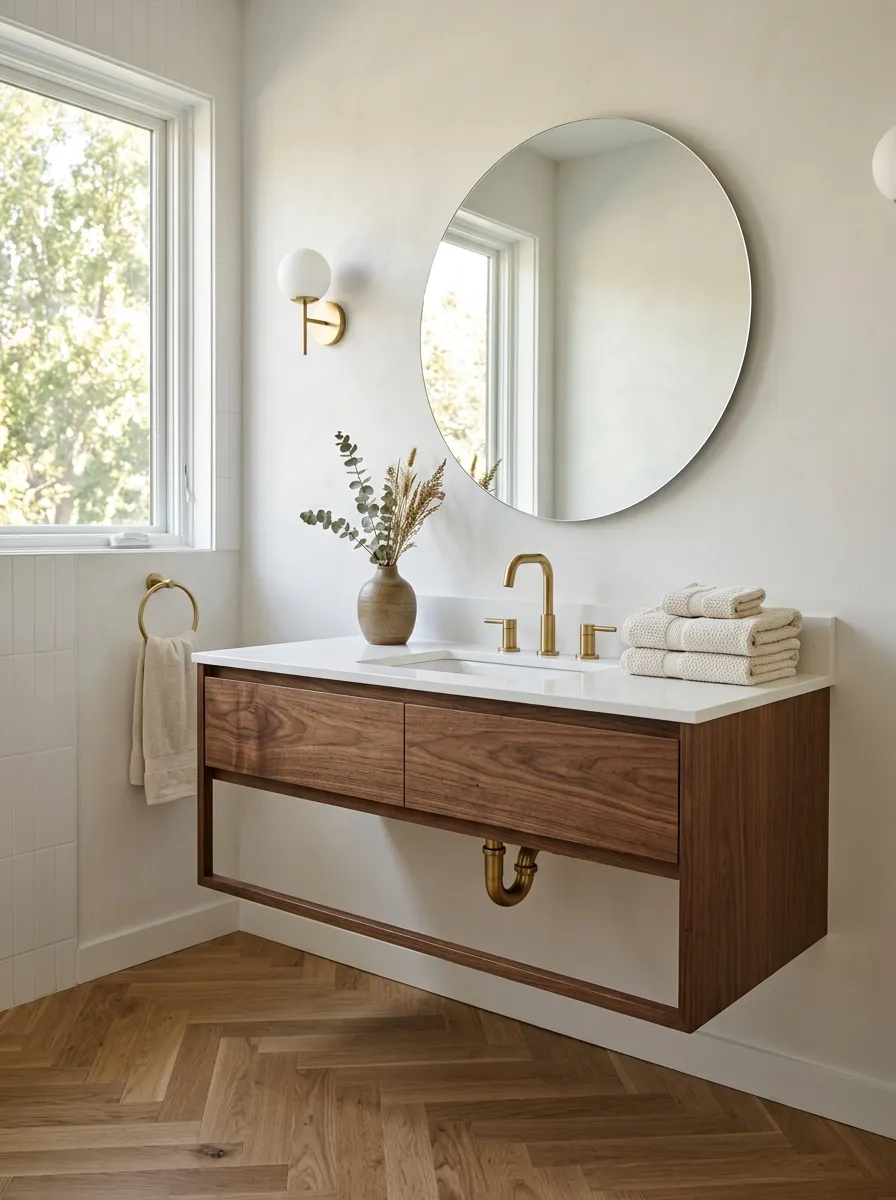
A floating vanity makes a small bathroom feel less boxed in because more of the floor remains visible.
That’s a simple visual trick, but it matters. You don’t need a tiny vanity to make a bathroom feel spacious. You need fewer heavy lines at floor level.
Quick rule: choose a clean rectangular cabinet, mount it above the floor, and avoid bulky decorative legs.
The open floor also makes cleaning easier, which is a practical win you’ll notice every day.
Wood and Art Harmony
Putting a massive piece of art in a bathroom is a classic power move. It screams that you have more wall space than common sense, but let’s be honest, it looks better than a generic plastic soap dispenser.
The green wall tiles provide just enough color to keep the room from feeling like a funeral parlor. It is a nice touch that adds some actual personality, assuming your personality isn’t just buying everything you see on Pinterest.
That floating wood vanity is fine, but it is the pedestal sink alternative that really sells the look. It is a bit more ‘old school’ than the standard floating box, which gives the room a sense of legitimacy that modern plastic finishes just cannot replicate.
Choose a Round Mirror to Break Up Hard Geometry
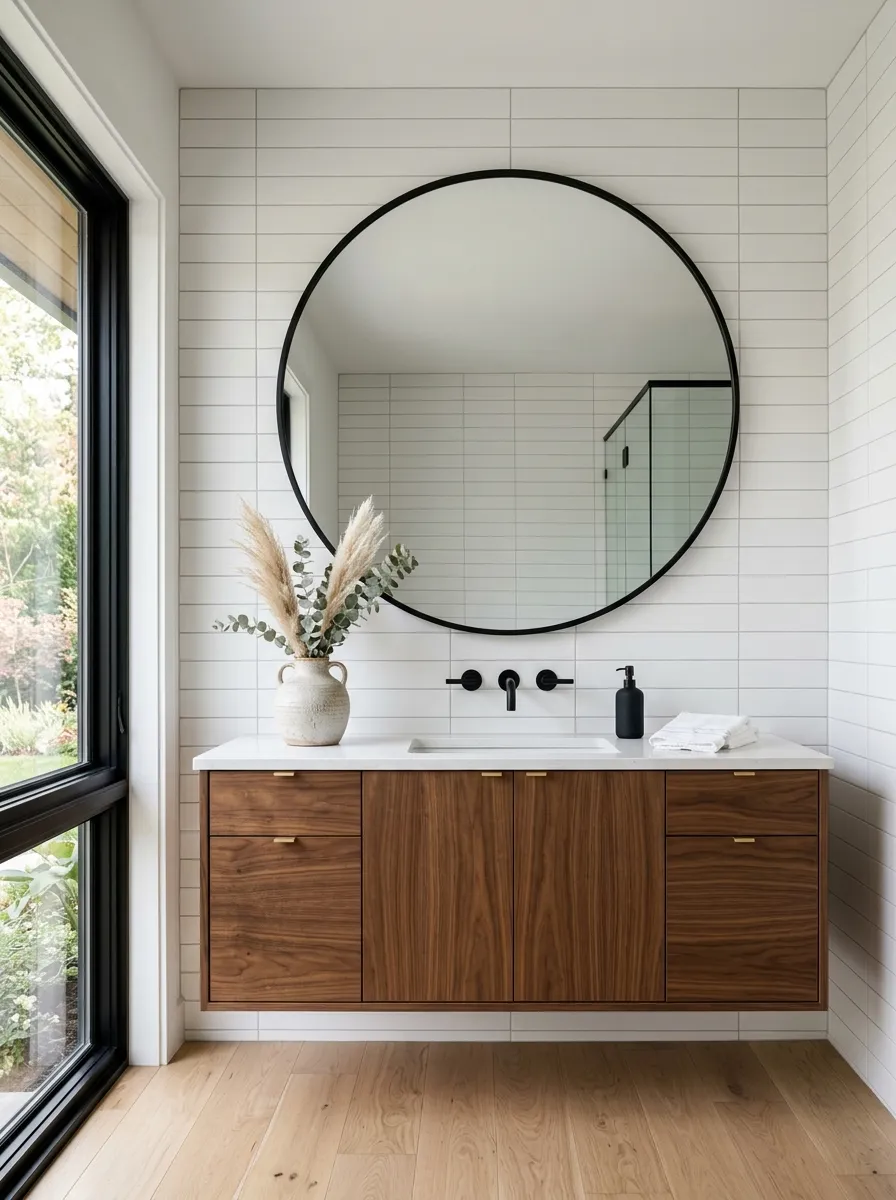
Bathrooms are full of rectangles. The vanity is rectangular. Tiles are rectangular. Cabinets and doors usually are too.
A round mirror gives the eye a completely different shape.
It also works beautifully with the clean lines of an MCM vanity because the contrast feels deliberate rather than random. Choose a simple circular frame in walnut, brass, or matte black.
Skip ornate frames. The shape itself is doing the work.
Terra-Cotta Tiled Bliss
If you want to feel like you are living in a seventies fever dream, terra-cotta is the way to go. The floor-to-ceiling tiling is an absolute commitment, so I hope you are not the type to change your mind after the grout dries.
A wooden vanity with a vessel sink is basically the gold standard for this look. It grounds the space and gives you a place to set your things that isn’t a slab of cold, uninviting granite. It is functional, which is rare for this kind of design.
That plant is doing its best to add some life to the room, but it is mostly there to hide the fact that you have no natural light. Just make sure you don’t overwater it while you are busy staring at your own reflection in that oversized round mirror.
Bring in Terrazzo Without Making the Room Busy
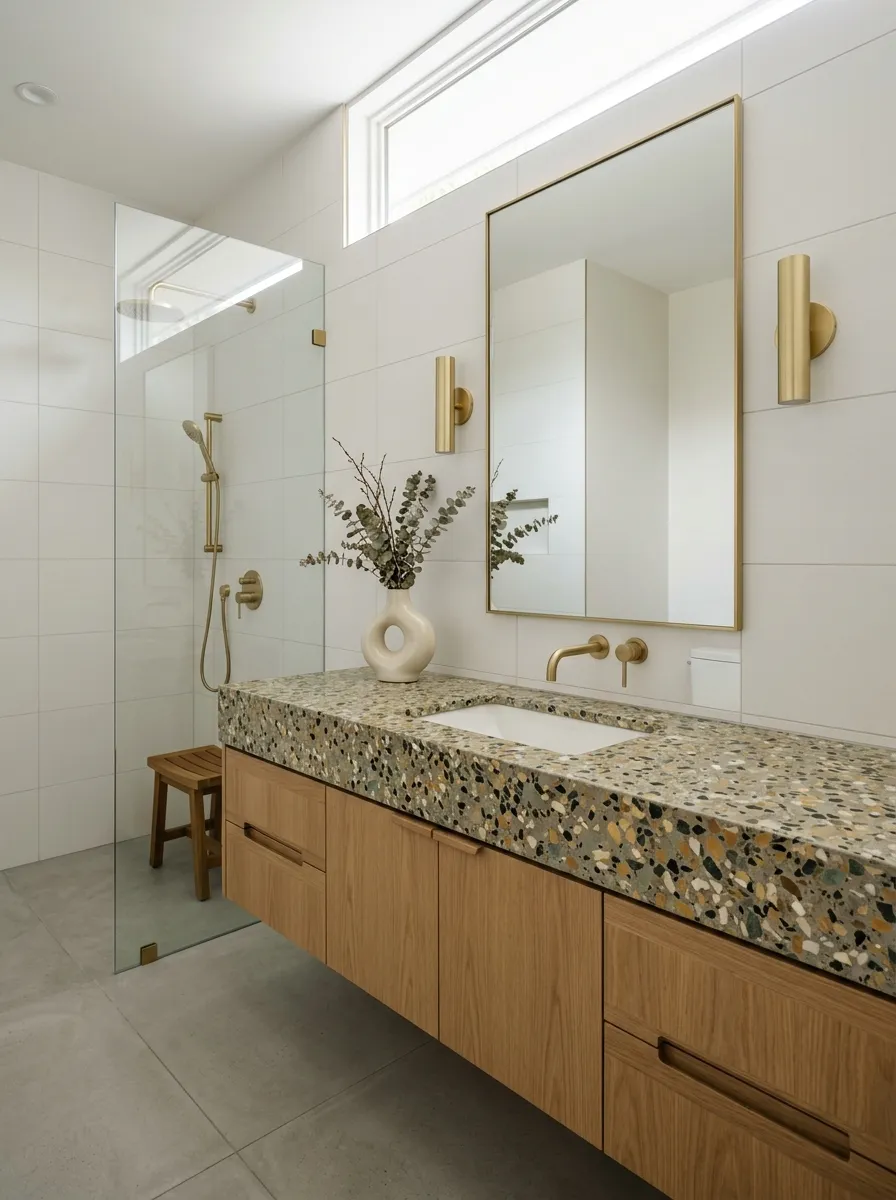
Terrazzo already has visual movement. That’s why covering every surface in it is usually too much.
Use it where you want the eye to land, such as the floor, vanity top, or a small shower detail. Then keep the surrounding materials calm.
Do this:
- Pick one terrazzo surface.
- Pull one quiet color from its chips.
- Repeat that color elsewhere.
- Leave the remaining surfaces simple.
The result feels intentional instead of noisy.
Wavy Patterned Boldness
That wallpaper, or tile, or whatever that hypnotic wave pattern is, is definitely a choice. It is the kind of design that makes guests feel slightly seasick, which is a great way to ensure they don’t linger in your bathroom for too long.
The deep burgundy pedestal sink is the star of the show. It is unapologetically vintage, and it demands attention. If you pair this with anything less than a very confident design scheme, it will just look like a plumbing mistake from forty years ago.
Symmetry is clearly the goal here, with the matching lights and the centered mirror. It’s all very balanced and orderly, which is the exact opposite of what you probably look like after waking up in the morning. At least your bathroom will look better than you feel.
Use Globe Lights for an Instant Mid Century Signal
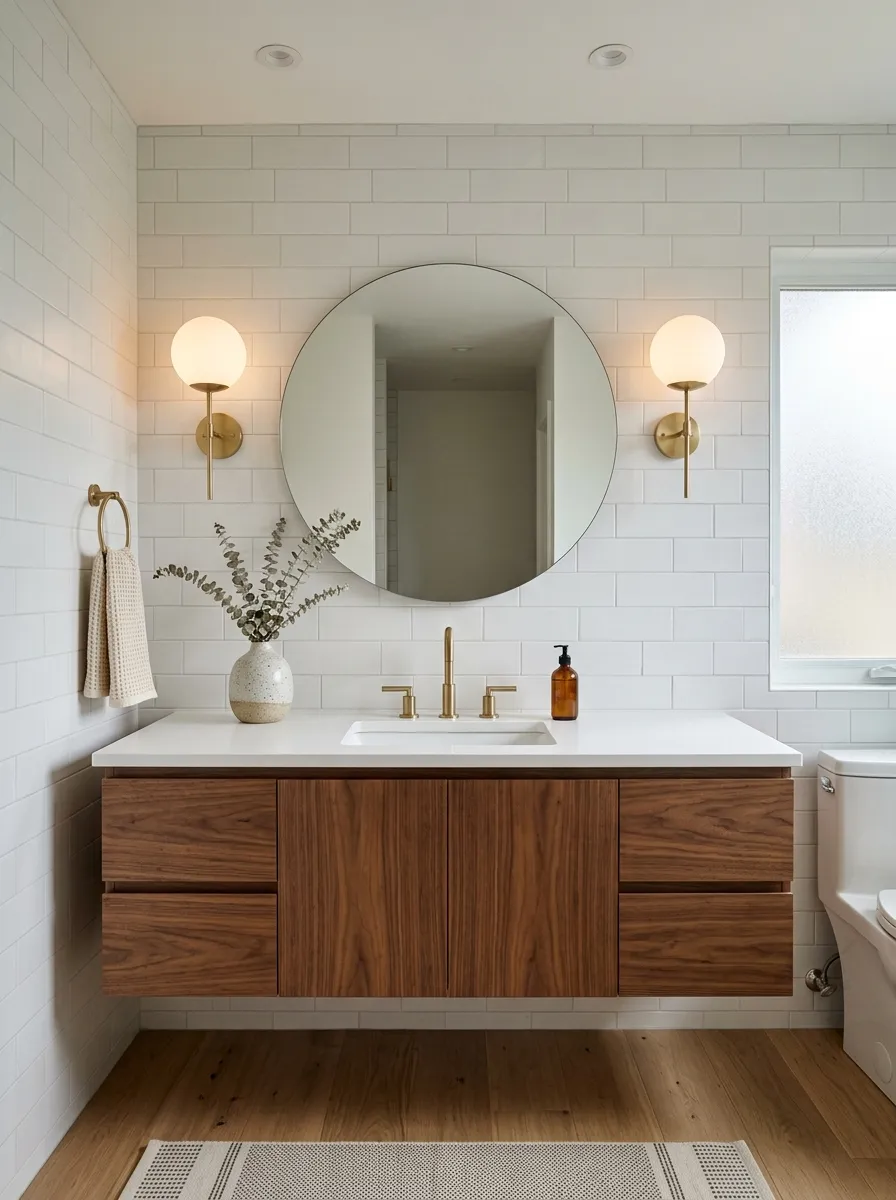
Globe lighting has the right combination of softness and geometry for this style.
Place globe sconces beside a round mirror, or use a simple multi-globe fixture above the vanity. Opal or frosted glass keeps the light soft on your face, which matters more than people realize during morning routines.
Don’t overcomplicate the fixture. A clean silhouette with warm metal is enough.
Let Brass Hardware Warm Up a White Bathroom
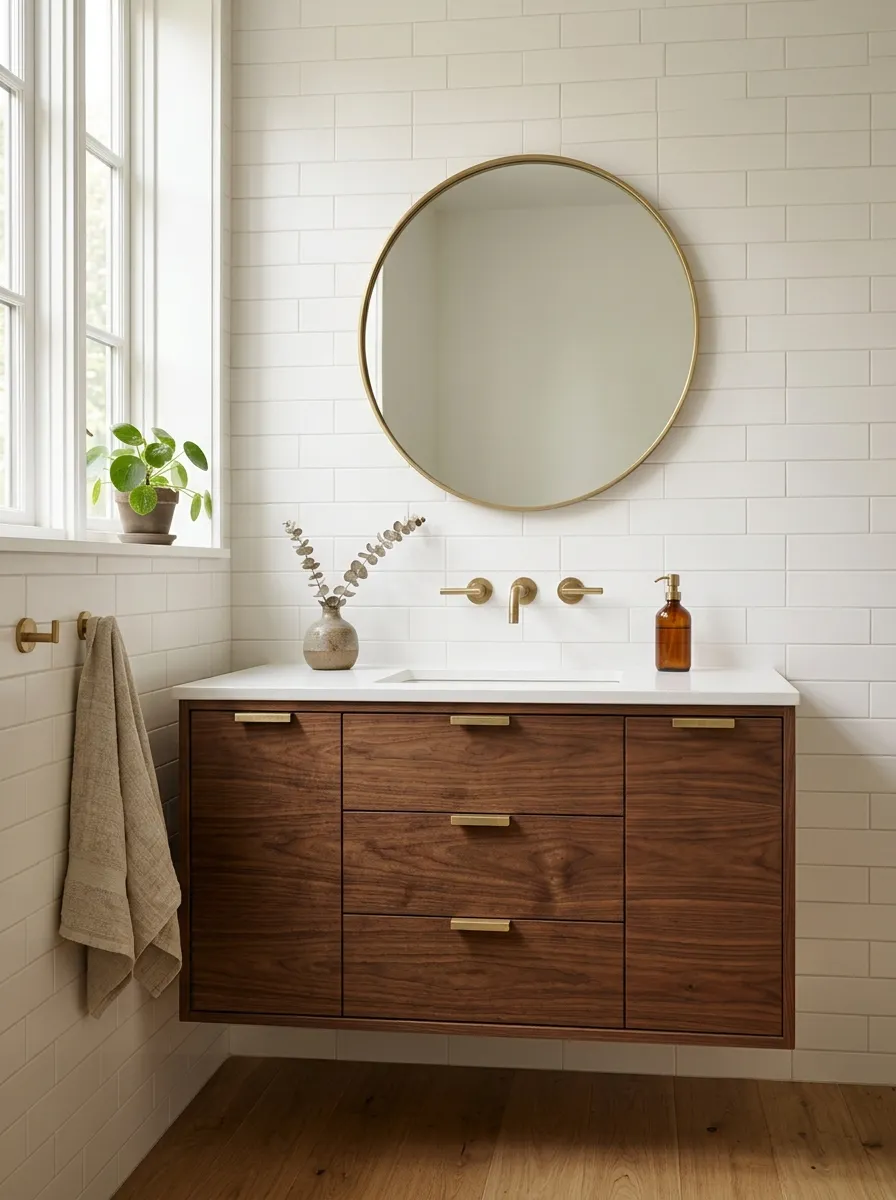
A white bathroom can feel too cold for mid-century style. Brass fixes that without requiring a full renovation.
Use it on the faucet, cabinet pulls, towel hooks, and mirror frame. The key is repetition. A single brass faucet can look random, but three or four small touches make the finish feel intentional.
Keep the brass warm and muted rather than mirror-bright.
Best pairing: warm white tile + walnut wood + aged brass.
Install Vertical Wood Slats as a Focus Wall
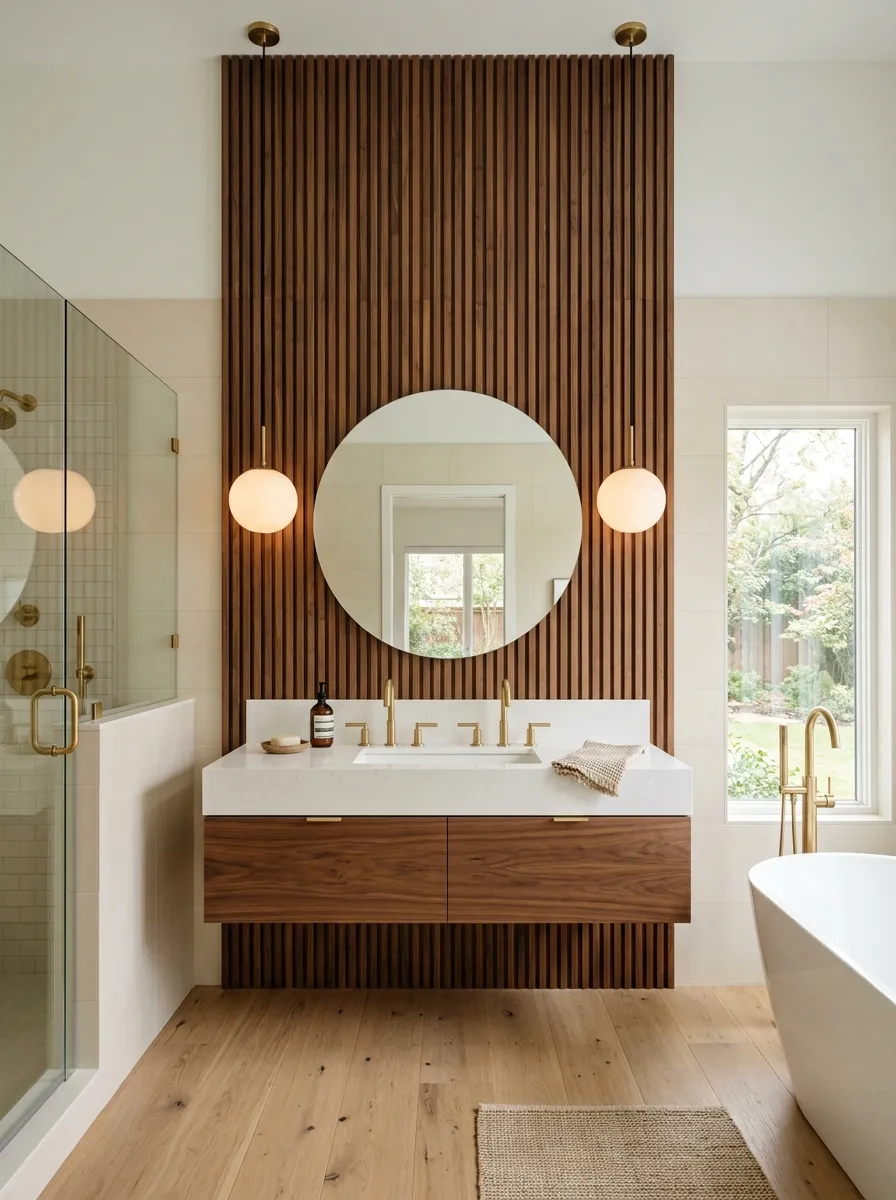
Vertical wood slats bring texture without breaking the clean geometry that makes MCM work.
They look especially good behind a vanity or beside a mirror. Use them on one controlled section rather than wrapping every wall. The bathroom already has enough hard surfaces.
Choose a warm wood tone that matches the vanity. If the vanity is walnut, don’t introduce a completely different orange-toned wood.
Keep the Tile Grid Simple and Let the Vanity Lead
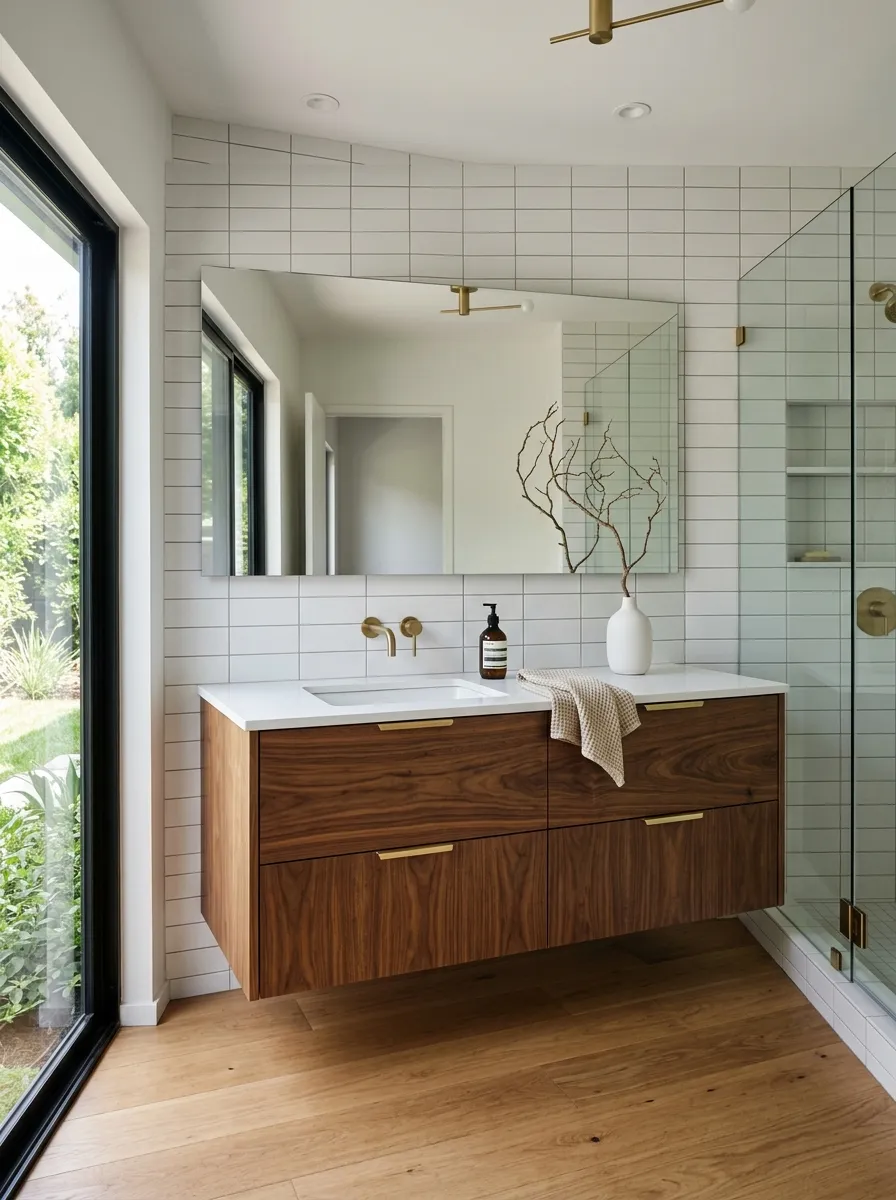
Too many tile patterns fight the furniture.
If you’ve invested in a beautiful walnut vanity, don’t surround it with three competing tile shapes. Use a quiet tile grid and let the vanity become the star.
A stacked rectangular tile works especially well because it echoes the horizontal lines common in mid-century furniture.
The rule is simple: one strong pattern beats several weak ones.
Try Muted Olive Instead of Bright Retro Green
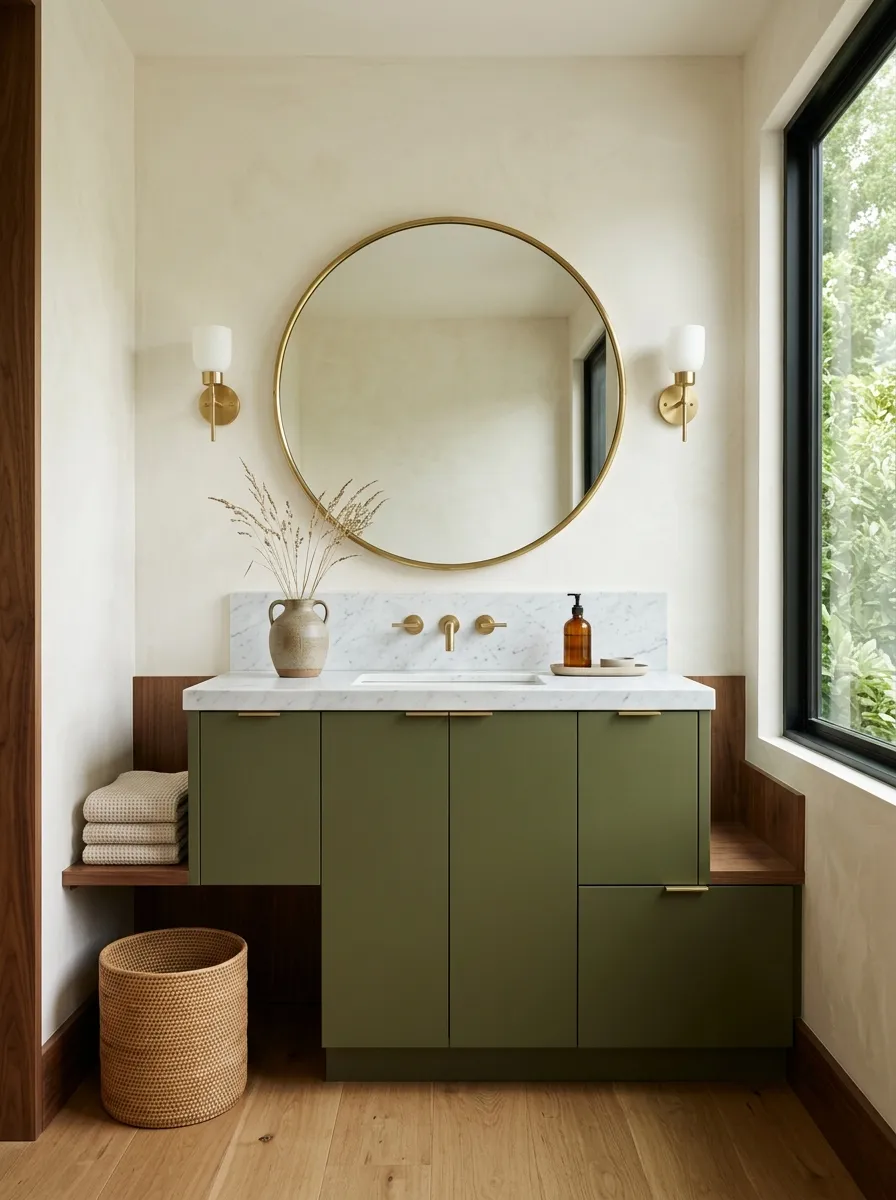
Green belongs in the mid-century color family, but the shade matters.
Bright green can make a bathroom feel themed. Muted olive, moss, or dusty sage feels more grown-up and works naturally with walnut, cream, and brass.
Use it on a vanity, painted wall, tile, or even a small framed print. You don’t need much.
Choose a Slim Console Vanity for a Small Bathroom
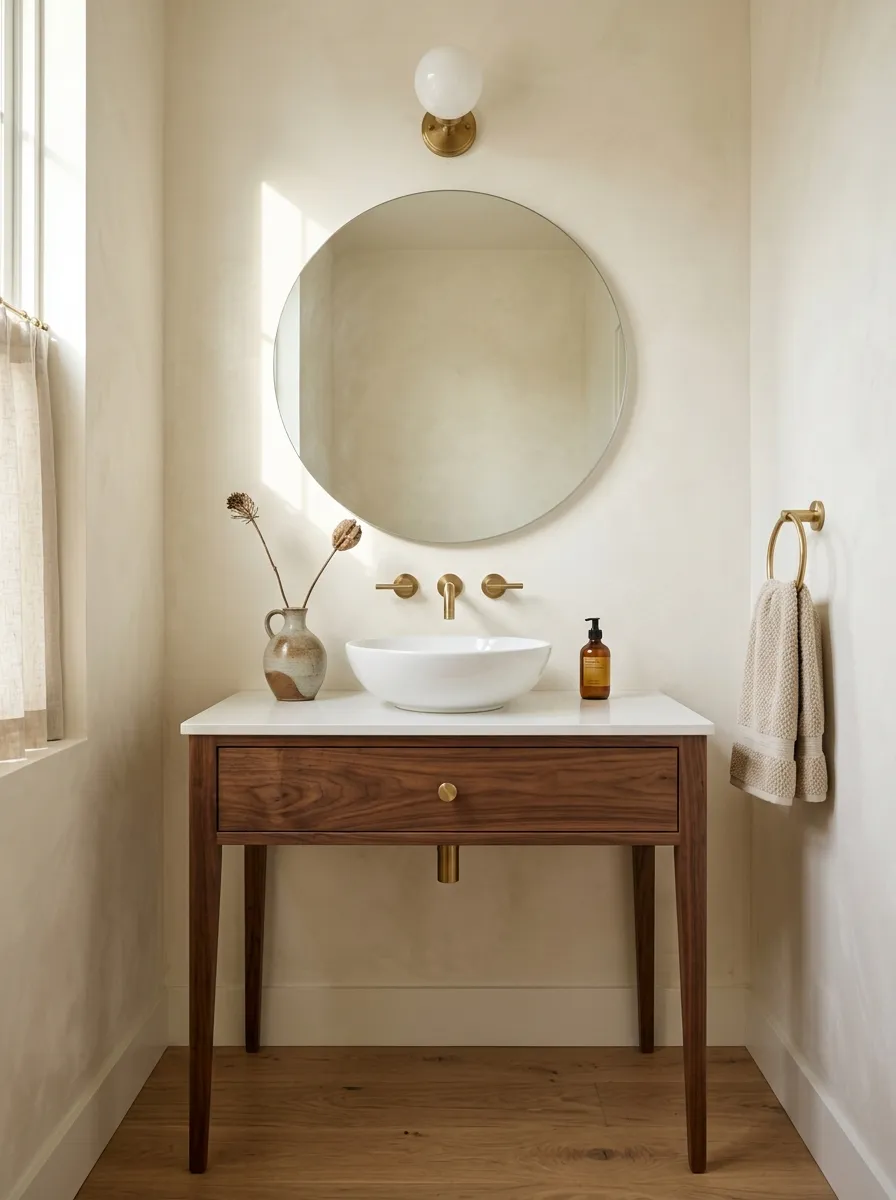
A bulky vanity can swallow a compact bathroom.
A slim console-style vanity gives you storage and a sink without making the lower half of the room feel heavy. Look for simple legs, a narrow profile, and enough counter space for the things you actually use.
This is especially useful in a powder room where storage needs are limited.
Small-space checklist:
- Keep the cabinet visually light.
- Choose one clean sink shape.
- Leave breathing room around the vanity.
- Skip decorative legs with complicated curves.
- Can you see enough floor underneath it?
- Does the silhouette stay visually simple?
- Is the storage sized for your actual routine?
- Does the wood or finish connect to another element?
Mix Wood With Matte Tile for Better Texture
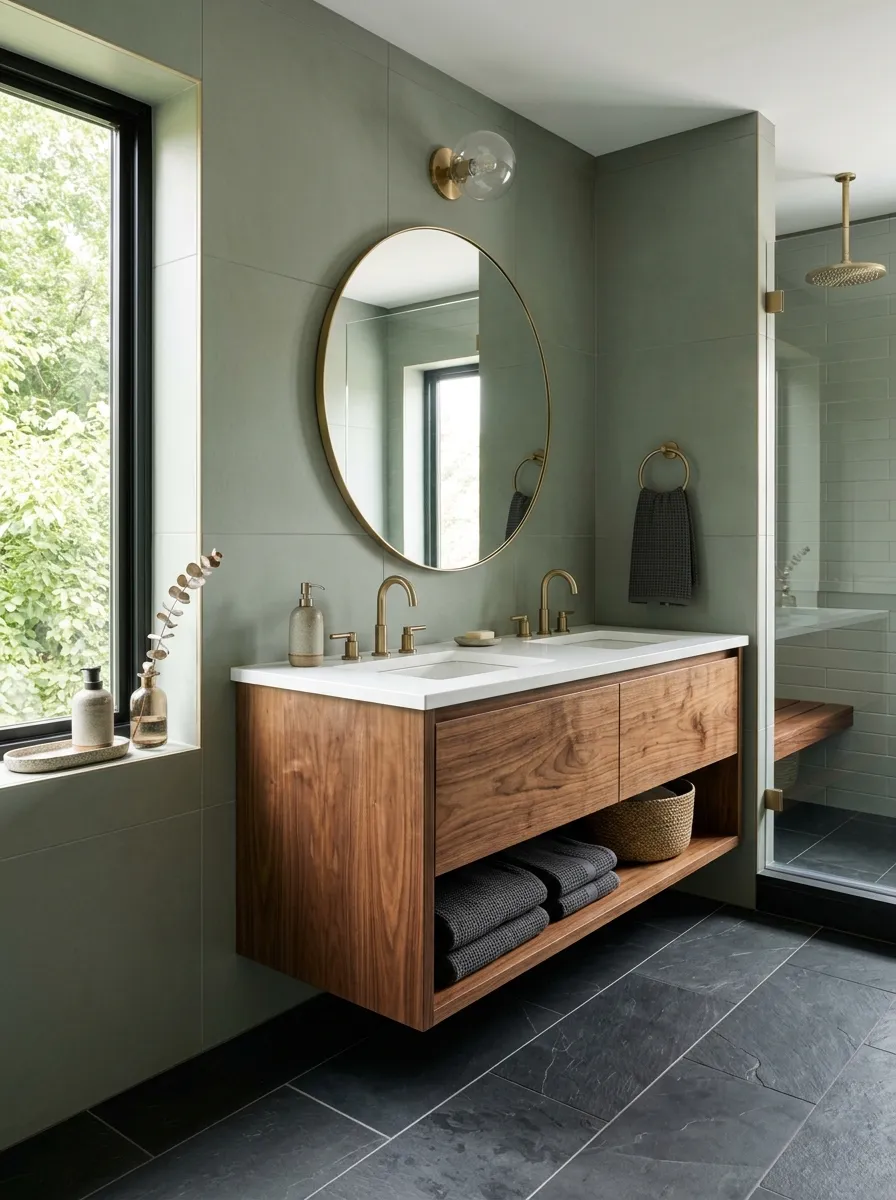
Glossy tile everywhere can make a bathroom feel flat and overly polished.
Matte tile gives the room a quieter surface, while wood adds the warmth and grain that mid-century bathrooms need. The contrast is subtle, but you’ll notice it every time light moves across the room.
Use matte tile on the walls or floor, then let the vanity bring in natural grain.
The best mix: smooth wood + slightly textured tile + simple metal.
Use a Statement Pendant Where the Ceiling Can Handle It
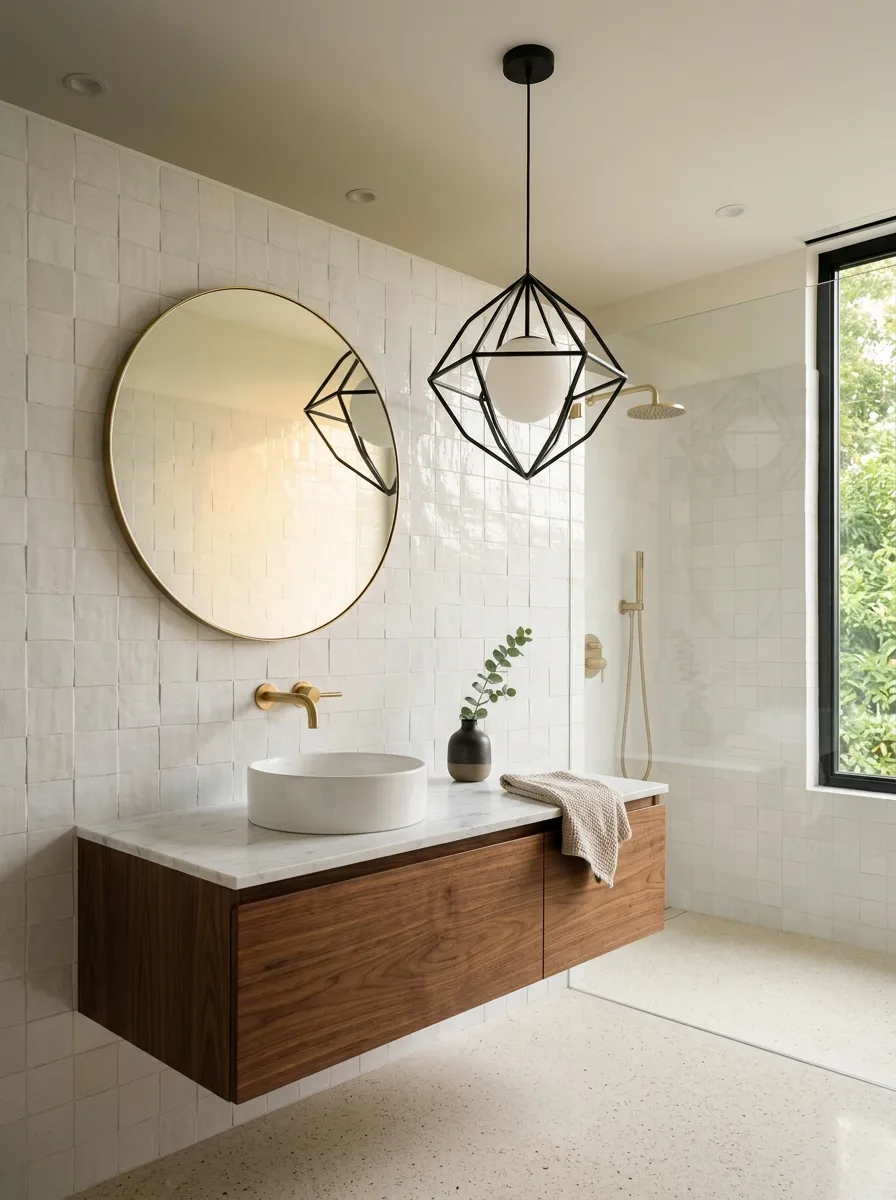
A bathroom doesn’t need to look like a utility room.
If your ceiling height and layout allow it, a simple pendant can add personality above a vanity or in a larger bathroom. Choose a sculptural but restrained shape, such as a globe or geometric fixture.
Keep the rest of the lighting quieter so the pendant has room to work.
Placement checklist:
- Don’t block the mirror.
- Keep the fixture visually balanced with the vanity.
- Use suitable bathroom-rated lighting where required.
- Let one fixture carry the statement.
Make sure the ceiling height gives the fixture enough breathing room.
Check that it doesn’t compete with a mirror, sconces, or shower enclosure.
Frame the Mirror With Warm Wood
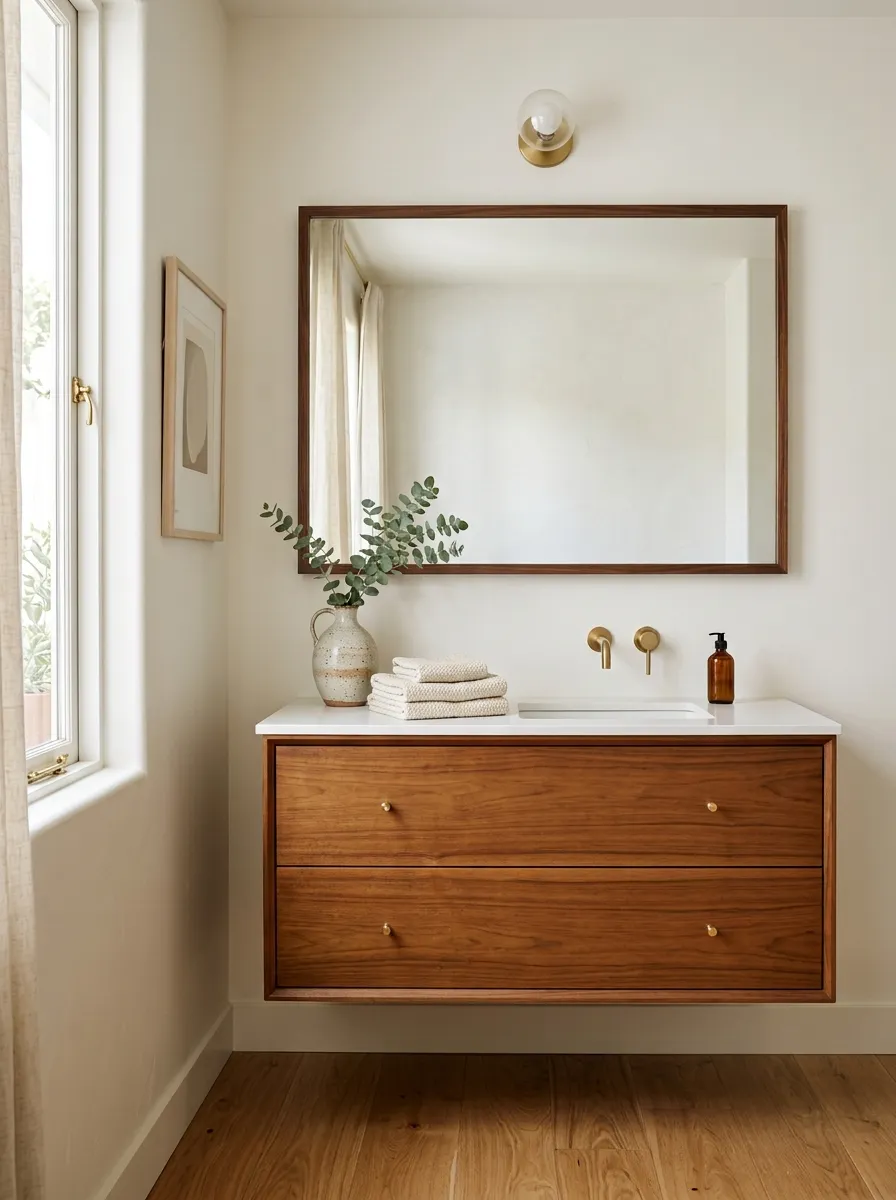
A plain mirror can look surprisingly disconnected in a carefully designed bathroom.
A thin wood frame fixes that. It creates a visual bridge between the mirror and vanity, especially when both use similar warm tones.
Don’t make the frame chunky. Mid-century furniture works because its proportions are controlled. A slim walnut or teak frame gives you the warmth without making the mirror feel heavy.
Add a Patterned Floor, Then Keep Everything Else Quiet
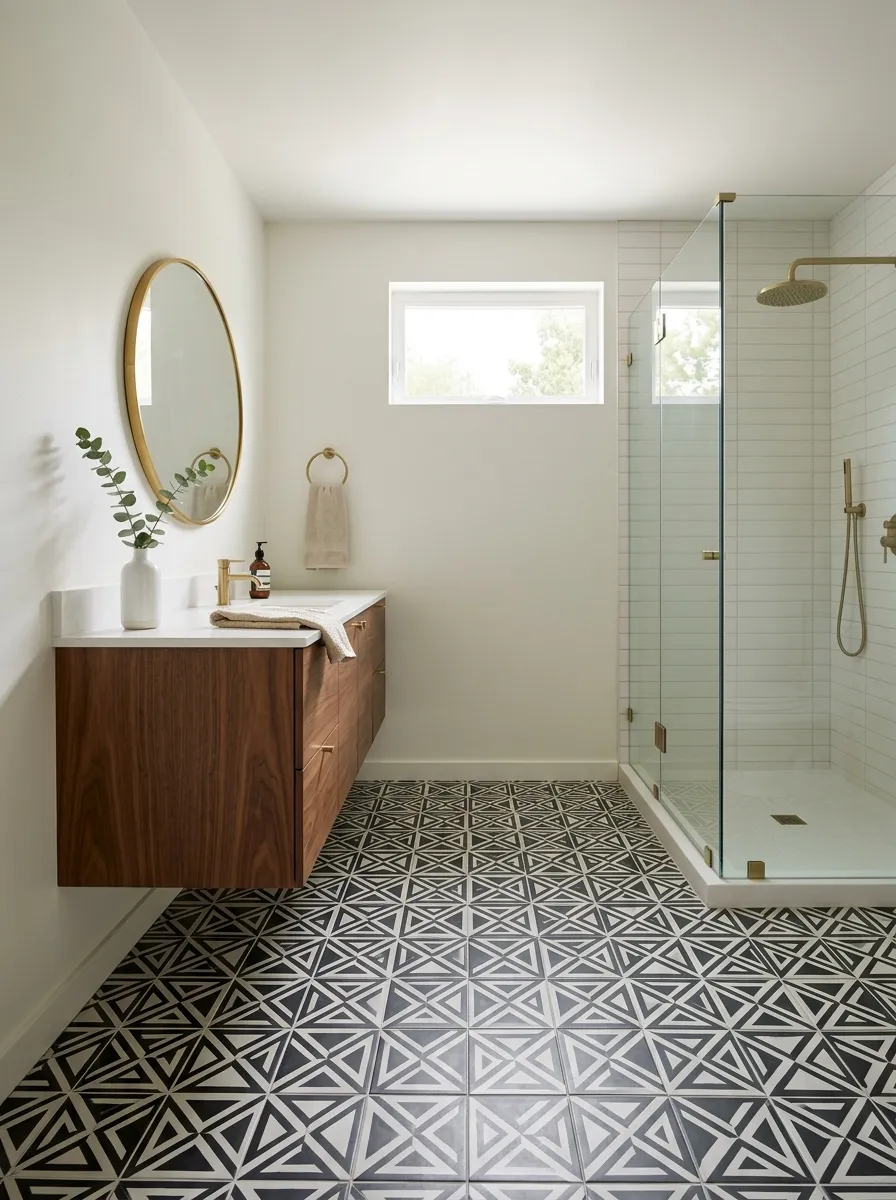
Patterned floor tile can give a bathroom serious personality, but it needs discipline.
If the floor is busy, don’t compete with it using patterned walls, colorful accessories, and an elaborate vanity. Let the floor be the visual event.
A geometric pattern works especially well with mid-century furniture because both rely on strong shapes.
Use the rest of the room as the backdrop.
Use Integrated Storage Instead of Cluttering the Counter
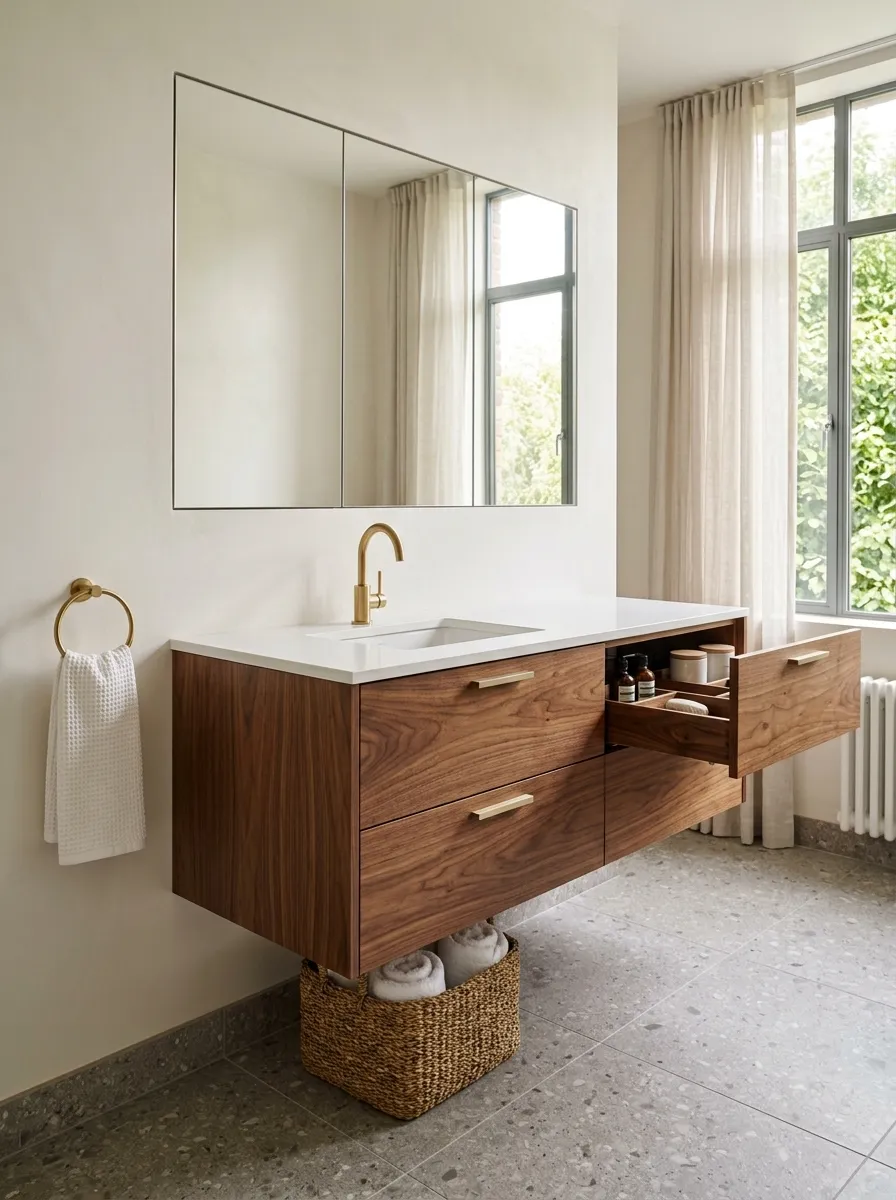
A mid-century bathroom looks best when you can actually see the furniture.
That means keeping daily products off the counter whenever possible. Build storage into the vanity, add a recessed cabinet, or use a mirrored medicine cabinet that disappears into the wall.
The goal isn’t minimalist living. It’s simply giving every repeat-use item a home.
Pick Retro-Inspired Faucets With Modern Proportions
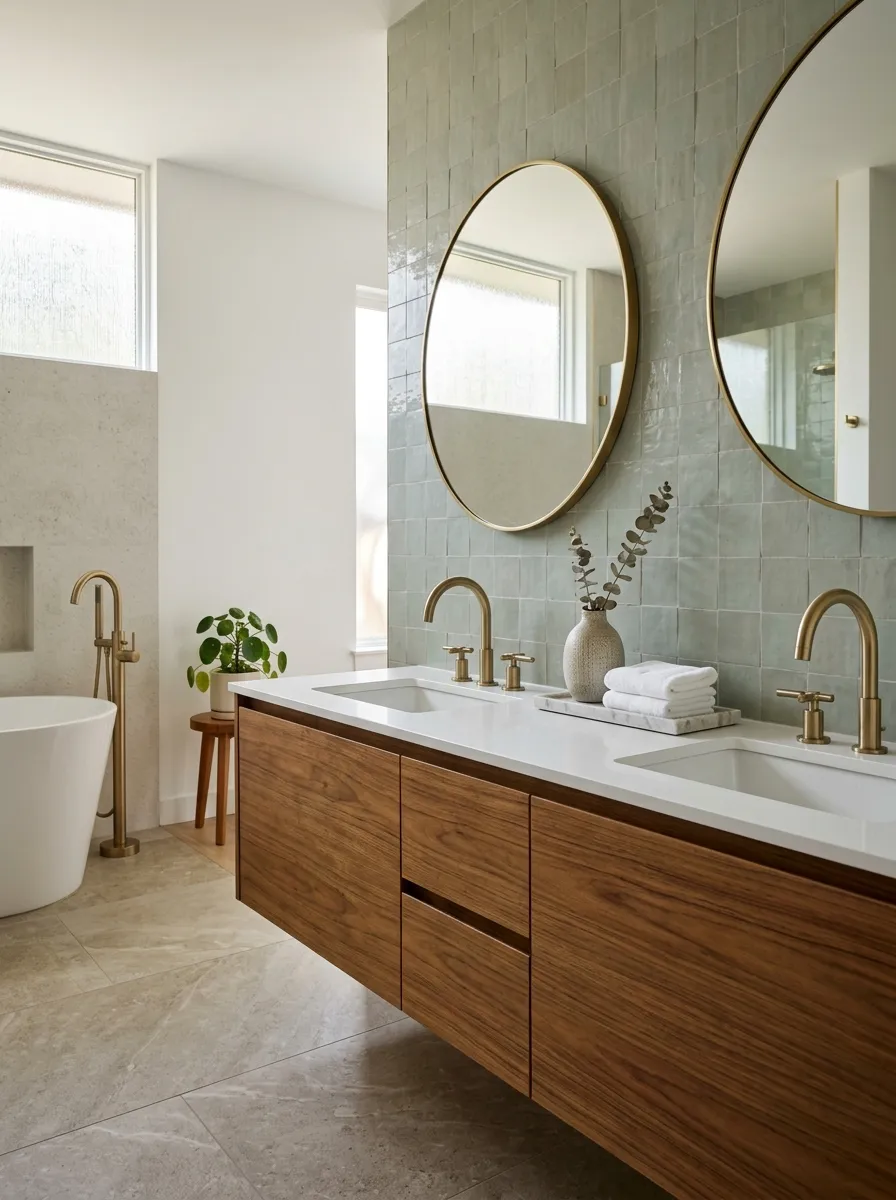
You don’t need an antique-looking faucet to make the bathroom feel mid-century.
In fact, overly ornate fixtures can push the room into a different era. Look for simple lever handles, clean curves, and a compact profile. Brass, chrome, or brushed metal can all work when the shape stays restrained.
The fixture should look like it belongs with the vanity, not like it came from a costume shop.
Best rule: borrow the shape language of vintage fixtures, not every old-fashioned detail.
Build Around Cream Instead of Stark Bathroom White
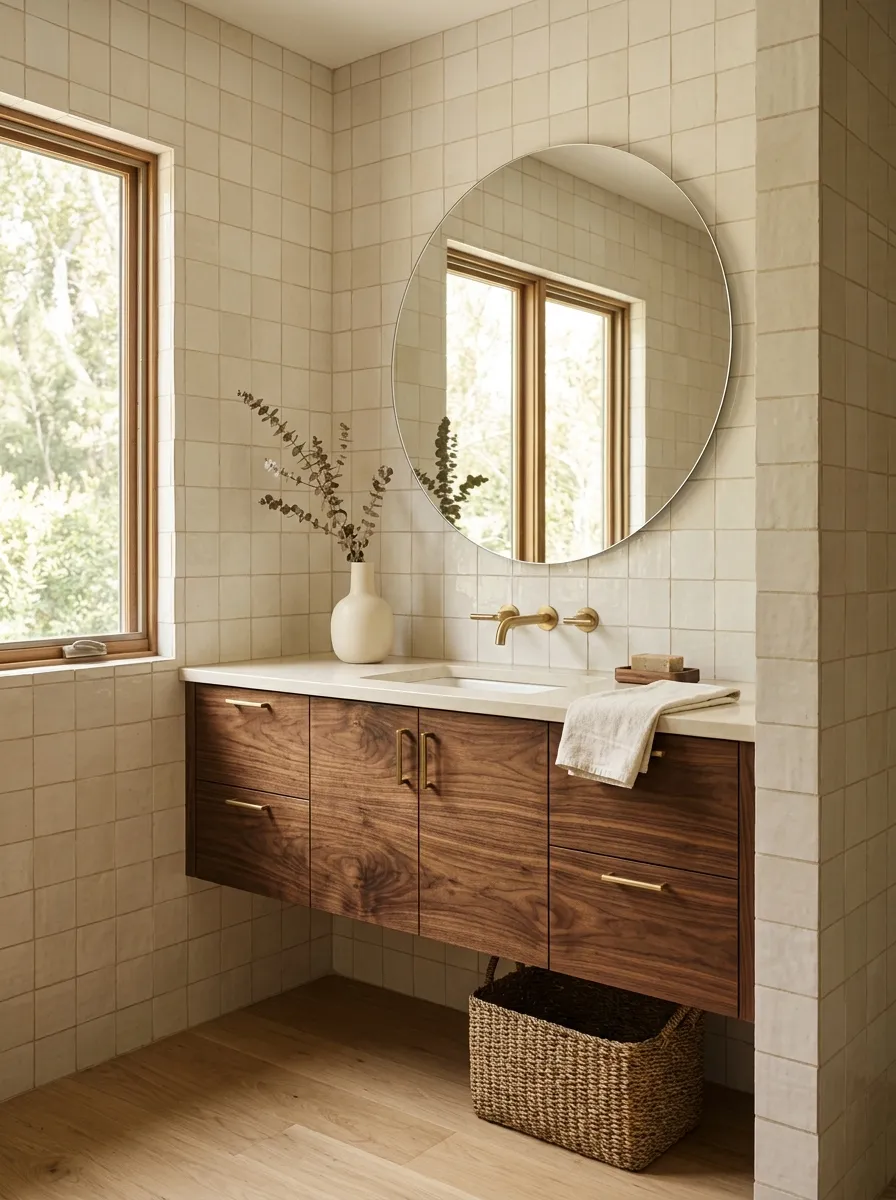
Cream gives a mid-century bathroom more depth.
It softens the contrast between tile, wood, metal, and porcelain. The room still feels bright, but it doesn’t have that harsh, ultra-modern look that pure cool white can create.
Use cream on walls, tile, grout, or even the vanity countertop. Then introduce darker wood for contrast.
A warm neutral does the quiet work that decoration can’t.
Use a Compact Tub With Clean Mid Century Lines
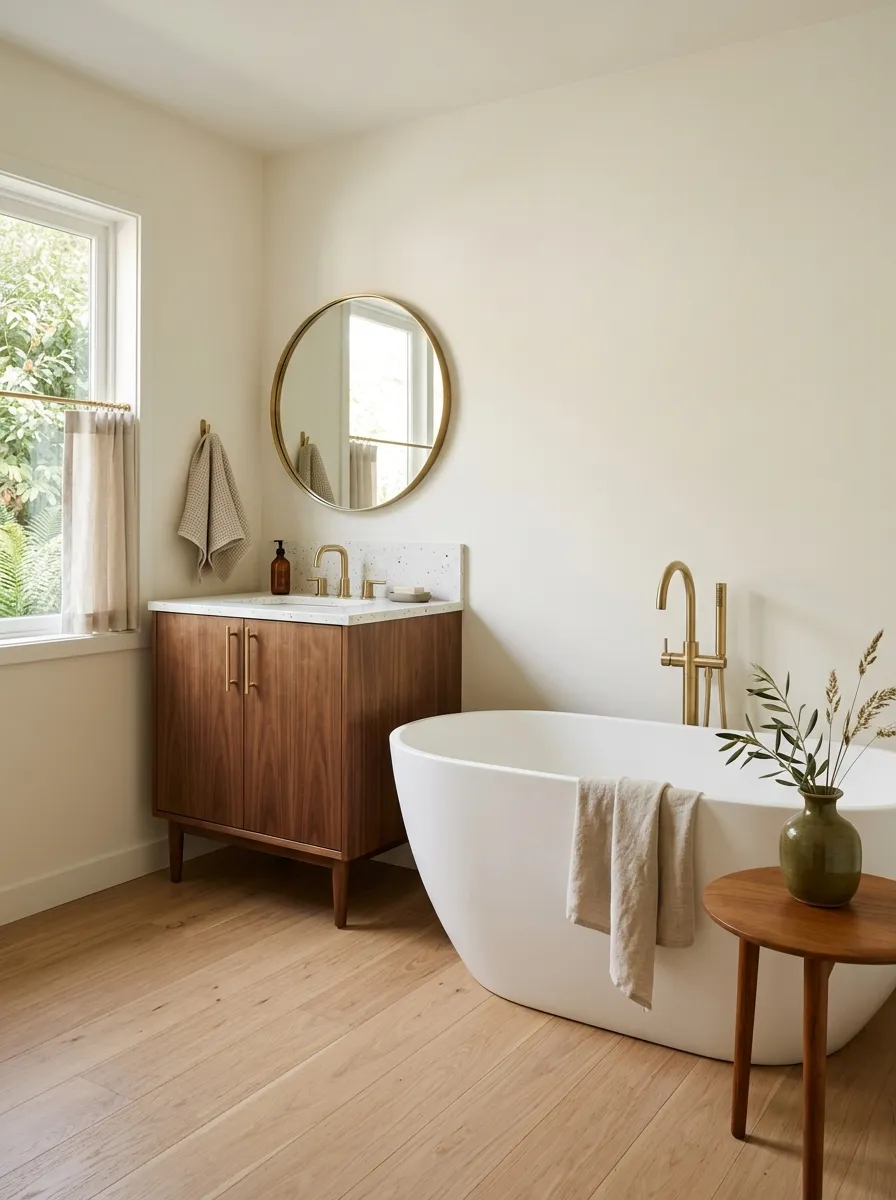
A freestanding tub doesn’t automatically make a bathroom look luxurious.
If the room is small, an oversized tub can eat up valuable floor space and ruin the proportions. Choose a compact tub with a simple exterior and smooth curves instead.
A white tub pairs naturally with walnut, teak, olive, cream, and warm brass.
Before choosing one, check:
- The walking space around it.
- The visual weight of the exterior.
- How it relates to the vanity.
- Whether the plumbing placement makes sense.
Add a Teak Stool for Warmth and Function
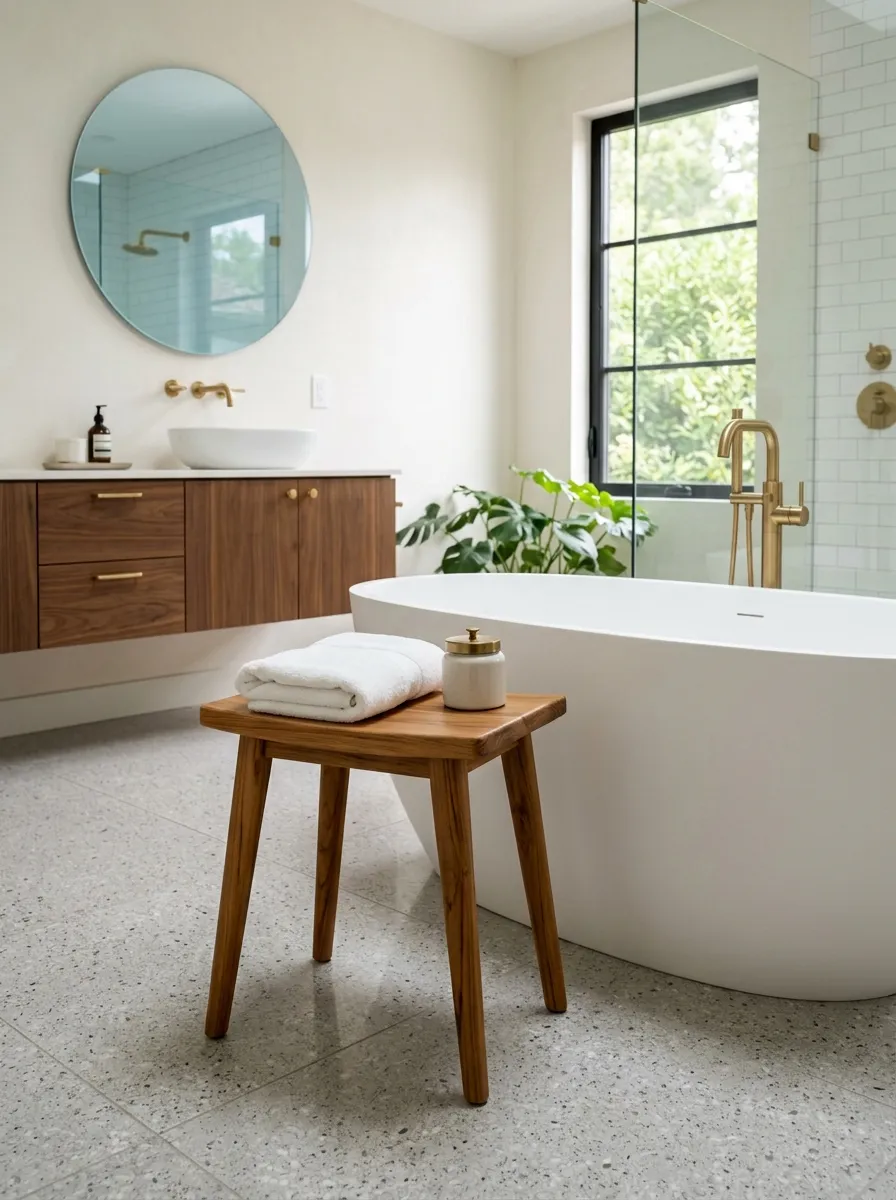
A small teak stool is one of those details that earns its place.
Use it beside the tub, near the shower, or underneath a vanity where the layout allows it. The wood brings warmth, while the stool gives you somewhere to place a towel, toiletries, or a book.
Choose a simple shape with clean legs. Don’t pile it with accessories.
Use Geometric Tile as a Small Accent, Not the Whole Room
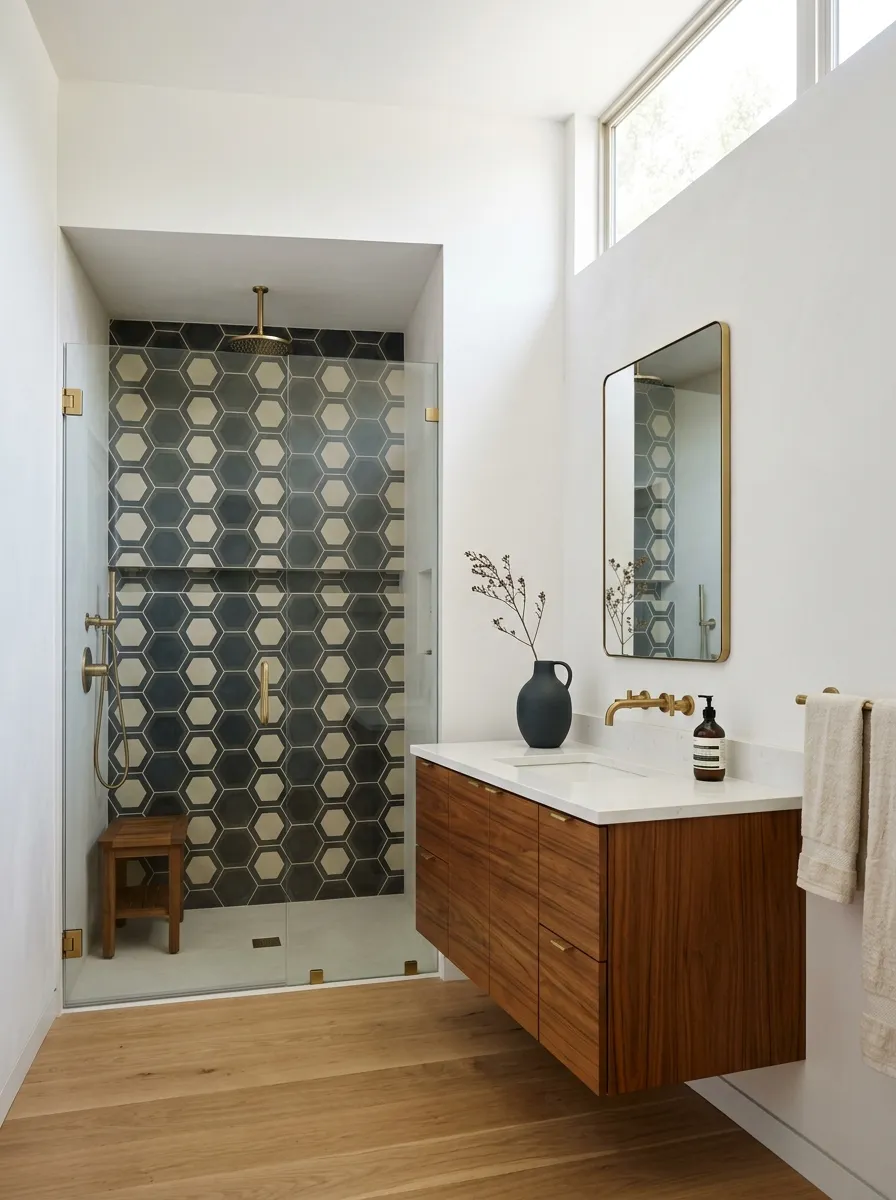
Geometry is a natural fit for mid-century design, but more isn’t better.
A small geometric backsplash, shower niche, or floor section can add enough pattern to make the room interesting. Covering every surface in bold shapes makes the bathroom feel busy fast.
Use geometry where you want the eye to pause.
If the floor already has a pattern, keep the wall tile quiet. If the shower has geometric tile, let the vanity stay simple.
- Pick one main geometric surface.
- Keep neighboring surfaces quieter.
- Repeat one color from the pattern elsewhere.
- Give the eye a plain surface to rest on.
Choose Sconces That Echo the Vanity Shape
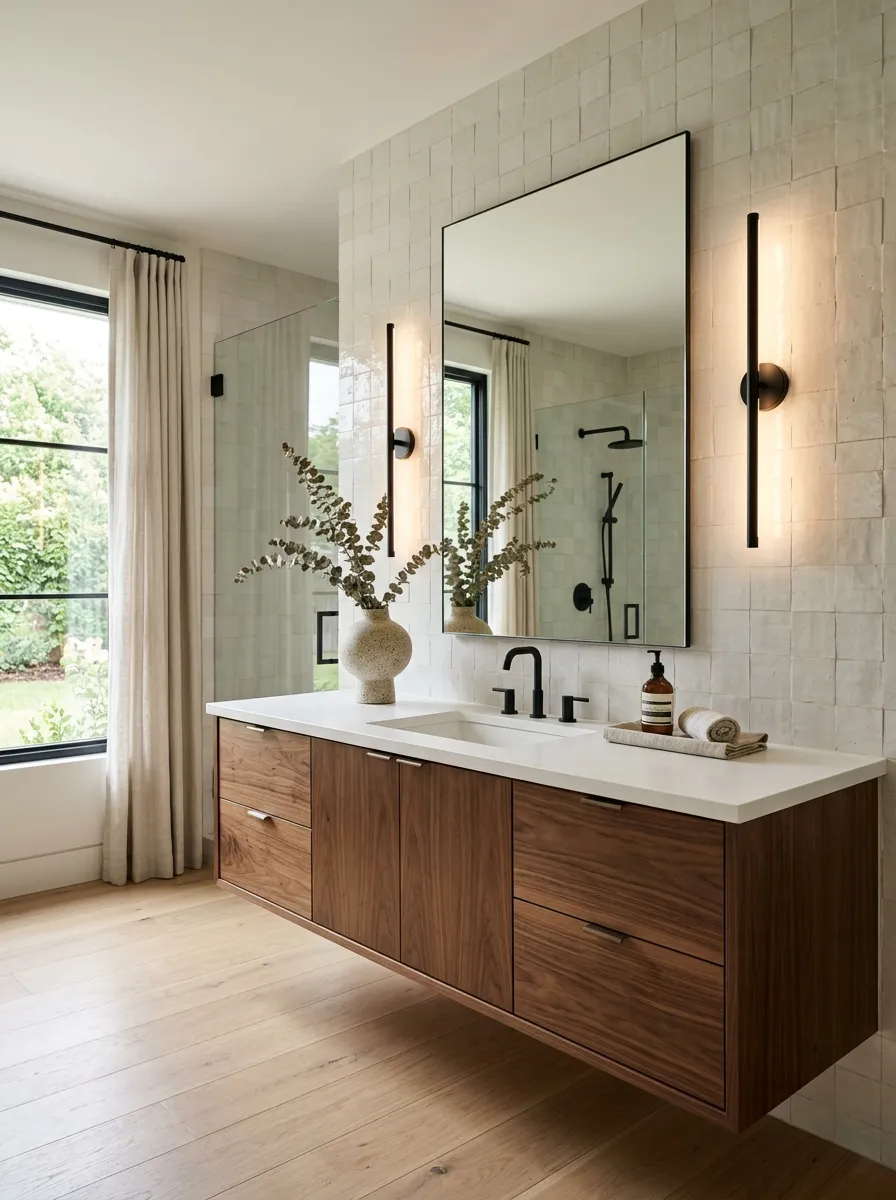
The best bathroom lighting doesn’t fight the furniture.
If your vanity has strong horizontal lines, choose sconces with a simple vertical or rounded form to create contrast. If the vanity has softer curves, a geometric fixture can sharpen the look.
Place the lighting with the mirror and sink as one composition rather than treating each piece separately.
Think in relationships, not individual purchases.
Let One Vintage Piece Carry the Personality
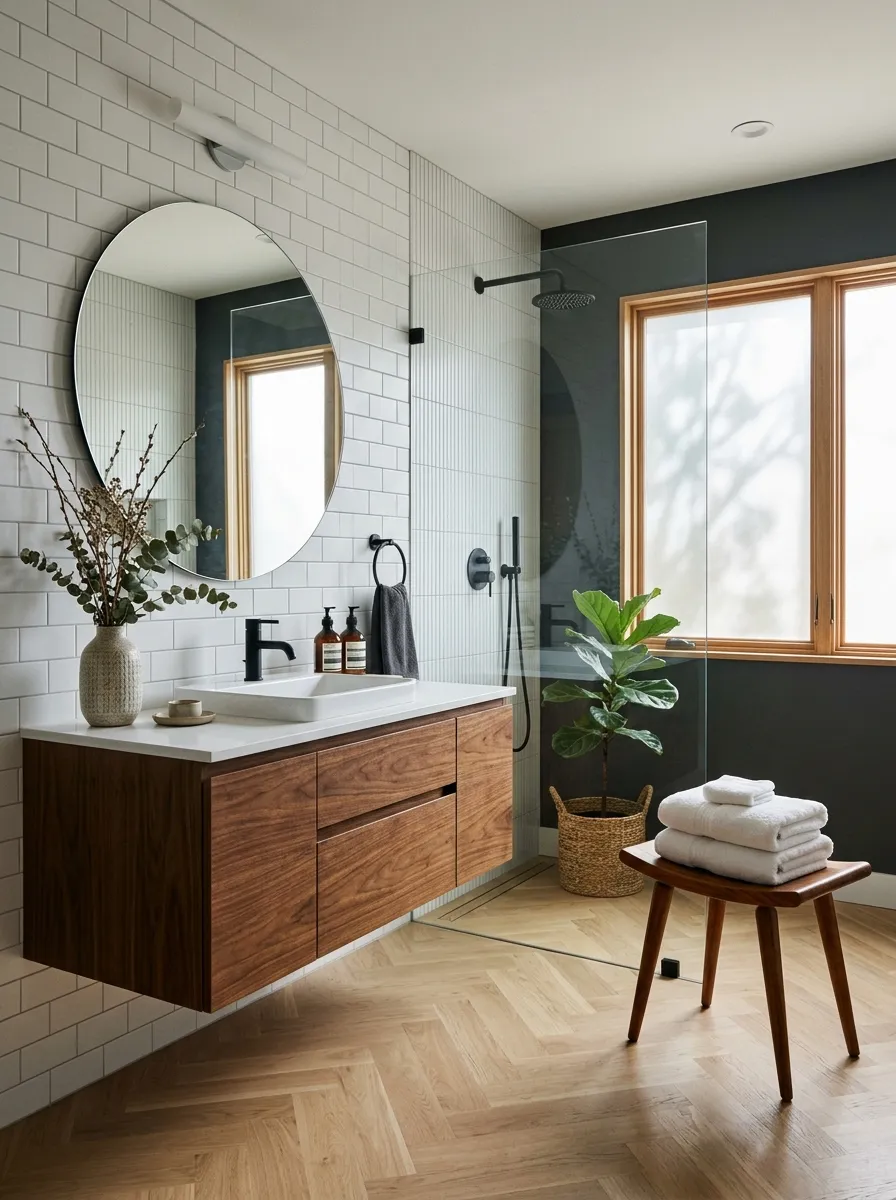
A bathroom doesn’t need five retro accessories to look authentic.
Choose one vintage-inspired piece and make it count. A framed print, small stool, mirror, clock, or decorative object can give the room personality while the permanent fixtures stay modern.
This approach also makes the room easier to update later.
Pick one piece that looks collected, not manufactured as a matching set.
Use Black Sparingly Against Warm Wood and Tile
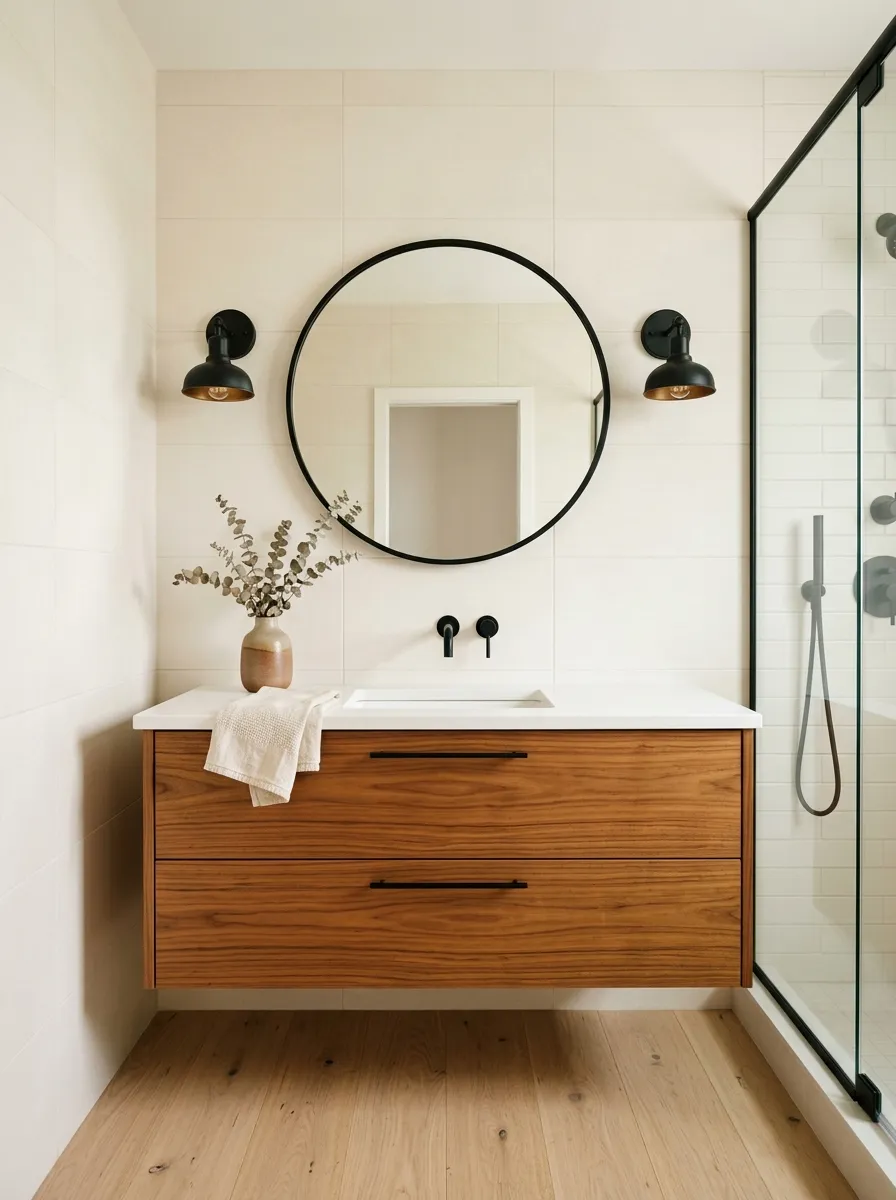
Black gives mid-century bathrooms a sharper edge, but too much can make the room feel contemporary rather than warm.
Use it for one or two controlled details. A thin mirror frame, sconce, cabinet pull, or shower trim can define the lighter materials around it.
Don’t make every fixture black just because the finish is popular.
The strongest contrast is usually the one you barely notice until you step back.
Make a Tiny Bathroom Feel Larger With Consistent Materials
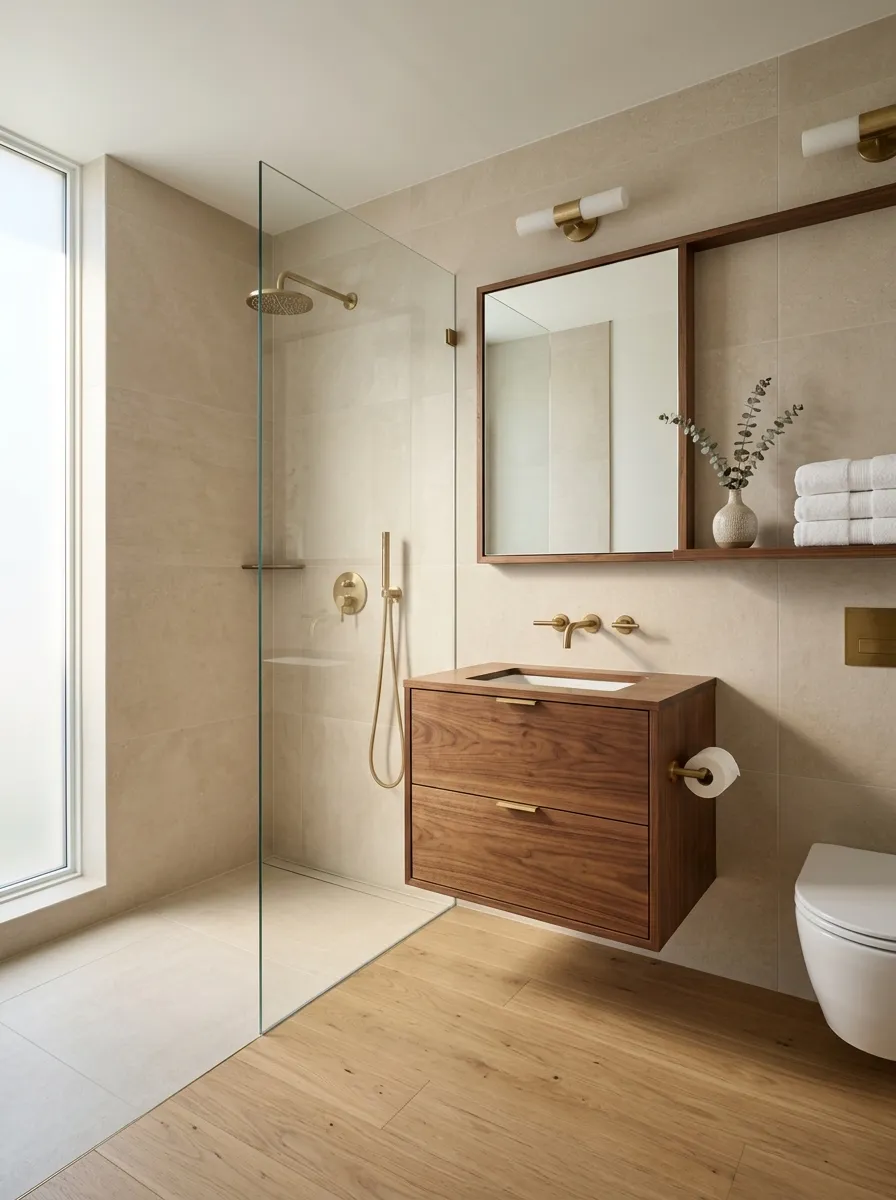
Small bathrooms don’t need more visual tricks. They need fewer material changes.
Use the same tile through the shower and onto nearby walls when the layout allows it. Keep the vanity finish connected to another wood detail. Repeat one metal finish instead of mixing several.
That continuity makes the room feel calmer and more spacious because your eye isn’t constantly stopping at a new boundary.
Small-space rule: fewer material transitions create a stronger visual flow.
Finish With Art That Feels Collected, Not Themed
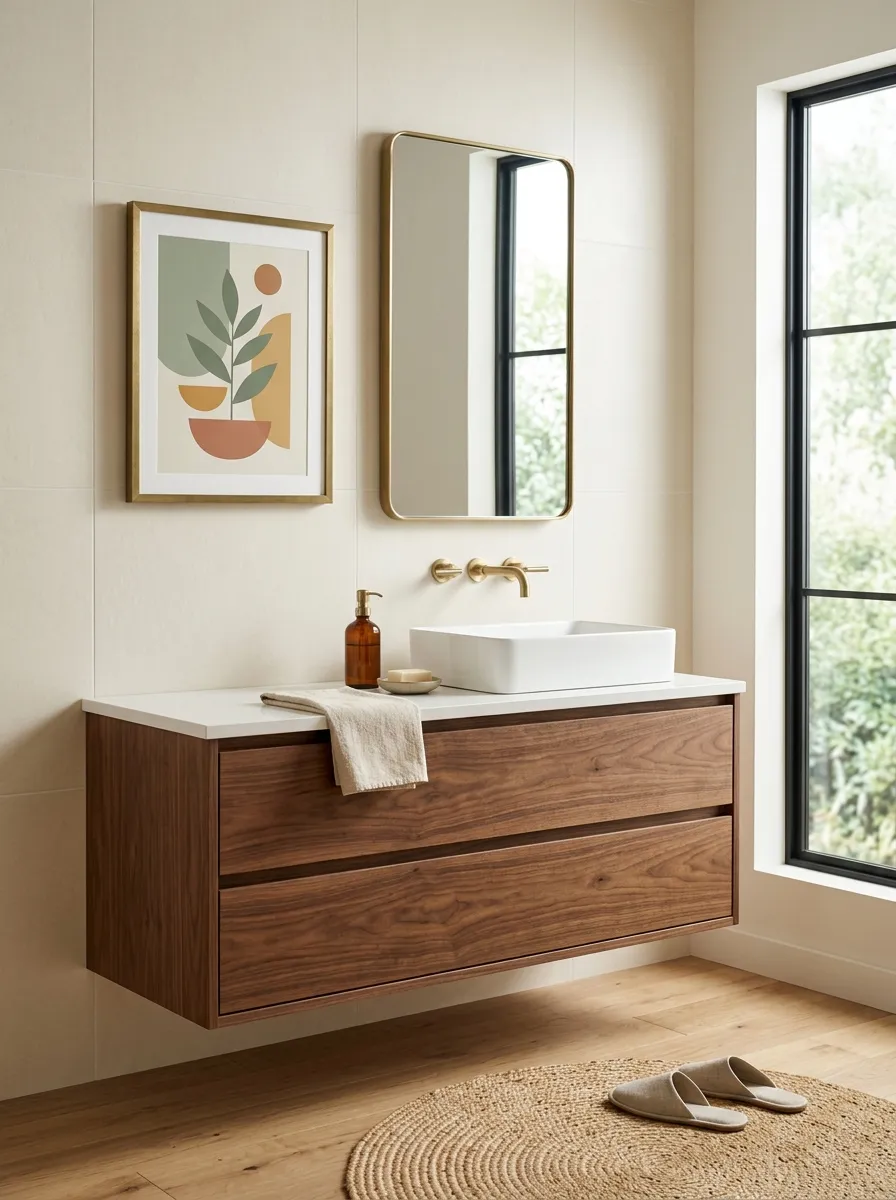
The final layer should make the bathroom feel like part of your home, not a showroom built around a decade.
Choose artwork with simple geometry, muted colors, botanical shapes, or an interesting vintage frame. Keep it personal enough that it doesn’t look like a generic mid-century print pulled from a matching set.
Then stop.
The room already has its strong materials, shapes, and fixtures. Art should add personality without competing with them.
Conclusion
Start with the big pieces. A walnut vanity, warm tile, rounded mirror, restrained lighting, and one memorable accent will do far more than a room packed with themed accessories.
Keep the palette controlled. Repeat materials instead of constantly introducing new ones. Most importantly, leave some breathing room.
That’s what makes the style feel confident instead of forced.
Save this list on Pinterest for the next time you’re planning a bathroom refresh and need a clear starting point.