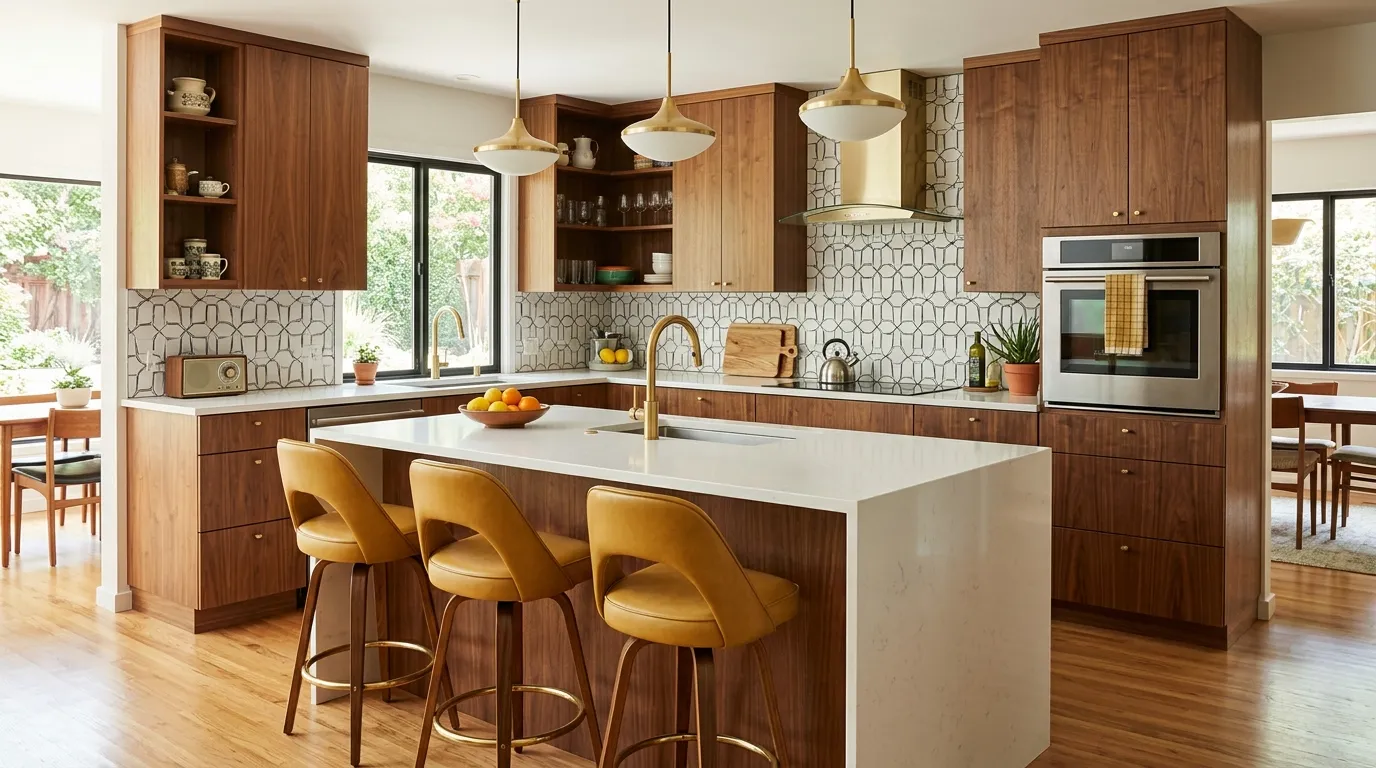
The problem with many mid century kitchens is that they lean too hard into the theme, with too many retro colors, too much vintage decor, or finishes that make the room feel dated instead of thoughtfully designed.
A mid century modern kitchen works better when you focus on the things that actually make the style recognizable: warm wood, clean cabinet lines, simple hardware, strong geometric shapes, earthy colors, and furniture with good proportions.
The best part is that you don’t need to remodel every inch to get the look. A walnut cabinet wall, a sculptural pendant, a geometric backsplash, or even the right bar stools can shift the entire room.
These ideas focus on practical choices that work in real kitchens. Some are big design decisions. Others are small details that make a surprisingly large difference.
What Actually Makes a Kitchen Feel Mid Century Modern?
The easiest mistake is treating mid century design like a shopping list of retro objects.
It isn’t.
The style depends more on shape, material, proportion, and restraint than on collecting vintage-looking accessories.
Warm wood does most of the heavy lifting
Walnut and other warm wood tones instantly bring the right character to a kitchen.
You don’t need wood everywhere. A strong cabinet run, island, shelving, or furniture piece is enough to establish warmth.
Clean shapes keep the room from looking dated
Flat cabinet fronts, tapered legs, simple pendants, rounded furniture, and strong horizontal lines all fit naturally into the style.
The goal is visual clarity.
Color should feel intentional
Muted olive, mustard, rust, burnt orange, cream, and earthy brown work especially well because they add personality without making the room feel like a themed diner.
The strongest kitchens usually choose one dominant accent instead of throwing every retro color into the same space.
Modern function still matters
A kitchen can look mid century while hiding appliances, using modern storage, and relying on current materials.
| Common mistake | Better approach |
|---|---|
| Too many retro accessories | Choose one or two character pieces |
| Several competing wood tones | Repeat one dominant wood tone |
| Loud patterned surfaces everywhere | Give one surface the pattern |
| Bulky furniture | Choose lightweight, tapered forms |
| Cluttered countertops | Build storage around daily appliances |
With those basics in place, the individual design choices become much easier.
Mid Century Modern Kitchen Ideas
Ambient Glow Cabinetry
Install small puck lights inside your upper cabinets if you enjoy highlighting exactly where your mismatched coffee mugs live. It serves as a great way to force yourself to keep the shelves tidy, because nothing screams mid-century regret like a spotlight on a pile of dusty takeout containers.
Choose glass-front doors if you truly believe your spice collection is a design statement. If you find your pantry items lacking visual appeal, stick with solid walnut to hide the chaos from unsuspecting guests who definitely didn’t ask to see your inventory.
Keep the hardware minimal so the wood grain does the heavy lifting. If the cabinetry feels too heavy, contrast the dark walnut with a bright, clean tile backsplash. It balances the room without requiring you to actually become an interior designer.
Choose Walnut Cabinets for Instant Warmth
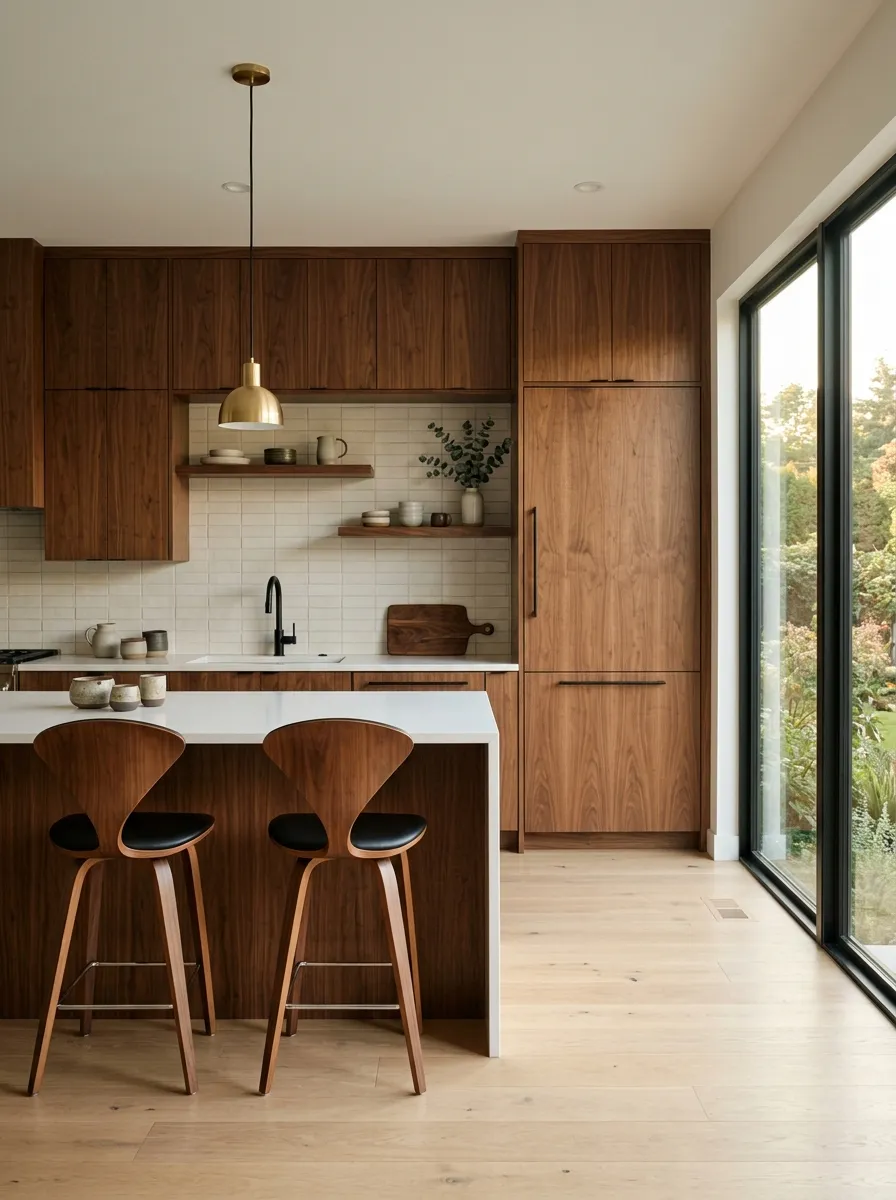
Warm wood is one of the strongest ways to establish a mid century mood without making the kitchen look overly themed.
Walnut cabinets work especially well because the grain adds visual interest while the simple cabinet shape keeps everything clean.
Don’t cover every surface in wood.
Let one major wood feature carry the room.
If you’re using walnut cabinetry, keep the counters and backsplash quieter. That contrast gives the wood room to stand out.
Vertical Tile Drama
Stack your backsplash tiles vertically instead of the standard horizontal brick pattern, unless you enjoy blending in with every other kitchen from 2015. It adds a bit of architectural edge that suggests you actually put some thought into your renovation beyond a Pinterest scroll.
Go for a darker, moody tile color to ground the natural wood warmth. If you pick a shade that matches the shadows in your soul, you have successfully achieved that timeless, slightly cynical aesthetic that makes bright white kitchens look painfully amateur.
Don’t clutter the counter space with useless gadgets just because you have the room. Let the texture of the tile and the richness of the walnut communicate that you are a person of taste, even if you are just using the kitchen to reheat leftovers.
Keep the Cabinet Doors Flat and Simple
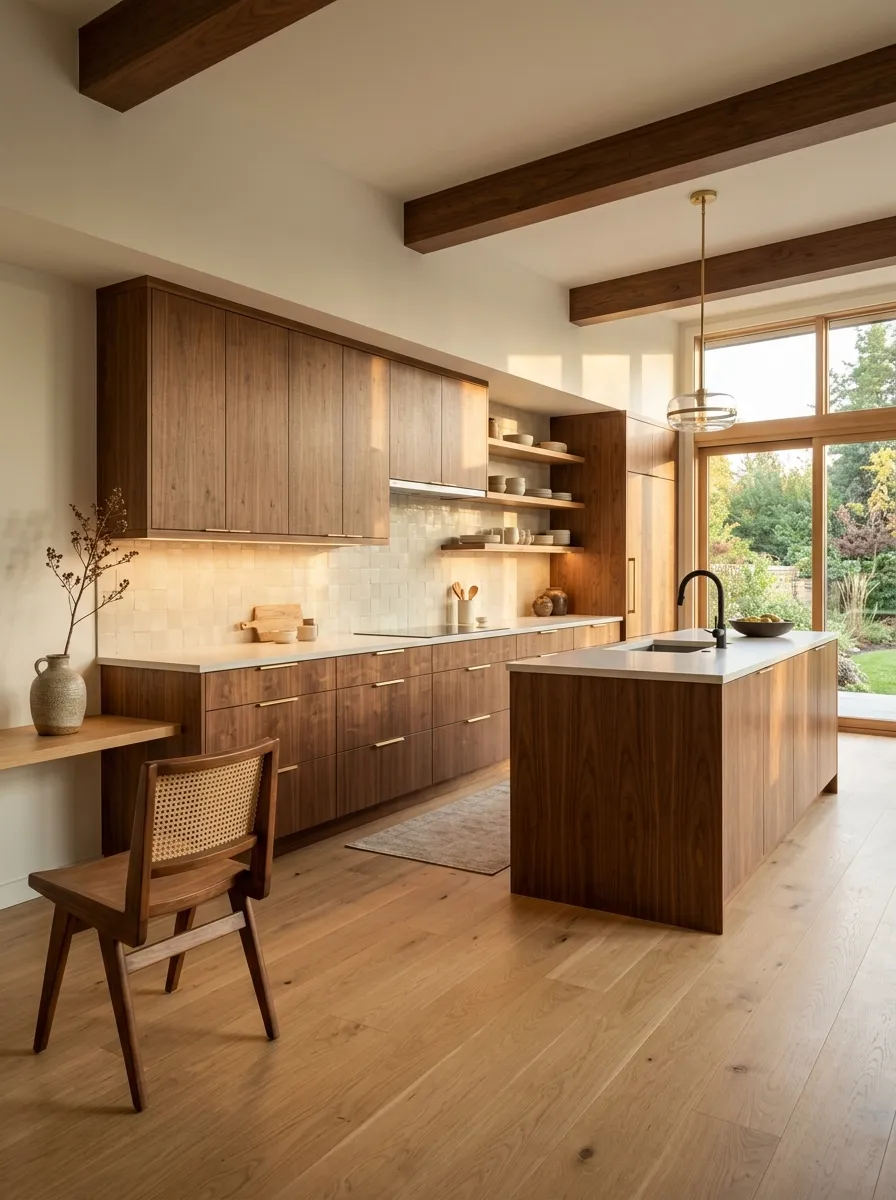
You don’t need elaborate cabinet profiles to make the kitchen interesting.
Flat-front cabinet doors are a much better starting point for this style. They create the clean, uninterrupted surfaces that make mid century kitchens feel architectural rather than traditional.
Pair them with slim horizontal pulls or understated knobs.
The key is proportion.
Simple cabinets need good spacing and strong surrounding materials.
If the cabinetry is plain, let the wood grain, lighting, backsplash, or furniture provide the personality instead.
Statement Dining Moments
Pair a simple circular wooden table with chairs that actually have some personality. The contrast between deep, saturated seat upholstery and the organic wood tone creates a visual tension that is much more interesting than a matched set from a big-box store.
Add a large, dramatic floral arrangement if you have a desperate need to feel like you live in a magazine editorial. It draws the eye away from the fact that you haven’t wiped down the back corner of your kitchen island in three days.
Choose lighting that mimics the era without looking like a museum prop. A pendant light should feel like an intentional sculpture rather than an afterthought you grabbed from the clearance bin. If it doesn’t spark a tiny bit of envy from your friends, you probably played it too safe.
Warm Up a White Kitchen With Natural Wood
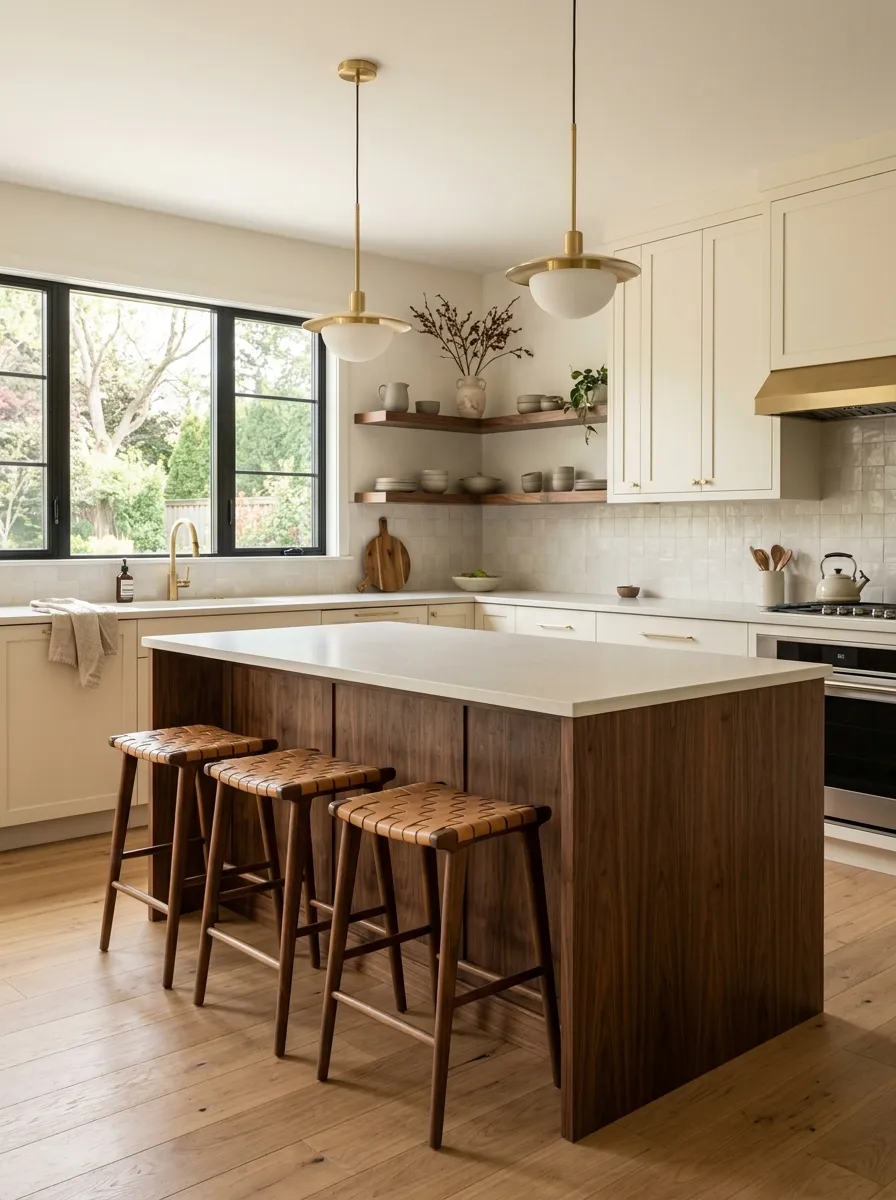
White kitchens can feel too crisp for a mid century look.
The fix isn’t adding a pile of colorful accessories. Bring in natural wood where it actually changes the composition.
A walnut island, wood stools, floating shelves, or a simple dining table can break up an all-white kitchen and give it the warmth the style needs.
Warm white works better than icy white here.
Keep the walls and counters soft, then use wood to create contrast.
Add a Geometric Backsplash Behind the Range
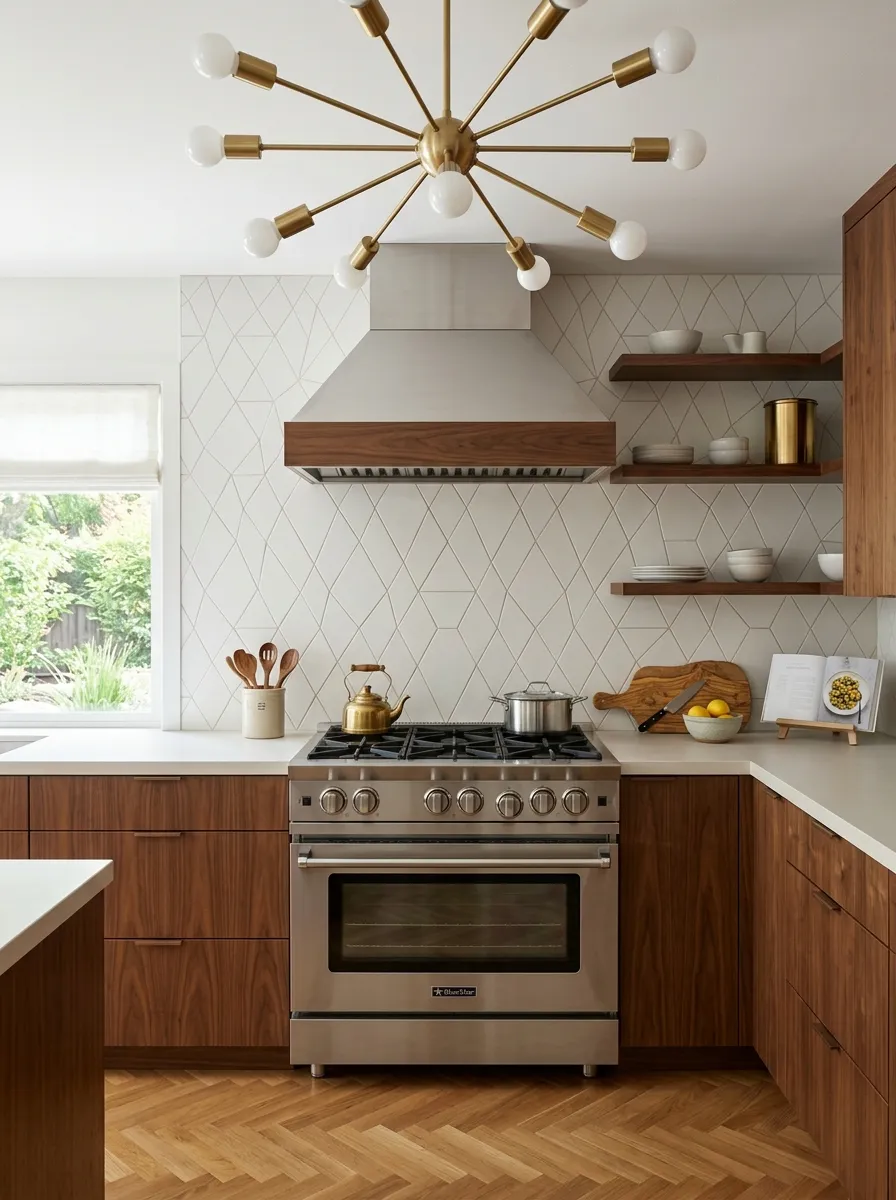
A geometric backsplash gives you the retro influence without forcing the entire kitchen to look vintage.
Use a simple repeating shape behind the range or along one focused wall. Squares, rectangles, diamonds, arches, and other clean geometric forms can work beautifully.
The important part is restraint.
If the backsplash has a pattern, let the cabinets calm everything else down.
Don’t pair a busy backsplash with busy counters and decorative cabinet fronts.
Add Open Wood Shelving Where You Actually Use It
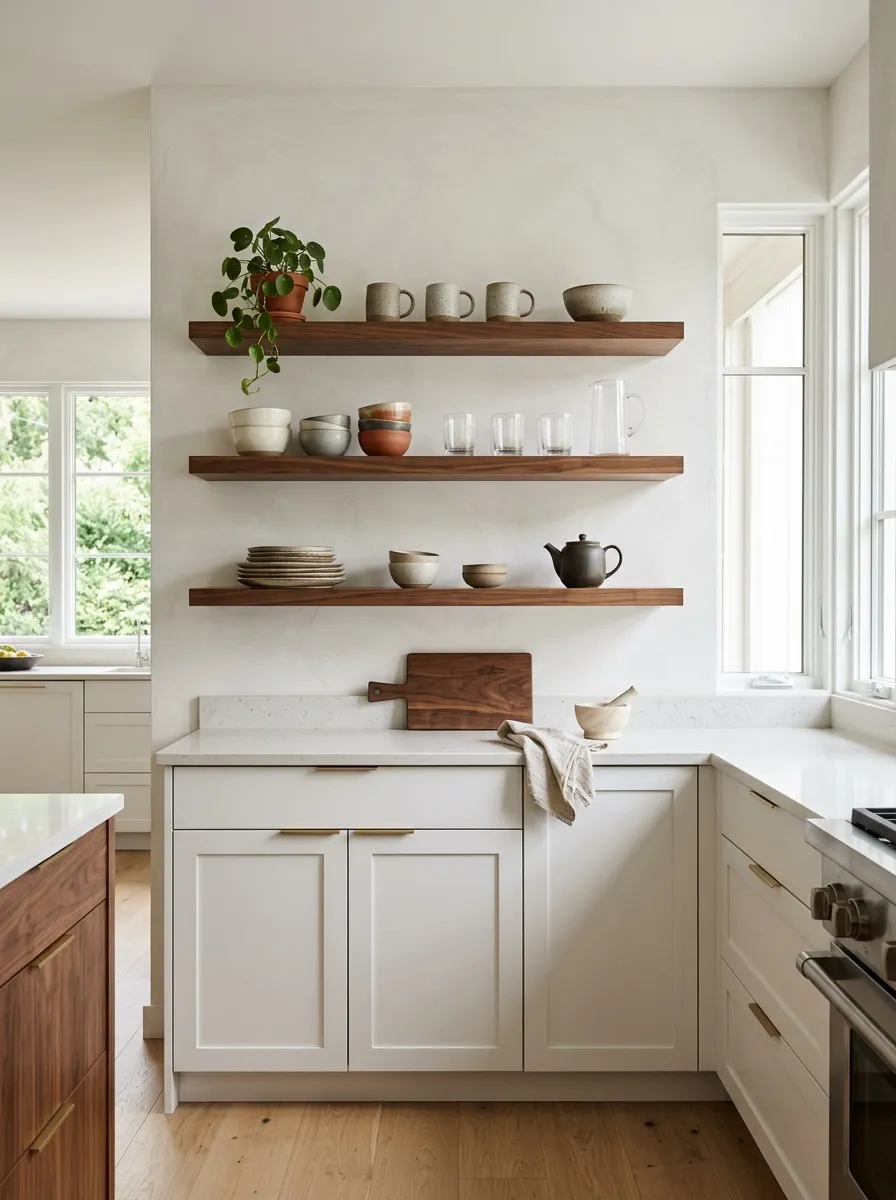
Open shelving makes sense when it holds things you reach for every day.
A walnut shelf with ceramic bowls, mugs, glasses, or a few useful cooking pieces can create the relaxed character associated with older mid century kitchens.
Don’t use open shelves as an excuse to display everything you own.
Three useful pieces look better than fifteen decorative objects.
Keep the shelf visually breathable and let the wood finish connect to the cabinetry.
Hang a Sculptural Pendant Over the Island
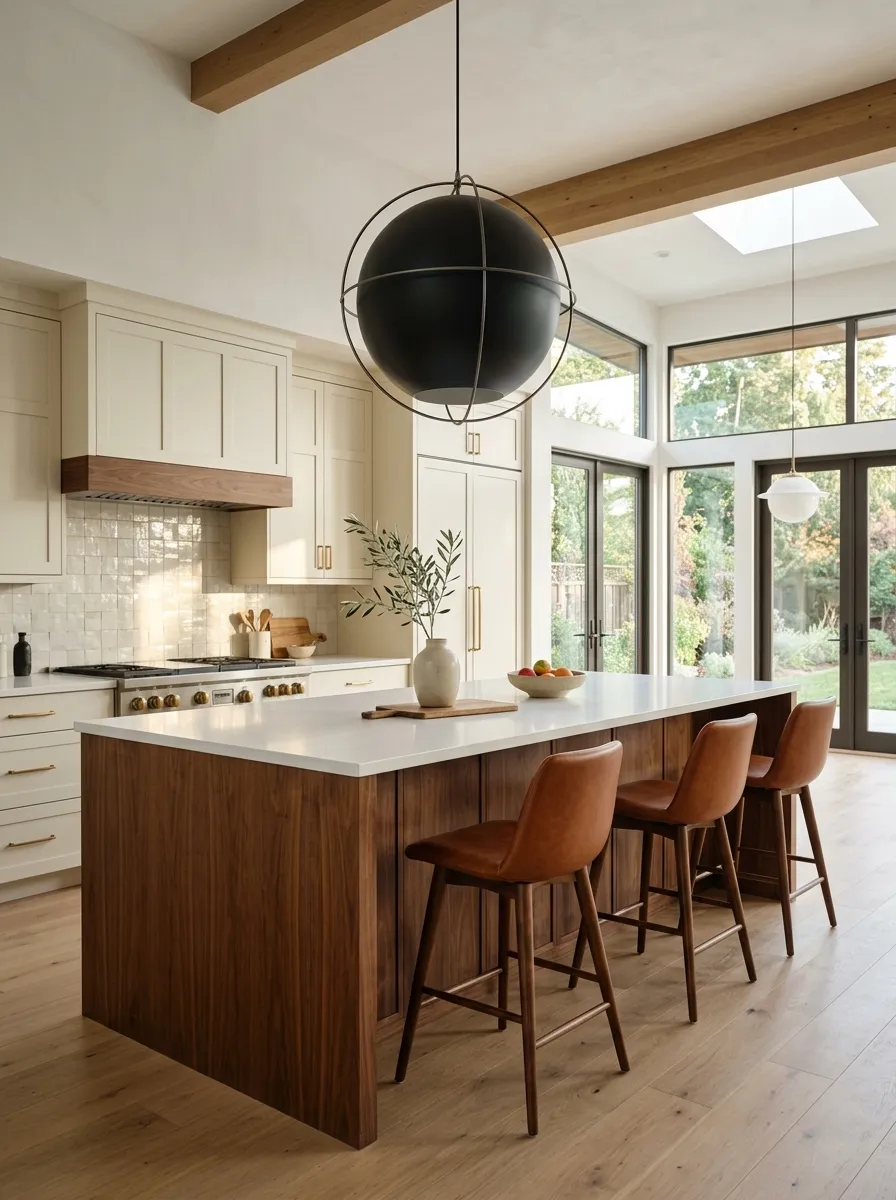
Lighting shouldn’t be an afterthought.
A sculptural pendant gives the kitchen a strong focal point while adding the curved or geometric shapes that work so well with mid century interiors.
Globe lights soften straight cabinet lines. Cone pendants feel more graphic. A simple linear fixture can reinforce a long island.
Choose the silhouette first.
The finish matters, but the shape is what people notice from across the room.
Pair Warm Wood With Simple Stone
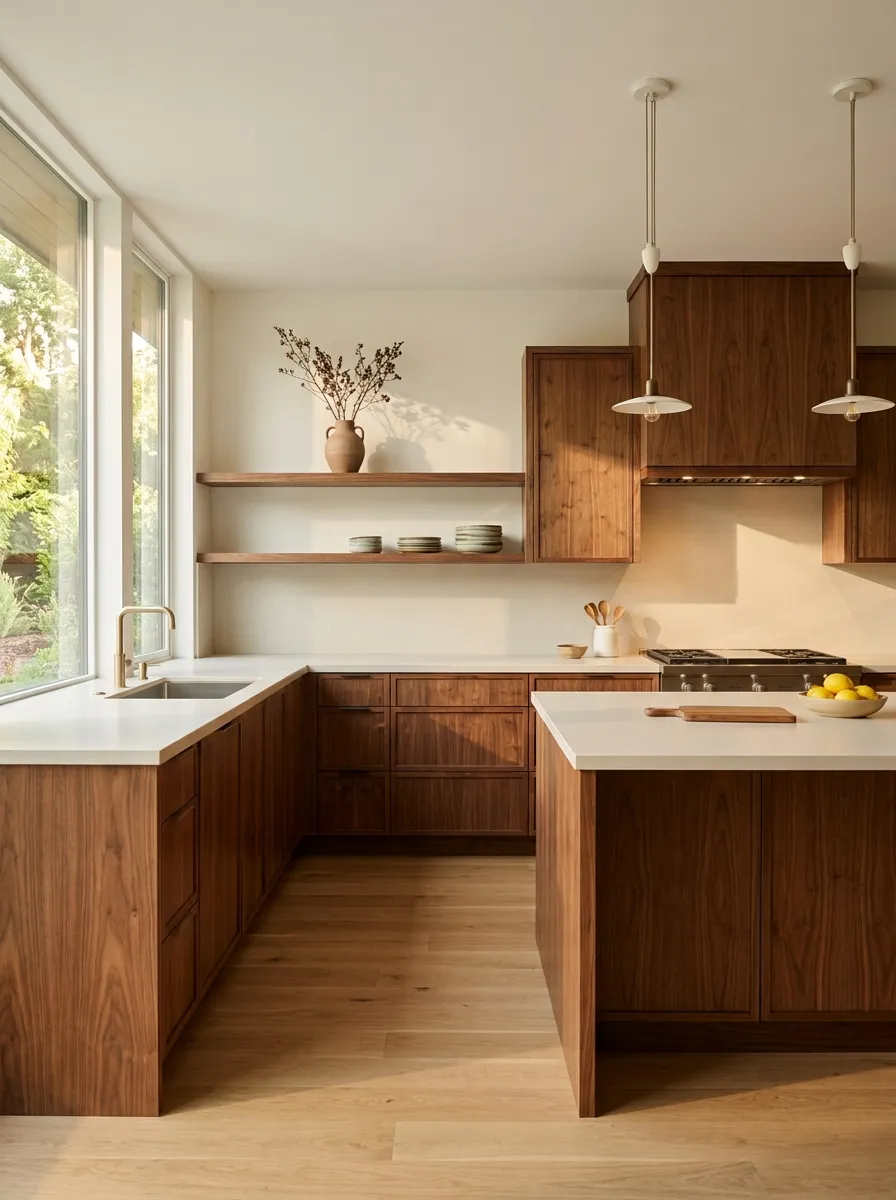
Wood and stone make a strong combination because one brings warmth while the other provides visual calm.
Use warm walnut or oak cabinetry with a restrained pale countertop. The contrast gives the kitchen depth without requiring extra decoration.
Avoid choosing a counter with a dramatic pattern if the cabinets already have strong grain.
The countertop should support the wood, not compete with it.
That one decision keeps the kitchen looking sophisticated instead of visually noisy.
Paint the Island a Muted Olive Green
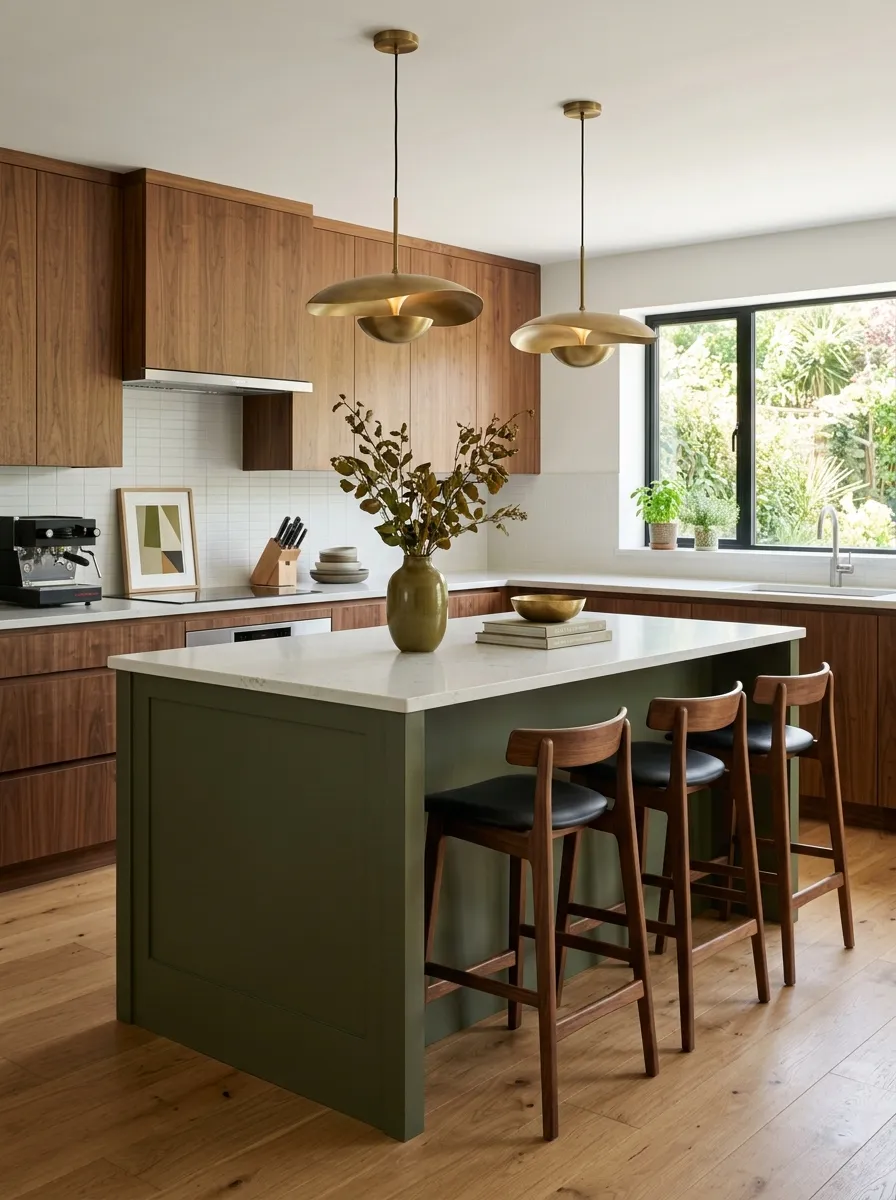
An olive island is one of the easiest ways to introduce color without losing the warm, grounded quality of the style.
Keep the surrounding cabinetry neutral or wood-toned.
The island then becomes the color anchor rather than another competing feature.
Muted green works because it feels earthy instead of sugary.
Add the same green in a small piece of artwork, textile, or ceramic if you want the color to feel connected.
Make a Wood Cabinet Wall the Focal Point
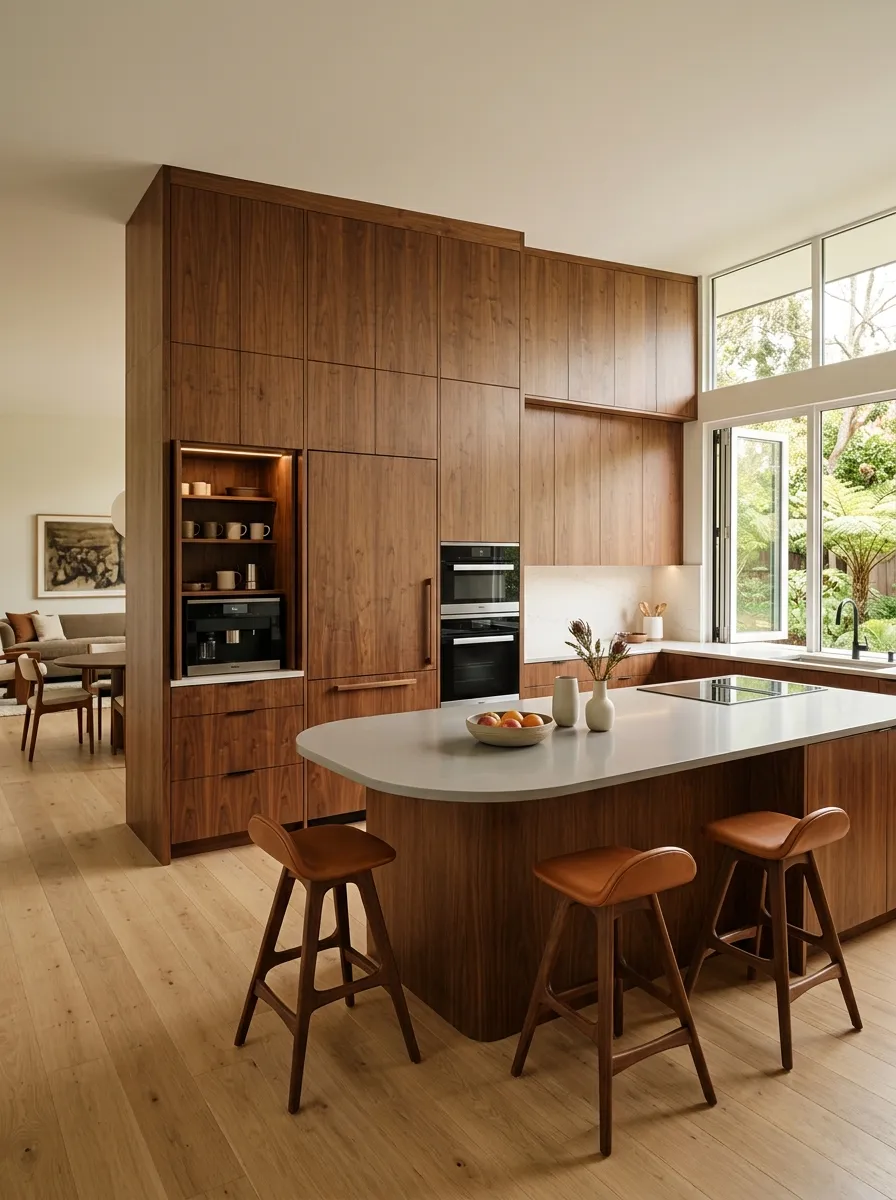
If your kitchen has a long blank wall, don’t fill it with random decor.
Turn it into one strong architectural feature.
A full-height walnut cabinet wall can hide a refrigerator, pantry, oven, or coffee station while giving the kitchen a dramatic mid century foundation.
This works especially well in open-plan homes because the cabinet wall becomes a visual backdrop from the living area.
One large gesture beats ten small decorations.
Choose Slim Horizontal Hardware
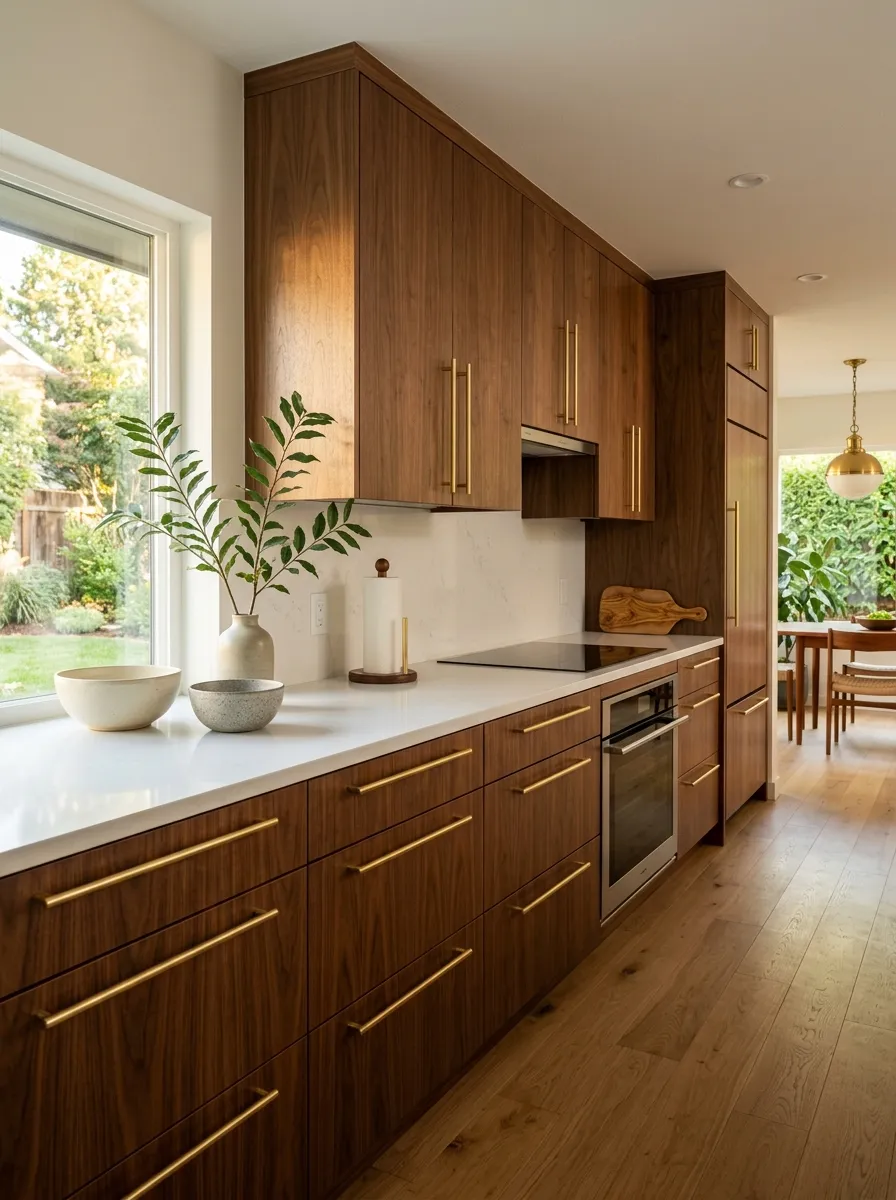
Hardware looks small until you install it across an entire kitchen.
Long, slim pulls reinforce the horizontal lines that are so important to mid century interiors. They also keep flat cabinet doors looking clean.
Brass warms the room. Black creates contrast. Brushed metal keeps things understated.
Don’t mix several unrelated shapes.
Choose one dominant hardware language and stick with it.
Build a Breakfast Nook With Tapered Furniture
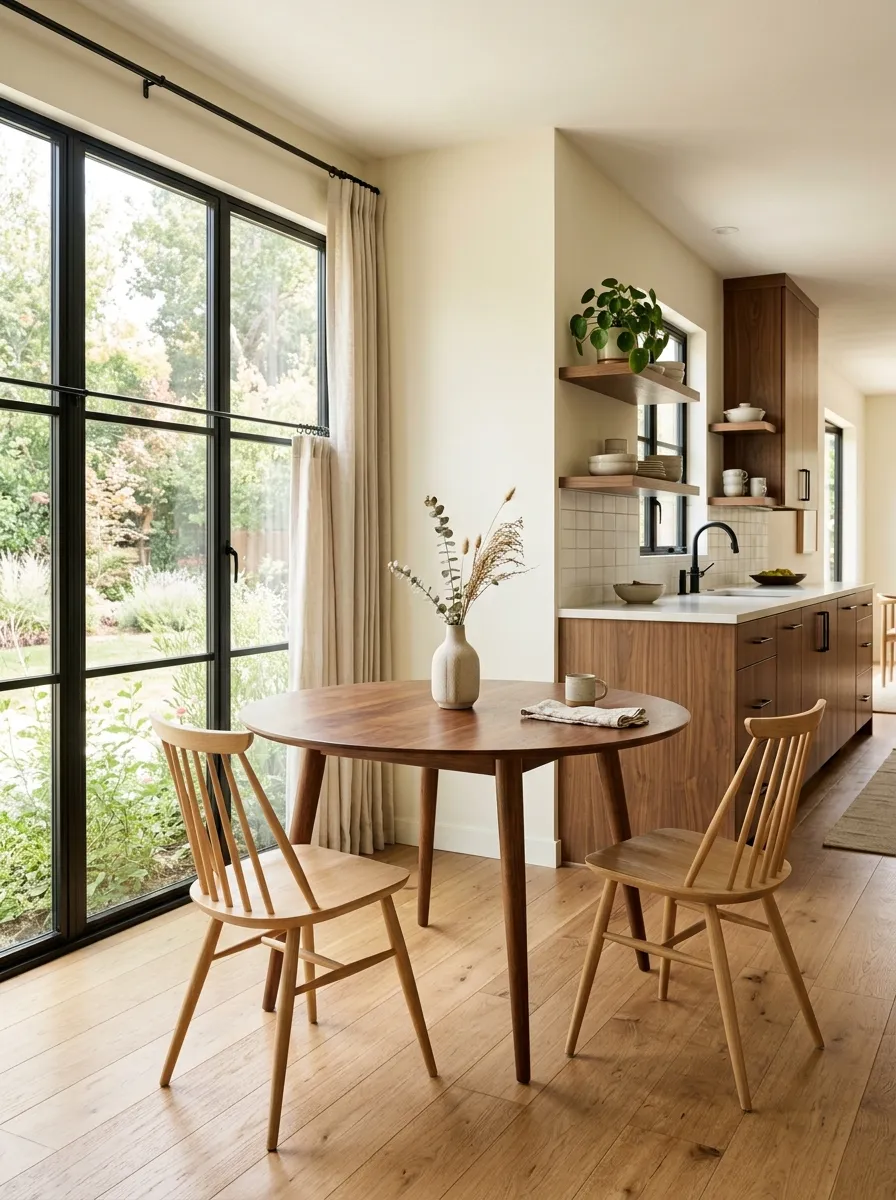
A breakfast nook gives a mid century kitchen something more important than decoration: furniture with personality.
Use a small round or oval table with tapered legs, then pair it with lightweight chairs or a simple built-in bench.
Keep the furniture visually light.
You should be able to see some floor underneath it.
That openness prevents the dining area from making a compact kitchen feel cramped.
Use Warm Wood Flooring to Connect the Whole Room
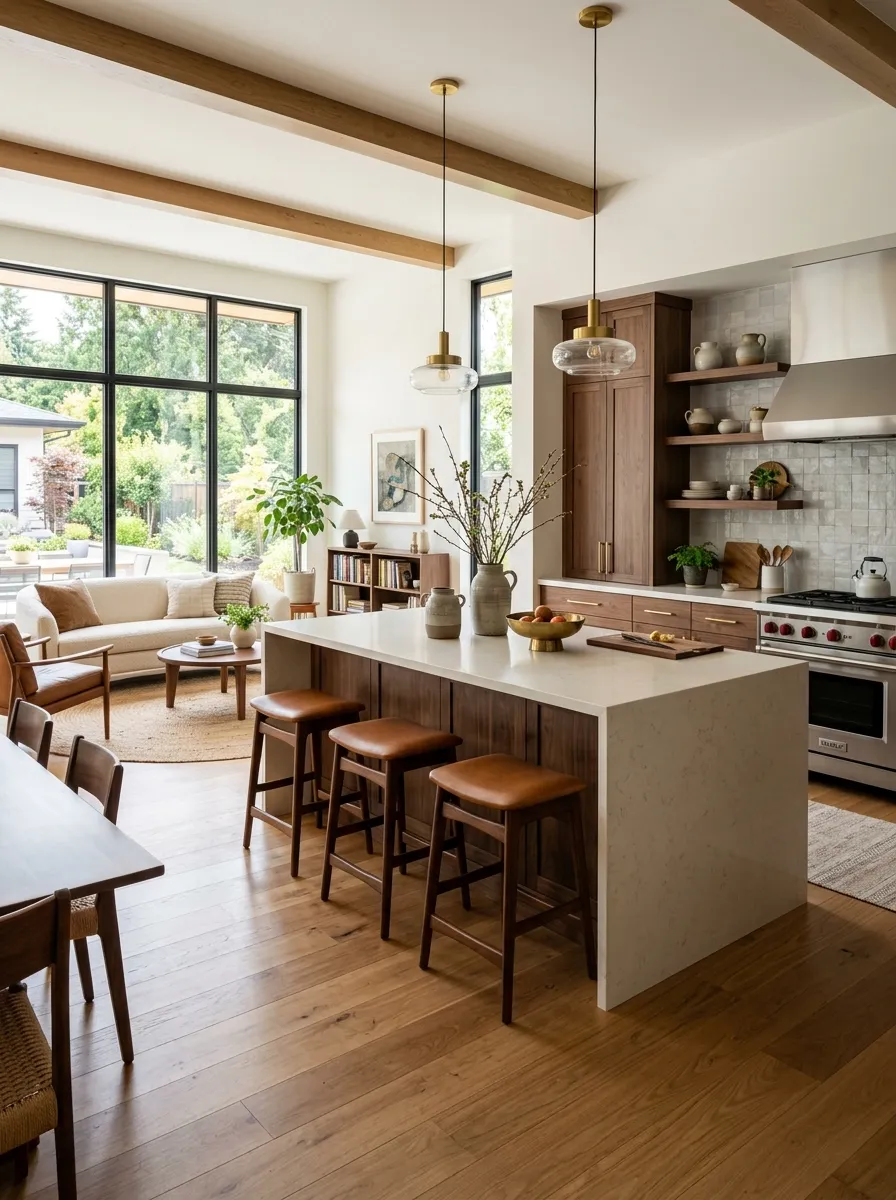
Flooring matters more than people expect.
Warm wood flooring creates a visual bridge between the kitchen, dining area, and living room, especially in open-plan homes.
If your cabinets are walnut, the floor doesn’t need to match them exactly.
Similar warmth matters more than an identical finish.
Let the cabinetry and flooring share an overall temperature while keeping enough variation that the room doesn’t look like one giant block of wood.
Add One Strong Retro Color Instead of Five
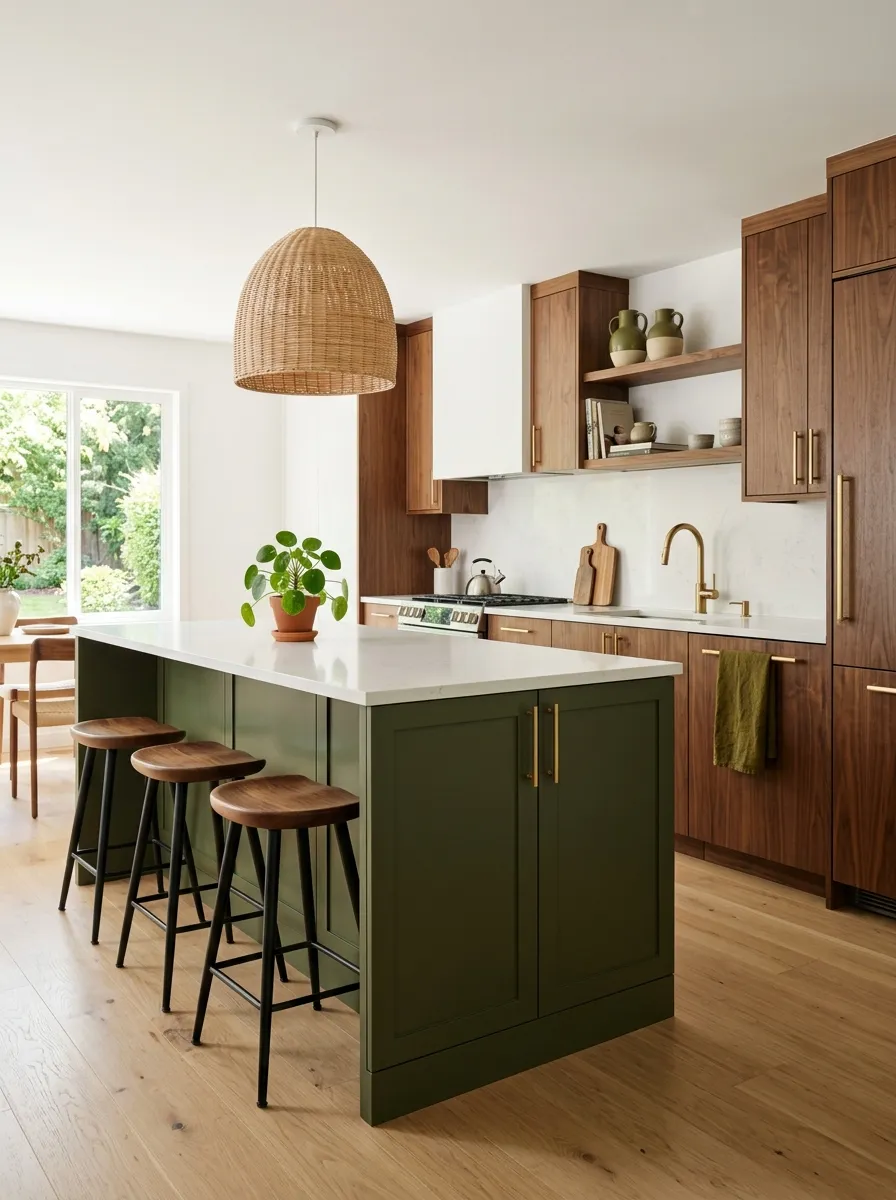
Mid century kitchens don’t need a rainbow of period colors.
Pick one color that gives the room personality, then repeat it in small places. A muted mustard can appear in a stool cushion and artwork. Rust can show up in a runner and ceramic pieces. Olive can connect an island to a small plant or textile.
One strong color looks intentional. Five competing colors look like a thrift store display.
Use Globe or Cone Lighting to Anchor the Room
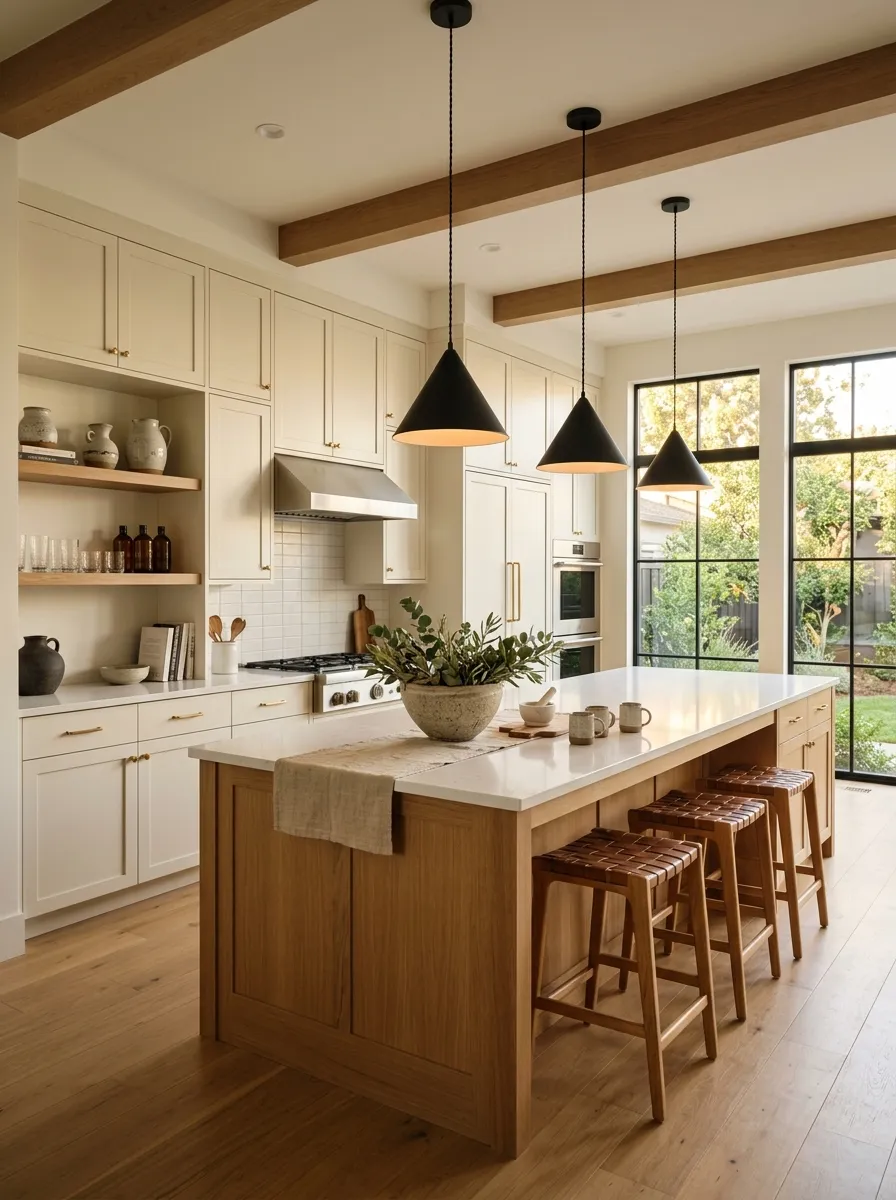
Lighting is one of the easiest ways to make the style recognizable without making the entire kitchen look vintage.
A globe fixture softens the straight cabinet lines. A cone pendant creates a stronger graphic shape. Both can work over an island, peninsula, or dining table.
Don’t scatter several different fixture styles around the room.
Pick one lighting language and repeat it.
Keep Countertops Visually Quiet
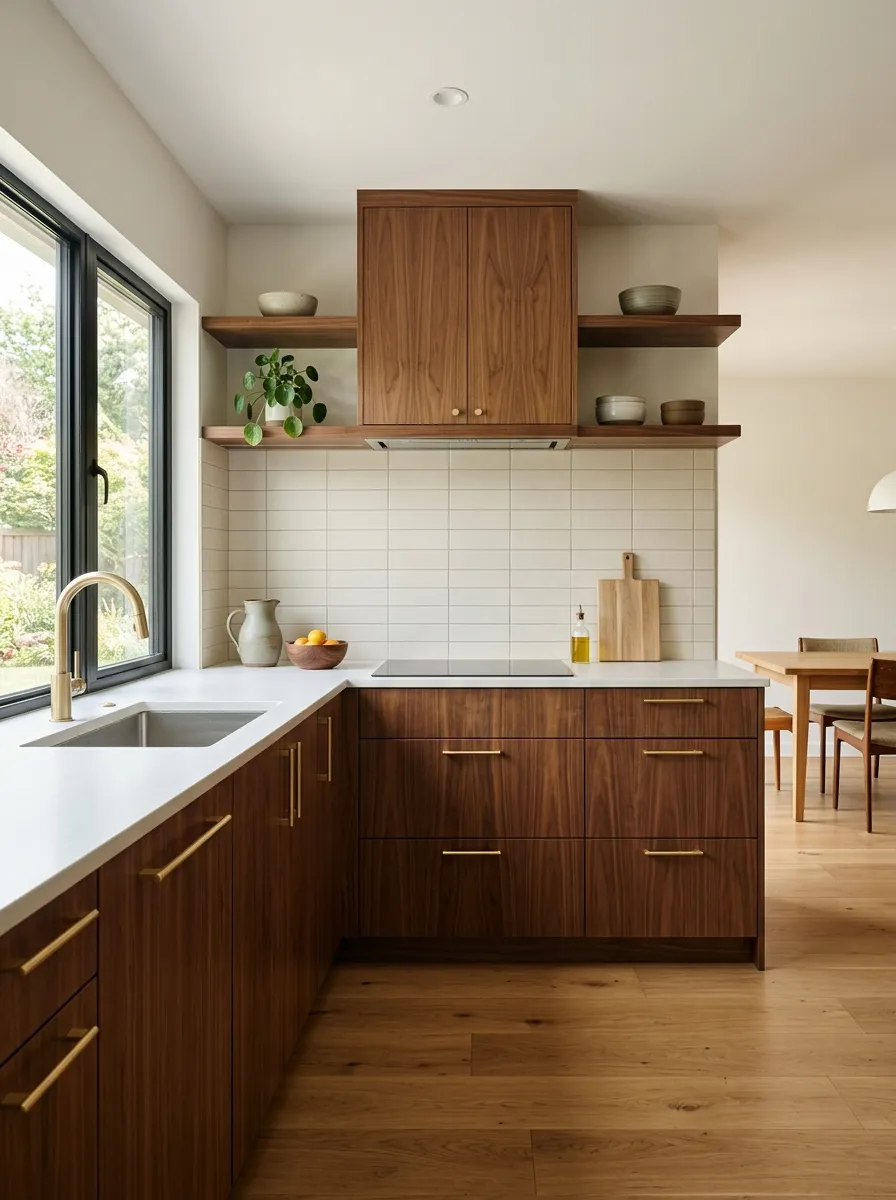
Countertops cover a large amount of visual space, so a dramatic surface can take over the entire kitchen.
For a calmer mid century look, choose a counter with a restrained pattern and let the cabinets or backsplash provide the personality.
This is especially important when you’re already using warm wood. You don’t need another competing focal point.
Think background, not centerpiece.
Let Vintage Pieces Add Character Without Taking Over
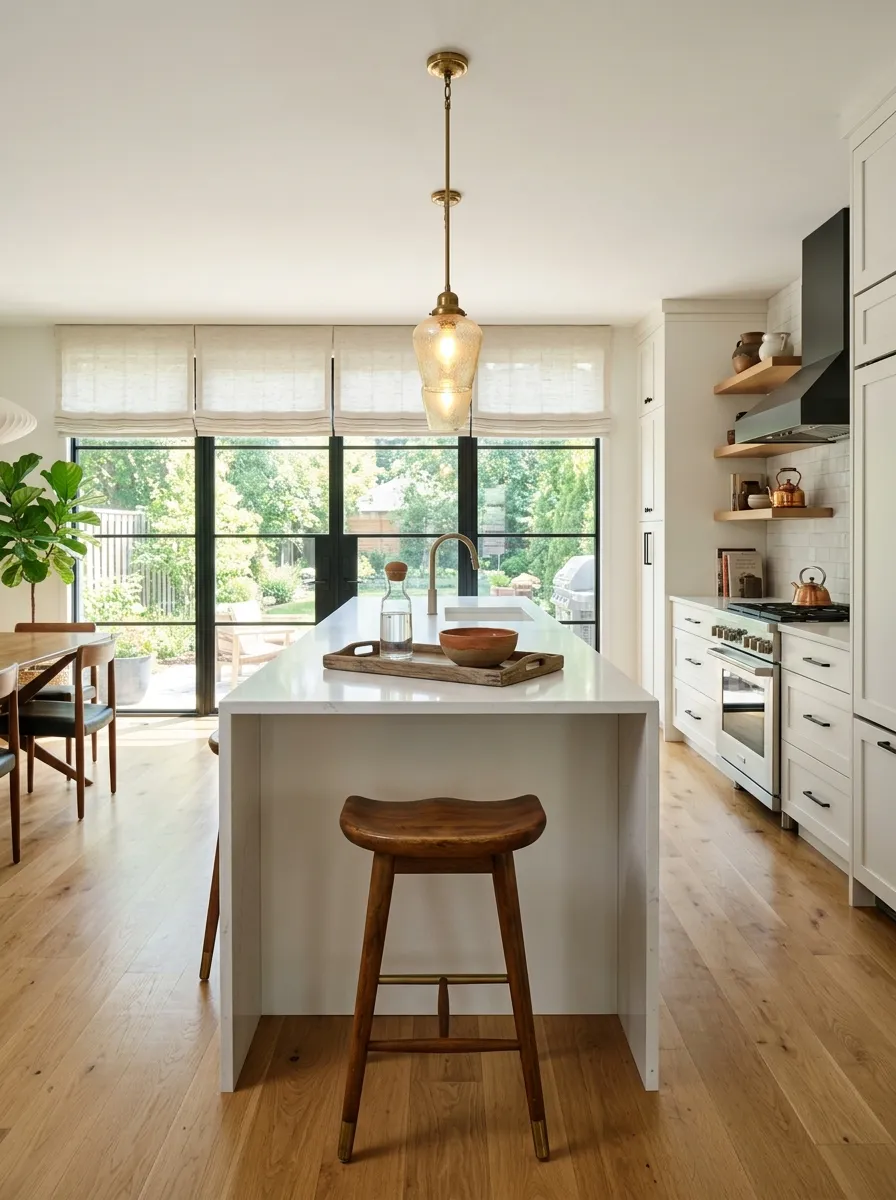
A real vintage piece can give the kitchen more personality than a room full of fake retro accessories.
Try a vintage stool, wood serving tray, old ceramic bowl, framed print, or small pendant. One or two authentic-looking pieces are enough.
The trick is to make them part of the room rather than museum objects.
Use vintage pieces where you’d naturally use something today.
That makes the kitchen feel lived in instead of staged.
Use Built-In Storage to Hide Modern Clutter
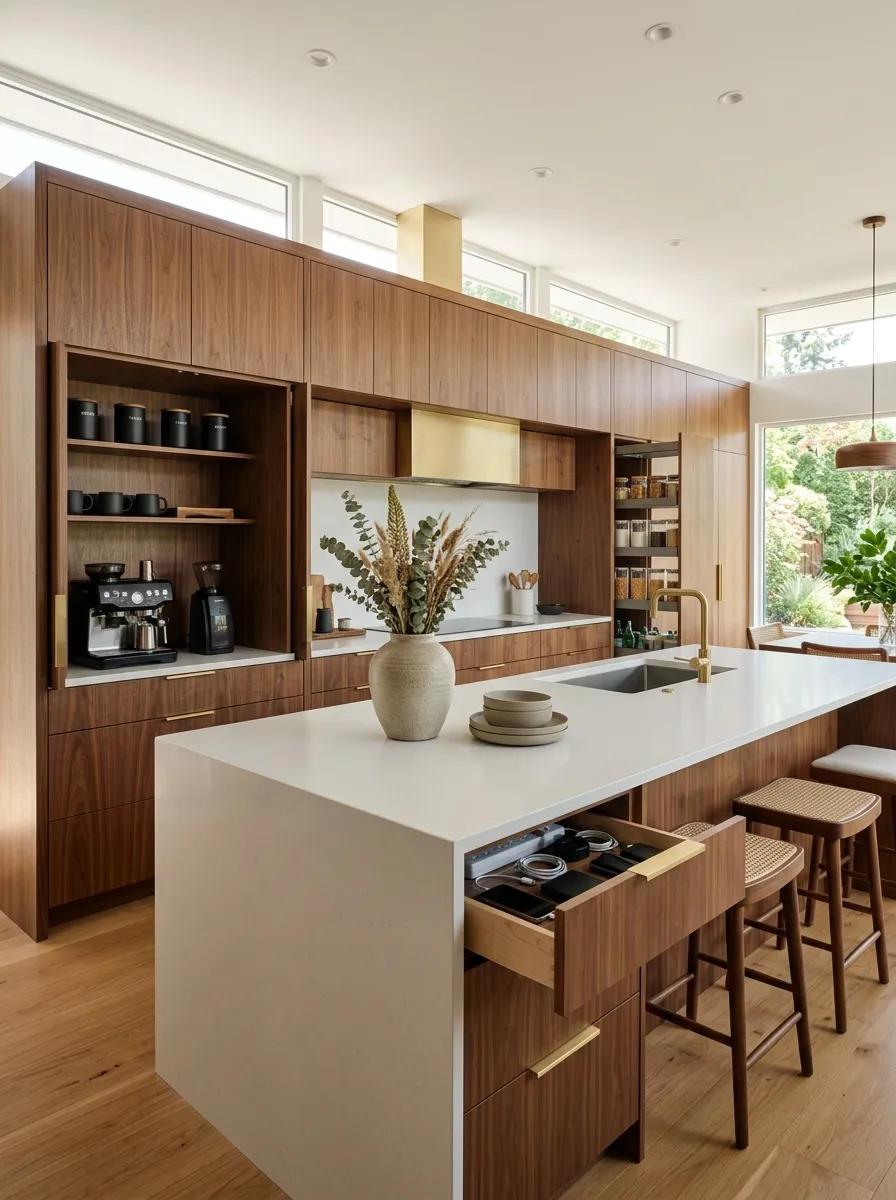
A mid century kitchen looks best when the architecture can actually be seen.
That becomes difficult when small appliances, chargers, food packets, cleaning products, and random containers cover every counter.
Built-in storage solves the problem without forcing you to live with an empty kitchen.
Create a dedicated appliance garage, tall pantry, drawer for charging gear, or concealed coffee station.
The goal isn’t fewer things. It’s fewer things sitting in sight.
Choose Bar Stools With the Right Mid Century Shape
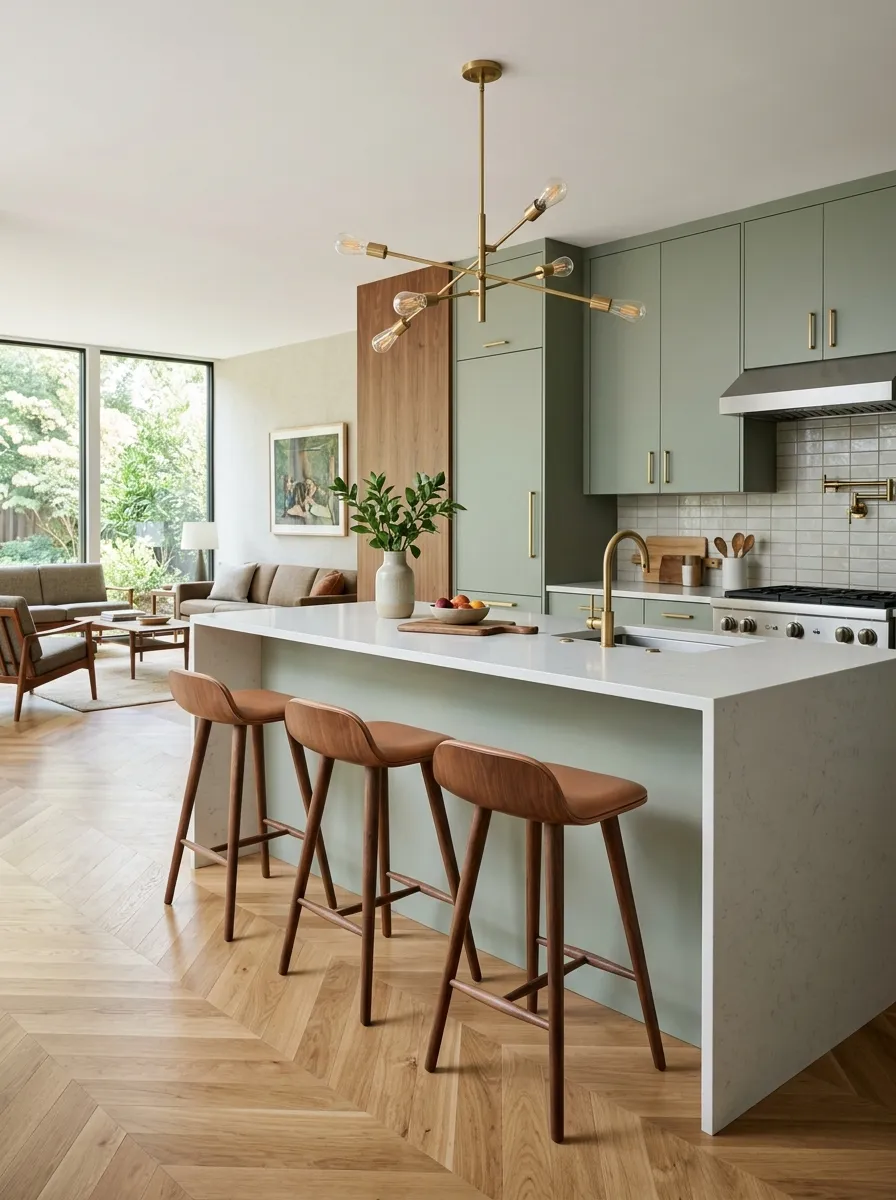
Bar stools can either reinforce the style or completely derail it.
Skip oversized upholstered stools with bulky backs. Look for tapered legs, molded forms, curved wood, simple upholstery, or a clean metal frame.
The stool should look light enough that you can see some floor underneath it.
| Stool feature | Best direction |
|---|---|
| Legs | Tapered or slender |
| Seat | Wood, leather-look, or simple upholstery |
| Back | Low or visually light |
| Shape | Rounded or clean geometric |
| Finish | Warm wood or restrained metal |
The right stool doesn’t need a retro label. Its proportions do the work.
Frame the Kitchen With Simple Wood Details
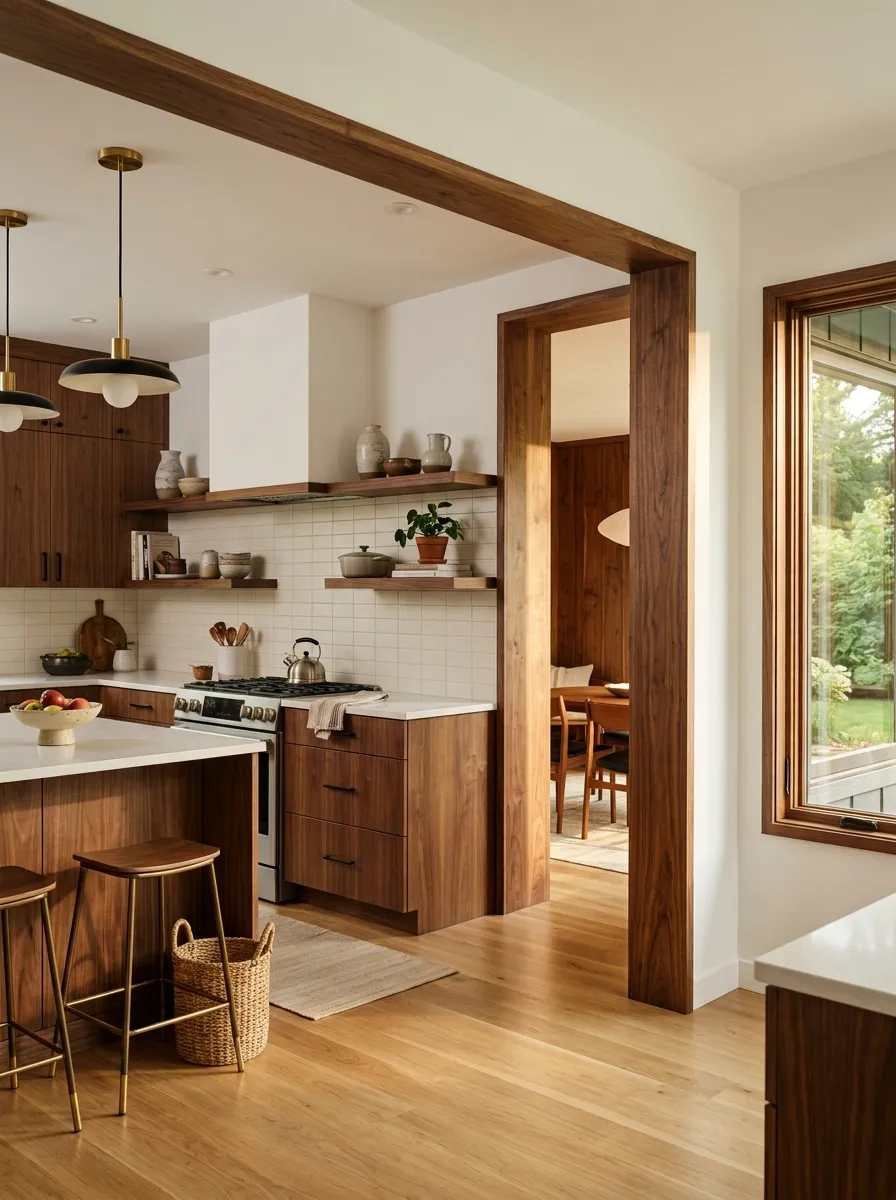
Wood trim can make a new kitchen feel more connected to mid century architecture.
Use it around a doorway, window, pantry opening, or ceiling transition. Even a simple wood shelf with a strong horizontal line can create that same effect.
Don’t add trim just because you can.
Pick architectural locations first.
A wood-framed opening can look intentional. Random wood strips placed around the room usually look like an afterthought.
Use Brass or Black Metal in Small Doses
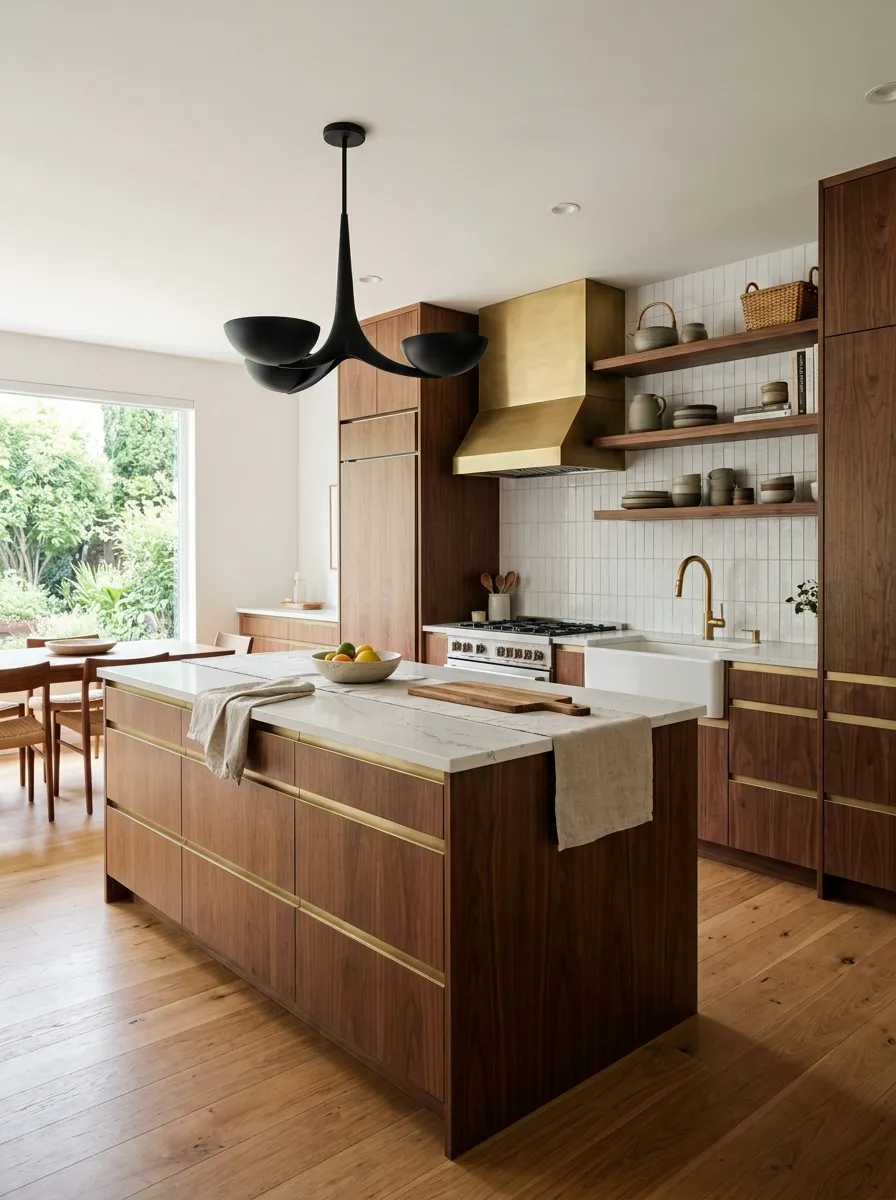
Metal finishes are supporting characters here.
Warm brass works when you want a softer, richer look. Black metal creates more contrast and gives the kitchen a sharper edge.
The mistake is using the same metal on every single object.
Keep the main finish consistent, then let one secondary metal appear in a small role.
For example, brass cabinet pulls can work with a black pendant. Or black hardware can sit beside a warm brass faucet.
Make a Small Kitchen Feel More Authentic With Repetition
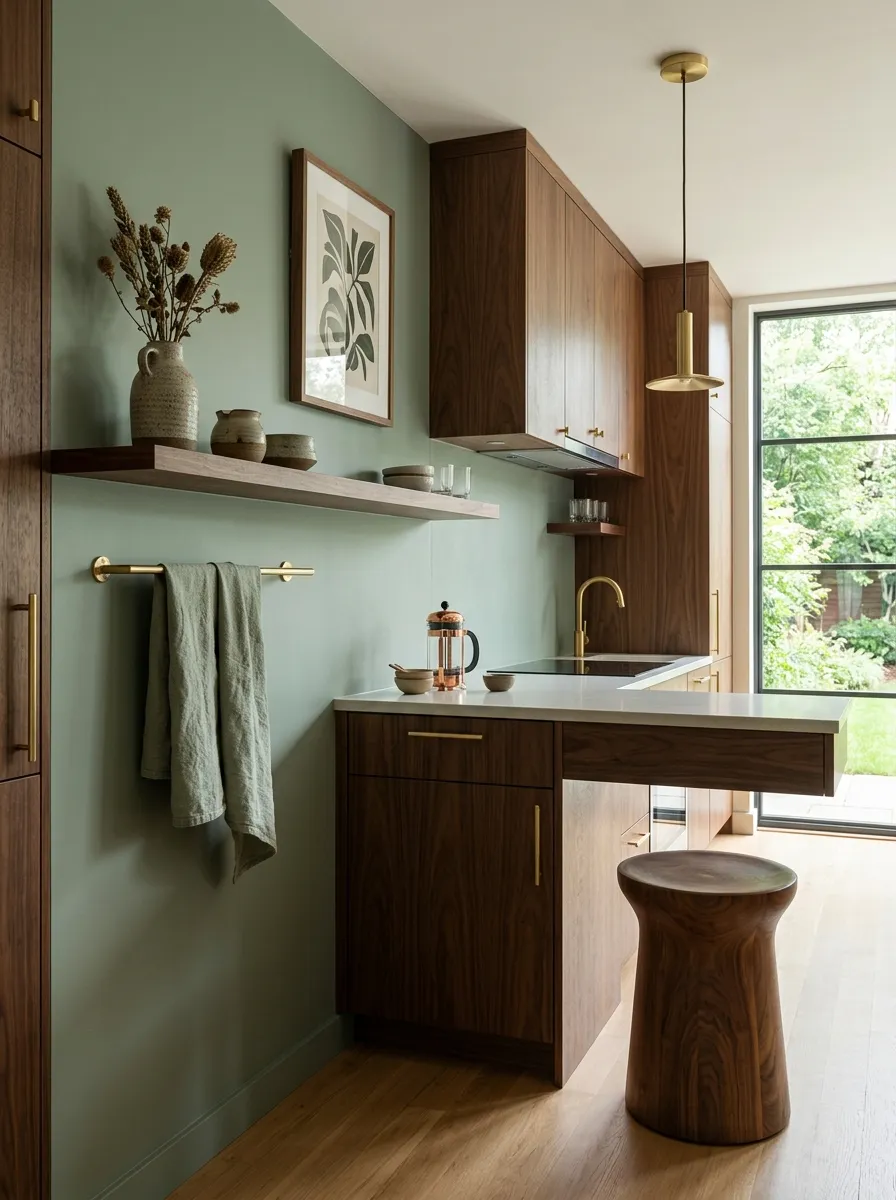
Small kitchens don’t need more decoration. They need stronger visual connections.
Repeat one wood tone, one metal finish, or one color in several places. The repetition makes separate pieces feel like they belong to the same room.
For example, walnut cabinets can connect to a walnut shelf and a wood stool. A muted green island can connect to green artwork or a small textile.
Repetition creates cohesion without adding clutter.
Mix Modern Appliances Into the Retro Scheme
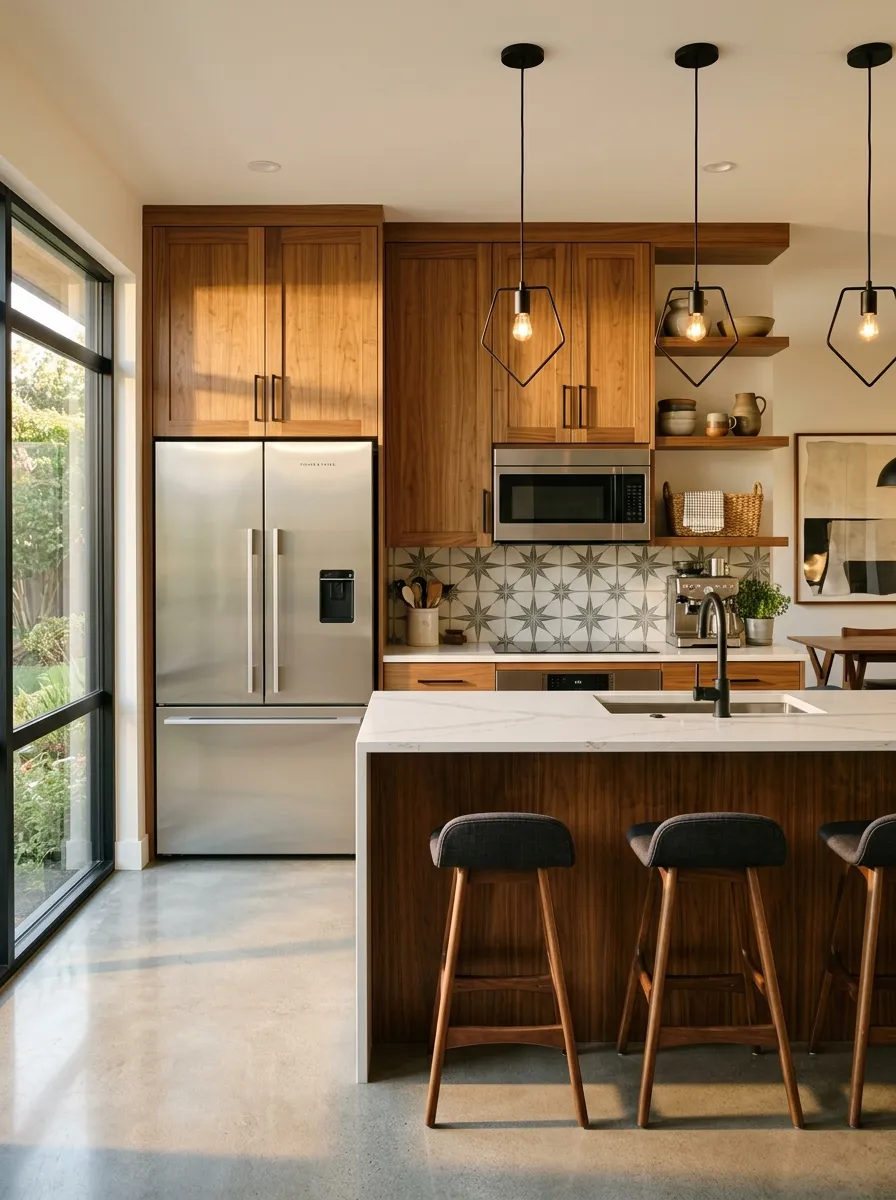
Your refrigerator doesn’t need to look like it came from another decade.
Modern appliances can sit comfortably in a mid century kitchen when the surrounding finishes carry the style. The trick is controlling how much attention the appliance gets.
Panel-ready appliances can disappear into cabinetry. Stainless steel can work when paired with warm wood and simple hardware. Even a standard black appliance can become part of the palette.
Don’t fight the appliance. Design around it.
Finish With One Piece That Looks Like It Belongs There
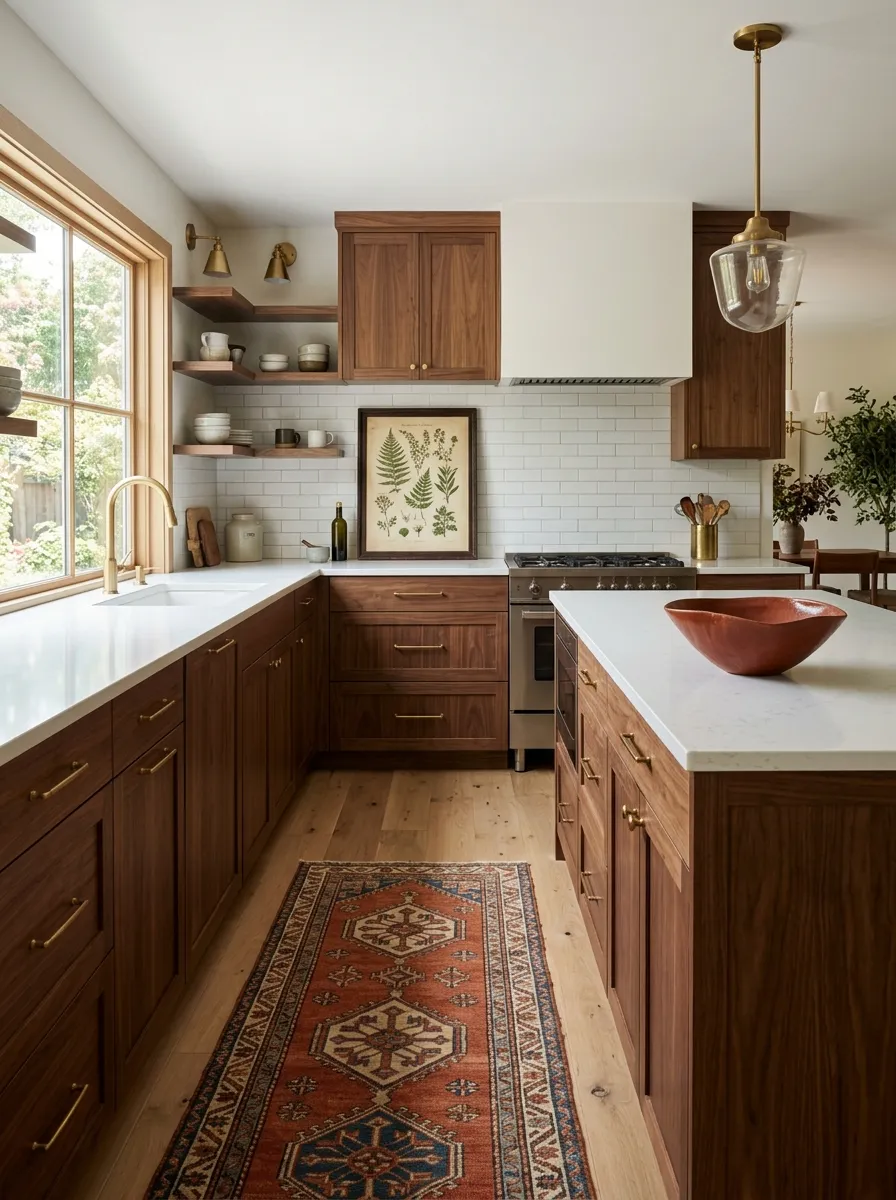
The final detail should feel discovered, not purchased as part of a matching set.
That could be a sculptural ceramic bowl, an old wood stool, a framed print, a vintage-inspired clock, or a simple piece of artwork with the kitchen’s existing colors.
Choose something with a little personality.
The best finishing piece connects at least two things already in the room.
A wood frame can echo the cabinets. A rust-colored ceramic piece can repeat the runner. A green print can connect to the island.
That’s how the room feels complete without looking decorated to death.
Keep the Backsplash Lower Than the Cabinet Drama
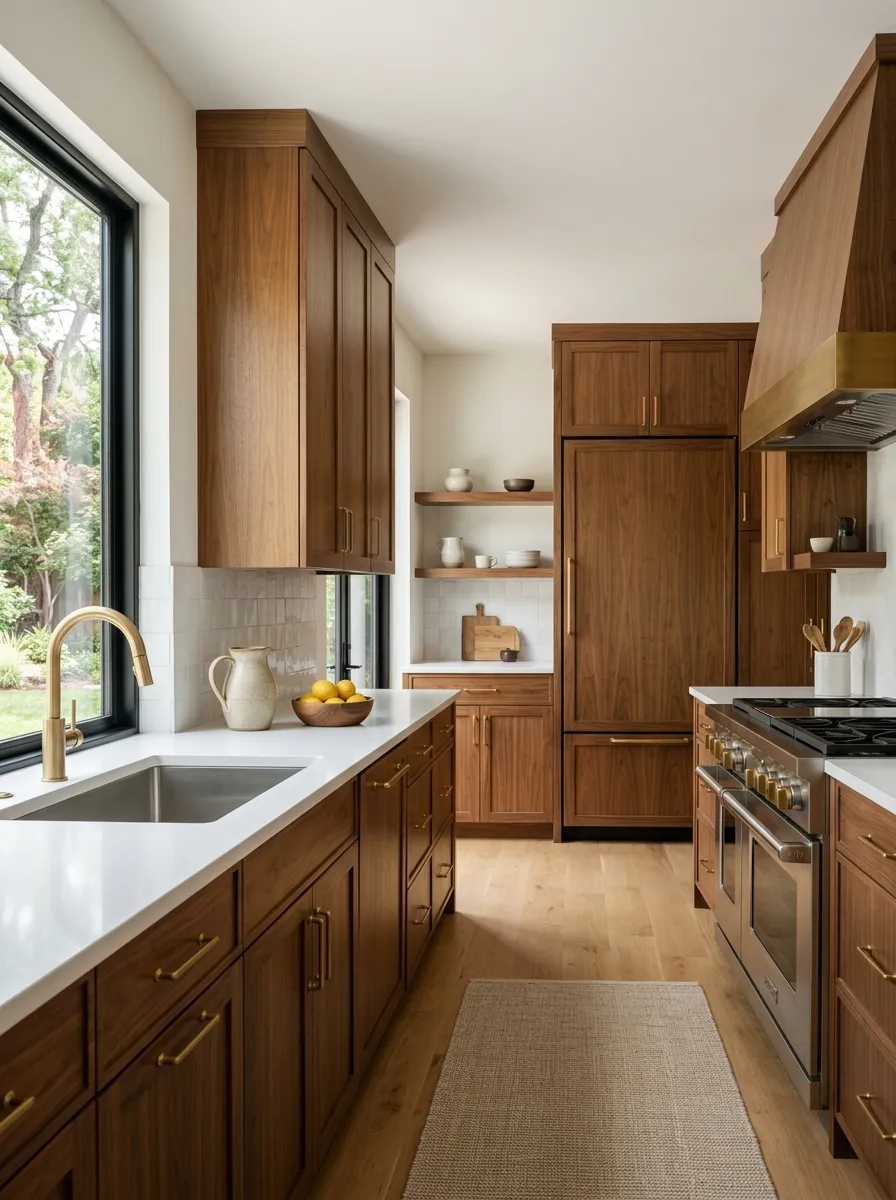
A backsplash doesn’t have to climb every wall to make an impact.
If your cabinetry already has rich wood grain or an unusual color, a simpler backsplash can create the breathing room the room needs.
Use tile where it protects the wall and where it helps define the cooking area.
The strongest backsplash is the one that knows when to stop.
This is especially useful in smaller kitchens where too many visual changes can make the room feel chopped up.
Add a Low-Profile Dining Table
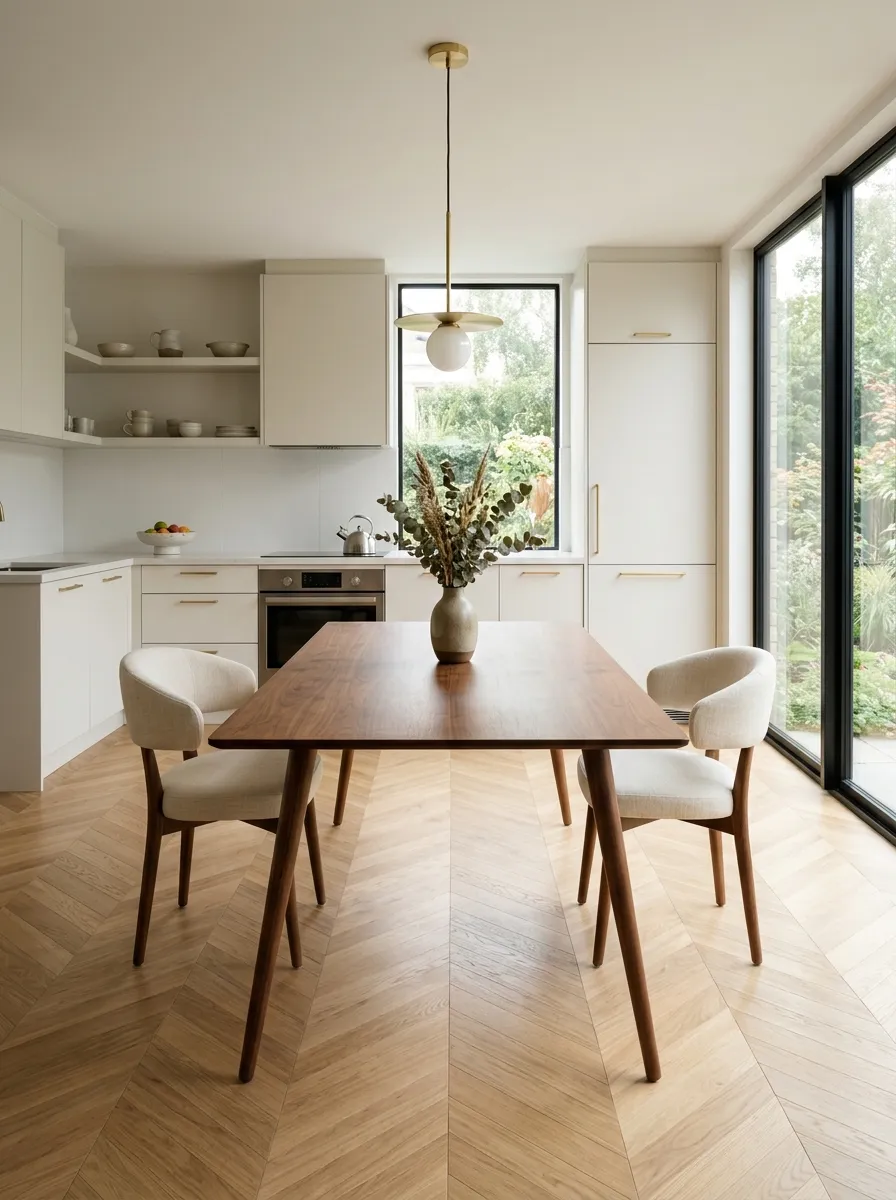
A dining table can reinforce the mid century look without competing with the kitchen.
Choose a simple wood table with tapered legs and a relatively thin profile. Avoid oversized farmhouse proportions or ornate traditional legs.
The table should feel like furniture, not another kitchen cabinet.
Leave some breathing room around the legs.
That small detail keeps the dining zone visually light and helps an open kitchen feel larger.
Use Brass Hardware for a Softer Retro Finish
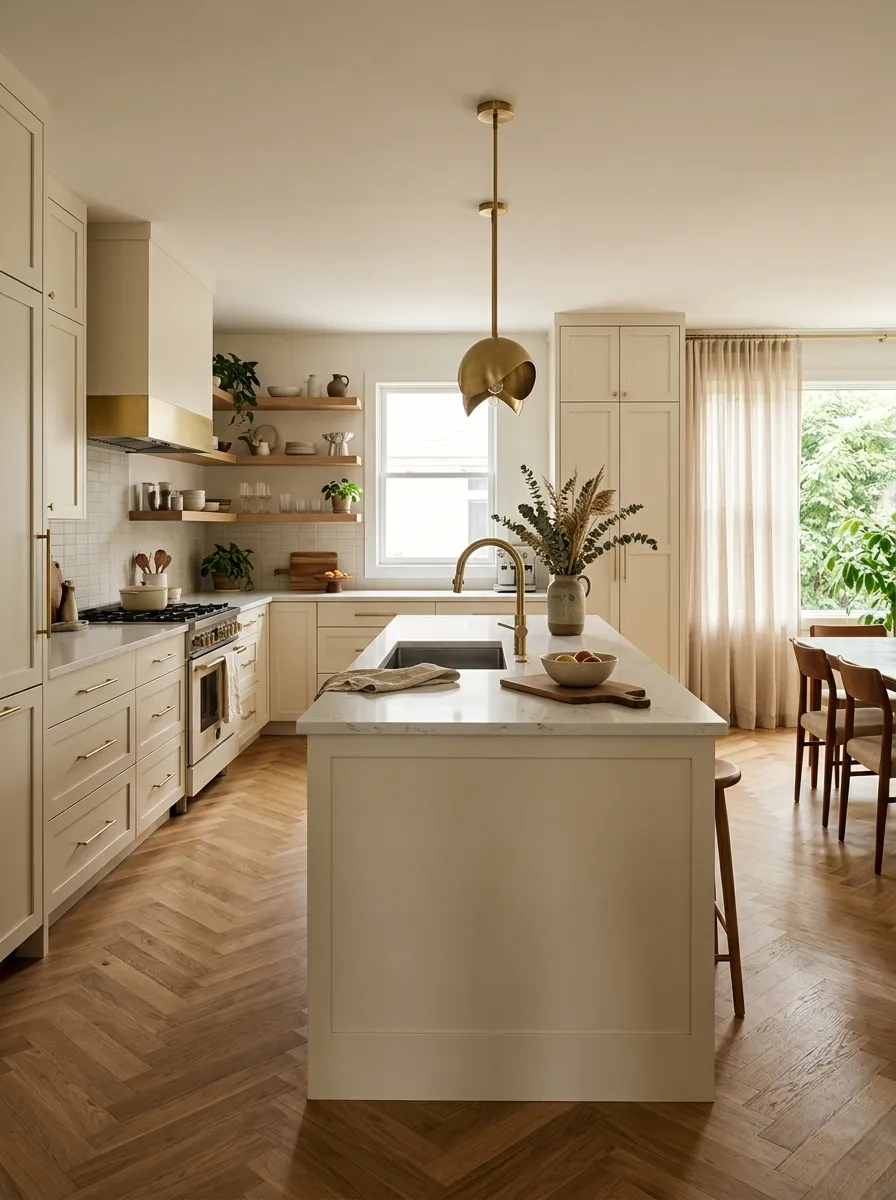
Brass is an easy way to warm up a kitchen that already has wood and cream tones.
Choose a finish that looks slightly muted rather than extremely shiny. Pair it with simple cabinet fronts so the hardware doesn’t become overly decorative.
You don’t need brass everywhere.
Cabinet pulls, a faucet, or a pendant are enough to establish the finish.
Repeat it in a small way elsewhere if the kitchen needs more cohesion.
Use Repetition to Make a Small Kitchen Feel Cohesive
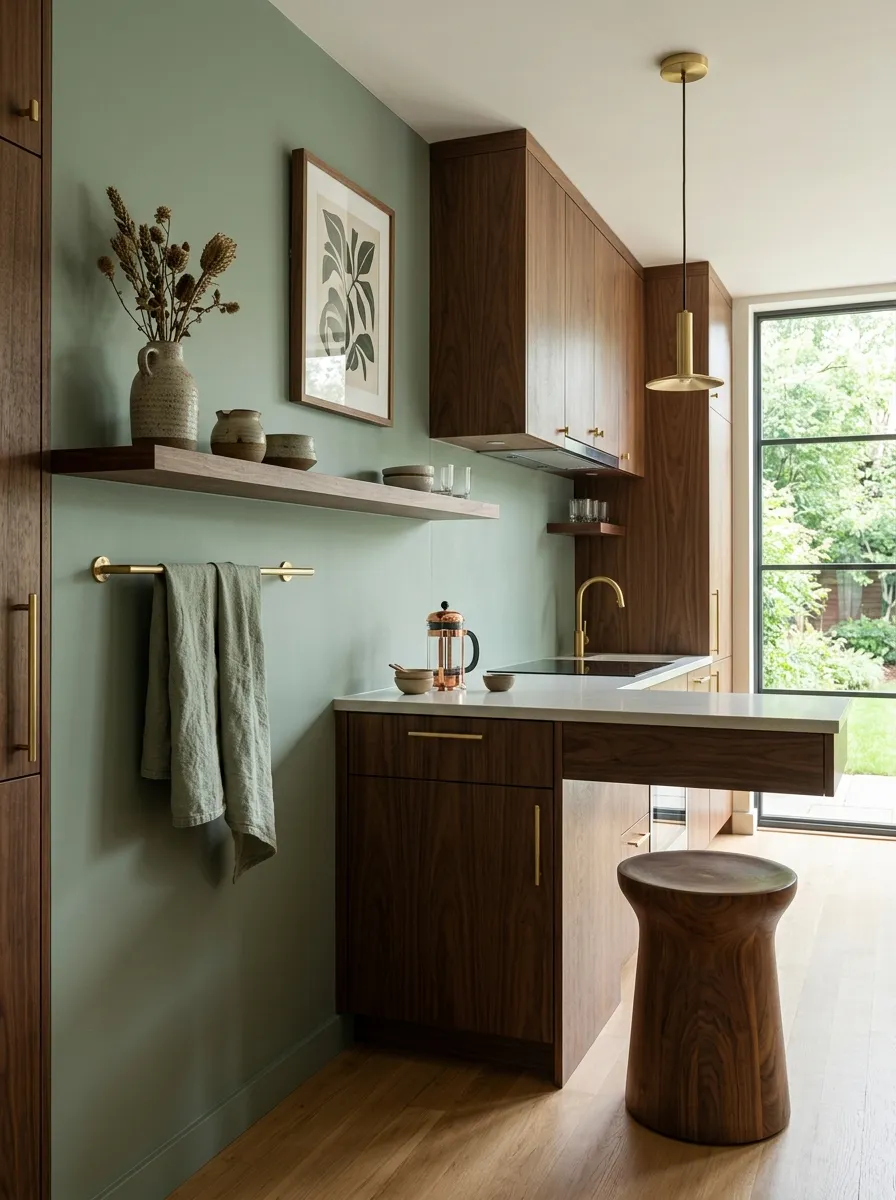
Small kitchens don’t need more decoration. They need stronger visual connections.
Repeat one wood tone, one metal finish, or one accent color in several places. The repetition makes separate pieces feel like they belong to the same room.
For example, walnut cabinets can connect to a walnut shelf and wood stool. A muted green island can connect to green artwork or a small textile.
Repetition creates cohesion without adding clutter.
Blend Modern Appliances Into the Retro Scheme
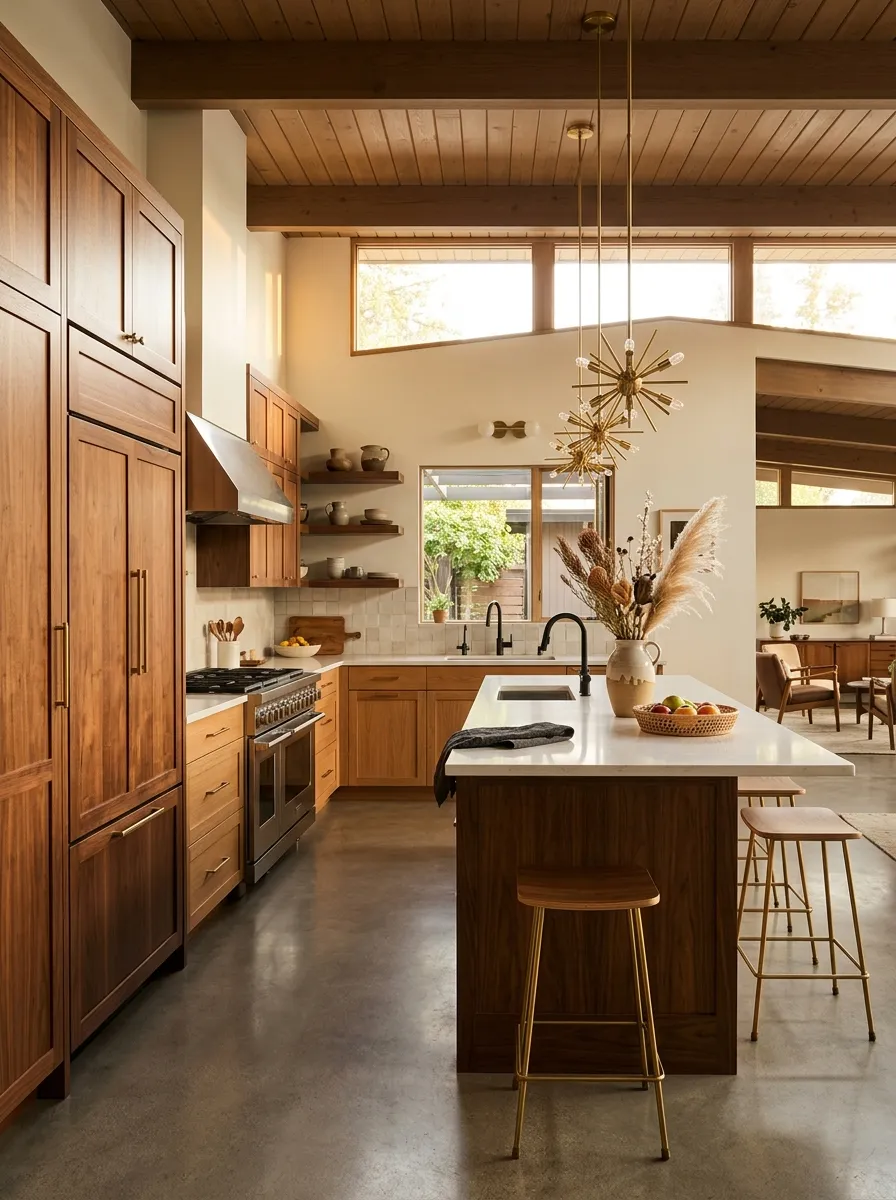
Your refrigerator doesn’t need to look like it came from another decade.
Modern appliances can sit comfortably in a mid century kitchen when the surrounding finishes carry the style. The trick is controlling how much attention the appliance gets.
Panel-ready appliances can disappear into cabinetry. Stainless steel can work when paired with warm wood and simple hardware. Even a standard black appliance can become part of the palette.
Don’t fight the appliance. Design around it.
Finish With One Piece That Looks Like It Belongs There
The final detail should feel discovered, not purchased as part of a matching set.
That could be a sculptural ceramic bowl, an old wood stool, a framed print, a vintage-inspired clock, or a simple piece of artwork with the kitchen’s existing colors.
Choose something with a little personality.
The best finishing piece connects at least two things already in the room.
A wood frame can echo the cabinets. A rust-colored ceramic piece can repeat the runner. A green print can connect to the island.
That’s how the room feels complete without looking decorated to death.
Conclusion
Start with warm wood. Keep cabinet shapes clean. Give geometric tile a controlled role. Use earthy color instead of loud novelty. Choose lighting with an actual silhouette, and hide the modern clutter that makes a kitchen feel visually messy.
Most importantly, don’t try to make every surface interesting. A good kitchen needs quiet areas so the best details can stand out.
Pick two or three ideas from this list and build from there. That’s enough to create a kitchen that feels warm, functional, and genuinely mid century without looking like a themed room.