
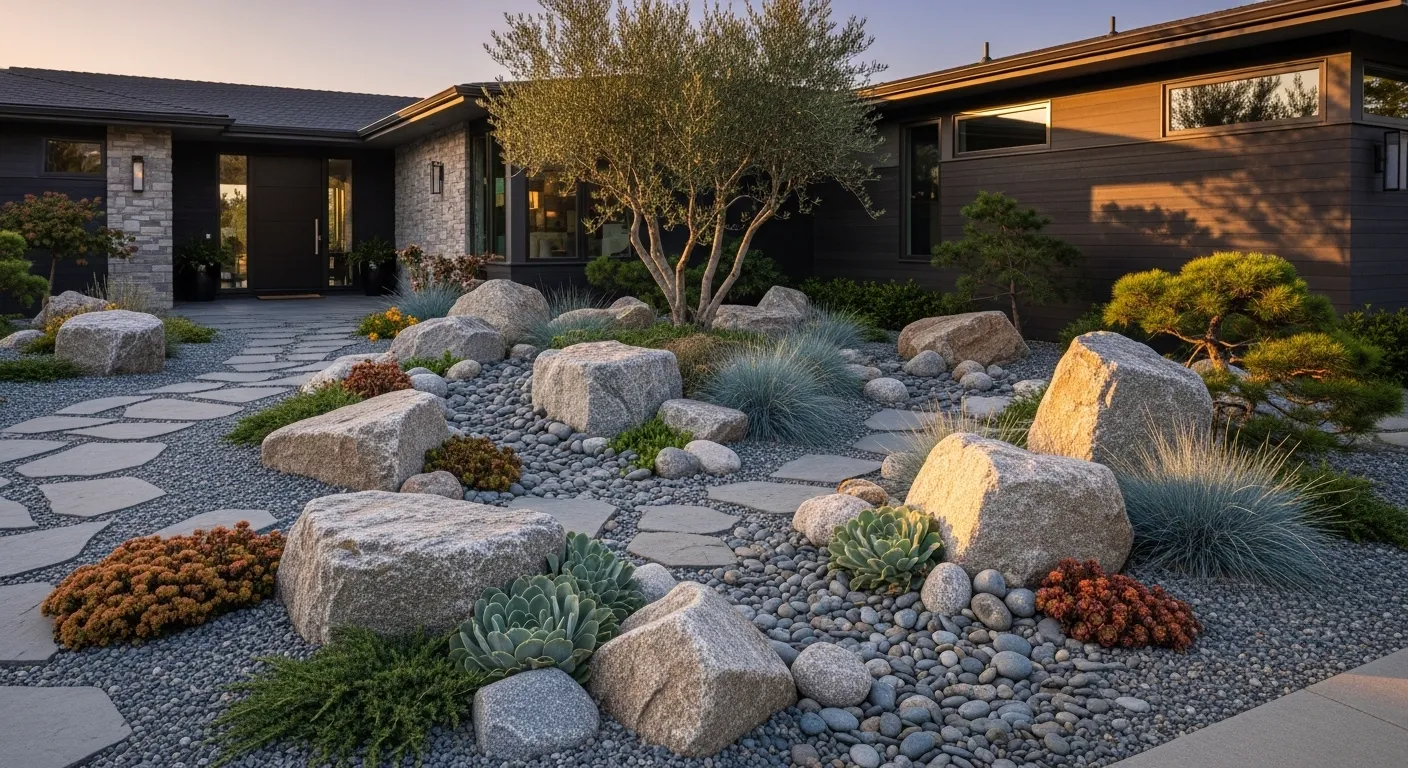
Your lawn is costing you money, water, and every Saturday morning from April through October.
Rock landscaping is the obvious answer. And yet most rock front yards look like someone poured a bag of gravel and walked away. No thought. No structure. Just rocks sitting there, vaguely hostile.
The difference between a rock yard that looks intentional and one that looks abandoned is not the rock. It is the decisions made before the rock arrived — the edging, the plant selection, the arrangement of boulders, the choice of gravel colour relative to the house.
Why Your Rock Colour Choice Matters More Than You Think
Most people choose their gravel by walking into a landscape supplier and pointing at whatever looks nice in a sample pile. The problem is that a sample pile is not your front yard.
The Light Problem Nobody Accounts For
Gravel looks different in direct sun versus shade. It looks different wet versus dry. White marble chips look elegant in the supplier’s yard and blinding in front of a south-facing house at noon.
Pale gravel amplifies light. If your front yard gets full afternoon sun, pale or white gravel will reflect heat and glare into your windows and off your front façade. This is not a minor inconvenience. In summer it significantly raises the temperature of the zone immediately in front of your house.
Warm-toned gravel — gold pea gravel, buff decomposed granite, tan river rock — absorbs more light and looks warmer and more natural against most house exteriors. It also doesn’t show dirt and dust the way pale gravel does.
Dark grey gravel reads as modern and high-contrast. It works well with contemporary architecture and alongside bold architectural plants. Against a traditional brick or stucco exterior it can feel slightly cold. Think about what your house is before you commit.
Matching Gravel Tone to Your House Exterior
The houses in this collection demonstrate the principle clearly.
Warm tan stucco or siding wants warm-toned gravel. The buff decomposed granite and warm pea gravel combinations in several of these yards work because the house and the ground surface occupy the same tonal family.
Red brick wants either white gravel for maximum contrast or grey river rock for a more natural pairing. The Georgian colonial with white marble chip beds works because the white gravel picks up the white trim and window surrounds — the same colour is used in both places, which creates visual unity.
Grey or greige siding is the most versatile. Both grey gravel and warm pea gravel work. White gravel can also work if your plantings have enough colour to prevent the yard from reading as monochrome.
The Edging Decision You Can’t Reverse
Good edging is invisible in a finished yard. Bad edging is the first thing anyone notices.
Steel Edging vs. Stone Border vs. Nothing
Black rolled steel landscape edging is the choice that appears in most of these yards — and for good reason. It sits almost flush with the ground surface, creates a crisp clean boundary between rock and grass or concrete, and doesn’t compete visually with anything else happening in the yard.
It is not the only option. Several yards here use boulder edging — a continuous line of rounded river rocks or field stones placed along the bed perimeter. This is softer and more decorative, particularly suited to curved island beds and cottage-style planting schemes.
Some yards use no edging at all — usually where the rock beds are bounded on all sides by hardscape like concrete paths and driveways. This only works when the boundaries are completely defined. One open edge without containment will migrate gravel onto the lawn or path within one season.
The Weed Barrier Question
Install a weed barrier fabric under every rock bed. Always.
Not the thin cheap kind. The heavy-duty woven landscape fabric that allows water through but prevents weed germination. You will still get some weeds in the surface of the rock — blown seeds, organic debris — but the population will be dramatically lower and the ones that do germinate will pull out easily because they can’t root into the soil below.
Skipping the weed barrier to save money is a mistake you will make once. The labour cost of removing established weeds from a gravel bed makes the fabric look very cheap in retrospect.
Rock Landscaping Front Yard Ideas Worth Copying
The Yin-Yang River of White and Black Pebbles
This is the most graphic rock design possible and it works because the two materials are treated as a single flowing composition.
Lay out a sinuous double-channel path using two contrasting pebble types — bright white marble stones and jet black lava or basalt pebbles. The white channel runs through the centre. The black channel borders it on both sides. The whole composition curves through the planting beds like a river, wide enough to read as a feature from the street.
The secret is the black edging. A thin border of black pebbles separates the white channel from the green lawn on each side, creating a clean dark outline that makes the whole composition look drawn rather than scattered.
Plant the surrounding beds with tropical or lush-foliaged species — low boxwood hedges, flowering perennials, ground-covering shrubs. The greenery needs to be dense and manicured. The moment the planting becomes sparse or overgrown, the pebble composition loses its frame and the design unravels.
The Volcanic Boulder with Succulent Garden Island
One massive dark volcanic boulder is the anchor. Everything else orbits it.
Source the largest lava or basalt boulder your budget and site will accommodate — ideally something that requires machinery to move. Half-bury it so it looks geological. This single decision makes the whole arrangement read as a discovered landscape rather than a constructed one.
Around and on top of the boulder, arrange a collection of succulents in the pockets and crevices: agaves for height and drama, echeverias and sedums for low spreading cover, blue chalk fingers for texture contrast. Nestle petrified wood or driftwood pieces among them as secondary material.
Surround the entire boulder grouping with a shallow ring of mixed pea gravel and small river pebbles, slightly wider than the boulder footprint. The gravel ring acts as a frame that contains the planting and separates the composition from the surrounding paved area.
The White Marble Chip Bed with Black Border and Tropical Accents
The two-material border system — white marble chips as the main bed surface, a border of dark charcoal or black crushed rock along the outer edge — gives a tropical foundation planting a contemporary graphic quality.
Lay the black border first along the bed perimeter, approximately six to eight inches wide. Fill the main bed area with bright white marble chips. The contrast line between the two materials does the design work.
Plant into the white marble surface with bold, architectural tropical plants: crotons with multi-coloured foliage, sago palms, ornamental grasses with fine texture, and low lime-green succulents. The goal is variety in form and foliage colour, all reading against the clean white ground.
Keep the marble surface clean. White gravel shows leaf litter, algae, and soil contamination immediately. This design demands maintenance — in exchange it delivers a front yard that looks like a resort.
The Modern Black and White Path with Slate Stepping Stones
The high contrast path — large format dark slate or porcelain pavers set into bright white river pebbles — is the contemporary front yard design that photographs best and ages best.
Choose oversized rectangular slate pavers, cut or natural, in a dark charcoal or near-black tone. Set them into white marble pebbles at a generous spacing — one slab, then a gap of white, then the next slab. The proportion of white pebble to dark slab should be roughly equal; too many slabs crowds the composition and loses the contrast effect.
Curve the path slightly from street to door. A perfectly straight path is more formal. A slight curve gives the approach a leisurely quality that a straight march to the door doesn’t.
Border the path with low ground-covering perennials in blue, purple, or white tones — anything that doesn’t compete with the dramatic black-and-white foreground. Brass path lighting at intervals completes the scheme.
The Dead Lawn to Dark Gravel Transformation
The before-and-after case is the most instructive image in rock landscaping. Dead brown lawn to finished rock yard in one renovation.
The ground material here is charcoal grey crushed granite — darker than most front yard gravel choices, which is exactly what makes it work against the white contemporary house exterior. Dark gravel against white walls creates the same kind of graphic contrast as dark window frames on a white façade.
The boulder grouping along the foundation is the feature that prevents the dark gravel from reading as a carpark. Three to five large moss-covered or rough-faced boulders, placed in a loose informal cluster rather than evenly spaced, give the yard its visual weight. A single yucca or palm as the tall vertical element anchors the composition from the street.
The secondary material — white river pebbles running as a narrow band along the driveway edge — repeats the high-contrast black-and-white logic in a minor key. It prevents the dark gravel from dominating all the way to the hardscape edge, and gives the eye somewhere to rest between the deep grey ground and the white house wall.
The Streetside Rock Strip with Agaves and River Boulders
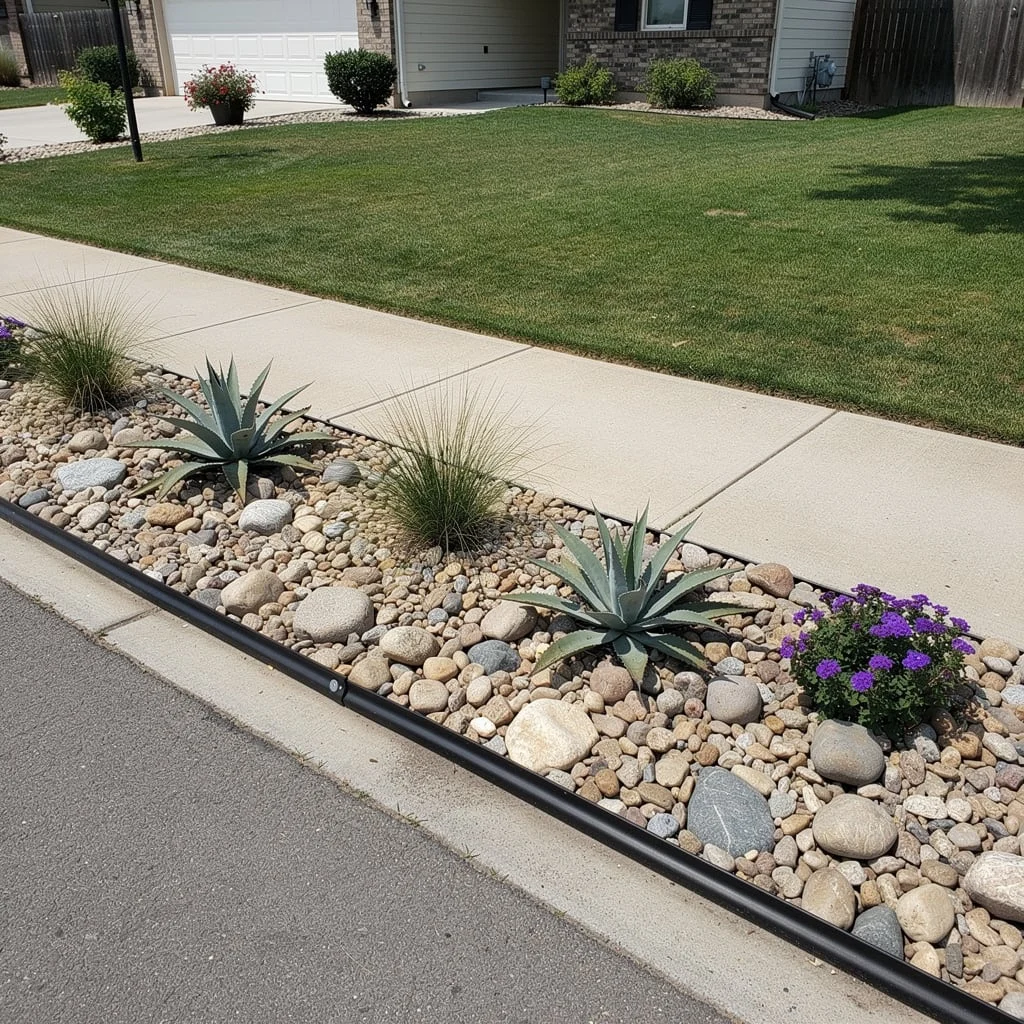
The parkway strip — the narrow band of ground between the sidewalk and the street — is where rock landscaping makes the most immediate practical sense. It typically gets vehicle exhaust, foot traffic, compacted soil, and very little supplemental water. Grass struggles. Rock thrives.
Fill the strip with a generous depth of mixed river rock in varied sizes — small rounded stones as the base, with larger boulders placed at intervals. Choose two or three architectural plants: blue agaves for structural drama, fine-textured grass mounds for movement, and one low flowering perennial like verbena or catmint for seasonal colour. Keep the edging steel and flush with the sidewalk edge.
The key is the rock depth. A thin single layer of gravel looks cheap. A proper four-inch depth of mixed river rock looks like someone spent real money, even when they didn’t.
The Reduced-Lawn Hybrid Front Yard
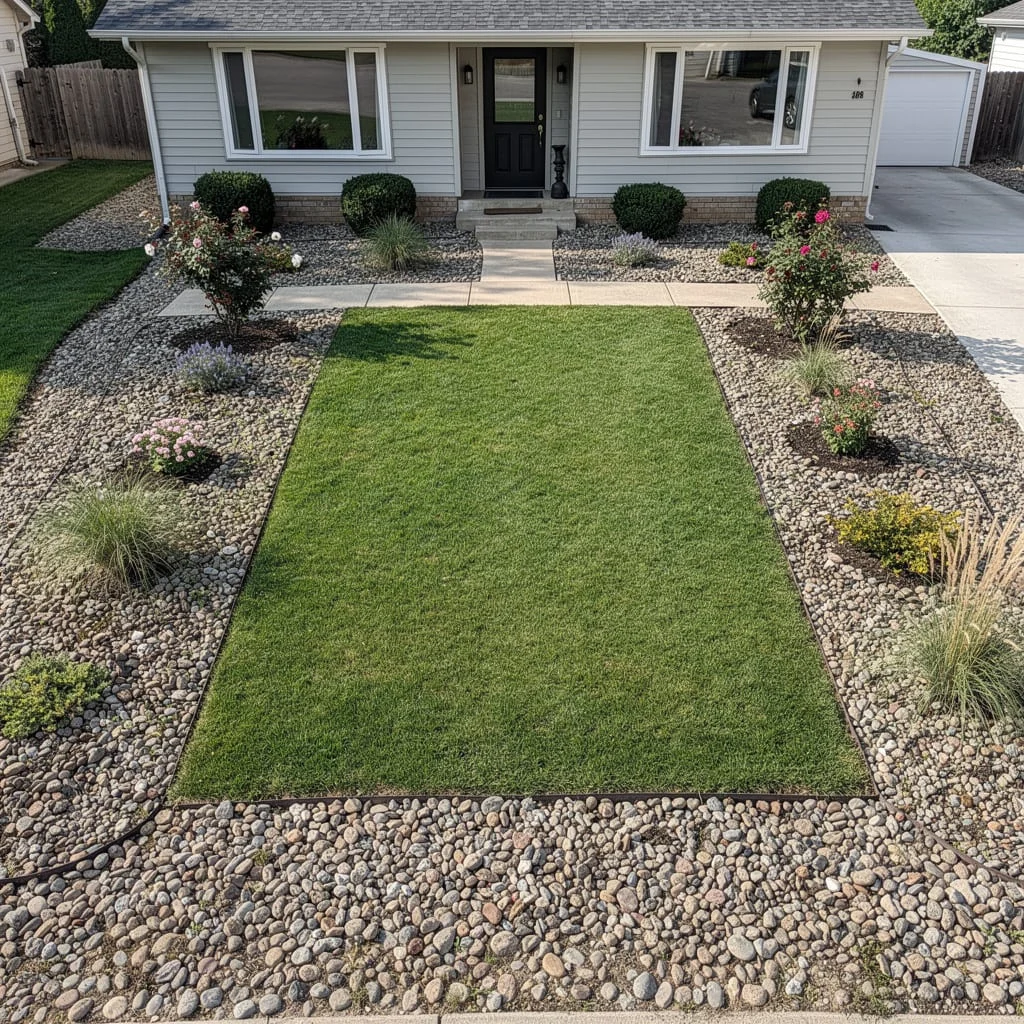
This is the compromise solution, and when executed well it is the most practical of all the options. Keep a central rectangle of lawn — properly edged, deeply green — and surround it with wide rock borders containing drought-tolerant shrubs, roses, ornamental grasses, and ground-covering perennials.
The central grass panel provides the softness and green colour that makes a front yard read as welcoming. The rock borders eliminate the maintenance burden of the perimeter areas where mowing is awkward and irrigation most inefficient.
Install black steel edging at the boundary between grass and rock. The crisp line it creates is part of the visual design. Everything inside that line is lawn. Everything outside is low-maintenance.
Plant the rock borders with roses — two or three on each side in complementary or matching colours — backed by ornamental grasses and low flowering perennials. The rock surface between plants should remain clearly visible.
The Tiered Retaining Wall with Gravel Terraces and Ornamental Grasses
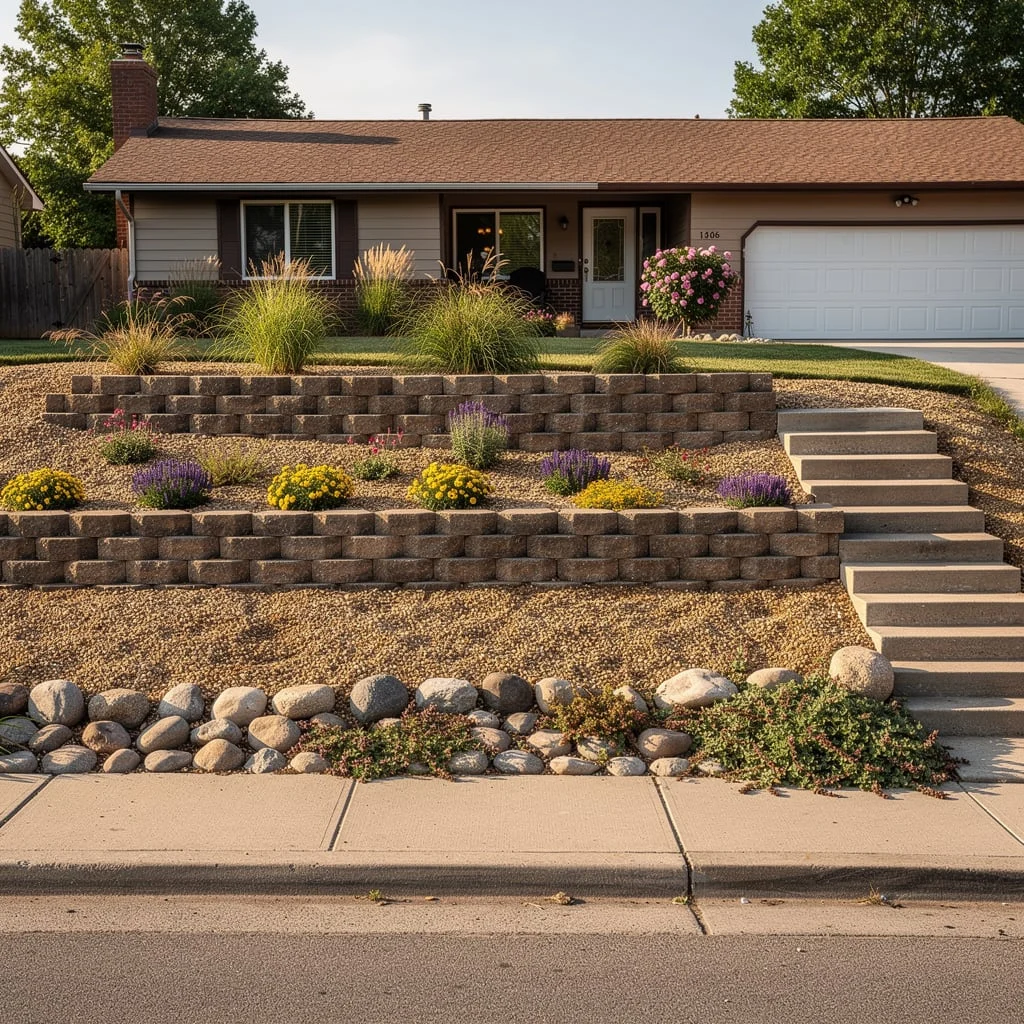
For a sloped front yard, tiered retaining walls built from concrete block or natural stone solve the erosion problem and create structured planting zones at the same time.
Two or three levels of low retaining walls, each creating a flat planting terrace behind it, allow you to use gravel on each level as the mulch surface. Plant each tier differently. The lowest tier handles ground-hugging plants — creeping phlox, low sedums, trailing iceplants. The middle tier works for mid-height flowering perennials — mums, lavender, low-growing asters. The top tier behind the highest wall handles ornamental grasses and shrubs that benefit from the elevated position.
Face the retaining wall toward the street with natural boulders at the base for a softer transition between the structured masonry above and the sidewalk below.
The Corner Lot Xeriscaped Triangle
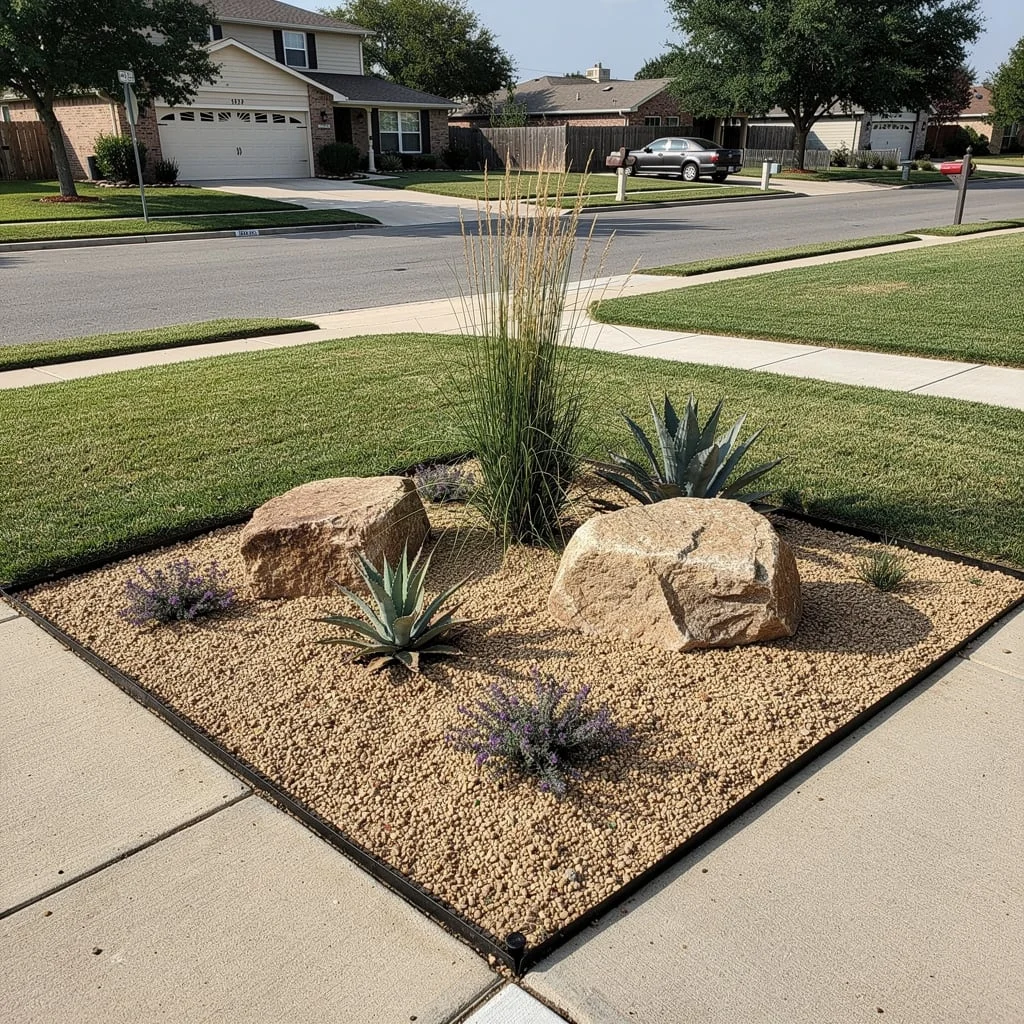
The corner lot triangle — the awkward wedge of ground bounded by two sidewalks meeting at the intersection — is the hardest piece of turf to maintain and the easiest to convert to rock.
Lay heavy weed barrier across the entire triangle and pin it at the edges. Install black steel edging along both sidewalk boundaries. Fill with a light-coloured decomposed granite or buff pea gravel to a depth of four inches.
Select three plants in graduated heights: one tall accent — a big bluestem grass or desert willow — in the centre-back. Two medium-height agaves or yuccas flanking it. Small flowering perennials like salvia or purple coneflower for colour at the front corners.
Place two or three large flat-top boulders asymmetrically within the triangle. They should not be equal in size or equally spaced. The arrangement should look found, not constructed.
The Rock-Ringed Tree Circles on a Lawn
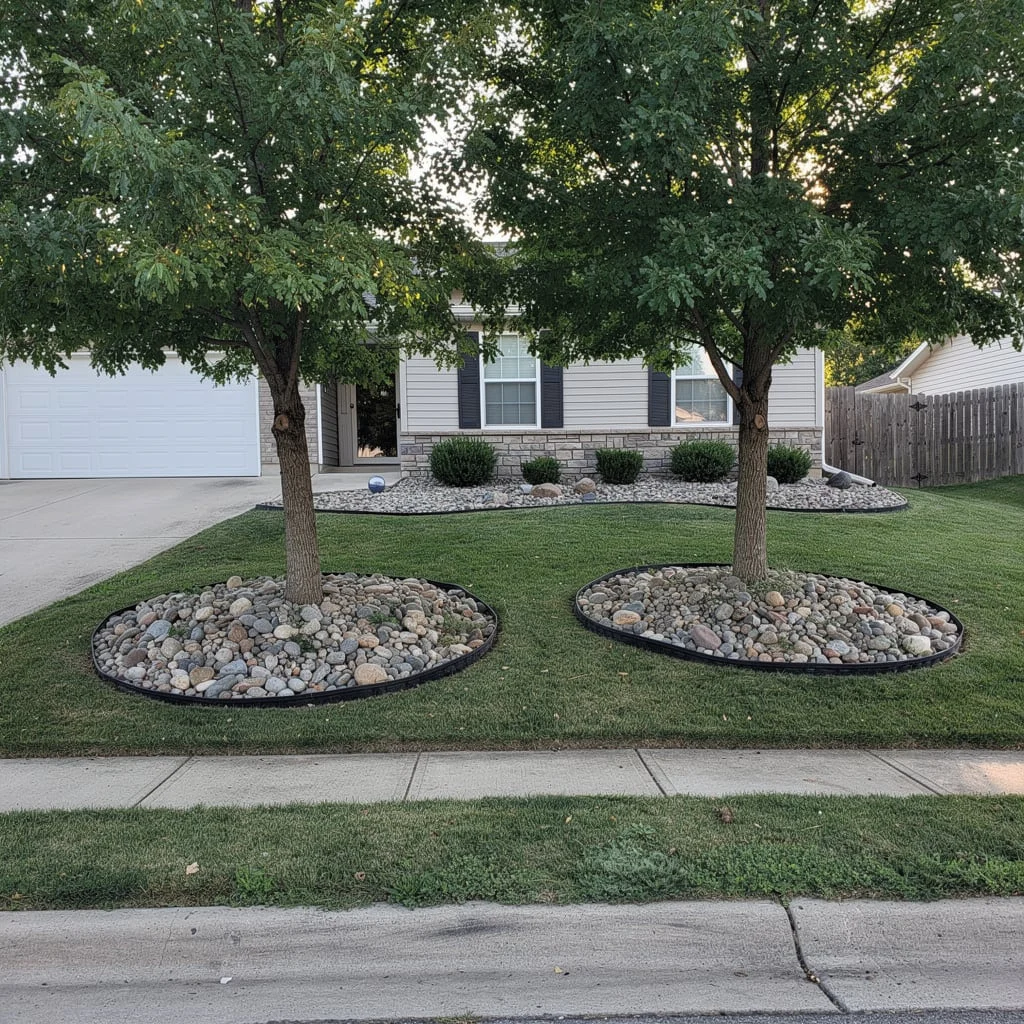
This is the lowest commitment version of rock landscaping and one of the highest-return.
Establish a circular river rock mulch ring around each existing tree in the front yard. Install black flexible steel edging to form the circle, allowing for a radius of at least three feet from the trunk — four is better. Fill with four inches of mixed river rock: mostly smooth rounded stones with a few larger accent boulders placed at the edge.
Remove the turf inside the circle before laying the fabric and rock. Grass growing against a tree trunk creates competition for water and increases disease risk. The rock ring is better for the tree and better for the mower line.
The result — two clean dark-edged circles of warm river rock with trees rising from their centres — is simple, formal, and immediately more polished than uncontained grass around tree trunks.
The Formal Red Brick Colonial with White Marble Chip Beds
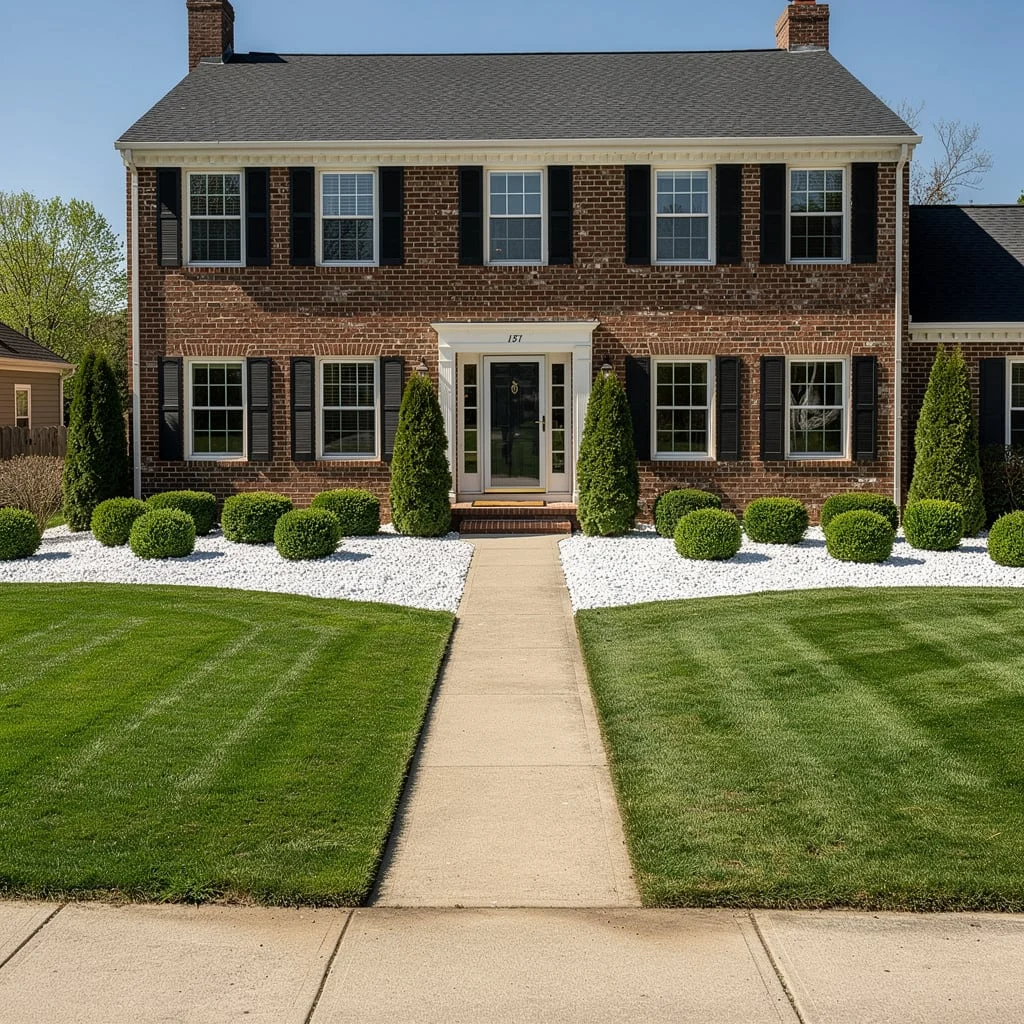
This is a maximally formal approach and it only works because it matches the architecture.
The Georgian-style brick house with symmetrical windows and a centre-hall entry demands symmetry in the landscaping. The formal approach: trim topiary shrubs — boxwoods in globe form and arborvitae as vertical accents — placed in a symmetrical arrangement either side of the front path. Fill the beds between them with white marble chips or white gravel.
White gravel reads as architectural — cleaner and more deliberate than natural earth tones — which suits a house that is itself quite architectural. The contrast between the deep red-brown brick, the white trim, and the white gravel creates a high-contrast front elevation that photographs extremely well.
Maintain the topiary shapes twice a year. Keep the gravel deep enough to suppress weeds. The formal scheme only works if both the clipping and the cleanliness are maintained. An overgrown topiary or a weed-infested white gravel bed destroys the effect entirely.
The Symmetrical Gravel Front Yard with Mirror-Image Island Beds
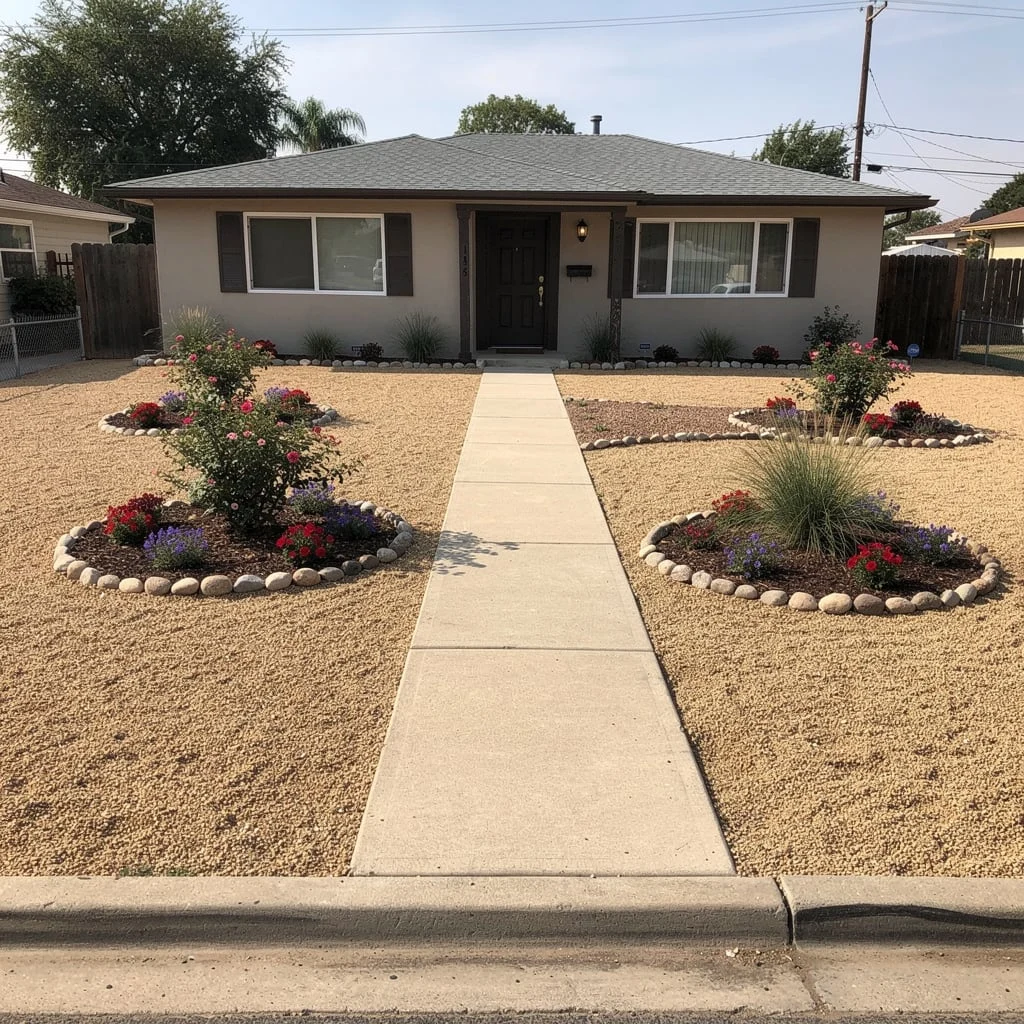
Symmetry organises a front yard the way good typography organises a page. The eye finds its place immediately. Everything reads as resolved.
Remove the lawn entirely except for the pathway. Fill the entire front yard area with warm pea gravel or buff decomposed granite. Create two mirror-image island beds — one either side of the path — defined with rounded river stone borders. Plant each island identically or in close reflection: a central small tree or large shrub, surrounded by flowering perennials and low ornamental grasses.
The identical planting of each island is more important than what you plant. The symmetry is the design. If one island has a rose and the other has a shrub, the order breaks down. Choose one species for the focal point of each island and repeat it.
Maintain the gravel surface raked and clean. Any organic debris that accumulates changes the texture and colour of the gravel surface unevenly, which damages the clean geometry the scheme depends on.
The Desert-Style Front Yard with Dry River Bed and Stepping Stones
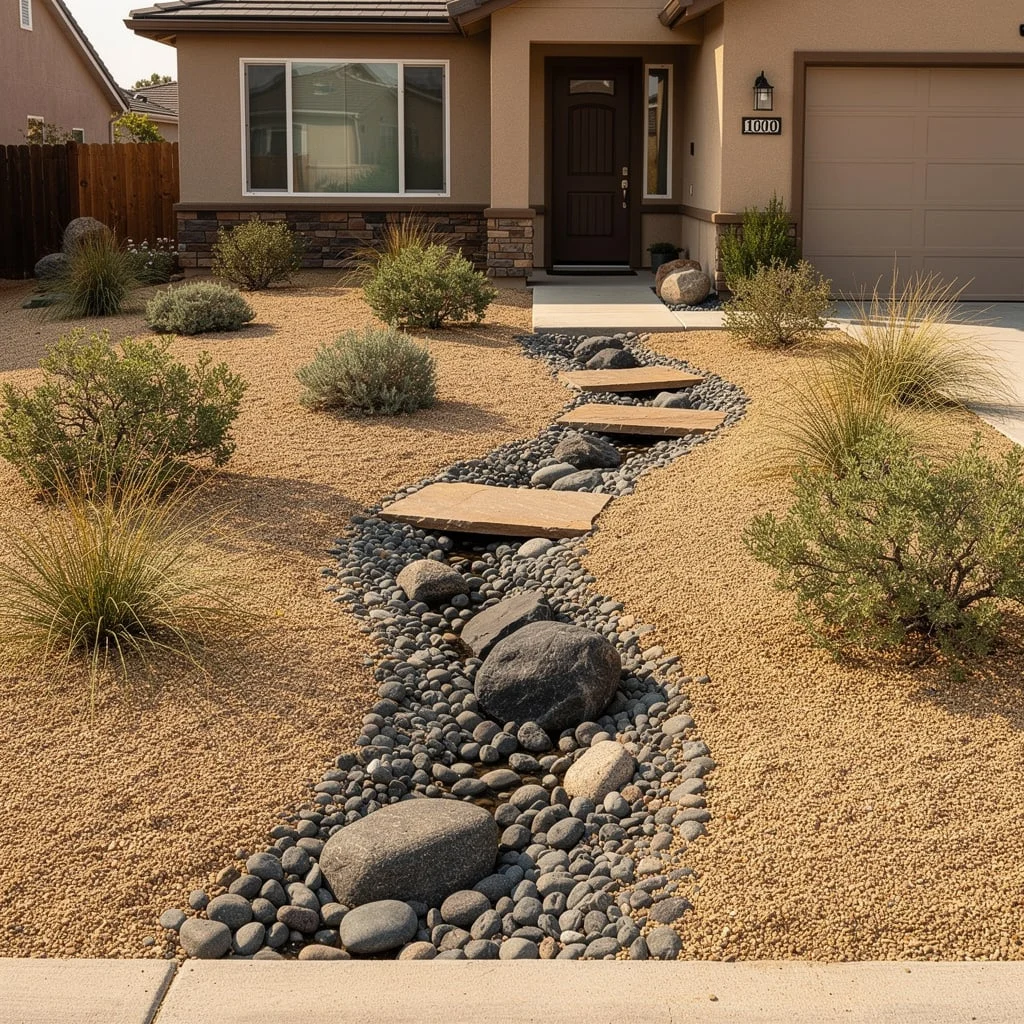
The dry river bed is both decorative and functional. It provides a visual drainage channel that also manages actual runoff during rain events.
Create the main bed in warm buff decomposed granite. Then lay out a sinuous river-bed channel from the curb toward the house — approximately two feet wide, with gently curved banks — filled with dark grey river pebbles and larger black boulders. The contrast between the warm buff ground and the dark river-bed channel creates the central visual feature of the yard.
Set large flat natural stone stepping pads in the channel at comfortable walking intervals. These serve as the actual path from sidewalk to front door while maintaining the dry river visual.
Plant the surrounding bed with drought-tolerant native shrubs — sagebrush, rabbitbrush, buckwheat — and ornamental grasses at varying heights. Let the planting look naturalistic and slightly wild. The geometry of the yard is provided by the river bed, not the plants.
The Mixed Mulch and River Rock Driveway Border with Boulders
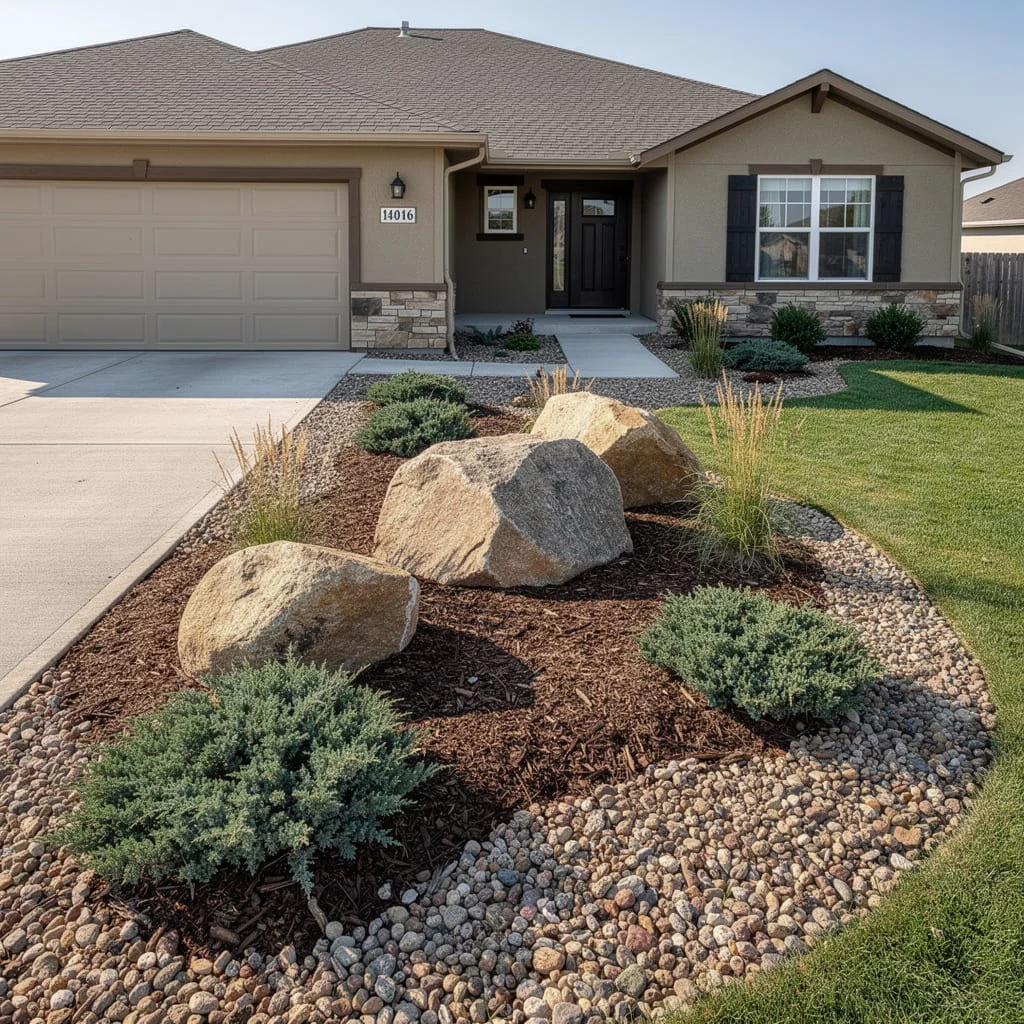
The border between driveway and lawn is one of the most maintenance-intensive edges in any front yard. It requires precise mowing, is susceptible to edging damage, and often becomes a dead zone where grass struggles.
Replace the grass in this border with a wide curved bed — minimum three feet, ideally five — filled with a combination of shredded bark mulch and river rock gravel. The mulch layer goes closest to any foundation planting beds. The river rock layer borders the driveway edge.
Place two or three large boulders within the bed at asymmetric intervals. These boulders should be large — at least eighteen inches across — and half-buried so they look geological rather than placed. The buried-boulder technique is the single most effective way to make a rock landscape look natural rather than constructed.
Plant silver-leafed low shrubs — catmint, artemisia, low junipers — and ornamental grasses between the boulders. Keep plant heights below the windowsill on the house-facing side.
The Cottage Garden with Stone-Edged Island Beds and Gravel Path
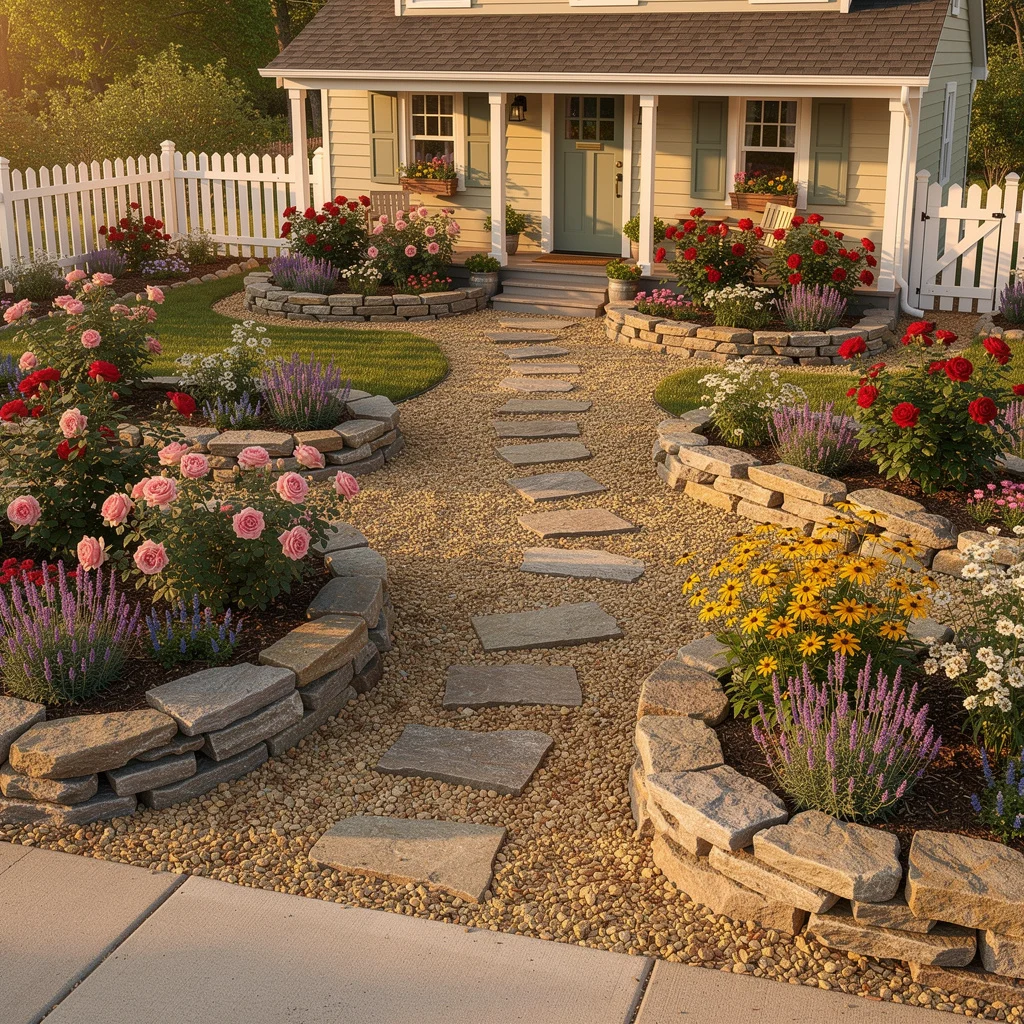
This is the only style in this collection that is genuinely high-maintenance. It earns its place because the result is so rewarding.
Remove the lawn and replace it with fine pea gravel as the ground plane. Create multiple curved island beds bordered with stacked dry-laid natural stone — the kind of rough-cut, variable-height stone stacking that looks like an old English farm wall rather than a formal retaining structure.
Plant each island bed differently but within a related palette: roses in pink and red, lavender, catmint, salvia, black-eyed Susans, and white daisy-type perennials. The overlapping colour and the casual profusion is the point. The gravel and stone edging provides the structure that keeps this from looking like neglect.
Lay large irregular flat stepping stones through the gravel on a slightly wandering path. The stones should be flat enough to walk on comfortably and irregular enough in shape to look found rather than bought.
This style requires regular deadheading, seasonal cutting back, and annual dividing of perennials. If you will do that work, it pays back in beauty at a rate no other front yard style can match.
The Golden Gravel Path with Lavender Border and Steppers
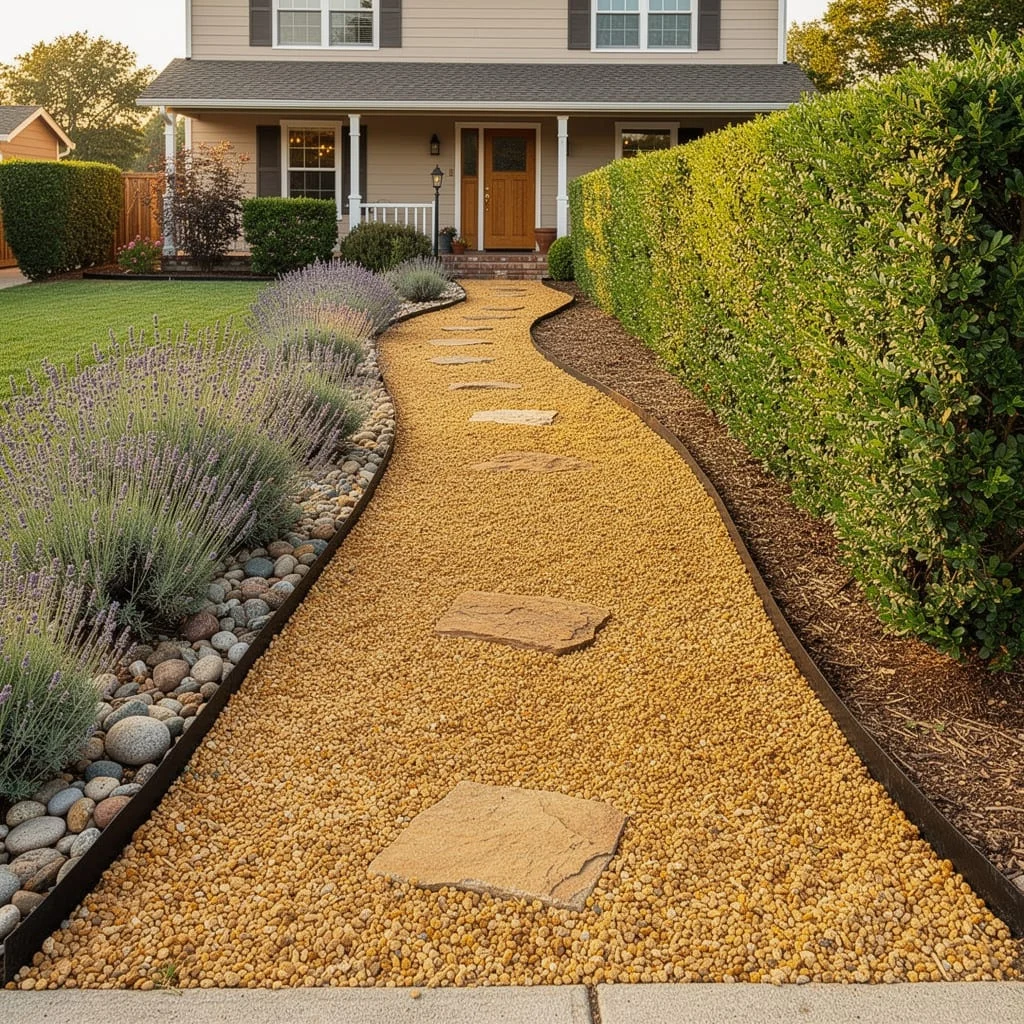
This is the front yard for the person who wants low maintenance and sensory richness simultaneously.
Lay golden pea gravel or warm-toned pea gravel along the path zone between the front lawn and the boundary hedge. Install black steel edging on both sides of this path zone. Embed large irregular natural sandstone or travertine stepping pads through the centre of the gravel — spaced at a natural walking pace, partially set into the gravel surface so they are level with it rather than sitting on top.
On the inner edge of the gravel path, plant lavender in a continuous informal line — multiple plants, slightly varied in size and spacing, so the row has rhythm without being rigid. Lavender in this position is walked past daily and brushed occasionally, releasing fragrance. Alongside it, place mixed smooth river stones in a secondary texture layer as a contrast band between the lavender and the gravel.
When the lavender is in bloom, this path is the best entry experience of any front yard in this list. When it is not in bloom it is still excellent, because the silver-grey foliage in a warm gold gravel setting is genuinely beautiful year-round.
The Full Xeriscaped Yard with Agave, Lavender, and Scattered Boulders
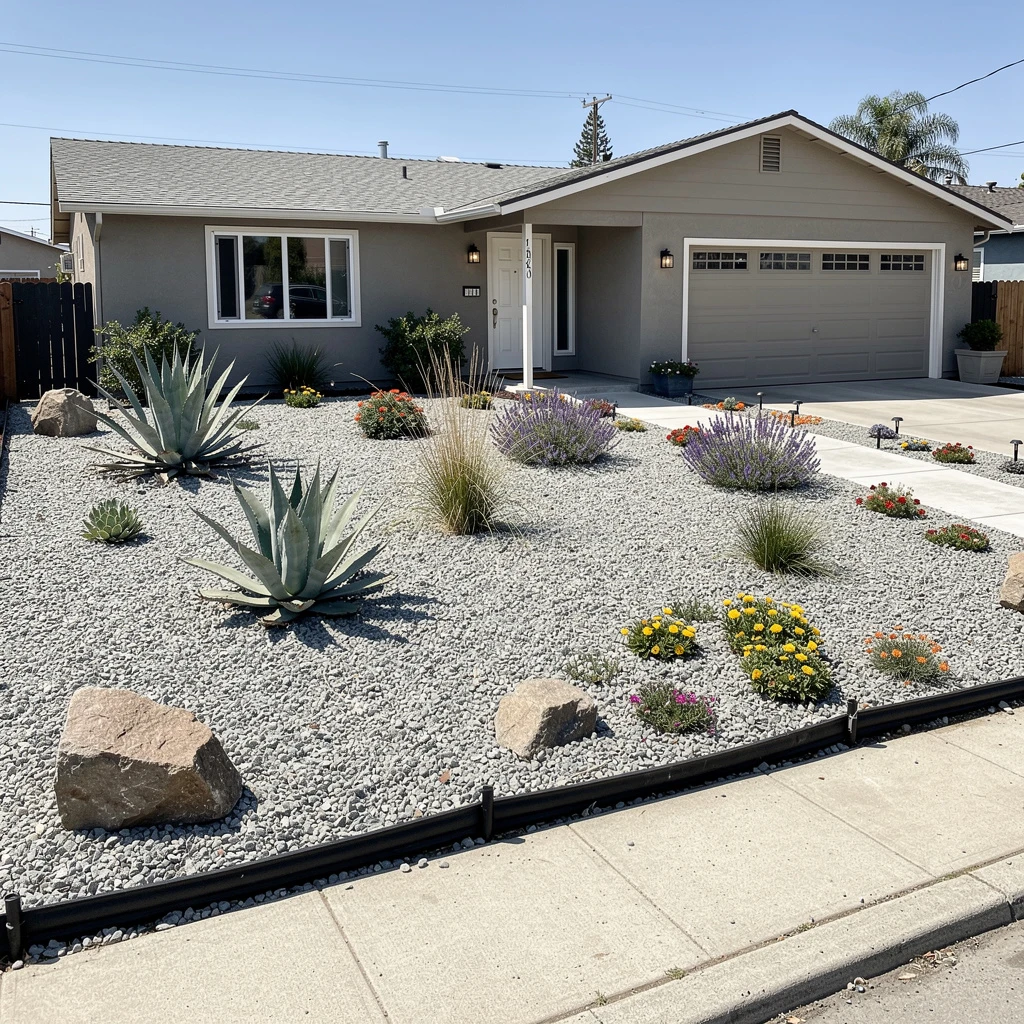
This is the complete lawn replacement — every square foot of grass gone, replaced with a coherent low-water landscape.
The ground plane is grey crushed granite or pale pebble gravel. The plants are selected entirely from drought-tolerant species that thrive in the specific climate and look good together: large blue agaves as the dominant structural plant, ornamental grasses in multiple sizes, lavender in clusters, low flowering portulaca or gazania for seasonal colour, and one or two accent succulents.
Place boulders sparingly — three or four maximum for a standard suburban front yard, in two sizes, grouped rather than scattered evenly. Group two boulders close together as if they fell that way. Put the third one alone a distance away. Never place boulders in a row or at equal intervals.
Install low-voltage path lights to illuminate the agaves at night. The silhouette of a large agave backlit against a house wall after dark is genuinely dramatic and justifies the cost of the lighting installation.
The Boxwood and River Rock Foundation Planting
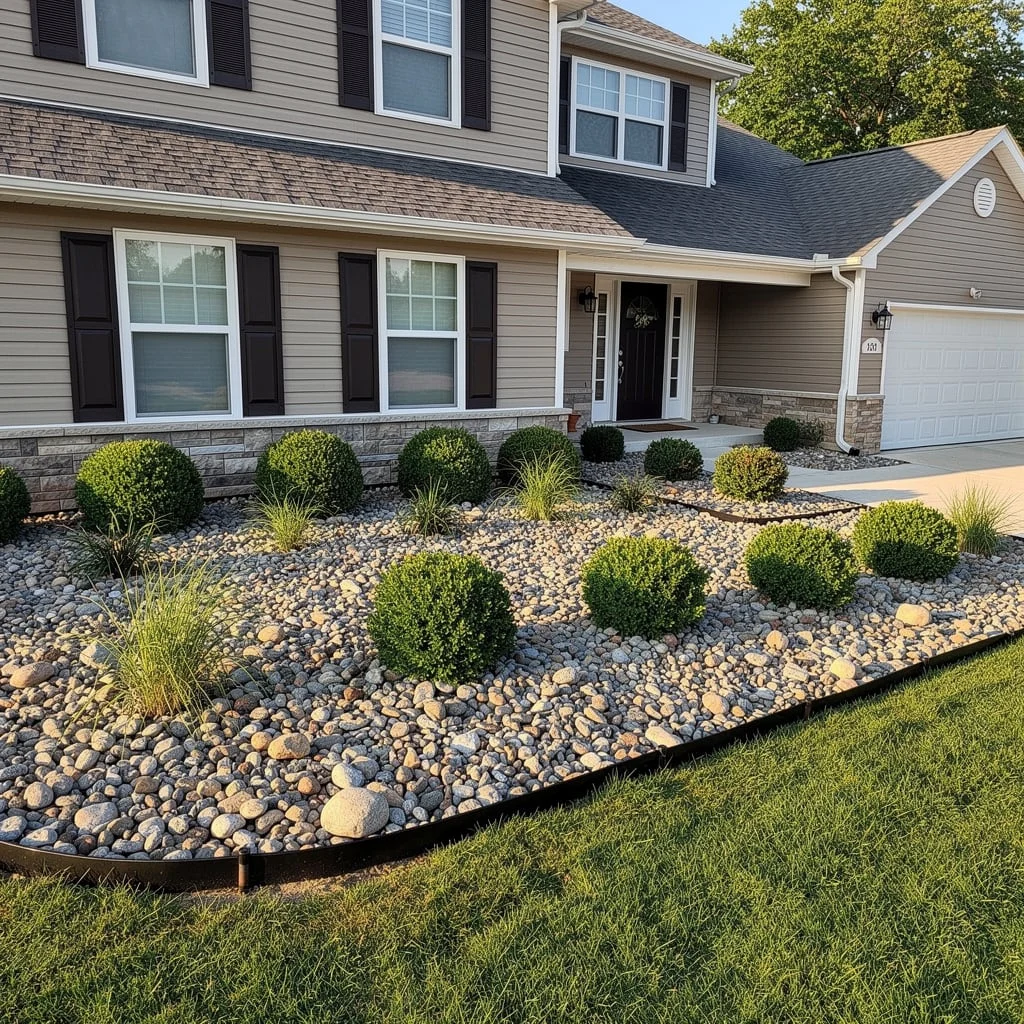
This is the style for the homeowner who wants something that looks maintained, orderly, and permanent without requiring constant intervention.
Remove mulch from existing foundation beds and replace it with mixed river rock — the kind with size variation, ranging from small pebbles to fist-sized rounded stones. This alone transforms the reading of a foundation planting from casual to considered.
Plant or retain a row of round-clipped boxwoods at regular intervals — spaced equally, clipped to consistent globe shapes. Between them, add upright ornamental grasses for vertical contrast. The combination of the rigid round form and the soft moving vertical is a classic planting pair that works with almost any house style.
Edge the front of the beds with black rolled steel edging set flush with the lawn grade. The crisp boundary between the river rock surface and the lawn edge is the finish detail that makes this scheme look professional.
The Slate Stepping Stone Path with River Rock and Lavender Corridor
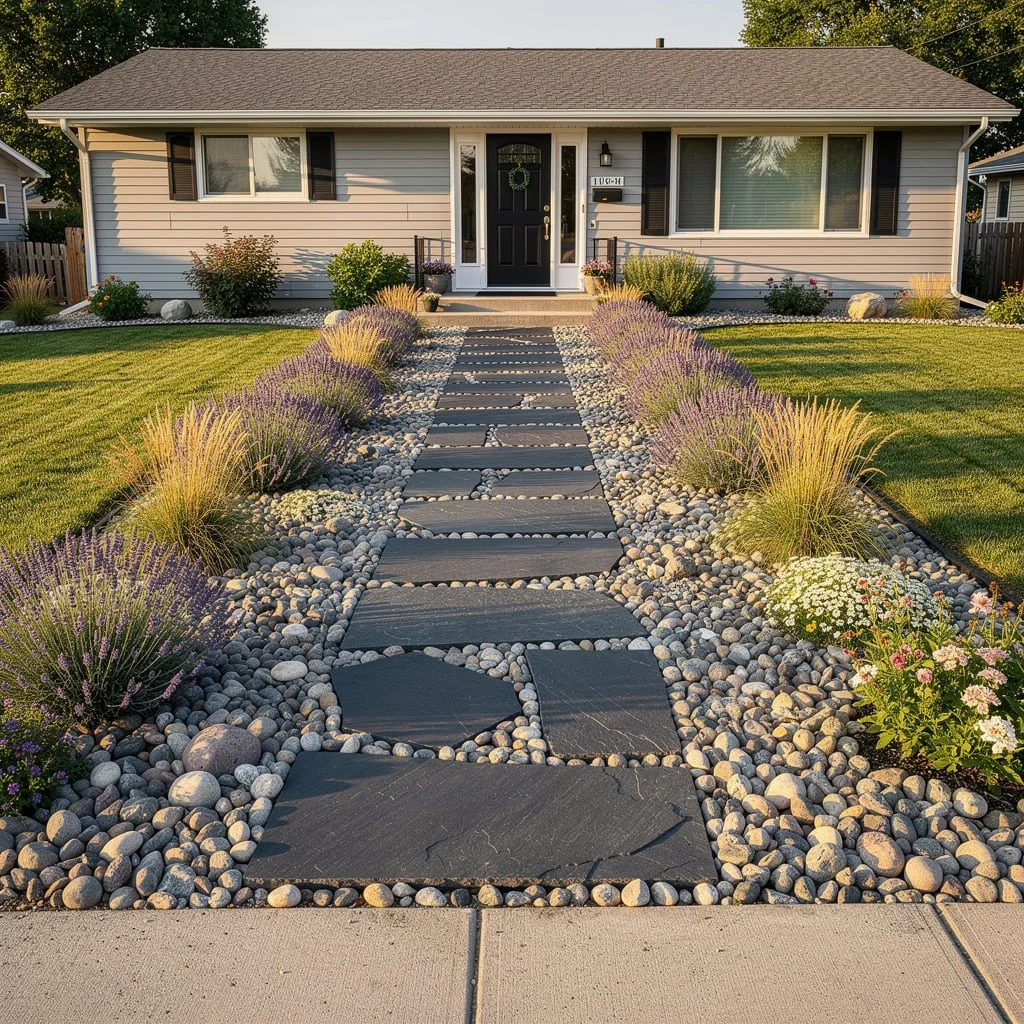
The path is the design event here. Everything else serves it.
Source large, irregular slate or dark quartzite slabs — not cut to uniform size, but selected for thickness and flatness. These are heavy. They need to be set into a compacted gravel base at least two inches deep so they don’t rock underfoot.
Lay the slabs from the sidewalk to the front door in a straight-ish line, slightly staggered rather than perfectly centred. Fill the gaps between slabs with small river pebbles in a contrasting lighter tone — the dark slate against pale pebble fill is the defining visual element of the path.
Either side of the path zone, create wide gravel borders filled with river rock in a generous depth. Plant lavender generously on both sides — enough plants that when they bloom the path runs through a purple corridor. Alternate lavender with ornamental grasses for year-round structure. Tuck in small flowering perennials for colour beyond the lavender season.
The front lawn on either side of this central planted zone remains as grass. The path and its borders are the feature. The lawn is the frame.
The One Rule That Makes Every Rock Yard Work
Choose a ground surface and commit to it.
The yards in this collection that look best all use one primary gravel or rock material across the main ground plane. They might use a second material as a path, a border, or a river bed feature — but there is always one dominant surface.
The yards that look confused use three or four different gravels in the same space. Tan gravel here, black here, river rock there, white marble in the corner. Each material is fighting the others for attention and none of them wins.
Pick one. Buy enough. Lay it deep.
The rest is just plants and patience.