
Most people put up a fence and stop there.
The fence goes in. The grass grows up to its base. A thin strip of dead zone develops along the bottom where the mower can’t reach. And that’s the front yard for the next fifteen years.
A fence is not just a boundary. It is a backdrop. It is a vertical surface that can make everything in front of it look either composed or accidental. And the strip of ground along its base is one of the most productive planting zones in the entire garden — shielded from foot traffic, defined on one side, highly visible
The Fence Colour Decision That Changes Everything Before You Plant a Single Thing
Nobody talks about this enough. The fence colour is the backdrop for every plant you put in front of it. Get it wrong and no amount of good planting will rescue the composition.
Dark Fences Make Plants Pop
Dark charcoal, deep green, near-black navy — these fence colours do something that natural timber and white fences cannot. They recede.
A dark fence visually disappears behind the planting. Everything in front of it reads as foreground. The pinks and purples and reds come forward. The greens glow. The flowers look like they are lit from behind even in flat light.
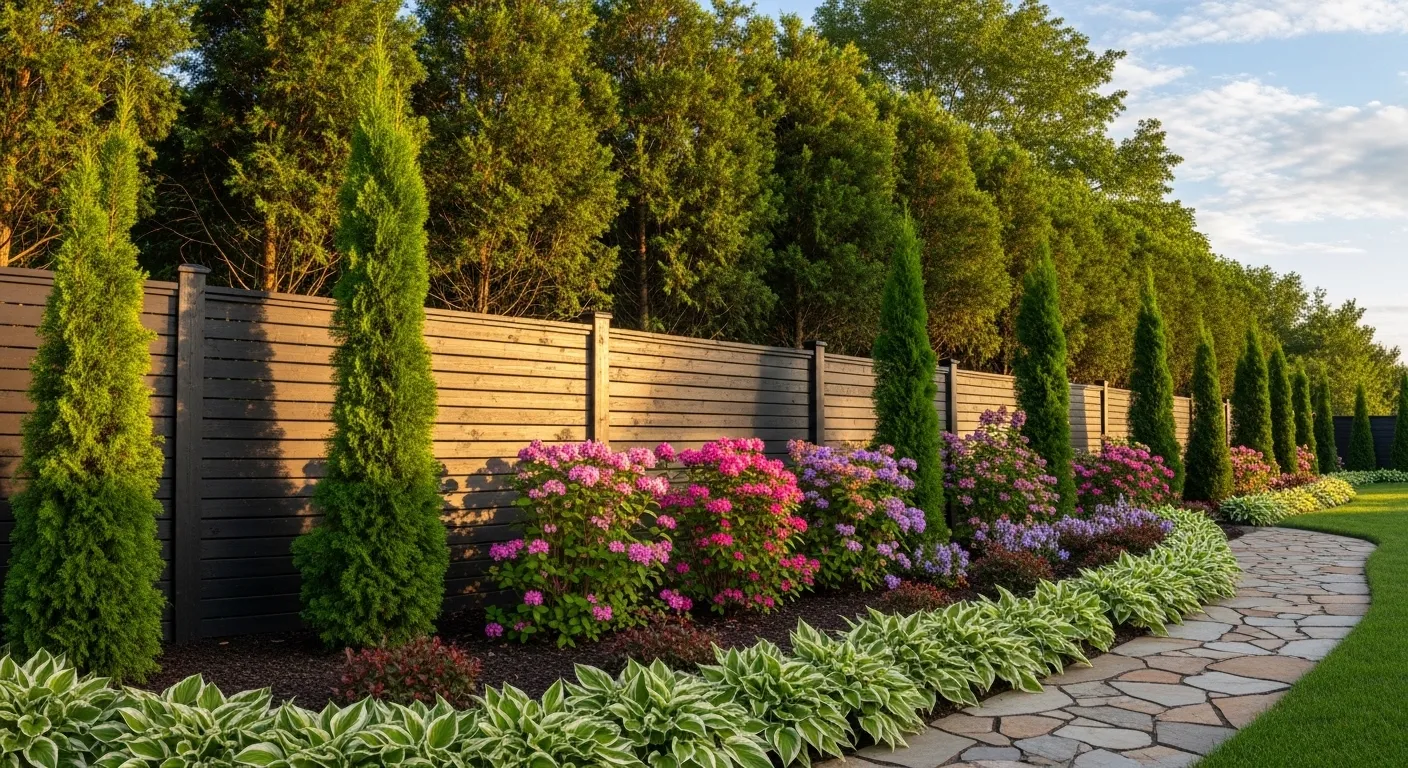
This is why the dark charcoal fence with the cottage border of foxgloves, peonies, and climbing roses is so effective. The fence is barely in the image. The flowers are everything. Remove the dark background and replace it with a light fence and the same planting would lose half its drama.
Warm Timber Reads as Natural
Fresh cedar or redwood fence staining gives a warm amber-brown background. It suits naturalistic and informal planting styles — lavender lines, wildflower borders, herb strips. The warm timber and the soft purple-grey of lavender is one of the most reliable colour combinations in garden design.
It does not suit every style. Against a very formal or contemporary house, warm timber can read as too casual. And it requires maintenance — restaining every three to five years to keep the warmth. Left untreated, it weathers to grey, which is a different character altogether.
White and Pale Fences Need Strong Planting Contrast
White vinyl, white painted timber, pale grey composite — these fences read as neutral but they are not invisible. They advance rather than recede. Everything in front of them competes with the brightness.
To make white fences work as a backdrop, you need either very bold planting colours — the deep green and red-orange of bromeliads against white, or the blue and white hydrangeas against white — or you need the fence itself to be a design feature rather than just a background.
The white horizontal privacy fence with the tropical planting works because the fence panels are architectural and clean enough to be interesting on their own terms. The plants are a foreground to the fence, not the other way around.
What to Plant in the Fence Line and Why Most People Get It Wrong
The most common fence planting mistake: choosing plants for how they look in the garden centre rather than how they look at the fence.
The Depth Problem
A fence line border is typically shallow — one to three feet deep. Most people treat this as a limitation. The best fence landscapes treat it as a constraint that forces good decisions.
Shallow borders need plants with strong vertical habit or strong spreading habit. They cannot accommodate plants that want to grow wide in all directions. A round shrub in a one-foot-deep border will grow into the lawn on one side and lean into the fence on the other. Neither is what you want.
Upright growers — columnar cypress, ornamental grasses, tall lavender — use shallow depth well. So do ground-hugging spreaders like thyme, alyssum, and low sedum, planted as the front edge of a border with taller plants behind.
The fence line border that goes wrong is usually the one with round ball-shaped shrubs planted equidistant along the base. It looks like a fence with bowling balls in front of it.
Climbers Change the Equation Entirely
Once you put a climbing rose, a clematis, or a jasmine against a fence, the fence stops being a backdrop and becomes a growing surface. The planting is no longer in front of the fence — it is the fence.
This is a different design strategy and it requires committing to it. A fence with one climber trying to grow up it among other planting looks messy. A fence colonised entirely by climbing roses — every panel covered, the canes trained horizontally to maximise bloom coverage — looks intentional and extraordinary.
The chain link fence with the pink climbing roses is the proof of this principle at its most basic. Chain link is one of the least attractive fence materials available. It is functionally invisible once covered in roses in full bloom. The fence material no longer matters. The roses are the entire experience.
Fence Landscaping Ideas
The White Slat Fence with Boulder-Edged Shrub Border
The contemporary white vertical slat fence — boards with gaps rather than solid panels — gives a sense of enclosure without complete opacity. The shadow lines of the slats on the interior surface are a decorative element in themselves.
Along the base of this fence, use large boulders as the defining edge of the planting bed rather than steel edging or a mown lawn boundary. Choose boulders in a warm sandy granite — nothing too dark, nothing that will compete with the white fence.
Plant the border with a restrained palette: blue-grey architectural plants like agave pups or blue chalk sticks for the foreground, compact round-form shrubs in dark green for the mid-ground, a feature plant with structural leaf form for the back. Keep the colour palette entirely cool — blue, grey, silver, dark green. Avoid anything warm-toned or bright that would fight the clean white fence.
The Japanese-Inspired Zen Corner with Bamboo Fence
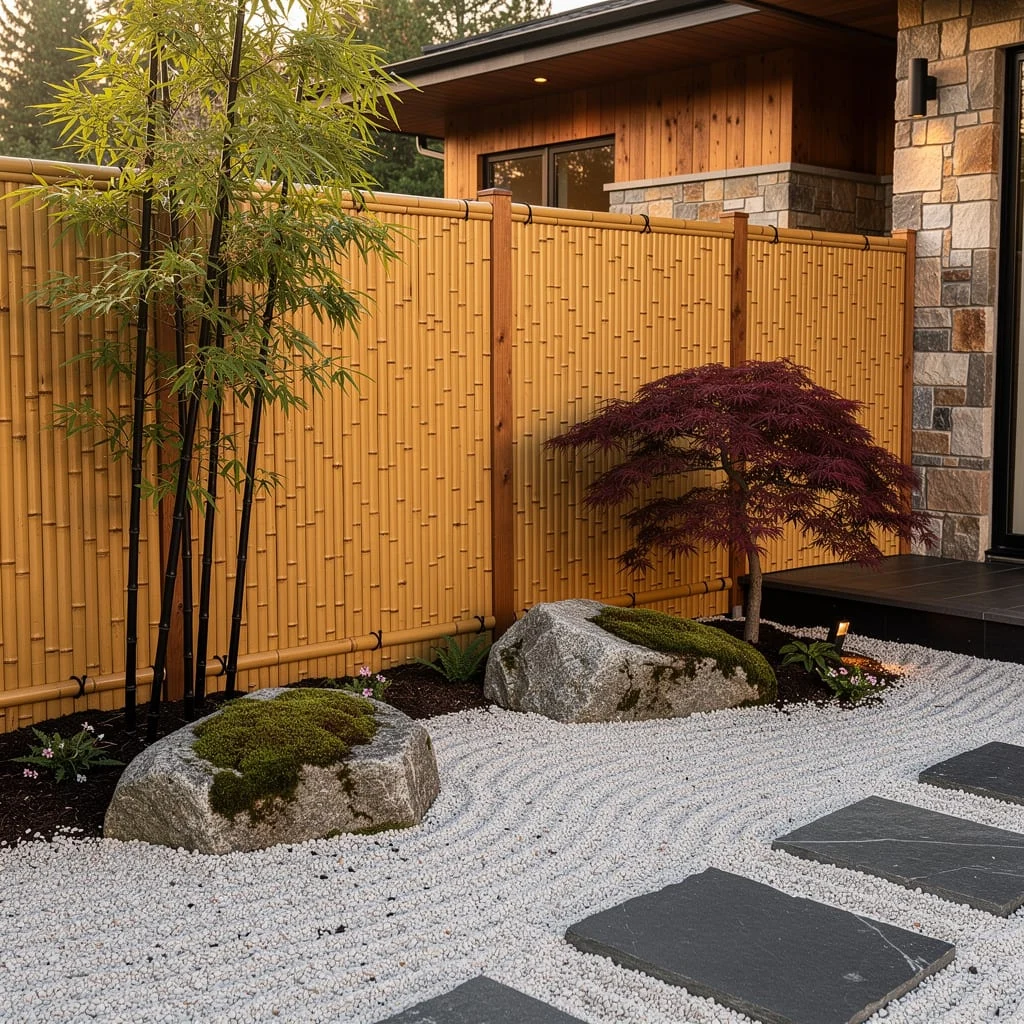
The bamboo fence is doing two things simultaneously: providing privacy and establishing the design language of the entire space.
Natural bamboo cane fencing — horizontal rails of bamboo culms bound to timber posts — sets a warm, organic tone that modern bamboo screens cannot replicate. The honey-yellow colour is distinctive. Pair it with a raked white pebble ground plane, dark slate stepping stones, and two or three carefully chosen rock specimens partly mossy and partly lichen-covered.
The plants are the real investment. A Japanese maple in deep burgundy or crimson is the centrepiece — place it slightly off-centre rather than perfectly centred. Clumping black bamboo on one side provides vertical contrast in a different texture and tone than the fence itself. Ground-level moss between the stepping stones bridges the transition between the raked pebbles and the dark planting beds against the house wall.
The Corten Steel Wall with Black Lava Rock and Ornamental Grasses
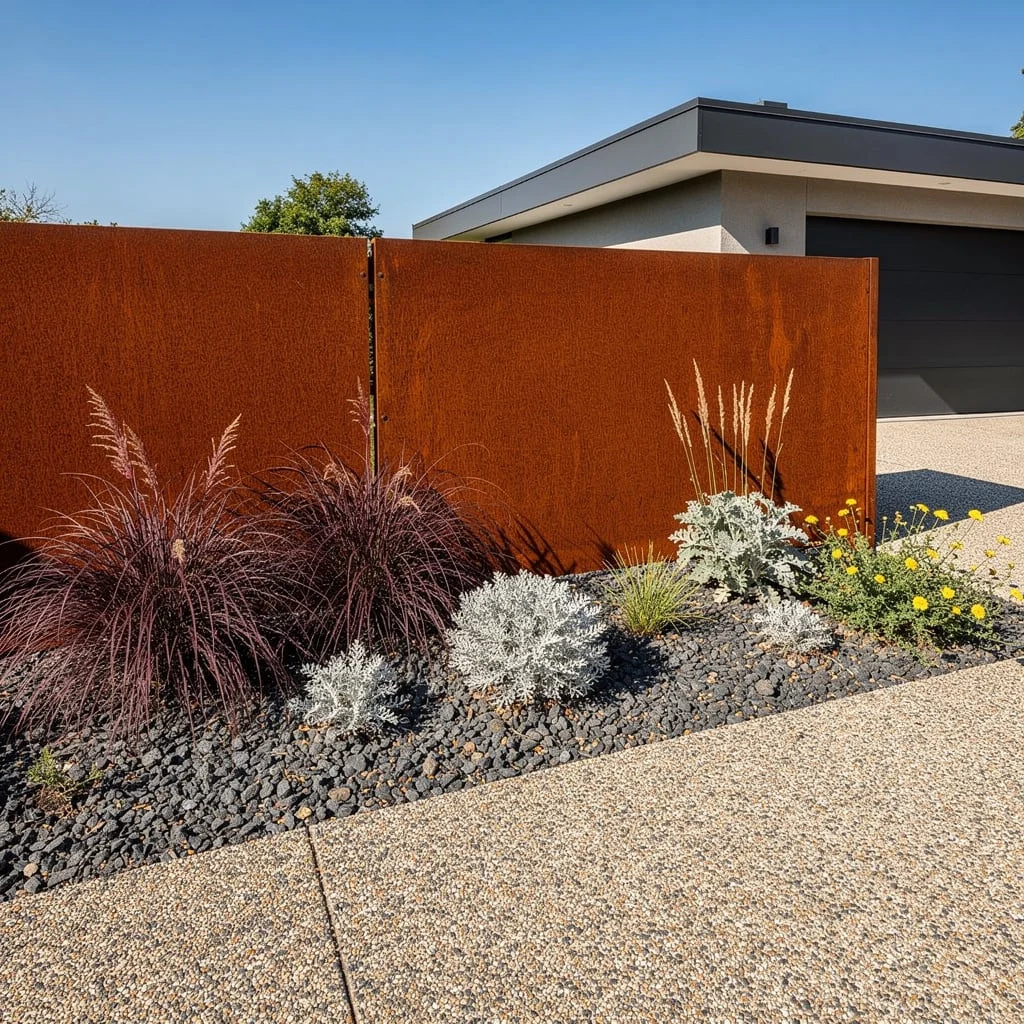
Corten steel — the self-rusting weathering steel that develops a rich orange-brown patina — is one of the most distinctive boundary materials available, and it pairs with plant material in a way that painted or timber fences cannot.
The warm rust colour of weathered corten sits in the same tonal family as burgundy ornamental grasses, amber grass seed heads, and warm-toned flowers. Plant directly against it with purple fountain grass or pennisetum for the burgundy and movement. Add silver-leafed dusty miller for the colour contrast. Plant yellow-flowering perennials like coreopsis or rudbeckia for the warm accent note.
Use dark lava rock or black crushed basalt as the mulch surface in the bed. The dark ground surface makes the fence colour and the plant colours read against a neutral base.
The Spanish Colonial Boundary Wall with Mosaic Tiles and Cobalt Pots
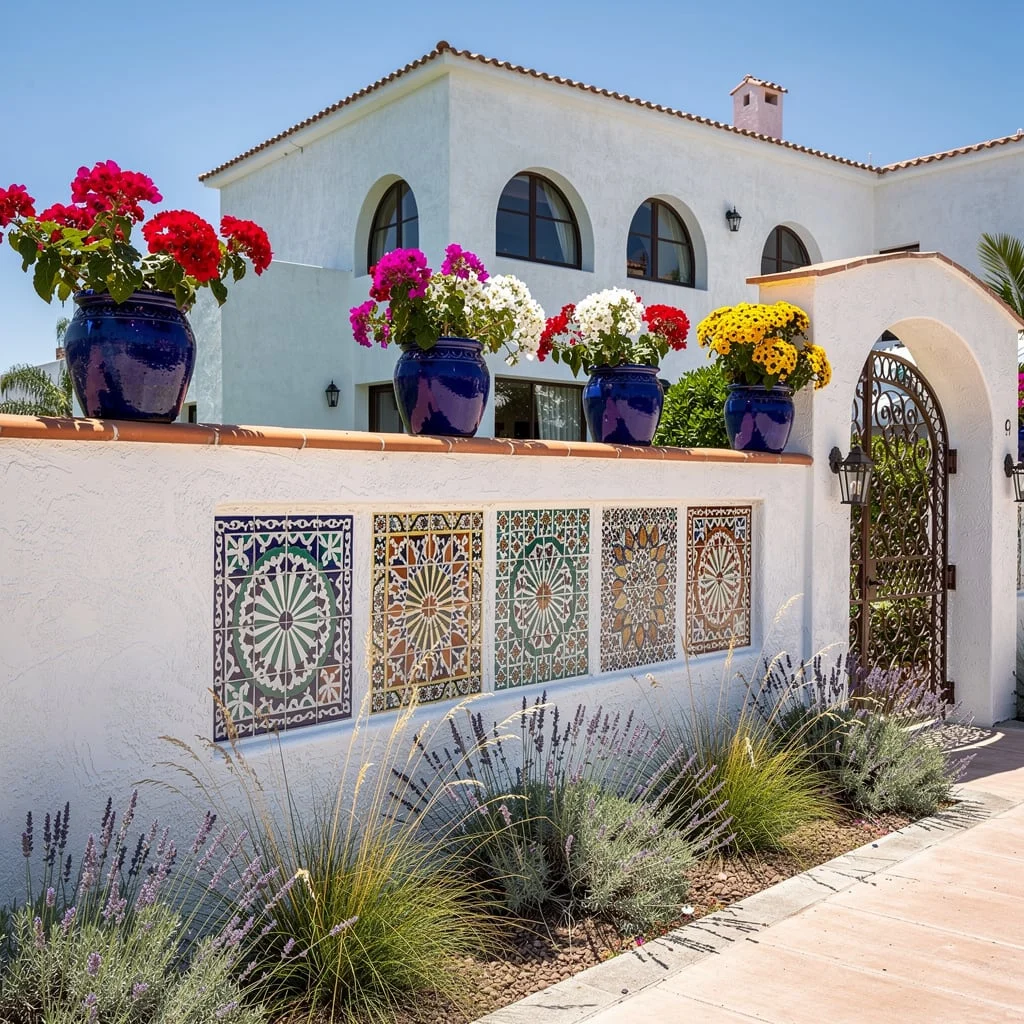
This is not a fence so much as a composed object. The low stucco wall with mosaic tile insets, the cobalt blue ceramic pots atop it, the ironwork gate — these are architectural elements designed as part of the house, not installed as boundary markers.
To recreate this look, the wall needs stucco rendering in warm white or off-white. The mosaic tile panels are set flush into the face of the wall — square format, geometric Islamic-inspired patterns, each panel individually designed or sourced. The cobalt glazed pots on the top of the wall are large — genuinely large, scale-model large — planted with bold-flowering species in reds, whites, and yellows.
Plant the base of the wall with lavender and fine-textured ornamental grasses. The silver-grey foliage of lavender against the white stucco is ideal. The informal planting at the base softens the formality of the wall above it.
The Dark Green Winter Interest Border with Black Gravel Mulch
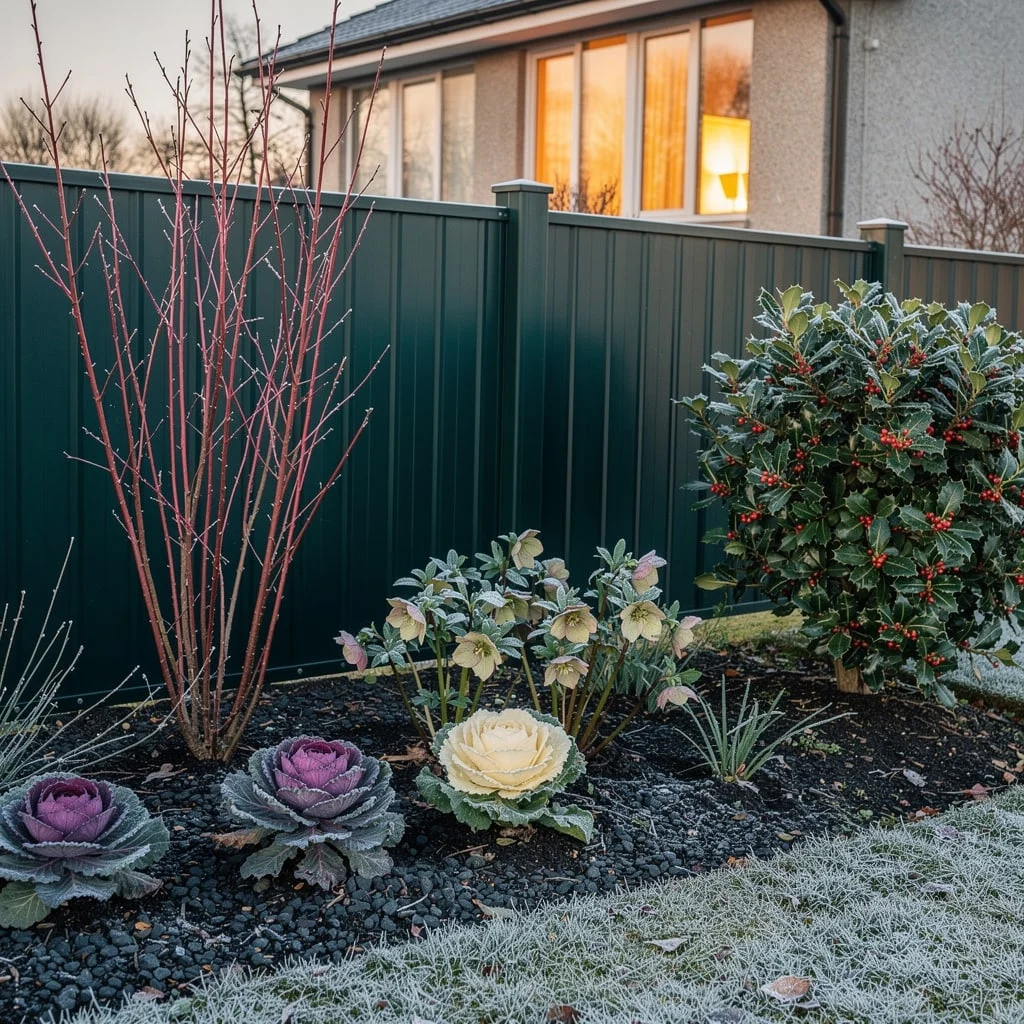
Most garden design focuses on summer. The gardens that look good in December and January are the ones that thought about it deliberately.
A dark green fence — deep forest green, the kind that reads almost black in low winter light — is the backdrop. Against it, plant for winter structure and interest: red-stemmed dogwood (Cornus alba) for the brilliant crimson bare stems, holly for the dark evergreen and red berries, hellebores for the nodding flowers that appear in frost, ornamental cabbages in purple and cream for low ground interest.
Use black lava pebbles or dark slate chippings as the mulch surface. The black ground, dark fence, and winter plants create a composition that is deliberately moody and beautiful — a garden that earns its keep in the least photogenic season.
The White Picket with Zinnia and Sunflower Border
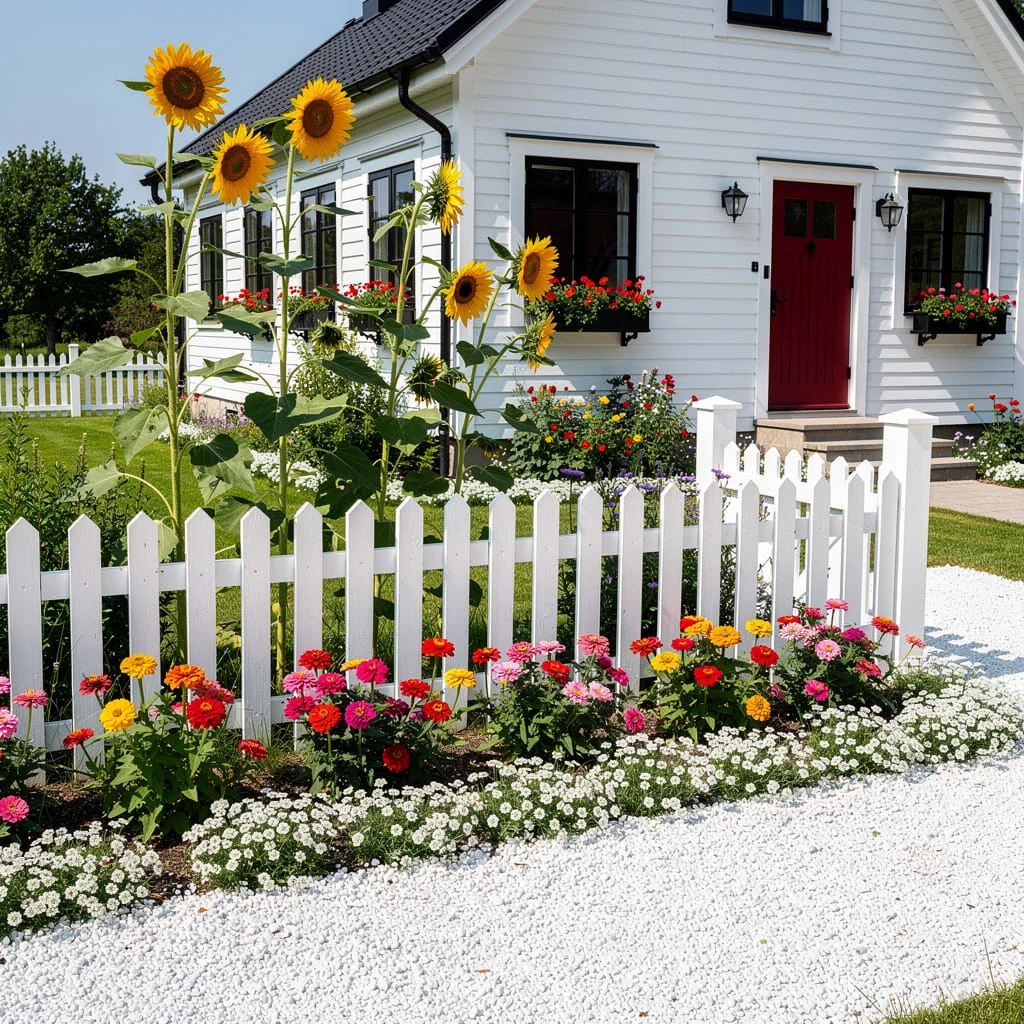
The white picket fence is an archetype. It will always read as a certain kind of American country comfort, and there is nothing wrong with that if you commit to it completely.
The mistake people make is planting something restrained against a white picket fence. It wants abundance. It wants the zinnias in every warm colour from yellow to magenta, planted thickly enough that they lean against the fence in a casual, tumbling way. It wants tall sunflowers behind them, four to six feet tall, rising above the fence line. It wants white alyssum as a low frothy edge at the front.
White gravel in the path adjacent to the planting ties the white fence to the ground plane and creates a sense of brightness and clarity that soil or dark mulch would absorb.
The Woodland Shade Border with River Rock Edge and Ferns
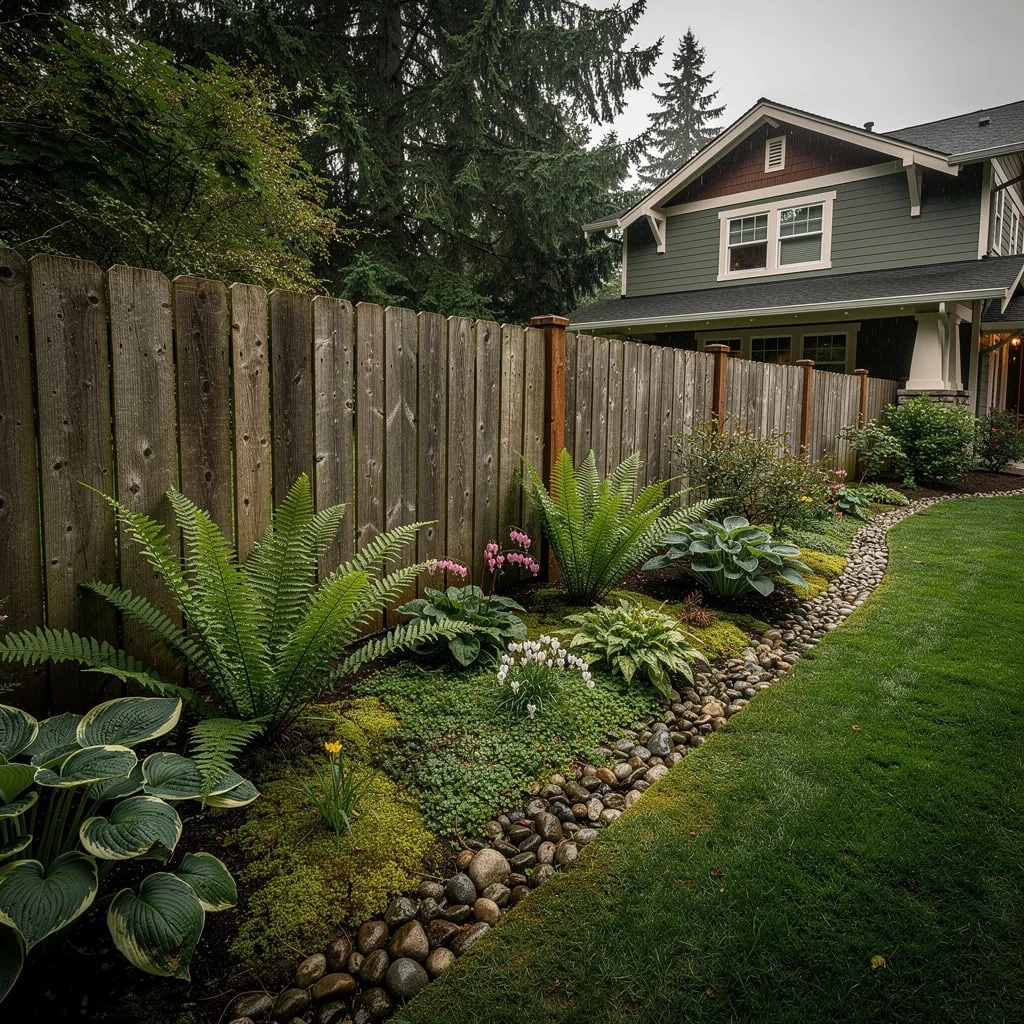
Not every fence line gets sun. The shaded fence border alongside a weathered timber fence is one of the most challenging planting situations — and one of the most rewarding when handled well.
The ground surface in this kind of border should be bare dark soil or a thin layer of composted bark — shade plants tend to be shallow-rooted and don’t benefit from thick mulch. The defining edge can be a continuous line of smooth river rocks, placed closely enough to form a clean boundary with the lawn.
Plant with species that genuinely enjoy shade: large-leaved hostas in variegated and plain green forms, sword ferns and lady ferns for strong vertical form, moss as a ground-covering element where the soil stays moist, cyclamen for seasonal flowering in pink and white, and creeping Jenny or baby’s tears as a trailing edge plant. The composition should feel like a fragment of woodland floor transplanted to the garden.
The Tropical White Fence with Bird of Paradise and Bromeliads
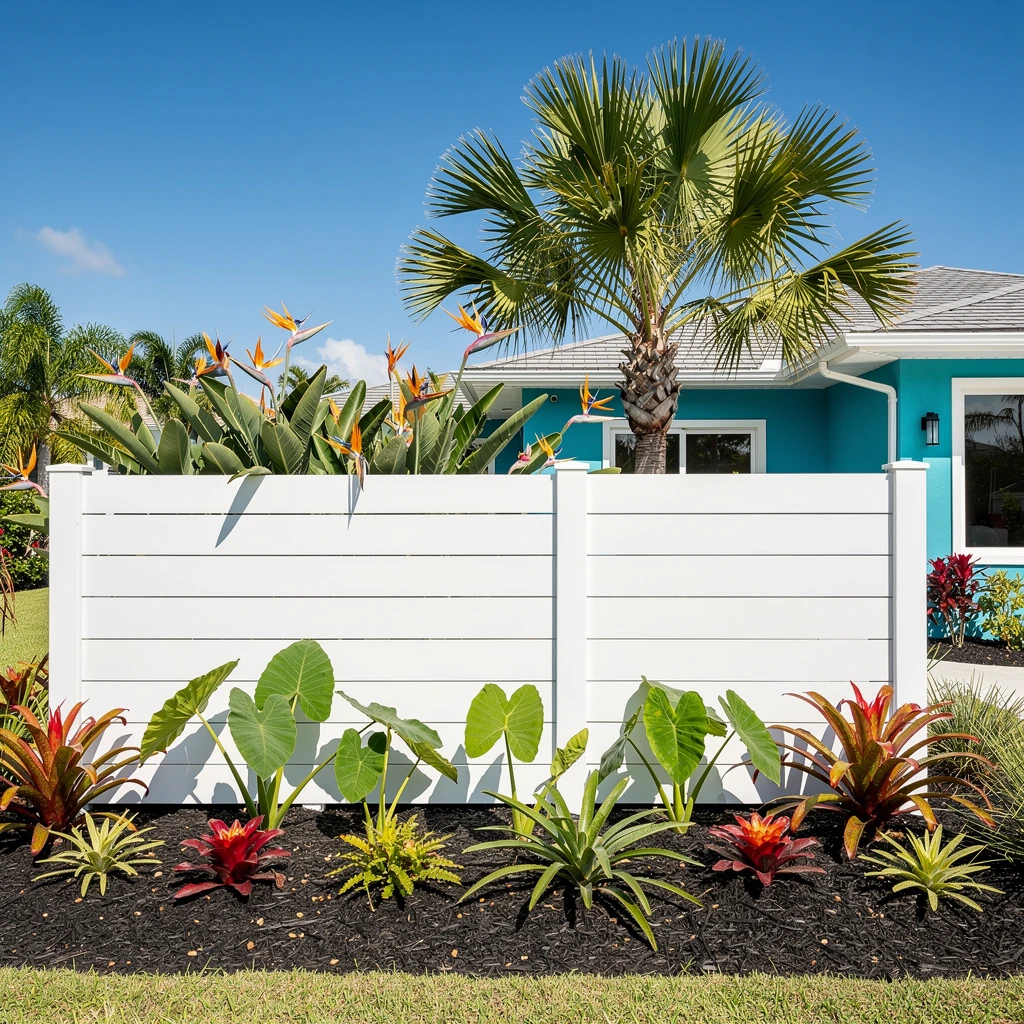
A white horizontal privacy fence — the architectural kind with broad horizontal boards rather than pickets — is the canvas for maximum tropical impact.
Plant directly in front of it using species with bold architectural form and strong colour. Bird of paradise is the statement plant: large paddle leaves and extraordinary orange-and-blue flowers that read from the street. Elephant ear for dramatic leaf scale. Bromeliads in red, orange, and yellow-green for low ground colour and textural contrast with the large-leaved plants.
Use dark mulch — black or near-black — to make every plant colour read against a dark ground. The combination of white fence, dark mulch, and saturated tropical colour is a deliberately bold aesthetic that works only in warm climates. In the right setting it is remarkable.
The Tudor-Style House with Hydrangea Foundation Fence Line
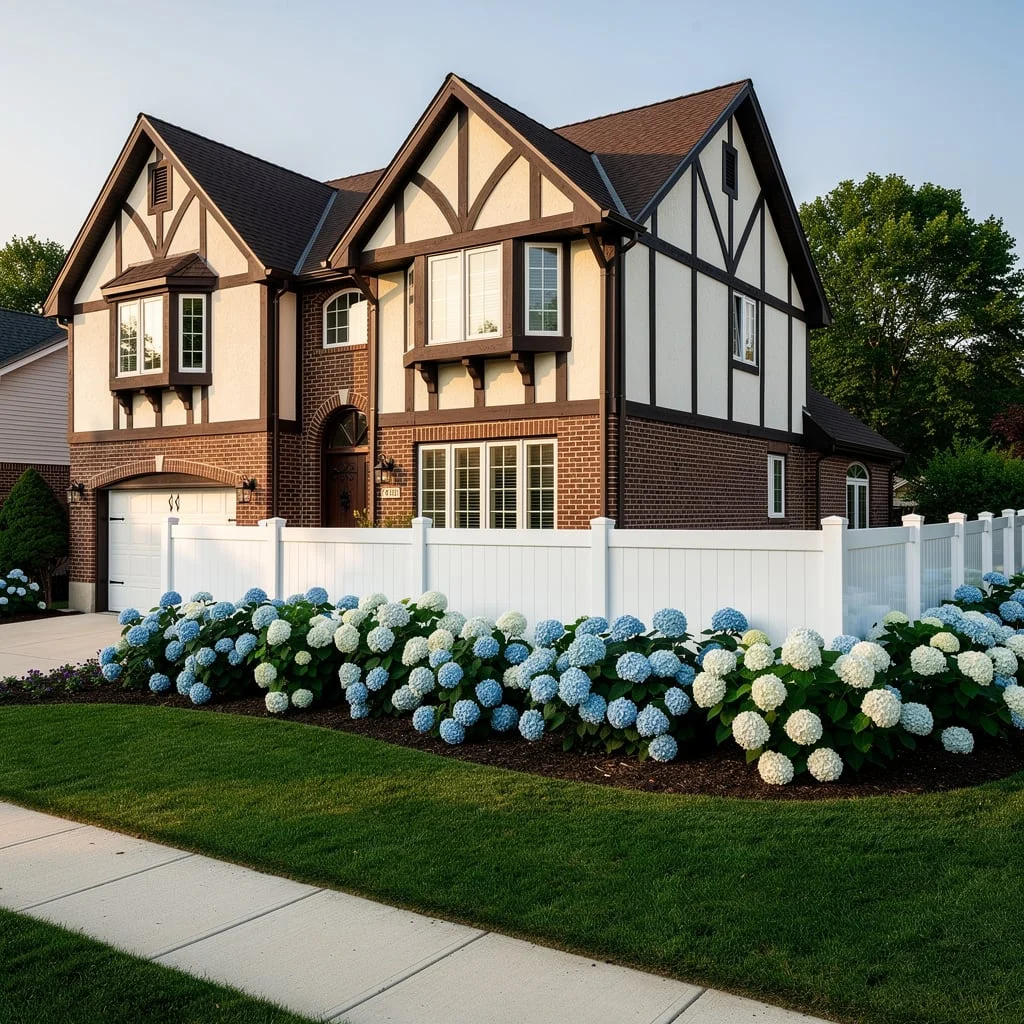
Some houses are served by one specific plant and no other. The Tudor-style house with exposed timber framing and brick base wants hydrangeas. Nothing else has the right combination of scale, softness, and flower-head weight.
Plant a continuous mixed hydrangea border along the fence line — interplanting blue mophead types with white lacecap and soft pink varieties. The colour mix should be subtle, all within the blue-purple-white range rather than jumping to pink or red.
Use dark shredded bark mulch as the ground surface and install black metal edging at the lawn border. Keep the edging line slightly curved rather than straight — the curve softens the relationship between the formal fence and the informal hydrangea mounds.
The Wildflower Border with Split-Rail Fence and Flagstone Entry
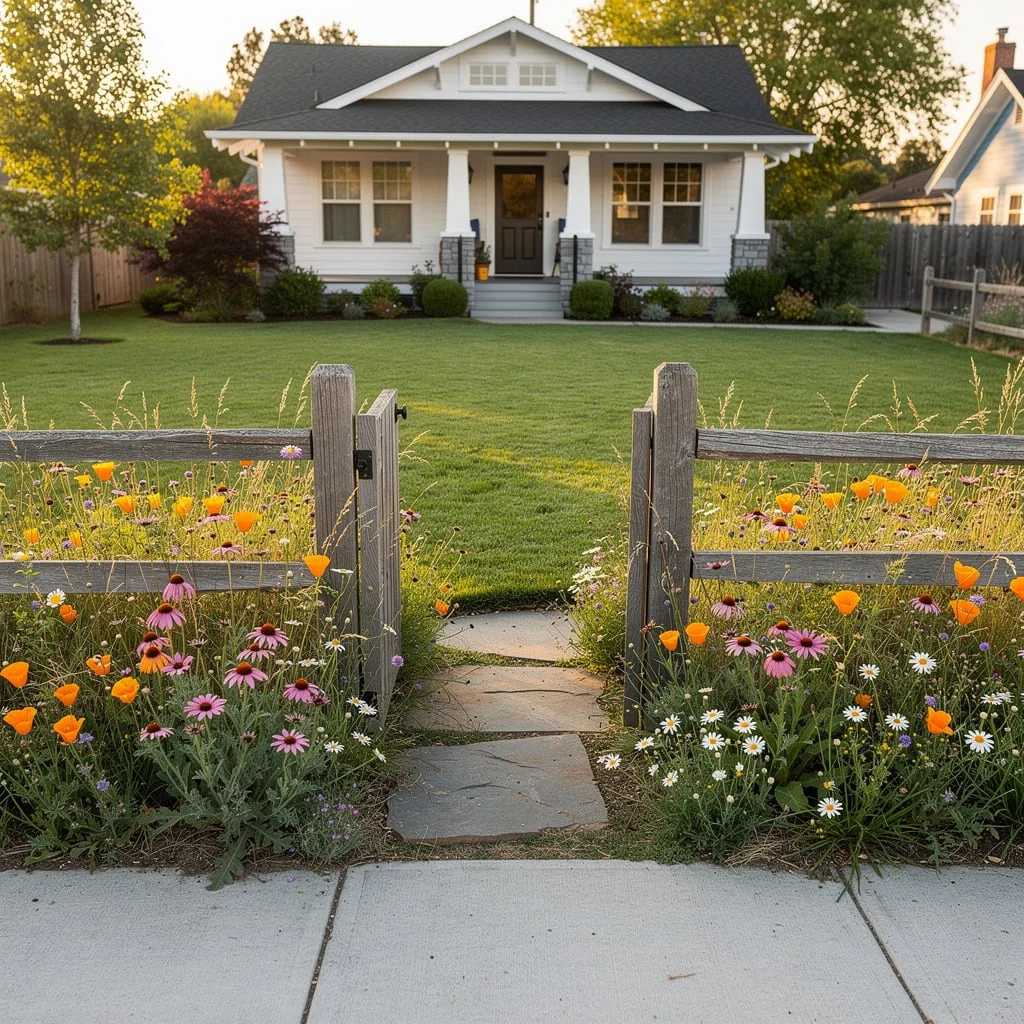
The split-rail fence is the least ornamental fence type available, which makes it ideal for the most naturalistic planting approach.
The concept: plant a wildflower meadow strip along the base of the fence. California poppy in orange, echinacea in pink and red, white and yellow daisy varieties, blue bachelor’s buttons — any mix of hardy annuals and perennials that will self-seed and naturalise. Let the planting be deliberately casual. Some plants lean through the fence rails. Some colonise the gaps between the stepping stones. Nothing is staked or contained.
The contrast between this informal wildflower approach and the mown lawn behind is the design event. The fence is the threshold between managed and wild. Set large irregular flagstones as the entry path, spaced with visible gaps where low plants are allowed to grow between them.
The Chain Link Fence Disguised by Climbing Roses
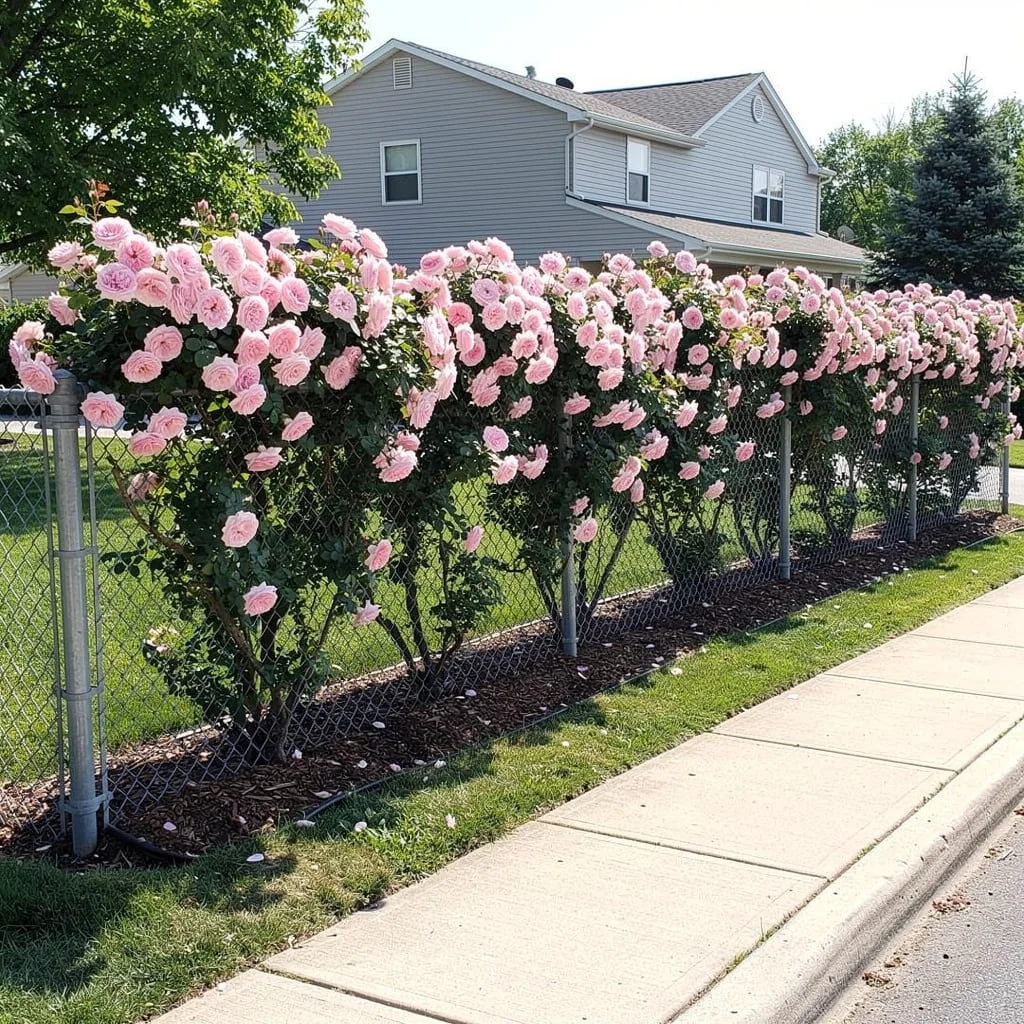
This one needs time, but it needs very little else.
Select a repeat-flowering climbing rose in a single variety — repeat flowering is essential because you want coverage for as long as possible each season. Plant at three-foot intervals along the base of the chain link. In the first year, the roses look ordinary. By year three, the fence has disappeared.
Train the long canes horizontally through the chain link rather than letting them grow vertically. Horizontal training induces more flowering shoots along the length of each cane. More shoots means more flowers means more fence coverage.
The mulched bed at the base should be generous in depth and width. Climbing roses are hungry plants. They need well-amended soil and reliable irrigation. Feed in spring and again in midsummer. Prune dead wood in late winter and retrain any canes that have come away from the fence.
The Cedar Fence with Lavender Line
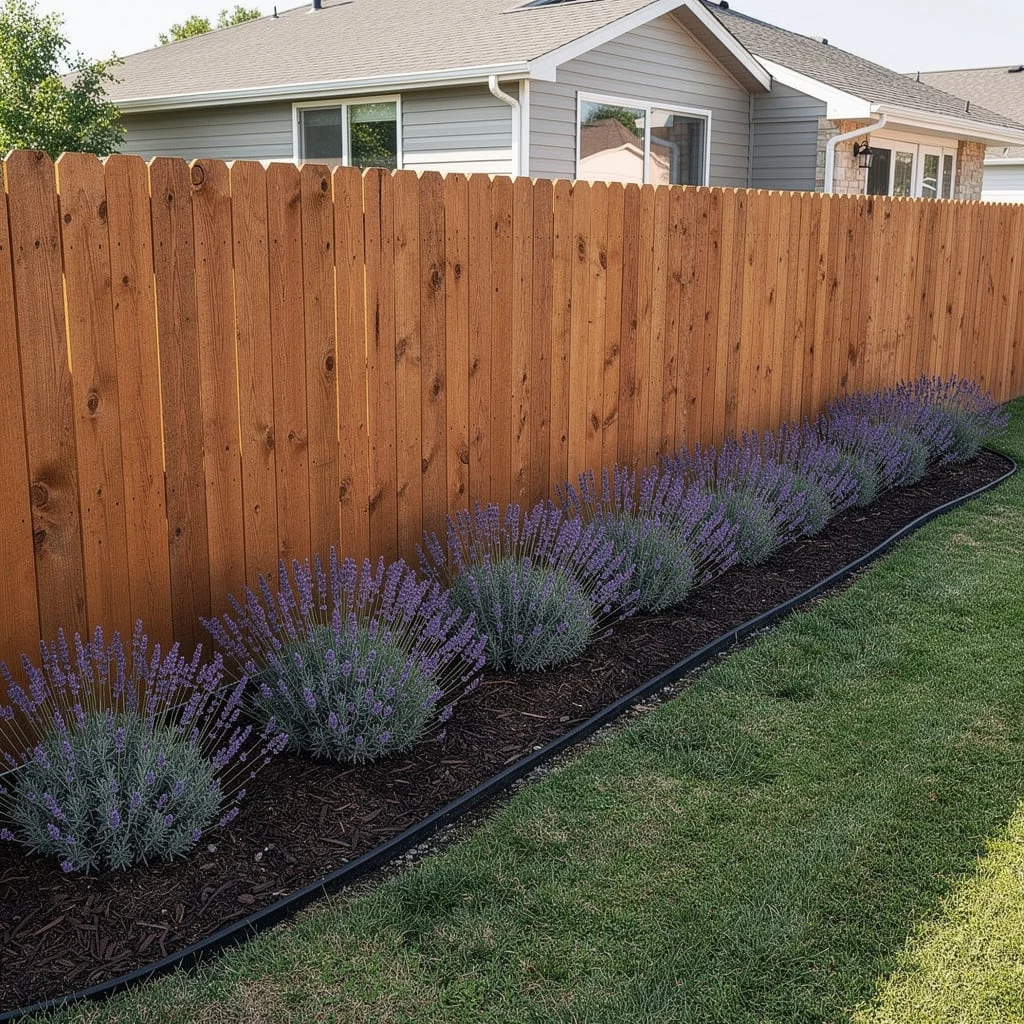
This is the simplest combination in this list and one of the most satisfying to live with.
Fresh cedar fence. Single row of English lavender, planted at eighteen-inch centres along the full length. Black steel edging at the lawn side. Dark bark mulch. That is the entire scheme.
The lavender’s silver-grey foliage against the warm amber cedar is a pairing that works in every season. In winter the silver stems and dried seed heads are still beautiful against the warm timber. In summer the purple flower spikes are extraordinary. The fragrance when you walk past is a daily pleasure that no other planting combination can provide along a fence line.
Cut the lavender back by one-third after each flush of flowering. This keeps the plants compact and prevents woody die-back at the base. Replace individual plants as they age out, usually after five to seven years.
The Tuscan Stone Wall with Terracotta Urns and Cypress Trees
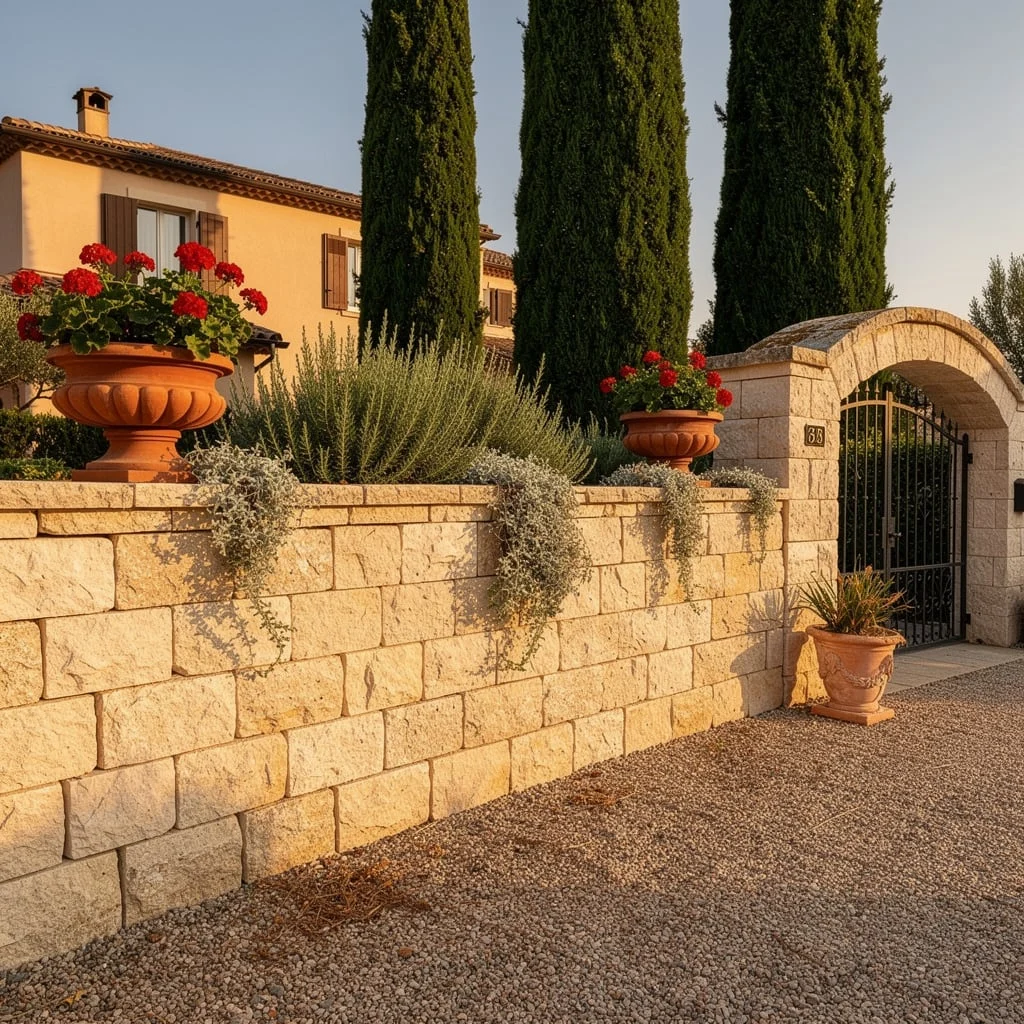
The stone boundary wall with the arched gate and cypress trees flanking it is an architectural landscape feature, not a garden border. It belongs to a specific tradition — Mediterranean farmhouse, Italian villa, Provençal estate — and it works only when every element speaks the same language.
The wall is dry-stack or mortared limestone or sandstone in a warm cream-buff colour. The cap stones are flat and project slightly over the face of the wall. Terracotta urn planters sit at intervals along the top, planted with red geraniums. Silver-leaved sprawling plants — santolina, trailing rosemary, artemisia — cascade over the wall face in several places.
Italian cypress trees rise behind the wall, providing the vertical element that makes the whole composition read as Mediterranean. Plant lavender and low herbs along the base. Use fine gravel on the ground surface rather than paving.
The Dark Painted Fence with Cottage Border and Climbing Rose Arch
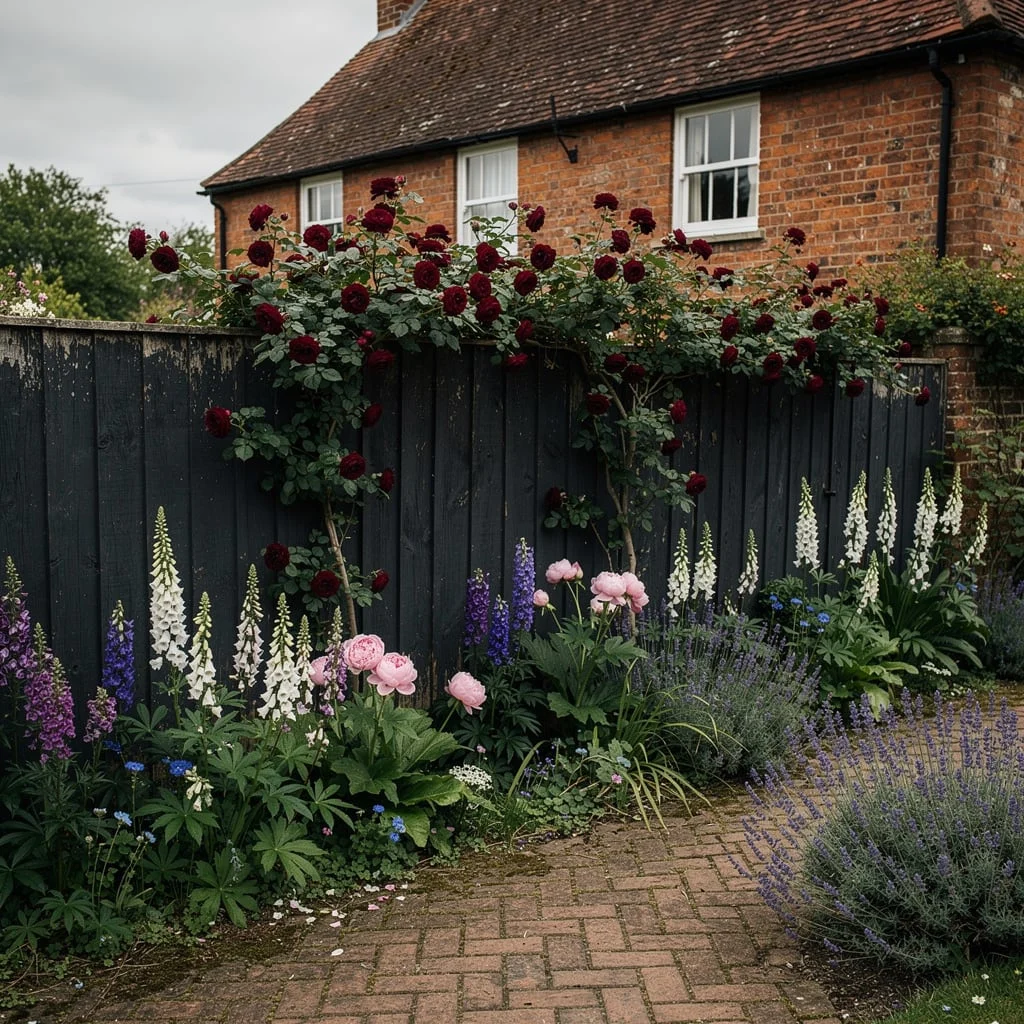
The English cottage border at its most deliberate: a charcoal or near-black painted vertical board fence, a dense mixed herbaceous border, and a climbing rose trained over a simple arch at the garden entry.
Layer the planting with genuine intention. Tall plants at the back — foxgloves in white and purple, tall delphiniums in blue, the climbing rose trained upward on the fence panels. Mid-height plants in the centre — peonies in soft pink, salvia in blue-purple, hardy geraniums as a filler. Low plants at the front — lavender, forget-me-nots in spring, alyssum in summer.
The dark fence behind the mixed border acts exactly as a studio backdrop acts behind a portrait subject. It eliminates distraction. Every flower colour reads purely and completely against the dark background. This is the technical reason why dark fences and cottage borders work so well together — it is a darkroom principle applied to horticulture.
The Fence Line Rule Nobody States But Everyone Knows
A fence with nothing growing against it is just a wall.
It creates a hard boundary. It reads as defensive. It makes the space feel smaller than it is.
A fence with planting along its base becomes a garden edge. It creates depth. It brings the inside of the garden to the street in a way that says: someone lives here who cares about this.
You do not need to plant the entire fence. One well-planted section, one section of climbing plant in full growth, one corner with boulders and structural shrubs — any one of these is enough to transform the boundary from enclosure to feature.
Start with the section most visible from the street. Get that right first.
Everything else can follow.