
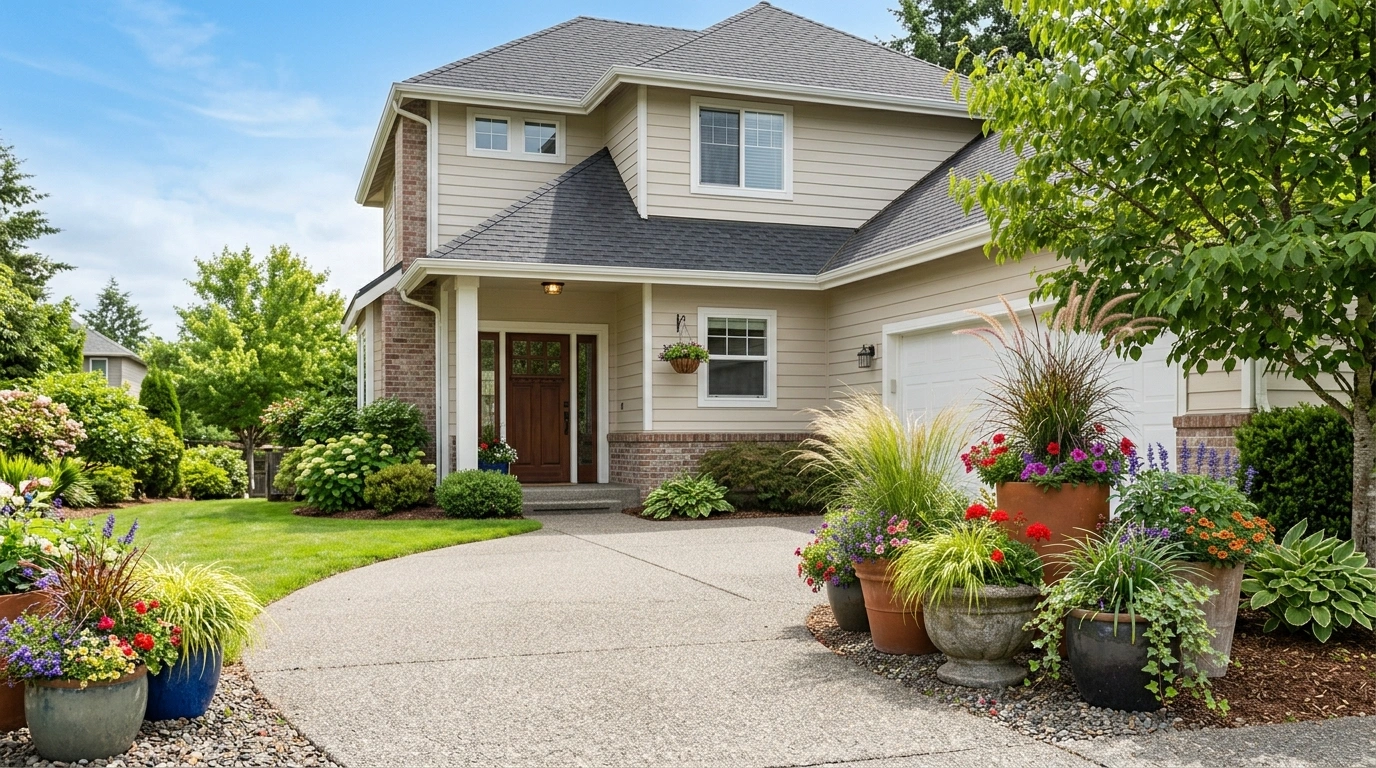
A driveway can be freshly paved, perfectly clean, and still make the front of a house look like something is missing. Usually, it is not another decorative object. It is the awkward strip where pavement meets lawn, the bare patch beside the garage, or a few random pots that somehow turned into a full-blown identity crisis.
These driveway planter ideas take a different approach. Instead of treating the planter as a standalone object, each design looks at the entire entrance as one finished composition. The driveway, planting, walkway, facade, lighting, and front door all have to make sense together.
Some of the looks are crisp and modern. Others are loose, cottage-inspired, Mediterranean, rustic, dramatic, or deliberately minimal. There are compact ideas for small entrances and bigger compositions for wide or long drives.
Because the goal is not to buy a planter and hope for the best.
The goal is to make the whole front approach look like it actually belongs together.
The Driveway Has Entered the Chat
Driveway Planter Ideas
Linear Boxwood Border With a Clean Paved Drive
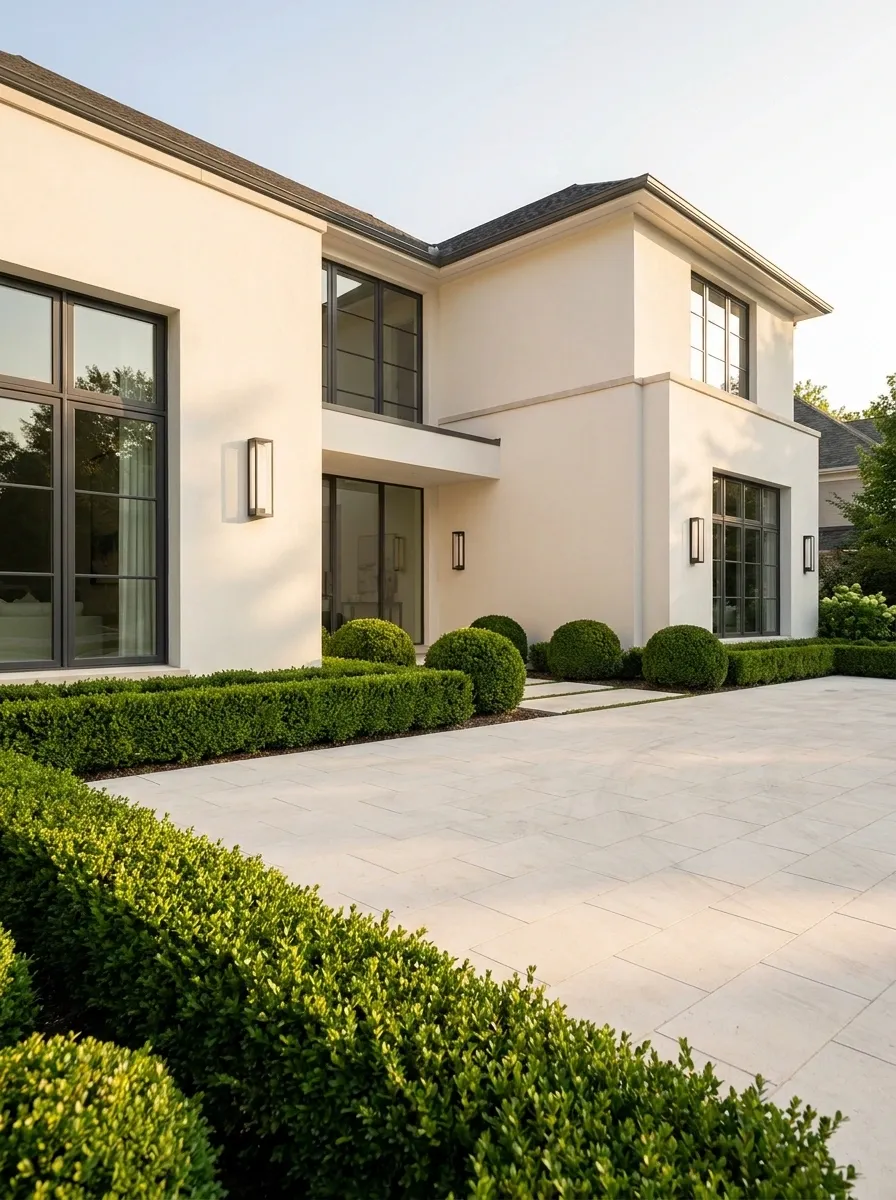
A broad pale driveway gets a completely different presence when one side is framed by a low, continuous boxwood border. The planting stays deliberately restrained, with clipped greenery running alongside the pavement and a few rounded forms near the front walk. The house itself stays fairly quiet, using warm white walls, dark window frames, and simple outdoor lighting.
The trick here is repetition. The same low green line carries the eye from the street toward the entrance instead of making the planting look like a pile of unrelated decisions.
And honestly, this is what tidy landscaping looks like when it has its life together. The driveway stays open, the planting stays disciplined, and nothing is trying desperately to become the star.
Olive Trees and Gravel Along a Mediterranean Driveway
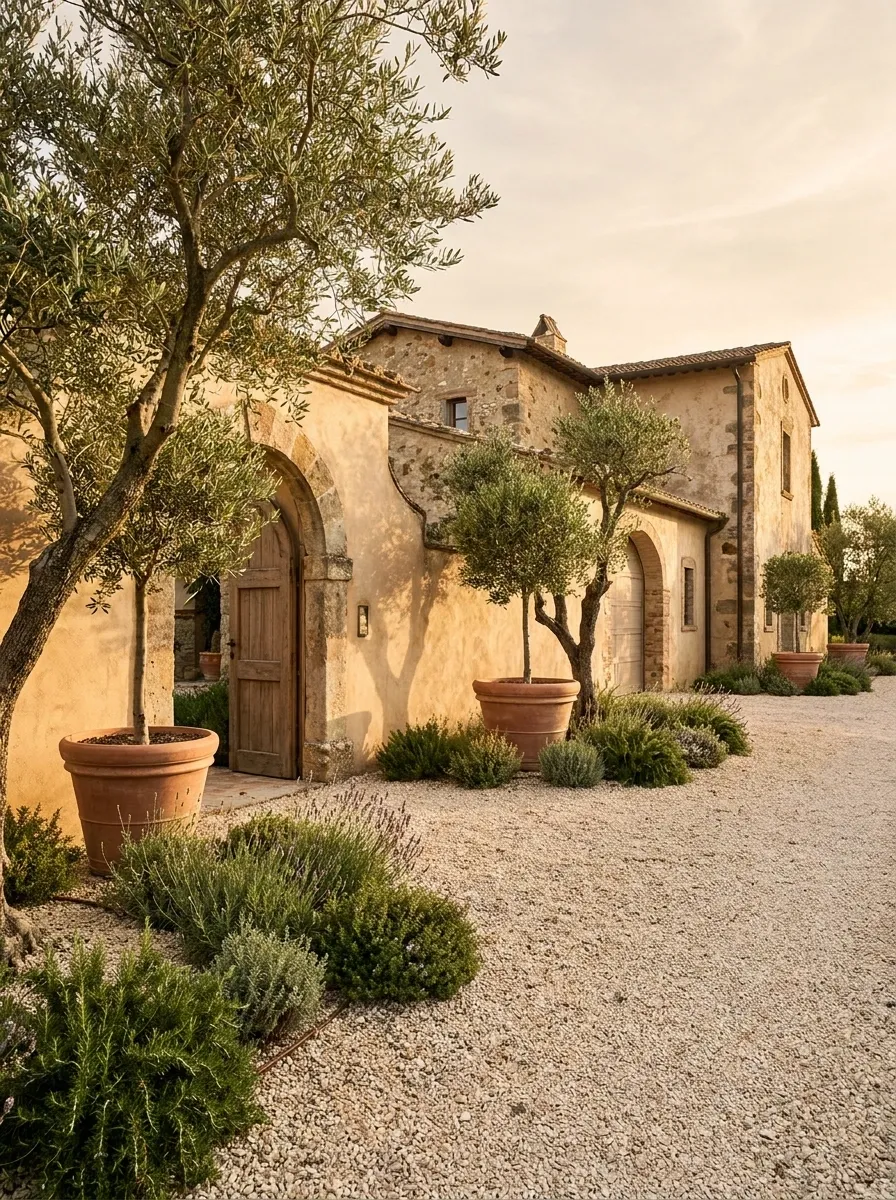
Warm stucco, pale gravel, weathered stone, and olive trees make this driveway feel like part of the architecture instead of a separate strip of pavement. The planting is loose rather than clipped, with silvery foliage, low herbs, and a few soft grasses breaking up the hard surfaces.
The driveway itself stays fairly simple so the texture of the landscape can carry the look. A warm wood gate or natural stone entry adds another layer without pushing the design into decorative overload.
This works because the materials all speak the same language. Nothing looks imported from a completely different house.
Also, there is no prize for filling every inch with plants. The gravel is doing actual aesthetic work here.
Tall Ornamental Grasses Framing a Modern Drive
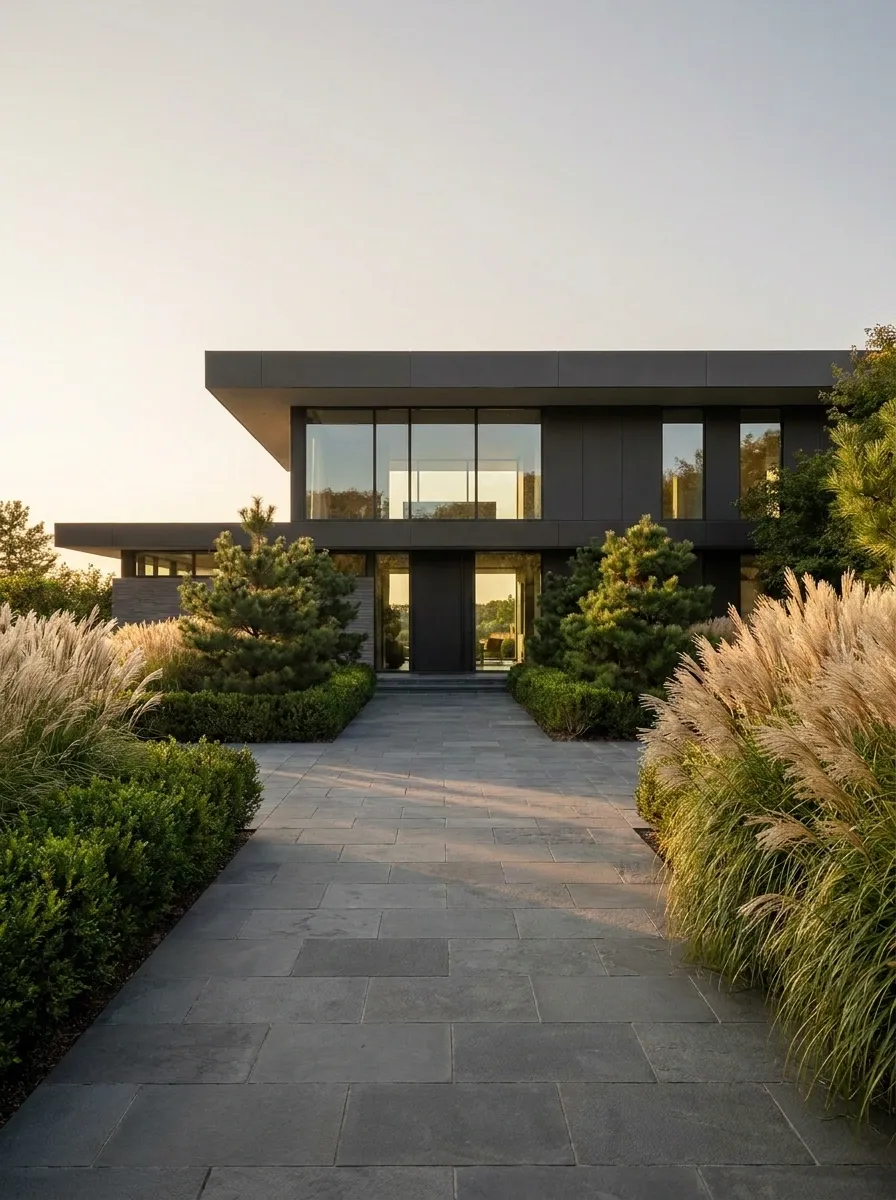
A modern house can handle stronger landscaping, and this version uses tall ornamental grasses as the main vertical element. The driveway is broad and straight, with dark or medium-gray paving surrounded by structured beds. Grasses rise above low shrubs and groundcover, creating movement against an otherwise angular facade.
A few architectural plants can fill the lower layer, but the composition should stay edited. The grasses are supposed to frame the entrance, not swallow it.
This design is especially effective when the house has large windows, flat rooflines, or dark cladding because the softness of the planting breaks up all those straight architectural lines.
The result feels polished without becoming fussy. Which is basically the dream.
Cottage Driveway With Loose Flowering Borders
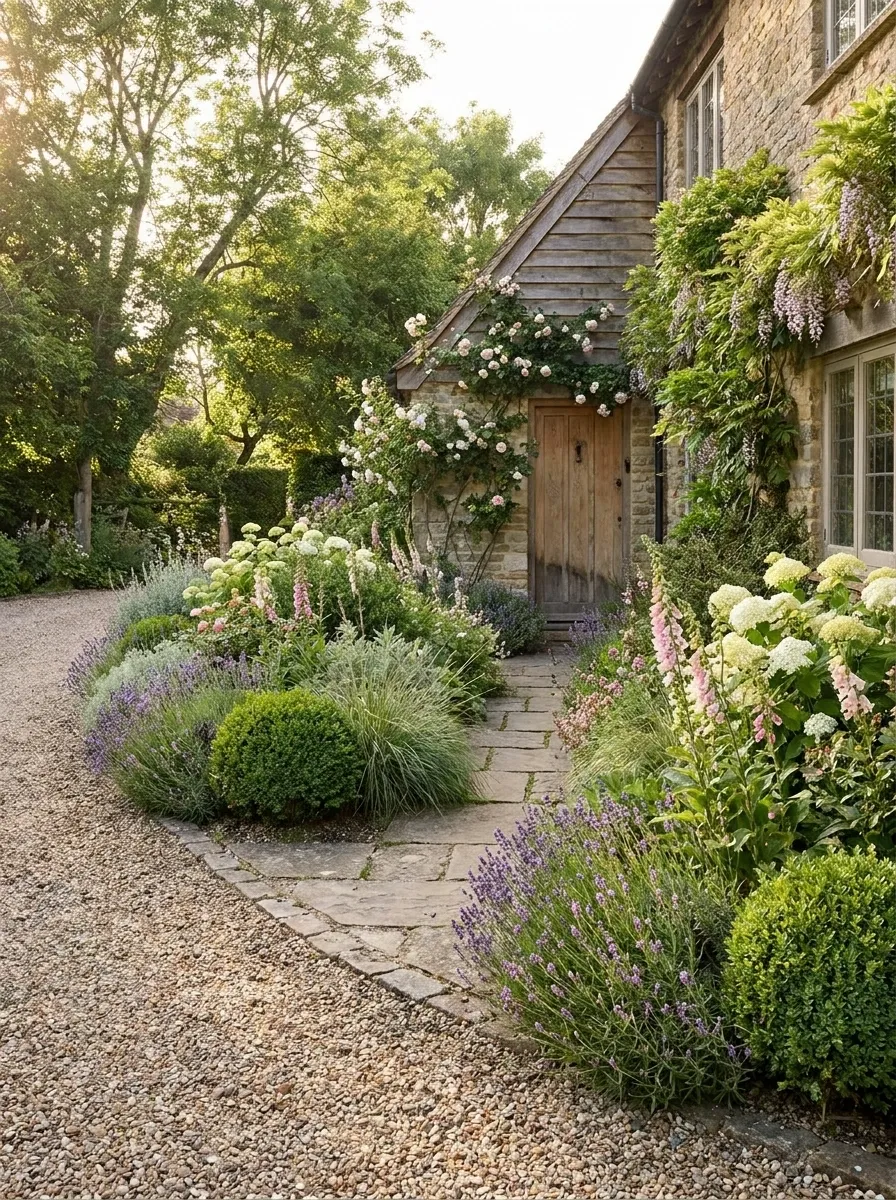
This driveway goes in the opposite direction, with almost nothing looking clipped or perfectly lined up. A gently curved gravel drive leads toward a cottage facade, while broad planting beds spill outward with flowering perennials, rounded shrubs, grasses, and climbing greenery.
The beauty comes from repetition without strict symmetry. Similar flowers appear in loose clusters, while evergreen shrubs give the border enough structure to keep it from becoming visual chaos.
A narrow path connects the planting to the front door, making the whole entrance feel like a garden people actually walk through rather than a decorative strip beside the driveway.
There is a fine line between “romantic cottage garden” and “every plant at the nursery came home.” This design stays on the right side of it.
Architectural Concrete Planters at a Wide Drive
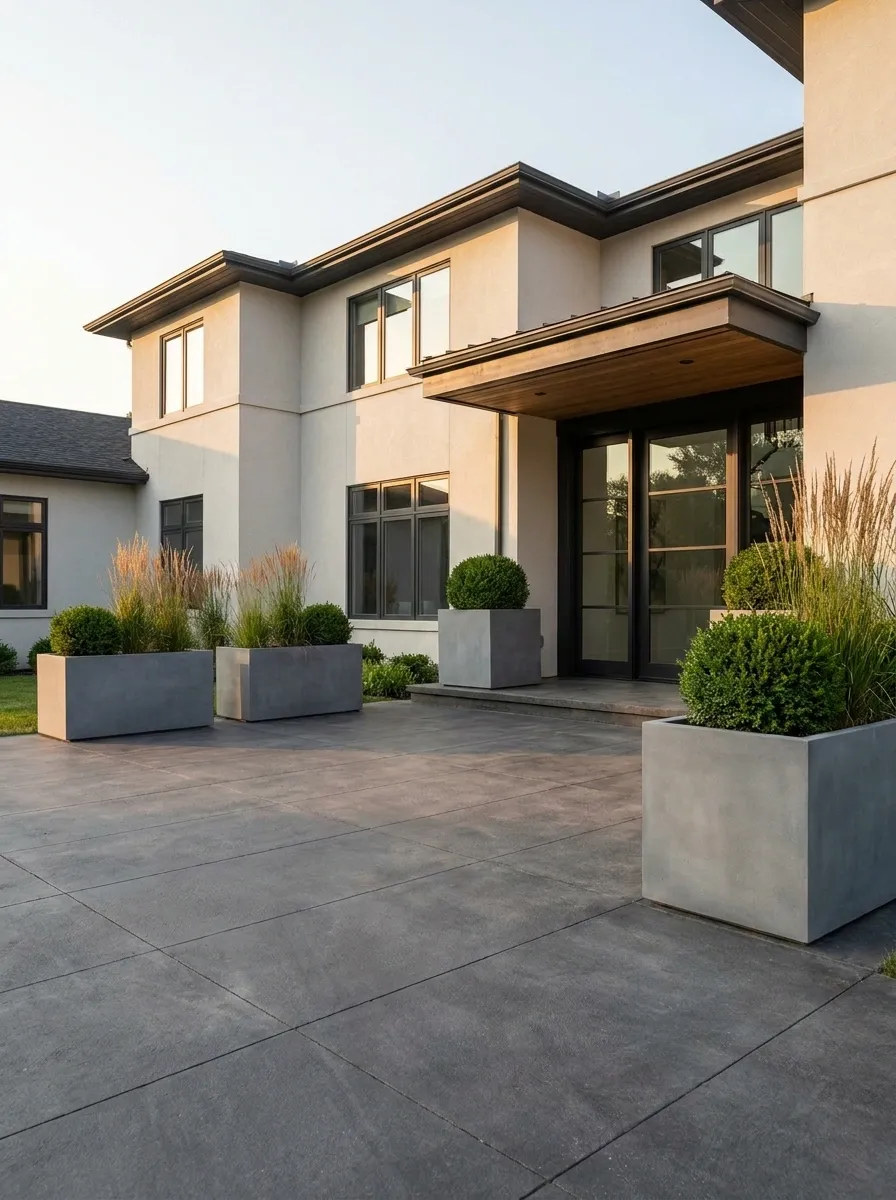
Oversized rectangular concrete planters make sense when the house and driveway are equally substantial. This composition uses a wide paved entrance, a contemporary facade, and several large planters placed where they visually frame the approach without interfering with vehicle movement. The planting inside stays relatively simple, with clipped evergreens and airy grasses providing shape and height.
Scale is what makes the whole thing convincing. Small containers would disappear against a large facade, while massive planters would overwhelm a modest cottage.
The finish should stay restrained, too. Concrete, dark window frames, pale walls, and controlled greenery are enough. There is no need to add seventeen decorative accessories just because there is space.
When the architecture is doing the heavy lifting, let it.
Layered Evergreen Planting for a Narrow Driveway
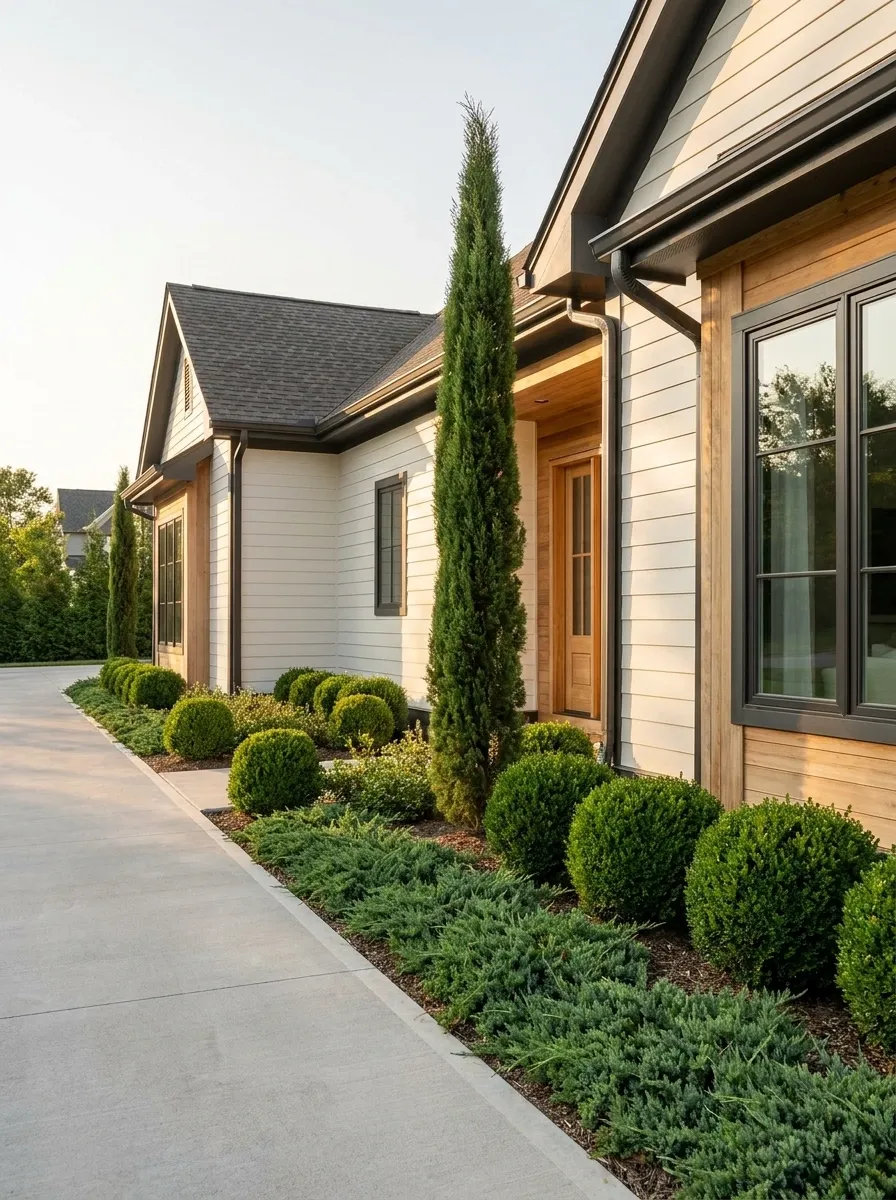
A narrow driveway does not need to look bare just because there is less room to plant. This compact composition uses a slim border of evergreen groundcover, rounded shrubs, and one taller evergreen near the front entrance. The planting stays tight to one side, leaving the driving surface visually and physically open.
The house uses warm white siding, natural wood, and simple dark trim, so the greenery becomes a quiet bridge between the architecture and driveway. Nothing sticks halfway into the path of a car, and nothing is fighting for attention.
That balance matters. A narrow drive already has enough going on. Adding a miniature rainforest beside the tires is not an upgrade.
Symmetrical Planters Flanking a Traditional Entrance
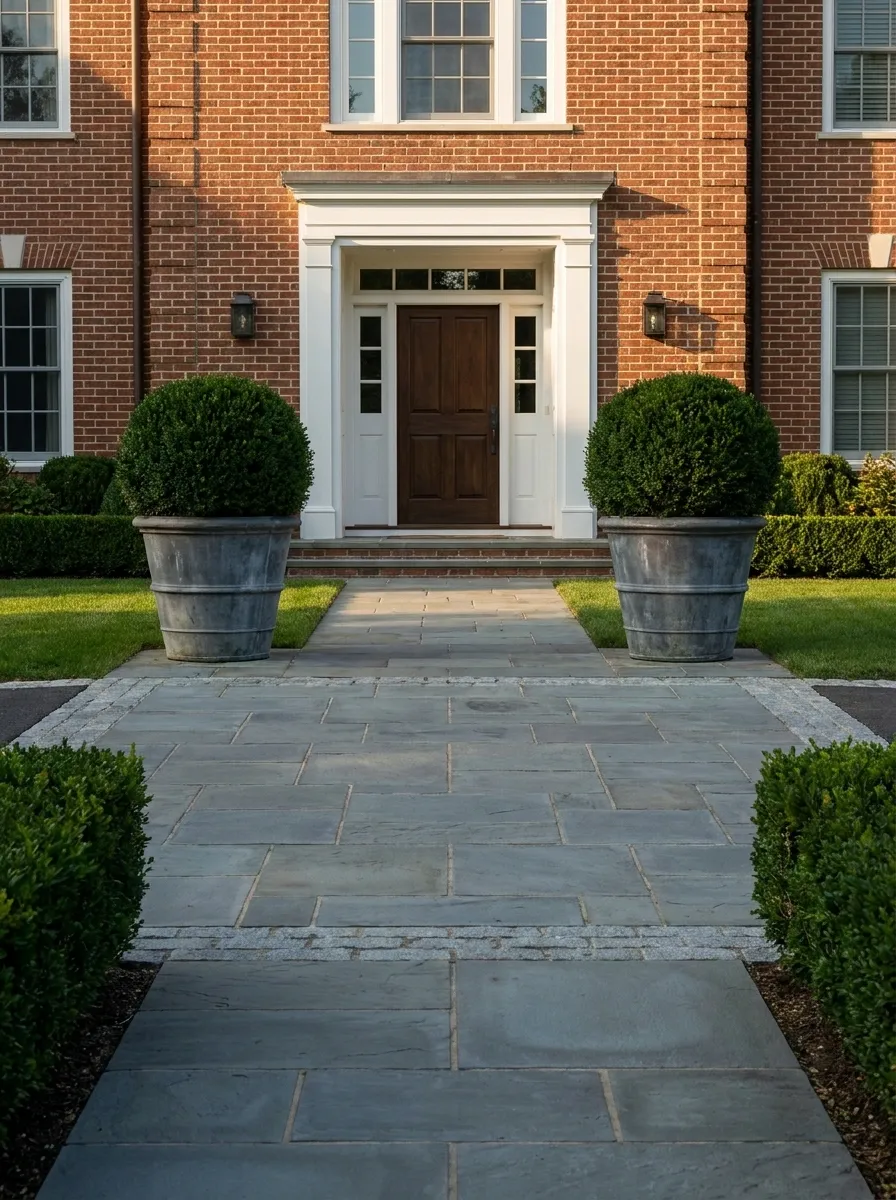
A straight driveway leading to a traditional front door practically begs for symmetry, and this composition leans into it. Matching substantial planters sit on either side of the entrance path, while clipped greenery continues toward the house and the brick facade provides a warm backdrop.
The planting remains formal without becoming stiff. Rounded evergreen shapes soften the hard geometry, while the repeated planters create a clear visual destination at the front door.
The important part is alignment. The driveway, walkway, planters, and entrance all share the same visual center, so the eye knows exactly where to go.
It has that satisfying “someone definitely thought this through” quality. No wandering pots. No mystery focal point. Just very good manners from the landscaping.
Natural Stone Drive With Soft Native Planting
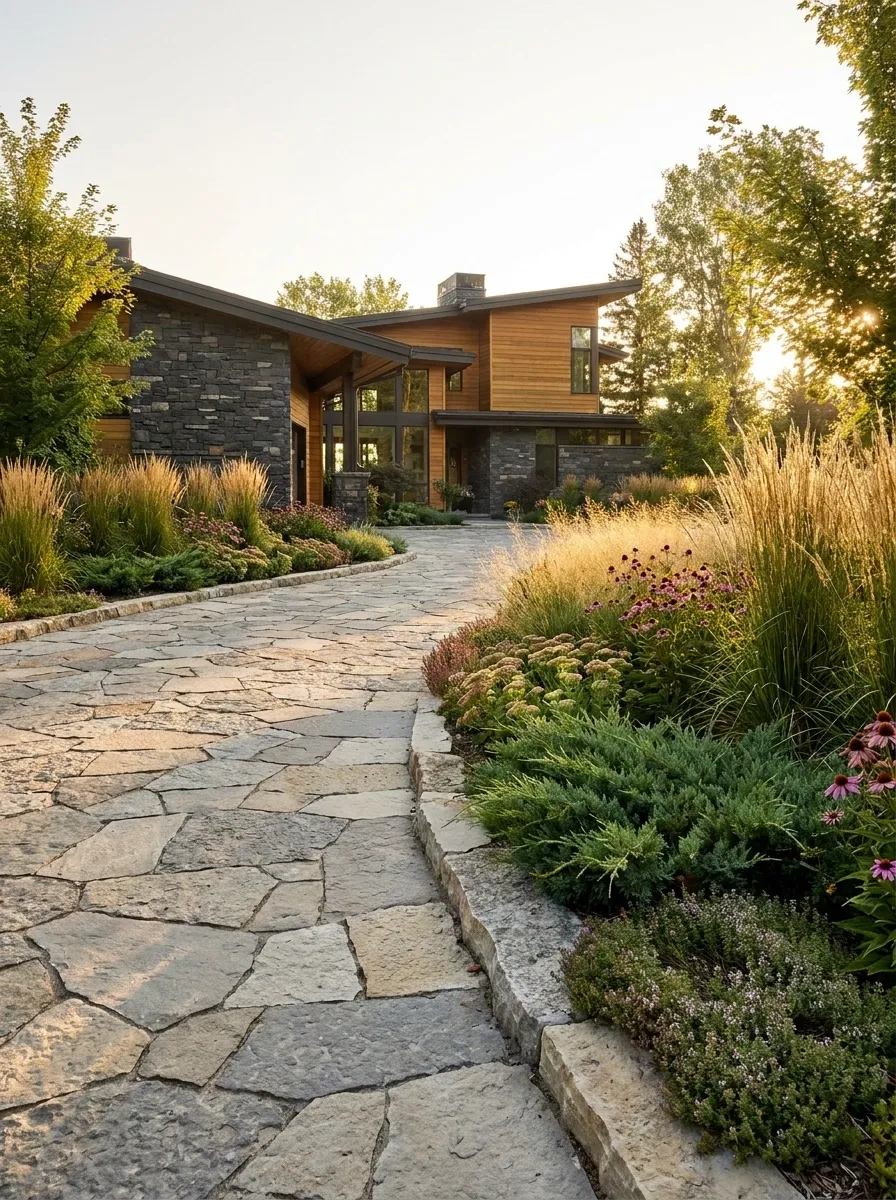
This entrance feels connected to the landscape instead of dropping a polished driveway into the middle of it. Irregular natural stone paving meets broad planting beds filled with grasses, low shrubs, flowering perennials, and loose groundcover. The house uses stone and warm wood, echoing the materials already present around the drive.
The planting edge is intentionally uneven, but the overall composition is still controlled. Taller plants appear farther back, softer textures gather near the stone, and the driveway remains clearly defined.
The result has character without looking overdesigned. It also proves that “natural” does not have to mean “nobody owns pruning shears.”
Black Planters With Architectural Evergreen Trees
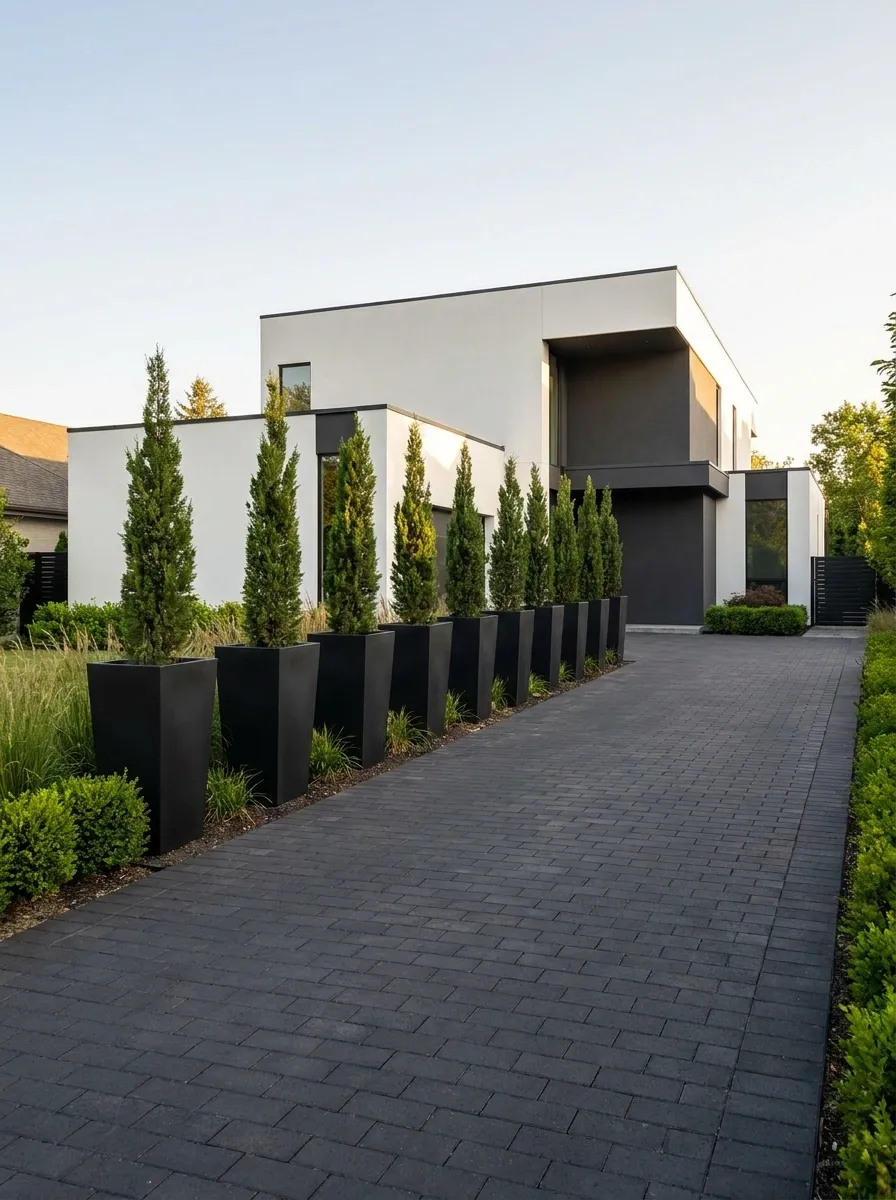
A charcoal-and-white facade gets a sharper entrance when tall black planters repeat along the driveway. Each container holds a slender evergreen tree, while low greenery fills the surrounding beds so the composition has both height and weight.
The repetition is deliberate. Rather than placing one statement container somewhere near the garage and hoping for the best, the planters create a visual rhythm that continues toward the front door. Dark paving reinforces the black accents, while the white walls keep the entire scene from becoming too heavy.
This is a strong choice for homes with simple modern architecture because the landscaping mirrors the clean geometry.
Basically, the planters understood the assignment.
Brick Driveway With Lavender and Silver Foliage
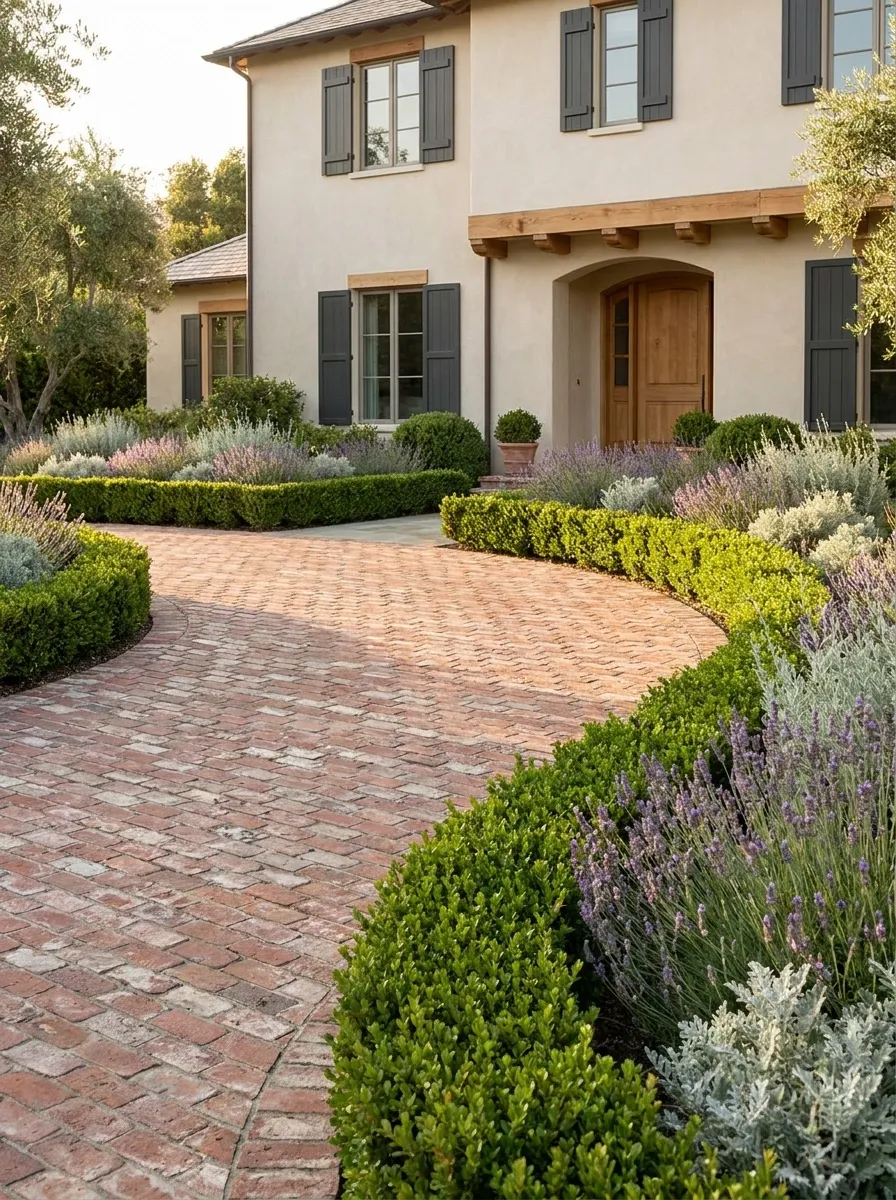
Warm brick paving gives this driveway a distinctly old-world starting point, while lavender and silvery foliage soften the transition into the front garden. Low clipped greenery provides structure at the edge, with flowering plants appearing in clusters rather than as a solid ribbon.
The house stays light and understated, using pale walls, dark shutters, or natural wood details that let the brick and planting carry the visual interest. The driveway feels connected to the garden because the same warm and muted tones repeat throughout the entrance.
The smartest part is the restraint. Lavender does not need to be packed into every available inch just because it looks good in photos. A little rhythm goes a long way.
And yes, the brick gets to be dramatic too.
Raised Masonry Planter Along a Split-Level Drive
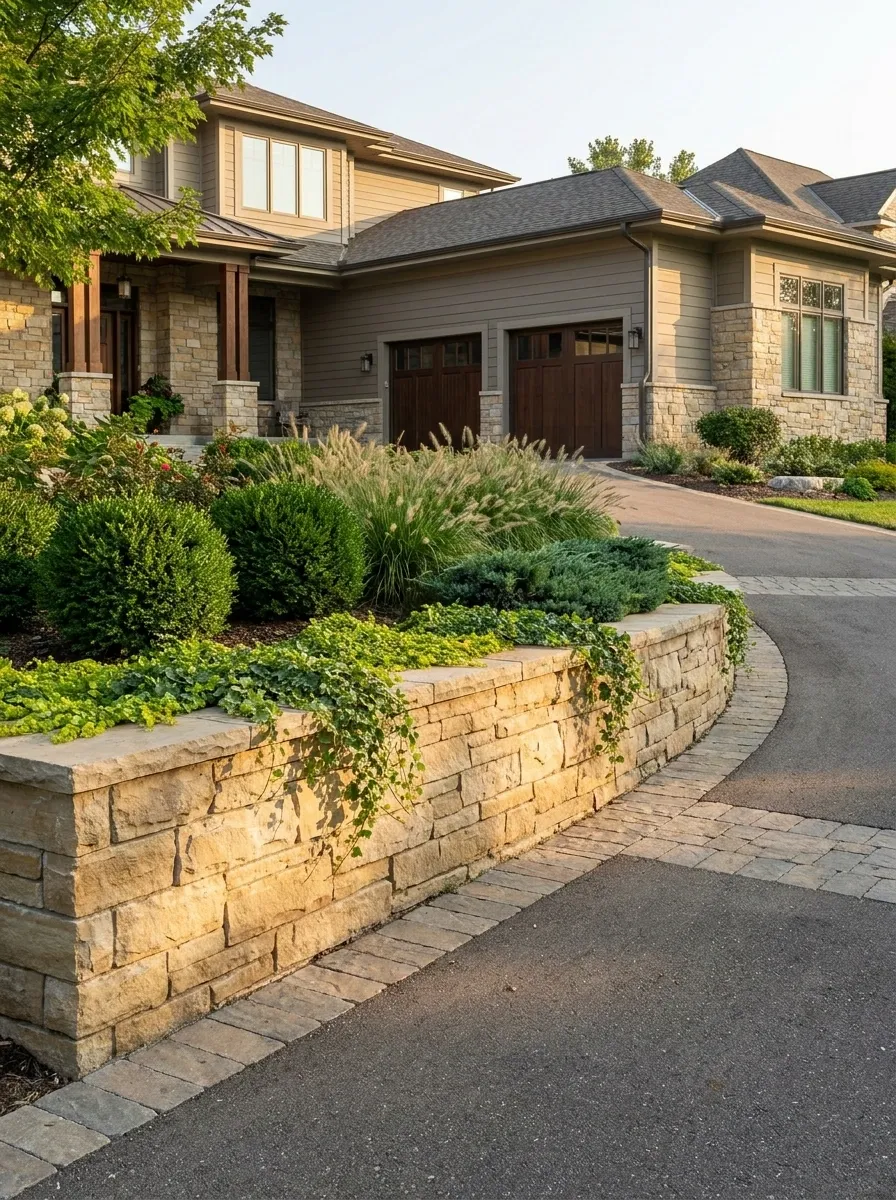
A sloped driveway can easily make the front of a house feel disconnected, especially when the lawn, pavement, and entrance sit at different heights. This design turns that awkward change in level into part of the architecture with a raised masonry planter running beside the drive.
The planter wall uses natural or warm-toned stone that echoes the house, while layered shrubs, ornamental grasses, and a few trailing plants soften its edges. The driveway remains clean and readable, and the planting creates a gradual visual transition toward the front door.
Nothing feels bolted on as an afterthought.
The elevation is doing half the decorating here. The plants just need to have enough self-control to let it.
Compact Corner Planter for a Small Front Drive
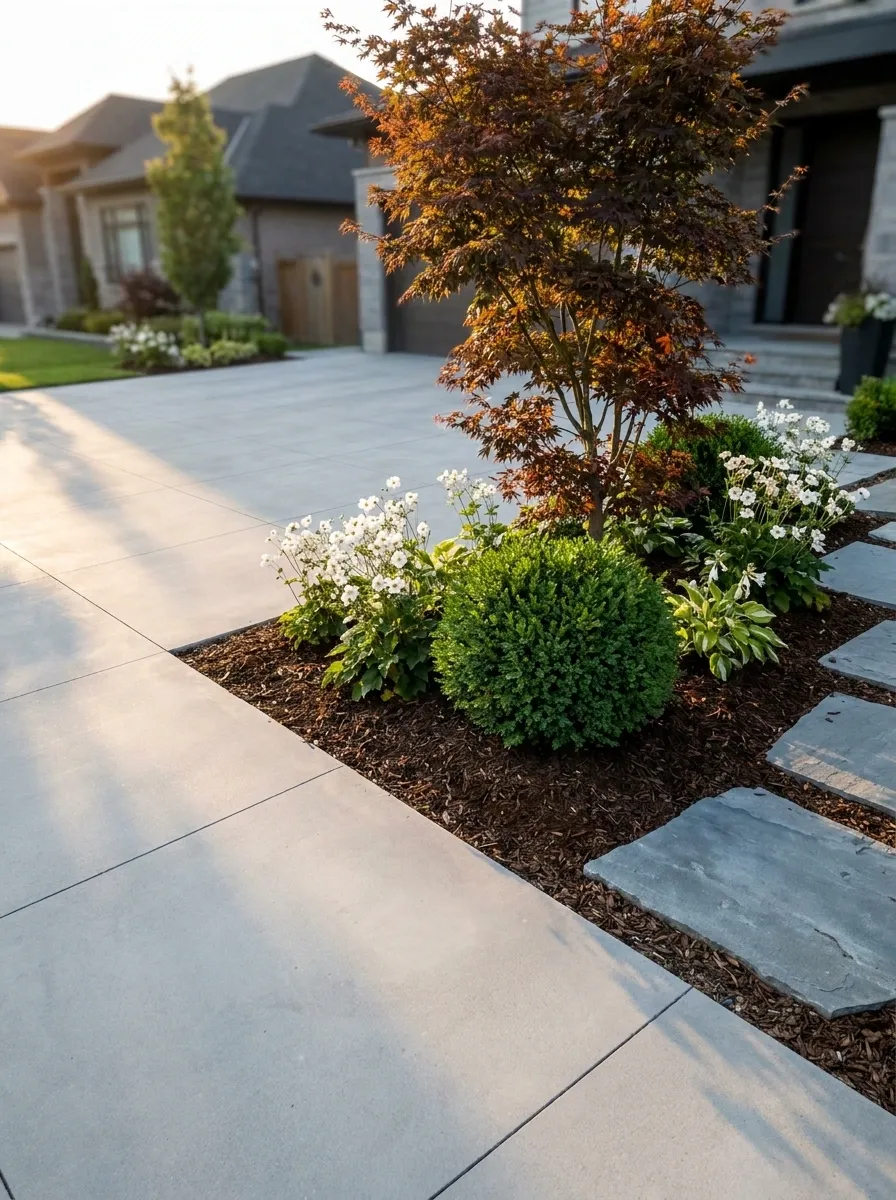
There is no need to stretch planting along every inch of a small driveway. This compact entrance concentrates everything into one strong corner bed, with a small ornamental tree, rounded shrub, seasonal flowers, and a clean layer of dark mulch.
The rest of the drive stays open, which makes the small property feel more spacious than it would with scattered containers and narrow planting strips everywhere. A simple path leads from the driveway toward the door, while the planting bed gives the arrival point a clear focal area.
The composition is small, but it does not look apologetic.
That is the secret with tiny front entrances. One confident move beats six nervous little ones.
Palm-Lined Driveway With Tropical Layering
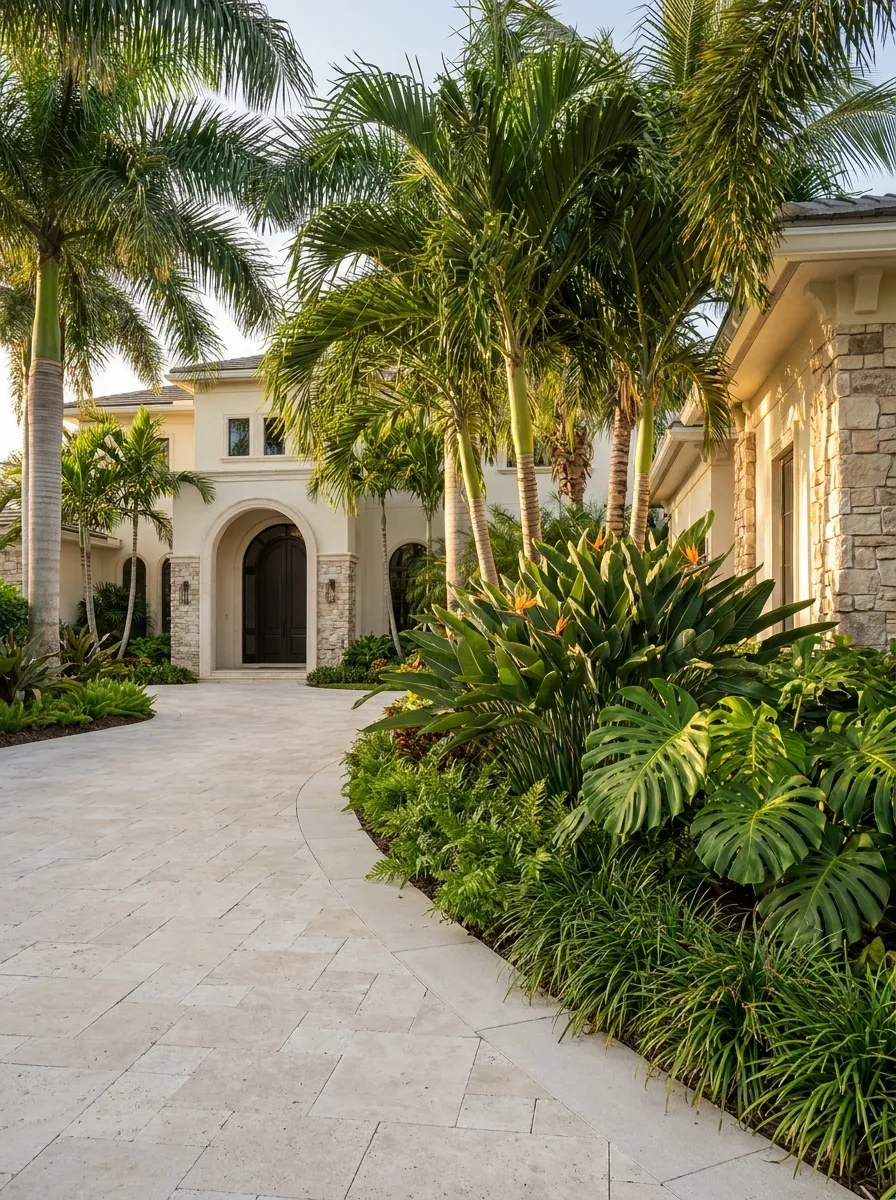
A warm-climate driveway can handle a much fuller planting composition, and this one embraces it. Palms create the upper silhouette while broad-leaf plants and lower tropical greenery fill the layers underneath. The driveway itself stays relatively clean, allowing the planting to feel lush without becoming a wall of foliage.
A light stucco facade and warm stone details keep the setting relaxed, while subtle low edging prevents the tropical planting from visually spilling into the driving zone.
This works because the greenery has hierarchy. The palms rise above everything else, the middle layer provides volume, and the ground layer ties the whole thing together.
Otherwise, it is just a pile of plants standing outside a house asking for attention.
Prairie-Style Driveway With Grasses and Perennials
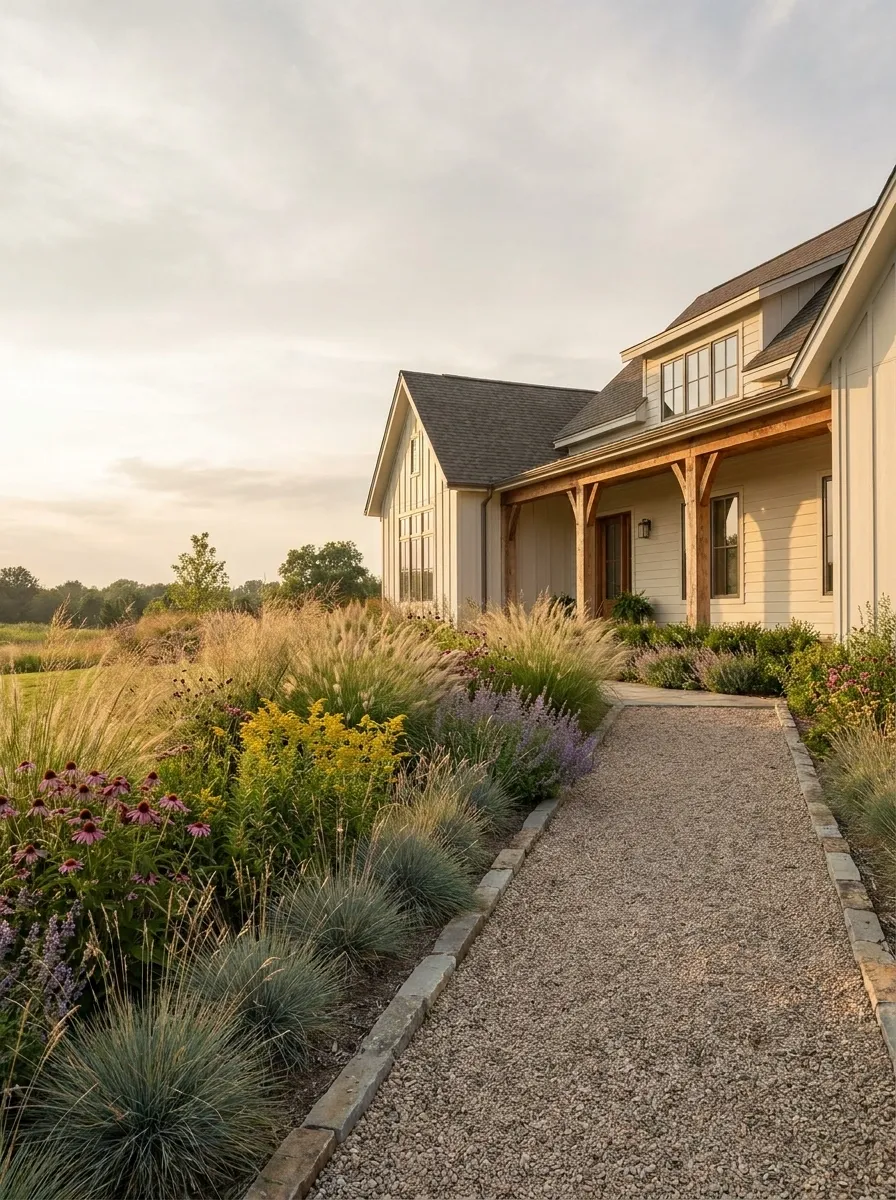
This farmhouse entrance skips the clipped hedge look entirely. A broad planting bed runs beside the driveway with ornamental grasses, flowering perennials, seedheads, and a few shrubs arranged in large, natural-looking drifts.
The architecture stays simple, using pale siding, timber details, and a gravel or muted stone driveway. The planting is allowed to move in the wind, but the bed still has a clear outer edge so the driveway does not disappear into it.
The contrast between the straight drive and loose planting gives the whole frontage personality.
It is tidy enough to look intentional, wild enough to avoid looking like the plants have been attending military school.
Formal Hedge and Stone Entrance Composition
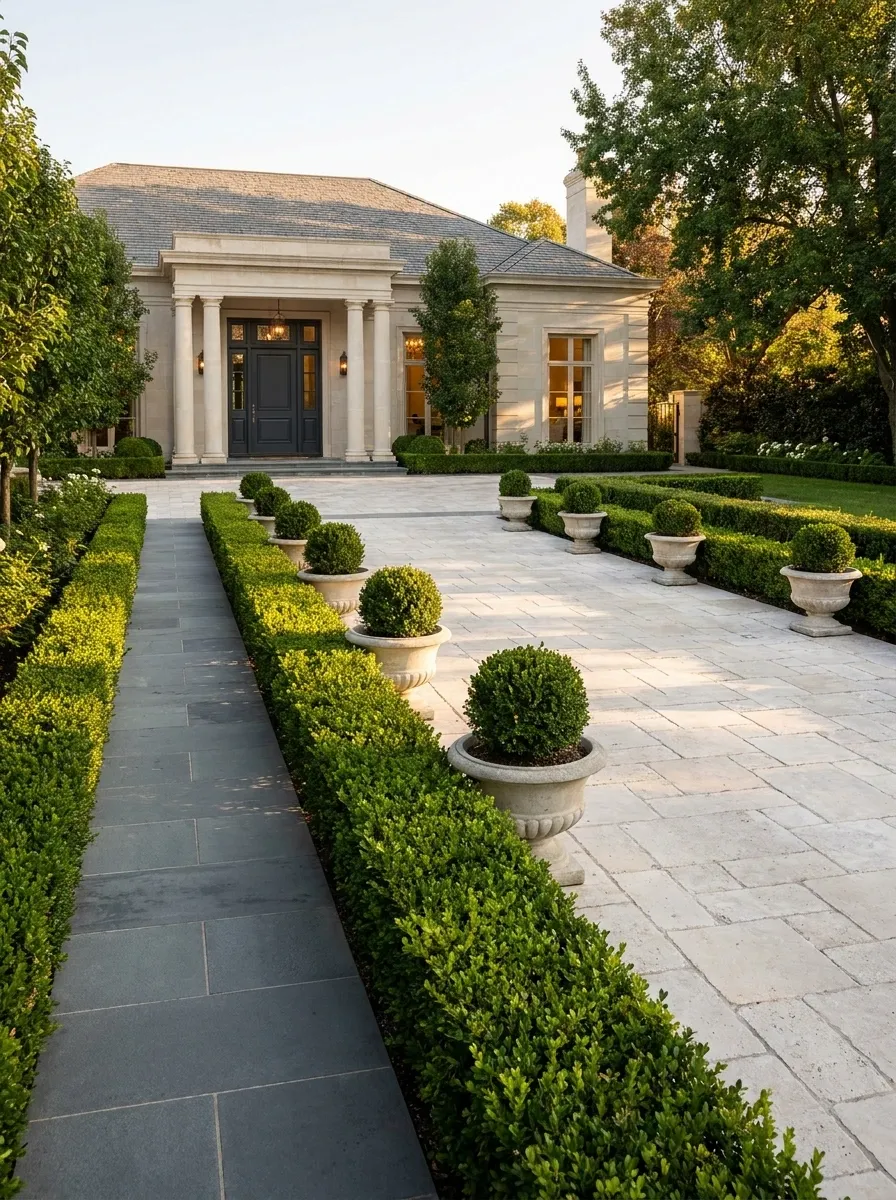
For a more traditional property, a formal entrance creates a strong sense of arrival before anyone even reaches the front door. This design uses a pale stone driveway, low clipped hedges, repeated evergreen forms, and a clearly defined pedestrian path leading directly toward the house.
The planting is symmetrical enough to feel architectural, but not so overloaded that the entrance starts resembling a wedding venue. Pale stone keeps the composition bright, while the greenery provides the contrast and repetition.
The magic is in the sequence. The eye catches the driveway, follows the hedge, picks up the repeated greenery, and naturally lands on the entrance.
That is a lot of work for some shrubs. Give them a raise.
Rustic Timber Planters Beside a Gravel Drive
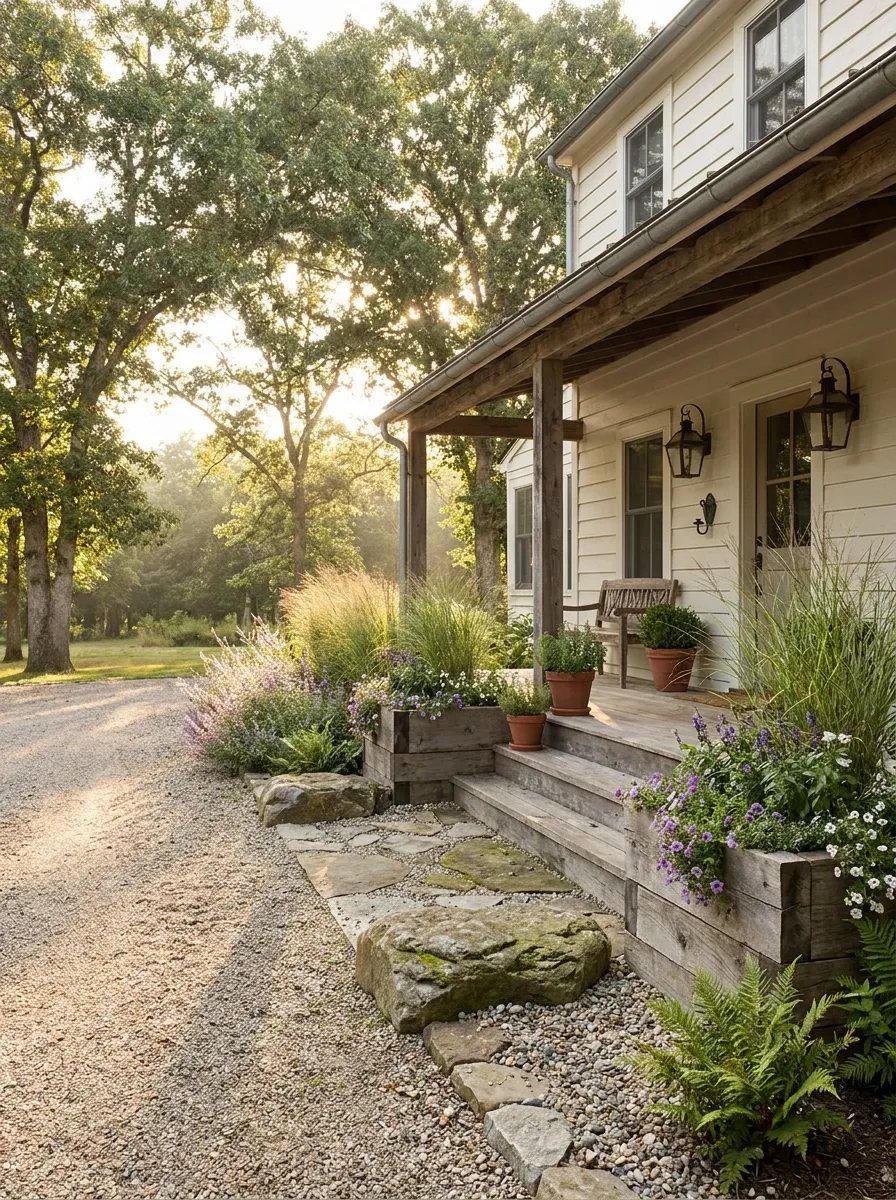
A gravel driveway beside a country home already has plenty of texture, so the planting should feel like it belongs there rather than arrive from a completely different design universe. This composition uses chunky timber planters filled with grasses, loose flowering plants, and soft green foliage, with weathered wood repeated around the porch and front entry.
The gravel remains visible between the planting and the driving surface, creating a natural transition instead of a hard line. A few larger stones help anchor the scene and keep the planters from feeling like portable decorations dropped onto the driveway edge.
The whole entrance feels relaxed, warm, and slightly imperfect.
Basically, everything is rustic except the part where someone clearly spent five hours deciding where the plants should go.
Minimal Concrete Drive With One Sculptural Tree
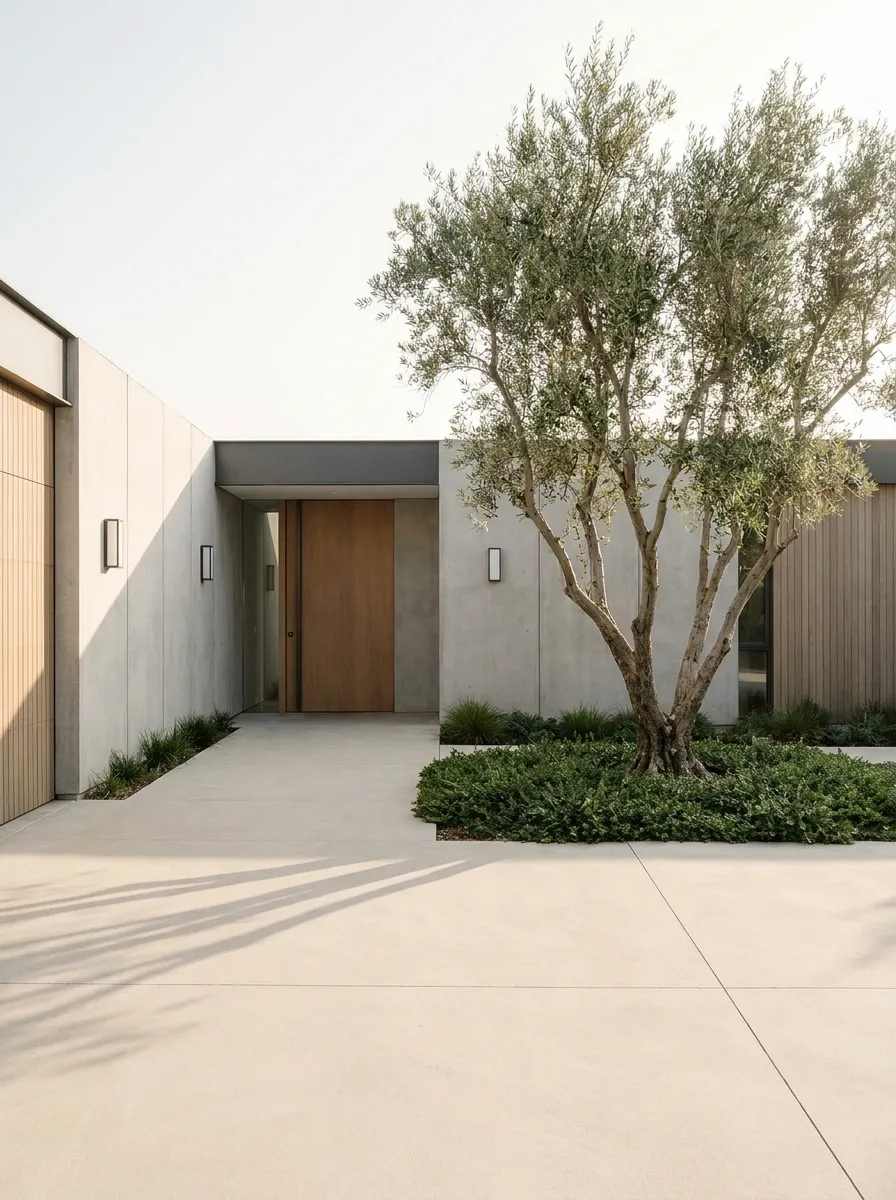
Some driveways look better when almost nothing is happening. This minimalist composition uses a smooth pale concrete drive, a simple facade, and one carefully positioned multi-stem tree as the main landscape feature. Low groundcover surrounds the tree, but most of the entrance remains deliberately open.
The empty paving is not unfinished. It gives the tree enough visual space to become the focal point and lets the architecture keep its clean silhouette. Simple wall lighting and one restrained front path complete the scene.
This is the driveway equivalent of knowing when to stop talking.
One strong tree can say more than twelve planters fighting for a speaking role.
Rose-Lined Driveway With Traditional Cottage Planting
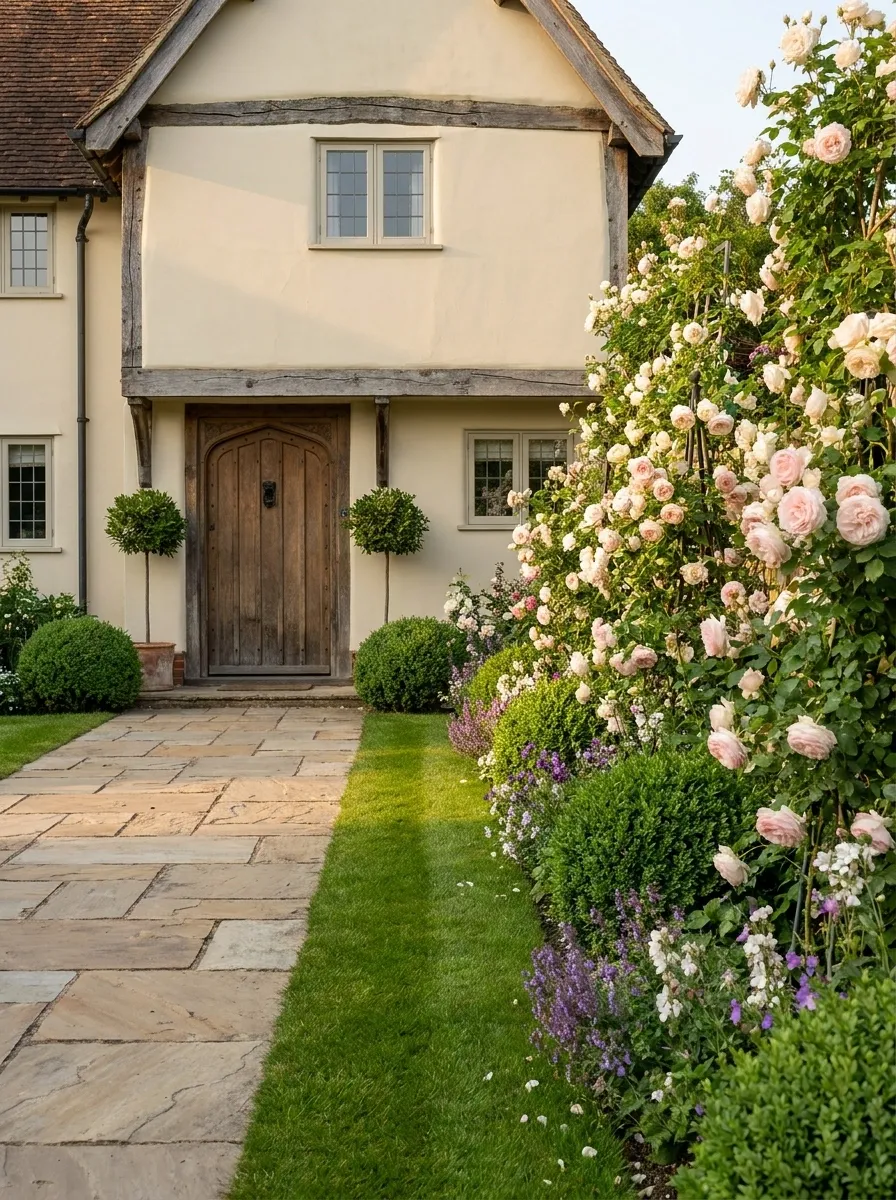
This entrance leans into the romance of an older garden without turning the driveway into a wall of flowers. A narrow lawn strip separates the paving from a mixed border of roses, rounded shrubs, flowering perennials, and climbing greenery trained close to the house.
The driveway remains clearly defined, while the planting gradually becomes fuller as it approaches the front entrance. Pale walls, natural stone, and muted timber details keep the colors from becoming too sweet.
The roses provide the memorable moment, but the evergreen structure is what keeps the composition working outside peak bloom.
Because apparently the roses have not been informed that they are not allowed to be dramatic.
Desert Driveway With Gravel, Agaves, and Stone
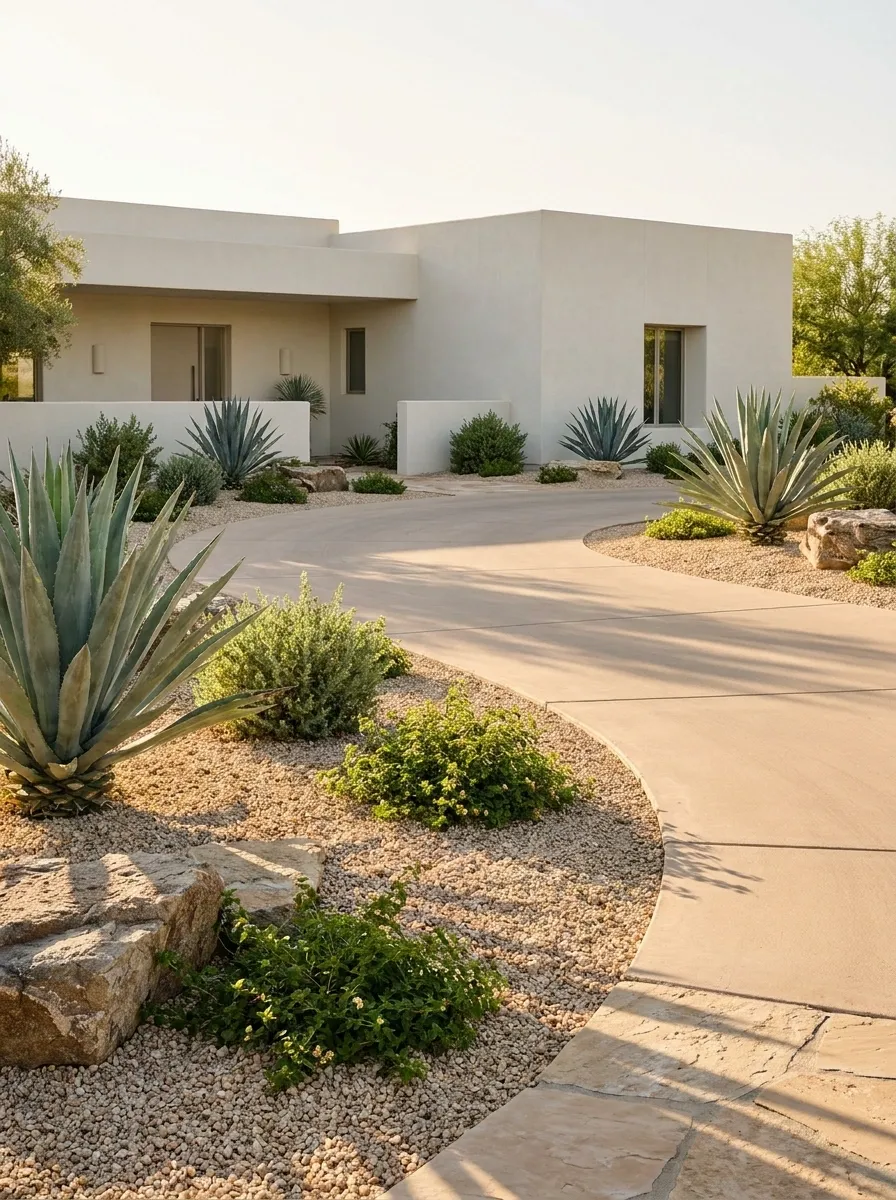
A desert-style driveway works best when the planting embraces openness rather than trying to fake a lush garden. This composition combines warm stone, pale gravel, sculptural agaves, low drought-friendly greenery, and carefully spaced shrubs around a simple stucco home.
The spaces between plants are important. They let every sculptural form stand out and prevent the entrance from becoming one giant mound of vegetation. The driveway uses a muted surface that blends into the surrounding landscape, while larger stones give the planting bed a grounded, architectural quality.
There is something wonderfully confident about a design that is not afraid of empty space.
Every square inch does not need a plant audition.
Curved Driveway With a Central Planting Island
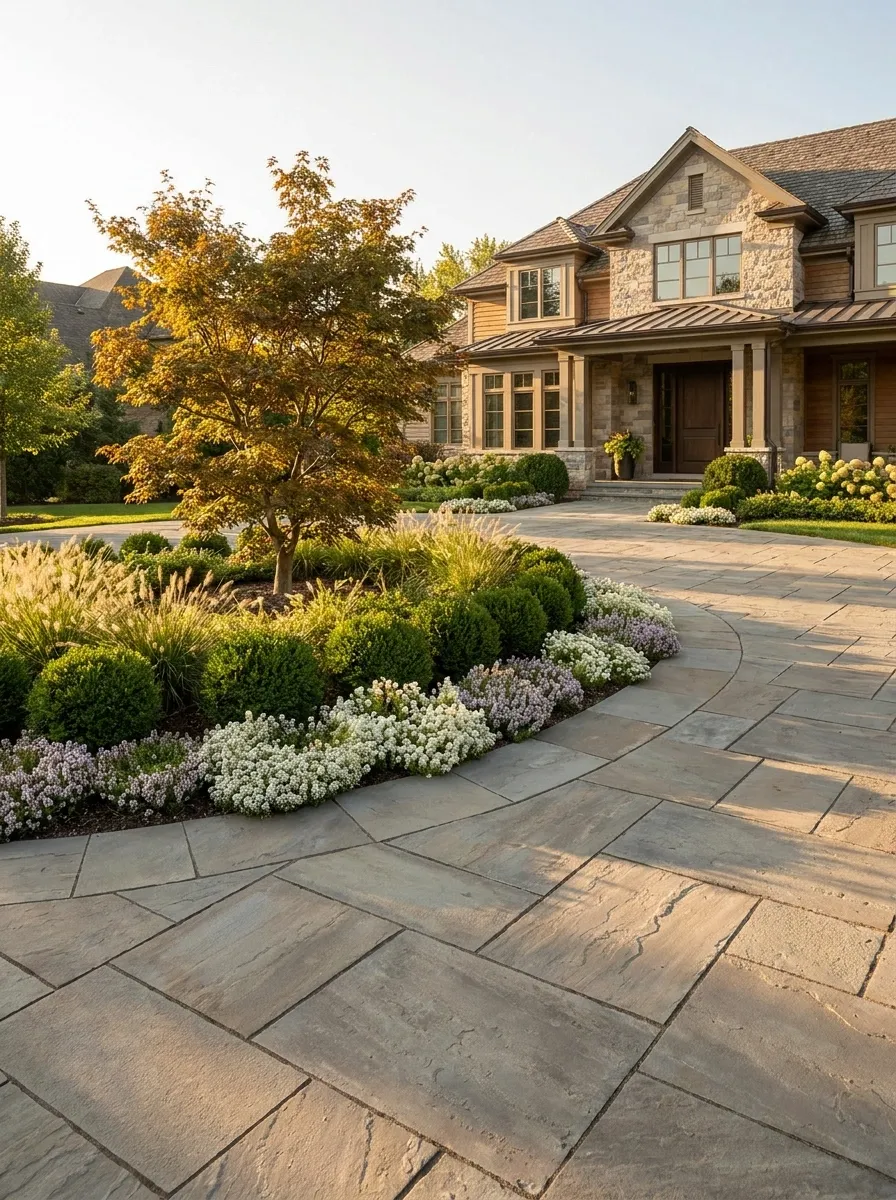
A circular or curved driveway creates a completely different opportunity because the planting can become the center of the arrival experience. This composition uses a generous paved loop around a central island planted with a small ornamental tree, clipped shrubs, low flowering groundcover, and a simple stone edge.
The island is broad enough to feel intentional rather than like a traffic obstacle, while the planting stays low enough around the perimeter to preserve an open view of the house.
The front entrance sits beyond the island, so the eye naturally moves from street to planting, then toward the door.
Finally, a driveway with a plotline.
The car gets around. The tree gets attention. Everybody wins.
Soft White Flower Border Against Dark Paving
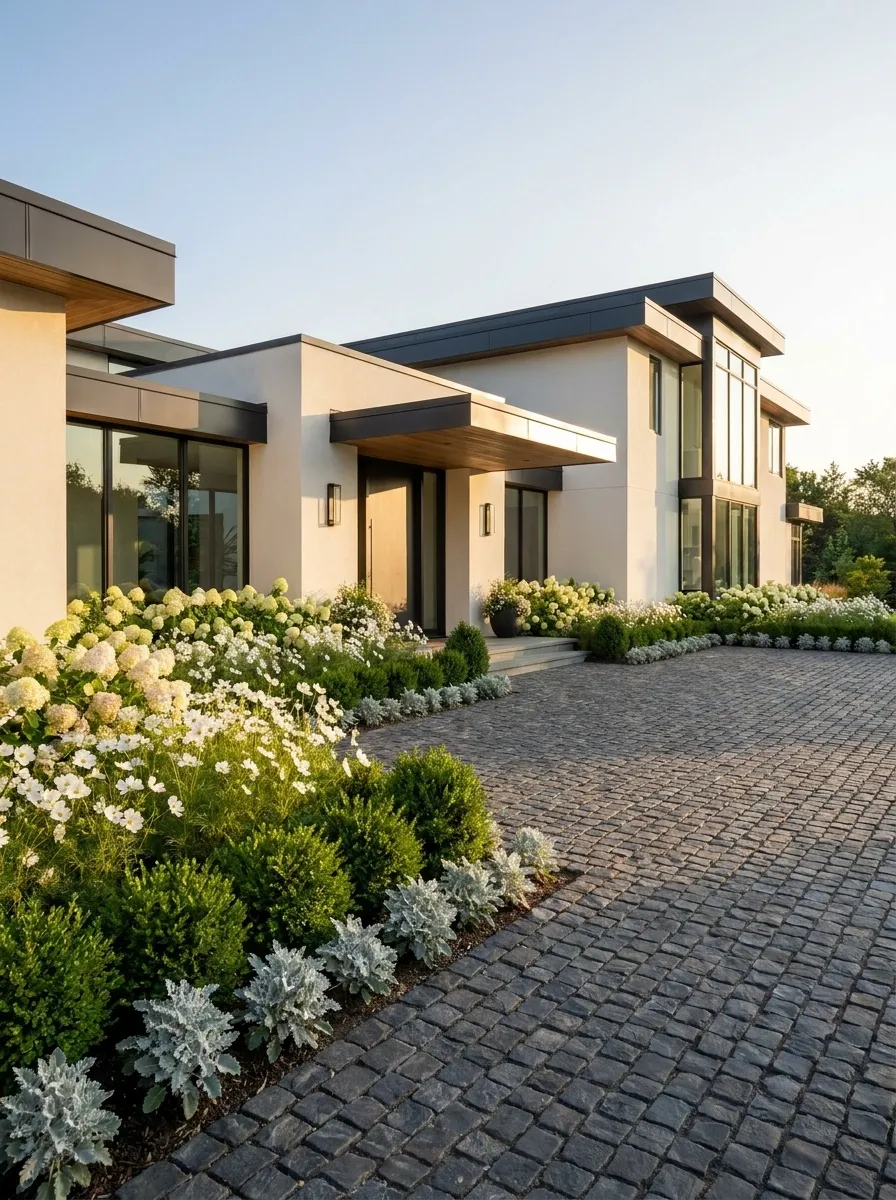
Dark paving gives this front entrance a naturally dramatic backdrop, so the planting takes the opposite approach with pale flowers, silver foliage, and medium green shrubs. The house stays simple with light walls and dark trim, creating a clean connection between architecture and driveway.
Instead of filling the whole border with flowers, the planting is arranged in soft drifts. A few evergreen shapes keep the composition grounded while the pale blooms catch the light along the edge of the drive.
The contrast does most of the work. Dark pavement makes the lighter planting pop without needing a dozen decorative extras.
The driveway basically said, “Wear something brighter,” and the garden understood the assignment.
Japanese-Inspired Driveway With Stone and Maple
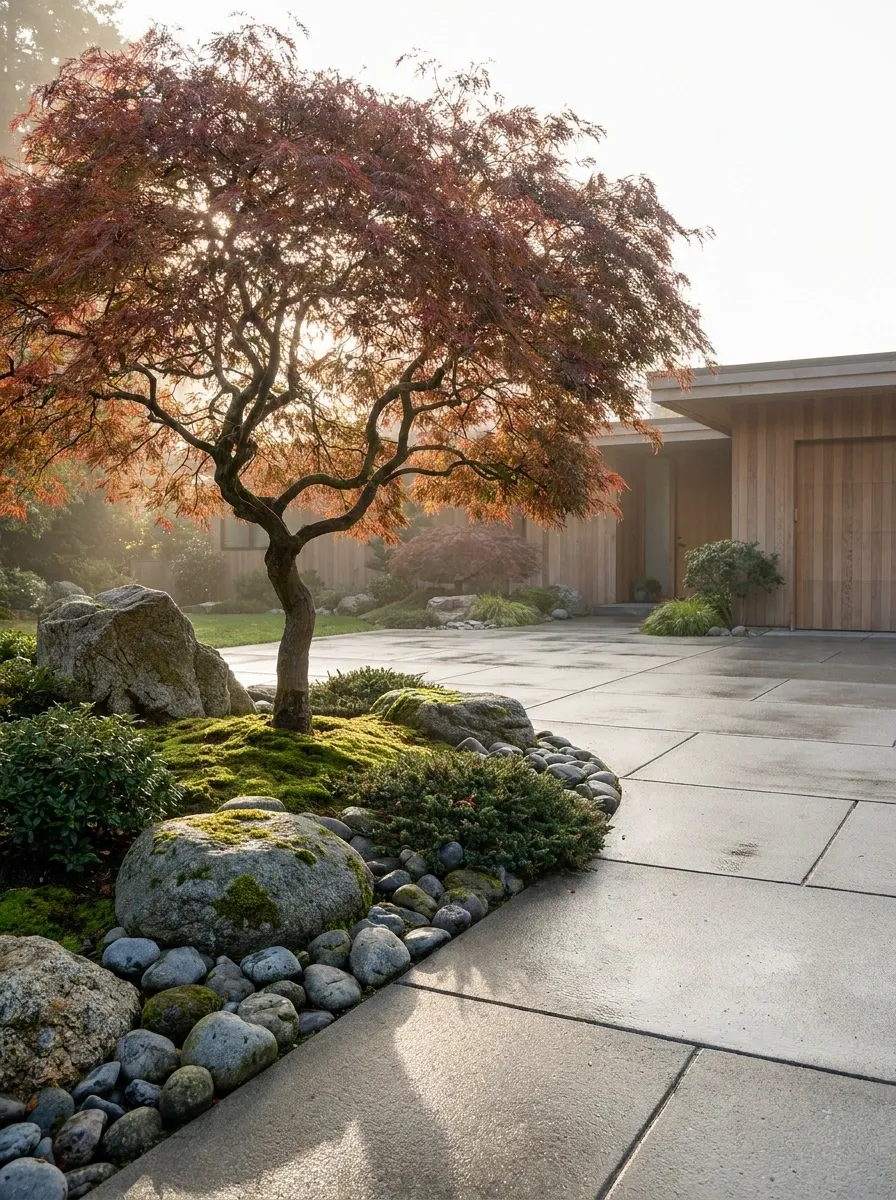
This entrance keeps everything restrained and deliberate. A clean modern driveway meets a sparse planting composition built around one sculptural maple, carefully placed stones, low greenery, and small areas of moss-like groundcover. The architecture stays quiet so the landscape can create the focal point.
There is no need for rows of identical shrubs here. The beauty comes from asymmetry, open space, and a few strong forms positioned with intention.
The tree sits slightly off center rather than directly in front of the house, giving the entrance a calmer, less predictable composition. The stones echo the natural quality of the planting while the driveway provides the hard geometric counterpoint.
Minimalism, but with significantly more personality than an empty flower bed.
Built-In Planter Wall Along a Contemporary Drive
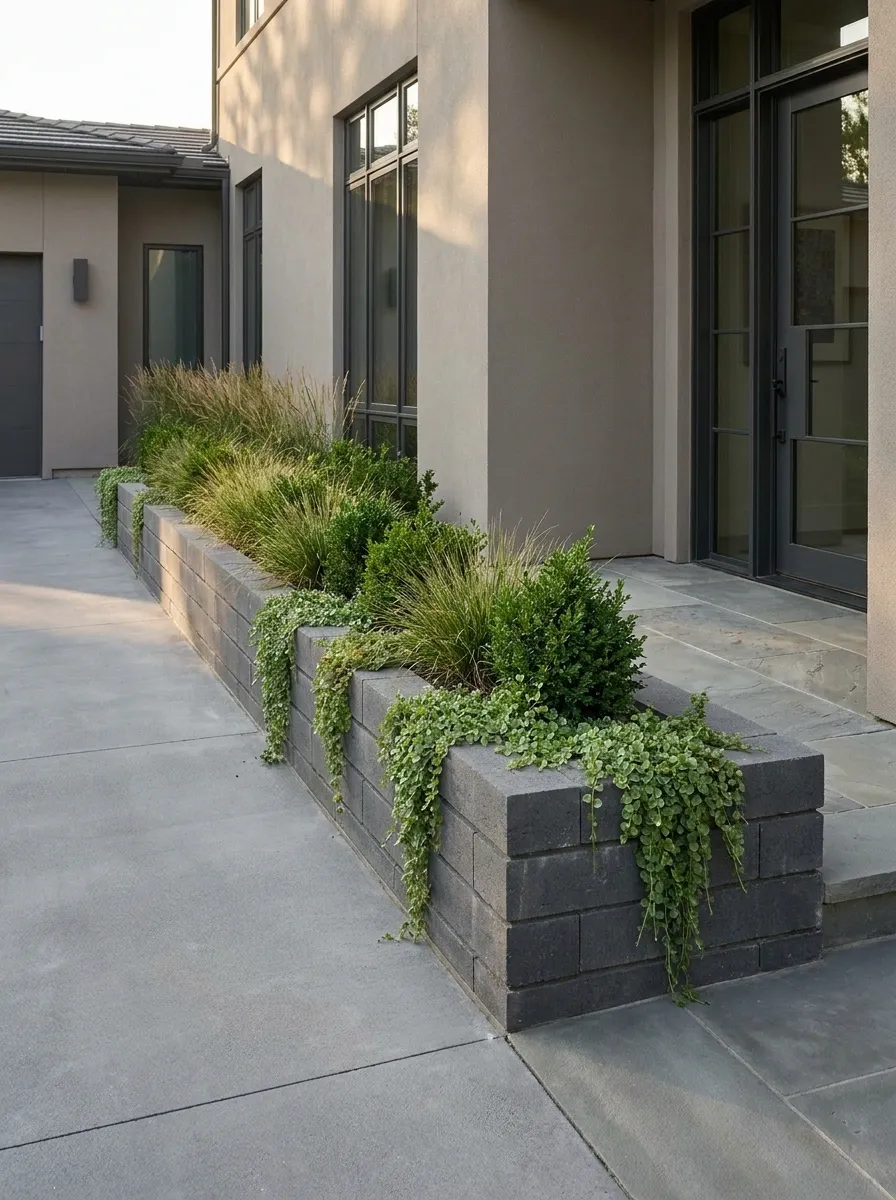
This contemporary entrance uses the planter wall itself as part of the architecture. A low masonry wall runs beside the driveway, creating a crisp boundary while holding layered grasses, compact shrubs, and trailing greenery above it.
The house uses the same family of materials, with smooth walls, dark frames, and understated paving. Because the planter is built into the edge, the landscape feels permanent rather than decorated with containers that could be moved around whenever someone’s mood changes.
The wall also creates a useful transition between the driveway and the rest of the front yard. The planting softens the masonry without hiding its clean line.
A planter that actually knows where it belongs. Character development.
Cottage Drive With a Small Ornamental Tree
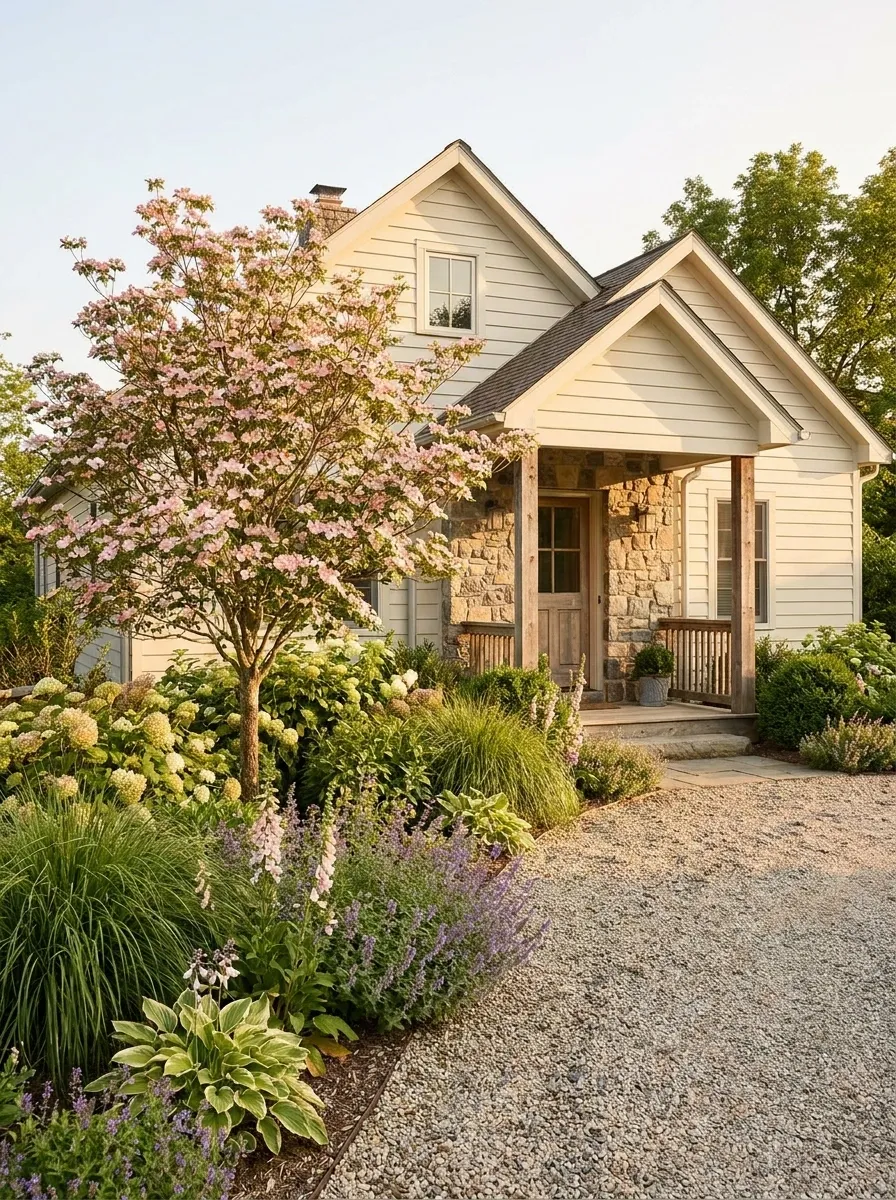
A small ornamental tree becomes the visual anchor in this compact cottage entrance. Rather than placing it directly in the middle of the driveway frontage, the tree sits slightly to one side within a layered bed of shrubs, grasses, and flowering plants.
That placement keeps the drive open while still giving the entrance a recognizable focal point from the street. The surrounding planting stays informal, with a few repeated flower colors and soft foliage connecting the tree to the rest of the garden.
The house itself provides the traditional backdrop, with painted siding, a simple porch, and natural details around the entry.
One little tree doing all that visual heavy lifting. Honestly, overachiever behavior.
Vehicle movement stays clear.
Creates a focal point without blocking the approach.
Country Farmhouse Drive With Layered Shrubs
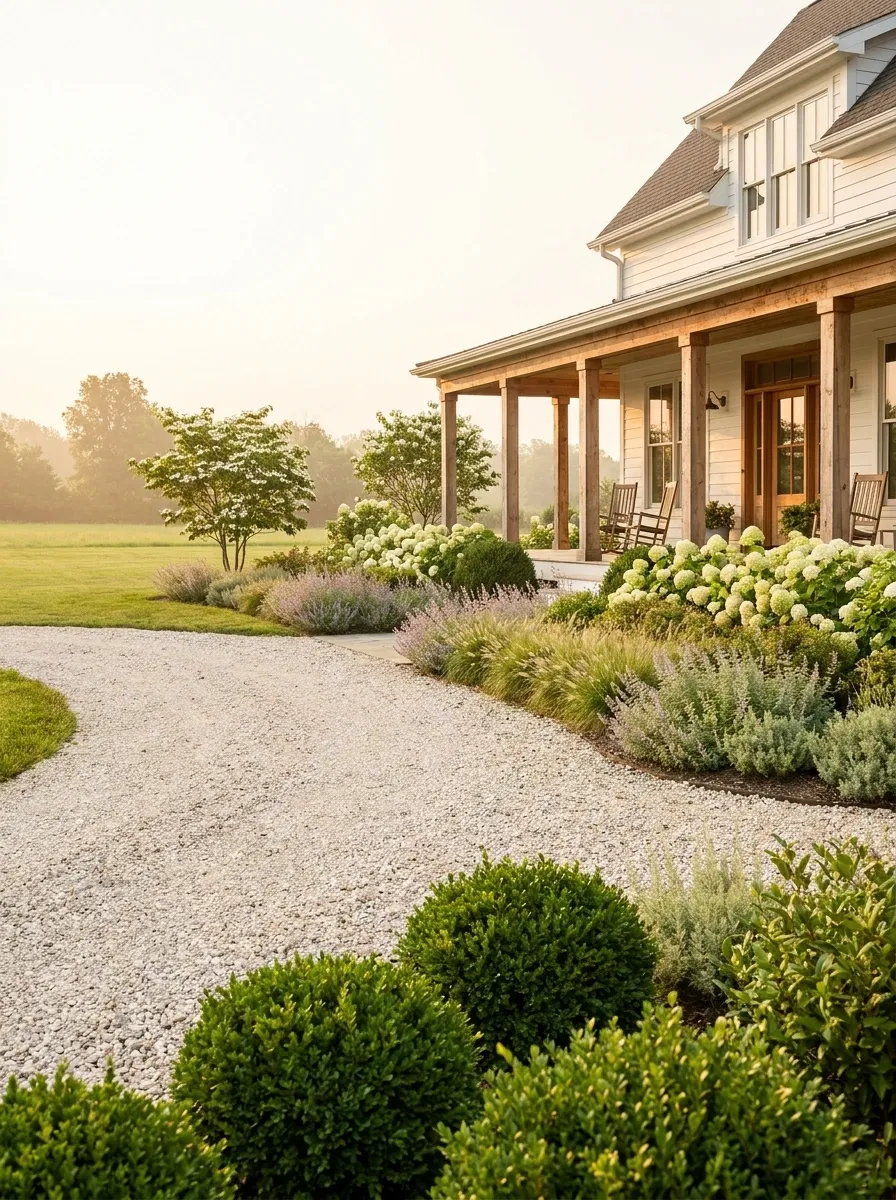
A farmhouse driveway looks especially natural when the planting feels like it grew out of the property rather than being installed as a decorative border. This composition uses a pale gravel drive with generous planting beds containing rounded shrubs, flowering perennials, grasses, and a few small trees farther back.
The layers become gradually taller toward the lawn and house, giving the frontage depth without closing in the driveway. Warm timber details, a simple porch, and a muted exterior reinforce the relaxed country character.
There is enough repetition to keep the garden looking intentional, but plenty of looseness to stop it from feeling clipped within an inch of its life.
It says farmhouse, not “corporate headquarters with three geraniums.”
Reclaimed Brick Planter With Soft Evergreen Planting
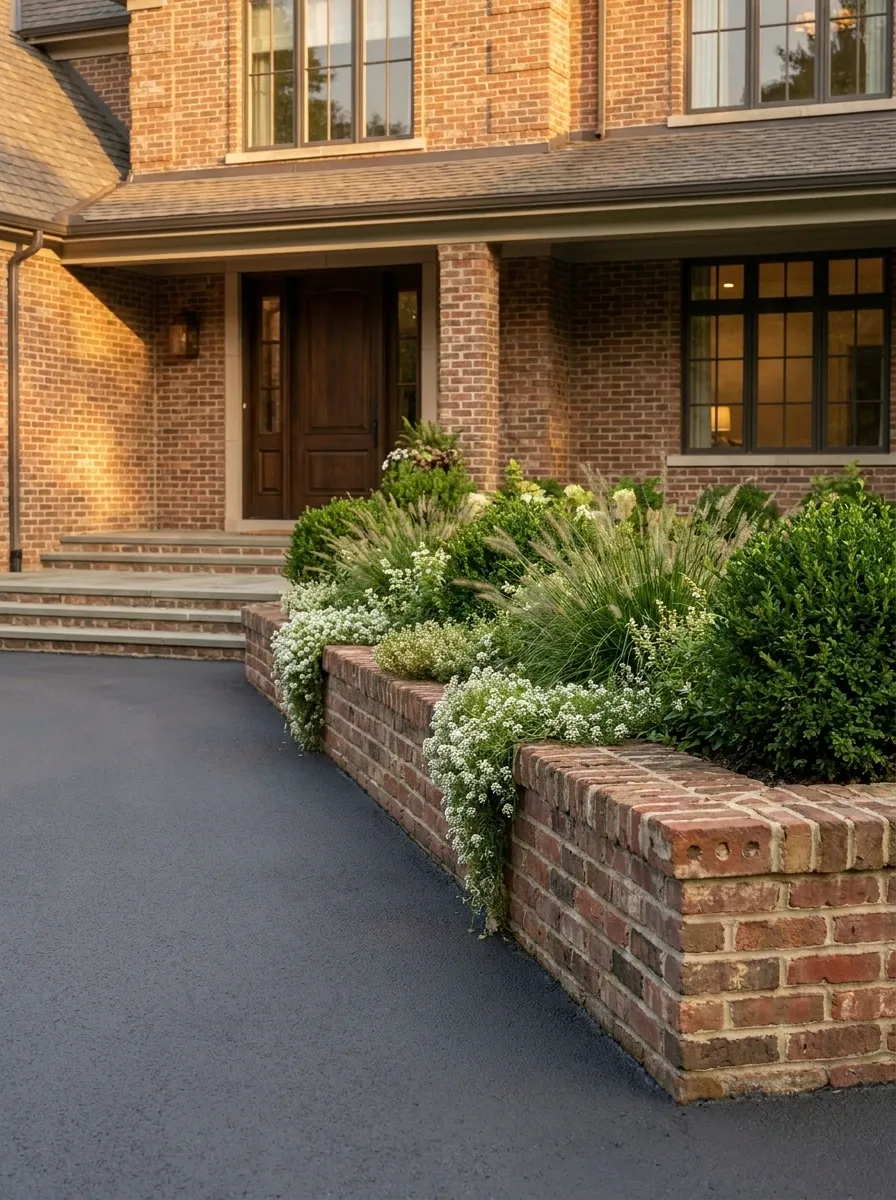
A reclaimed brick planter gives an older brick or stone home a natural connection to the driveway. The raised bed follows one side of the entrance, using the same weathered brick tones as the facade while soft evergreen shrubs and grasses spill gently over the top.
The driveway stays relatively smooth and quiet, creating a useful textural contrast against the rough masonry and layered foliage. A few subtle flowering accents add interest without competing with the brick.
This composition is especially convincing on homes with existing character because the new planting feels like an extension of the house rather than a modern insert.
Old brick has already survived several decades. It does not need to be outperformed by a flashy planter.
Slim Driveway With Repeated Tall Planters
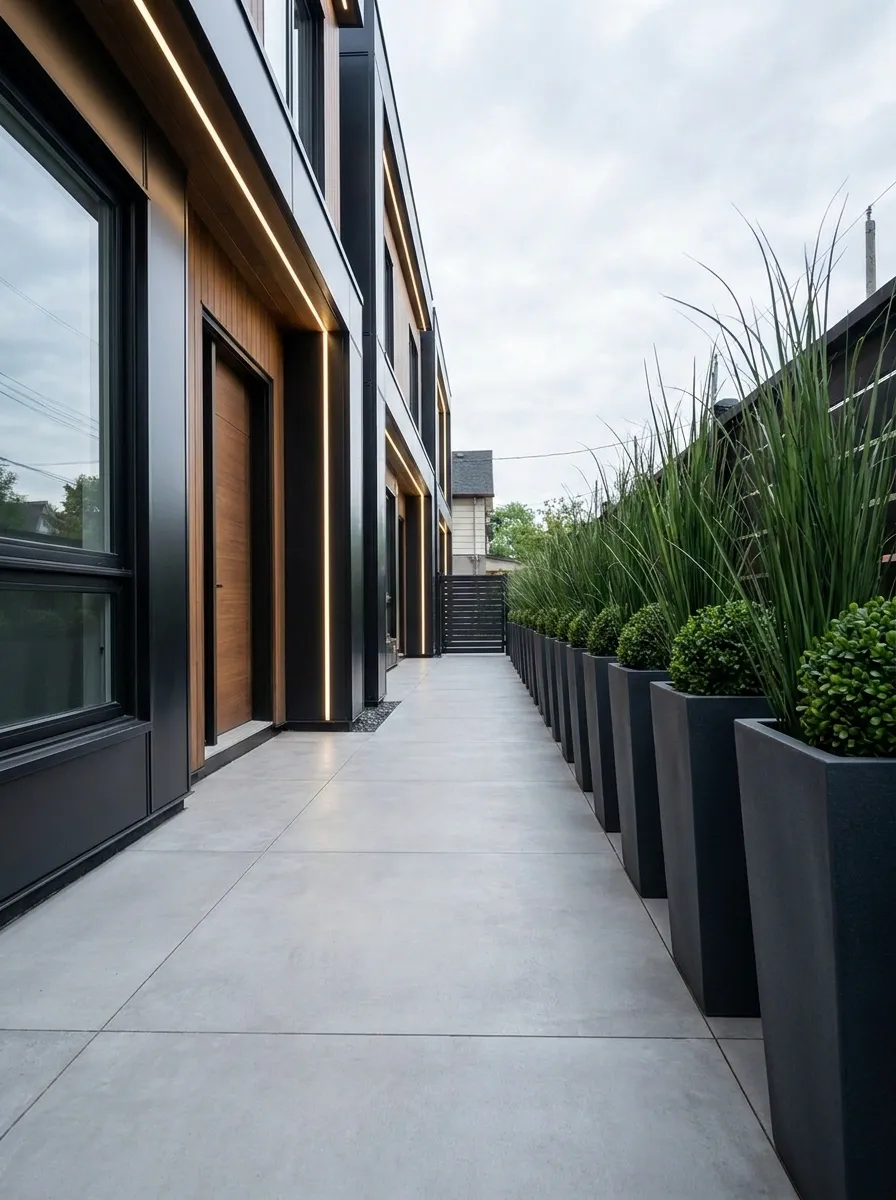
This narrow townhouse entrance uses repetition instead of a large planting bed. A line of tall, slender planters follows one side of the driveway, with restrained evergreen or architectural plants rising from each container.
The containers are spaced with enough room between them to keep the composition light. Their consistent shape creates a visual line toward the front entrance, while the rest of the driveway remains open for vehicles.
The house itself uses simple contemporary materials, so the repeated planters reinforce the clean architectural rhythm rather than introducing a competing style.
This is proof that repetition can do serious design work.
One planter looks decorative. Six properly placed ones start acting like a plan.
Mixed Stone and Greenery for an Older Home
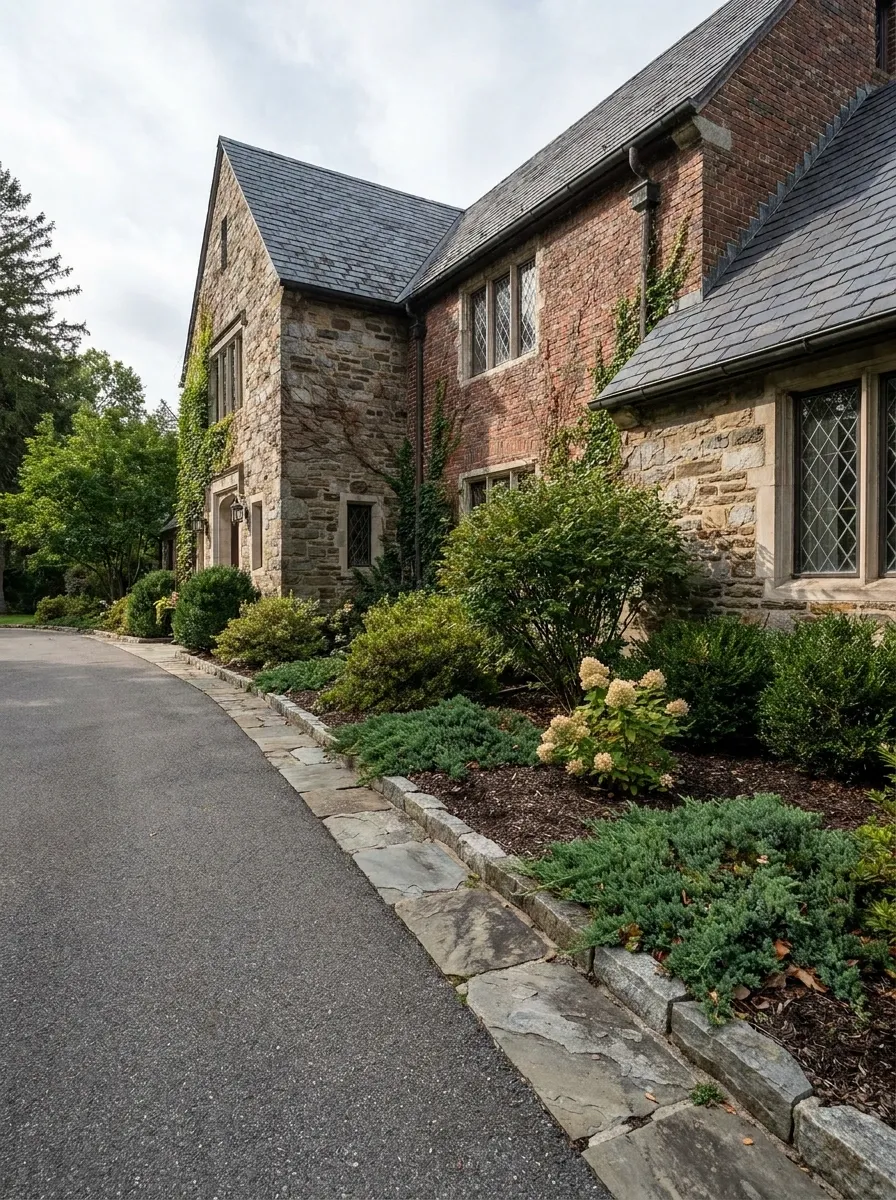
An older home does not always need a complete landscaping overhaul. Sometimes the existing architecture already has enough character, and the better move is to make the driveway feel more connected to it.
This composition uses irregular stone edging, mature-looking shrubs, low evergreen groundcover, and one restrained flowering accent along an otherwise ordinary driveway. The planting is intentionally relaxed so it does not clash with an older brick or stone facade.
The colors stay muted, with natural stone, green foliage, and small amounts of seasonal color doing most of the visual work. The result feels established rather than newly manufactured.
Basically, the house gets to keep its history. The landscaping just stops making it look like someone forgot about the front yard.
Long Estate Drive With Layered Entrance Planting
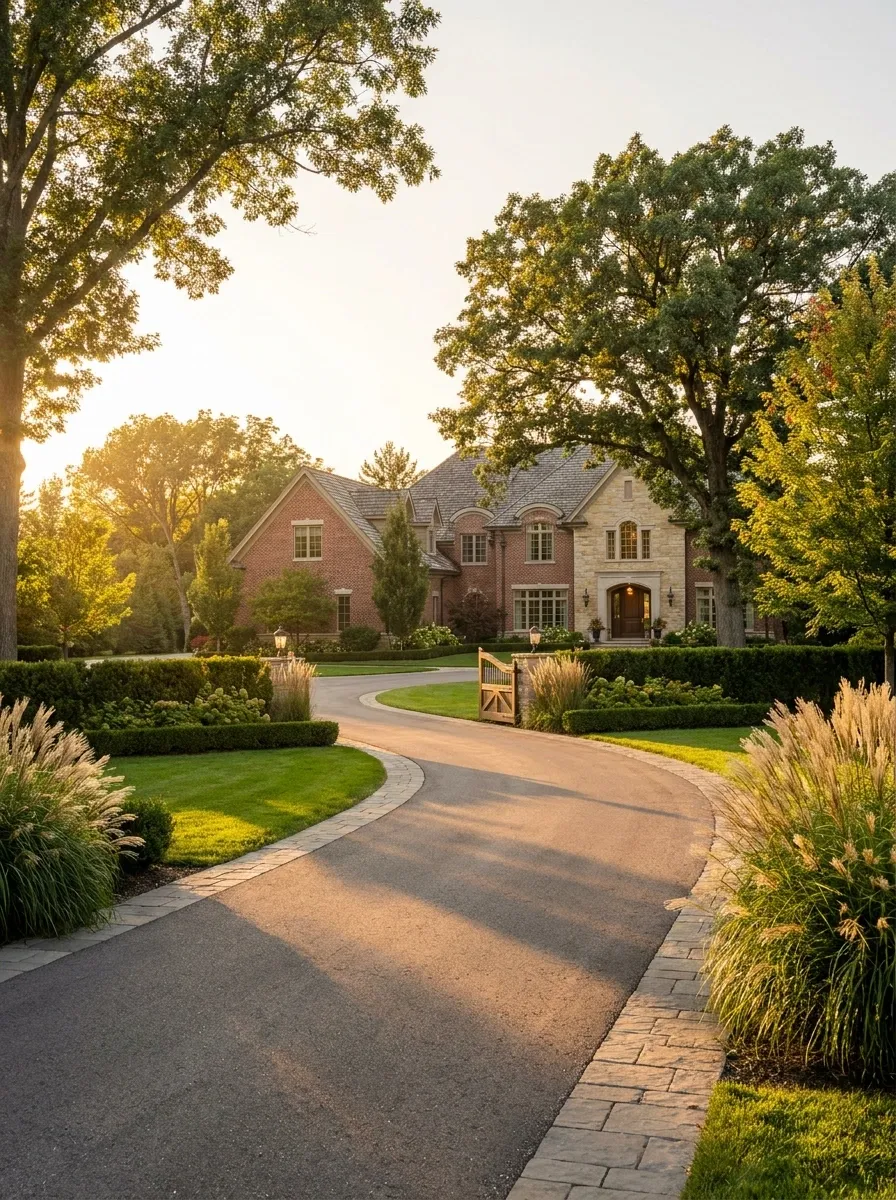
A long driveway gives the landscape more room to build a sense of arrival, and this final composition uses that length deliberately. Larger trees appear farther from the house, creating a broad backdrop, while layered shrubs and grasses become denser closer to the final approach.
Near the entrance, the planting becomes more intentional and architectural, with a concentrated group around the walkway and front door. The driveway remains visually readable all the way from the street, but the planting gradually makes the approach feel more connected to the house.
It is less about one giant statement planter and more about controlling the entire journey.
The driveway has been promoted from “place where the car goes” to “actual opening scene.” Finally.
When the Planter Is Not the Point
The most interesting thing about a good driveway planting design is that the planter itself often stops being the main event.
A narrow townhouse entrance can look better with one strong repeated form than with a dozen different containers. A traditional brick house may need soft planting that connects to its existing architecture rather than something trendy that looks like it was delivered yesterday. A huge modern facade can swallow tiny pots whole, while a compact cottage can feel crowded by oversized containers.
The driveway has to function first. Cars need room to move, doors need to open, walkways need to stay readable, and the house should remain visible.
Then comes the fun part.
Pick a complete look, repeat the right materials, control the planting height, and let the whole entrance speak the same visual language.
A driveway that looks intentional does not need to scream for attention. It just needs to stop looking like the landscaping department clocked out halfway through the job.
Save the designs that fit your house, your driveway shape, and the kind of entrance you actually want to come home to.